Why Your Child's Teacher Should Keep a Class Journal (And How to Do It Collaboratively)
Within a fortnight it starts to blur. Within a year, most of it is gone. And what remains is a report card — a document that records what each child scored, and absolutely nothing about who they were together.
All of it happened. Almost none of it was kept.
Here is what left with them: the field trip where it rained so hard everyone had to eat lunch on the bus and it somehow became the best part of the day. The three weeks of arguing about the class pet's name. The morning someone finally understood long division and the whole room spontaneously applauded. The play, and the forgotten line, and the improvised recovery that got a bigger laugh than the actual joke. The quiet kid who read aloud for the first time in March.
Then the bell goes, and thirty children walk out of a room where they spent roughly a thousand hours of their lives, and the room becomes empty and anonymous and ready for the next lot.
The walls come down first. The laminated word charts, the sunflower growth diagrams, the birthday calendar with everybody's name on it — all peeled off and stuffed into a recycling bin. Desks get emptied into backpacks. Textbooks are counted and stacked. Somebody finds a sock behind the reading corner and nobody claims it.
Picture the last week of the school year.
This is the quiet, unremarked loss that a class journal prevents. Not a gradebook. Not a portfolio. A living, collectively written record of what it was actually like to be in that room, that year, with those people.
We've been trained to think of journaling as a solitary act — a private notebook, a locked diary, a solo ritual before bed. That assumption is so deeply held that most teachers have never seriously considered the alternative. But collaborative journaling in a classroom isn't a novelty or a craft project. It's one of the most underused educational tools available, and the research behind it is stronger than most educators realise.
This piece is for three people. For the teacher wondering whether this is worth the effort and how on earth you'd manage thirty contributors. For the parent who wants their child's school year to leave behind something more than a grade. And for the student who suspects, correctly, that their year is worth remembering.
By the end you'll have the argument, the evidence, a six-step setup guide, fifteen ready-to-use journal prompts for students, and a clear picture of what the finished thing can become.
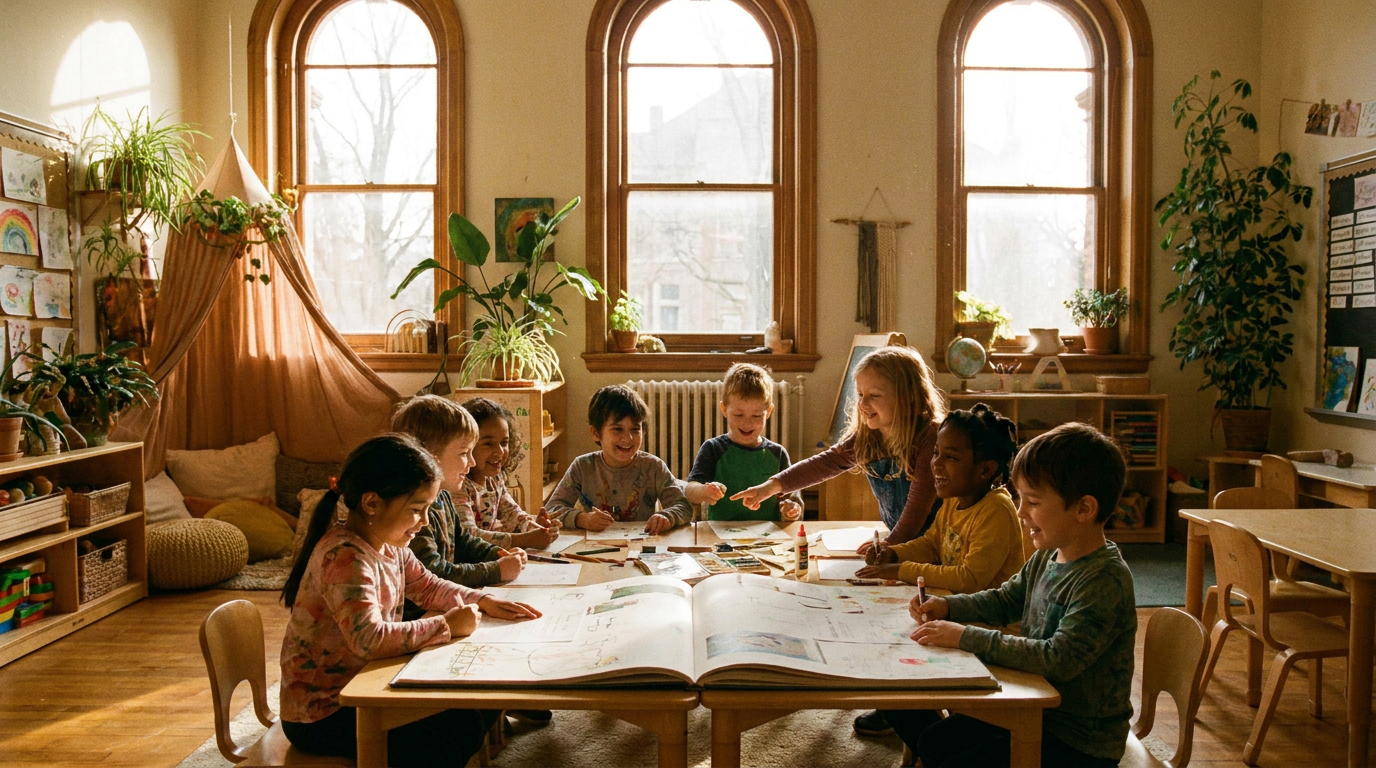
Journals Aren't Just for Personal Use: The Case for Class Journaling
Every one of those images is private. Singular. Interior. The journal as a sealed room with one occupant.
A teenager's diary with a small brass lock and a key hidden in a shoe. A leather Moleskine in a café, being filled by someone who wants you to notice they're filling it. A gratitude notebook on a bedside table, three bullet points a night. A therapist's homework assignment.
Ask someone to picture a journal and you'll get one of about four images.
That association is so automatic it functions as a rule, and the rule quietly forecloses an entire category of use. If journaling is by definitionExcept the rule is historically backwards.
personal, then a shared journal isn't just unusual — it's a category error, like a group diary or a committee-written love letter.
The Private Diary Is the Historical Anomaly
Strip journaling down to its functions and you get three: capture what happened, reflect on what it meant, and preserve it against forgettingAnd then there's the school yearbook, which is a collaborative memory document so normalised that we've stopped noticing what it is: a group of people, at the end of a shared period of their lives, deliberately building a record so the period doesn't vanish.
Commonplace books — those wonderful, chaotic personal anthologies of quotations and recipes and observations — were routinely passed between friends and family, each contributor adding to the accumulated whole.
A ship's log was a shared document, maintained across watches by rotating officers, recording weather and position and incident — the collective memory of a crew who could not afford to forget. Monastic chronicles were maintained across generations by successive hands, each scribe adding to a record none of them would live to finish. Parish registers logged the births, marriages and deaths of an entire community into a single volume. Regimental diaries in both world wars recorded the daily reality of units, written by whoever was assigned, read by anyone who needed to know what happened.
And for most of recorded history, humans did all three collectively.
. Nothing in that list requires solitude. Nothing in it even implies solitude.
Seen against that lineage, the locked diary is the outlier. It's a relatively recent, culturally specific idea — a product of rising literacy, cheap paper, private bedrooms and a particular modern interest in the interior self. It's a wonderful thing. But it is a variation on journaling, not the definition of it.
So the class journal isn't an experiment. It's a return to form.
Everyone has a story to tell — and in a classroom, that story belongs to everyone.
The Classroom Is Densely Packed With Shared Memory
A primary schooler spends something in the order of a thousand hours a year in one room with the same twenty-five to thirty people. They eat together, argue together, perform together, fail at things together, and are occasionally brilliant together. The density of shared incident is extraordinary — arguably higher than anywhere else in their life, including home, because home doesn't come with a fixed cast of thirty peers and a structured schedule of novel events.
Now consider where a child actually accumulates experience.
And crucially, most of what happens there is irreducibly collective. It doesn't belong to any one child.
The museum trip wasn't one child's memory — it was thirty simultaneous, overlapping, partially contradictory experiences of the same afternoon. The class play belongs to the lead, yes, but also to the kid who painted the backdrop, the one who ran the lights, and the three in the back row of the chorus who invented an entire subplot nobody on stage knew about. The long-division breakthrough belonged to the child who got it andA class journal is the only format that matches the shape of the thing being remembered.
Ask any one student to record that in a personal diary and you get a single-camera angle on a thirty-camera event. Something real is captured. Almost everything is lost.
to the room that cheered.
The Better Question
Which is why "should a teacher keep a class journal?" is the wrong question. It's phrased as though someone is proposing an unusual intervention that needs justifying.
The honest question is: given that classrooms are among the richest shared-experience environments in a child's life, and given that humans have kept collective records of shared experience for as long as we've been able to write, why did we stop doing it in schools?Teachers didn't abandon the class journal because it lacked value. They abandoned it because the admin ate them alive.
The answer is not pedagogical. Nobody decided this was a bad idea. It's logistical. Coordinating thirty contributors, chasing entries, storing photographs, keeping everything organised and private and legible, and then producing something at the end of it — with paper and a filing cabinet, that's a genuinely punishing amount of work for one already-overloaded adult.
That constraint is the one thing about this whole picture that has actually changed. Lugelo has written before about how
collaborative storytelling builds community
The case is intuitive. But intuition isn't evidence, and no teacher should have to defend a new practice to a sceptical head of department on vibes alone. So let's look at what the research actually shows.
, including classrooms where students co-author storybooks as part of curriculum projects — and the consistent finding is that when the coordination burden drops, the practice stops being aspirational and starts being routine.
What the Research Says About Journaling and Student Engagement
Let's go through the most useful ones — and, more importantly, translate them out of academic English into things you can actually picture happening in a classroom.
Here's the good news for any educator who needs to justify this upward: reflective journaling is not a fringe practice with a thin evidence base. It has been studied for decades across disciplines, age groups and countries, and the findings are consistent enough to build on.
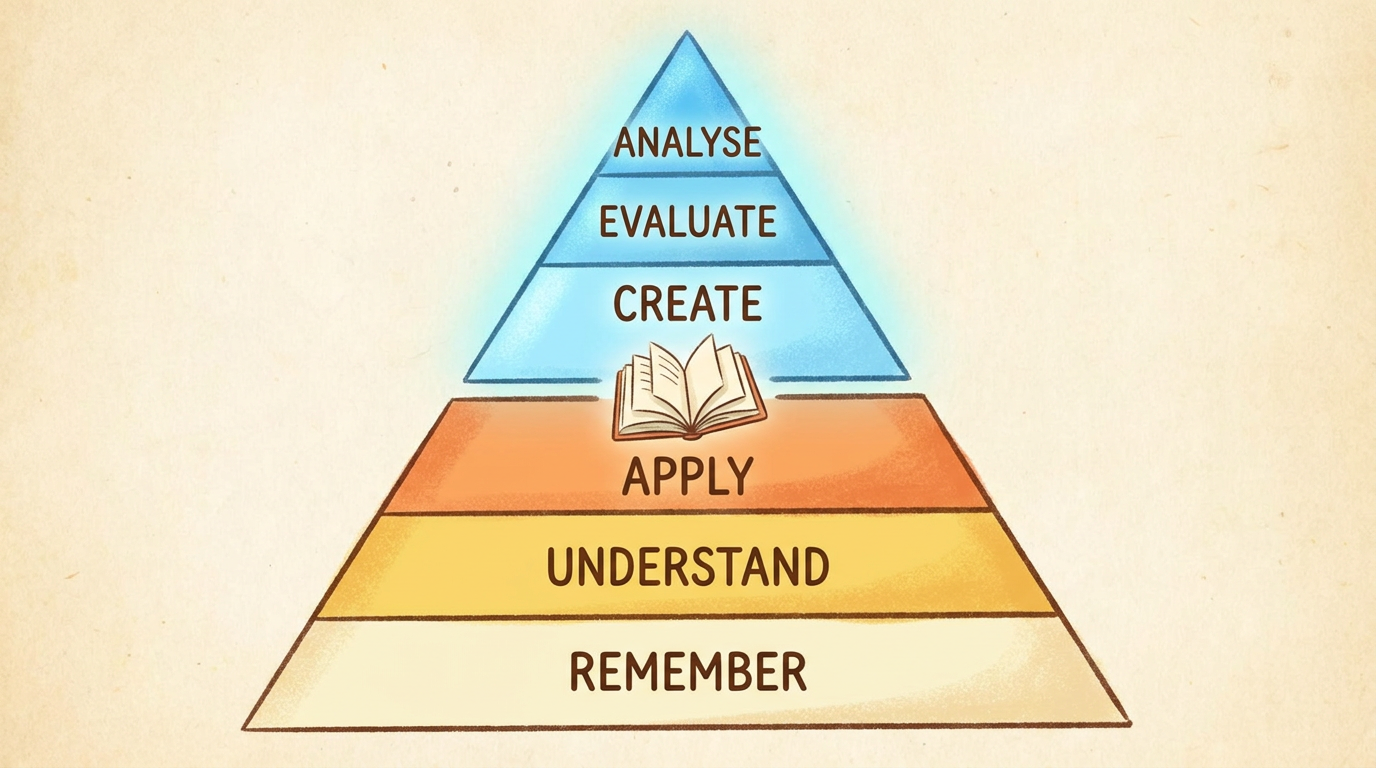
Journaling Pushes Thinking Up Bloom's Taxonomy
The most directly relevant recent work is , which examined handwritten reflective journaling and analysed the results against Bloom's Taxonomy.
Two things to be honest about up front, because credibility matters more than a tidy argument. First, the study is primarily qualitative — it interprets what students wrote rather than measuring test-score deltas against a control group. Second, the participants were undergraduate marketing students, not nine-year-olds. Anyone telling you this study proves journaling raises primary school attainment is overselling it.
What it does show is genuinely useful. When students wrote reflectively about a substantive topic, their writing consistently surfaced the upper tiers of Bloom's Taxonomy — analysis, evaluation and synthesis — rather than sitting at the bottom in recall and comprehension. The act of writing reflectively pulled cognition upward.
This is the finding that should interest teachers most, because it describes a mechanism you can watch happen in real time.
Consider two accounts of the same school trip.
"We went to the science museum. We saw the dinosaurs. It was fun." That's recall. It's the floor of the taxonomy. It's also, let's be honest, what you get from most children when you ask "how was the trip?"
Now consider what happens when the prompt is sharper — what surprised you today, and what did it change your mind about? — and you get: "I thought T-rex would be way bigger. The skeleton was tall but the bones looked thin, not heavy like I imagined. I think I got my idea of dinosaurs from films, not from real ones."
That child has just analysed, evaluated a prior belief, identified the source of their own misconception, and synthesised a new understanding. Same trip. Same child. Different cognitive altitude — produced by nothing more expensive than a well-designed prompt and five minutes to write.
The study also makes an interesting case for handwriting specifically, suggesting the slower physical pace supports deeper reflection. That's worth taking seriously, and we'll return to it honestly when we weigh paper against digital later on.
Personal Relevance Is the Engine of Engagement
The second finding is about why some journaling assignments produce that kind of thinking and others produce three flat sentences and a doodle.
examined what happened when students worked with self-generated data — their own information, their own observations — rather than abstract material handed down to them. Engagement rose. Learning outcomes improved. The content mattered more because it was theirsIf it's genuinely theirs — their memory, their angle, their choice of what mattered — you get the T-rex answer.
DeBoy's 2017 work
If the journal becomes another assignment — graded, corrected, marked for spelling, submitted for approval — students will produce assignment-shaped writing. Careful, hedged, minimal, aimed at compliance. The moment a child suspects they're being marked, the reflective register shuts off and the performative one switches on.
This is the single most important design principle for a class journal, and it's where most well-intentioned attempts quietly fail.
.
Practically, this means a class journal must be structurally distinct from graded work. Different time, different tone, different rules. It is not an English exercise that happens to be about the field trip. It's the class's record of itself, which the class maintains.
Reflection Binds Learning to Feeling
Reflection doesn't take time away from learning. It fastens learning down.
Dinç, Wherley and Sankey's 2024 research
But integration isn't decoration. A fact attached to a moment, a feeling, and a context is a fact with more handles on it. It's retrievable from more directions. The child who wrote about being nervous before the science fair and then relieved when the volcano actually erupted has bound the procedural knowledge to an emotional event — and emotional events are precisely what human memory is optimised to retain.
The implication overturns a common staffroom objection. Journaling is often treated as a nice-to-have that competes with "real" curriculum time — twenty minutes of writing feelings that could have been twenty minutes of fractions.
found that students who journaled during learning experiences reported stronger integration between academic content and personal reflection.
Writing About Shared Experience Builds Social Awareness
Picca, Starks and Gunderson's 2013 work found that journal writing focused on shared social topics measurably increased students' awareness of and critical thinking about their own environment.
Sit with the significance of that for a moment, because a class journal is, by its very nature, a journal about shared social experience. It's not an add-on to this finding — it's the purest expression of it. Every entry is a child paying deliberate attention to the social world of the classroom and putting language to it.
Who did something kind this week? What was hard for us as a group? What changed?Those are social-awareness questions dressed up as memory questions, and children answer them far more readily in a journal than in a circle-time discussion where everyone is watching.
An External Memory for the Whole Room
The final piece is the simplest. Expressive writing about experience encodes it more durably, and a written record can be revisitedA class journal creates an external archive the group can return to. In February you can read what the class wrote in September and see, collectively, how much has changed. That act of revisiting is itself a learning event: it makes growth visible to children who otherwise have no way of perceiving it, because from the inside, getting better at things feels like nothing at all.
— which is where the compounding really begins.
Lugelo's covers this retrieval advantage in more depth — a searchable, dated, multimedia archive is a fundamentally different object from a notebook in a drawer, precisely because you can find things in itbeginner's guide to digital journaling
So the evidence for journaling is solid. But every study above concerns individuals writing. The obvious question is what happens when you make it collective — and here the research gets genuinely surprising.
.
The Power of Collaborative Journaling in the Classroom
The research says otherwise. Collaboration doesn't dilute the benefits. It produces a different set of them.
There's a reasonable assumption that collaborative journaling is just individual journaling with more paperwork — the same benefits, distributed across more people, with added logistics.
Groups Get Better at Being Groups
Start with the finding that should reshape how you think about the whole exercise.
worked with 240 secondary students and tested retention at one day and again at seven days. The headline result: groups with prior collaborative experience outperformed inexperienced groups on both immediate and delayed retention, and did so with greater cognitive efficiency — better results for less mental effort.
Read that carefully, because the causal direction is the interesting part. The advantage didn't come from collaboration in the abstract. It came from having collaborated beforeA class that journals together every Friday isn't just building a memory book. It is, week by week, becoming a more capable collaborative unit — and that capability transfers to group projects, science investigations, and every other collective task you throw at them.
It is a low-stakes, recurring, structured collaborative task that runs for an entire academic year. It is, quite literally, a machine for accumulating exactly the kind of group experience that this study identifies as the source of the retention advantage.
Now think about what a weekly class journal is.
. Groups that had built up shared working experience had, in effect, developed a collective operating system — implicit knowledge of who does what, how to divide labour, how to disagree productively — and that infrastructure freed up cognitive capacity for the actual task.
The study contains a second finding with immediate practical value. Tasks with lower information density — where each member's contribution could be completed without heavy dependence on everyone else's — produced better performance and efficiency, particularly for less experienced groups.
This is a direct argument for designing class journal contributions as small, independent units. One photo and one sentence per student per week. Not a committee-drafted collective paragraph requiring consensus. Each child contributes something complete on its own; the richness emerges from the assembly, not from negotiated authorship. That design isn't laziness — it's cognitively sound, and it's why the simplest formats tend to survive the whole year.
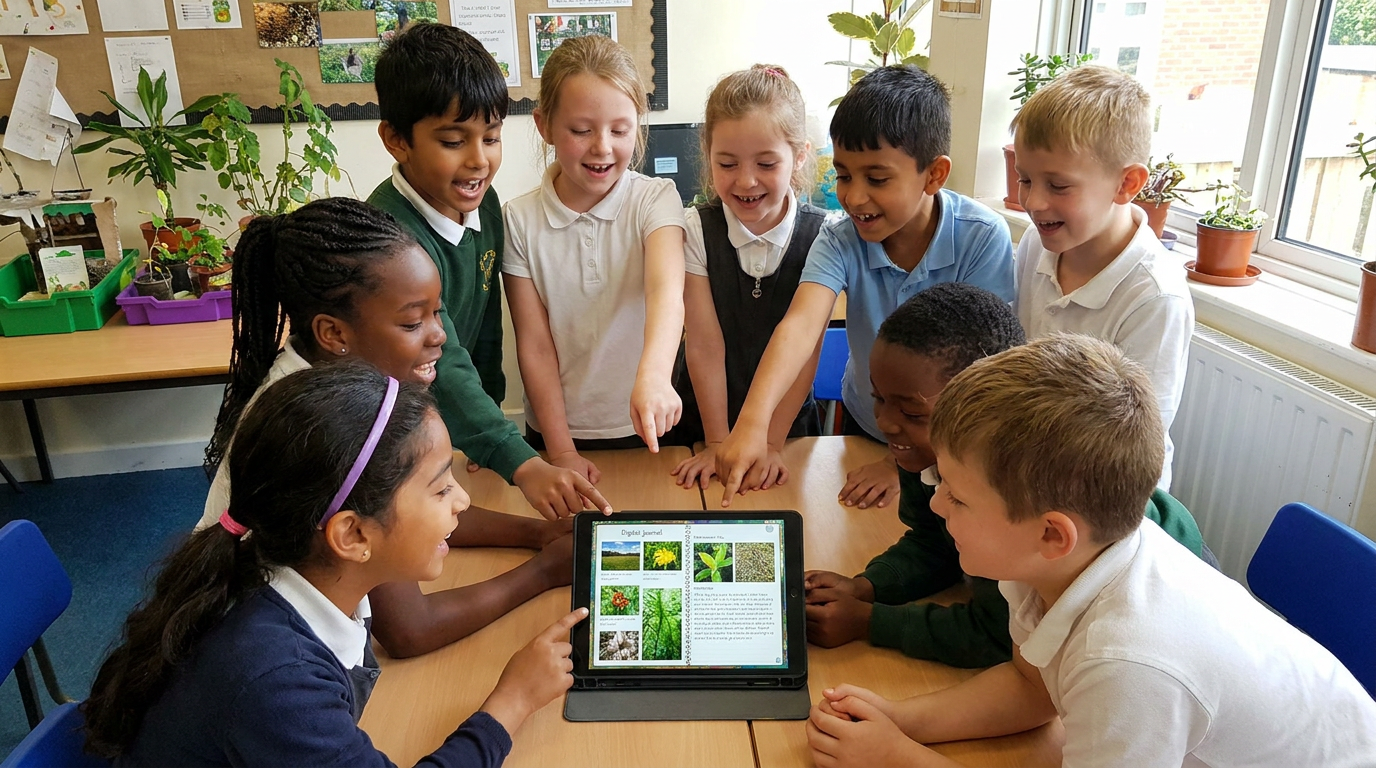
Reflecting Together Produces Support, Not Just Output
The second key study refines how the collaboration should work.
analysed video recordings of small groups and found that when groups engaged in regulation — planning together, monitoring their progress, evaluating how they were doing — those moments coincided with markedly more joint participation and more socio-emotional supportNow map that onto a class journal ritual.
They identified three specific things these convergences accomplished: establishing agreement, responding to challenges and mistakes, and discussing strengths and weaknesses.
than moments without regulation.
A Friday session where a class looks back at the week and decides together what deserves recording is not a writing exercise. It is collective monitoring and evaluation — precisely the regulatory activity the study associates with peer support. Deciding what mattered is establishing agreement. Writing honestly about the presentation that went badly is responding to challenges and mistakes. Reflecting on what the class did well is discussing strengths and weaknessesThe journal, in other words, isn't a container that happens to hold reflection. It's a structure that reliably produces the group behaviours associated with cohesion and mutual support — and it produces them on a schedule, without the teacher having to engineer each instance.
.
When groups plan, monitor and evaluate together, they don't just work better — they support each other more. A weekly class journal is one of the simplest ways to build that rhythm into the school year.
— adapted from the findings of Isohätälä, Näykki & Järvelä (2020)
The Emotional Skills Are Real Skills
A tracked students through project-based collaborative writing over an extended period and found development in emotion regulation strategiesNavigating that — repeatedly, in low-stakes conditions, with adult scaffolding — is emotional skill development of a kind that no worksheet delivers. And because it's longitudinal and recurring, it isn't a one-off lesson on empathy. It's practice.
Collaborative writing is emotionally demanding in productive ways. Your contribution sits beside someone else's. Somebody remembers the same afternoon differently. Somebody's sentence is funnier than yours. Somebody wants to record the thing you'd rather forget.
, alongside improvements in group cohesion, problem-solving and communication.
Thirty Angles on the Same Afternoon
The results are frequently better than anything an adult would have written. Children notice things adults filter out — that the museum guide had a tattoo of a trilobite, that the rain smelled like the car park, that the quietest kid in the class knew more about ammonites than the guide did. That texture is what makes a record worth revisiting a decade later, and it only exists if you let everyone write.
A collaborative journal captures the parallax. Thirty perspectives on one afternoon, and the truth living somewhere in the overlap.
Any single account of a shared event is a partial account. The teacher's version of the museum trip is organised around logistics, headcounts, and the moment the coach was late. A student's version is organised around who they sat next to and what was in the gift shop. Neither is wrong. Both are radically incomplete.
Then there's the quality of the record itself.
Evidence That the Group Existed
The last benefit resists measurement but may matter most.
When a class co-authors its own story, something shifts in how the students understand themselves. They stop being thirty individuals allocated to a room and start being a group with a narrative. The journal becomes a shared artefact — physical or digital proof that this specific configuration of people, which will never exist again in exactly this form, was real and did things and mattered.
For a child who feels peripheral, seeing their entry sitting in the class record beside everyone else's is a quiet form of recognition. You are in the story. You are part of what this was.
Which brings us, finally, to the practical question every teacher reading this has been holding since the first paragraph: how do you actually run one without it collapsing by October?
That's not a soft outcome. Belonging is among the strongest predictors of engagement, attendance and wellbeing in school. A class journal is one of the cheapest interventions available for producing it.
How to Set Up a Class Journal: A Practical Guide for Teachers
So here's a six-step setup designed for the reality of a school year rather than the fantasy of one. Consider it advice from a colleague who has watched this go wrong, rather than a policy document.
Not because the idea was wrong, but because the system was fragile. It depended on one adult remembering, chasing, collecting and organising — and the first genuinely difficult week of term swept it away.
Most class journals fail in week six.
Step 1 — Decide What This Journal Is Actually For
Before format, before tools, before anything: what is this for?
Four common purposes, each producing a different journal:
- The year-long story. A running chronicle of the class from September to July. Best for building identity and producing an end-of-year keepsake.
- The event archive. Focused on trips, performances, sports days, visitors, projects. Lower frequency, higher production value, very popular with families.
- The milestone record. Centred on growth — first solo reading, first swimming badge, the breakthrough moment. Emotionally powerful, particularly in early years.
- The curriculum companion. Reflective entries tied to topic work. What surprised you in the Romans unit? What do you still not understand about the water cycle? This one doubles as formative assessment.
Write your purpose in one sentence. Put it on the first page. It'll keep you honest in March.
You can blend them, but pick a primary purpose. It answers every downstream question — how often you write, who contributes, what prompts you use, what you do with it in July.
Step 2 — Choose Paper or Digital, Honestly
Both work. They work differently, and you deserve a straight comparison rather than a sales pitch.
Paper has genuine advantages. No screens, no logins, no device policy. It's tactile, and there's real evidence that handwriting supports reflection — the Berezan study found the slower physical pace of handwriting encouraged deeper thinking. A single beautiful bound volume passed around the room has a ceremonial weight that a shared file does not. For infants and lower primary, paper is often simply the right call.
Paper's costs are equally real. One physical object means one contributor at a time. It can't be in two places at once. It can't hold the photographs. It can't be searched. It can't be shared with a parent who wasn't at pickup. And at the end of the year there is exactly one copy — which goes to one child, or into a cupboard, or nowhere.
Digital solves the distribution problem. Thirty students can contribute simultaneously. Photos, audio and video attach directly to entries. Everything is dated, searchable and organised without anyone maintaining an index. It can be shared with families under controlled permissions. And it can become something at the end — an eBook, a printed storybook, a keepsake in every family's hands rather than one copy in a cupboard.
Digital's costs: you need devices, you need a workable privacy arrangement, and you lose some of the tactile ceremony.
The pragmatic answer many teachers land on is both. Handwritten reflection in the moment, photographed or transcribed into the shared digital journal so it's preserved, distributable and turnable into something at the end of the year. You keep the cognitive benefits of handwriting and solve the archive problem. Lugelo's piece on covers this hybrid approach in more detail.
adapting traditional journals for the digital era
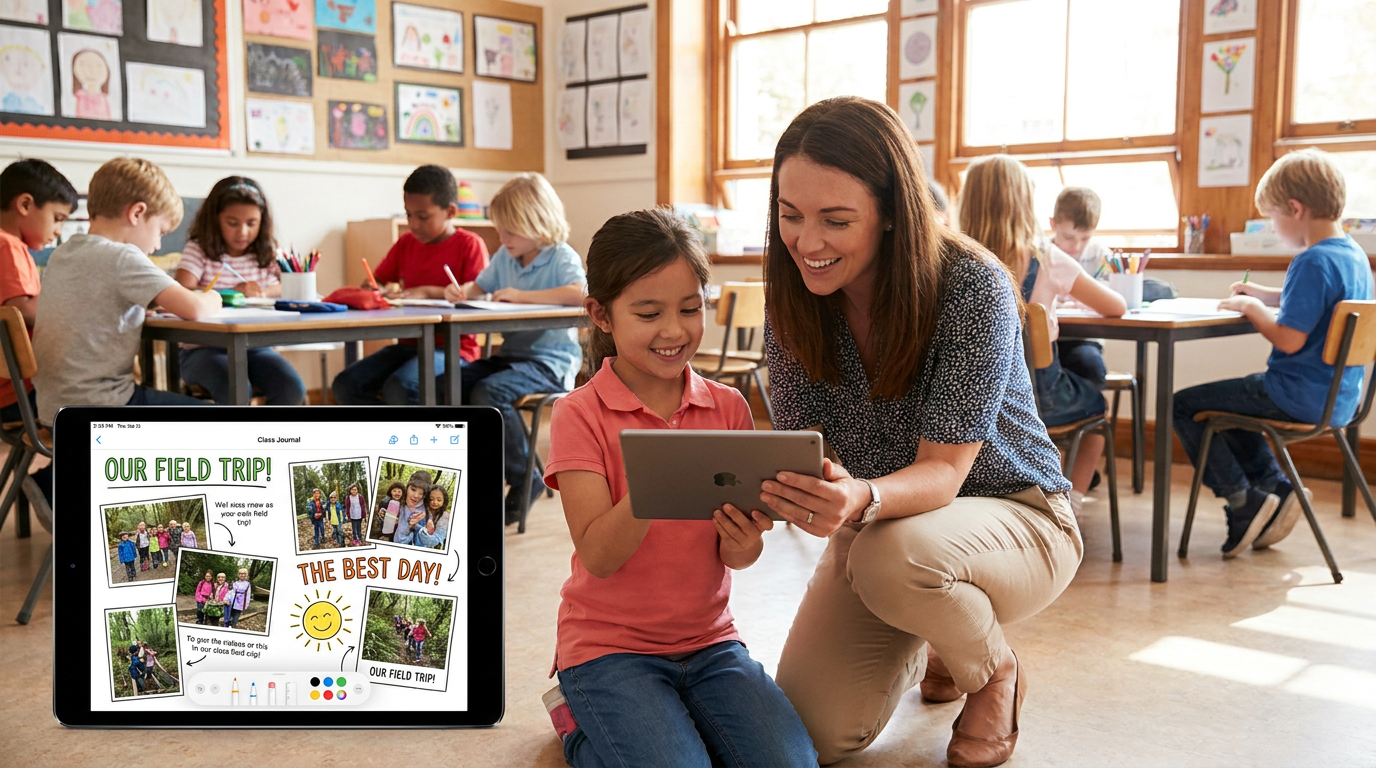
Step 3 — Distribute the Job Through Roles
The single biggest predictor of survival is whether the teacher is doing all the work. If they are, it ends by half term.
Rotating student roles fix this and add pedagogical value. Some that work:
- Journal Editor — collects and reviews the week's entries.
- Moment Capturer — takes the photographs during the week.
- Question Master — chooses which prompt the class answers.
- Read-Aloud Reader — selects one entry to share with the room on Friday.
- Archivist — checks that a major event actually got recorded.
Rotate weekly, so everyone holds each role at some point. This isn't just admin relief. Cornell's Center for Teaching Innovation notes in its that clearly defined roles improve accountability and participation — and role rotation is exactly the accumulated group experience the Zambrano study identified as driving retention gains.
guidance on creating and managing groups
Step 4 — Make Contributing Almost Effortless
Set expectations low. Deliberately, strategically low.
The temptation is to ask for a paragraph. Resist it. One photo and one sentenceAccept a range of contribution types so no child is locked out by writing ability:
is a perfect weekly contribution — small enough that no child can fail at it, quick enough that the whole class finishes in ten minutes, and independent enough to match the low-information-density design the research supports.
- A written reflection, however short
- A photo caption
- A drawing with a one-line description
- An audio memory, spoken rather than typed
- A simple "I noticed…" entry
- A single word describing the week, with a reason
A child with dyslexia recording a thirty-second voice note has contributed exactly as much as a child who wrote three sentences. Design for that from day one, not as an accommodation added later.
And remove the blank page wherever possible. Blank-page paralysis is real for children and adults alike — Lugelo's exploration of makes the case that a good opening question does most of the heavy lifting. Never open the journal without a prompt ready.
AI prompts in personal journaling
Step 5 — Settle Privacy Before You Start, Not After
Get this wrong and the whole project stalls. Get it right up front and it never becomes an issue.
Three questions, answered in writing before the first entry:
Who can see it? Options run from teacher-only, to class-only, to class-plus-invited-parents, to a public-facing class page. Most schools land on class-plus-parents with the teacher controlling access. Check your school's existing policy on photographs and any consent forms already in place — you're almost certainly working within a framework that exists.
Who can contribute? Usually every student, with the teacher as owner and administrator. Some classes invite parents to add entries after big events, which is lovely, but decide deliberately rather than by accident.
What are the ground rules? Three are usually enough: we write about our class with kindness; we don't publish anything about a classmate they wouldn't be happy to read; this is for remembering, not for judging. Have the class help write them — the rules stick better when they're theirs.
Whatever platform you use, it should be private by default, so that sharing is an active choice rather than an oversight.
Step 6 — Build a Ritual Around It
Class journals that survive are the ones that feel like an occasion rather than a task.
The mechanics matter less than the consistency. Fifteen minutes every Friday afternoon beats forty-five minutes whenever there's timeAdd ceremony where you can. A read-aloud of one entry to close the week. A "moment of the month" the class votes on. A December session revisiting September's entries — reliably one of the best sessions of the year, because children are astonished by their past selves. And an end-of-year celebration where families see the finished journal.
, because the first is a ritual and the second is a good intention. Anchor it to a fixed point in the week and protect it.
Lugelo's guide to makes the point that consistency compounds in a way that intensity never does. Twelve minutes a week across thirty-eight weeks is roughly seven and a half hours of collective reflection and a few hundred entries. That's a book.
journaling habits that stick
A Note for Parents
If you're a parent rather than a teacher: you can start this conversation, and it's a more welcome one than you might expect.
Don't arrive with a demand. Arrive with the idea and the reassurance that it's manageable. "I read something about class journals — apparently one photo and one sentence a week is enough, and it can be turned into a book for families at the end of the year. Is that something you'd ever consider?"
Structure sorted, one obstacle remains — the one that empties every journal by October. What are the children actually supposed to write?
Most teachers have half-thought about this already. What stops them isn't reluctance — it's not knowing whether the logistics are survivable. Showing them a workable framework is often all it takes.
15 Journal Prompts for Students That Spark Real Reflection
The blank page is where good intentions die.
Ask thirty children to "write about the week" and you'll get thirty variations on "this week was good." Not because they have nothing to say — because an open question with infinite possible answers is genuinely harder to answer than a specific one.
Good journal prompts for students work by narrowing the field. They make one particular door obvious and easy to walk through. The best of them have three qualities: they're open-ended enough to have no correct answer, non-judgemental enough that no child can get them wrong, and specificHere are fifteen, sorted by the job they do. Bookmark this section — it's built to be used on a Friday afternoon with no preparation.
enough that an answer arrives immediately.
Reflection Prompts: Looking Back on the Week or Term
These build the habit of noticing, and reliably produce the higher-order thinking the Bloom's research describes.
1. "What's one moment from this week at school that you don't want to forget?"
The perfect default. Works every single week, and the answers reveal what children actually value — which is rarely what adults assume.
2. "Describe a time this term when you felt proud of yourself, or proud of someone in your class."
The two-option structure is deliberate. Children who find self-praise uncomfortable can point outward instead, and the entries about classmates are consistently the ones families treasure.
3. "What's the hardest thing we did as a class this year — and what made it worth it?"
Frames difficulty as something the group came through together. Excellent after a challenging project or a disappointing result.
4. "If you could relive one day from this school year, which would it be and why?"
The why is the whole prompt. It forces evaluation rather than recall.
Creative Prompts: Imaginative Ways Into the Same Memory
Reflection prompts get more honest answers when they don't look like reflection prompts. These are for classes that go quiet when asked directly how they feel.
5. "If our class was a book, what would the title be — and what happens in Chapter 1?"
Produces class identity in one sentence. Some titles become the class's name for itself for the rest of the year.
6. "Write the story of today from the perspective of the classroom itself."
A perennial favourite. Rooms notice different things than people do — the chair that always wobbles, the clock everyone watches at 2:45 — and the shift in perspective loosens up children who've frozen on straight questions.
7. "If our class had a theme song, what would it be, and what would the lyrics say about us?"
Half creative writing, half group self-portrait. Excellent as a whole-class collaborative entry.
8. "Describe the most unexpected thing that happened to our class this year as a news headline."The headline constraint is a gift — it forces compression, and compression forces children to decide what actually mattered.
Collaborative Prompts: Add Your Voice to the Class Story
Designed specifically for a group journal, where every contribution is a small independent piece of a larger picture.
9. "Write one sentence describing what makes our class unique — then read everyone else's."
The second half is the important half. Thirty one-line answers side by side is a portrait no single child could have produced.
10. "Finish this sentence: 'The best thing about being in this class is…'"
Nearly frictionless. Even the most reluctant writer can complete a sentence someone else started.
11. "Describe a classmate without naming them, using only kind words. What do you appreciate about them?"
Handle with care and clear rules — but done well, this is one of the most powerful prompts on the list. It directly builds the social awareness that Picca and colleagues associated with journaling about shared social topics.
12. "What's one thing you've learned from a classmate — not from a textbook?"Repositions every child in the room as someone with something to teach. Watch what it does to a student who rarely gets recognised academically.
Gratitude and Memory Prompts: Writing for Future Readers
These work best at the end of a term or year, when the journal is nearly a finished object.
13. "What's one thing you'll tell your family about this school year?"
Bridges school and home, and quietly reveals which experiences children found significant enough to carry across that boundary.
14. "Write a thank-you note to this class — as if you're writing it five years from now."
The temporal displacement does something remarkable. Children write with a perspective they don't normally have access to, and the results are frequently moving.
15. "What moment from this year deserves to be in our class journal most — and why?"The perfect closing prompt. It's a genuine act of collective curation, and the argument the class has about the answer is often better than the entries.
Making Prompts Go Further
Two practical notes.
Don't burn through all fifteen in a fortnight. Rotate a small set and return to the strongest ones each term — the same prompt in September, February and June produces a growth record that no assessment framework will ever capture. Comparing a child's three answers to "what makes our class unique?" across a year is genuinely revealing.
And if you want to expand the bank, there are excellent open collections available — is a solid, classroom-tested starting point for teachers who want more raw material.
Texthelp's set of thirty creative writing prompts

These prompts work perfectly well in a paper notebook. But a digital class journal lets you pair each one with photographs, voice notes and simultaneous contributions from every student — turning a writing exercise into a living, multimedia record. Which raises the last question: where should all of this actually live?
How Lugelo Turns a Class Journal Into a Keepsake
Let's start with a picture of it working, rather than a list of features.
Ms. Rivera's Year 4 class journals every Friday at 2:45pm. It takes ten minutes. Each student adds one photo and one sentence about their week. The Moment Capturer has been taking pictures since Monday; the Read-Aloud Reader picks one entry to share before the bell.
By December they have around forty entries. When they scroll back to September, the class is genuinely startled — the handwriting is different, the photos show a shorter, smaller group of children, and somebody points out that they didn't even know each other yet.
In June, every family receives a printed storybook of the entire year. Photographs from the museum trip. The play, including the forgotten line. Thirty different answers to what makes our class unique. A nine-year-old carries it home and reads it at the kitchen table with her grandmother.
The whole thing cost Ms. Rivera about ten minutes a week.
That last line is the point. Everything Lugelo does for a class journal is aimed at making that ten-minute number true — because the barrier to class journaling has never been motivation. It's been the admin.
Everyone Writes at Once
A paper journal is a single object, which means a single contributor at a time and a queue.
Lugelo is built around — every student can add their own entry, photo or audio note simultaneously, from any device. The teacher owns the journal and controls who can contribute and who can view. Ten minutes on a Friday means ten minutes for the whole class, not thirty sequential turns.
shared journals with multiple contributors
Lugelo's walk through creating a shared journal, inviting members and managing contributors — the setup is a one-time job measured in minutes, not an ongoing burden.
how-to guides
The Blank Page, Solved
The AI Journal Assistant exists for exactly the problem the prompts section addresses. A student types a few words — museum, dinosaur bones, surprised — and Lugelo suggests a title and helps expand it into something fuller, without replacing the child's own voice.
Two features matter enormously in a mixed-ability classroom. Speech-to-text lets a child who struggles with writing speak their entry instead — the same contribution, a different door in. And scan-to-text turns handwritten work into a digital entry, which is how the hybrid approach becomes practical: children write by hand, keeping the reflective benefits the research points to, and the class journal still ends up searchable, shareable and printable.
Photos, Voices and Video in Every Entry
A class year is not a text document.
In Lugelo, a single Moment can hold photographs, video, audio and text together. The muddy field trip photo sits beside the child's caption. The audio clip of the class singing is in the journal, not on someone's phone. The video of the volcano erupting is attached to the entry describing it.
Everything lands automatically on a Memory Lane — a chronological timeline of the year that organises itself. Nobody maintains an index. Nobody files anything. Scroll back and the year is simply there, in order.
There's also a genuinely unusual option for the end of the year: Lugelo's VR Photo Gallery turns a journal's images into an explorable 3D space you can walk through. It works in-app without a headset, and it makes for an end-of-year session children remember long after the bell.
Private by Default
Lugelo uses end-to-end encryption, and every journal is private unless someone with permission decides otherwise. The teacher controls access completely — class-only, or extended to invited parents. Sharing is always an active decision, never an accident.
In a school context this is non-negotiable, so it's the default rather than a setting.
The Part That Makes It a Keepsake
Here's where a class journal stops being a classroom activity and becomes something a family keeps.
A Lugelo journal exports to a beautifully designed eBook or printed storybook in one tapThat book will outlive the report card by about fifty years. And in twenty years, when one of those children is clearing out a parent's loft, it's the thing they'll sit down on the floor to read.
Think about what that means in practice. Not one copy in a cupboard. A copy for every family. Thirty children each holding the story of their year, with their own words inside it and their own face in the photographs, alongside twenty-nine others.
. The year — every entry, every photograph, every one-line answer from every child — becomes an object.
This is what Lugelo means by create a legacy, not just entries. Lugelo's write-up on documents classrooms already doing this — students co-authoring storybooks as part of curriculum work, with the finished book as the artefact families keep.
collaborative storytelling in communities
Free, and on Every Device
Teachers update on the web. Students contribute on tablets or phones. Everything syncs. Lugelo is available free on , and , so no school budget approval is required to try it for a term.
the webAndroidiOS
Start with one journal, one weekly prompt, and ten minutes on a Friday. That's the whole commitment. You can and have the class journal set up before your next Friday afternoon.
download Lugelo here
Your Class's Story Is Worth Keeping
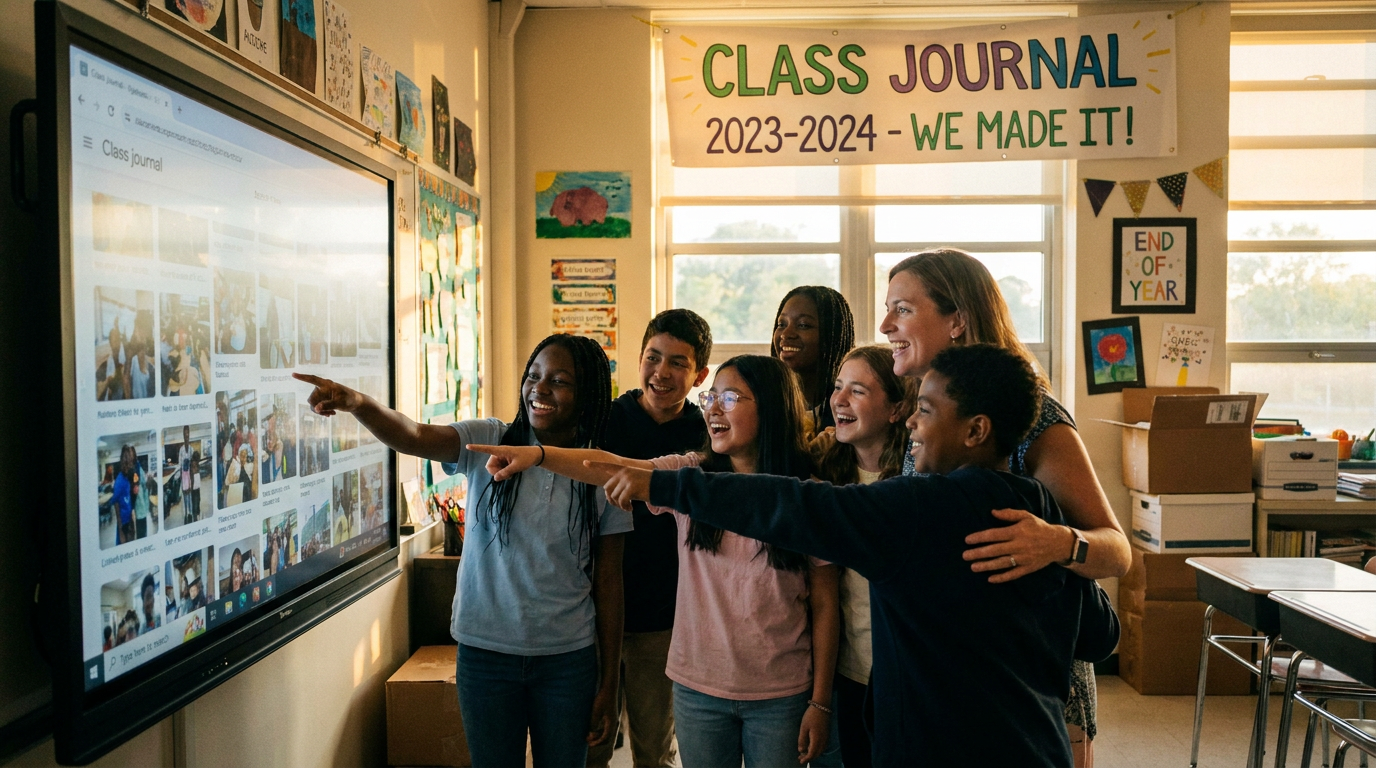
Now imagine the same room, the same day — except this time there's a book on every desk.
The walls are bare, the desks are cleared, and thirty children have walked out with a year in their heads that will begin dissolving before the end of the first week of the holidays.
Go back to that empty classroom on the last day.
Inside it: the rainy field trip. The play with the forgotten line. Thirty different answers to what makes our class uniqueSame year. Same children. One version kept, one version lost.
, sitting side by side, contradicting each other in the most interesting ways. The photograph from September where everyone looks impossibly small. A voice note of the whole class singing, badly, in December.
We started with a contrarian claim, and it's worth restating plainly now that the evidence is in: journals aren't just for personal use. The locked diary is a recent variation on a very old human practice, and that older practice — ship's logs, chronicles, parish registers, yearbooks — was almost always collective. Somewhere along the way schools stopped keeping group records, not because the idea stopped working, but because the paperwork was crushing. That constraint no longer exists.
And the evidence points the same direction. Reflective journaling pulls thinking into the upper reaches of Bloom's Taxonomy. Personal relevance drives engagement. Reflection binds academic content to memory rather than competing with it. Collaborative groups develop shared experience that measurably improves retention — and they build that experience by doing exactly the kind of small, regular, low-stakes collective task that a weekly class journal is.
If you're a teacher: you now have the argument for your head of department, a six-step framework, fifteen prompts and a tool that handles the logistics. There is nothing left to work out. There's only starting — and the honest truth is that starting badly in September beats starting perfectly in January, because the entries you'll treasure most are the early ones where nobody knew what they were doing yet.
If you're a parent: you can begin this. Send this to your child's teacher with a single sentence — one photo and one line a week, and every family gets a book at the end of it. Most teachers have half-imagined this already and simply never saw it framed as achievable. Ask the question. The answer might surprise you.
If you're a student: your class's story is worth keeping. You're not just a student in a room — you're a character in something that's happening right now, with a cast of thirty and one year to run. Write it down. In ten years you'll be very glad somebody did.
The last day of school is coming, as it always does. The only real question is whether anything stays behind.
Everyone has a story to tell — and in a classroom, that story belongs to everyone.
Journals are souvenirs of your past. Make sure your class has one.
Start Your Class Journal Today — Free on Lugelo
Capture your students' year in photos, stories and shared memories. Set up a collaborative class journal in minutes, and turn it into a keepsake every family keeps.
Create Your First Class Journal on Lugelo →
Parents: share this with your child's teacher. A great school year deserves to be remembered.
Explore Lugelo's Collaboration Features →
Create a Legacy, Not Just Entries.