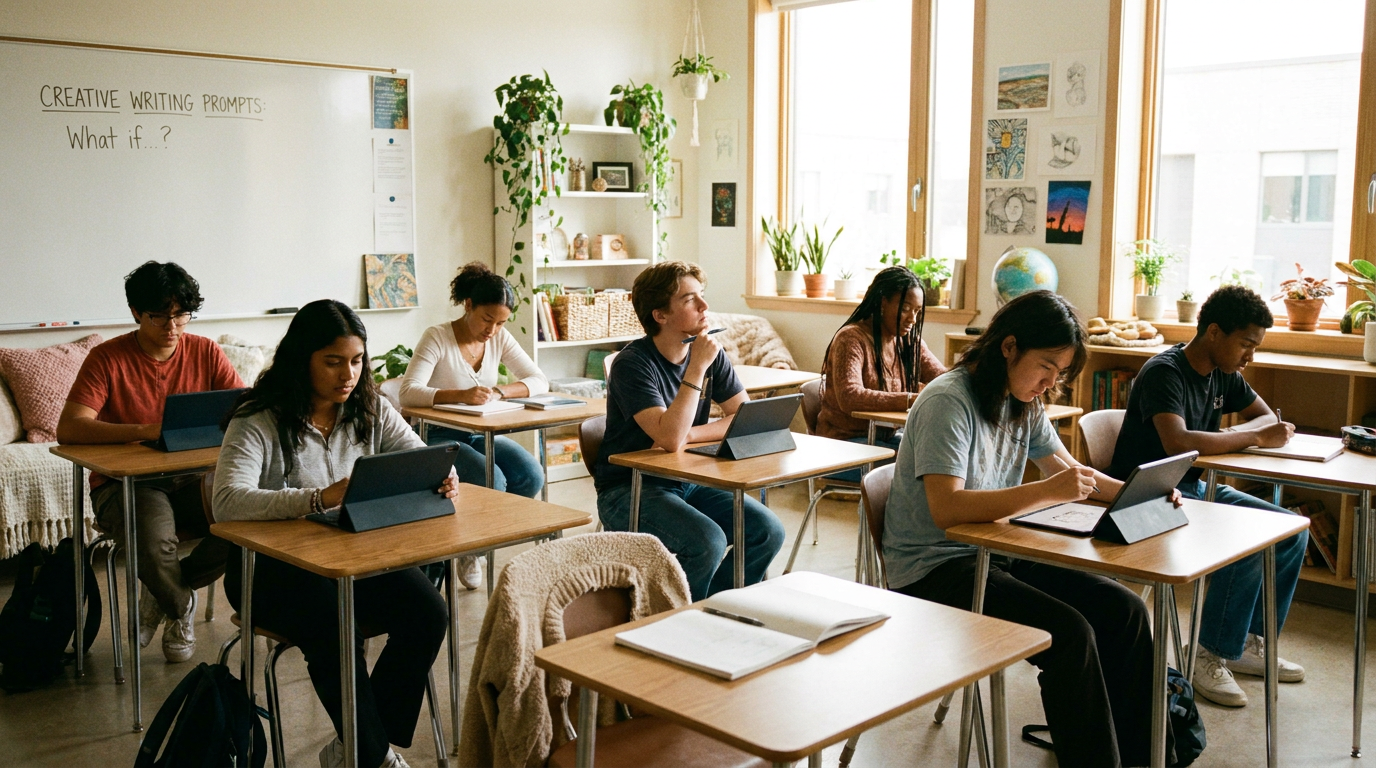
How Classroom Blogging Builds Self-Reflection Skills in Students
Picture this: your class has just returned from a field trip to the local nature reserve. The students were buzzing the entire bus ride back — pointing out the hawk they spotted, debating whether the creek was deeper on the left or the right, laughing about the mud incident near the trail’s end. It was one of those rare, genuinely alive classroom experiences. So you do what any good teacher would do — you ask them to write about it.
And what comes back?
“It was fun. We saw birds and a river. I liked it.”
Two sentences. Maybe three if you’re lucky. Not because the students didn’t experience something meaningful. Not because they weren’t paying attention. But because self-reflection is not an instinct — it is a skill.This is where classroom blogging enters the picture — not as a technology trend or a digital novelty, but as a purposeful pedagogical practice with deep roots in educational research. When students blog regularly, something remarkable begins to happen: they start to notice more, articulate more, feel more confident putting their interior world into words. They become, in the truest sense, more reflective human beings.
And like every other skill worth having, it needs to be taught deliberately, practiced consistently, and scaffolded with the right tools.
This guide is for teachers who want to understand why that transformation happens and how
Whether you teach kindergarteners or high school seniors, whether you have 45 minutes a week or five minutes a day, there is a version of this practice that works for you. Let’s find it together.
to make it happen in their own classrooms. We’ll walk through the research behind self-reflection and student development, explore the specific mechanisms that make classroom blogging so effective, show how it builds writing fluency and storytelling skills alongside reflective capacity, and give you a practical, week-by-week roadmap for getting started — complete with age-appropriate prompts you can use tomorrow.
Self-Reflection in Schools: A Skill Too Important to Leave to Chance
Most teachers intuitively understand that something important happens when students pause to think about their thinking. Ask a child what they learned during a lesson and you’re measuring an outcome. Ask them how they learned it, what confused them, what surprised them, and how their ideas changed — and you’re doing something far more powerful. You’re developing a metacognitive thinker.
Self-reflection, in an educational context, is the conscious act of observing one’s own thinking, emotional responses, and learning process. It’s the difference between a student who completes an assignment and one who understandsSo why do so few classrooms actively teach it?
The stakes are even higher when we zoom out from academia into life itself. Self-reflection connects directly to emotional intelligence. Students who can articulate what they observed, how they felt, and why something affected them are better communicators, more empathetic peers, and more adaptable human beings. They are equipped to navigate disagreement, to learn from failure, and to build meaningful relationships — skills that no standardized test will ever measure but that will define the quality of their lives.
The research on why this matters is unambiguous. Metacognition — thinking about one’s own thinking — has been consistently linked to improved academic performance, deeper learning retention, and the kind of self-directed learning that serves students far beyond the classroom. Students who can step back and examine their own learning processes don’t just perform better on tests; they develop intellectual humility, resilience in the face of challenge, and a genuine curiosity about their own growth.
why they found it hard, what strategy they used to push through, and what they would do differently next time. It is, at its core, the habit of becoming your own observer.
The honest answer is structural. Traditional classroom formats — essays, tests, presentations, worksheets — are designed to measure what a student knows, not to develop how a student thinks about what they know. They’re outcome-focused by design. A multiple-choice test tells you whether a student got the right answer; it reveals almost nothing about the mental journey that led them there. A five-paragraph essay demonstrates argument structure; it rarely asks students to examine how their perspective shifted in the writing of it.
A found that self-reflection interventions in 7th graders led to measurable improvements in resilience, self-esteem, and psychological well-being. These aren’t peripheral benefits — they are the foundations of a student who can learn, recover, connect, and grow across a lifetime. The study underscores what many educators feel intuitively: when we make space for students to look inward, we aren’t pulling time from the curriculum. We are building the human infrastructure that makes the curriculum matter.
Springer study on positive youth development
There’s also a writing dimension that teachers in every subject recognize. Educators who want students to become more fluent, authentic writers must first help them become better observers of their own inner life. You cannot write vividly about what you haven’t noticed. You cannot articulate an insight you haven’t paused to examine. As captures so well, writing for an audience of one — the private, unfiltered act of reflection — is often the first step toward finding your authentic voice. In a classroom context, that same principle applies: give students a regular, low-stakes opportunity to articulate their experience, and watch their relationship to both thinking and writing transform.
Lugelo’s exploration of journaling and self-discovery
The question, then, is not whether to teach self-reflection. The question is how
. And a growing body of research is pointing clearly in one direction: toward blogging.
Why Classroom Blogging Outperforms Traditional Journaling for Self-Reflection
There is a meaningful difference between asking students to keep a private journal and asking them to maintain a classroom blog — and that difference is not merely digital versus analogue. It is fundamentally about audience, iteration, and intentionality. Understanding that distinction is key to understanding why classroom blogging is such a uniquely powerful tool for developing self-reflection.
When a student writes in a private journal, they write for themselves. This has genuine value — the freedom to be unfiltered, to stumble, to contradict. But when a student writes a blog post, even one read only by classmates, something shifts. They become aware that someone else will read their words. And that awareness — subtle as it is — changes how they write. They slow down. They choose words more carefully. They ask themselves: does this make sense? Does this say what I actually mean? That self-interrogation is the engine of reflective writing.
Research backs this up with precision. A landmark study by Mohamad et al. (2013) found that blogging promotes what researchers call monologue-type reflection — a structured internal dialogue in which students process their learning experiences before committing them to the page. Unlike a quick verbal answer in class, blog writing requires students to hold an experience in mind, examine it from multiple angles, and translate it into coherent language. That process, repeated consistently, becomes a habit of mind. You can read the full study at .
ScienceDirect
Isakovic and McNaught (2013) found similarly compelling results: students who maintained reflective blogs specifically reported that the practice helped them think more deeply and articulate their thoughts more clearly than other forms of writing. The researchers categorized this as metacognitive thought — students were not just learning content; they were becoming more aware of how they learned it. The is a powerful reminder that the form of writing matters, not just the frequency.
Open Praxis study
What makes blogging different from essays? Blogs are ongoing, low-stakes, and iterative. They remove the pressure of formal academic writing — the fear of the red pen, the weight of the grade — and replace it with something closer to conversation. Students write more honestly when they know they won’t be penalized for imperfect grammar. They explore more freely when the goal is reflection rather than performance. And crucially, they write more often, which means reflection becomes a habit rather than an annual assignment.
The peer dimension of classroom blogging adds yet another layer. Research by Novakovich (2016), published in the There is also the multimedia advantage. A classroom blog is not just text. A student can attach a photo from the field trip that sparked their reflection, embed a short video, or link to an external source that extends their thinking. This richness is not merely decorative — it gives reflection a context, an anchor in specific, sensory reality. The student isn’t just saying “I noticed the hawk.” They’re attaching the photo they took of it, annotating what struck them about the moment, connecting it to the lesson on migration they’d studied the week before. That web of connection is the texture of genuine learning.
Journal of Computer Assisted Learning
, found that blog-mediated peer feedback fosters critical thinking and leads to measurably higher-quality student writing. When students read and respond to each other’s reflections, they are forced to engage with perspectives that differ from their own — to notice how a classmate experienced the same lesson, the same experiment, the same class discussion from a completely different vantage point. That comparative act deepens reflection further still.
For teachers interested in reducing the blank-page anxiety that can paralyze even enthusiastic students, . A well-crafted prompt removes the paralysis of the first sentence and gets students into the reflective act quickly — which is often all they need.
AI-assisted prompts offer a compelling approach
The research is clear: blogging doesn’t just record reflection, it produces
it. And that production has measurable ripple effects on students’ development as writers and thinkers — which is exactly what the next section examines.
Blogging as a Writing and Storytelling Development Engine
Self-reflection is the heart of classroom blogging. But it is far from the only organ keeping this practice alive. Teachers who implement regular blogging in their classrooms consistently discover something unexpected: their students don’t just become better reflectors. They become better writers. Better storytellers. Better observers of the world around them. And these improvements are not accidental — they are built into the architecture of the practice.
Writing for an audience is a fundamentally different skill than writing for a teacher. Every English class teaches students to write for evaluation — to produce a product that meets specified criteria and earns a grade. That is valuable, but it is only one register of written communication. Blogging teaches students to write to be understood — to consider clarity, tone, word choice, and emotional resonance not because a rubric demands it but because a real reader is on the other end. This shift in relationship to language is profound, and it happens naturally, without anyone having to teach it explicitly.
Lee (2010) studied the impact of blogging in an advanced language course and found that it positively influenced both writing fluency and student motivation to write for a broader audience. Students wrote more, and they wrote better, because they cared more — because the writing felt purposeful in a way that essays written for a teacher alone rarely do. The full study is available at .
Cambridge University Press
At the middle school level, a USC study on interactive journaling found significant improvements in writing self-efficacy, writing performance, and students’ overall attitude toward writing among 7th graders who participated in a regular journaling program. is particularly significant because it captures something teachers know from the classroom floor: when students feel ownership over their writing, everything improves — not just the output, but the relationship to the act itself. Students who believe they can write, write more. Students who write more, write better.
The research
Even at the elementary level, the data is compelling. A found measurable improvements in writing quality among young students who maintained classroom blogs — suggesting that the benefits of this practice begin early and build consistently over time.
study on the influence of classroom blogging on elementary student writing
But perhaps the most underrated benefit of classroom blogging is what it does for storytelling instinct. Storytelling is not a talent reserved for future novelists. It is a cognitive skill — the ability to organize experience into a coherent narrative with a beginning, middle, and end; to choose what to include and what to leave out; to understand that how you tell something matters as much as what you tell. These are skills that transfer across every academic discipline and every professional field.
Blogging provides the scaffolding for storytelling to develop naturally. Once a student can articulate what happened and how they felt about it, they are one step from constructing a narrative. Once they can describe a specific detail — the sound of the creek, the smell of the pine forest, the particular blue of the sky that afternoon — they are developing the writer’s most essential muscle: the ability to notice. That noticing, practiced week after week, accumulates into something genuinely remarkable.
“Before blogging, my students wrote to finish. After a semester of blogging, they wrote to say something. That’s the shift I’d been trying to produce for years.” — A middle school English teacher reflecting on her first year of classroom blogging.
There is also a longitudinal dimension to this benefit that teachers often overlook. A student who blogs consistently across a school year accumulates a portfolio — not just of assignments completed, but of a growing, evolving written voice. When that student scrolls back through their early September entries in May, they can see the growth themselves. The sentences get longer. The observations get sharper. The thinking gets more layered. That self-witnessed growth is one of the most powerful motivators a teacher can offer — and
daily journaling habits reinforce this trajectory
All of this — the reflection, the writing growth, the storytelling development — is available to every teacher willing to build the practice. The question is: how?
in ways that extend far beyond academic performance.
Building a Classroom Blogging Practice: Strategies That Actually Work
Knowing that classroom blogging works and knowing how to implement it sustainably are two different things. The gap between “this sounds great” and “this is happening in my classroom every week” is filled with practical questions: How do I start? What do students write about? How do I assess it without turning it into another graded assignment that kills the spirit of the thing? How do I manage the technology? How do I make it stick?
This section answers those questions directly — not with theory, but with concrete, implementable strategies drawn from educational research and classroom experience.
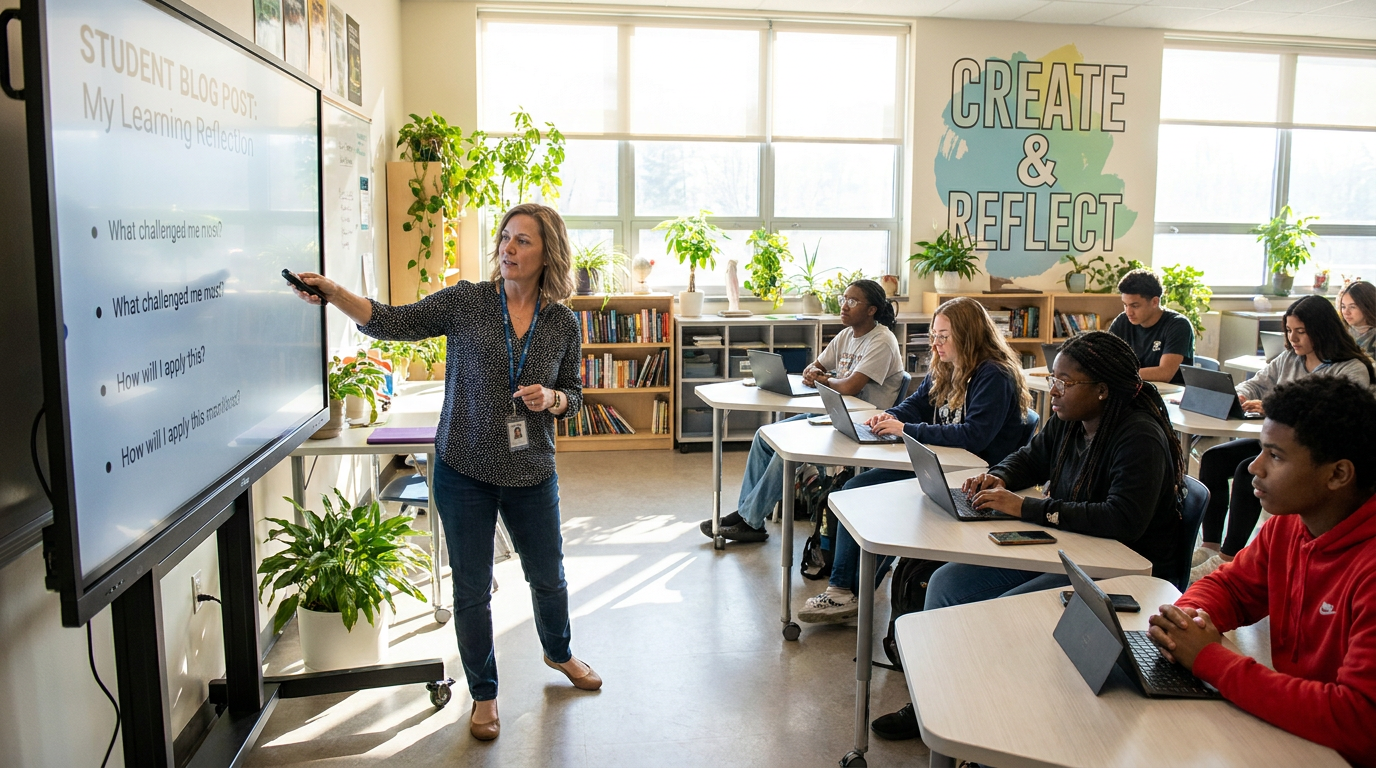
Start with a clear purpose — and share it with your students.
The single most important step before your students write a single word is defining what the blog is for. Is it a space for personal reflection after each lesson? A curriculum response journal? A peer dialogue platform? A combination of all three? Students perform significantly better when they understand the goal of a writing task, and classroom blogging is no exception. The emphasizes this as a foundational step: clarity of purpose shapes everything from prompt design to assessment criteria.
University of Michigan Sweetland Center for Writing
Use bell-ringer prompts to build the daily habit.
One of the most effective strategies for integrating classroom blogging into an already-packed school day is the bell-ringer format: a short, focused blogging prompt that students respond to in the first 5–10 minutes of class. as one of the highest-impact classroom blogging strategies available, precisely because it does two things at once: it focuses students on the day’s topic before the lesson begins, and it builds a writing habit that gradually becomes automatic.
KQED Education identifies this
Co-create the community guidelines with your students.
One of the most powerful — and most commonly skipped — steps in setting up a classroom blog is building the commenting norms with your students, not for them. When students help decide what respectful, constructive feedback looks like, they take ownership of the community they’re creating. The also highlights this as a critical component of successful classroom blog programs: digital citizenship, it turns out, is itself a form of self-reflection — requiring students to consider the impact of their words on a real person.
Sweetland Center
Keep entries low-stakes — always.
This cannot be overstated. The psychological safety of classroom blogging is its superpower, and grading on grammar or perfection destroys it instantly. Assess on effort, engagement, and reflection depth. Tell students explicitly: there are no wrong answers here, only honest ones. The moment students feel judged for the quality of their reflection, they stop reflecting honestly — and you lose the whole point of the practice.
Encourage multimedia from the start.
Allow — and encourage — students to add photos, sketches, voice notes, or links to their posts. This is not just about accommodating different learning styles (though it does that). It’s about enriching the reflective act itself. A student who attaches a photo of the plant they observed in science class and then writes about what drew their attention to it is engaging in a different, richer kind of noticing than one who writes in words alone. Multimedia grounds reflection in specific, sensory reality.
Introduce peer feedback cycles with structure.
Periodically — not every week, but regularly — have students read and respond to two or three classmates’ posts using a structured commenting framework. A simple one that works across grade levels:
- “I noticed…” — identify something specific from the post
- “I wonder…” — raise a genuine question the post sparked
- “This connects to…” — link their reflection to your own experience or another idea
This structure prevents generic feedback (“great post!”) and pushes students into genuine engagement with each other’s thinking.
Build in the “revisit” post.
Once a month, have students re-read an entry they wrote earlier in the term and write a brief response: What do I notice now that I didn’t notice then? Has my thinking changed? What would I add? This simple exercise is where metacognitive growth becomes visible — not just to the teacher, but to the student themselves. These strategies work across grade levels, across subjects, and across varying levels of technological access. They require no special equipment beyond whatever writing tool your students already use — and their effects compound beautifully over time.
Building consistent journaling habits
over time is what makes the retrospective “revisit” so powerful: there has to be a past to look back on.
But strategy alone doesn’t solve the most common teacher challenge: the blank page. What do students actually write about
? That’s what comes next.
Reflection Prompts for Every Grade: Ready to Use Tomorrow
The best classroom blogging prompt is one that meets students where they are — developmentally, emotionally, and intellectually. A prompt that works for a 10th grader will leave a 2nd grader confused; a prompt designed for a 7-year-old will feel condescending to a teenager. The art is in calibration — and the good news is that once you understand the developmental logic, creating your own prompts becomes instinctive.
What follows is a three-tier prompt bank organized by grade band. Use these as-is, adapt them to your current unit, or let them inspire your own variations. There are no wrong answers here. The goal is always observation, articulation, and the slow building of reflective fluency.
For Elementary Students (Grades K–5): Concrete, Sensory, and Personal
Young students reflect best when prompts are anchored in immediate, physical experience — things they can see, touch, hear, or feel. Abstract questions about “your learning process” will produce blank stares; questions about what they noticed today will produce genuine responses.
- “Write about something that surprised you today. What did you see, hear, or feel? What made it surprising?”
- “What was the hardest part of today? What did you try? Did it help?”
- “Draw or describe one moment from today that you want to remember. Why did you choose that moment?”
- “What is something you did today that you’re proud of? What made it feel good?”
- “Describe something you noticed today that you had never noticed before. Why do you think you noticed it today?”
offer excellent structured lesson frameworks for teachers embedding blogging into the K–3 curriculum for the first time.
ReadWriteThink’s classroom resources for primary blogging
For Middle School Students (Grades 6–8): Cause, Effect, and Perspective
Middle schoolers are developmentally ready to move from simple description to cause-and-effect thinking and emerging perspective-taking. The best prompts for this group invite them to examine not just what happened but why it happened and how it looked from someone else’s point of view.
- “Describe something you learned today that changed the way you were already thinking about it. What did you think before? What do you think now?”
- “What question do you still have after today’s lesson? Why does that question feel important to you?”
- “Write about a moment today when you felt challenged or confused. What did you do? What would you try differently next time?”
- “How might today’s lesson have looked different from another student’s point of view? What might they have noticed that you missed?”
- “If you had to explain the most interesting thing from today to a friend who wasn’t in class, what would you say? What details would you choose?”
is an excellent companion resource for middle school teachers building a blog-as-journal practice into their curriculum.
Classroom Nook’s guide to student blogging as journaling
For High School Students (Grades 9–12): Analysis, Identity, and Narrative
High school students are capable of sophisticated self-examination — but they need prompts that take them seriously as thinkers. The best high school reflection prompts push toward genuine intellectual honesty: examining assumptions, tracing the arc of their own thinking, connecting academic content to lived experience.
- “What assumption did you hold before this unit that has been challenged, confirmed, or complicated? What changed your mind — or didn’t?”
- “Describe the specific moment today when your thinking shifted. What caused it? What does it mean for how you understand this topic?”
- “Write a reflection on how today’s content connects to something happening in your own life or in the world right now. Where are the real connections?”
- “If you had to teach today’s concept to someone who knew nothing about it, how would you explain it? What would you emphasize? What would you leave out, and why?”
- “What is one thing you genuinely don’t understand yet — about today’s topic, or about your own response to it? Why does the uncertainty feel important to sit with?”
A note for teachers at every level: AI-assisted prompt generation is a genuinely useful tool for keeping your prompt library fresh without the prep burden. , for example, can help generate prompt variations tailored to a specific lesson topic — so you’re never starting from a blank page either.
Lugelo’s AI Journal Assistant
When students have prompts that actually fit where they are, blogging becomes generative rather than obligatory. But the experience deepens further still when individual blogs become something shared — when the class discovers what it means to reflect together
.
From Individual Blogs to Collective Stories: The Power of Collaborative Journaling
There is a moment in classroom blogging — typically a few weeks in — when something quietly extraordinary happens. A student reads a classmate’s reflection on the same field trip they both attended and realizes: they noticed something completely different than I did.Collaborative journaling moves students from self-reporting to perspective-taking. When they read each other’s reflections on shared experiences, they begin to understand one of the most foundational truths of communication and storytelling: that every shared event produces multiple valid narratives, each shaped by the observer’s unique lens of attention, memory, and meaning-making. This insight is the bedrock of empathy. It is the engine of literary analysis. It is the skill that distinguishes a thoughtful communicator from a merely fluent one.
This is the moment when individual blogging becomes something more. It’s the moment when collaborative journaling begins.
They saw the same hawk, walked the same path, stood in the same rain — and came back with an entirely different story.
Research by confirms what teachers who’ve tried this already know: structured peer interaction around student writing doesn’t just improve the social dynamics of a classroom — it measurably improves the quality of writing itself. When students know that peers — not just teachers — will read their reflections, they invest differently. They want to be understood. They want to be interesting. They want to say something worth reading.
Novakovich (2016)
“Stories are the shared symbols of our common journey. When we tell stories together, we illuminate paths of connection and purpose.” — Collaborative storytelling research, as cited in
Lugelo’s exploration of community storytelling
Digital journaling platforms designed for collaboration take this principle and give it a practical home. Imagine a class that has just completed a month-long science project. Each student has been keeping their own reflective blog throughout — noting what confused them, what clicked, what they discovered by accident. Now imagine gathering all of those entries into a single shared journal: a multi-perspective record of the project, told from twenty different angles, enriched with photos, sketches, and voice notes. The resulting document is something no individual student could have produced alone. It is a collaborative narrative — and it is a far more honest and complete record of what actually happened in that classroom than any teacher’s lesson plan or assessment rubric could ever capture.
This is precisely the kind of work that platforms like What makes Lugelo particularly well-suited to classroom use is what happens at the end of the process: the ability to transform a collection of entries into a beautiful storybook, interactive timeline, or ebook. Imagine presenting students with a finished, illustrated book of their class’s collaborative field trip journal at the end of the term. Imagine watching their faces when they see their words — their observations, their reflections, their photographs — transformed into something that looks and feels like a real publication. That moment changes a student’s relationship to writing. It stops being homework. It starts being creation.
Lugelo
are built to support. Lugelo’s shared journal features allow multiple contributors to add written entries, photos, voice notes, and videos to a single collaborative journal — making it possible for an entire class to build a collective memory of a shared experience. With teacher-controlled privacy settings, student entries remain visible only to the class — not publicly accessible on the internet — which is a non-negotiable requirement in K–12 settings.
As Lugelo’s own exploration of
digital diaries in educational contexts
The collaborative dimension of classroom blogging represents something deeper than a pedagogical technique. It represents a vision of what a classroom can be: a community of observers, each one noticing the world through their own particular lens, each one contributing their perspective to a shared story that is richer for every voice it includes.
notes, the transition from traditional to digital journaling opens new dimensions of expression — particularly for students who are more comfortable with visual or audio communication than with written text alone. Every student has a story to tell. The best platforms make room for all the ways that story might want to emerge.
Your 30-Day Launch Plan: How to Start a Classroom Blog Practice
Here’s the truth about starting something new: it always feels bigger than it turns out to be. The planning stage, the what-ifs, the concern about technology or time or student engagement — these obstacles loom large before you begin. And then you try it, and you realize: it was never that complicated. You just needed to start.
This four-week launch plan is designed to remove every barrier between you and your first classroom blog entry. Take it a week at a time. Take it a day at a time, if you need to. You don’t have to do all of this at once. Start with one prompt. One week. One entry.
Week 1 — The First Entry: Something I Noticed
Introduce the concept to your students without calling it “blogging” if that word carries baggage. Frame it as storytelling. Reflection. A written conversation. Have students write their first post using the simplest possible prompt: “Write about something you noticed this week — in class, in the hallway, at home, anywhere. What was it? Why did it catch your attention?”
Read the entries before the next class. Don’t grade them. Notice who surprised you. Notice who struggled. Share one or two observations with the class — anonymized if needed — to model what thoughtful reflection looks like.
Week 2 — Building the Community: The Commenting Framework
Establish the commenting community. Have students read two classmates’ posts and respond using the I noticed / I wonder / This connects to framework. Before they write their comments, hold a brief class discussion: What makes a comment feel respectful? What makes it feel dismissive? What does it feel like to have someone engage thoughtfully with something you wrote?
Debrief the experience afterward. Ask: What did you learn from reading someone else’s reflection on the same week you both lived through? The answers to that question are usually the most illuminating conversation you’ll have all term.
Week 3 — Adding Depth: Multimedia and Specificity
Introduce a multimedia element. Ask students to include one photo, one sketch, or one voice note in their week’s post — something that adds a dimension their words alone couldn’t capture. Discuss in class: How does the image change the story? What does it show that the writing doesn’t? What does the writing show that the image can’t?
This conversation about the relationship between image and text is, quietly, a lesson in media literacy, narrative structure, and the specific power of words — three skills any teacher in any subject would be glad to develop.
Week 4 — The Revisit: Seeing Your Own Growth
Assign the “revisit” post. Ask students to re-read their Week 1 entry and write a response: What do you notice now that you didn’t notice then? Has your thinking changed? What would you add, remove, or say differently?
This is the week when the magic becomes visible. Students will laugh at their own early entries. They’ll be surprised by an observation they’d forgotten making. They’ll notice their own growth — not because you pointed it out, but because they can see it in the evidence of their own words. That moment of self-witnessed development is more motivating than any grade, any comment, any gold star.
Privacy and Assessment — Two Non-NegotiablesBefore you launch, two practical essentials: privacy and assessment.
For K–12 settings, student entries must never be publicly accessible without explicit consent and parental permission. Always use a platform with teacher-controlled access settings. Platforms like are built with exactly this kind of privacy infrastructure — giving teachers full control over who can see what, while still enabling the collaborative and multimedia features that make the practice rich.
Lugelo
For assessment, use a simple rubric focused on three things: effort (did they engage genuinely?), reflection depth (did they go beyond surface description?), and peer engagement (did they contribute meaningfully to the commenting community?). Grammar is not on the rubric. Perfection is not the goal. The habit is the goal.
Scaling Up: When You’re ReadyOnce students are comfortable with the weekly rhythm — usually by Week 6 or 8 — begin introducing collaborative journals around specific class events. A science experiment. A book read aloud. A field trip. A classroom debate. Invite students to contribute their individual perspectives to a shared journal of the event, building a multi-voice record that the whole class can revisit at the end of the term.
With a platform like Lugelo, that shared journal can be transformed into a storybook or timeline — giving the class something lasting, beautiful, and genuinely their own to show for the work. walks through exactly what that collaborative, multimedia process looks like in practice.
Lugelo’s features page
And if you’re new to digital journaling entirely, is an excellent starting point — as is , which makes clear that educators and students are very much part of the answer.
this exploration of who digital journaling is actually forLugelo’s beginner’s guide to digital journaling
Additional practical guidance is available through — a resource worth bookmarking as you move from launch into a sustained practice.
KQED Education’s ten tips for a successful class blog
At the end of a semester of classroom blogging, your students will have something remarkable: a portfolio of reflections that traces their growth as thinkers, writers, and observers. A visible, scrollable, revisitable record of who they were and how they changed. That is not a side effect of the curriculum. That is the curriculum, made manifest.
The Story Worth Telling: Why This Work Matters Beyond the Classroom
Let’s return to the student from the beginning. The one who came back from the field trip and wrote two sentences. “It was fun. We saw birds and a river. I liked it.”Ask them now to write about a meaningful experience. Watch what happens.
Now imagine that same student — six months later, after a semester of classroom blogging. They’ve written every week. They’ve read classmates’ posts and discovered that the hawk meant something different to everyone who saw it. They’ve attached photos, added voice notes, revisited old entries and been surprised by what they found. They’ve had their reflections read, responded to, and taken seriously.
They notice more. They reach for more specific language. They place themselves inside the moment rather than reporting it from a distance. They tell you not just what they saw, but what they made of it — and why it still matters to them now. They have become, through practice and patience and the right kind of scaffolding, a reflective writer.
That transformation is what classroom blogging does. Not immediately. Not perfectly. But consistently, reliably, and in ways that extend far beyond any single subject or skill. Students who blog regularly become better writers, yes — but they also become clearer thinkers, more empathetic peers, and more confident storytellers. They develop the habit of looking inward and articulating honestly what they find there. And that habit — the habit of self-reflection — is one of the most durable gifts an education can give.
What teachers create through a sustained classroom blogging practice is more than a writing exercise. It is an archive. A record of who these students were during this particular year — what they noticed, what confused them, what moved them, what they were in the process of becoming. That record is worth preserving. Not just as an assessment tool. As a keepsake. As evidence of growth that both teacher and student can be genuinely proud of.
Journals are souvenirs of your past.
For students, a semester of classroom blogs is a record of who they were becoming. For the teachers who made space for that becoming, it is evidence of the most meaningful work in the room.
Start Building Your Classroom’s Story Together
Self-reflection is a practiced skill — and classroom blogging is one of the most effective, flexible, and joyful ways to teach it. You don’t need a special budget, a dedicated tech lab, or a perfectly designed lesson plan. You need a prompt, a platform, and the willingness to give your students space to think out loud in writing.
Lugelo is a private, collaborative journaling platform built for exactly this kind of shared storytelling. Multiple contributors. Multimedia support — photos, voice notes, videos, and text. Teacher-controlled privacy settings. And the ability to transform a collection of student entries into beautiful storybooks, timelines, and ebooks that the whole class can hold onto long after the school year ends.
Everyone has a story to tell. Help your students find theirs.
Get Started on Lugelo — Free →
Want to explore what Lugelo can do for collaborative classroom storytelling before you sign up?
See Lugelo’s Features →
Available wherever your students are — iOS, Android, HarmonyOS, and web.
Download the Lugelo App →