Cozy December evening scene: a person holding a phone showing a full camera roll beside a warm cup of tea and string lights in soft focus.
How to Save This Year's Memories Before They Slip Away
It's a December evening. The string lights are up, humming their small, warm glow against the dark outside. There's tea cooling on the table, a blanket you keep meaning to fold, and somewhere a playlist you've half-stopped hearing. You pick up your phone out of habit, and your thumb lands on the camera roll.
Four thousand photos. Maybe more.
You scroll for a second. A birthday. A sunset you'd forgotten. A screenshot of something that made you laugh in March. Then you stop, because scrolling four thousand photos isn't something anyone ever actually finishes. You set the phone down. And there it is — that quiet, slightly hollow feeling that arrives every year around now.
Where did the year go?
Here's the honest truth: the year didn't vanish. It's all still there, technically. But it's scattered. The best Moments of your last twelve months are spread across your camera roll, buried in group chats, trapped in voice memos, hiding in a notes app, and half-written in captions you never posted. The year wasn't lost. It was just never gathered.
This article is not about being more productive. It's not another system to feel guilty about abandoning by January. It's about something gentler and, frankly, more important: keeping what mattered before it blurs. We're going to walk through a simple, low-pressure path to year-end reflection — and then we'll turn that reflection into something you can actually hold onto: a finished eBook keepsake you'll genuinely want to reread.
The whole thing starts with a feeling, so let's stay with the feeling for a moment. Because before we talk about how to keep a year, it helps to understand why a year slips away in the first place. There's a reason this happens to all of us, and it's worth knowing — not to feel bad, but to finally do something about it. And when you're ready to gather it all, is the one private place built to hold it.
Lugelo
Why a Whole Year of Memories Slips Through Our Fingers
And then there's the second problem, which is entirely modern and entirely fixable: your memories are scattered across too many places. Think about where a single meaningful week actually lives right now.
Memory isn't a recording. It feels like one — like there's a tape somewhere in your head playing back exactly what happened. But in reality, memory is more like storytelling. Each time you recall something, your brain reconstructs it from fragments, filling gaps with guesses and shaping it around how you feel now. That's why two people remember the same dinner completely differently, and why a vivid moment can soften into a vague impression within weeks. The details blur faster than any of us expect. It's not a flaw. It's the design.
Let's start by letting you off the hook. You didn't forget your year because you're careless or too busy or bad at keeping things. You forgot pieces of it because that's simply how memory works.
- The photos are in your camera roll, mixed with screenshots and receipts.
- The voice note from a friend's birthday toast is in one app.
- The text that made you cry happy tears is in another.
- The ticket stub or the menu you photographed is somewhere in between.
- And the mental note — the one that captured why any of it mattered — is nowhere at all.
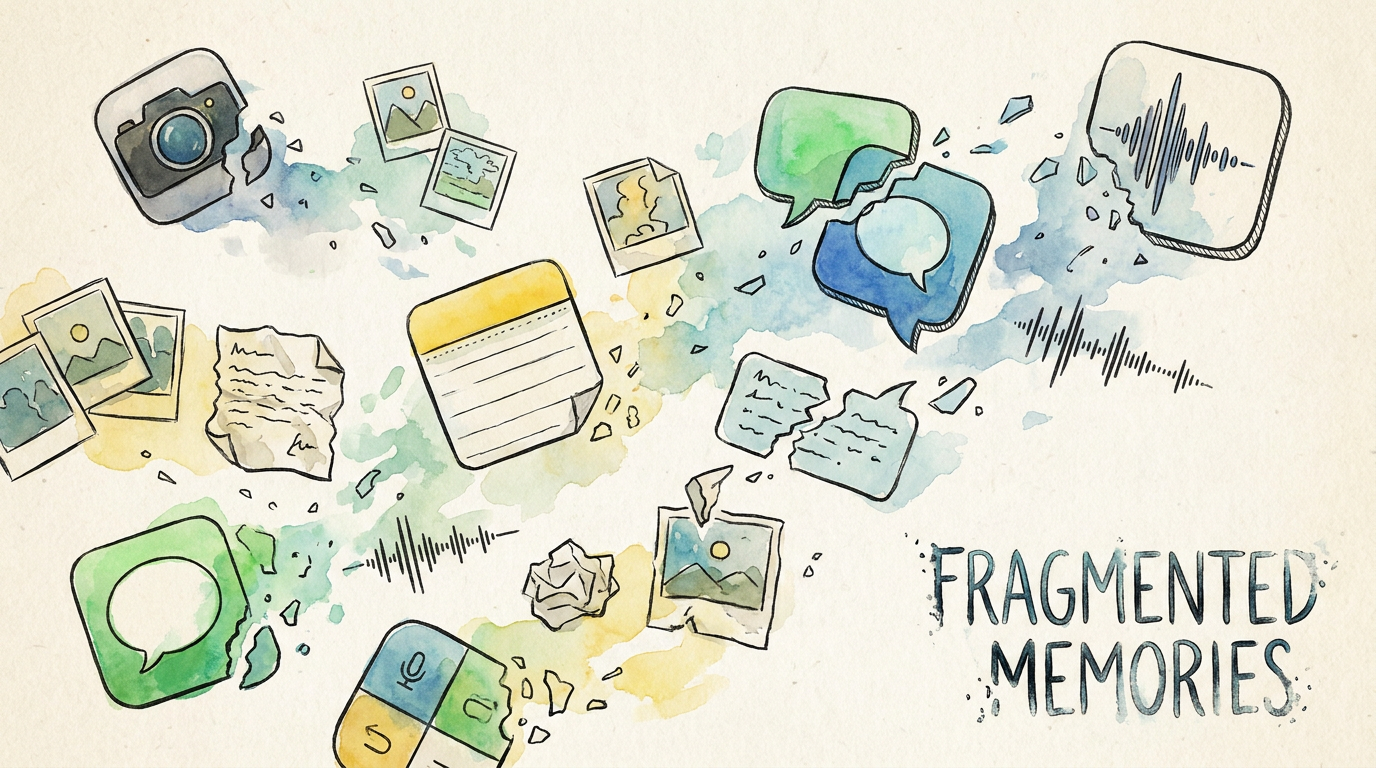
No single place holds the whole story. So even though the raw material exists, the memory itself is fractured across half a dozen apps that were never designed to talk to each other. This is the scattered-app problem, and almost everyone has it.
On top of that sits the quiet little lie we all tell ourselves: I'll organize it later. We screenshot things "to deal with later." We leave camera rolls to sort "when there's time." We promise ourselves a tidy year-end review that never quite arrives, because later is a place that keeps moving further away. By the time we do open the camera roll, there are four thousand photos and no energy to make sense of them. Lugelo exists precisely to collapse that gap — to instead of a dozen half-full ones.
turn a year of scattered moments into one private place
Here's the part that matters most, though, and it's the thing even the most dedicated photo-takers miss. Photos alone aren't the full story. A picture captures the what — the faces, the place, the outfit, the weather. But it almost never captures the why it matteredThat's the real loss in a scattered year. Not the photos — those we usually keep. It's the context. The small, true sentence that would have made the photo mean something in ten years.
. A photo of a crowded kitchen doesn't tell you that it was the last holiday before someone moved away. A snapshot of a quiet street doesn't record that it was the morning you finally made a decision you'd been dreading for months. The image survives. The meaning evaporates.
So what's the fix? It's humbler than you'd think, and that's exactly why it works. The antidote to fading, scattered memories isn't perfect archiving — it's good-enough capture, done now. Capturing the small Moments and a few lines of context in the present beats flawless organization that never happens. A photo plus one honest sentence is worth more, a year from now, than a thousand unlabeled images.
"The stories you don't write down disappear."
That's the whole philosophy in a single line. An end-of-year reflection or a simple year in reviewAnd if the cure for a scattered year is a short, intentional pause, then that's exactly where we should begin — not with technology, but with a ritual.
isn't about documenting everything. It's about rescuing the handful of things you'd be heartbroken to lose.
The Year-End Reflection Ritual: Start Here, Not With the Tech
That's the whole ask. Not a weekend. Not a color-coded project. Twenty minutes, a cup of something warm, and the willingness to look back on purpose. Think of it less as a task and more as a gift to your future self — the version of you who, a decade from now, will give anything for a clear window back into this exact year.
Before you open any app, open a quiet twenty minutes.
Most people skip this step because reflection sounds heavy, like therapy homework. It isn't. It's closer to flipping slowly through a shoebox of photos, except the photos are in your head and you're deciding which ones to save before the box tips over. The magic is that reflection surfacesSo here's your low-pressure starting point. Don't answer all of these. Pick the ones that make you pause.
the right memories. Instead of scrolling four thousand photos hoping something jumps out, you start from feeling and let the moments come to you.
- What's one Moment this year I never want to forget?
- Who showed up for me — and whom did I show up for?
- What small, ordinary day turned out to matter more than I expected?
- What did I learn, make, or survive this year?
- What am I grateful for that I almost overlooked?

Notice what these questions do. They don't ask about achievements or resolutions or whether you hit your goals. They ask about meaning. The ordinary Tuesday that turned out to matter. The person who quietly carried you. The thing you survived that you never gave yourself credit for. Those are the memories that fade fastest and hurt most to lose — and they're almost never the ones we photograph.
As you move through the prompts, capture something for each answer that lands. It doesn't have to be polished. A quick photo. A thirty-second voice note while the feeling is fresh. A single typed line. This is the raw material — the real, unglamorous ingredients that will later become your eBook. Think of yourself less as a writer right now and more as a gatherer, quietly collecting the pieces you'll assemble later.
There's a lovely truth tucked inside this practice. As the Lugelo team likes to put it:
"Journals are souvenirs of your past."
A souvenir isn't a complete record of a trip. It's one meaningful object that brings the whole thing rushing back. Your reflection answers work the same way. One sentence about why a day mattered can unlock the entire memory years later, far better than a hundred photos with no words at all.
Start this solo. There's something honest about reflecting privately first, before anyone else's version of events shapes yours. But once you've surfaced your own highlights, consider a second pass — this time together. Invite your family or a close friend to add their memories of the same year. You'll be amazed how differently someone else remembers the trip you both took, or the holiday you thought you knew by heart. (We'll come back to this idea of shared journals shortly, because it's one of the most quietly powerful ways to keep a year.)
If twenty minutes leaves you wanting more, there's a deeper well to draw from. You can borrow when you want a broader bank of questions, or follow the path we laid out for — which maps almost perfectly onto what we're building here.
turning seasonal prompts into a keepsake your family keepsreflective journal prompts to help you reset
One last reassurance before we move on, because it matters: everything you surface in this reflection stays private by default. These are your thoughts, your souvenirs, your year. Nothing gets shared until youOnce you've named the moments worth keeping, the next step is gathering them into one place you actually control. That's where the scattered year finally starts to come together.
decide to share it — and even then, only with exactly the people you choose.
Gather It All in One Private Place: From Scattered Moments to a Memory Lane
You've done the reflecting. You've got a small pile of raw material — a few photos, a voice note or two, some half-formed sentences about why a handful of days mattered. Now comes the satisfying part: bringing it all home.
The workflow is deliberately simple, because complexity is the enemy of actually finishing. Here's the shape of it:
- Create a journal for the year. One home for twelve months.
- Add your Moments — text, photos, video, audio, even links — one at a time, whenever you have a spare minute.
- Watch them arrange themselves into your Memory Lane, a clean chronological timeline of the year as it actually unfolded.
That last part is the quiet relief. You don't have to build a timeline. As you drop Moments in, your Memory Lane organizes them for you, so the year takes on a shape instead of staying a jumble. Scrolling it later feels less like searching a cluttered camera roll and more like flipping through a story that already makes sense.
The thing worth emphasizing is that a Moment is not just a photo. This is where Lugelo pulls your scattered apps back together. A single Moment can hold the voice note from a birthday toast, the photographed ticket stub from a concert, the screenshot of a text that meant everything, a short video of someone laughing, and a line of your own writing explaining why it mattered — all in one entry. That multimodal capture is exactly what rescues the why, not just the what. The photo shows the kitchen. The voice note is your grandmother's laugh. Together, finally, they're the memory.
And a year rarely belongs to just one person. This is where shared journals turn a good keepsake into an irreplaceable one. Invite your family or friends into a shared journal, and a holiday or a trip gets told from everyone's perspective at once. Your partner remembers the wrong turn that became the best part of the drive. Your sister has the photo you never saw. Your kid adds the detail you completely missed. The journal becomes richer and truer than anything one person could assemble alone — the natural next step after that collaborative reflection pass we talked about earlier.
Now, because this is your life we're talking about, privacy deserves to be stated plainly — not in vague marketing language, but in specifics. Here's exactly how it works, straight from :
how Lugelo handles your privacy and data
- Private by default. Every journal you create is completely private until you explicitly choose to share it. No other users — and no one on the Lugelo team — can see it without your permission.
- You control access. You decide precisely who can view, contribute to, or comment on each journal, and you can revoke that access at any time.
- Encrypted in transit. Data traveling between your device and Lugelo's servers is encrypted, which protects your entries from interception along the way.
- No third-party data selling. Lugelo does not sell your personal data or hand it to third parties for advertising. Your stories are yours.
- Delete anytime. You can delete your account and all associated data through the app; after a 30-day recovery window, it's permanently removed.
That's the honest version. No absolutes, no "military-grade" theatrics, no promises that nothing could ever happen anywhere in the world. Just clear, specific practices you can actually hold us to. For a privacy-conscious person collecting the most meaningful year of their life, specifics matter more than slogans — and you deserve to know exactly what you're agreeing to before you trust an app with your memories.
One more practical reassurance: you can capture on web, iOS, Android, and HarmonyOS, and your journals sync across all of them. Start a Moment on your phone at a family dinner, finish the thought on your laptop that night, and it's all there. Even offline capture works, which is a small mercy when the best memories tend to happen exactly where the signal is worst — a mountain trail, a packed stadium, a cabin with one bar. When you're ready to see the full picture, you can With a full year of Moments gathered on your Memory Lane, you've already done the hard part. Now you get to do the rewarding part — turning that timeline into something finished, something you can hold onto and reread for years.
capture, organize, and build your Memory Lane
in one place.
Turn Your Year Into an eBook You'll Actually Keep
A camera roll is infinite. It never ends, it never resolves, and it quietly makes you feel like you're behind. You scroll it with a vague anxiety and close it without satisfaction. It's a stream, not a story.
Let's talk about the difference between a camera roll and a keepsake.
An eBook is the opposite. It's finished. It has a cover, a title, a beginning and an end. It's a "Year in Review" you can actually sit down and reread the way you'd reread a good book — or hand to someone you love. That's the emotional payoff, and it's bigger than it sounds. There is something deeply settling about taking a chaotic, overwhelming year and giving it a shape you can hold. The scroll makes you feel like you're drowning in time. The eBook makes you feel like you kept it.
Here's the best part: making one is far simpler than making a scrapbook by hand ever was. You've already done the gathering. Now you're mostly just choosing and arranging.
- Open your year's journal — your Memory Lane, with everything already in order.
- Choose a template or theme for your year-in-review eBook.
- Arrange your chapters by month, by season, or by theme — travel, family, wins, the quiet moments.
- Let the layout pull in your photos, text, and captions automatically.
- Preview it, personalize the cover and title, and then export your eBook.
That's it. In an evening, a year of scattered fragments becomes a bound keepsake. This is what people really mean when they talk about turning photos into a book or building a proper year in review — not more storage, but a finished thing you'll return to.
Who is this for? Honestly, almost everyone, in slightly different ways:
- A parent making a family year-book the kids will fight over in twenty years.
- A group of friends compiling the trip of a lifetime into one shared volume so no one's version gets lost.
- A solo journaler writing a personal memoir of a single year — a private record of who they were right now.
And if your heart leans more visual than literary, the eBook has a sibling. Lugelo can also produce a scrapbook/storybook — a more collage-style, photo-forward keepsake for people who think in images rather than paragraphs. Same raw material, different mood. You're not locked into one format; you're choosing the one that feels like you.
Whatever shape you choose, it's shareable entirely on your terms. Gift the eBook to your family. Keep it fiercely private. Share it with a group of three. The choice stays yours, every time. And when you're ready, you can in just a few taps.
export your year into an eBook keepsake
If this all sounds a little sentimental, consider that the instinct to actively preserve memory — not just store it — is recognized as genuine best practice by institutions whose entire job is keeping things for the future. The , emphasizing that preservation is an intentional act, not a passive one. Files sitting on a hard drive aren't preserved; they're just stored, one failed device away from gone. A keepsake you've curated, titled, and can actually open and read is preservation in the truest sense. Making an eBook isn't indulgent. It's exactly what the archivists would tell you to do.
Library of Congress offers guidance on preserving family memories and collections
An eBook lets you reread your year whenever you like. But some memories deserve more than rereading — a handful each year are worth stepping back inside. For those, Lugelo has something more immersive in store.
Go Further: VR Galleries and Storybooks for the Moments You Want to Relive
Not every memory needs to be a cathedral. Most are perfectly happy as a page in your eBook. But every year has a few standout moments — the milestone trip, the wedding, the once-a-year celebration where everyone you love was somehow in the same room — that deserve something bigger than a flat photo on a flat screen.
That's where the VR Gallery comes in.

The idea is simple and a little magical: instead of scrolling photos on a screen, you step into them. Your images become a 360° gallery you can walk through — a personal museum of your own memories, each one placed in space around you, waiting to be rediscovered rather than just viewed. Open a chapter, and you're standing inside it. You can wander your memories alone, or walk through them with the people who were there.
A word of grounding, because aspiration without honesty is just hype: not every memory needs VR. Trying to immersively reconstruct all four thousand photos would be exhausting and, frankly, miss the point. The power of the VR Gallery is in restraint. Pick the handful of moments worth reliving in three dimensions — the trip, the milestone, the celebration — and let the rest live happily as pages and timelines. You don't need a headset to start, either; it works right in the app, with headset support when you want the fully immersive version. If you're curious, you can and see for yourself.
explore Lugelo's VR Galleries
And for those who'd rather hold a memory than put on a headset, the scrapbook/storybook format is the tactile counterpart — a warm, visual, collage-style keepsake that's perfect for family memories you want to flip through on a couch rather than experience in 3D. Different people relive memories differently. Some want to step inside them. Some want to turn pages. Lugelo is built to let you do either.
Now, there's a lovely reason to go to all this trouble of preserving family stories — and it's worth sharing carefully, because the research here is often overstated, and we'd rather tell you the honest version.
Researchers at Emory University — psychologists Marshall Duke and Robyn Fivush, through their — have suggested that children who know more about their family's stories tend to show a stronger sense of identity and well-being. They developed a short questionnaire, the "Do You Know?" scale, asking kids things like how their parents met and what happened the day they were born. Kids who could answer more of these questions tended to score better on measures of resilience.
research on family narratives
It's a beautiful finding. But here's the honest caveat the headlines usually leave out. This work is correlational, not causal — it shows an association, not proof that knowing family stories causes well-being. (It's just as plausible that families who are already close and stable both tell more stories and raise more resilient kids.) And the samples were small and fairly homogeneous — on the order of a few dozen families and roughly sixty-odd adolescents, largely two-parent and middle-class.
So treat it as a meaningful idea, not a scientific guarantee: preserving your family's stories is a lovely, well-motivated thing to do — not a magic formula with promised outcomes.
That honesty doesn't weaken the point; it strengthens it. You don't need a research guarantee to know in your bones that the people you love will treasure the stories you keep. Whether you choose an eBook, a storybook, or a VR Gallery, the goal is the same, and it's the thread running through everything here: don't just live the year — keep it.Before you dive in, there are a few practical questions almost everyone asks right about now. Let's clear those out of the way so nothing stands between you and starting.
Frequently Asked Questions About Saving This Year's Memories
How do I turn a year of photos into a book?
Gather your photos and notes as Moments inside a single journal, choose a template, arrange your chapters by month or theme, and export the whole thing as an eBook. The layout pulls in your photos and captions for you, so most of the work is just choosing and arranging. You can if you want the full walkthrough.
see all features
Is my journal private? Who can see it?
Private by default. Every journal stays completely private until you choose to share it, and even then you control exactly who gets access and can revoke it anytime. Data is encrypted in transit, it's never sold to third parties for advertising, and you can delete everything (permanently, after a 30-day recovery window). The full details are in .
the privacy and data handling FAQ
How long does it take to make a year-in-review eBook?
Honestly? A focused evening is usually enough once your Moments are gathered. If you capture a little each week going forward, it becomes almost effortless — but even starting from scratch in December, one good sitting with your camera roll and a few prompts will get you there.
Can my family or friends add their memories too?
Yes. Shared journals let you invite family and friends to contribute their own photos, voice notes, and reflections directly into the same story. You stay the owner with full control over access, while everyone adds the perspective only they have.
What devices can I use?
Lugelo works on web, iOS, Android, and HarmonyOS, and your journals sync automatically across all of them. Start on your phone, finish on your laptop — it's all in sync.
What if I didn't journal all year — is it too late?
Not even close. Start from your camera roll and a few of the reflection prompts above. You don't need a daily record of all twelve months — backfilling the highlights is more than enough to make a keepsake worth keeping. The best time to start was January. The second-best time is tonight.
With the practical worries handled, there's just one thing left: the reason to actually do it.
The Year Deserves a Shape, Not a Scroll
Only this time, the camera roll isn't a source of quiet dread. It's raw material with a purpose. The year isn't a blur you can't quite account for — it has a shape now. A journal. A Memory Lane. An eBook with a cover and a title and chapters you chose, resting on the table where anyone you love can pick it up.
Picture that December evening again. The string lights, the tea, the phone in your hand.
That's the whole promise of year-end memory preservationAnd it stays yours the entire way. Private by default, shared only when and with whom you choose, deletable anytime you want. You never have to trade your privacy for your memories.
, and it really is this simple: a short reflection to surface what mattered, a Memory Lane to gather your Moments in one private place, and an eBook export to turn it all into a keepsake you'll actually keep. Twenty minutes and an evening. That's the trade. A fading, scattered year in exchange for one you can hold.
If there's one thing to carry out of all this, it's that it is never too late to start — and next year's version begins the same humble way this one does: by capturing a little, today. One Moment. One honest sentence. One photo with its why attached.
This is simply the first step in saving this year well. There's more to come as the New Year approaches — but it all begins here, with a single journal and the decision not to let another year quietly slip away. When you're ready, you can in about sixty seconds.
start your first journal
Don't Just Live It — Keep It
Start Saving What Actually Matters.
Create your first journal, gather this year's Moments, and export your eBook before the year turns. It takes less time than scrolling your camera roll one more hopeless time — and it leaves you with something you'll still treasure a decade from now.
Available free on web, iOS, Android, and HarmonyOS.
Don't Just Live It — Keep It → Start your journal on Lugelo