What Is a Junk Journal? The Messiest, Most Forgiving Way to Keep Memories
So it sits there.
You do not know what to do with any of it. Too meaningful to bin. Not important enough to frame.
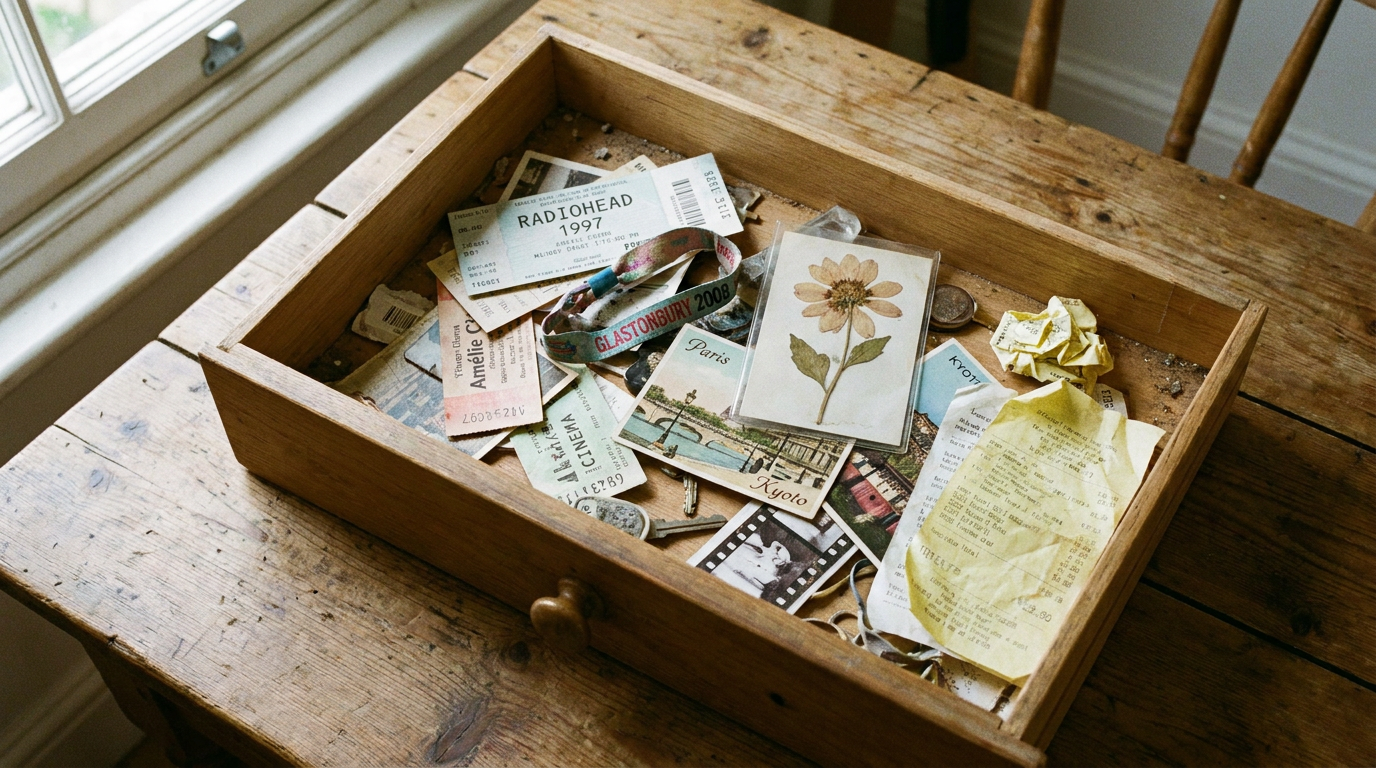
Inside it: a ticket stub from a gig you can still hear. A festival wristband cut off with kitchen scissors. A receipt from a day that turned out to be one of the good ones. A pressed flower, flattened inside a book you never finished. A hotel key card that stopped working the moment you left. A child's drawing, folded into quarters by small hands.
There is a drawer in your home. You know the one.
Here is the thing nobody told you: that drawer is already a junk journal waiting to happen. This post answers exactly what is a junk journal, and shows you how to start one this week without buying a single thing.
And if you have ever bought a beautiful notebook, written in it for nine days, missed a day, and never opened it again — read on. This is the format built for you.
The mess is the format, not a failure of it. Nothing here can be ruined. There is no blank page to live up to.
What Is a Junk Journal? A Plain-English Definition
That is the point. A junk journal is a rescue operation.
Let us be clear about the word "junk." It is literal, and it is affectionate. The materials really were heading for the bin. The bus ticket. The wrapper. The label off a bottle of wine you liked. Their whole value is that nobody else thought they were worth keeping.
Most journals ask you to produce something. A junk journal asks you to keep something. That is a much smaller ask, and it is why people who have failed at every other kind of journal tend to get on with this one.
That is the whole idea. You are not starting with an empty page and a pen. You are starting with a pile of things that already exist, that already meant something, and you are giving them somewhere to live.
A junk journal is a book you fill with everyday bits and pieces you already have — tickets, scraps, packaging, photos, notes — instead of writing on blank pages. There are no rules about neatness. The word "junk" means found and reused materials, not bought craft supplies. Anything you kept can go in.
What Actually Goes In One
Short answer: whatever survived your pockets. Longer answer:
- Tickets and stubs
- Maps and transit passes
- Boarding passes
- Menus
- Packaging and labels
- Postage stamps
- Receipts
- Fabric or ribbon
- Pressed flowers and leaves
- Handwriting — notes, cards, lists
- Kids' drawings
- Photos, including the bad ones
- Wrappers
- Business cards from places you loved
The bad photos matter more than you think. The blurry one where somebody blinked is often the one that brings a day back whole.
People Have Been Doing This For Centuries
This is not an internet trend that appeared last week. Long before anyone had a phone, people were saving scraps.
Families tucked clippings, announcements and sentimental odds and ends between the pages of household books for safekeeping. Others kept commonplace books — gathered in one place so nothing got lost. When printing got cheap, people began pasting cards, wrappers and clippings straight into bound books.
collections of recipes, quotes, letters and useful notes
The Victorians were especially good at it. University collections of There is even a surviving journal kept by a boy who filled his with clippings, sketches, maps and keepsakes. No name for the format back then. He just did it.
everyday printed material from the Victorian era
are full of things nobody was supposed to keep — greeting cards, packaging, handbills, advertising oddments — described by the library as treasures rescued from the wastebasket. They were tucked away in scrapbooks, shoe boxes and old trunks, and they are now a record of ordinary life that no official history could give us.
The proper word for all this throwaway paper is — things made to be used once and discarded. Junk journals are the modern, messier descendant of the same instinct.
ephemera
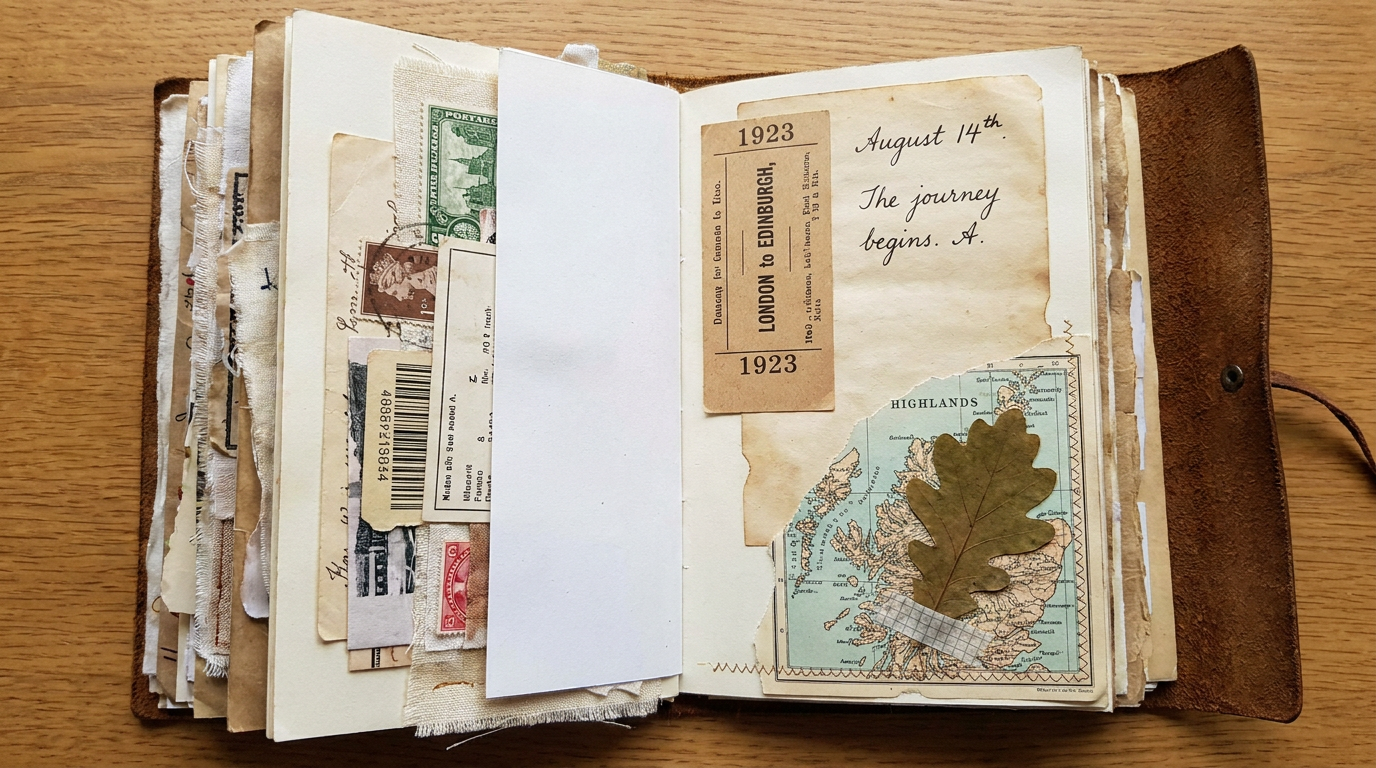
One last reassurance before we go further. A junk journal does not have to look like the ones you have seen online. Most real ones do not. Most real ones are lumpy, over-stuffed, slightly crooked, and closed with an elastic band because the spine gave up months ago.
That is what a used one looks like.
Now you know what it is. The next question is the one everybody asks: how is this different from all the other books people keep?
Junk Journal vs Scrapbook vs Bullet Journal vs Art Journal vs Diary
Five formats, constantly confused with each other. Here is each one measured the same way — how neat it needs to be, what it is for, how long it takes, and who it suits.
Junk journal
- How neat does it need to be? Messy is fine and expected
- What it's for: Keeping physical bits of real life
- Time it takes: Minutes at a time
- Best for: People who hate blank pages
Scrapbook
- How neat does it need to be? Tidy and planned
- What it's for: Displaying photos of events
- Time it takes: A longer sit-down project
- Best for: People who like layouts and finishing things
Bullet journal
- How neat does it need to be? Neat and structured
- What it's for: Planning, tasks and habits
- Time it takes: Daily upkeep
- Best for: Organisers and list-makers
Art journal
- How neat does it need to be? Messy is fine
- What it's for: Drawing, painting and visual play
- Time it takes: Varies widely
- Best for: People who want to make art, not records
Diary
- How neat does it need to be? Neatness irrelevant
- What it's for: Writing down thoughts and days
- Time it takes: A few minutes daily
- Best for: People who process by writing
If you have not come across the structured list-and-symbol system before, the is worth a look purely for contrast — it is the most organised end of the spectrum, where a junk journal is the least. Similarly, an shares the junk journal's tolerance for mess but has a different goal entirely: making images rather than keeping objects.
art journal or visual diarybullet journal method
Junk Journal vs Scrapbook: The Honest Difference
We have just established that junk journals ask less of you than any of the other four. Now let us talk about why that forgiveness matters so much more than it sounds.
And one permission line before we move on: you are allowed to mix these. Plenty of people keep one book that is part diary, part junk journal, with a shopping list in the back and a pressed leaf taped over it. No one is checking. There is no governing body.
That difference changes everything about how it feels to keep one. A scrapbook has a standard you can fall short of. A junk journal has a drawer you can empty.
A scrapbook gets finished. A junk journal just gets fed.
A junk journal is about keeping the actual object. Not a photo of the ticket. The ticket.
A scrapbook is usually about presenting photos nicely. Trimmed, arranged, captioned, laid out with some care. It has a subject — the wedding, the holiday, the first year — and when the subject is covered, the book is done.
This is the comparison people search for most, so here it is plainly.
Why the Mess Is the Point (And Why Junk Journaling Is So Hard to Fail At)
Now flip it.
Here is why it happens. Blank pages set a standard before you have written a word. Neat daily journals punish gaps by design — the gap is visible, dated, permanent. And the moment a notebook starts feeling like homework, your brain files it under obligation, and obligations are the first thing to go in a hard week.
Almost everyone has done this. It is not a character flaw. It is a format problem.
Then you miss three, and now there is a gap. The gap bothers you. You think about going back to fill it in, which is somehow worse. By week three the notebook has moved to the drawer, and every time you see it you feel a small, specific flavour of guilt.
Then you miss a day.
You buy a beautiful notebook. Thick paper, good cover, the kind you do not want to spoil. The first week is strong. You write every night and you feel like a person who has their life together.
You know the pattern. Let us say it out loud.
A junk journal has no streak to break. There is nothing to keep up. Skip six months and the book is not ruined — there is simply nothing on those pages, and no one to answer to. You come back, you tape something in, you carry on.
The mess is the format, not a failure of it.
The format absorbs mistakes instead of recording them as failures. That is genuinely rare. Most things we try to keep up punish us for our worst week. This one just takes it.
Glue something crooked and it looks like a junk journal. Overlap two tickets so one is half hidden and it looks like a junk journal. Spill coffee on a page and it looks like a junk journal that has been somewhere.
Better still: nothing in it can be wrong.
The Bar Is Lower Than You Think
There is no minimum. There is no expected frequency. Some people add something weekly. Some people tip out an envelope twice a year and spend a Sunday afternoon on it. Both are doing it correctly, because there is no incorrectly.
Read that again if you need to. Not a page. Not a spread. One ticket, one strip of tape, done. That is a complete act of memory keeping, and you can do it standing up in a coat.
One ticket, taped in, is a valid entry.
If you want a little structure alongside the objects — something to write when you are in the mood — a set of gives you a question to answer in a sentence without committing you to anything. One line. No streak attached.
simple prompts for a fresh start
Nothing Was Spent, So Nothing Is Lost
Permission granted. Now let us make starting genuinely easy.
A junk journal asks for a ticket and some tape.
You were using a format that demanded more than you had to give that week. Neatness, consistency, words on demand, a tidy hand, something worth saying. That is a lot to ask of a Tuesday.
You were never bad at journaling.
So let us do the reframe properly, because you may have been carrying this for years.
A junk journal cannot do that to you. The worst possible outcome is a half-full book of things you liked, which is still a nice thing to own.
Compare that to the beautiful notebook. Part of the guilt was always the money. You spent something on the version of yourself who would journal every night, and abandoning it felt like wasting it.
The materials are things you would have thrown away. The book can be one you already own. So if you start and stop, you have lost nothing — no investment sitting there reproaching you.
Here is the quiet advantage nobody mentions.
How to Start a Junk Journal This Week (Without Buying Anything)
You do not need to buy anything. No special paper. No craft kit. No supplies list, no starter bundle, no trip anywhere.
If a guide tells you to buy things before you begin, it has already made this harder than it is. Here is the whole method.
- Find a book. Any notebook. An old diary with blank pages. A cheap exercise book. Even a ring binder. It does not need to be nice — in fact a nice book actively works against you, because nice books make people precious, and precious people do not glue crooked things into them.
- Empty the drawer. Tip the whole lot out onto a table. Ticket stubs, cards, scraps, the wristband, the folded drawing. Do not sort it yet. Sorting is a delaying tactic dressed up as progress.
- Pick five things. Only five. Not the five most important — the five that made you feel something when you picked them up. Your hand already knows.
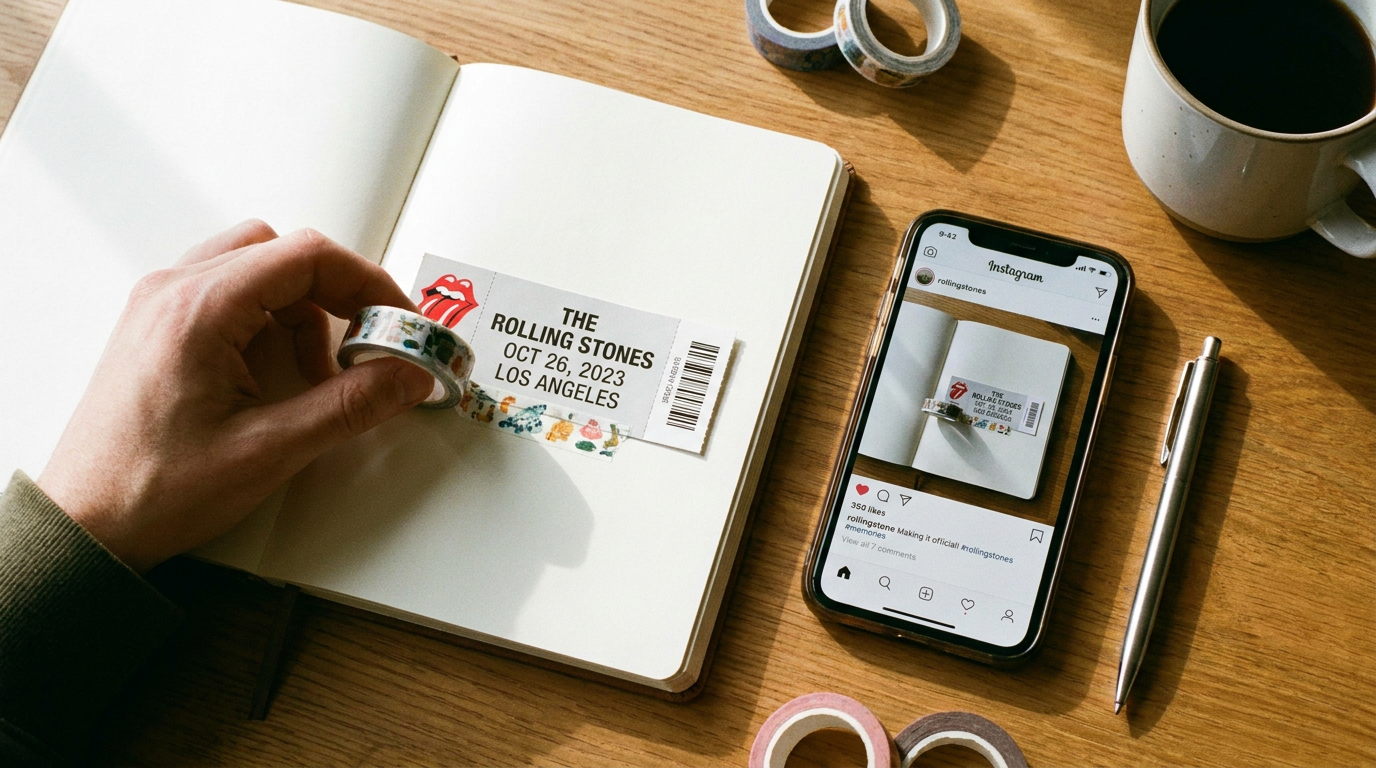
- Stick them in. Tape, glue stick, staples, a paperclip if it is bulky. Crooked is fine. Overlapping is fine. Sticking out past the edge of the page is fine and honestly looks quite good.
- Write one line next to each. The date if you know it, and why it mattered. This is the step people skip. This is the step people regret. More on this shortly, because it is the single most important thing in this entire post.
- Put the book somewhere visible. Not a shelf. A kitchen counter, a bedside table, the arm of the sofa. Out of sight is the death of it. The book needs to be in your way.
- Start a holding spot. An envelope, a tin, a jar by the door. Everything goes in there the moment it comes out of your pocket, and stays until you feel like sticking things down. This is the part that makes it sustainable — it removes the need to do anything at the time.
What Counts As A Tool You Already Have
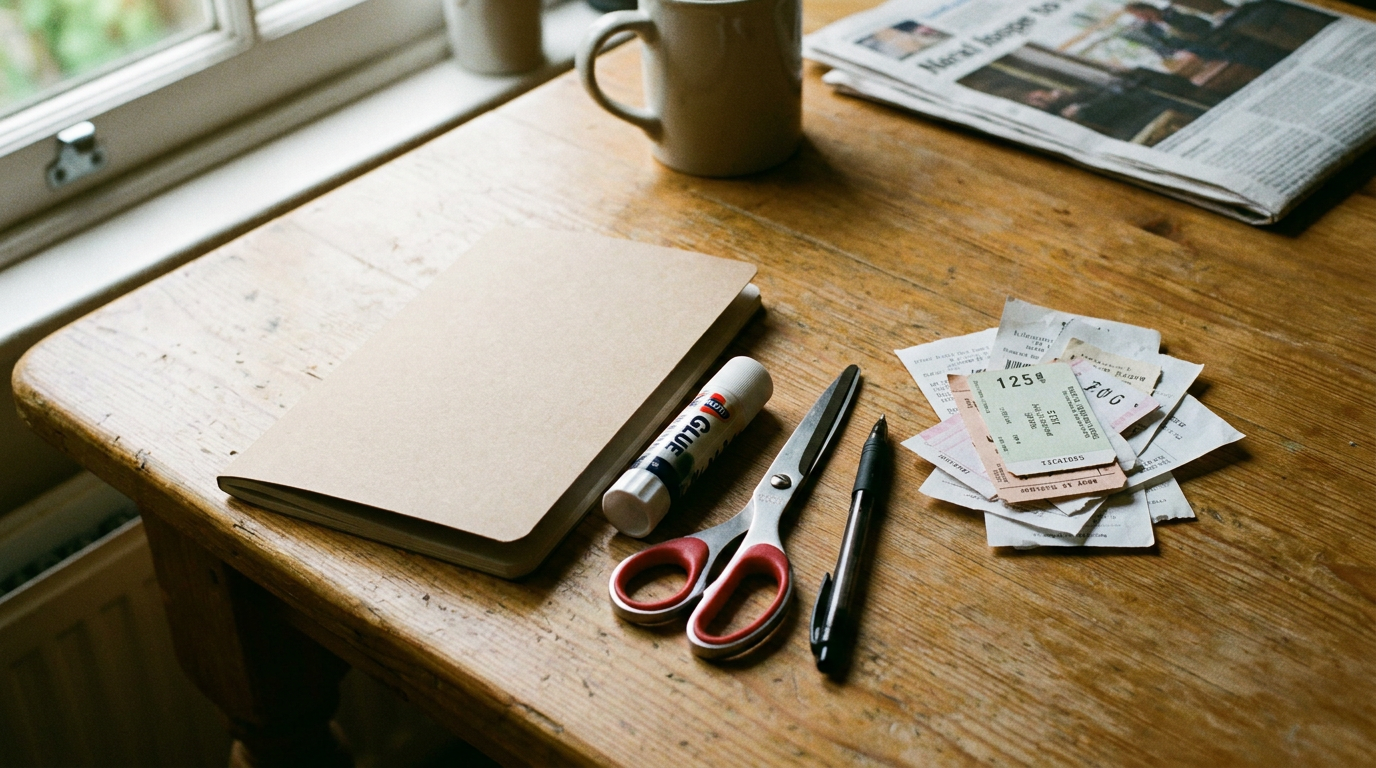
Scissors. Tape. A pen. An envelope.
That is the whole kit. If you own those four things you are fully equipped and can start tonight.
Be realistic about what this is. It is a ten-minute activity done occasionally. It is not a project, it does not need a dedicated evening, and it will not take over your weekends unless you want it to. People who treat it as a project burn out. People who treat it as tipping out an envelope while the kettle boils keep going for years.
One Honest Warning
Glue is not reversible, and tape does not age kindly. Photograph or copy those items instead, put the copy in the book, and keep the original somewhere safe and flat.
An original document. A birth certificate. The only existing copy of a photograph. Something with legal weight or something that belongs to the whole family, not just you.
Do not glue in anything irreplaceable.
If you would rather skip the scissors altogether and start on your phone, a
beginner's guide to digital journaling
You have a book and a method. Now here is what to put in it.
walks through that route — same instinct, different surface.
Junk Journal Ideas: 12 Themes Worth Keeping
The hardest part is not the sticking. It is deciding what the book is about.
You do not strictly need a theme — a general one works fine. But a theme gives you a reason to keep specific things, and that turns a vague intention into something you actually notice in your pocket. Here are twelve junk journal ideas, with the actual objects you would be collecting.
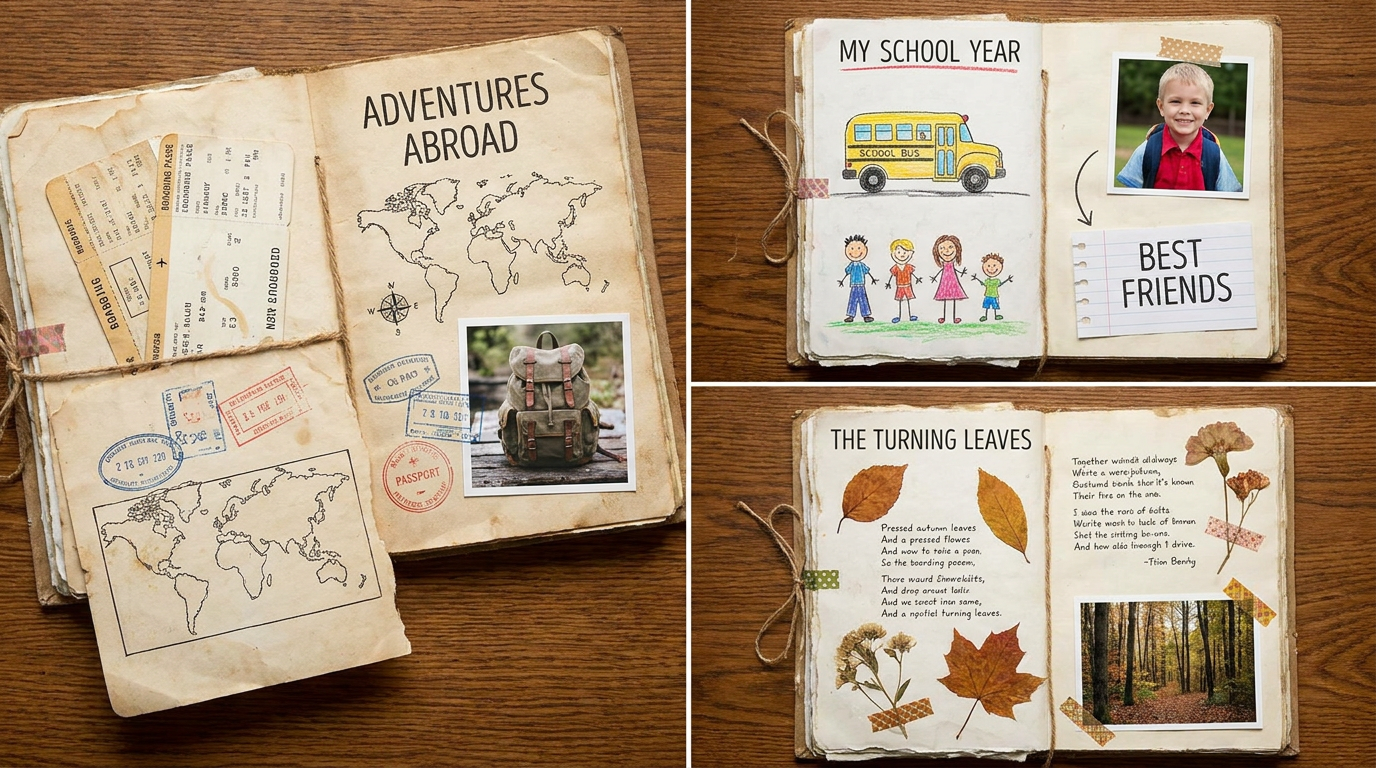
- A trip. Boarding passes, transit tickets, hotel key cards, the napkin from the restaurant you argued about, coins you came home with and never changed back.
- A single year. One page a month. Whatever that month produced — even if some months produce a receipt and nothing else. Especially then.
- A child's school year. Drawings, the class photo, the reading list, a note from a teacher, the date a tooth came out. Children produce ephemera at industrial speed and almost none of it survives. If you want the writing side of this too, there is good thinking in this piece on reflection and self-expression for students.
- A house move. The old front door key, paint swatches you agonised over, the estate agent's listing, the first takeaway receipt in the new place eaten off a box.
- A relationship. Cinema tickets, the receipt from the first meal, notes left on the counter in handwriting you would know anywhere.
- A season. Pressed leaves, a beach ticket, the date of the first frost, a summer festival wristband gone soft at the edges.
- Grief. The order of service. A handwritten recipe in their writing. A photo you cannot frame yet but do not want in a drawer. Some people find this the only kind of keeping they can manage for a while, and that is a good enough reason to do it.
- A hobby. Race numbers, seed packets, concert stubs, match tickets, the scorecard from the round you will not stop mentioning.
- A first job. The ID badge, the lanyard, the offer letter you read four times, a note from a colleague who made it bearable.
- A pregnancy or a new baby. Hospital wristbands, scan appointment cards, the label off the first babygro. This period vanishes from memory faster than almost any other.
- A year of food. Menus, wine labels peeled off carefully, recipes torn from magazines, the card from a bakery worth the detour.
- Family history. Older relatives' handwriting, old stamps, inherited photographs nobody can identify. Objects are only half of it here — the stories need catching too, and 50 questions to ask your grandparents is a practical way to get them said out loud while you still can.
If you want writing to sit alongside the objects, simple art journal prompts
Ideas are the easy part. Making them still mean something in ten years takes one extra step — and it is the step almost everyone skips.
Themes can overlap, and a journal can change theme halfway through. A trip book that turns into a relationship book is not a mistake; it is an accurate account of what happened. Let it drift.
work well — one question at the top of a page, answered in a sentence underneath whatever you have taped down. Not an essay. A sentence. "What did this day smell like." "Who was there." "What did we eat."
Making It Last: One Line of Context, and Whether to Go Digital
The One Thing Junk Journalers Get Wrong
Here is the difference in practice.
One sentence fixes this. Who you were with. What the weather did. What you argued about in the car. What you ate and whether it was any good.
Open an old box of keepsakes and you will find it immediately — a ticket to something, a card from someone, a scrap you clearly cared enough to save, and total silence around it. The object survived. The meaning did not.
This is the whole warning, and it is worth more than every other tip in this post. You will remember the object. You will not remember why you kept it.
A ticket with no note is a mystery in ten years.
A bare concert stub, taped to a page.
The same stub, with one line under it: "First gig after we moved — we got soaked walking back and couldn't stop laughing."
Dates help. Feelings help more. If you write nothing else, write who was there — names are the thing that fades first and hurts most to lose.
Same object. Completely different future.
Physical vs Digital, Honestly
Let us start with what paper does better, because it is a real list and it is not a polite warm-up.
Paper has texture. You are holding the actual object — the one your hand touched, and someone else's hand touched before that. An old ticket smells like the drawer it lived in. The slowness of gluing something down is half the pleasure; it makes you sit with the memory for a minute instead of filing it.
A physical journal asks nothing of a battery or an account. It never logs you out. It does not need updating. Nobody in history has ever lost a shoebox to a forgotten password.
And a physical book can be handed to someone. That matters. There is a particular quality to putting a real object in another person's hands that no screen replicates.
Now what digital does better, plainly.
It is searchable — you can find one memory in seconds without going through a box. Paper fades, ink lifts, tape yellows and goes brittle, pressed flowers crumble to dust if you breathe near them. Boxes get lost in house moves or ruined by damp in a loft.
A physical book can only ever be in one room, which means only one person can hold it at a time. Digital holds audio and video — a voice, a laugh, the way someone said your name — which paper simply cannot do at all. And other people can add their own pieces to the same collection from anywhere, so the version of the story you end up with is not only yours.
The honest recommendation: most people should do both.That is the same act, done twice, in two places. It is insurance, not a replacement.
Keep the physical book. It is the better object and the better experience. Then photograph the pages or the objects as you add them, and type that one line of context alongside the photo.
This is exactly the job a digital journal like is built for — a photo of the ticket, a sentence about the day, and the memory survives long after the tape has gone brittle and the ink has faded. The object stays in the book. The meaning gets a second home.
Lugelo
There is a natural next worry, so let us answer it directly. Lugelo journals are private by default, with owner-controlled sharing, and data is encrypted in transit. You choose whether anyone else ever sees a page. If you want to, family members can be invited to add their own photos and memories to a shared journal — which is genuinely useful for a trip or a family history, where everyone is holding a different piece of the same story and none of the pieces are written down.
And if a collection eventually grows into something you want to hold or hand on, it can be
turned into a printed book or PDF
If you only ever keep the shoebox and the messy notebook — no photos, no app, no backup — you have already done the important part. The objects are saved. Write the line, and you have done nearly all of it.
But let us finish this section where it should finish.
. Back to paper, which is where a lot of this ends up anyway.
Junk Journal FAQs
What's the difference between a junk journal and a scrapbook?
A scrapbook presents photos neatly, with planned layouts and a clear subject. A junk journal keeps the actual physical objects and does not need to be tidy at all. The comparison above breaks down both alongside three other formats. The shortest version: a scrapbook gets finished, a junk journal just gets fed.
Do I need special supplies to start a junk journal?
No. A notebook, glue or tape, scissors and a pen. That is the complete kit and you almost certainly own all of it already. Buying supplies before you start is the most common way people delay starting. Use the rubbish notebook in the kitchen drawer and begin tonight.
What paper do I use in a junk journal?
Whatever you have. Old book pages, envelopes cut open flat, paper bags, plain notebook paper, the back of a leaflet. Thicker pages hold glue better and buckle less, but nothing is required and nothing is wrong. The paper is a surface, not the point.
Is junk journaling expensive?
It is one of the cheapest hobbies there is, because the raw materials are things you were going to throw away. Your only real costs are tape and possibly a notebook. There is no ongoing spend, no kit to upgrade, and nothing wasted if you stop for a year.
How do I start if I have no craft skills?
You do not need any. If you can stick a ticket to a page, you are fully qualified. There is no drawing, no lettering, no layout planning and no technique to learn. Crooked is the house style, and overlapping things is generally an improvement.
What do I write in a junk journal?
One line per item. What it is, roughly when it happened, and why you kept it. Names are the most valuable thing you can record, because they fade fastest. Skip this step and in ten years you will have a book of beautiful objects with no idea what any of them meant.
Can I do a junk journal digitally?
Yes. Photograph the objects and add a line of context underneath each one. It is searchable, it does not fade, and it can hold audio and video. Plenty of people do both — physical book for the pleasure of it, digital copy as a backup against damp, house moves and yellowing tape.
How long does a junk journal take?
Minutes at a time. You can tape something in while the kettle boils, or empty a whole envelope over one afternoon a few times a year. There is no schedule, no streak and no expected frequency. Coming back after six months costs you nothing.
The Drawer, Revisited
There is no streak. No neatness. No rules, and nothing in it that can be ruined — not by mess, not by gaps, not by six months of silence.
A junk journal is not a craft project. It is not a skill to acquire or a standard to reach. It is a place to put the things you could not throw away, which is a need you already had before you had a word for it.
What has changed is that you now know what it is for.
Nothing in it has changed since you started reading. The wristband is still there, the stub, the folded drawing, the receipt from the good day.
Go back to that drawer.
The only rule worth keeping is this one: write the one line.
That is a junk journal. You have already got most of one.
So tonight, five things. Ten minutes. Tape them in crooked and write who was there.
The objects keep themselves. The meaning needs your help.
Don't Just Live It — Keep It
If you want a copy of it somewhere that will not fade, yellow or disappear in the next house move: photograph the ticket, add the line, and let it sit safely alongside everything else.
Journals are private by default, with owner-controlled sharing — you decide whether anyone else ever sees a page. When you do want company, family and friends can be invited to add their own photos and memories to a shared journal, so the whole story gets kept and not just your corner of it.
Start Saving What Actually Matters →
And if you would rather not? Keep the shoebox. Keep the messy notebook with the elastic band round it. That is still a perfectly good answer, and it always was.