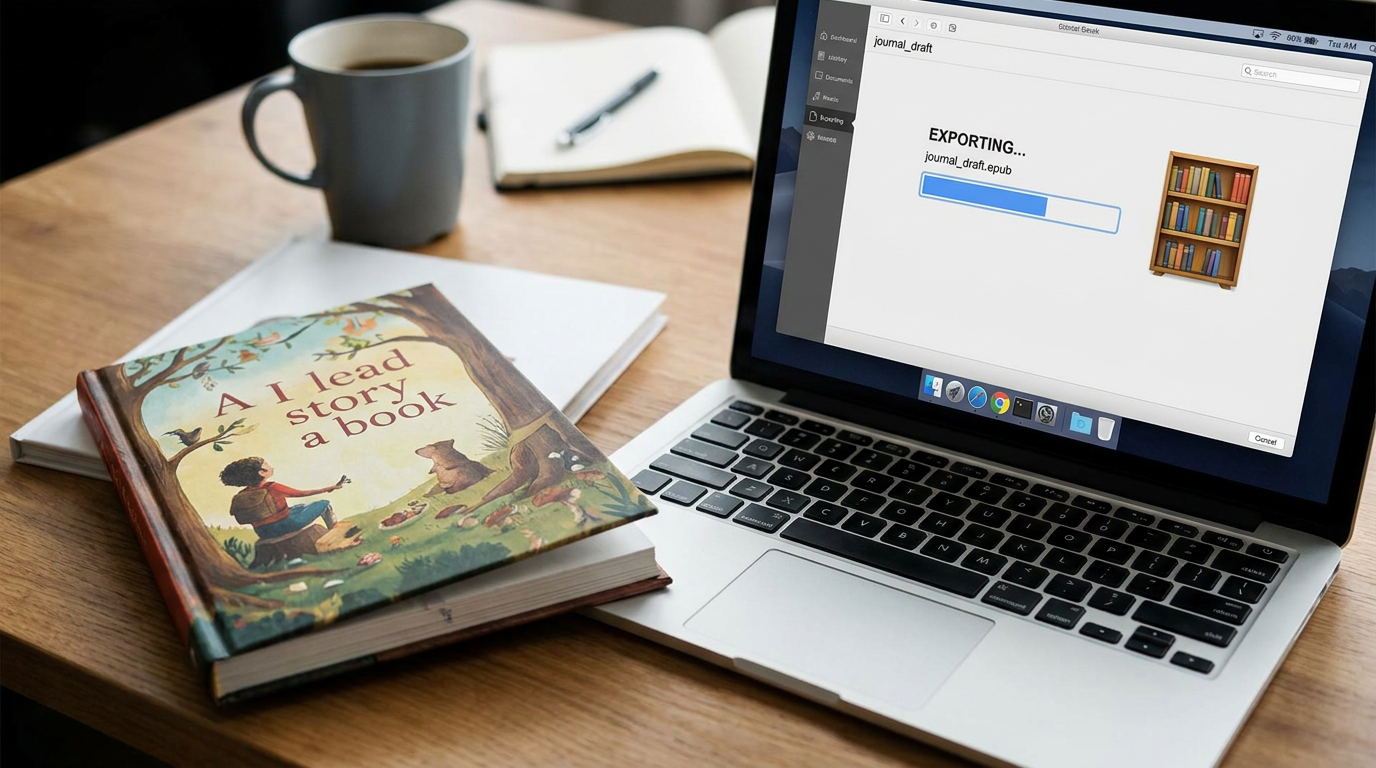
Turn Your Journal Into a Book: eBook & PDF Export, Step by Step
Here is the part that makes this year different, and the timing is the whole point: the best gift you can give is already sitting on your phone.
Not another candle. Not another gadget that gets charged twice and then lives in a drawer. Not the thing you bought because it was the right price rather than the right present. You know the fate of most of what gets unwrapped in December — a polite thank you, a few weeks on a shelf, and a quiet rehoming by February.
It is late October, which means the season is close enough to feel it. And somewhere in the back of your mind is the same problem you had last year: you want to give people something that isn’t just more stuff.
You have spent the last twelve months collecting it without noticing. Photographs from the trip. The blurry one from the kitchen that somehow captures everything. Voice notes. Screenshots of a group chat that was funnier than anything you’d write on purpose. Half-finished thoughts typed at midnight. It’s all there. It doesn’t need buying. It needs assemblingAnd if you’ve tried something like this before and abandoned it — most people have — the reason almost certainly wasn’t effort or ability. It was scope. We fix that in Step 1, before you touch a single photograph.
Set your expectations honestly, because I’d rather you finish than be impressed. This is an evening or two of work. Maybe three if you’re enjoying it. It is not a lost weekend of misery.
This post is a genuine, step-by-step guide to doing exactly that: turning a journal into a finished book you can put in someone’s hands. We’ll cover deciding what the book actually is, editing it down without agonising, writing the text that holds it together, sequencing it into something that reads like a book rather than a folder, choosing a cover and a title, exporting it as an eBook or a PDF-style storybook, and getting it printed and wrapped with time to spare.
If you came here searching for how to create a book as a gift, you’ve landed in the right place. Let’s build one.
The Gift Problem: The Best Present Is Already on Your Phone
You are not starting from nothing. You have spent a year gathering raw material with no plan to use it. The camera roll. The voice memo from the drive home. The photo of the handwritten note on the fridge. The screenshots. The clipped article someone sent that started a three-day argument. It is unassembled, not missing. And that distinction changes the entire size of the job.
Which brings us to the counter-observation this whole post rests on.
So the search begins, every autumn, for the gift that isn’t more stuff. Experiences. Subscriptions. Donations in someone’s name. All reasonable, all slightly abstract, and none of them quite scratching the itch — because what you actually want to communicate isn’t generosity. It’s attention.
Then there’s the clutter problem, which has become genuinely acute. Homes are full. People are actively trying to own less. Giving someone a physical object now carries a small burden alongside it — where does this go, and how long before I’m allowed to get rid of it?
Most of us shop to a budget rather than to a person. We start with a number — thirty pounds, fifty dollars, whatever the unspoken family convention is — and then reverse-engineer an object that costs roughly that. The object is fine. It’s perfectly nice. It’s also almost entirely interchangeable with something else at the same price, and both giver and receiver know it. There’s a small, specific guilt in that transaction: the sense that you’ve discharged an obligation rather than expressed anything.
Let’s be honest about gift-giving, because pretending it’s simple helps nobody.
Creating something from nothing is hard, which is why people don’t do it. Editing something that already exists is a fundamentally different task — smaller, more concrete, and far more forgiving. You’re not being asked to invent. You’re being asked to choose.
This is also why a book of shared memories lands differently from anything you can buy. It is legible proof that someone was paying attention. Every caption with a real name in it, every date that’s actually correct, every photograph of the unglamorous moment nobody else thought to keep — these are evidence. They say I noticed, and I kept it.Attention is the one thing in a gift that cannot be purchased, only spent.
You cannot buy that at any price point, and the recipient knows it the moment they open the cover.
Now, the objection I can hear from here: I’m not a writer, and I’m definitely not a designer.Good. Neither are most of the people who make the best versions of these. A memory book is not judged on typography. Nobody has ever opened one and thought about kerning. Its value lives entirely in what it contains — whose face is on page nine, what you wrote underneath it, whether you remembered that your father-in-law’s name is spelled with two Ls. The craft that matters here is selection and specificity, and both are learnable in the next ten minutes.
If it helps, know that the assembling itself is the easy part these days. A journaling app like is designed around exactly this: you collect Moments through the year, they sit in order on Memory Lane, and when you want a book, the journal converts into one. The technology is not the obstacle. Your scope is.
Lugelo
This post is the full practical expansion of a broader argument we’ve made before — — which covers whyHere’s the roadmap, six steps, in order:
the wider case for building a family memory book
a life is worth recording in the first place. This one is about the mechanics of turning what you’ve recorded into an object you can wrap.
- Decide what the book actually is.
- Gather and choose — the ruthless edit.
- Write the connective text, captions and names.
- Sequence it, then choose a cover and a title.
- Export it as an eBook or PDF storybook.
- Print it, understand what printing really buys you, and hand it over.
The material exists. What determines whether it becomes a book is the single decision we make next.
Step 1: Decide What the Book Is (Scope Is Everything)
It’s an infinite brief.
Almost every abandoned memory book dies in the same place, for the same reason, and it isn’t laziness.
The project gets opened as “our family memories.” That sounds lovely and is completely unbuildable. There is no version of “our family memories” that has an ending. Every photo you select suggests three more that belong beside it. Every year you include implies the year before. There’s no point at which you can look at the pile and say that’s the book, because the brief contains no boundary that would let you. So you work on it for three weekends, feel the scale of it, and quietly stop. The folder stays on the desktop for two years, renamed once, never opened.
The fix is unglamorous and takes about ninety seconds: decide what the book is before you look at a single photograph.
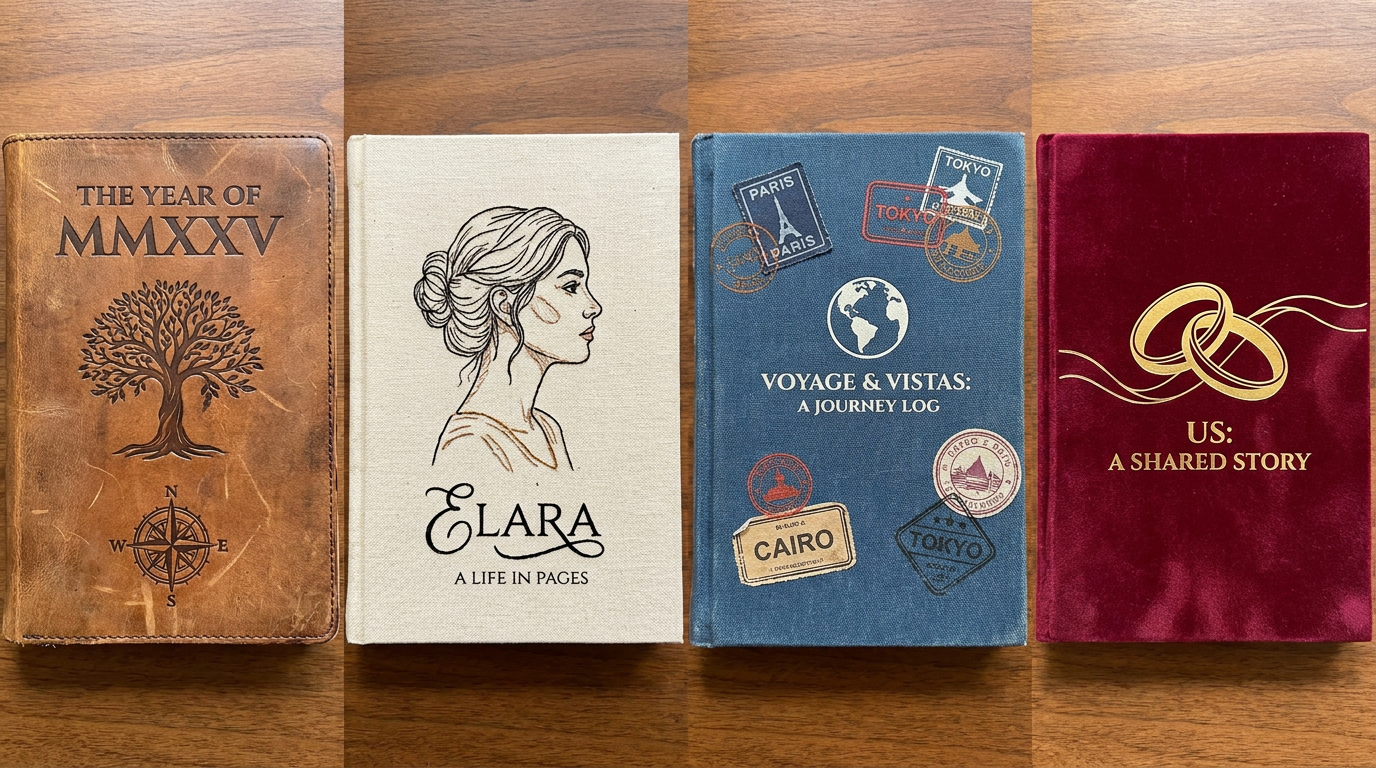
Here are four scopes that reliably get finished.
One year. A year-in-review for the household. Naturally bounded, naturally seasonal, and perfectly suited to a December gift because the year is conveniently ending anyway. This is the easiest annual habit to sustain, because next year you just do it again.
One person. A child’s year. A parent’s early life. A life story book assembled for a milestone birthday — sixtieth, seventieth, a retirement. The subject provides the boundary: if they’re not in it or around it, it’s not in the book.
One trip. The clearest boundaries available to you, because the start and end dates are literally on a boarding pass. If you’ve never made one of these before, start here. A three-week trip produces a book you can finish in an evening, and finishing one is what teaches you that you can.
One relationship. A marriage. A friendship of twenty years. A grandparent and a grandchild. These are quietly the most affecting books of the lot, because the scope itself is the message.
Pick one. Write it down as a single sentence — “Dad’s first thirty years, for his seventieth” or “Sardinia, June, the four of us”Now the sizing rule, which exists to stop you drowning.
— and put that sentence somewhere you’ll see it while you work.
Aim for roughly 40 to 80 photographs and 20 to 40 short passages of textAnd you have full permission to go smaller. This matters more than people expect. A tight thirty-page book is a better gift than a bloated hundred-and-twenty-page one, because the tight one gets read repeatedly and the bloated one gets flicked through once and admired politely. Density is not generosity. A book that respects the reader’s attention is a more loving object than one that exhausts it.
. That produces a book with real substance that a person will read from front to back in one sitting.
The habit that makes all of this work is treating your scope sentence as a hard border. Everything outside it — the brilliant photo from the year before, the story that’s technically about someone else, the tangent you’d love to include — goes in a list called next book. Not deleted. Not lost. Just not this one.
That single discipline is the difference between finished memory booksA life story book is paced completely differently. It moves more slowly, spans decades rather than days, and needs significantly more connective writing to carry a reader across gaps in time. You’re not just showing moments; you’re explaining a life’s shape — where people lived, what work they did, who arrived and who left. Budget more writing time for it, and fewer photographs per page.
A one-trip book is playful. It can be funny, fast, full of in-jokes, heavy on images and light on text. Nobody needs three hundred words explaining a photograph of a broken hire car.
Scope also quietly decides your tone, which is worth knowing before you start writing.
and abandoned folders. I’d go further: it’s the only technique in this entire post that’s genuinely non-negotiable. Everything else you can do badly and still end up with something wonderful.
A practical note on where the material lives. If you’ve been journaling through the year, your Moments are already sitting in chronological order on , which makes scoping visible in a way a camera roll never does. You can see the shape of a year — where it’s dense, where it’s thin, where the good stuff clusters. Scoping stops being guesswork and becomes something closer to drawing a box around a section of a timeline.
Memory Lane
And if the story genuinely belongs to more than one person — a family year, a shared trip, a grandparent’s life that only the siblings collectively remember — you’ll want so contributors add their own material directly. We’ll come back to how that works in the next step.
a shared journal
Boundaries drawn. Now the harder part: deciding what goes inside them, which means deciding what doesn’t.
Step 2: Gather and Choose — Make the Ruthless Edit
Here is the one rule that separates an amateur memory book from a good one, and it’s uncomfortable.
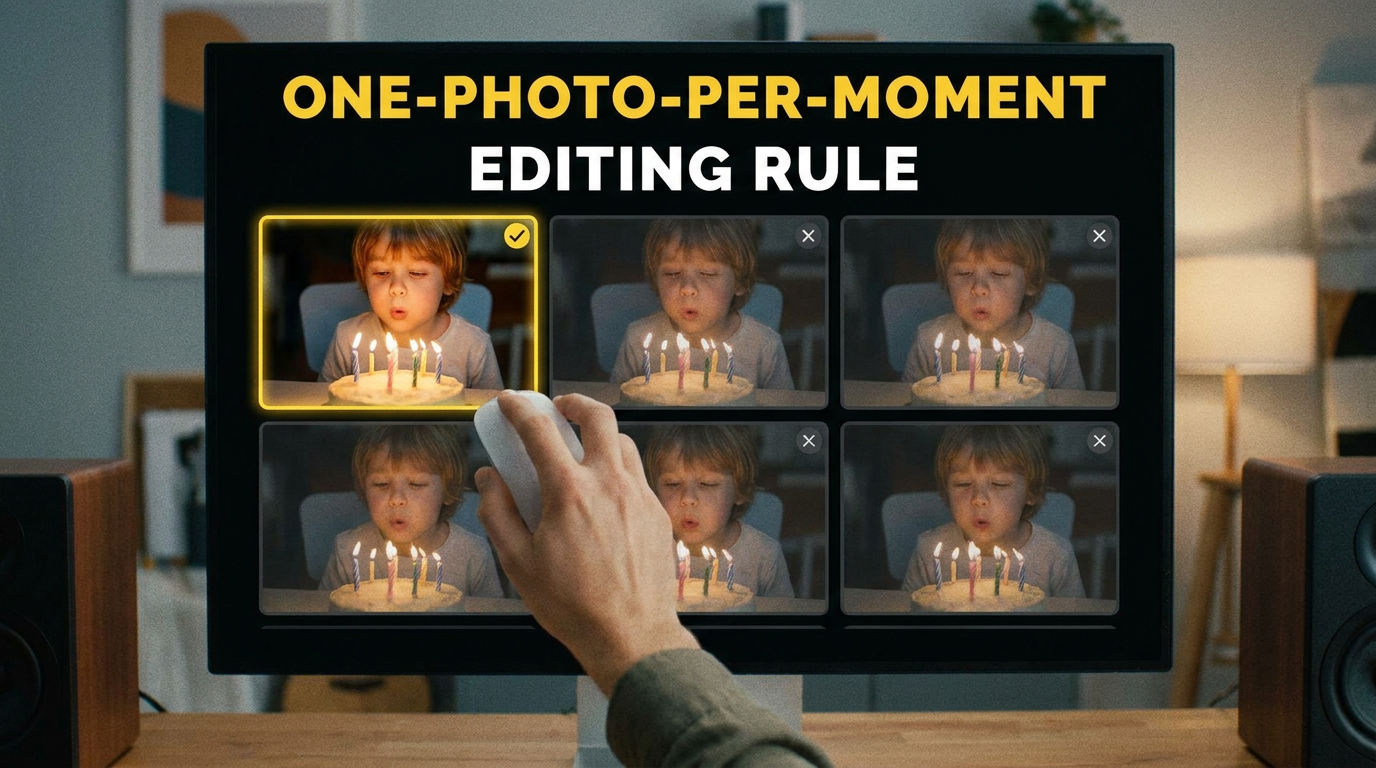
One photo per moment. Not six.
Six near-identical shots of the same birthday candle is a camera roll. One is a book. The difference isn’t quality of photography — it’s editorial judgement, and it’s the single skill that most improves what you make. Every additional near-duplicate you include dilutes the one you should have chosen.
Your phone has trained you badly here. Burst mode, cloud storage and infinite capacity have removed every natural pressure to choose. You’ve never had to decide, so the muscle has atrophied. Rebuilding it takes one evening of deliberate practice.
So: how do you pick the keeper?
Choose the frame with a face doing something. Not the best-composed one. Not the sharpest. The one where someone is mid-laugh, mid-sentence, mid-eye-roll. Slightly blurred and alive beats crisp and posed every single time, because readers respond to expression, not exposure. A technically perfect photograph of four people arranged in front of a monument communicates almost nothing. A slightly soft shot of two of them arguing about the map communicates a relationship.
Deliberately include the unglamorous. This is where most memory books go wrong, and where yours can immediately be better than average. Include the packed car with the boot that wouldn’t shut. The hospital corridor. The kitchen table covered in the debris of a meal that’s just finished. The hotel room that was worse than the photos suggested.
These images date and locate a story far more precisely than any posed group shot. They carry period detail — the phone someone’s holding, the packaging on the counter, the state of the wallpaper. They’re what makes a photo book giftNow, gathering. This is faster than you think, provided you’ve been collecting as you go.
feel true rather than curated. A book made entirely of everyone’s best angles reads like an advertisement for a family. A book that includes the mess reads like a life.
If your year already lives as Moments on Memory Lane, gathering is filtering, not hunting. You’re scrolling a sequence that’s already in order, marking things, rather than excavating four apps and two hard drives trying to remember which month something happened in. That distinction is the difference between a two-hour job and a two-week job.
It’s also worth knowing what a single Moment can hold, because it affects what your book can contain. That scan-to-text route deserves a moment of your attention if you’re building a life story book. Shoeboxes of printed photographs and letters are exactly the material that makes these books extraordinary, and exactly the material people assume is too much hassle to include. It isn’t. A stack of old prints and a rainy Sunday afternoon will get you further than any amount of digital archaeology.
Photos, video, audio and imports live inside one Moment
— so a Moment can be a photograph with a voice note attached, or a video with written context around it. Beyond that, there are practical routes for material that isn’t already digital or isn’t already yours: scan-to-text for older printed material and handwritten notes, speech-to-text for anything you’d rather say than type, social imports, and browser-extension clipping for things you found online during the year.
When the story belongs to several people
The instinct is to become a project manager — messaging everyone, chasing files, collating a shared folder that three people never open. Don’t. It’s slow, it’s thankless, and it usually kills the project.
Some books simply cannot be built alone. A family year happened in four different houses. A grandparent’s life is remembered in fragments distributed across five siblings, none of whom remember it the same way.
Invite them into the book instead. With Audio contributions are the underrated part of this. Plenty of people — often exactly the older relatives whose memories you most want — will never write three paragraphs about 1974. The same person will happily talk for eleven minutes about it. Let them. A recorded voice is also, incidentally, one of the things families most regret not having.
a shared journal
, contributors add their own Moments directly — their own photographs, their own version of what happened, their own captions. You get material you’d never have obtained by asking, because people remember different things and nobody produces their best recollections on demand via text message.
The two-pass method
Practical mechanics, because “be ruthless” is easy to say and hard to execute in one sitting.
First pass: generous. Go through your scoped range and mark anything that’s possible. Don’t deliberate. Don’t compare. If it might belong, flag it. Move fast — a year should take you thirty or forty minutes. You are not making decisions here; you’re building a shortlist.
Second pass: cold. Come back to the shortlist later — ideally the following day, when the sentimental fog has lifted — and cut it down to the final set. Now you compare. Now you enforce one-per-moment. Now you ask, of every image, what does this one do that the one next to it doesn’t?Two passes beat one agonised pass, comprehensively. Trying to be both generous and ruthless simultaneously is what makes people stall for weeks at the selection stage. Separate the modes and each one becomes easy.
On the gaps
If part of your year genuinely wasn’t documented — a hard stretch, a period of illness, three months where nobody picked up a camera — resist the urge to paper over it. Don’t pad it with whatever thin material exists just to keep the pages even.
One last thing, and it’s a small piece of craft that will make your book noticeably better than most.
Say it. A line like “we took almost no photographs in February, and here’s why” is more interesting, more honest and more moving than a spread of filler. Gaps are part of the shape of a year. Acknowledging one tells the reader something real; disguising it tells them nothing at all.
Images chosen. Now they need words around them — words that make sense to somebody who wasn’t there.
Step 3: Write the Captions, Names and Connective Text
This is the step people skip, and the only one they later regret.
It’s understandable. Photographs feel finished on their own. Writing feels like work, and like exposure. So the book gets assembled as a beautiful sequence of images with nothing underneath them, and it looks great, and then five years later somebody points at a face and says who’s that, again? — and nobody in the room is completely sure.
So here’s the governing test, and it fixes most weak memory-book writing on its own:
Write for a reader who wasn’t there.Not for yourself. Not for the one other person who already remembers the day perfectly. Write for the niece who was four at the time, or the person who joins the family in 2031, or your own future self at seventy, who will have forgotten far more than currently seems possible.
Apply that test to any caption and it immediately tells you what’s missing. “Best day ever 😂” fails instantly. “Marcus, Priya and Dan on the last morning in Sardinia — twenty minutes after the boat broke, before anyone found it funny” passes, and it took nine seconds longer to write.
The three layers of text
You don’t need to write a lot. You need to write three different kinds of thing, each doing a distinct job.
Chapter or section openers — 60 to 120 words. These set the scene at the top of a section. The year, the circumstances, what was going on around the edges. “2026 started badly. Sam’s job ended in the second week of January, and for two months the plan was simply to get to spring.” That’s the connective tissue that lets a stranger follow your book.
Captions — one or two lines. Who, where, roughly when, and one specific detail. This is where most of your writing happens, and each one takes under a minute.
The occasional longer passage — 200 to 300 words.That last constraint matters more than it looks. If you write long everywhere, nothing stands out and the book becomes homework. The contrast between brief and expansive is what gives a book rhythm, and rhythm is most of what makes something readable. Silence around a passage is what makes it land.
Reserved for the two or three moments in the entire book that genuinely warrant it. The birth, the funeral, the move, the diagnosis, the reunion. Two or three. Not twelve.
Names and dates are the most valuable thing you will write
That’s not a sentimental point. It’s a plain observation about how information decays. The context lives in people’s heads, and heads are not a storage medium you can query later.
An unlabelled photograph loses most of its meaning surprisingly quickly. Not because the image degrades, but because the people who could identify the faces are exactly the people who eventually stop being available to ask. Every family has a box of photographs of strangers who were, at one point, entirely known. Nobody wrote it down, because at the time it was obvious.
I want to give this its own space, because it’s the part most likely to be skipped and the part with the most concrete consequence.
So: name everyone.Then add the detail only you have. What was said just before the shutter. What the room smelled like. Why everyone in the frame is laughing at something outside it. Why that particular jumper was significant. Specificity is what a reader remembers, and it’s the one thing no amount of design polish can substitute for.
Including — especially — the ones “everyone knows.” Your mother is not “Mum” in a caption; she’s Angela, in 2026, at fifty-eight. Write the year. Write the place. It costs you four words and it’s the difference between a photograph that means something in thirty years and one that doesn’t.
“Documenting little details of your everyday life becomes a celebration of who you are.” — Carolyn V. Hamilton
When you’re staring at a blank page
Some practical help, because “just write specifically” is advice that assumes you can start.
The AI Journal Assistant is genuinely useful at exactly the point where people freeze. Give it a few words and it’ll suggest a title. Give it rough notes — half sentences, fragments, a bullet list of what happened — and it’ll expand them into a first draft you can then rewrite in your own words.
That last clause is the whole point. Treat it as scaffolding, not as a substitute. The entire value of this gift is that it sounds like the person who made it — with their turns of phrase, their sense of humour, their slightly odd way of describing things. A book that reads as though it was written by nobody in particular defeats its own purpose. Use the assistant to get past the blank page, then make the sentences yours.
Speech-to-text is the other one worth knowing about, and it’s transformative for people who talk more easily than they type. That includes a lot of us, and it disproportionately includes older relatives who’d never sit down and write but will happily tell you the whole story out loud. Both of these sit alongside the rest of the writing tools in .
Lugelo’s features
The three-question fix
If you’re still stuck, use this and stop overthinking. For each photograph, answer three questions:
- What was happening?
- Who was there?
- Why does this one matter?
Words and pictures in hand. Now the book needs an order, a cover and a name.
Three short answers. Then stop. Do not embellish, do not reach for a poetic closing line, do not try to find the meaning of the year. Three answers per image is a completely sufficient book, and it’s better than ninety percent of what people produce when they try to write beautifully.
Step 4: Sequence the Book, Then Choose a Cover and Title
There’s a moment in this process where a pile of good material either becomes a book or stays a pile. That moment is sequencing.
Chronological is the safe default, and it works for the large majority of books. It requires no cleverness, it’s how memory is naturally indexed, and it means nobody ever gets lost. If you’ve been journaling through the year, Memory Lane has already done this for you — the order exists before you ask for it, which removes the single most tedious part of the job.
Use chronological unless you have a specific reason not to. “It felt boring” is not a specific reason; a well-paced chronological book is not boring.
That said, three alternatives genuinely earn their place in the right circumstances.
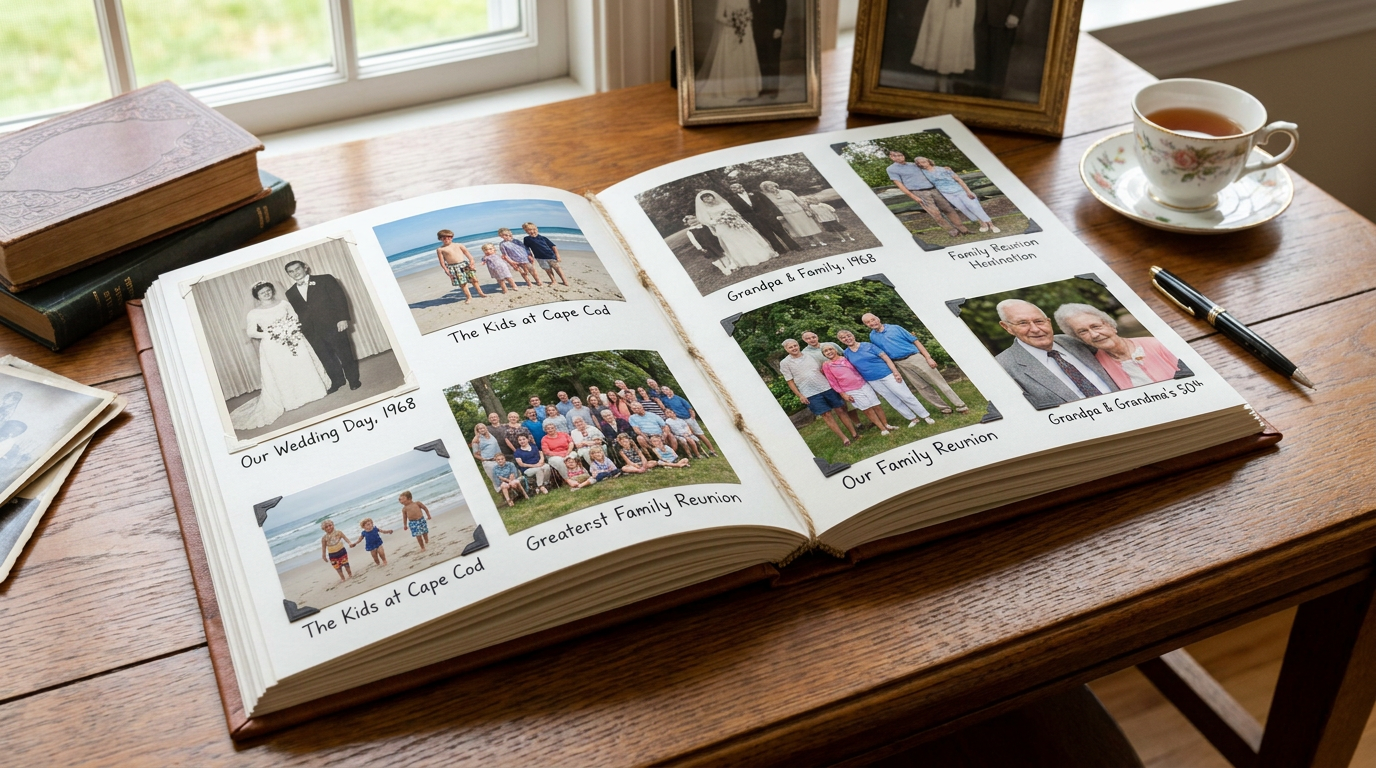
Thematic. Organised by person, place or recurring ritual rather than by date. This is the strongest option for a life story book spanning decades, where strict chronology starts to sag under its own weight. Sixty years told strictly in order becomes a list. The same sixty years told as The Houses, The Work, The Sundays, The People Who Came and Went becomes a portrait. Thematic structure lets you put a photograph from 1968 next to one from 2019 and let the reader do the arithmetic — which is a genuinely powerful effect.
Bookended. Open with the biggest moment in the book, then go back and tell the story of how you arrived there. Journalists have used this forever because it works: it buys you the reader’s patience by showing them where they’re heading. Ideal when your material has one obvious peak — the wedding, the move, the reunion.
Seasonal. For a year-in-review, this is close to free. Four chapters, already written, with built-in visual variety and a natural sense of progression. Spring looks different from November, and the book benefits from that without you doing anything.
Pacing: don’t fill every page
Here’s the design instinct most first-time makers get wrong. Given a page, people fill it. Given a spread, people fit six photographs onto it.
Vary your density deliberately instead. After a dense spread of five or six images, give the reader a single full-bleed photograph with a one-line caption and nothing else. It functions as a breath. It signals this one matters. And it makes the dense spreads feel energetic rather than cluttered, because contrast is what creates the impression of pace.
Empty space is not wasted space. It’s the thing that tells a reader how to feel about what’s next to it.
Openings and endings carry disproportionate weight. Your first image sets the tone for everything after it — choose it for mood rather than chronology, and don’t default to whatever happened first. Your last image should genuinely close. Something that has the quality of an ending: people leaving, a light going off, a door, a road, an empty room after. Books that trail off do so because the maker ran out of material and simply stopped. Choose your final page deliberately and the whole thing feels composed.
Titles: specific beats poetic
Resist the pull toward the evocative and abstract. Memories. Our Story. Moments in Time. These sound like books and mean nothing.
Specific wins. A date range. A place name. An in-joke the recipient recognises before they’ve opened it.
“Sardinia, and the Summer of the Broken Boat” beats “Memories” by a distance — because one of them is already a story and the other is a genre. A title that makes the recipient laugh or wince on the doorstep has done more work than any amount of elegant phrasing.
Covers: name it and date it
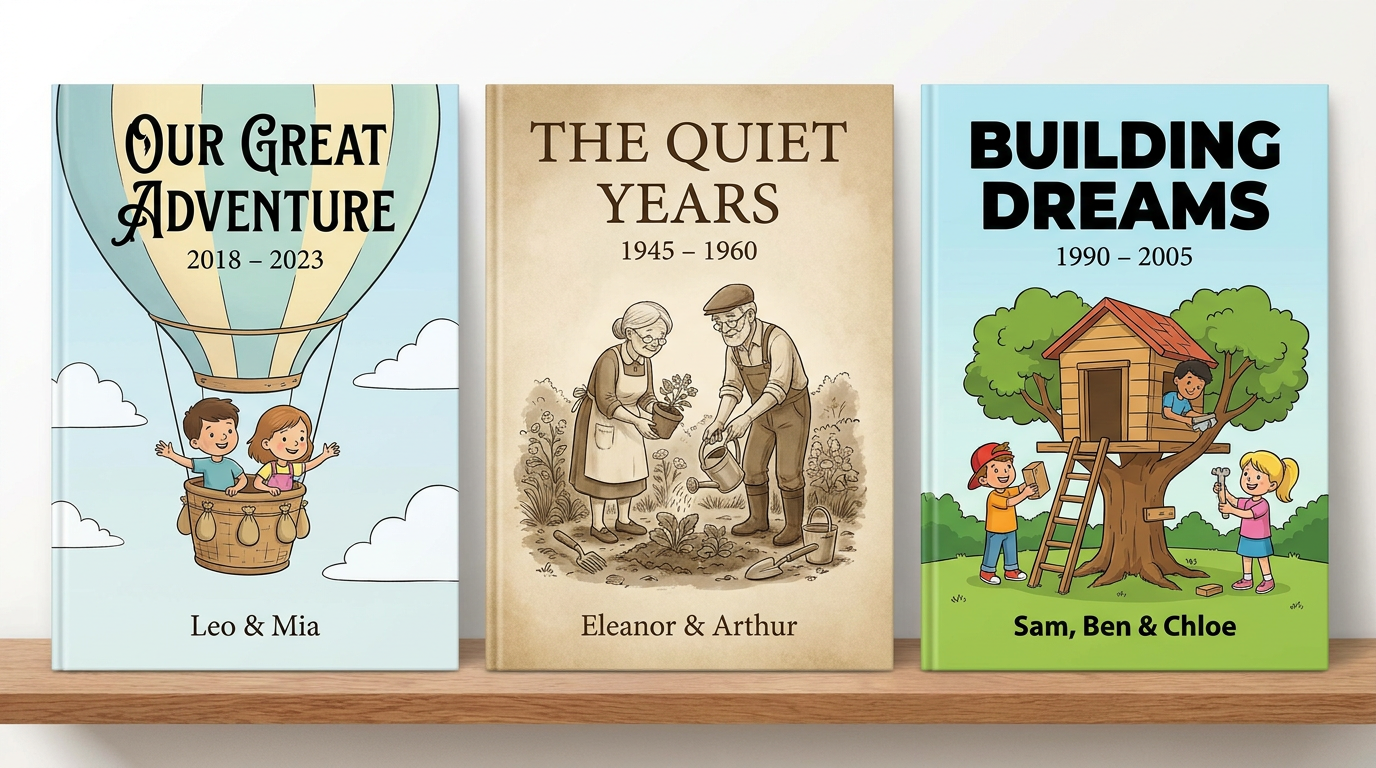
Your cover has one strong image, legible text, and — this is the part people forget — the names of who it’s about and the period it covers.
Not because it looks good. Because in ten years, on a shelf, next to three other books you’ve made by then, the one that identifies itself is the one that gets picked up. A handsome abstract cover with a single word on it is a beautiful object that nobody can navigate. “Angela & Tom — 1994 to 2004”Prioritise legibility over sophistication. This is a book that lives on a shelf and gets handed around, not a portfolio piece.
is instantly useful to anyone who encounters it, including people who weren’t born when you made it.
Templates are not cheating
One last thing, because it stops people unnecessarily.
Starting from a does not produce a lesser book. It produces a book where you spent your limited energy on choosing photographs and writing captions rather than on deciding margin widths — which is unambiguously the better trade.
template or a storybook layout
Nobody receiving this gift will assess your layout decisions. They’ll look for their own face, read the caption, and then go back to the start and read it properly. The layout’s entire job is to get out of the way. A good template does that job better than most of us would, on a Tuesday evening, at speed.
The book is built. What remains is turning it into a file you can actually give.
Step 5: Turn Your Journal Into a Book With eBook or PDF Export
This is the part the title promised, and it’s the least dramatic step in the whole process — which is exactly as it should be.
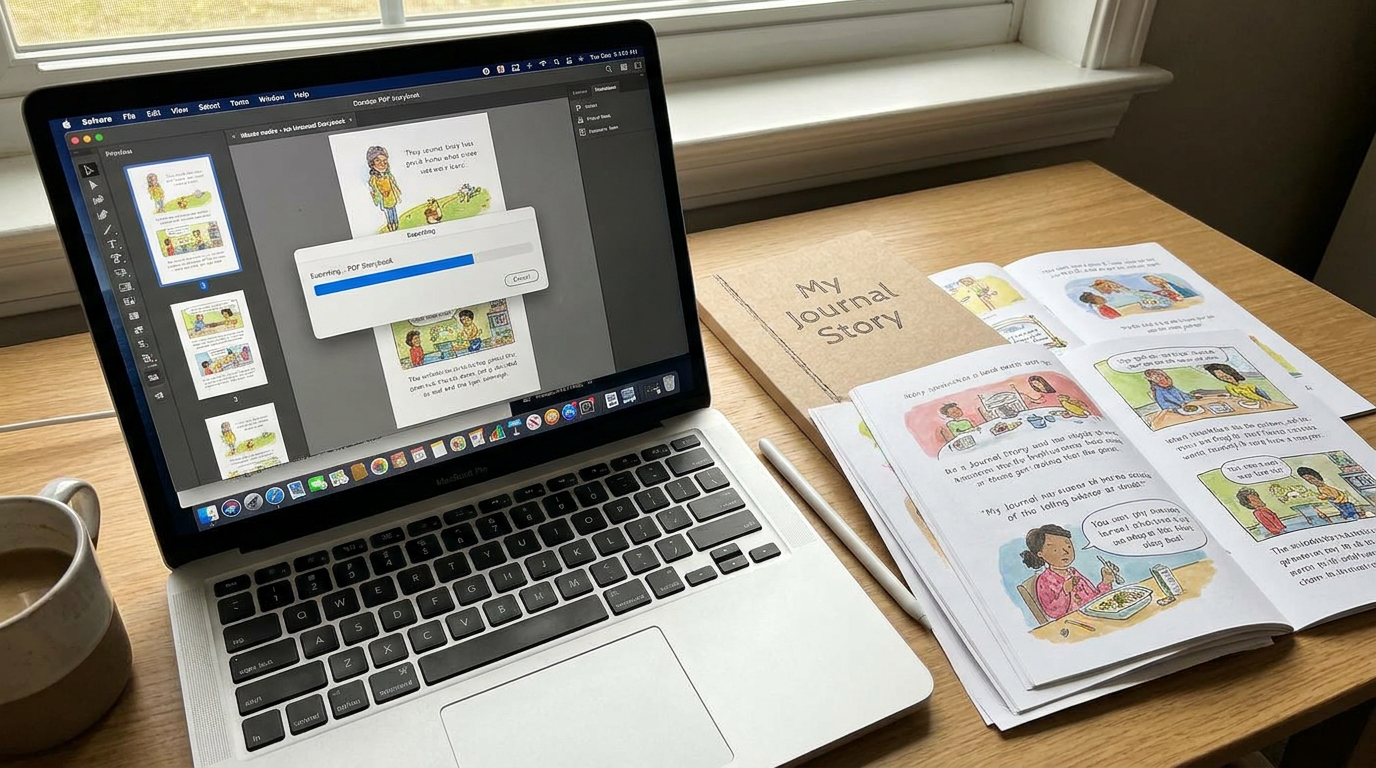
A finished journal converts into an eBook or a PDF-style storybook: a single file containing your Moments, images and text, in the order you set. Lugelo describes it as one-tap eBook conversion, alongside a full journal export. The outcome is the thing to hold in your head — you end up with one file that contains the whole book, sequenced the way you arranged it, ready to send or print. You can see how That’s genuinely it. The work was Steps 1 through 4. This step is the reward.
eBook and storybook export
sits alongside the rest of the toolkit.
Which format should you choose?
Export as an eBook when the book is going to be read on a phone or a tablet. It’s easy to send, it costs nothing to distribute, and it’s the right answer for relatives who live somewhere else and would otherwise be waiting on the post. If you’ve got a large extended family, the eBook is how everybody gets a copy without you spending a fortune.
Export as a PDF storybook when you intend to print. This is the important distinction: a PDF holds your layout fixed exactly as you arranged it. Every image stays where you put it, every caption stays with its photograph, and nothing reflows because of a different screen size. When a file is going to a printer, fixed layout isn’t a preference — it’s the requirement.
Most people end up doing both, and there’s no reason not to. Export the PDF for printing, export the eBook for sharing, and you’ve covered every recipient with one afternoon’s work.
The pre-flight checklist
Before you export the version you’re going to print, run this. It takes fifteen minutes and prevents every common regret. It’s also the one part of this post worth screenshotting.
- [ ] Check the spelling of every name. Especially children’s names and in-laws’ names. A misspelled name in a printed book is permanent in a way nothing else in the project is, and it’s the error people notice first.
- [ ] Verify dates and years. Don’t assume. You will misremember at least one, and it’s almost always the one somebody else remembers precisely.
- [ ] Decide what stays private. Journals are private by default with owner-controlled sharing, which means everything in yours was written for an audience of one. A book is a different audience. Reread anything you wrote during a bad week and ask whether it belongs in something you’re handing to another person.
- [ ] Check anything involving other people’s children or private circumstances. Ask first. Always. This is the one item on the list with consequences beyond the book.
- [ ] Read every caption aloud, once. This is not optional and it is not fussy. Your eye skips errors it expects; your mouth doesn’t. You’ll catch duplicated words, missing words, and at least one sentence that made sense in your head and nowhere else.
- [ ] Check the image ordering one final time, after any late edits. Late changes are where sequences quietly break.
What it costs
Straightforwardly: Lugelo is free on iOS, Android, Web and HarmonyOS, with no ads, and there’s an optional Plus tier if you want it. You can see exactly what that includes on the The real expense of this gift is printing, which we’ll get to next.
pricing page
. That’s the whole story on software cost.
One more way to see the same memories
Worth a brief mention because it’s genuinely a different experience rather than a variation on the same one: the same journal can also be explored as a VR gallery. It works best on Meta Quest, Apple Vision Pro or WebXR-capable browsers, with a 2D preview available on any device, and shared rooms supporting up to eight people. Think of it as a complement to the book rather than a replacement — the book is the thing you hand over; the gallery is somewhere a few people can stand inside the same year together.
On privacy, precisely
While we’re on the subject of what’s in your journal: your data is encrypted in transit, journals are private by default, and sharing is owner-controlled. That’s the accurate description, and it’s the one worth knowing before you decide what goes in a book that leaves your hands.
File exported. Now the physical questions — printing it, understanding honestly what printing actually buys you, and handing it over.
Step 6: Printing, Honest Preservation and Handing It Over
Let’s be clear about how printing works, because vagueness here would be doing you a disservice.
Lugelo does not print or ship books.That’s a genuine division of labour rather than a limitation. It means you’re free to choose based on price, speed, quality or proximity, and you’re never locked into one supplier’s catalogue.
What you get is the exported file. You take that PDF and arrange the printing yourself, with whichever printer you prefer — a local print shop, an online service, whatever suits your budget and timeline. Lugelo makes the file; you decide how it becomes an object.
What to think about when you print
You don’t need to become an expert. You need to make four decisions.
Softcover or hardcover. Softcover is cheaper and lighter, and is entirely respectable — it reads like a nice paperback. Hardcover feels considerably more like a gift when it’s unwrapped, sits better on a shelf, and holds up to repeated handling. If this book is the main present, hardcover is usually worth the difference.
Size. Larger formats show photographs properly and cost proportionally more. If your book is image-led — a trip, a child’s year — go bigger, because shrinking a good photograph wastes it. If it’s text-heavy, like a life story book, a smaller format reads more comfortably and feels more like something you’d sit down with.
Paper weight. Thin paper lets the next page show through, which is visible and slightly cheapening on image-heavy spreads. Heavier stock costs more and immediately feels more substantial. This is the upgrade most worth paying for if you’re choosing one.
Finish.Prices vary enormously by region, format and supplier, so get two or three quotes rather than trusting any number you read online — including any I might have guessed at.
Matte pages tend to make photographs look considered and are much easier to read under a lamp. Gloss makes colours pop and shows every fingerprint. Neither is wrong; matte is the safer default for a book that will be handled a lot.
Give yourself time
Build in a fortnight for printing and delivery, plus a few days’ buffer in case something’s wrong and needs reprinting.
Starting in late October is comfortable. You have time to make the book properly, order a proof, notice the three errors you’ll inevitably find, fix them and reorder without anxiety.
Starting in mid-December is not comfortable. At that point you’re paying rush rates, you have no room for a reprint, and you’re refreshing a tracking page on the 23rd. Don’t do that to yourself — the whole appeal of this gift is that it’s the calm option.
Order a proof copy if the budget allows. Things that look correct on a screen behave differently on paper: images crop at the edges, text sits closer to the gutter than expected, a colour reads warmer than you intended. If a proof isn’t realistic, do the minimum version — open the PDF at full size on the largest screen you own and go through every page before committing. You will find something.
What a printed copy actually buys you
There’s a version of this article that tells you a printed book lasts forever. It’s the easy thing to write and it’s not true, so I’m not going to write it.
Now the honest part, and it’s the passage in this post I’d most want you to read carefully.
Here’s the accurate version, which I think is more persuasive anyway: a printed copy is a hedge.Formats change. Services close. Accounts lapse when nobody remembers the password. Drives fail silently and are discovered years later. None of this is alarmism — it’s the ordinary, well-documented behaviour of digital material over time.
Paper survives neglect better than files do.
That’s the real argument. A book on a shelf keeps working with nobody maintaining it. Nobody has to migrate it, remember it, pay for it or open it periodically to check it’s still there. It just sits there being readable, which is a genuinely rare property.
Digital records don’t have that property. They need active care: keep more than one copy, keep those copies in more than one place, and periodically check that older files still open. That’s not difficult, but it is ongoing, and ongoing is precisely what tends not to happen over decades.
You don’t have to take my word for any of this. The Library of Congress — a national institution whose actual job is keeping things — publishes public guidance on exactly this problem through its , including practical advice on .
caring for digital photographspersonal digital archiving resources
Sit with the implication of that for a second. A national library publishes a public how-to guide because personal digital material is genuinely difficult to hold onto. That’s not a marketing claim from an app; it’s an institution with deep expertise telling ordinary people that this requires effort.
Which leads to a simple, practical recommendation:
- Keep the journal in Lugelo — it stays live, searchable and easy to add to.
- Keep the exported file somewhere of your own — your own storage, your own control, ideally in two places.
- Print one copy — the version that needs nothing from anybody.
That’s a hedge, not a promise. And it’s a far more useful thing to tell someone than “forever.”
Three forms, three completely different failure modes. If one goes, the others almost certainly don’t go with it.
How to actually give it
The final logistics, which matter more than you’d expect.
Hand it over quietly. Not in the middle of a loud group unwrapping with wrapping paper flying and someone’s toddler screaming. This gift needs about three minutes of undivided attention to land, and a chaotic living room will not provide them. Find a lull, or give it separately.
Say almost nothing. “I made this.” That’s the script. Resist the powerful urge to narrate — to explain what’s on page eleven, to apologise for the cover, to point out the bit you’re pleased with. The book does that job. Let it.
Expect a delayed reaction. People frequently go quiet. They turn pages slowly, say very little, and then come back to it alone later that evening and read the whole thing properly. If you don’t get an immediate emotional response, the gift hasn’t failed — it’s working exactly as it should. Big reactions in front of an audience are rarer than the versions we imagine.
Print two copies if the book is about a relationship. A marriage, a friendship, two siblings. Both people will want one, and only one of them will be comfortable saying so.
Write a note inside the front cover. Handwritten, dated, signed. It costs nothing, takes two minutes, and it’s routinely the part people mention first — partly because it’s the only page in the whole book that’s unmistakably, physically yours.
If you haven’t started a journal yet and you’re reading this thinking next year, the useful move is to start now rather than in January. That’s the whole method. What’s left are the questions people usually ask next.
Lugelo is free on iOS, Android, Web and HarmonyOS
, and a year of Moments collected casually is what makes next October’s book an evening’s work instead of a project.
Frequently Asked Questions
How long does it take to create a book as a gift from an existing journal?
If your Moments are already captured through the year, a scoped book takes an evening or two. Selection and captions are the bulk of the time. If you’re gathering material from scratch across several apps and devices, add considerably more. Scope is the biggest variable by far — a one-trip book is an evening, a decade-spanning life story book is a few weekends.
What’s the difference between exporting an eBook and a PDF storybook?
An eBook is best for reading and sharing on phones and tablets — easy to send, costs nothing to distribute. A PDF storybook keeps your layout fixed exactly as you arranged it, which is what a printer needs. Many people export both: the PDF goes to print, the eBook goes to relatives who live too far away to hand one to.
Can several people contribute to the same book?
Yes. Contributors add their own Moments directly rather than sending you files to collate — photographs, written entries and audio notes included. That last option matters for relatives who’d never write three paragraphs but will happily talk for ten minutes. You can see how this works with .
collaborative journals
Does Lugelo print and post the book for me?
No. Lugelo produces the exported file — the eBook or PDF storybook — and you arrange printing yourself with a printer of your choice. That means you pick the format, paper, binding and price point that suit you, and you’re not tied to any single supplier’s options or delivery schedule.
Is Lugelo free, and what does Plus add?
Lugelo is free on iOS, Android, Web and HarmonyOS, with no ads. There’s an optional Plus tier for people who want it, and the current details of what’s included are on the . You do not need Plus to keep a journal or to make a book from one.
pricing page
Who can see my journal before I export it?
Journals are private by default, with owner-controlled sharing — you decide who gets access and when. Data is encrypted in transit. In practice this means nothing leaves your journal unless you choose to share it, which is worth remembering when you decide what belongs in a book you’re handing to someone else.
Can I view the same memories as a VR gallery?
Yes. The same journal can be explored as a VR gallery, which works best on Meta Quest, Apple Vision Pro or WebXR-capable browsers. A 2D preview is available on any device if you don’t have a headset, and shared rooms support up to eight people — so a few family members can walk through the same set of Moments together.
Why This Gift Is Different From Anything You Can Buy
Let me restate the honest case one last time, without inflating it.
You came here with a problem: something to give that isn’t more stuff. And the answer turned out to be sitting in your pocket the entire time — it just needed scoping, editing, captioning, ordering and exporting.
This gift is not valuable because it will last forever. Nobody can promise that about anything, and you should be suspicious of anyone who does. It’s valuable because it is specificWrite that sentence tonight. Then create a book as a gift the way it’s actually done — one Moment at a time, from a year you already lived.
And on timing: it’s late October, which is comfortably enough. Not tight. Comfortable. The material is already collected, which was always the hard part. Everything that’s left is choosing and assembling, and all of that begins with a single sentence describing what the book is about.
Keep the practical hedge from Step 6 in mind. Keep the journal live. Keep the exported file somewhere of your own. Print one copy. Three forms, three different failure modes — sensible rather than sentimental.
It contains real names, correctly spelled. Actual dates. The messy kitchen table nobody else would have photographed. The detail only you would have thought to write down — what was said, why everyone was laughing, why that particular Tuesday mattered. That specificity is the thing no purchased object can imitate at any price, and it’s why this is the gift that gets read twice, and then again in March, and then once more when somebody visits.
.
Don’t Just Live It — Keep It
Start the journal now, and the book will be waiting when you need it. Free on iOS, Android, Web and HarmonyOS — no ads.
Get Started