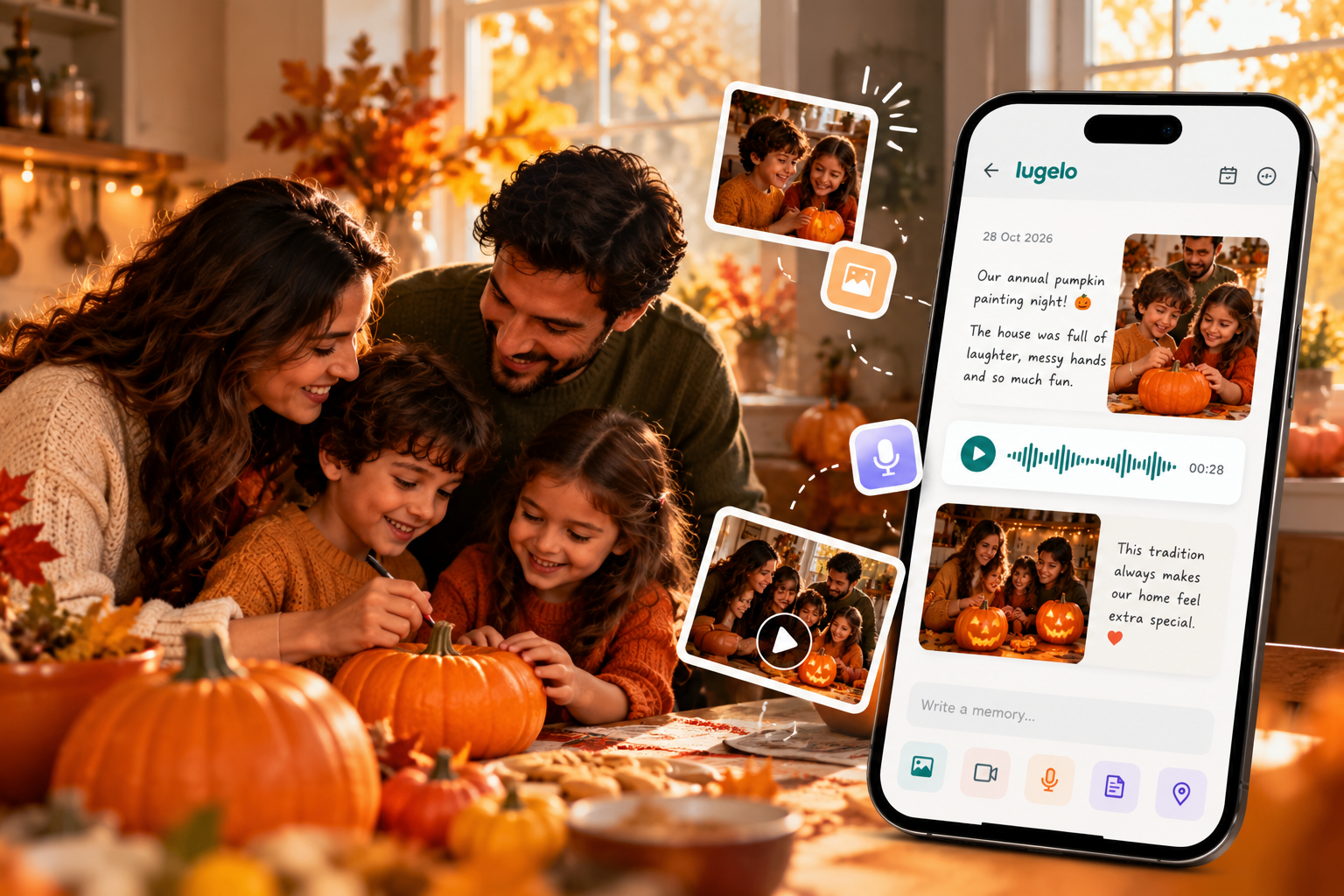
How to Start a Family Traditions Journal: A Step-by-Step Guide to Preserving What Makes Your Family Yours
There is a particular kind of quiet that settles over a family table in autumn. The light comes in sideways and golden. Someone has made the same thing they always make this time of year. The children are older than they were last October, but the ritual is the same — the same warmth, the same laughter, the same small arguments about who gets the first bowl. And then, without warning, you notice it: nobody has ever written any of this down. Not the recipe. Not the story of how it started. Not the way your youngest always spills something and nobody minds. Not the feeling of it.
Life moves fast, and traditions have a way of feeling permanent — so permanent that we never think to preserve them. But memories are surprisingly fragile. The specific details evaporate. The origin stories blur. The children grow up and move away, and one day someone asks “how did that tradition start?” and nobody quite remembers anymore.
This is what a family traditions journal is for. Not a chore. Not a project. An act of love — a quiet, deliberate way of saying “this matters, and we’re keeping it.” As Lugelo puts it: Journals are souvenirs of your past. This blog is your practical, hopeful guide to starting one — covering why your traditions are worth documenting, what to capture, how to build the habit, how to involve the whole family, and how to turn it all into a lasting keepsake that will mean something to people who haven’t even been born yet.
Why Family Traditions Are Worth Documenting: The Science Behind the Story
But this isn’t sentimentality. It’s science.
Most of us feel instinctively that family traditions matter. We feel it in the way a particular smell — cinnamon, woodsmoke, a specific candle — can collapse twenty years in an instant and return you to a kitchen you grew up in. We feel it in the mild panic when a beloved annual ritual is threatened by circumstance. We feel it, most sharply, when it’s gone.
In a landmark review of fifty years of research on naturally occurring family routines and rituals, psychologist Barbara Fiese and her colleagues found that . Published in the Journal of Family Psychology and reviewed by the American Psychological Association, this body of research — drawing on studies spanning five decades — concluded that rituals are not decorative features of family life. They are structural ones. They organise a family’s sense of time, identity, and belonging. They are, in the most literal sense, what holds a family together.
family routines and rituals are deeply connected to parenting competence, positive child adjustment, and marital satisfaction
The research doesn’t stop there. that family rituals amplify closeness and involvement, and generate measurably greater feelings of happiness throughout the year — not just in the moments the traditions occur, but in the anticipation of them and the memory of them. Traditions give families something to look forward to together, and something to look back on together. That dual temporal quality — the tradition as both a future anchor and a past comfort — is what makes them so psychologically powerful.
“Our most treasured memories are likely experiences we shared with other people.”
— Journal of the Association for Consumer Research, cited in Psychology Today
For children specifically, the evidence is striking. The notes that traditions give children a sense of security, identity, and belonging — three of the deepest needs of a developing human being. And that children who grow up with consistent family traditions are more likely to develop higher self-esteem. Traditions tell a child: you belong somewhere. You are part of something. This is your people.WebMD points outRaising Children Network
But here is the tension that the research doesn’t quite name: traditions undocumented are traditions at risk. The rituals themselves may persist from year to year, but the story of them — who started them, what they meant, how they felt in the year that everything changed — that evaporates unless someone writes it down. Oral history fades. Families scatter. The grandmother who remembers why the recipe was made that particular way every October will not always be there to explain it.
A family journal is the bridge between the living tradition and its legacy. It preserves not just the what — the pumpkin soup, the decorations, the birthday ritual — but the why, the who, and the how it felt. It is memory keeping in its most intentional, most human form. And the science makes clear that this kind of preservation is not indulgent. It is one of the most meaningful investments a family can make in its own wellbeing.
Understanding why to document is only the beginning. The next question — and for many families, the more surprising one — is what
is actually worth capturing.
What Family Traditions Are Actually Worth Capturing: More Than You Think
Here is a belief that stops many families before they even begin: we don’t really have traditions. It’s said with a slightly apologetic shrug, as though a tradition must be grand, ancient, or formally declared to count. A family without a centuries-old holiday ceremony or a weekend of elaborate cultural observance might feel like a family without much to document.
This belief is wrong. And recognising why it’s wrong is what opens the door to a rich, living family traditions journal.
Traditions exist on a spectrum. At one end sit the grand annual events — the Thanksgiving gathering, the holiday road trip, the summer reunion that requires a calendar invite six months in advance. These are easy to identify. But the other end of the spectrum is where the real richness lives: the quiet, recurring rituals that are so woven into daily and weekly life that they’ve become invisible. The Sunday morning pancakes. The bedtime story that became the bedtime story, the one that gets requested by name. The way your family watches a particular film every year without anyone formally deciding to. The specific playlist that goes on every Friday afternoon. These are traditions. They are worth capturing.
Consider the full landscape of what might be documented in a family journal:
- Seasonal and holiday traditions: The autumn baking ritual. The way your family decorates for Halloween — who gets to put the first decoration up, the running argument about whether the spider goes on the left or the right. The specific meal that only gets made in October. The annual trip to the pumpkin patch or the apple orchard that the children have been part of since before they could walk.
- Milestone traditions: Birthday morning rituals — the breakfast in bed, the same song, the specific way candles are blown out. First-day-of-school photos taken in the same spot, against the same door, every single year. Graduation dinners. The way your family marks a new year, a new chapter, a new beginning.
- Weekly and daily rituals: The carpool playlist. The Friday takeaway order that never really varies. The way Sunday mornings have their own particular quality, distinct from every other morning of the week. The goodnight routine that every child in the family has grown up with.
- Cultural and heritage traditions: Recipes passed down from grandparents, sometimes in handwriting that is no longer with us. Phrases and words unique to the family — the private vocabulary that makes outsiders smile. Religious or cultural observances. The origin stories of how your family began its traditions, and where those traditions came from before they were yours.
- Invented traditions: These are perhaps the most precious of all — the ones that started as an accident and became sacred. The ugly holiday sweater competition that nobody can remember starting. The running joke that has developed its own mythology over years. The game that nobody can explain to outsiders but that every family member plays with total fluency.
A useful way to identify which traditions are worth capturing is to ask yourself a single question: What would be noticeably absent if it didn’t happen this year? That gap — that sense of something missing — is the shape of a tradition. And the shape of a tradition is exactly what a family journal is built to hold.
What would be noticeably absent if it didn’t happen this year? That feeling is a tradition — and that tradition is worth keeping.
The next step is the practical one: how, actually, do you begin?
October is one of the richest moments in the year for this kind of reflection. The season itself is transitional — the school year has found its rhythm, the holidays are approaching, and the particular rituals of autumn are either already underway or just beginning. If you’re reading this now, you’re likely surrounded by traditions that are happening or about to happen. That makes this a perfect time to start.
How to Start a Family Traditions Journal: A Step-by-Step Guide
The hardest part of starting any journal is the blank page. It has a way of making the whole project feel heavier than it needs to be. The good news is that a family traditions journal doesn’t require a grand beginning — it requires a first entry. Here is how to get there, and how to build something lasting from that single starting point.
Step 1 — Choose your format deliberately. The first decision is whether your journal will be physical or digital. A physical notebook has undeniable charm — the texture of the pages, the handwriting, the pressed autumn leaf tucked between entries. But it has real limitations for a family traditions journal specifically: it can be lost, damaged, or destroyed. It cannot hold photographs, voice notes, or video clips. It cannot be contributed to simultaneously by a grandmother in another city and a teenager in their bedroom. A dedicated digital journaling platform — not a notes app or a shared document, but a platform built for this purpose — offers structure, multimedia support, collaborative access, and longevity that a physical notebook simply cannot match. For personal journals kept by individuals, either format works beautifully. For a family traditions journal meant to grow across years and contributors, digital is the superior choice.
Step 2 — Name your journal with intention. The name of your journal is not a minor detail. It sets the emotional tone for everything that follows. “Family Notes 2026” is a filing label. “The Henderson Family Traditions” or “Our Book of Moments” is a keepsake. A name gives the journal weight, identity, and a sense that it is something worth adding to. Take five minutes on this. It matters more than it seems.
Step 3 — Start with one tradition, not all of them. This is perhaps the most important instruction in this entire guide. The instinct, when beginning any documentation project, is to try to capture everything at once — to go back and reconstruct years of history before writing a single word about the present. Resist this entirely. Pick the tradition that feels most alive right now. The autumn one that’s happening this weekend. The birthday ritual that just occurred. The weekly routine that happened yesterday. Write that first. The system can come later. The first entry cannot wait.
Tip: Don’t aim for perfection in your first entry. A few sentences written now are worth more than a beautifully composed paragraph written six months from now, when the details have faded and the feeling has gone cold.
Step 4 — Document the what AND the why. A journal entry that reads “We made pumpkin soup on the first Sunday of October” is a record. One that adds “Mum started this the year we moved into this house. She said the smell made it feel like home. It still does.” is a story — and a story is what survives. Every entry in your family traditions journal should reach beyond the facts of what happened to capture the context, the origin, and the emotional texture of the moment. Why does this tradition exist? Who started it? What does it feel like to be inside it? These are the questions that matter most to future readers who weren’t there.
Step 5 — Add multimedia to bring entries alive. Text is the foundation, but photographs, voice notes, video clips, and scanned items — a handwritten recipe card, a child’s drawing of the pumpkin they carved, the ticket stub from the concert you go to every year — make an entry feel like a time capsule rather than a report. A family traditions journal should engage the senses of whoever reads it decades from now, not just inform them. If you’re using a platform like , multimedia support is built in — you can attach photos, record voice notes, and embed videos directly within each entry.
Lugelo
Step 6 — Build the habit around the tradition itself. The biggest enemy of any journaling practice is the gap between the event and the writing. Details are freshest in the hours and days immediately after a tradition happens. Set a recurring reminder tied to the tradition — not a general “journal more” reminder, but a specific one: “Write the pumpkin soup entry tonight.” Immediate capture beats perfect prose every time.
Step 7 — Tag and organise as you go. If you’re using a digital journaling platform, use tags from your very first entry. Seasonal tags (autumn, winter, spring, summer), category tags (food traditions, milestone, weekly ritual, cultural heritage), and contributor tags make the journal navigable as it grows across years. A journal that covers five years of family traditions is a treasure — a disorganised one is an archive nobody can use. Structure it from the start, and it will reward you for decades.
If you’re new to the concept of digital journaling and want to understand how it works before diving in,
this guide to the mechanics of digital journaling
Starting is the hardest part. But once the first entry exists, the journal has momentum. The next step is making it richer — by inviting the rest of the family in.
is a clear and practical starting point. And when words don’t come easily — when you know what you want to say but can’t quite shape it — Lugelo’s AI Journal Assistant can help you turn a few bullet points into a readable, emotionally resonant entry in minutes, always in your own voice.
Getting the Whole Family Involved: Collaborative Journaling That Actually Works
A family traditions journal documented by one person captures one perspective. It captures the parent who organises, the partner who photographs, the adult who holds the memory of why things began. But that is only one layer of the truth. A family’s traditions live differently in every member of the family — and a journal that captures only one version is missing most of the story.
Consider this: your daughter’s favourite part of the pumpkin carving tradition is probably not what you think it is. Your son experiences the birthday morning ritual through a completely different emotional lens than you do. Your mother-in-law holds the origin story of the recipe that you’ve been making for fifteen years without fully knowing why. The journal that captures all of these perspectives doesn’t just document a tradition — it documents how the tradition lives in the people who love it. That is something far more extraordinary.
Imagine your daughter writing about the pumpkin carving tradition from her perspective, your mother-in-law adding the story of where it began, and your partner recording a voice note of the whole family laughing together. The journal doesn’t just capture the tradition — it captures how the tradition lives differently in each person who loves it.
Involving children begins with making contribution age-appropriate and genuinely fun. Young children — three, four, five years old — can dictate a voice note answering a single simple prompt: “What’s your favourite part of this?” Their answer, in their voice, at that age, will be one of the most precious things in the entire journal. Older children can write their own entries, add photos they took themselves, or even take ownership of documenting a particular tradition that matters to them. Teenagers, who often resist family activities, frequently engage with journaling when given genuine authorship — their own entry, their own voice, no editing. Their perspective on the family’s traditions, written in real time, will be something they treasure profoundly as adults.
Involving grandparents and extended family transforms a family traditions journal into an intergenerational archive. Grandparents are the keepers of origin stories — they know why the recipe was passed down, what the tradition looked like in a different era, the version of it that existed before the current family was even formed. Inviting them to contribute is not just good for the journal. It is an act of connection — a way of saying “your memories matter here, and we want them preserved alongside ours.”
Practical tips for collaborative journaling that actually works:
- Set simple, low-pressure expectations. One entry per tradition per contributor. Not a novel — a paragraph, a photo, a voice note. The bar should be low enough that participation feels easy.
- Use prompts to lower the barrier further. Nobody stares at a blank page if they’re given a question to answer. Good prompts unlock good entries. (More on this in the next section.)
- Make the journal itself part of the tradition. Read entries aloud at family gatherings. Pull up last year’s entry during this year’s tradition. Let the journal become the thing you do together, not just the record of it.
- Celebrate contributions publicly within the family. When a grandparent adds a memory, let everyone know. When a child records a voice note, play it at dinner. Acknowledged contributions become repeated contributions.
The logistical challenge of multiple contributors is solved by a shared digital platform. With a tool like , every family member can contribute from their own device, in their own time, from wherever they happen to be — whether that’s the next room or the next country. The journal lives in one place and grows with every entry. You can find real examples of families doing exactly this at Lugelo
Lugelo’s family journal stories page
With the family on board and the format in place, the next practical tool is a set of prompts — the specific questions that unlock the specific memories you want to preserve.
One more important point: a collaborative family traditions journal is private by default. It is not a social media account. It is not a public document. It is a family’s own private space for honest, personal memory keeping — visible only to the people invited into it. That privacy is what makes genuine, unguarded contribution possible.
— real people building real archives of the moments that define them.
Family Tradition Journal Prompts for Every Season: Start This October
Here is a full set of seasonal prompts, starting with autumn — because if you’re reading this in October, the richest season for family tradition-making is already happening around you right now.
Great journaling starts with great questions. When you don’t know where to begin — when you’re sitting in front of a blank entry after a tradition has just happened and the words won’t come — a prompt does the thinking so you can do the feeling. The right question unlocks the right memory, and the right memory becomes the entry that future generations will read with their hearts in their throats.
Autumn & October Prompts
- What autumn tradition would feel noticeably wrong if it didn’t happen this year?
- Describe the smell, the sound, and the physical feeling of your family’s favourite October moment.
- What does your family do together as the seasons change that you’ve never seen any other family do?
- Write about a family recipe that only comes out in autumn. Who taught it to you? What does making it feel like?
- What was this tradition like when you were a child? How has it changed — and what has stayed exactly the same?
Winter & Holiday Prompts
- What is the one holiday tradition that makes your family feel most unmistakably like yourselves?
- Write about a tradition you started. When did it begin — and what made it stick?
- What would you want your children to pass on to their own children one day? Why this one?
- Describe the moment in the holiday season that you always want to hold onto a little longer.
Spring & Summer Prompts
- Describe your family’s annual warm-weather ritual. Who always shows up? What always happens?
- What’s the tradition that marks the official start of summer in your family?
- Write about a spontaneous moment from this past summer that quietly became a tradition without anyone deciding it would.
Milestone & Anytime Prompts
- What tradition does your family have around birthdays? Where did it come from?
- Describe a tradition that has its own mythology — a story you tell every single time it happens.
- Write a letter to a future family member — a grandchild, a great-niece, someone not yet born — explaining why this tradition matters and what it feels like to be part of it.
- If a stranger spent an entire year inside your family, what tradition would surprise them most? Why?
- What tradition are you most afraid of losing? What would need to happen to make sure it survives?
These prompts are designed to feel like a conversation, not homework. They’re questions that invite honesty, specificity, and emotional depth — the three ingredients of a journal entry that lasts. And if you’re using Lugelo, the AI Journal Assistant can generate personalised prompts based on your family’s previous entries, learning over time what questions will unlock the richest responses for your particular family. You can explore this capability and others at , or jump straight in with the Lugelo’s features page
The prompts give you the questions. The next section shows you what the answers look like in practice — a real-world walkthrough of a family traditions journal built in Lugelo, from first entry to full archive.
to see it all in action.
What a Family Traditions Journal Looks Like in Practice: A Lugelo Walkthrough
Abstract ideas become real when you see them in action. So let’s walk through what a family traditions journal actually looks like — from the first five minutes to a full year of documented memories — through the story of a fictional but entirely believable family.
Meet the Martins: two parents, two school-age children (aged seven and ten), and a grandmother — Grandma Jean — who lives forty minutes away and holds more family history than anyone realises. They have traditions everywhere. They’ve just never called them that or written them down.
The setup: One Sunday evening in early October, after the first batch of pumpkin soup of the season, Mum opens and creates a new journal. She names it “Martin Family Traditions.” She adds a cover photo — a picture from last October, all four of them crowded around the same pot in the same kitchen. She creates her first seasonal tag: autumn. Total time: four minutes.
Lugelo
The first entry — Pumpkin Soup Sunday: She starts writing while the kitchen still smells of it. She describes the process — the specific way the squash gets cut, the argument about whether it needs more nutmeg, the daughter who always wants to stir and the son who always disappears until it’s time to eat. She adds three photos taken on her phone during the afternoon. Then she adds the detail that matters most: “Mum started this recipe the autumn we moved into this house. She said making something warm on the first cold Sunday would make it feel like home. It did. It still does.” She tags it autumn and food traditions and saves it.
The collaboration layer: She invites Dad, their daughter Lily, and Grandma Jean. Dad, scrolling through on his phone that evening, adds a photo he took without anyone noticing — Mum stirring, steam rising, the October light coming through the kitchen window. Lily records a thirty-second voice note: “My favourite part is when the bread gets toasty and you have to be quick or it gets cold.” Grandma Jean, at home that night, logs in and adds three sentences: “That recipe came from my mother’s kitchen in the sixties. She made it every October because potatoes were cheap and it fed everyone. I never thought it would travel this far.” Four contributors. One evening. One entry that now contains four versions of the same memory — each one irreplaceable, each one different.
Over the year: The journal grows. Halloween costumes documented with the story of who chose what and why. The first-of-December tradition that the children have enforced with increasing seriousness since they were toddlers. Lily’s birthday morning ritual — the specific pancake order, the banner that comes out of the same box every year, the song that Dad sings badly on purpose. The July camping trip. The Sunday film rotation. Each entry is contributed to by whoever was there, in their own voice, on their own device.
By the following October, the Martins have a living archive of a full year of family traditions. They can search by tag. They can read last year’s pumpkin soup entry while making this year’s batch. The children can hear Grandma Jean’s voice note from the birthday entry — recorded when she couldn’t make it in person — as clearly as the day she recorded it.
When words don’t come: When Mum sits down after the camping trip and can’t find the right way to start, she types a few bullet points into the AI Journal Assistant — “campfire, Lily caught a fish for the first time, it rained on the last night, everyone stayed up anyway” — and asks it to help shape an entry. What comes back is a paragraph in her voice, with her details, that she edits slightly and saves. It took seven minutes instead of the forty she might have spent staring at a blank screen.
Privacy: The journal is visible to the five people invited into it. Not the internet. Not a platform’s algorithm. Not strangers. Just the Martins, in their own private space. Owner-controlled access, encrypted in transit. Their family’s story belongs to their family.
You can explore what — stories that look, in their warmth and their specificity, a great deal like the Martins’. And you can see the full range of Lugelo’s features — from multimedia support to tagging to the AI Journal Assistant — at .
lugelo.com/featuresreal families are doing with Lugelo here
The journal is built. The entries are there. Now comes the question every reader is quietly asking: “So after all of this journaling — what do I actually end up with?”
Turning Your Family Traditions Journal into an Annual Keepsake
A family traditions journal is not just a digital diary. It is raw material — rich, living, contributed-to raw material — for something permanent and beautiful. And the most satisfying thing you can do at the end of each year is transform it.
Think of it this way: every December, the Martins sit down together and turn the year’s tradition entries into their family storybook. The act of compiling it becomes a tradition in itself — a quiet, reflective evening when the family looks back at everything the year contained. The pumpkin soup. The camping trip. Grandma Jean’s voice note. Lily catching the fish. All of it, gathered and shaped into something you can hold.
What a family traditions journal can become, in Lugelo:
A beautifully formatted eBook or PDF storybook. A themed, structured document that can be shared privately with every contributor, downloaded, printed at home, or sent to a local print shop. Imagine gifting Grandma Jean a printed storybook of the year’s family traditions — including her own entry about her mother’s recipe from the sixties. Imagine handing it to her at the December gathering, and watching her read it. That moment is the whole point. .
Explore Lugelo’s output features here
A visual timeline. A chronological view of the entire year’s traditions — from January’s winter rituals to October’s autumn ones — laid out as a single scrollable narrative arc. It shows the shape of a family’s year in one view: the rhythms, the milestones, the seasons. It is a remarkable thing to look at. It shows you, concretely and beautifully, how full a single year was.
A VR Gallery. This is Lugelo’s most immersive output — and the one that tends to make people stop and sit quietly for a moment when they first encounter it. The photos and videos from a year of tradition entries are transformed into a three-dimensional gallery that family members can explore. Step back into the pumpkin carving session. Walk through the summer camping trip. Relive the birthday morning from the perspective of the living room where it happened. It is, genuinely, an extraordinary way to return to a shared memory — and it is available to every family who uses .
Lugelo’s VR galleries feature
The generational argument for all of this is the one that lands most heavily. These keepsakes are not just for the parents who created them. They are for the children who will one day want to know who their family was — what they did together, what made them laugh, what they did every single October without fail. A digital scrapbook of family traditions is one of the most meaningful things a parent can leave behind. Not the most expensive. Not the most elaborate. The most meaningful.
Think about what it would have meant to receive, as a child or a young adult, a storybook compiled by your parents — full of the traditions you grew up inside, the origin stories you never knew, the voice notes from the grandparents who are no longer here. Think about what it would mean to give one. That weight — that quiet, permanent significance — is what a family traditions journal, transformed into a keepsake, carries.
If you haven’t started yet, October is the perfect moment. The first tradition of the season is just around the corner — and some of it is probably already happening.
The Most Important Step Is the First One
Every family already has traditions. They’re happening right now — in the kitchen, in the morning routine, in the particular way your family does the things it does every October. The journal doesn’t create the tradition. It simply says, clearly and permanently: this matters. We’re keeping it.
The bittersweet awareness from the opening of this piece — the realisation that something beloved has never been written down — has a solution, and the solution is not complicated. It begins with a name, a first entry, and one tradition that feels alive right now. It grows from there, one season at a time, one contributor at a time, until it becomes something that future generations will treasure in ways you cannot yet imagine.
Traditions are already happening in your family. The journal is simply the act of meeting them where they are.
October is one of the richest months of the year for family tradition-making. The season is at its peak. The holidays are approaching. The rituals that define your family’s autumn are either already underway or just about to begin. Starting now means capturing the season as it happens — not reconstructing it in January from a faded memory, but preserving it in the hours when the soup is still warm and the candles are still lit.
Journals are souvenirs of your past. Rejoice in yours.
Start Your Family Traditions Journal Today — It’s Free
Your family’s traditions are already happening. All that’s missing is the journal to hold them.
Create Your First Journal on Lugelo →
Don’t Just Live It — Keep It.
Download the app and start today:
Download on the App Store (iOS)Get it on Google Play (Android)Start on the Web
Want to explore first?
See How Lugelo Works →Watch the How-To Guides →Get Inspired by Real Family Stories →