And then it scatters.
It is a whole moment. Complete. Alive in the room while it happens.
The candles are lit. The room has gone quiet in that way rooms do right before a kid blows. Everyone leans in. She screws her eyes shut, puffs her cheeks out like a cartoon, and lets go — and misses two of them, and laughs so hard she nearly falls off the chair, and your mother laughs, and the dog barks at nothing, and someone starts clapping too early.
She is six, and she has just taken the biggest breath of her life.
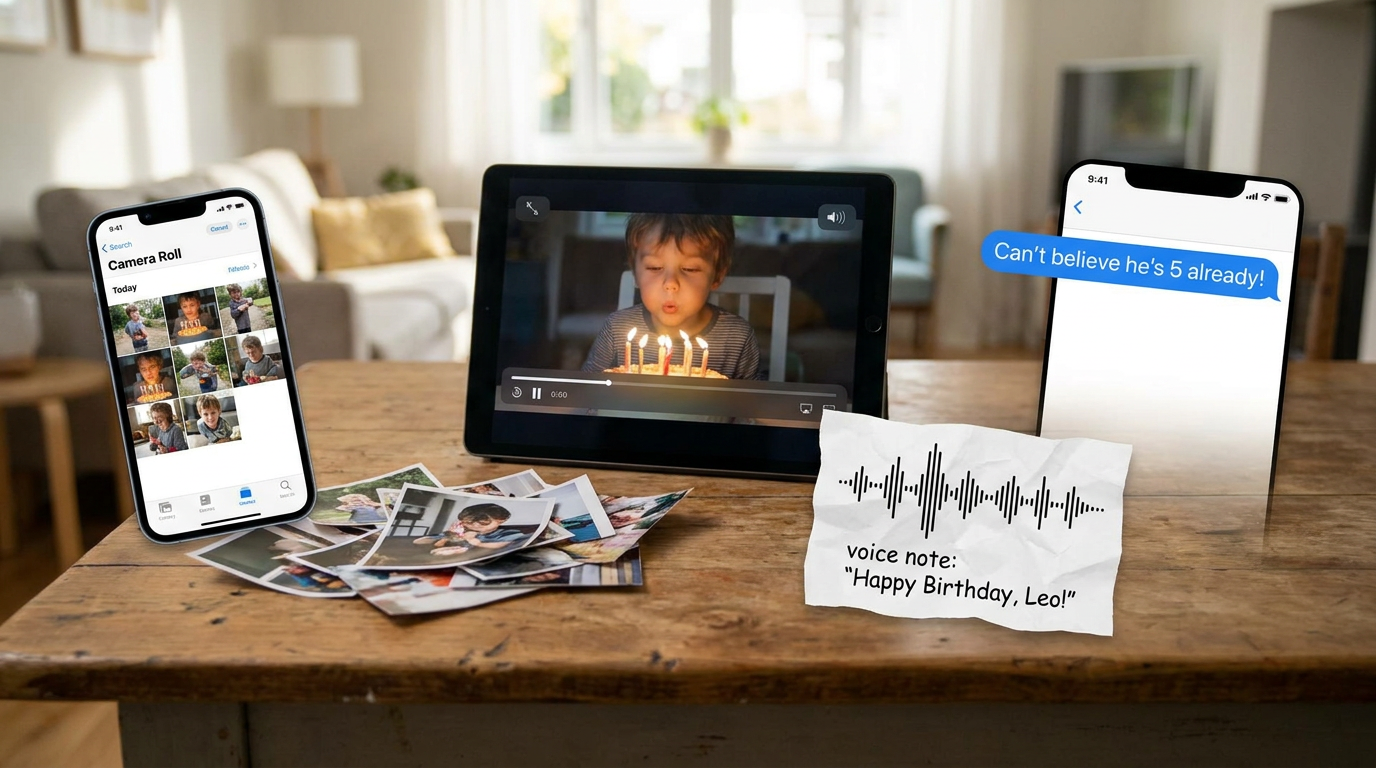
The photo — the good one, the one where her eyes are closed and her cheeks are full — goes into your camera roll, somewhere between a screenshot of a parking receipt and nine near-identical shots of the same cake. The ten-second video of the actual blow, the laugh, the miss, lives in a different place entirely, buried under a week of other clips. The voice note where she explains, with total seriousness, why she wanted a dinosaur cake and not a princess one — that is in yet another app, the one you only open to record voice notes and then never listen to them again. And the text you sent your father that night, the one that said you should have seen her face, is gone into a thread that will be impossible to find by next spring.
Here is the quiet, honest thing. The memory is whole. You still have it, for now. But the record of it is in four places, and no two of them know the others exist. Nothing is technically lost. It is just nowhere you would ever think to look — which, by next year, amounts to exactly the same thing.
This is the problem a multimedia journal is built to solve. Instead of forcing every moment to pick a single format and then exiling each format to a different corner of your phone, a multimedia journal keeps text, photos, video, voice and links together in one entry. One container for the whole thing. The photo and the laugh and the reason she wanted the dinosaur, side by side, where they belong.
That is the idea behind this piece — and it is the opposite of how most journaling works. Most journaling is a single text box. We are going to argue for something bigger: one moment, every format.
In the next ten minutes we will cover what a multimedia journal actually is and why one format was never enough, how to build your first multimedia entry tonight in five steps, what in your ordinary life is most worth capturing this way, how to keep rich entries readable instead of cluttered, how those entries quietly become a keepsake you can hold and share, a plain-English word on privacy, and a quick FAQ for the questions people always ask before they start.
But all of it comes back to one question, the one that started this whole thing:
What if the whole memory could live in one place?
What a Multimedia Journal Actually Is (and Why One Format Was Never Enough)
Let us start with a plain definition, because the term gets thrown around and rarely pinned down.
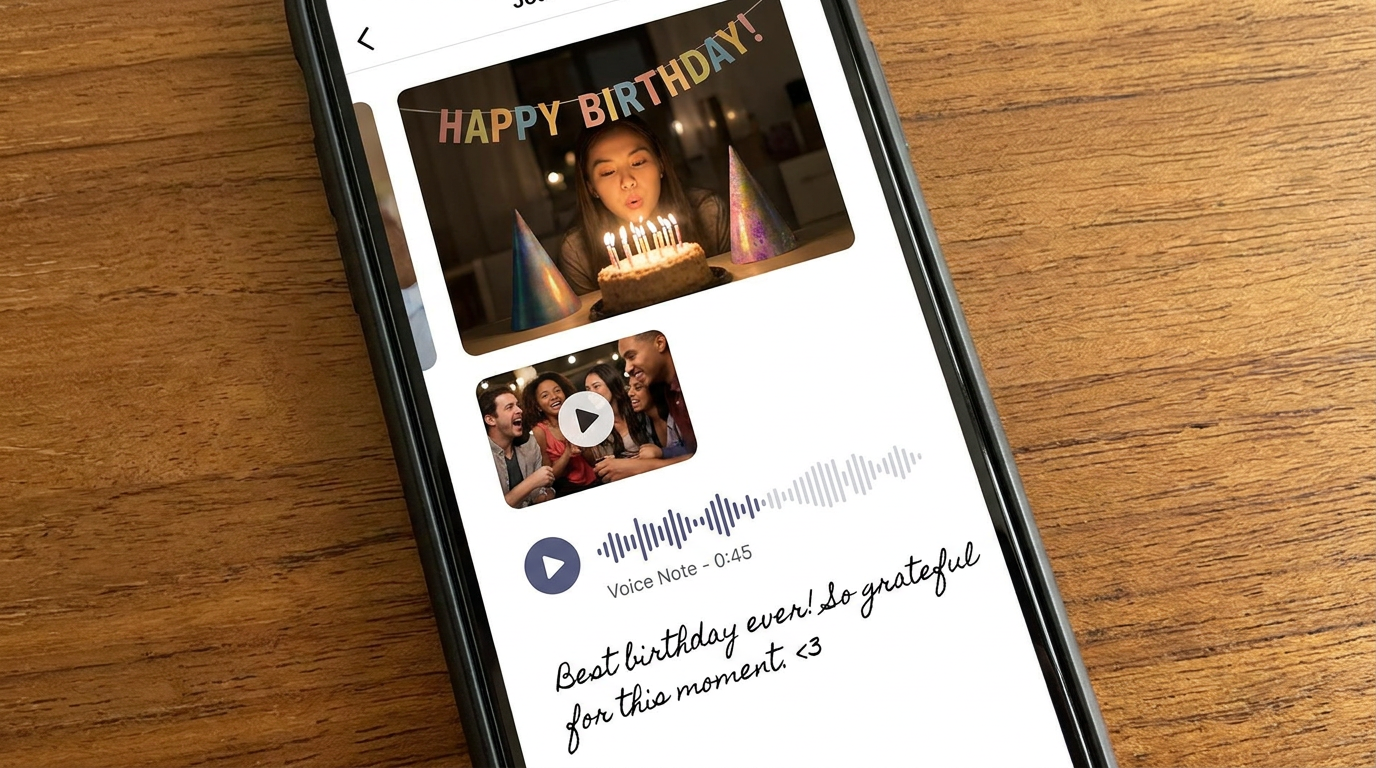
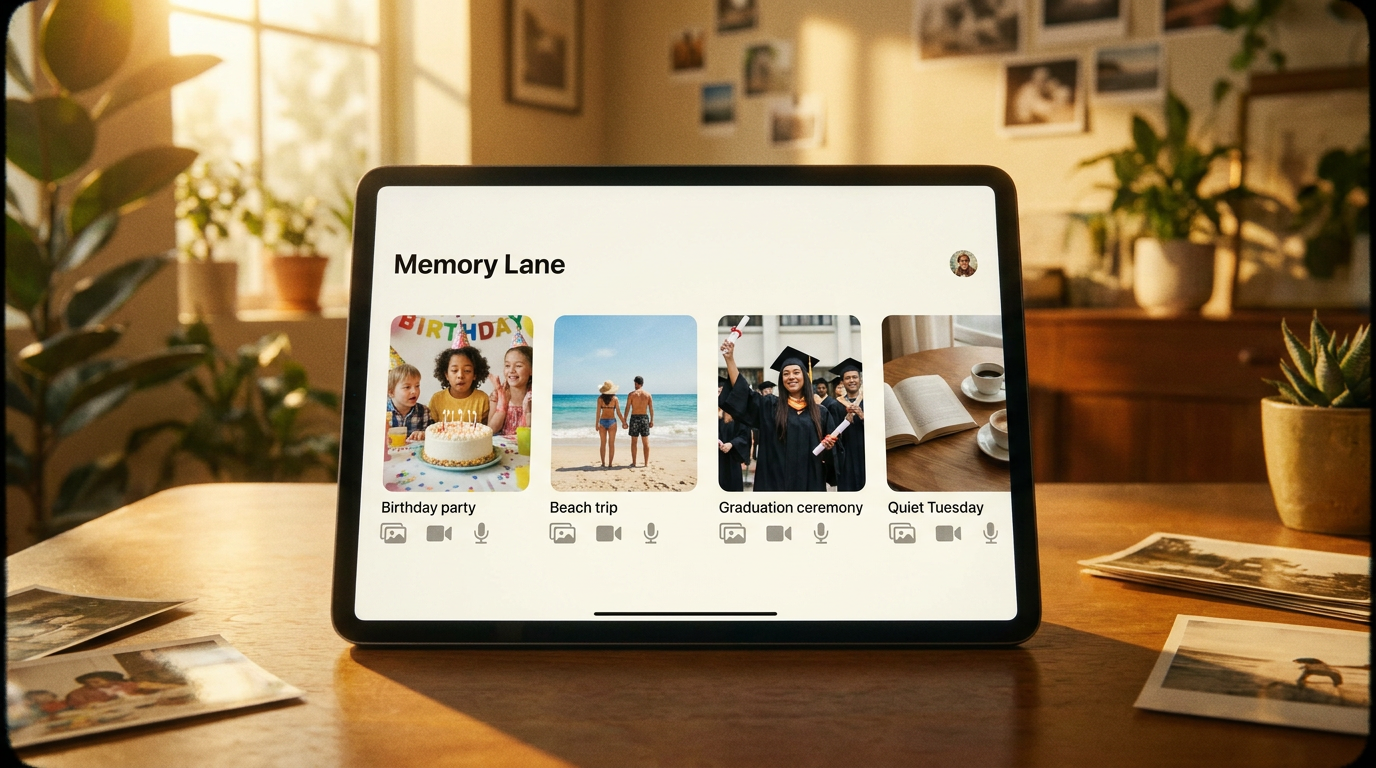
A multimedia journal is a journal where a single entry can hold more than one kind of thing at once. Not just text. Not just photos. All of it, together. In Lugelo, that single entry is called a Moment, and a Moment can hold text, photos, video, audio and links in the same place — so you never have to choose which part of a memory is allowed to survive and which part gets left behind in another app.
That "choose" is the whole point, and it is worth sitting with for a second. Most tools are built for exactly one format. A notes app wants you to type. A camera app wants you to shoot. A voice-recorder wants you to talk. Each of them is good at its one job and completely indifferent to the others. So a single memory — which almost never arrives in only one format — gets split up at the door, like a family being seated at four different tables. A mixed media journal refuses that arrangement. It seats the whole memory together.
Why does that matter so much? Because of what each format is actually for.
A photo is extraordinarily good at one thing and useless at everything else. It answers the question what did this look like? with total authority. It cannot answer a single other question. It cannot tell you why everyone in the frame is laughing. It cannot tell you what was playing in the background, or what your daughter said thirty seconds before, or that the reason your mother is crying is happiness and not the onions. The photo captures the what. Everything else — the voice note, the ten-second video, the one line of context you typed — captures the why.
A photo captures the what. Everything else captures the why.
And the why is the part that evaporates. This is the honest observation underneath the entire case for multimedia. We photograph our lives obsessively and we record the reasons behind them almost never. We end up with volume and no meaning — ten thousand images and not a single sentence explaining any of them. That is not a memory. That is an archive nobody can read. Volume isn't memory. A thousand undated photos of a thousand afternoons tell you less, in the end, than one Moment that holds the picture and the laugh and the one line about why it mattered.
This is where a multimedia journal parts ways with ordinary journaling and ordinary note-taking. A traditional digital journal is usually text-first — a diary, basically, with a date on it. That is a lovely thing and plenty of people want exactly that. But it leaves the photo over here and the video over there. The promise of a true journal app with photos and video is different: it is that the memory arrives intact and stays intact. Nothing gets amputated for the sake of the format.
Lugelo's own describes this directly — a single entry carrying photos, videos, audio and text together, rather than scattered across separate tools. That is the mechanical definition. The emotional definition is simpler. It is the difference between a memory you can reconstruct and a memory you can re-enter.
features page
There is one more piece to the mental model, and it is what turns a pile of good entries into something you actually return to. A single Moment is powerful. But Moments also need somewhere coherent to land. In Lugelo, each one settles automatically onto Memory Lane — a living, chronological record of your moments, laid out in sequence so that your entries become a timeline you can scroll through rather than a folder you have to excavate. You can read more about how that timeline works on the same . The point is that a multimedia entry is not a one-off. It is a brick. Enough of them, in order, build a wall you can walk along.
features page
So that is the what and the why. A multimedia journal is a container, not a text box. It exists because a single format can only ever tell you a fraction of the truth, and because the fractions, scattered, decay. An all-in-one journaling appWhich raises the obvious, practical question. If this is what a multimedia journal is — how do you actually build one?
is really just a promise that the pieces will stay together long enough to still mean something later.
How to Build a Multimedia Entry in 5 Steps
The honest answer is that it is much easier than it sounds, and the whole thing takes a minute or two. You are not assembling a documentary. You are dropping a handful of things into one place before they wander off. Here is the exact sequence, start to finish, using that birthday as the example.
Step 1 — Start a Moment.
Open a journal, create a new Moment, and — this is the part people skip and later regret — give it a specific name. Not "Birthday." Put a person, a place, or a date in the title: "Maya's 6th birthday — kitchen, March." It feels fussy in the moment and it is a gift to yourself in ten years. Specific names are findable. "Birthday" is a word you will have used forty times by the time you go looking, and a search for it will return a wall of candles with no way to tell March from July. The title is the handle you will grab this memory by later, so make it a handle worth grabbing.
Step 2 — Add the photo.
Drop in the hero image. Straight from the camera roll, or taken with the in-app camera, or imported — whichever is in front of you. One thing here, and it matters more than it looks: one strong photo beats twelve near-duplicates. You do not need the whole burst. You need the one where her eyes are shut and her cheeks are full. Pick it, add it, move on. The temptation to dump the entire sequence is the beginning of the clutter problem we will deal with later — resist it now and your future self will thank you.
Step 3 — Attach the voice note or video.
This is the step that does the thing a photo cannot. The ten-second clip of the actual blow — the laugh, the miss, the dog barking. Or the voice note where she explains the dinosaur cake. This is the sound of the moment, and sound is the first thing memory loses. You will remember that she laughed long before you remember what the laugh sounded like. A short video or a quick voice note is the only way to keep the second one. Add it here, in the same Moment, right under the photo.
Step 4 — Drop in a link.
Context lives in links, and context is what makes a memory legible years later. The playlist that was playing. The article about the bakery that made the cake. The map pin of the house. These are the details that would otherwise vanish entirely, because nobody thinks to write them down. If the thing lives on the web, Lugelo's browser extension lets you clip it straight into a Moment — the describes how the web and photo clipping works. A single link can anchor a whole afternoon to the wider world it happened in.
features page
Step 5 — Add a line of context, and let it land on your timeline.
One or two sentences. Not an essay. Just the why. "She practised blowing them out all afternoon and then missed two and thought it was the funniest thing that had ever happened." That sentence is what makes the entry rereadable in a decade — the media shows what it looked like, the line tells you what it meant. Then you are done. The Moment settles automatically onto your Memory Lane, in sequence, in order, as part of the larger story of your year. If you want to understand exactly how that timeline assembles itself, Lugelo's explains Memory Lane in plain English.
FAQ page
Now, before anyone talks themselves out of starting, the most important reassurance in this entire post:
You do not have to do all five steps.
One photo and one sentence is a finished entry. Genuinely finished. Everything else — the video, the voice note, the link — is optional richness, not required homework. This is a principle Lugelo returns to again and again, including in its : the bar for a "complete" entry is deliberately, almost embarrassingly low, because a low bar is the only kind of bar a journaling habit survives. A rich five-format Moment is wonderful when you have the energy. A blurry photo and a half-sentence is wonderful when you do not. Both count. Both land on the timeline. Neither is a failure.
September journal prompts post
So that is how. Five steps, two minutes, and a bar you can clear on your worst day. Now the more interesting question — what in your actual life is most worth capturing this way?
What to Capture as Multimedia Moments (Five Everyday Clusters)
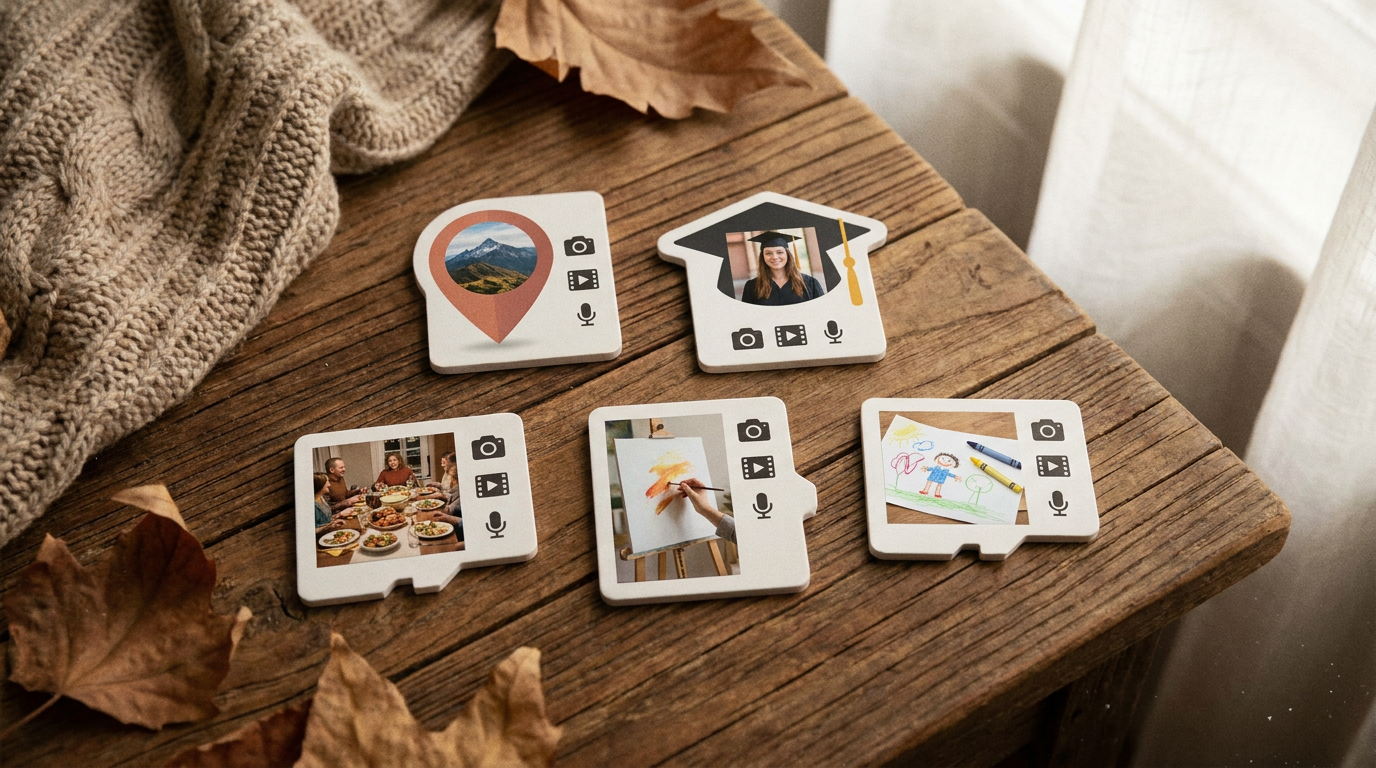
The method is only useful if you can see your own life in it. So here are five clusters of moments where a single format quietly fails you — and where combining a few formats turns a thin record into something you can genuinely step back into. Notice the pattern in each: the feeling comes first, the format follows.
A trip.
A trip is the clearest case, because a trip is never one thing. It is the view, yes — but it is also the voice note you recorded in the car when you were overtired and said something that made everyone laugh, and the video panning across a street market, and the map pin of the tiny restaurant you would never otherwise find again. A single postcard photo reduces a whole day to its prettiest two seconds. A travel Moment — photos, a clip of the view, a voice note from the road, a map link — holds the day the way you actually lived it. Lugelo is built with exactly this in mind; the describes a travel journal designed to document every adventure, companions and map pins included.
features page
A milestone.
Here is a cruel little irony: milestones are the memories we photograph the most and record the least. A graduation. A first job. First steps across a living-room floor. We take forty photos and write down nothing — no sense of how the room felt, nothing of what was actually said. The photo of the mortarboard in the air is beautiful and empty. Add the shaky video of the name being called, and the voice note of the thing your father said afterward that you want to remember word-for-word, and suddenly the milestone has a why attached to its what. The format mix is doing the work the single photo never could.
A family gathering.
Family gatherings have a hidden property: there is no single true version of them. Several people, several perspectives, several afternoons happening in the same room. The parent remembers the logistics; the kids remember the dog; the teenager remembers something neither adult noticed. This is exactly where a grandparent's voice note becomes the detail no photo on earth could hold — the specific way they tell the story that gets told every year, in their actual voice, at this actual age. A gathering is the first place you start to feel the pull toward collaboration — more on that shortly — because the fullest record of the day is the one that lets more than one person add their part.
A creative project.
If you make things — paint, build, write, cook, renovate — you already know that the finished object is the least interesting part of the story. The interesting part is how it came together: the work-in-progress photos, the voice memo where you talked out the idea before you knew if it would work, the link to the reference that started the whole thing. A creative-project Moment is a record of a process, and a process is a far richer thing to revisit than a result. The before matters more than the after, and multimedia is the only way to keep the before.
A child's year.
This is the one that compounds the hardest. A child's year is made of small, specific, perishable things: the costume and why they insisted on it, the drawing that meant everything to them for a week, the voice clip of them explaining, at length and with total conviction, some theory about the world that will be gone by spring. Capture a handful of these every year — photo, voice, one line — and stack them year over year, and you are no longer keeping a journal. You are building a portrait of a childhood, assembled almost accidentally, out of entries nobody thought were important at the time. Lugelo's is the deep-dive companion to this idea — how a single child's year, captured in multiple formats and repeated annually, becomes a keepsake a family keeps forever.
October memory journal post
You will notice none of these are extraordinary. No weddings required, no once-in-a-lifetime trips. The richest multimedia Moments are usually the ordinary ones — the Tuesday, the car ride, the kitchen — precisely because the ordinary is what we never think to record and therefore lose completely. The milestones at least get photographed. It is the quiet afternoons that disappear without a trace.
Which brings up the one practical worry that everyone has at this point. If a single memory can hold photos and video and voice and links and text — won't the entry become a cluttered mess? Here is how to make sure richer never means messier.
Readability Tips for Mixed-Media Entries (So Richer Doesn't Mean Messier)
This is the fear, and it is a fair one. More formats sounds like more clutter. A Moment stuffed with every photo, three videos, four voice notes and a wall of text is not a memory — it is a junk drawer with a date on it. The good news is that readable multimedia entries follow a few simple craft rules, and once you internalise them, richness stops fighting clarity and starts serving it. Here are the five that matter most.
1. Lead with one hero.
Every Moment should have a single anchor — one photo or one clip that is the memory — and everything else should support it. Not compete with it. The instinct to add all nine versions of the same shot is the instinct that ruins the entry. Pick the one. The hero does the emotional work; the supporting pieces fill in context around it. An entry with one strong image and a few deliberate additions is a pleasure to reopen. An entry with forty images is a chore nobody will ever reread.
2. One sentence of "why" beats three paragraphs of "what."
You do not need to describe what the photo shows — the photo already shows it. Writing "here we are at the beach" under a picture of the beach is wasted effort. What the picture cannot show is why the day mattered, and that is the one thing worth typing. One honest sentence of why is what makes an entry rereadable in ten years. The media handles the what. Your job is the why, and your job is small.
3. Let format follow the memory.
Do not force every Moment into every format. Let the memory tell you what it needs. Use voice for the things you would never bother to type — the long, rambling, affectionate stuff that dies the second you reach for a keyboard. Use video for motion and sound, the things a still frame kills. Use photos for the single image you will want to return to. Use links for the context you would otherwise lose. The format should follow the feeling, not the other way around.
4. Name it so you can find it.
This is the rule that separates a searchable digital journal from a pile of undated files. Specific titles plus dates mean that in five years you can actually find the thing. The whole value of keeping a record collapses if the record is unsearchable, and a Moment called "Maya's 6th birthday — kitchen, March" is findable in a way that forty files called "IMG_4471" never will be. National archivists make precisely this point about personal collections: the stresses that keeping things labelled, dated and in one place is what makes them findable years later. The people whose literal job is preservation agree — naming is not fussiness, it is the whole game.
Library of Congress's guidance on personal digital archiving
5. Don't aim for perfect. Aim for captured.
Here is the rule that holds all the others up. A finished entry is one photo and one line. Richness is optional. Perfection is not the target, and chasing it is the single most reliable way to abandon the habit entirely. The point of a mixed media journal is not to produce beautiful artefacts on demand — it is to catch the memory before it scatters, and a roughly-caught memory beats a perfectly-planned one that never gets made. This is also, pragmatically, how the habit survives a busy week: the weeks you have nothing to give, you give one photo and one line, and the record stays unbroken. An all-in-one journaling app is only useful if you actually use it, and you only keep using the tools that let you do a bad job on a bad day.
A finished entry is one photo and one line. Everything after that is a bonus, not a requirement.
Follow those five and your entries will be rich and readable — the kind of thing that is a genuine pleasure to reopen rather than a guilt-pile you scroll past. Lugelo has written at length about this low-bar philosophy in its Once your Moments are rich and readable, something begins to happen that you did not necessarily plan for. They stop being just entries. They start becoming something you can hold, share, and even step inside.
September journal prompts post
, and it is worth absorbing, because it is the quiet engine behind every record that actually survives.
From Multimedia Journal to Keepsake (eBooks, Storybooks, Shared Journals & VR Galleries)
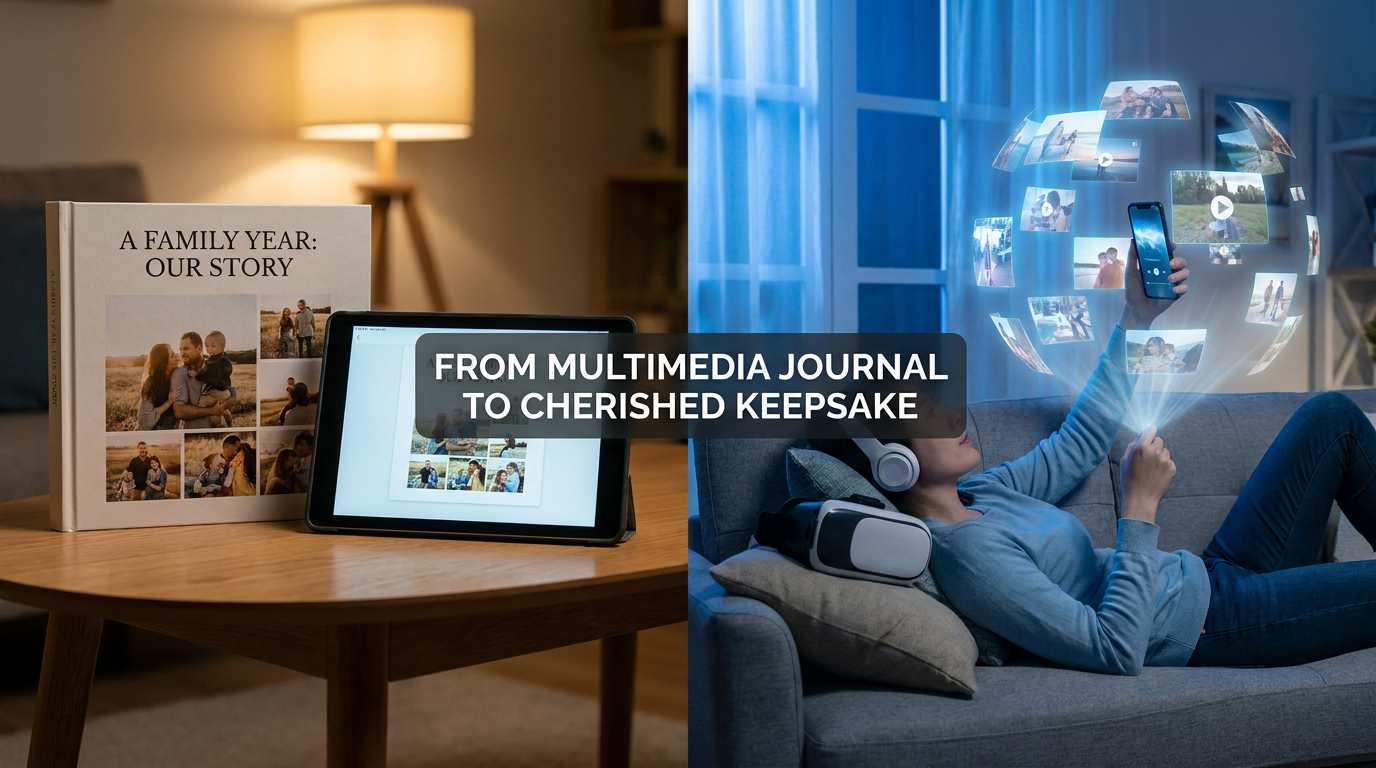
Here is the part most people never reach, and it is the part that makes all the small daily effort compound into something unexpectedly large. A multimedia journal does not just sit there accumulating. The Moments you have been quietly building — photo, voice, video, one line of why — turn out to be the raw material for keepsakes you can actually hand to the people in them. This is where the format choice you made months ago pays off, because the media travels with the memory wherever it goes.
An eBook with the media attached.
A month, or a season, or a whole year of multimedia Moments can become a printable, giftable eBook. Not a flat PDF of text — an actual book of your family's time, with the photos and the context carried along inside it. Because the entries were multimodal from the start, the eBook is not a stripped-down summary; it is the real thing, portable. The afternoon you caught in five formats is still, recognisably, that afternoon.
A scrapbook or storybook.
Sometimes you want an object. Something on the table at the next gathering that people can pick up and pass around, rather than five people hunched over one phone, waiting their turn to swipe. A storybook or scrapbook export is for exactly that moment — the physical artefact that lives in the room, that a child can take off a shelf, that survives a dead battery and a forgotten password. The digital record is the living, growing thing; the printed book is the keepsake it becomes at milestones.
Shared and collaborative journals.
This is where multimedia and collaboration compound into something no single person could build alone. You can invite family and friends to add their formats and their perspectives to the same journal — the grandparent's voice note, the cousin's photos, the version of the night that only the eight-year-old saw. Access is owner-controlled and role-based, so you decide who can contribute and you can change your mind at any time. Lugelo's describes how shared and family journals work, with every contributor's additions attributed to them — so in a decade you will know not just what happened, but who remembered it, and how old they were when they did. A family gathering recorded by four people is four times the truth of one recorded by one.
features page
A VR Gallery.
And then there is the most immersive output of all — the one you genuinely will not find anywhere else. Your photos and the places you wrote about can become a 360° gallery you can step inside. Photographs flatten memories; a VR Gallery gives them dimension again, turning a flat scroll into a space you can walk through, alone or with the people who were there. You do not need a headset to begin — you can view a 2D preview in your browser or on your phone, and reach for the fully immersive version when you want it. The shows what this looks like; it is the clearest proof of the whole argument, that a memory kept in rich formats can be re-entered rather than merely reviewed.
VR Galleries page
Keep the emotional order straight, because it is the order that matters: first you preserve the moment, and only later does it becomeBefore you pour your life into one place, though, there is one fair question that deserves a direct answer: who can actually see all this?
an eBook or a gallery. The keepsake is the reward, not the reason. You are not journaling in order to make a book; you are catching afternoons before they scatter, and the book is simply what a year of caught afternoons turns into when you are not looking. That is the compounding payoff — nothing extra required, just the ordinary habit, grown over time into something you can hand across a table.
A Plain-English Word on Privacy
Here is the plain language.
This is where your voice notes live. The video of your daughter's laugh. Photos of the people you love most, at ages they will never be again. So the privacy question is not a box to tick — it is the whole foundation, and it deserves plain language rather than marketing gloss.
Your journals are private by default. Nothing is shared until you choose to share it. There is no public-unless-you-hide-it trick, no quiet opt-out buried in a settings menu. The default is closed.
You control access, person by person. When you invite someone into a shared journal, you decide what they can do — and you can revoke that access at any time, for any reason, without explaining yourself. The owner holds the keys.
Your data is encrypted in transit, and there is no third-party data selling. Your memories are not a product being sold to someone else. They are yours.
And if you ever want to leave, deletion is available, with a 30-day recovery window — long enough to undo a decision made in a bad mood, final enough to mean something.
Now the honest part, because honesty is the only version of a privacy promise worth making. Nothing is permanent, and anyone who tells you otherwise is selling something. No one can guarantee forever — not an app, not a shoebox, not a hard drive in a drawer. What a privacy promise can do is be specific and keepable: private by default, owner-controlled, encrypted in transit, not sold, deletable. Those are commitments you can actually hold a company to, which is exactly why they are the only ones worth stating. What you write in Lugelo stays in Lugelo, unless you choose otherwise. The full detail lives on the With that settled, a few quick questions people always ask right before they start.
FAQ page
, in the same plain English, with no asterisks hiding in the small print.
Frequently Asked Questions
What is a multimedia journal?
A multimedia journal is a journal where a single entry can hold text, photos, video, audio and links together — instead of forcing you to choose one format and lose the rest. The whole memory stays in one place.
What's the difference between a multimedia journal and a regular digital journal?
A regular digital journal is usually text-first — essentially a dated diary. A multimedia (or mixed media) journal keeps every format in the same entry, so the photo, the video, the voice note and the context all stay together instead of scattering across separate apps.
Can I really put photos, video and voice in one journal entry?
Yes. A single Moment in Lugelo holds photos, short videos, audio and voice notes, text and links all in one place — that is the core of what the app is built to do.
Is there an all-in-one journaling app that works across devices?
Yes. Lugelo works on web, iOS, Android and HarmonyOS, and your Moments sync across all of them — so you can start an entry on your phone and finish it on your laptop.
Can other people add their photos and videos to the same journal?
Yes. Shared journals let invited family or friends contribute their own Moments — their photos, their videos, their voice notes — with owner-controlled, revocable access. You decide who joins and you can change that at any time.
Can I turn a multimedia journal into something to keep or share?
Yes. Your Moments can become a printable eBook, a storybook or scrapbook, or an immersive VR Gallery you can step inside. You can see examples on the .
FAQ page
Is it private?
Journals are private by default, with owner-controlled access, encrypted in transit, no third-party data selling, and deletion available with a 30-day recovery window.
Is it free?
Yes. Lugelo is free on iOS, Android, HarmonyOS and the web, with an optional Plus tier — and no ads.
Conclusion: One Moment, Every Format
For most of us, that moment is already four moments — a photo over here, a video over there, a voice note in an app we never open, a text in a thread we will never find. Four places, none of them talking to the others, each one quietly decaying on its own schedule. Not lost, exactly. Just scattered beyond retrieval, which comes to the same thing in the end.
Go back to the kitchen. The candles, the big breath, the two she missed, the laugh that nearly put her on the floor.
A multimedia journal does one simple, stubborn thing against all of that. It keeps the whole memory together — the photo and the laugh and the dinosaur-cake explanation andBecause everyone has a story to tell, and almost all of it is made of ordinary afternoons that nobody thought to keep. This is how you keep them.
And you do not have to do all of it. You do not need the video and the voice note and the link and the perfect title. Start one Moment tonight — one photo, one line, and maybe, if you have the energy, one ten-second clip of a laugh you will want to hear again in ten years. That is a finished entry. That is the whole habit, in miniature.
Let us be honest about what that does and does not promise. Nothing is permanent, and nobody can promise you forever. But a memory kept whole, in one place, with a name you can search and a sentence that explains it, is a memory you are far more likely to still have hold of on the day you want it back. That is not a guarantee. It is just a much better bet than a shoebox and four apps.
the one line about why it mattered — in a single Moment, on a single timeline, where you will actually be able to find it. Not four places. One.
Don't Just Live It — Keep It
Start one Moment — a photo, a line, a voice note — and keep the whole memory in one place, where the people who were there can add their part too.
Start Saving What Actually Matters →
Want to see where this leads before you begin? or .
explore every feature →See how Moments become keepsakes →
Available on web, iOS, Android and HarmonyOS. Journals are private by default, and you decide who can view or contribute.