60
Blogs
-
Oct 01
Halloween Journal Prompts for Families: 30 Spooky and Sweet Prompts to Capture the Magic
You're standing at the front door. The tiny witch's hat is askew — it keeps sliding because your child absolutely refused a bobby pin. The candy bucket is swinging so hard it's almost a weapon. And your little one is vibrating at a frequency that you're pretty sure only dogs can hear. This is it. ThisAnd then — just like that — they're gone. Running toward the first lit-up house, shrieking with delight, not looking back. is the moment. The cold October air spills in, jack-o'-lanterns flicker on the porch, and somewhere down the street a fog machine rumbles to life. Every Halloween parent knows this feeling: the desperate, helpless joy of watching a moment you love slip into the past before it's even finished. The candy will be sorted and eaten within a week. The costume will be folded into a bag and forgotten by Thanksgiving. And within a few Octobers, the specific details — the exact thing your child said when they saw their reflection in the mirror for the first time in costume, the neighbor who handed out king-size bars, the moment the little one got spooked and reached for your hand — those details will blur. That's where Halloween journal prompts come in. Journaling is the single most powerful tool families have for turning fleeting seasonal magic into something permanent. Not just photos — though photos are wonderful — but the feelings, the stories, the words your children use to make sense of the world around them. This post is your complete guide to doing exactly that, with 30 Halloween journal prompts for kids and families organized into five rich categories: costumes and creativity, trick-or-treating adventures, spooky storytelling, family traditions, and gratitude and reflection. Along the way, you'll find practical tips for capturing Halloween memories across text, photos, voice, and video — and a guide to turning this year's October into a storybook your family will return to for years to come. Let's get started. The magic is already happening. Let's make sure it lasts. Why Halloween Is One of the Year's Best Journaling Moments for FamiliesThere are a handful of days in childhood that live permanently in full color — the first day of school, birthdays, the morning of a big trip. Halloween is always on that list. It's one of the only days of the entire year where imagination, community, sensory experience, and sheer joy converge all at once, and for children, it registers as something almost mythological. That makes it one of the richest possible opportunities for journal prompts for kids — and for the families and educators who guide them. Think about what Halloween actually contains as an experience. There's the weeks-long build-up of choosing a costume, the rituals of carving pumpkins and decorating the house, the transformation of a familiar neighborhood into something almost unrecognizable at night, the social theater of trick-or-treating, the sugar-fueled debrief afterward, and the slow, satisfying fade back into ordinary life. Each of those moments is layered with emotion, sensory detail, and meaning — the precise ingredients that make for compelling journaling. And yet, most families let it pass undocumented beyond a handful of photos in a camera roll that they'll struggle to find two years from now. The developmental case for journaling is strong. According to the For educators, this is equally valuable. October writing exercises that are grounded in a child's real, lived experience are far more engaging than generic prompts. A classroom full of children describing their Halloween costumes, their trick-or-treating routes, or their own invented ghost stories is a classroom that's genuinely excited about writing — and that excitement is the first step toward literacy that lasts. Institute of Child Psychology's evidence-based resource on journaling for children, regular journaling gives kids a safe container to explore emotions, build self-awareness, and practice resilience. Seasonal prompts — like Halloween-specific questions — lower the barrier to entry dramatically, because children already have something vivid and emotionally charged to write about. You're not asking them to "write about their feelings" in the abstract; you're asking them to describe the spookiest house on the street. The emotional processing happens naturally, through the specificity of the story. But beyond development, there's something even more fundamental at stake: memory itself.Halloween memories fade faster than we expect. Not the big impressionistic feeling — you'll always remember that your child loved Halloween — but the details. What they said the first time they saw themselves in costume. The specific design they chose for their pumpkin. The neighbor who always outdid herself with decorations. The moment your fearless five-year-old discovered there were things that scared them after all. Those details, if not captured, are simply gone. Photos capture faces. Journals capture feelings. Together, they create something your family will treasure for decades. "Photos capture faces. Journals capture feelings. Together, they create something your family will treasure for decades."The concept of a "Halloween memory lane"Journaling also doesn't have to be a solo, silent, written exercise. It can be collaborative — parents and children building entries together, taking turns, contributing different perspectives on the same evening. It can be multimedia, weaving photos and voice recordings and sketches into a single rich entry. And it can be quick — even fifteen minutes during the post-trick-or-treating candy sort can yield something extraordinary. — a journal that grows year over year, capturing each October as children grow — is one of the most meaningful things a family can build together. Imagine opening a journal from ten years ago and reading what your child thought was the scariest house on the street. Imagine hearing, in their own handwriting, exactly who they wanted to be and why. That's not just a memory. That's a treasure. You can find , and if you're looking for broader resources on memory-keeping with young children, is full of ideas for families at every stage. Lugelo's early childhood blog categoryreal examples of families using Lugelo to document shared experiences like theseThink of the 30 prompts ahead as a trick-or-treat bag of journaling ideas — something for every age, every mood, and every Halloween tradition. We're starting where every great Halloween begins: the costume. Costumes & Creativity — Halloween Journal Prompts 1–7The costume is everything. It's the weeks of negotiation and imagination, the last-minute hot-glue panic, the moment of reveal when the child first sees themselves transformed in a mirror and their whole face changes. Costumes are deeply revealing — of what children are drawn to, who they want to be, what stories live inside them. The stories behind costume choices are some of the most charming, funny, and touching memories families hold, and they deserve to be documented with care. These seven Halloween journal prompts for kids center on costumes and creativity. A pro tip before you begin: ask your child to answer one or two of these prompts before Halloween, as part of the excitement ritual of costume season. Make it part of getting dressed for the big night. Prompt 1 — The Big RevealWhy did you choose your costume this year? Was it something you saw, dreamed about, or decided instantly? Walk me through the moment you knew.This prompt is deceptively simple and produces remarkable results. Children's answers range from "I saw it in a movie and I wanted to feel like the hero" to "I just really like dragons." Both are perfect. Both are irreplaceable. Prompt 2 — Design Your Dream CostumeIf you could wear any costume in the entire world — real or imaginary, from any story, any time period, any universe — what would it be and why? Describe it in as much detail as you can.This prompt works for any age. Younger children can draw and dictate; older children can write elaborate descriptions. It reveals imagination in its purest form. Prompt 3 — Character in CostumeIf you actually were your Halloween character for one full day — not just wearing the costume, but truly living as them — what would you do? What would you eat? What would you say? Where would you go?This is the prompt that turns into a short story before anyone realizes it. Encourage children to write at least three "scenes" from their character's day. Prompt 4 — The Making OfHow was your costume made or put together? Describe every detail, from the very top of your head to the tips of your toes. What was the hardest part to get right?This prompt does double duty: it documents the costume in detail (better than any photo alone) and captures the creative process, which is often where the best family stories live. Prompt 5 — The Best Costume You've Ever SeenThink of the most amazing costume you've ever seen on another person — it can be this year or any Halloween you can remember. Describe it in detail. What made it so incredible?Children's answers to this one will surprise you. The "best costume ever" is rarely the most elaborate or expensive — it's the one that made them feel something. Prompt 6 — Halloween Through the YearsIf you've had more than one Halloween costume, try to list every single one you can remember. Which was your all-time favorite, and why? Which would you wear again tomorrow?This prompt becomes more powerful every year. A ten-year-old answering it has a genuine retrospective to explore. A six-year-old answering it is already building the archive that will matter later. Prompt 7 — Costume Advice to a FriendImagine your best friend is completely stuck — they have no idea what to be for Halloween. Write them the best advice you can. What should they think about? How do you find the perfect costume?This prompt builds empathy and metacognition simultaneously. And the advice children give is almost always wiser and funnier than you'd expect. 📸 Multimedia Capture Tip: Photograph the costume before trick-or-treating — when it's pristine — and then again afterward, when it's been lived in. Candy smudge on the witch's robe? That's part of the story too. Ask your child to write a caption for each photo in their own words. And if you can, record a short voice note of your child saying in their own voice. Even ten seconds of a four-year-old explaining their costume is, ten years from now, completely irreplaceable. make adding photos and voice notes to a journal entry seamless — you can build a full costume entry in minutes. Lugelo's featuresFor educators looking for complementary classroom resources, Scholastic's spooky prompts for collective storytellingWith the costume documented and the anticipation at its peak, it's time to step out into the October night — candy bucket swinging, breath visible in the cold air — for the main event. pair beautifully with these prompts for group creative writing exercises in October. Trick-or-Treating Adventures & Spooky Stories — Prompts 8–16The night itself. This is what children dream about for weeks — the moment the door opens, the cold air hits their costumed skin, and the neighborhood transforms into something almost mythological. Familiar houses become mysterious. Ordinary streets become an adventure route. Even the most confident children feel something electric and slightly primal about Halloween night — the dark, the costumes, the strangers at the door, the possibility of something genuinely scary around every corner. These nine halloween journal prompts are divided into two groups: five that document the real-world adventure of trick-or-treating, and four that open the door to imaginative spooky storytelling. Together, they span the full emotional range of Halloween night. The Night Itself: Trick-or-Treating Prompts 8–12Prompt 8 — The First HouseDescribe the very first house you went to this Halloween. What did it look like? How was it decorated? Who answered the door? What did they give you? How did it feel to say "trick or treat" for the very first time that night?First impressions carry enormous weight on Halloween. The first house sets the tone for the whole evening, and children remember it with surprising specificity when asked the right questions. Prompt 9 — The Spookiest House on the StreetWas there one house that made you slow down, hold your breath, or reach for someone's hand? Describe it in as much detail as you can — the decorations, the sounds, the lighting, the feeling in your stomach as you walked up.This prompt reliably produces some of the most vivid writing children do all year. Fear, even safe Halloween fear, sharpens the senses and the memory. Prompt 10 — Your Candy ReportMake a full inventory of your candy haul. What was the best piece — and why? What was the worst? Were there any surprises? Which piece did you eat first? Would you trade any of them, and for what?This one is pure joy. The candy report is part inventory, part editorial, and entirely charming. Read it back in February when the candy is long gone. Prompt 11 — The Neighborhood at NightDescribe your street or your neighborhood on Halloween night. What does it look, sound, and smell like? How is it different from every other night of the year? If a visitor from another planet landed on your street on Halloween, what would they think was happening?This prompt develops observational writing and encourages children to see their familiar surroundings with fresh eyes. Prompt 12 — The Trick-or-Treat Moment You'll Never ForgetOut of everything that happened on Halloween night, what was the single most memorable moment? It doesn't have to be dramatic — it just has to be the one that stays with you. Describe it as if you're telling a friend who wasn't there.This is the anchor prompt of the trick-or-treating section. Whatever the child chooses — the funny moment, the scary one, the sweet one — it's guaranteed to be exactly what you'd most want to remember. Now for the Really Fun Part: Spooky Story Prompts 13–16There's a reason ghost stories have been told around fires for as long as humans have gathered together in the dark. Fear, held safely within the container of a story, is one of the most electrifying human experiences — and children are naturally gifted storytellers when given a good starting point. These four creative prompts are perfect as classroom Halloween writing exercises in the week before the holiday, and equally wonderful as family journaling adventures. For even more classroom-ready ideas, offer a fantastic complementary resource. Night Zoo Keeper's Halloween writing prompts for kidsPrompt 13 — The Haunted HouseWrite a short story about a family who moves into a house that everyone in town says is haunted. At first they're terrified — strange sounds, flickering lights, cold drafts. But then they discover that the ghost is actually... friendly. What does the ghost want? What happens when they finally meet?This prompt's twist — the friendly ghost — gives children permission to be imaginative without being overwhelmed by genuine fear. It also naturally leads to character development, conflict, and resolution. Prompt 14 — The Witch's InvitationOn Halloween morning, you find a mysterious folded note slipped under your front door. It's written in purple ink on black paper. It's an invitation — to the witch's Halloween party. Describe the invitation in detail. Then write about what happens when you decide to go.The two-part structure of this prompt — describe the artifact, then write the adventure — gives children a concrete starting point and an open-ended destination. Prompt 15 — The Pumpkin That Came to LifeYou carved your jack-o'-lantern this afternoon. You lit the candle inside and stepped back to admire it. And then — it blinked. A slow, deliberate blink. Then it smiled, wider than you carved it. And then... it spoke. What does it say? What happens next?This prompt produces reliably wonderful results across all ages. Younger children tend toward whimsy; older children lean into the uncanny. Both directions make for unforgettable entries. Prompt 16 — Your Own Spooky StoryWrite a Halloween story that is exactly as spooky as you want it to be — no more, no less. You choose the characters, the setting, the monster (if there is one), and the ending. The only rule: make it yours.This is the open prompt — the one that reveals the most about a child's imagination, because there are no guardrails. It's the prompt to revisit year after year and watch the stories evolve. 📸 Multimedia Capture Tip: During trick-or-treating, take short video clips — just 10 to 15 seconds per house — that can later be embedded in a journal entry alongside the written prompts. Capture audio of kids reacting at the door in real time. And consider drawing or printing a simple map of the trick-or-treating route; photograph it and add it to the journal as a visual record of the evening's geography. Lugelo's how-to videosFrom the electric energy of Halloween night, we turn now to something quieter and equally beautiful — the season itself, and the rituals that make it more than just one extraordinary evening. show exactly how to add voice memos and video clips to a journal entry in seconds. Family Traditions & The Full Season of Autumn Magic — Prompts 17–24Halloween is not a single night. It's a season — a full six weeks (at minimum, for the enthusiastic families) of rituals, anticipation, and sensory pleasure that accumulate into something much larger than any single October 31st. The pumpkin patch trip you take every year. The movie you always watch. The smell of the house when the cinnamon candles are lit. These traditions are the architecture of a family's identity, built slowly and lovingly, year by year. And they are, in many ways, the most important things to document — because they are also the first things to drift and change as children grow. One October, your child is too old for the pumpkin patch. One year, the spooky movie you always watched together is "too babyish." These moments of outgrowing are quiet and often unannounced, which makes the records of the before all the more precious. These eight journal prompts for kids and families zoom out from Halloween night to capture the full richness of the season. Prompt 17 — Pumpkin Patch DayDescribe your trip to the pumpkin patch — or wherever you found your pumpkin this year. How did you travel there? What did you see when you arrived? How did you choose your pumpkin? What made it feel like "the one"?The pumpkin-choosing process is, to children, a deeply serious endeavor. Honor that seriousness in the journal. Prompt 18 — Carving NightWalk through the pumpkin carving process, step by step. What design did you choose, and how did you decide? What was the most challenging part? Describe the moment you put the candle inside and turned out the lights for the very first time.Carving night is one of the most tactile, sensory-rich Halloween experiences — the feel of the pumpkin's interior, the smell of the seeds, the careful work of the design. Prompts that ask children to describe sensory experience produce some of the strongest writing. Prompt 19 — Our Halloween TraditionsWhat does your family do every Halloween that you would never, ever want to skip? Pick your most important Halloween tradition and describe it from beginning to end — every step, every detail, every feeling.This is the prompt that, read years later, reconstructs an entire family ritual in perfect detail. Encourage completeness over brevity: more detail is always better. Prompt 20 — Decorating the HouseDescribe how your home looks and feels when it's fully decorated for Halloween. Walk me through each room or each part of the house. What is your absolute favorite decoration, and why does it matter to you?Children's favorite decorations are rarely the most expensive or elaborate ones. They're the ones with stories attached — and those are the stories worth capturing. Prompt 21 — The Smell of OctoberClose your eyes and think about autumn. What do you smell? Describe each smell as vividly as you can. What does that smell remind you of? Where does it take you?Smell is the sense most directly linked to memory. This prompt produces astonishing results — and children who might struggle with narrative writing often flourish with sensory description. Prompt 22 — Halloween Food & TreatsWhat food or treat is most "Halloween" to you — the one that, when you taste it, feels like October? Describe making it or eating it in as much sensory detail as possible. Who makes it? When do you have it?Candy apples. Pumpkin seeds. Hot cider. Caramel everything. Food is culture, and documenting a family's Halloween food traditions is a form of keeping history. Prompt 23 — A Letter to Next Year's SelfWrite a short letter to yourself, to be opened next Halloween. Tell future-you everything important about this October: what you loved, what surprised you, what you hope will happen again. Seal it and save it.Prompt 23 — A Letter to Next Year's Self — is the one your child will thank you for making them write.This is the prompt families come back to again and again. Opening last year's letter on the first day of October the following year becomes, over time, one of the most magical Halloween rituals of all. Prompt 24 — What Halloween Teaches UsWhat does Halloween teach us — about imagination, about community, about the strange fun of being a little bit scared? Write your answer as thoughtfully as you can.This is the reflective, philosophical prompt of the section — the one that invites children to step back and think about why Halloween matters, not just what happens during it. Older children especially will surprise you with their answers. 📸 Multimedia Capture Tip: For pumpkin carving, take a sequence of photos from start to finish — the uncarved pumpkin, the design sketched on, the mid-carve, and the final glowing result — and add all of them to a single journal entry to create a visual narrative. Record voice notes of children describing the smell and feel of pulling pumpkin seeds (what photos simply cannot capture). And don't miss the decorated front porch at night, with the jack-o'-lanterns glowing — it's the quintessential Halloween image, and it belongs in the journal alongside the stories. This is also the ideal section to highlight collaborative journaling across generations. According to , family traditions are among the most powerful contributors to children's sense of identity and belonging. Imagine inviting grandparents to add their childhood Halloween memories to the same journal — what they wore, how their neighborhoods looked, what candy they traded away. A multigenerational Halloween journal, built through , is something no photo album can replicate. Lugelo's collaboration featuresCreative ChildAnd if you want to truly future-proof these memories, imagine your decorated home, your carved pumpkins, your trick-or-treating route — all preserved in an immersive your children can explore decades from now. Lugelo VR galleryThe candy is sorted. The traditions are documented. Now comes the quietest, most meaningful part of the whole season — the reflection. Gratitude, Reflection & Looking Back — Prompts 25–30This is exactly the right moment for these final six prompts. After the candy is sorted and the costumes are packed away, after the jack-o'-lanterns have been set out and the decorations have come down, there is a quiet window — usually the first few days of November — when the season is still close enough to feel. The memories are vivid. The feelings haven't faded. The details are still right there, at the surface. These are the Halloween journaling prompts that serve most directly as keepsakes — the ones that, read a decade later, have the power to stop you completely in the middle of whatever you're doing and send you back, fully and completely, to exactly the way things were. They are also the prompts that most gently introduce the idea of journaling as a year-round practice — not just a Halloween activity, but a lifelong habit of noticing and recording what matters. consistently highlights the emotional value of reflective writing — its ability to help children process experiences, build gratitude, and develop a stronger sense of self. These prompts do all of that, with the added gift of becoming treasures to return to. Research on the benefits of journaling for childrenPrompt 25 — The Best PartIf you had to choose just one thing — a single moment, feeling, or experience — that made this Halloween truly special, what would it be? Don't overthink it. What comes to mind first?First instincts are almost always right. The answer to this prompt is usually not what parents expect, and that's exactly what makes it so valuable. Prompt 26 — Thank You, HalloweenWrite a thank-you note to Halloween itself — the season, the holiday, the whole idea of it. What are you most grateful for this year? What did Halloween give you that you didn't have before?This prompt reframes gratitude in a playful, accessible way that even young children can engage with. A thank-you note to a holiday is a delightful genre, and children rise to it magnificently. Prompt 27 — Who Made It SpecialThink about the most important person in your Halloween this year — the person who made it better just by being there. Who is it? What did they do? Write them something that tells them exactly what they mean to you.This prompt generates the most emotionally resonant entries of any in this collection. It documents relationships, not just events — and relationships are what Halloween is ultimately about. Prompt 28 — What Surprised YouWhat happened this Halloween that you didn't expect? It could be something funny, something touching, something a little scary, or something completely random. Were you glad it happened? What did it teach you?The unexpected moments are the ones that define a Halloween in hindsight. This prompt specifically captures them before they fade. Prompt 29 — What I Want to RememberIf you could bottle up one feeling from this Halloween — just one — and save it to open in ten years, what feeling would it be? Describe it as precisely as you can, so that future-you can feel it again.This is a prompt about emotional memory — one of the most sophisticated forms of reflection children can practice. The answers are often achingly beautiful. Prompt 30 — A Message to My Future SelfYou are writing from October 2026. Describe this Halloween in full — the costume, the weather, who you were with, how old you are, how you felt, what you ate, what made you laugh, what made you a little scared. Write it so that the future you — ten, twenty, thirty years from now — can step back into this exact night and feel it again.This is the most powerful long-term keepsake prompt in the entire collection. Make it a yearly ritual. Build a "Prompt 30 archive" that grows alongside your child, and you will have built something more valuable than any photograph — a window back into every Halloween they've ever lived. For educators, prompts 25 through 28 make excellent post-Halloween classroom discussion or writing exercises in the first week of November, when children are still brimming with memories and eager to share them. For younger children who struggle with the writing itself, Lugelo's AI Journal Assistant can help parents expand a few spoken sentences into a full, beautifully articulated journal entry — so that even a three-year-old's answer to Prompt 30 gets preserved with the richness it deserves. Explore all of to see how the platform supports children at every age and stage. Lugelo's featuresJournaling isn't just about what you remember — it's about who you were when you experienced it. And as beautifully illustrates, the chapters we record with the most intention are the ones we get to live twice. Lugelo's approach to life-chapter journaling"Journals are souvenirs of your past. This October is worth keeping."You now have 30 prompts. Here's how to bring them to life — in one beautiful, enduring place. Bringing It All to Life with Lugelo — Text, Photos, Voice & Video in One PlaceHere is a problem that nearly every family faces after Halloween: you have dozens of photos. They live scattered across your phone's camera roll, your partner's camera roll, a group chat with your in-laws, and possibly a tablet that the kids used to take photos of the candy pile. They're disconnected from each other and entirely disconnected from the stories, feelings, and words that give them meaning. A photo of your child in their costume is lovely. A photo of your child in their costume, next to their handwritten answer to Prompt 1 ("I chose to be a dragon because dragons are brave and they're a little scary but not mean scary"), alongside a voice recording of them explaining their reasoning in their own six-year-old voice — that is something else entirely. That's what a Lugelo Halloween journal is. Here's how to build one. Step 1 — Create a "Halloween 2026" JournalSet it up before October 31st so you're ready to capture in real time. Name it something meaningful to your family. Think of it as the container for everything that's about to happen — a dedicated, private space that's just for this October. Step 2 — Use the Prompts as Journal EntriesEach of the 30 prompts above becomes its own entry, or you can group related prompts together — for example, "Trick-or-Treating Night" might hold prompts 8 through 12 in a single rich entry with multiple photos embedded throughout. There's no wrong way to organize it. Step 3 — Add PhotosThe costume before-and-after. The pumpkin carving sequence. The decorated house. The neighborhood at night. The candy haul spread out on the living room floor. Embed these directly into the relevant entries, so the visual and the written tell the story together. Step 4 — Record Voice NotesCapture your children's voices answering prompts out loud — this is especially powerful for very young children who can't yet write. Even a thirty-second audio clip of a four-year-old explaining their costume becomes, in ten years, one of the most precious things you own. The voice changes so fast. Lugelo captures it. Step 5 — Invite Family to CollaborateGrandparents, aunts and uncles, cousins — invite them to add their own memories and perspectives to the shared journal. A grandmother describing her own childhood Halloween costume alongside her grandchild's 2026 entry creates a multigenerational thread that no photo album on earth can replicate. make this seamless, with owner-controlled sharing that keeps the journal private by default while still welcoming the people you choose. Lugelo's collaboration featuresStep 6 — Turn It Into a KeepsakeWhen the journal is complete, Lugelo lets you transform it into something your family can relive — an eBook, a visual timeline, or a that lets you literally step back into the decorated house, the glowing pumpkins, the costumes, the night. Imagine your child at 25, putting on a VR headset and stepping back into Halloween 2026. That is not a fantasy. That is a feature. VR galleryThe journal is private by default, owner-controlled, and available across — so every family member can contribute from whatever device they're holding. iOS, Android, HarmonyOS, and webWant to see exactly how it all works before you start? gives you the full picture in minutes, and the answers every question you might have about getting started. Lugelo FAQHow Lugelo WorksThis isn't just a journal app. It's where this Halloween — and every Halloween after it — gets to live. This October Is Worth KeepingRemember the front door. The tiny witch's hat askew. The candy bucket swinging. The cold October air rushing in and the child rushing out, not looking back. That moment — that specific, irreplaceable, already-fading momentThese 30 prompts don't ask anything impossible of your family. They don't require special skills, special equipment, or hours of dedicated time. They ask for a few minutes and a willing child and a place to put the words. That's it. The magic is already happening all around you — the prompts just give it somewhere to live. — is what this is all for. The journal you build this October becomes next year's most treasured read-aloud. Next October, you'll settle onto the couch and open it, and you'll read back what your child said — the candy they rated a ten, the house that made them grab your hand, the dragon costume they loved because dragons are braveEveryone has a story to tell. This Halloween, help your family tell theirs. Because the children who are trick-or-treating tonight will be different children next year, and different again the year after that. The costumes will change. The candy preferences will change. The fears will change, and so will the things that make them laugh. What won't change is the value of having written it down when it was real, and vivid, and right in front of you. Prompt 30 — the message to the future self — is the one that grows in value every single year. Write it this October. Open it next October. And then write it again. — and it will feel like time travel in the very best sense. Start Your Family's Halloween Journal TonightDon't Let This Halloween Become a Blur.Start your family's Halloween journal on Lugelo — free, private, and ready to hold every costume photo, voice note, and spooky story your children create this October.Start Your Halloween Journal — It's Free →Already on Lugelo? Open a new Halloween journal and use these prompts tonight →See how Lugelo turns memories into storybooks: Explore Features →Get inspired by real families doing exactly this: Family Journal Stories →Get Lugelo on iOS | Android | WebRead More about Halloween Journal Prompts for Families: 30 Spooky and Sweet Prompts to Capture the Magic -
Sep 28

The Family Memory Book: Preserving a Life, Not Just a Camera Roll
And it's just a picture. There's a date stamp that means nothing to anyone but you. No names. No story. No indication of why your hands were shaking when you took it, or that it happened three weeks after she'd told you she was never going to learn, or that the bike had been your brother's. Nine minutes later, you find it. So you scroll. Past four hundred screenshots. Past three nearly identical photographs of a parking space you were worried you'd forget. Past a receipt, a meme someone sent you in 2023, twelve pictures of a restaurant menu. Past a blurred thumb. Picture this: it's a Sunday evening and you're looking for one photograph. Just one. The afternoon your daughter finally rode her bike without you holding the saddle — the wobble, the shriek, the look back over her shoulder. You know it exists. You took it. Here's the gap nobody names: saving is not the same as preserving. We have never captured more and remembered less. Roughly — about 5.3 billion every single day. The typical phone carries somewhere in the low thousands of images, with most credible estimates landing between about 2,000 and 2,800. Plenty of family phones carry many multiples of that. Volume has never been our problem. Meaning is. 1.95 trillion photographs will be taken worldwide this year A memory book does something structurally different. It isn't a bigger pile. It's a record — curated, contextual, and deliberately built to be understood by someone who wasn't there. Let's be honest with each other from the first paragraph, because this whole guide depends on it: making one takes real effort. Most people who start a memory book never finish it. This guide exists to make sure you're not one of them. So we'll cover all of it. What a memory book actually is. What belongs inside it beyond photographs. Who to involve, and how to get them to actually respond. How to begin whether you're facing fifty years of shoeboxes or a completely blank page. Which format to choose, honestly assessed. How to organise it without inventing a second job for yourself. And the part nobody warns you about — how to finish. Journals are souvenirs of your past. What a Family Memory Book Actually Is A memory book is a curated, narrated record of a person, a family, or a period of time — one that combines images with the words, voices, objects and context that explain why any of it mattered. Where a camera roll accumulates, a memory book selects and explains. That single difference is the whole discipline. The confusion is understandable, because three different objects get used interchangeably in everyday conversation. They are not the same thing, and choosing between them deliberately will save you months. The photo album. Images arranged in sequence, usually chronological, usually behind plastic sleeves. It's strong on visuals and almost entirely silent on meaning. It answers exactly one question: what did this look like? Effort is low, shareability is poor (it exists in one copy), and it's best suited to people who already know the story and simply want to see it again. The scrapbook. Images plus decorative craft — patterned paper, ticket stubs, ribbon, hand-lettering, pressed flowers. Scrapbooks are wonderful. They carry texture and personality that nothing digital replicates, and the making of them is genuinely pleasurable. But they're typically thin on narrative, extremely difficult to duplicate, and effectively impossible to share with a cousin in another country. They answer what did this feel like aesthetically? rather than what happened? The memory book. Images plus narrative, voice, documents and context. It answers the questions that actually survive: Who were these people? What happened? Why did it matter? It carries more effort than an album but produces something categorically more useful — a record legible to a reader who has no prior knowledge, no shared memories, and no one left to ask. That last point is the test this entire article runs on, so let's state it plainly and come back to it repeatedly: Would a stranger — or your own great-grandchild — understand this without you standing next to them explaining it? If the answer is no, you have a pile. A beautiful, beloved, carefully stored pile. But a pile. The Variations People Are Actually Looking For "Memory book" is an umbrella term covering several genuinely distinct projects, and knowing which one you're making changes every decision downstream. A family memory book is multi-generational — several people, often several decades, usually assembled by one person with contributions from many. A baby memory book covers the first years: milestones, firsts, the name story, the things nobody thinks to write down because they assume they'll remember. A memory journal runs forward rather than backward — ongoing, written, closer to a diary with intent. A memorial or tribute book gathers a life after it's ended, often assembled collaboratively by people processing the same loss from different angles. And single-event books cover one bounded thing: a wedding, an emigration, a year abroad, a house. There's also the school-years version, which deserves its own treatment — if that's your project specifically, we've written that goes considerably deeper on that narrower scope than this page can. a complete guide to creating a school memory book Retrospective, Prospective, or Both Every memory book runs in one of two directions, and most good ones run in both. Retrospective means assembling what already exists — the loft boxes, the inherited albums, the folder of scans your aunt emailed you in 2019. ProspectiveThe retrospective approach is archaeology. The prospective approach is journalism. Archaeology is harder, slower, and often incomplete. Journalism is easier and produces better material — but only if you start. means capturing as life happens, so that in five years you have material with full context attached rather than mysteries to solve. In , the vocabulary for this is simple and worth learning now because it recurs throughout this guide. An individual entry — a photo with a caption, a voice recording, a scanned document, a paragraph of writing — is called a Moment. The chronological view where those Moments arrange themselves into a readable timeline is called Memory LaneOnce you know what a memory book is meant to do, the practical question arrives immediately — what actually goes inside one? Lugelo One reassurance before we go further, because it stops more people than any technical obstacle. You do not need to be a writer. You do not need to be a designer. You do not need to be an organised person, and the evidence suggests most people who successfully make these are not. What you need is a decision about scope and a single place to put things. . That's the whole structural grammar: you add Moments, and Memory Lane puts them in order. What to Put in a Memory Book Beyond Photographs Here's the insight that changes how people approach this entire project: photographs record surfaces. Almost everything that makes a person recognisable lives somewhere else. A photograph shows you a face. It doesn't carry a voice. It doesn't hold a phrase, a temper, a laugh, the particular way someone came down the stairs, or what the kitchen smelled like on a Sunday. Twenty years on, the face is the thing you're least likely to have forgotten — and the voice is the thing you'd give almost anything to hear again. So build outward from the photographs. Voices. This is the category families consistently name as the most treasured thing they own, and the one they most regret not gathering. A recording of a grandparent telling a story in their own accent, at their own pace, with their own hesitations and their own laugh, is not a supplement to a photograph. It's a different order of thing entirely. Record it before you feel ready. A two-minute voice note made badly on a kitchen table beats a perfectly planned interview that never happens, and the perfect interview is the enemy here. Lugelo Moments accept audio directly, so a voice note can be the entry — no transcription required. "A photograph shows you a face. A voice recording gives you back a person." Handwriting. A shopping list. A birthday card. A note in the margin of a cookbook. Handwriting is startlingly personal — more identifiably someone than most portraits — and it is disappearing faster than any other category on this list. Photograph it or scan it. Before you handle fragile originals, it's worth reading the : clean dry hands, support the whole item, and never reach for adhesive tape. National Archives guidance on handling family papers Recipes. Especially annotated ones. The splashes, the crossings-out, the "add more than it says," the oven temperature amended twice in different pens. An unmarked recipe is instructions. A marked one is a record of someone cooking. Documents. Immigration papers, military records, deeds, school reports, letters, telegrams, naturalisation certificates, employment cards. These anchor a family in verifiable history and give future readers something to pull on when they want to go further. The mundane details. This is the category nobody thinks to record, because at the time it all feels too ordinary to be worth the trouble. The car they drove. The exact route of the school run. What was always in the fridge. The phrase your father used when he was annoyed. What the house sounded like at seven in the morning. These become the most precious material in the book, and they vanish completely and without warning. Objects, photographed. A watch, a christening gown, a ticket stub, a chipped mug that nobody was allowed to throw away. Photograph the object and write down who it belonged to and why it survived. An unexplained object in a photograph is a puzzle; an explained one is a story. Maps and places. Where people lived, in what order, and why they moved. Migration is the spine of most family histories, and the "why" is almost never recorded. Prompts to Capture the Ordinary If you want something you can act on tonight, answer these in writing or out loud: What did a completely normal Tuesday look like in 1994? What was always in the fridge? Who called the house, and at what time of day? What did the house sound like in the morning? What did people wear indoors? What was the argument that came back every year? One honest counterweight: more is not automatically better. A memory book bloated with everything is just a camera roll with extra steps. Every addition should survive the stranger test — would someone who wasn't there understand why this is here? The Ten Things Families Wish They'd Recorded: voices · handwriting · recipes · the name story · an ordinary weekday · the house · the car · the repeated phrases · the objects and who owned them · the reasons behind the big decisions. Building a Baby Memory Book: The First-Years Version The baby memory bookKnowing what to gather raises an awkward question, though: most of this material isn't actually in your possession. One structural advantage worth using from day one: both parents can add their own Moments to the same baby journal, and so can grandparents, rather than one person silently inheriting the entire job. Two perspectives on the same first year is a better record than one — and it halves the load. The practical approach is to capture loosely and organise later. A single running journal you actually add to beats a beautiful structured template you fall behind on by February. Add a Moment when something happens; let the timeline sort itself out. What genuinely matters is a much shorter list than the templates suggest. The first photograph. The name story — who chose it, why, and what the alternatives were, because that gets forgotten within a decade. A handwriting sample: a note from each parent to the child, written now, in the present tense. Birth details. A recording of the parents' voices in the first weeks, when everyone sounds exhausted and slightly amazed. First words. And the sayings — the mangled, invented words a child produces that the family repeats for the next thirty years and never writes down. is the most common entry point into this entire subject — and the easiest to over-plan and abandon. Something about a new baby makes people buy a 200-page hardback with prompts for every week, which is precisely the design most likely to stall at week six, at which point the guilt of being behind becomes a reason not to open it at all. Who to Involve and How to Get Family to Contribute So the collaboration problem isn't optional. It's structural. That person inherits two things simultaneously: all of the labour, and an incomplete record. Because siblings remember different years. Cousins hold photographs from the branch of the family that emigrated. An aunt has the letters. Your mother knows who the people in the 1968 photographs are, and nobody else does. The archivist has the motivation and roughly a third of the material. In almost every family, one person becomes the default archivist. You probably know who it is in yours. There's a reasonable chance it's you, given you're reading this. Why People Don't Contribute It is almost never indifference, which is worth internalising before you get resentful. There are four real reasons: They don't know what you want. "Send me your old photos" is not a request, it's a project. It requires the recipient to make decisions, and so they defer it. They think their contribution isn't good enough. The photograph is blurry. They can't remember the exact year. They're "not a writer." So they send nothing, on the theory that nothing is better than something imperfect. They don't know how to use the tool. Particularly for older relatives, the fear of pressing the wrong button and breaking something you've spent months building is genuinely paralysing. The ask is too big. An open-ended request to "help with the family history" reads as a commitment of unknown size, and people don't accept commitments of unknown size. The Fixes That Actually Work Ask for one specific thing. "Do you have a photo from the 1987 holiday in Cornwall?" gets a reply within a day. "Send me your old photos" gets nothing, ever, from anyone. Set a comically low bar and say so out loud. Tell people explicitly: one photograph with one sentence is a complete contribution. Say it in those words. It removes the fear of being judged on effort. Accept voice notes. The relative who insists they aren't a writer will happily talk for four minutes without pausing. Meet people in the format they're comfortable with, and you'll get ten times the material. Assign by era, not by task. Whoever was there for the 1970s owns the 1970s. This converts a vague collective obligation into a defined personal one, and it flatters people by treating their memory as authoritative. Attach a deadline to a real event. A birthday, an anniversary, a reunion, Christmas. Open-ended projects do not finish. Projects with a delivery date do. Here's a message you can copy and adapt right now: "Hi — I'm putting together a memory book for Mum's 70th in March. Could you send me one photo of her from before 1985, and one thing you remember about her from back then? Doesn't need to be long — two lines is perfect, or just record yourself talking for a minute and send me the voice note. That's genuinely all I need." How It Works in Practice In , you create a shared journal and invite people by email or link, assigning each person a role: Viewer, Contributor, or EditorThat role distinction solves the anxiety problem directly. Contributors can add their own Moments — photos, video, audio, text — but cannot alter anyone else's entries. Nobody can accidentally delete your work. Once an older relative understands that, the "what if I mess it up" objection disappears, and it is a far bigger barrier than most people realise. Lugelo's collaborative journal . Journals are private by default. The owner keeps owner-controlled access throughout and can revoke it at any point. And every Moment shows who added it and when, which means the finished book naturally carries multiple voices rather than flattening into a single narrator's summary of everyone else's lives. If you're dividing the work between two people specifically — two parents, two siblings — our guide on covers that workflow in more depth. how to co-create a journal with a partner Making a Grandparents' Memory Book This is the most time-sensitive version of the project and, predictably, the one people most often postpone. The approach that works is questions, not a blank page. Nobody can respond usefully to "tell me about your life." Almost everybody can answer: Where were you living when you were my age? What was your first job, and what did it pay? What was your mother like? What did you do on a Saturday when you were nineteen? What's a story your parents told you about their parents?With people and material lined up, the hardest practical question arrives: where do you actually begin? Grandparents can be added as Contributors and add Moments from their own device — or a family member can add on their behalf after a visit, which is often the more realistic arrangement. And it's worth saying plainly, without drama: this particular project has a deadline set by circumstance rather than by you. The people who can identify the faces in the photographs and explain why the family left in 1962 are a finite resource. That isn't a reason for anxiety. It's a reason to book the first session this month. Work in short sessions. Forty minutes is plenty. Repeat visits produce dramatically better material than one marathon interview, partly because memory works associatively — the question you asked on Tuesday surfaces an answer on Friday. Record audio rather than transcribing as you go. It's faster, it keeps the conversation natural instead of turning it into dictation, and it preserves the voice itself, which is the point. That last question is quietly the most valuable one on the list — it reaches back a generation further than living memory usually goes. How to Start a Memory Book From Anything or Nothing Two opposite paralysis states stop most memory books before the first page. Either there's far too much material, or there's almost none. Both feel like disqualifications. Neither is. Start Here If You Have Too Much Do not start by sorting. This is the single most important instruction in the section. Sorting is where these projects die — it's effortful, it produces no visible output, and it can be extended indefinitely, which makes it the perfect procrastination activity disguised as progress. Start instead by choosing a scope. One person. One decade. One household. One theme. A finished book about your mother's childhood is worth more than an unfinished book about everything since 1890, and the second one is what you'll accidentally attempt if you don't decide now. Then work in passes rather than perfection: Pass one — gather. Get everything into one physical place. No decisions, no sorting, no reading. Just consolidation. Pass two — react. Go through and pull out only the items that make you feel something. Trust that instinct; it's a better editor than any system. Pass three — caption. Identify and caption what you pulled. Names, approximate year, what's happening, why it's here. Ignore everything else for now. It isn't going anywhere. Before you handle anything fragile, get the basics right. The is plain-English, non-commercial and genuinely practical: clean dry hands, support the whole item, no adhesive tape, no rubber bands, no paper clips. Their guidance on is worth reading before you put anything back in the loft, because storage conditions do more damage than handling ever will. storing family papers and photographsNational Archives' guide to preserving family archives Digitise the fragile things first. Anything brittle, fading, water-marked or stored somewhere damp goes to the front of the queue. Photographs and negatives are considerably more vulnerable than paper. The Archives also publish specific advice on and on — worth having open the first time you lift the lid on a box that's been in a garage since 1998. what to do about mould or insect damagescanning and digitising And then the highest-value hour of the entire project: caption while the person who knows is still in the room. Sit with the oldest relative you have and go through photographs asking who, where, roughly when. An unidentified photograph is close to worthless three generations on. An identified one is evidence. Start Here If You Have Almost Nothing An empty start is a genuine advantage, and it's worth reframing it as one immediately. You aren't reconstructing a record from fragments with the context missing. You're building forward, with full context available, from people who are still here to explain themselves. Start with living memory. Interview the oldest willing relative this month. One conversation typically produces more usable material than a weekend in the loft. Start with the present. A memory book does not have to begin in the past. Begin today — this week, this ordinary September — and let it accumulate. In five years you'll hold something no amount of retrospective effort could ever manufacture, because it'll have the details that only get recorded contemporaneously. Anchor with documents. Certificates, records and public archives fix names, dates and places, and give later readers something verifiable to build on. Beat the blank page with prompts. If the obstacle is simply not knowing what to write, Lugelo's offers prompts and can expand rough bullet points into a readable entry — without replacing your own voice, which remains the thing that matters. Used well, it's a way past the first sentence, not a ghostwriter. AI Journal Assistant The First Weekend Plan Four hours, and you'll be ahead of most people who ever attempt this: Hour one. Decide the scope and give the book a name. Write both down. Hour two. Gather twenty items. No sorting, no judging. Hour three. Caption ten of them — names, rough year, what's happening. Hour four. Record one voice memory. Yours or someone else's. Before committing serious hours to gathering, though, it's worth deciding what form the finished thing will actually take. That's it. You now have a scoped project, twenty pieces of material, ten identified items and one voice recording. That is further than the overwhelming majority of memory books ever get. Memory Book Formats Compared: Physical, Printed and Digital This is the section where the article either earns your trust or loses it, so let's be genuinely even-handed. There are four realistic formats, and the right answer depends entirely on what you're optimising for. Physical scrapbook or album. Best for tactility, craft and the pleasure of making something with your hands. Holds audio or video? No. Shareable? Barely — it exists in exactly one copy. Main risk: that single copy. Fire, flood, damp, a house move, a well-meaning clearout. Real strengths, though, and they're often undersold: no device required, no file formats to worry about, no account to maintain, and it's genuinely lovely to hold. People pick up physical books. They rarely open folders. Printed photo book. Best for producing a finished, giftable object with a definite ending. Holds audio or video? No. Shareable? Yes, at a cost per copy. Main risk: it's fixed at the moment of printing — an error in a name is permanent-ish in the only sense that matters, and there's limited room for text. But it sits on a shelf where people actually reach for it, which is more than can be said for most digital archives. Digital, private and single-owner. Best for searchability, multimedia and ongoing capture. Holds audio or video? Yes. Shareable? Yes, at your discretion. Main risk: it requires active care, and people assume it doesn't. Strengths are substantial — it holds voice, video and documents, it's searchable, it can be copied to multiple locations, and it has no page limit. Shared digital. Best for multi-contributor family projects across distance. Holds audio or video? Yes. Shareable? By design. Main risk: it still needs one person to own it and set expectations, or it drifts. The upside is that no single person carries the entire load, and you get multiple perspectives instead of one narrator's summary. Digital Is Not the Same as Durable Here's the honest part, and it matters more than anything else in this section. Digital files are not self-preserving. Putting something into an app does not make it safe. The makes the point that digital materials can in some respects be harder to look after than physical ones, precisely because they depend on technology — file formats, software, hardware, accounts — to remain readable at all. A shoebox in a dry cupboard needs nothing from you for thirty years. A digital archive needs attention. Library of Congress's personal digital archiving programme So three rules, and they apply regardless of which service or software you use: More than one copy. Always. In more than one place. Not two folders on the same laptop. Checked more than once. Periodically open old files and confirm they still open. Migrate ageing formats before they become unreadable, and favour common, well-supported ones. The Library of Congress publishes format-specific guidance worth following for and , which is particularly relevant if voice recordings are going to be the emotional centre of your book. digital audiodigital photographs The Hybrid Is the Honest Recommendation Keep a working digital record as the living archive — searchable, multimedia, shareable, easy to add to on a Tuesday evening. Then print a physical copy at milestones: a significant birthday, the end of a decade, the completion of a chapter. Two formats. Two entirely different failure modes. One story. That's the most defensible answer anyone can give you, and it's what we'd actually recommend. Choosing Tools for a Family Memoir Project Rather than a shopping list, use criteria. Ask any tool you're considering these six questions: Does it hold audio and video, or only photos and text? If voices matter to you — and they should — this is disqualifying for a lot of options. Can more than one person contribute, with controlled permissions? Not just shared access. Roles, so a nervous relative can add without being able to overwrite. Can you export your material out in a standard format? This is the most overlooked criterion in the entire decision, and the one people regret ignoring. If your family's record can't leave, it isn't really yours to move. Is it private by default? The default matters more than the settings, because defaults are what most people actually live with. Can it produce something printable at the end? A record with no exit into physical form is a record with only one failure mode. Does it work on the devices your least tech-confident relative actually owns? The most capable tool is useless if your grandmother can't open it. For transparency, here's where Lugelo sits factually against those criteria: multimedia Moments including audio and video, role-based collaboration with Viewer, Contributor and Editor permissions, eBook and PDF export, private by default with owner-controlled sharing, and availability on iOS, Android, HarmonyOS and the web. Cost is a legitimate factor in this decision too, and the With the format settled, the work becomes organisational — and this is where projects quietly collapse under admin. pricing page lays that out plainly. Organising a Memory Book Without Drowning in Admin Chronological order is the default that worksIt requires no invented logic, so you never have to explain the structure. It shows change over time, which is the thing photographs do better than any other medium. And crucially, a stranger can follow it without instruction. The visual force of seeing the same person at five, at fifteen and at fifty in sequence cannot be replicated by any thematic arrangement, however clever. , and it's worth understanding why before you consider alternatives. Now the release valve, because this is where perfectionism does its damage: you do not need exact dates. "Sometime in the mid-eighties" is a perfectly good date. So is "before they moved." So is "she looks about seven here, so probably 1974." Approximate placement beats indefinite postponement every single time, and perfectionism about metadata is the number one cause of abandonment in this entire category. "An approximate date beats an indefinite delay. 'Sometime in the eighties' is a date." Four Structures That Work Strict chronology. Everything in time order, one continuous run. Best for single-subject books and family histories. Life stages. Childhood, school, working life, parenthood, later years. Gentler than strict chronology when dates are patchy, and it gives the book natural chapters. One book per person. Cleaner than it sounds, and much easier to finish. Also the most giftable structure — each person's book can go to the people who loved them. Thematic threads across the timeline. Holidays, houses, the same photograph taken every year. These work best layered on top of a chronological spine rather than replacing it. Let the Structure Emerge From Adding The mechanism matters here. In Lugelo, Moments arrange themselves chronologically into , which means the structure emerges from the act of adding rather than from a separate sorting phase. You add; the timeline organises. That single design choice removes most of the administrative overhead that kills these projects, because the organising work never accumulates into a task you have to schedule. Memory Lane If you'd rather watch the workflow than read about it, the show the process directly. how-to walkthroughs Five Anti-Admin Rules Caption at the moment of adding. Never "I'll do it later." Later is where uncaptioned photographs go to become anonymous. Use consistent naming for people. Pick one form of each name — "Nana Ruth," not sometimes "Ruth," sometimes "Nan," sometimes "Mum's mum" — so the record stays searchable. Add the year even when you can't add the day. Partial data is data. Batch similar work. Twenty captions in one sitting is faster than twenty captions across twenty sittings. Set a recurring twenty-minute slot. Sunday evening, Wednesday lunchtime, whenever. Waiting for a free weekend is waiting for something that does not arrive. Recurring Traditions Make the Best Timelines The single most powerful structure available in any memory book is the same thing, photographed every year. Repetition is what converts ordinary snapshots into a visible record of change — no individual photo does much, but forty of them in a row are extraordinary. Annual family traditions are the load-bearing structure of family identity: the same table, the same dish, the same argument about the same board game, the same person falling asleep at the same point in the afternoon. They photograph consistently by their nature, which makes them ideal timeline material. The costume timeline is the clearest example. Halloween costumes lined up year on year — the same child, October after October, at four, at nine, at fourteen — is one of the most striking sequences a family can build. Nothing demonstrates the speed of childhood more plainly, and it takes one photograph a year to produce. Remembrance traditions translate unusually well into this format. Día de los Muertos ofrendas — photographs, favourite foods, marigolds, objects belonging to those being remembered — map naturally onto a digital memory book, where each person remembered can hold their own set of Moments, stories and recorded voices. Approached with cultural respect rather than as novelty, it's one of the most meaningful structures in this guide, because the tradition and the medium are doing the same work. The same-capture-every-year method is exactly what makes so effective in practice, and it scales to any repeating occasion. an annual school year record These annual sequences can also be gathered as a themed journal and later viewed as a VR gallery, with a 2D preview available on any device for family without a headset. Structure solves the middle of the project. The ending is where nearly every memory book actually fails. Finishing a Memory Book: The Completion Problem Let's say the quiet part directly: the hard part is not starting. It's finishing.Starting is emotionally rewarding and requires no discipline. Finishing requires both. Half-built memory books are among the most common objects in family homes. The album with twelve filled pages and forty empty ones. The box labelled "to sort" in handwriting from two house moves ago. The app opened twice. The scanner bought in January. The Four Reasons They Stall Scope creep. The project quietly expands from "Mum's childhood" to "everything about our family since 1890." Nobody decides this; it just happens, one reasonable addition at a time, until the project is too large to complete and too meaningful to abandon. The perfection trap. Waiting until you have every date, every name and every photograph before you'll let yourself call it finished. There is always one more relative to ask. No deadline. Nothing external forces completion, so completion never happens. This is the most fixable of the four. Solo overload. One person carrying material that belongs to eight people, doing the work of an archivist without the mandate or the hours. How to Actually Finish Define "done" before you start — in writing. One person. One era. Forty pages. Thirty Moments. Whatever it is, name it and write it down, because an undefined project cannot be completed by definition. Attach it to a date. A birthday, an anniversary, a reunion, a Christmas. A memory book with a delivery date gets finished. One without a delivery date becomes a hobby, and then a guilt. Ship version one. Finish something small and imperfect. You can always make a second, and a second is much easier than a first. This is the most important sentence in the article, so it gets its own line: "A finished, imperfect memory book beats a perfect one you never made." Leave the gaps visible. "We don't know who this is" is a legitimate entry. So is "Nobody could remember whether this was 1961 or 1962." Honest gaps are part of the record, not a failure of it — and a future relative might close one. The Define Done worksheet. Five lines, filled in before you start: Who is this about? Which years does it cover? How many entries will it contain? Who is it for? When is it due? Turning a Memory Book Into a Printed Book, eBook or VR Gallery A completed journal doesn't have to stay on a screen. There are three outputs, and they serve different purposes. Export as an eBook or PDF-style storybook. This is what most families print, bind or gift. It's the version that ends up on a shelf, and it's the one that survives independently of any account or device. View it as a Memory Lane timeline. The living version — still readable, still searchable, still open to additions when a cousin surfaces a photograph nobody had seen. Galleries work best on Meta Quest, Apple Vision Pro, or WebXR-capable browsers, with a 2D preview available on any device so nobody is excluded for lack of hardware. Shared rooms support up to eight peopleBefore you export, do four things. Check the captions. Confirm names are spelled correctly — this is the error people regret most in print. Decide what stays private. Choose a cover image. Without overstating it: for relatives who missed the years in question entirely, moving through a gallery of a life is a fundamentally different experience from scrolling a feed. It has scale and sequence. You can see how much there was. , which is what makes it workable for a family spread across several countries — a grandparent in one place, grandchildren in another, walking through the same gallery at the same time. And on control: exporting and sharing are always deliberate, owner-controlled actions. Journals remain private by default until you decide otherwise. If you'd like to see what completion actually looks like in practice, the collection is a more persuasive argument than anything we could write here. family journal stories Frequently Asked Questions About Memory Books What is a memory book? A memory book is a curated, narrated record of a person, family or period — photographs combined with stories, voices, documents and context that explain why the moments mattered. Unlike a camera roll, it's selective and explained, built so that someone who wasn't there can still understand what they're looking at. What's the difference between a memory book and a scrapbook? A scrapbook is primarily decorative — craft, ephemera and layout, focused on how the page looks and feels. A memory book is primarily narrative — it prioritises context, voices and documents that explain events. Scrapbooks capture texture and personality; memory books capture meaning. Many people combine both, using craft for presentation and narrative for substance. What should I include in a family memory book? Photographs, plus everything photographs can't carry: voice recordings, handwriting samples, annotated recipes, official documents, and the ordinary details nobody thinks to record — the car, the weekday routine, the phrases people repeated, what was always in the fridge. Include objects too, photographed alongside a note about who owned them and why they survived. How do I start a baby memory book? Start with the first photograph, the name story, a handwritten note from each parent, birth details and a voice recording from the first weeks. Then keep it loose. Add moments as they happen rather than following a rigid weekly template — a running journal you actually maintain beats a structured book you fall behind on. How long does it take to make a memory book? A focused single-subject book — one person, one decade — is realistically a few weekends of concentrated work. A broader family archive isn't a project with an end date; it's a habit, best served by twenty minutes a week rather than a mythical free weekend. Scope determines timeline more than anything else. Is it better to make a memory book digitally or on paper? The hybrid is the honest answer. Keep a digital record as the living archive — searchable, multimedia, easy to add to and share — and print a physical copy at milestones. Digital needs active care to stay readable. Paper exists in a single vulnerable copy. Together they cover each other's weaknesses. How do I get relatives to contribute? Ask for one specific thing rather than "anything you've got." Set an openly low bar: one photo and one sentence is a complete contribution. Accept voice notes from people who say they aren't writers. Assign by era so each person owns the years they lived through. And attach a deadline to a real event. Are my memories private if I use an app? In Lugelo, journals are private by default and sharing is owner-controlled — you decide who gets access and can revoke it at any time. Data is encrypted in transit, and there is no third-party data sharing. You can delete your account at any point, with a 30-day recovery window. Full details are on the . Lugelo FAQs page Can I turn a memory book into a printed book? Yes. A completed journal can be exported as an eBook or PDF-style storybook suitable for printing or gifting. You can also view it as a Memory Lane timeline, or build it into a VR gallery that works on Meta Quest, Apple Vision Pro or WebXR-capable browsers, with a 2D preview on any device. How do I make sure a digital memory book lasts? Keep more than one copy, in more than one location, and check periodically that older files still open. Migrate ageing formats before they become unreadable, and prefer common, well-supported ones. The is independent, practical and free — digital records need active care, not just storage. Library of Congress personal digital archiving guidance Preserving a Life, Not Just a Camera Roll The goal was never to have more photographs. We solved that problem so thoroughly that it became a different problem. The goal is to be able to hand someone a life and have them understand it. Go back to that Sunday evening. The phone with forty thousand images on it. The nine minutes of scrolling. The photograph you finally found, which turned out to explain nothing at all. That's the whole shift. A memory bookOne last piece of honesty, because this guide has tried to be honest throughout. This takes effort. Digital records need looking after — copies, checks, migration. Physical materials degrade. Nothing you do makes a memory immune to time, and anyone who tells you otherwise is selling something. is not a bigger camera roll — it's a record: what it is, what belongs in it beyond photographs, who should help build it, how to begin whether you're facing fifty years of shoeboxes or an empty page, which format genuinely suits you, how to organise it without inventing a second job, and how to finish the thing rather than joining the enormous silent population of people with twelve filled pages and good intentions. But here's what you can do, and it's not a small thing. You can make a life findable, understandable and shareable by the people who come after you. You can make sure the faces have names, the stories have context, and the voice still exists somewhere. That is the entire job, and it's worth doing properly. The urgency isn't dramatic, but it is real. The people who can identify the faces and explain why the family left in 1962 are the resource with a deadline attached. Everything else can wait; that can't. So do one thing this week. Not the whole project — one thing. Record one voice. Two minutes, badly, on a kitchen table. Journals are souvenirs of your past. And everyone has a story worth telling. Stop Losing the Moments That Matter Start your family memory book on Lugelo — free, private by default, and ready for everyone you want to invite. Get Started → Build it together — explore collaborative journals → See what you can create — Lugelo features → Step inside your memories — VR galleries → Available on iOS, Android, HarmonyOS and the web. Because some days are too important to lose.Read More about The Family Memory Book: Preserving a Life, Not Just a Camera Roll -
Sep 25
Your Kid’s Costume, Every Year: Building a Halloween Photo Timeline
Here is the thing nobody tells you on that first Halloween: the photograph is not the point. You take the photo. You take about forty photos that night, honestly. This one goes in among the rest. The light goes amber around half past five at the end of October. You know the exact quality of it — low, slanting, the kind that turns a perfectly ordinary front step into something out of a film. Your child is standing on that step in a costume they chose themselves, with a level of conviction that only a four-year-old can bring to the question of whether they are, in fact, a dinosaur. The sequenceAn honest expectation before we start: this costs about ninety seconds a year, plus a little care. Not nothing. But close. We'll cover the rule you need to write down before you need it, the four details worth capturing alongside the image, how to build the timeline backwards out of the Halloweens you've already photographed, what to do about the years you genuinely missed, how to handle several children and one unimpressed teenager, and what the whole run actually becomes when you finally scroll it end to end. So this post is about one artifact and one artifact only: the annual costume photograph, taken year after year, and what it turns into when the years line up. Not Halloween in general. Not what to do on the night. Just the photo, and the sequence. It works for a reason worth understanding. What changes only becomes legible because everything else stays the same. The door doesn't move. The framing doesn't move. The date doesn't move. Against all that constancy, growth becomes visible in a way it simply isn't in a camera roll of thirty thousand images shot from thirty thousand angles. Consistency is what makes change readable. Put that same child on that same step at four, at nine, at fourteen — the same doorway, the same light, the same slightly crooked house number over their shoulder — and you have made something that no single photograph is capable of doing. You have made the plainest, most undeniable record of how quickly childhood actually moves. is the point. It's also one thread inside a much bigger idea — the notion that a family's real record isn't the camera roll but the handful of things you deliberately keep. We wrote about that at length in , and the costume timeline is one of its most rewarding chapters. It's also, for most families, the easiest place to start collecting kids halloween memories that hold up over time. The Family Memory Book: Preserving a Life, Not Just a Camera Roll But none of the practical advice lands unless you first understand why repetition does the heavy lifting. So let's begin there. The Power of One Photo a Year Forty photos of one evening is a blur. One photo across ten evenings is a story. Think about last Halloween. You probably came home with somewhere between thirty and a hundred images — the costume half-on, the costume fully on, the costume being adjusted in the hallway, three near-identical frames on the path, a blurry one of them running, a group shot where one child blinked, a group shot where a different child blinked. All of it evidence of a good evening. Almost none of it something you'd ever sit down and look at again. There's a paradox sitting underneath modern family photography, and once you notice it you can't stop noticing it: the more photos you take of an occasion, the less any individual one of them means. Forty photos of one evening is a blur. One photo across ten evenings is a story. That's not a sentimental claim, it's a structural one. A timeline is a comparison deviceThis is why the effort curve and the value curve run in completely different directions, which is the best deal in family record-keeping. . It functions the way a scientific control functions — by holding every variable steady except the one you actually want to observe. Same location. Same framing. Same week of the year. Same distance from the camera. When all of that is locked down, the only thing left for the eye to read is the child, and the child is the thing you wanted to see all along. Year one, you have a photo of a small person in a costume. Nice. Unremarkable. Year two, you have two photos that look pleasingly similar. Year three, it's mildly interesting — you can see something happening. Year five is usually where other people start reacting; someone glances over your shoulder and says oh, look at herThe work stays exactly the same the whole way through. Ninety seconds, once a year. The value compounds on its own. . And by year ten, it has quietly stopped being a photo album at all. It has become a document. It is the sort of thing that gets shown at a twenty-first birthday. Why Halloween is the ideal anchor You could theoretically do this on any recurring date, and plenty of families do it with birthdays or the first day of school. But Halloween has a specific set of properties that make it unusually well-suited to becoming an annual photographic anchor, and they're worth spelling out. It lands on the same date every year. No moving feast, no shifting term dates, no "was it the second weekend or the third?" October 31st, permanently. That reliability matters enormously over a decade. The photograph already exists in the evening's natural shape. You are, on this specific night, already dressing the child up and already photographing them. You are not adding a task to the calendar — you are shaping a task that was going to happen anyway. That's the difference between a habit that survives and a habit that gets quietly dropped in year three. There's a natural moment built into the evening. Just before leaving the house, everyone is dressed, everyone is together, nobody has eaten their body weight in fun-size chocolate yet, and the costume is at peak structural integrity. You have a window of roughly two minutes where the conditions are ideal and everybody is in one place. Very few family occasions offer that. And the costume itself is a genuine annual snapshot of the person wearing it.What a child chooses to dress as tells you more about that specific year of their life than almost any other single data point you could collect. It's an inadvertent autobiography, recorded one frame at a time, entirely by accident. This is the part I find most quietly remarkable. The four-year-old dinosaur — that's the year of the dinosaur books, the dinosaur pyjamas, the correcting of adults who mispronounce ParasaurolophusWhich raises the immediate practical problem. Sameness is the entire mechanism — but how do you guarantee sameness across ten years, when you will not have the faintest memory next October of what you did this one? This is also why the costume timeline makes such a good spine for a wider halloween scrapbook. If you want to keep more — the pumpkin designs, the haul, the neighbourhood, the friends — you can hang all of it off the annual photo, because the photo is the thing that gives every year its fixed point. Build the spine first. Everything else can attach to it later. Scroll those in order and you're not just watching a child get taller. You're watching an imagination develop — the obsessions arriving and departing, the influences shifting, the exact year self-consciousness turned up. Height is the obvious story in a costume sequence. Personality is the better one. . The seven-year-old astronaut belongs to the year they became briefly, intensely obsessed with the solar system and insisted on the correct number of moons around Jupiter. The nine-year-old who wanted to be a very specific character from a very specific film that nobody outside the household had heard of. The twelve-year-old who chose something deliberately, elaborately ironic, because irony had just arrived in their life and they were trying it on for size along with the costume. Set the Rule Before You Need It Here is the single most useful thing in this entire post, so I'll put it plainly: the enemy of a multi-year photo sequence is not laziness. It's forgetting your own system. Nobody abandons a costume timeline because they can't be bothered to take a photograph. They abandon it because it's 4:50pm on October 31st, there's a child in a cape vibrating with impatience by the door, and you cannot for the life of you remember whether last year you stood to the left of the door or the right, whether you shot portrait or landscape, or whether you got the whole costume in or cut it off at the knees. So you take a photo that's near enough, and the year after that you take another one that's near enough to thatThe fix takes four minutes and you only do it once. Write the rule down. one, and by year five the sequence has drifted so far that it no longer reads as a sequence at all. The five decisions to make once A fixed spot. Front door, porch step, the gate, the same tree at the end of the drive, a particular stretch of living room wall. What you're looking for is something structural — something unlikely to be repainted, removed, replaced or grown over within a decade. A front door is close to perfect. A specific shrub is a gamble. And if you move house, don't quietly pretend nothing happened: note the move, and let the sequence show a visible new chapter. A timeline that changes address mid-run isn't broken. It's accurate. A fixed framing. Full body, head to shoes. This is non-negotiable and it's the mistake I see most often — costumes live in their details, and the details are almost always at the bottom. The boots. The tail. The hem of the cape. The wellies underneath the princess dress because it was raining. Crop those out and you've lost half the record. Decide portrait or landscape now and never switch, because a sequence that alternates orientation is genuinely unpleasant to scroll. Decide roughly how much headroom you're leaving. And mark the physical spot the child stands on — a chalk cross, a specific paving slab, the join in the decking, the third floorboard. Standing on the same mark matters far more than people expect, because it's what keeps the child the same size in frame relative to the background, which is precisely what makes the growth legible. A fixed time of day. Late afternoon or early evening, before trick-or-treating — not at nine o'clock at night under a porch light, when the costume has been through a hedge, the face paint has migrated, and everyone involved has stopped enjoying themselves. Natural light at the same hour is remarkably consistent from one year to the next. Flash photography is not; it changes with every phone upgrade and every slightly different angle, and it flattens everything it touches. A fixed photographer, where you can manage it. The same person, at the same height, holding the phone the same habitual way, produces a far more consistent run than a rotating cast. If the photographer has to change — and over ten years it will — just note the height difference in the rule so the new person knows to crouch or stand. A fixed "one and done" discipline. Three frames, pick one, done. The instant the annual photo turns into a photoshoot, children stop cooperating, and a tradition that generates friction is a tradition with a short life expectancy. Protect the ritual by keeping it almost insultingly quick. The Costume Photo Rule Card Now — where do you keep it? Copy this, fill it in, and keep it somewhere you'll actually find it again. This is the whole system. Not in a notes app you'll never open. Not on a scrap of paper in a kitchen drawer, which is where it will be found in 2034 during a house move. The most reliable place to store the rule is attached to last year's photograph itself, because last year's photograph is the one thing you're guaranteed to go looking for. This is where keeping the sequence in a journal rather than a camera roll starts to pay for itself. In Lugelo, each entry is called a Moment, and is the chronological timeline that places every Moment in order as you add it — so the sequence assembles itself rather than needing to be sorted, hunted for or manually arranged. Put the rule in the same Moment as the photo, and opening last October shows you both the image you're matching and the instructions for matching it, side by side, at the exact second you need them. Memory Lane Which brings me to the single best trick in this whole article, and it costs nothing. Before you shoot, pull up last year's photo on your phone and hold it up beside the scene. Look at where the child's head sat against the door. Look at how much step was showing at the bottom. Then move your feet until the live view matches. It takes about ninety seconds and it is the difference between a decade of photographs that align beautifully and a decade of photographs that are all sort ofThe photo, though, is only half of what you're keeping. The other half is a handful of details that will be entirely gone from your memory inside eighteen months. the same. Do this one thing and you can be fairly relaxed about everything else. Capture the Story Around the Photo Let me describe a very specific kind of loss, because I suspect you've already experienced it. You're looking at a photo from five or six years ago. Your child is dressed as something extremely elaborate — a hand-built cardboard robot, say, or a character you can no longer identify. And you remember the costume perfectly. What you cannot remember, at all, is why. You can't remember that they were obsessed with a particular film for exactly four months that spring. You can't remember that they'd originally wanted to be something else entirely and changed their mind twice in the last week of October. You can't remember that the robot was built out of a nappy box and about eleven metres of duct tape because the shop-bought one was £40. You can't remember what they said when they saw themselves in the hall mirror. All of that was completely obvious to you at the time. That's precisely why you didn't write it down. So: four details, captured every year, taking about sixty seconds. Not an assignment. Just a caption with a bit more in it than usual. Who chose it, and why. Was it their idea or yours? What were they into that year? What had they just watched, just read, just decided they were going to be when they grew up? This is the line that will mean the most in a decade, and it's the one you're most likely to skip because it feels too obvious to bother recording. What it was made of. Shop-bought, hand-sewn, hired, inherited from an older sibling, or assembled at eleven o'clock the night before out of cardboard and desperation. The construction story is very often the actual family story — the year the grandmother sewed it, the year you gave up and ordered it, the year they made the whole thing themselves and wouldn't let you help. Note who made it. That detail ages beautifully. The rejected options. Genuinely my favourite thing on this list, and the one that vanishes fastest. The two or three things they nearly were — the ones campaigned for hard in mid-October and then abandoned — are a portrait of a child's year all by themselves. Wanted to be a shark, then a vampire, settled on a shark-vampire. You will never remember this. You will be delighted to have it. What they said when they put it on. One line, verbatim, in their words. Do not clean it up, do not fix the grammar, do not translate it into adult English. The mistakes are the entire point. "I'm a dinosaur but a nice one so people can still be friends with me." — age four, dinosaur, 2019 That's the whole thing. Eighteen words that will outlast the costume, the photograph and quite possibly the house. Capture it in the sixty seconds before you leave Timing is everything here, and the timing is: nowYou don't have to type it. Honestly, you shouldn't — typing on a phone in a hallway while wearing a coat is nobody's idea of a good time. Just talk. Lugelo supports audio, so you can record a thirty-second voice note saying "right, this is 2026, she's a shark-vampire, it was entirely her idea, we made the fin out of a yoga mat, she rejected being a postbox and a wolf, and when she put it on she said—" and you're done. Speech-to-text is there if you'd rather end up with something written. , not later. Later never happens. The window is the minute before you leave the house, or the first two minutes in the car, while it's all still fresh and nobody has yet been handed a bucket of sweets. The advantage of keeping it together is that — so this year's frame, the thirty-second voice note, a ten-second clip of them belting down the path, and the four typed details all live as one object. That matters more than it sounds. The usual failure mode isn't losing things; it's scattering them. The photo ends up in the camera roll, the funny quote in a message to your sister, the video in a group chat, and the costume's origin story nowhere at all. Reassembling that in eight years is essentially impossible. Keeping it assembled in the first place takes a minute. a single Moment can hold photos, video, audio and text in one place Optional extras, if you're enjoying yourself None of these are required. Some families add one or two and find they become the best part. A photo of the costume laid flat on the floor before it's worn — surprisingly striking as its own annual sequence. What it cost, or how many hours it took to make. Both are funny later. The weather. October weather shapes the entire evening and is completely unmemorable afterwards. Who they went out with, and how that changes as friendship groups shift. How far you walked, and what time they gave up. The year they lasted eleven minutes is a story. Now, most people reading this are not standing at year zero with a newborn. You've probably got five or six Halloweens already sitting in a camera roll somewhere, which raises the obvious question. Keep the whole thing light. If it starts feeling like homework, cut it back to the photo and the one quote — those two alone are worth more than a complete set you resent doing. Backfill the Years Behind You This is completely wrong, and dismantling it is probably the most valuable thing this article can do. The most common reason people don't start a costume timeline is the belief that they've missed the boat. Their eldest is nine. The moment has gone. Starting now feels like admitting defeat on the eight years already behind them. You are almost certainly not starting at year one. You have been photographing your children on Halloween for as long as you've had them, because everybody does. Those photographs exist. The work in front of you isn't taking new pictures — it's finding and sequencing the ones you already have. That's an afternoon's work, not a decade's, and it can take a timeline from "started this year" to "goes back to 2018" in a single sitting. Where to look Work through these in order. Most people find eighty percent of what they need in the first twenty minutes. Search your camera roll by date range — October 28th to November 1st, one year at a time. This single trick surfaces almost everything. Every phone photo library supports date search, and Halloween's fixed date makes it unusually easy to target. Go back as far as your library goes. Check messaging threads and group chats. This is where the best photo often hides. The really good frame was frequently the one you sent straight to a grandparent or the family group and never saved back to your own device. Check the other parent's phone. Then check the grandparents' phones. The best shot of a child is very often on somebody else's device entirely — the person who wasn't holding the bucket, wrangling the little one or driving, and therefore had a free hand. Photograph or scan any printed photos. For older years, lay the print flat in good indirect daylight, avoid your own shadow, and shoot straight down. It won't be archival quality but it will absolutely be good enough for a timeline, and it takes seconds per photo. Pull from old social posts if that's the only surviving copy. Lugelo offers social media import, and its Chrome and Firefox extensions let you clip photos straight into a journal from the browser — genuinely useful when the only remaining copy of year one is a post from six years ago on a platform you've barely opened since. Use scan-to-text on the backs of prints. Older photographs often have a date, a name or a note pencilled on the reverse, and that handwriting is worth keeping alongside the image itself. Backfilling also tends to be a collective activity, because the photos are distributed across a family rather than sitting on one device. This is where it helps that — the missing year-two photograph can be added directly by the grandparent who actually took it, rather than being described over the phone, emailed at the wrong resolution, and lost again. grandparents and both parents can add their own shots to the same journal Choosing one photo per year is the hard part And it is genuinely hard, so brace for it. You will find forty photos from Halloween 2021 and you will want to keep nine of them. Don't. Pick one frame per year.The other photos aren't deleted. They stay wherever they are. You're not curating your camera roll — you're pulling one thread out of it. Your selection criteria, in priority order: full body if it exists, clearest view of the costume, child recognisably themselves and facing roughly forwards. Sharpness matters less than you think. A slightly soft photo showing the whole costume beats a pin-sharp one cropped at the waist every single time. The sequence only reads as a sequence if each year is represented by a single image — the moment 2021 gets six photos and 2022 gets one, the rhythm collapses and you're back to a folder of pictures. Dating the ones you can't place You'll hit photos you can't confidently assign to a year. Detective work, in rough order of reliability: the child's height against a doorframe, their teeth (missing front teeth date a photo with startling precision), which other children are in the shot and how old theyAnd when all that fails — approximate. "Roughly 2021" is infinitely more useful than leaving the photo out entirely. Note the uncertainty and move on. look, the state of the garden, the car on the drive, the sofa, the phone it was taken on. The years you genuinely missed Mark the gap. Add one line saying why. Carry on. The year the new baby arrived and the entire month is a blur. The year you moved house in October and Halloween happened somewhere between two postcodes. The year everyone had the same virus and nobody left the sofa. The year you were simply too tired, which is a completely legitimate reason and requires no further explanation. Some years there is no photo. There just isn't. A gap is not a failure in a family record — it is the record. "2020: no photo, we didn't go out" says something true and specific about that year, and in fifteen years it will read as history rather than omission. A sequence with a hole in it is still deeply moving. A sequence abandoned in year three because it wasn't going to be complete is nothing at all. I want to be blunt about this, because I think it's the thing that stops most people: perfectionism destroys more family archives than forgetfulness ever has. The instinct that says if I can't do this properly I won't do itEven a well-set-up timeline, though, eventually collides with real family life. Usually in the form of a second child, and eventually in the form of a teenager who would rather not. is the single most destructive force in personal record-keeping. Incomplete and existing beats complete and imaginary, permanently. When the Streak Gets Complicated Every costume timeline that fails, fails in one of about four places. Knowing where the failures happen means you can see them coming, which is most of the battle. More Than One Child Three approaches genuinely work. Each involves a trade, so pick with your eyes open. Separate sequences. Each child gets their own timeline, in their own journal. This is by far the cleanest to read back, and it's the best option if you intend to hand each child their own record when they're grown — nobody wants their childhood interleaved with their brother's. The cost is time on the night: two children means two setups, two rounds of cooperation, twice the negotiation. One group shot per year. The simplest and by some distance the most sustainable. It captures something the solo shots can't — the sibling dynamic, who's holding whose hand, the exact year the younger one stopped being carried, the year they started standing deliberately far apart. The weakness is that individual costumes get lost in a wide frame, and the sequence takes a hit in any year one child is away, unwell or has flatly refused to participate. Both, which is what I'd actually recommend. One group frame, then one solo frame each, all in the same spot with the same framing. If the spot and the rule are already fixed, this is still comfortably under three minutes for two or three children, because you're not making any decisions — you're just executing a plan you already wrote down. One more thing worth saying: children arrive at different times, so their sequences start at different years. A second child's timeline simply begins later, and the eldest will always have more frames. This isn't an imbalance to correct. It's just true, and it's part of what the record shows. Teenagers This is where most sequences quietly die, so let's handle it with some care. Expect resistance somewhere between eleven and fourteen. It arrives suddenly, it is not personal, and it is very nearly always temporary. The child who spent October planning a costume for six weeks straight has become a person for whom standing on the front step being photographed is a genuinely excruciating prospect, and that shift is a normal, healthy part of growing up rather than a rejection of the tradition. Four things help. Drop the costume requirement. This is the big one. Nothing in the sequence's value depends on there being a costume — the value comes from continuity. If they've aged out of dressing up, the annual photo can just be them, on the step, on October 31st, in a hoodie. The run continues uninterrupted. Fifteen years later, the hoodie years will be every bit as affecting as the dinosaur years, and possibly more so, because that's the exact stretch of their life you have the fewest photographs of. Hand them control. Let them see the shot. Let them veto a frame. Let them choose the pose and the expression. A teenager who gets to reject the first two frames is a teenager participating in the tradition rather than submitting to it. Accept irony as participation. The deliberately unimpressed teenage photo — dead-eyed, arms folded, radiating suffering — is reliably one of the funniest and most beloved frames in any sequence. It is not a failed photo. It is an extremely accurate one. Let them be sardonic about it; sardonic is a form of taking part. Show them the run.And if none of it works? Let it go for the year. One skipped year is entirely survivable. An argument about it is what actually ends the streak, because it converts a warm family ritual into a thing that gets fought about — and no tradition survives that for long. This is the move that works most often. Most resistance evaporates the instant a fourteen-year-old scrolls back and sees themselves at five, in a costume made of a cereal box, grinning with two teeth missing. Nobody is immune to that. Very often they'll take the photo without further comment — and quite often they'll start caring about the sequence more than you do. When Life Interrupts Split households where Halloween alternates. A house move. A year abroad. Illness. A year where the 31st fell somewhere inconvenient and it simply didn't happen. The principle in every case is identical: keep the rule even when the spot has to change.Note what changed. One sentence. Continue. If the child is at their other parent's house, the photo can be taken there — same framing, same time of day, different doorstep — and someone else can add it to the shared journal directly, which is exactly the sort of situation collaborative access is useful for. If you've moved, use the new front door and note the move in a line. If you were abroad, photograph them against whatever door you had. The underlying truth here, and I'd like it to be the thing you take away from this section: the sequence is resilient, not fragile. It tolerates gaps, changed locations, wildly varying photo quality, missing years and reluctant participants far better than anyone expects. A timeline with three different front doors, two missing years and one furious teenager in it is not a compromised record — it's a truthfulSo — assume you keep it going. What does it actually become? The only thing it doesn't tolerate is being abandoned. one. What the Sequence Becomes and How to Keep It Readable It's one object. It behaves like one thing. And you notice this the first time you show it to anyone, because of a consistent and slightly strange reaction: nobody looks at any individual frame. Not one. They scroll the entire run, top to bottom, in about four seconds — and then they immediately scroll it again, slower. Ten costume photographs in a row is not ten photographs. The second pass is where it lands. That's when people start pointing. Look how small. When did that happen? That's the year of the shark. Watch a child's head climb the door frame year on year — the same door, the same paint, the same house number — and there's simply no arguing with it. You cannot feel your children growing in real time; the change is too gradual and you're too close to it. A costume timeline is one of the very few instruments that makes it visible. Nobody looks at any single frame. Everybody scrolls the whole run, twice. Three ways to see the whole run Memory Lane. The chronological timeline, where each October's Moment sits in sequence automatically because it was filed by date the moment you added it. No folders, no sorting, no annual admin. Scrolling ten years of costumes takes a few seconds, and the fact that it takes a few seconds is the entire reason people actually do it. A walkable gallery. The sequence can also be viewed as a 3D space rather than a scroll — one costume per wall, so you walk through the years instead of swiping them. It's a different experience, and a surprisingly emotional one, because the years become distances you move through. You can on Meta Quest, Apple Vision Pro or a WebXR browser, and there's a 2D preview available on any device if you don't own a headset. Shared rooms hold up to eight people, which makes it a genuinely good thing to open with extended family at the end of October — grandparents in one house, cousins in another, everybody walking the same decade of costumes together. view the sequence as a walkable gallery An eBook or storybook export. The sequence as a printable keepsake, one year per page. This is the format that turns the timeline into a gift: for a child at eighteen, for grandparents at Christmas, for the wall. Printed and bound, the run has a weight that scrolling doesn't quite replicate. On privacy, briefly Since this is a decade of photographs of children, one plain statement and then I'll move on. A family journal in Lugelo is private by default and shared only with the people the owner invites — you control who has access, and you can change that at any time. Data is encrypted in transit. For a lot of parents, that's the appeal of keeping the sequence somewhere other than a public feed: the photos still get shared with the grandparents, just not with everybody else. The honest part: a photo sequence is a thing you tend A multi-year photo sequence needs active care. Files corrupt. Drives fail. Formats fall out of use. Accounts get abandoned. This is true of every digital photograph you own, and it becomes more true the longer the collection lives — which is exactly the problem with something designed to span a childhood. I'm not going to end this post pretending the timeline looks after itself, because it doesn't, and a preservation article that overpromises isn't worth reading. The good news is that the people who think hardest about this have published plain, actionable advice. The Library of Congress maintains that translates neatly into family language: guidance on keeping personal digital photographs Keep more than one copy, in more than one place. The LoC recommends at least two copies of anything you've chosen to keep, and more is better — across different types of storage, held as physically far apart as is practical. One copy on the device you use every day is not a backup. Two copies in the same house survive most things but not a fire. Check once a year that the files still open. The LoC's advice is to verify at least annually that you can still read your photos, and this is the single most useful habit in this entire article. Pair it with the ritual you're already doing: you're standing in the hallway every October anyway, so scroll back to the oldest photo in the run and confirm it opens. Thirty seconds. Once a year. That one check catches almost every slow-motion disaster before it becomes permanent. Name things descriptively, and note who's in them. 2021-halloween-shark-vampire-age-7.jpg is legible to a stranger; IMG_4471.jpg is legible to nobody, including you, in 2039. The LoC also suggests keeping a short inventory describing what's in your collection and storing a copy of it with your important papers — for a costume timeline that's a one-page list of which year is which, kept with the passports. Refresh copies onto current media every few years. The LoC suggests making new copies roughly every five years, or sooner if a drive is getting old. Storage formats age out; the photographs only survive if they keep moving onto things that can still be read. And the thing that needs saying directly: no app, Lugelo very much included, removes your need for your own backups.Think of the sequence as a thing you tend rather than a thing you set and forget — closer to a garden than a safe. Ninety seconds in October to take the photo, thirty seconds to check the old ones still open, and a copy somewhere else. That's the whole maintenance burden, and it's small enough to actually keep up. A journal keeps the sequence organised, dated, captioned and in one piece, which solves the problem most families actually have. It does not replace the discipline of keeping copies elsewhere. Anyone who tells you otherwise is selling something. Halloween Costume Timeline FAQ When should I take the annual Halloween costume photo? Late afternoon or early evening, before trick-or-treating begins. The costume is still intact, the child is still cooperative, and natural light at that hour is far more consistent from year to year than flash. Aim for the same time each year — around 5pm works for most families — and take it just before you leave the house, when everyone's dressed and together. What if I've already missed several years? You've almost certainly got the photos already. Search your camera roll by date range, October 28th to November 1st, one year at a time — that alone usually surfaces most of them. Then check messaging threads, the other parent's phone, and grandparents' devices. Approximate dating is completely fine, and missing years are acceptable. Backfilling a decade typically takes one afternoon. How do I keep the photos consistent from year to year? Fix five things and write them down: the spot, the framing, the time of day, the photographer, and a three-frames-then-stop rule. Store that note with last year's photo so you find it when you need it. Then, before shooting, pull up last year's image on your phone and physically match the scene to it. That ninety seconds of alignment is what produces a decade of consistency. How should I handle more than one child? The most sustainable approach is one group frame plus one solo frame for each child, all taken in the same spot with the same framing — under three minutes once the rule is fixed. If you'd rather give each child their own keepsake when they're grown, run separate sequences in separate journals. Younger siblings' timelines simply start later, which is fine. What do I do when my teenager refuses to dress up? Drop the costume requirement and keep the photograph. Continuity is what gives the sequence its power, not novelty — them on the step in a hoodie on October 31st continues the run perfectly. Give them control over the frame, let them veto shots, and accept ironic participation. Showing them the earlier years usually resolves the resistance faster than anything you can say. How do I make sure the photo sequence stays readable over the years? Keep at least two copies in different places and on different types of storage, check once a year that the files still open, give files descriptive names, and copy everything onto current media every few years. The sets out the detail. Pair the annual check with the annual photo so it actually gets done. Library of Congress personal archiving guidance Is a family journal private? A journal in Lugelo is private by default and shared only with the people the owner chooses to invite, with owner-controlled sharing you can adjust at any time. Data is encrypted in transit. The Photo You Take This Year Won't Look Like Much Back to the doorstep, then, and the amber light, and the child who is absolutely certain about the dinosaur. The photo you take this October will be unremarkable. It will look like every other photo you took that night, and when you look at it on November 1st you will feel nothing in particular about it. That is exactly as it should be — the value of an annual photograph isn't created on the night. It accrues. Quietly, in the background, at a rate you won't notice until year five, when someone glances at the run and says ohNinety seconds a year. One frame. One rule, written down once. Keep a couple of copies somewhere sensible and check them each October when you take the new one, and the sequence will still be there when you want it — which, sooner than feels possible, will be at an eighteenth birthday, or a wedding, or an ordinary Tuesday when someone asks what they were like as a child and for once you can just show them. . So here's the only thing to do this week, before the 31st arrives and the moment slides past for another year: decide the spot, and write down the rule. That's it. Four minutes at the kitchen table. Everything else in this article is optional; that one step is what makes the rest possible. And if the idea of a recurring thread that quietly compounds appeals to you, the costume timeline is one of several — the same thinking applies to first days of school, to birthdays, to the same walk taken every New Year's Day. We laid out the wider version of the idea in , which is the natural next read. The Family Memory Book: Preserving a Life, Not Just a Camera Roll Set up this year's Moment before October 31st, and let Memory Lane keep the rest in order. Lugelo is free on iOS, Android, Web and HarmonyOS, with Chrome and Firefox extensions, no ads, and an optional Plus tier if you want more. Start JournalingRead More about Your Kid’s Costume, Every Year: Building a Halloween Photo Timeline -
Sep 23
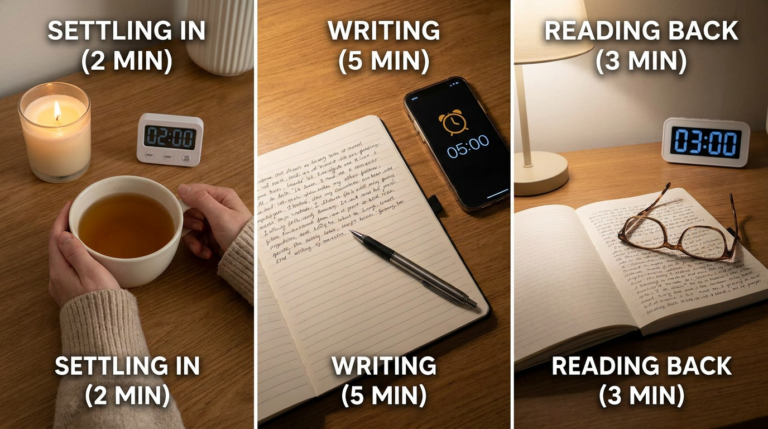
A Gentle 10-Minute Reflection Ritual (No Pressure, No Rules)
That's the whole problem this post is about. Not a large problem. Just a quietly annoying one. It's nine o'clock on a Saturday evening in October. The washing up is done, or it isn't. There's a lamp on in the corner. The day is essentially over, and if someone asked you what happened on Tuesday, you'd hesitate. Not because Tuesday was bad. Because Tuesday was Tuesday, and it went the way most Tuesdays go — which is to say it went, and took its details with it. Most advice about writing things down arrives with a lot of scaffolding attached. Streaks. Daily targets. An app that turns amber when you've missed two days and sends you a notification shaped like disappointment. The implication is always that you're starting something, and starting something means keeping it up, and keeping it up is the part you already know you're bad at. If you've tried before and it fizzled out by mid-February, you're in good company — and if you want the wider view on that, we've written a fuller guide to Here's the offer, plainly. Ten minutes. A few times a week. At the end of the day. That's it. That's the entire proposition. It sits in your evening the way making a cup of tea sits in your evening, or reading a chapter before you turn the light off. It is not a project. There is nothing to complete. starting a journal again after it didn't stick before . This post is the narrow version. It takes one section of that guide — the short reflection ritual — and gives it the room it deserves. And here's what you get, stated honestly and without inflation: you'll remember the day, and the week will stop blurring together. That's the payoff. It's real, it's modest, and I'm not going to dress it up as anything larger, because the moment a small pleasant thing gets sold as a life overhaul, it stops being small and pleasant and starts being one more thing you're behind on. Along the way you'll get a bank of more than thirty gentle prompts to write to — gratitude prompts among them, alongside noticing prompts, small-detail prompts and a set for the end of the week. Pick one. Ignore the rest. That's allowed. So why does a bounded ten minutes work when a sincere intention to "journal more" doesn't? That's worth understanding before we get to the structure itself. Why a Container Beats an Open-Ended Habit "Journal more" is a strange instruction when you look at it directly. More than what? Finished when? There's no line you cross where you can put your pen down and think, right, that's done.That difference sounds small. It isn't. Most of what makes an intention wear you down is the low background hum of incompleteness it generates. Remove the open end and the hum goes with it. Ten minutes at the end of the day is a different kind of object entirely. It has edges. It starts when you sit down and it ends when it ends, and at that point you have unambiguously done the thing. There's no partial credit and no residue. Ten minutes is ten minutes. You can always have written more, gone deeper, been more consistent. An unbounded task never releases you. It just sits there, permanently slightly unmet. A habit asks you to keep something going. A ritual just asks you to show up tonight. Habits accumulate failure. That's almost their defining feature. Miss nine days and the nine days are now part of the story — you're not returning to a neutral thing, you're returning to a thing you've already let down. There's an implicit apology built into picking it back up. Rituals don't work like that. A ritual has no memory of your absence. You didn't feel like it on Tuesday; you feel like it tonight. Those two facts have nothing to do with each other. There's a second advantage, and it's the one that matters most if you've abandoned this sort of thing before. A container is much easier to restart than a habit is. This is where it helps to separate a reflection journal from the older idea of a diary. A diary, in the way most of us absorbed it as children, is something you keepLet me be as clear as I can about what this post is not going to do. It is not going to ask you to be consistent. There are no streaks here, no counters, no completion percentages, no little rings to close. I'm not going to suggest you build a chain and then not break it. Those mechanisms work for some people and they're genuinely motivating right up until the moment they aren't, at which point they convert straight into a reason to quit. A missed day shouldn't be able to cost you anything. In this ritual, it can't. The end of the day makes a particularly good container, for a reason that's easy to miss. The day is already finished. There's nothing left to add to it, nothing you could still get done, no way to improve your performance in it. It's closed. You're not sitting down to plan or fix or optimise anything — you're sitting down to note down what happened in a stretch of time that has already concluded. That's a genuinely low-stakes position to write from, and it's why evening suits this ritual better than morning does. Morning is full of the day's potential. Evening has none, and that's the appeal. . The verb is telling. It implies custody, maintenance, an unbroken line of entries with dates on them, and a faint sense of shame about the gaps. A reflection journal with a container attached is a much lighter proposition: it's somewhere you write for ten minutes when you fancy it, and the record it produces is a record of the evenings you felt like writing. Which is a perfectly honest thing for a record to be. If you want the broader framing — how a container fits into the wider question of making a journal stick after a few false starts — covers it at length. Otherwise, we've established the shape of the box. Let's look at what goes inside it. the wider guide to restarting a journal The Ten Minutes: Three Short Movements The ritual has three parts, and they're deliberately uneven: Two minutes — settling, and running the day back Five minutes — writing to one prompt Three minutes — reading back the last few entries That's the whole architecture. You can follow it tonight without reading another word of this post, though the prompt bank in the next section will make the middle five minutes considerably easier. Two minutes: settling Don't skip ahead to writing. The retrieval is what gives you something to write about, and it's also the part that lets you arrive properly in the ten minutes rather than opening an app and staring at it. You'll find this is harder than it sounds for the first few evenings and then rapidly becomes easy. You'll also find that about a third of what surfaces is stuff you'd genuinely have lost by Thursday. That's the point of the two minutes. For two minutes, just run the day back roughly from the morning. Where you were. Who you spoke to. What you ate. What the weather did. What you were doing at eleven, and at three, and at six. It's a mechanical exercise, and it's meant to be — you're not hunting for significance or deciding what any of it meant. You're just retrieving. Most of the day is sitting there perfectly accessible; it simply hasn't been asked for. Sit down. Put the tea somewhere it won't get knocked over. Don't write anything yet. Five minutes: writing to one prompt If you already know what you want to write when you sit down, skip the prompt entirely. Prompts exist to solve the blank-page problem. No blank page, no problem. Set a timer if it helps. Plenty of people find the timer is the thing that makes it work, because it converts "write about your day" into "survive five minutes," which is a much simpler assignment. When it goes, stop — even mid-sentence, if you like. You can always come back tomorrow, and the unfinished sentence will make you smile in a year. Five minutes is short on purpose. It's enough for a few sentences — three, four, six if you're moving quickly — and it is emphatically not enough for an essay. That ceiling is doing useful work. It means you never sit down to a blank page with the vague expectation of producing something substantial, which is the expectation that kills more evening writing than tiredness ever has. A few sentences is a complete, legitimate entry. You're not producing literature. You're noting down what happened. Write to it for five minutes and then stop. Pick one prompt. One. Not three, not a sequence, not "I'll do the gratitude one and then the noticing one." Three minutes: reading back Scroll back through the last three or four entries and read them. This is the movement everyone skips. It's also the one that makes the entire ritual worth doing, and if you only take one thing from this post, take this: the reading back is not an optional extra bolted onto the writing. It is where the value actually lives. Writing an entry produces a record. Reading back is the moment you useThree minutes is enough for four short entries. You'll notice things: that you mentioned the same small irritation twice, that Wednesday had something good in it you'd already mislaid, that you ate the same dinner three times. None of that needs interpreting. It's just nice to know. it — and the moment the previous week stops being an undifferentiated smear and turns back into a series of specific days with things in them. In Lugelo, this is your Memory Lane — the chronological view your Moments land on automatically, in order, without you filing anything. You can see what that looks like alongside if you want a sense of it before you start. Memory Lane and the rest of Lugelo's journaling features The proportions matter more than the numbers What holds is the relationship: a short settle, a bounded write, and a genuine read-back. Lose the read-back and you've got a slightly dutiful writing exercise. Keep it and you've got something you look forward to. Two, five and three are a suggestion, not a specification. One minute settling, six writing, three reading works fine. So does three, five, two. Some evenings you'll do ninety seconds of writing and four minutes of reading back and that'll be the right shape for that evening. One practical note, particularly if you've arrived here looking for an evening journal routineThe five minutes in the middle needs something to point at, though. So here's the bank. that survives contact with real life: this works on a phone on the sofa. It works on a laptop at a cleared kitchen table. It works in a paper notebook with a pen that lives next to it. Lugelo captures Moments offline as well, so a patchy signal on the train home isn't a reason to skip — the entry syncs across your devices when it can. A Bank of 30+ Gentle Prompts (Including Gratitude Prompts) Before the list, three rules for using it — and they're the only rules in this post. Pick one. Don't work through them in order. This isn't a curriculum and there's no completion state. Don't feel obliged to use one at all. If you sat down already knowing what you wanted to write, write that. Small is correct. Every prompt below is answerable in a few sentences. None of them require excavation, none of them ask you to reach a conclusion, and none of them are trying to get somewhere with you. If a prompt feels like homework, pick a different one. They're grouped into five registers. Skim to whichever suits the evening. Noticing prompts The smallest register in the bank. Sensory, low-stakes, no significance required. These are perfect for tired evenings because they don't ask you to have had an interesting day — only to have been present during an ordinary one. What's one thing you noticed today that you'd usually walk past? (This one is a real Lugelo prompt.) What was the light doing at some point today? What was the first thing you heard this morning? Was there a smell today that reminded you of something else? What could you hear from outside, if you'd stopped to listen? What was the temperature like — not the number, the feeling of it? What's one small change you noticed in a place you go often? What did your hands do today that you didn't have to think about? Gratitude prompts The fullest set in the bank, and the one people ask for most. The trick with gratitude prompts is to keep them specific and unsentimental. "What are you grateful for?" is an enormous question that tends to produce the same three answers forever. Small and concrete beats grand and abstract every time — and a specific answer is far more interesting to read back in a year. Who held the door for you this week — physically or otherwise? (Another real Lugelo prompt.) What did someone do today that saved you five minutes? What's a thing you own that worked exactly as it was supposed to? What small thing would you miss if it vanished tomorrow? Who made something easier today without being asked? What went right today that you'd only have noticed if it had gone wrong? Which part of today would you happily do again tomorrow? What's something you were given once that you still use? Gratitude prompts of this kind sit alongside the — short, repeatable exercises in noting what you're glad of. gratitude practices described by the Greater Good Science Center at UC Berkeley Small-detail prompts These are the prompts that age best. They feel almost pointless to write and they are, without competition, the most rewarding to read back. In five years the detail is the whole value — you will not remember what you ate on an ordinary Thursday in October 2026 unless you wrote it down, and you'll be oddly delighted to find out. What did you eat today? What were you wearing? What was on — music, a programme, a podcast, the radio? What was the walk like? (Any walk. Even the short one.) What did you nearly buy and then didn't? What's currently on the table or the desk in front of you? What did you do today that you also did yesterday? What's the last thing you looked up? People prompts Observational, not diagnostic. These are about who was in your day, not about what your relationships mean. Keep them light — you're recording the cast, not analysing the plot. Who did you see today, even briefly? Who did you text, and roughly what about? What's something someone said that stuck? What made you laugh? Who did you think about but not contact? Who did you overhear? Who was somewhere they usually aren't? Who's someone you'll probably see tomorrow? End-of-week prompts A slightly wider frame, for Fridays, Saturdays or Sundays — the evenings where the natural unit isn't the day but the week. These pair particularly well with a longer read-back. What happened this week that you'd otherwise forget by next month? What's different from last Saturday? What was the best hour of the week? What did this week have that last week didn't? Where did most of the week actually go? What's one thing from this week you'd tell someone about? What are you carrying into next week? That's thirty-nine prompts. On any given evening, thirty-eight of them are irrelevant and one of them is the right one. And some nights, none of them will fit — which is precisely what the AI Journal Assistant is for. There's a bigger objection than "none of these fit," though, and it deserves its own section: some days genuinely have nothing in them. Lugelo's AI Journal Assistant can generate prompts that fit your journal : prompts that reflect the kind of journal you're actually building rather than a generic list, across registers like reflection, gratitude and memory. Refresh one you don't like. Ignore all of them. It's a suggestion, not an instruction. What to Write on Days When Nothing Happened You sit down. You do the two minutes. You run the day back and it's work, dinner, a screen, bed. There's a real temptation at that point to close the app and think, not tonight, there's nothing to say.This is the single most common reason an evening ritual quietly stops. Not tiredness. Not lack of time. The conviction that an uneventful day isn't worth recording. Here's the reframe, and it's a practical one rather than an inspiring one: ordinary days are the ones you actually lose. Big days look after themselves. You'll remember the wedding without writing it down. You'll remember the move, the trip, the day the offer came through. Those are already anchored — other people remember them too, there are photographs, they come up in conversation. Tuesday the fourteenth has none of that support. It disappears entirely within about three weeks unless something catches it. So the days that feel least worth writing about are, in strict record-keeping terms, the days where writing produces the most. That's not a motivational flourish. It's just how memory distributes itself. On a flat evening, here's what to do: Write one sentence and stop. Genuinely. One sentence is a complete entry. Record what you ate. The most reliably interesting detail in any old journal. Note the weather and what you wore. Two lines, both of which will place the day precisely when you read it back. Write down what you're reading or watching, and where you're up to. This turns your journal into an accidental log of your own tastes over time. Log one thing you did that you won't otherwise remember doing. Rang the dentist. Fixed the wobbly shelf. Walked the long way. The one-line entry is fully legitimate. I want to be unambiguous about that, because a lot of people carry an unexamined belief that a short entry is a failed entry. It isn't. A Moment that reads: Rain all day. Finished the blue book. Beans on toast. is a real entry, and in three years it will read beautifully. Better, in fact, than four laboured paragraphs about how you were feeling, because it's specific, and specificity is what survives. It's also worth remembering that a Moment doesn't have to be text at all. A photograph of what was on the table. A twenty-second voice note recorded while the kettle boils. A short clip of the rain on the window. You can , and on a genuinely flat evening the lowest-effort capture is usually the right one. A photo of Tuesday's dinner is a better record of Tuesday than nothing is, and it takes four seconds. capture a Moment as text, a photo, or a voice note The practical payoff has never been that the day was interesting. It's that you'll know what October actually looked likeThat covers the evening where nothing happened. Now the harder one: the evening where you simply don't want to. — not the highlights of October, the texture of it. The rain, the book, the beans on toast. Permission to Skip: This Is a Ritual, Not a Commitment The distinction that matters is between a ritual and a commitment. A commitment is something you are failing at during every moment you're not doing it — that's structurally what a commitment is. A ritual is simply available. The tea is there whether you make it or not, and the kettle doesn't take it personally. Let's kill the make-up instinct while we're here, because it's the second thing that goes wrong. If you've missed a week, do not sit down on Sunday and try to backfill it. Don't reconstruct Tuesday from your camera roll and your messages out of some obligation to completeness. You don't owe the journal the days you missed. The journal isn't waiting. Start with tonight. I want that sentence to sit on its own, because everything else in this section is a footnote to it. There is no streak to break. There is no counter to reset. There is nothing to catch up on. Missing a Saturday means nothing. And a gap in a reflection journalSo what's a realistic target? A few times a week is a good outcome. Not every night. Every night was never the goal, and anyone telling you otherwise is selling you a streak. Three evenings a week, for a season, produces a genuinely useful record. Two is fine. One good Sunday a week is fine. None of this is undermined by the product, either, and it's worth saying plainly. Lugelo's prompts can be refreshed or ignored entirely, and plenty of people use the app without ever touching the AI features at all. There's no nagging. Nothing turns amber. is not damage to the record. It's part of it. A three-week hole in late November almost always means something busy was going on — a deadline, a house move, a new baby, a bad flu, a good holiday. When you read back, the gap tells you that as clearly as an entry would. Nothing has been lost. The shape of the year includes the parts where you weren't writing. One more thing belongs here, because evening writing is personal by nature. Journals in Lugelo are private by default, with owner-controlled sharing — nothing is shared unless you choose to share it — and your data is encrypted in transit. That's the arrangement, and it's the reason people feel able to write the unflattering bits. With the pressure off, the interesting question becomes a different one. Not how do I make myself do this, but how do I make this something I want to come back to. Making It Pleasant Rather Than Dutiful The single most useful principle for an evening ritual is this: attach the ten minutes to something you already like. Not as a reward afterwards. As part of it. The ritual should be the good bit of the evening — the bit you're heading towards — rather than a small obstacle standing between you and bed. Get that right and consistency stops being a question of discipline, because you'll be going back for the tea and the lamp and the chair, and the writing will come along as a passenger. The tea, or whatever yours is. A drink you actually like, made deliberately. Not a mug of something reheated twice. The making of it is genuinely part of the ritual — the kettle, the two minutes of waiting, carrying it through — and it conveniently doubles as your settling time. By the time you sit down you've already been running the day back while the water boiled. Wine works. Cocoa works. A specific mug helps more than it has any right to. The chair. One place. Not "wherever I end up." The corner of the sofa nearest the lamp, the chair by the window, the kitchen table once it's been cleared. Location does far more work than willpower does, because a specific spot builds an association you don't have to maintain consciously — after a fortnight, sitting there is itself the cue. This is also why the bed is a poor choice. Too many other associations already booked in. The lamp. Low, warm, not the overhead light. This sounds like an affectation and isn't. Switching the big light off marks the evening as a different part of the day from the one that came before it, and that boundary is doing real work. In October, when it's properly dark by six, the lamp is the whole difference between "still in the day" and "in the evening." The same time, loosely. Roughly after dinner. Roughly before bed. Not a scheduled slot with an alarm attached — an alarm turns it into an appointment, and appointments can be missed, and missing appointments feels like something. A rough position in the evening can't be missed. It just arrives or it doesn't. The device or the notebook — whichever you'll actually reach for. There's a certain romance to the leather-bound notebook, and if that's genuinely what you'll pick up, use it. But be honest. If the notebook lives in a drawer upstairs and your phone is already in your hand, the phone is the better tool, and a phone on the sofa is a perfectly respectable end of day reflection setup. A few optional flourishes, worth a line each because small specifics are what turn a routine into a ritual: Lugelo is free on iOS, Android, HarmonyOS and the web , with Chrome and Firefox extensions, no ads, and an optional Plus tier if you ever want it. The best journal is the one within arm's reach at nine o'clock. A record on, quietly. Something without lyrics if you're writing. A window open for the first two minutes, even in October. Especially in October. The same candle, but only in one season — so that in three years the smell places the entries. Writing before you properly look at your phone, rather than after twenty minutes of scrolling that you'll then have nothing to say about. A blanket. Genuinely. And here's the honest test, the one to apply after a fortnight: if you're dreading it, something in the setup is wrong.Get it right and it stops being something you do and starts being something the evening does. Which raises the last question worth answering: what does all this quietly amount to? Shorten it. Move it. Change the drink. Drop to twice a week. The ritual is supposed to bend. Not something in you. The ritual is ten minutes of writing a few sentences with a warm drink — there is nothing inherently dreadful in it, so if dread has appeared, it's been imported from somewhere. Usually it's length: five minutes has quietly become twenty. Sometimes it's placement: you've put it after the point in the evening where you've run out of energy. Sometimes it's the drink, or the chair, or the fact that you've started treating the prompt bank as a to-do list. What Ten Minutes a Few Times a Week Adds Up To The entries you don't remember writing are the good ones. That's the consistent experience. The ones you laboured over are fine; the throwaway line about the man at the bus stop, or the fact that the heating made a new noise, or that you finished a book on a Tuesday and started another one the same night — those are the ones that reach out and hand you the evening back. And the week you'd have sworn was completely empty turns out, on inspection, to have had four things in it. But it's thirty evenings you can account for. And the strange thing — the thing nobody quite believes until it happens to them — is what it's like to read back a season of it in January. That is not a book. Nobody's publishing it. Total time invested: around five hours, spread across a season, most of it spent with a warm drink in a comfortable chair. Three evenings a week, from the start of October to Christmas, is about twelve weeks. Call it thirty-something entries, allowing for the weeks where you skip entirely and the weeks where you write four times because you're enjoying it. Thirty entries, each of them a few sentences long, some of them a single line about the weather and what you had for dinner. Let's do the arithmetic out loud, because the honest number is more persuasive than a vague promise. The read-back payoff compounds. Three entries back is mildly interesting. Thirty entries back is a season. In Lugelo, your Moments land on Memory Lane in order automatically, so the season assembles itself while you're not paying attention — there's no filing, no tagging, no organising step you'll fall behind on. You just scroll. The blank page never beat you. It just outlasted you. If you ever want to do something with a run of entries, you can. A season of Moments can Similarly, and only because it comes up: some people keep a shared evening journal with a partner or a family member, which is owner-controlled like everything else. Nice if it appeals. Ignore it if it doesn't. turn a season of Moments into a storybook or an eBook export, which some people do at the end of a year and most people never do at all. Treat it as strictly downstream and entirely optional — the ten minutes is worth doing if you never export a single thing. Which brings us back to where we started. None of this was about becoming a person who journals. There's no identity on offer here, no new version of yourself to construct, no membership. It was ten minutes and a cup of tea, a few times a week, in October — and the week not blurring together. If you want the fuller picture of how a small ritual like this fits into a journaling habit that actually survives, is the place to go next. the fuller guide to making a journal stick Frequently Asked Questions How long should an end-of-day reflection take? Ten minutes is plenty. The three movements run roughly two minutes settling and running the day back, five minutes writing to one prompt, and three minutes reading the last few entries. Shorter is completely fine — some evenings you'll do four minutes and call it done. The proportions matter more than the exact numbers, and the read-back is the part worth protecting. What are good gratitude prompts to start with? Start with the small, specific ones rather than the big abstract ones. "What did someone do today that saved you five minutes?" produces a much better entry than "What are you grateful for?" Pick a single prompt for the evening rather than working through the list — the bank is there so you never face a blank page, not so you can complete it. Do I have to write every night? No. A few times a week is a good outcome, and it was never meant to be nightly. There's no streak, no counter and nothing to catch up on. Missing days doesn't undo anything you've already written, and you don't need to backfill the week you skipped. Just start again with tonight. What should I write when nothing happened that day? One line. What you ate, what the weather did, what you're reading and where you're up to. Ordinary days are the ones you'd otherwise lose entirely — big days survive on their own, but an unremarkable Tuesday disappears within weeks unless something catches it. A single sentence is a complete, legitimate entry. Is it better to journal in the morning or the evening? Evening suits this particular ritual, because the day is finished and there's nothing left to add to it. You're noting down what happened rather than planning what might. Morning writing is a different thing and works well for other purposes — intentions, ideas, longer pieces. For a short end-of-day record, evening is the natural fit. Is a reflection journal the same as a diary? Broadly, yes — both are records of your days. The difference here is the container. A diary implies an open page and an obligation to keep it up. This is a bounded ten minutes and one prompt, a few times a week, with no expectation of an unbroken run. Same idea, much lighter frame. Do I need an app, or is paper fine? Either works. Paper is genuinely good, and if a notebook is what you'll actually reach for, use it. An app makes the reading-back movement easier, since entries land in date order automatically with no filing, and photos or voice notes can sit in the same entry as the text. Use whichever is within arm's reach. Are my journal entries private? Journals in Lugelo are private by default with owner-controlled sharing, and data is encrypted in transit. Nothing is shared unless you choose to share it. What if none of the prompts fit? That happens most weeks. Lugelo's can generate prompts based on the journal you're actually building, across registers like reflection, gratitude and memory. Any prompt can be refreshed if it doesn't suit the evening, or ignored completely — and if you already know what you want to write, skip the prompt entirely. AI Journal Assistant Is Lugelo free?Yes. It's free on iOS, Android, HarmonyOS and the web, with Chrome and Firefox extensions, and there are no ads. There's an optional Plus tier if you want it, and offline capture is built in, so entries you write without a signal sync across your devices later. Ten Minutes, a Cup of Tea, and October You'll remember the day. And the season won't blur. And the permission, restated plainly, because it's the part most worth keeping: no streaks, no rules, nothing to keep up with perfectly. Skip whenever you like. Miss a fortnight. Come back on a Thursday in November with a single line about the weather and it'll count exactly as much as anything else in there. The whole ritual, one more time, so it's easy to remember. Two minutes running the day back without writing anything. Five minutes on one prompt — just one — and then stop, even mid-sentence. Three minutes scrolling back through the last few entries, which is the part that makes the rest of it worth doing. So: it's nine o'clock on a Saturday evening in October. The lamp's on. There's a drink going cold at your elbow because you got interested in something you were writing. If you want somewhere to put tonight's ten minutes, Lugelo is free on iOS, Android, HarmonyOS and the web, with Chrome and Firefox extensions. Journals are private by default, with owner-controlled sharing. Start with one Moment tonight — . Get StartedRead More about A Gentle 10-Minute Reflection Ritual (No Pressure, No Rules) -
Sep 21

Turn Your Journal Into a Book: eBook & PDF Export, Step by Step
Here is the part that makes this year different, and the timing is the whole point: the best gift you can give is already sitting on your phone. Not another candle. Not another gadget that gets charged twice and then lives in a drawer. Not the thing you bought because it was the right price rather than the right present. You know the fate of most of what gets unwrapped in December — a polite thank you, a few weeks on a shelf, and a quiet rehoming by February. It is late October, which means the season is close enough to feel it. And somewhere in the back of your mind is the same problem you had last year: you want to give people something that isn't just more stuff. You have spent the last twelve months collecting it without noticing. Photographs from the trip. The blurry one from the kitchen that somehow captures everything. Voice notes. Screenshots of a group chat that was funnier than anything you'd write on purpose. Half-finished thoughts typed at midnight. It's all there. It doesn't need buying. It needs assemblingAnd if you've tried something like this before and abandoned it — most people have — the reason almost certainly wasn't effort or ability. It was scope. We fix that in Step 1, before you touch a single photograph. Set your expectations honestly, because I'd rather you finish than be impressed. This is an evening or two of work. Maybe three if you're enjoying it. It is not a lost weekend of misery. This post is a genuine, step-by-step guide to doing exactly that: turning a journal into a finished book you can put in someone's hands. We'll cover deciding what the book actually is, editing it down without agonising, writing the text that holds it together, sequencing it into something that reads like a book rather than a folder, choosing a cover and a title, exporting it as an eBook or a PDF-style storybook, and getting it printed and wrapped with time to spare. If you came here searching for how to create a book as a gift, you've landed in the right place. Let's build one. The Gift Problem: The Best Present Is Already on Your Phone You are not starting from nothing. You have spent a year gathering raw material with no plan to use it. The camera roll. The voice memo from the drive home. The photo of the handwritten note on the fridge. The screenshots. The clipped article someone sent that started a three-day argument. It is unassembled, not missing. And that distinction changes the entire size of the job. Which brings us to the counter-observation this whole post rests on. So the search begins, every autumn, for the gift that isn't more stuff. Experiences. Subscriptions. Donations in someone's name. All reasonable, all slightly abstract, and none of them quite scratching the itch — because what you actually want to communicate isn't generosity. It's attention. Then there's the clutter problem, which has become genuinely acute. Homes are full. People are actively trying to own less. Giving someone a physical object now carries a small burden alongside it — where does this go, and how long before I'm allowed to get rid of it? Most of us shop to a budget rather than to a person. We start with a number — thirty pounds, fifty dollars, whatever the unspoken family convention is — and then reverse-engineer an object that costs roughly that. The object is fine. It's perfectly nice. It's also almost entirely interchangeable with something else at the same price, and both giver and receiver know it. There's a small, specific guilt in that transaction: the sense that you've discharged an obligation rather than expressed anything. Let's be honest about gift-giving, because pretending it's simple helps nobody. Creating something from nothing is hard, which is why people don't do it. Editing something that already exists is a fundamentally different task — smaller, more concrete, and far more forgiving. You're not being asked to invent. You're being asked to choose. This is also why a book of shared memories lands differently from anything you can buy. It is legible proof that someone was paying attention. Every caption with a real name in it, every date that's actually correct, every photograph of the unglamorous moment nobody else thought to keep — these are evidence. They say I noticed, and I kept it.Attention is the one thing in a gift that cannot be purchased, only spent. You cannot buy that at any price point, and the recipient knows it the moment they open the cover. Now, the objection I can hear from here: I'm not a writer, and I'm definitely not a designer.Good. Neither are most of the people who make the best versions of these. A memory book is not judged on typography. Nobody has ever opened one and thought about kerning. Its value lives entirely in what it contains — whose face is on page nine, what you wrote underneath it, whether you remembered that your father-in-law's name is spelled with two Ls. The craft that matters here is selection and specificity, and both are learnable in the next ten minutes. If it helps, know that the assembling itself is the easy part these days. A journaling app like is designed around exactly this: you collect Moments through the year, they sit in order on Memory Lane, and when you want a book, the journal converts into one. The technology is not the obstacle. Your scope is. Lugelo This post is the full practical expansion of a broader argument we've made before — — which covers whyHere's the roadmap, six steps, in order: the wider case for building a family memory book a life is worth recording in the first place. This one is about the mechanics of turning what you've recorded into an object you can wrap. Decide what the book actually is. Gather and choose — the ruthless edit. Write the connective text, captions and names. Sequence it, then choose a cover and a title. Export it as an eBook or PDF storybook. Print it, understand what printing really buys you, and hand it over. The material exists. What determines whether it becomes a book is the single decision we make next. Step 1: Decide What the Book Is (Scope Is Everything) It's an infinite brief. Almost every abandoned memory book dies in the same place, for the same reason, and it isn't laziness. The project gets opened as "our family memories." That sounds lovely and is completely unbuildable. There is no version of "our family memories" that has an ending. Every photo you select suggests three more that belong beside it. Every year you include implies the year before. There's no point at which you can look at the pile and say that's the book, because the brief contains no boundary that would let you. So you work on it for three weekends, feel the scale of it, and quietly stop. The folder stays on the desktop for two years, renamed once, never opened. The fix is unglamorous and takes about ninety seconds: decide what the book is before you look at a single photograph. Here are four scopes that reliably get finished. One year. A year-in-review for the household. Naturally bounded, naturally seasonal, and perfectly suited to a December gift because the year is conveniently ending anyway. This is the easiest annual habit to sustain, because next year you just do it again. One person. A child's year. A parent's early life. A life story book assembled for a milestone birthday — sixtieth, seventieth, a retirement. The subject provides the boundary: if they're not in it or around it, it's not in the book. One trip. The clearest boundaries available to you, because the start and end dates are literally on a boarding pass. If you've never made one of these before, start here. A three-week trip produces a book you can finish in an evening, and finishing one is what teaches you that you can. One relationship. A marriage. A friendship of twenty years. A grandparent and a grandchild. These are quietly the most affecting books of the lot, because the scope itself is the message. Pick one. Write it down as a single sentence — "Dad's first thirty years, for his seventieth" or "Sardinia, June, the four of us"Now the sizing rule, which exists to stop you drowning. — and put that sentence somewhere you'll see it while you work. Aim for roughly 40 to 80 photographs and 20 to 40 short passages of textAnd you have full permission to go smaller. This matters more than people expect. A tight thirty-page book is a better gift than a bloated hundred-and-twenty-page one, because the tight one gets read repeatedly and the bloated one gets flicked through once and admired politely. Density is not generosity. A book that respects the reader's attention is a more loving object than one that exhausts it. . That produces a book with real substance that a person will read from front to back in one sitting. The habit that makes all of this work is treating your scope sentence as a hard border. Everything outside it — the brilliant photo from the year before, the story that's technically about someone else, the tangent you'd love to include — goes in a list called next book. Not deleted. Not lost. Just not this one. That single discipline is the difference between finished memory booksA life story book is paced completely differently. It moves more slowly, spans decades rather than days, and needs significantly more connective writing to carry a reader across gaps in time. You're not just showing moments; you're explaining a life's shape — where people lived, what work they did, who arrived and who left. Budget more writing time for it, and fewer photographs per page. A one-trip book is playful. It can be funny, fast, full of in-jokes, heavy on images and light on text. Nobody needs three hundred words explaining a photograph of a broken hire car. Scope also quietly decides your tone, which is worth knowing before you start writing. and abandoned folders. I'd go further: it's the only technique in this entire post that's genuinely non-negotiable. Everything else you can do badly and still end up with something wonderful. A practical note on where the material lives. If you've been journaling through the year, your Moments are already sitting in chronological order on , which makes scoping visible in a way a camera roll never does. You can see the shape of a year — where it's dense, where it's thin, where the good stuff clusters. Scoping stops being guesswork and becomes something closer to drawing a box around a section of a timeline. Memory Lane And if the story genuinely belongs to more than one person — a family year, a shared trip, a grandparent's life that only the siblings collectively remember — you'll want so contributors add their own material directly. We'll come back to how that works in the next step. a shared journal Boundaries drawn. Now the harder part: deciding what goes inside them, which means deciding what doesn't. Step 2: Gather and Choose — Make the Ruthless Edit Here is the one rule that separates an amateur memory book from a good one, and it's uncomfortable. One photo per moment. Not six. Six near-identical shots of the same birthday candle is a camera roll. One is a book. The difference isn't quality of photography — it's editorial judgement, and it's the single skill that most improves what you make. Every additional near-duplicate you include dilutes the one you should have chosen. Your phone has trained you badly here. Burst mode, cloud storage and infinite capacity have removed every natural pressure to choose. You've never had to decide, so the muscle has atrophied. Rebuilding it takes one evening of deliberate practice. So: how do you pick the keeper? Choose the frame with a face doing something. Not the best-composed one. Not the sharpest. The one where someone is mid-laugh, mid-sentence, mid-eye-roll. Slightly blurred and alive beats crisp and posed every single time, because readers respond to expression, not exposure. A technically perfect photograph of four people arranged in front of a monument communicates almost nothing. A slightly soft shot of two of them arguing about the map communicates a relationship. Deliberately include the unglamorous. This is where most memory books go wrong, and where yours can immediately be better than average. Include the packed car with the boot that wouldn't shut. The hospital corridor. The kitchen table covered in the debris of a meal that's just finished. The hotel room that was worse than the photos suggested. These images date and locate a story far more precisely than any posed group shot. They carry period detail — the phone someone's holding, the packaging on the counter, the state of the wallpaper. They're what makes a photo book giftNow, gathering. This is faster than you think, provided you've been collecting as you go. feel true rather than curated. A book made entirely of everyone's best angles reads like an advertisement for a family. A book that includes the mess reads like a life. If your year already lives as Moments on Memory Lane, gathering is filtering, not hunting. You're scrolling a sequence that's already in order, marking things, rather than excavating four apps and two hard drives trying to remember which month something happened in. That distinction is the difference between a two-hour job and a two-week job. It's also worth knowing what a single Moment can hold, because it affects what your book can contain. That scan-to-text route deserves a moment of your attention if you're building a life story book. Shoeboxes of printed photographs and letters are exactly the material that makes these books extraordinary, and exactly the material people assume is too much hassle to include. It isn't. A stack of old prints and a rainy Sunday afternoon will get you further than any amount of digital archaeology. Photos, video, audio and imports live inside one Moment — so a Moment can be a photograph with a voice note attached, or a video with written context around it. Beyond that, there are practical routes for material that isn't already digital or isn't already yours: scan-to-text for older printed material and handwritten notes, speech-to-text for anything you'd rather say than type, social imports, and browser-extension clipping for things you found online during the year. When the story belongs to several people The instinct is to become a project manager — messaging everyone, chasing files, collating a shared folder that three people never open. Don't. It's slow, it's thankless, and it usually kills the project. Some books simply cannot be built alone. A family year happened in four different houses. A grandparent's life is remembered in fragments distributed across five siblings, none of whom remember it the same way. Invite them into the book instead. With Audio contributions are the underrated part of this. Plenty of people — often exactly the older relatives whose memories you most want — will never write three paragraphs about 1974. The same person will happily talk for eleven minutes about it. Let them. A recorded voice is also, incidentally, one of the things families most regret not having. a shared journal , contributors add their own Moments directly — their own photographs, their own version of what happened, their own captions. You get material you'd never have obtained by asking, because people remember different things and nobody produces their best recollections on demand via text message. The two-pass method Practical mechanics, because "be ruthless" is easy to say and hard to execute in one sitting. First pass: generous. Go through your scoped range and mark anything that's possible. Don't deliberate. Don't compare. If it might belong, flag it. Move fast — a year should take you thirty or forty minutes. You are not making decisions here; you're building a shortlist. Second pass: cold. Come back to the shortlist later — ideally the following day, when the sentimental fog has lifted — and cut it down to the final set. Now you compare. Now you enforce one-per-moment. Now you ask, of every image, what does this one do that the one next to it doesn't?Two passes beat one agonised pass, comprehensively. Trying to be both generous and ruthless simultaneously is what makes people stall for weeks at the selection stage. Separate the modes and each one becomes easy. On the gaps If part of your year genuinely wasn't documented — a hard stretch, a period of illness, three months where nobody picked up a camera — resist the urge to paper over it. Don't pad it with whatever thin material exists just to keep the pages even. One last thing, and it's a small piece of craft that will make your book noticeably better than most. Say it. A line like "we took almost no photographs in February, and here's why" is more interesting, more honest and more moving than a spread of filler. Gaps are part of the shape of a year. Acknowledging one tells the reader something real; disguising it tells them nothing at all. Images chosen. Now they need words around them — words that make sense to somebody who wasn't there. Step 3: Write the Captions, Names and Connective Text This is the step people skip, and the only one they later regret. It's understandable. Photographs feel finished on their own. Writing feels like work, and like exposure. So the book gets assembled as a beautiful sequence of images with nothing underneath them, and it looks great, and then five years later somebody points at a face and says who's that, again? — and nobody in the room is completely sure. So here's the governing test, and it fixes most weak memory-book writing on its own: Write for a reader who wasn't there.Not for yourself. Not for the one other person who already remembers the day perfectly. Write for the niece who was four at the time, or the person who joins the family in 2031, or your own future self at seventy, who will have forgotten far more than currently seems possible. Apply that test to any caption and it immediately tells you what's missing. "Best day ever 😂" fails instantly. "Marcus, Priya and Dan on the last morning in Sardinia — twenty minutes after the boat broke, before anyone found it funny" passes, and it took nine seconds longer to write. The three layers of text You don't need to write a lot. You need to write three different kinds of thing, each doing a distinct job. Chapter or section openers — 60 to 120 words. These set the scene at the top of a section. The year, the circumstances, what was going on around the edges. "2026 started badly. Sam's job ended in the second week of January, and for two months the plan was simply to get to spring." That's the connective tissue that lets a stranger follow your book. Captions — one or two lines. Who, where, roughly when, and one specific detail. This is where most of your writing happens, and each one takes under a minute. The occasional longer passage — 200 to 300 words.That last constraint matters more than it looks. If you write long everywhere, nothing stands out and the book becomes homework. The contrast between brief and expansive is what gives a book rhythm, and rhythm is most of what makes something readable. Silence around a passage is what makes it land. Reserved for the two or three moments in the entire book that genuinely warrant it. The birth, the funeral, the move, the diagnosis, the reunion. Two or three. Not twelve. Names and dates are the most valuable thing you will write That's not a sentimental point. It's a plain observation about how information decays. The context lives in people's heads, and heads are not a storage medium you can query later. An unlabelled photograph loses most of its meaning surprisingly quickly. Not because the image degrades, but because the people who could identify the faces are exactly the people who eventually stop being available to ask. Every family has a box of photographs of strangers who were, at one point, entirely known. Nobody wrote it down, because at the time it was obvious. I want to give this its own space, because it's the part most likely to be skipped and the part with the most concrete consequence. So: name everyone.Then add the detail only you have. What was said just before the shutter. What the room smelled like. Why everyone in the frame is laughing at something outside it. Why that particular jumper was significant. Specificity is what a reader remembers, and it's the one thing no amount of design polish can substitute for. Including — especially — the ones "everyone knows." Your mother is not "Mum" in a caption; she's Angela, in 2026, at fifty-eight. Write the year. Write the place. It costs you four words and it's the difference between a photograph that means something in thirty years and one that doesn't. "Documenting little details of your everyday life becomes a celebration of who you are." — Carolyn V. Hamilton When you're staring at a blank page Some practical help, because "just write specifically" is advice that assumes you can start. The AI Journal Assistant is genuinely useful at exactly the point where people freeze. Give it a few words and it'll suggest a title. Give it rough notes — half sentences, fragments, a bullet list of what happened — and it'll expand them into a first draft you can then rewrite in your own words. That last clause is the whole point. Treat it as scaffolding, not as a substitute. The entire value of this gift is that it sounds like the person who made it — with their turns of phrase, their sense of humour, their slightly odd way of describing things. A book that reads as though it was written by nobody in particular defeats its own purpose. Use the assistant to get past the blank page, then make the sentences yours. Speech-to-text is the other one worth knowing about, and it's transformative for people who talk more easily than they type. That includes a lot of us, and it disproportionately includes older relatives who'd never sit down and write but will happily tell you the whole story out loud. Both of these sit alongside the rest of the writing tools in . Lugelo's features The three-question fix If you're still stuck, use this and stop overthinking. For each photograph, answer three questions: What was happening? Who was there? Why does this one matter? Words and pictures in hand. Now the book needs an order, a cover and a name. Three short answers. Then stop. Do not embellish, do not reach for a poetic closing line, do not try to find the meaning of the year. Three answers per image is a completely sufficient book, and it's better than ninety percent of what people produce when they try to write beautifully. Step 4: Sequence the Book, Then Choose a Cover and Title There's a moment in this process where a pile of good material either becomes a book or stays a pile. That moment is sequencing. Chronological is the safe default, and it works for the large majority of books. It requires no cleverness, it's how memory is naturally indexed, and it means nobody ever gets lost. If you've been journaling through the year, Memory Lane has already done this for you — the order exists before you ask for it, which removes the single most tedious part of the job. Use chronological unless you have a specific reason not to. "It felt boring" is not a specific reason; a well-paced chronological book is not boring. That said, three alternatives genuinely earn their place in the right circumstances. Thematic. Organised by person, place or recurring ritual rather than by date. This is the strongest option for a life story book spanning decades, where strict chronology starts to sag under its own weight. Sixty years told strictly in order becomes a list. The same sixty years told as The Houses, The Work, The Sundays, The People Who Came and Went becomes a portrait. Thematic structure lets you put a photograph from 1968 next to one from 2019 and let the reader do the arithmetic — which is a genuinely powerful effect. Bookended. Open with the biggest moment in the book, then go back and tell the story of how you arrived there. Journalists have used this forever because it works: it buys you the reader's patience by showing them where they're heading. Ideal when your material has one obvious peak — the wedding, the move, the reunion. Seasonal. For a year-in-review, this is close to free. Four chapters, already written, with built-in visual variety and a natural sense of progression. Spring looks different from November, and the book benefits from that without you doing anything. Pacing: don't fill every page Here's the design instinct most first-time makers get wrong. Given a page, people fill it. Given a spread, people fit six photographs onto it. Vary your density deliberately instead. After a dense spread of five or six images, give the reader a single full-bleed photograph with a one-line caption and nothing else. It functions as a breath. It signals this one matters. And it makes the dense spreads feel energetic rather than cluttered, because contrast is what creates the impression of pace. Empty space is not wasted space. It's the thing that tells a reader how to feel about what's next to it. Openings and endings carry disproportionate weight. Your first image sets the tone for everything after it — choose it for mood rather than chronology, and don't default to whatever happened first. Your last image should genuinely close. Something that has the quality of an ending: people leaving, a light going off, a door, a road, an empty room after. Books that trail off do so because the maker ran out of material and simply stopped. Choose your final page deliberately and the whole thing feels composed. Titles: specific beats poetic Resist the pull toward the evocative and abstract. Memories. Our Story. Moments in Time. These sound like books and mean nothing. Specific wins. A date range. A place name. An in-joke the recipient recognises before they've opened it. "Sardinia, and the Summer of the Broken Boat" beats "Memories" by a distance — because one of them is already a story and the other is a genre. A title that makes the recipient laugh or wince on the doorstep has done more work than any amount of elegant phrasing. Covers: name it and date it Your cover has one strong image, legible text, and — this is the part people forget — the names of who it's about and the period it covers. Not because it looks good. Because in ten years, on a shelf, next to three other books you've made by then, the one that identifies itself is the one that gets picked up. A handsome abstract cover with a single word on it is a beautiful object that nobody can navigate. "Angela & Tom — 1994 to 2004"Prioritise legibility over sophistication. This is a book that lives on a shelf and gets handed around, not a portfolio piece. is instantly useful to anyone who encounters it, including people who weren't born when you made it. Templates are not cheating One last thing, because it stops people unnecessarily. Starting from a does not produce a lesser book. It produces a book where you spent your limited energy on choosing photographs and writing captions rather than on deciding margin widths — which is unambiguously the better trade. template or a storybook layout Nobody receiving this gift will assess your layout decisions. They'll look for their own face, read the caption, and then go back to the start and read it properly. The layout's entire job is to get out of the way. A good template does that job better than most of us would, on a Tuesday evening, at speed. The book is built. What remains is turning it into a file you can actually give. Step 5: Turn Your Journal Into a Book With eBook or PDF Export This is the part the title promised, and it's the least dramatic step in the whole process — which is exactly as it should be. A finished journal converts into an eBook or a PDF-style storybook: a single file containing your Moments, images and text, in the order you set. Lugelo describes it as one-tap eBook conversion, alongside a full journal export. The outcome is the thing to hold in your head — you end up with one file that contains the whole book, sequenced the way you arranged it, ready to send or print. You can see how That's genuinely it. The work was Steps 1 through 4. This step is the reward. eBook and storybook export sits alongside the rest of the toolkit. Which format should you choose? Export as an eBook when the book is going to be read on a phone or a tablet. It's easy to send, it costs nothing to distribute, and it's the right answer for relatives who live somewhere else and would otherwise be waiting on the post. If you've got a large extended family, the eBook is how everybody gets a copy without you spending a fortune. Export as a PDF storybook when you intend to print. This is the important distinction: a PDF holds your layout fixed exactly as you arranged it. Every image stays where you put it, every caption stays with its photograph, and nothing reflows because of a different screen size. When a file is going to a printer, fixed layout isn't a preference — it's the requirement. Most people end up doing both, and there's no reason not to. Export the PDF for printing, export the eBook for sharing, and you've covered every recipient with one afternoon's work. The pre-flight checklist Before you export the version you're going to print, run this. It takes fifteen minutes and prevents every common regret. It's also the one part of this post worth screenshotting. [ ] Check the spelling of every name. Especially children's names and in-laws' names. A misspelled name in a printed book is permanent in a way nothing else in the project is, and it's the error people notice first. [ ] Verify dates and years. Don't assume. You will misremember at least one, and it's almost always the one somebody else remembers precisely. [ ] Decide what stays private. Journals are private by default with owner-controlled sharing, which means everything in yours was written for an audience of one. A book is a different audience. Reread anything you wrote during a bad week and ask whether it belongs in something you're handing to another person. [ ] Check anything involving other people's children or private circumstances. Ask first. Always. This is the one item on the list with consequences beyond the book. [ ] Read every caption aloud, once. This is not optional and it is not fussy. Your eye skips errors it expects; your mouth doesn't. You'll catch duplicated words, missing words, and at least one sentence that made sense in your head and nowhere else. [ ] Check the image ordering one final time, after any late edits. Late changes are where sequences quietly break. What it costs Straightforwardly: Lugelo is free on iOS, Android, Web and HarmonyOS, with no ads, and there's an optional Plus tier if you want it. You can see exactly what that includes on the The real expense of this gift is printing, which we'll get to next. pricing page . That's the whole story on software cost. One more way to see the same memories Worth a brief mention because it's genuinely a different experience rather than a variation on the same one: the same journal can also be explored as a VR gallery. It works best on Meta Quest, Apple Vision Pro or WebXR-capable browsers, with a 2D preview available on any device, and shared rooms supporting up to eight people. Think of it as a complement to the book rather than a replacement — the book is the thing you hand over; the gallery is somewhere a few people can stand inside the same year together. On privacy, precisely While we're on the subject of what's in your journal: your data is encrypted in transit, journals are private by default, and sharing is owner-controlled. That's the accurate description, and it's the one worth knowing before you decide what goes in a book that leaves your hands. File exported. Now the physical questions — printing it, understanding honestly what printing actually buys you, and handing it over. Step 6: Printing, Honest Preservation and Handing It Over Let's be clear about how printing works, because vagueness here would be doing you a disservice. Lugelo does not print or ship books.That's a genuine division of labour rather than a limitation. It means you're free to choose based on price, speed, quality or proximity, and you're never locked into one supplier's catalogue. What you get is the exported file. You take that PDF and arrange the printing yourself, with whichever printer you prefer — a local print shop, an online service, whatever suits your budget and timeline. Lugelo makes the file; you decide how it becomes an object. What to think about when you print You don't need to become an expert. You need to make four decisions. Softcover or hardcover. Softcover is cheaper and lighter, and is entirely respectable — it reads like a nice paperback. Hardcover feels considerably more like a gift when it's unwrapped, sits better on a shelf, and holds up to repeated handling. If this book is the main present, hardcover is usually worth the difference. Size. Larger formats show photographs properly and cost proportionally more. If your book is image-led — a trip, a child's year — go bigger, because shrinking a good photograph wastes it. If it's text-heavy, like a life story book, a smaller format reads more comfortably and feels more like something you'd sit down with. Paper weight. Thin paper lets the next page show through, which is visible and slightly cheapening on image-heavy spreads. Heavier stock costs more and immediately feels more substantial. This is the upgrade most worth paying for if you're choosing one. Finish.Prices vary enormously by region, format and supplier, so get two or three quotes rather than trusting any number you read online — including any I might have guessed at. Matte pages tend to make photographs look considered and are much easier to read under a lamp. Gloss makes colours pop and shows every fingerprint. Neither is wrong; matte is the safer default for a book that will be handled a lot. Give yourself time Build in a fortnight for printing and delivery, plus a few days' buffer in case something's wrong and needs reprinting. Starting in late October is comfortable. You have time to make the book properly, order a proof, notice the three errors you'll inevitably find, fix them and reorder without anxiety. Starting in mid-December is not comfortable. At that point you're paying rush rates, you have no room for a reprint, and you're refreshing a tracking page on the 23rd. Don't do that to yourself — the whole appeal of this gift is that it's the calm option. Order a proof copy if the budget allows. Things that look correct on a screen behave differently on paper: images crop at the edges, text sits closer to the gutter than expected, a colour reads warmer than you intended. If a proof isn't realistic, do the minimum version — open the PDF at full size on the largest screen you own and go through every page before committing. You will find something. What a printed copy actually buys you There's a version of this article that tells you a printed book lasts forever. It's the easy thing to write and it's not true, so I'm not going to write it. Now the honest part, and it's the passage in this post I'd most want you to read carefully. Here's the accurate version, which I think is more persuasive anyway: a printed copy is a hedge.Formats change. Services close. Accounts lapse when nobody remembers the password. Drives fail silently and are discovered years later. None of this is alarmism — it's the ordinary, well-documented behaviour of digital material over time. Paper survives neglect better than files do. That's the real argument. A book on a shelf keeps working with nobody maintaining it. Nobody has to migrate it, remember it, pay for it or open it periodically to check it's still there. It just sits there being readable, which is a genuinely rare property. Digital records don't have that property. They need active care: keep more than one copy, keep those copies in more than one place, and periodically check that older files still open. That's not difficult, but it is ongoing, and ongoing is precisely what tends not to happen over decades. You don't have to take my word for any of this. The Library of Congress — a national institution whose actual job is keeping things — publishes public guidance on exactly this problem through its , including practical advice on . caring for digital photographspersonal digital archiving resources Sit with the implication of that for a second. A national library publishes a public how-to guide because personal digital material is genuinely difficult to hold onto. That's not a marketing claim from an app; it's an institution with deep expertise telling ordinary people that this requires effort. Which leads to a simple, practical recommendation: Keep the journal in Lugelo — it stays live, searchable and easy to add to. Keep the exported file somewhere of your own — your own storage, your own control, ideally in two places. Print one copy — the version that needs nothing from anybody. That's a hedge, not a promise. And it's a far more useful thing to tell someone than "forever." Three forms, three completely different failure modes. If one goes, the others almost certainly don't go with it. How to actually give it The final logistics, which matter more than you'd expect. Hand it over quietly. Not in the middle of a loud group unwrapping with wrapping paper flying and someone's toddler screaming. This gift needs about three minutes of undivided attention to land, and a chaotic living room will not provide them. Find a lull, or give it separately. Say almost nothing. "I made this." That's the script. Resist the powerful urge to narrate — to explain what's on page eleven, to apologise for the cover, to point out the bit you're pleased with. The book does that job. Let it. Expect a delayed reaction. People frequently go quiet. They turn pages slowly, say very little, and then come back to it alone later that evening and read the whole thing properly. If you don't get an immediate emotional response, the gift hasn't failed — it's working exactly as it should. Big reactions in front of an audience are rarer than the versions we imagine. Print two copies if the book is about a relationship. A marriage, a friendship, two siblings. Both people will want one, and only one of them will be comfortable saying so. Write a note inside the front cover. Handwritten, dated, signed. It costs nothing, takes two minutes, and it's routinely the part people mention first — partly because it's the only page in the whole book that's unmistakably, physically yours. If you haven't started a journal yet and you're reading this thinking next year, the useful move is to start now rather than in January. That's the whole method. What's left are the questions people usually ask next. Lugelo is free on iOS, Android, Web and HarmonyOS , and a year of Moments collected casually is what makes next October's book an evening's work instead of a project. Frequently Asked Questions How long does it take to create a book as a gift from an existing journal? If your Moments are already captured through the year, a scoped book takes an evening or two. Selection and captions are the bulk of the time. If you're gathering material from scratch across several apps and devices, add considerably more. Scope is the biggest variable by far — a one-trip book is an evening, a decade-spanning life story book is a few weekends. What's the difference between exporting an eBook and a PDF storybook? An eBook is best for reading and sharing on phones and tablets — easy to send, costs nothing to distribute. A PDF storybook keeps your layout fixed exactly as you arranged it, which is what a printer needs. Many people export both: the PDF goes to print, the eBook goes to relatives who live too far away to hand one to. Can several people contribute to the same book? Yes. Contributors add their own Moments directly rather than sending you files to collate — photographs, written entries and audio notes included. That last option matters for relatives who'd never write three paragraphs but will happily talk for ten minutes. You can see how this works with . collaborative journals Does Lugelo print and post the book for me? No. Lugelo produces the exported file — the eBook or PDF storybook — and you arrange printing yourself with a printer of your choice. That means you pick the format, paper, binding and price point that suit you, and you're not tied to any single supplier's options or delivery schedule. Is Lugelo free, and what does Plus add? Lugelo is free on iOS, Android, Web and HarmonyOS, with no ads. There's an optional Plus tier for people who want it, and the current details of what's included are on the . You do not need Plus to keep a journal or to make a book from one. pricing page Who can see my journal before I export it? Journals are private by default, with owner-controlled sharing — you decide who gets access and when. Data is encrypted in transit. In practice this means nothing leaves your journal unless you choose to share it, which is worth remembering when you decide what belongs in a book you're handing to someone else. Can I view the same memories as a VR gallery? Yes. The same journal can be explored as a VR gallery, which works best on Meta Quest, Apple Vision Pro or WebXR-capable browsers. A 2D preview is available on any device if you don't have a headset, and shared rooms support up to eight people — so a few family members can walk through the same set of Moments together. Why This Gift Is Different From Anything You Can Buy Let me restate the honest case one last time, without inflating it. You came here with a problem: something to give that isn't more stuff. And the answer turned out to be sitting in your pocket the entire time — it just needed scoping, editing, captioning, ordering and exporting. This gift is not valuable because it will last forever. Nobody can promise that about anything, and you should be suspicious of anyone who does. It's valuable because it is specificWrite that sentence tonight. Then create a book as a gift the way it's actually done — one Moment at a time, from a year you already lived. And on timing: it's late October, which is comfortably enough. Not tight. Comfortable. The material is already collected, which was always the hard part. Everything that's left is choosing and assembling, and all of that begins with a single sentence describing what the book is about. Keep the practical hedge from Step 6 in mind. Keep the journal live. Keep the exported file somewhere of your own. Print one copy. Three forms, three different failure modes — sensible rather than sentimental. It contains real names, correctly spelled. Actual dates. The messy kitchen table nobody else would have photographed. The detail only you would have thought to write down — what was said, why everyone was laughing, why that particular Tuesday mattered. That specificity is the thing no purchased object can imitate at any price, and it's why this is the gift that gets read twice, and then again in March, and then once more when somebody visits. . Don't Just Live It — Keep It Start the journal now, and the book will be waiting when you need it. Free on iOS, Android, Web and HarmonyOS — no ads. Get StartedRead More about Turn Your Journal Into a Book: eBook & PDF Export, Step by Step


Loading...