60 Couples Journal Prompts For People Who Aren’t “Journal People”
The problem is not that nothing happened. Plenty happened. Nobody wrote any of it down.
You can narrow it down by a haircut. Somebody's coat helps. But the actual year — the one where the car broke down, the one where you were both exhausted, the one that was quietly one of the best — those have merged into a single smear of good intentions and similar jumpers.
And now you cannot tell which year is which.
There is a photo of the two of you standing in front of the same tree, or the same front door, or the same stretch of coastline. You take it every year. It has become a thing you do.
So here are sixty couples journal promptsBecause two accounts of the same weekend are more interesting than one negotiated summary — and in ten years, they are worth considerably more.
Two answers. One question.
built around one rule that makes them work differently to every other list of this kind: you both answer the same question, separately, and then you read what the other one put. Not together. Not out loud. Not one agreed version you both nod at.
Now, the bit you are already thinking. Neither of you is a "journal person." One of you may in fact physically recoil from the word. That is fine, and it does not stop this working, because nobody here is being asked to write a paragraph. A sentence is a complete answer. "Tacos. Yes." is a complete answer.
What follows is sixty prompts in six blocks, a short method that takes about a minute to read, and the part most lists skip entirely — what you actually do with the answers once you have them.
Before the prompts, though, there is one rule. It is the only thing on this page that really matters.

Why you should both answer the same question separately
Most journal prompts for couplesTwo separate accounts of the same week keep both versions intact. Nothing gets negotiated away.
One person writing means you get one set of eyes on the whole relationship. Discussing it and agreeing flattens it — you talk until you land on the version you both accept, and the differences get sanded off in the conversation. What survives is a summary. Summaries are fine. They are also forgettable.
Both of those lose the good part.
quietly assume one of two things. Either one person is doing the writing and the other is a character in it, or the two of you discuss the question over dinner and arrive at a shared version of events.
The gap between your two answers is the actual point
Neither of you is wrong. Neither of you has a bad memory.
Here is what happens the first time you try it. You will write about the drive — the wrong turn, the terrible service station coffee, the argument about the sat nav that was not really an argument. Your partner will write about the meal at the end of it, and will not mention the drive at all.
Two people standing in the same room genuinely encode different versions of it, because they noticed different things and felt different things while it was happening. As , you may recall something differently partly because you understood it differently at the time. There is also a well-documented tendency for people to remember their own actions more clearly than anyone else's, which is exactly as ordinary as it sounds and says nothing at all about a relationship.
the University of Waterloo's psychology department explains
So the gap is not a fault in the record. The gap isOnce you know that, the whole exercise changes shape. You stop trying to produce an accurate account and start collecting two honest ones.
the record. Two people, same Tuesday, two completely different Tuesdays.
The five ground rules, in full
These take ten seconds to read and they are the entire method.
- Answer separately. Do not write it together, do not read over a shoulder, do not narrate as you go.
- Do not negotiate a version. There is no final draft. Two answers stand as two answers.
- Do not correct the other person's account. What they wrote is a record of what they noticed. Correcting it turns two records back into one.
- Nobody has to share every answer. Some answers can stay yours.
- Anyone can pass on any prompt. No reason required, no follow-up question, no sulking.
Rules four and five are not politeness. They are structural. The moment answering becomes compulsory, the answers start getting managed, and managed answers are worth nothing in ten years.
What if the two answers really don't match?
Sometimes you will read their version of a day and think: that is not what happened.One plain line, and then we move on: if things are genuinely hard between the two of you right now, a journal is not the tool for that, and real support exists for it. Please use that instead.
Usually that is interesting rather than a problem. You remembered the part that mattered to you and they remembered the part that mattered to them, and now you have both. If it turns out to be an actual problem — a genuine disagreement about something that matters — that is a conversation to have out loud, face to face. It is not a journal entry, and a journal is a poor place to conduct it.
The bar is much lower than you think
Nobody is being graded. There is no minimum length, no requirement to be insightful, and no prize for good handwriting.
A sentence is a finished answer. Three words is a finished answer. "Rained. Went anyway."The method is genuinely this simple. Which is why it is slightly infuriating that almost nobody ever gets round to doing it — so here is how to make it actually happen.
is, honestly, a better entry than four paragraphs of reflection, because you will actually write it, and because in ten years it will bring the whole day back faster than the four paragraphs would.
How to actually make this happen (without it becoming a chore)
Every good intention in this category dies the same way. You both agree it is a lovely idea, you do it twice, and then the notebook goes in a drawer and becomes a small, quiet monument to a nice evening you once had.
Here is how to avoid that.
Once a month beats every night. Twelve entries a year that actually exist are worth more than a nightly habit abandoned in week two. Twelve is a real record. Nine consecutive days in February is an anecdote.
Ten minutes, and use a timer if it helps. When the timer goes, you are done — even mid-sentence, especially mid-sentence. The unfinished sentence is oddly one of the nicer things to find later.
Bolt it onto something that already happens. The last night of a trip. The Sunday evening before the week starts. A birthday. The drive home from somewhere you go regularly. A habit attached to an existing routine survives; a free-floating one does not, no matter how much you both meant it.
One of you will be more into this than the other. This is normal, it is not a verdict on the relationship, and it is not a problem unless the keen one starts managing the reluctant one. Do not chase. Do not remind twice. Do not leave a notebook open on someone's side of the bed with a pen balanced on it. The fastest way to kill this is to turn it into homework with a deadline set by your partner.
You do not need anything new to start
These journal ideas for couplesThat is worth saying plainly, because the rest of this section is about one specific weakness that paper has.
A shared note on your phones works. A paper notebook works. An email thread to yourselves works, and has the accidental benefit of being timestamped and searchable. A folder of voice notes works if neither of you wants to type. The method is what matters — separate answers to the same question — and the method does not care what it is written in.
work perfectly well in whatever you already own.
A notebook can only be in one place. Whoever's bag it is in becomes the person who writes in it, and within a couple of months one of you has quietly become the designated archivist while the other has stopped contributing entirely. Then the record has one author again, and the entire point has evaporated. A shared journal both of you can add to from your own phones sidesteps that — is built for exactly this kind of thing, where in their own words rather than one person transcribing for two.
more than one person contributes to a single recordLugelo
But if you do this in a notebook and it works, you have done it properly. Nothing about the sixty prompts below requires an app.
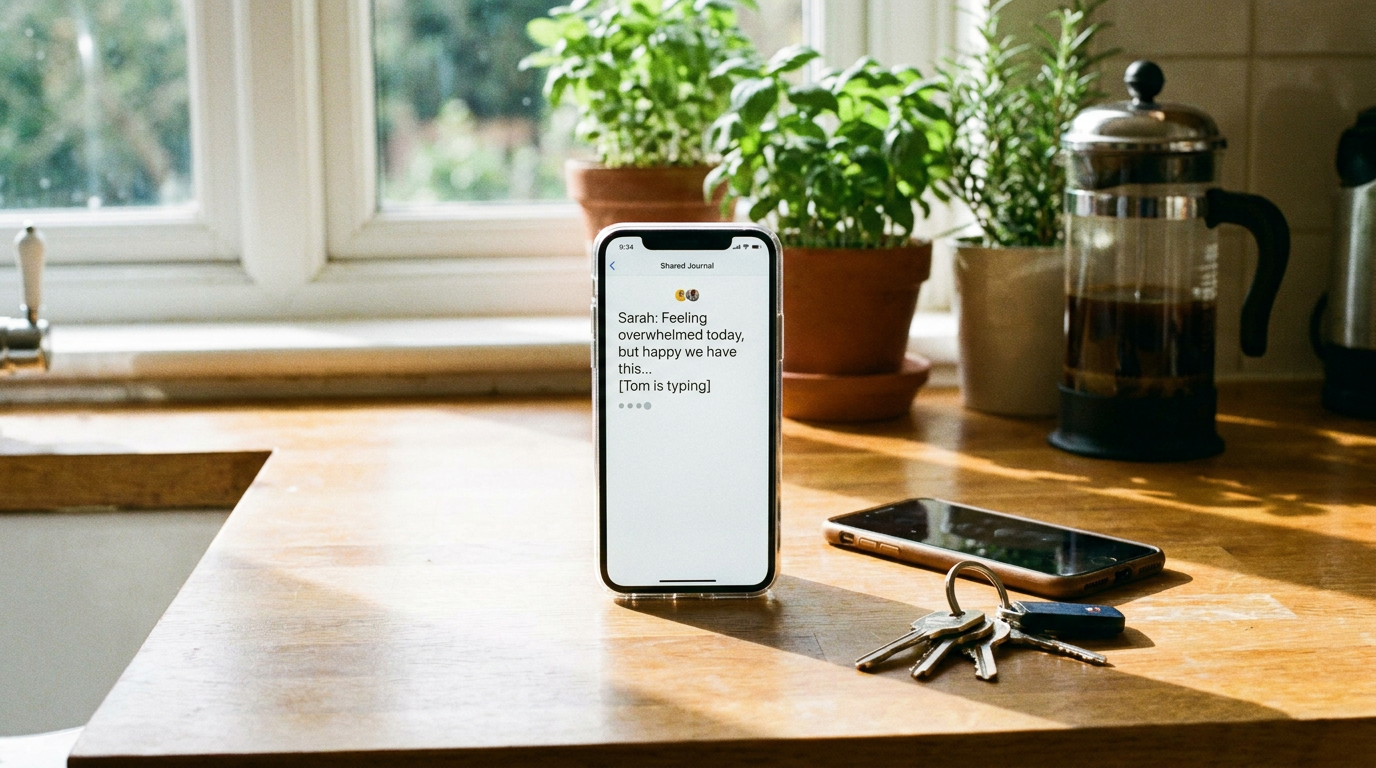
Right. The list.
60 couples journal prompts, in six blocks
Here are the sixty couples journal prompts, grouped into six blocks of ten so you can find the right one in about four seconds. Use whichever block suits the week you are having. Screenshot the block you want. Skip anything that does not appeal. If you like this format and want prompts outside the couples context, there are Same rule throughout: you both answer the same number, separately, then swap.
more prompt lists on the Lugelo blog
to raid.
Easy starters for people who have never done this (1–10)
Use these for your first go, when neither of you is sure about any of this.
These are the couple journal prompts to open with — genuinely low stakes, answerable in one line, and a couple of them are quite funny once you read what the other one put.
- What did you eat today, and was it any good?
- What's something small that annoyed you this week that you've already forgotten the reason for?
- If someone filmed the last hour of your day, what would it look like?
- What song have you had on repeat lately, and are you embarrassed about it?
- What's currently on your side of the room that shouldn't be?
- What did you nearly say out loud today and didn't?
- What's the last thing that made you laugh when you were on your own?
- How did you actually sleep, and what's your excuse?
- What's the most boring thing you did today?
- If today had a title, what would it be?
The week you just had (11–20)
Use these on a Sunday night, or whenever the week has blurred into one long Wednesday.These are the ones that build the actual record. Small, specific, recent. Nothing abstract, nothing that needs thinking about for more than a few seconds.
- What's one thing that happened this week you'd have forgotten by next month?
- Where did you go this week that you don't usually go?
- What was the best ten minutes of your week?
- Who did you talk to this week that you were glad to hear from?
- What did you eat this week that was worth eating?
- What took longer than it should have?
- What was the weather doing on the day you remember most clearly?
- What did you spend money on that you're pleased about?
- What's still on the list that was on the list last week?
- What would you tell someone about this week if they asked how it was and actually meant it?
How you got here (21–30)
Use these when you want the origin story on the record, in both versions.This is the block where two separate answers pay off hardest. You both write your own account of the same beginning, and the two accounts will not match. Keep it curious rather than evaluative — you are collecting what each of you noticed, not scoring the performance.
- What do you actually remember about the first time you met? Not the version you tell people — what you remember.
- What did you think was going to happen next?
- What's the first meal you remember eating together?
- When did you first tell someone else about them, and what did you say?
- What were you wearing, as far as you can recall, and how confident are you about that?
- What's the first thing you noticed about them that wasn't how they looked?
- Where did you go on an early outing that you've never been back to?
- What did you get completely wrong about them at the start?
- What's a small thing from the early days that you'd forgotten until right now?
- When did it stop feeling new?
What you notice about each other (31–40)
Use these when you want to say something nice and can't think how to start.Appreciative and specific. Nothing in this block invites criticism, scoring or comparison — it is the good version of noticing, and it is the block people are most surprised by when they read the other answer.
- What did they do this week that they'd assume you didn't notice?
- What are they better at than they think they are?
- What's a small thing they always do that you'd miss if it stopped?
- When did they last make you laugh without trying to?
- What do they do that other people don't see?
- What would you trust them with that you wouldn't trust anyone else with?
- What's a phrase they say constantly that is now permanently theirs?
- What did they handle recently that you were quietly glad you didn't have to?
- What do they look like when they're properly concentrating?
- What's something they've got better at since you met?
Couples travel journal prompts (41–50)
Use these during a trip, or in the day or two after, while it's all still fresh.

- What surprised you about this place?
- Which meal would you go back for?
- What went wrong that's already funny?
- If you came back, what would you skip?
- What's the one moment from this trip you want to still have in ten years?
- What did the mornings smell like?
- Who did you meet, even briefly, that you'll remember?
- What did you spend far too long deciding about?
- What's the thing you saw that the photos completely failed to capture?
- What did you get used to here that you'll miss by Thursday?
Looking forward (51–60)
Use these at the start of a year, a season, or anything new.Modest and concrete. No five-year plans, no vision boards, nothing that requires a whiteboard.
- What's one small thing you'd like to do more of next month?
- Where would you like to go that's less than two hours away?
- What's something you keep meaning to sort out?
- What would make next weekend a good one?
- What's one thing you'd like to be slightly better at by the end of the season?
- Who would you like to see more of?
- What's a small thing you'd happily spend money on this year?
- What do you want to have stopped doing by this time next year?
- What's one evening in the next month you'd like to properly plan?
- What would you like next year's version of this answer to say?
That is the sixty. They are the easy part — what you do with the answers is what makes any of this worth doing.
What to do once you've both answered
You have two answers to the same question. Now read them.
Read their version and leave it alone
What they wrote is a record of what they noticed and how it landed for them, which is a different and more interesting thing than a verified timeline. The second you start editing their entry, you are back to one negotiated version, and you have undone the only thing that made this worth doing.
Let it be wrong.
Resist the urge to correct it. This is harder than it sounds, because their account will contain something you are certain is wrong — the wrong restaurant, the wrong month, a conversation you are sure went differently.
The most common reaction, by a distance, is mild surprise. You remembered that bit? That is the method landing. Two people were there, two people came away with different halves, and now both halves exist.
Archivists have known this for a long time — precisely because the differences between them carry information that no single tidy version could. What is true for a public archive is true for a kitchen table. Two records are richer than one.
oral history collections routinely hold several narrators' accounts of the same event
The once-a-year reread is where the payoff lives
You will also find that the entries you thought were pointless at the time are the best ones. Nobody rereads the profound entry. Everybody rereads the one about the disastrous barbecue.
Most of it will be things neither of you could have recalled unprompted. That is not a sign you have bad memories. It is just what happens to ordinary weeks, which is the entire reason for writing them down in the first place.
Pick a fixed occasion — an anniversary of something, the last weekend of summer, the flat bit between Christmas and New Year — and read the whole thing back in one sitting.
The single highest-value habit on this page
That is it. That is the trick.
Pick two or three prompts and answer the same ones every year.
One entry is a snapshot. The same question answered five years running is something else entirely — you can watch your own answers change, and watch theirs change, and see things neither of you announced or even noticed at the time. What would make next weekend a good one?Nothing else in this post comes close to it for value per minute spent.
answered five times in a row tells you more about a relationship than any amount of reflective writing.
Over time the pile stops being entries and starts being an object. You can Which raises the obvious practical question — where does a thing like this actually live, and who gets to see it?
turn a journal into a printed book or a PDF
And again, because it bears repeating: some answers stay private, and that is completely fine. A record with a few things held back is still a record.
if you want something you can actually hold, which is a nice thing to have on a shelf and a genuinely strange thing to read.
Where a shared couples journal lives, and who can see it
Take the format question honestly first, because every option has a trade-off and pretending otherwise would be silly.
Paper is lovely and lives in exactly one place, which is the archivist problem from earlier. A shared note on your phones is frictionless and gets buried under shopping lists within about a fortnight. A document works and is searchable, but nobody in the history of the world has opened a word processor and felt they were making a keepsake. An email threadNone of these is disqualifying. Pick one and start.
is surprisingly durable and aesthetically grim.
What you actually need from whatever you choose
That is the honest specification. Anything that meets it is fine.
Strip it back and the requirements are short. Both of you need to be able to add to it from your own phone, in your own words, without one person turning into the designated typist. It needs to survive a phone upgrade. And a year later, the whole thing needs to be in one place you can find without a search party.
Privacy is what makes the permission real
Sharing should be a choice you make per journal, not a default you inherit.
If everything either of you writes is automatically visible to the other, then "you can pass on any prompt" is a polite fiction. You need somewhere that separates the two. The usual arrangement is straightforward: one shared journal for the answers you both read, and a separate private one for the answers you don't.
This part matters more than it looks, because the permission this post gave you in the ground rules — you can keep some answers to yourself — is only real if the place you are writing actually supports it.
This is where relationship journals for couples differ from a general note-taking app, and it is the practical reason people end up wanting something purpose-built. On , journals are private by default with owner-controlled sharing — you decide what gets shared and who can contribute, and you can keep separate journals for the shared answers and the private ones. Data is encrypted in transit. The travel case is the one that sells itself: both of you adding photos and short notes to the same trip record while you are still on the trip, rather than one person reconstructing the whole thing a fortnight later from two thousand camera roll photos and a receipt.
Lugelo
But the honest position stands, and it is the one worth ending this section on. The method matters more than the tool. A couples journal kept in a cheap notebook, with both of you writing your own answers and neither of you editing the other's, beats the most elegant app used badly. If you do this in a notebook, you have done it.
Couples journaling: common questions
What is a couples journal?
A couples journal is a shared record that both people write in, rather than one person keeping a diary about a relationship. In this post's version, you both answer the same prompt separately and then read each other's answers, so the journal ends up holding two accounts of every entry instead of one. That is the only meaningful difference from a normal journal, and it is the thing that makes it worth the ten minutes.
Do we both write in the same journal?
Yes — same journal, separate answers. The distinction matters, because "writing together" usually means one person talking while the other types, which produces a single version filtered through one set of hands. Instead, you each answer the prompt on your own, without conferring, and both answers go in. Same question, two entries, sitting next to each other. That side-by-side is the whole method.
How often should we do this?
Once a month, reliably, beats every night for a fortnight. Ten minutes is plenty — set a timer and stop when it goes. The failure mode here is almost never doing too little; it is starting with an ambitious nightly plan, missing four days, feeling vaguely guilty, and quietly never returning. Twelve honest entries a year is a real record. Attach it to something that already happens and it will survive.
What if my partner isn't interested?
Start on your own, keep it light, and do not manage them. Your answers are worth keeping regardless, and a one-sided record is still better than none. Plenty of people come round after reading a single entry, usually because it is funnier or odder than they expected. Some never do, and that is genuinely fine — it is a preference, not a statement about the relationship. Nagging converts nobody and turns a nice idea into an obligation.
What do you write in a relationship journal?
Whatever the prompt asks, in as few words as you like. Use the six blocks above — starters, the week you just had, how you got here, what you notice about each other, travel, and looking forward — and pick the block that fits the week. A sentence counts as a complete entry. If you like this question-led format, the same approach works for , which is the same trick pointed at a different person.
asking your grandparents about their lives
Is couples journaling actually worth it?
Honest answer: not for the writing, for the reading. On the day itself, couples journaling feels mildly pleasant and slightly pointless — you have written three lines about a Tuesday. The value arrives later, on the reread, when you find a week you had completely lost and an account of it from someone who was there and noticed different things. Judge it after a year, not after an evening.
Should we read each other's entries?
Yes — that is the entire point, but only the ones you have both chosen to share. The pass rule stands permanently: anyone can skip any prompt without explaining why, and anyone can keep an answer private. Reading is what turns two separate entries into something better than either one alone. Just read without correcting. Their version is theirs.
What if we disagree about what happened?
Usually it is interesting rather than a problem — two people notice and remember different things, which is ordinary and well understood. Most gaps are about what each of you paid attention to, not about who is right. If a disagreement turns out to be a real one, that is a conversation to have out loud rather than in writing. A journal is a good place to keep a record and a poor place to argue with one.

The photo, with something attached to it
So lower the bar as far as it will go. Pick one block. Answer three prompts. That already beats the alternative, which is another year of similar jumpers and no idea which was which. Skip anything you do not fancy, and keep some answers to yourself.
That is all this is. Two accounts of the same week are better than one, and dramatically better than none.
Now imagine that one of them has two short written answers attached — yours and theirs, written the same evening, neither of them edited. One mentions the drive. One mentions the meal. Between them they hand you back a day you had otherwise lost entirely.
Go back to the photo in front of the same tree. It is still a nice photo, and you still cannot tell which year is which.
Pick a block. Both of you answer three prompts tonight, separately. Then read what the other one wrote — that part takes about ninety seconds and is the good bit. If you want somewhere for it to live that both of you can reach, you can start a shared journal on from either of your phones, private by default with owner-controlled sharing.
Lugelo
Don't Just Live It — Keep It