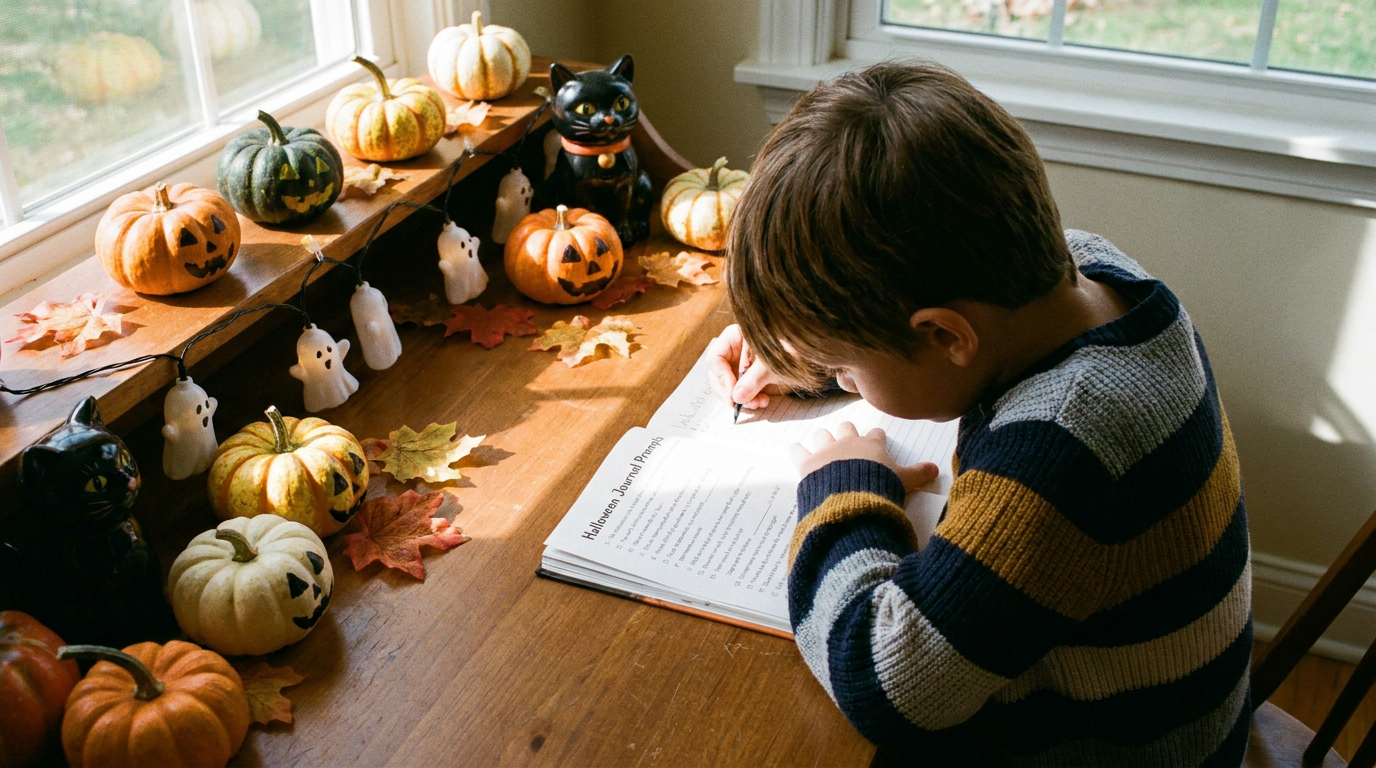
31 Halloween Journal Prompts for Kids and Grown-Ups
The evenings have started closing in early again. Somewhere in your house there is a notebook with three entries in it, all dated January, all written in a hand that clearly believed this time would be different. You are not going to be scolded about that here.
Here is what this post is instead: 31 Halloween journal promptsAnd some days you will write two sentences. That counts. That has always counted.
The whole thing ends on Halloween. That’s not a limitation — it’s the entire design. You are not being asked to journal forever. You’re being asked for October.
Most seasonal prompt lists pick a side. They’re written for classrooms, or they’re written for adults who want something atmospheric to write about on a Sunday. This one is built to be done at the same table by two people at once. A seven-year-old can answer the day’s question in a sentence. A forty-year-old can answer the same question in a paragraph and find something they hadn’t thought about in thirty years. Neither of you has to pretend to be interested in the other’s version.
— one for every day of October — with two versions of each. A playful one for children. A reflective one for grown-ups. Same theme, same day, two registers. Sixty-two prompts in total, and a finish line you can see from where you’re standing.
The month runs in five arcs: the season arriving, costumes and imagination, friendly frights and brave moments, the people you spend it with, and the final three days that land on Halloween itself. If , this format was designed with you specifically in mind.
journaling has never quite stuck for you before
So — before the list itself — a short word on why a list with an end date works when an empty notebook doesn’t.
Why Themed, Time-Boxed Journal Prompts Actually Get Finished
Ask anyone who has abandoned a journal what went wrong, and they will almost never say I ran out of things to say. They ran out of patience. They sat down with a blank page and a pen and an expectant silence, and somewhere around the third minute of deciding what today was aboutA prompt removes that decision before you arrive. You already know what you’re writing about. All that’s left is the writing, which was never the difficult part.
This is worth sitting with, because it reframes the whole failure. You didn’t lack discipline. You were handed the hardest task first — choose a subject, from the infinite set of things that happened to you today, with no criteria for what makes a good one — and then asked to be eloquent immediately afterward. Nobody would design a habit that way on purpose.
The blank page is the problem. Not the writing.
, they discovered there was laundry to move.
A finish line changes the arithmetic
“Journal every day” is a commitment with no edge to it. There is no version of that sentence where you win. There is only an infinite corridor of days, each one carrying the quiet possibility of failure, and the near-certainty that some Tuesday in February you’ll miss one and the whole structure will collapse under the weight of its own perfectionism.
“Journal through October” is different in kind, not just in degree. It’s thirty-one days. You can see the end from the beginning. You can count them on a calendar. Missing the 14th doesn’t invalidate anything, because the project isn’t be a person who journals — the project is get to the 31st.
This is the difference between a habit and a season. Habits are identity claims, and identity claims are exhausting to defend. Seasons just end.
You are not committing to journaling forever. You are committing to October.
A shared theme does the connective work
Here’s the quiet benefit of running a set of october journal promptsEvery entry sits inside the same season, orbits the same handful of subjects, and was written in the same stretch of shortening days. That’s a body of work. It reads as a portrait of one particular October — this one, the year your child was seven, the year the clocks went back on a Sunday you happened to describe. Thirty-one scattered entries about thirty-one unrelated topics would never cohere into that. The theme is doing structural work you don’t have to think about.
rather than writing whatever surfaces on a given evening: at the end, you don’t have thirty-one unrelated notes. You have one thing.
October hands you the material for free
Some months you’d have to invent things to notice. October isn’t one of them.
The light changes measurably week to week. The air acquires that specific cold-leaf smell that no candle has ever successfully imitated. There are costumes to have opinions about, a doorbell that rings more than usual, decorations appearing on houses whose owners you’ve never spoken to, and an entire cultural apparatus of pretend-fear that everyone participates in without embarrassment. The month is loud with subject matterYou are not being asked to be interesting. You’re being asked to notice things that are already happening, which is a substantially easier assignment.
.
Missing days is built into the design
Read this part twice, because it is the single most important permission in this post:
If you miss the 6th, write it on the 7th. Or skip it entirely.You are not. You’re a person with a calendar and a busy Tuesday. Those are different.
The month still ends on Halloween either way. Nothing breaks. There is no streak to protect, no chain to keep unbroken, no small green square that turns grey and shames you. Twenty entries out of thirty-one is a genuine, detailed record of an October. Twelve is too. The only version of this that fails is the one where you miss two days and decide, on that basis, that you’re the kind of person who doesn’t finish things.
If journaling has never stuck for you before, the underlying reason is almost always one of these two — the blank page, or the open-ended commitment. This format removes both on purpose. There’s a fuller treatment of that problem in Now — how to actually run it.
How to Start a Journal After Failing at It Before
, which is the piece this post grew out of.
How to Use These October Journal Prompts (Kids and Grown-Ups, Side by Side)
Before the first day, five minutes of setup. Skim this if you’re doing it alone; read it properly if there’s a child involved.
Two registers, one theme
Answer whichever fits. Answer both if you like. The point of the pairing is that a child and an adult can sit at the same table, hear the same question read out loud, and each answer it honestly at their own depth. Nobody is being talked down to and nobody is being asked to perform.
Every day in this list carries two prompts on the same subject. The kids’ version is concrete, answerable in a sentence, and usually a little silly. The grown-ups’ version takes the same idea and points it backwards — at memory, at noticing, at the thing you’d forgotten you knew.
There’s something quietly good that happens when you do this properly. Your child answers “What’s the best thing about it getting dark early?” with something about torches in the garden. You answer the grown-up version and find yourself in 1994, in a specific hallway, and you say so out loud. That exchange doesn’t happen if you’re both just journaling in the same room.
Doing it with a child
The mechanics matter more than you’d think:
- Read the prompt aloud. Don’t hand them a page. A question asked is a different object from a question printed.
- Let them answer out loud first, then write. Speech comes before writing developmentally, and letting a child talk an idea through before committing it to paper removes most of the friction. Reading Rockets has good, plain guidance on this if you want the fuller version.
- Accept one-line answers. “A skeleton but funny” is a complete entry. Do not fish for more.
- Don’t correct spelling. Not in a journal. Not once. The moment a journal becomes a place where you get things wrong, it stops being a journal.
- Drawings count. Fully, without qualification. A drawn answer is an answer.
That last one does more work than any of the others. A child who draws their answer has participated completely, and in ten years the drawing will be worth considerably more than the sentence would have been.
Doing it alone
Ignore the kids’ column. Genuinely — skip straight past it, it isn’t for you.
Or, better: read it first. The playful version is often the key that unlocks the reflective one. “What’s under your bed? Make it up” is a children’s question, but reading it puts you back in a room you haven’t thought about since you were nine, and by the time you reach the grown-up prompt you already know what you’re writing about. The silly question is a side door into the serious one.
Where to keep it
A paper notebook is completely fine. So is the notes app on your phone. So is Lugelo, which is what we built for this.
In Lugelo each day becomes a Moment — and a Moment can hold more than text. You can attach a photo of the costume, a voice note of your child answering out loud before they’ve written anything down, or a short video from the doorstep on the 31st. rather than living in a separate camera roll. At the end of the month, the whole thing lines up on your Memory LaneThe voice-note option is worth flagging specifically for anyone with a child under about seven. A thirty-second recording of a five-year-old explaining their invented ghost is a better artefact than anything either of you would have written, and it takes no effort at all.
Photos, voice notes and video sit alongside the writing
in order, so you can see the arc of October in one view instead of scrolling backwards through a folder.
Privacy, stated plainly
Journals in Lugelo are private by default, with owner-controlled sharing and data encrypted in transit. Which in practice means a family can keep the whole month entirely to themselves — or deliberately invite a grandparent in to read it and add their own entries. That’s your decision, made once, and changeable.
When a prompt doesn’t land
Some days one of these thirty-one won’t suit your family. Maybe the costume question doesn’t apply this year. Maybe your child answers “I don’t know” to Day 17 with real conviction.
That’s what the is for. It can generate a different prompt on the same theme so you don’t lose the day, or take a one-line answer and help expand it into something fuller without putting words in a child’s mouth — it works from what they actually said, which is the only version worth keeping. It’s genuinely useful for the specific problem of I want to write this down and I don’t know how to start, which is the problem these spooky writing prompts for kids are designed to solve in the first place.
That’s the method. Now the month itself, starting with the week the season shows up.
Week 1: The Season Arriving — Journal Prompts for October 1–7
The first week isn’t about Halloween at all. It’s about the turn — the dark arriving earlier than it did last week, the particular smell the air takes on, the low hum of anticipation before the month gets loud. Starting here is deliberate. Nobody should hit a difficult question on day one. These fall journal prompts ask only that you notice what’s already outside the window, which is the easiest possible request.
If the words won’t come on a given evening, the Poetry Foundation keeps an editor-curated that works well as a warm-up. Read one, then write. It reliably shakes something loose.
collection of autumn poems
Season of mists and mellow fruitfulness,
Close bosom-friend of the maturing sun…
— John Keats, (1819)
Day 1 — The first day of October.
For kids: What’s the first thing that told you it wasn’t summer anymore?
For grown-ups: Describe this morning’s light in three sentences, without using the word “autumn.”
Day 2 — Dark evenings.
For kids: What’s the best thing about it getting dark early?
For grown-ups: What did the dark evenings mean when you were nine, and what do they mean now?
Day 3 — The clocks and the shortening days.
For kids: If you could keep one hour of daylight in a jar and use it whenever you wanted, when would you open it?
For grown-ups: Write about the specific hour of the day that has changed most since summer — what you used to be doing in it, and what you do now.
Day 4 — The smell of the season.
For kids: If October had a smell, what would it be?
For grown-ups: Write about a smell that puts you instantly in a specific October.
Day 5 — The first cold morning.
For kids: Describe the coldest you’ve been this year. Where were you and what did you do about it?
For grown-ups: Write about the first cold morning of a year you remember clearly — what you were wearing, what you could see your breath against.
Day 6 — Something you noticed on a walk.
For kids: Describe one thing you saw outside today that you’d never seen before.
For grown-ups: Take the same route you always take and write down three things you have walked past for years without registering.
Day 7 — Anticipation.
For kids: What are you most looking forward to this month?
For grown-ups:From noticing the season, to the part of October where everybody starts deciding who they’d rather be.
Day 6 is the sleeper of this week, incidentally. “Three things you have walked past for years without registering” is the prompt most likely to produce a sentence you’ll reread in five years and not remember writing.
Seven days in. Notice what’s happened to the calibration: the kids’ prompts are all answerable in a single line, and the grown-up prompts all ask for something concrete rather than something profound. That’s the register for the whole month. Nothing here demands a paragraph. Most of it just asks you to look at something properly.
Write about waiting for something as a child — the specific feeling of the days before.
Week 2: Costumes, Imagination and Pretending — Journal Prompts for October 8–14
Costumes are the one week a year when everyone is openly permitted to answer the question who else could I be? Children answer it literally, with total commitment and no irony whatsoever. Adults answer it in hindsight, which turns out to be just as revealing.
This is the most playful stretch of the month, and the one where the two registers diverge most interestingly. A child writing about their costume is writing about the future — about Friday, about the plan. An adult writing about a costume is almost always writing about their mother at a sewing machine.
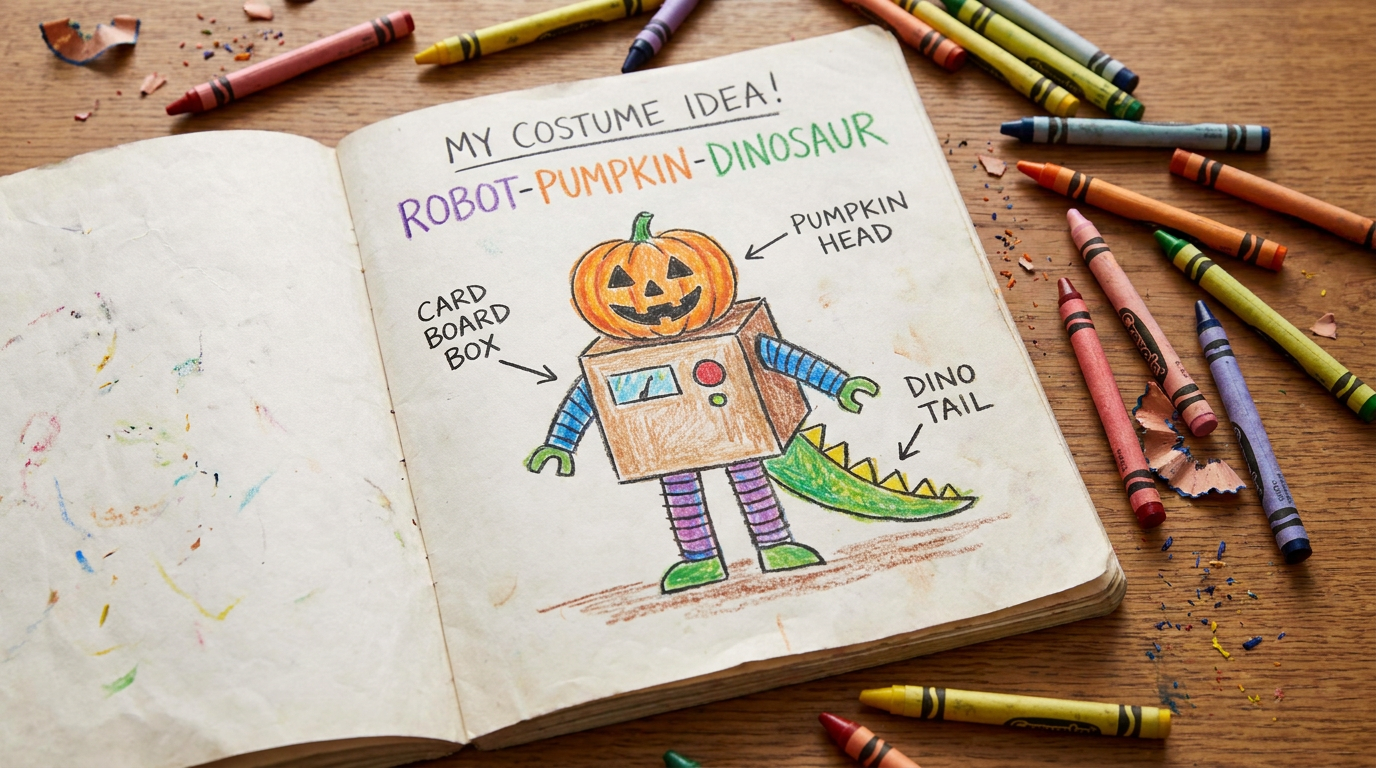
A note for parents before you start: drawings absolutely count this week, more than any other. A child who draws their invented costume has completed the day in full. is the whole point of this arc — the author Mary Amato’s guidance for parents is worth two minutes if you find yourself tempted to ask for more than they’ve given.
Low-pressure, imagination-first writing
Day 8 — This year’s costume.
For kids: Who are you going to be this year, and why did you pick them?
For grown-ups: What does your child’s costume choice tell you about who they are right now?
Day 9 — Homemade or shop-bought.
For kids: Would you rather have a costume someone made for you or one from a shop? Argue your case.
For grown-ups: Write about the effort that went into a costume once — yours or one you made — and whether the effort was visible in the result.
Day 10 — The costume you’d never actually wear.
For kids: Invent a costume nobody has ever made before. Draw it if it’s easier.
For grown-ups: Describe a version of yourself you’ve never let anyone meet — the harmless one you keep to yourself.
Day 11 — The costume that went wrong.
For kids: Write about a costume that didn’t work out. What happened to it?
For grown-ups: Write about something you wore that was misidentified all night. Did you correct people, or give up?
Day 12 — Costumes past.
For kids: What was your best costume ever?
For grown-ups: Write about a costume your mother or father made you — the materials, the effort, whether you appreciated it at the time.
Day 13 — Dress up someone else.
For kids: Choose someone in your family and invent the perfect costume for them. What is it, and why is it exactly right?
For grown-ups: If you had to costume the person you know best as the thing they most resemble, what would it be? Be generous.
Day 14 — Pretending.
For kids: If you could be someone else for one whole day, who?
For grown-ups: What did you pretend to be as a child, over and over, and does any of it survive in what you do now?
That’s fourteen days done — nearly half the month.
Day 12 is the one that tends to ambush people. “Whether you appreciated it at the time” is a small, quiet question with a lot behind it, and it’s the sort of thing that gets written down once, in a journal, and then never said out loud to the person it concerns. Which is fine. That’s what journals are for.
And Day 13 is worth doing as a pair even if you’re not doing the rest of the month together. Two people costuming each other on paper, then swapping, is a better game than it sounds.
From pretending to be someone braver, to what bravery actually looked like.
If a costume actually materialises this year, photograph it and attach the photo to the same Moment as the writing — the drawing of the invented version and the photo of the real one, filed together, is a better record than either alone.
Week 3: Friendly Frights and Brave Moments — Journal Prompts for October 15–21
This week is about the enjoyable kind of spooky. The shiver you choose. Ghosts who mean well, monsters with poor career prospects, the specific and delicious feeling of being slightly scared on purpose in a warm room with the lights on.
That’s the boundary, and it’s worth naming out loud so nobody opens this section braced for something heavier. Nothing here is designed to unsettle a child. The grown-up prompts are nostalgic — creaky stairs, films watched too young, the hallway light switch you always sprinted for. Fond, specific, and light on their feet.
Day 15 — The friendly ghost.
For kids: Invent a ghost who is bad at being scary. What goes wrong?
For grown-ups: Write about a house that made noises at night and the explanations you invented for them.
Day 16 — The monster who’s scared of you.
For kids: There’s a monster in the wardrobe and it’s terrified of you. Write its diary entry.
For grown-ups: Write about something you were frightened of as a child that would find you completely unremarkable now.
Day 17 — Under the bed.
For kids: What’s under your bed? Make it up.
For grown-ups: What were you certain was in your room at night, and when exactly did you stop believing it?
Day 18 — The sound.
For kids: Describe the spookiest sound you can think of, without saying what’s making it.
For grown-ups: Write about a sound your childhood house made that no other house has ever made since.
Day 19 — Brave.
For kids: Write about a time you were brave — the dentist, the diving board, a spider.
For grown-ups: What’s something that used to scare you that you now do without thinking?
Day 20 — Trying something new.
For kids: Write about the first time you did something you’d never done before. Was it as bad as you thought?
For grown-ups: Write about a first attempt at something — the specific awkwardness of not yet being any good at it.
Day 21 — Scary stories.
For kids: Write the shortest scary story you can — three sentences, and it has to end funny.
For grown-ups:Twenty-one days. Three weeks down, ten days to go.
Write about a film or book you watched far too young, and how it lodged itself in your imagination.
Day 21 deserves a note, because the constraint is doing something clever. Three sentences, and it has to end funny caps the intensity structurally rather than tonally — a child can go as spooky as they like in sentences one and two, because sentence three is contractually obliged to undercut it. You don’t have to police the tone. The form does it for you. It’s also, reliably, the funniest thing anyone writes all month.
Day 16 is the other standout. Giving the monster a diary entry flips the whole architecture of the fear — you can’t be frightened of something whose paperwork you’ve read.
From the imagined company of ghosts, to the real company of the people you actually spend the night with.
Week 4: Family, Neighbours and the People You Spend It With — Journal Prompts for October 22–28
Halloween is one of the very few nights in the year that puts you on your neighbours’ doorsteps. For one evening the street becomes briefly, genuinely social — people you nod at in the car park are standing in their doorways handing sweets to your children, and everyone behaves as though this is normal.
This week writes down the people rather than the pumpkins. These are the entries most likely to matter in fifteen years, and they’re the ones nobody thinks to record, because at the time the people seem like the permanent part.
Day 22 — The street.
For kids: Which house on your street does Halloween best, and what makes it the best?
For grown-ups: Write about the street you trick-or-treated on as a child — the specific houses, who lived there, how far you were allowed to go.
Day 23 — The doorbell.
For kids: Describe the best costume that came to your door this year. Would you have thought of it?
For grown-ups: Write about answering the door on Halloween — who you were before you opened it and who you become for the ninety seconds afterwards.
Day 24 — Who you go with.
For kids: Who are you going out with this year? Describe them as if a stranger had to pick them out of a crowd.
For grown-ups: Who took you out as a child, and what do you remember about how they were on that night specifically?
Day 25 — The decorations.
For kids: Describe the most decorated house you’ve seen this year, from the pavement, in as much detail as you can manage.
For grown-ups: Write about a house that goes to unreasonable effort every year, and what you suspect the reason is.
Day 26 — Family Halloween.
For kids: What does your family always do that other families don’t?
For grown-ups: What did your family do every year that you didn’t realise was unusual until much later?
Day 27 — Someone you’d like to spend it with.
For kids: If anyone in the world could come trick-or-treating with you, who would you pick and what would they wear?
For grown-ups: Write about someone who isn’t here for this one, and what they’d have made of it.
Day 28 — The grown-ups.
For kids: Interview a grown-up about their best Halloween ever and write down their answer.
For grown-ups: Write down a Halloween story from your own childhood that nobody in your house has heard yet.
Twenty-eight days. Three to go.
Day 28 is the one to do with a grandparent. It’s the only interview prompt in the month, and it’s deliberately placed here. A child transcribing an older relative’s Halloween story — in the child’s handwriting, with the child’s spelling, capturing an eighty-year-old’s memory of a night in 1958 — is the single entry from this whole month most likely to be treasured decades from now. Ring someone. Do it on speakerphone.
This is also the week where opening the journal up makes the most sense. A journal owner can , with owner-controlled sharing — so a grandparent can answer Day 28 in their own words, from their own device, rather than being quoted secondhand. Two generations answering the same question about the same night, filed side by side. If they need setting up, Lugelo is From the people, to the night itself.
free on iOS, Android, Web and HarmonyOSinvite family members to add their own Moments
Push yourself toward specifics this week. Not “the neighbours were lovely” but “the Hendersons at number 14, who gave out full-size bars and made a point of guessing wrong about every costume.” Names, house numbers, what someone wore, what they said at the door. General fondness evaporates. Detail doesn’t.
.
The Final Stretch: October 29–31 and What to Do With Your 31 Entries
Three days left. One of them is Halloween.
Day 29 — The night before the night.
For kids: What are you most excited about for tomorrow? Write it now so you can check tomorrow if you were right.
For grown-ups: Write down what you’re expecting from tomorrow, in detail, before it happens.
Day 30 — Halloween itself.
For kids: Write about tonight while you’re still in your costume. What was the best bit?
For grown-ups: Capture one small moment from tonight that a photograph wouldn’t have caught.
Day 31 — Looking back.
For kids: Read your entry from October 1st. What’s different now?
For grown-ups:That’s thirty-one days and sixty-two prompts. You can count them.
You’ve written for a month. Which entry surprised you, and what would you tell yourself on October 1st?
Why Day 31 is the one that makes it a month rather than a pile
The looking-back mechanic is the payoff, and it’s worth understanding why it works.
Anyone can accumulate thirty-one entries. What turns accumulation into an arc is the moment you close the loop — when you go back to the first thing you wrote, on the last day of writing, and read it as a stranger would. Four and a half weeks isn’t long. But it’s long enough that October 1st will feel genuinely distant by the 31st, and the distance is the point.
For a child, this is often the first time they’ve ever encountered their own writing as a historical document. I wrote that? That’s not what I think now.For an adult, the surprise is usually more specific: you’ll find you wrote something on Day 5 or Day 12 that you have no memory of writing, and it will be better than you expect. The entries you thought were the good ones rarely are. It’s almost always the throwaway line on the day you nearly skipped.
That’s a real cognitive event and it tends to land hard.
Day 29 sets up a smaller version of the same trick — writing down your expectations before the night, so that Day 30 can be checked against them. Children love this. Adults find it quietly educational.
What the finished month can become
You’ve got thirty-one entries and, probably, a handful of photographs. That’s already more than most families keep from an entire year. Here’s what it can turn into:
- A Memory Lane timeline. The whole of October in sequence, in one view — the season arriving on the left, Halloween night on the right, and the shape of the month visible at a glance in a way it never is while you’re living through it.
- A storybook or ebook. Thirty-one entries plus the costume photos is already a book about one specific year. The AI Journal Assistant can help turn a month of entries into something more finished — formatted, ordered, and handed to someone rather than scrolled.
- A VR gallery. For families who’d rather walk through the month than scroll it.
- An annual thing. This is the strongest idea in the whole post, so it gets said plainly: do it again next October. Then you have two years to compare. Same prompts, same child, twelve months of growing up in between. The Day 8 costume answer at seven and the Day 8 costume answer at eight are not the same document, and reading them together is worth more than either separately. By year three it stops being a writing exercise and becomes a family record.
Whatever it becomes, it stays yours: private by default, with owner-controlled sharing and data encrypted in transit. Nothing leaves the journal unless you decide it does.
And if you get to November 1st and find you’d rather not stop — that’s a useful thing to have learned about yourself. Thirty-one days is proof the format works on you. A few practical questions remain.
If you want to keep going after October 31st
, the longer piece on starting a journal after failing at it before covers how to turn a finished month into something ongoing without recreating the conditions that made it collapse last time.
Frequently Asked Questions About Halloween Journal Prompts
What are Halloween journal prompts?
Halloween journal prompts are short seasonal questions designed to be written about rather than acted on. This set runs one per day across October — thirty-one days, each with a playful version for children and a reflective version for adults on the same theme. The month ends on Halloween night.
What age are these spooky writing prompts for kids suitable for?
Roughly five to twelve. Younger children can answer aloud while a grown-up writes it down word for word, which preserves their phrasing better than paraphrasing does. Drawings count as complete entries at any age. Older children tend to prefer the adult column, and that’s fine.
Do I have to start on October 1st?
No. Start whenever you pick this up. Work through them in order, or skip to whichever prompt appeals on a given evening. The month still ends on Halloween regardless of when you began, and a fortnight of entries is a real record of October.
What if we miss a few days?
Expected, and planned for. Double up the next day, or skip those prompts entirely and rejoin at the current date. Twenty entries out of thirty-one is still a detailed portrait of the month. There is no streak here to protect and nothing breaks when a day is missed.
Can adults do these on their own?
Yes. Ignore the kids’ column completely, or read it first as a warm-up — the playful version often unlocks the reflective one by putting you back in the right room before the harder question arrives. Roughly half the prompts in the adult column work perfectly well solo.
What if none of the 31 prompts suit us on a given day?
Some days one won’t fit your family. The can generate an alternative on the same theme so you don’t lose the day, or take a one-line answer from a child and help expand it into a fuller entry using their own words.
AI Journal Assistant
Can family members add their own entries?
Yes. Journals are private by default, with owner-controlled sharing — so you can invite a grandparent, a co-parent or a sibling to add their own Moments to the same October, from their own device. Day 28 is the natural place to start.
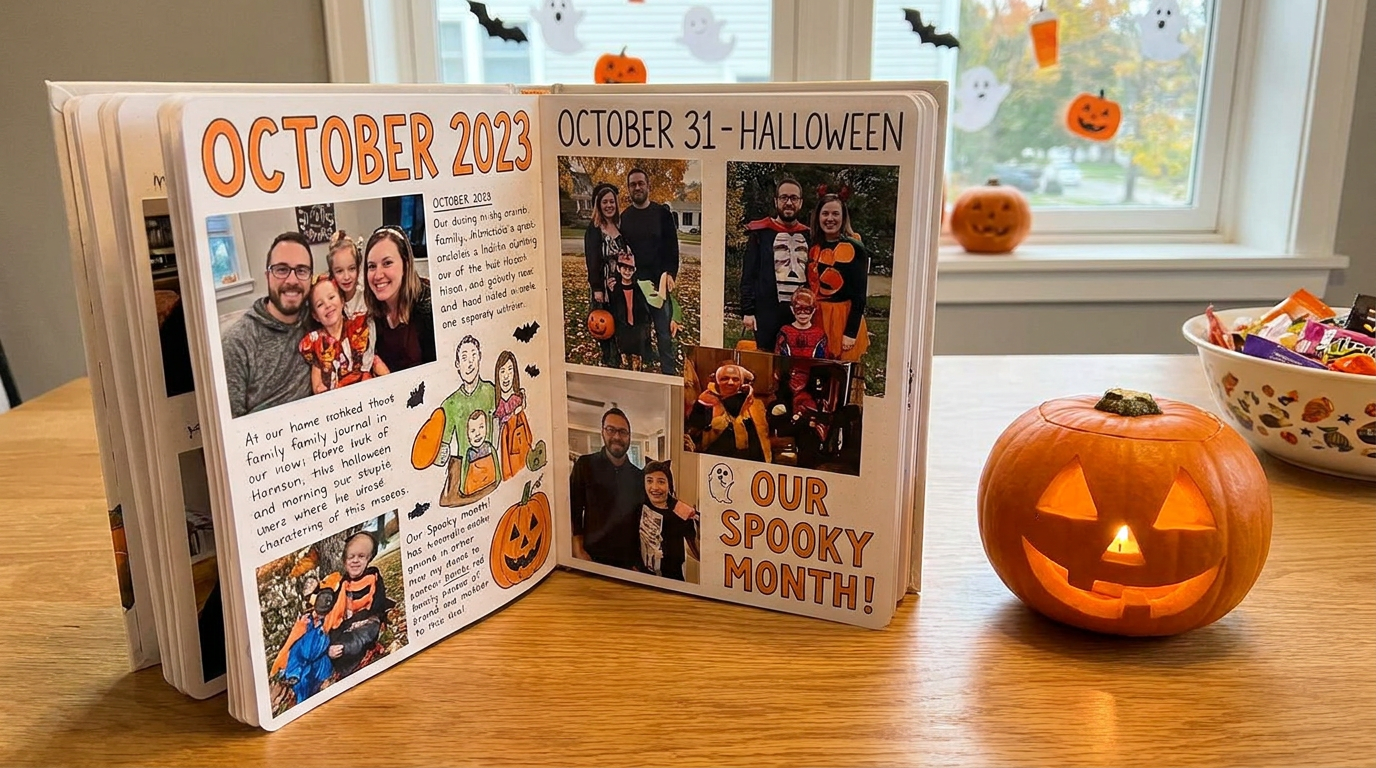
What You’ll Have on November 1st
If you’ve tried this before and it didn’t take, nothing about that was a character flaw — it was a format problem, and this format is different. A month is finishable. You can see the end of it from the beginning, the subject is chosen for you every single day, and missing a Tuesday costs you nothing.
Thirty-one days. Two registers. Starts on the 1st, ends on Halloween, and asks nothing of you after that.
Here’s what makes it worth the thirty-one evenings. A year from now the photographs will show you the costumes — the wig, the face paint, the cape that came apart by eight o’clock. Only the writing will show you what your child saidJournals are souvenirs of your past. This one takes a month to collect.
about them. The reasoning behind the choice. The invented ghost with the career problem. The three-sentence story that ended funny.
Start Tomorrow
This publishes on September 30th, which means October 1st is tomorrow. That’s not a coincidence and it’s the most useful sentence in this post — you don’t have to remember this in three weeks, or wait for a better moment, or start on a Monday. You can set it up tonight and answer Day 1 in the morning.
Don’t just live it — keep it. Start your October on the 1st, and let the fill in the days these thirty-one prompts don’t cover.
Try AI Journal, free →
Free on iOS, Android, Web and HarmonyOS, with Chrome and Firefox extensions. No ads. Optional Plus tier.
Your journal is private by default, with owner-controlled sharing and data encrypted in transit.