How Collaborative Journaling Strengthens the Home-School Connection
Every school day, your child lives a life you didn’t see. And every evening, their teacher wonders about the world your child came from that morning. The space between those two halves is where so much of a child’s story goes untold — and uncelebrated.
It’s a moment every parent knows intimately. Your child walks through the front door, backpack still on their shoulders, and you ask the question you always ask: “How was your day?” The answer comes quickly, almost reflexively: “Fine.”The teacher experiences the other side of this same silence. They spend six or seven hours with your child each day — watching them think, struggle, laugh, grow — but they rarely get to see the child who comes home. The one who talks at the dinner table, who reads books under the covers at night, who was anxious about the maths test last Tuesday and needed a hug before bed. Each party — parent and teacher — holds half the picture. Neither ever quite sees the whole child.
And that’s it. The classroom, the lunch table, the science experiment, the argument with a friend, the moment they finally understood something that had confused them for weeks — all of it compressed into a single, impenetrable syllable.
This is the home-school disconnect, and it is one of the most quietly persistent frustrations in modern education. It isn’t born from a lack of care. Parents care deeply. Teachers care deeply. The problem is structural: the tools and habits we’ve built for parent-teacher communication weren’t designed to create genuine connection. They were designed to flag problems, share timetables, and process permission slips. That’s not a bridge. That’s a bulletin board.
Collaborative journaling — the practice of parents, teachers, and children contributing to a shared digital journal — is something different altogether. It isn’t homework. It isn’t an app notification. It is a living document of a child’s two worlds, built together by the people who inhabit both of them. And the research on what happens when those worlds connect — truly connect — is both clear and quietly profound.
This blog explores why the home-school connection matters so deeply, how collaborative journaling builds it, what it looks like in practice, how it benefits children at the centre of it, and how
collaborative features make it simple, private, and genuinely meaningful — starting today.
Why the Home-School Connection Matters More Than You Think
There is a temptation to frame the home-school relationship as a courtesy — something that good schools offer and conscientious parents appreciate, but not something that fundamentally changes outcomes. That temptation is worth resisting. Because the evidence, drawn from decades of research across developmental psychology, education science, and social-emotional learning, tells a very different story.
Students whose parents are engaged with their schools, and whose teachers actively maintain that engagement, don’t just feel better about school — they perform measurably better in nearly every dimension we care about. According to , collaboration between parents and educators leads to increased student engagement, improved academic success, and better mental health outcomes. These aren’t marginal gains at the edges of the data. They appear consistently, across age groups, across socioeconomic backgrounds, and across school types.
research from Lindenwood University
The puts it plainly: “Positive connections between parents and teachers have been shown to improve children’s academic achievement, social competencies and emotional wellbeing.” That one sentence covers the full landscape of what we want for children — academically, socially, and emotionally — and attributes it, at least in part, to something as human as a positive connection between the adults in a child’s life.
University of Nebraska’s Early Learning Network
reinforces this from the angle of early childhood specifically: “Students with involved parents experience higher academic achievement, school engagement, and motivation.” This is particularly significant in the early years, when the habits of learning — curiosity, persistence, confidence — are still being formed, and when the relationships a child builds with school as an institution will shape their relationship with learning for years to come.
Pacific Oaks College’s research
“Positive connections between parents and teachers have been shown to improve children’s academic achievement, social competencies and emotional wellbeing.”
— University of Nebraska Early Learning Network
So why, given all of this evidence, does the home-school connection remain so fragile in practice? The answer isn’t indifference. Most parents want to be involved. Most teachers want that involvement. The gap exists because the infrastructure for connection hasn’t kept pace with what we know about why connection matters. The tools that dominate parent-teacher communication — newsletters, school apps, brief end-of-term reports — are built around information transfer, not relationship building. They answer the question “What happened?” but rarely ask “Who is this child becoming, and how can we support that together?”
What’s missing is a model of two-way home-school partnership — one where both environments continuously inform and enrich each other, not just at parents’ evening, not just when something goes wrong, but as an ongoing, living exchange. A model where a teacher knows what a child was feeling before they walked into school that morning, and a parent knows what made their child light up in the classroom that afternoon. A model where both halves of the child’s world are visible, valued, and woven together into something coherent.
That model exists. And it starts with a journal.
The home-school connection is not a peripheral concern for schools and families — it is one of the most high-leverage investments either can make in a child’s development. With that foundation established, the next question becomes: what does a tool built specifically for this connection actually look like?
Journaling as a Bridge — The Surprising Power of Shared Stories
Journaling, in its most familiar form, is a private act. A notebook kept under a pillow. A locked diary. A document no one else is supposed to read. That image of journaling — solitary, inward, sealed — is so culturally ingrained that it can make the idea of collaborative journaling feel almost contradictory. If a journal is shared, is it still a journal?
The answer is yes — and it becomes something more. Collaborative journaling, where multiple trusted people contribute to a shared record, is not a compromise of the journal’s intimacy. It is an expansion of it. Instead of one perspective capturing one slice of a life, you get several perspectives capturing the same life from different vantage points. The result is richer, more complete, and more meaningful than any single author could produce alone.
In the home-school context, a collaborative journal might look like this: a parent writes a note on a Sunday evening about the book their child has been obsessed with all weekend. The teacher sees it Monday morning and connects it to a class discussion about storytelling. The child, back home on Monday afternoon, records a voice note — prompted gently by a parent — about what happened in that discussion. The teacher adds a photo from the classroom moment that sparked it. Over days and weeks, what accumulates is not a series of isolated updates but a living narrative — a story of a child thinking, connecting, growing — told from two angles, by two people who each see something the other cannot.
highlights how the practice develops social and emotional awareness, alongside early literacy skills — benefits that compound significantly when the journaling takes place across two trusted environments rather than one. When a child knows that what they say, draw, or record might be seen by both their parent and their teacher, they are in a subtle but powerful way being invited to be known — not just assessed, not just managed, but genuinely known by the adults who matter most to them.
Edutopia’s research on introducing journaling to young children
There is a crucial distinction worth making clearly here. Most parent-teacher communication is transactional. A school app notification tells you: “Your child scored well on the spelling test today.” That’s useful. But it’s information, not connection. A shared journal entry says: “She was so proud of herself after that test — I could see it in her face when she walked out. Here’s a photo.” That’s a story. And stories are how human beings actually understand each other.
as a team — one that requires the same investment in communication and shared purpose as any effective team. Collaborative journaling is, in this sense, the team’s shared record: not a scorecard, but a logbook of what this particular child is experiencing, discovering, and becoming.
Edutopia frames the home-school relationship
This isn’t about surveillance. It isn’t about adding more work to already overstretched parents and teachers. It’s about replacing the frustration of disconnection — that helpless “Fine” at the front door — with something that builds, incrementally, into a picture of extraordinary depth and warmth. As shows, collaborative journaling has already been used in classroom contexts to create shared stories that bring communities together around a child’s experience — and the home-school pairing is perhaps the most natural and powerful application of that model.
Lugelo’s own community storytelling framework
Life moments become lasting stories.
With the concept firmly in view, it’s time to move from the abstract to the concrete — to explore exactly what a shared home-school journal looks like in the day-to-day lives of real parents and real teachers.
That’s as true for the moment a child reads their first sentence aloud in class as it is for the moment they tell you about it at dinner. The question is whether those two moments — the classroom one and the kitchen one — ever find each other. Collaborative journaling is how they do.
What Collaborative Home-School Journaling Looks Like in Practice
Understanding an idea and being able to picture yourself doing it are two different things. So let’s be specific. Here is what collaborative home-school journaling actually looks like — not in theory, but in the kind of ordinary, imperfect, meaningful moments that make up a school year.
From the teacher’s side, it might begin with a class field trip. The day is full of moments: a student who was nervous on the bus but was the first to ask a question at the museum. A group photograph in front of the exhibition. A drawing one child made of what they saw. Rather than those moments living only in the teacher’s memory — or in a folder on a school server no parent ever sees — the teacher takes five minutes after lunch to add a photo and a short reflection to the shared class journal. Every parent who opens that evening sees the field trip through their child’s classroom eyes. Not a permission slip. Not a trip report. A story.
Lugelo
From the parent’s side, it might look like a Monday morning note — written the night before, when a parent remembers that their child has been anxious about the maths test all week. “She worked on it for two hours last night. She’s feeling better but still nervous. Just wanted you to know.” The teacher reads it before the school day begins. When that child walks in looking uncertain, the teacher already understands why — and can respond accordingly. One small note. One transformed morning.
From the child’s side, the contribution might be as simple as a voice note recorded on a parent’s phone after dinner. “I liked when we did the science experiment because the colours mixed up and made purple.” Nineteen words. But preserved in the shared journal, added alongside the teacher’s photo of that same experiment, it becomes something worth keeping — a record of a child discovering that chemistry is beautiful.
Here are some of the most natural use cases for a shared home-school journal:
- Milestone documentation — The first time a child reads a full sentence aloud without help. The first independently completed maths problem. The first school report. Co-documented from both the classroom and the kitchen table, these moments become richer for having two perspectives.
- Event journals — School performances, sports days, science fairs. Parents capture the moment from the audience; teachers document the weeks of preparation that led to it. Together, they tell the whole story of an achievement.
- Morning context notes — A quick note from a parent before school (“big family news this week — she might be a little distracted”) gives the teacher context that transforms their understanding of a student’s day.
- End-of-week reflections — A teacher’s brief Friday entry: “Great week. He surprised everyone with his presentation — including himself.” A parent reads it over the weekend and knows exactly what to celebrate at dinner.
- Project documentation — From first draft to finished piece, a child’s school project can be chronicled across multiple entries — photos of the work in progress, notes from the teacher about the learning behind it, a parent’s note about the late-night effort.
The practical threshold here is important: this does not require daily entries from both parties. Even a few shared contributions per week — a photograph, a sentence, a voice note — build into something remarkable over the course of a school term. The journal doesn’t demand consistency; it rewards it, gently, over time.
solves the blank-page problem that stops most people before they begin. A teacher who wants to document a field trip but isn’t sure what to write gets prompts that draw out the detail. A parent who wants to add context about their child’s weekend but doesn’t consider themselves a writer is guided gently through it. The barrier to entry isn’t skill — it’s simply starting.
Lugelo’s AI Journal Assistant
As shows, the practice of capturing a child’s journey — however informally — creates a document of remarkable emotional value. And as makes clear, parents, families, and educators are among the most natural journalers — they simply need a framework that makes the habit feel achievable rather than aspirational.
Lugelo’s overview of who digital journaling is actually forLugelo’s guide to parents documenting their child’s growth
CASEL’s School Guide on connecting and collaborating with families
The practical picture is vivid. Now it’s time to look more closely at who benefits most from it — the child at the centre — and what the research tells us about what happens to children when their two worlds finally connect.
identifies family connection as a core component of social-emotional learning infrastructure — not an add-on, but a foundational practice. Collaborative journaling is one of the most human and sustainable ways to build exactly that infrastructure, one entry at a time.
How Children Thrive When Their School World and Home World Connect
Step back from the tools and the features and the research frameworks for a moment. Consider the child.
They spend their days moving between two entirely different worlds — the world of school and the world of home — and they hold both of them simultaneously, often without the language or the perspective to explain either one to the people in the other. When something happens at school, the parent only hears what makes it through the filter of “Fine.” When something is happening at home, the teacher only sees the surface-level effect — a child who is quieter than usual, or more distracted, or unexpectedly bright-eyed. The full picture of who this child is, in both their worlds, belongs to no single person.
What happens when those two worlds are connected? What happens when a child sees — explicitly, tangibly — that the adults they love and trust in both environments are working together, speaking the same language, telling the same story?
The research is clear, and it is worth sitting with. According to , students who participated in social-emotional learning programs — programs that depend, crucially, on both school and home environments reinforcing the same values and skills — demonstrate better academic performance, improved wellbeing, and stronger perceptions of school safety. The SEL benefits don’t just occur in school. They compound when both environments are aligned.
“Students with involved parents experience higher academic achievement, school engagement, and motivation.”
— Pacific Oaks College
A , found that increases in parent involvement across elementary school years were associated with meaningful improvements in children’s social skills and significant reductions in problem behaviours. Children with consistently high levels of parental involvement showed enhanced social functioning and fewer behavioural difficulties — benefits that are directly connected to how well a child’s home and school environments communicate and collaborate with each other.
highly cited study from El Nokali, Bachman, and Votruba-Drzal (2010), published in PMC
identifies improved attendance, better classroom behaviour, and stronger social development as consistent outcomes of genuine home-school partnership — outcomes that appear not because any single intervention works magic, but because children fundamentally thrive in coherence. When the messages they receive from home and school align, when the people in their lives share a common understanding of who they are, children feel more secure, more seen, and more capable of engaging fully with their own development.
WGU’s overview of parent-teacher collaboration
There is something deeply important in the storytelling dimension of this specifically. When a child’s experiences are documented — given words and images and context — and then returned to them as a story, something remarkable happens. They begin to develop narrative identity: an understanding of themselves as a person whose experiences have meaning, whose growth is real, and whose moments are worth preserving. Psychologists have long recognised that the ability to place oneself in a coherent life narrative is foundational to self-esteem and emotional resilience.
A shared home-school journal contributes directly to this. When a child can look back — even years later — and see a photograph of themselves at the science fair, alongside a note from their teacher about what made that moment special, and a note from their parent about the pride they felt watching it, that child is given something irreplaceable: evidence that they were seen, fully and lovingly, by the people who mattered most during the years when they were becoming who they are.
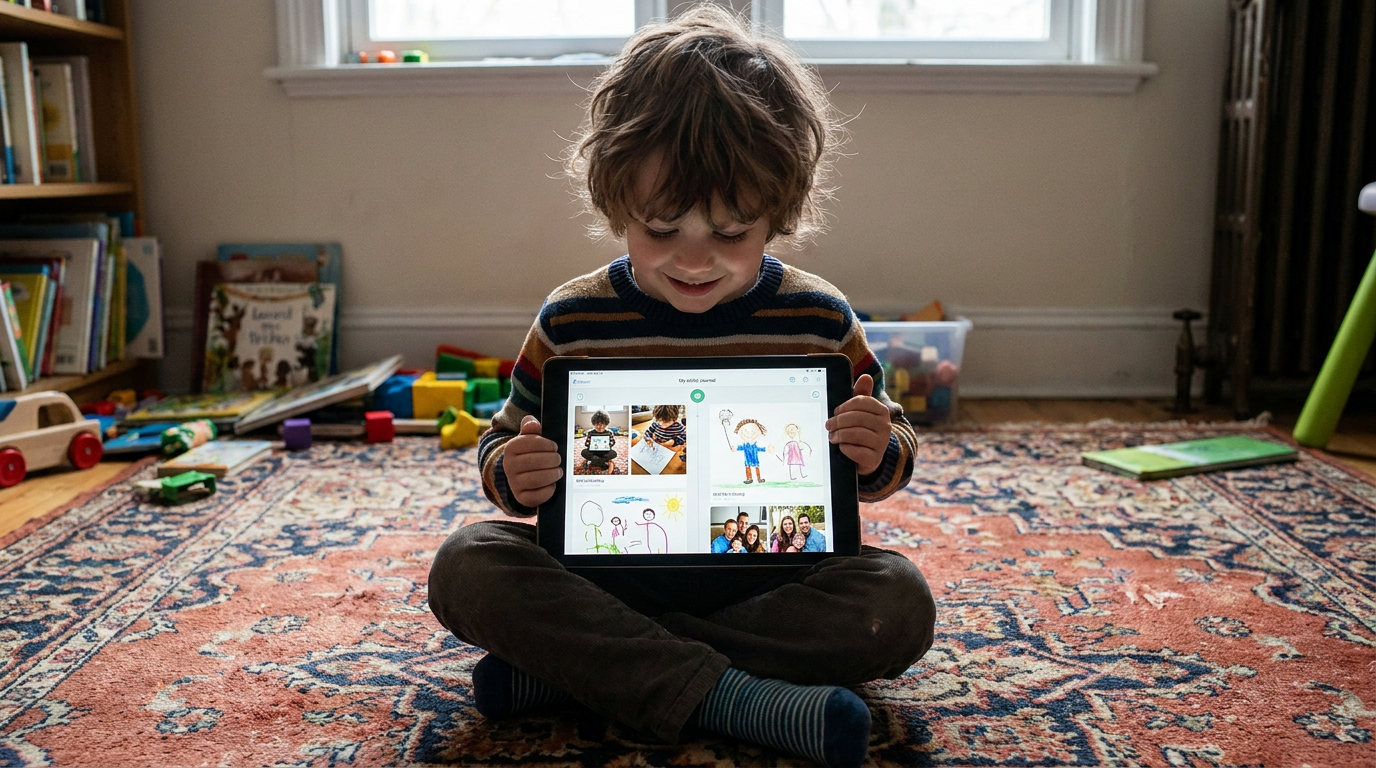
Children who are journaled about and with are also more likely to develop early literacy skills, a richer emotional vocabulary, and a positive relationship with the idea that life is worth documenting. The journal becomes a mirror — and every child deserves to see themselves reflected in it clearly, warmly, and from more than one angle.
Journals are souvenirs of your past. The collaborative home-school journal — built together by the people who loved and taught a child during the most formative years of their life — will one day become one of the most treasured documents that child has ever held.
The emotional case is made. But before any parent or teacher commits to a shared journal, there is one critical question to answer: who sees this, and how is it protected?
Privacy, Trust, and Boundaries — Getting Shared Journaling Right
Privacy is not a technicality in collaborative journaling. It is the foundation on which the entire practice rests. Without genuine, clearly understood privacy protections, neither parents nor teachers will feel comfortable contributing with honesty and depth — and the journal will never become the rich, authentic document it has the potential to be.
This section speaks directly to the concerns you may already be forming as you read this.
If you’re a parent, you need to know that what you share about your child’s home life — their anxieties, their family context, their personal breakthroughs — is visible only to the specific people you have chosen to invite. Not to the whole school. Not to an algorithm. Not to a company mining your data for advertising. Only to the person — perhaps one teacher, perhaps two — that you have deliberately and specifically included.
If you’re a teacher, you need to know that what you share about a child’s classroom experiences and progress is protected and professional — accessible only to that child’s family, not to a wider platform, not to other parents, not to anyone who hasn’t been specifically granted access by the journal’s owner.
If you’re thinking about the child, know that their drawings, their voice notes, their photographs, their stories deserve exactly the same care and security as any sensitive personal document. Children cannot advocate for their own digital privacy. The adults around them must do it on their behalf.
is built on a private-by-default architecture. Journals are owner-controlled. Access is granted by invitation only and can be revoked at any time. Data is encrypted in transit. Nothing is shared with third parties. No one outside your specifically chosen circle — ever — sees what’s inside your journal.
Lugelo
This is also where the concept of tiered sharing becomes practically useful. A parent using Lugelo for home-school collaborative journaling might maintain three distinct layers:
- A private family journal — completely personal, visible only to family members, where home life is documented freely and without any connection to school
- A shared home-school journal — collaboratively maintained with one or two specific teachers, with agreed-upon content boundaries and mutual respect for professional and personal context
- A child-facing storybook — a curated, beautifully designed output drawn from both journals, created as a keepsake for the child to keep
Each layer has its own privacy settings. Each is under the complete control of the journal owner. Nothing bleeds from one layer to another without deliberate, explicit action.
It is also worth naming what Lugelo is not. It is not a social media platform. There is no feed. There is no audience. There is no pressure to perform for followers or optimise for engagement. It is a private-by-default journaling space — the digital equivalent of a trusted notebook, shared only with the people you’ve specifically chosen to hand a pen to.
Before a parent and teacher begin a shared journal together, it’s worth agreeing — briefly, practically — on a few basic boundaries:
- What types of content are appropriate — photos from school events, reflections on learning, context notes from home; sensitive medical or family details might belong in the private family journal instead
- Who initiates vs. responds — perhaps the teacher leads with classroom updates and the parent responds with home context, or vice versa
- How often contributions are expected — there is no obligation to post daily; even weekly contributions build meaningfully over time
- What happens to the journal at the end of the school year — does it remain a shared document, or does the parent retain sole ownership as the teacher’s access is removed?
These aren’t difficult conversations. They take ten minutes and set the foundation for a year of meaningful collaboration. addresses the most common practical questions about privacy settings, collaborative features, and data security in plain, accessible language — a useful first read for any parent or teacher considering a shared journal. And if you want to understand exactly how the mechanics work from day one, Lugelo’s FAQ on digital journaling
How Digital Journaling Works — The Mechanics Made Simple
Privacy is established. Trust is possible. Now the only question is: how does Lugelo actually make this work — and what specific features bring the home-school collaborative journal to life?
walks through setup, sync, and privacy controls without technical jargon.
How Lugelo Makes Home-School Collaborative Journaling Practical — and Meaningful
Tools only matter if they make something genuinely easier, or genuinely better, than what came before. So let’s be specific about what Lugelo offers in the precise context of home-school collaborative journaling — not as a list of features, but as a set of answers to the real problems parents and teachers face.
The problem of the blank page is where most good intentions go to die. A teacher wants to document a class moment. A parent wants to add context about their child’s weekend. But the cursor blinks, and nothing comes, and eventually the moment passes undocumented. Lugelo’s AI Journal Assistant solves this directly. It doesn’t write the entry for you — it prompts, structures, and gently guides you through it. A teacher with five minutes after lunch can document a field trip. A parent sitting with their child after dinner can record a memory they’d otherwise lose. The AI assistant removes the friction between the intention and the act.
The problem of scattered media is equally real. A classroom drawing photographed on a teacher’s phone. A voice note of the child reading their first full sentence. A short video clip from the school play rehearsal. A screenshot of a completed maths worksheet. These moments currently live in camera rolls, email chains, messaging apps, and WhatsApp groups — disconnected, unlabelled, and increasingly buried under everything that came after. brings all of it into one private, organised space. Photos, videos, voice recordings, drawings, written notes — every format of memory, in one place.
Lugelo’s multimedia journaling
The problem of time and the school year is that it moves fast, and the first day of school feels both recent and impossibly distant by June. Lugelo’s timeline feature turns the school year into a chronological story — searchable, scrollable, and structured. Every entry finds its place in the arc of the year. The first-day photograph is followed, naturally, by the first reading milestone, the half-term project, the sports day, the last day. By the time the year ends, both parent and teacher have something they couldn’t have built alone: a coherent, beautiful record of who this child was during this particular year.
The problem of the ending — that most school journals, like most memories, fade — is solved by Lugelo’s storybook and eBook output. The shared journal can be transformed into a beautifully designed, professionally formatted storybook or digital keepsake. Imagine a child at twenty-five, opening the book that documented their first year of school. Reading the note their teacher wrote about the day they finally understood how to count to a hundred. Reading the note their parent wrote about the way they came home that evening, beaming. That is not a camera roll. That is a treasure.
The problem of access — the teacher is on their phone at lunchtime; the parent is on their laptop at 10pm — is solved by Lugelo’s cross-device sync. iOS, Android, and web. A contribution made on a phone in a classroom appears instantly in the shared journal, ready for the parent to see and respond to from their laptop that evening. No friction. No emails. No forwarded photos lost in threads.
Here is how to begin — not as a checklist, but as a story of three simple steps:
First, create your journal in . Give it a name — perhaps your child’s name, and the school year. It takes two minutes and costs nothing to start.
Lugelo
Second, invite the teacher or parent. Lugelo’s collaborative feature lets you add a specific person to a specific journal — with their own access, their own ability to contribute, and privacy controls that remain entirely in your hands. One invitation. One shared space.
Third, add the first entry today. A photo from this morning. A sentence about how the week has gone. A voice note from your child about something they’re excited about. It doesn’t need to be perfect. It just needs to exist. Because the first entry is what makes the second one possible — and the hundredth one inevitable.
show what this looks like when it’s been running for months — the richness that accumulates when two people commit to documenting a child’s life together. And explains how every element of the platform — from collaborative access to AI prompts to multimedia capture — is designed not just for individuals but for groups of people who care about the same story.
Lugelo’s full feature overviewLugelo’s family stories
As shows, the platform was built for exactly this kind of use: meaningful, private, multi-contributor documentation of a life being lived. The home-school journal is not an edge case. It is one of the most natural expressions of what Lugelo was designed to do.
Lugelo’s exploration of digital journaling across educational and personal contexts
Your child’s first year of school deserves more than a camera roll full of unlabelled photos. It deserves a story — written by the people who loved watching it unfold.
The Story That Belongs to All of You
Come back, for a moment, to that child in the doorway. Backpack on shoulders. The answer already forming: “Fine.”
Now imagine something different. Imagine that before they even walked through the door, there was already an entry in a shared journal — a photo their teacher took during the science experiment, with three sentences about what that child said when the colours mixed. Imagine that sitting next to it, from two days before, was a note you wrote about how they’d been practising reading aloud every night that week, getting more confident each time. And imagine that somewhere in that journal, in a small voice note barely thirty seconds long, there is the sound of your child’s voice saying: “I liked the part where we figured it out ourselves.”None of those contributions took more than five minutes. None of them required a writer’s skill or a photographer’s eye. But together, accumulated over weeks and months, they build something extraordinary — a record of a child becoming who they are, documented from every angle, by every person who had the privilege of watching it happen.
This is what the home-school connection can look like when it moves beyond notice boards and report cards and into something genuinely human. The research makes the case clearly: when parents and teachers collaborate, children attend more, engage more, and develop stronger social and emotional foundations. But the research only tells you that it works. The journal shows you why — because it turns the invisible into the visible, the forgotten into the preserved, and the separate into the shared.
You don’t need to be a writer. You don’t need to post every day. You just need to start — with one photograph, one sentence, one voice note — and then invite the other half of your child’s world to do the same. Over time, something accumulates that neither of you could have built alone. And one day, when your child is old enough to look back and ask “Who was I then?”, the answer will be waiting for them — in both your handwriting.
Everyone has a story to tell. Your child’s story is already being written — in two places, by two sets of loving hands. Lugelo is where those two halves finally meet.
Start Your Child’s Home-School Journal Today
Begin for free — private by default, yours to control.
Owner-controlled access. Private by default. No third-party sharing. Your story, your way.
Explore how Lugelo works →Download Lugelo for iOS, Android & Web →