What to Write in a Pregnancy Journal (Week by Week, Without the Pressure)
You bought the journal at week six. It has a ribbon marker and gold lettering on the front. It sat on the bedside table for a while. Now it is in a drawer, still blank, and you are twenty-two weeks in.
The blank journal is not evidence that you don't care. It is evidence that the journal asked for more than you had.
So if you're wondering what to write in a pregnancy journal, here is the short version:
- The date, and how many weeks you are.
- How you feel today. One word is enough.
- One thing that happened.
- One thing you're wondering about.
That's it. Four lines is a complete entry. Not a rough draft of one. A complete one.
The rest of this post is the long version. Sixty prompts sorted by stage. Low-effort formats that aren't a book. What to do on the days you're too tired to type. And where the entries live afterwards, which matters more than most people expect.
One more thing before we start. You are allowed to write badly. You are allowed to skip weeks. You are allowed to write down the hard parts.

Why do week-by-week pregnancy journal templates stop working around week 12?
Then you miss two weeks. And the template stops being a journal and turns into a scoreboard you are losing.
A template asks the same amount from you every single week. It asks whether or not anything happened. It asks whether or not you have anything left in the tank. Week nine and week nineteen get identical space and identical questions.
The week-by-week template is usually where it breaks. Not because you lost interest. Because of how the thing is built.
Almost everyone stops. That is worth saying at the start, plainly, because most people assume they are the only one with a drawer like that.
What the format assumes about you
So the format fails on contact with an ordinary life. That is a design problem, not a character problem.
Early pregnancy frequently supplies none of the three. Neither does late pregnancy, for different reasons. The middle stretch might, if you're lucky, for a while.
That page is designed around three assumptions: that you had a steady week, that you have a settled mood, and that you have time.
Look at what a standard week-by-week page actually requires. A full page of writing. A styled photo. A mood. A reflection. Sometimes a letter.
What actually counts as a finished entry
Here is the bar, and it is deliberately low enough that it cannot be failed.
One line and one photo is a finished entry.A single line with a date attached is worth more, a year from now, than the beautiful page you kept meaning to write and never did. The beautiful page does not exist. The line does.
Read that again if you've been carrying around a mental image of what a "proper" entry looks like. There is no proper. There is dated and undated, and dated wins.
The backfill instinct is what kills it
This is the single most common reason people never restart, so it gets its own section.
You open the journal after a gap. Your instinct is to catch up. Summarise the three weeks you missed. Maybe write a small apology at the top — sorry, it's been a while.Backfilling converts re-entry into homework. Homework is something you postpone. Postponing is how a two-week gap becomes a two-month gap becomes a drawer.
Pick up at today's date. Write today's four lines. The gap stays a gap.
Do not catch up. Do not apologise to your own notebook. Do not summarise the weeks you missed.
Don't. Any of it.
What the template asks for, versus what actually works
This is the whole argument in one block. If you only read one part of this section, read this one.
- A full page every week — versus four lines, on the weeks you can manage four lines.
- A styled bump photo with good light — versus the photo you already took in the bathroom mirror.
- Every week, in order, none missing — versus whichever weeks you actually felt like it.
- Considered, reflective prose — versus a fragment. A list. One word.
- A fresh start each week — versus adding to the same note from the top.
- Neat handwriting, no crossings-out — versus typos stay. Nobody is marking this.
The right-hand column is not a compromised version of the left-hand column. It is the version that gets finished.
Gaps are information too
You do not have to fill them in later to make them count. An uneven record is an honest record.
The weeks where nothing gets written are also part of the record. A three-week silence in a journal tells you something real about that stretch of time. You were flat out. Or you were flattened. Or nothing happened worth reporting, which is itself a fact about those weeks.
One last reframe, and it's the one people find most freeing.
If you want the longer case for a lower bar you can actually keep, Lugelo's
post on building a journaling habit without the streak pressure
Everything that follows is built to that lower bar. Starting with sixty questions you can answer in a sentence each.
makes the same argument in more depth — weekly beats daily, one photo and one sentence is complete, and you always pick up at today's date rather than backfilling.
What to write in a pregnancy journal: 60 prompts by stage
Pick two or three. Not all sixty. Answer them out of order, skip anything that irritates you, and treat one sentence as a complete answer. These are here to remove the blank page, not to give you a new list of things you are behind on.
A short note on how to use these before you scroll.
First trimester prompts (1–10)
For the early weeks, including the stretch where you haven't told anyone yet.
- The moment you found out — where were you, and who else was in the room?
- What did you do in the first hour afterwards?
- Who do you most want to tell, and why haven't you yet?
- What is it like holding news this big inside a completely ordinary week?
- What excuse have you been using to explain how you've been feeling?
- What are you most looking forward to about telling people?
- What are you worried about that you haven't said out loud to anyone?
- What has changed in your day-to-day this week, in practical terms?
- How do you feel about your body right now?
- What would you want to remember specifically about this week?
Second trimester prompts (11–20)
- How did telling people go, and who surprised you?
- What was the first thing you bought, or the first thing you were given?
- Have you had a name conversation yet, and did you agree?
- What have strangers started saying to you?
- What have you stopped doing, and do you miss it?
- What is one moment from this month you would keep?
- What are you reading, watching or listening to on a loop right now?
- Who has been most useful, and what exactly did they do?
- What did you think you would feel by now that you don't?
- What is one question you want to ask at your next appointment?
Third trimester prompts (21–30)
- What does a normal day look like now, hour by hour?
- What are you doing to fill the waiting?
- What has been prepared, and what definitely hasn't?
- What was the last completely ordinary thing you did?
- What are you nervous about? Write it plainly, not politely.
- What are you quietly looking forward to?
- What is the conversation you keep having with everyone?
- What would you tell yourself at week eight, if you could?
- Who do you want nearby?
- What is the smallest thing that has made this week easier?

Pregnancy journal prompts that aren't tied to any week (31–40)
Starting at week 30 costs you nothing. These work at any point, including retroactively.
- What do you remember about finding out? Write it now rather than then.
- What are the three things about this stretch you would forget first?
- What have you changed your mind about?
- What are you grateful for today that is small and specific?
- What food, smell or song is attached to this particular time?
- What would you tell someone at the very start of theirs?
- What has surprised you most so far?
- How have the people around you changed?
- What are you carrying at the moment that you would rather put down?
- What do you want this record to be for?
Prompts for a partner to answer separately (41–50)
The value here is in the word separately. Two accounts of the same weeks are far more interesting than one negotiated version. Don't compare notes first.
- Where were you when you found out?
- What did you do for the rest of that day?
- What are you most looking forward to?
- What are you worried about that you haven't mentioned?
- What have you noticed changing in them?
- What have you been doing that nobody has noticed?
- What do you think you'll be like?
- What do you want to remember about this specific week?
- What would you want them to know about how you feel?
- What is a question you have and haven't asked?
Questions you'll wish you'd asked your own parent (51–60)
Answer these about them if you already know, or put them to your parent directly. Most people find they know almost nothing about this particular stretch of their own parent's life. If you want a fuller list of questions worth asking an older relative — including how to ask, how to get consent before recording anything, and how to keep the answers — there's .
Lugelo's guide to interviewing family before it's too late
- What do they remember about being pregnant with you?
- How did they find out, and who did they tell first?
- What were they afraid of?
- What did nobody warn them about?
- What did the weeks beforehand actually look like, day to day?
- What did they hope for?
- What would they do differently?
- What advice were they given that turned out to be nonsense?
- What did their own parent say to them at the time?
- What do they wish someone had asked them back then?
That's sixty. Notice that not one of them requires a notebook.
DIY pregnancy journal ideas that don't involve a notebook
Here is the reframe that makes the rest of this section work.
A pregnancy journal is a habit, not an object.
This is why the prettiest notebook has the worst completion rate. A beautiful blank page raises the stakes of every entry. You start editing before you've written anything, because the object looks like it deserves better than a fragment.
Cheap and ugly gets used. That is not a slogan, it's just what happens.
So here are eight formats that are genuinely low-effort. None of them require you to sit down at a desk.
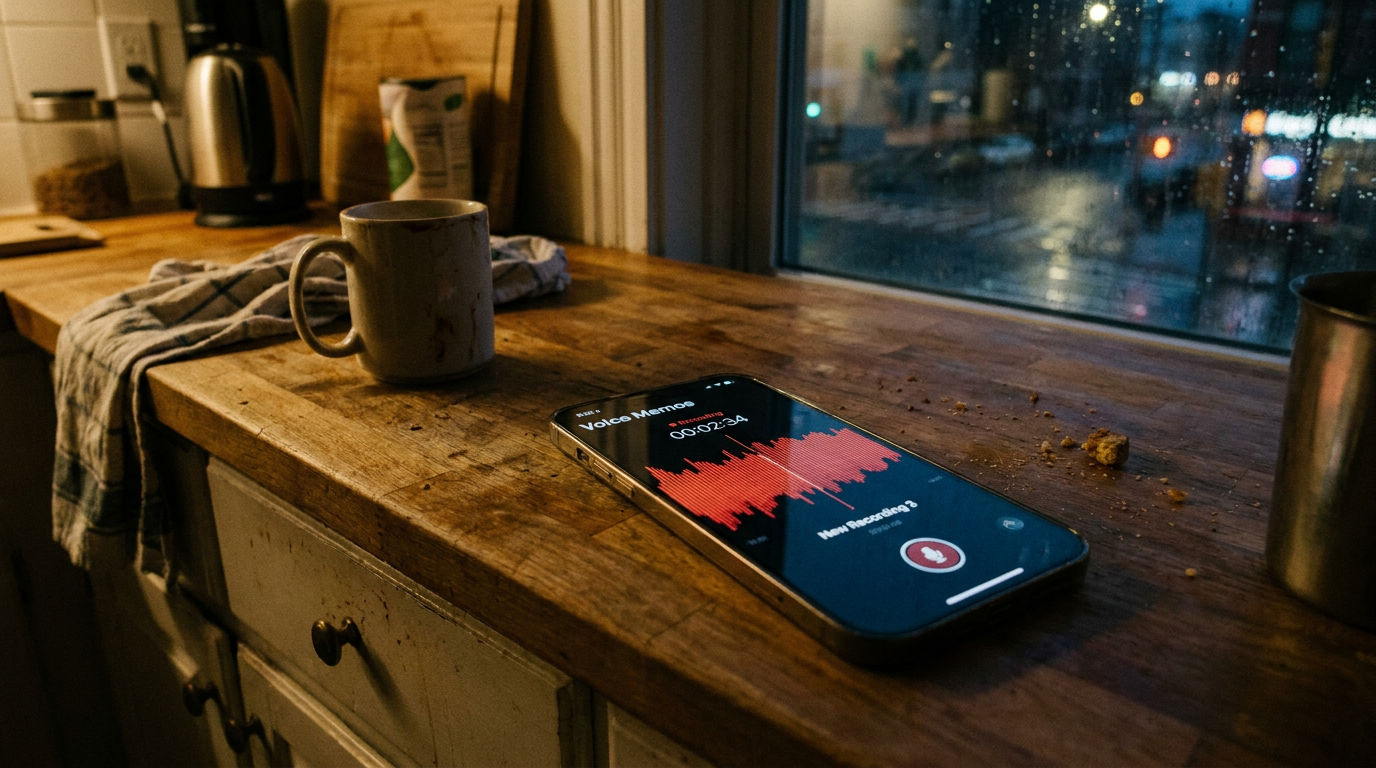
- The voice memo in the car. Ninety seconds after an appointment, before you've started driving. Takes two minutes. Best for the weeks when appointments are the main thing happening.
- One photo a week. Same spot, same angle, no styling. Takes ten seconds. Best for people who don't want to write at all.
- A note on your phone. One single note, added to from the top. No app, no setup. Takes thirty seconds. Best for people who want zero friction.
- A running list. Not sentences. Just lines: tired, craving oranges, that thing my sister said. Takes fifteen seconds. Best for the depleted days.
- Texts to yourself. Send them to a saved chat and screenshot the lot later. Takes ten seconds. Best for people who already live in their messages.
- The appointment card, photographed. A dated object, no writing required at all. Takes five seconds. Best for building a spine of dates you can hang things on later.
- A weekly voice note to someone you haven't told yet. Takes two minutes. Best for the secret-keeping stretch, when you need somewhere to put it.
- The five-minute Sunday. One slot a week, attached to something that already happens. Takes five minutes. Best for people who need a rhythm rather than a reminder.
Pick one. Not four. The whole point of this list is that you choose the lowest-effort option available to you and then stop thinking about it.
Mixing formats is normal
You don't have to be consistent. A voice memo one week, a photo the next, three lines typed on a Tuesday. That is a journal.
The thing people get wrong is believing the format has to match across entries. It doesn't. Nobody is going to grade the presentation.
If you've never kept a journal on a phone before, explains the mechanics in plain English — no jargon, and no assumption that you've done this before.
the beginner's guide to digital journaling
And a word in defence of paper
A few things worth keeping from these weeks, though, can't be written down at all.
If you want to keep the notebook, keep it — just shrink what you require of it. Four lines. Same bar.
The problem was never paper. It was the size of the ask.
Handwriting genuinely carries something typing doesn't. Your own handwriting on a tired evening looks different from your handwriting on a good morning, and that is information no font preserves. A physical object on a shelf survives neglect better than most people expect.
There is nothing wrong with a notebook.
What's worth capturing that paper can't hold?
Some of the most specific things about these particular weeks are sounds and movement. A page cannot hold either one.
That isn't an argument against writing. It's just an observation about what writing is for, and where it runs out.
Here is what people consistently say they're glad they have.
Audio from an appointment. If you're allowed to record, and you've asked first. Ask the clinic before recording anything — some will say no, and that is entirely their call to make.
A voice note at 3am. When you're awake anyway and there's nothing else to do with the time. These are reliably the most honest entries anyone keeps, for the simple reason that nobody composes anything at 3am.
A short video of a kick. The blanket moving, filmed on a phone, ten seconds long, badly lit.
The sound of the room. Not just the event — the background. A conversation, a laugh, the television going in the next room. Ambient sound dates a period of your life more precisely than almost anything else.
Your own voice at each stage. Tone changes across these months in a way that writing does not capture. You will not notice it while it's happening. You will notice it immediately on playback.
The problem is not capturing it — it's finding it again
Six months later, none of them are findable. Functionally, that means they are lost. You have not lost the file. You have lost the ability to ever come across it again, which amounts to the same thing.
The video ends up in the camera roll among several thousand other images. The voice memo is titled with a number. The written note is in a different app entirely, and the photo of the appointment card is somewhere between the two.
This is the bit that catches people out.
This is the practical job that is meant to solve. When an entry can hold all four, the ten-second video sits beside the line you wrote that day instead of drifting off into a folder on its own. That's the whole point of it here — everything about a given week in one place, rather than scattered across four apps that don't know the others exist.
keeping text, photos, video and audio in one entry
Label things, even badly
One small habit that pays off out of all proportion to the effort.
Date it, and give it three words. Week 24, clinic, raining. That's enough.
An untitled file is an invisible file. Three words is the difference between something you'll find again and something that dissolves into a list of numbered recordings you will never scroll through.
Which raises the question you're probably already holding. If all of this is being written down and recorded — who can see it?
Where do these entries live, and who can see them?
That creates a specific requirement, and most of the obvious options fail it.
A great many people journal a pregnancy for weeks or months before telling anybody. The record starts long before the announcement does.
Here is the situation almost no pregnancy content acknowledges.
Why the usual options don't fit this stretch
A shared photo album is visible to everyone already in it. That's the entire purpose of a shared album, and it's exactly wrong here.
A social platform is the wrong shape entirely. There is no audience for this yet. There may never be one, and that has to be an acceptable outcome.
A notes app is genuinely private, which is a real advantage — but it's unstructured, and nothing in it is findable later. Everything sits in one undifferentiated list.
A paper notebook on the bedside table is findable by anyone who lives in your house, including the people you haven't told.
The requirement changes over time, and that's the crux
Access needs to be able to move in one direction, on your schedule, decided by you. Not set once at the beginning and then forgotten about.
What you need at week seven is not what you need at week twenty-five. Private to begin with. Shared with one person later, maybe. Possibly opened up to family after that.
This is the part that matters most.
That's the reason this post treats privacy as a practical feature rather than a legal footnote. In Lugelo, journals are private by default, with owner-controlled sharing — you decide who can view or contribute, and access can be revoked at any time. Data is encrypted in transit, personal data is not sold to third parties, and deletion is available. You can read yourself rather than taking a blog post's word for it.
the plain-English detail
The partner version
You let them in when you're ready, and not before. One person's account of week nineteen sitting next to another person's account of week nineteen is considerably more interesting than a single version that two people agreed on.
Prompts 41 to 50 are built to be answered separately. That works best when both sets of answers end up in the same place without either person editing the other's.
What happens to it afterwards
A quiet note, and then we'll move on.
Entries from a stretch like this can later become something readable — a timeline, or something you can hold. If that appeals, there's a
step-by-step guide to exporting a journal as an eBook or PDF
Which brings us to the harder question — not where the entries live, but how you keep making them at all.
They don't have to become anything. A record that stays exactly as it is, unread and unformatted, is also a complete outcome.
that walks through it.
How do you keep a pregnancy journal going when you're exhausted?
Let's restate the bar, because the skimmer may have missed it the first time and it is the whole thesis of this post.
One line plus one photo is a finished entry.Everything below assumes that. None of these tactics are about writing more. They're about lowering the cost of writing at all.
Five things that actually help
- Attach it to something that already happens. After an appointment. Sunday evening. The moment you sit down at the end of the day. A habit bolted onto an existing habit survives; a habit floating free of your routine does not.
- Never end on a blank. If you open it, put something in it. One word counts. Opening and closing without writing teaches you that opening it is pointless.
- Let the format drop. On the worst days, a voice note instead of typing. Speaking is significantly easier than writing when you're depleted, and the entry is no less real for being spoken.
- Skip on purpose rather than by default. A deliberate skip doesn't build guilt — you decided, and the decision was fine. A drift does build guilt, because nothing was ever decided.
- Expect the gap and plan the re-entry. You will stop for a stretch. When you come back, pick up at today's date. No apology. No catch-up.
That last one is worth more than the other four combined.
The hard parts belong in it
Write the flat weeks. Write the irritating ones. "Nothing today" with a date on it is a real entry.
A record of only the good days is a less useful record, and a less honest one. It is also, practically speaking, harder to keep — because it means you can only write on the days you're doing well, which are not reliably the days you have time.
All of it is legitimate journal material. None of it needs to be balanced out with a positive line afterwards.
Exhaustion. Nausea. Fear. Resentment. Boredom. Ambivalence. Feeling nothing at all, on a day when you assumed you'd feel something.
One thing this article will not do
If something about how you're feeling is worrying you, that is a conversation for your own midwife, OB or care provider — not for a journal, and not for an article. The Nothing in this post is medical advice, and no journal prompt is a substitute for asking someone qualified.
NHS guidance on antenatal care and appointments
sets out how that care is structured.
On pregnancies that don't go as hoped
A few questions come up repeatedly.
The rest of this post is practical, and it resumes below.
Not every pregnancy ends the way the person hoped it would. A journal kept during that time is still worth keeping. There is no wrong way to handle those pages — you can keep them, close them, come back to them in years, or never open them again. Whatever you decide about them is the right decision, and it does not have to be made now. It does not have to be made at all.
Pregnancy journal FAQs
When should I start a pregnancy journal?
Whenever you're reading this. Starting late costs you nothing at all. A record that begins at week 31 is a record of weeks 31 onwards, which is considerably more than a record that never begins because the timing felt wrong.
What if I missed the whole first trimester?
Use the prompts that aren't tied to a week — numbers 31 to 40 — and write those weeks from memory now. Write it as memory, though. "I remember it being" rather than pretending you wrote it live. The hedges and the gaps are part of the record.
Do I need a special pregnancy journal?
No. A notes app, a voice memo and a weekly photo are a pregnancy journal. The dedicated product with the guided pages is a format, not a requirement, and for a lot of people it's the format that caused the problem in the first place.
What do I write if I don't feel anything?
Write that. "Nothing today" with a date attached is a real entry, and it is more honest than a manufactured one. Flatness is a genuine feature of some weeks. A journal that only records the weeks you had feelings about is a partial journal.
Is it weird to write to the baby?
No, and plenty of people do it. Plenty of others don't, and write to themselves, or to nobody in particular. Both are completely normal. Pick whichever framing doesn't make you self-conscious, and change your mind whenever you like.
Should my partner write in it too?
Only if they want to. It works considerably better if you both answer separately rather than composing entries together — two independent accounts beat one negotiated one. Prompts 41 to 50 are written for exactly that.
What about a second pregnancy — is it worth journaling again?
Yes, and the content comes out different. There's less novelty and a lot more comparison to last time. There's also usually far less time, which is precisely why the four-line entry matters more the second time round, not less.
What if I stop halfway through?
Then you have half a record, which is more than none. Pick up at today's date if you want to, or don't. An unfinished journal is not a failed one — it's just a record with an end date you didn't choose in advance.
The notebook in the drawer was never your failure
It's still in there. With the ribbon and the gold lettering and the twenty-two blank weeks.
You don't have to do anything about it. It asked for a full page every week from someone who had a fraction of that, and it was never going to work. That is a fact about the notebook.
Here is the whole post, compressed, for anyone who scrolled straight down:
- The date and how many weeks you are. How you feel. One thing that happened. One thing you're wondering about.
- Four lines is a complete entry.
- Skip weeks. Write badly. Write the hard parts too.
So: write four lines tonight. That's the whole thing.
That's the part that disappears, and it's the part you'd want if you read this back later.
Why bother at all? Only this, and it's modest: the detail goes first, and it goes much faster than anyone expects. Not the big moments — those tend to stay. The ordinary texture of these particular weeks. What the waiting room smelled like. What you kept eating. The thing someone said that annoyed you out of all proportion.
Don't Just Live It — Keep It
Start a journal for these weeks, write four lines tonight, and add to it whenever you can.
Journals are private by default, with owner-controlled sharing — you decide if and when anyone else sees it. Available on web, iOS, Android and HarmonyOS.
Start Saving What Actually Matters