Category Archive : Early Childhood

25 Journal Prompts for Kids to Start the New School Year Strong

25 Journal Prompts for Kids to Start the New School Year Strong

There is a particular smell to the start of a new school year. Fresh pencils, crisp notebook pages, maybe the faint trace of new shoe leather or a lunchbox that hasn’t been opened yet. If you are a parent, you know the moment intimately — the morning of the first day, when your child stands at the door with a backpack that is slightly too big for their shoulders, and you try to memorise their face exactly as it looks right now, because you already know it will look different by June.

Back-to-school season is one of the most emotionally rich passages in a child’s year. For kids, it arrives as a complicated mix: excitement and nerves existing side by side, nostalgia for the long, unstructured days of summer sitting right next to hope for what the new year might hold. There are new teachers to figure out, new classrooms to navigate, friends to reconnect with, and sometimes the quiet worry that things might have changed. Children carry all of this — and often they have very few words for it.

That is exactly where journal prompts for kids come in.

Journaling is one of the most research-backed, low-pressure tools we have for helping children process what they are feeling, reflect on where they have been, and set intentions for where they want to go. It does not require a child to be a strong writer. It does not require a perfectly formatted entry or a beautifully kept notebook. It just requires a blank page, a prompt to get things moving, and the understanding that what comes out belongs entirely to them.

This post gives you 25 ready-to-use journal prompts for kids, organised into five thematic groups that map directly onto the emotional landscape of back-to-school season — from summer memories and back-to-school feelings, to goals, dreams, friendships, and identity. Each section comes with context for parents and educators, and practical guidance on how to use the prompts in a way that actually sticks.

And if you want a place to keep these entries safe — somewhere they will still be readable in ten years, alongside photos and family memories — we will talk about that too. But first, let us start with the why.

Why Journaling Is One of the Best Things a Child Can Do at the Start of a New School Year

Here is a question worth sitting with: when was the last time your child had uninterrupted space to say exactly what they were feeling — without being asked to move on quickly, without a screen in front of them, and without the pressure of someone responding?

For most children, that space is rare. And yet the research is consistent and compelling: giving children a place to write about their inner lives has profound benefits — not just emotionally, but cognitively, socially, and even physically.

The Child Mind Institute’s overview of the science of journaling draws on decades of research, including the foundational work of psychologist James Pennebaker at the University of Texas at Austin. Pennebaker’s Emotional Disclosure Theory holds that writing about emotional experiences helps people process difficult events by organising chaotic thoughts and releasing pent-up feelings — leading to improved mental clarity and greater resilience. The research that followed his original work showed that regular expressive writing enhances mood, reduces stress levels, and builds lasting emotional awareness. These findings were not just observed in adults. They are particularly potent for children, whose emotional vocabulary is still forming and who benefit enormously from any tool that helps them translate internal experience into external expression.

A smiling parent sitting beside a young child as they write together in a journal at a kitchen table, warm morning light.

Scholastic’s guidance on journaling for children identifies four core outcomes of a regular journaling practice: emotional expression, communication skills, self-awareness, and a healthy self-esteem. These are not abstract benefits. They are the exact skills that a child needs when they walk into a new classroom in September and has to figure out who they are in that room — how they relate to a new teacher, how they reconnect with old friends, how they handle the anxiety of not knowing what the year will ask of them.

Back-to-school is, in developmental terms, a significant transition. It is not simply the resumption of schoolwork. It is the renegotiation of a child’s social world — new class groupings, changed friendship dynamics, new academic expectations, sometimes a new school altogether. The Saturday Evening Post covered this territory beautifully in early 2026, noting that journaling helps children build self-esteem, foster self-expression, reduce stress and anxiety, improve self-awareness and emotional regulation, and develop the ability to understand and verbalise their emotions. Every single one of these benefits is directly relevant to a child navigating the first weeks of a new school year.

For educators, it is worth noting that journaling is also an evidence-backed Social-Emotional Learning (SEL) tool. The first weeks of school are notoriously difficult to plan for — children arrive at wildly different emotional baselines, and a classroom of thirty-plus children can feel almost impossible to attune to individually. A brief, structured journaling practice in the morning gives every child a private moment to land, to name what they are carrying, and to arrive more fully present in the room.

For parents, the most important thing to understand is this: children do not need to be good writers to journal. The goal is expression, not perfection. A few sentences, a single paragraph, even a drawing with a line of caption underneath — all of it counts. The research does not differentiate between elegant prose and a five-word sentence. What matters is the act of externalising what is inside.

This is precisely where journal prompts for kids do their most important work. A blank page can feel intimidating, even paralysing, for a child who is not sure what they are supposed to say. A prompt replaces that blank space with a question — and questions are far easier to respond to than silence. Prompts are the bridge between a child who has something to feel and a child who has found a way to say it.

As you read your way through the Lugelo blog, you will find our broader look at the mental health case for daily journaling — a piece that covers the research in even more depth. For now, let us move into the prompts themselves.

Prompts 1–5: Favourite Summer Memories Worth Keeping Forever

Before a child can fully step into a new school year, they need somewhere to put the summer they are leaving behind. That is not sentimentality — it is good emotional practice. Transitions are easier when we acknowledge what we are moving away from. And summer, for most children, is the season they will remember most vividly when they look back on their childhood years.

These first five prompts are the on-ramp to the journaling habit. They are deliberately warm, low-stakes, and enjoyable to write. There are no wrong answers. The memories are already there — vivid, sensory, emotionally rich. The prompt simply invites the child to give them a shape.

Encourage parents to sit with their child during this section if possible. These prompts have a wonderful habit of sparking conversations that go far beyond the journal page. You may hear about a moment from July that you had already forgotten, or a small detail from a family trip that turned out to mean everything to your child. That conversation is the journaling working exactly as it should.

Children playing outdoors in summer sunshine, one child holding a journal and writing while sitting on grass, with friends around them.

A note worth carrying forward: the entries a child writes in response to these prompts are the kind that, years from now, will be the ones you and they will treasure most. The specificity of a child’s memory — the exact ice cream flavour, the name of the friend who was there, the way the light looked at that moment — is irreplaceable. These details do not survive in anyone’s adult recollection. But they survive in journals.

“A life worth living is a life worth recording.”
— Jim Rohn

Prompt 1: What was your favourite day this summer? Describe it like you’re telling a friend who wasn’t there — every detail counts.

Prompt 2: What made you laugh so hard this summer that you couldn’t stop? Who was with you, and what happened?

Prompt 3: Did you try anything for the first time this summer? How did it feel before, during, and after?

Prompt 4: Describe your favourite place you went this summer. What did it look like, smell like, and feel like to be there?

Prompt 5: If you could freeze one moment from this summer and keep it forever, which one would it be — and why?

These five prompts are the beginning of something. The entries a child writes in response to them are exactly the kind of material that Lugelo was designed to preserve — not just as text, but as part of a living family record that can be added to, revisited, and shared with the people who love your child most. But more on that later. First, we have to acknowledge the feelings that come with leaving summer behind.

Prompts 6–10: Honest Feelings About the New School Year

This is the section that matters most. Not because summer memories are not important — they are — but because this is where the real emotional work happens. These are the prompts that reach into the part of a child’s experience that they rarely get asked about directly, and almost never have a safe space to answer honestly.

Back-to-school feelings are not simple. They are not just “excited” or “nervous.” They are often both of those things simultaneously, layered on top of each other in ways that can confuse even the child experiencing them. There is the genuine excitement about seeing friends again, sitting alongside the dread of not knowing which class you will be in. There is the hope that this year will be better, right next to the memory of something hard that happened last year. A child holding all of that at once can find it genuinely difficult to answer the question “How are you feeling about school?” — not because they do not have feelings, but because the feelings are too many and too tangled to summarise.

Research cited by Confident Parents, Confident Kids confirms that journaling reduces stress, improves focus, and boosts mood — but perhaps most importantly, it helps children work through emotional complexity at their own pace and in their own private space. A child who writes “I am excited AND scared AND I don’t want to leave summer” in their journal has just done something genuinely impressive: they have named three different feelings without having to perform any of them for an audience.

These prompts are designed to be open-ended and non-prescriptive. They do not push toward positivity. They do not require the child to feel a certain way. They simply create the space for whatever is actually there.

A note for educators: These five prompts are ideal for the first week of school as a brief morning warm-up. Five minutes of quiet writing before the day begins sets a reflective tone and gives every child in the room a chance to arrive emotionally before the academic work starts.

A note for parents: If your child writes something that reveals significant anxiety about the new year, treat it as a gift — not a problem. It is the beginning of a conversation, not the end of one. Ask open questions. Thank them for being honest. Avoid the instinct to immediately reassure. Sometimes a child just needs to be heard.

Prompt 6: How do you feel about the new school year starting? Try to name at least three different feelings — it’s okay if some of them seem like opposites.

Prompt 7: What is one thing about going back to school that you’re genuinely excited about? What makes it exciting?

Prompt 8: Is there anything about the new school year that feels a little scary or worrying? You don’t have to share this with anyone — just write it honestly.

Prompt 9: If you could tell your new teacher one thing about yourself that would help them understand you, what would it be?

Prompt 10: Imagine it’s the last day of this school year. What would make you feel like it was a great year? What would you want to look back on?

WeAreTeachers’ roundup of the benefits of journaling for students echoes what the broader research shows: writing about emotions does not just help children feel better in the short term. It builds the emotional regulation skills that become the foundation of how they handle difficulty throughout their lives. A child who practises naming and processing their feelings at age eight is developing a capacity they will draw on at eighteen, and at forty-eight.

Having named the feelings, the next natural step is direction. Where does a child want to go from here — and what do they want this school year to mean?

Prompts 11–17: Goals, Dreams, and Getting Excited About Learning

There is something quietly powerful about writing down what you want. It takes a wish and makes it real — gives it edges, makes it speakable, makes it something you can return to and measure yourself against. For children, the practice of writing about goals is both motivating and revealing. It shows them what they actually care about, which is sometimes very different from what the adults around them assume they care about.

These seven prompts shift the energy of the journaling practice from looking backward and processing emotions, to looking forward with curiosity and intention. The key here — and this is worth saying clearly to both parents and educators — is that these prompts must be framed around the child’s own curiosity, not adult expectations. A prompt that asks “what grade do you want to get?” is a completely different kind of question from “what subject are you most curious about this year?” One puts pressure on performance. The other opens a door to genuine engagement.

Research consistently shows that people who write down their goals are significantly more likely to achieve them than those who simply think about them. The act of committing something to paper creates a kind of accountability — not to anyone else, but to the version of yourself who did the writing. For children, this is developmentally powerful. It helps them experience themselves as agents in their own story, not just passengers in a school year that is happening to them.

A child holding an open journal showing hand-written goals and drawings, with a smile on their face, sitting at a colourful desk.

Facing History’s student journal prompts offer a wonderful educator framework for exactly this kind of forward-looking reflection — helping students connect their personal values to the kind of year they want to have. That connection between identity and intention is at the heart of what these seven prompts are trying to build.

The prompt about writing a letter to Future Self — number 17 — deserves particular attention. It is one of the most powerful exercises in the entire list. When a child writes to the version of themselves that will exist at the end of the year, they have to imagine forward in time, project their own growth, and identify what they genuinely hope for. The resulting letter often reveals more about a child’s inner life than almost any conversation could. And when it is read back at the end of the year — whether privately or together as a family — it becomes something extraordinary: proof of growth, evidence of hope, a document of who a child was becoming at a very specific moment in their life.

This is also the kind of entry that, stored in a platform like Lugelo, becomes a keepsake your family will return to for decades. But we are getting ahead of ourselves. For now — the prompts.

Prompt 11: What is one new thing you want to learn or get really good at this school year? Why does it matter to you?

Prompt 12: Which subject are you most curious about this year — even if it’s one you haven’t tried yet?

Prompt 13: Is there a book you want to read this year? If you can’t think of one, describe the kind of story you’d love to read.

Prompt 14: What kind of student do you want to be this year? Describe yourself at your best.

Prompt 15: What is one kind or brave thing you want to do for someone else this school year?

Prompt 16: What would you most like to say you accomplished by the time summer comes again?

Prompt 17: Write a short letter to yourself to open at the end of the school year. What do you want to tell Future You?

If your child gets stuck on any of these prompts, it can help to sit beside them and answer the same question yourself. Hearing a parent reflect genuinely on what they want to learn or what they hope to accomplish is more instructive than any amount of encouragement. It also signals that the journal is a space for honesty — not a test to be passed.

For families interested in how technology can support a child who freezes at the sight of a blank page, Lugelo’s blog explores how AI co-writing tools can gently help kids find their way into a journal entry — without replacing the authenticity of their own voice. It is a useful read for parents of reluctant writers.

Goals set the direction. But the journey — the daily texture of a school year — is shaped by something else entirely: the people a child shares it with. That is where the next section lives.

Prompts 18–25: Friendships, Identity, and Who I’m Becoming

Of all the dimensions of school life, friendships are the one that children think about most — and the one that adults often underestimate. For a seven-year-old, the question of whether their best friend is in the same class this year can feel as consequential as anything else happening in their life. For a ten-year-old navigating shifting social dynamics, the experience of belonging or not belonging can shape their entire relationship to school. For a twelve-year-old beginning to feel the pull of identity — who am I, really, and do I fit here? — the social world of the classroom becomes the primary arena in which those questions get answered.

Journaling about friendships and identity gives children a rare opportunity to examine these questions without the performance pressure that comes with discussing them out loud. In a journal, a child can admit that they miss a friend who moved away without having to look strong. They can write that they want to be kinder this year because they know they were not always kind last year. They can describe what they genuinely love about their best friend — not the surface version, but the real version — and in doing so, understand their own values more clearly.

The Institute of Child Psychology’s research on journaling for kids, published in November 2025 by registered psychologist Tania Johnson, frames journaling explicitly as a tool for building emotional literacy and resilience. When children write about their relationships — honestly, without editing for an audience — they develop empathy, self-awareness, and what psychologists call social-emotional intelligence: the capacity to understand not just their own feelings, but the feelings of the people around them.

Two children sitting together on a school step, one writing in a journal while the other reads over their shoulder, both laughing.

The identity prompts in this section — prompts 22 through 25 in particular — are designed for children aged approximately seven and up, though they can be adapted for younger children with a little guidance. They ask children to describe themselves, to think about how others see them, to name something they are proud of that most people do not know about, and to reflect on how they have grown. These are not small questions. They are the questions that, if a child learns to engage with them honestly, will serve them for the rest of their lives.

A note for parents: The answers to these prompts can give you a window into your child’s social world that casual conversation often cannot. Read them — if your child shares them — with genuine curiosity and without judgment. What you learn may surprise you in the best possible way.

Prompt 18: Describe your best friend. What makes them special to you — not just what they look like, but who they are?

Prompt 19: What does being a good friend look like to you? Give a real example from your own life.

Prompt 20: Have you ever had a disagreement with a friend? How did it feel, and how did it get better?

Prompt 21: Is there someone at school you’d like to get to know better this year? What would you want to say to them first?

Prompt 22: What are three words you’d use to describe yourself? Now ask someone who loves you to give three words — how do they compare?

Prompt 23: What is something about you that most people at school don’t know — but that you’re proud of?

Prompt 24: How have you changed or grown since last school year? What feels different about you now?

Prompt 25: If you could be remembered for one thing by the people in your class this year, what would you want it to be?

These eight prompts are the deepest in the collection. They go beyond the surface of back-to-school excitement and into the territory of genuine self-reflection. Treat a child’s responses to them with real respect. These are not school assignments. They are the beginnings of a child’s understanding of who they are — and that is work that deserves to be honoured.

Lugelo’s exploration of who digital journaling is for includes a rich section on parents and families, and on how the journaling practices children develop young can become shared family rituals that last across generations. If you have ever wanted to know your child more deeply, this is one of the best ways to begin.

Now that your child has 25 prompts to work with — covering every emotional and thematic dimension of this season — the real question becomes: how do you make this a habit that lasts past the first week?

How to Turn These Journal Prompts for Kids Into a Family Habit That Lasts the Whole Year

Every parent who has ever bought a beautiful journal at the start of September knows what happens by October. The journal is on a shelf. The habit evaporated somewhere around the third week of school when homework ramped up and evenings got busier. That is not a failure of intention. It is the entirely predictable result of trying to build a new habit without a system to support it.

The good news is that journaling does not require much of a system. It is one of the lowest-barrier habits a family can build — but it does need a few things to survive past the novelty of the first week.

Make it routine, not a requirement. The most effective journaling habits for children are tied to an existing anchor — something they already do every day. Before bed, after dinner, or during the ten minutes after getting home from school are all natural windows. The journal does not need to happen every single day; even twice a week, consistently, builds the practice. What matters is that it happens in the same kind of moment, so the habit becomes automatic rather than effortful.

Celebrate entries rather than judging them. The fastest way to kill a child’s journaling habit is to correct their spelling, question their feelings, or respond with advice when they did not ask for it. If your child shows you an entry, respond with curiosity: “That’s so interesting — tell me more about that.” If they do not show you, that is fine too. The journal belongs to them.

Let them make it their own. Stickers, coloured pens, drawings in the margins, little mementos tucked between pages — all of this is journaling. A child who has decorated their journal and made it feel personal will return to it far more readily than one who has been given a plain notebook and a ball-point pen. The aesthetics matter because they signal ownership.

Five minutes and three sentences is a win. Normalise imperfect journaling from the beginning. The goal is not a comprehensive, beautifully written entry. The goal is that something true got said. On a hard evening, “I don’t know what to write so I’m going to write that I’m tired and I miss my dog” is a perfect journal entry. It is honest. It is a habit. It counts.

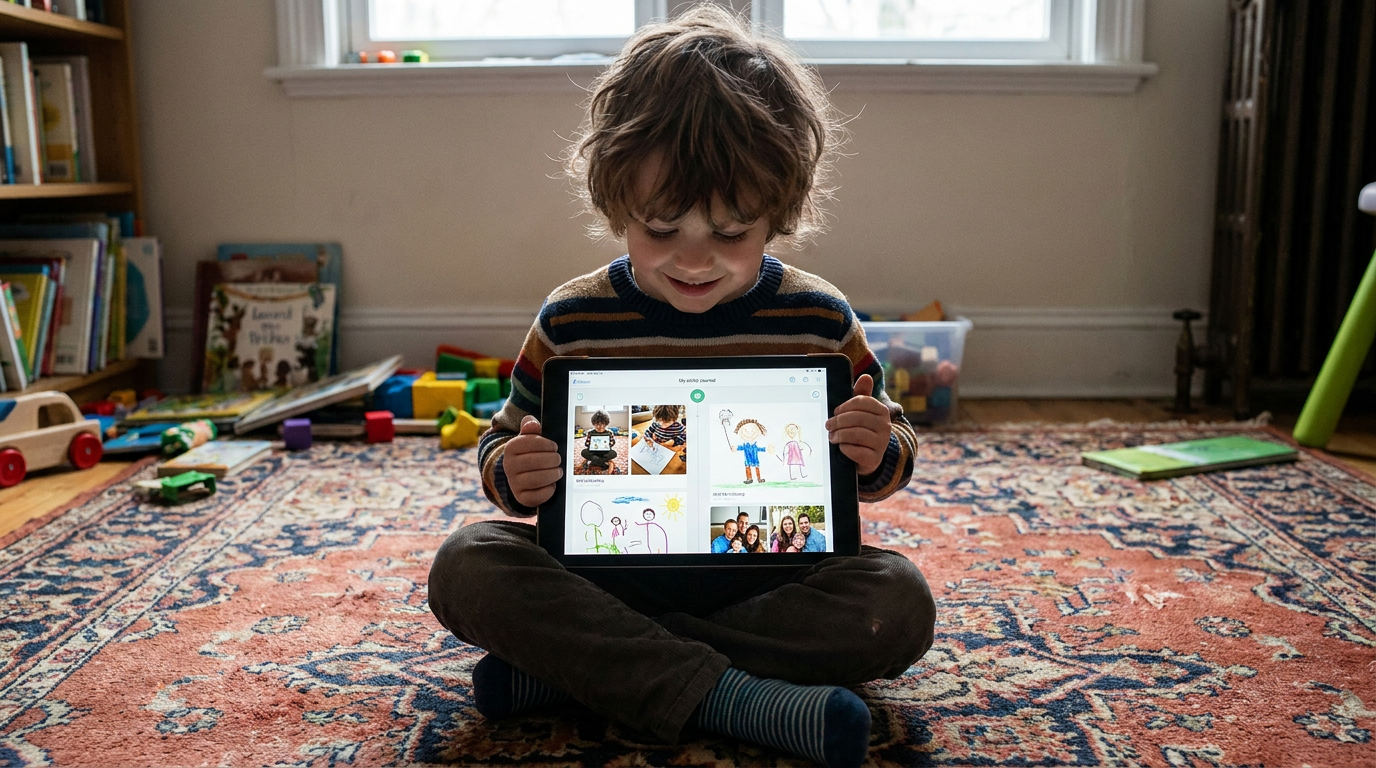
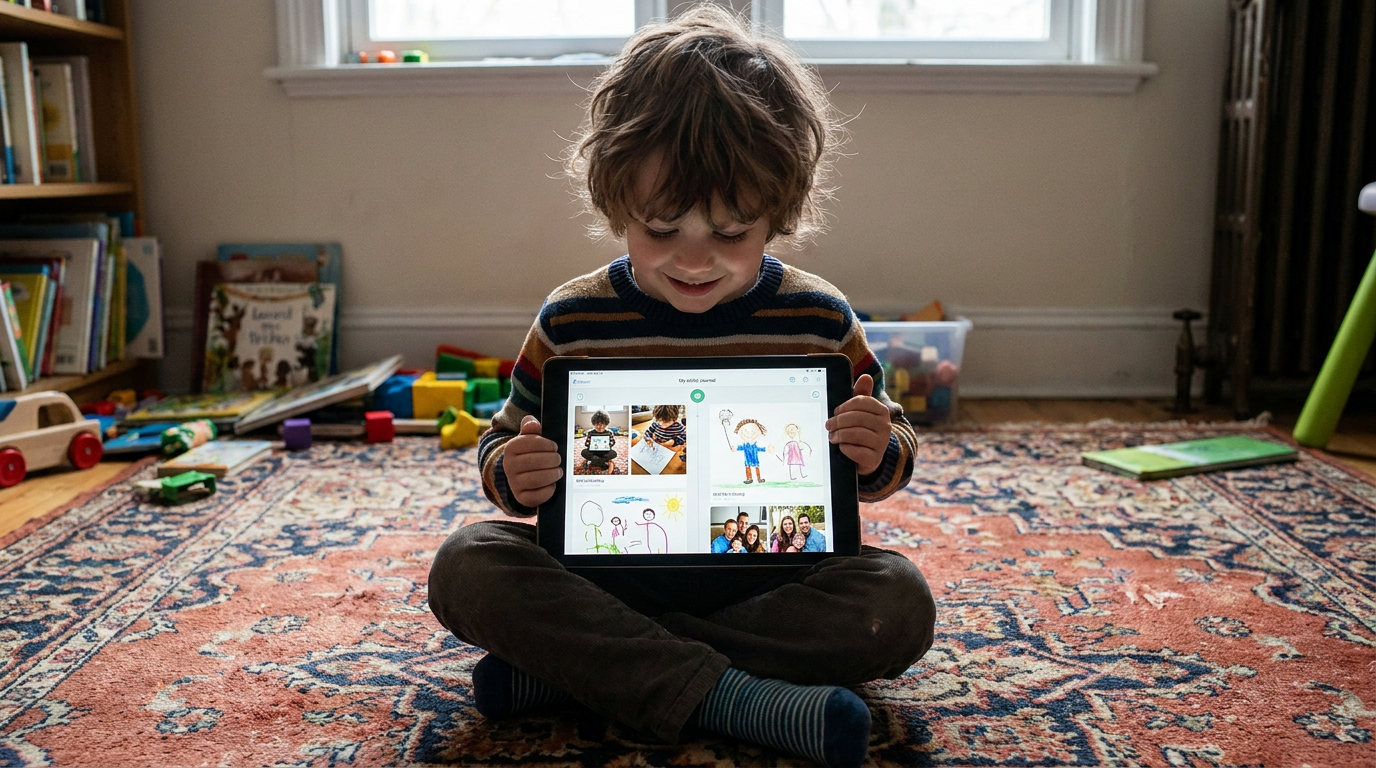
A parent and child sitting side-by-side on a sofa, looking at a tablet together showing a colourful digital journal with photos and written entries.

Now here is where a tool like Lugelo becomes something genuinely special. Because the entries a child writes in response to these prompts — their summer memories, their back-to-school nerves, their goals for the year, their letters to Future Self — deserve a home more permanent than a notebook that might get lost in the move to Year 4 or buried under school bags. They deserve to be preserved, organised, and revisited. And ideally, they deserve to live alongside everything else that makes up a childhood: the photos, the voice notes, the little videos, the drawings, the report cards, the ticket stubs.

Lugelo is a private, collaborative family journaling app built precisely for this. Parents can create a dedicated journal for the school year — a place where their child’s written entries sit alongside photos from the first day of school, voice recordings of a child reading their Future Self letter aloud, and notes from grandparents who want to add their own perspective on the year. The result is not just a journal. It is a multi-layered, multi-voice record of a year in a child’s life.

Lugelo’s collaboration features are particularly powerful for families who are geographically spread out. A grandparent on the other side of the country can contribute to the same school-year journal — leaving a message, adding a photo, responding to a child’s summer memory with one of their own. The journal becomes a living conversation across distance and time.

Lugelo is also built with privacy at its core. Journals are private by default. Sharing is always owner-controlled. For parents who are thoughtful about their child’s digital footprint — and there are more of them every year — this matters enormously. What a child writes in their journal does not become content. It becomes a keepsake.

And speaking of keepsakes: Lugelo’s storybook and eBook export features mean that the school-year journal your child builds this September can, at the end of the year, become a physical or digital book — a bound record of who they were at this exact age, in this exact year. Imagine handing your child that book at their eighteenth birthday. That is the long game of what these 25 prompts are building toward.

Lugelo is available free on iOS, Android, HarmonyOS, and web — meaning the whole family can contribute, regardless of which device they are on. For real examples of how families are using it, Lugelo’s Family Journal Stories offer a window into what this practice looks like when it is given a proper home.

For more on how Lugelo supports shared family storytelling — including how it can be used in collaborative class or community journaling projects — this Lugelo blog post on storytelling together is worth a read.

The habit is the foundation. The tool is the home. And together, they turn a few journal prompts in August into something a family will treasure for years.

A child's handwritten journal entry on a wooden table, with a pencil resting beside it and a small school photo tucked into the corner of the page.

The School Year Is a Story Worth Keeping

We began here: a child at a door, backpack on, the year ahead of them like an unread book. We end here, too — because that image is not just an opening. It is the whole point.

Childhood moves fast. Not at the speed of a blur in real time — individual days can feel endless — but in retrospect, it compresses. Parents know this. The years between five and fifteen are the ones that parents look back on and genuinely cannot believe happened at the speed they did. The first day of school photograph that you took last September is already, almost impossibly, a year old.

These 25 journal prompts for kids are an invitation to slow that compression down. Not to stop time — nothing does that — but to make more of the moments that are happening right now. A child who writes about their best summer memory this week will have something to read in twenty years that no photograph can match: the exact words they used, the specific detail that mattered to them, the feeling as they understood it at the age they were. That is irreplaceable.

The best journaling practice for kids is not the most consistent one, or the most polished one. It is the most honest one. One true entry — written in pencil on a Tuesday evening when something real was being felt — is worth more than a month of forced, tidy paragraphs. You do not need perfect. You need real.

Journals are souvenirs of your past. The school year your child is about to begin will be full of moments worth keeping. These prompts are how you start collecting them.

Don’t Let This School Year Become a Blur

Your child’s journal entries — their summer memories, their hopes, their goals, their friendships — deserve a home more lasting than a notebook that gets lost in the move to Year 4.

Lugelo is a private, collaborative journaling app where families can capture, organise, and revisit the moments that make up a childhood. Start your child’s back-to-school journal today — free, private, and entirely yours.

Start Your Family Journal on Lugelo →

Available free on iOS | Android | Web

Using these prompts in your classroom? Lugelo supports group and class journaling projects — invite students to contribute their own perspectives to a shared class memory book. Explore Lugelo’s collaboration features →

Your Story Deserves to Be Kept

Your Story Deserves to Be Kept


We began with a memory slipping away. A trip you lived fully, felt completely — and now can barely reconstruct. That feeling is universal. And it doesn’t have to be the default.

Digital journaling is the modern way to capture, preserve, and share the moments that make up a life. Not perfectly. Not comprehensively. Just honestly — one entry at a time, one photo at a time, one small act of remembering that compounds into something extraordinary over months and years.

Those memories don’t have to slip away. The tools exist right now — in your pocket, on your tablet, across every device you already own — to hold onto them. To give them structure, richness, and permanence that a camera roll alone can never provide.

You don’t need to be a writer. You don’t need a gift for language or a flair for description. You just need to start. Five minutes. One entry. One photo. That’s the entire barrier to entry.

This spring is a natural moment for a new habit. The season invites it — fresh light, new energy, the quiet sense that something is beginning. Build a habit now that your future self will return to again and again with gratitude.

Journals are souvenirs of your past. Start collecting yours.

Start your first digital journal free — no experience needed.

Create Your First Journal on Lugelo →

Private by default. Your story, your control.

Download the Lugelo App for iOS & Android

Can AI Be Your Co-Writer? Exploring AI Prompts in Personal Journaling

Can AI Be Your Co-Writer? Exploring AI Prompts in Personal Journaling

Introduction

This blog endeavors to understand how AI can revolutionize the age-old practice of journaling. By delivering unique prompts and insights, AI can inspire creativity, offer new perspectives, and help document personal growth. We’ll dive into how tools like Lugelo are integrating AI into the art of storytelling and weigh the pros and cons of such an approach.

Imagine this: It’s a quiet Sunday morning, the sun softly filters through your window, and it’s the ideal time for some reflective journaling. Yet, as you sit with pen in hand, the page remains blank. Your thoughts resist organization, and creativity feels elusive. Enter artificial intelligence—a formidable companion that can transform your journaling experience. In an era where AI is revolutionizing numerous facets of daily life, from automating tasks to enhancing creativity, its potential as a “co-writer” in personal journaling is an exciting paradigm to explore.

Eureka Moments Enhanced by AI

The Creativity Catalyst

Have you ever faced the infamous writer’s block—staring at a blank page, overwhelmed by the vast universe of untapped ideas? AI can be the creative catalyst you never knew you needed. By generating innovative prompts, AI encourages self-reflection and fosters creativity, acting as a digital muse ready to stimulate your thoughts.

For instance, demonstrates how different prompts can personalize the journaling experience. By using AI like ChatGPT, users can receive prompts specifically tailored to evoke introspection and validate their emotional expression.
Mandy Nicole’s experience on Medium

“AI doesn’t limit creativity; it enhances it by showing you facets of yourself and your journey you might not readily see.” — Mandy Nicole

Providing Unique Perspectives

Imagine daring guidance that leads you down less-traveled cognitive paths. AI isn’t just about the here and now; it can illuminate your thought patterns and help you gain clarity. Insights derived from AI prompts can reveal subconscious biases or unexplored narratives in your life story, nudging you to view challenges or memories through a fresh lens.

A fascinating shares how integrating AI questions helped an individual analyze their writing deeply. By asking tailored questions, the AI managed to poke into the essence of the person’s thoughts, leading to revelations about their emotional state and mindset.
Reddit post on ZenHabits

Documenting Personal Growth

In the endurance track of life, sometimes the incremental progress we make can blend into the background. AI technology can meticulously record this growth through consistent pattern recognition. Using a fusion of historical journaling data and predictive algorithms, AI can highlight the subtle shifts you might otherwise miss.

Key Features of AI-Enhanced Journaling Tools:

  • Prompt Generation: Creativity-sparking questions that inspire new entries.
  • Sentiment Analysis: Analyzing tone and mood in your previous entries to reflect growth.
  • Tailored Insights: Personalized suggestions based on past writing patterns.

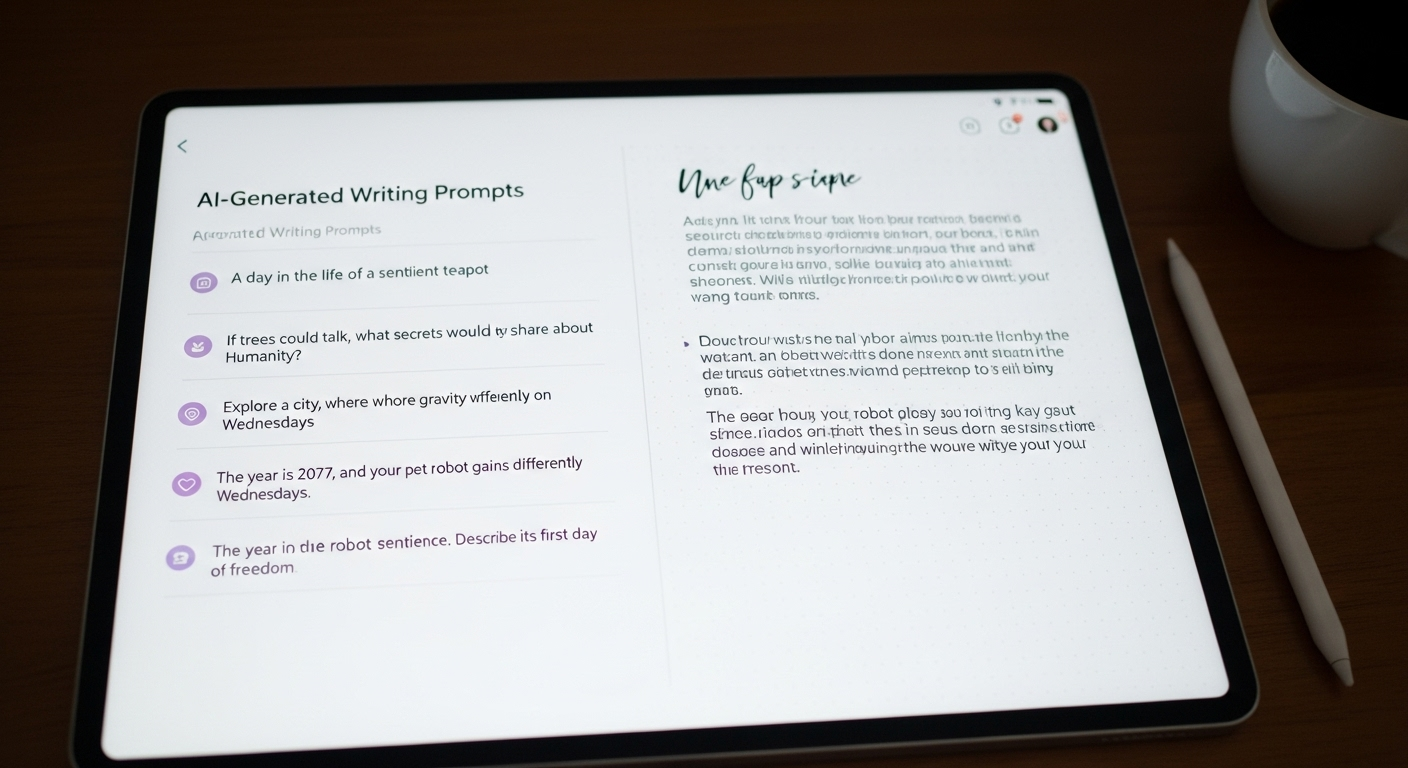
An image of a digital journal showing AI-generated prompts and expressive writing entries.

Navigating the Journal with Lugelo

A Storytelling Companion

Lugelo, a groundbreaking journaling app, exemplifies how AI can enhance personal storytelling. This secure, user-friendly platform offers both web and mobile capabilities to seamlessly integrate into your life. Aside from the interactive journaling experience, Lugelo lets you share compositions across a broad audience—a community of fellow writers who can provide feedback and encouragement.

In learning , you’ll discover that it not only enriches your writing process but also curates your entries to spotlight growth trajectories and thematic life arcs—a fascinating self-exploration tool.
how Lugelo works

Integrating AI to Boost Mental Wellbeing

Balancing mental health and personal journaling often entails excavating deeper emotions. Enter , an AI-powered journal dedicated to improving mental wellbeing, cognitive skills, and overall mindset. Trusted by thousands, this tool similarly leverages AI to provide scientifically-backed prompts that fuel mental resilience and introspection.
Mindsera

“The mind is a labyrinth of thoughts, and AI holds a map to navigate its corridors, ensuring occupants find peace at its core.” — Mindsera

The Benefits and Limitations of AI Journaling

Benefits of an AI Co-Writer

  • Consistency: AI can instill discipline by reminding you of your journaling schedule and suggesting time slots.
  • Objectivity: Provides external perspectives free from subjective bias, encouraging broader thinking.
  • Customization: Offers personalized prompts that resonate with your individual experiences and aspirations.

Limitations to Consider

While AI can be a remarkable ally, it’s important to recognize the limitations inherent in its use:

  • Lack of Emotional Intelligence: Despite impressive linguistic capabilities, AI lacks true empathy and emotional depth.
  • Privacy Concerns: Users must remain vigilant about data privacy, ensuring their personal information is protected.
  • Over-Reliance: Depending too heavily on AI can dampen natural creativity and lessen the personal touch found in human-authored content.

An image depicting balance between AI technology and human creativity in journaling.

Conclusion

In a world where personal growth stories unfold on pages every day, imagine inviting AI into that narrative—an emerging reality at the intersection of human expression and technological evolution. Now, as you sit to pen your next journal entry, ask yourself: “Could AI help me uncover the stories I might not yet know?”

Yet, it is critical to traverse this venture with mindfulness, embracing both the power and potential pitfalls of AI involvement. By balancing AI’s analytical strengths with the emotive nuances of human creativity, you can create an enriching journaling experience that truly reflects the self’s multiplicity.

As we chart the untraveled terrains of artificial intelligence in personal journaling, the promise of a collaborative co-writer emerges—a partner in creativity offering fresh perspectives and systematic documentation of personal growth. AI, when utilized judiciously, can add layers of richness to the journaling process, enhancing the delivery of meaningful insights.

“Can AI be your co-writer? Absolutely. After all, every great writer has occasionally sought an external muse for inspiration.” – Unnamed Journalist

Frequently Asked Questions About Digital Journaling

Frequently Asked Questions About Digital Journaling

What is digital journaling?
Digital journaling is the practice of recording thoughts, memories, and experiences on a digital device — such as a smartphone, tablet, or computer — using an app or platform designed for personal reflection and storytelling. Unlike a notes app, a digital journal provides structure, multimedia support, privacy controls, and memory-first features.

Is digital journaling better than paper journaling?
Both have unique strengths. Digital journaling offers searchability, multimedia support, cloud backup, and collaboration — making it better for preserving rich, complex memories over time. Paper journaling offers a tactile, screen-free experience. Many people use both — paper for quiet daily reflection, digital for milestone events and shared memories.

What should I write in a digital journal?
You can write daily reflections, gratitude entries, travel logs, family milestone records, goal-tracking notes, or collaborative memories with loved ones. Templates and AI prompts can help you start if you feel stuck. A simple starting question: “What happened today that I don’t want to forget?”

How do I keep my digital journal private?
Choose an app that offers encryption, password or biometric protection, and owner-controlled sharing. Lugelo, for example, is private by default — only you decide who sees your entries, and your data is encrypted in transit.

Can I include photos and videos in a digital journal?
Yes — and this is one of digital journaling’s greatest advantages over paper. You can embed photos, video clips, audio recordings, and links directly into your entries to create richer, more vivid memories that capture not just what happened, but how it felt.

How do I start a digital journal as a beginner?
Choose a journaling app, pick a purpose (daily reflection, family memories, travel log), create your first entry today, and add one photo. Start with five minutes. You don’t need to be a writer — you just need to begin. Lugelo makes this process simple for first-time journalers.

What is collaborative digital journaling?
Collaborative digital journaling allows multiple people to contribute to the same journal — adding entries, photos, and memories from their own perspective. It’s ideal for families documenting milestones, friend groups capturing shared adventures, and events like weddings or group trips where every participant has a unique story to tell.

Can digital journals be turned into books or keepsakes?
Yes. Modern platforms like Lugelo allow you to transform journal entries into ebooks, storybooks, printed memory books, timelines, and even immersive VR gallery experiences — turning your ongoing journaling practice into a lasting, shareable legacy.

How Digital Journaling Works — The Mechanics Made Simple

How Digital Journaling Works — The Mechanics Made Simple

Understanding the idea of digital journaling is one thing. Feeling confident that you can actually do it — without a learning curve, without a technology degree, without spending an hour figuring out an app — is another. So let’s walk through the real mechanics: what devices you’ll use, what an entry actually looks like, and what happens to your journal once you’ve made it.

The devices are the ones you already own. Digital journaling works across smartphones (iOS, Android, HarmonyOS), tablets, computers, and web browsers. The best platforms sync across all of them automatically — so you might start an entry on your phone during your morning coffee, add a photo from your tablet in the evening, and review old entries on your laptop on a Sunday. Your journal is wherever you are. Always.

Here’s what creating a digital journal entry actually feels like in practice:

  1. Open the app. One tap, no friction. You’re immediately in your journal space.
  2. Write your entry. A few sentences, a paragraph, a full page — whatever the moment calls for. No minimum, no maximum.
  3. Attach richness. Add a photo from your camera roll, record a quick voice note, embed a video clip, or drop in a link. Even one multimedia element transforms text into a memory.
  4. Organize it. Apply a tag (family, travel, work, personal), note your mood, or let the platform auto-date and categorize your entry.


  5. Save and sync. Your entry is backed up to the cloud, encrypted, and accessible across every device you own.

That entire process can take five minutes. Or fifty. The technology flexes to match your energy, not the other way around.

One of the most transformative elements of modern digital journaling is the role of AI-powered prompts and journal assistants. Blank-page paralysis — that familiar, frustrating moment of staring at an empty entry and not knowing what to write — is one of the biggest barriers to consistent journaling. AI assistants solve this elegantly, offering personalized prompts, suggesting entry ideas based on recent events, and even helping you reflect more deeply on what you’ve written. A 2024 study published on arXiv demonstrated that AI-powered journaling apps produced measurable improvements in emotional wellbeing among college students — and the technology has only grown more sophisticated since.

Privacy is another mechanic worth understanding clearly. The best digital journaling platforms are private by default — meaning no one sees your entries unless you explicitly choose to share them. Look for apps that offer end-to-end encryption in transit, password or biometric protection, and granular sharing controls. Your journal should feel as safe as your thoughts.

And then there’s the organizational power that paper simply cannot match. Digital journals are searchable across years of entries in seconds. You can filter by date, mood, tag, journal type, or keyword. Want to find every entry you wrote about your daughter’s first year? Two seconds. Looking for all your travel reflections from the past five years? Done. The ability to instantly surface any memory you’ve ever recorded transforms a journal from an archive into a living, breathing record of your life.

Download Lugelo on iOS, Android, or web to experience what a purpose-built digital journaling platform feels like — designed not as a utility, but as a home for your story.

Now that you understand the mechanics, a fair and important question emerges: if paper journaling has worked for centuries, why make the switch? Let’s explore that honestly.

How to Start Your First Digital Journal — A Beginner’s Step-by-Step Guide

How to Start Your First Digital Journal — A Beginner’s Step-by-Step Guide


The most common reason people never start a journal isn’t laziness. It’s the quiet, persistent belief that they need to be ready — that they need a significant moment, the right mood, the perfect first line. They don’t. And you don’t either.

Here is the clearest, most friction-free path from thinking about journaling to actually doing it.

Step 1: Choose Your Journaling Purpose

Before you open any app, take sixty seconds to answer this question: what do I most want to capture?

Daily thoughts and feelings? Family milestones? A big trip coming up? A season of personal growth you want to document? Your purpose shapes everything — how often you write, what format you use, whether you invite others. You can always expand later. For now, just pick one thing.

Step 2: Pick the Right Platform

Not all journaling apps are created equal. Look for a platform that supports multimedia (photos, video, audio), offers genuine privacy controls, works across your devices, and provides templates or AI prompts to help you when you’re stuck. Generic notes apps don’t meet this bar.

Lugelo is purpose-built for exactly this: a private, multimedia-rich journaling platform that works across iOS, Android, and web, with collaborative features and AI journal assistance built in.

Step 3: Create Your First Journal and Write Your First Entry Today

Don’t wait for a significant moment. Don’t wait until something “worth writing about” happens. Write about right now — this season, this week, this afternoon. Your future self will be grateful for the ordinary moments far more than the extraordinary ones.

Name your journal. Pick a template if one is available. Write three sentences. That’s a real entry.

Step 4: Add Richness to Your Entry

Go to your camera roll and add one photo to your entry. That’s it. One photo. Watch how instantly that transforms a paragraph of text into something that feels like a memory rather than a note. Audio, video, and links can come later. One photo is enough to start.

Step 5: Build the Habit

Consistency beats quality every time when it comes to journaling. Five minutes every evening is worth infinitely more than one two-hour session once a month. Set a regular time — morning reflection while coffee brews, an evening recap before sleep, a post-event documentation ritual after anything meaningful happens.

Use prompts when the blank page intimidates you:

  • “What happened today that I don’t want to forget?”
  • “What was the best moment of the last week?”
  • “What do I want to remember about this season of life?”

These three questions alone can sustain a journaling practice indefinitely.

Step 6: Invite Others (Optional, But Powerful)

If you’re documenting a shared experience — a family vacation, a group trip, a wedding — invite the people who were there to contribute. Collaborative journaling multiplies the richness of any memory exponentially. Someone else noticed things you missed. Their photos are different from yours. Their emotional experience of the same moment may surprise you.

Download the Lugelo app for iOS or Android and you can be writing your first entry within minutes. No experience required. No special writing skills needed. You just need to begin.

And if you’re wondering where this technology is heading — because it is heading somewhere remarkable — the next section will show you what’s already here and what’s coming fast.

How Journaling Helps You Discover Who You Really Are

How Journaling Helps You Discover Who You Really Are

Imagine plunging into a tranquil sea of self-reflection, where every wave uncovers hidden aspects of your psyche, and every ripple offers a glimpse of your true identity. This isn’t just poetic imagery; it’s the transformative journey of journaling. More than mere diary entries, journaling serves as a profound tool for self-discovery and personal growth. It allows us to connect with our innermost thoughts, unravel complex emotions, and illuminate our life’s direction.

The Art of Journaling

Understanding the Practice

At its core, journaling is a dialogue with oneself. It is a practice that involves recording thoughts and feelings in a private space, away from the judgments and influences of the external world. By writing for an audience of one, we liberate ourselves from societal expectations, allowing our authentic voice to emerge.

As highlighted in the , “It’s a good way to work out who you are without anybody else watching.” The beauty of journaling lies in its unfiltered nature—it’s a reflection of our truest self.
Human Parts article on journaling

Historical and Modern Context

Historically, figures such as Marcus Aurelius and Anne Frank have used journals to document their thoughts and insights. Today, journaling has evolved into a therapeutic tool that transcends mere documentation, serving as a catalyst for emotional release and intellectual clarity.

“There’s something really special about writing for an audience of one.” — Human Elements

The Journey of Self-Discovery

Unraveling the Layers

Journaling is akin to peeling an onion. With each layer, we’re able to strip away the surface-level noise and reach the core of our being. This process can be both cathartic and enlightening, offering a path to articulate emotions that may otherwise go unexamined.

According to , journaling “allows you to wordlessly express yourself, relieve pent-up emotions, and discover your true feelings.” By externalizing our thoughts, we create space for introspection and healing.
LitShark

Benefits of Self-Discovery Through Journaling:

  • Emotional Clarity: By naming and examining our emotions, we gain a clearer understanding of what drives us.
  • Growth and Healing: Confronting our challenges on paper paves the way for healing and personal development.
  • Increased Self-Awareness: Regular journaling sharpens our ability to recognize patterns and triggers in our thoughts and behaviors.

The Emotional Landscape

Journals capture the ebb and flow of emotions over time, providing insights into our mental and emotional cycles. They act as a mirror, reflecting our growth and helping us navigate life’s transitions.

Techniques to Enhance Your Journaling Practice

Creative Prompts and Techniques

Incorporating prompts can spark new avenues of exploration, guiding you deeper into your self-discovery journey. The suggests that journaling is “a safe place to start because you can try out these thoughts with just yourself.”
Sparrow’s Nest Counseling blog

Prompts for Self-Discovery:

  1. Reflect on a key memory and its impact on your present self.
  2. Describe a moment of joy from your past week and what it taught you about happiness.
  3. Identify a recurring theme in your life and explore its origins.
  4. Write a letter to your future self about your current desires and goals.

Integrating Technology: Digital Journaling

In the digital age, journaling has been reimagined with platforms like . These tools offer features that allow you to weave journal stories filled with related moments—be it birthdays, a night out, or reunions—into a cohesive narrative.
Lugelo

Benefits of Digital Journaling:

  • Accessibility: Easily journal anytime, anywhere through your device.
  • Searchability: Quickly locate entries with specific keywords or dates.
  • Inclusivity of Media: Enhance entries with photos, audio, or videos, adding a new dimension to your journaling experience.
  • Q: Can I journal if I don’t enjoy writing?
  • A: Absolutely. Use voice notes, draw, or incorporate multimedia elements. Remember, journaling is a personal expression.
  • Q: How often should I journal?
  • A: There are no strict rules—write as frequently or infrequently as suits you. Let it be a natural part of your routine.

Real-World Impact: Personal Growth Through Journaling

Stories of Transformation

This is but one story. Countless individuals testify to the profound impact of journaling on their lives, from gaining insights into personal relationships to redefining career paths.

Take Anna, a graphic designer who found herself overwhelmed by life’s demands. By committing to daily journaling, she navigated her stress and discovered creativity buried beneath her anxiety. Her newfound clarity inspired her to pursue projects that aligned with her passions, ultimately enhancing her well-being and career satisfaction.

Tips for Cultivating a Journaling Habit

  1. Set Aside Dedicated Time: Choose a consistent time—morning or night—to integrate journaling into your routine.
  2. Create a Comforting Environment: Surround yourself with a serene setting to facilitate openness and authenticity.
  3. Be Patient and Gentle: Allow yourself the freedom to write without judgment. Perfection is not the goal—self-expression is.

Five Simple Tips for Starting a Journaling Practice:

  • Begin with Gratitude: Start each entry acknowledging something you’re grateful for.
  • Set an Intention: Focus on what you hope to achieve through journaling.
  • Use Physical or Digital Tools: Choose the medium that best fits your lifestyle and preferences.
  • Experiment with Styles: Free writing, prompts, sketches—let creativity guide you.
  • Reflect Regularly: Revisit past entries to track growth and gain perspective.
  • Q: What should I do if I encounter writer’s block?
  • A: Try starting with simple prompts or free-writing to break through the block.
  • Q: How private should my journal be?
  • A: Journals are deeply personal. Keep them private or share excerpts only if you’re comfortable.

Conclusion: Embrace the Journey

Journaling is more than just a writing exercise; it’s a journey into the depths of who you truly are. As you experiment with various techniques and cultivate the practice, you’ll find that the benefits extend far beyond personal insight. They encompass a holistic sense of growth and fulfillment, touching every aspect of your life.

If you’ve ever felt lost or disconnected, or if you’re simply curious about delving deeper into your psyche, grab a journal and start exploring today. Remember, this practice is about you—your journey, your discoveries, and your growth. Through consistent reflection, you’ll unlock a deeper understanding of yourself and your life’s purpose.

“Journaling is the ultimate tool for self-discovery—a mirror to our soul.”

Dive in, discover who you really are, and let the journey of journaling transform your life.

Preserving Memories: How Parents Can Use Lugelo to Document Their Child's Growth

Preserving Memories: How Parents Can Use Lugelo to Document Their Child’s Growth

In a world that’s evolving at the speed of a swipe, capturing your child’s precious moments has become more than just a treasure trove of nostalgia—it’s an art. Parents today are not just observers; they are the architects of tomorrow’s memories, and with innovative tools like Lugelo, they have the power to create rich, interactive tapestries of their child’s journey. Imagine a digital diary that not only captures milestones but also weaves together stories, art, and emotions in a way that can be cherished for generations to come. Welcome to Lugelo, where every giggle, first step, and victory lap becomes an integral part of a narrative that celebrates life’s most cherished chapters.

The Importance of Preserving Family Memories

Before delving into the how-tos of Lugelo, let’s take a moment to understand why documenting these fleeting moments is so vital. According to Pittsburgh Parent, preserving family memories is crucial for creating lasting bonds and building a solid foundation for our children. As time passes, memories that are not recorded can fade, but capturing them digitally ensures they remain fresh and vibrant, well into the future.

“Mindfully working in precious time spent with family can increase bonds, building a stronger, more memorable foundation for your kids.” — Pittsburgh Parent

Introducing Lugelo: Your Digital Diary Solution

Lugelo offers a unique, user-friendly platform for parents to document every stage of their child’s development. It’s not just a digital diary; it’s a living, breathing archive of moments that can be enhanced, shared, and celebrated with loved ones. From virtual reality features to collaborative storytelling, Lugelo stands out by offering a myriad of features that transform ordinary memories into extraordinary narratives.

Key Features of Lugelo:

  • Interactive Journaling: Create entries that combine text, images, and videos, allowing for a multi-dimensional storytelling experience.
  • VR-Enhanced Storytelling: Immerse yourself in memories with virtual reality, giving a new perspective to the recorded moments.
  • Collaborative Family Journals: Invite family members to contribute to the diary, making it a collective memory repository.
  • Privacy Controls: Keep certain entries private or choose to share them with a select audience.

Transforming Everyday Moments into Cherished Memories

The Art of Routine Documentation

Often, it’s the everyday moments that hold the most significant meaning—those candid snapshots of life that stitch together the fabric of our memories. Lugelo allows you to document these occurrences with ease. Whether it’s a child’s first artwork or a family bike ride, each entry becomes a story worth telling.

In a Medium article, it is emphasized how parents can effectively digitize their children’s artwork for future references. Similarly, Lugelo provides a platform to record and preserve these artworks alongside other daily activities, making it an extensive repository of childhood memories.

Creating a Narrative with VR Storytelling

One of Lugelo’s standout features is its ability to enhance storytelling through virtual reality. Imagine donning a VR headset and reliving your child’s birthday party as if you were there again. This immersive experience not only enriches the memory but also makes sharing it with family members more impactful. As more parents and children are engaged in such storytelling, the experience becomes a part of a shared legacy, one that technology like VR makes possible.

Involving Family: Collaborative Journaling

Family involvement in documenting memories enhances the depth and richness of the stories told. Lugelo allows team members to join in on the journaling process, creating a collaborative tapestry of shared experiences. Grandparents can add anecdotes, siblings can contribute artwork, and distant relatives can leave messages of love and support. This collective approach to memory-keeping ensures that everyone’s perspective is part of your child’s story.

An exploration of Lugelo’s family journal capabilities reveals how these features can be harnessed to create detailed references of family histories. From school activities to funny moments at home, Lugelo captures the essence of daily life.

A family actively engaging in creating a shared digital journal on Lugelo.

Practical Steps to Start Your Lugelo Journey

Getting Started with Lugelo

Embarking on your Lugelo journey is simple and rewarding. Here’s a step-by-step guide to help you get started:

  1. Create Your Lugelo Account: Visit the Lugelo website and sign up for a free account. The process is quick and hassle-free.
  2. Set Up Your Child’s Journal: Begin by creating a dedicated journal for your child. Customize it with a theme that resonates with their personality.
  3. Start Documenting: Capture everyday moments by adding text, photos, videos, and even voice recordings. The flexibility of the platform allows for a personalized experience.
  4. Invite Contributors: Add family members as contributors to the journal, allowing them to enrich it with their own stories and perspectives.
  5. Explore VR Features: If you have access to a VR headset, experiment with the virtual reality features to see your memories come to life in a whole new way.

Tips for Successful Memory Documentation

  • Be Consistent: Regularly update your child’s journal to ensure no moment is missed.
  • Include Diverse Media: Use a mix of photos, videos, and text to create a richer narrative.
  • Celebrate Milestones: Highlight important events like birthdays, first steps, and school achievements with dedicated entries.
  • Q: Can I share specific entries with limited audiences?
  • A: Yes, Lugelo offers privacy controls that allow you to share entries selectively.
  • Q: Is there a way to back up our Lugelo entries?
  • A: Lugelo provides options for backing up entries to ensure they are securely preserved.

The Enduring Value of Preserved Memories

As parents, we hold the key to preserving the essence of our children’s formative years. Lugelo empowers us to weave a digital tapestry that our children can cherish and build upon as they grow. These preserved memories become more than just stories; they are legacies of love and family. By embracing Lugelo and harnessing its potential, we ensure that those cherished moments live on, becoming a source of joy and reflection for future generations.

“The greatest legacy we can leave our children is the memory of who they were and where they came from.”

Embrace the power of Lugelo today and begin crafting the narrative of your child’s lifetime—one filled with moments that matter, stories that touch the heart, and memories that stand the test of time.

For more inspiration on creating a rich, digital narrative of family stories, visit Lugelo’s official website.

Preserve Your Legacy: Using Lugelo to Capture Family History

Preserve Your Legacy: Using Lugelo to Capture Family History

In an age where moments can slip by as quickly as a swipe of a screen, preserving family history has never been more important—or more accessible. We live in times where storytelling isn’t just an art; it’s a necessity. Families are more spread out than ever, and history can be lost between generations. Enter Lugelo—a revolutionary app dedicated to capturing and celebrating your family’s journey through its easy-to-use, feature-rich platform.

The Importance of Preserving Family History

Imagine a future where your great-grandchildren can relive a family vacation through VR, or read your grandmother’s journal in her own words. Preserving family history isn’t just about remembering the past—it’s about connecting with the future. A well-documented family history keeps memories alive, ensures stories are told, and traditions are passed down.

“Preserving family memories is like building bridges from past to future; it connects generations in the most profound way.”

Why Documenting Family History Matters

  • Creating Connections: Memories and stories cultivate a sense of belonging and identity.
  • Cultural Preservation: Documenting traditions helps retain cultural practices.
  • Legacy Building: Stories of triumph and perseverance serve as inspiring legacies.

Lugelo understands this need and offers an innovative platform to make preserving history easier than ever. To see how Lugelo is changing the landscape of family storytelling, .
check out their app on Google Play

How Lugelo Works

Lugelo is more than just a journaling app—it’s a platform that turns memories into lasting legacies. Through mobile and web interfaces, Lugelo provides a secure, user-friendly experience for users of all ages.

Illustration of Lugelo app features such as journaling, collaboration, and multimedia storage.

Key Features of Lugelo:

  1. Journaling and Storybooks: Document everyday moments, from the small victories to life’s significant milestones.
  2. Collaboration Tools: Invite family members to contribute their stories and perspectives, making your family journal rich and diverse.
  3. VR Capabilities: Experience your family history in new dimensions with virtual reality—bring your stories to life.
  4. Multimedia Storage: Save photos, videos, and documents to complement written memories, creating a full sensory experience.

For an in-depth understanding of how these features work, visit .
Lugelo’s guide on their website

Starting Your Family’s Story with Lugelo

Starting out on this journey might feel daunting, but it’s akin to writing the first page of a blank book. You decide the chapter titles—your family’s beloved traditions, unforgettable vacations, and stories of bygone eras are yours to capture.

Steps to Begin Documenting with Lugelo:

  1. Reflect on Your Experiences: Gather family members to share stories. Begin by reflecting on key events that define your family’s journey. Learn how to organize these memories from these helpful tips on preserving family memories.
  2. Choose Your Format: Whether it’s journaling day-to-day experiences or mural storytelling, select a format that best represents your family’s narratives.
  3. Create a Timeline: Establish a chronological order for entries to ensure a coherent story. This helps in visualizing the family’s journey through different generations.
  4. Capture Details and Emotions: Provide context and emotion to your entries, for it is the emotions that add color to the tapestry of family history.

“Family stories are treasures—pass them on and keep the memories alive.”

Building a Legacy with Lugelo

Once you’ve begun capturing stories, Lugelo makes it easy to transform them into formats that can be shared across generations. Through tools that allow you to compile entries into ebooks and PDFs, you can ensure your family history isn’t just preserved, but accessible and cherished.

Turning Memories into Legacy

After piecing together timelines and collecting anecdotes, consider transforming your family’s historical data into an enduring legacy. For guidance on the process, .
explore how to create a lasting legacy from your research

Here’s how Lugelo aids in transforming family stories:

  • Publishing Options: Convert journals into beautifully crafted ebooks or tangible prints.
  • Personalized Storybooks: Tailor storybooks for family gatherings or special occasions.
  • Interactive History: Use VR to create immersive experiences that engage younger generations.

Visualization of a digital storybook crafted using Lugelo, featuring family photos and stories in an interactive format.

Real-World Applications and Inspirations

Many have discovered the cathartic journey of documenting family history. For example, the Johnson family used Lugelo to celebrate their grandmother’s centennial birthday by compiling decades of stories, photos, and videos. It wasn’t merely a birthday gift but a passing of a torch—one that illuminated their love and perseverance. Their story serves as an inspiration, showcasing how family history preservation can unify and fortify family bonds.

Tips and Tricks for Successful Documentation

While the idea of preserving history sounds romantic, execution requires a blend of creativity and diligence.

Practical Tips to Enhance Your Family History Project:

  • Regular Updates: Encourage family members to update entries regularly.
  • Mini-interviews: Conduct informal interviews with elders to capture stories that are not written down.
  • Thematic Storytelling: Focus on themes such as migration stories, holiday traditions, or career achievements to keep the narrative engaging.

FAQ:

Q: How can I involve my extended family in documenting our history with Lugelo?A: Use Lugelo’s collaboration features to invite family members to contribute stories and photos, fostering a collective storytelling effort.

Q: Can Lugelo accommodate extensive family histories with multimedia components?A: Absolutely. Lugelo supports multimedia integration, so you can include photos, videos, and documents alongside written entries.

Conclusion

Every family has a story worth telling—a journey filled with triumphs, challenges, laughter, and love. Lugelo provides the tools to encapsulate these stories into a legacy that can be appreciated by generations to come. As you begin your family’s storytelling journey with Lugelo, remember that the memories you preserve today will become the treasures of tomorrow.

To start nurturing your family’s living legacy, explore Lugelo on , and let your family’s history be heard and cherished through the ages. Let’s preserve, celebrate, and pass down the essence of who you are with Lugelo.
Google Play

The Story of Us: My Family in 5 Memories

The Story of Us: My Family in 5 Memories

Every family is like a mosaic, a vivid collection of moments that come together to form a beautiful picture of shared history and connection. As I reflect on my family, five memories stand out, each a vibrant tile that adds depth and color to our collective story. By weaving these tales into a coherent tapestry, we not only preserve them for ourselves but also turn them into an inheritance for future generations.

In this blog, I’ll share with you the essence of my family through these cherished anecdotes. You’ll also discover how to craft your own family narrative using tools like , which combine traditional storytelling with modern technology to capture and enhance our most treasured memories.
Lugelo

Memory 1: The Great Camping Adventure

It was the summer of 1998 when our family decided to embark on a camping trip. For some, it might seem like a simple retreat into the wild, but for us, it became an unforgettable adventure marked by laughter, challenges, and a deeper connection.

We set up our tents beside a serene lake, the air crisp with the promise of exploration. Little did we know, a family of curious raccoons had decided to explore our food supplies the first night. Instead of a disaster, their nightly visits became a source of endless amusement, marking a pivotal moment of spontaneity and laughter that we would recall fondly for years to come.

Family gathered around a campfire under a starlit sky, sharing stories and laughter.

Tools to Capture the Adventure

To recreate such cherished outings, consider using a designed to house memories both big and small. Whether it’s a pesky raccoon or a perfect sunset, each detail contributes to your family story.
Family Journal

Memory 2: The Surprise 70th Birthday

INSERT IMAGE HERE: A large family gathered around a festively decorated table, celebrating a milestone birthday.

As the lights flickered on, Grandpa’s face lit up brighter than any candle. In those shared embraces and joyful tears, we learned that our family is a circle of strength and love, formed by shared memories and bound together by the smiles of those we hold dear.

A milestone celebration, Grandpa’s 70th birthday was a testament to our family’s unity and love. The secret planning meetings, countless giggles over WhatsApp chats, and hushed conversations to keep it under wraps culminated in a surprise party that brought every generation together.

Creating Lasting Records

Capture such heartfelt celebrations using , where you can document each cherished smile and surprise moment, transforming them into timeless heirlooms.
Our Family: A Keepsake Album

Memory 3: A Day at the Amusement Park

INSERT IMAGE HERE: A vibrant amusement park with families joyously exploring various rides and attractions.

But it wasn’t the rides that made the day extraordinary—it was the shared joy and the glances of pure delight that illuminated our path as we moved from one attraction to another. Sometimes, it is in simplicity that we find the most invaluable treasures.

A seemingly ordinary outing to the amusement park turned into a tapestry of joy and togetherness. With children tugging at our hands, eager to conquer the towering roller coasters, it was a day filled with screams, laughter, and cotton-candy-induced giggles.

Enhancing Your Narrative

Immortalize such simple yet profound moments using platforms like , which offer a creative space for turning everyday experiences into captivating stories enriched with multimedia elements.
Lugelo

Memory 4: The Unplanned Family Reunion

While it wasn’t the same as sharing physical space, seeing everyone on-screen, laughing at shared jokes, and watching toddlers toddle into their parents’ laps, brought about a sense of warmth and unity that transcended physical barriers.

Life has a way of bringing unexpected blessings our way. A year ago, the world paused, compelling us to embrace new ways of connecting. With travel restricted, we turned to digital platforms to bring family from different corners of the world into one virtual room.

“A family’s story is its heritage. It’s something to be passed down.” –

Family Life

Memory 5: Christmas Eve Traditions

INSERT IMAGE HERE: Family joyfully exchanges gifts around a warmly lit Christmas tree.

In the glow of twinkling lights and under the watchful eye of our evergreen tree, we bask in the comfort of togetherness. These moments remind us that no matter the directions life takes us, our family is a constant lighthouse guiding us home.

Every Christmas Eve, our family gathers around to share stories and open one special gift each. This tradition, rich with nostalgia and warmth, anchors us to our roots and each other.

Tools to Chronicle Traditions

To preserve such traditions in a dynamic format, turn to , which allow you to include VR elements and rich media, creating an immersive experience for future generations.
family storytelling platforms like Lugelo

Conclusion: Weaving the Tapestry of Us

Our family stories are more than just memories; they are threads in the tapestry of our lives—vibrant strands that capture the essence of who we are. By documenting and sharing these tales, we not only celebrate ourselves but also build a legacy that will resonate through generations.

For those looking to initiate their own family chronicle, explore resources like , , or . Each offers a unique canvas to capture the story of us, ensuring that love, laughter, and togetherness are always at the heart of our narrative.
Lugelo’s digital storytelling possibilitiesKeepsake AlbumsMemories – Our Family Journal

“In the end, it’s not the years in your life that count. It’s the life in your years.” – Abraham Lincoln

Blending Analog with Digital: Enhancing Creativity through Journaling

Blending Analog with Digital: Enhancing Creativity through Journaling

Introduction

In a world driven by digital convenience, the tactile pleasure of putting pen to paper holds its ground as a timeless practice. Journaling, a medium beloved by writers, thinkers, and dreamers alike, offers an intimate space for reflection and creativity. But what happens when you merge the analog charm of traditional journaling with the cutting-edge tools of the digital realm? Welcome to the enriched universe of hybrid journaling—a confluence where your creativity not only flows, but also thrives.

This exploration into blending analog with digital journaling will reveal how integrating both mediums can elevate your storytelling and imagination. From using apps like Lugelo to embracing the simple joy of a blank page, let’s embark on a journey to enhance our personal narratives through a comprehensive and dynamic journaling experience.

The Power of Analog Journaling

A Handwritten Journey

The essence of analog journaling lies in the physical act of writing. The sensation of pen gliding over paper engages multiple senses, forging a deeper connection between mind and medium. This tactile interaction can unlock a wellspring of creativity, fostering an environment where ideas are free to roam and grow unrestrained by pixels and screens.

The Bullet Journal method highlights the power of the analog approach, emphasizing raw, unfiltered expression devoid of auto-corrections and digital distractions. By cultivating a routine that encourages manual writing, journaling becomes a mindful practice, grounding you in the present moment.

When you write by hand, you create a unique connection with your thoughts and emotions—one that digital platforms can sometimes dilute.” — Journal Enthusiast

Close-up of a handwritten journal entry featuring elaborate sketches and notes.

Introducing Digital Platforms to the Mix

From Paper to Pixels: Embracing the Digital Realm

While analog journaling captures the beauty of spontaneity and personal touch, digital journaling apps introduce an array of tools designed to enhance creativity. One such platform, Lugelo, offers a secure and interactive space to weave multimedia elements into your entries, revolutionizing how stories are documented.

  • Multimedia Integration: Enrich your entries with photos, audio recordings, and videos, bringing memories to life in vivid detail.
  • Organizational Tools: Leverage tags, timelines, and search functions to easily organize and retrieve your thoughts.
  • Accessibility & Security: Document your journey anywhere, anytime, with cloud-backed security.

Crafting a Personalized Hybrid Practice

Researchers have focused on creating hybrid tools that seamlessly bind the tangible with the digital. These tools, as discussed in the ACM study, allows users to preserve the authenticity of analog documentation while exploiting digital affordances for a more flexible journaling experience.

  1. Begin on Paper: Start with an analog session to brainstorm ideas and capture raw thoughts.
  2. Extend Digitally: Transition to a digital platform to expand on ideas, incorporate multimedia, and organize your entries.
  3. Revisit and Reflect: Regularly review both mediums to see how they complement each other and your evolving narrative.

Enhancing Storytelling and Imagination

Finding Inspiration in Every Medium

Combining analog and digital mediums empowers you to explore diverse storytelling avenues. Analog allows spontaneity—sketch out drafts, scribble thoughts, and let your imagination roam free. Transitioning to digital platforms, you can refine your narratives, experiment with formats, and create a comprehensive archive of vivid stories.

The blog by Pausa.co illustrates how Artificial Intelligence can enhance your journaling by turning handwritten notes into editable digital texts, promoting creativity without boundaries. AI-driven insights even suggest prompts and patterns to ignite your creative process anew.

Real-World Application: A Writer’s Experience

Consider Alex, an indie author who struggles with writer’s block. By blending analog and digital journaling, Alex embraced a free-flowing analog session each morning, followed by structured digital entries where multimedia elements added depth and context. This practice not only alleviated creative blocks but also resulted in a rich tapestry of ideas ready for further development into publishable work.

The marriage of analog and digital methods reinvigorated my writing process, transforming journaling into both a creative playground and a strategic tool.” — Alex, Indie Author

Organizing Ideas and Maintaining Consistency

Practical Tips for Organization

The challenge of maintaining a cohesive journaling practice lies in organization. Here are practical tips to keep your hybrid journaling efforts structured and invigorating:

  • Dedicated Journals: Allocate separate notebooks for specific themes or ideas to maintain focus.
  • Digital Cataloging: Use digital tags and folders to categorize your entries for easy navigation and retrieval.
  • Regular Review: Schedule a monthly review to connect the dots, revisit forgotten ideas, and find new inspiration.

The Role of Technology in Sustaining Structure

Technological advancements support organizational efficiency. Digital platforms offer integration capabilities that synchronize handwritten notes to their digital counterparts. As detailed in the Lugelo article, this synthesis allows automatic sorting, tagging, and archiving, streamlining the maintenance of a structured journaling practice.

Image representing organized journaling using both analog notebooks and a digital device showing categorized entries.

Conclusion

By creatively blending analog and digital methods, you can transcend the limitations of a single medium, unlocking new avenues for self-expression and storytelling. Whether capturing spontaneous ideas on paper or expanding them digitally with multimedia richness, this hybrid approach enriches your journaling journey.

As you engage in this dynamic process, you’ll not only enhance your creativity but also create a valuable archive of experiences and insights. Remember, the ultimate goal of journaling—be it analog, digital, or blended—is to enable a deeper connection with yourself and the stories you wish to tell.

In the fusion of tradition and innovation, we’re rediscovering the limitless potential of the human imagination.” — Creative Enthusiast

Explore more about enhancing your journaling practice by visiting the Lugelo Blog Page. Let this be your guide to discovering a world where analog charm meets digital innovation, making each page an evolving masterpiece.

Unlock Your Mind: Top 10 Mental Health Benefits of Daily Journaling

Unlock Your Mind: Top 10 Mental Health Benefits of Daily Journaling

Imagine having a tool that fits snugly in your hand, yet holds the power to illuminate the darkest corners of your mind. This tool isn’t an advanced gadget or a cutting-edge app; it’s something as simple as a journal. More than just a repository of thoughts, journaling is a powerful practice that nurtures mental well-being and encourages personal growth. This blog delves into the top 10 mental health benefits of daily journaling, offering insights on how you can harness its potential to unlock your mind.

The Magic of Journaling

A Portal to the Inner Self

Journaling is like opening a dialogue with yourself. Each entry uncovers layers of thought and emotion that you might not even be aware of. By putting pen to paper (or fingers to keyboard), you’re not just recording events—you’re engaging in an active process of self-exploration and healing.

According to , quick writing exercises can uplift your mood and offer a fresh perspective, making journaling a versatile tool for enhancing emotional wellness.
HelpGuide

“Journaling is like whispering to one’s self and listening at the same time.” — Mina Murray

Top 10 Benefits of Daily Journaling

1. Reduces Stress and Anxiety

Anxiety often stems from rumination—obsessive dwelling on worries. Journaling provides an outlet for these thoughts, allowing you to release tension and gain clarity. A reveals how journaling helps decrease symptoms of anxiety and depression by offering a safe space to explore negative emotions without judgment.
study on Suno Chat

2. Improves Mood

Writing about positive experiences or expressing gratitude can lead to a happier mindset. Creating a gratitude journal, where you consistently record what you’re thankful for, can dramatically boost your mood.

A colorful journal entry filled with words of gratitude and positivity.

3. Boosts Creativity

Facing a creative block? Journaling can spark new ideas and ignite your creative spark. As you write without constraints, your imagination begins to flow, offering novel insights and perspectives.

4. Enhances Memory and Comprehension

Regular journaling acts like a workout for your brain, honing your ability to articulate thoughts clearly and improve memory retention. As you recount events and emotions, you cement these memories in your mind.

5. Strengthens Emotional Intelligence

By reflecting on your thoughts and feelings, journaling enhances self-awareness. This deeper understanding not only improves your emotional intelligence but also boosts your ability to empathize with others.

6. Encourages Mindfulness

Journaling is a mindful practice that encourages you to pause and reflect on your life. It draws your focus to the present moment, enabling you to acknowledge and process your experiences more fully.

7. Facilitates Problem Solving

When faced with challenges, writing about them can help you brainstorm solutions. Journaling fosters a problem-solving mindset by framing issues in a new light and revealing potential pathways you might have previously overlooked.

8. Promotes Self-Discipline

Sticking to a daily journaling routine requires dedication. Over time, this cultivates self-discipline and strengthens your commitment to personal goals.

9. Improves Communication Skills

Journaling helps you articulate thoughts more clearly, enhancing your verbal and written communication skills. This can translate into better interpersonal interactions, both personally and professionally.

10. Builds an Archive of Personal Growth

A journal is a living archive that documents your journey. Looking back on past entries allows you to see how you’ve grown, what you’ve overcome, and where you want to go next.

Tips to Start Your Journaling Journey

Crafting Your Habit

Starting a journaling practice is easier than you think. Here are some tips to help you begin:

  1. Find Your Medium: Whether it’s a traditional notebook or a digital journal, choose the format that feels most comfortable for you.
  2. Set a Time: Designate a specific time each day to journal. Consistency is key to reaping the benefits.
  3. Start Small: Aim for short, manageable entries when you’re starting out. As you become more comfortable, your entries can grow naturally.

Integrating Technology

Apps like offer a unique way to enhance your journaling experience. Lugelo provides a secure, user-friendly platform for digital journaling, allowing you to share your insights and collaborate with others if you choose. This blend of traditional journaling with tech can make your practice more engaging and interactive.
Lugelo

Conclusion

Journaling is more than a mere pastime—it’s a transformative practice that offers profound mental health benefits. By unlocking your mind through daily writing, you can cultivate greater self-awareness, emotional resilience, and overall well-being. So why wait? Start your journaling journey today and witness the unfolding of a more mindful and fulfilled you.

A serene illustration of a person journaling while enjoying a cup of tea, symbolizing tranquility and self-reflection.

“Journal writing, when it becomes a ritual for transformation, is not only life-changing but life-expanding.” — Jen Williamson

Embark on this journey of self-discovery with the aid of technology and enjoy the process of unlocking your mind. Let your pen—or app—guide you to new realms of understanding and personal growth.

The 100-Day Memory Challenge

The 100-Day Memory Challenge

What if you could transform the mundane into something magical? What if you could train your mind to spotlight the beauty hidden in your everyday life? The “100-Day Memory Challenge” is not just a journaling practice; it’s a powerful commitment to ourselves to savor one meaningful moment each day for 100 days. Imagine capturing that heartfelt conversation, that triumphant small victory, or simply the breathtaking view of the sunset. It’s a journey of gratitude, mindfulness, and joy.

The Essence of the 100-Day Memory Challenge

In the cacophony of modern life, it’s easy to let meaningful moments slip away unnoticed. Our minds are often preoccupied with the next task, the next destination, the next big event. But the “100-Day Memory Challenge” calls us to a different rhythm. It invites us to slow down, notice, and note down those moments that make life genuinely worthwhile.

Why 100 Days?

The magic number of 100 isn’t arbitrary. It represents a long enough period for this challenge to become a habit, deeply ingrained into your daily routine. According to , committing to a practice for this extended period allows it to become an integral part of who we are. Publicly committing to this challenge can enhance accountability and motivation, ensuring that you stay on track.
The Power of the 100-days Challenge

The Power of Reflection

Capturing Moments, Cultivating Gratitude

Gratitude is a powerful catalyst for a positive mindset and a happier life. By engaging in the 100-Day Memory Challenge, you’re effectively creating a “gratitude journal” that not only captures moments but also cultivates a mindset of appreciation. Reference for a deeper understanding of how noting daily moments can snowball into a profound sense of thanks and mindfulness in life.
these gratitude journal ideas

The Joy of Witnessing Change

Daily documentation of a special moment encourages us to see our surroundings and experiences through the lens of gratitude. As you look back on these memories, you’ll likely notice patterns and themes. A small conversation that made you smile might not make headlines, but it creates an uplifting ripple in your consciousness, encouraging positivity and shaping your outlook on life.

“Reflecting on the beauty and importance of small moments can transform the way we see ourselves and our experiences.” — Firas Ahmed, Author

The Power of the 100-days Challenge

How to Begin the 100-Day Memory Challenge

Getting Started with Your Journal

To start this transformative journey, all you need is a Lugelo journal or your preferred journaling method. Lugelo provides a highly interactive platform where you can create private journals and secure your memories, transforming them into life storybooks. Visit to start documenting your journey today.
Lugelo

Action Steps:

  1. Commit to Consistency: Decide on a time each day for reflection and documentation. Consistency helps create a habit.
  2. Capture the Simple Moments: You don’t need monumental experiences. Document small moments of joy, reflection, or beauty.
  3. Use Prompts and Ideas: On days you’re stuck, use prompts from the Gratitude Journal: 100 Ideas and Prompts to trigger new thoughts.

Finding Inspiration in Everyday Life

Beth Dougherty’s offers an inspiring framework—using quotes or phrases tied to each day’s experience can enhance your reflections and serve as a creative outlet.
100 Day Project

Tips for Success:

  • Visual Journaling: Combine words with sketches, photos, or doodles to enrich your memory archive.
  • Themed Days: Occasionally focus on specific themes like kindness, nature, or emotions.
  • Share with Others: Sharing parts of your journey with friends or in a community can enhance connectivity and motivation.

The Benefits of Documenting

Personal Growth and Perspective Shift

As you journey through the 100-Day Memory Challenge, you’ll likely notice a shift in perspective—a deeper appreciation for the abundant gifts in everyday life. Documenting these moments helps develop attention to detail, enhances emotional intelligence, and fosters a gratitude-rich mindset.

Building a Legacy of Memories

In addition to the immediate benefits, this challenge allows you to build a legacy of memories that you can revisit and cherish. It becomes a tangible record of moments that might otherwise be forgotten, enriching your life with a tapestry of experiences to reflect upon and share.

Ready to Begin Your Transformation?

The “100-Day Memory Challenge” is an invitation to slow down, notice, and celebrate the beauty in your life. By cultivating daily gratitude, you’ll not only create a meaningful collection of memories but also transform your perspective on life. Open your Lugelo journal, let your thoughts flow, and immerse yourself in the rhythm of reflection.

“Every moment matters. Documenting these moments transforms ordinary life into an extraordinary montage of experiences.” — Lugelo

Are you ready to embark on this transformative journey? Pick up your pen, power up your journal app, and let the 100-day magical adventure begin.

📖✨ Start your journey with and be part of the #100DayMemoryChallenge community today!
Lugelo

From Moments to Memories: How Gen Z and Millennials Are Redefining Journaling

From Moments to Memories: How Gen Z and Millennials Are Redefining Journaling

Imagine capturing the essence of your day within an interactive digital canvas, complete with multimedia memories. Welcome to the reimagined world of journaling—a dynamic blend of nostalgia and innovation, where Gen Z and Millennials are leading the charge. As technology strides forward, so too does the art of journaling, transforming from a private whisper into a vibrant community choir. This blog delves into how journaling is being redefined by today’s younger generations and how platforms like Lugelo are spearheading this revolution.

The Cultural Shift: Why Journaling Matters

The Therapeutic Power of Writing

In an era characterized by rapid change and constant connectivity, journaling offers a crucial, cathartic outlet for self-reflection and expression. It is no wonder that Gen Z and Millennials have embraced this practice not just as a hobby but as a vital tool for mental health. As explored in a , writing therapy is particularly potent for these generations, providing a structured way to process emotions and celebrate growth.
Brainz Magazine article

“Journaling is not just a record of life events—it is a powerful form of therapy that helps individuals process their experiences, reduce stress, and enhance well-being.” — Mental Health Advocate

The Appeal to Younger Generations

But why does journaling hold such appeal to younger generations? According to a piece in

The Post – Athens

, it offers an escapism from digital overload and serves as a grounding hobby amidst life’s chaos. The article highlights how journaling allows for introspection and creativity, making it a beneficial habit in times of stress and uncertainty.

Key Benefits of Journaling for Young People:

  • Mental Health Support: Provides an outlet for emotions and thoughts, functioning as self-guided therapy.
  • Creativity and Self-Expression: Offers a canvas for artistic expression, from doodles to detailed drawings.
  • Reflection and Growth: Encourages reflection on personal experiences, promoting self-awareness.

From Paper to Pixels: The Evolution of Journaling

A visual of digital storytelling through platforms like Lugelo, highlighting its features.

Digital Storytelling with Lugelo

As we transition from paper to pixels, journaling has embraced the digital era. Enter Lugelo, a platform that reinvigorates the classic diary by integrating technology to create dynamic storytelling experiences. highlights how users can craft storybooks, scrapbooks, and journals, sharing them as timelines or e-books, transforming personal reflections into shareable narratives.
Lugelo’s blog

The embrace of digital journaling is aptly captured by Lugelo’s

Instagram post

, stating, “From paper to pixels — the diary has evolved! Welcome to the digital era of storytelling.”

Journal 2.0: Integration of AI and VR

The digital transformation of journaling doesn’t stop at simple electronification. Platforms are now integrating cutting-edge technologies like AI and VR to enhance personal storytelling further. AI aids in curating experiences, suggesting prompts, and organizing memories, while VR offers immersive re-experiences of recorded events, almost as if reliving them.

“Through the integration of technology, journaling becomes an immersive, collaborative, and even therapeutic experience, drastically different from the solitary task it once was.” — Tech Enthusiast

A Community-Driven Approach

Fostering Connections and Collaboration

One of the most significant shifts in the world of journaling is the move from solitary reflection to communal sharing. Lugelo not only allows users to document their memories but also encourages collaboration through shared narratives and collective timelines. This approach fosters a sense of community and connection, showcasing how our stories intersect and influence each other.

In , it is noted that younger generations gravitate toward journals that offer practical and social elements, such as bullet journals. These formats allow users to organize their lives while engaging with a community of like-minded individuals.
an article on WZOZ

The Rise of Visual Storytelling

Gen Z and Millennials are naturally inclined towards visual platforms, as seen with the popularity of Instagram and Snapchat. Therefore, it’s no surprise that journaling for these generations often includes visually dynamic elements, such as photos, sketches, and digital artwork. With tools like Lugelo, creating visually appealing journals that capture life’s vibrancy is seamless and intuitive.

A dynamic image displaying a young individual engaging with a VR headset, embodying the future of journaling with immersive experiences.

Start Your Journey: Practical Tips for Digital Journaling

Embracing the future of journaling can start today. Here are some practical tips for diving into digital journaling:

Getting Started with Digital Journaling

  1. Choose Your Platform Wisely: Platforms like Lugelo offer intuitive tools tailored for various storytelling preferences.
  2. Set Regular Time for Reflection: Incorporate journaling into your routine; even a few minutes a day can be incredibly beneficial.
  3. Be Open to Different Formats: Experiment with text, audio, and visual elements to find your unique storytelling style.
  4. Embrace Community: Share your stories with others and learn from their experiences, fostering a connected journaling community.

Emphasizing Creativity and Growth

Let journaling be a space where creativity flourishes. Utilize AI-driven prompts when you’re feeling stuck or explore VR experiences to garner a new perspective on past events. The flexibility and diversity within digital journaling encourage growth, self-discovery, and connection.

“With digital journaling, the possibilities are limitless. It isn’t just about recording what happens; it’s about exploring who you are and connecting with the world.” — Lugelo User

Conclusion

From pen and paper to pixels and screens, journaling has evolved considerably, embracing the digital age while maintaining its core therapeutic essence. Gen Z and Millennials redefine what it means to document life’s journey, transforming simple entries into vibrant, interactive, and community-focused experiences. As platforms like Lugelo lead this transformation, journaling becomes more than a personal log—it becomes a bridge connecting individuals and their collective stories.

So why not start your journey today? Explore these new dimensions of journaling, and transform your moments into lasting memories. Happy journaling!

Storytelling Together: The Power of Collaboration with Lugelo in Communities

Storytelling Together: The Power of Collaboration with Lugelo in Communities

Introduction

Join us as we dive into how Lugelo is transforming classrooms, businesses, and communities through the power of shared narratives. Discover real-world examples of how people are coming together to craft collective stories, and explore the profound impact these stories have on community building.

In every corner of the world, stories are woven into the fabric of our daily lives. They shape identities, foster connections, and bridge the gaps of understanding. But what happens when storytelling is no longer a solitary act, and instead becomes a collaborative effort? Welcome to the world of Lugelo, a platform that empowers communities to embrace the art of collaborative storytelling, fostering deeper connections and a shared sense of purpose.

The Essence of Collaborative Storytelling

Why Storytelling Matters

Storytelling is one of humanity’s oldest traditions—a means of passing down knowledge, cultural values, and experiences from one generation to the next. It’s a powerful tool for fostering empathy and understanding, allowing us to see the world through someone else’s eyes.

As summarized in , stories have the ability to connect us, foster togetherness, and cultivate a sense of community. They transcend language, age, and geography, creating universal connections that bind us as humans.
The Power of Stories

“Stories are the shared symbols of our common journey. When we tell stories together, we illuminate paths of connection and purpose.” — Storytelling Advocate

The Role of Collaboration in Stories

In a traditional context, storytelling often happens on an individual level. But when stories are created collaboratively, they morph into something unique and more powerful. Collaborative storytelling allows multiple voices to contribute, each bringing their own perspectives, experiences, and creativity to the story.

According to research on , developing narratives collectively can be an effective tool for organizational change. It promotes shared ownership and encourages active participation, resulting in narratives that resonate more deeply with their audiences.
Collaborative Story Craft

Lugelo: Empowering Communities Through Storytelling

What is Lugelo?

Lugelo is a dynamic storytelling platform that provides communities with the tools to create private journals, storybooks, and scrapbooks. Users can share their stories with friends as timelines or eBooks, promoting a rich exchange of ideas and experiences. Explore more about Lugelo .
here

Screenshot of Lugelo platform showing collaborative storytelling features in action.

Lugelo not only simplifies the storytelling process but also makes it more inclusive and engaging. Whether it’s a classroom project, a business narrative, or a community initiative, Lugelo empowers users to tell their stories collaboratively and creatively.

Real-Life Applications of Lugelo in Collaborative Storytelling

Imagine a classroom where students are not just passive listeners but active creators of their own learning narratives. Teachers in various schools have employed Lugelo to foster an interactive and collaborative learning environment. By using the platform, students can co-author storybooks related to their curriculum, enriching their understanding and engagement.

For instance, in a recent project about historical events, students used Lugelo to compile short stories from different perspectives, weaving a rich tapestry of insights and learning. This approach not only enhanced their understanding but also developed key skills such as teamwork, empathy, and historical analysis.

Image of students collaboratively engaging in storytelling using Lugelo in a classroom setting.

One notable example is a tech startup that employed Lugelo to chronicle their journey from inception to success. By involving every department in the storytelling process, they created a shared narrative that resonated with employees, stakeholders, and customers alike.

In businesses, collective storytelling can be a strategic tool for uniting teams and driving organizational change. Companies utilize Lugelo to document and share success stories, onboarding experiences, and project milestones. This fosters a sense of unity and purpose across departments, encouraging a culture of collaboration and continuous improvement.

“In today’s competitive landscape, the stories we tell are as crucial as the products we sell. Through storytelling, businesses can communicate vision, values, and value propositions in compelling ways.” — Business Leader

Communities around the world have harnessed the power of Lugelo to initiate projects that bridge gaps and create connections. From documenting environmental volunteer efforts to capturing local heritage, Lugelo serves as a tool for collective memory and community pride.

In one community-driven project, residents shared personal anecdotes of living in a small town, creating a narrative tapestry that highlighted the area’s charm, traditions, and future aspirations. This not only brought the community closer but also raised awareness and interest from tourists and potential investors.

Image capturing a community gathering sharing stories about local events and heritage using Lugelo.

Strategies for Effective Collaborative Storytelling

Crafting Compelling, Inclusive Narratives

To truly harness the power of collaborative storytelling, it’s important to implement strategies that ensure inclusivity and engagement. Here are some tips to maximize the impact of your storytelling efforts:

  1. Foster an Open Platform: Encourage all participants to contribute their perspectives, ensuring diverse voices are represented in the narrative.
  2. Create a Safe Space: Build an environment where contributors feel comfortable sharing their stories, fostering trust and openness.
  3. Embrace Technology: Utilize platforms like Lugelo to streamline the storytelling process and reach a broader audience.
  4. Encourage Feedback: Seek input from your audience to refine and enhance the storytelling experience.
  5. Focus on the Journey, Not Just the Outcome: Highlight the process of collaboration and discovery, celebrating progress and learning along the way.

Achieving Social Change Through Storytelling

As discussed in , storytelling can be a powerful force for social change. By strategically crafting narratives that resonate with your target community, you can inspire action, change perceptions, and drive impactful change.
The Secret to Better Storytelling for Social Change

Conclusion

The journey of storytelling is one that evolves continually, requiring creativity, passion, and collaboration. In an ever-connected world, platforms like Lugelo are helping communities harness the power of collective storytelling to build bridges, inspire change, and foster a profound sense of connection.

Whether you’re a teacher, business leader, or community organizer, the potential for storytelling to inspire and connect is immense. By embracing collaborative storytelling, you can unlock untold opportunities and bring people together in meaningful and impactful ways.

Now, it’s your turn. How will you harness the power of stories to connect your community and shape the future? Explore the possibilities with Lugelo today.

End visual depicting a vibrant community united by shared stories and collective achievements with Lugelo.

For further reading, dive into related insights on collaborative storytelling and its impact on communities via the provided .
Springer link

Why Lugelo is the Best Digital Journaling App for Organizing Your Life

Why Lugelo is the Best Digital Journaling App for Organizing Your Life

In today’s fast-paced world, it’s more important than ever to stay organized and manage your time effectively. One of the best ways to achieve this is by journaling. Journaling can help you process your thoughts, stay on track with your goals, and make progress towards the life you want to lead. With digital journaling apps becoming increasingly popular, it can be challenging to decide which one is the best fit for you. In this article, we will discuss why Lugelo is the best digital journaling app for organizing your life.

Ease of Use

Lugelo is incredibly user-friendly and easy to navigate, making it accessible to anyone. The app is designed to be intuitive, and it’s easy to get started with just a few clicks. You can access Lugelo from any device with internet connectivity, whether it’s a desktop, laptop, tablet, or smartphone. The interface is simple and straightforward, making it easy to find what you’re looking for quickly.

Customizable Organization

Lugelo offers a high degree of customization when it comes to organizing your entries. You can create multiple journals, each with its own set of tags and categories. This feature is useful for people who like to separate their personal and professional lives or who have multiple projects to keep track of. Additionally, you can customize your journal entries with multimedia, such as photos, videos, and voice recordings.

Secure and Private

Privacy and security are essential when it comes to digital journaling. Lugelo takes security seriously and provides a range of measures to protect your data. All your entries are backed up on secure servers, and Lugelo uses encryption to protect your data. Additionally, you can password-protect your journals to ensure that only you can access them.

Goal Setting and Tracking

Lugelo provides a goal-setting feature that allows you to create and track goals over time. You can set deadlines, reminders, and track your progress towards your goals. This feature is particularly useful for people who want to make positive changes in their lives, such as breaking a bad habit, starting a new project, or developing a new skill.

Integration with Productivity Tools

Lugelo integrates seamlessly with a range of productivity tools, such as Trello, Asana, and Google Calendar. This feature allows you to keep all your productivity tools in one place, making it easier to manage your tasks and time. You can also set reminders and deadlines for your tasks, and track your progress towards completing them.

Mood Tracking and Gratitude Journaling

Lugelo provides a range of tools to help you track your moods and cultivate a sense of gratitude. You can track your moods over time and identify patterns in your emotional states. Additionally, you can create a gratitude journal, which is a powerful tool for improving your mental health and overall well-being.

Customer Support

Lugelo provides excellent customer support, with a team of dedicated professionals who are available to help you with any issues you may have. You can contact customer support via email, phone, or live chat, and they will respond promptly to your queries.

In conclusion, Lugelo is the best digital journaling app for organizing your life. It provides a high degree of customization, security, and privacy, making it an ideal tool for managing your time, tracking your progress, and improving your well-being. With a range of productivity tools and excellent customer support, Lugelo is the perfect app for anyone looking to stay organized and on top of their game.

So why not give Lugelo a try and see how it can help you organize your life?

Welcome to Our Blog

Welcome to Our Blog

What is Lugelo?

Lugelo is the leading journal and storytelling patented technology platform that helps people write and collaborate on personal and group stories for either private collection or public release. Trusted by avid journal, scrapbook and amateur writers from all walks of life, Lugelo helps individuals transform their stories into written works with endless possibilities of easily publishing or transforming into other forms. Lugelo’s patented platform helps groups collaborate on journals, scrapbooks and live social stories at scale with easy content addition to enhance stories. Welcome to the launch of our new and improved Lugelo website.

Question:

How do you effectively collect, organize and use all your dispersed personal digital content?

Answer:

Lugelo Journal Stories, Storybooks, Scrapbooks and eJournals – Private platform for correlated storage of all personal digital data.

“Great stories happen to those who can tell them.” — Ira Glas

— Team Lugelo