Digital Scrapbook vs. Journal App: Which Preserves Your Family’s Story?
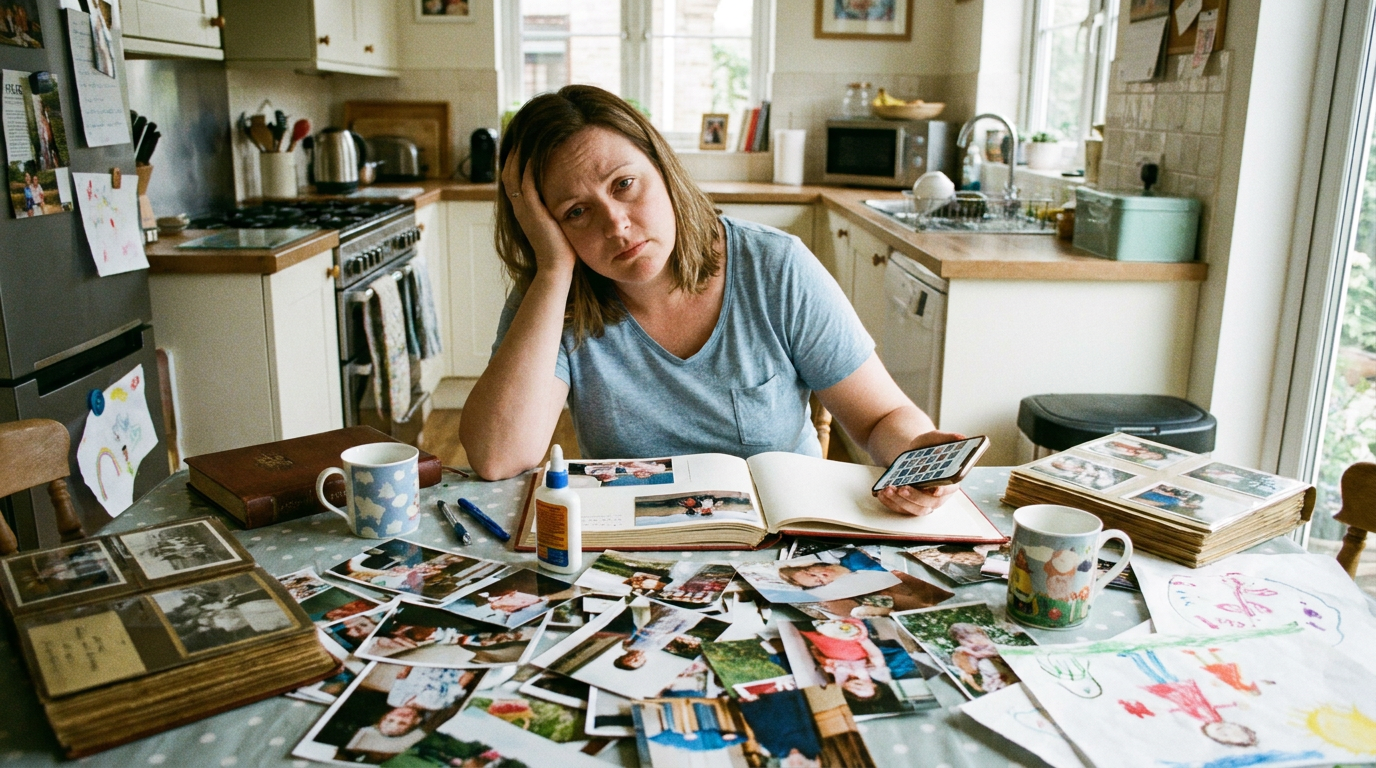
There is a particular kind of quiet guilt that lives in the homes of people who love their families very much.
It looks like this: a phone with nine thousand photos on it, most of them never opened again after the day they were taken. A cardboard box in the closet with a half-finished scrapbook inside, three pages beautifully done, the rest still blank from the spring of 2021. A folder on a laptop called Photos to Sort that has not been sorted. A vague, persistent awareness that your children are getting older at a speed you did not consent to, and that the small things — the way your daughter says "lellow" instead of yellow, the specific joke your father tells every single Christmas — are quietly leaving the building.
You are not disorganised. You are not lazy. You are living through the strangest paradox in the history of memory: we have more tools to capture our lives than any generation that has ever existed, and most of us feel like we are losing them anyway.
So people go looking for a solution, and they usually land in one of two places. Either they start building a digital scrapbookMost people assume the answer is obvious. Scrapbooking is the traditional, respected, visual craft of memory keeping — of course it wins. It has decades of culture behind it, dedicated communities, a whole aisle at the craft store.
Which one actually works? Which one is the better home for your family's story?
— beautiful layouts, digital paper, decorative embellishments, photos arranged with real care. Or they download a journal app and hope that writing things down will finally make the memories stick.
We are going to challenge that assumption, carefully and with evidence. Not because scrapbooking is bad — it genuinely isn't, and we'll spend real time honouring what it does brilliantly — but because preserving a story and designing a page turn out to be two very different jobs.
The answer might surprise you.
What a Digital Scrapbook Does Well — And Where It Stops
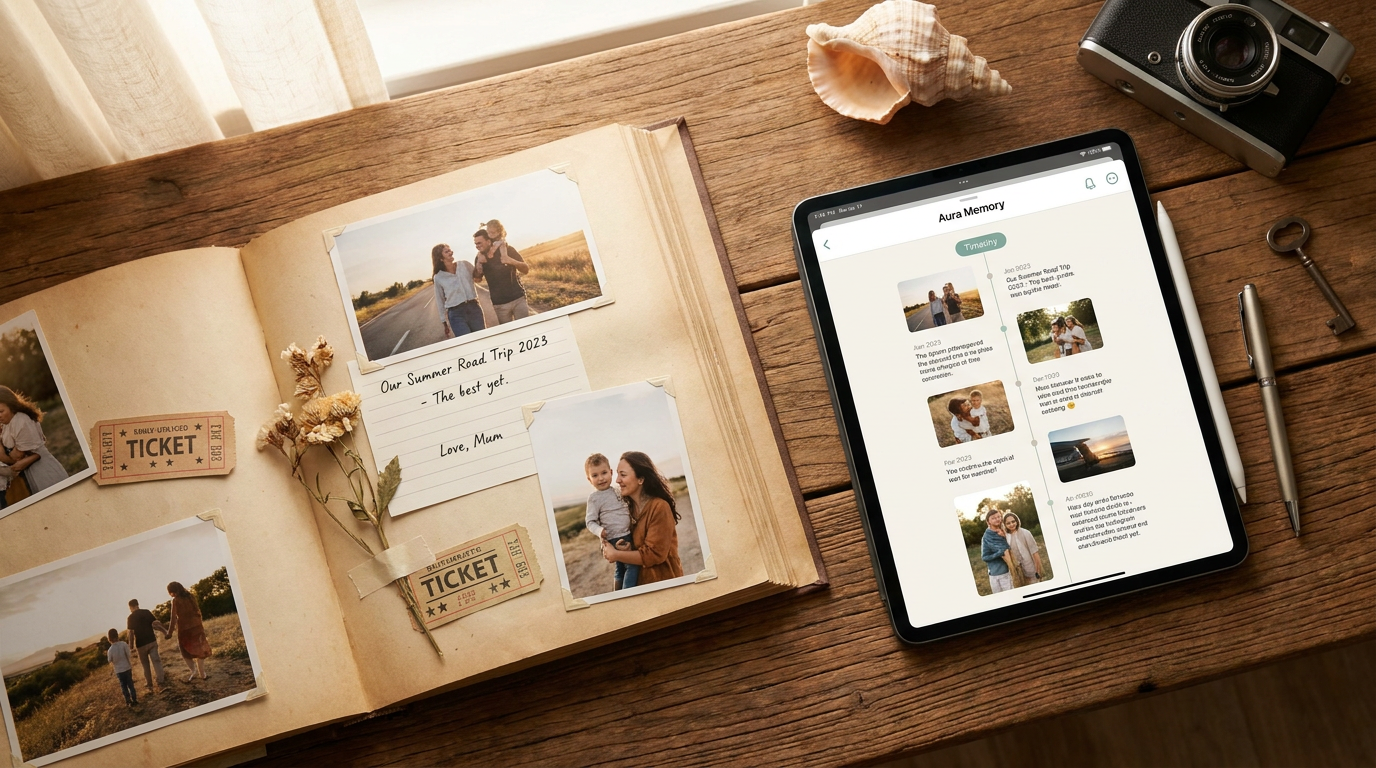
Before we can compare anything fairly, we need to define it honestly. And digital scrapbooking deserves a fair definition, because it is a real craft practised by serious people who care deeply about their families.
Digital scrapbookingAnd it solved some genuinely painful problems.
is the practice of building decorated, photo-centric layouts on a screen instead of on cardstock. You take your photographs, arrange them on a digital canvas, and surround them with digital paper, borders, frames, stickers, journaling cards, and typography. The finished product is usually exported as a high-resolution image, a printable page, or a PDF you can send to a printing service and hold in your hands. It is the descendant of the physical scrapbook — same instinct, different medium.
The Case for Digital Scrapbooking Is Stronger Than You Think
The first thing digital scrapbooking fixed was cost. Traditional scrapbooking is an expensive hobby, and not in a small way. According to , traditional scrapbookers spend roughly $700 to $900 per year on physical supplies — paper, adhesives, punches, dies, albums, embellishments. Digital scrapbookers, by contrast, typically spend somewhere between $0 and $100 annually. That is not a marginal saving. That is the difference between a hobby you can afford and one you cannot.
digital scrapbooking statistics compiled for 2026
The second thing it fixed was storage. Physical scrapbooking generates stuffThe third thing it fixed was the fear of ruining a page. Anyone who has ever glued a one-of-a-kind photograph slightly crooked onto expensive cardstock knows the specific horror of the irreversible mistake. Digital work has an undo button. That freedom makes people braver and more creative.
. Bins of patterned paper. Drawers of stickers. Finished albums that weigh several kilograms each and take up an entire shelf. Digital scrapbooking collapses all of that into a folder.
This is not a fringe activity, either. Roughly 25 million Americans identify as scrapbookers, and the global memory-keeping market — spanning scrapbooking, photo books, and related keepsakes — is valued at around $3.5 billion. The same 2026 research indicates that at least 40% of active scrapbookers now use digital tools somewhere in their workflow, with the digital segment growing at roughly 12% annually. Digital scrapbooking isn't a novelty. It's a mainstream, thriving discipline with real craft standards and real communities behind it.
So let's be unambiguous: digital scrapbooking is good at what it is designed to do. It produces beautiful artefacts. It is creatively satisfying in a way that few hobbies are. Making something lovely with your own hands and eye, out of the raw material of your own life, is a legitimate joy.
The question is not whether digital scrapbooking is worthwhile. The question is whether building layouts is the same activity as preserving a story.
The Four Gaps Nobody Mentions in the Tutorial
Here is where honesty requires us to keep going.
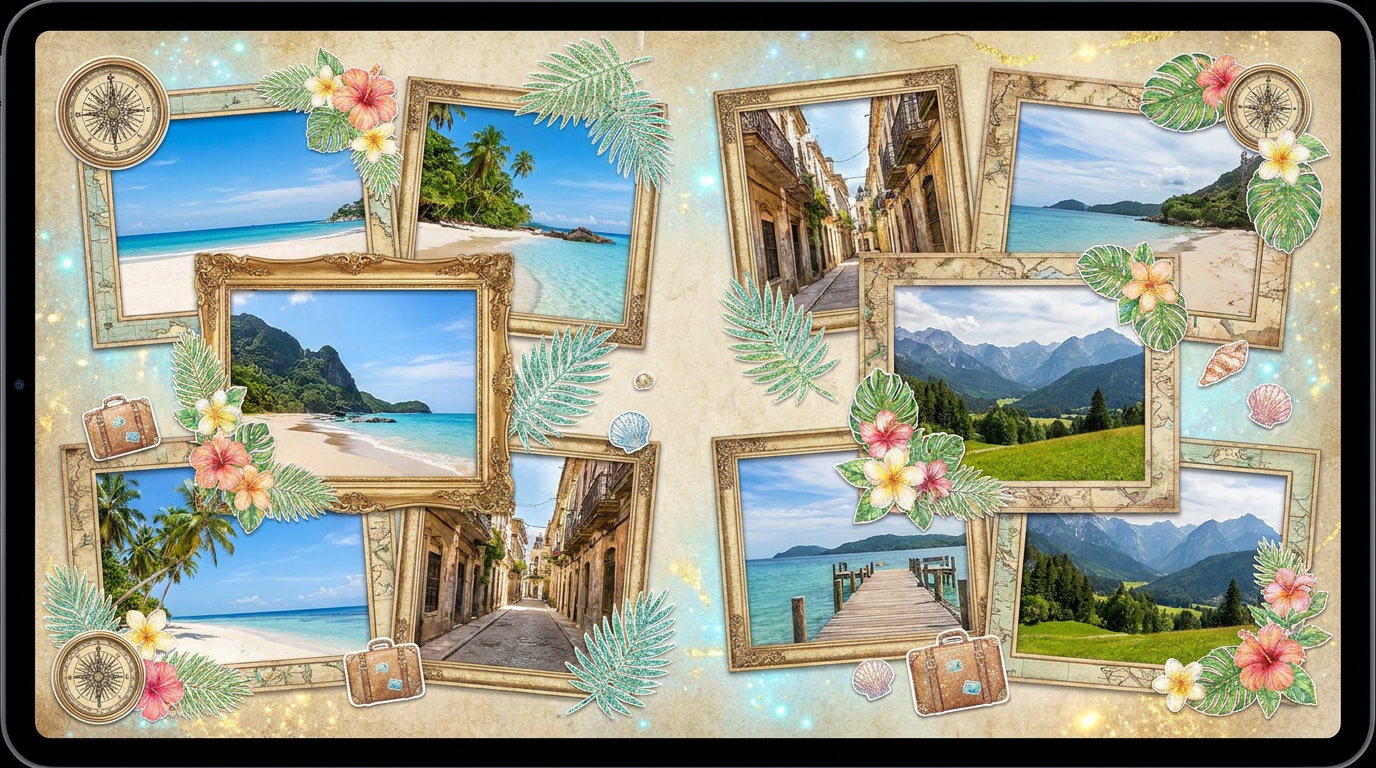
1. It is fundamentally visual and fundamentally static. A digital scrapbook page is optimised for composition — balance, colour, hierarchy, white space. Those are design problems, and design tools solve design problems. But a page that is optimised for how it looks is not optimised for what it means. You can spend two hours perfecting the placement of six photographs from your son's birthday and, at the end of it, have recorded almost nothing about the birthday itself.
2. There is no room for the story. Most scrapbook layouts allow captions. A caption is typically a handful of words: "Beach Day 2025." "He did it!" "Summer at Nana's." Captions are labels, not narratives. They tell you the what and occasionally the when. They almost never tell you the how it felt, the what went wrong, the what she said in the car on the way home that made everyone go quiet. The story — the actual memory — has nowhere to live.
3. There is no audio. At all. This is, to my mind, the single most consequential gap. A scrapbook page cannot hold your child's voice. It cannot hold your grandmother telling the story of the photograph you are looking at. It cannot hold the specific pitch of a four-year-old's laugh, which you will forget, completely, within about eighteen months, and which no photograph will ever give back to you. Sound is the most emotionally direct medium humans have, and the entire scrapbooking format is structurally deaf to it.
4. It is almost always a solo project. Scrapbooking is one person, working alone, making design decisions. That means the finished album represents exactly one perspective on a shared family life — usually the person who took most of the photos. Your partner remembers that holiday differently. Your teenager definitely does. Your mother remembers a version of your childhood that you have no access to. In a solo workflow, none of those perspectives make it in.
The Statistic That Explains the Whole Problem
Consumer research on American photo habits found that 48% of Americans have more than 1,000 photos on their phone — and printing is vanishingly rare. Roughly one in three people have never printed a single smartphone photo in their lives, and only about 18% have printed one in the past three months. The average iPhone is now carrying somewhere in the region of 2,500 images.
Read that carefully, because it describes a genuine crisis rather than a mild inconvenience. Enormous quantities of captured life, almost entirely unprocessed. And here is the uncomfortable implication for scrapbooking: it is a craft with a high effort cost per page. It asks people who already feel behind by nine thousand photos to sit down and design. Which is exactly why so many scrapbooks stop at page three.
The tool isn't failing because it's badly made. It's failing because the job has changed. Families are no longer short of images. They are short of context, voices, and time
Which raises the obvious question: what's the alternative? And here most people picture something even less appealing — a blank text box with a padlock on it. That picture is about a decade out of date.
.
What a Modern Journal App Actually Offers in 2026
If that is your mental image, you are comparing a 2026 digital scrapbook to a 2012 notes app, and the comparison isn't close to fair.
Say the words "journal app" to most people and they imagine a diary. A cursor blinking on an empty white page. Maybe a PIN code. Something you are supposed to write in every night, which you will do for eleven days and then abandon forever.
A modern journaling platform is not a text document. It is a multimedia container for a moment. And that distinction changes everything about this comparison.
One Entry, Every Layer of the Memory
Here is the core structural difference. In a digital scrapbook, a memory is represented by images arranged in space. In a modern journal app, a memory is represented by a single entry that can hold every format at once.
A single entry can contain:
- The photographs — as many as you want, full quality, no layout skills required.
- The written story — not a caption. The actual account. What happened, who was there, what it felt like, what you want to remember.
- A voice note — your child describing their own birthday in their own words, at their own age, in their own voice.
- A video clip — the six seconds of footage that carry more than any still frame could.
- Links and documents — the ticket stub scan, the recipe, the hospital wristband photo, the article about the town you visited.
Imagine you are journaling a Sunday lunch at your grandmother's house. In a scrapbook, you get four nice photographs of the table and the people around it. In a journal entry, you get those same four photographs — plus two hundred words about the argument over the roast potatoes that everyone found hilarious, plus a ninety-second audio recording of your grandmother explaining where the recipe came from and which of her sisters taught it to her, plus a short video of your uncle failing to carve anything correctly.
Twenty years from now, which of those two artefacts do you want to own?
Writing Isn't Just Storage — It Changes the Memory Itself
This is the part that surprises people, and it's worth slowing down for, because it is the strongest argument in this entire article.
We tend to assume that writing something down is simply an act of storage — you put the memory somewhere so you can retrieve it later. The psychological research suggests something more interesting: the act of writing actively changes how the experience sits in your mind.
The by Kitty Klein and Adriel Boals, who found that people who wrote expressively about a significant life experience showed measurable improvements in working memory compared with control groups who wrote about neutral topics — with effects still present seven weeks later. The proposed mechanism is elegant: unprocessed experiences generate intrusive, recurring thoughts that quietly consume cognitive bandwidth. Writing them into a coherent narrative reduces that intrusive load, freeing up mental resources.
American Psychological Association reported on research
Notably, the researchers found that the participants who improved most were those whose writing contained more causal and insight language — words like because, realised, understood. In other words, the benefit came specifically from constructing meaning, not from merely recording events.
That finding maps almost perfectly onto our comparison. Arranging a photograph on a page is recording. Writing "we booked that trip because we'd had the hardest year of our marriage and needed to remember we liked each other" is meaning-making. The tools are not doing the same thing to your brain.
"Writing about a stressful experience helps people organise their thoughts and find meaning in what happened — and that process, rather than the writing itself, appears to carry the benefit."
It's worth being precise rather than overselling here. This research is about emotional processing and working memory, not about photographic recall, and effects across the wider literature are modest and vary by person. But the direction is consistent and the implication is real: narrative does something that layout cannot.
The Four Capabilities That Redefine the Category
Beyond the multimedia layer, four features separate modern journaling platforms from both old-fashioned diaries and digital scrapbooks.
Collaboration. A journal can have more than one author. Your partner, your parents, your siblings, your closest friends — anyone who was actually there can contribute their own version of the same event. This is genuinely new, and we'll come back to why it matters so much.
Outputs. A journal doesn't have to stay trapped inside an app. Entries can be transformed into an ebook, a printed storybook, an interactive timeline, or even an immersive gallery you can step inside. The scrapbook's biggest advantage — you end up with something tangible — is no longer exclusive to scrapbooking.
Privacy by design. This matters more every year. Social platforms were never built to be family archives; they were built to be advertising surfaces, and the memories you post there live on someone else's terms. A private-by-default journal inverts that relationship. Nothing is public unless you decide it is.
AI assistance. Not to write your memories for you — that would defeat the entire purpose — but to defeat the blank page. Prompts, questions, and gentle structure for the parent who wants to write but doesn't know how to start.
If you're new to the concept and want the foundations before the comparison, our guide on walks through it from scratch.
what digital journaling actually is
The Living Record
There's one more difference, and it's philosophical rather than technical.
A scrapbook page is finished. That's the goal — you complete it, you print it, you close the album. Completion is the reward.
A journal is alive
One produces artefacts. The other produces an archive. With both tools now clearly defined, let's put them directly against each other on the criteria families actually care about.
. It accumulates. Entry three hundred sits in the same continuous record as entry one, and the relationship between them is part of the story. You can see your child's vocabulary changing across years of voice notes. You can watch your own handwriting-equivalent — your written voice — mature. You can trace the arc of a family across a decade rather than admiring individual frozen frames.
Digital Scrapbook vs. Journal App: The Honest Comparison
Let's run this properly — criterion by criterion, with real scenarios rather than feature-list abstractions. I'll give each one a plain verdict.
1. Getting Started
Digital scrapbook: moderate difficulty. Journal app: low difficulty.Digital scrapbooking has a genuine learning curve. You need to understand layers, resolution, export settings, and — crucially — you need some visual design instinct. Templates help enormously, but the gap between "used a template" and "made something you're proud of" is real, and it's where a lot of beginners quietly give up.
A journal entry has a much lower floor. You can produce a valuable entry in ninety seconds: three sentences and a photo. It will not be beautiful, but it will be complete in the way that matters. When a tool's minimum viable output is that cheap, you actually keep using it.
2. Photos
Draw.
Both handle photos excellently. This is scrapbooking's home turf and journaling has fully caught up. No meaningful advantage either way — though it's worth noting the two tools treat photos differently philosophically. Scrapbooking treats the photo as the subject. Journaling treats it as evidence supporting the story.
3. Video
Journal app wins outright.And yet some of the most precious footage any family owns is video: first steps, a wobbly rendition of Happy Birthday, a dog meeting a baby for the first time. In a journal app, that clip lives inside the entry, next to the photos and the writing, permanently attached to its context.
Digital scrapbooks are, by definition, page-based. Pages don't move. If a page is destined for print or PDF, video simply cannot exist within it.
4. Audio and Voice Notes
Journal app wins outright — and this is the widest gap in the entire comparison.
Picture a specific Tuesday. Your five-year-old says something at the dinner table that is so unexpectedly funny and so perfectly themMultiply that by every year of childhood and every ageing relative you have, and the gap stops being a feature difference and becomes something closer to a tragedy. Voices are the first thing memory loses and the last thing we'd choose to give up.
With a digital scrapbook, you have nothing. There is no mechanism. The format cannot accept the input.
With a journal app, you pick up your phone, hit record, and ask them to say it again. Now you have their voice, at five, saying that thing, forever.
that the whole table stops. You have maybe forty seconds before the moment passes.
5. Written Narrative
Journal app wins clearly.Scrapbooks offer captions; some styles include a small "journaling block" of a few sentences. Journals offer unlimited written space with search across every word you've ever written.
The search point deserves emphasis. In a journal, you can type "hospital" or "Portugal" or "first day of school" and instantly surface every relevant memory across ten years. A scrapbook album offers no such thing. You flip pages and hope.
6. Collaboration
Journal app wins outright — and this is the most underrated row here.Consider a family holiday documented collaboratively. You write about the logistics and the exhaustion and the moment it finally clicked. Your partner adds the photos you didn't take. Your teenager contributes a wry three-line entry that captures something you'd never have noticed. Your mother, who joined for two days, adds a voice note about how strange and lovely it was to watch her grandchildren play in a place she visited as a child.
Family memories are inherently plural. Everyone who was present holds a different piece of the same event. But the digital scrapbook is a single-author medium: one designer, one set of choices, one perspective.
That is not an album. That's a document of how a family experienced its own life — and it can only exist if the tool allows multiple contributors. You can see the collaboration and multimedia capabilities in detail on .
Lugelo's feature set
7. Privacy and Control
Journal app wins, with caveats on both sides.A privacy-first journal app inverts the default: everything is private unless you explicitly share it, with owner-controlled permissions. Given that we're discussing photographs of children, this isn't a minor preference.
Digital scrapbook privacy varies wildly. Files stored locally are private but fragile — one hard drive failure from oblivion. Cloud-based design tools have their own terms, and community-oriented scrapbooking platforms are often built around sharing galleries publicly.
8. Outputs and Keepsakes
Journal app wins on range; scrapbook remains excellent at one specific thing.But the range is narrow — printable pages and PDFs, essentially. A modern journal can become an ebook, a professionally formatted printed storybook, an interactive chronological timeline, or an immersive VR gallery you can walk through. The same underlying memories, expressed in whatever form suits the occasion.
Credit where it's due: a digital scrapbook produces a genuinely lovely printed page. That's the craft's whole purpose and it delivers.
9. Living Record vs. Finished Artefact
Journal app wins for families; scrapbook wins for project-lovers.
If you love the satisfaction of completing something, scrapbooking gives you that. Journaling never finishes — which is either its greatest strength or a mild frustration, depending on your temperament.
For preserving a family's story, though, "never finished" is precisely correct. The story isn't over.
10. AI Assistance
Journal app wins.
Scrapbooking tools have some AI-assisted layout features, but they help you design. Journaling AI helps you remember — prompting with questions like "What surprised you about today?" or "What do you want them to know about this when they're older?"
For the parent staring at a blank entry at 10pm, thinking I know this mattered but I don't know how to say it, that assistance is the difference between an entry existing and not existing.
Scoring It Honestly
Across ten criteria: the journal app wins seven outright, draws one, and loses none — though scrapbooking retains a real edge in pure visual craftsmanship and the satisfaction of a finished object.
That's the fair summary. Digital scrapbooking is a design practice that uses memories as raw material. Journaling is a memory practice that happens to include design. If your goal is making beautiful pages, scrapbook. If your goal is preserving your family's story, the evidence points elsewhere. For broader context on what separates capable journaling platforms from basic note-taking, our goes deeper.
honest comparison of journaling apps in 2026
The comparison is settled on features. But there's a more important argument underneath it.
Let me put the central claim as plainly as I can.
In ten years, you will not remember the layout of the page. You will remember the story — but only if somebody wrote it down.
The Context Collapse Problem
You know roughly when it was. You recognise everyone. But try to answer these: What were you laughing at? What had happened that morning? Why is your son wearing that particular shirt, and wasn't there something about that shirt? Who took the picture? What did you eat? What was worrying you that week that felt enormous and has now completely evaporated?
Open a photograph from eight years ago. Really look at it.
You almost certainly can't. This is context collapse, and it happens far faster than anyone expects — meaningfully within five to ten years. The image survives perfectly. The world around the image dissolves.
A photograph is a trigger, not a record. It's superb at reactivating a memory that still exists somewhere in you, and completely powerless once that memory has faded. Which means a photo-only archive is, functionally, a collection of keys to doors that are slowly being bricked up.
The written sentence is what holds the door open. Twenty words is enough: "This was the day after the scan came back clear, which is why everyone looks slightly unhinged with relief." That sentence will still work in forty years. The photo alone will not.
What Writing Actually Does
There's real science underneath this. — building on decades of work pioneered by James Pennebaker — describes how writing about meaningful experiences helps people organise their thoughts, regulate emotion, and construct meaning from events, with measurable effects on stress and wellbeing.
Harvard Health's summary of the expressive writing research
A examined journaling interventions across randomised controlled trials and found statistically significant reductions in mental illness symptom scores compared to controls — with anxiety showing among the clearer responses. The effects were modest rather than dramatic, and the researchers noted considerable variation across studies. I'd rather report that accurately than inflate it.
2022 systematic review and meta-analysis published in Family Medicine and Community Health
But note what's consistent across the literature: the benefit lives in the narrative construction. In building a coherent account. In the causal and insight language that turns "things happened" into "this is what it meant."That is not a thing a beautifully composed page can do, no matter how skilfully it's made.
The Voice You Will Wish You Had Recorded
I want to be specific here, because abstraction lets people off the hook.
Your child is six. Ask them, out loud, what their favourite thing about this year was. Record the answer. It'll take ninety seconds and they will say something strange and wonderful and entirely of their age.
Now project forward twenty-six years. They're thirty-two. Perhaps they have children. And you can play them the sound of themselves at six.
There is no scrapbook page in existence that can do that. There's no layout, no embellishment, no typography choice that comes close. Sound is the most direct route to emotional memory we have — most of us can conjure a departed relative's voice more vividly than their face, and we lose it faster too, because nobody ever thinks to record it.
This is why the audio gap isn't a footnote in a feature comparison. It's the whole argument.
The Grandparent Window Is Closing
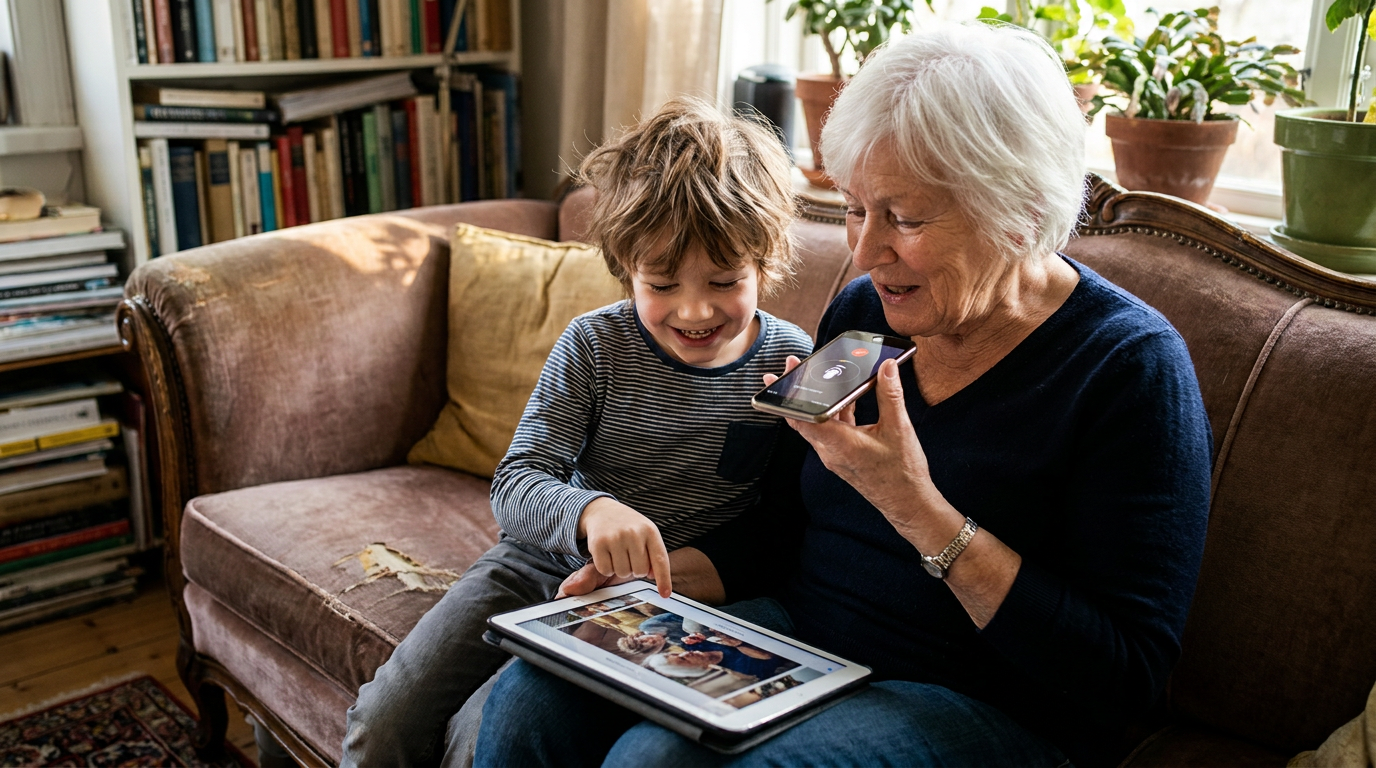
Every family has a person who holds the history. The one who knows which cousin emigrated and why, what the village looked like, what your father was like at nineteen, why nobody speaks to that branch of the family anymore.
When that person dies, their entire archive goes with them. Not metaphorically — literally. Decades of irreplaceable first-hand memory, gone in an afternoon.
Collaborative journaling may be the single most valuable answer to this that currently exists. A grandmother doesn't need to learn design software or write a memoir. She needs to be invited to a family journal and asked, occasionally, to record a two-minute voice note about one photograph.
Do that fifty times over two years and you've built something no amount of money can reconstruct later.
"Journals are souvenirs of your past."
That's Lugelo's line, and it earns its place. A souvenir isn't decoration — it's proof. It's the physical evidence that you were there, that it happened, that it mattered. A well-kept family journal is a souvenir of an entire life, gathered in real time by the people who lived it.
Honouring the Craft, Reframing the Purpose
Digital scrapbooking is an art form. The people who do it well are making something genuinely lovely, and the hours spent are hours spent thinking lovingly about your own family. That has value independent of preservation.
None of this diminishes scrapbooking. I want to say that clearly, because I suspect some readers have a half-finished album in a drawer and feel got at.
But a beautiful layout of a memory is not the same as the memory. The page is the frame. The story is the picture. Scrapbooking has spent decades perfecting the frame — which is honourable work, and also why so many families discover, years later, that they own thousands of exquisitely framed blanks.
For the practical version of what this looks like day-to-day, our piece on
how parents use Lugelo to document their child's growth
So if photos alone aren't enough and layouts aren't the point — what does a family actually need?
shows real families doing exactly this.
What Families Actually Need — And How Lugelo Delivers It
Here's the honest reframe: you shouldn't have to choose.The reason this comparison feels difficult is that both tools are offering something real. Scrapbooking offers beauty and a finished keepsake. Journaling offers depth, voices, and completeness. Most families want all of it.
Lugelo was built on the premise that this trade-off is artificial. It isn't a scrapbook. It isn't a diary with a padlock. It's a collaborative multimedia storytelling platform — the visual richness families love, joined to the narrative depth their memories actually require.
Every Layer of a Memory, in One Place
In Lugelo, the unit of memory is a Moment — and a Moment holds everything. Photos. Video. Voice recordings. Written narrative of any length. Links and documents.
That birthday isn't six photos on a page. It's the photos, and the story of how the cake collapsed, and the audio of everyone singing badly, and the clip of the candles. One entry. Complete. You can .
explore the full feature set here
The AI Journal Assistant: Beating the Blank Page
The main reason memory-keeping projects die isn't lack of desire. It's the blank page at 10pm when you're exhausted and can't find the words.
Lugelo's AI Journal Assistant exists to remove that specific friction — offering prompts, asking the questions that unlock a memory, helping shape rough thoughts into something readable. Crucially, it doesn't replace your voice. Your family doesn't want a polished essay from a machine. They want you, imperfect and specific. The assistant just gets you past the paralysis.
Built for More Than One Author
Invite your partner. Your parents. Your siblings. Your children, when they're old enough.
Everyone contributes their own perspective to the same shared journal, and the result is genuinely different in kind — a family holiday recorded from five angles instead of one. You can see how real families are using this on .
Lugelo's family stories page
Private by Default
Your family archive should belong to your family. That principle is architectural, not a setting.
Everything is private unless you choose otherwise, protected with strong encryption and owner-controlled sharing. No algorithmic feed. No public gallery by default. No monetising your children's faces.
From Journal to Keepsake
Your entries can become:
This is where Lugelo closes the loop with scrapbooking's greatest strength — the tangible artefact.
- A printed storybook you can hold, shelve, and give as a gift.
- An ebook shared instantly with relatives anywhere.
- A Memory Lane timeline that places every entry chronologically, building a visual arc of your family's story.
- An immersive VR gallery you can genuinely step inside.
Lugelo reports that 92% of users are satisfied with the quality of their keepsake outputs — meaning the finished object looks as good as the story reads. You aren't trading beauty for depth. You're getting the depth and then the beautiful object at the end.
The Core Difference
A digital scrapbook gives you a finished, beautiful page.
Lugelo gives you a living archive — one that grows with your family, holds every format a memory needs, welcomes everyone who was there, and can be transformed into a printed book or a walkable gallery whenever you want.
It's available on iOS, Android, HarmonyOS, and the web, and it's free to start. If you'd like the practical mechanics first, we've written
a plain-English explanation of how digital journaling actually works
Which leaves one question — the one that stops most people before they begin.
.
How to Start Today, Even With Years to Catch Up On
"I have ten years of memories I've never recorded. Where do I even begin?"
This is the objection, and it stops more people than any other. So let's dismantle it.
You do not begin at the beginning. You begin now, with the most recent thing you'd hate to lose. The backlog is not a prerequisite. It's optional, and it can be worked backwards slowly, whenever you feel like it, forever.
The single most damaging idea in memory keeping is that it must be complete to be worthwhile. It doesn't. An incomplete archive that exists beats a perfect one that never got started, every single time.
Your First Twenty Minutes
- Choose one memory. Not the most important one. A recent one. Last weekend. A birthday. An ordinary Tuesday that felt unexpectedly significant.
- Create a free journal. Name it. Add a cover photo. Ninety seconds.
- Write three sentences. Not an essay — three. What happened. How it felt. What you want to remember. That's a complete entry.
- Add one photo. Watch the entry turn from text into a memory.
- Record ten seconds of audio. Your voice, or theirs. This is the step people skip and later wish they hadn't.
- Invite one person. Partner, parent, sibling. Ask them to add their version of the same moment. Their entry will contain something you'd have never thought to record.
Twenty minutes. One complete, multi-layered memory — with the story, the image, and the voice all in the same place. Already richer than most finished scrapbook pages.
Permission to Be Imperfect
Your first entries will be clumsy. Good.
Nobody's grandchildren will read their family journal and think the prose was uneven in year one. They will think: she wrote this down. She thought this was worth keeping.One honest, messy, three-sentence entry with a voice note attached is worth more than ten immaculate but empty layouts. Lower the bar until you can step over it, then keep stepping.
Bringing the Past With You
If you do want to tackle the backlog, Lugelo makes it manageable: import from your camera roll, pull memories in from Facebook, Instagram, and WhatsApp, and scan handwritten letters, cards, and documents.
That's the key move for anyone with a decade of photos — you're not recreating the past, you're giving existing images the narrative layer they never had. Ten minutes on a Sunday, one old photo, one paragraph about what was happening in it. Do that occasionally and the archive fills in behind you.
If you're not sure you're the "journaling type," our piece on will likely change your mind.
who digital journaling is actually for
"Don't let your best memories disappear."
Whether you've been searching for a digital scrapbook alternative or simply a better way to hold onto your family's story, the answer is the same: start with one memory, today. — free to begin.
Download Lugelo on iOS, Android, or the web
The Verdict: Beautiful Isn't the Same as Complete
Here is the whole argument in one line: a digital scrapbook is beautiful. A journal is complete.But we should be clear-eyed about what it is. Scrapbooking is a design practice that uses memories as material. It arranges the surface of your life very well. It was never built to hold the voice, the argument, the private reason a photograph matters, or the four other people who remember the day differently.
Digital scrapbooking deserves its place. The craft is real, the community is real, and the care that goes into a well-made page is a form of love. Twenty-five million Americans haven't been wrong for thirty years. If making beautiful things from your family's photographs brings you joy, keep doing it — that joy needs no further justification.
Your family's story is not a layout. It's a living thing, still being written, and it deserves a home that holds all of it — the photographs and the voices, the written memories and the competing perspectives, the ordinary Tuesdays alongside the milestone Saturdays.
That's the real distinction. One tool asks how should this look? The other asks what actually happened, and what did it mean?Only one of those questions still has an answer in forty years.
So whether you've been exploring digital scrapbooking or searching for something deeper, the invitation is the same — and it's simpler than the backlog in your camera roll makes it feel. Everyone has a story to tell. Share yours on Lugelo.
The best time to record it was the moment it happened. The second best time is tonight, in three sentences, before you forget.
Your Family's Story Deserves More Than a Camera Roll
Start preserving it today — free, private, and entirely yours.
Create Your First Journal on Lugelo →
Want to look around first?
Explore everything Lugelo can do →Download the app on iOS, Android, or web →