The October Memory Journal: 60+ Fall & Halloween Journal Prompts (Plus How to Turn Them Into a Keepsake Your Family Keeps Forever)
This is the strange arithmetic of October. It is one of the richest months of the year for family memory, and simultaneously one of the most reliably forgotten. We photograph it obsessively and document it almost never. The camera captures what the costume looked like; it does not capture why your seven-year-old insisted on being a dragon instead of the astronaut you had already half-built, or what she said in the car on the way home, or which house on the route gave out full-sized chocolate bars and became legend for the next four years.
The costume survived. The story did not.
So the argument starts, the way it always does. Was that the dinosaur year or the witch year? Was that before or after you moved? Who is that other kid, half-cropped out on the left, the one with the cape? Somebody remembers the cape. Nobody remembers the kid. And the reason everybody in the photo is laughing — genuinely, mouth-open laughing, the kind you cannot pose — is simply gone. Not misfiled. Gone.
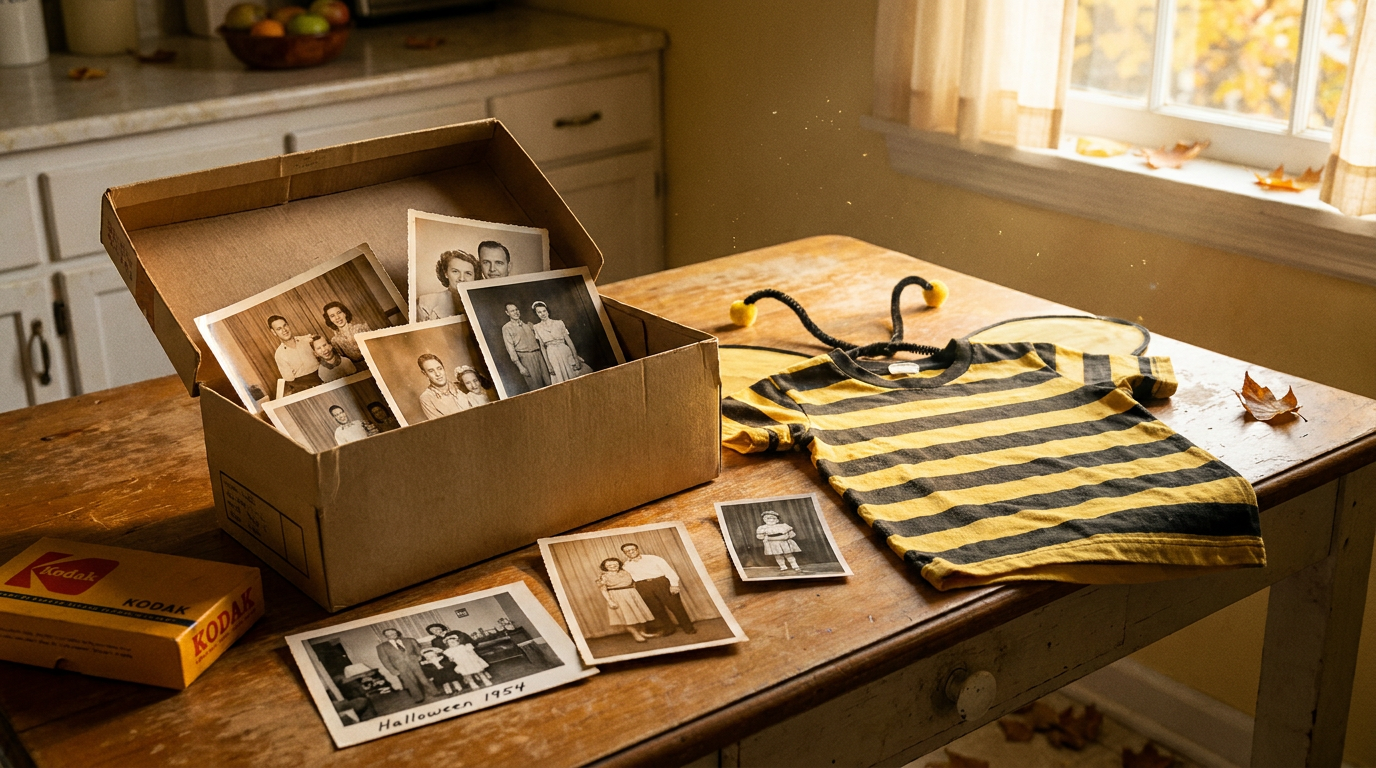
And on the back of it: nothing. No date. No name. No year.
You know the one. Slightly out of focus. A porch light blowing out the top corner. A plastic pumpkin bucket held with both hands.
There is a shoebox in most houses. Yours might be a drawer, or a chipped biscuit tin, or a folder on a laptop nobody has opened since the last operating system update. Inside it, somewhere near the bottom, is a photograph of a child in a Halloween costume.
This post is the fix. Below you will find 60+ October, fall, and Halloween journal prompts — 84 of them, actually — organised into six banks: a full 31-day October prompt calendar, a set written specifically for Halloween night, age-tiered prompts for kids from kindergarten through middle school, quieter reflective prompts for adults, a Halloween “would you rather” block for reluctant writers, and group prompts for when several people are journaling the same evening.
Then, after the prompts, the part almost nobody does: a practical method for turning a month of scattered answers into something your family actually keeps.
Why October Is the Best Month of the Year to Start a Journal
Consider what is actually stacked into these thirty-one days. The season visibly turns — you can watch it happen through a window, week by week, in a way you cannot with most months. Routines have reset after the summer and are now bedded in enough to have a shape. Costumes are chosen, argued over, abandoned, re-chosen and eventually assembled at 9pm the night before. Pumpkins arrive and are butchered with varying levels of skill. Clocks change in much of the world. And then there is one single night that generates more photographs than almost any other night on the family calendar.
October has the opposite problem. October has too much.
Most people decide to start journaling on January 1st, which is arguably the worst possible day to try. Nothing is happening. The decorations are down, the visitors have gone, the weather is grey in a monotonous rather than an interesting way, and you are being asked to write meaningfully about a Tuesday in which you did laundry. The resolution dies by the 9th, not because you lack discipline, but because you have nothing to write about.
The raw material is simply there. You are not manufacturing something to write about. You are declining to let a month that is already full of material evaporate.
The paradox: heavily photographed, barely documented
Here is what makes October worth a set of dedicated october journal prompts rather than generic ones. The month is over-photographed and under-recorded, and those are not the same thing.
Your camera roll from last October probably contains forty images. It contains zero explanations. A photograph is extremely good at answering what did this look like and completely useless at answering everything else. It cannot tell you why that costume was chosen over the other one. It cannot tell you who came to the door in the first hour and who came in the last. It cannot tell you that your child was quietly terrified of the inflatable spider three houses down and made you cross the road, and that by the following year she thought the spider was hilarious — which is, if you think about it, a more complete record of a year of growing up than any photograph could manage.
The same argument sits at the heart of Lugelo’s : photos without context are just files. Volume is not memory. Ten thousand images with no story attached is an archive nobody can read.
guide to building a school memory book
“Journals are souvenirs of your past.”
What the research actually says about writing things down
It is worth being precise here, because this territory attracts a lot of overclaiming.
A examined 51 studies of positiveThere is a second, quieter reason to write, and it has nothing to do with wellbeing outcomes at all. You write in October because in eleven years you will want to know what happened, and nobody else is keeping the record.
So: no promises. Writing a few sentences a night in October is not a treatment for anything, and nobody should sell it as one. What the literature suggests is narrower and still worth knowing — that structured, positive, reflective writing is associated with improvements in how people report feeling, and that the benefits appear regardless of whether people typed or handwrote their entries. The mode of disclosure was not the active ingredient. The writing was.
The authors are also candid about the limits of their own evidence base: every study included in the review was rated as poor or fair quality, and they explicitly call for more rigorous methods in future work. That caveat belongs here as much as the headline does.
expressive writing — that is, structured writing about gratitude, positive experiences, benefit finding, “three good things,” and best-possible-self exercises — in non-clinical adult populations. The reviewers found that the most consistent benefits appeared in wellbeing and positive affect outcomes, things like optimism and happiness. Effects on negative affect, psychological health outcomes such as stress and anxiety, and physical health outcomes were considerably more mixed. Gratitude and best-possible-self exercises showed the most reliable results of the seven techniques examined.
The case for a very low bar
The reason most October journaling attempts collapse around the 6th is that people set out to write properlyDiscard all of that. The unit of work here is one prompt, answered in two or three sentences, once a day. That is thirty seconds of typing. It fits inside the time you spend waiting for a kettle.
. They picture paragraphs. They picture a leather notebook and a fountain pen and a mood.
The value is not in eloquence. It is in accumulation. Thirty-one unremarkable entries produce something that no single remarkable entry ever could — a texture, a month with edges, a record that includes the boring Wednesdays that turn out, years later, to be the ones you actually miss. Lugelo’s The fastest way to begin is to stop planning and answer one question tonight. Here are eighty-four of them.
guide to building journaling habits over thirty days
And prompts are only the starting point. What you do with a month of answers is where the keepsake comes from — but that comes later in this post, and only after the prompts, because prompts are what you came for.
makes this point in more depth: consistency at a low bar beats ambition at a high one, every time.
60+ October, Fall & Halloween Journal Prompts
Six banks follow. Take what you need and ignore the rest — nobody is grading this. Each bank has a short note above it explaining who it is for and when to use it.
A 31-Day October Journal Prompt Calendar
This is the core bank: one prompt for every day of the month, built as an arc. The first ten days lean into the turn of the season and sensory detail. The middle stretch moves into memory, family and gratitude. The final week ramps into costumes, anticipation and Halloween itself. Each is answerable in three sentences. If you miss a day, skip it — do not backfill, just carry on.
- What does this week smell like?
- What is the first thing you noticed changing outside this year?
- Which piece of clothing have you just started wearing again, and how long have you had it?
- What did the light look like this evening?
- What sound belongs to October in your house?
- Which meal have you cooked or eaten this week that you would never make in July?
- What is currently on your kitchen table that would not have been there a month ago?
- Where were you the moment you first felt properly cold this year?
- What did you do today that you also did on this date last year?
- Which song, film or book do you always return to at this time of year, and when did that start?
- Which autumn tradition did your family invent rather than inherit?
- Who taught you something this month without meaning to?
- What is the oldest object in your house right now, and how did it get here?
- Which family story gets told every year, and who tells it best?
- What is one small thing someone did for you recently that you have not mentioned to them?
- Which room in your home do you like most in October, and why that one?
- What are you grateful for today that you were not grateful for last October?
- Who did you think about today that you have not seen in a long time?
- What is something you are quietly proud of from the last three months?
- What are you ready to let go of before the year ends?
- What is one thing you want to finish before December?
- What costume are you or your kids considering, and what changed your mind so far?
- What is the most ambitious costume anyone in this family has ever attempted, and did it survive the night?
- Which decorations went up first this year, and who insisted?
- How did the pumpkin carving go, and whose idea was the design?
- What are you most looking forward to about Halloween this year?
- What is one thing about Halloween that you find genuinely a bit unnerving, even now?
- Which sweets get eaten first in this house, and which are still in the bowl in December?
- What is the plan for the 31st, and who came up with it?
- What is the last thing left to do before tomorrow night, and is it going to get done?
- Describe tonight from the moment you left the house to the moment you got back.
Those thirty-one cover october journal prompts, fall journal prompts, and the broader journal prompts for october territory in one pass. The next bank narrows to a single night.
Halloween Night Journal Prompts
These ten are written to be answered on the 31st itself or the morning after — while the details are still warm and before the week erases them. Halloween night details have an unusually short half-life. Within seven days you will remember that it was fun; you will not remember why. Answer these in a rush, badly, with sticky hands. That is the correct way to use them.
- Who came to the door, and who was the best-dressed caller of the night?
- What was the weather actually doing, and did it change anything?
- Which house on the route did everyone talk about afterwards?
- What got traded, negotiated or quietly stolen out of the candy bag?
- What was funny tonight that absolutely nobody planned?
- Who did you go out with, and how did that end up being the group?
- What was the first house you knocked on, and how did it go?
- Which costume did you see tonight that you wish you had thought of?
- What was the moment you would put in a photograph if you could only keep one?
- What time did you get home, and what was the first thing anyone said?
Halloween & October Journal Prompts for Kids (By Age)
Fifteen prompts across three age tiers. The register shifts deliberately as the ages climb — concrete and sensory for the youngest, cause-and-effect for the middle group, perspective and self-reflection for the oldest. These build on the approach in Lugelo’s , adapted for the season.
25 journal prompts for kids
For teachers and parents wondering whether this is too slight to bother with: Edutopia’s reporting on makes the case that short, frequent, low-pressure prompts do more for developing writers than occasional long assignments. Frequency beats length.
getting elementary students writing every day
Kindergarten and early elementary (ages 5–7)
Concrete, sensory, immediate. Drawing counts as a complete answer. So does dictating it to an adult while eating.
- Draw your costume and tell me one thing you love about it.
- What was the best thing you ate today?
- Draw the scariest thing you saw tonight — was it actually scary, or just a bit surprising?
- Who held your hand tonight?
- What sound do you remember most from tonight?
Elementary (ages 8–10)
Cause, effect, and the beginnings of narrative. Ask for one detail that nobody else would know.
- What was the best thing that happened tonight that you didn’t expect?
- What went wrong tonight, and how did everyone deal with it?
- If you could change one thing about tonight, what would it be?
- Which friend made you laugh the most, and what did they do?
- What would you tell someone who wasn’t there, to make them understand what it was like?
Middle school (ages 11–13)
Perspective, comparison, and a first pass at reflection. These work best if nobody reads them over the writer’s shoulder.
- What’s changed about how you feel about Halloween since you were little?
- What did you notice tonight that the younger kids didn’t?
- Was tonight what you expected? What was different?
- What’s one thing you’re glad you did, and one thing you’d skip next year?
- What do you think you’ll remember about tonight in ten years?
Halloween Journal Prompts for Adults and Reflective Journalers
October is a threshold month. The year is visibly running down, the last quarter has started, and there is something about the early dark that makes people take stock whether they meant to or not. These ten are quieter and more interior than anything above, and they serve the halloween journal prompts for adults and october journal prompts for adults end of the spectrum.
- Which Halloween from your own childhood do you remember most clearly, and what makes it stick?
- What did your parents do in October that you have carried into your own house without noticing?
- What are you carrying into the last quarter of this year that you would rather put down?
- What ended this year that you have not properly acknowledged?
- Who is missing from this October, and what would they have said about it?
- What did you believe in October last year that you no longer believe?
- What is the version of this season you keep trying to recreate, and where does it come from?
- What are you afraid of at the moment, in the ordinary daylight sense of the word?
- What has this year taught you that you did not want to learn?
- If this October were a chapter, what would the chapter be called?
Halloween “Would You Rather” Prompts for Kids
This bank exists for one specific reader: the child who says “I don’t know what to write.” Ten would-you-rather questions, each followed by the same instruction — explain why. That single word is what converts a party game into a journal entry, because the why is where the writing actually happens.
Edutopia’s collection of makes the underlying point well: when there is no wrong answer and no grade attached, reluctant writers write considerably more. Keep these light. None of them are meant to be frightening.
low-stakes writing prompts
- Would you rather have a pet bat or a pet black cat? Why?
- Would you rather trick-or-treat in the rain or in the snow? Why?
- Would you rather have a costume that glows in the dark or one that makes noise? Why?
- Would you rather get one enormous chocolate bar or thirty small ones? Why?
- Would you rather carve a pumpkin or decorate the whole house? Why?
- Would you rather be invisible for a day or able to fly for an hour? Why?
- Would you rather live in a house made of gingerbread or a treehouse in a spooky forest? Why?
- Would you rather wear the same costume for five years or a different one every single day for a week? Why?
- Would you rather hand out the sweets or go door to door? Why?
- Would you rather have a talking pumpkin or a talking skeleton as a friend? Why?
Group and Party Prompts for Multi-Contributor Journaling
The value here is contrast, and it is worth being explicit about it. Ask four people the same question about the same evening and you will get four different evenings back. The parent remembers the logistics. The eight-year-old remembers a dog. The teenager remembers something neither adult noticed. None of them are wrong, and the composite is far closer to the truth than any single account.
The last bank is different in kind. These eight are designed for several people answering the same question on the same night — a family around a table, a classroom, a friend group, a Halloween party where the sugar has worn off and everyone is sitting down.
- What was the best moment of tonight, in one sentence?
- Who was the funniest person here tonight, and what did they do?
- What is one thing that happened tonight that you think nobody else noticed?
- Describe the same five minutes: what were you doing at eight o’clock?
- What surprised you tonight?
- What would you do differently next year?
- What is one thing you want to remember about this specific group of people?
- Finish this sentence: the thing about tonight was —
That is eighty-four prompts. Which raises the obvious question, and it is the question that separates a prompt list from a keepsake: you now have a month of answers sitting somewhere. What happens to them?
Turning a Month of Prompts Into a Family Halloween Memory Timeline
One October of prompts is a nice thing to have. Ten Octobers of prompts, sitting side by side, is something else entirely — it is a portrait of a childhood, assembled almost accidentally, out of two-sentence entries nobody thought were important at the time.
This is the part that compounds. A single year cannot show it to you, which is precisely why most people never get there. The first October feels like a modest little project. The fourth starts to feel like something. By the tenth you are holding a document that no photograph collection, however large, could have produced.
Three threads are worth tracking deliberately, year after year:
- Costumes — what they were, and critically, why they were chosen
- The route — which streets, which houses, and who came along
- Pumpkins — the design, and whose idea it was
Everything else can be improvised. Those three, repeated annually, do the heavy lifting.
The year-over-year costume timeline
Same child. Same month. Ten consecutive years. Each entry carrying three things: the costume, the reason they chose it, and who they went out with.
The costume is the easy part — you already have the photograph. The other two are the ones that vanish, and they are the ones worth having. A costume choice is a snapshot of who a child was that year: what they were reading, who they were copying, what they thought was cool, whether they wanted to be admired or frightening or funny or invisible. A four-year-old choosing a dinosaur and a nine-year-old choosing a dinosaur are two entirely different pieces of information, and only the why tells you which one you are looking at.
Read ten of those in sequence and you can watch a personality assemble itself.
The trick-or-treat route
You will not notice the shift while it is happening. You will notice it very clearly reading the entries back.
Here is why it earns its place: the route changes as children get older, and the record of that change is quietly the record of them growing up. Year one is four houses on your own street with a parent holding a hand. Year five is the full loop with a torch. Year nine is a different street entirely, with friends, and you are waiting at home. Year twelve there is no route at all because they are handing out sweets at the door instead, and that transition happened without any announcement whatsoever.
Which streets you covered, which houses were reliable, who joined you and at what point, which neighbour went so comprehensively overboard with the decorations that their address became shorthand in your household for years afterwards. Write it down as a list, or sketch it, or just name the three houses that mattered.
Nobody thinks the route is worth recording. It is.
Pumpkins, and other small repeatable things
It sounds almost too small to bother with, and that is the point. Small and repeatable beats large and abandoned. The families who successfully keep multi-year records are not the ones with the most elaborate systems; they are the ones whose system takes ninety seconds and therefore survives a year in which everything else went wrong.
A photograph of the pumpkin, plus one line about whose idea the design was. That is the entire commitment.
The multi-year timeline as a structure
The reason to think of it that way rather than as “starting a family archive” is that the second framing guarantees you will never begin. Nobody has time to start an archive. Everybody has ten minutes on the 31st.
Ten minutes a year. That is the actual cost.
Frame the whole thing correctly and it stops feeling like a project. One journal. One entry per Halloween. Revisited every October.
What the research says about families who tell their stories
There is a substantial body of work behind the intuition that this matters, and it comes out of Emory University.
Psychologists Marshall Duke and Robyn Fivush, who directs Emory’s Family Narratives Lab, spent decades developing a scale measuring how much children know about their own family histories — the “Do You Know” scale. In Fivush’s own description of what actually works is the most useful line in the whole piece, and it is strikingly unglamorous:
one study that began just before 9/11 and ran for two years
To be clear about what this is and is not — this is research about families who talk to each other about their past. It is not a claim about journaling software, and nobody should present it as one. What it does establish is that the shared, coherent family story is not sentimental fluff. It is load-bearing.
On standardised measures, the children in the more narratively open families showed better self-esteem, higher social competence, higher-quality friendships, and less anxiety and stress. Parents also reported fewer behavioural problems. Worth noting for accuracy: the families studied were all comparable middle-class, two-parent households, which is a real limit on how far the finding generalises.
, they looked at families with 10- to 12-year-olds and found that children in families that talked about challenging events in more coherent and emotionally open ways coped better across that two-year period than children in families telling less expressive, less coherent stories.
“It’s the really mundane, everyday stories that reassure them that life is stable. It provides a sense of continuity, of enduring relationships and values.”
The mundane ones. Not the milestones. Which is an excellent argument for a prompt that asks what this week smells like.
Four people, one night, four true accounts
A Halloween documented by a parent and the same Halloween documented by the child produce two genuinely different accounts, both accurate. The parent’s version has the weather, the timing, the neighbour conversation, the mild anxiety about the road. The child’s version has the dog, the sweet they had never seen before, and the friend who fell over. Neither is the whole night. Together they are much closer to it.
Return for a moment to the group prompts. The multi-perspective idea is not a gimmick — it is the thing that makes a family record substantially richer than a personal one.
Lugelo’s works through the two-perspective approach in more depth, and the same principle applies to the — same subject, same framing, every year, because repetition is what makes change visible.
year-over-year consistency argument in the school memory book guideguide to co-creating a child’s school year journal
“Turn fleeting moments into permanent memories.”
Plenty of families already attempt exactly this, and they attempt it with glue, card and a box of printed photos. The scrapbook deserves an honest conversation.
Halloween Scrapbook Page Ideas — and the Digital Alternative
Scrapbooking is a real craft with a real history, and it has been doing this job properly for a great deal longer than any app has existed. Anyone writing about digital memory-keeping who opens by dismissing paper is not worth listening to.
So let us start with the page ideas themselves, which work identically in either format. These are structural — what goes on the page and why — rather than decorative.
- The costume page. The photograph, plus the story of why that costume. The story is the part that makes it a page rather than a picture.
- The pumpkin page. The carving, the design, and one line about who came up with it and who did the actual scooping.
- The trick-or-treat route map. Hand-drawn is better than accurate. Mark the houses that mattered.
- The candy haul inventory. A list. Genuinely — a list of what came home, what got traded, and what was still in the bowl at Christmas. Absurdly good at triggering memory later.
- The “who came with us” page. Names, and how each person ended up in the group. Friendship groups reshuffle constantly in childhood and this page dates itself precisely.
- The year-over-year comparison spread. Same child, same pose, consecutive years, side by side. The single most affecting page in any family album.
What paper does better
Be honest about this, because the honesty is what makes the rest of the argument credible.
A physical album has weight. You can put it on a table and it is thereNone of that is nostalgia. Those are real advantages and they are the reason scrapbooking persists.
And a book on a shelf does not require an account, a subscription, or a functioning device. It survives neglect remarkably well.
, taking up space, in a way a file never is. Turning pages is a fundamentally different experience from scrolling — slower, more deliberate, harder to skim. Two people can look at an open album together on a sofa in a way that two people cannot comfortably share a phone. Handwriting carries information that typed text does not; a child’s handwriting at six and at eleven tells you something no font can.
What a digital page does that paper cannot
The honest counter-case rests on three things.
A digital page can hold what a paper page physically cannot. Fifteen seconds of video of the doorbell moment. A voice note of a seven-year-old explaining, at length and with total conviction, why the dragon was the correct choice. Her actual voice, at seven, which you will not otherwise have. A paper page can hold the photograph. It cannot hold the sound.
It is searchable and backed up. Ten years of Octobers in a box is ten years of Octobers you have to physically dig through. Ten years digitally is a search. And a shoebox has exactly one copy of everything in it — which brings us back to the undated photograph at the top of this post, and everything else that box has lost along the way.
It can be added to on the night. This is the decisive practical difference. Paper scrapbooking requires a second session: you take the photos in October, then you sit down in November or January or never with the printed images and assemble the page. The gap between the event and the recording is where most of the detail dies. A digital entry can be made from a phone at 9:40pm on the 31st, sticky-handed, in ninety seconds — while you still remember which house did the most.
The hybrid model
The digital record is the working document. The printed book is the artefact. They do different jobs and there is no reason to choose.
Keep the living record digital, because that is where capture actually happens — in the moment, on a phone, with video and voice included. Then print something physical at milestones. The end of a decade of Octobers. A child leaving primary school. A birthday that feels like a turning point.
For most families the sensible answer is not one or the other.
Lugelo’s piece on speaks directly to memory-keepers and scrapbookers considering this shift, and the Before starting, most people new to prompt journaling have a few basic questions. Here are the ones that come up most.
beginner’s guide to digital journalingwho digital journaling is actually for
walks through the mechanics without any pressure to abandon paper.
Journal Prompt FAQs: What They Are and How to Actually Use Them
What is a journal prompt?
A journal prompt is a short question or instruction that gives you a specific starting point instead of a blank page. Rather than facing an empty screen and the vague obligation to write something meaningful, you answer one narrow question. The narrowness is the entire mechanism — a small question is easy to answer, and an easy answer is one you will actually write.
What are journaling prompts used for?
That last function is underrated. Most journaling advice treats prompts as a tool for self-understanding. They are equally a tool for record-keeping, and the record does not require you to be insightful. It only requires you to be specific.
Four things, mainly. They build a habit, because a daily question is easier to sustain than a daily intention. They get you past the blank page, which is where most journaling attempts die. They guide reflection toward areas you would not naturally wander into. And — the use this post is built around — they capture specific detail that would otherwise disappear entirely within a week.
What makes a good Halloween journal prompt?
The principle is portable, so you can write your own: ask about a single moment, a single object, a single person, or a single decision. Avoid anything that could be answered with an adjective.
“What was Halloween like?” produces nothing — it is too large to answer, so the brain returns something generic like “fun” and stops. “Which house on the route did everyone talk about afterwards?” produces an actual memory, because there is only one correct answer and retrieving it requires you to go back into the evening and look around.
Specificity. That is essentially the whole answer.
How do you use journal prompts as a family?
Ten minutes, total. The separate-answers part matters — if people answer as a group you get one negotiated version of the evening rather than four distinct ones, and the contrast between them is the most valuable thing you are collecting. Younger children can answer by drawing, or by talking while someone records a voice note. A drawing is a complete entry.
One prompt, read aloud. Everyone answers separately. All the answers end up in one place.
For classrooms, Lugelo’s piece on covers the same mechanics adapted for teachers.
how collaborative journaling strengthens the home-school connection
How do you start journaling with prompts if you’ve never done it?
Start with one prompt, not thirty-one. Answer it tonight, not on the first of the month. Write two sentences and stop.
The most common failure is treating the calendar as an obligation to complete rather than a menu to draw from. Missing days is normal and does not invalidate anything — a journal with eleven entries in October is infinitely more useful than an empty one. Two sentences is a complete entry. If you want the full mechanics of setting up somewhere to keep it all, the Which leaves the last practical question: where do the answers actually go?
beginner’s guide to digital journaling
covers it.
How Lugelo Turns October Prompts Into a Keepsake
Eighty-four prompts solve the blank page problem. They do not solve the four problems that come after it. Here is how Lugelo handles each.
The problem of the blank page — even with a prompt in front of you. People still stall. You sit down with a good question and produce four disconnected fragments: costume was a dragon, made it herself, rained, came home early. Lugelo’s AI Journal Assistant takes those fragments and helps shape them into an entry worth rereading in ten years. It asks the follow-up question you did not think to ask yourself, and it works from your material rather than substituting its own. It prompts and shapes; it does not replace your voice. The dragon was still her idea.
The problem of scattered moments. The photo is on one phone. The video is on another. The funniest thing anyone said is buried in a group chat that will be unsearchable by Christmas. One night, distributed across four services, effectively unrecoverable. Lugelo’s multimodal capture puts text, photos, video, audio and links into a single entry — so the doorbell video, the voice note of the costume explanation, and the two-sentence answer to prompt 31 all live in the same place, dated, together.
The problem of one perspective. A Halloween recorded only by the parent is a partial Halloween. Collaboration lets a parent, a child and a grandparent each contribute their own account of the same night to the same journal. Invitations are controlled by the journal’s owner, and every contributor’s entries are attributed to them — so in ten years you know who wrote what, and at what age. Lugelo’s show what this looks like for families already doing it.
family journal stories
The problem of the month ending. Thirty-one entries and then what? Lugelo’s timeline view is where the year-over-year Halloween arc becomes visible — each October stacked against the last, which is the whole compounding argument made concrete. Storybook and eBook outputs turn a month of entries into something printable and giftable, which is the hybrid model in practice. And offer an immersive version of a milestone year for families who want to step back into it rather than page through it.
Lugelo VR Galleries
The problem of starting from scratch. If you would rather not build a 31-day structure by hand, templates give you the calendar ready-made. Open it, answer today’s question, done.
On privacy, in plain language. Journals are private by default. Access is controlled by the owner and can be revoked at any time. Data is encrypted in transit. There is no third-party data sharing, and deletion requests are available. That is the complete description — no embellishment, because a family memory journal is not the place for marketing language about security.
If you want to see the full picture before committing, the covers everything, and the show it working rather than describing it.
how-to videosfeatures page
“Your memories deserve better than scattered apps.”
None of that matters, though, until there is a first entry. And October is about to start.

Don’t Let This October Become a Blur
That undated photograph is not a failure of anybody’s memory. It is just what happens by default. Photographs record surfaces, memory erodes on a schedule nobody controls, and the story attached to any given image has roughly a two-year shelf life unless somebody writes it down. The dinosaur year became indistinguishable from the witch year because nothing was ever going to stop that from happening.
Go back to the shoebox.
But it does not have to be how thisEveryone has a story to tell.
The costume in that old photo is still there. Everything around it is gone. This year, write down the everything.
So lower the bar as far as it will go. Not thirty-one entries. One. Tonight. Two sentences and a photograph, and if the two sentences are badly written and the photograph is blurry, that is completely fine — in nine years nobody will be assessing the prose. October 1st is close enough to start clean, and starting on the 14th costs you nothing at all.
That is the real argument here, and it is worth stating once more plainly. The first October is a journal. The tenth is a family archive. Nothing about the effort changes between them; only the value does.
You now have eighty-four prompts across six banks: a full 31-day calendar with a seasonal arc, ten prompts for Halloween night itself, fifteen for kids across three age tiers, ten quieter ones for adults, ten would-you-rather questions for whoever refuses to write, and eight group prompts for nights when several people are recording the same evening. You also have a method for what comes next — the costume, the route, the pumpkin, tracked year over year until the accumulation does something a single year never could.
October ends up.
Start Your October Memory Journal — Free
Create your first journal on Lugelo. Free to start, private by default, and the first entry takes under five minutes.
Explore how Lugelo works →See how journals become storybooks and VR galleries →Download Lugelo for iOS, Android, HarmonyOS & Web →
Private by default. Owner-controlled access. No third-party data sharing.
Don’t let this October become a blur.