Category Archive : Collaboration

A young woman sitting with her grandmother, having a memory book in hand and revisiting memories through the book.

50 Questions to Ask Your Grandparents Before It’s Too Late

A grandmother mentions, in passing, that she used to drive a delivery van. And the person sitting opposite her — thirty-four years old, someone who has known her their entire life — has never once heard about a van.

It usually happens somewhere between the second cup of tea and the biscuit tin.

They ask one follow-up question. What did you deliver?Here is the honest thing, said once and then set down: most of us quietly assume there will be another Sunday. There usually is. But that assumption is why the van never came up for thirty-four years — not because time was short, but because nobody thought to ask. And that is a much more hopeful problem, because it has a very easy solution.

She says “bread, mostly.” Then somebody’s phone rings, and the moment closes, and that story is still unfinished years later.

So this is a list of 50 real questions to ask grandparents — questions you can actually say out loud, in a kitchen, without anybody feeling like they’re being interviewed. No clipboard. No solemn voice.

We’re going to start with the silly ones. There’s a reason for that.

After the list, we’ll get into the part most articles skip: how to actually have the conversation, how to ask permission properly before you record anything, and how to keep what they tell you somewhere it can be found again instead of buried in a phone.

National Grandparents Day falls on Sunday 13 September 2026, which makes a convenient excuse to pick up the phone. Treat it as a reason, not a deadline.

But first — why should a handful of ordinary questions change how you see someone you’ve known your whole life?

Why the Questions You Never Thought to Ask Matter Most

We know them as grandparents — which is to say we know them in the last act, in the good chair, in the version of themselves that has already been softened and edited and made safe for children. We rarely know them as the twenty-two-year-old who moved cities with one suitcase and no plan. We don’t know which of their siblings they found unbearable. We don’t know that they were, by their own account, genuinely terrible at their first job.

Because we don’t know our grandparents. We know them in one role.

Most family knowledge turns out to be exactly one generation deep. Ask yourself what you actually know about your great-grandmother — not her name, but what she was likeOrdinary detail outlasts official detail. This is the single most useful thing to understand before you start asking, because it changes what you ask for. The dates are recoverable — a certificate, a census record, a headstone will give you those. What isn’t recoverable is the texture: the smell of the hallway, the nickname, the argument about the dress.

What survives, when anything survives, is almost never the headline facts. Nobody remembers the year of the wedding. Everybody remembers that he proposed at a bus stop in the rain because he’d rehearsed it for the restaurant and lost his nerve. Nobody remembers what street the first flat was on. Everybody remembers that she hated the dress in the wedding photograph and said so, loudly, for six decades.

, what she found funny, what she was afraid of — and for most of us the answer arrives embarrassingly fast. Nothing. We know nothing. And the gap didn’t open because of some dramatic loss. It opened because one generation didn’t ask the next, and then it was simply gone from the record, the way a conversation is gone when the room empties.

What the Research Gently Suggests About Family Stories

There’s a well-known piece of work here worth one careful mention. Researchers at Emory University developed something called the “Do You Know?” scale — a short set of questions measuring how much children know about their family’s history, things like where their parents grew up or how their grandparents met. In Hold that loosely. The samples studied skewed heavily towards middle-class, two-parent households, and an observed association is not proof that learning family stories causes any particular outcome. It’s a correlation, noticed by careful people, and it’s suggestive rather than conclusive.
Emory University’s reporting on family narrative research

, children who scored higher on that scale tended to also report a stronger sense of where they came from and of belonging to something larger than themselves.

That’s the whole research section. One nod, hedged, and back to the human part — which is where the interesting material lives anyway. Emory has also written more warmly about , which is closer to the spirit of this exercise: not a study, just people around a table, telling each other where they came from.
sharing family stories around holidays and get-togethers

This Is a Real Discipline, Not a Sentimental Hobby

If asking your grandmother about her first job feels a little self-indulgent, it’s worth knowing that entire national institutions exist to do precisely this, at scale, with archivists and release forms and climate-controlled storage.

The has spent decades collecting first-hand accounts from American war veterans, on the explicit reasoning that these accounts cannot be reconstructed from any other source. You can look up what happened in 1962 in about nine seconds. You cannot look up what your grandfather thought about it while it was happening, or who he was sitting next to, or whether he was frightened. That information exists in exactly one location, and it is not the internet.
Library of Congress Veterans History Project

Oral history is a recognised discipline with its own methodology because first-hand testimony is genuinely irreplaceable — not sentimentally irreplaceable, practicallySo let’s reframe the title, because it did its job and now it can relax.

irreplaceable. Historians know this. Archivists know this. It just doesn’t tend to occur to us that the same logic applies to the woman making us a sandwich.

The best time to ask is while the asking is easy and the tea is hot.

“Before it’s too late” isn’t a countdown, and this article is not going to spend another word on that. It’s just an honest reminder that this conversation is available right now, for free, from someone who already likes you. That’s it. That’s the entire argument.

And these are, in the end, the stories that hold a family together — the ones cousins repeat at weddings, the ones that explain why your family does that odd thing at Christmas that no other family does. If you’d like somewhere for several relatives to add their own versions of the same story, Before you ask anything at all, though, there’s one conversation to have first. It’s short.
a shared family journal

is built for exactly that.

Before You Ask: Consent, Comfort and the Right to Say No

You don’t need elegant phrasing. You need something like this:

Never start a recording — audio, video, or even tapping notes into a phone under the table — without saying plainly what you’re doing and why. Not because of any rule, but because being recorded without knowing it is a small betrayal, and this whole exercise is built on trust.

Ask first. Always.

“I’d love to record this so I can listen back later, and so the cousins can hear it too. Is that okay with you? I’ll turn it off the second you want me to.”

That’s the entire ask. Say it, then wait for a real answer rather than a polite one.

They can decline any question, without giving a reason. Say this out loud before you begin — not after they’ve already hesitated and had to invent a reason. A skipped question is a completely normal outcome, not a failure of the interview. Professional interviewers treat consent as step one for exactly this reason, and if you look at , the entire structure is built around a participant who knows what’s happening and has agreed to it. The Library of Congress sends people actual release forms. Institutions do the paperwork; you can manage a sentence.
StoryCorps’ guidance on what to expect from an interview

Some topics carry real weight. A sibling who died young. A war. A marriage that ended badly and was never discussed again. A country they left and cannot go back to. If you sense resistance — a shortened answer, a change of subject, a hand moving to a teacup — let it go. Move to something lighter, and do not circle back to it later in the same sitting hoping they’ve warmed up. They haven’t. They noticed you noticing.

Stopping is always available. “We can stop whenever you like” should be said at the beginning and meant throughout, and if they ask you afterwards to delete the recording, you delete the recording. No negotiation, no “let me just keep it for the family.” Delete it.

Ask who else gets to hear it. This one gets forgotten constantly. Someone may be perfectly happy talking to you and horrified at the idea of the recording being played at a family gathering, or sent to a relative they’ve fallen out with. Agree on that in advance, in plain terms: who is this for? It takes ten seconds and it prevents the one outcome that would genuinely make them regret talking to you.

Comfort is practical, too. Pick their chair, not yours. Pick their best time of day — for a lot of older people that’s mid-morning, not after dinner. Somewhere quiet. And if energy is limited, keep it short and leave while everyone’s still enjoying it. This is a visit, not a session.

The four non-negotiables, in one place:

  • Ask before you record — every time, in plain words
  • Any question can be skipped — no reason required, no follow-up
  • Stopping is always allowed — including deleting it afterwards
  • Agree who gets to hear it — before you start, not after

With that settled, the fun part. And the list begins exactly where it should.

Here’s the reframe that matters: permission isn’t a formality that slows the conversation down. Being asked properly is very often the thing that makes someone willing to talk in the first place. People open up when they can feel the exits. Take the exits away and they’ll give you the polished version — the same six anecdotes you’ve heard at every birthday for twenty years.

The 50 Questions to Ask Your Grandparents

A note on the running order before you dive in: this list starts light on purpose. The warm-up questions aren’t filler — they’re what make the later ones possible. Nobody in the history of conversation has successfully opened with “tell me about the hardest year of your life.” But ask about a bad haircut, get a laugh, and twenty minutes later you’ll find yourself somewhere you couldn’t have reached directly.

Also, plainly: you will not get through all 50 in one sitting, and you shouldn’t try. Pick five or six. The rest keep. Professional interviewers keep a list of great questions on hand for exactly this reason — exists so that interviewers have somewhere to go when the conversation stalls, not so they can march through every item. Use this the same way.
StoryCorps’ Great Questions

Fun Questions to Ask Your Grandparents (Questions 1–10)

Start here. Always start here. These are the fun questions to ask grandparents that get a laugh in the first two minutes and change the temperature of everything that follows.

  1. What’s the worst haircut you ever had, and whose fault was it?
  2. What did you get in trouble for most often as a kid?
  3. What’s a food you loved back then that nobody seems to eat anymore?
  4. Did you have a nickname? Who gave it to you, and did you hate it?
  5. What’s the most ridiculous thing you ever spent money on?
  6. What song did you play so many times that everyone in the house begged you to stop?
  7. What’s something you did as a teenager that your parents never found out about?
  8. Who was the best dancer in your family, and who thought they were?
  9. What’s the worst outfit you ever wore in public and genuinely believed looked good?
  10. What was the biggest fad when you were young that you can’t believe you fell for?

Question seven does more work than the other nine combined. There is always an answer, it is always better than you expect, and the moment they realise they’re allowed to tell you is usually the moment the real conversation starts.
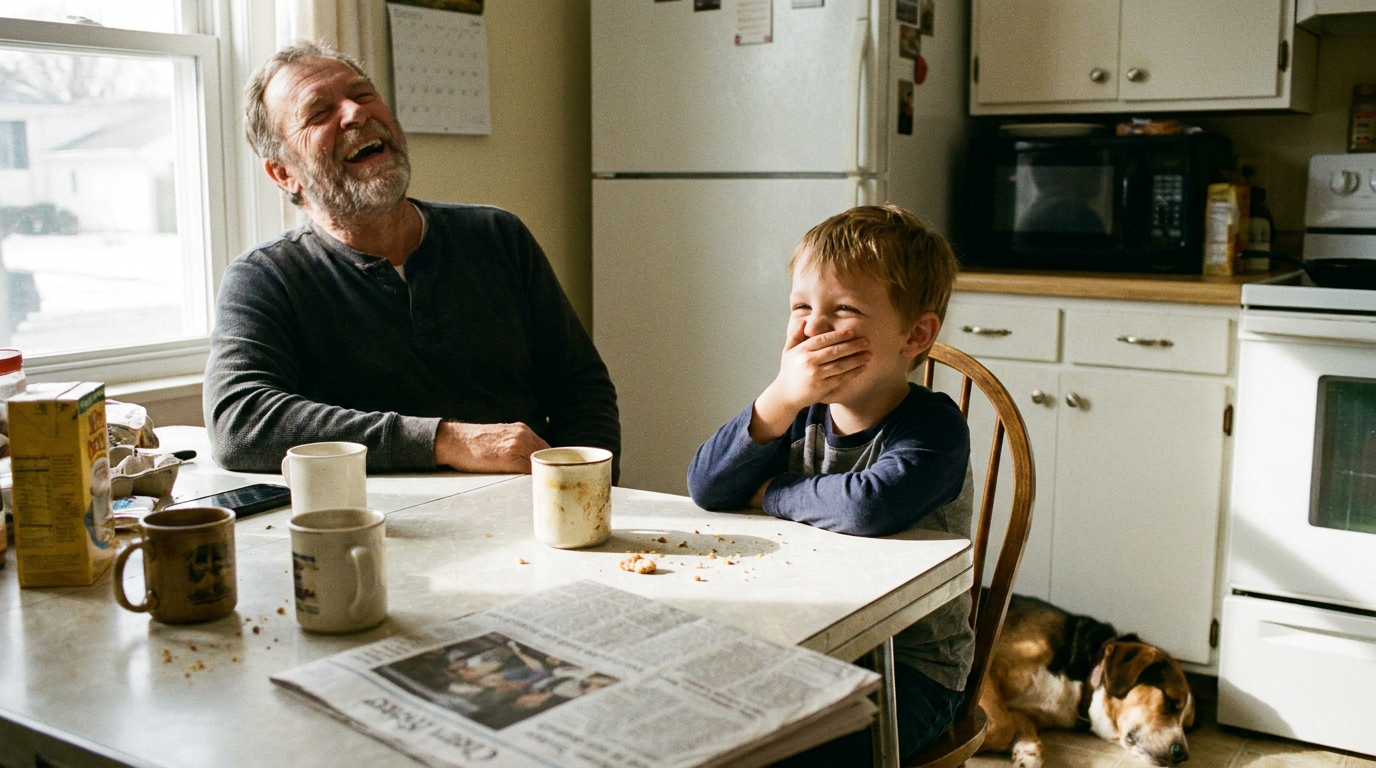
Grandfather and young grandson laughing together at a kitchen table, mid-conversation.

Childhood and Growing Up (Questions 11–18)

Now go concrete. Sensory detail unlocks memory far more reliably than big abstract questions do — ask someone about the smell of a hallway and you’ll often get twenty minutes you didn’t ask for.

  1. What did your childhood home smell like when you walked in the door?
  2. Who was your best friend, and what did the two of you actually do all day?
  3. What was your bedroom like — did you have it to yourself?
  4. What chore did you hate most, and did you ever get out of it?
  5. What was the walk to school like, and who did you walk with?
  6. Which teacher do you still remember, and what did they do to earn that?
  7. What did your mother or father say so often that you can still hear their voice saying it?
  8. What were you frightened of as a child that seems funny to you now?

Love, and How You Two Met (Questions 19–25)

A gentle note before this cluster: if a partner has died, these questions are very often welcomed rather than avoided. Many people are grateful for the chance to talk about someone whose name has quietly dropped out of family conversation. But follow their lead entirely — if the answer is short, let it be short, and move on without commentary.

  1. Where were you standing the first time you saw each other?
  2. What did you wear on your first date, and how long did it take to decide?
  3. What did your parents think of them at the beginning?
  4. What’s something they did that always made you laugh, even when you didn’t want to?
  5. When did you know, and did you tell anyone before you told them?
  6. What did the two of you argue about most, and who usually won?
  7. What’s the best thing about them that most people never noticed?

Work, Money and Everyday Life (Questions 26–32)

This cluster is underrated and it is where the surprises live. Oral historians ask about ordinary days, not just big events — you can see the same instinct in , which spend as much time on daily routine and living conditions as on major events. The texture of an ordinary decade is what actually vanishes.
the Library of Congress’s sample interview questions

  1. What was your very first job, and what did it pay?
  2. What did a completely normal Saturday look like for you at twenty-five?
  3. What was the first thing you bought that you were genuinely proud of?
  4. What did you want to be, before you became what you became?
  5. How did you get to work, and how long did it take?
  6. What did you and your friends do that cost nothing?
  7. Was there ever a stretch when money was tight, and how did you manage it?

Hard Times and How You Got Through Them (Questions 33–38)

Only ask these if the conversation has already gone somewhere real — and accept a “no” instantly, without a follow-up question. Notice that every one of these is pointed at what got them through, not at the difficulty itself. That’s deliberate. Keep it that way.

  1. Who helped you when things were hardest?
  2. What got you through that particular year?
  3. Was there a decision you made that changed everything afterwards?
  4. What do you know now that you wish somebody had told you then?
  5. Who did you turn to when you needed to talk to someone?
  6. What’s something you’re glad you didn’t do?

Family History and Where We Come From (Questions 39–45)

This is the cluster to write down carefully, because these are the family history questions that turn into actual research trails later. Names, places, dates, and the stories nobody can verify.

  1. Where did our family come from, as far back as you know?
  2. Who am I named after, and what were they like?
  3. What’s the oldest photograph you have, and who’s in it?
  4. Is there a family story you’ve never been sure is actually true?
  5. What happened to the people who stayed behind?
  6. What did your grandparents do, and did you ever meet them?
  7. Is there anything in this family that gets passed down — an object, a name, a habit?

Once you have names and places, becomes genuinely straightforward — the National Archives publishes a free guide to starting genealogy research, and a single accurate town name from a grandparent will save you months of guessing.
tracing the names and places they mention
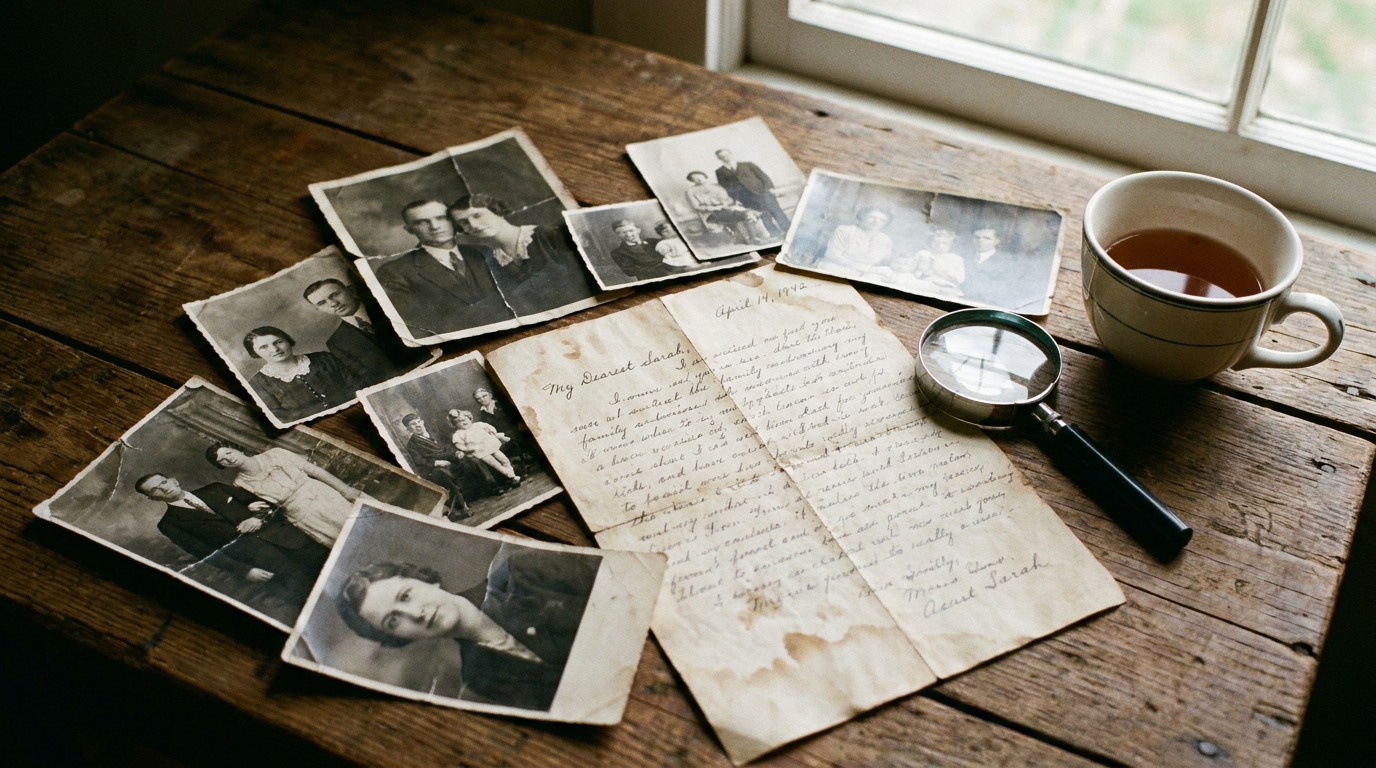
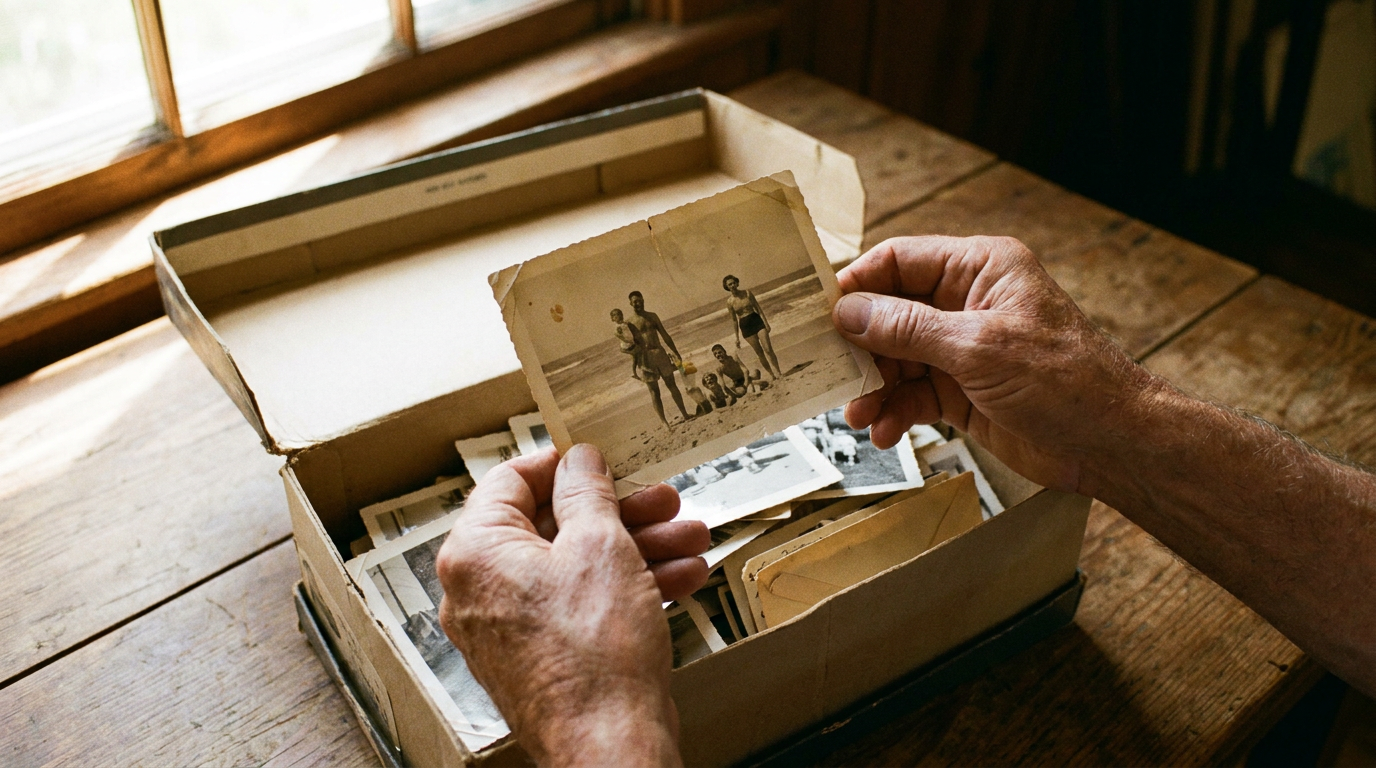
Weathered black-and-white family photographs and a handwritten letter spread across a wooden table.

A note on what question 41 tends to do. People ask about the oldest photograph expecting a name and a date. What comes back is frequently fifteen minutes about someone nobody in the family has ever mentioned — a woman who ran the household with an iron grip and once threw a saucepan at a landlord, say, sitting in a drawer for sixty years, one question away.And if their answers start turning into something longer — if one afternoon becomes four, if they start bringing things out of cupboards — there’s a natural next step in shaping all of it into something readable.

Advice, Belief and What You’d Pass On (Questions 46–50)

End warm. These aren’t farewell questions and shouldn’t be delivered like they are — they’re just the questions you can finally ask once someone has spent an hour remembering who they were.

  1. What are you proudest of?
  2. What advice would you give me, at exactly the age I am now?
  3. What do you hope I remember about you?
  4. What’s something you changed your mind about as you got older?
  5. Is there anything you’ve always wanted to tell me and never have?

Fifty questions. But a good list is only half of it — what you do with their answer matters considerably more than which question you asked.

How to Actually Have the Conversation

The list is a starting point. The material is in the follow-ups.

This is the thing nobody tells you: the prepared question opens the door, and then everything worth having comes from the four or five unscripted seconds after they finish answering. What happened next? How did that feel? Who else was there? Wait — go back, who was Ronnie?

The single easiest technique, and it feels absurd until you try it, is to repeat their last few words back as a question. They say “and after that we didn’t speak for two years.” You say “you didn’t speak for two years?” And they tell you why. You’ve contributed four words and received the entire story. Interviewers are trained to listen more than they speak, which is very clearly the operating principle behind — the interviewer’s job is to be interested, not interesting.
StoryCorps’ guidance for interview participants

Learn to Sit in the Silence

A pause of five seconds usually means they’re retrieving something. It almost never means they’ve finished. Do not fill it.

This is the most actionable advice in this entire article and it is the hardest to follow, because silence in conversation feels like a failure you’re personally responsible for. Resist it. Count to five in your head if you have to. The thing they say after the pause is consistently better than the thing they said before it — memory takes a moment to load, especially for something that hasn’t been accessed in forty years.

Many Short Chats Beat One Long Afternoon

So stop early. You have explicit permission. Leaving while it’s still enjoyable is how you get invited back.

There’s a second benefit that people rarely anticipate: between visits, they think about it. You’ll arrive the following week and be told “I remembered something after you left,” which is frequently the best thing you’ll get all month. A single long session doesn’t give memory time to do that work.

Twenty minutes over a cup of tea, repeated across several weeks, will produce better material than one heroic two-hour sitting. Every time. Energy fades, attention drifts, and hour two is almost always worse than hour one — for both of you.

Put an Object in Their Hands

Props unlock memory better than questions do. It’s not close.

An old photograph, a recipe card in handwriting they recognise, a piece of jewellery, a map of the street they grew up on, a tin, a tool, a school report. Physical objects bypass the part of the brain that’s trying to produce a sensible answer for you and go straight to recall. Hand someone a photograph and they don’t tell you about the photograph — they tell you who took it, and what happened immediately afterwards, and why the man on the left isn’t smiling.

If you’re visiting and can only bring one thing, bring a photograph with more than three people in it. Group photos are the most efficient memory device ever invented.
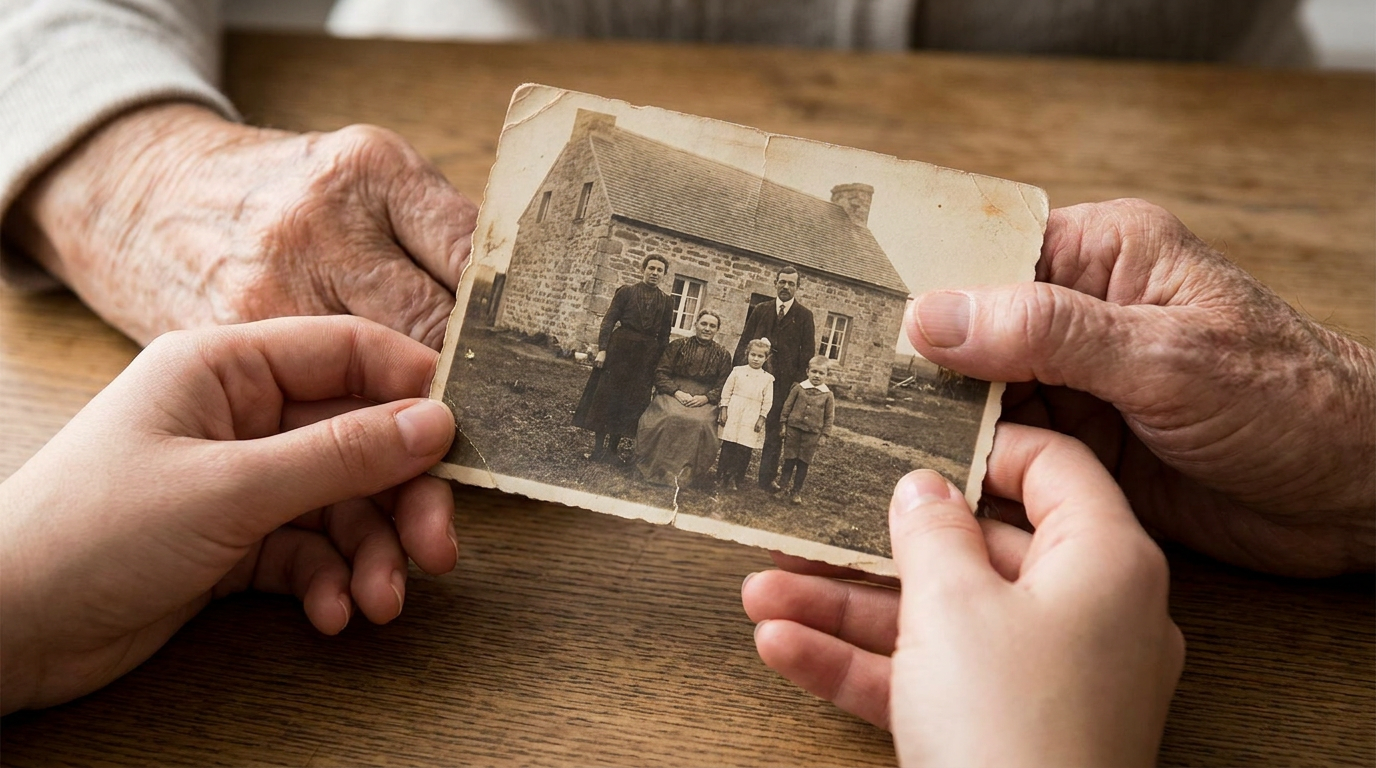
Two pairs of hands, one older and one younger, holding an old photograph between them.

Don’t Correct Them

You are collecting their account, not fact-checking a record, and the moment you correct someone they become careful — and careful people give you nothing. The version of events they carry around is itself a piece of information, and often a more interesting one than what actually happened. Public records can fill in the names and dates later, quietly, without anybody being contradicted in their own kitchen.

If a date is wrong, let it be wrong. If two separate stories have quietly merged into one over the decades, let them stay merged.

Ask About the People, Not Just the Events

Events tend to come out pre-packaged, because they’ve been told before and worn smooth. People don’t. Ask “who else lived on that street?” and you’ll get material that has genuinely never been said out loud in your family, because nobody’s ever asked a question shaped like that.

Ask about the neighbours. The colleague who was always late. The sibling nobody mentions. The woman two doors down who everybody was slightly afraid of.

And if they’d rather not be recorded at all — some people simply won’t, and that’s entirely their right — then write down three things afterwards while it’s fresh. Not a transcript. Three things. Notes are a completely valid outcome and infinitely better than the nothing you’d otherwise have. If you want prompts for your own journal while you’re at it, our Now, from how to ask to how to capture it — starting, as always, from the permission you already agreed.
25 journal prompts for kids

work in both directions — the same habit, pointed at your own week.

How to Record It Without Making It Awkward

Reconfirm consent before you press record. Every single time — not just the first time, not just the first visit.

It’s one sentence: “Still okay to record today?” Permission given in March is not permission given in June, and asking again takes two seconds and signals that you meant it the first time.

Right. The technical part, which is mercifully small.

The phone in your pocket is enough. Open the voice memo app, press record, put it face-down on the table, and then forget about it entirely. That’s the whole setup. Elaborate equipment — microphones on stands, tripods, anything with a windsock — makes everybody self-conscious and produces worse conversation in better audio quality, which is the wrong trade.

Audio usually beats video.Quick setup checklist:

People relax dramatically more without a lens pointed at them, and a voice carries far more of a person than most people expect. The hesitations, the laugh, the way they say your name — all of that is in the audio. Video mostly adds the sight of someone being visibly aware they’re on camera.

  • Quiet room — no TV, no radio, and check the dishwasher isn’t about to start
  • Take the phone off the table surface if it’s a hard table that rattles, or put it on a cloth
  • Sit at an angle to each other rather than directly face-on — it’s less like an interview
  • Say the date and who’s speaking at the start, out loud, on the recording
  • Keep it to 20–30 minutes; battery, energy and attention all run out at roughly the same point

Label it immediately. An untitled audio file is a lost audio file. Rename it the moment you finish — who, when, and roughly what — because Voice 047 is functionally invisible and you will never find it again. The two minutes you spend renaming a file is the entire difference between something you’ll actually return to and something that dissolves into a camera roll of two thousand untouched photos.

If you want to go deeper, there’s free field guidance from established oral-history programmes: is a genuinely practical, government-issued guide to recording an interview properly, and it costs nothing. And when you’re ready to check the names and dates you didn’t correct in the moment, through the National Archives’ resources for family historians.
public records can fill in the names and dates laterthe Library of Congress Veterans History Project Field Kit
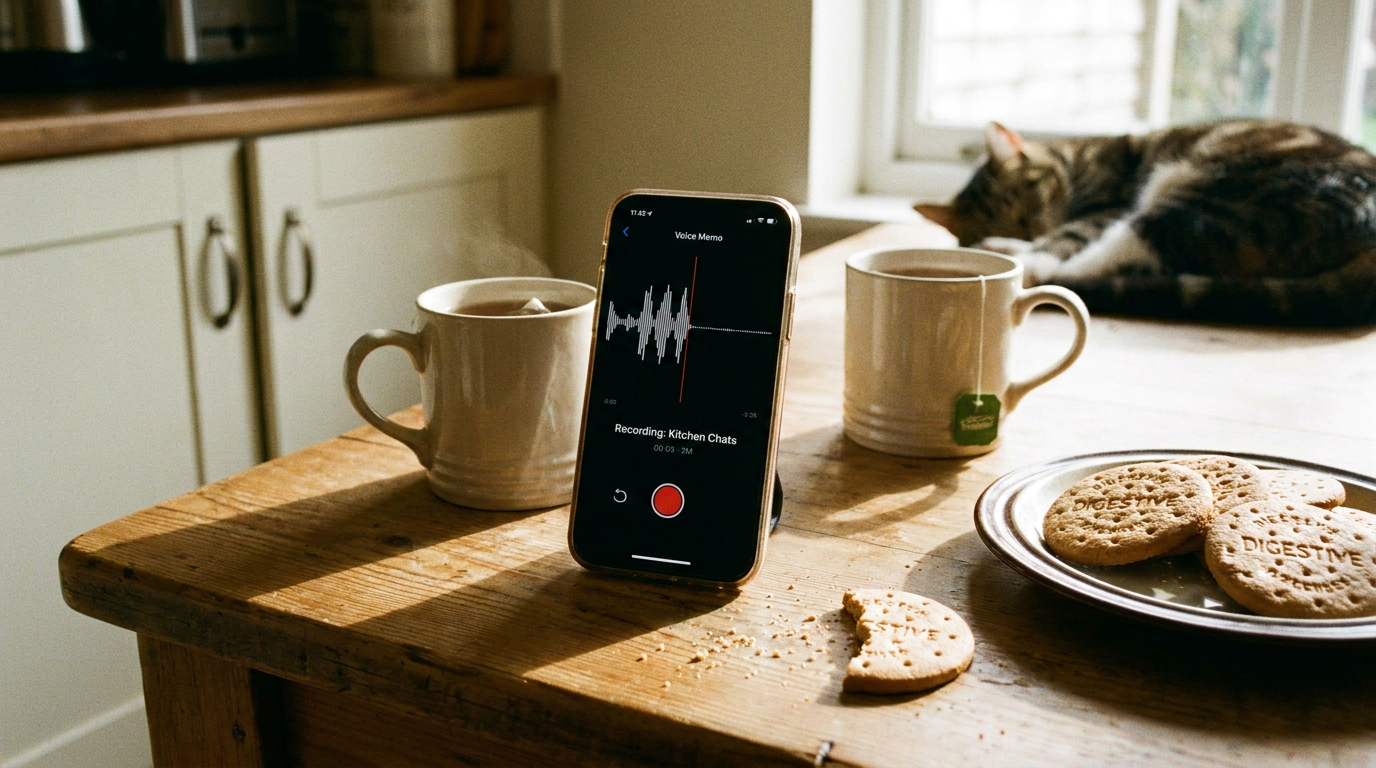
Smartphone recording a voice memo on a kitchen table beside two cups of tea and a plate of biscuits.

Which raises the question you’re probably already holding: you’ve now got an hour of audio, a shoebox of photographs and three pages of notes. Where does all of that actually go?

Where Their Answers Live Afterwards

Play a recording back three years later and something happens that you cannot prepare for.

It isn’t the information. You already know the story by then — you’ve told it at two family dinners. It’s the soundThen the practical problem arrives, and it’s always the same problem. The recording is on your phone. The photographs are on your sister’s. Your cousin has the only surviving picture of the house on the corner, on a hard drive, in a box. The story your grandmother told you exists in four places and belongs to nobody, and every one of those places is a device that will eventually be replaced.

. The specific shape of their laugh. The two-second pause before they answer the question about their mother. The particular way they say your name, which you had never once thought of as distinctive until it was coming out of a speaker. A transcript cannot do that. A photograph cannot do that. Only their voice can, and it turns out that voices are the thing we forget first and miss most.

This is the gap was built for. A single Moment can hold the text of what they said, the photographs they were holding while they said it, video, and the audio of their actual voice — all in one entry. The recording sits beside the picture it belongs to, rather than drifting off alone into a folder with a number for a name.
Lugelo

Shared journals are the part that matters for a family. Siblings, cousins and grandchildren can all contribute to one family record, each adding the piece they happened to be there for — your brother’s version of the same afternoon, your aunt’s photographs, the detail your cousin remembers that you completely missed. Role-based permissions mean you decide who can view and who can add. You can see how invitations and access work on the .
collaborative journal page

Memory Lane arranges it all into a timeline, so a life reads in order — the childhood house, the wedding, the move, the grandchildren — instead of as a pile of undated files. That ordering is quietly the whole trick. Twelve recordings in a folder is homework; twelve moments along a timeline is a story.

Clean, light Lugelo journal interface on a tablet showing a family Moment with a photo, a short note and an audio clip.

From there it can become something you hand around. Templates to start faster when the blank page is intimidating, the to help shape rough notes into readable entries, and outputs like a storybook, a scrapbook, an eBook or a VR gallery — so at the next family gathering there’s an actual object on the table rather than five people passing a phone. covers the range.
Lugelo’s features pageAI Journal Assistant

On privacy, plainly, because this is somebody else’s personal history and you made them a promise about who would hear it: journals are private by default, with owner-controlled access. You decide who can view or contribute, and access can be revoked at any time. Data is encrypted in transit, personal data is not sold to third parties, and account and data deletion is available with a 30-day recovery window. That’s the whole picture — the agreement you made in their kitchen about who gets to listen is one you can actually keep. The plain-English detail lives on the .
FAQ page

The point of all of it is unglamorous: everything in one place, easy to revisit, somewhere it can be found again. If you’re setting one up from scratch, start small — one Moment, one recording, one photograph. Other families have written about how theirs came together over on Which brings us down from the whole system to the smallest possible first step.
family journal stories

.

Start With Three Questions This Sunday

Fifty questions is a library, not a to-do list. Choose three.

If you’d like the shortcut, here’s the opening trio worth recommending, all lifted from the fun cluster:

  1. What’s the worst haircut you ever had?
  2. Did you have a nickname, and who gave it to you?
  3. What did you get in trouble for most as a kid?

Bring one object if you can — a photograph, a recipe card, a map of the old street — and let it do half the work for you.

If they’re far away, the phone is completely fine. Ask permission to record the call in exactly the same way you would in person.

National Grandparents Day is Sunday 13 September 2026, which is a ready-made excuse to call or visit — an occasion, not a deadline. If Sunday doesn’t work, any Tuesday will do just as well.

A laugh in the first two minutes genuinely changes everything that follows. Once somebody has laughed, they’ve stopped performing, and once they’ve stopped performing you can ask them almost anything.

Afterwards, while the kettle’s still warm, write down the three things you don’t want to lose. Not a transcript. Three things. That’s the entire practice, and you can in about ninety seconds.
pick your three from the list above

Three generations of a family sitting together in a garden in late afternoon light, one holding a phone recording, everyone mid-laugh.

The Real Reason to Ask

Ask about the haircut. See where it goes.

So the reason to do this isn’t that time is running out. It’s that there’s someone remarkable sitting in the good chair whom you’ve only ever met in one role, and they have almost certainly been waiting for someone to ask. Two things make it work, and they’re both simple: ask permission, and keep what they tell you somewhere it can be found again.

That’s what one question opens. Not a revelation, not a family secret — just a whole person who has been standing in the kitchen the entire time, filed under “grandmother,” waiting for somebody to ask a question that didn’t have an obvious answer.

Forty minutes, from a woman somebody had known for thirty-four years and never seen like that before.

Because here is how that story tends to end, when somebody finally asks. It was a bakery. It was 1961. She was nineteen, and she was the only woman driving for them. She got the job because her brother taught her to drive in a field and then told the depot she’d been driving for years. She loved it — the early starts, the empty roads, the man on the corner who bought the same loaf every morning for eleven years and never once said good morning.

Go back about the van.

Don’t Just Live It — Keep It

Start a shared family journal, invite the people who were there, and keep their answers, their photographs and their voice in one place — where the whole family can add the pieces only they remember.

Start Saving What Actually Matters →

Available on . Journals are private by default, and you decide who can view or contribute.
web, iOS, Android and HarmonyOS
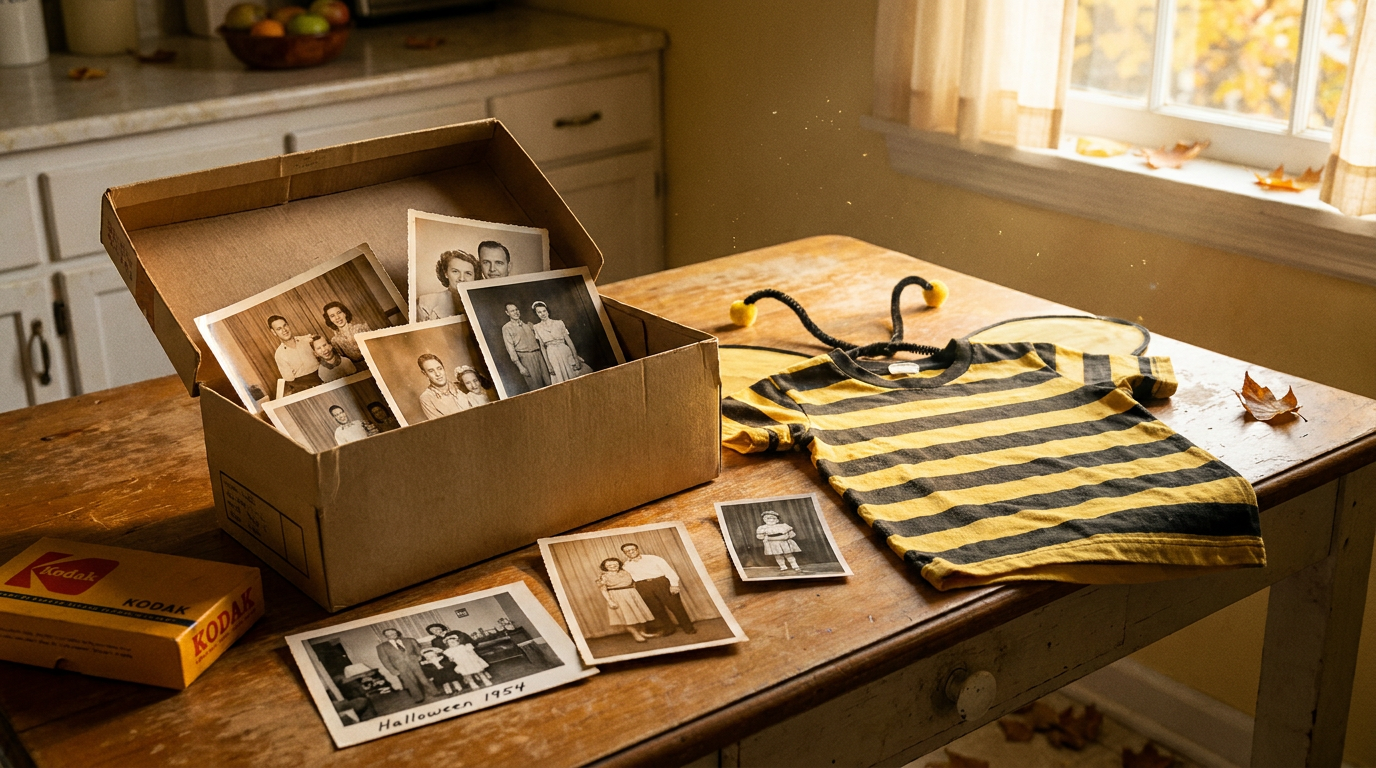

The October Memory Journal: 60+ Fall & Halloween Journal Prompts (Plus How to Turn Them Into a Keepsake Your Family Keeps Forever)

The October Memory Journal: 60+ Fall & Halloween Journal Prompts (Plus How to Turn Them Into a Keepsake Your Family Keeps Forever)

This is the strange arithmetic of October. It is one of the richest months of the year for family memory, and simultaneously one of the most reliably forgotten. We photograph it obsessively and document it almost never. The camera captures what the costume looked like; it does not capture why your seven-year-old insisted on being a dragon instead of the astronaut you had already half-built, or what she said in the car on the way home, or which house on the route gave out full-sized chocolate bars and became legend for the next four years.

The costume survived. The story did not.

So the argument starts, the way it always does. Was that the dinosaur year or the witch year? Was that before or after you moved? Who is that other kid, half-cropped out on the left, the one with the cape? Somebody remembers the cape. Nobody remembers the kid. And the reason everybody in the photo is laughing — genuinely, mouth-open laughing, the kind you cannot pose — is simply gone. Not misfiled. Gone.

And on the back of it: nothing. No date. No name. No year.

You know the one. Slightly out of focus. A porch light blowing out the top corner. A plastic pumpkin bucket held with both hands.

There is a shoebox in most houses. Yours might be a drawer, or a chipped biscuit tin, or a folder on a laptop nobody has opened since the last operating system update. Inside it, somewhere near the bottom, is a photograph of a child in a Halloween costume.

This post is the fix. Below you will find 60+ October, fall, and Halloween journal prompts — 84 of them, actually — organised into six banks: a full 31-day October prompt calendar, a set written specifically for Halloween night, age-tiered prompts for kids from kindergarten through middle school, quieter reflective prompts for adults, a Halloween “would you rather” block for reluctant writers, and group prompts for when several people are journaling the same evening.

Then, after the prompts, the part almost nobody does: a practical method for turning a month of scattered answers into something your family actually keeps.

Why October Is the Best Month of the Year to Start a Journal

Consider what is actually stacked into these thirty-one days. The season visibly turns — you can watch it happen through a window, week by week, in a way you cannot with most months. Routines have reset after the summer and are now bedded in enough to have a shape. Costumes are chosen, argued over, abandoned, re-chosen and eventually assembled at 9pm the night before. Pumpkins arrive and are butchered with varying levels of skill. Clocks change in much of the world. And then there is one single night that generates more photographs than almost any other night on the family calendar.

October has the opposite problem. October has too much.

Most people decide to start journaling on January 1st, which is arguably the worst possible day to try. Nothing is happening. The decorations are down, the visitors have gone, the weather is grey in a monotonous rather than an interesting way, and you are being asked to write meaningfully about a Tuesday in which you did laundry. The resolution dies by the 9th, not because you lack discipline, but because you have nothing to write about.

The raw material is simply there. You are not manufacturing something to write about. You are declining to let a month that is already full of material evaporate.

The paradox: heavily photographed, barely documented

Here is what makes October worth a set of dedicated october journal prompts rather than generic ones. The month is over-photographed and under-recorded, and those are not the same thing.

Your camera roll from last October probably contains forty images. It contains zero explanations. A photograph is extremely good at answering what did this look like and completely useless at answering everything else. It cannot tell you why that costume was chosen over the other one. It cannot tell you who came to the door in the first hour and who came in the last. It cannot tell you that your child was quietly terrified of the inflatable spider three houses down and made you cross the road, and that by the following year she thought the spider was hilarious — which is, if you think about it, a more complete record of a year of growing up than any photograph could manage.

The same argument sits at the heart of Lugelo’s : photos without context are just files. Volume is not memory. Ten thousand images with no story attached is an archive nobody can read.
guide to building a school memory book

“Journals are souvenirs of your past.”

What the research actually says about writing things down

It is worth being precise here, because this territory attracts a lot of overclaiming.

A examined 51 studies of positiveThere is a second, quieter reason to write, and it has nothing to do with wellbeing outcomes at all. You write in October because in eleven years you will want to know what happened, and nobody else is keeping the record.

So: no promises. Writing a few sentences a night in October is not a treatment for anything, and nobody should sell it as one. What the literature suggests is narrower and still worth knowing — that structured, positive, reflective writing is associated with improvements in how people report feeling, and that the benefits appear regardless of whether people typed or handwrote their entries. The mode of disclosure was not the active ingredient. The writing was.

The authors are also candid about the limits of their own evidence base: every study included in the review was rated as poor or fair quality, and they explicitly call for more rigorous methods in future work. That caveat belongs here as much as the headline does.

expressive writing — that is, structured writing about gratitude, positive experiences, benefit finding, “three good things,” and best-possible-self exercises — in non-clinical adult populations. The reviewers found that the most consistent benefits appeared in wellbeing and positive affect outcomes, things like optimism and happiness. Effects on negative affect, psychological health outcomes such as stress and anxiety, and physical health outcomes were considerably more mixed. Gratitude and best-possible-self exercises showed the most reliable results of the seven techniques examined.

The case for a very low bar

The reason most October journaling attempts collapse around the 6th is that people set out to write properlyDiscard all of that. The unit of work here is one prompt, answered in two or three sentences, once a day. That is thirty seconds of typing. It fits inside the time you spend waiting for a kettle.

. They picture paragraphs. They picture a leather notebook and a fountain pen and a mood.

The value is not in eloquence. It is in accumulation. Thirty-one unremarkable entries produce something that no single remarkable entry ever could — a texture, a month with edges, a record that includes the boring Wednesdays that turn out, years later, to be the ones you actually miss. Lugelo’s The fastest way to begin is to stop planning and answer one question tonight. Here are eighty-four of them.
guide to building journaling habits over thirty days

And prompts are only the starting point. What you do with a month of answers is where the keepsake comes from — but that comes later in this post, and only after the prompts, because prompts are what you came for.

makes this point in more depth: consistency at a low bar beats ambition at a high one, every time.

60+ October, Fall & Halloween Journal Prompts

Six banks follow. Take what you need and ignore the rest — nobody is grading this. Each bank has a short note above it explaining who it is for and when to use it.

A 31-Day October Journal Prompt Calendar

This is the core bank: one prompt for every day of the month, built as an arc. The first ten days lean into the turn of the season and sensory detail. The middle stretch moves into memory, family and gratitude. The final week ramps into costumes, anticipation and Halloween itself. Each is answerable in three sentences. If you miss a day, skip it — do not backfill, just carry on.

  1. What does this week smell like?
  2. What is the first thing you noticed changing outside this year?
  3. Which piece of clothing have you just started wearing again, and how long have you had it?
  4. What did the light look like this evening?
  5. What sound belongs to October in your house?
  6. Which meal have you cooked or eaten this week that you would never make in July?
  7. What is currently on your kitchen table that would not have been there a month ago?
  8. Where were you the moment you first felt properly cold this year?
  9. What did you do today that you also did on this date last year?
  10. Which song, film or book do you always return to at this time of year, and when did that start?
  11. Which autumn tradition did your family invent rather than inherit?
  12. Who taught you something this month without meaning to?
  13. What is the oldest object in your house right now, and how did it get here?
  14. Which family story gets told every year, and who tells it best?
  15. What is one small thing someone did for you recently that you have not mentioned to them?
  16. Which room in your home do you like most in October, and why that one?
  17. What are you grateful for today that you were not grateful for last October?
  18. Who did you think about today that you have not seen in a long time?
  19. What is something you are quietly proud of from the last three months?
  20. What are you ready to let go of before the year ends?
  21. What is one thing you want to finish before December?
  22. What costume are you or your kids considering, and what changed your mind so far?
  23. What is the most ambitious costume anyone in this family has ever attempted, and did it survive the night?
  24. Which decorations went up first this year, and who insisted?
  25. How did the pumpkin carving go, and whose idea was the design?
  26. What are you most looking forward to about Halloween this year?
  27. What is one thing about Halloween that you find genuinely a bit unnerving, even now?
  28. Which sweets get eaten first in this house, and which are still in the bowl in December?
  29. What is the plan for the 31st, and who came up with it?
  30. What is the last thing left to do before tomorrow night, and is it going to get done?
  31. Describe tonight from the moment you left the house to the moment you got back.

Those thirty-one cover october journal prompts, fall journal prompts, and the broader journal prompts for october territory in one pass. The next bank narrows to a single night.

Halloween Night Journal Prompts

These ten are written to be answered on the 31st itself or the morning after — while the details are still warm and before the week erases them. Halloween night details have an unusually short half-life. Within seven days you will remember that it was fun; you will not remember why. Answer these in a rush, badly, with sticky hands. That is the correct way to use them.

  1. Who came to the door, and who was the best-dressed caller of the night?
  2. What was the weather actually doing, and did it change anything?
  3. Which house on the route did everyone talk about afterwards?
  4. What got traded, negotiated or quietly stolen out of the candy bag?
  5. What was funny tonight that absolutely nobody planned?
  6. Who did you go out with, and how did that end up being the group?
  7. What was the first house you knocked on, and how did it go?
  8. Which costume did you see tonight that you wish you had thought of?
  9. What was the moment you would put in a photograph if you could only keep one?
  10. What time did you get home, and what was the first thing anyone said?

A child in a Halloween costume sitting at a kitchen table writing in a journal, candy bucket beside them.

Halloween & October Journal Prompts for Kids (By Age)

Fifteen prompts across three age tiers. The register shifts deliberately as the ages climb — concrete and sensory for the youngest, cause-and-effect for the middle group, perspective and self-reflection for the oldest. These build on the approach in Lugelo’s , adapted for the season.
25 journal prompts for kids

For teachers and parents wondering whether this is too slight to bother with: Edutopia’s reporting on makes the case that short, frequent, low-pressure prompts do more for developing writers than occasional long assignments. Frequency beats length.
getting elementary students writing every day

Kindergarten and early elementary (ages 5–7)

Concrete, sensory, immediate. Drawing counts as a complete answer. So does dictating it to an adult while eating.

  1. Draw your costume and tell me one thing you love about it.
  2. What was the best thing you ate today?
  3. Draw the scariest thing you saw tonight — was it actually scary, or just a bit surprising?
  4. Who held your hand tonight?
  5. What sound do you remember most from tonight?

Elementary (ages 8–10)

Cause, effect, and the beginnings of narrative. Ask for one detail that nobody else would know.

  1. What was the best thing that happened tonight that you didn’t expect?
  2. What went wrong tonight, and how did everyone deal with it?
  3. If you could change one thing about tonight, what would it be?
  4. Which friend made you laugh the most, and what did they do?
  5. What would you tell someone who wasn’t there, to make them understand what it was like?

Middle school (ages 11–13)

Perspective, comparison, and a first pass at reflection. These work best if nobody reads them over the writer’s shoulder.

  1. What’s changed about how you feel about Halloween since you were little?
  2. What did you notice tonight that the younger kids didn’t?
  3. Was tonight what you expected? What was different?
  4. What’s one thing you’re glad you did, and one thing you’d skip next year?
  5. What do you think you’ll remember about tonight in ten years?

Halloween Journal Prompts for Adults and Reflective Journalers

October is a threshold month. The year is visibly running down, the last quarter has started, and there is something about the early dark that makes people take stock whether they meant to or not. These ten are quieter and more interior than anything above, and they serve the halloween journal prompts for adults and october journal prompts for adults end of the spectrum.

  1. Which Halloween from your own childhood do you remember most clearly, and what makes it stick?
  2. What did your parents do in October that you have carried into your own house without noticing?
  3. What are you carrying into the last quarter of this year that you would rather put down?
  4. What ended this year that you have not properly acknowledged?
  5. Who is missing from this October, and what would they have said about it?
  6. What did you believe in October last year that you no longer believe?
  7. What is the version of this season you keep trying to recreate, and where does it come from?
  8. What are you afraid of at the moment, in the ordinary daylight sense of the word?
  9. What has this year taught you that you did not want to learn?
  10. If this October were a chapter, what would the chapter be called?

Halloween “Would You Rather” Prompts for Kids

This bank exists for one specific reader: the child who says “I don’t know what to write.” Ten would-you-rather questions, each followed by the same instruction — explain why. That single word is what converts a party game into a journal entry, because the why is where the writing actually happens.

Edutopia’s collection of makes the underlying point well: when there is no wrong answer and no grade attached, reluctant writers write considerably more. Keep these light. None of them are meant to be frightening.
low-stakes writing prompts

  1. Would you rather have a pet bat or a pet black cat? Why?
  2. Would you rather trick-or-treat in the rain or in the snow? Why?
  3. Would you rather have a costume that glows in the dark or one that makes noise? Why?
  4. Would you rather get one enormous chocolate bar or thirty small ones? Why?
  5. Would you rather carve a pumpkin or decorate the whole house? Why?
  6. Would you rather be invisible for a day or able to fly for an hour? Why?
  7. Would you rather live in a house made of gingerbread or a treehouse in a spooky forest? Why?
  8. Would you rather wear the same costume for five years or a different one every single day for a week? Why?
  9. Would you rather hand out the sweets or go door to door? Why?
  10. Would you rather have a talking pumpkin or a talking skeleton as a friend? Why?

Group and Party Prompts for Multi-Contributor Journaling

The value here is contrast, and it is worth being explicit about it. Ask four people the same question about the same evening and you will get four different evenings back. The parent remembers the logistics. The eight-year-old remembers a dog. The teenager remembers something neither adult noticed. None of them are wrong, and the composite is far closer to the truth than any single account.

The last bank is different in kind. These eight are designed for several people answering the same question on the same night — a family around a table, a classroom, a friend group, a Halloween party where the sugar has worn off and everyone is sitting down.

  1. What was the best moment of tonight, in one sentence?
  2. Who was the funniest person here tonight, and what did they do?
  3. What is one thing that happened tonight that you think nobody else noticed?
  4. Describe the same five minutes: what were you doing at eight o’clock?
  5. What surprised you tonight?
  6. What would you do differently next year?
  7. What is one thing you want to remember about this specific group of people?
  8. Finish this sentence: the thing about tonight was —

That is eighty-four prompts. Which raises the obvious question, and it is the question that separates a prompt list from a keepsake: you now have a month of answers sitting somewhere. What happens to them?

Turning a Month of Prompts Into a Family Halloween Memory Timeline

One October of prompts is a nice thing to have. Ten Octobers of prompts, sitting side by side, is something else entirely — it is a portrait of a childhood, assembled almost accidentally, out of two-sentence entries nobody thought were important at the time.

This is the part that compounds. A single year cannot show it to you, which is precisely why most people never get there. The first October feels like a modest little project. The fourth starts to feel like something. By the tenth you are holding a document that no photograph collection, however large, could have produced.

Three threads are worth tracking deliberately, year after year:

  • Costumes — what they were, and critically, why they were chosen
  • The route — which streets, which houses, and who came along
  • Pumpkins — the design, and whose idea it was

Everything else can be improvised. Those three, repeated annually, do the heavy lifting.

The year-over-year costume timeline

Same child. Same month. Ten consecutive years. Each entry carrying three things: the costume, the reason they chose it, and who they went out with.

The costume is the easy part — you already have the photograph. The other two are the ones that vanish, and they are the ones worth having. A costume choice is a snapshot of who a child was that year: what they were reading, who they were copying, what they thought was cool, whether they wanted to be admired or frightening or funny or invisible. A four-year-old choosing a dinosaur and a nine-year-old choosing a dinosaur are two entirely different pieces of information, and only the why tells you which one you are looking at.

Read ten of those in sequence and you can watch a personality assemble itself.

A row of Halloween costume photographs of the same child across several years, laid out in chronological order.

The trick-or-treat route

You will not notice the shift while it is happening. You will notice it very clearly reading the entries back.

Here is why it earns its place: the route changes as children get older, and the record of that change is quietly the record of them growing up. Year one is four houses on your own street with a parent holding a hand. Year five is the full loop with a torch. Year nine is a different street entirely, with friends, and you are waiting at home. Year twelve there is no route at all because they are handing out sweets at the door instead, and that transition happened without any announcement whatsoever.

Which streets you covered, which houses were reliable, who joined you and at what point, which neighbour went so comprehensively overboard with the decorations that their address became shorthand in your household for years afterwards. Write it down as a list, or sketch it, or just name the three houses that mattered.

Nobody thinks the route is worth recording. It is.

Pumpkins, and other small repeatable things

It sounds almost too small to bother with, and that is the point. Small and repeatable beats large and abandoned. The families who successfully keep multi-year records are not the ones with the most elaborate systems; they are the ones whose system takes ninety seconds and therefore survives a year in which everything else went wrong.

A photograph of the pumpkin, plus one line about whose idea the design was. That is the entire commitment.

The multi-year timeline as a structure

The reason to think of it that way rather than as “starting a family archive” is that the second framing guarantees you will never begin. Nobody has time to start an archive. Everybody has ten minutes on the 31st.

Ten minutes a year. That is the actual cost.

Frame the whole thing correctly and it stops feeling like a project. One journal. One entry per Halloween. Revisited every October.

What the research says about families who tell their stories

There is a substantial body of work behind the intuition that this matters, and it comes out of Emory University.

Psychologists Marshall Duke and Robyn Fivush, who directs Emory’s Family Narratives Lab, spent decades developing a scale measuring how much children know about their own family histories — the “Do You Know” scale. In Fivush’s own description of what actually works is the most useful line in the whole piece, and it is strikingly unglamorous:
one study that began just before 9/11 and ran for two years

To be clear about what this is and is not — this is research about families who talk to each other about their past. It is not a claim about journaling software, and nobody should present it as one. What it does establish is that the shared, coherent family story is not sentimental fluff. It is load-bearing.

On standardised measures, the children in the more narratively open families showed better self-esteem, higher social competence, higher-quality friendships, and less anxiety and stress. Parents also reported fewer behavioural problems. Worth noting for accuracy: the families studied were all comparable middle-class, two-parent households, which is a real limit on how far the finding generalises.

, they looked at families with 10- to 12-year-olds and found that children in families that talked about challenging events in more coherent and emotionally open ways coped better across that two-year period than children in families telling less expressive, less coherent stories.

“It’s the really mundane, everyday stories that reassure them that life is stable. It provides a sense of continuity, of enduring relationships and values.”

The mundane ones. Not the milestones. Which is an excellent argument for a prompt that asks what this week smells like.

Four people, one night, four true accounts

A Halloween documented by a parent and the same Halloween documented by the child produce two genuinely different accounts, both accurate. The parent’s version has the weather, the timing, the neighbour conversation, the mild anxiety about the road. The child’s version has the dog, the sweet they had never seen before, and the friend who fell over. Neither is the whole night. Together they are much closer to it.

Return for a moment to the group prompts. The multi-perspective idea is not a gimmick — it is the thing that makes a family record substantially richer than a personal one.

Lugelo’s works through the two-perspective approach in more depth, and the same principle applies to the — same subject, same framing, every year, because repetition is what makes change visible.
year-over-year consistency argument in the school memory book guideguide to co-creating a child’s school year journal

“Turn fleeting moments into permanent memories.”

Plenty of families already attempt exactly this, and they attempt it with glue, card and a box of printed photos. The scrapbook deserves an honest conversation.

Halloween Scrapbook Page Ideas — and the Digital Alternative

Scrapbooking is a real craft with a real history, and it has been doing this job properly for a great deal longer than any app has existed. Anyone writing about digital memory-keeping who opens by dismissing paper is not worth listening to.

So let us start with the page ideas themselves, which work identically in either format. These are structural — what goes on the page and why — rather than decorative.

  • The costume page. The photograph, plus the story of why that costume. The story is the part that makes it a page rather than a picture.
  • The pumpkin page. The carving, the design, and one line about who came up with it and who did the actual scooping.
  • The trick-or-treat route map. Hand-drawn is better than accurate. Mark the houses that mattered.
  • The candy haul inventory. A list. Genuinely — a list of what came home, what got traded, and what was still in the bowl at Christmas. Absurdly good at triggering memory later.
  • The “who came with us” page. Names, and how each person ended up in the group. Friendship groups reshuffle constantly in childhood and this page dates itself precisely.
  • The year-over-year comparison spread. Same child, same pose, consecutive years, side by side. The single most affecting page in any family album.

What paper does better

Be honest about this, because the honesty is what makes the rest of the argument credible.

A physical album has weight. You can put it on a table and it is thereNone of that is nostalgia. Those are real advantages and they are the reason scrapbooking persists.

And a book on a shelf does not require an account, a subscription, or a functioning device. It survives neglect remarkably well.

, taking up space, in a way a file never is. Turning pages is a fundamentally different experience from scrolling — slower, more deliberate, harder to skim. Two people can look at an open album together on a sofa in a way that two people cannot comfortably share a phone. Handwriting carries information that typed text does not; a child’s handwriting at six and at eleven tells you something no font can.

What a digital page does that paper cannot

The honest counter-case rests on three things.

A digital page can hold what a paper page physically cannot. Fifteen seconds of video of the doorbell moment. A voice note of a seven-year-old explaining, at length and with total conviction, why the dragon was the correct choice. Her actual voice, at seven, which you will not otherwise have. A paper page can hold the photograph. It cannot hold the sound.

It is searchable and backed up. Ten years of Octobers in a box is ten years of Octobers you have to physically dig through. Ten years digitally is a search. And a shoebox has exactly one copy of everything in it — which brings us back to the undated photograph at the top of this post, and everything else that box has lost along the way.

It can be added to on the night. This is the decisive practical difference. Paper scrapbooking requires a second session: you take the photos in October, then you sit down in November or January or never with the printed images and assemble the page. The gap between the event and the recording is where most of the detail dies. A digital entry can be made from a phone at 9:40pm on the 31st, sticky-handed, in ninety seconds — while you still remember which house did the most.

The hybrid model

The digital record is the working document. The printed book is the artefact. They do different jobs and there is no reason to choose.

Keep the living record digital, because that is where capture actually happens — in the moment, on a phone, with video and voice included. Then print something physical at milestones. The end of a decade of Octobers. A child leaving primary school. A birthday that feels like a turning point.

For most families the sensible answer is not one or the other.

Lugelo’s piece on speaks directly to memory-keepers and scrapbookers considering this shift, and the Before starting, most people new to prompt journaling have a few basic questions. Here are the ones that come up most.
beginner’s guide to digital journalingwho digital journaling is actually for

walks through the mechanics without any pressure to abandon paper.

Journal Prompt FAQs: What They Are and How to Actually Use Them

What is a journal prompt?

A journal prompt is a short question or instruction that gives you a specific starting point instead of a blank page. Rather than facing an empty screen and the vague obligation to write something meaningful, you answer one narrow question. The narrowness is the entire mechanism — a small question is easy to answer, and an easy answer is one you will actually write.

What are journaling prompts used for?

That last function is underrated. Most journaling advice treats prompts as a tool for self-understanding. They are equally a tool for record-keeping, and the record does not require you to be insightful. It only requires you to be specific.

Four things, mainly. They build a habit, because a daily question is easier to sustain than a daily intention. They get you past the blank page, which is where most journaling attempts die. They guide reflection toward areas you would not naturally wander into. And — the use this post is built around — they capture specific detail that would otherwise disappear entirely within a week.

What makes a good Halloween journal prompt?

The principle is portable, so you can write your own: ask about a single moment, a single object, a single person, or a single decision. Avoid anything that could be answered with an adjective.

“What was Halloween like?” produces nothing — it is too large to answer, so the brain returns something generic like “fun” and stops. “Which house on the route did everyone talk about afterwards?” produces an actual memory, because there is only one correct answer and retrieving it requires you to go back into the evening and look around.

Specificity. That is essentially the whole answer.

How do you use journal prompts as a family?

Ten minutes, total. The separate-answers part matters — if people answer as a group you get one negotiated version of the evening rather than four distinct ones, and the contrast between them is the most valuable thing you are collecting. Younger children can answer by drawing, or by talking while someone records a voice note. A drawing is a complete entry.

One prompt, read aloud. Everyone answers separately. All the answers end up in one place.

For classrooms, Lugelo’s piece on covers the same mechanics adapted for teachers.
how collaborative journaling strengthens the home-school connection

How do you start journaling with prompts if you’ve never done it?

Start with one prompt, not thirty-one. Answer it tonight, not on the first of the month. Write two sentences and stop.

The most common failure is treating the calendar as an obligation to complete rather than a menu to draw from. Missing days is normal and does not invalidate anything — a journal with eleven entries in October is infinitely more useful than an empty one. Two sentences is a complete entry. If you want the full mechanics of setting up somewhere to keep it all, the Which leaves the last practical question: where do the answers actually go?
beginner’s guide to digital journaling

covers it.

How Lugelo Turns October Prompts Into a Keepsake

Eighty-four prompts solve the blank page problem. They do not solve the four problems that come after it. Here is how Lugelo handles each.

The problem of the blank page — even with a prompt in front of you. People still stall. You sit down with a good question and produce four disconnected fragments: costume was a dragon, made it herself, rained, came home early. Lugelo’s AI Journal Assistant takes those fragments and helps shape them into an entry worth rereading in ten years. It asks the follow-up question you did not think to ask yourself, and it works from your material rather than substituting its own. It prompts and shapes; it does not replace your voice. The dragon was still her idea.

The problem of scattered moments. The photo is on one phone. The video is on another. The funniest thing anyone said is buried in a group chat that will be unsearchable by Christmas. One night, distributed across four services, effectively unrecoverable. Lugelo’s multimodal capture puts text, photos, video, audio and links into a single entry — so the doorbell video, the voice note of the costume explanation, and the two-sentence answer to prompt 31 all live in the same place, dated, together.

The problem of one perspective. A Halloween recorded only by the parent is a partial Halloween. Collaboration lets a parent, a child and a grandparent each contribute their own account of the same night to the same journal. Invitations are controlled by the journal’s owner, and every contributor’s entries are attributed to them — so in ten years you know who wrote what, and at what age. Lugelo’s show what this looks like for families already doing it.
family journal stories

The problem of the month ending. Thirty-one entries and then what? Lugelo’s timeline view is where the year-over-year Halloween arc becomes visible — each October stacked against the last, which is the whole compounding argument made concrete. Storybook and eBook outputs turn a month of entries into something printable and giftable, which is the hybrid model in practice. And offer an immersive version of a milestone year for families who want to step back into it rather than page through it.
Lugelo VR Galleries

The problem of starting from scratch. If you would rather not build a 31-day structure by hand, templates give you the calendar ready-made. Open it, answer today’s question, done.

On privacy, in plain language. Journals are private by default. Access is controlled by the owner and can be revoked at any time. Data is encrypted in transit. There is no third-party data sharing, and deletion requests are available. That is the complete description — no embellishment, because a family memory journal is not the place for marketing language about security.

If you want to see the full picture before committing, the covers everything, and the show it working rather than describing it.
how-to videosfeatures page

“Your memories deserve better than scattered apps.”

The Lugelo app displaying an October journal with Halloween photos, a voice note, and a timeline of past years.

None of that matters, though, until there is a first entry. And October is about to start.

A family gathered on a sofa in autumn evening light, looking together at a tablet showing photos from past Halloweens.

Don’t Let This October Become a Blur

That undated photograph is not a failure of anybody’s memory. It is just what happens by default. Photographs record surfaces, memory erodes on a schedule nobody controls, and the story attached to any given image has roughly a two-year shelf life unless somebody writes it down. The dinosaur year became indistinguishable from the witch year because nothing was ever going to stop that from happening.

Go back to the shoebox.

But it does not have to be how thisEveryone has a story to tell.

The costume in that old photo is still there. Everything around it is gone. This year, write down the everything.

So lower the bar as far as it will go. Not thirty-one entries. One. Tonight. Two sentences and a photograph, and if the two sentences are badly written and the photograph is blurry, that is completely fine — in nine years nobody will be assessing the prose. October 1st is close enough to start clean, and starting on the 14th costs you nothing at all.

That is the real argument here, and it is worth stating once more plainly. The first October is a journal. The tenth is a family archive. Nothing about the effort changes between them; only the value does.

You now have eighty-four prompts across six banks: a full 31-day calendar with a seasonal arc, ten prompts for Halloween night itself, fifteen for kids across three age tiers, ten quieter ones for adults, ten would-you-rather questions for whoever refuses to write, and eight group prompts for nights when several people are recording the same evening. You also have a method for what comes next — the costume, the route, the pumpkin, tracked year over year until the accumulation does something a single year never could.

October ends up.

Start Your October Memory Journal — Free

Create your first journal on Lugelo. Free to start, private by default, and the first entry takes under five minutes.

Explore how Lugelo works →See how journals become storybooks and VR galleries →Download Lugelo for iOS, Android, HarmonyOS & Web →

Private by default. Owner-controlled access. No third-party data sharing.

Don’t let this October become a blur.

You Took 2,000 Holiday Photos. Here's How to Turn Them Into Something You'll Actually Look At

You Took 2,000 Holiday Photos. Here’s How to Turn Them Into Something You’ll Actually Look At

You’re home. The suitcase is finally empty, the laundry is done, and the tan is already fading. It was a genuinely wonderful trip — one of the good ones. And somewhere on your phone are roughly two thousand photographs of it, which you have looked at approximately nine times, all of them in the first four days back.

You are not disorganized. Let’s establish that in the first paragraph and never revisit it. Your camera is built to capture infinitely and your photo library is built to store infinitely, but almost nothing in that system is built to surfaceSo here’s the order of operations. First we clear the mess — practical, specific advice you can start acting on in the next sixty seconds. Then we get to the part almost everyone skips, which is the actual reason those photos will or won’t mean anything to you in ten years.

anything. That’s not a character flaw. That’s a design gap.

This works for the trip you just got back from and for the shoebox in the closet, the inherited albums, the folder of exports from a phone you no longer own. And if you haven’t written the trip down at all yet — not a word — and come back here after.
start with a travel journal first

Let’s begin with the uncomfortable bit: why two thousand photos is a worse outcome than twenty.

Why 2,000 Photos Is Worse Than 20

Scarcity used to do the editing for us. Twenty-four exposures per roll, a cost per shot, a wait to see what you got — the constraint forced selection before the shutter even opened. Abundance removed the constraint and, with it, the selection. Nobody replaced that job. It simply stopped being done.

There is a shoebox somewhere in your family containing perhaps twenty prints from a holiday in 1994. Someone has looked at those prints more recently than you have looked at last month’s camera roll. That is not nostalgia talking. It’s arithmetic.

Then there’s the deeper problem, which has nothing to do with quantity. A photo with no context is a file, not a memory. You can see the beach. You cannot see why everybody in the frame is laughing, who was standing behind the camera making them laugh, or what happened twenty seconds before the shutter went. The photograph captured the surface of the moment and none of its substance. Five years from now, the surface is all that’s left.

Which brings us to retrieval. People rarely lose digital photos — the files sit there faithfully, backed up, duplicated across devices. What people lose is access. Anything you cannot find, and would never think to go looking for, is functionally gone whether it exists or not. Your library isn’t a collection; it’s a haystack with excellent uptime.

So there are two distinct jobs here, and the whole architecture of this article rests on separating them:

  1. Reduction — getting from two thousand files to a number a human being can actually care about.
  2. Attachment — adding the context that makes those survivors both findable and worth finding.

Nearly every guide you’ll read does the first job and stops. It’s telling that professional archivists don’t. The treats deciding which photos are most important and describing them with names and subjects as core preservation work — not optional polish afterwards. Selection and description sit at the center of the discipline.
Library of Congress’s personal archiving guidance

You can see people arriving at this conclusion on their own. Search behavior gives it away: alongside the tidy queries about folders and drives, people type things like how to organize and preserve digitized family photos with stories

Let’s do the first job properly, then.

. They already know that storage is only half the job. Almost nobody has been answering the other half. Ask for the best way to organize your photos and you’ll be handed a list of software, when what you needed was a method.

How to Organize Digital Photos: The Ruthless First Pass

The single most valuable thing about this week is that you still remember everything. You know which of the four near-identical shots of the harbour is the good one, because you remember standing there. Give it three months and all four will look the same to you. Momentum beats method — start now, imperfectly, rather than later, systematically.

Start with duplicates, because they require no thinking

Deleting duplicates and near-identical bursts is the fastest volume win available to you, and it demands zero decisions about meaning. Nobody ever agonized over which of eight consecutive frames of a sunset to sacrifice.

If you’re on an iPhone, the Photos app will do a chunk of this for you. Open Photos, tap Collections, scroll to Utilities, and tap Duplicates. explains that merging keeps the highest-quality version along with the most relevant metadata and moves the rest out of your way. One useful thing that trips people up: the Duplicates album only appears once your phone has actually detected duplicates, and that detection runs quietly in the background while the device is locked and charging. If it isn’t there tonight, plug in and check tomorrow.
Apple’s guide to merging duplicate photos and videos

Name the fear, then dissolve it

The real reason people never delete anything is not laziness. It’s the fear of an irreversible mistake — the conviction that the one photo you bin will turn out to have been the good one.

So let’s remove it. On an iPhone, deleted photos don’t vanish; they move to Recently Deleted, where Read that again if you need to, because it’s the psychological unlock that makes everything below executable.
Apple confirms they stay for 30 days

before being removed. You have a month-long undo button. Anything you regret at any point in the next four weeks is one tap from coming back.

The 10% rule

Here’s a working target rather than a law: from any given trip, roughly one photo in ten is worth keeping, and maybe one in a hundred is worth actively showing to another human being. Aim to keep two hundred from two thousand — not two thousand from two thousand.

If deleting still feels transgressive, take it from the archivists. The states plainly that snapshot collections should be weeded of poor prints — blurred images, bad exposures — and of less desirable photos such as multiples and badly cropped shots, before the best ones are properly housed. A national archive is telling you to throw away your bad photos. Consider it permission, formally granted.
National Archives’ family archives guidance

Two side-by-side phone screens: the left showing eight nearly identical burst photos of the same sunset, the right showing one selected favorite with the rest cleared away.

Favorite, don’t file

Sorting is a completely separate job from selecting, and combining them is the number one reason people abandon this project halfway through. Choosing what matters uses one part of your brain; deciding where it belongs uses another. Ask for both at once and you’ll stall around photo four hundred, somewhere over the Adriatic.

On the first pass, do not build a single folder. Do not create a single album. Just go through and tap the heart on anything that makes you feel something.

How to organize thousands of digital photos in one sitting

You won’t, and you shouldn’t try. Work in twenty-minute blocks, trip by trip or oldest-first, never the whole library at once.

The rule that makes this survivable: finish one bounded chunk completely rather than half-doing everything. One trip fully sorted beats five trips partially sorted, because the finished one gives you a small, real hit of completion — and that’s the fuel for the next block.

How to organize years of digital photos without giving up

If you’re staring down a decade-deep backlog, here’s the counterintuitive advice: do not start at the beginning.

Now that there’s dramatically less to organize, you need somewhere for it to live that won’t fall apart the moment real life resumes.

Start with the three events you genuinely care about. Finish those completely. Then let everything else stay messy for as long as it likes. A backlog is not a moral failing and it carries no obligation to be resolved in sequence. The years in between will still be there, and honestly, most of them can wait indefinitely without anyone suffering.

Chronological order is how the files were created, not how you care about them.

A Folder Structure That Survives Contact With Real Life

Most advice on this topic hands you a menu — organize by date, or by event, or by person, or by project — and then declines to recommend anything. That’s not helpful, so here is a recommendation you can act on.

Organize by event, not by date. Human memory retrieves by occasion. Nobody has ever thought “I’d like to see March 2024.” They think “Lisbon,” or “Mum’s 60th,” or “the weekend it rained the entire time.” Your filing structure should mirror the way you’ll actually go looking, and you go looking by occasion every single time.

The hybrid that actually works

The date prefix keeps everything sorting chronologically without any effort from you. The event name makes it findable by memory. You get both properties from one convention, and you never have to think about it again.

Which in practice looks like:

Pure event names sort alphabetically, which scatters your chronology to the wind. So combine the two:

Naming conventions, in plain English

Be consistent — a slightly imperfect system applied everywhere beats a perfect one applied twice. Write dates year-month-day so they sort correctly. Skip special characters, which some systems and drives handle badly. And resist the urge to cram the whole story into the filename; that isn’t what filenames are for. The offers genuinely practical, non-commercial guidance on hierarchy and consistent naming if you want to go deeper.
University of Cincinnati Libraries’ guide to digitizing home collections

How to organize digital photos on your computer

Mirror the exact same structure you use everywhere else. One structure, replicated identically across every device and location, beats three clever bespoke ones every time. Cleverness is the enemy here — you want a system so boring that future-you can navigate it half-asleep.

How to organize digital photos on an external hard drive

Your external drive is a copyThen, once a year, plug it in and confirm it still reads. Drives fail silently and they fail most often at exactly the moment you finally need them.

, not a filing system. Keep the identical structure so the two are genuinely interchangeable and you never have to work out which version is authoritative.

The uncomfortable truth about backups

A single cloud account is not a backup. It is one copy, in one place, behind one password. That’s a convenience, and a good one, but it isn’t redundancy.

Archival practice is unambiguous. The keeping at least two copies and storing them “in different locations that are as physically far apart as practical” — the reasoning being that if disaster reaches one location, the copies elsewhere survive it. That’s the whole principle: separation, not accumulation.
Library of Congress advises

And here’s the part that rarely gets said out loud in articles like this one. No storage is permanent. Even national archives don’t pretend otherwise — the

National Archives’ guidance on digital photographic records

With the new photos handled, it’s time for the harder pile — the one that was never digital to begin with.

Which is a genuinely useful thing to know, because it changes what you should be optimizing for. If nothing sits safely untouched, then the value isn’t in the pile. It’s in whether you ever go back to it.

is built around active management precisely because hardware and file formats age out from underneath you. Institutions whose entire purpose is preservation plan for migration, not for a resting place.

What to Do With Old Photos: Shoeboxes, Inherited Albums and Decade-Old Exports

Old photos aren’t one problem. They’re three, and each wants different handling.

There are printed photos — the shoebox, the sticky-page albums from the seventies, the envelopes from the developer with the negatives still tucked in the flap. There are inherited photos, arriving in bulk after a house move or a bereavement, often featuring people nobody present can reliably name. And there are orphaned digital exports: the folder from the laptop that died, the download from a photo service that shut down, the dump from a phone three phones ago, named something like IMG_20140812_00417.jpg.

Digitizing without turning it into a second career

Phone scanning apps are fast and perfectly good for volume — for the hundred holiday snapshots that matter as a set rather than individually. A flatbed scanner is worth the extra minutes for the ones you’d genuinely be upset to lose. Professional services earn their fee on fragile, oversized, or irreplaceable originals — glass plates, large-format prints, anything crumbling at the edges. You do not need archival-grade scans of every photo of a caravan.

Match your effort to the importance of the original. That’s the whole strategy.

Keep the originals — scanning is not replacing

This one is worth stating firmly, because a lot of people scan a box and then feel entitled to recycle it.

The guidance from both the and the is explicit: don’t throw away original film and prints after digitizing them. A digital copy is not considered a replacement for an original — data can be lost, and the hardware and software needed to read it go obsolete. That’s the same honest logic from the last section, stated by the people who do this professionally.
Library of CongressNational Archives

So store prints somewhere cool, dry and dark. Not the loft, which cooks in summer. Not the basement, which floods. Handle them by the edges. If you have anything genuinely fragile or valuable, the are an excellent, entirely non-commercial place to learn what you’re dealing with.
Northeast Document Conservation Center’s free preservation leaflets

How to organize old photos digitally

Digitize straight into the same event-based structure you built in the previous section. 1994-08 — Cornwall sits perfectly happily beside 2026-07 — Lisbon with the Hendersons.

Do this from the start and your old library and your new one gradually merge into a single thing. Do it separately and you’ve simply created a second problem with its own filing logic, which you will eventually have to reconcile.

Two hands holding a faded printed photograph over an open shoebox of old prints, lit by warm natural window light.

The part that matters more than the scanner

Here is the strongest argument in this entire section, and it’s the one that gets left out of every digitizing guide on the internet.

Scanning a photo without capturing the story attached to it is a half-finished job.And the person who knows who’s in the photograph is a finite resource.

A 600-dpi scan of a photograph where nobody knows who’s in it is not a preserved memory. It’s a high-resolution mystery. You’ve upgraded the file format of something you’ve already lost.

That’s not meant morbidly. It’s meant as an invitation, and a rather lovely one: call your mum and ask her about this one. Take the album to your grandfather’s and go through it with

Which leads directly to the step almost everyone skips.

People in decluttering and family-history communities describe this same regret over and over — the box got digitized beautifully, and nobody thought to write down the names while there was still someone to ask.

That afternoon is worth more than the scanner. It’s worth more than the entire rest of this article, frankly. Scanners will keep getting better and cheaper; that conversation has a window.

him, phone on the table recording audio, one unhurried afternoon and a pot of tea. Ask who that is at the back. Ask where it was taken. Ask why everyone’s dressed like that.

The Part Everyone Skips: Attaching the Story to the Photo

You’ll want to know why everyone was laughing.

In ten years’ time, you will not want to know that this photograph was taken on 14 July at 6:42pm at latitude 38.7223. Your phone has recorded that with tremendous precision and it will be of no use to you whatsoever.

You’ll want to know why everyone was laughing. Nothing in your camera roll is recording that.

The four things worth capturing

For any photo you actually care about — and after the first pass, that’s a manageable number — capture four things:

  1. Who is in it. Full names, including the people at the edges you’ll stop recognizing.
  2. Where it was. The actual place, in words a human would use, not coordinates.
  3. What had just happened. The twenty seconds before the shutter. This is almost always the story.
  4. Why you took it. What made you reach for your phone at that particular moment.

Here’s what’s striking about that list: it’s essentially the standard professional archivists have used for decades. The describes captioning in a consistent format covering dates, locations, names, subjects and events — who, what, when, where, why. The likewise recommends tagging photos with the names of people and descriptive subjects.
Library of CongressNational Archives’ guidance on photographic records

Adding the story isn’t a soft, sentimental extra layered on top of real preservation. It is real preservation. Everybody just quietly dropped it from the consumer version.

Side-by-side comparison: a bare holiday photo with no information, and the same photo inside a journal entry with a written caption, names, a date and a voice note attached.

Voice notes are the cheat code

If you take one thing from this entire article, take this.

Forty seconds of you talking over a photo captures more than an hour of typing. You’ll mention the smell of the place. You’ll mention that the restaurant got your order wrong twice and it became the running joke of the week. You’ll go off on a tangent about the man with the accordion. None of that survives the transition to a typed caption, because typing makes people formal and formal people leave out the good bits.

And it captures your actual voice. Which, decades from now, is not a small thing to have recorded.

You don’t need to be articulate. You don’t need to prepare. Press record, look at the photo, and describe it to someone who wasn’t there. Ramble. Ramble is good. Ramble is texture.

A person sitting on a sofa recording a short voice note over a photo on their phone in warm evening light, with a clean sky-blue app interface visible.

Do it in batches, while it’s warm

Twenty photos with real context beat two thousand with none. Not slightly — categorically. Twenty is a story. Two thousand is a directory listing.

The flight home is the single best journaling opportunity of any trip. You’re sitting still, you have no signal, and everything is still vivid. The same evening works nearly as well.

Where the story actually goes

Because there’s nowhere natural to put it. Your photo library has a caption field that nobody fills in, buried behind a swipe, designed for a sentence. It treats the story as metadata attached to the file — a small note pinned to the important thing.

So why does everybody skip this step, given it’s clearly the valuable one?

The alternative is to invert it: put the photo inside the story instead of the story beside the photo.

That’s the idea is built around. A Moment holds the photos, the writing, the voice notes and the video together as a single entry — not a picture with a label, but a record of something that happened, which happens to contain pictures. Those Moments accumulate into a Memory LaneYour camera roll keeps the files. Your backup drive keeps the copies. This is where the story goes.
Lugelo

: a timeline you can walk back through, where each stop has something to say for itself.

The version of the trip none of you had alone

Everyone on the trip photographed a different half of it. You have the mornings; someone else has the night everybody remembers. You have the landscapes; someone else has the candid shot of you looking genuinely happy, which you’ve never seen.

Invite them into the same journal and you assemble the version of the trip that no single person actually experienced. let several people contribute to one record — their photos, their voice notes, their memory of what happened, sitting alongside yours.
Lugelo’s collaborative journals

On staring at a blank box with nothing to say

It happens. You open the entry, look at a photograph of a perfectly nice square in a perfectly nice town, and find you have absolutely nothing to write.

The exists for that specific moment. It prompts and expands — asks the question that unsticks you, helps shape three bullet points into something you’d actually want to reread. It doesn’t replace your voice; it gets you talking.
AI Journal Assistant

Privacy, in plain English

Since we’re asking you to put the meaningful version of your life somewhere, you’re owed a straight answer about it. Per

Lugelo’s own FAQs

Once the story is attached, there’s finally something worth making out of it.

: journals are private by default. You choose exactly who can view or contribute, and you can revoke that access whenever you want. Data is encrypted in transit. Personal data isn’t sold to third parties. And if you want out, you can delete your account and your data, with a 30-day window to recover it if you change your mind.

Turning a Trip Into a Digital Memory Book

A digital memory book is an edit, not an archive — and that distinction is the entire reason it works.

Choose 20 to 40 photos

Not two hundred. Certainly not two thousand.

The restraint is the product. A book of thirty photographs gets opened, passed around, and finished. A gallery of eight hundred gets scrolled for forty seconds and closed. If you did the ruthless first pass, you’ve already got your two hundred keepers; now pick the best fifth of those and let the rest stay where they are.

Sequence for narrative, not chronology

A folder has an order. A memory book has a shape, and they’re not the same thing.

Open on your strongest image — not the first one taken, the best one. Group by day or by theme, whichever tells better. Put the funny one where the pace needs lifting. Close on something quiet: the empty street on the last morning, the view from the plane, somebody asleep in the car on the way home from the airport.

A finished digital memory book open on a tablet, showing a curated two-page spread of trip photos with short written captions.

Write short connective text

Two or three sentences between clusters. That’s it. You’re writing connective tissue, not a travelogue, and the temptation to over-explain is what kills most of these projects before they’re finished.

How to make a photo album on iPhone

If you want to group your selection natively first, lays out the steps: open Photos, tap Collections, tap Albums, tap the Add (+) button, choose New Album, name it, then select your photos and tap CreateWorth being honest about what that gives you. As a selection tool it’s excellent — fast, native, and free. As a story tool it does nothing at all, because there’s still nowhere for the story to live. You’ve made a smaller pile. A better pile, but a pile.
Apple’s guide to creating photo albums

.

The step beyond the album

Once your Moments exist, they can become something you’d actually hand to another person. In Lugelo, a journal can be shaped into a storybook, exported as an eBook, laid out as a timeline, or opened as a you can step into from a browser or your phone. covers the range if you want to see it.
The features page

“There are some awesome and cool features on Lugelo that I like. Creating journals, adding moments and converting them into an eBook!” — Krishna Pankhania, App Store review

If everyone on the trip has been contributing, the finished thing is genuinely collective — and if you want to think harder about how

shared memories work across a group

Before we close, a few questions that tend to come up.

, that’s worth its own read.

Frequently Asked Questions About Organizing Photos

What’s the best way to organize thousands of digital photos?

Reduce before you sort. Delete duplicates and burst sequences first, then keep roughly one in ten of what’s left, then file the survivors into event-based folders. Sorting before reducing is why most attempts stall — you end up carefully filing hundreds of photos you were always going to delete.

Should I organize photos by date or by event?

By event, with the date as a prefix — 2026-07 — Lisbon. You remember occasions, not timestamps, so your structure should match how you’ll actually search. The date prefix keeps folders in chronological order automatically, so you lose nothing by leading with the name.

What should I do with old printed photos?

Digitize the ones that matter, keep the physical originals stored somewhere cool, dry and dark, and record who’s in them while someone still knows. Archival guidance is clear that scans don’t replace originals. The identification is the urgent part; the scanning can wait.

How do I organize digital photos on an external hard drive?

Mirror the exact folder structure you use elsewhere, so the drive and your main library are interchangeable. Treat it as one copy among several rather than as your filing system, and check it still reads at least once a year — drives fail quietly.

How many photos should I keep from a trip?

Around 10% is a realistic target: roughly two hundred from two thousand. For something you’d actually show people — a memory book, a shared album — twenty to forty is plenty. Keeping more doesn’t preserve more; it just raises the cost of finding anything.

What’s the best way to back up family photos?

At least two copies, on different media, in different physical locations, refreshed every few years as hardware and formats age. The recommends keeping copies as physically far apart as practical. One cloud account is a single copy, not a backup.
Library of Congress

How do I make a photo album on iPhone?

In , tap Collections → Albums → the Add (+) button → New Album, then name it and add your photos. It’s a strong grouping tool, but note that an album holds images without holding any of the story behind them.
Photos

How do I organize digital photos and videos together?

Keep them in the same event folder rather than splitting them by file type. The thirty-second video from a moment belongs beside the photos from that same moment — separating them by format breaks the story into two halves that no longer make sense on their own.

A family sitting together on a sofa, laughing while scrolling back through a timeline of their trip on a tablet, in warm light with a clean sky-blue interface.

Conclusion

Same trip. Same two thousand photos. But now there are forty you can actually find, a handful with names attached to the faces, and two or three where you can hear yourself talking about what happened just before the picture.

That’s the distinction worth holding onto: organizing your photos makes them findable; attaching the story makes them worth finding. The first job is housekeeping. The second is the one that decides whether any of this matters in a decade.

And no, nothing lasts indefinitely — not drives, not file formats, not services, not shoeboxes. Every serious archive plans around that rather than pretending otherwise. What you can

build is something you actually return to, because the records that survive tend to be the ones people keep visiting. Attention is the only preservation strategy that has ever really worked.

Ditch Camera Roll Chaos

Start small — one trip, one journal, one Moment. Your camera roll keeps the files; keeps the story that makes them worth keeping. Available on web, iOS, Android and HarmonyOS — and start saving what actually matters.

download it hereLugelo

A Beatles Song for Every Life Chapter: How Music Inspires Journaling

A Beatles Song for Every Life Chapter: How Music Inspires Journaling

There’s a moment most of us know well. A song comes on — maybe from a half-remembered radio station, a film, a playlist someone made you years ago — and suddenly, you’re somewhere else entirely. Not in the room you’re sitting in, but in a memory so vivid you can almost smell it. The particular quality of afternoon light through a car window. The way a kitchen smelled on a Sunday morning. The feeling of being young and certain that the moment you were living would last forever.

Music does this to us. Not occasionally. Reliably. And perhaps no catalogue of music has triggered more of these moments, across more generations, across more cultures and languages and continents, than the songs of The Beatles.

Today — June 25, 2026 — is Global Beatles Day, an annual worldwide celebration of the most influential band in history. It’s a day that invites us to come together around music, memory, and the message that has outlasted every era it passed through: that love, creativity, and human connection are the things worth holding onto. And it is the perfect occasion to do something that the Beatles themselves were masters of — to look back at the chapters of a life, honestly and tenderly, and to put them into words.

This is what we’re doing today. We’re pairing iconic Beatles songs with the chapters of a human life — from childhood wonder to lasting legacy — and giving you the journaling prompts to unlock each one. Whether you’re new to journaling or you’ve been keeping one for years, this is an invitation to let the music lead you somewhere true. To let the songs do what they’ve always done: carry you back to the moments that made you.

By the end of this blog, you’ll have a song-by-song guide through life’s most significant milestones, a set of journaling prompts to help you capture each one, and a clear path to preserving all of it beautifully — using Lugelo, the digital journaling app built for exactly this kind of storytelling.

Press play. Let’s begin.

Vintage vinyl record spinning on a turntable with warm afternoon light streaming across it, evoking nostalgia and memory.

Why Music Unlocks Memory — The Science Behind the Song

Before we can talk about which Beatles song belongs to which chapter of your life, it’s worth understanding why this works at all — because the answer is more extraordinary than you might expect. The reason a song can drop you instantly into a thirty-year-old memory isn’t sentimentality. It’s neuroscience. And the science, it turns out, makes the emotional experience even richer.

Music and memory are neurologically intertwined in a way that is almost unique among human experiences. When you hear a song tied to a meaningful moment in your past, your brain doesn’t just retrieve a memory passively, the way it might recall a fact from a textbook. Instead, it lights up across multiple systems simultaneously. A 2025 study led by Assal Habibi of the Brain and Creativity Institute at USC Dornsife used functional MRI to monitor participants’ brain activity as they listened to songs connected to significant life events. What the researchers found was striking: nostalgic music activates both the brain’s default mode network — the system linked to memory, self-reflection, and autobiographical thought — and its reward circuitry, simultaneously. This dual activation is rare. Very few stimuli can produce it. Music, it seems, has a special key.

As Habibi put it directly: “Music is deeply intertwined with our sense of identity and personal history. What we’re seeing is that nostalgic songs don’t just bring back memories — they activate the brain in ways that could support emotional well-being and cognitive function.” The research, published in Human Brain Mapping, goes further to identify a distinct neural signature for music-evoked nostalgia — what the researchers call a pattern that explains music’s unique ability to unlock vivid, personal, autobiographical memory. This isn’t just a warm feeling. It’s a measurable, reproducible brain event.

A brain scan illustration overlaid with musical waveforms and soft glowing nodes, representing memory activation through music.

There’s another concept worth understanding here: the reminiscence bump. Psychologists use this term to describe the clusters of memory formed between the ages of roughly 15 and 25 — the formative years when identity is being built, when first loves and first losses are happening, when the world seems largest and most vivid. Songs that were the soundtrack to those years become anchored to those memories in an especially durable way. Research in the psychological benefits of music-evoked nostalgia shows that these musically-linked memories tend to promote feelings of social connectedness, self-continuity, and meaning — exactly the emotional resources that make life feel coherent and worthwhile.

For journaling, this is profound. It means that music isn’t just a mood-setter before you write. It’s a memory key. Playing a song associated with a life chapter unlocks not just the event, but the textures surrounding it — the emotions, the sensory details, the faces and conversations that belong to that time. It hands you the raw material that makes a journal entry come alive, not as a dry record of events, but as something true and felt and worth preserving.

Here’s a practical note: before you sit down to write about a particular memory or period of your life, try putting on the song that was playing in the background of that time. Let it run for its full duration. Don’t try to write yet — just listen. Notice what surfaces. The images that arrive uninvited. The feelings that come before you’ve had a chance to name them. That is where your journal entry begins.

The Beatles’ catalogue spans from 1963 to 1970 — seven years of recording that somehow managed to cover the full emotional spectrum of human experience. Joy, heartbreak, wonder, loss, love, change, legacy, defiance, tenderness. Their songs have been reaching people across generations for over six decades precisely because they touch something essential about what it means to be alive. Which makes them, as it turns out, the perfect companions for a life-chapter journaling practice.

Understanding why music unlocks memory so powerfully sets the stage for everything that follows. But first, let’s take a moment to honour the occasion that brought us here — and the remarkable story of why June 25th belongs to The Beatles.

The Story Behind Global Beatles Day — and Why June 25th Matters

Not everyone knows the specific history behind Global Beatles Day, and that history is worth knowing — because it makes the occasion feel less like a marketing calendar entry and more like what it actually is: a celebration of one of the most extraordinary moments in the history of human communication.

The date, June 25, was chosen for a specific reason. On June 25, 1967, The Beatles performed “All You Need Is Love” live as part of the BBC’s Our World programme — the first-ever live international satellite television broadcast in history. For the first time, the entire planet was watching the same thing, at the same moment. An estimated 400 million people across 25 countries tuned in simultaneously. And what they saw was four young men from Liverpool, surrounded by friends, flowers, and hand-painted signs, playing a song that had been deliberately written to be understood by anyone, in any language, anywhere on Earth.

“All You Need Is Love” was composed by John Lennon with the specific brief that it needed to be universally comprehensible — no complicated wordplay, no cultural references that would lose people in translation. Just a message so simple and so true that a child in Tokyo and a grandmother in São Paulo could receive it equally. The song was performed live in Abbey Road’s Studio One, with guests including members of the Rolling Stones, Eric Clapton, and Marianne Faithfull joining in the final chorus. The world was watching. And what The Beatles chose to say to the world, when given this unprecedented stage, was: love is all you need.

A retro television screen displaying a colourful globe surrounded by music notes, representing the first-ever global satellite TV broadcast in 1967.

Global Beatles Day was established in 2009 as an annual occasion to celebrate the band’s music, legacy, and enduring message. Today, June 25, 2026, it is marked by fans, musicians, and cultural institutions across the world. You can explore the official Beatles celebration of the day to see just how global this community remains — proof that songs written over sixty years ago haven’t just survived, they’ve continued to find new listeners in every generation.

What makes The Beatles so powerful as a vehicle for a “life chapters” exercise is precisely what made them powerful as a band: they wrote from inside human experience. Many of their most beloved songs were directly autobiographical. “In My Life” was Lennon’s meditation on the places and people of his past. “Yesterday” grew from a melody McCartney dreamed. “Let It Be” was his tribute to his late mother, Mary. “Hey Jude” was written to comfort a child in pain. These weren’t constructed pop songs designed to sell records — they were people trying to make sense of their lives through music. Which is, of course, exactly what journaling is.

On this Global Beatles Day, we’re honouring that tradition. Because if John Lennon could write “In My Life” and lay his memories out with such clarity and grace, you can write a journal entry. The scale is different. The impulse is the same.

With the cultural and historical stage set, it’s time to open the album and begin — at life’s most golden chapter: childhood, youth, and the first wide-eyed adventures of growing up.

Your Early Chapters — Childhood, Youth & First Adventures

Imagine it. A summer afternoon that never seemed to end. A backyard, a field, a street corner that felt like the whole world. The smell of cut grass or library books or your grandmother’s kitchen. The absolute certainty, available only in childhood, that whatever you were doing in that moment was the most important thing that had ever happened.

These early chapters — the wonder years, the school days, the summers of infinite possibility — are often the hardest to articulate precisely because they were felt rather than understood. We didn’t have words for them at the time. We just lived them. Journaling about them now, from the distance of years, is one of the most generous things you can do for your younger self: it says, I see you. That mattered.

A child running through a sunlit field with arms outstretched, capturing the joy and freedom of early childhood.The Beatles, who spent their own youth navigating the bombed-out streets and council estates of post-war Liverpool, understood the texture of early life intimately. Several of their most enduring songs speak directly to these first chapters — and each one carries a journaling prompt that can help you bring yours back to life on the page.

🎵 “Here Comes the Sun” (1969) — Childhood wonder and new beginnings

George Harrison wrote this song in a friend’s garden one spring morning, after what he described as a particularly difficult winter. But the feeling it captures — that sudden, almost physical sense of relief and brightness when hard times lift — is one of the most universally recognisable experiences of childhood. Think of the last day of school before summer. Think of the morning after a frightening night. Think of the first warm day that tells you everything is going to be okay. That is “Here Comes the Sun.”

Journaling Prompt: Describe the moment in your childhood when you felt the world open up in front of you. What did it look, smell, and feel like? Who was there? Don’t summarise it — step back inside it, and describe it as if it’s happening right now.

🎵 “Yellow Submarine” (1966) — Imagination, play, and the magic of being young

This is the song that proved The Beatles could do anything — a full children’s lullaby sitting comfortably on the same album as “Eleanor Rigby.” “Yellow Submarine” is about the world children build inside their heads: the imaginary kingdoms, the invented games, the private languages between best friends. Every child had their yellow submarine — the hiding place, the make-believe, the world that was entirely their own.

Journaling Prompt: What was your childhood “yellow submarine” — the place, game, or world you retreated to that felt entirely your own? Who was allowed in? What were the rules? What happened there that you’ve never fully described to anyone?

🎵 “Help!” (1965) — The turbulence of growing up and finding your footing

It’s worth knowing that John Lennon later said this was one of the most honest songs he ever wrote — and that at the time, people thought it was just a catchy title. “Help!” was written during a period of genuine personal crisis, when Lennon felt overwhelmed by fame, identity, and the sense that he was losing himself. Which makes it, paradoxically, the most adolescent Beatles song of all. Because what is adolescence if not that exact feeling — the sense of needing something you can’t name, from someone you haven’t met yet, for reasons you don’t fully understand?

Journaling Prompt: Write about a time in your youth when you felt lost or overwhelmed. Not the resolved version — the middle of it. Who or what became your anchor? What did that period teach you that you couldn’t have learned any other way?

🎵 “A Hard Day’s Night” (1964) — The energy, chaos, and thrill of youthful ambition

The title came from Ringo Starr, who said it accidentally after a particularly exhausting day of filming, and Lennon knew immediately it was a song. “A Hard Day’s Night” is relentless energy — it’s the feeling of working yourself to the bone toward something that matters desperately, then collapsing into the arms of whoever is waiting for you. It’s the spirit of a young person who is chasing something with everything they have.

Journaling Prompt: Describe your hardest-working younger self. What were you chasing, and why did it matter so much? What were you willing to sacrifice for it? And when you finally got to collapse — who or what were you coming home to?

Developing strong journaling habits around these early memories is one of the most powerful things you can do — both for your own sense of self and for the people who will one day want to know who you were before they knew you. These aren’t just diary entries. They’re the opening chapters of a story worth telling.

As we grow older, the chapters deepen — and the heart opens in ways that surprise us. Love arrives. Commitments are made. Families are built. The Beatles had songs for all of that, too.

Love, Commitment & Family — Songs for Your Heart’s Chapters

If the early chapters were about discovery — of the world, of yourself, of your own edges and appetite — then these are the chapters of connection. The love that arrived and rearranged everything. The person you chose, and chose again. The children who made you understand what you were capable of feeling. The friendships and families that became the true architecture of your life.

These are the chapters that most Lugelo users describe as the ones they most want to preserve — not because they’re the most dramatic, but because they’re the most precious. A first date doesn’t announce itself as a turning point when you’re living it. You only know it was, looking back. Which is exactly why you need to write it down.

🎵 “I Want to Hold Your Hand” (1963) — First love and the electricity of new connection

This is the song that launched Beatlemania across the Atlantic — the track that made America stop, turn around, and pay attention. And it’s the most physically direct love song ever written: not “I love you” or “you’re beautiful,” but I want to hold your hand. That specific urgency. That particular want. It captures the electricity of new connection in a way that is almost embarrassingly accurate — the desire just to be near someone, to close the distance between you.

Journaling Prompt: Write about the first time you truly wanted to be close to someone — romantically or otherwise. What was it about them? What made that feeling so different from anything you’d experienced before? Describe the specific moment you knew.

🎵 “Something” (1969) — Deep, enduring love that grows quietly over time

George Harrison’s masterpiece — and perhaps the greatest love song in the entire Beatles catalogue. Frank Sinatra reportedly called it “the greatest love song of the last fifty years,” and he wasn’t wrong. What makes “Something” extraordinary is what it doesn’t say: it never defines the feeling, it never explains why. It just observes — something in the way she moves — and trusts that the listener will recognise it. This is the song for long love. Quiet love. The kind that has stopped needing to announce itself because it’s simply become part of the structure of your days.

Journaling Prompt: Describe the person in your life who makes you feel the way Harrison describes — inexplicable, certain, and full. Don’t describe your relationship. Describe the small, specific moments that show you what it is. The morning routine. The look across a room. The thing they do that no one else notices.

A couple sitting together outdoors at golden hour, looking at old photographs together, sharing a quiet moment of memory.

🎵 “All You Need Is Love” (1967) — Commitment, community, and the radical simplicity of love

Broadcast to 400 million people on this very date in 1967, this song was written as a universal statement — and it works as a personal one, too. “All You Need Is Love” is the song for the moment you chose: the relationship you committed to, the community you built, the cause you gave yourself over to. It’s the song for yes. For the moment you understood, with full clarity, what truly matters.

Journaling Prompt: Write about a time you chose love over logic. A decision that didn’t make rational sense but felt completely right. What did you commit to? How did it change the shape of your life? And what would you tell the version of you who was afraid to make that choice?

🎵 “Hey Jude” (1968) — Parenthood, protection, and the courage to encourage

The backstory of this song is one of the most quietly beautiful in all of popular music. Paul McCartney wrote it in 1968 to comfort five-year-old Julian Lennon, who was going through the turmoil of his parents’ divorce. McCartney was driving to visit Julian and Cynthia Lennon when he began composing a melody in the car, singing “Hey Jules” to himself — a private note of encouragement to a child he loved. By the time it was released, it had become an anthem. But at its heart, it was always just one person saying to another: take a sad song, and make it better. Don’t be afraid. Don’t carry this alone.

Journaling Prompt: Write a letter — in your journal — to someone younger than you who is going through something difficult. It could be a child, a younger sibling, a student, a mentee. What do you want them to know? What would the younger version of you have needed to hear? Write it with all of the tenderness you actually feel.

🎵 “Let It Be” (1970) — The grace of acceptance in family and love

Paul McCartney wrote this song about his late mother, Mary, who died of cancer when he was fourteen. “Let It Be” is about surrender — not defeat, but the deeper kind of peace that comes from accepting what cannot be changed. It is the song for every hard chapter in a family’s life: the loss, the estrangement, the year everything fell apart and you had to find a way through anyway. It is the song of a person who has learned that sometimes, the wisest thing you can do is let go.

Journaling Prompt: Write about a time you had to let something — or someone — go. Not the anger around it. Not the story of how it happened. The moment of acceptance itself. What did it feel like to stop fighting? What did that surrender leave behind?

Lugelo’s collaborative journaling features make these love and family chapters particularly powerful to preserve — because the people who share these memories with you can contribute their own perspectives, photos, and voices to the same journal. Two people will always remember the same moment differently. Both versions are worth keeping. As explored in Storytelling Together: The Power of Collaboration with Lugelo, shared journals don’t just document a memory — they deepen it, layering it with the fullness of multiple lives lived alongside each other.

Love shapes us. But so does loss. So does change. And some of the most profound journaling happens when we turn toward the chapters that don’t have easy names — the ones that required more of us than we knew we had.

Change, Loss & Legacy — Songs for Life’s Deeper Chapters

Every life has chapters that resist neat description. The year everything shifted. The loss that rewired you. The quiet morning you looked in the mirror and realised how much time had passed since you last truly took stock of where you were and how you got there. These are the chapters that most people leave unjournaled — not because they don’t matter, but because they matter too much, and the page can feel inadequate to the weight of them.

It isn’t. The page can hold all of it. And some of the Beatles’ most profound, most enduring songs were written from exactly this place — from grief, from reflection, from the long view that only time can give. They make the deepest journaling prompts of all.

An older pair of hands holding a worn, open journal filled with handwritten notes, pressed flowers, and old photographs.

🎵 “Yesterday” (1965) — Loss, grief, and the weight of what has passed

One of the most covered songs in the history of recorded music. McCartney dreamed the melody and woke up convinced he’d heard it somewhere before — it took him weeks to accept that it was his own. The song is about the sudden, wrenching realisation that something is gone and cannot come back. It doesn’t rage. It doesn’t explain. It simply holds the loss, with all of its bewildering weight. Why she had to go, I don’t know — she wouldn’t say.

Journaling Prompt: Write about something from your past that you miss. Not to grieve it — to honour it. Give it the full, careful attention it deserves: describe what made it matter, what it felt like to be inside it, what it gave you that you carry forward still. Let it live again on the page.

🎵 “Across the Universe” (1970) — Change, surrender, and the vast uncertainty of transition

Lennon wrote this during a period of personal upheaval, and its lyrics — “words are flowing out like endless rain into a paper cup” — feel like the experience of trying to journal during a time when nothing has resolved yet. “Across the Universe” is the song for the middle of a change: a move, a career shift, a relationship ending before the next one has begun. It is about sitting inside uncertainty with something approaching peace.

Journaling Prompt: You are in the middle of something shifting right now — or recall a time when you were. Write about it without needing to know how it ends. Don’t write the conclusion. Write the middle: what are you noticing? What are you afraid of? What, despite everything, are you curious about?

🎵 “The Long and Winding Road” (1970) — The journey itself, with all its beautiful detours

McCartney’s final recorded appeal to the band he loved — a meditation on persistence, on the sheer length of a life, on all the people and places left behind in the process of becoming who you are. It is the song for anyone who has walked a long road — a career, a creative project, a relationship, a recovery — and has moments of wondering whether any of it was worth it. The answer, the song suggests, is in the walking. It was always in the walking.

Journaling Prompt: Look back at the longest road you’ve walked — the commitment that has asked the most of you over the most time. Map it out in your journal: the decision that set you on it, the moment it became genuinely hard, what kept you going when you could have turned back, and what you can see now that you couldn’t see then.

🎵 “In My Life” (1965) — Gratitude, legacy, and the people who made you

Often cited as the greatest Beatles song ever written — and it is easy to understand why. Lennon’s “In My Life” is a perfect piece of writing: unsentimental but tender, specific but universal, clear-eyed about loss but fundamentally grateful. It is a song about taking stock. About looking back across a life and naming — with precision and love — the places and people who mattered most. It is, in essence, the ideal journaling prompt set to music.

Journaling Prompt: Write about the five people, places, or moments that shaped you most. Don’t summarise them or explain their significance. Describe them. Let each one live again on the page with as much sensory detail as you can give it. Smell, sound, light, feeling. Let them be real.

There is a concept worth naming here: journaling as a legacy practice. These reflections are not just for you. They are for the people who will come after you — the children, grandchildren, nieces and nephews, students and friends who will one day want to know who you were, what you loved, what you survived, and what you thought about it all. Lugelo’s storybook and eBook outputs — explored in Journaling 2.0: The Future of Personal Storytelling — mean that these journals can become something tangible and lasting: not just files on a phone, but keepsakes that can be held, shared, and revisited across generations. For the most immersive experience, Lugelo’s VR Galleries allow you to step back inside your memories in three dimensions — a truly extraordinary way to honour the chapters that made you.

If you’re new to digital journaling and wondering where to begin, What Is Digital Journaling? A Complete Beginner’s Guide for 2026 is the perfect starting point.

Now that the life chapters are mapped and the prompts are in hand, the question becomes a practical one: how do you actually build this? How do you turn a Beatles-inspired journaling session into something you can treasure, share, and relive for years?

How to Build Your Beatles-Inspired Memory Journal with Lugelo

The song pairings and prompts above are the beginning — the spark. What you do with that spark is what determines whether a single journal entry becomes a treasured piece of your story, or simply a note you’ll forget about by next week. The good news is that building a beautiful, lasting, Beatles-inspired memory journal is far simpler than it sounds. Here’s exactly how to do it.

A person sitting at a café table with a phone open to a journaling app, headphones in, with a coffee and soft warm light — mid-journaling session.


Step 1: Choose Your Chapter

Start by reading back through the song pairings in this blog and noticing which one pulls at you most — which melody already started playing in your head before you’d finished reading the prompt. That instinctive response is important. It’s your memory telling you where it wants to go. Pick one song. One chapter. That’s your starting point, and it’s enough.

Don’t try to document everything at once. Journals built one entry at a time, each one rich and specific, are far more alive than ambitious projects that lose momentum after the first week. The chapter that calls to you today is the right one. Start there.

Step 2: Press Play, Then Write

Before opening Lugelo, put the song on. Not as background music — as a deliberate act of memory. Find it on whatever platform you use, put on headphones if you have them, and let it run for its full duration. As you listen, don’t try to organise your thoughts. Just notice: what images arrive? What faces? What smells or sensations? What emotion comes before you’ve had time to name it?

When the song ends, open a new journal in Lugelo and begin with the corresponding prompt. Don’t write to impress anyone — write to remember. The first sentence doesn’t need to be beautiful. It just needs to be true. Everything else will follow.

Step 3: Add the Full Picture

One of the things that makes Lugelo so powerful for this kind of journaling is that it supports far more than text. A memory isn’t just words — it’s a photograph tucked into a wallet for twenty years, a voice note recorded on a crackly phone, a link to a song that takes you straight back to where you were. Lugelo lets you add all of it.

Find a photograph from the chapter you’re writing about. Record a voice note describing the moment in your own voice — the way you actually talk, with all the pauses and warmth that written words can flatten out. Add the Beatles song itself as a link. Let the entry be as multimedia and layered as the memory actually is. The richest journals aren’t just the best-written ones — they’re the ones that feel most fully inhabited.

Step 4: Invite Your People

If the memory involves family or friends — and most of the best ones do — consider inviting them in. Lugelo’s collaboration features allow co-authors to contribute their own perspectives, photos, and stories to a shared journal. This is where something genuinely extraordinary can happen: you write your version of the family road trip, your sibling writes theirs, and your parent adds a photograph you’ve never seen before. Three versions of the same moment, each one true, each one different.

Memory is not a single channel. It’s a chorus. And a journal that holds multiple voices is a richer document of a life than any one person could create alone. Digital journaling is for far more people than you might think — families, communities, couples, and collaborators all have a place in this practice.

Step 5: Turn It Into Something Lasting

When your Beatles-chapter journal is complete — when the text is written, the photos are in, the voices are recorded and the memories are alive on the page — Lugelo can transform it into something you can hold. A storybook. An eBook. A timeline. A keepsake that can be printed, shared, gifted, or simply kept somewhere safe for the people who come after you.

For the most immersive experience available, explore Lugelo’s VR Gallery feature — which allows you to step back inside your memories in three dimensions, experiencing them not just as words on a screen but as spaces you can inhabit again. It is, genuinely, unlike anything else available in journaling today.

Lugelo is available on iOS, Android, HarmonyOS, and web — so you can capture wherever the memory finds you. And when the words don’t flow easily, Lugelo’s AI Journal Assistant offers follow-up questions and gentle prompts to help you go deeper rather than stopping at the surface.

You can explore everything Lugelo offers at lugelo.com/features. But the most important step is the one you take first: choosing a song, pressing play, and beginning.

A warm, beautifully lit journal spread open on a wooden table, surrounded by vinyl records, old photographs, and a cup of tea — a rich tapestry of remembered life.

The Song That Never Really Ends

We began with a moment most of us know: a song coming on unexpectedly and dropping you, whole and immediate, into a memory you thought you’d half-forgotten. By now, you understand why that happens — not as magic, but as something even more wonderful: your brain doing exactly what it was built to do, keeping what matters alive, lighting up the reward and memory systems simultaneously in a way that few other experiences can produce.

The Beatles gave us a soundtrack for every chapter because they were doing what all great artists do — they were trying to make sense of their own lives, and in doing so, they made sense of ours. Every “Yesterday” is someone’s loss. Every “Here Comes the Sun” is someone’s first breath of relief after a long winter. Every “In My Life” is someone taking stock and finding, to their own surprise, that they are grateful.

Beatles journaling prompts like the ones in this blog are not exercises in nostalgia for its own sake. They are invitations to do something quietly radical: to insist that your life — the specific, particular, unrepeatable life that you have lived — is worth the attention of careful words. That the people who loved you deserve to be described. That the moments that shaped you deserve to be honoured. That the chapters, even the hard ones, deserve to be named.

Journaling is the act of saying: this happened, and it mattered. Your journals are the storybooks your future self — and the people who come after you — will one day be grateful for. You don’t need to write perfectly. You don’t need to write every day. You just need to start. Pick a song. Write one true sentence. The chapter begins there.

Lugelo was built for exactly this — to help you turn the music of your life into something you can hold, share, and relive. The memories are already in you. The songs are already playing. All that’s left is to open the page.

Don’t Just Live It — Keep It

Start your first Beatles-inspired memory journal on Lugelo today — free, private, and entirely yours.

Start Your Story Now →

Already on Lugelo? Open a new journal and start with your favourite Beatles song prompt today. Explore Lugelo’s features →

Get Lugelo on iOS | Android | Web

All You Need Is Love: The Story Behind the World’s First Viral Moment — and Why Shared Memories Still Matter

All You Need Is Love: The Story Behind the World’s First Viral Moment — and Why Shared Memories Still Matter

Picture this. It’s June 25, 2026. You’re somewhere — a kitchen, a commute, a quiet room before the rest of the house wakes up — and you click on a video. A colorized clip, recently surfaced on YouTube. Four young men in a flower-strewn studio, bathed in the warm, surreal light of a summer that believed, genuinely and recklessly, that love could change everything. A simple melody begins. Eight notes. And then a voice: All you need is love.

You’ve heard this song a thousand times. You know every word. But something about watching it today — right now, on this particular June morning — feels different. Feels alive.

Here’s why: fifty-nine years ago today, on June 25, 1967, approximately 400 million people watched this exact performance together. Simultaneously. Live. Across 24 countries, in the same moment, breathing the same four words. It was the largest shared television audience in human history up to that point. It was the world’s first truly viral moment — before the internet, before social media, before any of the infrastructure we now take for granted as the connective tissue of modern life. Four satellites, 10,000 people, and one song were all it took.

And today, on Global Beatles Day 2026, that story is more alive than ever. Apple Corps Ltd. has officially recognised the fan-founded celebration for the first time. The colorized version of that legendary performance has been released publicly online for the very first time. Millions of fans around the world are watching together again — this time in their living rooms, on their phones, in their own private corners of a world that desperately needs reminding of something it has always known: that sharing what we love with the people we love is the most human thing we do.

This is the story of that moment. Why it happened. Why it still matters. And what it tells us about memory, love, and the stories we owe it to ourselves to keep.A warm, golden-toned horizontal photograph evoking the Summer of Love — flower petals, vintage recording equipment, a globe lit from within, and a faint satellite arc across the sky above it.

June 25, 1967 — The Night the World Watched Together

To understand what happened on the evening of June 25, 1967, you have to understand what kind of world it happened in.

It was a year of extremes. The Vietnam War was at its most brutal and contested. The Six-Day War had just reshaped the Middle East. Civil rights movements were convulsing cities across America. And yet, simultaneously, something extraordinary was blooming in the cultural soil of the decade: a genuine, wide-eyed, flower-wearing belief that the world could be made better. That music could carry the weight of that hope. That if you said something true enough, simply enough, to enough people at once — it might actually land.

It was into this world that the BBC’s Our World broadcast was born. Conceived by BBC producer Aubrey Singer and coordinated by the European Broadcasting Union (EBU), the programme was, in every sense of the phrase, a logistical miracle. It took ten months of planning and the coordinated effort of 10,000 technicians, producers, and performers across 14 national broadcasters on five continents. The technical infrastructure required to pull it off had never been assembled before and would not be replicated for years afterward.

Four communications satellites were pressed into service to make the broadcast physically possible: Intelsat I — nicknamed “Early Bird” — and Intelsat II F-3, known as “Canary Bird,” held geosynchronous orbits over different parts of the Atlantic Ocean. Intelsat II F-2, or “Lani Bird,” and NASA’s ATS-1 covered the Pacific. Nine ground stations across North America, Europe, Australia, and Japan received and transmitted signals in real time. Forty-three control rooms monitored and manipulated those feeds simultaneously, routed through master control at BBC Television Centre in London. It was, by any measure, the most technically complex television production that had ever been attempted.

The full historical record of the Our World program tells the story in remarkable detail. Fourteen national broadcasters participated. The programme was transmitted live to 24 countries, with an estimated audience of between 400 and 700 million people — the largest television audience up to that date in history. The rules were strict and deliberately idealistic: no politicians or heads of state could appear; everything had to be transmitted live (no pre-recorded content); and inclusion was based solely on programme balance, not on geography or politics. It was, in its structure, an act of radical optimism.

A vintage black-and-white image of a broadcast control room in 1967 showing multiple screens relaying live satellite feeds from around the world during the Our World television broadcast.

The programme’s opening was its own small act of planetary poetry. The Vienna Boys’ Choir sang the Our World theme in seventeen different languages — a number that had originally been twenty-two, but was reduced after a shadow fell across the broadcast just four days before air. Five Eastern Bloc countries — Czechoslovakia, East Germany, Hungary, Poland, and the Soviet Union — withdrew in protest of the Western nations’ response to the Six-Day War. The world that had hoped to unite itself was reminded, at the last possible moment, that unity is never as simple as it appears on paper. The broadcast went ahead without them.

What viewers saw over the following two hours was a portrait of the world in its fullness: factories in Austria, fishing fleets in the Gulf of Cádiz, construction workers building Tokyo’s subway system, a summit conference in Glassboro, New Jersey — as close as the programme’s no-politicians rule would allow to the Lyndon Johnson–Alexei Kosygin meeting happening just outside frame — and the Kennedy Space Center, reaching toward the stars. Births were broadcast live from hospitals in Japan, Denmark, Mexico, and Canada. The world was shown to itself, in all its working, striving, aspiring complexity, in real time.

And then came Abbey Road.

In Studio One, the Beatles were surrounded by balloons, flowers, and their closest friends — members of the Rolling Stones, Eric Clapton, Marianne Faithfull, Keith Moon, Graham Nash — seated on the floor and draped across chairs in the festival atmosphere that John, Paul, George, and Ringo had deliberately created. They had been asked, simply and impossibly, to write a song that the whole world could understand, with a message that could travel across every language barrier, every cultural divide, every political fracture — at the exact height of the Vietnam War.

They wrote four words.

“All you need is love,” introduced to the world by broadcaster Steve Race, rippled out from a London studio through four satellites to 400 million screens. Within a month, the song was released as a single. It reached number one in country after country. It has never really stopped playing since.

According to the official Beatles account of the day, Our World was “the first live multinational satellite TV production” — a description that barely captures what it actually was: the moment humanity first watched itself together, in a single shared breath. The Summer of Love had its anthem. And the world had its first viral moment.

What is extraordinary is not just the scale of it, but the intention behind it. The Our World broadcast didn’t go viral by accident. It was designed, at every level, to create a feeling of shared humanity — to make every person watching feel that they were part of something larger than themselves. That instinct — the desire to make people feel together — is what made it last.

Fifty-nine years later, that instinct is still the most powerful force in human communication. And it’s that same force that, in 2026, has brought the story of the broadcast back to life in a way nobody anticipated.

Global Beatles Day 2026 — When a Fan’s Dream Becomes Official History

There is something deeply moving about the way Global Beatles Day began. Not in a boardroom or in a marketing campaign or with the machinery of a major label or the resources of a global corporation. It began, in 2009, with a fan.

Her name is Faith Cohen. A lifelong Beatles devotee, she looked at the calendar, saw June 25 — the anniversary of the Our World broadcast — and decided, with the quiet conviction of someone who simply believes in something, that this day deserved to be remembered. That the spirit of that broadcast — the idea that love is the message, and that the message belongs to everyone — was worth celebrating, every single year, without permission or precedent.

And so Global Beatles Day was born. Grassroots, fan-run, built entirely on love. Over more than fifteen years, it grew organically, the way things grow when they’re rooted in something real: tribute concerts in Tokyo, Beatles-themed exhibitions in New York City, singalongs in Buenos Aires, fan gatherings on the streets of Liverpool. No official backing. No corporate endorsement. Just people, wherever they were, stopping to listen and share a little joy.

For fifteen years, Apple Corps Ltd. — the company founded by the Beatles themselves to manage their creative and business legacy — watched this movement grow from the outside. And in 2026, on the fifty-ninth anniversary of the broadcast that started it all, they finally stepped in. Not to take it over. Not to commercialise it. But to do something far more meaningful: to say we see you, and we agree.

Apple Corps Ltd.’s official announcement confirmed, for the first time, that the company formally acknowledges Global Beatles Day — celebrated annually on June 25, marking the anniversary of the Our World BBC performance of “All You Need Is Love.” In a letter written personally to Faith Cohen, Apple Corps CEO Tom Greene articulated exactly why the day matters:

“More than ever, the message of The Beatles, and of ‘All You Need Is Love’ speaks to something vital for community, connection, and the power of bringing people together. That is what makes Global Beatles Day so special. It asks nothing more than for people, wherever they are, to stop, listen, and share a little joy.”

Those words — stop, listen, and share a little joy — could serve as the mission statement of an entire philosophy of living. They certainly serve as the soul of what Global Beatles Day has always been.A colorized image from the Beatles' 1967 Our World BBC broadcast performance of All You Need Is Love, showing the band in flower-decorated Abbey Road Studios surrounded by friends.

To mark the occasion, on June 25, 2026, a newly colorized version of the Beatles’ BBC Our World performance of “All You Need Is Love” was released for free on YouTube — the first time the iconic performance has been made publicly available online. The colorized version itself is not new: it was created in 1995 for The Beatles Anthology TV special, using color photographs taken at the original event as a reference, beginning in its original monochromatic format before rapidly morphing into the vivid, psychedelic flower-power palette of the Summer of Love. But it had never been released publicly online before today. That deliberate choice — to release it now, on this anniversary, to give fans around the world the chance to watch together in a live YouTube chat — is its own act of poetic symmetry. In 1967, 400 million people watched together. Today, the invitation is open again.

The Beatles’ legacy, of course, needs no introduction. More than five decades after their split, their music continues to reach new listeners through streaming platforms, through films, through the kind of cross-generational discovery that no algorithm fully explains — only love does. Their influence stretches from the fashion of the 1960s to the production techniques of contemporary pop, from the “British Invasion” that rewired American music to the groundbreaking studio experimentation of Sgt. Pepper’s Lonely Hearts Club Band. And the future is bright: a four-film Beatles cinematic event — directed by Sam Mendes, starring Harris Dickinson, Barry Keoghan, Paul Mescal, and Joseph Quinn — is set for April 2028 through Sony Pictures Entertainment. The first official Beatles fan experience, at 3 Savile Row, opens in 2027. The story is still being told. The legacy is still being built.

But today, on Global Beatles Day 2026, the story that matters most is the oldest one: a group of friends in a flower-decorated studio, sending a message to everyone, everywhere. And one fan who decided, seventeen years ago, that the world should never forget it.

The historical and the contemporary now converge on a single question that has always been at the heart of this story: why do moments like this one resonate so deeply? Why does a song from 1967 still make people feel something in 2026? The answer reaches deeper than music, deeper than nostalgia — all the way down to the way human memory actually works.

Why Shared Moments Become the Memories We Keep Longest

Think back to your most vivid memory. Not a photograph. Not a story you’ve been told about yourself. An actual memory — the kind where you can feel the texture of the moment, smell it almost, hear the quality of the light. The chances are very high that you were not alone in it.

There’s a reason for that. Neuroscience and memory research have long established that emotionally charged experiences are encoded more deeply in the brain than neutral ones — the amygdala essentially flags the moment as important, instructing the hippocampus to store it with greater fidelity. But the presence of other people amplifies this effect in ways that researchers are still working to fully understand. Shared experiences are rated as more intense, more meaningful, and more memorable than the same experiences had alone. When we feel something together, we feel it more.

The Our World broadcast worked not just as a technological triumph but as a human one. For a few minutes on the evening of June 25, 1967, 400 million people had the same feeling at the same time. They didn’t know each other. They didn’t share a language or a government or a set of beliefs. But they shared a moment. And that simultaneity — the knowledge, even if only subconscious, that millions of others were experiencing the same thing right now — gave the moment a weight it could not have had in isolation.

This is what sociologists call collective memory: the phenomenon by which groups of people share a common recollection of a significant event, and in doing so, weave that event into the fabric of a shared identity. The Our World broadcast is collective memory made literal — a single moment that belonged to everyone who watched it, across every divide, and continues to belong to the generations who have inherited it since.

A group of friends and family sitting together in a warmly lit living room, watching something emotional on a screen, faces showing shared joy and connection.

Music adds another dimension to this. Decades of research into autobiographical memory — the kind of memory that tells us the story of our own lives — have consistently shown that music-triggered memories are among the most vivid and emotionally complete that human beings can access. A melody can unlock a moment in time with a precision that no other sense can match. “All You Need Is Love” has served as this kind of memory key for generations: for the people who watched the broadcast live in 1967, for their children who grew up hearing it, for every person who has ever heard it at a wedding, or in a hospital waiting room, or through a car radio on a road they’ll never forget.

The impulse to share an experience — to turn to someone beside you and say are you feeling this too? — is one of the most fundamentally human impulses there is. The Beatles understood this instinctively; they built their career on it. The BBC’s Our World broadcast understood it on a civilisational scale, and weaponised it in the best possible sense: to remind a fractured world of its own wholeness, even briefly.

But here is where the story becomes personal. Here is where it stops being about 1967 and starts being about right now.

Because in 2026, we have more tools to share than at any point in the history of the species. More cameras, more platforms, more channels, more ways to say look at this, feel this, be here with me. And yet there is a growing, quiet, private grief at the heart of modern life: the sense that the truly meaningful moments — the ones we want to hold onto — are getting harder to preserve. They slip into camera rolls nobody opens then disappear from social media stories after twenty-four hours. They blur into the general noise of a life lived at speed.

We have captured more moments than any generation in history. We have preserved fewer of them in any meaningful form.

Journals are souvenirs of your past.

That line — Lugelo’s own — lands differently when you hold it against the scale of what was lost and found in the story of the Our World broadcast. Because the broadcast itself was preserved: in archives, in memories, in the cultural inheritance of every generation since. And because of that preservation, it is still alive today. It is still being watched. Still being felt. Still being shared.

The question for every one of us, right now, is whether our own moments will be as lucky.

From “All You Need Is Love” to the Stories You Share with the People You Love

The Beatles didn’t write “All You Need Is Love” for a stadium tour or a record label’s quarterly target. They wrote it for the world, and they shared it in the most deliberately collaborative way possible: surrounded by their closest friends, in a room full of balloons and flowers, the doors open to anyone who was supposed to be there. The song’s chorus was designed to be sung along with. The performance was designed to feel like a gathering. The whole broadcast was engineered to make 400 million strangers feel like they were in the same room.

That spirit — the come join us, this moment is for everyone spirit — is ancient.

  • It predates the Beatles by millennia.
  • It is the spirit of the campfire, the feast, the communal song.
  • It is what every family photograph is reaching toward, what every group chat full of shared memories is trying to replicate.
  • It is the impulse that says: I want you to have been part of this.

The difference between experiencing something and preserving it is the difference between a feeling and a story. Feelings are real, but they fade. They erode at the edges, soften in the middle, lose their colour over time like an old photograph left in sunlight.

  • Stories survive.
  • Stories can be returned to.
  • Stories carry the weight of a moment across years, across generations, across the distance between who you were then and who you are now.

A parent and child sitting together on a sofa, looking at a shared digital journal on a tablet, smiling warmly at photos and written entries capturing shared family memories.

What Lugelo does, at its core, is what the Our World broadcast did in 1967: it creates a shared space where multiple people can contribute their perspective on the same moment and build something together that no single person could build alone. Because the truth about every significant moment in your life is that your account of it is only ever partial. You saw it through your own eyes, felt it through your own nervous system, understood it through the lens of your own particular history. Someone else who was there — your mother, your best friend, your child — saw something different. Felt something different. Noticed the detail you missed and missed the detail you noticed.

The journal that holds all of those perspectives is something richer, truer, and more lasting than any single account. It is the emotional equivalent of 400 million viewers each holding their own memory of the same broadcast — and someone having the wisdom to collect them all into one place.

Lugelo’s collaborative journaling features allow multiple people to contribute to the same journal: their own photos, voice notes, videos, and written reflections, woven together into a multi-voice, multi-perspective memory that honours the complexity of shared experience. The journal becomes not just a record of what happened, but a record of how different people experienced it — and that difference, that beautiful variation in human perception, is where the real richness lives.

The best moments in your life were almost certainly shared with someone else. That’s not a coincidence. That’s the nature of love. And the question of whether those moments belong only to you — or to all of you — is one worth sitting with.

In 1967, you needed four satellites, 10,000 people, and the BBC to share a moment with the world. Today, all you need is Lugelo.

Capture Your Own “All You Need Is Love” Moment — Preserving Shared Stories with Lugelo

Every person reading this has their own version of the Our World moment. The gathering that felt historic. The ordinary Tuesday that was secretly perfect. The meal that lasted four hours because nobody wanted it to end. The concert where you looked around and realised you were exactly where you were supposed to be. These moments exist in your life. The question is only whether you capture them.

Here’s how to start.

1. Create the shared journal

Open Lugelo and create a new journal for the moment you want to preserve. Give it a name that actually means something. Not “Photos 2026” — something with weight. “Summer Before Everything Changed.” “Mum’s 70th.” “The Year We All Came Home.” This is the equivalent of choosing your broadcast studio: the name sets the intention, and the intention shapes what you collect.

2. Invite your people

Use Lugelo’s collaboration features to invite everyone who was part of the moment — family members, friends, whoever was there. The ground rule of the Our World broadcast was that inclusion should be based on what makes the programme richer, not on hierarchy or politics. Apply the same rule to your journal: every perspective matters, every contribution adds something nobody else could have added.

  • Let your grandmother add her memory.
  • Let your teenage nephew add his.
  • Let the person who almost didn’t come add theirs — because their almost-wasn’t-there perspective might be the most interesting of all.

3. Capture everything

Text, photographs, audio recordings, short video clips, links to the song that was playing, the article you all argued about, the menu from the restaurant — Lugelo holds all of it in one private, organised place. Capture the moment as it’s happening, or sit down in the immediate aftermath, before the edges start to blur, and write down the raw feeling. The feeling you’re afraid you’ll lose. Because you will lose it, if you don’t.

Family collecting memories together.


4. Let the AI help when the words won’t come

Sometimes the moment is too big for a neat sentence. Sometimes you know what you felt but you can’t find the shape of it in language. Lugelo’s AI Journal Assistant is designed for exactly this: speak or type the raw reaction, however fragmented, and let the assistant help you shape it into something worth rereading. The Our World broadcast had Antony Jay writing the script and a team of interpreters providing real-time translation. You have something better: an assistant that works in your own voice, at your own pace, with your own memories.

5. Turn it into a keepsake

When the moment is fully documented, transform the journal into something lasting. An eBook. A timeline. Or a VR gallery that lets you step back inside the memory, walking through it the way you might walk through a room you haven’t visited in years. The Our World performance was originally broadcast in black and white — it took until 1995 for it to be colorized, until 2026 for it to be shared with the world. Your memories deserve that same transformation. Give them color, form and somewhere to live.

Think about what this looks like in practice. A family reunion captured not just through your eyes but through your uncle’s, your grandmother’s, your children’s — four generations, four sets of memories, one journal that holds them all. A group of friends watching a historic sporting event together and each adding their own moment of disbelief, joy, heartbreak. A wedding documented from ten different angles, ten different emotional vantage points, each one a love letter to the couple from a different direction. An ordinary Tuesday that felt, unexpectedly, like the kind of day you’ll still be thinking about in thirty years — and which you actually captured, because you had somewhere to put it.

Lugelo works across iOS, Android, and web, syncing seamlessly across all your devices. Journals are private by default; sharing is always user-controlled; your data is encrypted in transit and never sold to third parties. The infrastructure, in other words, is the opposite of four satellites and a control room in London: it fits in your pocket, and it belongs entirely to you.

The practical tools are in your hands. But the more important question — the one this blog has been building toward since the very first paragraph — is not how to capture your moments. It’s why it matters that you do.

The Story Behind the Moment — Why Keeping Your Memories Is an Act of Love

The Beatles wrote “All You Need Is Love” as a message to the world. That is its public meaning, its historical purpose, the reason it was chosen to represent Britain to 400 million viewers on a summer evening in 1967. But the truest version of that message has always been quieter and more intimate than its global broadcast suggests. It’s not about the world. It’s about the people whose lives are tangled up with yours.

  • The ones who were in the room.
  • The ones who remember the same night from a different angle.
  • The ones who you want to still know what that felt like, years from now, when memory has done its slow and inevitable work.
  • Every photograph left uncaptioned.
  • Every voice note not recorded.
  • Every moment allowed to blur into the general noise of a life lived forward — these are not just missed memories.

They are missed stories. And stories are how we make sense of who we are, who we loved, how we lived, and what it was all for.

The act of writing down a memory — of reaching for it before it recedes, organising it into something that can be returned to, giving it a form that outlasts the day it happened — is an act of love.

  • Love toward your future self, who will one day be grateful beyond measure that you bothered.
  • Love toward your family, who deserve to inherit more than photographs they can’t place.
  • Love toward the people who shared the moment with you, whose experience of it deserves to be held alongside yours, not left to fade in separate, private minds.

A multi-generational family sitting together outdoors in warm golden-hour light, laughing and looking at a phone or tablet together, representing the joy of shared and preserved family memories.

In 1967, the BBC needed four satellites and 10,000 people to share a moment with 400 million viewers and ensure it would be remembered. In 2026, you need a phone and a Lugelo account. The technology has changed almost beyond recognition. The impulse behind it — this matters, let’s make sure it lasts — has not changed at all.

Global Beatles Day began because one person decided that a moment worth feeling was worth preserving. Faith Cohen didn’t have satellites or a BBC studio. She had conviction and love for a band whose message she believed in. And from that, something global grew — organically, beautifully, unstoppably — because it was rooted in something true.

Your moments are happening right now. In your kitchen, your garden, your childhood home on a holiday visit, your friendship group in the years before everyone scatters. The question is not whether those moments matter. You already know they do. The question is whether they will still be there to revisit — fully, vividly, the way the colorized Our World performance is there to revisit today — in ten, twenty, fifty years.

Lugelo exists to make sure the answer is yes. Not because it sells journals, but because it believes what the Beatles believed, and what Faith Cohen believed, and what the producers of Our World believed in 1967: that the moments that matter most are the ones we share. And that sharing them — really sharing them, in a form that lasts — is itself an act of love.

The moments that mattered most to you in your life were almost certainly shared with someone else. That’s not a coincidence. That’s the nature of love. And love, as it turns out, is all you need.

An open journal filled with photographs and handwritten notes, resting beside a smartphone showing a digital memory app, bathed in warm afternoon sunlight — representing the timeless human practice of capturing and preserving stories.

The Chord That Never Stopped Ringing

On June 25, 1967, four musicians in a flower-decorated studio sent a four-word message to 400 million people. It was the world’s first viral moment. And it worked — not because of the satellites, not because of the BBC, not because of the technical wizardry of 43 control rooms and nine ground stations — but because it was true.

Fifty-nine years later, on Global Beatles Day 2026, Apple Corps Ltd. officially recognised what fans have always known: that moment is still alive. The colorized video is on YouTube right now. The feeling is still real. A fan named Faith Cohen spent fifteen years making sure it was never forgotten, and this year, the world finally said thank you.

And the truth behind the moment is still real too. The memories that matter most are the ones we share. The ones we capture. The ones we give a form that can outlast the day they happened — that can be colorized, if you like, by the warmth of everyone who was there.

Your All You Need Is Love moment is closer than you think. It might be tonight’s dinner. Your child’s laugh on an unremarkable Wednesday. A road trip you haven’t taken yet but will always be grateful you did. A gathering of people who will one day be your most treasured memory — if you let them be.

Don’t let it be the moment that 400 million people watched and nobody wrote down.

Journals are souvenirs of your past. Rejoice in yours.


Start Saving What Actually Matters — Get Lugelo Free

Download Lugelo — iOS, Android & Web

Create your first shared journal on Lugelo →

Explore Lugelo’s collaborative journaling features →

See how Lugelo turns memories into VR galleries →

Best Journaling Apps in 2026: Honest Comparison for Every Type of Journaler

Best Journaling Apps in 2026: Honest Comparison for Every Type of Journaler

What is the best journaling app in 2026? The best journaling app in 2026 depends on what you need. For solo reflection and clean design, Day One leads. For AI-guided emotional check-ins, Rosebud excels. For privacy-first simplicity, Penzu delivers. For one-time purchase flexibility, Diarium stands out. And for families, friend groups, and memory keepers who want to collaborate and turn moments into storybooks, ebooks, timelines, and VR galleries — Lugelo is the clear standout.

You know that feeling when a moment slips by before you’ve had a chance to hold onto it? A birthday dinner where everyone was laughing just right. A road trip morning where the light came through the windows at a perfect angle. A quiet conversation with someone you love that you knew — even as it was happening — you’d want to remember forever. And then life moves on, and the moment fades faster than you expected.

That’s exactly why journaling exists. Not as a productivity ritual or a self-optimization hack, but as an act of preservation. Research consistently shows that journaling supports mental health, sharpens self-awareness, and helps people process emotions with greater clarity and depth. But beyond the clinical benefits lies something more personal and more urgent: the human need to make meaning out of the moments that matter.

In 2026, the journaling app landscape has expanded in ways that would have felt like science fiction not long ago. There are apps built for quiet solo reflection, apps powered by AI wellness companions, apps that lock your thoughts behind military-grade encryption, and apps that transform your memories into immersive VR galleries and beautifully designed storybooks. The challenge isn’t finding a journaling app anymore. It’s finding the right one — the one that fits your habits, your relationships, and the kind of story you want to tell.

This post is an honest, structured comparison of six of the best journaling apps available today: Day One, Journey, Penzu, Rosebud, Diarium, and Lugelo. We’ll walk through what each does well, where each falls short, and which one wins for every type of journaler. No spec-sheet recitations. No affiliate hedging. Just a straight answer.

Before diving in, though, it helps to know how to evaluate these apps — because the criteria matter as much as the conclusions.

What Makes a Great Journaling App in 2026? The Criteria That Actually Matter

Choosing a journaling app is a surprisingly personal decision — more personal, arguably, than choosing a note-taking tool or a task manager. A journaling app is where you put the unfinished thoughts, the raw feelings, the memories you don’t want to lose. That intimacy makes the evaluation stakes high. A great app doesn’t just hold your words; it earns your trust, fits your life, and ideally makes you want to come back.

Before this comparison can be fair, the criteria need to be transparent. Consistency matters more than frequency when it comes to journaling’s long-term benefits — which means the right app isn’t the one with the most features, it’s the one that makes showing up feel natural and easy. Here’s exactly what was evaluated across all six apps:

Privacy & Security: Does the app encrypt your entries? Who controls access? Can you password-lock individual journals? Is data stored locally, in the cloud, or both — and can you choose? For many journalers, this is non-negotiable. A diary that isn’t truly private isn’t truly a diary.

Multimedia Support: Life doesn’t happen in plain text. A great journaling app should support photos, video, audio recordings, and links — capturing not just what you thought but what you saw, heard, and experienced. The richer the media support, the more complete the memory.

Platform Availability: Can you journal on your phone during a commute, on your laptop at night, and on a web browser at work? Availability across iOS, Android, web, Windows, macOS, and even HarmonyOS determines whether the app fits your actual life or just your ideal one.
Collaboration: Can you share journals with family, friends, or a partner? Can you co-create entries in real time? For most apps, the answer is limited at best. But collaboration is increasingly the defining differentiator for a new generation of memory-keepers who want to document life together.

Output & Export: Can your journal become something more? A PDF, an ebook, a printed storybook, an immersive gallery? Or does everything you write stay locked inside the app forever? The export question is actually a legacy question: what can you do with this someday?

AI & Smart Features: From automatic location and weather tagging to conversational AI companions and reflective summaries, smart features are transforming what journaling feels like. Some people want none of it. Others want a guided experience that meets them where they are emotionally.

Pricing Model: Subscription, one-time purchase, or freemium? The pricing model affects not just your wallet but your relationship with the app. A subscription creates pressure to use something you’re paying for monthly. A one-time purchase removes that friction entirely.

Offline Access: Can you journal without an internet connection — on a plane, in a remote cabin, in a dead zone? Offline sync is a quiet but critical feature for real-world journaling habits.

These criteria map directly to the app-by-app comparison that follows. Keep them in mind — they’re the lens, not just the list.

An Honest App-by-App Breakdown: The Top Journaling Apps of 2026

Writing enhances memory formation — and the medium you choose shapes the experience profoundly. With that in mind, here’s a fair, rigorous breakdown of each app. What it does well. Where it stumbles. And who it’s truly built for.

Day One: The Gold Standard for Solo Journaling

There’s a reason Day One is the first app that comes up in virtually every best-journaling-apps conversation. It’s simply one of the most thoughtfully designed journaling experiences ever built. The interface is clean, warm, and inviting in a way that makes opening the app feel like sitting down with a good book. Every design decision, from the typography to the entry animations, signals that someone cared deeply about the experience.

In 2026, Day One has expanded its offering to three tiers. The Basic (free) plan includes unlimited text entries, one photo per entry, end-to-end encryption, daily prompts, and templates. The Silver plan at $49.99/year unlocks unlimited photos and videos, audio recordings with transcription, cross-device sync, and integrations with Strava, Zapier, and IFTTT. The Gold plan at $74.99/year adds AI features: Daily Chat for guided reflection, AI-generated summaries, entry title suggestions, reflective prompts, and image generation. Day One is available on iOS, macOS, Android, and the web.

The app automatically captures contextual metadata — weather, location, step count — creating a rich environmental layer around each entry without requiring any extra effort. It supports end-to-end encryption and biometric lock options, making it one of the more trustworthy privacy options in this space.

Where Day One falls short is equally clear: it’s fundamentally a solo experience. There are no real-time collaboration tools, no co-journaling features, and no meaningful way to share a living journal with someone else. Export options, while decent (PDF, printed journals), don’t extend to ebooks or immersive formats. And at the Gold tier, the price point climbs high for features that some journalers will use rarely.

Best for: Solo journalers who want a beautiful, private, richly designed multimedia diary — and are willing to pay a premium for the experience.

Journey: The Cross-Platform Journaler’s Best Friend

If your life spans multiple devices, operating systems, and contexts, Journey is the app that refuses to leave anyone behind. Available on iOS, Android, macOS, Windows, Linux, and the web, Journey is the most genuinely cross-platform option in this comparison — and it earns that distinction without sacrificing depth.

Journey’s feature set is impressively broad. Entries support text, photos, videos, and audio. The app automatically adds weather and location context. Mood tracking gives users a longitudinal view of their emotional landscape over time. Guided programs provide structured journaling experiences focused on self-care, gratitude, and personal growth. The premium plan runs $4.99/month with a free tier available, making it one of the more accessible options on price.

One of Journey’s most underrated features is its ePub export capability — users can turn their journal into an actual ebook. For writers, memoirists, and memory-keepers, this is a meaningful output option that most apps don’t offer. End-to-end encryption covers the privacy bases.

The critique most often leveled at Journey is that its interface can feel cluttered. The wealth of features is a strength and a weakness simultaneously — new users sometimes struggle to find their footing, and the experience lacks the calm, focused elegance of Day One. Collaborative features exist but feel like an afterthought rather than a design priority.

Best for: Journalers who need true cross-platform access across all devices and want light guided reflection without committing to a single ecosystem.

Penzu: The Privacy Purist’s Safe Haven

Penzu doesn’t try to be everything. It tries to be one thing exceptionally well: a genuinely private, genuinely secure digital diary. And it succeeds.

The app’s interface is deliberately minimal — clean white pages, a text cursor, and nothing to distract you from writing. There are no social features, no AI companions, no multimedia galleries. There’s just the page and your words. For a particular type of journaler — someone who wants a private outlet with zero noise — this is exactly the point. As one user put it, “Penzu offers something increasingly rare: a journaling app where your entries are genuinely private.”

On the security front, Penzu delivers meaningfully. The Pro plan ($19.99/year) includes encryption locking, custom journal covers, entry tagging, PDF export, and writing prompts. The Pro+ plan ($49.99/year) adds military-grade encryption, fullscreen zen mode, version history, and premium support. Critically, even Penzu’s support team cannot retrieve your entries if you forget your password — the encryption is genuinely user-controlled. The app runs on iOS, Android, and web, with email reminders and writing prompts to keep users consistent.

The limitations are real and by design: no AI features, no multimedia-rich entries beyond basic images, and no collaborative tools whatsoever. If you want your journal to become something — a keepsake, a shared memory, an ebook — Penzu isn’t the vehicle for that journey.

Best for: Privacy-focused individuals who want a simple, distraction-free, genuinely secure digital diary and nothing more.

Rosebud: The AI Wellness Companion for Self-Reflection

Rosebud exists in a category of its own. It’s less a traditional journaling app and more a guided emotional wellness experience powered by a sophisticated AI companion. Where most apps give you a blank page and step aside, Rosebud leans in — asking follow-up questions, identifying emotional patterns, and offering personalized feedback that evolves with your entries over time.

The core journaling experience is conversational. You write (or speak — Rosebud supports voice journaling in over 20 languages with automatic transcription), and the AI responds with adaptive follow-up questions that deepen the reflection. Weekly AI-generated summaries highlight key themes and emotional trends, making it easier to see patterns you might otherwise miss. Intention-setting tools and habit tracking round out the self-improvement toolkit.

The results have been notable. In a study of Rosebud users, 69% of those struggling with anxiety reported improvement within a single week of use. The app is available on web, iOS, and Android. The Bloom premium plan runs $12.99/month or $8.99/month when billed annually, with a free version offering basic features.

Where Rosebud falls short is outside its lane: there are no collaborative features, limited multimedia support, and minimal export options. It’s an introspective wellness tool, not a memory-preservation platform. If your goal is emotional growth and self-awareness, it’s exceptional. If your goal is capturing and sharing the texture of your life, it’s not the right fit.

Best for: Individuals focused on emotional wellness, self-improvement, and AI-guided reflection who want a thoughtful companion for inner work.

Diarium: The Power User’s Subscription-Free Diary

Diarium occupies a unique space in the journaling app market by refusing the subscription model entirely. You pay once per platform — approximately $19.99 on Windows, with the Android version offering a free download and a one-time Pro unlock after a 7-day trial — and the app is yours. No monthly fees. No renewal anxiety. Just a fully-featured diary that you own.

The feature set is genuinely impressive for a one-time purchase. Diarium supports text, photos, audio, video, location, and tags. It integrates automatically with services like Facebook, Instagram, Google Fit, Fitbit, and Strava — meaning your workouts, your social posts, and your life data can all flow into your journal without manual effort. Cloud sync works through your own storage (OneDrive, Google Drive, Dropbox, iCloud, WebDAV), which is another privacy-friendly choice. Strong offline functionality means you can journal anywhere, internet or not. Available on Windows, macOS, Android, and iOS.

The gaps are meaningful: there are no collaborative features, no VR or immersive export formats, and the design aesthetic won’t win design awards alongside Day One. For users who want a deeply customizable, privacy-respecting, subscription-free diary that integrates with the rest of their digital life, though, Diarium is a genuinely excellent choice.

Best for: Power users who want a feature-rich, subscription-free personal diary with deep customization and cross-platform support.

Lugelo: The Platform Built for Shared Memory-Making

Lugelo is a different kind of journaling app — different in ambition, different in design philosophy, and different in what it believes a journal can ultimately become. Where most journaling apps are built around the private individual experience, Lugelo was built around the fundamental truth that the memories worth keeping are rarely made alone.

At its core, Lugelo is a collaborative, multimedia storytelling platform. You can create journals with text, photos, video, audio, and links. You can invite family members, friends, or entire groups to co-create and contribute to shared journals — making it the natural home for family travel diaries, couples’ memory books, friend group adventures, wedding keepsakes, and graduation archives. An AI Journal Assistant helps users build and structure their stories faster, removing the blank-page paralysis that stops many people from ever starting.

What sets Lugelo apart most dramatically, though, is what you can do with your journal once it exists. Entries can be organized into interactive timelines, transformed into beautifully designed ebooks, printed as storybooks, or viewed as immersive VR gallery experiences — three-dimensional spaces where your memories become something you can walk through, not just scroll past. No other app in this comparison offers this breadth of output.

Privacy is built into the foundation. Lugelo uses military-grade encryption and gives owners full control over sharing — every journal is private by default. The app is available on iOS, Android, HarmonyOS, and web, with Chrome and Firefox browser extensions and offline sync for journaling without a connection. It’s free to start on iOS, and 92% of users report satisfaction with the keepsake output quality.

Best for: Families, friend groups, couples, event participants, and anyone who wants to turn shared moments into lasting, beautifully crafted keepsakes.

With a clear picture of what each app offers and where each falls short, the natural next question is: which one is right for you specifically?

Best Journaling App for Every Type of Journaler: The Use-Case Winners

This is the section that matters most for most readers. You don’t need to evaluate six apps in their entirety — you need to find your app. Here are the clear winners for every type of journaler, based on the honest assessments above.

Best for Solo Daily Journaling → Lugelo

For the journaler who wants a beautiful, private, richly designed space to document their inner world, Day One remains the benchmark. The interface is second to none. The multimedia support is deep. The AI features in the Gold plan add genuine value for guided reflection. If your journaling is fundamentally a solo practice, Day One is the app that will make that practice feel worthy of the moments you’re capturing.

Best for Privacy & Simplicity → Penzu

If your primary concern is keeping your thoughts genuinely, verifiably private — and you want nothing more than a clean page and a reliable lock — Penzu is the right answer. Its Pro+ plan’s military-grade encryption and user-controlled password protection offer a level of security that most apps gesture toward but Penzu actually delivers. Simple. Private. Exactly what it says it is.

Best for AI-Guided Emotional Wellness → Rosebud

No other app in this comparison invests in the emotional intelligence of the journaling experience the way Rosebud does. If you’re using journaling as a tool for self-awareness, mental health, or personal growth, Rosebud’s conversational AI, mood tracking, and weekly insights create a feedback loop that a blank page simply cannot match. The data on anxiety improvement alone — 69% of users seeing results within a week — is compelling.

Best for Cross-Platform Flexibility → Journey

If you move between a Windows laptop, an Android phone, a Mac, and a web browser throughout your week, Journey is the only app that follows you everywhere without compromise. Its guided programs and ePub export add meaningful depth. And at $4.99/month with a free tier, the entry point is accessible. Cross-platform champion, no contest.

Best for Subscription-Free Customization → Diarium

For journalers who resent the subscription economy and want a fully-featured diary they can own outright, Diarium is in a category of one. The one-time purchase model, deep customization options, and automatic integrations with fitness trackers and social platforms make it the power user’s choice — without the recurring bill.

Best for Families & Collaborative Memory-Keeping → Lugelo

“For families and groups who want to preserve shared memories, Lugelo is the journaling app that enables collaborative storytelling with privacy controls.”

Lugelo was purpose-built for this. No other app lets multiple people contribute to a living, shared journal in real time, with the result exportable as a storybook, ebook, or immersive VR gallery. Family vacations, milestones, reunions, celebrations — Lugelo captures them the way they actually happened: together.

Best for Turning Memories into Keepsakes (Ebooks, Storybooks, VR) → Lugelo

If you’ve ever wished your camera roll could become something more meaningful — a book someone could hold, a gallery someone could step into — Lugelo is the only app that makes that possible at this level of quality. The 92% user satisfaction with keepsake output quality isn’t a marketing number; it reflects how different the emotional experience of a beautifully produced memory book feels compared to a feed of photos.

Start creating your first collaborative journal on Lugelo →

Best for Friend Groups Documenting Shared Experiences → Lugelo

Group chats scatter memories across threads. Shared photo albums lack context and story. Lugelo gives friend groups a dedicated, structured, collaborative space to build a living record of their shared experiences — with everyone contributing, and everyone receiving something beautiful at the end.

Best Overall for Memory Preservation → Lugelo

Expressive writing helps people process and preserve meaningful memories in ways that passive photo capture simply cannot replicate. When the goal is not just recording but preserving — creating something that will matter to the people you love for decades — Lugelo is the only app in this comparison that was designed with that ambition at its center.

Ready to see how Lugelo works? Start your free journal today →

How Every App Stacks Up: A Full Feature-by-Feature Comparison

The individual app reviews tell the story in depth. But sometimes you need a fast, clean side-by-side reference. Here’s how all six apps compare across the criteria that matter most, as of April 2026.

Platforms Available

  • Day One: iOS, Android, macOS, Web
  • Journey: iOS, Android, macOS, Windows, Linux, Web
  • Penzu: iOS, Android, Web
  • Rosebud: iOS, Android, Web
  • Diarium: iOS, Android, macOS, Windows
  • Lugelo: iOS, Android, HarmonyOS, Web + Chrome & Firefox Extensions

Offline Access

  • Day One: ✅ Yes
  • Journey: ✅ Yes
  • Penzu: ⚠️ Limited
  • Rosebud: ⚠️ Limited
  • Diarium: ✅ Yes (strong offline mode)
  • Lugelo: ✅ Yes (offline sync)

Multimedia Support (Photos, Video, Audio)

  • Day One: ✅ Full (photos, video, audio, drawings)
  • Journey: ✅ Full (photos, video, audio)
  • Penzu: ⚠️ Basic (images only)
  • Rosebud: ⚠️ Voice input only
  • Diarium: ✅ Full (photos, video, audio, files)
  • Lugelo: ✅ Full (photos, video, audio, links)

Privacy & Encryption

  • Day One: ✅ End-to-end encryption
  • Journey: ✅ End-to-end encryption
  • Penzu: ✅ Military-grade encryption (Pro+)
  • Rosebud: ✅ Standard encryption
  • Diarium: ✅ Password/biometric protection
  • Lugelo: ✅ Military-grade encryption, owner-controlled sharing

AI Features

  • Day One: ✅ Gold plan (AI chat, summaries, prompts, image generation)
  • Journey: ⚠️ Basic prompts and mood tracking
  • Penzu: ❌ None
  • Rosebud: ✅ Full AI companion (voice, insights, weekly reports)
  • Diarium: ❌ None
  • Lugelo: ✅ AI Journal Assistant for faster story creation

Collaboration

  • Day One: ❌ Solo only
  • Journey: ⚠️ Limited
  • Penzu: ❌ Solo only
  • Rosebud: ❌ Solo only
  • Diarium: ❌ Solo only
  • Lugelo: ✅ Full real-time co-journaling with groups

Export Formats

  • Day One: ✅ PDF, printed journals
  • Journey: ✅ ePub ebook, PDF
  • Penzu: ✅ PDF
  • Rosebud: ❌ Minimal
  • Diarium: ⚠️ Basic export
  • Lugelo: ✅ Ebook, storybook, timeline, VR gallery

VR Gallery

  • Day One: ❌
  • Journey: ❌
  • Penzu: ❌
  • Rosebud: ❌
  • Diarium: ❌
  • Lugelo: ✅

Pricing Model

  • Day One: Freemium + subscription ($49.99–$74.99/yr)
  • Journey: Freemium + subscription ($4.99/mo)
  • Penzu: Freemium + subscription ($19.99–$49.99/yr)
  • Rosebud: Freemium + subscription ($8.99–$12.99/mo)
  • Diarium: One-time purchase per platform (~$19.99)
  • Lugelo: Free on iOS; platform-based access

Free Tier Available

  • Day One: ✅
  • Journey: ✅
  • Penzu: ✅
  • Rosebud: ✅
  • Diarium: ⚠️ Trial only
  • Lugelo: ✅ Free on iOS
Feature data accurate as of April 2026. Always verify current pricing and availability directly with each app — Lugelo is available on iOS, Android, HarmonyOS, and web.

The comparison makes the differentiation clear. The next question is: why does this differentiation matter — and where is journaling as a category actually heading?

Why the Future of Journaling Is Collaborative, Multimodal, and Immersive

For most of human history, a journal was a private thing. A leather book. A locked drawer. A record of the self, for the self. That model still has profound value — and apps like Day One and Penzu honor it faithfully. But something significant is shifting in how people think about memory, storytelling, and what a journal is actually for.

“Journals are souvenirs of your past.”

That line gets at something true. A souvenir isn’t meant to stay hidden. It’s meant to be held, shared, returned to — to serve as a bridge between the moment something happened and the people who lived it. And that idea is quietly transforming what the best journaling platforms look like.

The mental health and self-awareness benefits of journaling have always centered on the individual. Writing about your experiences creates distance, perspective, and emotional clarity that’s hard to access any other way. But there’s a parallel truth that the most meaningful experiences tend to involve other people. Weddings. Vacations. Graduations. The late-night conversations that define a friendship. The family dinners that become family lore. These moments don’t belong to one person’s journal — they belong to everyone who was there.

Collaborative journaling is no longer a niche feature. It’s becoming the defining direction for a new generation of memory-keepers. Families who want to build shared archives of their life together. Friend groups who want something more lasting than a group chat thread. Event participants — at conferences, retreats, celebrations — who want to document a shared experience as it unfolds. Lugelo’s growth in this space reflects a broader shift: the journal is moving from private document to shared artifact.

AI is accelerating this shift in unexpected ways. Not by replacing the human voice in journaling — that would defeat the purpose — but by removing the friction that stops people from showing up. An AI Journal Assistant that helps you structure a story, suggest a caption, or organize a timeline of entries makes it dramatically easier to maintain a rich, collaborative journal over time. The blank page has always been the enemy of consistent journaling. AI is finally a credible answer to it.

Perhaps the most forward-looking development in the category is immersive output. Lugelo’s VR gallery feature represents something genuinely new: the idea that revisiting a memory shouldn’t mean scrolling through a feed. It should mean stepping into a space — a three-dimensional gallery where photos, journal entries, and moments from a family vacation or a milestone birthday float around you like a living archive. This is what journaling looks like when the technology finally catches up to the emotional ambition.

The shift from “journaling as productivity” to “journaling as legacy” is real and accelerating. The apps built only for today’s private entry will serve today’s need. But the platforms built to help people create something that lasts — something their children might explore someday, something their friends might share at a reunion — are building for a different and more enduring kind of value. Lugelo users report 3x faster family story collaboration compared to standard note-taking apps, which reflects not just a feature advantage but a fundamentally different product philosophy.

For anyone who has ever thought, I wish I had kept better track of this period of our lives — the tools to do that now exist in ways they simply didn’t five years ago. The question is whether you’ll choose a tool built for that ambition, or one that was designed for something simpler. Lugelo’s blog is a rich resource for exploring how people are using collaborative journaling to document every

Want the most beautifully designed solo journaling experience?
→ Day One. Nothing comes close on pure design quality and individual journaling depth.

Want genuine, verifiable privacy and nothing else?
→ Penzu. Simple, encrypted, yours. Exactly as promised.

Want AI to help you understand yourself better?
→ Rosebud. The emotional intelligence here is unmatched in the category.

Want to journal on every device, everywhere?
→ Journey. The true cross-platform champion for multi-device lives.

Want to own your app outright with no subscription?
→ Diarium. A one-time purchase that delivers a genuinely full-featured diary.

Want to capture life together — and turn those moments into something that lasts?
→ Lugelo. And it’s not even close.

Here’s the truth that the feature comparisons point toward but don’t quite say outright: most of the moments in your life that you’ll most want to remember are moments you shared with other people. Your children’s milestones. Your family’s trips. The celebrations that took years to plan and flew by in a single afternoon. None of those memories belong in a solo diary. They belong in a shared space — one where everyone who was there can contribute, and everyone can receive something beautiful from what was built together.

The moments that matter most are rarely lived alone.

Lugelo was built with that understanding at its foundation. It’s free to start on iOS, available on iOS, Android, HarmonyOS, and web — and the keepsakes it produces speak for themselves. Storybooks. Ebooks. Timelines. VR galleries. Not just entries in an app, but artifacts that will still matter in twenty years.

Your story deserves more than a camera roll. It deserves a home.

The Only Question Left to Answer

Every journaling app in this comparison serves someone well. Day One is a masterpiece for the solo journaler. Penzu is a fortress for the privacy-conscious writer. Rosebud is a revelation for the person doing the inner work. Journey is a workhorse for the perpetual multi-device switcher. Diarium is freedom for the subscription-averse power user.

But none of them were built for what Lugelo was built for: the belief that a journal shouldn’t just hold your memories — it should help you share them, shape them into something meaningful, and preserve them in forms worthy of the moments they capture. That’s not a feature difference. It’s a philosophical one. And it’s the difference between an app that holds your words and a platform that honors your story.

The best journaling app isn’t the one with the most features. It’s the one you’ll actually use — the one that fits the kind of storyteller you want to be. If your story involves other people (and the best stories always do), you need a platform that was designed for that from the ground up.

Everyone has a story to tell. The only question is: where are you keeping yours?

Your memories deserve better than scattered apps.
Start capturing, collaborating, and creating with Lugelo — free to get started.
Create Your First Journal →


Already journaling? Explore how Lugelo turns your entries into storybooks, ebooks, and VR galleries.
Learn More →

Can AI Be Your Co-Writer? Exploring AI Prompts in Personal Journaling

Can AI Be Your Co-Writer? Exploring AI Prompts in Personal Journaling

Introduction

This blog endeavors to understand how AI can revolutionize the age-old practice of journaling. By delivering unique prompts and insights, AI can inspire creativity, offer new perspectives, and help document personal growth. We’ll dive into how tools like Lugelo are integrating AI into the art of storytelling and weigh the pros and cons of such an approach.

Imagine this: It’s a quiet Sunday morning, the sun softly filters through your window, and it’s the ideal time for some reflective journaling. Yet, as you sit with pen in hand, the page remains blank. Your thoughts resist organization, and creativity feels elusive. Enter artificial intelligence—a formidable companion that can transform your journaling experience. In an era where AI is revolutionizing numerous facets of daily life, from automating tasks to enhancing creativity, its potential as a “co-writer” in personal journaling is an exciting paradigm to explore.

Eureka Moments Enhanced by AI

The Creativity Catalyst

Have you ever faced the infamous writer’s block—staring at a blank page, overwhelmed by the vast universe of untapped ideas? AI can be the creative catalyst you never knew you needed. By generating innovative prompts, AI encourages self-reflection and fosters creativity, acting as a digital muse ready to stimulate your thoughts.

For instance, demonstrates how different prompts can personalize the journaling experience. By using AI like ChatGPT, users can receive prompts specifically tailored to evoke introspection and validate their emotional expression.
Mandy Nicole’s experience on Medium

“AI doesn’t limit creativity; it enhances it by showing you facets of yourself and your journey you might not readily see.” — Mandy Nicole

Providing Unique Perspectives

Imagine daring guidance that leads you down less-traveled cognitive paths. AI isn’t just about the here and now; it can illuminate your thought patterns and help you gain clarity. Insights derived from AI prompts can reveal subconscious biases or unexplored narratives in your life story, nudging you to view challenges or memories through a fresh lens.

A fascinating shares how integrating AI questions helped an individual analyze their writing deeply. By asking tailored questions, the AI managed to poke into the essence of the person’s thoughts, leading to revelations about their emotional state and mindset.
Reddit post on ZenHabits

Documenting Personal Growth

In the endurance track of life, sometimes the incremental progress we make can blend into the background. AI technology can meticulously record this growth through consistent pattern recognition. Using a fusion of historical journaling data and predictive algorithms, AI can highlight the subtle shifts you might otherwise miss.

Key Features of AI-Enhanced Journaling Tools:

  • Prompt Generation: Creativity-sparking questions that inspire new entries.
  • Sentiment Analysis: Analyzing tone and mood in your previous entries to reflect growth.
  • Tailored Insights: Personalized suggestions based on past writing patterns.

An image of a digital journal showing AI-generated prompts and expressive writing entries.

Navigating the Journal with Lugelo

A Storytelling Companion

Lugelo, a groundbreaking journaling app, exemplifies how AI can enhance personal storytelling. This secure, user-friendly platform offers both web and mobile capabilities to seamlessly integrate into your life. Aside from the interactive journaling experience, Lugelo lets you share compositions across a broad audience—a community of fellow writers who can provide feedback and encouragement.

In learning , you’ll discover that it not only enriches your writing process but also curates your entries to spotlight growth trajectories and thematic life arcs—a fascinating self-exploration tool.
how Lugelo works

Integrating AI to Boost Mental Wellbeing

Balancing mental health and personal journaling often entails excavating deeper emotions. Enter , an AI-powered journal dedicated to improving mental wellbeing, cognitive skills, and overall mindset. Trusted by thousands, this tool similarly leverages AI to provide scientifically-backed prompts that fuel mental resilience and introspection.
Mindsera

“The mind is a labyrinth of thoughts, and AI holds a map to navigate its corridors, ensuring occupants find peace at its core.” — Mindsera

The Benefits and Limitations of AI Journaling

Benefits of an AI Co-Writer

  • Consistency: AI can instill discipline by reminding you of your journaling schedule and suggesting time slots.
  • Objectivity: Provides external perspectives free from subjective bias, encouraging broader thinking.
  • Customization: Offers personalized prompts that resonate with your individual experiences and aspirations.

Limitations to Consider

While AI can be a remarkable ally, it’s important to recognize the limitations inherent in its use:

  • Lack of Emotional Intelligence: Despite impressive linguistic capabilities, AI lacks true empathy and emotional depth.
  • Privacy Concerns: Users must remain vigilant about data privacy, ensuring their personal information is protected.
  • Over-Reliance: Depending too heavily on AI can dampen natural creativity and lessen the personal touch found in human-authored content.

An image depicting balance between AI technology and human creativity in journaling.

Conclusion

In a world where personal growth stories unfold on pages every day, imagine inviting AI into that narrative—an emerging reality at the intersection of human expression and technological evolution. Now, as you sit to pen your next journal entry, ask yourself: “Could AI help me uncover the stories I might not yet know?”

Yet, it is critical to traverse this venture with mindfulness, embracing both the power and potential pitfalls of AI involvement. By balancing AI’s analytical strengths with the emotive nuances of human creativity, you can create an enriching journaling experience that truly reflects the self’s multiplicity.

As we chart the untraveled terrains of artificial intelligence in personal journaling, the promise of a collaborative co-writer emerges—a partner in creativity offering fresh perspectives and systematic documentation of personal growth. AI, when utilized judiciously, can add layers of richness to the journaling process, enhancing the delivery of meaningful insights.

“Can AI be your co-writer? Absolutely. After all, every great writer has occasionally sought an external muse for inspiration.” – Unnamed Journalist

What Is Digital Journaling? A Complete Beginner’s Guide for 2026

What Is Digital Journaling? A Complete Beginner’s Guide for 2026

You took a hundred photos on that trip. You felt everything — the warmth of the afternoon light, the sound of laughter echoing down a cobblestone street, the way that one perfect meal tasted after a long day of walking. But six months later, you can barely piece together what actually happened. The photos are buried in a camera roll somewhere. The feelings? Gone. The story? Lost.

This is the quiet tragedy of modern memory. We capture more than any generation before us, yet we preserve less. And that gap — between living a moment and actually keeping it — is exactly what digital journaling was built to close.

What is digital journaling? Digital journaling is the practice of recording your thoughts, memories, experiences, and reflections using a digital device — such as a smartphone, tablet, or computer — instead of pen and paper. Unlike traditional journaling, digital journals can include photos, videos, audio clips, and links, and are accessible across multiple devices at any time.

Spring 2026 is a natural reset moment. A new season, new energy, a quiet pull toward building habits that actually stick. And if there’s one habit that your future self will thank you for, it’s this one.

In this guide, you’ll learn:

  • What digital journaling actually is — and what it isn’t
  • How it differs from paper journaling and generic notes apps
  • The proven mental health, memory, and creativity benefits backed by research
  • Who digital journaling is for (the answer may surprise you)
  • How to start your very first digital journal today, step by step
  • Where the technology is headed in 2026 and beyond

The digital journaling market is valued at $5.69 billion in 2025 and growing rapidly — this isn’t a niche wellness trend anymore. It’s a mainstream shift in how people preserve their lives. And platforms like Lugelo’s private journaling platform are at the forefront of turning scattered memories into meaningful, lasting stories.

Let’s begin.

Digital Journaling Defined: More Than Just a Notes App

Before we go anywhere else, let’s establish a clear, complete understanding of what digital journaling actually is — because it’s frequently misunderstood, undersold, and confused with tools that don’t come close to capturing what it can do.

At its most fundamental level, digital journaling is the intentional practice of recording your inner life using digital tools. That means your thoughts, your memories, your experiences, your reflections — all captured not in a leather-bound notebook with a pen, but on the devices you already carry everywhere. A smartphone in your pocket. A tablet on your nightstand. A laptop open on a rainy Sunday afternoon.

But the definition doesn’t stop at “digital text.” That’s like describing a photograph as “light on paper.” The real power of digital journaling lies in what it can hold that paper never could.

A digital journal entry can include a paragraph of reflection and three photos from that afternoon and a voice note of your daughter laughing and a link to the song that was playing. It can be tagged by mood, date, location, or theme. It can be searched instantly — find every entry from last November in seconds. It can be private, shared with select people, or built collaboratively with a group.

This is why Harvard Health’s research on writing your life story consistently emphasizes that documenting lived experience has profound cognitive and emotional benefits — and digital journaling doesn’t just enable that practice, it deepens it by giving your story texture, multimedia richness, and longevity.

Here’s what digital journaling is not:

  • It is not a notes app. A generic notes application has no structure, no memory-first purpose, no prompts, and no privacy architecture designed around your story. It’s a scratchpad, not a journal.
  • It is not social media. Social media is audience-first — you perform for others. Journaling is self-first — you record for yourself and the people you choose.
  • It is not a word processor. Opening a blank document and hoping for the best is very different from a journaling experience that provides templates, AI prompts, emotional context, and organizational tools designed to make reflection natural.

Digital journals come in many formats, each serving a different kind of story:

  • Daily reflections — capturing the rhythm of ordinary life before it slips away
  • Gratitude journals — a research-backed practice for building positive emotional patterns
  • Travel logs — rich, multimedia accounts of adventures while the details are still vivid
  • Family memory books — collaborative archives built across generations
  • Life story timelines — chronological narratives of a person’s whole journey
  • Group or event journals — shared spaces where friends, couples, or families co-author a memory

And then there are platforms like Lugelo that take this further still — transforming journal entries not just into a list of memories, but into storybooks, ebooks, interactive timelines, and even VR galleries. Digital journaling, at its best, isn’t just record-keeping. It’s legacy-building.

The question of what is digital journaling is really a question about how you want to experience your own story. Once you understand what it’s truly capable of, the more interesting question becomes: how does it actually work?

How Digital Journaling Works — The Mechanics Made Simple

Understanding the idea of digital journaling is one thing. Feeling confident that you can actually do it — without a learning curve, without a technology degree, without spending an hour figuring out an app — is another. So let’s walk through the real mechanics: what devices you’ll use, what an entry actually looks like, and what happens to your journal once you’ve made it.

The devices are the ones you already own. Digital journaling works across smartphones (iOS, Android, HarmonyOS), tablets, computers, and web browsers. The best platforms sync across all of them automatically — so you might start an entry on your phone during your morning coffee, add a photo from your tablet in the evening, and review old entries on your laptop on a Sunday. Your journal is wherever you are. Always.

Here’s what creating a digital journal entry actually feels like in practice:

  1. Open the app. One tap, no friction. You’re immediately in your journal space.
  2. Write your entry. A few sentences, a paragraph, a full page — whatever the moment calls for. No minimum, no maximum.
  3. Attach richness. Add a photo from your camera roll, record a quick voice note, embed a video clip, or drop in a link. Even one multimedia element transforms text into a memory.
  4. Organize it. Apply a tag (family, travel, work, personal), note your mood, or let the platform auto-date and categorize your entry.
  5. Save and sync. Your entry is backed up to the cloud, encrypted, and accessible across every device you own.

That entire process can take five minutes. Or fifty. The technology flexes to match your energy, not the other way around.

One of the most transformative elements of modern digital journaling is the role of AI-powered prompts and journal assistants. Blank-page paralysis — that familiar, frustrating moment of staring at an empty entry and not knowing what to write — is one of the biggest barriers to consistent journaling. AI assistants solve this elegantly, offering personalized prompts, suggesting entry ideas based on recent events, and even helping you reflect more deeply on what you’ve written. A 2024 study published on arXiv demonstrated that AI-powered journaling apps produced measurable improvements in emotional wellbeing among college students — and the technology has only grown more sophisticated since.

Privacy is another mechanic worth understanding clearly. The best digital journaling platforms are private by default — meaning no one sees your entries unless you explicitly choose to share them. Look for apps that offer end-to-end encryption in transit, password or biometric protection, and granular sharing controls. Your journal should feel as safe as your thoughts.

And then there’s the organizational power that paper simply cannot match. Digital journals are searchable across years of entries in seconds. You can filter by date, mood, tag, journal type, or keyword. Want to find every entry you wrote about your daughter’s first year? Two seconds. Looking for all your travel reflections from the past five years? Done. The ability to instantly surface any memory you’ve ever recorded transforms a journal from an archive into a living, breathing record of your life.

Download Lugelo on iOS, Android, or web to experience what a purpose-built digital journaling platform feels like — designed not as a utility, but as a home for your story.

Now that you understand the mechanics, a fair and important question emerges: if paper journaling has worked for centuries, why make the switch? Let’s explore that honestly.

Digital Journaling vs. Paper Journaling — An Honest Side-by-Side

This is the debate that every journaling beginner eventually encounters, and it deserves a fair, nuanced answer — not a sales pitch. Because paper journaling is genuinely beautiful. It has real advantages. And dismissing it would be both dishonest and unhelpful.

So let’s look at both clearly.

Where paper journaling genuinely wins:

Paper offers something digital can’t fully replicate: the sensory experience of writing by hand. The scratch of a pen on a page, the physical act of forming letters, the smell of a worn notebook — these tactile elements engage the brain differently. Research consistently suggests that handwriting can produce a slower, more deliberate mode of thinking. There are no notifications on a paper journal. No battery warnings. No temptation to check your messages mid-sentence.

Paper also offers absolute creative freedom. You can sketch in the margins, press a flower between the pages, write in three different colors, or let your handwriting itself carry your mood. A paper journal has personality in ways a digital font cannot always match.

Where digital journaling pulls decisively ahead:

The moment you need to find something, paper breaks down completely. There’s no search function in a handwritten journal from 2019. There’s no way to attach the photo you took that day, the song you were listening to, or the voice message your mother sent. Paper journals can’t be backed up. They can be lost in a move, damaged by water, or simply sit in a box for decades, unread and unfound.

Here’s what digital journaling offers that paper fundamentally cannot:

  • Searchability — find any entry, any memory, from any year, in seconds
  • Multimedia richness — photos, video, audio, and links woven directly into your story
  • Cross-device access — your journal is always with you, on any screen
  • Cloud backup and encryption — your memories are protected from loss, damage, or theft
  • Collaboration — invite family members, friends, or partners to contribute their own perspective to a shared journal
  • Templates and AI prompts — no more blank-page paralysis
  • Output formats — transform entries into ebooks, storybooks, timelines, and VR galleries

The real-world problem with paper isn’t just convenience — it’s completeness. A handwritten journal entry about a birthday party exists separately from the photos on your phone, the video on your partner’s camera, and the note your child drew. Digital journaling brings all of these threads together into one coherent, searchable, shareable memory.

Harvard Health’s research on expressive writing confirms that the act of writing about emotions produces real mental health benefits — and those benefits apply whether you’re writing by hand or typing. The format matters far less than the habit.

The wisest approach for many journalers is a hybrid model: paper for daily quiet reflection, digital for milestone events, collaborative memories, and anything you want to preserve for decades. These two practices don’t compete — they complement each other.

But if you’re choosing where to build your primary memory archive — the one you want to search, share, and transform into something lasting — digital journaling isn’t just better. It’s in a different category entirely. As Lugelo puts it: “Your memories deserve better than scattered apps.”

Beyond the format debate, the science behind journaling itself is remarkably powerful — and that’s where digital journaling truly earns its place in a modern life.

The Future of Digital Journaling in 2026 — AI, VR, and Collaborative Storytelling

The Future of Digital Journaling in 2026 — AI, VR, and Collaborative Storytelling

We are living through an inflection point in how human beings preserve their stories. The tools available to journalers in spring 2026 would have seemed extraordinary five years ago — and what’s emerging over the next few years is more extraordinary still.

The Market Signal: This Is Mainstream Now

The digital journaling market is projected to grow from $5.69 billion in 2025 to $6.34 billion in 2026 at an 11.4% CAGR. Journaling app downloads increased 400% between 2020 and 2024. These numbers don’t describe a niche habit — they describe a mainstream cultural shift in how people think about memory, reflection, and self-documentation. The question is no longer whether digital journaling will become a standard practice. It already has.

AI Journal Assistants: The End of Blank-Page Paralysis

The integration of artificial intelligence into journaling isn’t a gimmick — it’s genuinely changing the experience of sitting down to write. AI-powered prompts adapt to your patterns, suggesting entry ideas based on what you’ve written before, the time of year, or events you’ve noted. AI assistants can help you reflect more deeply on an entry you’ve just finished, identifying emotional themes you might not have noticed yourself.

The MindScape study on arXiv documented how an AI-powered journaling app produced meaningful improvements in positive affect, reductions in loneliness, and gains in mindfulness — all from an 8-week journaling habit enhanced by intelligent prompting. As these systems become more sophisticated, the gap between “wanting to journal” and “actually journaling consistently” will continue to shrink.

VR Memory Galleries: Walking Through Your Story

This is the frontier that feels most extraordinary — and it’s closer than most people realize. Imagine not just reading a journal entry from a family vacation, but stepping into it: a three-dimensional, explorable space where the photos become windows, the videos play in the air around you, and the full richness of a memory surrounds you immersively.

Lugelo’s VR gallery feature is already moving in this direction — allowing users to transform their journal entries and photos into three-dimensional memory galleries. The goal is not novelty. The goal is presence — the feeling of actually being back in a moment, not just reading about it.

Collaborative Storytelling: From Solo Practice to Shared Legacy

Perhaps the most meaningful evolution in digital journaling isn’t technological — it’s social. Journaling is transforming from a solitary, private act into a collaborative, multi-perspective memory-building experience. Families co-author memory books. Friend groups build shared archives. Partners document their relationship from both sides. Groups create event journals that capture a celebration from every angle at once.

This shift matters because the most complete version of any memory is never a single perspective. Your daughter’s first birthday looks different through her eyes than through yours. A road trip remembered by five friends contains five stories. Collaborative digital journaling is the infrastructure for capturing that full richness.

From Journal to Keepsake: The Evolution of Output

The final major trend reshaping digital journaling is the evolution of what a journal can become. Entries in a list are just the beginning. Modern platforms are transforming those entries into printed memory books, illustrated ebooks, interactive timelines, and immersive VR galleries. Journaling is becoming legacy creation — the act of building something that outlasts the moment and can be passed down through generations.

“Your memories deserve more than a folder of photos. They deserve a story — and in 2026, the tools to tell it have never been better.”

Privacy as a Standard, Not a Feature

As people grow more conscious of data ownership — who sees their information, who controls their story — private-by-default journaling is becoming the expected norm rather than a premium offering. The best platforms don’t ask you to opt into privacy. They build it in from the ground up, with user-controlled sharing and encryption as baseline features.

Spring 2026 is the right moment to start. The technology is ready. The research is clear. And the tools — like Lugelo — are more accessible and more powerful than they’ve ever been.

How Digital Journaling Works — The Mechanics Made Simple

How Digital Journaling Works — The Mechanics Made Simple

Understanding the idea of digital journaling is one thing. Feeling confident that you can actually do it — without a learning curve, without a technology degree, without spending an hour figuring out an app — is another. So let’s walk through the real mechanics: what devices you’ll use, what an entry actually looks like, and what happens to your journal once you’ve made it.

The devices are the ones you already own. Digital journaling works across smartphones (iOS, Android, HarmonyOS), tablets, computers, and web browsers. The best platforms sync across all of them automatically — so you might start an entry on your phone during your morning coffee, add a photo from your tablet in the evening, and review old entries on your laptop on a Sunday. Your journal is wherever you are. Always.

Here’s what creating a digital journal entry actually feels like in practice:

  1. Open the app. One tap, no friction. You’re immediately in your journal space.
  2. Write your entry. A few sentences, a paragraph, a full page — whatever the moment calls for. No minimum, no maximum.
  3. Attach richness. Add a photo from your camera roll, record a quick voice note, embed a video clip, or drop in a link. Even one multimedia element transforms text into a memory.
  4. Organize it. Apply a tag (family, travel, work, personal), note your mood, or let the platform auto-date and categorize your entry.
  5. Save and sync. Your entry is backed up to the cloud, encrypted, and accessible across every device you own.

That entire process can take five minutes. Or fifty. The technology flexes to match your energy, not the other way around.

One of the most transformative elements of modern digital journaling is the role of AI-powered prompts and journal assistants. Blank-page paralysis — that familiar, frustrating moment of staring at an empty entry and not knowing what to write — is one of the biggest barriers to consistent journaling. AI assistants solve this elegantly, offering personalized prompts, suggesting entry ideas based on recent events, and even helping you reflect more deeply on what you’ve written. A 2024 study published on arXiv demonstrated that AI-powered journaling apps produced measurable improvements in emotional wellbeing among college students — and the technology has only grown more sophisticated since.

Privacy is another mechanic worth understanding clearly. The best digital journaling platforms are private by default — meaning no one sees your entries unless you explicitly choose to share them. Look for apps that offer end-to-end encryption in transit, password or biometric protection, and granular sharing controls. Your journal should feel as safe as your thoughts.

And then there’s the organizational power that paper simply cannot match. Digital journals are searchable across years of entries in seconds. You can filter by date, mood, tag, journal type, or keyword. Want to find every entry you wrote about your daughter’s first year? Two seconds. Looking for all your travel reflections from the past five years? Done. The ability to instantly surface any memory you’ve ever recorded transforms a journal from an archive into a living, breathing record of your life.

Download Lugelo on iOS, Android, or web to experience what a purpose-built digital journaling platform feels like — designed not as a utility, but as a home for your story.

Now that you understand the mechanics, a fair and important question emerges: if paper journaling has worked for centuries, why make the switch? Let’s explore that honestly.

Writing Through Change: Journaling During Life Transitions

In this blog, we’ll delve into effective journaling techniques for times of change and explore how tools like Lugelo are revolutionizing the journaling landscape, offering new dimensions through collaboration and virtual reality (VR) features.

Transitions in life are inevitable, whether it’s starting a new job, moving to a new city, or navigating personal growth. These moments, though often exciting, can also bring a sense of uncertainty and emotional upheaval. Enter journaling—a powerful tool that offers not just an escape, but a lens to view, process, and understand these turbulent periods.

The Power of Journaling Through Transitions

Why Journaling Matters

Journaling isn’t just about jotting down thoughts; it’s about weaving a narrative through the chaos. When life is in flux, journaling serves as a grounding practice, helping you reflect, gain clarity, and process emotions. It’s a safe space where you can explore fears, dreams, and challenges without judgment.

According to , regular journaling can keep your practice engaging and meaningful, allowing you to uncover insights about your personal journey through weekly prompts.
iDare’s article

“Great stories happen to those who can tell them.” — Ira Glass

How Journaling Helps:

  • Emotional Outlet: Writing provides a therapeutic release of pent-up emotions.
  • Clarity and Perspective: Organizing your thoughts on paper can offer new perspectives.
  • Track Growth: Journaling serves as a record of progress over time.
  • Creative Freedom: It’s a space to experiment and explore unfiltered creativity.

Real-World Examples

Consider Emma, who moved from her hometown to a bustling metropolis for a new career opportunity. Initially overwhelmed, she decided to chronicle her experience through journaling. Month by month, she saw her transition from fear of the unknown to confidently navigating and embracing her new lifestyle.

An open journal with handwritten notes and sketches depicting a personal journey.

Techniques for Effective Journaling During Transitions

Finding Your Style

No two journals are the same. Your journaling style should be unique to your preferences and might include a mix of written entries, sketches, and even digital elements. Here are some techniques to consider:

Use prompts to guide your writing and ensure you explore areas you might overlook. Prompts from resources like Pose questions to yourself in your journal and answer them. It’s a way of engaging with your inner dialogue and uncovering deeper insights.
iDare

Use diagrams or mind maps to visualize connections between thoughts and ideas. This can help in organizing complex feelings and decisions during a transitional period.

Create themed entries that focus on specific areas, such as career aspirations, personal networks, or emotional check-ins. This technique helps in structuring thoughts and recognizing patterns.

can fuel introspection and spark creativity, keeping your journaling practice rich and varied.

Leveraging Lugelo for Enhanced Journaling

Digital Journaling with Lugelo

Lugelo stands out as a modern, secure platform designed for the digital age of journaling. It offers more than just a digital notebook; it’s an ecosystem where you can create private journals, interactive timelines, and even collaborative stories.

Explore for insights on how to maximize these features and leverage the platform for enriched journaling experiences.
Lugelo’s Blog

Key Features:

  • Interactive Timelines: Track events and emotions through dynamic timelines.
  • Secure Private Journals: Safety is paramount; Lugelo ensures your entries remain confidential.
  • Collaborative Stories: Engage with friends or communities in group journaling projects.
  • VR Experiences: Immerse yourself in capturing moments with a new depth of feeling through VR.

Capturing Pivotal Moments

With , you can preserve life’s milestones with precision and creativity. Whether it’s starting a new chapter or reflecting on a completed one, Lugelo’s features empower you to document your journey in innovative ways.
Lugelo’s digital storytelling tools

Person using Lugelo app on a tablet to journal their life transitions.

Journaling as a Transformative Practice

Creating a Ritual

Make journaling a ritual rather than a chore. Set aside dedicated time for it, create a comfortable environment, and perhaps pair it with activities like meditative music or a soothing cup of tea to establish consistency and ritualistic pleasure.

Incorporating Feedback Loops

Review past entries periodically to gain insight and measure growth. Reflect on earlier concerns or ideas and consider how your perspective has evolved. This feedback loop encourages self-reflection and growth.

  • Q: How often should I journal during a transition?
  • A: There is no fixed rule. Some prefer daily entries, while others benefit from weekly reflections. The key is consistency and finding a rhythm that suits you.
  • Q: What if I experience writer’s block?
  • A: Use prompts or switch to drawing and doodling. Sometimes visual expression can unblock verbal expression.

Conclusion

Journaling is a journey in itself—a voyage through the landscapes of change, doubt, and discovery. It provides a roadmap of where you’ve been and points to the direction in which you’re heading. As you write through life’s transitions, remember to embrace each entry as a step closer to understanding and transformation.

Start your journaling practice with tools like , and turn life’s transitional periods into rich, meaningful stories worth revisiting. Happy journaling!
Lugelo

“Each day has a new story to tell. Just open the book and let the writing begin.”

Preserve Your Legacy: Using Lugelo to Capture Family History

Preserve Your Legacy: Using Lugelo to Capture Family History

In an age where moments can slip by as quickly as a swipe of a screen, preserving family history has never been more important—or more accessible. We live in times where storytelling isn’t just an art; it’s a necessity. Families are more spread out than ever, and history can be lost between generations. Enter Lugelo—a revolutionary app dedicated to capturing and celebrating your family’s journey through its easy-to-use, feature-rich platform.

The Importance of Preserving Family History

Imagine a future where your great-grandchildren can relive a family vacation through VR, or read your grandmother’s journal in her own words. Preserving family history isn’t just about remembering the past—it’s about connecting with the future. A well-documented family history keeps memories alive, ensures stories are told, and traditions are passed down.

“Preserving family memories is like building bridges from past to future; it connects generations in the most profound way.”

Why Documenting Family History Matters

  • Creating Connections: Memories and stories cultivate a sense of belonging and identity.
  • Cultural Preservation: Documenting traditions helps retain cultural practices.
  • Legacy Building: Stories of triumph and perseverance serve as inspiring legacies.

Lugelo understands this need and offers an innovative platform to make preserving history easier than ever. To see how Lugelo is changing the landscape of family storytelling, .
check out their app on Google Play

How Lugelo Works

Lugelo is more than just a journaling app—it’s a platform that turns memories into lasting legacies. Through mobile and web interfaces, Lugelo provides a secure, user-friendly experience for users of all ages.

Illustration of Lugelo app features such as journaling, collaboration, and multimedia storage.

Key Features of Lugelo:

  1. Journaling and Storybooks: Document everyday moments, from the small victories to life’s significant milestones.
  2. Collaboration Tools: Invite family members to contribute their stories and perspectives, making your family journal rich and diverse.
  3. VR Capabilities: Experience your family history in new dimensions with virtual reality—bring your stories to life.
  4. Multimedia Storage: Save photos, videos, and documents to complement written memories, creating a full sensory experience.

For an in-depth understanding of how these features work, visit .
Lugelo’s guide on their website

Starting Your Family’s Story with Lugelo

Starting out on this journey might feel daunting, but it’s akin to writing the first page of a blank book. You decide the chapter titles—your family’s beloved traditions, unforgettable vacations, and stories of bygone eras are yours to capture.

Steps to Begin Documenting with Lugelo:

  1. Reflect on Your Experiences: Gather family members to share stories. Begin by reflecting on key events that define your family’s journey. Learn how to organize these memories from these helpful tips on preserving family memories.
  2. Choose Your Format: Whether it’s journaling day-to-day experiences or mural storytelling, select a format that best represents your family’s narratives.
  3. Create a Timeline: Establish a chronological order for entries to ensure a coherent story. This helps in visualizing the family’s journey through different generations.
  4. Capture Details and Emotions: Provide context and emotion to your entries, for it is the emotions that add color to the tapestry of family history.

“Family stories are treasures—pass them on and keep the memories alive.”

Building a Legacy with Lugelo

Once you’ve begun capturing stories, Lugelo makes it easy to transform them into formats that can be shared across generations. Through tools that allow you to compile entries into ebooks and PDFs, you can ensure your family history isn’t just preserved, but accessible and cherished.

Turning Memories into Legacy

After piecing together timelines and collecting anecdotes, consider transforming your family’s historical data into an enduring legacy. For guidance on the process, .
explore how to create a lasting legacy from your research

Here’s how Lugelo aids in transforming family stories:

  • Publishing Options: Convert journals into beautifully crafted ebooks or tangible prints.
  • Personalized Storybooks: Tailor storybooks for family gatherings or special occasions.
  • Interactive History: Use VR to create immersive experiences that engage younger generations.

Visualization of a digital storybook crafted using Lugelo, featuring family photos and stories in an interactive format.

Real-World Applications and Inspirations

Many have discovered the cathartic journey of documenting family history. For example, the Johnson family used Lugelo to celebrate their grandmother’s centennial birthday by compiling decades of stories, photos, and videos. It wasn’t merely a birthday gift but a passing of a torch—one that illuminated their love and perseverance. Their story serves as an inspiration, showcasing how family history preservation can unify and fortify family bonds.

Tips and Tricks for Successful Documentation

While the idea of preserving history sounds romantic, execution requires a blend of creativity and diligence.

Practical Tips to Enhance Your Family History Project:

  • Regular Updates: Encourage family members to update entries regularly.
  • Mini-interviews: Conduct informal interviews with elders to capture stories that are not written down.
  • Thematic Storytelling: Focus on themes such as migration stories, holiday traditions, or career achievements to keep the narrative engaging.

FAQ:

Q: How can I involve my extended family in documenting our history with Lugelo?A: Use Lugelo’s collaboration features to invite family members to contribute stories and photos, fostering a collective storytelling effort.

Q: Can Lugelo accommodate extensive family histories with multimedia components?A: Absolutely. Lugelo supports multimedia integration, so you can include photos, videos, and documents alongside written entries.

Conclusion

Every family has a story worth telling—a journey filled with triumphs, challenges, laughter, and love. Lugelo provides the tools to encapsulate these stories into a legacy that can be appreciated by generations to come. As you begin your family’s storytelling journey with Lugelo, remember that the memories you preserve today will become the treasures of tomorrow.

To start nurturing your family’s living legacy, explore Lugelo on , and let your family’s history be heard and cherished through the ages. Let’s preserve, celebrate, and pass down the essence of who you are with Lugelo.
Google Play

Journaling 2.0: Exploring the Future of Personal Storytelling

Journaling 2.0: Exploring the Future of Personal Storytelling

Imagine opening your journal to find not just blank pages, but an intelligent companion guiding your thoughts, offering immersive experiences, and allowing your stories to be shared and relived in vivid detail. Welcome to Journaling 2.0, where technology meets personal storytelling, creating a new era of memory preservation and narrative expression. In this blog, we will explore how platforms like Lugelo, AI prompts, and virtual reality are transforming the journaling landscape into an interactive, collaborative canvas for personal narratives.

The Time-Tested Art of Journaling

A Legacy Built on Words

Journaling has been a cornerstone for self-reflection and personal growth for centuries. From Leonardo da Vinci’s creative scribbles to Anne Frank’s poignant wartime diary, the act of journaling is a profound way to process thoughts, capture memories, and craft narratives. As noted in the Every article on AI Journaling, journaling is an effective practice for personal development, helping individuals reduce anxiety by transferring fears from the mind to the page.

“Journaling is already an effective personal development practice. It can help you get your thoughts out of your head, rendering them less scary.” — Every

However, the digital age beckons, elevating the humble journal into a dynamic, tech-driven experience that keeps the essence of storytelling alive while offering new dimensions for its expression.

Innovations Redefining Personal Narratives

AI-Assisted Writing Prompts

Incorporating artificial intelligence into journaling offers a personalized assistant to guide and inspire writing. AI tools can deliver tailored prompts to spark creativity or nudge users to explore deeper emotional terrains. These prompts serve as digital moonlit pathways, guiding thoughts into rich, vast territories yet explored.

The Every article illuminates how AI has the potential to change the way we interact with our journals, turning a static activity into a dynamic conversation. AI doesn’t just fill in blanks—it asks the poignant questions that unlock narrative treasures nestled within the subconscious.

Immersive Storytelling with VR

Virtual reality presents another revolutionary layer to journaling by creating immersive storytelling environments. Imagine revisiting a cherished memory not just through words, but by stepping into it as though you’re there again. The medium article on Fable and immersive journaling explores how VR journaling can transform the diarist into both author and protagonist, crafting narratives that are as engaging to relive as they are to write.

“Fable 2.0 introduces a new category of personal growth: immersive journaling. Through interactive storytelling, it transforms journaling…” — Medium

Collaborative and Gamified Features

Platforms like Lugelo are setting the stage for collaborative, gamified journaling. Here, journals transform into shared storytelling mediums where narratives become collective histories, enriched by multiple perspectives and memories. Lugelo allows users to compile moments into stories, creating a tapestry of shared experiences, from birthdays to holiday adventures.

Visualization of collaborative journaling, showing multiple users contributing to a single story through a virtual platform.

Self-Care and Emotional Wellbeing Through Writing

Journaling is increasingly recognized as a tool for emotional well-being and self-care. According to research published on PMC, storytelling and journaling aid professional caregivers in maintaining mental wellness. Similarly, personalized digital journals empower everyday individuals to navigate emotional landscapes and achieve greater self-awareness through narrative exploration.

The Future Holds More Than Words

Journaling in Tomorrow’s World

As storytelling technologies evolve, so does the potential of personal narratives. The intersection of technology and journaling not only enriches the writer’s experience but also preserves each slippered detail with crystal clarity for future generations. Imagine a journal that serves as an interactive family heirloom, transcending paper to become a digital diadem imbued with the very essence of past lives, dreams, and visions.

The future of journaling invites us all to take courage, to be protagonists in our own stories, with tools that turn the introspective into the interactive, and the reflective into the immersive.

Practical Tips for Journaling in the Digital Age

Considering the ever-expanding universe of journaling options, here’s how you can integrate these innovations into your journal practice:

  1. Start with AI Prompts: Use AI to overcome writer’s block and delve into meaningful self-reflection.
  2. Explore VR Journaling: For visually rich storytelling, experiment with immersive technologies that enable you to relive memories.
  3. Make It a Collaborative Journey: Platforms like Lugelo make it easy to involve family and friends, enriching your stories with diverse perspectives.
  4. Leverage Gamification: Turn journaling into an engaging activity with gamified challenges that motivate daily entries.
  • Q: What if I’m new to digital journaling?
  • A: Ease in with AI prompts and simple digital platforms before exploring more advanced features like VR.
  • Q: How can I use journaling for self-care?
  • A: Utilize AI prompts to navigate your emotions and engage with immersive storytelling to unpack personal narratives in a therapeutic context.

Conclusion

“The power of journaling lies not merely in the act of writing, but in the journey of discovery, introspection, and connection it enables.”

As we lean into the future of personal storytelling, journaling is poised to become richer and more inclusive than ever before. Whether you’re seeking personal growth, emotional catharsis, or the preservation of memories, Journaling 2.0 holds the keys to unexplored realms of creativity and self-expression.

Join us as we explore these new horizons, and transform your journaling practice into something more vivid, more connected, and more alive. Explore tools like Lugelo to begin your journey into the next realm of personal storytelling.

The Story of Us: My Family in 5 Memories

The Story of Us: My Family in 5 Memories

Every family is like a mosaic, a vivid collection of moments that come together to form a beautiful picture of shared history and connection. As I reflect on my family, five memories stand out, each a vibrant tile that adds depth and color to our collective story. By weaving these tales into a coherent tapestry, we not only preserve them for ourselves but also turn them into an inheritance for future generations.

In this blog, I’ll share with you the essence of my family through these cherished anecdotes. You’ll also discover how to craft your own family narrative using tools like , which combine traditional storytelling with modern technology to capture and enhance our most treasured memories.
Lugelo

Memory 1: The Great Camping Adventure

It was the summer of 1998 when our family decided to embark on a camping trip. For some, it might seem like a simple retreat into the wild, but for us, it became an unforgettable adventure marked by laughter, challenges, and a deeper connection.

We set up our tents beside a serene lake, the air crisp with the promise of exploration. Little did we know, a family of curious raccoons had decided to explore our food supplies the first night. Instead of a disaster, their nightly visits became a source of endless amusement, marking a pivotal moment of spontaneity and laughter that we would recall fondly for years to come.

Family gathered around a campfire under a starlit sky, sharing stories and laughter.

Tools to Capture the Adventure

To recreate such cherished outings, consider using a designed to house memories both big and small. Whether it’s a pesky raccoon or a perfect sunset, each detail contributes to your family story.
Family Journal

Memory 2: The Surprise 70th Birthday

INSERT IMAGE HERE: A large family gathered around a festively decorated table, celebrating a milestone birthday.

As the lights flickered on, Grandpa’s face lit up brighter than any candle. In those shared embraces and joyful tears, we learned that our family is a circle of strength and love, formed by shared memories and bound together by the smiles of those we hold dear.

A milestone celebration, Grandpa’s 70th birthday was a testament to our family’s unity and love. The secret planning meetings, countless giggles over WhatsApp chats, and hushed conversations to keep it under wraps culminated in a surprise party that brought every generation together.

Creating Lasting Records

Capture such heartfelt celebrations using , where you can document each cherished smile and surprise moment, transforming them into timeless heirlooms.
Our Family: A Keepsake Album

Memory 3: A Day at the Amusement Park

INSERT IMAGE HERE: A vibrant amusement park with families joyously exploring various rides and attractions.

But it wasn’t the rides that made the day extraordinary—it was the shared joy and the glances of pure delight that illuminated our path as we moved from one attraction to another. Sometimes, it is in simplicity that we find the most invaluable treasures.

A seemingly ordinary outing to the amusement park turned into a tapestry of joy and togetherness. With children tugging at our hands, eager to conquer the towering roller coasters, it was a day filled with screams, laughter, and cotton-candy-induced giggles.

Enhancing Your Narrative

Immortalize such simple yet profound moments using platforms like , which offer a creative space for turning everyday experiences into captivating stories enriched with multimedia elements.
Lugelo

Memory 4: The Unplanned Family Reunion

While it wasn’t the same as sharing physical space, seeing everyone on-screen, laughing at shared jokes, and watching toddlers toddle into their parents’ laps, brought about a sense of warmth and unity that transcended physical barriers.

Life has a way of bringing unexpected blessings our way. A year ago, the world paused, compelling us to embrace new ways of connecting. With travel restricted, we turned to digital platforms to bring family from different corners of the world into one virtual room.

“A family’s story is its heritage. It’s something to be passed down.” –

Family Life

Memory 5: Christmas Eve Traditions

INSERT IMAGE HERE: Family joyfully exchanges gifts around a warmly lit Christmas tree.

In the glow of twinkling lights and under the watchful eye of our evergreen tree, we bask in the comfort of togetherness. These moments remind us that no matter the directions life takes us, our family is a constant lighthouse guiding us home.

Every Christmas Eve, our family gathers around to share stories and open one special gift each. This tradition, rich with nostalgia and warmth, anchors us to our roots and each other.

Tools to Chronicle Traditions

To preserve such traditions in a dynamic format, turn to , which allow you to include VR elements and rich media, creating an immersive experience for future generations.
family storytelling platforms like Lugelo

Conclusion: Weaving the Tapestry of Us

Our family stories are more than just memories; they are threads in the tapestry of our lives—vibrant strands that capture the essence of who we are. By documenting and sharing these tales, we not only celebrate ourselves but also build a legacy that will resonate through generations.

For those looking to initiate their own family chronicle, explore resources like , , or . Each offers a unique canvas to capture the story of us, ensuring that love, laughter, and togetherness are always at the heart of our narrative.
Lugelo’s digital storytelling possibilitiesKeepsake AlbumsMemories – Our Family Journal

“In the end, it’s not the years in your life that count. It’s the life in your years.” – Abraham Lincoln

Blending Analog with Digital: Enhancing Creativity through Journaling

Blending Analog with Digital: Enhancing Creativity through Journaling

Introduction

In a world driven by digital convenience, the tactile pleasure of putting pen to paper holds its ground as a timeless practice. Journaling, a medium beloved by writers, thinkers, and dreamers alike, offers an intimate space for reflection and creativity. But what happens when you merge the analog charm of traditional journaling with the cutting-edge tools of the digital realm? Welcome to the enriched universe of hybrid journaling—a confluence where your creativity not only flows, but also thrives.

This exploration into blending analog with digital journaling will reveal how integrating both mediums can elevate your storytelling and imagination. From using apps like Lugelo to embracing the simple joy of a blank page, let’s embark on a journey to enhance our personal narratives through a comprehensive and dynamic journaling experience.

The Power of Analog Journaling

A Handwritten Journey

The essence of analog journaling lies in the physical act of writing. The sensation of pen gliding over paper engages multiple senses, forging a deeper connection between mind and medium. This tactile interaction can unlock a wellspring of creativity, fostering an environment where ideas are free to roam and grow unrestrained by pixels and screens.

The Bullet Journal method highlights the power of the analog approach, emphasizing raw, unfiltered expression devoid of auto-corrections and digital distractions. By cultivating a routine that encourages manual writing, journaling becomes a mindful practice, grounding you in the present moment.

“When you write by hand, you create a unique connection with your thoughts and emotions—one that digital platforms can sometimes dilute.” — Journal Enthusiast

Close-up of a handwritten journal entry featuring elaborate sketches and notes.

Introducing Digital Platforms to the Mix

From Paper to Pixels: Embracing the Digital Realm

While analog journaling captures the beauty of spontaneity and personal touch, digital journaling apps introduce an array of tools designed to enhance creativity. One such platform, Lugelo, offers a secure and interactive space to weave multimedia elements into your entries, revolutionizing how stories are documented.

  • Multimedia Integration: Enrich your entries with photos, audio recordings, and videos, bringing memories to life in vivid detail.
  • Organizational Tools: Leverage tags, timelines, and search functions to easily organize and retrieve your thoughts.
  • Accessibility & Security: Document your journey anywhere, anytime, with cloud-backed security.

Crafting a Personalized Hybrid Practice

Researchers have focused on creating hybrid tools that seamlessly bind the tangible with the digital. These tools, as discussed in the ACM study, allows users to preserve the authenticity of analog documentation while exploiting digital affordances for a more flexible journaling experience.

  1. Begin on Paper: Start with an analog session to brainstorm ideas and capture raw thoughts.
  2. Extend Digitally: Transition to a digital platform to expand on ideas, incorporate multimedia, and organize your entries.
  3. Revisit and Reflect: Regularly review both mediums to see how they complement each other and your evolving narrative.

Enhancing Storytelling and Imagination

Finding Inspiration in Every Medium

Combining analog and digital mediums empowers you to explore diverse storytelling avenues. Analog allows spontaneity—sketch out drafts, scribble thoughts, and let your imagination roam free. Transitioning to digital platforms, you can refine your narratives, experiment with formats, and create a comprehensive archive of vivid stories.

The blog by Pausa.co illustrates how Artificial Intelligence can enhance your journaling by turning handwritten notes into editable digital texts, promoting creativity without boundaries. AI-driven insights even suggest prompts and patterns to ignite your creative process anew.

Real-World Application: A Writer’s Experience

Consider Alex, an indie author who struggles with writer’s block. By blending analog and digital journaling, Alex embraced a free-flowing analog session each morning, followed by structured digital entries where multimedia elements added depth and context. This practice not only alleviated creative blocks but also resulted in a rich tapestry of ideas ready for further development into publishable work.

“The marriage of analog and digital methods reinvigorated my writing process, transforming journaling into both a creative playground and a strategic tool.” — Alex, Indie Author

Organizing Ideas and Maintaining Consistency

Practical Tips for Organization

The challenge of maintaining a cohesive journaling practice lies in organization. Here are practical tips to keep your hybrid journaling efforts structured and invigorating:

  • Dedicated Journals: Allocate separate notebooks for specific themes or ideas to maintain focus.
  • Digital Cataloging: Use digital tags and folders to categorize your entries for easy navigation and retrieval.
  • Regular Review: Schedule a monthly review to connect the dots, revisit forgotten ideas, and find new inspiration.

The Role of Technology in Sustaining Structure

Technological advancements support organizational efficiency. Digital platforms offer integration capabilities that synchronize handwritten notes to their digital counterparts. As detailed in the Lugelo article, this synthesis allows automatic sorting, tagging, and archiving, streamlining the maintenance of a structured journaling practice.

Image representing organized journaling using both analog notebooks and a digital device showing categorized entries.

Conclusion

By creatively blending analog and digital methods, you can transcend the limitations of a single medium, unlocking new avenues for self-expression and storytelling. Whether capturing spontaneous ideas on paper or expanding them digitally with multimedia richness, this hybrid approach enriches your journaling journey.

As you engage in this dynamic process, you’ll not only enhance your creativity but also create a valuable archive of experiences and insights. Remember, the ultimate goal of journaling—be it analog, digital, or blended—is to enable a deeper connection with yourself and the stories you wish to tell.

“In the fusion of tradition and innovation, we’re rediscovering the limitless potential of the human imagination.” — Creative Enthusiast

Explore more about enhancing your journaling practice by visiting the Lugelo Blog Page. Let this be your guide to discovering a world where analog charm meets digital innovation, making each page an evolving masterpiece.

The Future of Journaling: AI Meets VR in Lugelo

The Future of Journaling: AI Meets VR in Lugelo

Introduction

Imagine stepping into a world where your personal diary isn’t just a collection of written entries but a vivid, immersive experience. Imagine reliving your memories as if you are walking through them again, witnessing moments frozen in time. This is precisely what Lugelo, an innovative journaling app, is bringing to life by merging artificial intelligence (AI) with virtual reality (VR). In this blog, we’ll explore how these cutting-edge technologies are revolutionizing the way we document and relive our personal stories.

The Evolution of Journaling

From Pen and Paper to Digital Platforms

Journaling has been a way for people to document their lives for centuries, evolving from simple diary entries written with quill and ink to digital notes on smartphones. But technology is taking journaling a quantum leap forward. With Lugelo, the act of journaling becomes an immersive journey, integrating the experiential power of AI and VR.

The Role of AI in Modern Journaling

Artificial intelligence introduces a new dimension to journaling by automating and enhancing traditional diary tasks. Whether it’s through AI-driven suggestions for entries or organizing your life stories in a cohesive narrative, AI serves as a personal assistant in the journaling process. More insights on the seamless integration of AI and VR can be found in a .
Medium article on crafting realities that feel alive

“AI is the invisible engine making virtual worlds smarter, more responsive, and eerily lifelike.” — Medium

Enter: Virtual Reality

Making Memories Tangible

Virtual reality has the potential to transform how we experience our memories. By turning journal entries into vivid VR experiences, Lugelo enables users to walk through memories as if they are living them again. Instead of merely reading about a family vacation, you can put on a VR headset and find yourself back at that beach, feeling the sand beneath your feet and hearing the waves crash.

Creating a Personal VR Gallery

Lugelo offers a unique feature called the Personal VR Gallery, which allows users to curate their virtual spaces filled with moments, achievements, and stories. This customization not only makes the journaling experience more personal but also deeply immersive. Interested users can explore how to create their Personal VR Gallery in Lugelo through their .
website

The Synergy of AI and VR

Enhancing User Experience

The convergence of AI and VR holds immense potential for enriching user experiences. AI can enhance interactions within VR environments by providing AI-driven chatbots and virtual companions. These elements offer guidance and companionship, making the VR experience not just interactive but engaging and personalized. Learn how AI enhances VR devices on .
Unite AI

Narratives Brought to Life

The ability to interact with AI-driven elements within a VR setting enables storytelling to be more dynamic and interactive. Instead of reading about a significant life event, imagine conversing with a virtual representation of your past self or watching a critical moment unfold with digital aids guiding you through the narrative. This immersive storytelling is explored further in .
emerging frontiers in immersive technologies

“AI-driven chatbots provide assistance and companionship, enriching the user’s interaction with VR devices.” — Unite AI

Real-World Applications and Benefits

Personalized Experiences

One of the most significant benefits of combining AI with VR in journaling is the ability to offer personalized experiences. AI tailors the content, presenting you the most meaningful narratives based on your past entries and preferences.

A New Dimension of Therapy

This technological advancement also has implications for the therapeutic realm. The immersive recounting of positive memories through VR can serve as an innovative tool for reflection, relaxation, and therapy. Users can revisit happier times, reinforcing positive emotions and providing mental health benefits. The emotional and psychological advantages of AI-enhanced VR are a burgeoning field that promises transformative outcomes.

Challenges and Future Prospects

Overcoming Technical Hurdles

As exciting as these advancements are, integrating AI and VR into something as personal as journaling isn’t without its challenges. Ensuring privacy, managing data security, and delivering high-quality immersive experiences are crucial concerns that Lugelo and similar platforms will need to address.

Charting the Path Forward

Despite these challenges, the future looks promising. As AI and VR technologies continue to evolve, the potential applications within the field of personal journaling are vast. We are on the cusp of making personal storytelling not only a digital interaction but an immersive adventure.

Conclusion

The convergence of AI and VR in the realm of journaling marks a pivotal transformation in how we document and relive our life stories. With Lugelo at the forefront, users are offered a glimpse into a future where the boundaries between memory and experience blur, creating a rich tapestry of personal narratives. As you consider adopting these innovative tools, envision the power of not just reading your memories but stepping back into them, enveloped by the richness of your past transported to life through technology.

As we embrace these technological innovations, the question is no longer merely how we will remember but how vividly we will choose to relive. Explore this new journaling frontier with Lugelo today.

A mesmerizing VR landscape symbolizing the expansive potential of immersive journaling.

5 Journaling Habits That Will Transform Your Life in 30 Days

5 Journaling Habits That Will Transform Your Life in 30 Days

Introduction

Get ready to embark on a transformative journey of self-discovery and personal growth, one page at a time.

Imagine waking up each morning with a sense of clarity and purpose, feeling in control of your thoughts and emotions. Now, picture the transformation your life could undergo with just 30 days of a simple yet powerful habit: journaling. Whether you’re a seasoned journaler or a complete beginner, incorporating these five journaling habits can lead to profound changes in your daily life—bringing clarity, focus, and emotional balance.

1. Set Daily Intentions

Every morning, embrace the power of intention-setting. By writing down your intentions for the day, you create a roadmap for your thoughts and actions. This practice enhances focus and motivation, aligning your daily activities with your broader life goals.

How to Set Intentions:

  • Start with a Focus: Choose one or two areas in your life you want to focus on. For example, “Improve my productivity” or “Practice kindness.”
  • Specificity is Key: Make your intentions specific. Instead of “Be more productive,” write, “Completed 3 key tasks at work today.”
  • Reflect and Adapt: At the end of the day, revisit your intentions. Reflect on what worked and what needs adjusting.

Quote:

“Setting intentions is a vigorous act of creation. This is the power of the conscious mind.” — Jane Houston

Consider joining a , which offers daily prompts to inspire and solidify your intentions.
One Month Journaling Challenge

2. Gratitude Journaling

Gratitude journaling has the power to shift your mindset to one of abundance and positivity. By regularly noting what you’re grateful for, you train your brain to focus on the good, reducing stress and enhancing happiness.

Gratitude Journaling Tips:

  • Keep it Simple: Each day, list 3 things you’re grateful for. They can be as simple as a great cup of coffee or the smile of a stranger.
  • Be Consistent: Establish a specific time each day to write, like right before bed. Consistency helps make gratitude journaling a habit.
  • Expand Your Gratitude: Occasionally, dive deeper into why you’re grateful for something. This enriches the practice.

Explore how gratitude can transform your mindset in this and start your journey toward positivity.
Inkspire Daily article

An open journal with a list of gratitude entries.

3. Mindful Reflection

In a world of constant distractions, taking the time to reflect mindfully is a grounding practice. It allows you to digest your day, understand your emotions, and grow from your experiences.

Reflective Journaling Practice:

  • Daily Reflection: Spend a few minutes each evening reflecting on your day. Ask yourself, “What went well today?” and “What could I improve tomorrow?”
  • Emotional Check-in: Note any strong emotions you experienced and what triggered them. This helps in understanding emotional patterns.
  • Weekly Summary: At the end of each week, summarize your insights. Look for recurring themes or lessons.

Mindful reflections help solidify learning and foster self-awareness, aiding personal growth. For more on effective journaling habits, check out .
5 Habits That Will Change Your Life in 30 Days

4. Goal Setting and Tracking

A crucial aspect of personal development is setting and tracking meaningful goals. Journaling provides a structured way to outline your aspirations and monitor your progress.

Goal-Setting Steps:

  • Define Clear Goals: Write down both short-term and long-term goals with realistic deadlines.
  • Break It Down: Divide large goals into smaller, manageable tasks.
  • Review Regularly: Track your progress frequently and adjust your strategies as needed.

Using a journal to track goals not only helps in achieving them but also in understanding the journey and obstacles encountered along the way. For more in-depth guidance, explore the .
Lugelo Blog’s journaling techniques

Women checking journal with goal entries, celebrating milestones.

5. Creative Expression

Unleash your creativity and reduce stress through free writing, sketching, or any form of artistic expression that suits you. Journaling provides a private space to explore your creative side and process emotions constructively.

Creative Journaling Techniques:

  • Free Writing: Spend 10 minutes writing without any constraints. Let your thoughts flow without judgment.
  • Drawing and Doodling: Use illustrations or doodles to express ideas or emotions.
  • Storytelling: Write short stories or anecdotes about your day or imagined scenarios. This can boost creativity and offer new perspectives.

Creative expression through journaling not only enhances creativity but also acts as a therapeutic outlet, improving mental well-being.

Quote:

“Creativity is intelligence having fun.” — Albert Einstein

Conclusion

In just 30 days, these five journaling habits can truly transform your life. They offer pathways to clarity, intentionality, gratitude, introspection, and creativity. The beauty of journaling is its ability to adapt to each individual’s journey, allowing for a deeply personal transformation.

Start today and experience the positive changes these journaling practices can bring to your life. For further inspiration and resources, explore the vast benefits of journaling and personal growth with and other influential sources.
Inkspire Daily

A peaceful scene of journaling, signaling a new beginning.

Set aside time for yourself, turn the page, and begin a new chapter today. Your journaling journey awaits!

The Future of Digital Journaling: Embracing VR, AI, and Enhanced Privacy

The Future of Digital Journaling: Embracing VR, AI, and Enhanced Privacy

Imagine journaling in a realm where your stories come alive, where your inner thoughts are transformed into immersive realities. The era of introspective pen-to-paper routines is being redefined by the cutting-edge advancements in Virtual Reality (VR) and Artificial Intelligence (AI). Welcome to the future of digital journaling, an exciting frontier where Lugelo stands at the forefront, seamlessly integrating technological innovation with personal reflection.

Introduction: Venturing into an Immersive Storytelling Experience

In a world increasingly driven by technological marvels, the act of journaling—once a solitary and introspective task—is evolving. Technologies like VR and AI are not only enhancing the storytelling experience but are doing so while addressing paramount concerns of digital privacy. In this blog, we delve into how Lugelo’s innovative approach is setting a new benchmark in the realm of digital journaling, ensuring stories are more engaging than ever while keeping your personal data secure.

The Role of VR and AI: Bringing Stories to Life

VR: The Next Leap in Storytelling

Imagine putting on a VR headset and finding yourself immersed in the vibrant streets of Paris, the tranquil gardens of Kyoto, or the bustling bazaars of Marrakech—all while documenting your travel memories. With advancements in VR, these once-static journal entries evolve into dynamic, multisensory experiences.

According to , the marriage of VR and AI is unlocking unprecedented levels of realism and interactivity, allowing for hyper-personalized, dynamic stories. VR is the canvas, and your memories paint the narrative—creating a vivid tapestry of your life’s story.
AxisXR

AI: From Narration to Curation

AI, on the other hand, transforms journaling by acting as a digital muse. Not only can AI curate your journal entries, but it can also provide prompts, generate insights, and even detect emotional tones through sophisticated algorithms. This interactivity makes journaling an evolving conversation rather than a static monologue. As discussed in , AI is significantly enhancing user interaction, making digital journaling smarter and more engaging than ever before.
Whimsy Games’ blog

AI and VR merging to create a vibrant digital journaling experience, showcasing a blend of neural networks and virtual environments.

Importance of Digital Privacy: The Lugelo Promise

Ensuring Privacy in a Digital Age

While the technological horizon looks promising, it also comes with the specter of privacy concerns. As journaling moves from paper to pixels, the security of personal narratives becomes a critical concern. In an era where digital identities are constantly under threat, Lugelo takes a proactive stance in ensuring user data remains both private and secure.

A recent highlights the importance of protecting user privacy and identity in social virtual reality. This is where Lugelo excels, offering robust encryption and adhering to strict data protection protocols—ensuring your stories remain your own.
systematic review in Frontiers in Virtual Reality

Encryption and Secure Storage

Lugelo prioritizes privacy through advanced encryption techniques, creating a digital vault for your stories. This commitment ensures that your personal experiences are safeguarded against unauthorized access, allowing you to journal freely without worrying about data breaches. Visit to learn more about how they protect your cherished memories in secure, interactive journals.
Lugelo

“In a digital era, privacy is not just an option—it is a fundamental right. Lugelo embodies this ethos by ensuring that your digital reflections remain yours alone.” — Data Privacy Advocate

Real-World Applications and Future Prospects

Beyond Journaling: Expanding Horizons

The implications of VR and AI in journaling go beyond simply enhancing the traditional experience. These technologies pave the way for new forms of storytelling, educational tools, therapeutic applications, and even virtual legacy creation—where narratives are preserved as living histories for future generations.

A glimpse of a digital legacy creation setup where AI organizes family stories into an interactive VR experience.

Lugelo’s Vision for the Future

Looking ahead, Lugelo envisions further integration of biometric data to create even more personalized and dynamic storytelling experiences. This advancement will enable the journaling process to adapt to your mood and mental state, offering insights and reflections that are deeply attuned to your current emotions.

  • Q: How does Lugelo ensure my data is secure?
  • A: Lugelo uses advanced encryption to secure data. All journals are stored in a protected digital vault accessible only by you.
  • Q: Can I experience VR journaling without any specialized equipment?
  • A: While a VR headset enhances the experience, Lugelo is accessible on various devices, allowing for a flexible and adjustable journaling experience.

Conclusion: Embrace the Future

As we stand on the cusp of a new era in personal storytelling, the fusion of VR, AI, and enhanced privacy represents an exciting frontier. Lugelo is leading this revolution, offering a platform where your personal reflections are not only vividly alive but also securely protected.

By embracing these advancements, you can embark on a journaling journey that is as dynamic and unique as your own story. Join the movement, safeguard your digital identity, and create the vibrant stories of tomorrow with Lugelo today.

“The future of journaling is not just digital—it’s immersive, intelligent, and secure.” – Innovator in Digital Storytelling

An artist's impression of future journaling technology where digital interactions and data security converge.

Prepare to leave behind the constraints of traditional journaling and step into a world where your narratives are enriched with life-like experiences, all while protected by industry-leading privacy measures. Welcome to the future of digital journaling—a realm that awaits your stories.

The 100-Day Memory Challenge

The 100-Day Memory Challenge

What if you could transform the mundane into something magical? What if you could train your mind to spotlight the beauty hidden in your everyday life? The “100-Day Memory Challenge” is not just a journaling practice; it’s a powerful commitment to ourselves to savor one meaningful moment each day for 100 days. Imagine capturing that heartfelt conversation, that triumphant small victory, or simply the breathtaking view of the sunset. It’s a journey of gratitude, mindfulness, and joy.

The Essence of the 100-Day Memory Challenge

In the cacophony of modern life, it’s easy to let meaningful moments slip away unnoticed. Our minds are often preoccupied with the next task, the next destination, the next big event. But the “100-Day Memory Challenge” calls us to a different rhythm. It invites us to slow down, notice, and note down those moments that make life genuinely worthwhile.

Why 100 Days?

The magic number of 100 isn’t arbitrary. It represents a long enough period for this challenge to become a habit, deeply ingrained into your daily routine. According to , committing to a practice for this extended period allows it to become an integral part of who we are. Publicly committing to this challenge can enhance accountability and motivation, ensuring that you stay on track.
The Power of the 100-days Challenge

The Power of Reflection

Capturing Moments, Cultivating Gratitude

Gratitude is a powerful catalyst for a positive mindset and a happier life. By engaging in the 100-Day Memory Challenge, you’re effectively creating a “gratitude journal” that not only captures moments but also cultivates a mindset of appreciation. Reference for a deeper understanding of how noting daily moments can snowball into a profound sense of thanks and mindfulness in life.
these gratitude journal ideas

The Joy of Witnessing Change

Daily documentation of a special moment encourages us to see our surroundings and experiences through the lens of gratitude. As you look back on these memories, you’ll likely notice patterns and themes. A small conversation that made you smile might not make headlines, but it creates an uplifting ripple in your consciousness, encouraging positivity and shaping your outlook on life.

“Reflecting on the beauty and importance of small moments can transform the way we see ourselves and our experiences.” — Firas Ahmed, Author

The Power of the 100-days Challenge

How to Begin the 100-Day Memory Challenge

Getting Started with Your Journal

To start this transformative journey, all you need is a Lugelo journal or your preferred journaling method. Lugelo provides a highly interactive platform where you can create private journals and secure your memories, transforming them into life storybooks. Visit to start documenting your journey today.
Lugelo

Action Steps:

  1. Commit to Consistency: Decide on a time each day for reflection and documentation. Consistency helps create a habit.
  2. Capture the Simple Moments: You don’t need monumental experiences. Document small moments of joy, reflection, or beauty.
  3. Use Prompts and Ideas: On days you’re stuck, use prompts from the Gratitude Journal: 100 Ideas and Prompts to trigger new thoughts.

Finding Inspiration in Everyday Life

Beth Dougherty’s offers an inspiring framework—using quotes or phrases tied to each day’s experience can enhance your reflections and serve as a creative outlet.
100 Day Project

Tips for Success:

  • Visual Journaling: Combine words with sketches, photos, or doodles to enrich your memory archive.
  • Themed Days: Occasionally focus on specific themes like kindness, nature, or emotions.
  • Share with Others: Sharing parts of your journey with friends or in a community can enhance connectivity and motivation.

The Benefits of Documenting

Personal Growth and Perspective Shift

As you journey through the 100-Day Memory Challenge, you’ll likely notice a shift in perspective—a deeper appreciation for the abundant gifts in everyday life. Documenting these moments helps develop attention to detail, enhances emotional intelligence, and fosters a gratitude-rich mindset.

Building a Legacy of Memories

In addition to the immediate benefits, this challenge allows you to build a legacy of memories that you can revisit and cherish. It becomes a tangible record of moments that might otherwise be forgotten, enriching your life with a tapestry of experiences to reflect upon and share.

Ready to Begin Your Transformation?

The “100-Day Memory Challenge” is an invitation to slow down, notice, and celebrate the beauty in your life. By cultivating daily gratitude, you’ll not only create a meaningful collection of memories but also transform your perspective on life. Open your Lugelo journal, let your thoughts flow, and immerse yourself in the rhythm of reflection.

“Every moment matters. Documenting these moments transforms ordinary life into an extraordinary montage of experiences.” — Lugelo

Are you ready to embark on this transformative journey? Pick up your pen, power up your journal app, and let the 100-day magical adventure begin.

📖✨ Start your journey with and be part of the #100DayMemoryChallenge community today!
Lugelo

Journaling is the New Self-Care: Transforming Well-Being with Words

Journaling is the New Self-Care: Transforming Well-Being with Words

Introduction

Join us as we delve into the transformative power of journaling, a practice that extends beyond mere diary entries into a potent form of self-care capable of nurturing the mind and spirit.

In an era where our lives often move at breakneck speed, carving out moments for self-care has become not just beneficial, but essential. While many individuals turn to meditation or mindful breathing, another, perhaps less trodden path to emotional and mental well-being lies in the simple yet profound act of journaling. As contemporary self-care evolves, journaling has emerged as a versatile tool to help individuals harness their thoughts, emotions, and creativity. But what is it about putting pen to paper—or fingers to keyboard—that offers such profound benefits?

The Science Behind Journaling

The Psychological Benefits

Journaling’s efficacy as a self-care tool is firmly rooted in psychological science. As outlined in the , journaling offers a way to declutter the mind and process complex emotions by externalizing inner turmoil onto the page. This act of transcription not only aids in organizing thoughts but also offers an opportunity for reflection and self-discovery. By documenting personal experiences and related feelings, individuals can gain clarity and practice mindfulness, leading to an enhanced sense of well-being.
HelpGuide article

“Journaling transforms swirling thoughts into clear, tangible expressions, serving as a bridge connecting your mind and heart.” — Luke Coutinho (source)

Stress Reduction and Emotional Processing

Beyond just organizing thoughts, journaling has the power to significantly reduce stress. Writing about events and emotions can help individuals process life experiences in a healthy manner, reducing the cognitive load associated with unexpressed emotions. By reflecting in a journal, individuals often uncover patterns in their behaviors and thoughts, gaining new insights and fostering emotional release and relief. As explored in the article on the , journaling encourages a deeper exploration of one’s “self,” enhancing emotional intelligence and resilience.
Peachey Counselling website

Exploring Different Journaling Techniques

From Traditional to Technological

Journaling isn’t a one-size-fits-all practice; it can be tailored to meet individual needs and preferences. Traditional pen-and-paper journaling offers tactile satisfaction and a personal touch, while digital journaling allows for endless customization and accessibility. Modern apps, like Lugelo, take journaling to an innovative level by incorporating storytelling and collaboration features, making it easier for families to document shared memories .
source

  1. Stream of Consciousness: Write continuously for a set period without worrying about grammar or structure. This technique encourages free expression and unearths subconscious feelings.
  2. Gratitude Journaling: Focus on documenting things you are grateful for each day. This positive reflection improves mood and outlook.
  3. Prompted Journaling: Use prompts or questions to guide your writing, facilitating exploration of specific topics.
  4. Collaborative Journaling: Use apps like Lugelo to share and document memories with others, enhancing family connections.

Customizing Your Journaling Experience

Whether traditional or digital, journaling should be as unique as you are. Consider personalizing your journaling practice by experimenting with different techniques to see which resonates most. You might begin with prompt-based journaling to guide your thoughts, or perhaps a blend of gratitude entries and storytelling to build narratives around positive experiences. Whatever form it takes, your journal should be a safe space for self-expression and growth.

Journaling as a Form of Self-Exploration

Insights and Reflections

By regularly engaging in journaling, individuals are often surprised by the self-insights they uncover. Writing not only clears the mind but also fosters self-awareness by highlighting recurring themes and patterns. As suggests, this practice can be transformative, turning ephemeral thoughts into enduring insights that guide personal growth.
Luke Coutinho

Setting and Achieving Goals

Journaling can also be a powerful tool for setting and pursuing goals. Documenting your aspirations and mapping out steps to achieve them focuses your energy, offering a tangible reminder of your progress. Whether it’s building a new habit, developing a skill, or simply enhancing your life satisfaction, journaling helps sustain motivation by reminding you of your journey.

  • Q: How often should I journal?
  • A: There’s no fixed rule. Some find daily journaling beneficial, while others prefer weekly entries. Find a rhythm that fits your lifestyle.
  • Q: Is digital journaling as effective as traditional methods?
  • A: Both methods have their merits. Digital journaling offers flexibility and convenience, while traditional writing provides a tactile experience. Your personal comfort should guide your choice.

Innovative Tools to Enhance Your Journaling

Technology Meets Tradition

As the art of journaling evolves, so do the tools that facilitate it. Digital applications like Lugelo provide platforms not only to pen down your musings but to also engage with storytelling elements and collaborative features . These innovations expand the realm of journaling, transforming it from a solitary activity into a shared, dynamic experience.
source

  1. Lugelo: Offers features for collaborative journaling, perfect for families documenting shared experiences.
  2. Day One: An app that combines beautiful interface design with powerful features like photos and tags.
  3. Journey: A user-friendly app that integrates text, photos, and social sharing.

The Role of Apps in Modern Journaling

Apps can enhance journaling in myriad ways, from automating entries to integrating multimedia components. They provide versatility and accessibility, enabling users to journal anytime, anywhere. Moreover, the integration of AI offers unique insights and prompts, personalizing your journaling journey and encouraging deeper emotional exploration.

Conclusion

Let your journal be a refuge and a guide—a transformative space where your mind and heart connect. Ready your pen or open your app, and embark on this profound journey to well-being through words.

In a world where self-care is paramount, journaling emerges as a timeless yet adaptable practice that nurtures mental and emotional well-being. Whether through traditional writing or innovative digital platforms such as Lugelo, journaling invites introspection, cultivates self-awareness, and fosters mental clarity. By turning to this tool, we can navigate life’s challenges with grace and intentionality, bridging our inner worlds with the outside chaos in a meaningful dance of words.

“In the tapestry of our lives, journaling stitches together moments of insight and clarity, crafting a narrative that’s uniquely ours.” — Unattributed Proverb

Open journal with a quotes page and warm lighting, symbolizing inspiration and reflection.

Explore the transformative power of journaling for mental wellness and discover personalized journaling techniques that suit your lifestyle today!

Storytelling in the Age of AI: How Your Personal Journal Can Stand Out

Storytelling in the Age of AI: How Your Personal Journal Can Stand Out

In the digital age, where artificial intelligence and virtual reality are no longer elements of science fiction but integral parts of our everyday lives, storytelling is undergoing a remarkable transformation. With tools that can generate text, create immersive experiences, and analyze personal data with astounding precision, one might wonder how traditional forms of storytelling, like personal journaling, manage to retain their relevance and charm. This blog explores the unique position of personal journals in the age of AI and how platforms like Lugelo are empowering individuals to capture and share their stories in a way that is both innovative and deeply personal.

The Evolution of Storytelling

A New Age of Narrative

Storytelling has always been a fundamental human practice, a way to share experiences, connect with others, and make sense of the world around us. However, the advent of AI is reshaping the narrative landscape. As explored in a recent , AI has opened up new horizons for writers, offering powerful tools to enhance storytelling. Yet, even amidst these technological advancements, the essence of storytelling remains rooted in the human experience.
Tufts Now article

The potential of AI in storytelling is vast—AI can suggest themes, revise drafts, and even generate narratives from scratch. But the heart of a story, its emotional depth and personal nuances, is something that AI can’t replicate. As highlighted by Nate Lewis in the , AI serves as an enhancer, not a replacement, for the storyteller.
LinkedIn article on the power of storytelling

The Human Touch

As technology advances, it’s important to remember the value of the human touch in storytelling. AI may be able to analyze data and provide insights, but it is the subtleties of human emotion that bring a narrative to life. Stories are more than just data points; they are reflections of our experiences, our hopes, our fears, and our dreams. In an era where AI can create content, maintaining this personal touch is what allows personal journals to stand out.

Personal Journals: Where Tradition Meets Innovation

Journaling’s Timeless Appeal

The act of journaling is timeless. It serves as a refuge where individuals can capture their thoughts, document their journeys, and reflect on their personal growth. But in the age of AI, journaling is undergoing its own evolution. Platforms like Lugelo provide innovative ways to document life’s narratives while preserving the authenticity of the writer’s voice.

Hand holding a pen poised over an open journal, with digital symbols representing AI and technology hovering above the page.

The Lugelo Experience

Lugelo empowers users to create rich, multimedia journals that bring stories to life in unprecedented ways. Whether you’re chronicling family adventures or recording personal milestones, Lugelo allows you to add photos, videos, and even voice notes, creating a living archive of your experiences. As explained in For example, a family vacation documented in a Lugelo journal is more than just words on a page—it’s a vivid, multi-sensory experience. With the ability to integrate different media types, Lugelo journals capture the nuances of an experience, enriching the story with visual and auditory elements that text alone cannot convey.
Lugelo’s Family Journal Stories

, these features translate into more meaningful and engaging storytelling.

AI: Friend, Not Foe

Enhancing the Personal Narrative

AI can assist in the journaling process by offering prompts, providing insights, and organizing entries in ways that reveal deeper patterns and themes. According to an article in When combined with human creativity, AI becomes a powerful ally. It allows storytellers to explore new dimensions of their narratives, offering tools that enhance rather than replace the human perspective. By utilizing AI to manage the technical components, writers are free to focus on the emotional resonance of their stories.
Psyche

, AI journaling tools can provide a mirror for self-reflection, helping individuals to see their lives from new perspectives and find meaning in their experiences.

Balancing Technology and Emotion

The challenge lies in striking a balance between technological assistance and the emotional core of storytelling. While AI can organize data and suggest narrative arcs, it is the writer’s unique voice and emotional insight that breathe life into the narrative. This synergy between technology and human emotion has the potential to create stories that are more compelling and meaningful than ever before.

An eye symbolizing individual perspective amidst a digital web of data and AI elements, representing the balance of human emotions and technology in storytelling.

Making Your Journal Stand Out

Practical Tips for Unique Storytelling

  1. Embrace Multimedia Elements: Enrich your journal with photos, videos, and audio recordings to create a multi-sensory narrative.
  2. Utilize AI Insights: Leverage AI tools for prompts and reflections, but ensure your authentic voice remains central.
  3. Integrate Personal Reflection: Dive deep into your emotions and insights to add depth and authenticity to your stories.
  4. Regularly Review and Reflect: Revisit past entries to identify recurring themes and personal growth over time.
  5. Be Authentic: Let your unique perspective and voice shine through each entry—a human touch that AI can never replicate.

Examples of Successful Storytelling

To better understand how personal storytelling can thrive amidst AI advancements, consider the stories of individuals who have used platforms like Lugelo to craft their narratives. One storyteller chronicled their journey through a career change, using multimedia elements to capture the highs and lows of the experience. Through reflection and vulnerability, their journal became a source of inspiration and insight for others.

The Future of Storytelling

The future of storytelling will be a dance between the storyteller and technology, where both play essential roles. AI will enhance and expand storytelling possibilities, but it will be the human experience, that ineffable quality unique to each individual, that continues to captivate audiences.

Emphasizing Creativity

As we look to the future, it’s crucial to encourage creativity and exploration in storytelling. Supporting platforms like Lugelo that prioritize personal expression will play a key role in ensuring that stories remain diverse, vibrant, and personal, even as technology continues to evolve.

Two hands, one human and one virtual, holding a pen, symbolizing the collaboration between humans and AI in storytelling.

Conclusion

In the age of AI, personal journals offer a retreat from the digital noise—a space where stories are not just reflections of data but expressions of the soul. Platforms like Lugelo empower individuals to preserve their unique voices while embracing technology in a way that enhances their storytelling. So, here’s to the stories yet to be told, the narratives waiting to be discovered, and the journals that will stand out as both a testament to human creativity and a celebration of the age of AI.

“Storytelling is about engaging the human heart and mind, something that, even in the age of AI, remains inherently human.” – Nate Lewis

Explore, reflect, and write your own story today, blending the timeless art of journaling with the tools of the future.

From Moments to Memories: How Gen Z and Millennials Are Redefining Journaling

From Moments to Memories: How Gen Z and Millennials Are Redefining Journaling

Imagine capturing the essence of your day within an interactive digital canvas, complete with multimedia memories. Welcome to the reimagined world of journaling—a dynamic blend of nostalgia and innovation, where Gen Z and Millennials are leading the charge. As technology strides forward, so too does the art of journaling, transforming from a private whisper into a vibrant community choir. This blog delves into how journaling is being redefined by today’s younger generations and how platforms like Lugelo are spearheading this revolution.

The Cultural Shift: Why Journaling Matters

The Therapeutic Power of Writing

In an era characterized by rapid change and constant connectivity, journaling offers a crucial, cathartic outlet for self-reflection and expression. It is no wonder that Gen Z and Millennials have embraced this practice not just as a hobby but as a vital tool for mental health. As explored in a , writing therapy is particularly potent for these generations, providing a structured way to process emotions and celebrate growth.
Brainz Magazine article

“Journaling is not just a record of life events—it is a powerful form of therapy that helps individuals process their experiences, reduce stress, and enhance well-being.” — Mental Health Advocate

The Appeal to Younger Generations

But why does journaling hold such appeal to younger generations? According to a piece in

The Post – Athens

, it offers an escapism from digital overload and serves as a grounding hobby amidst life’s chaos. The article highlights how journaling allows for introspection and creativity, making it a beneficial habit in times of stress and uncertainty.

Key Benefits of Journaling for Young People:

  • Mental Health Support: Provides an outlet for emotions and thoughts, functioning as self-guided therapy.
  • Creativity and Self-Expression: Offers a canvas for artistic expression, from doodles to detailed drawings.
  • Reflection and Growth: Encourages reflection on personal experiences, promoting self-awareness.

From Paper to Pixels: The Evolution of Journaling

A visual of digital storytelling through platforms like Lugelo, highlighting its features.

Digital Storytelling with Lugelo

As we transition from paper to pixels, journaling has embraced the digital era. Enter Lugelo, a platform that reinvigorates the classic diary by integrating technology to create dynamic storytelling experiences. highlights how users can craft storybooks, scrapbooks, and journals, sharing them as timelines or e-books, transforming personal reflections into shareable narratives.
Lugelo’s blog

The embrace of digital journaling is aptly captured by Lugelo’s

Instagram post

, stating, “From paper to pixels — the diary has evolved! Welcome to the digital era of storytelling.”

Journal 2.0: Integration of AI and VR

The digital transformation of journaling doesn’t stop at simple electronification. Platforms are now integrating cutting-edge technologies like AI and VR to enhance personal storytelling further. AI aids in curating experiences, suggesting prompts, and organizing memories, while VR offers immersive re-experiences of recorded events, almost as if reliving them.

“Through the integration of technology, journaling becomes an immersive, collaborative, and even therapeutic experience, drastically different from the solitary task it once was.” — Tech Enthusiast

A Community-Driven Approach

Fostering Connections and Collaboration

One of the most significant shifts in the world of journaling is the move from solitary reflection to communal sharing. Lugelo not only allows users to document their memories but also encourages collaboration through shared narratives and collective timelines. This approach fosters a sense of community and connection, showcasing how our stories intersect and influence each other.

In , it is noted that younger generations gravitate toward journals that offer practical and social elements, such as bullet journals. These formats allow users to organize their lives while engaging with a community of like-minded individuals.
an article on WZOZ

The Rise of Visual Storytelling

Gen Z and Millennials are naturally inclined towards visual platforms, as seen with the popularity of Instagram and Snapchat. Therefore, it’s no surprise that journaling for these generations often includes visually dynamic elements, such as photos, sketches, and digital artwork. With tools like Lugelo, creating visually appealing journals that capture life’s vibrancy is seamless and intuitive.

A dynamic image displaying a young individual engaging with a VR headset, embodying the future of journaling with immersive experiences.

Start Your Journey: Practical Tips for Digital Journaling

Embracing the future of journaling can start today. Here are some practical tips for diving into digital journaling:

Getting Started with Digital Journaling

  1. Choose Your Platform Wisely: Platforms like Lugelo offer intuitive tools tailored for various storytelling preferences.
  2. Set Regular Time for Reflection: Incorporate journaling into your routine; even a few minutes a day can be incredibly beneficial.
  3. Be Open to Different Formats: Experiment with text, audio, and visual elements to find your unique storytelling style.
  4. Embrace Community: Share your stories with others and learn from their experiences, fostering a connected journaling community.

Emphasizing Creativity and Growth

Let journaling be a space where creativity flourishes. Utilize AI-driven prompts when you’re feeling stuck or explore VR experiences to garner a new perspective on past events. The flexibility and diversity within digital journaling encourage growth, self-discovery, and connection.

“With digital journaling, the possibilities are limitless. It isn’t just about recording what happens; it’s about exploring who you are and connecting with the world.” — Lugelo User

Conclusion

From pen and paper to pixels and screens, journaling has evolved considerably, embracing the digital age while maintaining its core therapeutic essence. Gen Z and Millennials redefine what it means to document life’s journey, transforming simple entries into vibrant, interactive, and community-focused experiences. As platforms like Lugelo lead this transformation, journaling becomes more than a personal log—it becomes a bridge connecting individuals and their collective stories.

So why not start your journey today? Explore these new dimensions of journaling, and transform your moments into lasting memories. Happy journaling!

Digital Diaries: Adapting Traditional Journals to the Technological Era with Lugelo

Digital Diaries: Adapting Traditional Journals to the Technological Era with Lugelo

In an age where almost every aspect of life is documented in digital form—from the casual tweet to the vast archives of online videos—the tradition of journaling is undergoing a digital renaissance. Long have physical diaries been the silent confidants of our innermost thoughts and dreams; now, in the digital age, they find new life through platforms like Lugelo. This platform not only updates the concept of personal journals but enhances them with the kind of vivid, multimedia storytelling once reserved for our social media feeds.

The Evolution of Journaling: Analog to Digital

The Timeless Allure of Journals

Journals have been the trusted keepers of people’s lives for centuries, cherished for their ability to preserve memories and emotions in the ink of our own design. However, as our lives become ever more intertwined with technology, traditional paper journaling is gradually evolving into a form better suited to our digital world.

Digital diaries stand at the frontier of this evolution, offering not only a blank canvas to capture personal reflections but also the tools to weave rich, interactive tales. According to an , digital diary applications are playing an increasingly significant role in our daily documentation practices, providing both reliability and expansive functionality that traditional methods can’t match.
exploratory study published in Sage Journals

Digital Diaries vs. Paper Diaries

The debate over the merits of digital versus traditional paper diaries is ongoing, but each offers unique benefits. offer the allure of convenience and security, with features that appeal to the tech-savvy or those seeking efficiency in their storytelling.
Digital diaries

Key Advantages of Digital Diaries:

  • Multi-Format Entries: Beyond text, users can incorporate photos, videos, and audio recordings.
  • Ease of Organization: Digital tags and search features allow for easy navigation and organization.
  • Security Features: Password protection and cloud storage provide safety against physical damage or loss.
  • Accessibility: Your digital diary can be accessed and updated anywhere, anytime.

In contrast, traditional paper diaries offer a tangible intimacy and tactile experience, and many still find comfort in the physical act of writing. The two, however, are not mutually exclusive; rather, they complement each other in the diverse ecosystem of personal documentation.

Image illustrating the contrast and coexistence between digital and paper diaries.

Lugelo: A Pioneer in Digital Storytelling

Overview of Lugelo’s Unique Offerings

Lugelo distinguishes itself in the digital journaling space with its robust suite of features designed to cater to modern storytellers. allows users to create rich narrative arcs filled with related moments, whether they are documenting a weekend getaway or a significant life milestone.
The platform

Lugelo’s Key Features:

  • Story-Based Entries: Users can create journal stories by integrating text with photos, videos, and events into cohesive narratives.
  • Moment Organization: Save and categorize significant life events, like birthdays or holidays, into organized “moments.”
  • Collaboration Opportunities: Lugelo allows sharing with friends and family, enabling collaborative storytelling.
  • Interactive Multimedia: Embed videos and audio clips to enrich your stories.

These interactive elements ensure that users are not simply maintaining a record but actively engaging in storytelling that captures the richness of their lives.

The Science of Digital Journaling

Diving deeper into the technical advantages of digital journaling, a evaluates the accuracy and compliance of digital diaries compared to their traditional paper counterparts. With the integration of smartphone technology, digital diaries like Lugelo offer unparalleled precision, making them indispensable tools for those tracking not only emotional moments but health metrics and lifestyle habits.
study in Frontiers in Neurology

“Digital diaries cater to modern life’s pace, integrating seamlessly with technology to document our complex, multimedia experiences.” — Dr. Emily Tan, Cognitive Scientist

Real-World Applications of Digital Journals

Personal Growth and Reflection

By adopting digital journaling habits, individuals often find themselves on a path of deeper personal growth and self-reflection. The ease of accessing past entries allows for ongoing reflection and learning from one’s own life.

Collective Memory-Keeping

Beyond personal use, Lugelo facilitates keeping collective memories alive. Families can build collaborative memorials or biographies, making the platform a multi-generational storytelling tool.

Professional and Educational Uses

In professional settings, digital journals prove useful for maintaining project logs or research journals, wherein multimedia documentation can enrich presentations and reports. Educators may also leverage digital journaling to foster reflection and writing skills in students, merging technology with learning.

Interactive graph illustrating how digital diaries can enhance various aspects of life, including personal growth, professional use, and educational purposes.

Conclusion: The Future of Journaling with Lugelo

What’s certain is that whether one’s preference leans towards digital convenience or the revered ritual of pen-and-paper, journaling in all its forms will remain an integral part of personal expression and historical documentation. For the modern user, digital diaries offer a bridge to the past with a forward-looking view, ensuring our stories continue to unfold in vibrant, digital landscapes.

As we continue to merge storytelling with technology, platforms like Lugelo are at the vanguard, transforming how we perceive journaling. The convergence of traditional diary-keeping with digital innovation provides an opportunity to capture the human experience more dynamically and inclusively.

“In merging the old with the new, we ensure that our stories—full of emotions, triumphs, and lessons—live on vividly and endlessly.” — Unnamed Historian

Consider embracing the digital storytelling revolution with Lugelo, where your journal transforms from mere notes to a rich tapestry of life’s meaningful moments.

Storytelling Together: The Power of Collaboration with Lugelo in Communities

Storytelling Together: The Power of Collaboration with Lugelo in Communities

Introduction

Join us as we dive into how Lugelo is transforming classrooms, businesses, and communities through the power of shared narratives. Discover real-world examples of how people are coming together to craft collective stories, and explore the profound impact these stories have on community building.

In every corner of the world, stories are woven into the fabric of our daily lives. They shape identities, foster connections, and bridge the gaps of understanding. But what happens when storytelling is no longer a solitary act, and instead becomes a collaborative effort? Welcome to the world of Lugelo, a platform that empowers communities to embrace the art of collaborative storytelling, fostering deeper connections and a shared sense of purpose.

The Essence of Collaborative Storytelling

Why Storytelling Matters

Storytelling is one of humanity’s oldest traditions—a means of passing down knowledge, cultural values, and experiences from one generation to the next. It’s a powerful tool for fostering empathy and understanding, allowing us to see the world through someone else’s eyes.

As summarized in , stories have the ability to connect us, foster togetherness, and cultivate a sense of community. They transcend language, age, and geography, creating universal connections that bind us as humans.
The Power of Stories

“Stories are the shared symbols of our common journey. When we tell stories together, we illuminate paths of connection and purpose.” — Storytelling Advocate

The Role of Collaboration in Stories

In a traditional context, storytelling often happens on an individual level. But when stories are created collaboratively, they morph into something unique and more powerful. Collaborative storytelling allows multiple voices to contribute, each bringing their own perspectives, experiences, and creativity to the story.

According to research on , developing narratives collectively can be an effective tool for organizational change. It promotes shared ownership and encourages active participation, resulting in narratives that resonate more deeply with their audiences.
Collaborative Story Craft

Lugelo: Empowering Communities Through Storytelling

What is Lugelo?

Lugelo is a dynamic storytelling platform that provides communities with the tools to create private journals, storybooks, and scrapbooks. Users can share their stories with friends as timelines or eBooks, promoting a rich exchange of ideas and experiences. Explore more about Lugelo .
here

Screenshot of Lugelo platform showing collaborative storytelling features in action.

Lugelo not only simplifies the storytelling process but also makes it more inclusive and engaging. Whether it’s a classroom project, a business narrative, or a community initiative, Lugelo empowers users to tell their stories collaboratively and creatively.

Real-Life Applications of Lugelo in Collaborative Storytelling

Imagine a classroom where students are not just passive listeners but active creators of their own learning narratives. Teachers in various schools have employed Lugelo to foster an interactive and collaborative learning environment. By using the platform, students can co-author storybooks related to their curriculum, enriching their understanding and engagement.

For instance, in a recent project about historical events, students used Lugelo to compile short stories from different perspectives, weaving a rich tapestry of insights and learning. This approach not only enhanced their understanding but also developed key skills such as teamwork, empathy, and historical analysis.

Image of students collaboratively engaging in storytelling using Lugelo in a classroom setting.

One notable example is a tech startup that employed Lugelo to chronicle their journey from inception to success. By involving every department in the storytelling process, they created a shared narrative that resonated with employees, stakeholders, and customers alike.

In businesses, collective storytelling can be a strategic tool for uniting teams and driving organizational change. Companies utilize Lugelo to document and share success stories, onboarding experiences, and project milestones. This fosters a sense of unity and purpose across departments, encouraging a culture of collaboration and continuous improvement.

“In today’s competitive landscape, the stories we tell are as crucial as the products we sell. Through storytelling, businesses can communicate vision, values, and value propositions in compelling ways.” — Business Leader

Communities around the world have harnessed the power of Lugelo to initiate projects that bridge gaps and create connections. From documenting environmental volunteer efforts to capturing local heritage, Lugelo serves as a tool for collective memory and community pride.

In one community-driven project, residents shared personal anecdotes of living in a small town, creating a narrative tapestry that highlighted the area’s charm, traditions, and future aspirations. This not only brought the community closer but also raised awareness and interest from tourists and potential investors.

Image capturing a community gathering sharing stories about local events and heritage using Lugelo.

Strategies for Effective Collaborative Storytelling

Crafting Compelling, Inclusive Narratives

To truly harness the power of collaborative storytelling, it’s important to implement strategies that ensure inclusivity and engagement. Here are some tips to maximize the impact of your storytelling efforts:

  1. Foster an Open Platform: Encourage all participants to contribute their perspectives, ensuring diverse voices are represented in the narrative.
  2. Create a Safe Space: Build an environment where contributors feel comfortable sharing their stories, fostering trust and openness.
  3. Embrace Technology: Utilize platforms like Lugelo to streamline the storytelling process and reach a broader audience.
  4. Encourage Feedback: Seek input from your audience to refine and enhance the storytelling experience.
  5. Focus on the Journey, Not Just the Outcome: Highlight the process of collaboration and discovery, celebrating progress and learning along the way.

Achieving Social Change Through Storytelling

As discussed in , storytelling can be a powerful force for social change. By strategically crafting narratives that resonate with your target community, you can inspire action, change perceptions, and drive impactful change.
The Secret to Better Storytelling for Social Change

Conclusion

The journey of storytelling is one that evolves continually, requiring creativity, passion, and collaboration. In an ever-connected world, platforms like Lugelo are helping communities harness the power of collective storytelling to build bridges, inspire change, and foster a profound sense of connection.

Whether you’re a teacher, business leader, or community organizer, the potential for storytelling to inspire and connect is immense. By embracing collaborative storytelling, you can unlock untold opportunities and bring people together in meaningful and impactful ways.

Now, it’s your turn. How will you harness the power of stories to connect your community and shape the future? Explore the possibilities with Lugelo today.

End visual depicting a vibrant community united by shared stories and collective achievements with Lugelo.

For further reading, dive into related insights on collaborative storytelling and its impact on communities via the provided .
Springer link

Why Lugelo is the Best Digital Journaling App for Organizing Your Life

Why Lugelo is the Best Digital Journaling App for Organizing Your Life

In today’s fast-paced world, it’s more important than ever to stay organized and manage your time effectively. One of the best ways to achieve this is by journaling. Journaling can help you process your thoughts, stay on track with your goals, and make progress towards the life you want to lead. With digital journaling apps becoming increasingly popular, it can be challenging to decide which one is the best fit for you. In this article, we will discuss why Lugelo is the best digital journaling app for organizing your life.

Ease of Use

Lugelo is incredibly user-friendly and easy to navigate, making it accessible to anyone. The app is designed to be intuitive, and it’s easy to get started with just a few clicks. You can access Lugelo from any device with internet connectivity, whether it’s a desktop, laptop, tablet, or smartphone. The interface is simple and straightforward, making it easy to find what you’re looking for quickly.

Customizable Organization

Lugelo offers a high degree of customization when it comes to organizing your entries. You can create multiple journals, each with its own set of tags and categories. This feature is useful for people who like to separate their personal and professional lives or who have multiple projects to keep track of. Additionally, you can customize your journal entries with multimedia, such as photos, videos, and voice recordings.

Secure and Private

Privacy and security are essential when it comes to digital journaling. Lugelo takes security seriously and provides a range of measures to protect your data. All your entries are backed up on secure servers, and Lugelo uses encryption to protect your data. Additionally, you can password-protect your journals to ensure that only you can access them.

Goal Setting and Tracking

Lugelo provides a goal-setting feature that allows you to create and track goals over time. You can set deadlines, reminders, and track your progress towards your goals. This feature is particularly useful for people who want to make positive changes in their lives, such as breaking a bad habit, starting a new project, or developing a new skill.

Integration with Productivity Tools

Lugelo integrates seamlessly with a range of productivity tools, such as Trello, Asana, and Google Calendar. This feature allows you to keep all your productivity tools in one place, making it easier to manage your tasks and time. You can also set reminders and deadlines for your tasks, and track your progress towards completing them.

Mood Tracking and Gratitude Journaling

Lugelo provides a range of tools to help you track your moods and cultivate a sense of gratitude. You can track your moods over time and identify patterns in your emotional states. Additionally, you can create a gratitude journal, which is a powerful tool for improving your mental health and overall well-being.

Customer Support

Lugelo provides excellent customer support, with a team of dedicated professionals who are available to help you with any issues you may have. You can contact customer support via email, phone, or live chat, and they will respond promptly to your queries.

In conclusion, Lugelo is the best digital journaling app for organizing your life. It provides a high degree of customization, security, and privacy, making it an ideal tool for managing your time, tracking your progress, and improving your well-being. With a range of productivity tools and excellent customer support, Lugelo is the perfect app for anyone looking to stay organized and on top of their game.
​
So why not give Lugelo a try and see how it can help you organize your life?

Welcome to Our Blog

Welcome to Our Blog

What is Lugelo?

Lugelo is the leading journal and storytelling patented technology platform that helps people write and collaborate on personal and group stories for either private collection or public release. Trusted by avid journal, scrapbook and amateur writers from all walks of life, Lugelo helps individuals transform their stories into written works with endless possibilities of easily publishing or transforming into other forms. Lugelo’s patented platform helps groups collaborate on journals, scrapbooks and live social stories at scale with easy content addition to enhance stories. Welcome to the launch of our new and improved Lugelo website.

Question:

How do you effectively collect, organize and use all your dispersed personal digital content?

Answer:

Lugelo Journal Stories, Storybooks, Scrapbooks and eJournals – Private platform for correlated storage of all personal digital data.

“Great stories happen to those who can tell them.” — Ira Glas

— Team Lugelo