
September Journal Prompts: 30 Ways to Reset for Autumn
Summer ends fast, and mostly undocumented. There are photos, hundreds of them, sitting in a camera roll nobody has scrolled since the day they were taken. What’s missing isn’t the images. It’s the story around them — who said the thing that made everyone laugh, why that particular Tuesday mattered, what the evening actually felt like.
The first genuinely cool morning always arrives without warning. You step outside in the same t-shirt you’ve worn since June, and something has changed — the air has an edge to it, the light comes in at a lower angle, and the pavement is damp in a way it hasn’t been for months. A week later the school run is back. The calendar, which spent August as a soft blur, suddenly has edges again.
These thirty september journal prompts are built to fix that, gently. They’re grouped into six themed clusters, and every single one is a real question you could sit down and answer tonight in five minutes.
Two rules before we start, and they’re the important part. You are not required to answer all thirty. And you are not required to write daily. This isn’t a streak, a challenge, or a self-improvement project with a completion certificate at the end. It’s a list you dip into when a question catches you.
Below the prompts you’ll also find the practical scaffolding: what cadence actually works, what counts as a finished entry (it’s less than you think), and how to pick things back up after you inevitably drop off for a fortnight.
But first — it’s worth understanding why this particular month works so well as a starting line.
Why September Feels Like a Second New Year
September carries all the structure of a new year and almost none of the pressure. Terms restart. Schedules firm up. The people around you reappear from wherever they’d gone, and the week reassembles itself into a shape you recognise. It’s a calendarMost of us are also running on a decade or more of muscle memory. New stationery. A fresh timetable pinned somewhere. The specific pleasure of a clean page and a pen that hasn’t been chewed yet. That instinct doesn’t disappear when you leave school; it just goes unused. September is the one month of the year when it’s genuinely worth putting to work.
reset rather than a resolution — nobody asks you what your September goals are, and nobody checks in on them in February.
There’s a practical argument too. Journal prompts for fallCompare that to the January attempt. New Year journaling tends to arrive bundled with goals — targets, systems, the whole apparatus of self-optimisation. It’s heavy, and heavy things collapse. Autumn journaling is observational rather than aspirational. You’re recording what’s in front of you, not auditing yourself against a plan. Lower stakes, easier to sustain, considerably more interesting to read back.
have an advantage that January prompts simply don’t: the season hands you subject matter, free, every single day. The light changes. The food changes. What you wear changes, what you cook changes, what’s growing outside changes. You are never short of something concrete to write about, which means you’re never staring at a blank page trying to manufacture significance out of an ordinary Wednesday.
January asks what you’ll change. September just asks what you’ll notice.
It helps that a season is a genuinely manageable unit. Roughly three months, with a clear beginning and a clear end. Unlike “this year” — a container so large that documenting it feels absurd before you’ve started — autumn is small enough to actually finish. Thirty prompts across twelve or thirteen weeks is not an ambitious pace.
One craft idea is worth borrowing before you begin, and it’s the most useful thing in this entire article. Cornell University’s Knight Institute, in its , makes the point that specificity is what gives reflective writing its substance: a small, closely observed moment carries far more than a general summary. That principle shapes every prompt below. None of them ask how your autumn is going. They ask about one afternoon, one sound, one object, one meal.
guidance on reflective writing
Which brings us to the mechanics — because knowing why to start matters far less than knowing how to keep going.
How to Use These Fall Journal Prompts (Without Falling Behind)
Three things reliably kill a journaling habit: the tyranny of the daily streak, a fuzzy sense of what “finished” means, and the guilt that arrives after your first missed week. Let’s dismantle all three now, before you reach the list.
Weekly beats daily. Answer two or three prompts a week, not one a day. Thirty prompts spread across a full season is a comfortable, unhurried pace — and this list is explicitly designed for about three months, not thirty days. A weekly rhythm survives a chaotic fortnight in a way a daily streak never does. A daily streak has one failure state, and once you hit it, the whole thing tends to go in the bin.
Define a complete entry generously. One photo and one sentence is a finished entry. That’s it. That’s the whole bar. A single line with a date attached is worth more, six months from now, than the beautifully composed page you kept meaning to write and never did.

Expect the gap, and plan the recovery. Almost everyone stops for a stretch. The recovery move is simple: pick up at today’s date. Don’t backfill three weeks. Don’t open with an apology to your own journal. Don’t write a summary of what you missed — that summary is the reason people never restart, because it turns re-entry into homework. Just start again with a new entry, today.
Answer out of order. Skip anything that doesn’t land. If prompt 9 irritates you, leave it. A prompt you don’t want to answer this week is often a prompt for a different week entirely, and the numbering is for tracking progress, not for obedience.
Vary the format. A voice note recorded on a walk counts. A photo with a two-line caption counts. Not every entry needs to be typed, and some of the best ones won’t be — there are things you’ll say out loud that you’d never bother writing down.
Give it a slot. Three that genuinely work: the commute, the ten minutes after the kids are finally down, and Sunday evening before the week starts. Attaching the habit to something that already happens is more reliable than attaching it to willpower.
One more tactic worth knowing: answering alongside someone else is one of the most effective consistency mechanisms there is. If you’ve got children in the house this autumn, hand them their own version — our earlier collection of Right. Let’s start where the season starts — with summer just behind you.
25 journal prompts for kids
is built for younger writers, and doing it together turns a solo habit into a shared five minutes at the kitchen table.
Fall Journal Prompts, Part One: Closing Out Summer, Settling In and Slowing Down
The first fifteen prompts move through the opening arc of the season: the summer you’re leaving, the routine you’re rebuilding, and the sensory shift happening around you while you’re busy doing both.
Closing Out Summer (Prompts 1–5)
Best answered in the first week or two of September, while the details are still sharp. Wait until November and you’ll only remember the highlights, which are rarely the good bits.
- What is the one afternoon from this summer you’d live again exactly as it happened, and what made it that specific afternoon rather than any other?
- Which photo from the last three months have you looked at more than once — and what does the photo leave out?
- Who did you spend more time with this summer than you expected to, and how did that change things between you?
- What did you plan to do this summer and never get round to? Are you disappointed, or quietly relieved?
- Describe the last genuinely hot day you remember. Where were you, what could you hear, and what were you wearing?
The New Routine (Prompts 6–10)
For the back-to-school, back-to-work weeks when the calendar tightens up. These are best caught in the first fortnight of the change, before the new normal stops feeling new.
- What does your first hour of the day look like now, and how is it different from six weeks ago?
- Which part of the return to routine do you secretly like — the structure, the earlier nights, the excuse to say no?
- What is one thing you’re carrying into this autumn that you’d rather have left in the summer?
- If someone watched a normal Tuesday of yours this month, what would they say your priorities are?
- What is the smallest change you’ve made to your week that has made the biggest difference?
Slowing Down and Noticing (Prompts 11–15)
Sensory prompts. Answer these outdoors if you can, or from a window if you can’t. They take two minutes each and they’re the ones you’ll be most glad you wrote.
- What has changed about the light in the room you’re sitting in right now?
- What did you hear this week that you only hear at this time of year?
- Describe the first time this season you reached for something warmer to wear. Where were you going?
- What does your neighbourhood smell like in September, and what does that smell remind you of?
- Which tree, street or view near you has changed most in the last two weeks — and did you notice it happening, or only after?
That last cluster is doing more work than it looks like. Small, sensory, closely observed moments are precisely the raw material that longer personal writing is built from — the specific detail that makes a scene real rather than reported. If you find yourself writing well past the two-minute mark on any of them, that’s worth following, and worth giving somewhere bigger to go.
Halfway. Here’s one to save before you carry on.
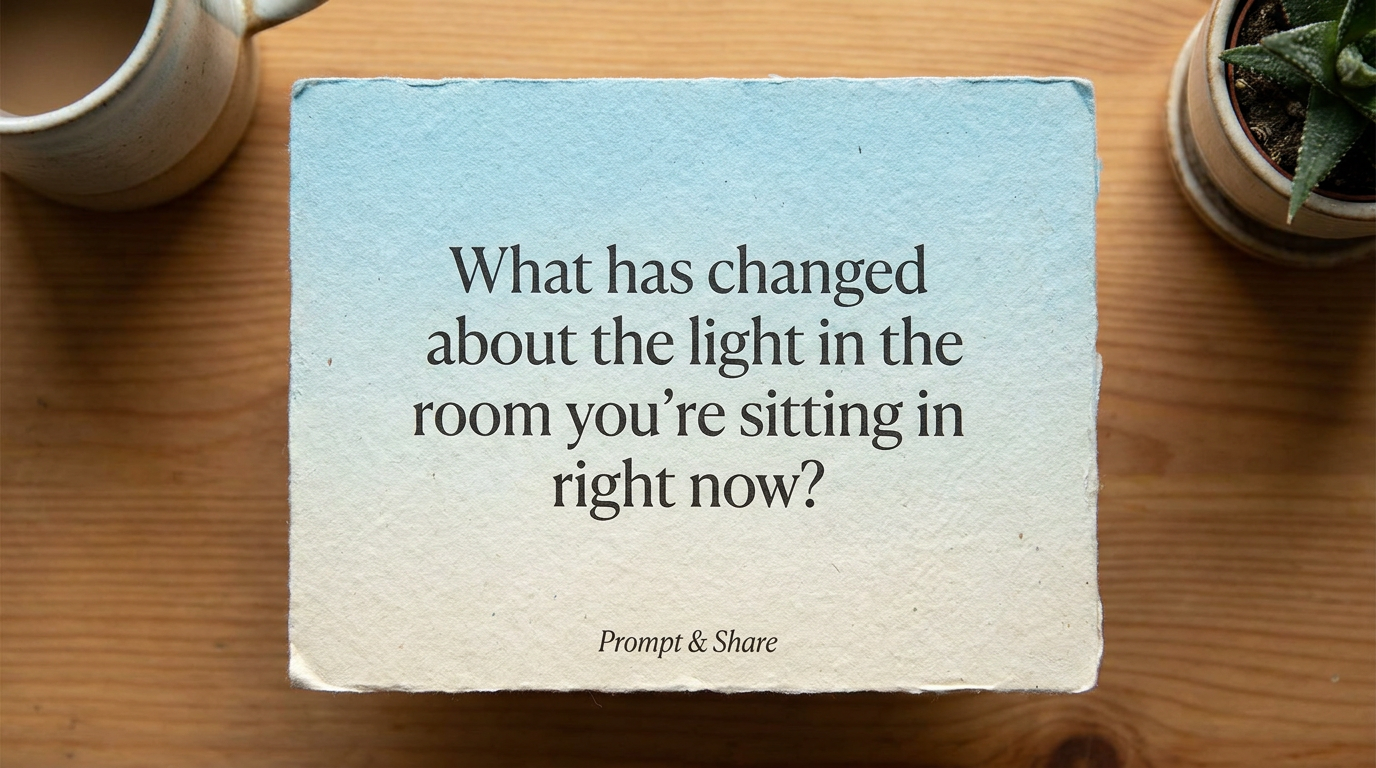
Fall Journal Prompts, Part Two: Gratitude, a Mid-Season Check-In and Looking Toward Winter
The second fifteen move from noticing small things, through a brief and deliberately forward-facing check-in, to the turn toward the colder months.
Gratitude for Small Things (Prompts 16–21)
Deliberately small-scale. Skip the big obvious answers — health, family, home. They’re true, they’re important, and they’re the least interesting things you could write. Go smaller.
- What ordinary object did you use today that would genuinely annoy you to lose?
- Who made something easier for you this week without being asked?
- What is something about your home that you stopped noticing years ago but would miss immediately?
- Which meal have you eaten most often this month, and who taught you to make it — or where did you first have it?
- What did you laugh at most recently, and can you still explain why it was funny?
- Name one thing that went right this week that you’d forgotten about by the evening.
Taking Stock of the Year So Far (Prompts 22–25)
Keep this cluster short and keep it facing forward. You’re checking the map at the mid-point of a walk, not writing the trip report. There are roughly four months left — this cluster is entirely about what you do with them.
- What are you doing now that you weren’t doing in March, and do you want to keep doing it?
- What’s one thing still sitting on your list that you actually intend to finish before the year turns?
- Which of your current commitments has stopped earning its place in your week?
- What would make the last stretch of this year feel well spent — not impressive, just well spent?
If those four open up something bigger than four short answers, a fuller guided reflection is coming next month.

Looking Toward Winter (Prompts 26–30)
For late in the season, as the light goes early and plans start forming for the colder end of the year.
- What are you quietly looking forward to in the next three months?
- Which tradition from last winter do you want to repeat, and which one has run its course?
- Who do you want to see before the year ends, and what’s actually stopping you?
- What does a genuinely good winter evening look like for you — be specific about the room, the food and the company?
- If you kept only one entry from this autumn, which of these thirty answers would you want it to be?
Which leaves the question prompt 30 quietly raises. If you’d keep one of these answers — where, exactly, is it going to be?
Prompt 27 has a habit of going somewhere unexpected. Traditions are almost always inherited, and the person who started them is usually still around to ask. Winter gatherings are the most natural moment in the entire year to record an older relative’s version of events — and it works best when you’ve already got a recorder running for something else.
Keeping the Season Somewhere You’ll Find It Again
Here’s the honest problem: the prompts are the easy part. Finding the answers again in six months is the hard part.
Think about where your last attempt actually went. Two entries in a notes app. A voice memo with a filename that’s just a date. Three photos in the camera roll among four thousand others. A paragraph typed into a message you sent yourself. None of that is lostAnd the point of answering thirty questions is being able to read them back. That’s the entire return on the investment. An autumn you can revisit is worth considerably more than an autumn you merely documented — the writing is the deposit, the rereading is the interest.
, exactly. It’s just not anywhere you’d ever think to look, which amounts to the same thing by March.
This is the specific problem is built around. A few things make it work for a season like this one:
Lugelo
- A Moment holds text, photos, video and audio in the same entry. So prompt 12’s sound, prompt 14’s smell and prompt 5’s photograph end up in one place rather than scattered across three apps that don’t know the others exist.
- Templates and the AI Journal Assistant handle the blank-page evenings — the ones where the prompt doesn’t immediately land and you’d otherwise close the app and forget about it.
- Memory Lane puts the season on a timeline, which is where the accumulation becomes visible. Individually, thirty short entries feel like nothing much. Laid out in sequence, they read as one coherent autumn.
The U.S. National Archives makes a related point in its : labelling and dating material is what makes it findable later. The same logic applies to an entry written on your phone in October.
guidance on preserving family archives
A word on privacy, because some of these thirty prompts get personal — 8, 24 and 28 especially. Journals in Lugelo are private by default. You decide who can view or contribute, and access can be revoked at any time. Data is encrypted in transit, and personal data is not sold to third parties. If you decide you’re done, account and data deletion is available, with a 30-day recovery window. The full detail lives on the That’s the solo version. The other version involves other people, and it’s better.
FAQ page
— worth two minutes before you write anything you’d rather keep to yourself.
Turn Fall Journal Prompts into a Shared Autumn Journal
That’s not a rhetorical flourish — it’s the actual mechanism. Prompts 3, 19 and 27 are noticeably better answered by more than one person, because the interesting part isn’t any single answer. It’s the gap between them. Two siblings will remember the same dish differently. Two friends will remember the same summer week as having happened in different months.
Hand the same prompt to three people and you’ll get three different autumns.
Hand the same prompt to three people and you’ll get three different autumns.
A few shapes this takes:
- A household, answering one prompt each on Sunday evening. Children included — theirs are usually the best ones.
- Siblings, answering the food and tradition prompts separately and then comparing notes on what they each swear happened.
- A grandparent, answering the sensory prompts about autumns from fifty years ago.
- Friends scattered after summer, keeping one shared autumn journal between four cities.
Shared journals use role-based permissions: the owner decides who can view and who can contribute, and access can be revoked at any time. Practically, contributors can add voice notes and photos rather than only typed text — which is what makes it genuinely workable for a seven-year-old and for a relative who’d rather talk than type. You can see how invitations and permissions work on the .
collaborative journal page
If you want a walkthrough of splitting a shared journal between two people rather than the summary above, our guide to covers the ground this section deliberately skips. And the is where the rest of the seasonal prompt collections live.
Lugelo blogco-creating a journal with a partner or co-parent

Start With One Prompt Tonight
Everyone has a story worth telling. Most of it is made of ordinary afternoons.
Here’s the concrete first move. Don’t plan the habit. Pick one prompt from the Closing Out Summer cluster and answer it tonight, while the details are still sharp enough to be specific. Prompt 5 is a good place to start — the last genuinely hot day. You still remember it. In six weeks you won’t.
The value doesn’t arrive tonight. It arrives on the reread — next spring, or three autumns from now, when you open something you’d completely forgotten writing and find the detail you’d otherwise have lost. That only happens if the entries are somewhere you’ll actually find them again.
So, one last time, the generous rule: not all thirty, and not every day. Two or three prompts a week. One photo and one sentence is a finished entry. Do that from now until December and a season’s worth of writing builds itself without you ever once having to feel behind.
The first cool morning has already happened. The calendar has already tightened. The season you’d be documenting isn’t approaching — it started somewhere in the last fortnight, while you were busy getting the routine back together.
Don’t Just Live It — Keep It
Start a journal for this autumn, answer a single prompt, and let the season fill it in from there.
Get Started
Available on iOS, Android, HarmonyOS and the web — and write your first entry tonight. Journals are private by default, and you decide who can view or contribute.
install Lugelo