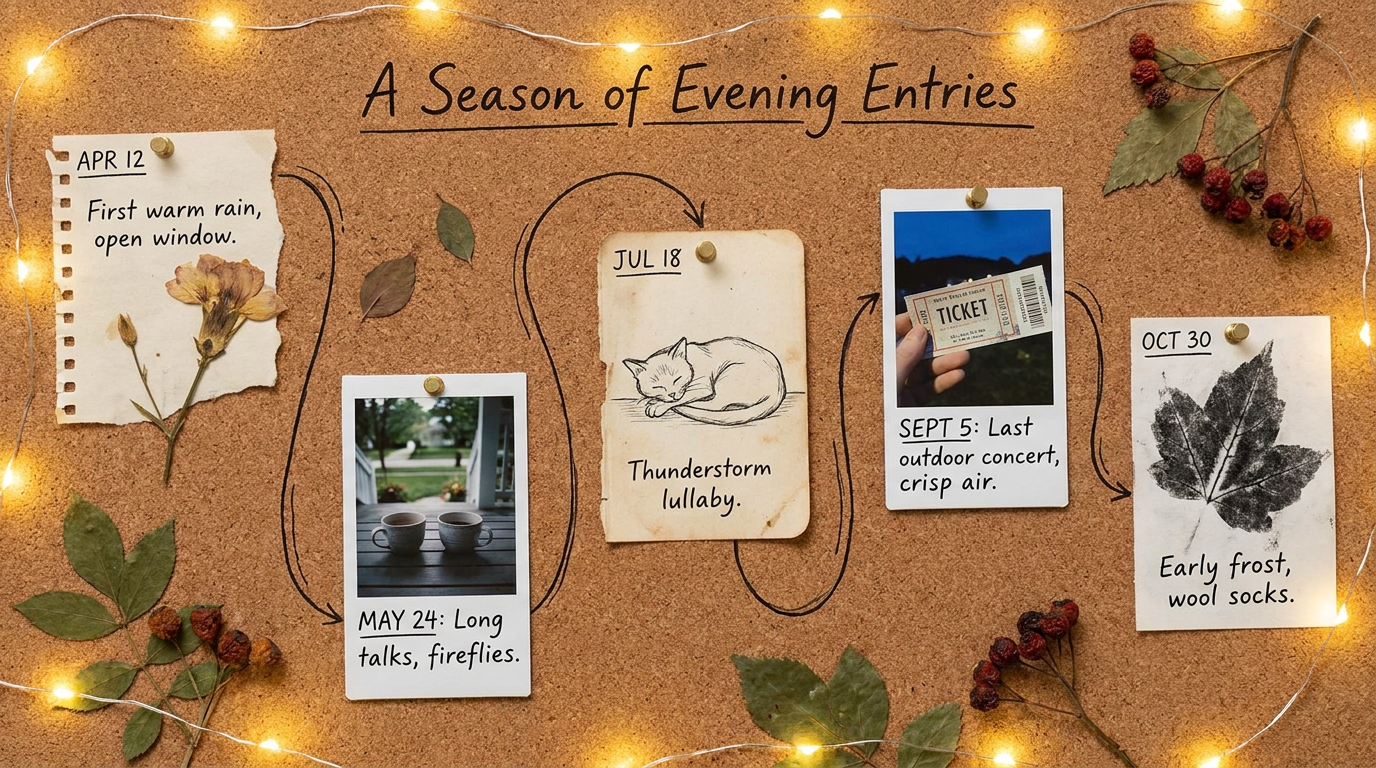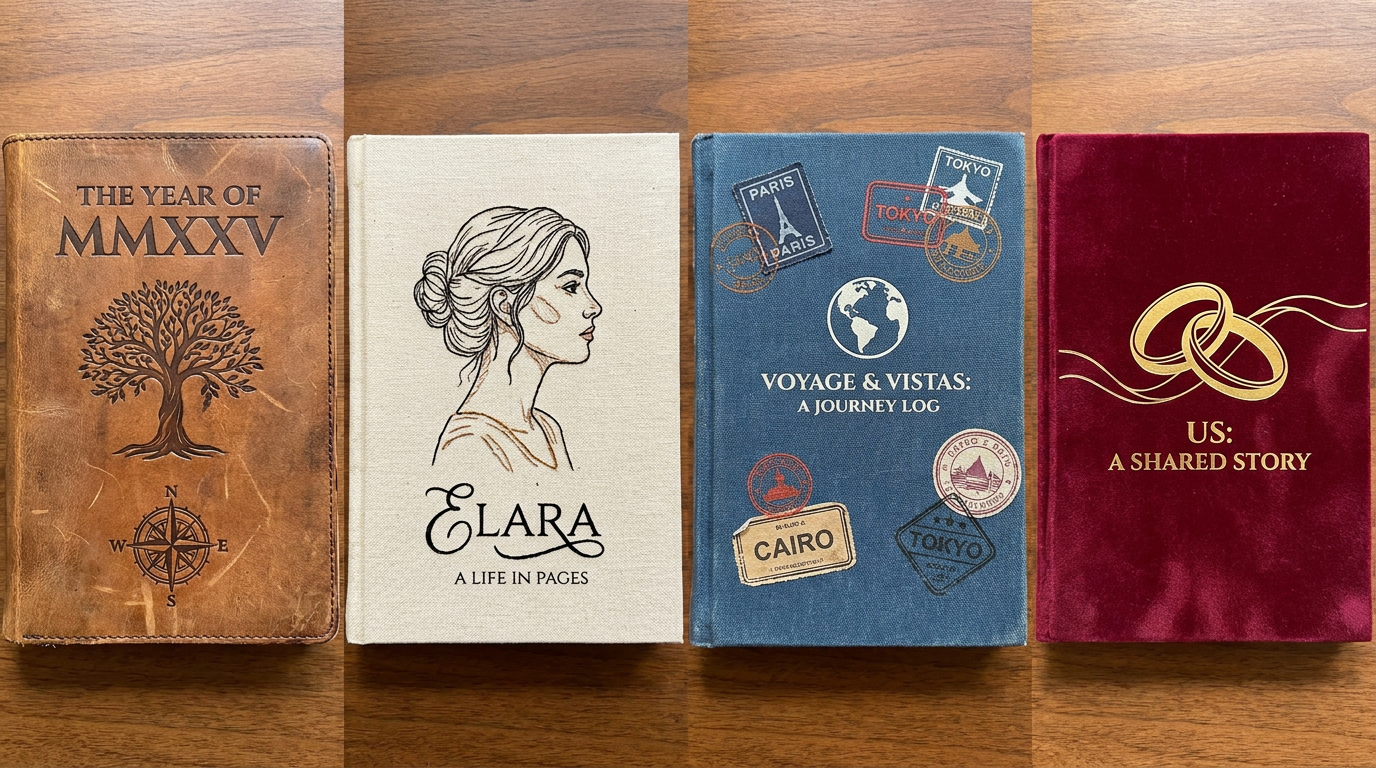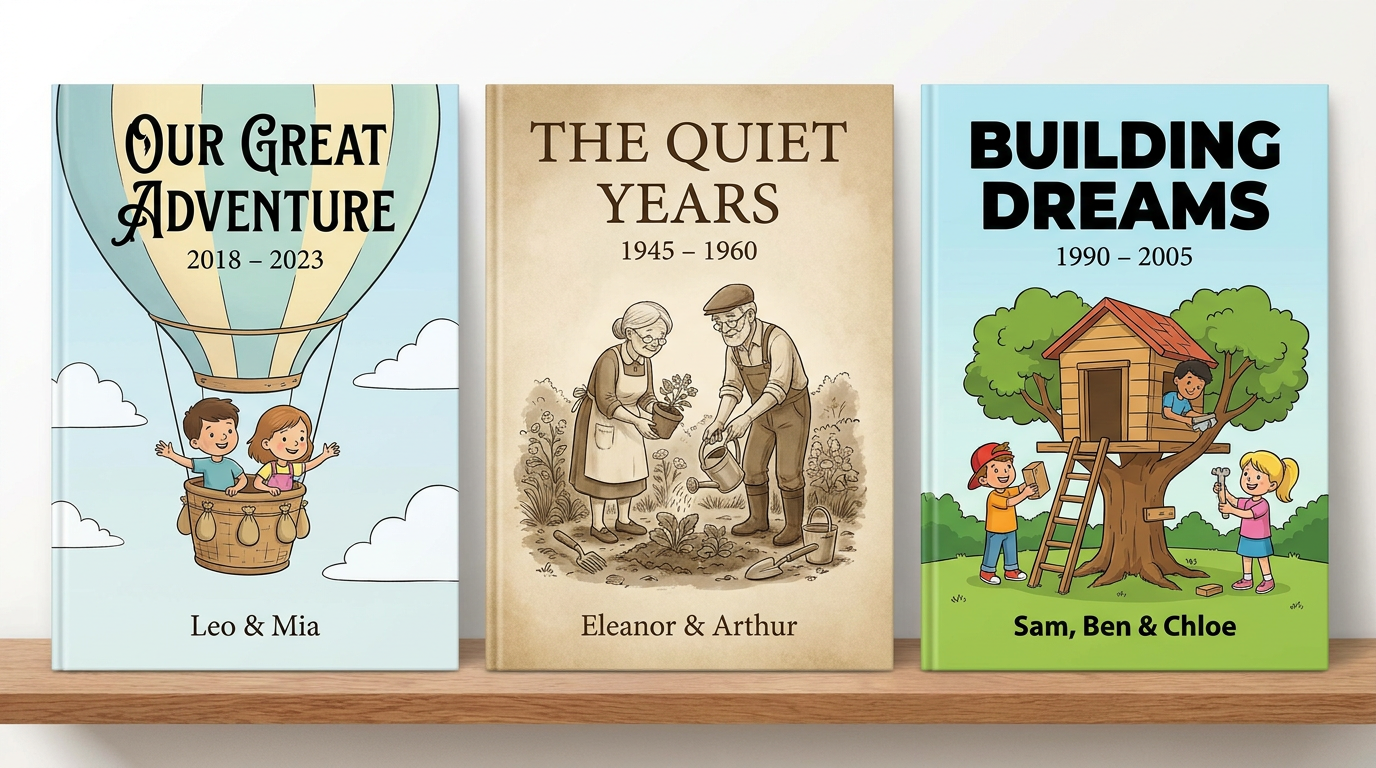
Category Archive : Diary

The Family Memory Book: Preserving a Life, Not Just a Camera Roll

And it’s just a picture. There’s a date stamp that means nothing to anyone but you. No names. No story. No indication of why your hands were shaking when you took it, or that it happened three weeks after she’d told you she was never going to learn, or that the bike had been your brother’s.

Nine minutes later, you find it.

So you scroll. Past four hundred screenshots. Past three nearly identical photographs of a parking space you were worried you’d forget. Past a receipt, a meme someone sent you in 2023, twelve pictures of a restaurant menu. Past a blurred thumb.

Picture this: it’s a Sunday evening and you’re looking for one photograph. Just one. The afternoon your daughter finally rode her bike without you holding the saddle — the wobble, the shriek, the look back over her shoulder. You know it exists. You took it.

Here’s the gap nobody names: saving is not the same as preserving.

We have never captured more and remembered less. Roughly — about 5.3 billion every single day. The typical phone carries somewhere in the low thousands of images, with most credible estimates landing between about 2,000 and 2,800. Plenty of family phones carry many multiples of that. Volume has never been our problem. Meaning is.
1.95 trillion photographs will be taken worldwide this year

A memory book does something structurally different. It isn’t a bigger pile. It’s a record — curated, contextual, and deliberately built to be understood by someone who wasn’t there.

Let’s be honest with each other from the first paragraph, because this whole guide depends on it: making one takes real effort. Most people who start a memory book never finish it. This guide exists to make sure you’re not one of them.

So we’ll cover all of it. What a memory book actually is. What belongs inside it beyond photographs. Who to involve, and how to get them to actually respond. How to begin whether you’re facing fifty years of shoeboxes or a completely blank page. Which format to choose, honestly assessed. How to organise it without inventing a second job for yourself. And the part nobody warns you about — how to finish.

Journals are souvenirs of your past.

What a Family Memory Book Actually Is

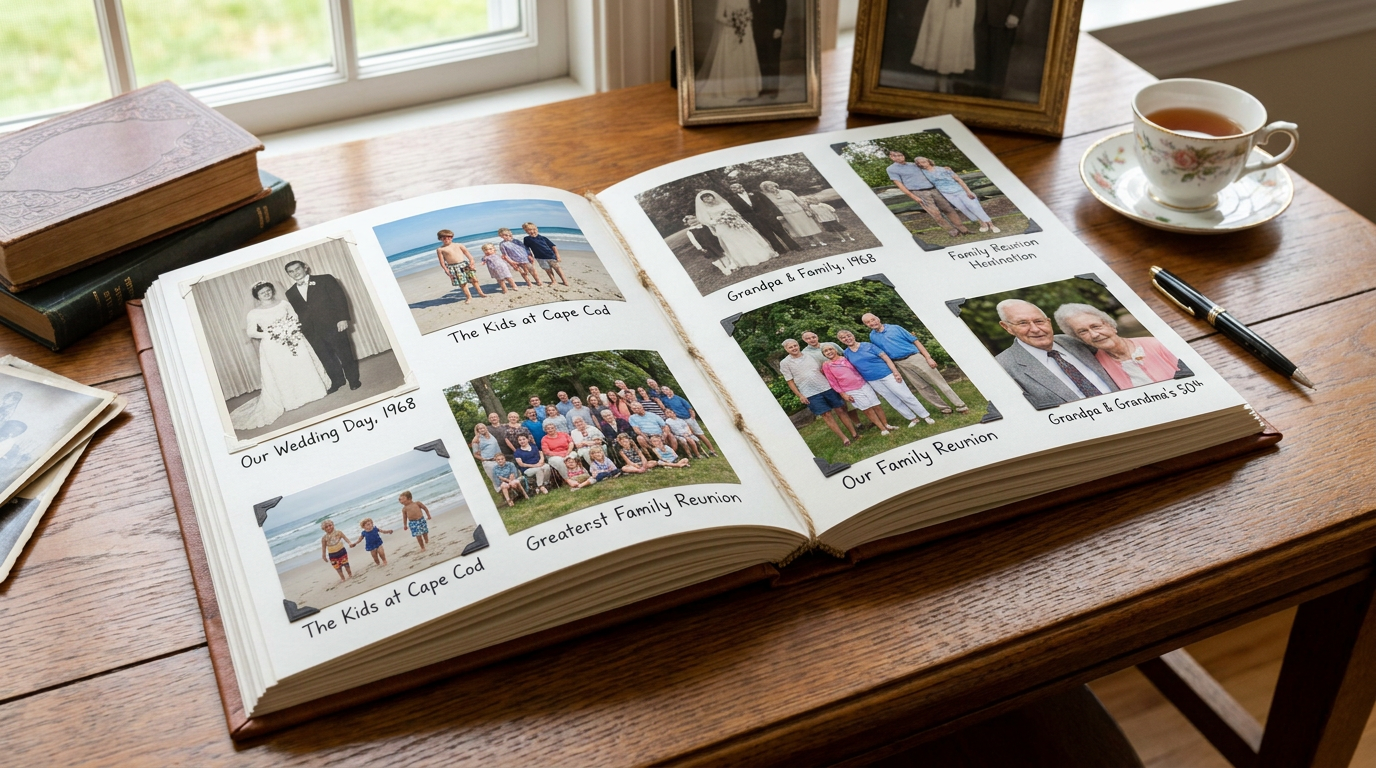
A memory book is a curated, narrated record of a person, a family, or a period of time — one that combines images with the words, voices, objects and context that explain why any of it mattered. Where a camera roll accumulates, a memory book selects and explains. That single difference is the whole discipline.

The confusion is understandable, because three different objects get used interchangeably in everyday conversation. They are not the same thing, and choosing between them deliberately will save you months.

The photo album. Images arranged in sequence, usually chronological, usually behind plastic sleeves. It’s strong on visuals and almost entirely silent on meaning. It answers exactly one question: what did this look like? Effort is low, shareability is poor (it exists in one copy), and it’s best suited to people who already know the story and simply want to see it again.

The scrapbook. Images plus decorative craft — patterned paper, ticket stubs, ribbon, hand-lettering, pressed flowers. Scrapbooks are wonderful. They carry texture and personality that nothing digital replicates, and the making of them is genuinely pleasurable. But they’re typically thin on narrative, extremely difficult to duplicate, and effectively impossible to share with a cousin in another country. They answer what did this feel like aesthetically? rather than what happened?

The memory book. Images plus narrative, voice, documents and context. It answers the questions that actually survive: Who were these people? What happened? Why did it matter? It carries more effort than an album but produces something categorically more useful — a record legible to a reader who has no prior knowledge, no shared memories, and no one left to ask.

That last point is the test this entire article runs on, so let’s state it plainly and come back to it repeatedly:

Would a stranger — or your own great-grandchild — understand this without you standing next to them explaining it?

If the answer is no, you have a pile. A beautiful, beloved, carefully stored pile. But a pile.

The Variations People Are Actually Looking For

“Memory book” is an umbrella term covering several genuinely distinct projects, and knowing which one you’re making changes every decision downstream.

A family memory book is multi-generational — several people, often several decades, usually assembled by one person with contributions from many. A baby memory book covers the first years: milestones, firsts, the name story, the things nobody thinks to write down because they assume they’ll remember. A memory journal runs forward rather than backward — ongoing, written, closer to a diary with intent. A memorial or tribute book gathers a life after it’s ended, often assembled collaboratively by people processing the same loss from different angles. And single-event books cover one bounded thing: a wedding, an emigration, a year abroad, a house.

There’s also the school-years version, which deserves its own treatment — if that’s your project specifically, we’ve written that goes considerably deeper on that narrower scope than this page can.
a complete guide to creating a school memory book

Retrospective, Prospective, or Both

Every memory book runs in one of two directions, and most good ones run in both.

Retrospective means assembling what already exists — the loft boxes, the inherited albums, the folder of scans your aunt emailed you in 2019. ProspectiveThe retrospective approach is archaeology. The prospective approach is journalism. Archaeology is harder, slower, and often incomplete. Journalism is easier and produces better material — but only if you start.

means capturing as life happens, so that in five years you have material with full context attached rather than mysteries to solve.

In , the vocabulary for this is simple and worth learning now because it recurs throughout this guide. An individual entry — a photo with a caption, a voice recording, a scanned document, a paragraph of writing — is called a Moment. The chronological view where those Moments arrange themselves into a readable timeline is called Memory LaneOnce you know what a memory book is meant to do, the practical question arrives immediately — what actually goes inside one?
Lugelo

One reassurance before we go further, because it stops more people than any technical obstacle. You do not need to be a writer. You do not need to be a designer. You do not need to be an organised person, and the evidence suggests most people who successfully make these are not. What you need is a decision about scope and a single place to put things.

. That’s the whole structural grammar: you add Moments, and Memory Lane puts them in order.

What to Put in a Memory Book Beyond Photographs

Here’s the insight that changes how people approach this entire project: photographs record surfaces. Almost everything that makes a person recognisable lives somewhere else.

A photograph shows you a face. It doesn’t carry a voice. It doesn’t hold a phrase, a temper, a laugh, the particular way someone came down the stairs, or what the kitchen smelled like on a Sunday. Twenty years on, the face is the thing you’re least likely to have forgotten — and the voice is the thing you’d give almost anything to hear again.

So build outward from the photographs.

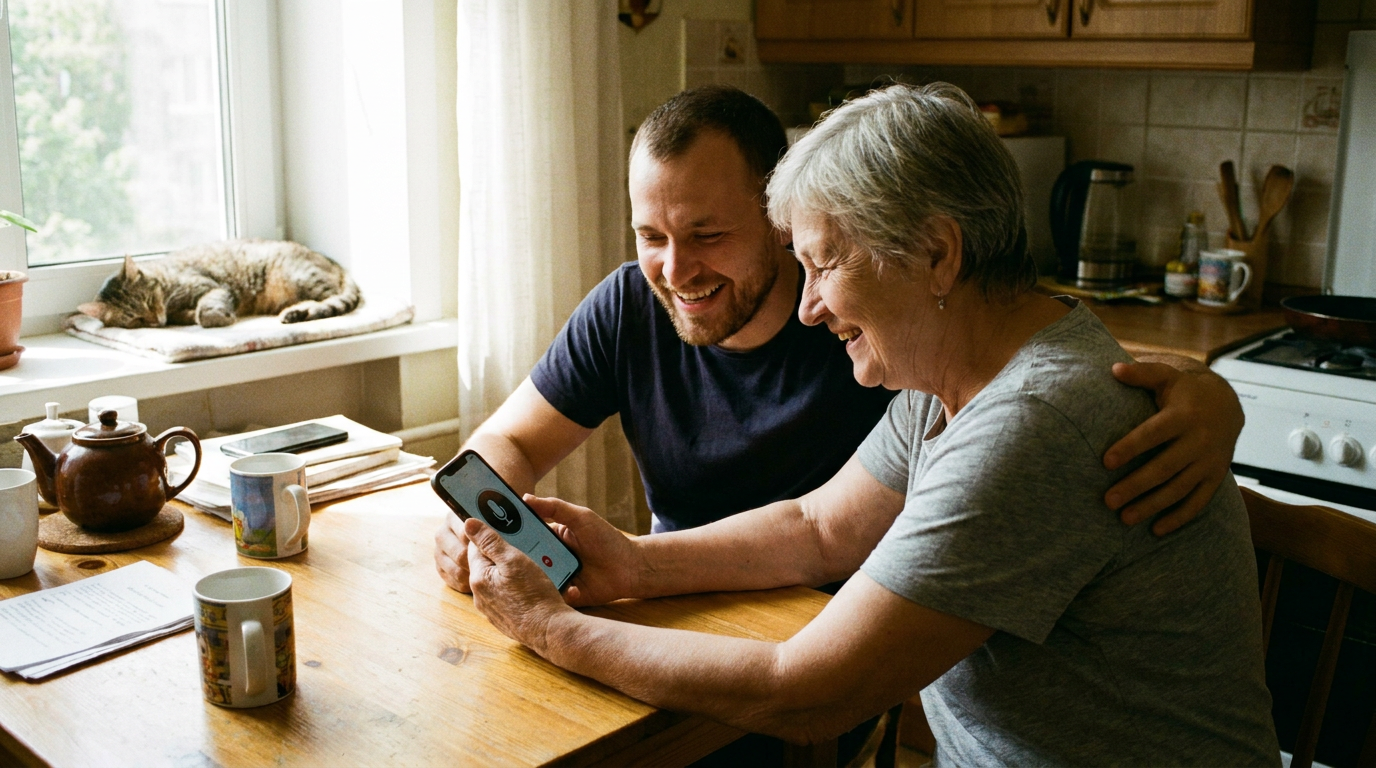
Voices. This is the category families consistently name as the most treasured thing they own, and the one they most regret not gathering. A recording of a grandparent telling a story in their own accent, at their own pace, with their own hesitations and their own laugh, is not a supplement to a photograph. It’s a different order of thing entirely. Record it before you feel ready. A two-minute voice note made badly on a kitchen table beats a perfectly planned interview that never happens, and the perfect interview is the enemy here. Lugelo Moments accept audio directly, so a voice note can be the entry — no transcription required.

“A photograph shows you a face. A voice recording gives you back a person.”

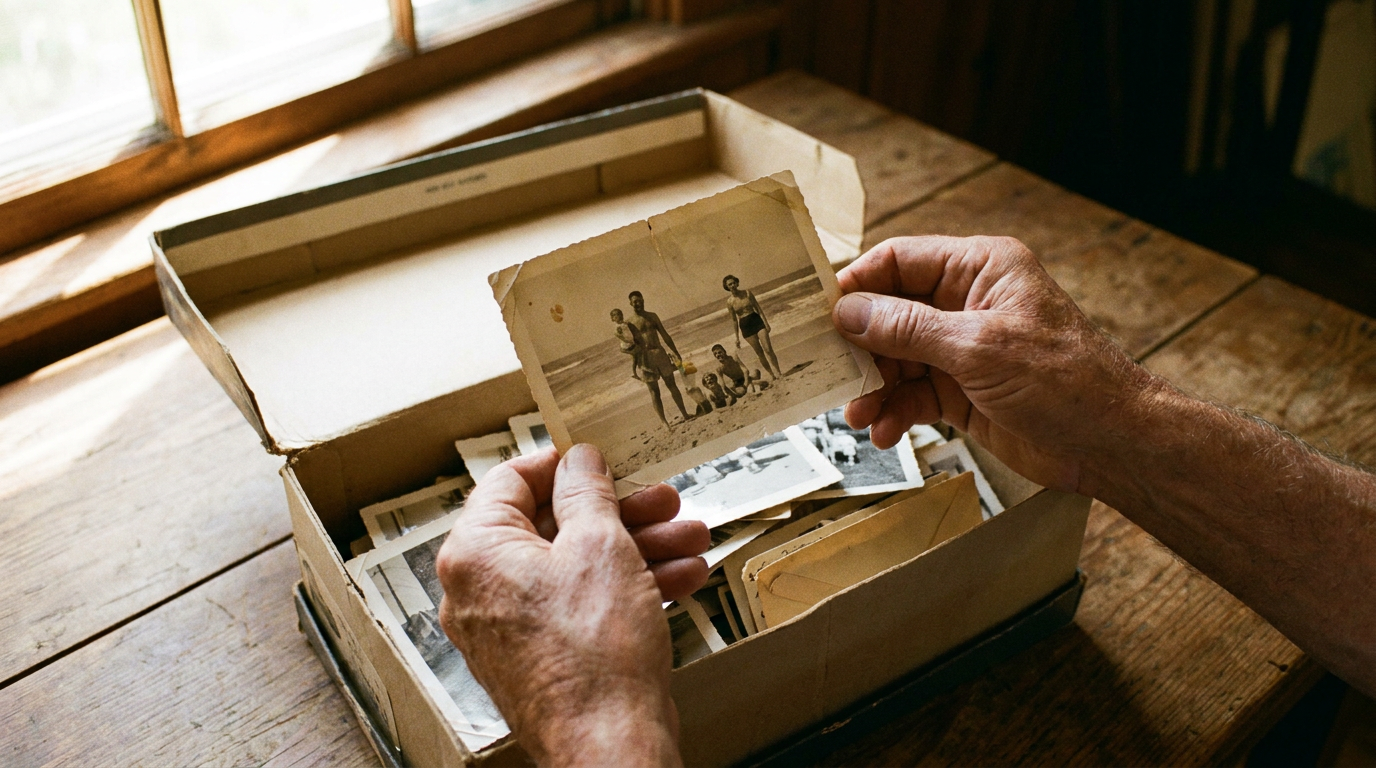
Handwriting. A shopping list. A birthday card. A note in the margin of a cookbook. Handwriting is startlingly personal — more identifiably someone than most portraits — and it is disappearing faster than any other category on this list. Photograph it or scan it. Before you handle fragile originals, it’s worth reading the : clean dry hands, support the whole item, and never reach for adhesive tape.
National Archives guidance on handling family papers

Recipes. Especially annotated ones. The splashes, the crossings-out, the “add more than it says,” the oven temperature amended twice in different pens. An unmarked recipe is instructions. A marked one is a record of someone cooking.

Documents. Immigration papers, military records, deeds, school reports, letters, telegrams, naturalisation certificates, employment cards. These anchor a family in verifiable history and give future readers something to pull on when they want to go further.

The mundane details. This is the category nobody thinks to record, because at the time it all feels too ordinary to be worth the trouble. The car they drove. The exact route of the school run. What was always in the fridge. The phrase your father used when he was annoyed. What the house sounded like at seven in the morning. These become the most precious material in the book, and they vanish completely and without warning.

Objects, photographed. A watch, a christening gown, a ticket stub, a chipped mug that nobody was allowed to throw away. Photograph the object and write down who it belonged to and why it survived. An unexplained object in a photograph is a puzzle; an explained one is a story.

Maps and places. Where people lived, in what order, and why they moved. Migration is the spine of most family histories, and the “why” is almost never recorded.

Prompts to Capture the Ordinary

If you want something you can act on tonight, answer these in writing or out loud:

  1. What did a completely normal Tuesday look like in 1994?
  2. What was always in the fridge?
  3. Who called the house, and at what time of day?
  4. What did the house sound like in the morning?
  5. What did people wear indoors?
  6. What was the argument that came back every year?

One honest counterweight: more is not automatically better. A memory book bloated with everything is just a camera roll with extra steps. Every addition should survive the stranger test — would someone who wasn’t there understand why this is here?

The Ten Things Families Wish They’d Recorded: voices · handwriting · recipes · the name story · an ordinary weekday · the house · the car · the repeated phrases · the objects and who owned them · the reasons behind the big decisions.
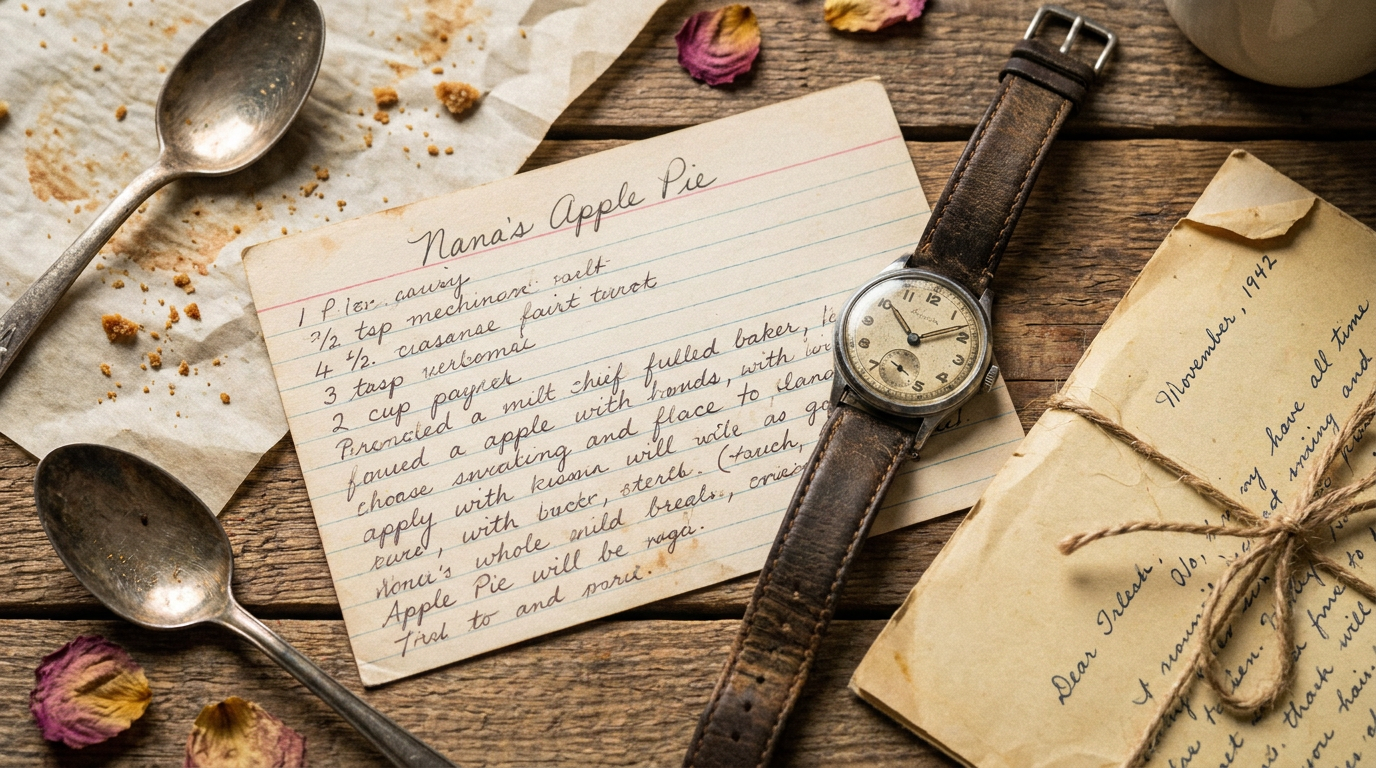
Close-up of a handwritten recipe card, a wristwatch and an old letter arranged on a table

Building a Baby Memory Book: The First-Years Version

The baby memory bookKnowing what to gather raises an awkward question, though: most of this material isn’t actually in your possession.

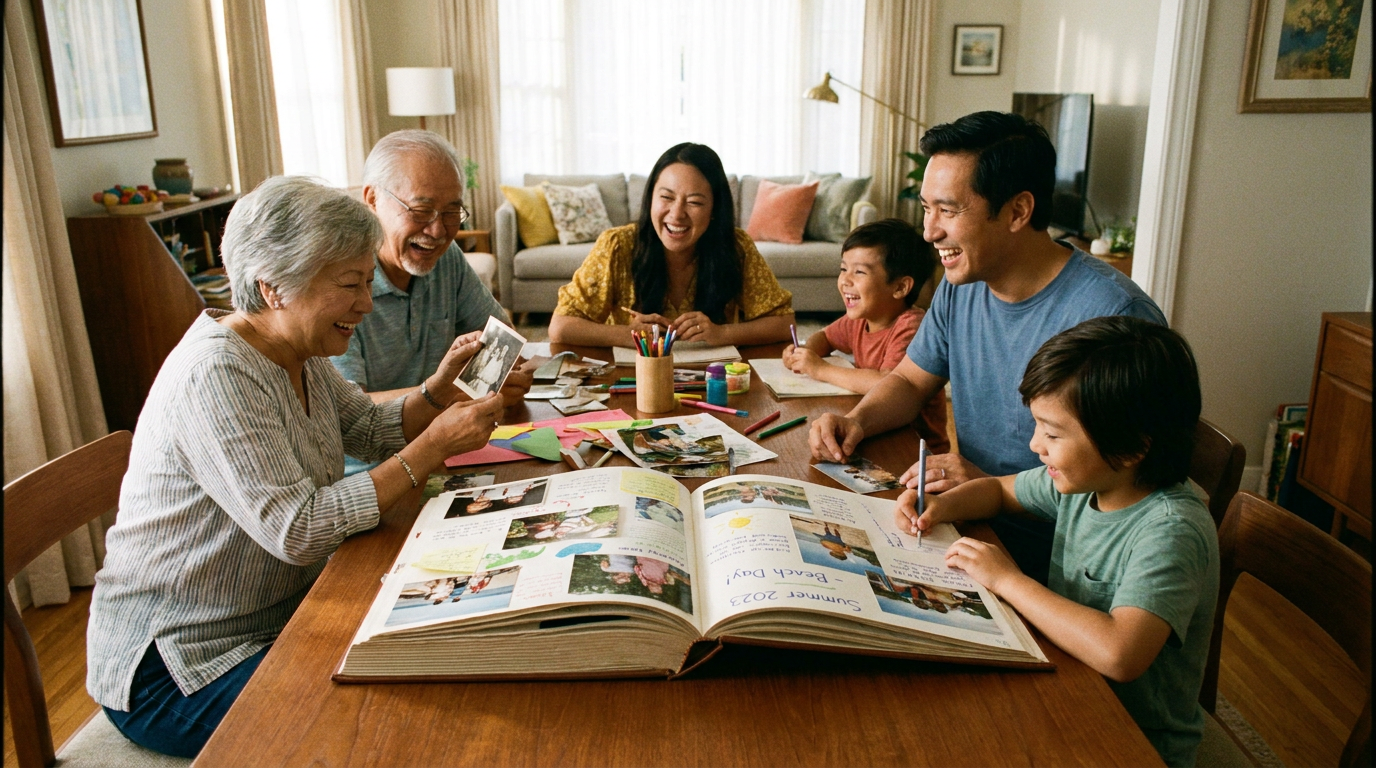
One structural advantage worth using from day one: both parents can add their own Moments to the same baby journal, and so can grandparents, rather than one person silently inheriting the entire job. Two perspectives on the same first year is a better record than one — and it halves the load.

The practical approach is to capture loosely and organise later. A single running journal you actually add to beats a beautiful structured template you fall behind on by February. Add a Moment when something happens; let the timeline sort itself out.

What genuinely matters is a much shorter list than the templates suggest. The first photograph. The name story — who chose it, why, and what the alternatives were, because that gets forgotten within a decade. A handwriting sample: a note from each parent to the child, written now, in the present tense. Birth details. A recording of the parents’ voices in the first weeks, when everyone sounds exhausted and slightly amazed. First words. And the sayings — the mangled, invented words a child produces that the family repeats for the next thirty years and never writes down.

is the most common entry point into this entire subject — and the easiest to over-plan and abandon. Something about a new baby makes people buy a 200-page hardback with prompts for every week, which is precisely the design most likely to stall at week six, at which point the guilt of being behind becomes a reason not to open it at all.

Who to Involve and How to Get Family to Contribute

So the collaboration problem isn’t optional. It’s structural.

That person inherits two things simultaneously: all of the labour, and an incomplete record. Because siblings remember different years. Cousins hold photographs from the branch of the family that emigrated. An aunt has the letters. Your mother knows who the people in the 1968 photographs are, and nobody else does. The archivist has the motivation and roughly a third of the material.

In almost every family, one person becomes the default archivist. You probably know who it is in yours. There’s a reasonable chance it’s you, given you’re reading this.

Why People Don’t Contribute

It is almost never indifference, which is worth internalising before you get resentful. There are four real reasons:

They don’t know what you want. “Send me your old photos” is not a request, it’s a project. It requires the recipient to make decisions, and so they defer it.

They think their contribution isn’t good enough. The photograph is blurry. They can’t remember the exact year. They’re “not a writer.” So they send nothing, on the theory that nothing is better than something imperfect.

They don’t know how to use the tool. Particularly for older relatives, the fear of pressing the wrong button and breaking something you’ve spent months building is genuinely paralysing.

The ask is too big. An open-ended request to “help with the family history” reads as a commitment of unknown size, and people don’t accept commitments of unknown size.

The Fixes That Actually Work

Ask for one specific thing. “Do you have a photo from the 1987 holiday in Cornwall?” gets a reply within a day. “Send me your old photos” gets nothing, ever, from anyone.

Set a comically low bar and say so out loud. Tell people explicitly: one photograph with one sentence is a complete contribution. Say it in those words. It removes the fear of being judged on effort.

Accept voice notes. The relative who insists they aren’t a writer will happily talk for four minutes without pausing. Meet people in the format they’re comfortable with, and you’ll get ten times the material.

Assign by era, not by task. Whoever was there for the 1970s owns the 1970s. This converts a vague collective obligation into a defined personal one, and it flatters people by treating their memory as authoritative.

Attach a deadline to a real event. A birthday, an anniversary, a reunion, Christmas. Open-ended projects do not finish. Projects with a delivery date do.

Here’s a message you can copy and adapt right now:

“Hi — I’m putting together a memory book for Mum’s 70th in March. Could you send me one photo of her from before 1985, and one thing you remember about her from back then? Doesn’t need to be long — two lines is perfect, or just record yourself talking for a minute and send me the voice note. That’s genuinely all I need.”

How It Works in Practice

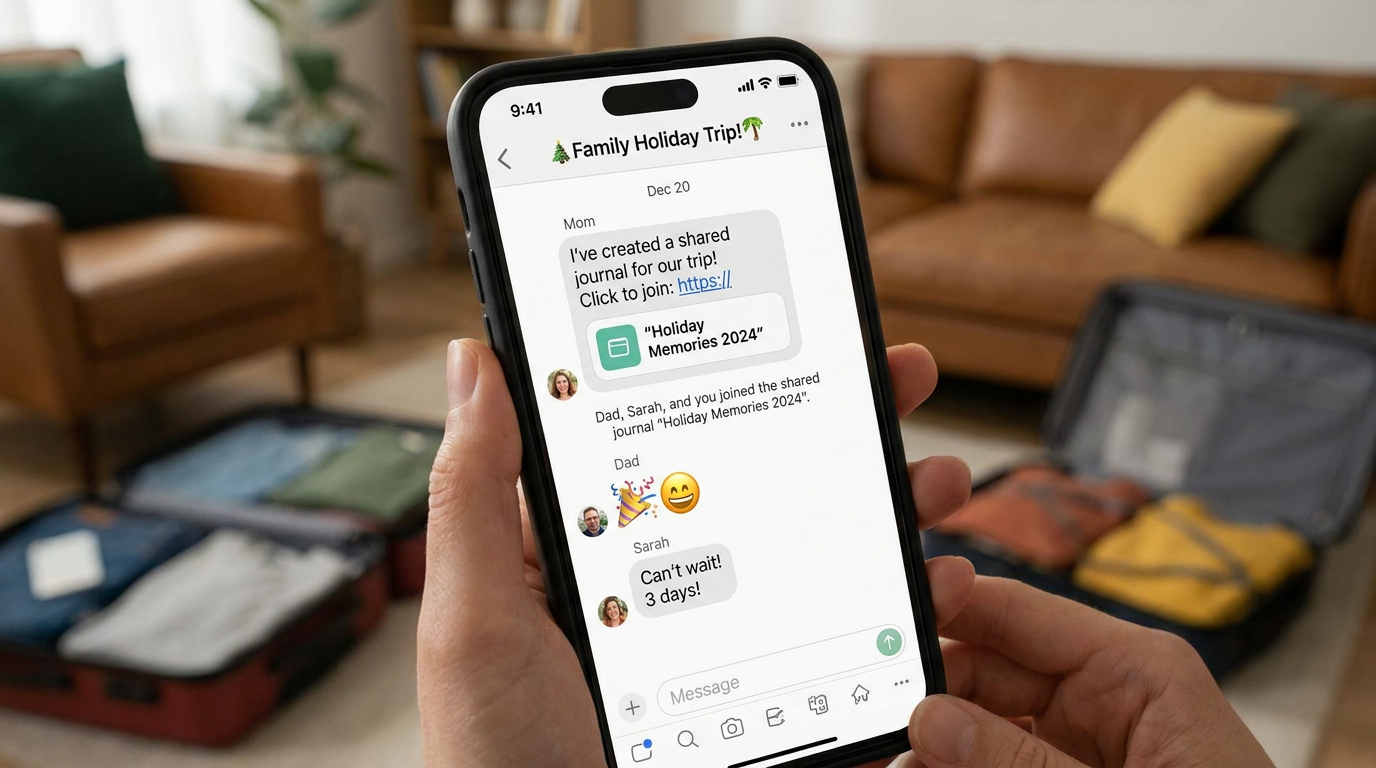
In , you create a shared journal and invite people by email or link, assigning each person a role: Viewer, Contributor, or EditorThat role distinction solves the anxiety problem directly. Contributors can add their own Moments — photos, video, audio, text — but cannot alter anyone else’s entries. Nobody can accidentally delete your work. Once an older relative understands that, the “what if I mess it up” objection disappears, and it is a far bigger barrier than most people realise.
Lugelo’s collaborative journal

.

Journals are private by default. The owner keeps owner-controlled access throughout and can revoke it at any point. And every Moment shows who added it and when, which means the finished book naturally carries multiple voices rather than flattening into a single narrator’s summary of everyone else’s lives.

If you’re dividing the work between two people specifically — two parents, two siblings — our guide on covers that workflow in more depth.
how to co-create a journal with a partner
An older woman and her adult grandson recording a voice note together on a phone at a kitchen table

Making a Grandparents’ Memory Book

This is the most time-sensitive version of the project and, predictably, the one people most often postpone.

The approach that works is questions, not a blank page. Nobody can respond usefully to “tell me about your life.” Almost everybody can answer: Where were you living when you were my age? What was your first job, and what did it pay? What was your mother like? What did you do on a Saturday when you were nineteen? What’s a story your parents told you about their parents?With people and material lined up, the hardest practical question arrives: where do you actually begin?

Grandparents can be added as Contributors and add Moments from their own device — or a family member can add on their behalf after a visit, which is often the more realistic arrangement.

And it’s worth saying plainly, without drama: this particular project has a deadline set by circumstance rather than by you. The people who can identify the faces in the photographs and explain why the family left in 1962 are a finite resource. That isn’t a reason for anxiety. It’s a reason to book the first session this month.

Work in short sessions. Forty minutes is plenty. Repeat visits produce dramatically better material than one marathon interview, partly because memory works associatively — the question you asked on Tuesday surfaces an answer on Friday.

Record audio rather than transcribing as you go. It’s faster, it keeps the conversation natural instead of turning it into dictation, and it preserves the voice itself, which is the point.

That last question is quietly the most valuable one on the list — it reaches back a generation further than living memory usually goes.

How to Start a Memory Book From Anything or Nothing

Two opposite paralysis states stop most memory books before the first page. Either there’s far too much material, or there’s almost none. Both feel like disqualifications. Neither is.

Start Here If You Have Too Much

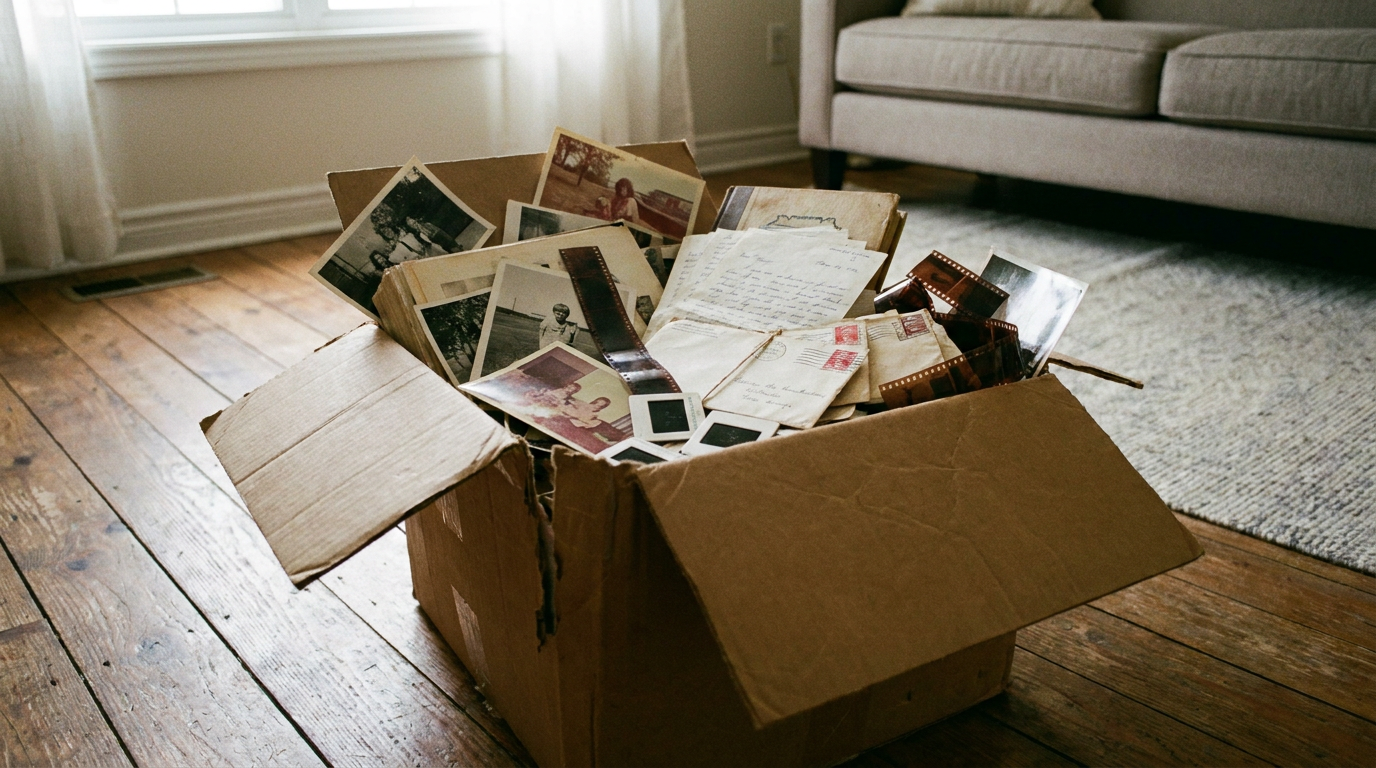
Do not start by sorting. This is the single most important instruction in the section. Sorting is where these projects die — it’s effortful, it produces no visible output, and it can be extended indefinitely, which makes it the perfect procrastination activity disguised as progress.

Start instead by choosing a scope. One person. One decade. One household. One theme. A finished book about your mother’s childhood is worth more than an unfinished book about everything since 1890, and the second one is what you’ll accidentally attempt if you don’t decide now.

Then work in passes rather than perfection:

  1. Pass one — gather. Get everything into one physical place. No decisions, no sorting, no reading. Just consolidation.
  2. Pass two — react. Go through and pull out only the items that make you feel something. Trust that instinct; it’s a better editor than any system.
  3. Pass three — caption. Identify and caption what you pulled. Names, approximate year, what’s happening, why it’s here.
  4. Ignore everything else for now. It isn’t going anywhere.

Before you handle anything fragile, get the basics right. The is plain-English, non-commercial and genuinely practical: clean dry hands, support the whole item, no adhesive tape, no rubber bands, no paper clips. Their guidance on is worth reading before you put anything back in the loft, because storage conditions do more damage than handling ever will.
storing family papers and photographsNational Archives’ guide to preserving family archives

Digitise the fragile things first. Anything brittle, fading, water-marked or stored somewhere damp goes to the front of the queue. Photographs and negatives are considerably more vulnerable than paper. The Archives also publish specific advice on and on — worth having open the first time you lift the lid on a box that’s been in a garage since 1998.
what to do about mould or insect damagescanning and digitising

And then the highest-value hour of the entire project: caption while the person who knows is still in the room. Sit with the oldest relative you have and go through photographs asking who, where, roughly when. An unidentified photograph is close to worthless three generations on. An identified one is evidence.
An open cardboard box of unsorted family photographs, letters and negatives on a living room floor

Start Here If You Have Almost Nothing

An empty start is a genuine advantage, and it’s worth reframing it as one immediately. You aren’t reconstructing a record from fragments with the context missing. You’re building forward, with full context available, from people who are still here to explain themselves.

Start with living memory. Interview the oldest willing relative this month. One conversation typically produces more usable material than a weekend in the loft.

Start with the present. A memory book does not have to begin in the past. Begin today — this week, this ordinary September — and let it accumulate. In five years you’ll hold something no amount of retrospective effort could ever manufacture, because it’ll have the details that only get recorded contemporaneously.

Anchor with documents. Certificates, records and public archives fix names, dates and places, and give later readers something verifiable to build on.

Beat the blank page with prompts. If the obstacle is simply not knowing what to write, Lugelo’s offers prompts and can expand rough bullet points into a readable entry — without replacing your own voice, which remains the thing that matters. Used well, it’s a way past the first sentence, not a ghostwriter.
AI Journal Assistant

The First Weekend Plan

Four hours, and you’ll be ahead of most people who ever attempt this:

  • Hour one. Decide the scope and give the book a name. Write both down.
  • Hour two. Gather twenty items. No sorting, no judging.
  • Hour three. Caption ten of them — names, rough year, what’s happening.
  • Hour four. Record one voice memory. Yours or someone else’s.

Before committing serious hours to gathering, though, it’s worth deciding what form the finished thing will actually take.

That’s it. You now have a scoped project, twenty pieces of material, ten identified items and one voice recording. That is further than the overwhelming majority of memory books ever get.

Memory Book Formats Compared: Physical, Printed and Digital

This is the section where the article either earns your trust or loses it, so let’s be genuinely even-handed. There are four realistic formats, and the right answer depends entirely on what you’re optimising for.

Physical scrapbook or album. Best for tactility, craft and the pleasure of making something with your hands. Holds audio or video? No. Shareable? Barely — it exists in exactly one copy. Main risk: that single copy. Fire, flood, damp, a house move, a well-meaning clearout. Real strengths, though, and they’re often undersold: no device required, no file formats to worry about, no account to maintain, and it’s genuinely lovely to hold. People pick up physical books. They rarely open folders.

Printed photo book. Best for producing a finished, giftable object with a definite ending. Holds audio or video? No. Shareable? Yes, at a cost per copy. Main risk: it’s fixed at the moment of printing — an error in a name is permanent-ish in the only sense that matters, and there’s limited room for text. But it sits on a shelf where people actually reach for it, which is more than can be said for most digital archives.

Digital, private and single-owner. Best for searchability, multimedia and ongoing capture. Holds audio or video? Yes. Shareable? Yes, at your discretion. Main risk: it requires active care, and people assume it doesn’t. Strengths are substantial — it holds voice, video and documents, it’s searchable, it can be copied to multiple locations, and it has no page limit.

Shared digital. Best for multi-contributor family projects across distance. Holds audio or video? Yes. Shareable? By design. Main risk: it still needs one person to own it and set expectations, or it drifts. The upside is that no single person carries the entire load, and you get multiple perspectives instead of one narrator’s summary.

Digital Is Not the Same as Durable

Here’s the honest part, and it matters more than anything else in this section.

Digital files are not self-preserving. Putting something into an app does not make it safe. The makes the point that digital materials can in some respects be harder to look after than physical ones, precisely because they depend on technology — file formats, software, hardware, accounts — to remain readable at all. A shoebox in a dry cupboard needs nothing from you for thirty years. A digital archive needs attention.
Library of Congress’s personal digital archiving programme

So three rules, and they apply regardless of which service or software you use:

  1. More than one copy. Always.
  2. In more than one place. Not two folders on the same laptop.
  3. Checked more than once. Periodically open old files and confirm they still open. Migrate ageing formats before they become unreadable, and favour common, well-supported ones.

The Library of Congress publishes format-specific guidance worth following for and , which is particularly relevant if voice recordings are going to be the emotional centre of your book.
digital audiodigital photographs

The Hybrid Is the Honest Recommendation

Keep a working digital record as the living archive — searchable, multimedia, shareable, easy to add to on a Tuesday evening. Then print a physical copy at milestones: a significant birthday, the end of a decade, the completion of a chapter.

Two formats. Two entirely different failure modes. One story. That’s the most defensible answer anyone can give you, and it’s what we’d actually recommend.

A printed family photo book sitting beside a tablet showing a digital memory timeline

Choosing Tools for a Family Memoir Project

Rather than a shopping list, use criteria. Ask any tool you’re considering these six questions:

Does it hold audio and video, or only photos and text? If voices matter to you — and they should — this is disqualifying for a lot of options.

Can more than one person contribute, with controlled permissions? Not just shared access. Roles, so a nervous relative can add without being able to overwrite.

Can you export your material out in a standard format? This is the most overlooked criterion in the entire decision, and the one people regret ignoring. If your family’s record can’t leave, it isn’t really yours to move.

Is it private by default? The default matters more than the settings, because defaults are what most people actually live with.

Can it produce something printable at the end? A record with no exit into physical form is a record with only one failure mode.

Does it work on the devices your least tech-confident relative actually owns? The most capable tool is useless if your grandmother can’t open it.

For transparency, here’s where Lugelo sits factually against those criteria: multimedia Moments including audio and video, role-based collaboration with Viewer, Contributor and Editor permissions, eBook and PDF export, private by default with owner-controlled sharing, and availability on iOS, Android, HarmonyOS and the web. Cost is a legitimate factor in this decision too, and the With the format settled, the work becomes organisational — and this is where projects quietly collapse under admin.
pricing page

lays that out plainly.

Organising a Memory Book Without Drowning in Admin

Chronological order is the default that worksIt requires no invented logic, so you never have to explain the structure. It shows change over time, which is the thing photographs do better than any other medium. And crucially, a stranger can follow it without instruction. The visual force of seeing the same person at five, at fifteen and at fifty in sequence cannot be replicated by any thematic arrangement, however clever.

, and it’s worth understanding why before you consider alternatives.

Now the release valve, because this is where perfectionism does its damage: you do not need exact dates.

“Sometime in the mid-eighties” is a perfectly good date. So is “before they moved.” So is “she looks about seven here, so probably 1974.” Approximate placement beats indefinite postponement every single time, and perfectionism about metadata is the number one cause of abandonment in this entire category.

“An approximate date beats an indefinite delay. ‘Sometime in the eighties’ is a date.”

Four Structures That Work

Strict chronology. Everything in time order, one continuous run. Best for single-subject books and family histories.

Life stages. Childhood, school, working life, parenthood, later years. Gentler than strict chronology when dates are patchy, and it gives the book natural chapters.

One book per person. Cleaner than it sounds, and much easier to finish. Also the most giftable structure — each person’s book can go to the people who loved them.

Thematic threads across the timeline. Holidays, houses, the same photograph taken every year. These work best layered on top of a chronological spine rather than replacing it.

Let the Structure Emerge From Adding

The mechanism matters here. In Lugelo, Moments arrange themselves chronologically into , which means the structure emerges from the act of adding rather than from a separate sorting phase. You add; the timeline organises. That single design choice removes most of the administrative overhead that kills these projects, because the organising work never accumulates into a task you have to schedule.
Memory Lane

If you’d rather watch the workflow than read about it, the show the process directly.
how-to walkthroughs

Five Anti-Admin Rules

  1. Caption at the moment of adding. Never “I’ll do it later.” Later is where uncaptioned photographs go to become anonymous.
  2. Use consistent naming for people. Pick one form of each name — “Nana Ruth,” not sometimes “Ruth,” sometimes “Nan,” sometimes “Mum’s mum” — so the record stays searchable.
  3. Add the year even when you can’t add the day. Partial data is data.
  4. Batch similar work. Twenty captions in one sitting is faster than twenty captions across twenty sittings.
  5. Set a recurring twenty-minute slot. Sunday evening, Wednesday lunchtime, whenever. Waiting for a free weekend is waiting for something that does not arrive.

Recurring Traditions Make the Best Timelines

The single most powerful structure available in any memory book is the same thing, photographed every year. Repetition is what converts ordinary snapshots into a visible record of change — no individual photo does much, but forty of them in a row are extraordinary.

Annual family traditions are the load-bearing structure of family identity: the same table, the same dish, the same argument about the same board game, the same person falling asleep at the same point in the afternoon. They photograph consistently by their nature, which makes them ideal timeline material.

The costume timeline is the clearest example. Halloween costumes lined up year on year — the same child, October after October, at four, at nine, at fourteen — is one of the most striking sequences a family can build. Nothing demonstrates the speed of childhood more plainly, and it takes one photograph a year to produce.

Remembrance traditions translate unusually well into this format. Día de los Muertos ofrendas — photographs, favourite foods, marigolds, objects belonging to those being remembered — map naturally onto a digital memory book, where each person remembered can hold their own set of Moments, stories and recorded voices. Approached with cultural respect rather than as novelty, it’s one of the most meaningful structures in this guide, because the tradition and the medium are doing the same work.

The same-capture-every-year method is exactly what makes so effective in practice, and it scales to any repeating occasion.
an annual school year record

These annual sequences can also be gathered as a themed journal and later viewed as a VR gallery, with a 2D preview available on any device for family without a headset.

A digital Memory Lane timeline showing family moments arranged chronologically across several decades

Structure solves the middle of the project. The ending is where nearly every memory book actually fails.

Finishing a Memory Book: The Completion Problem

Let’s say the quiet part directly: the hard part is not starting. It’s finishing.Starting is emotionally rewarding and requires no discipline. Finishing requires both.

Half-built memory books are among the most common objects in family homes. The album with twelve filled pages and forty empty ones. The box labelled “to sort” in handwriting from two house moves ago. The app opened twice. The scanner bought in January.

The Four Reasons They Stall

Scope creep. The project quietly expands from “Mum’s childhood” to “everything about our family since 1890.” Nobody decides this; it just happens, one reasonable addition at a time, until the project is too large to complete and too meaningful to abandon.

The perfection trap. Waiting until you have every date, every name and every photograph before you’ll let yourself call it finished. There is always one more relative to ask.

No deadline. Nothing external forces completion, so completion never happens. This is the most fixable of the four.

Solo overload. One person carrying material that belongs to eight people, doing the work of an archivist without the mandate or the hours.

How to Actually Finish

Define “done” before you start — in writing. One person. One era. Forty pages. Thirty Moments. Whatever it is, name it and write it down, because an undefined project cannot be completed by definition.

Attach it to a date. A birthday, an anniversary, a reunion, a Christmas. A memory book with a delivery date gets finished. One without a delivery date becomes a hobby, and then a guilt.

Ship version one. Finish something small and imperfect. You can always make a second, and a second is much easier than a first. This is the most important sentence in the article, so it gets its own line:

“A finished, imperfect memory book beats a perfect one you never made.”

Leave the gaps visible. “We don’t know who this is” is a legitimate entry. So is “Nobody could remember whether this was 1961 or 1962.” Honest gaps are part of the record, not a failure of it — and a future relative might close one.

The Define Done worksheet. Five lines, filled in before you start:

  1. Who is this about?
  2. Which years does it cover?
  3. How many entries will it contain?
  4. Who is it for?
  5. When is it due?

A finished printed family memory book being handed to an older relative as a gift

Turning a Memory Book Into a Printed Book, eBook or VR Gallery

A completed journal doesn’t have to stay on a screen. There are three outputs, and they serve different purposes.

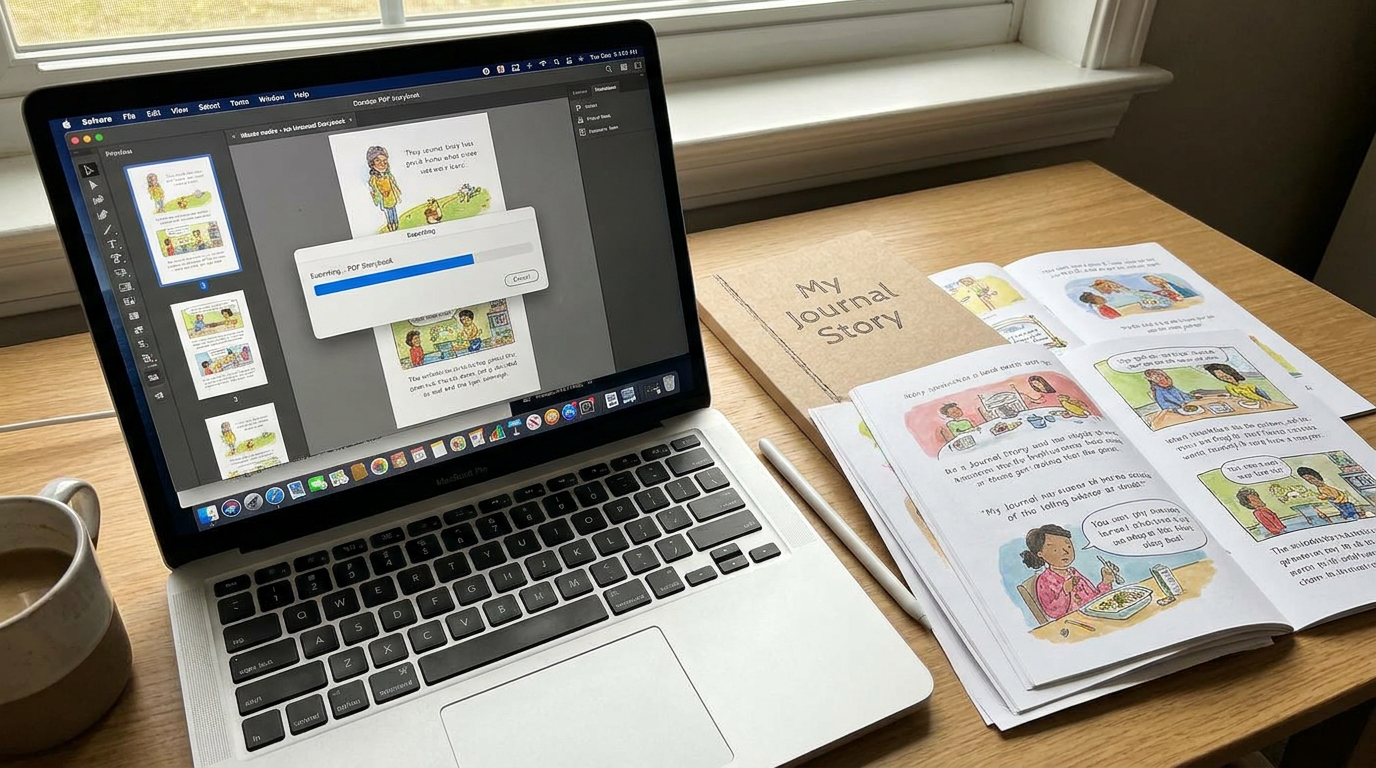
Export as an eBook or PDF-style storybook. This is what most families print, bind or gift. It’s the version that ends up on a shelf, and it’s the one that survives independently of any account or device.

View it as a Memory Lane timeline. The living version — still readable, still searchable, still open to additions when a cousin surfaces a photograph nobody had seen.

Galleries work best on Meta Quest, Apple Vision Pro, or WebXR-capable browsers, with a 2D preview available on any device so nobody is excluded for lack of hardware. Shared rooms support up to eight peopleBefore you export, do four things. Check the captions. Confirm names are spelled correctly — this is the error people regret most in print. Decide what stays private. Choose a cover image.

Without overstating it: for relatives who missed the years in question entirely, moving through a gallery of a life is a fundamentally different experience from scrolling a feed. It has scale and sequence. You can see how much there was.

, which is what makes it workable for a family spread across several countries — a grandparent in one place, grandchildren in another, walking through the same gallery at the same time.

And on control: exporting and sharing are always deliberate, owner-controlled actions. Journals remain private by default until you decide otherwise. If you’d like to see what completion actually looks like in practice, the collection is a more persuasive argument than anything we could write here.
family journal stories

Frequently Asked Questions About Memory Books

What is a memory book?

A memory book is a curated, narrated record of a person, family or period — photographs combined with stories, voices, documents and context that explain why the moments mattered. Unlike a camera roll, it’s selective and explained, built so that someone who wasn’t there can still understand what they’re looking at.

What’s the difference between a memory book and a scrapbook?

A scrapbook is primarily decorative — craft, ephemera and layout, focused on how the page looks and feels. A memory book is primarily narrative — it prioritises context, voices and documents that explain events. Scrapbooks capture texture and personality; memory books capture meaning. Many people combine both, using craft for presentation and narrative for substance.

What should I include in a family memory book?

Photographs, plus everything photographs can’t carry: voice recordings, handwriting samples, annotated recipes, official documents, and the ordinary details nobody thinks to record — the car, the weekday routine, the phrases people repeated, what was always in the fridge. Include objects too, photographed alongside a note about who owned them and why they survived.

How do I start a baby memory book?

Start with the first photograph, the name story, a handwritten note from each parent, birth details and a voice recording from the first weeks. Then keep it loose. Add moments as they happen rather than following a rigid weekly template — a running journal you actually maintain beats a structured book you fall behind on.

How long does it take to make a memory book?

A focused single-subject book — one person, one decade — is realistically a few weekends of concentrated work. A broader family archive isn’t a project with an end date; it’s a habit, best served by twenty minutes a week rather than a mythical free weekend. Scope determines timeline more than anything else.

Is it better to make a memory book digitally or on paper?

The hybrid is the honest answer. Keep a digital record as the living archive — searchable, multimedia, easy to add to and share — and print a physical copy at milestones. Digital needs active care to stay readable. Paper exists in a single vulnerable copy. Together they cover each other’s weaknesses.

How do I get relatives to contribute?

Ask for one specific thing rather than “anything you’ve got.” Set an openly low bar: one photo and one sentence is a complete contribution. Accept voice notes from people who say they aren’t writers. Assign by era so each person owns the years they lived through. And attach a deadline to a real event.

Are my memories private if I use an app?

In Lugelo, journals are private by default and sharing is owner-controlled — you decide who gets access and can revoke it at any time. Data is encrypted in transit, and there is no third-party data sharing. You can delete your account at any point, with a 30-day recovery window. Full details are on the .
Lugelo FAQs page

Can I turn a memory book into a printed book?

Yes. A completed journal can be exported as an eBook or PDF-style storybook suitable for printing or gifting. You can also view it as a Memory Lane timeline, or build it into a VR gallery that works on Meta Quest, Apple Vision Pro or WebXR-capable browsers, with a 2D preview on any device.

How do I make sure a digital memory book lasts?

Keep more than one copy, in more than one location, and check periodically that older files still open. Migrate ageing formats before they become unreadable, and prefer common, well-supported ones. The is independent, practical and free — digital records need active care, not just storage.
Library of Congress personal digital archiving guidance
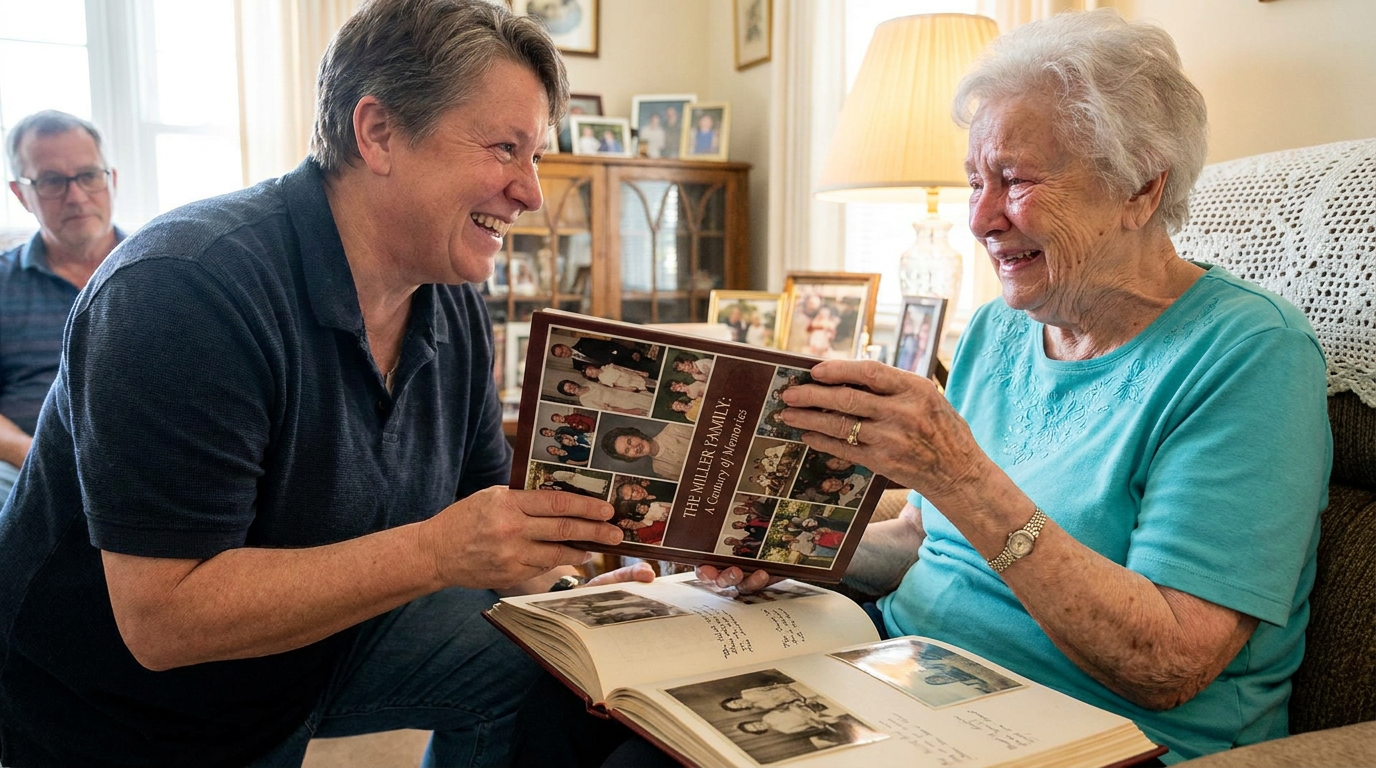
A family adding photographs and handwritten notes to a shared memory book together

Preserving a Life, Not Just a Camera Roll

The goal was never to have more photographs. We solved that problem so thoroughly that it became a different problem. The goal is to be able to hand someone a life and have them understand it.

Go back to that Sunday evening. The phone with forty thousand images on it. The nine minutes of scrolling. The photograph you finally found, which turned out to explain nothing at all.

That’s the whole shift. A memory bookOne last piece of honesty, because this guide has tried to be honest throughout. This takes effort. Digital records need looking after — copies, checks, migration. Physical materials degrade. Nothing you do makes a memory immune to time, and anyone who tells you otherwise is selling something.

is not a bigger camera roll — it’s a record: what it is, what belongs in it beyond photographs, who should help build it, how to begin whether you’re facing fifty years of shoeboxes or an empty page, which format genuinely suits you, how to organise it without inventing a second job, and how to finish the thing rather than joining the enormous silent population of people with twelve filled pages and good intentions.

But here’s what you can do, and it’s not a small thing. You can make a life findable, understandable and shareable by the people who come after you. You can make sure the faces have names, the stories have context, and the voice still exists somewhere. That is the entire job, and it’s worth doing properly.

The urgency isn’t dramatic, but it is real. The people who can identify the faces and explain why the family left in 1962 are the resource with a deadline attached. Everything else can wait; that can’t.

So do one thing this week. Not the whole project — one thing. Record one voice. Two minutes, badly, on a kitchen table.

Journals are souvenirs of your past.

And everyone has a story worth telling.

Stop Losing the Moments That Matter

Start your family memory book on Lugelo — free, private by default, and ready for everyone you want to invite.

Get Started →

Build it together —

explore collaborative journals →

See what you can create —

Lugelo features →

Step inside your memories —

VR galleries →

Available on iOS, Android, HarmonyOS and the web.

Because some days are too important to lose.
Old Halloween photos spread across a table with a smartphone capturing a family costume photo

Your Kid’s Costume, Every Year: Building a Halloween Photo Timeline

Here is the thing nobody tells you on that first Halloween: the photograph is not the point.

You take the photo. You take about forty photos that night, honestly. This one goes in among the rest.

The light goes amber around half past five at the end of October. You know the exact quality of it — low, slanting, the kind that turns a perfectly ordinary front step into something out of a film. Your child is standing on that step in a costume they chose themselves, with a level of conviction that only a four-year-old can bring to the question of whether they are, in fact, a dinosaur.

The sequenceAn honest expectation before we start: this costs about ninety seconds a year, plus a little care. Not nothing. But close.

We’ll cover the rule you need to write down before you need it, the four details worth capturing alongside the image, how to build the timeline backwards out of the Halloweens you’ve already photographed, what to do about the years you genuinely missed, how to handle several children and one unimpressed teenager, and what the whole run actually becomes when you finally scroll it end to end.

So this post is about one artifact and one artifact only: the annual costume photograph, taken year after year, and what it turns into when the years line up. Not Halloween in general. Not what to do on the night. Just the photo, and the sequence.

It works for a reason worth understanding. What changes only becomes legible because everything else stays the same. The door doesn’t move. The framing doesn’t move. The date doesn’t move. Against all that constancy, growth becomes visible in a way it simply isn’t in a camera roll of thirty thousand images shot from thirty thousand angles. Consistency is what makes change readable.

Put that same child on that same step at four, at nine, at fourteen — the same doorway, the same light, the same slightly crooked house number over their shoulder — and you have made something that no single photograph is capable of doing. You have made the plainest, most undeniable record of how quickly childhood actually moves.

is the point.

It’s also one thread inside a much bigger idea — the notion that a family’s real record isn’t the camera roll but the handful of things you deliberately keep. We wrote about that at length in , and the costume timeline is one of its most rewarding chapters. It’s also, for most families, the easiest place to start collecting kids halloween memories that hold up over time.
The Family Memory Book: Preserving a Life, Not Just a Camera Roll

But none of the practical advice lands unless you first understand why repetition does the heavy lifting. So let’s begin there.

The Power of One Photo a Year

Forty photos of one evening is a blur. One photo across ten evenings is a story.

Think about last Halloween. You probably came home with somewhere between thirty and a hundred images — the costume half-on, the costume fully on, the costume being adjusted in the hallway, three near-identical frames on the path, a blurry one of them running, a group shot where one child blinked, a group shot where a different child blinked. All of it evidence of a good evening. Almost none of it something you’d ever sit down and look at again.

There’s a paradox sitting underneath modern family photography, and once you notice it you can’t stop noticing it: the more photos you take of an occasion, the less any individual one of them means.

Forty photos of one evening is a blur. One photo across ten evenings is a story.

That’s not a sentimental claim, it’s a structural one. A timeline is a comparison deviceThis is why the effort curve and the value curve run in completely different directions, which is the best deal in family record-keeping.

. It functions the way a scientific control functions — by holding every variable steady except the one you actually want to observe. Same location. Same framing. Same week of the year. Same distance from the camera. When all of that is locked down, the only thing left for the eye to read is the child, and the child is the thing you wanted to see all along.

Year one, you have a photo of a small person in a costume. Nice. Unremarkable. Year two, you have two photos that look pleasingly similar. Year three, it’s mildly interesting — you can see something happening. Year five is usually where other people start reacting; someone glances over your shoulder and says oh, look at herThe work stays exactly the same the whole way through. Ninety seconds, once a year. The value compounds on its own.

. And by year ten, it has quietly stopped being a photo album at all. It has become a document. It is the sort of thing that gets shown at a twenty-first birthday.

Why Halloween is the ideal anchor

You could theoretically do this on any recurring date, and plenty of families do it with birthdays or the first day of school. But Halloween has a specific set of properties that make it unusually well-suited to becoming an annual photographic anchor, and they’re worth spelling out.

It lands on the same date every year. No moving feast, no shifting term dates, no “was it the second weekend or the third?” October 31st, permanently. That reliability matters enormously over a decade.

The photograph already exists in the evening’s natural shape. You are, on this specific night, already dressing the child up and already photographing them. You are not adding a task to the calendar — you are shaping a task that was going to happen anyway. That’s the difference between a habit that survives and a habit that gets quietly dropped in year three.

There’s a natural moment built into the evening. Just before leaving the house, everyone is dressed, everyone is together, nobody has eaten their body weight in fun-size chocolate yet, and the costume is at peak structural integrity. You have a window of roughly two minutes where the conditions are ideal and everybody is in one place. Very few family occasions offer that.

And the costume itself is a genuine annual snapshot of the person wearing it.What a child chooses to dress as tells you more about that specific year of their life than almost any other single data point you could collect. It’s an inadvertent autobiography, recorded one frame at a time, entirely by accident.

This is the part I find most quietly remarkable.

The four-year-old dinosaur — that’s the year of the dinosaur books, the dinosaur pyjamas, the correcting of adults who mispronounce ParasaurolophusWhich raises the immediate practical problem. Sameness is the entire mechanism — but how do you guarantee sameness across ten years, when you will not have the faintest memory next October of what you did this one?

This is also why the costume timeline makes such a good spine for a wider halloween scrapbook. If you want to keep more — the pumpkin designs, the haul, the neighbourhood, the friends — you can hang all of it off the annual photo, because the photo is the thing that gives every year its fixed point. Build the spine first. Everything else can attach to it later.

Scroll those in order and you’re not just watching a child get taller. You’re watching an imagination develop — the obsessions arriving and departing, the influences shifting, the exact year self-consciousness turned up. Height is the obvious story in a costume sequence. Personality is the better one.

. The seven-year-old astronaut belongs to the year they became briefly, intensely obsessed with the solar system and insisted on the correct number of moons around Jupiter. The nine-year-old who wanted to be a very specific character from a very specific film that nobody outside the household had heard of. The twelve-year-old who chose something deliberately, elaborately ironic, because irony had just arrived in their life and they were trying it on for size along with the costume.

Set the Rule Before You Need It

Here is the single most useful thing in this entire post, so I’ll put it plainly: the enemy of a multi-year photo sequence is not laziness. It’s forgetting your own system.

Nobody abandons a costume timeline because they can’t be bothered to take a photograph. They abandon it because it’s 4:50pm on October 31st, there’s a child in a cape vibrating with impatience by the door, and you cannot for the life of you remember whether last year you stood to the left of the door or the right, whether you shot portrait or landscape, or whether you got the whole costume in or cut it off at the knees. So you take a photo that’s near enough, and the year after that you take another one that’s near enough to thatThe fix takes four minutes and you only do it once. Write the rule down.

one, and by year five the sequence has drifted so far that it no longer reads as a sequence at all.

The five decisions to make once

A fixed spot. Front door, porch step, the gate, the same tree at the end of the drive, a particular stretch of living room wall. What you’re looking for is something structural — something unlikely to be repainted, removed, replaced or grown over within a decade. A front door is close to perfect. A specific shrub is a gamble. And if you move house, don’t quietly pretend nothing happened: note the move, and let the sequence show a visible new chapter. A timeline that changes address mid-run isn’t broken. It’s accurate.

A fixed framing. Full body, head to shoes. This is non-negotiable and it’s the mistake I see most often — costumes live in their details, and the details are almost always at the bottom. The boots. The tail. The hem of the cape. The wellies underneath the princess dress because it was raining. Crop those out and you’ve lost half the record. Decide portrait or landscape now and never switch, because a sequence that alternates orientation is genuinely unpleasant to scroll. Decide roughly how much headroom you’re leaving. And mark the physical spot the child stands on — a chalk cross, a specific paving slab, the join in the decking, the third floorboard. Standing on the same mark matters far more than people expect, because it’s what keeps the child the same size in frame relative to the background, which is precisely what makes the growth legible.

A fixed time of day. Late afternoon or early evening, before trick-or-treating — not at nine o’clock at night under a porch light, when the costume has been through a hedge, the face paint has migrated, and everyone involved has stopped enjoying themselves. Natural light at the same hour is remarkably consistent from one year to the next. Flash photography is not; it changes with every phone upgrade and every slightly different angle, and it flattens everything it touches.

A fixed photographer, where you can manage it. The same person, at the same height, holding the phone the same habitual way, produces a far more consistent run than a rotating cast. If the photographer has to change — and over ten years it will — just note the height difference in the rule so the new person knows to crouch or stand.

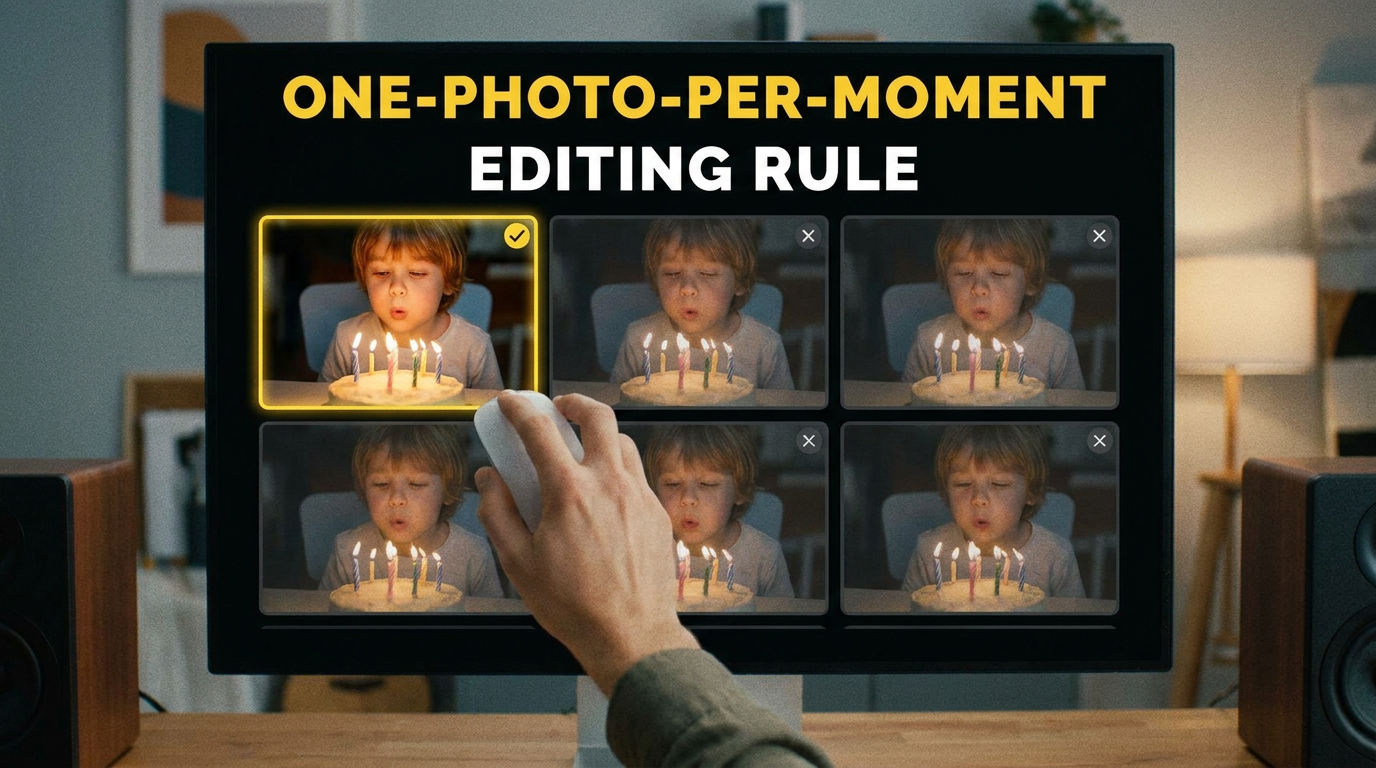
A fixed “one and done” discipline. Three frames, pick one, done. The instant the annual photo turns into a photoshoot, children stop cooperating, and a tradition that generates friction is a tradition with a short life expectancy. Protect the ritual by keeping it almost insultingly quick.

The Costume Photo Rule Card

Now — where do you keep it?

Copy this, fill it in, and keep it somewhere you’ll actually find it again. This is the whole system.

Not in a notes app you’ll never open. Not on a scrap of paper in a kitchen drawer, which is where it will be found in 2034 during a house move. The most reliable place to store the rule is attached to last year’s photograph itself, because last year’s photograph is the one thing you’re guaranteed to go looking for.

This is where keeping the sequence in a journal rather than a camera roll starts to pay for itself. In Lugelo, each entry is called a Moment, and is the chronological timeline that places every Moment in order as you add it — so the sequence assembles itself rather than needing to be sorted, hunted for or manually arranged. Put the rule in the same Moment as the photo, and opening last October shows you both the image you’re matching and the instructions for matching it, side by side, at the exact second you need them.
Memory Lane

Which brings me to the single best trick in this whole article, and it costs nothing.

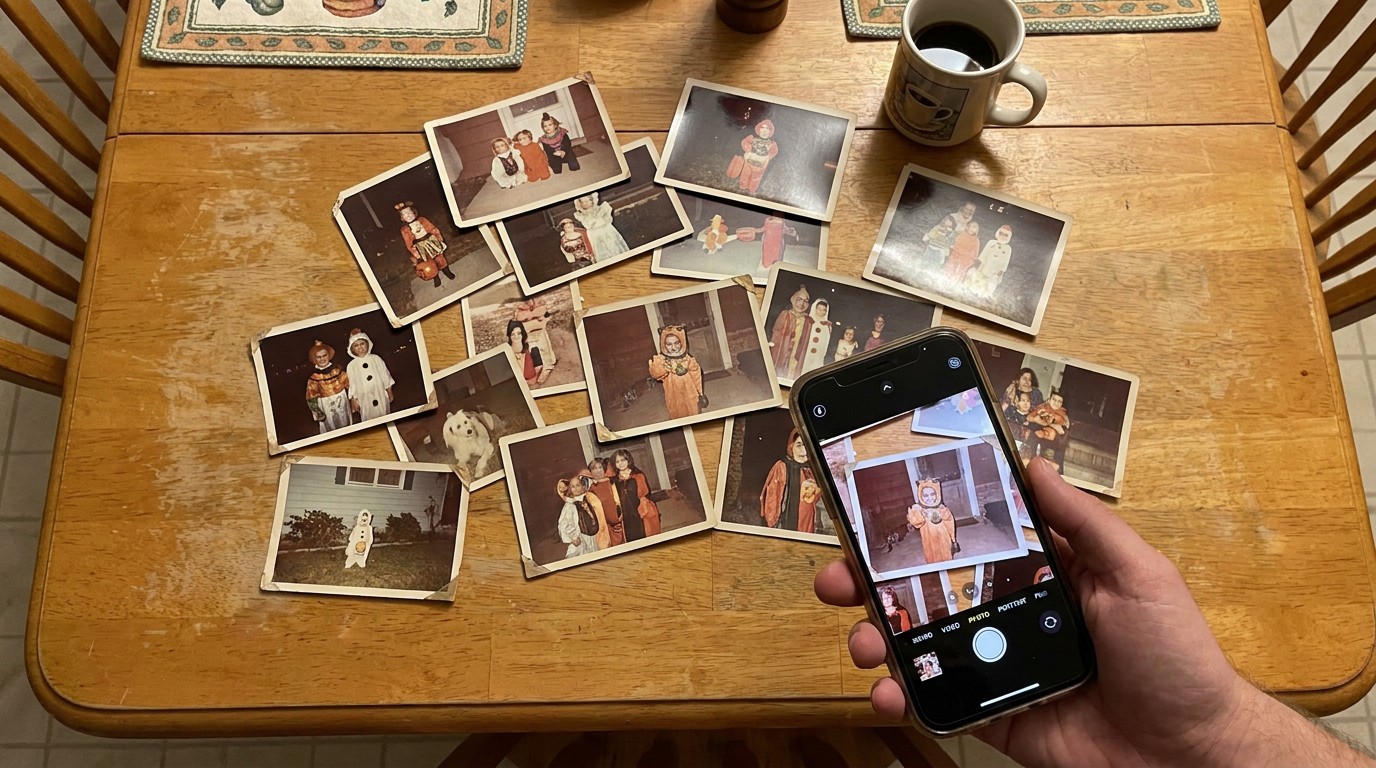
Before you shoot, pull up last year’s photo on your phone and hold it up beside the scene. Look at where the child’s head sat against the door. Look at how much step was showing at the bottom. Then move your feet until the live view matches. It takes about ninety seconds and it is the difference between a decade of photographs that align beautifully and a decade of photographs that are all sort ofThe photo, though, is only half of what you’re keeping. The other half is a handful of details that will be entirely gone from your memory inside eighteen months.

the same. Do this one thing and you can be fairly relaxed about everything else.

Capture the Story Around the Photo

Let me describe a very specific kind of loss, because I suspect you’ve already experienced it.

You’re looking at a photo from five or six years ago. Your child is dressed as something extremely elaborate — a hand-built cardboard robot, say, or a character you can no longer identify. And you remember the costume perfectly. What you cannot remember, at all, is why.

You can’t remember that they were obsessed with a particular film for exactly four months that spring. You can’t remember that they’d originally wanted to be something else entirely and changed their mind twice in the last week of October. You can’t remember that the robot was built out of a nappy box and about eleven metres of duct tape because the shop-bought one was £40. You can’t remember what they said when they saw themselves in the hall mirror.

All of that was completely obvious to you at the time. That’s precisely why you didn’t write it down.

So: four details, captured every year, taking about sixty seconds. Not an assignment. Just a caption with a bit more in it than usual.

Who chose it, and why. Was it their idea or yours? What were they into that year? What had they just watched, just read, just decided they were going to be when they grew up? This is the line that will mean the most in a decade, and it’s the one you’re most likely to skip because it feels too obvious to bother recording.

What it was made of. Shop-bought, hand-sewn, hired, inherited from an older sibling, or assembled at eleven o’clock the night before out of cardboard and desperation. The construction story is very often the actual family story — the year the grandmother sewed it, the year you gave up and ordered it, the year they made the whole thing themselves and wouldn’t let you help. Note who made it. That detail ages beautifully.

The rejected options. Genuinely my favourite thing on this list, and the one that vanishes fastest. The two or three things they nearly were — the ones campaigned for hard in mid-October and then abandoned — are a portrait of a child’s year all by themselves. Wanted to be a shark, then a vampire, settled on a shark-vampire. You will never remember this. You will be delighted to have it.

What they said when they put it on. One line, verbatim, in their words. Do not clean it up, do not fix the grammar, do not translate it into adult English. The mistakes are the entire point.

“I’m a dinosaur but a nice one so people can still be friends with me.”

— age four, dinosaur, 2019

That’s the whole thing. Eighteen words that will outlast the costume, the photograph and quite possibly the house.

Capture it in the sixty seconds before you leave

Timing is everything here, and the timing is: nowYou don’t have to type it. Honestly, you shouldn’t — typing on a phone in a hallway while wearing a coat is nobody’s idea of a good time. Just talk. Lugelo supports audio, so you can record a thirty-second voice note saying “right, this is 2026, she’s a shark-vampire, it was entirely her idea, we made the fin out of a yoga mat, she rejected being a postbox and a wolf, and when she put it on she said—” and you’re done. Speech-to-text is there if you’d rather end up with something written.

, not later. Later never happens. The window is the minute before you leave the house, or the first two minutes in the car, while it’s all still fresh and nobody has yet been handed a bucket of sweets.

The advantage of keeping it together is that — so this year’s frame, the thirty-second voice note, a ten-second clip of them belting down the path, and the four typed details all live as one object. That matters more than it sounds. The usual failure mode isn’t losing things; it’s scattering them. The photo ends up in the camera roll, the funny quote in a message to your sister, the video in a group chat, and the costume’s origin story nowhere at all. Reassembling that in eight years is essentially impossible. Keeping it assembled in the first place takes a minute.
a single Moment can hold photos, video, audio and text in one place

Optional extras, if you’re enjoying yourself

None of these are required. Some families add one or two and find they become the best part.

  1. A photo of the costume laid flat on the floor before it’s worn — surprisingly striking as its own annual sequence.
  2. What it cost, or how many hours it took to make. Both are funny later.
  3. The weather. October weather shapes the entire evening and is completely unmemorable afterwards.
  4. Who they went out with, and how that changes as friendship groups shift.
  5. How far you walked, and what time they gave up. The year they lasted eleven minutes is a story.

Now, most people reading this are not standing at year zero with a newborn. You’ve probably got five or six Halloweens already sitting in a camera roll somewhere, which raises the obvious question.

Keep the whole thing light. If it starts feeling like homework, cut it back to the photo and the one quote — those two alone are worth more than a complete set you resent doing.

Backfill the Years Behind You

This is completely wrong, and dismantling it is probably the most valuable thing this article can do.

The most common reason people don’t start a costume timeline is the belief that they’ve missed the boat. Their eldest is nine. The moment has gone. Starting now feels like admitting defeat on the eight years already behind them.

You are almost certainly not starting at year one. You have been photographing your children on Halloween for as long as you’ve had them, because everybody does. Those photographs exist. The work in front of you isn’t taking new pictures — it’s finding and sequencing the ones you already have. That’s an afternoon’s work, not a decade’s, and it can take a timeline from “started this year” to “goes back to 2018” in a single sitting.

Where to look

Work through these in order. Most people find eighty percent of what they need in the first twenty minutes.

  1. Search your camera roll by date range — October 28th to November 1st, one year at a time. This single trick surfaces almost everything. Every phone photo library supports date search, and Halloween’s fixed date makes it unusually easy to target. Go back as far as your library goes.
  2. Check messaging threads and group chats. This is where the best photo often hides. The really good frame was frequently the one you sent straight to a grandparent or the family group and never saved back to your own device.
  3. Check the other parent’s phone. Then check the grandparents’ phones. The best shot of a child is very often on somebody else’s device entirely — the person who wasn’t holding the bucket, wrangling the little one or driving, and therefore had a free hand.
  4. Photograph or scan any printed photos. For older years, lay the print flat in good indirect daylight, avoid your own shadow, and shoot straight down. It won’t be archival quality but it will absolutely be good enough for a timeline, and it takes seconds per photo.
  5. Pull from old social posts if that’s the only surviving copy. Lugelo offers social media import, and its Chrome and Firefox extensions let you clip photos straight into a journal from the browser — genuinely useful when the only remaining copy of year one is a post from six years ago on a platform you’ve barely opened since.
  6. Use scan-to-text on the backs of prints. Older photographs often have a date, a name or a note pencilled on the reverse, and that handwriting is worth keeping alongside the image itself.

Backfilling also tends to be a collective activity, because the photos are distributed across a family rather than sitting on one device. This is where it helps that — the missing year-two photograph can be added directly by the grandparent who actually took it, rather than being described over the phone, emailed at the wrong resolution, and lost again.
grandparents and both parents can add their own shots to the same journal

Choosing one photo per year is the hard part

And it is genuinely hard, so brace for it.

You will find forty photos from Halloween 2021 and you will want to keep nine of them. Don’t. Pick one frame per year.The other photos aren’t deleted. They stay wherever they are. You’re not curating your camera roll — you’re pulling one thread out of it.

Your selection criteria, in priority order: full body if it exists, clearest view of the costume, child recognisably themselves and facing roughly forwards. Sharpness matters less than you think. A slightly soft photo showing the whole costume beats a pin-sharp one cropped at the waist every single time.

The sequence only reads as a sequence if each year is represented by a single image — the moment 2021 gets six photos and 2022 gets one, the rhythm collapses and you’re back to a folder of pictures.

Dating the ones you can’t place

You’ll hit photos you can’t confidently assign to a year. Detective work, in rough order of reliability: the child’s height against a doorframe, their teeth (missing front teeth date a photo with startling precision), which other children are in the shot and how old theyAnd when all that fails — approximate. “Roughly 2021” is infinitely more useful than leaving the photo out entirely. Note the uncertainty and move on.

look, the state of the garden, the car on the drive, the sofa, the phone it was taken on.

The years you genuinely missed

Mark the gap. Add one line saying why. Carry on.

The year the new baby arrived and the entire month is a blur. The year you moved house in October and Halloween happened somewhere between two postcodes. The year everyone had the same virus and nobody left the sofa. The year you were simply too tired, which is a completely legitimate reason and requires no further explanation.

Some years there is no photo. There just isn’t.

A gap is not a failure in a family record — it is the record. “2020: no photo, we didn’t go out” says something true and specific about that year, and in fifteen years it will read as history rather than omission. A sequence with a hole in it is still deeply moving. A sequence abandoned in year three because it wasn’t going to be complete is nothing at all.

I want to be blunt about this, because I think it’s the thing that stops most people: perfectionism destroys more family archives than forgetfulness ever has. The instinct that says if I can’t do this properly I won’t do itEven a well-set-up timeline, though, eventually collides with real family life. Usually in the form of a second child, and eventually in the form of a teenager who would rather not.

is the single most destructive force in personal record-keeping. Incomplete and existing beats complete and imaginary, permanently.

When the Streak Gets Complicated

Every costume timeline that fails, fails in one of about four places. Knowing where the failures happen means you can see them coming, which is most of the battle.

More Than One Child

Three approaches genuinely work. Each involves a trade, so pick with your eyes open.

Separate sequences. Each child gets their own timeline, in their own journal. This is by far the cleanest to read back, and it’s the best option if you intend to hand each child their own record when they’re grown — nobody wants their childhood interleaved with their brother’s. The cost is time on the night: two children means two setups, two rounds of cooperation, twice the negotiation.

One group shot per year. The simplest and by some distance the most sustainable. It captures something the solo shots can’t — the sibling dynamic, who’s holding whose hand, the exact year the younger one stopped being carried, the year they started standing deliberately far apart. The weakness is that individual costumes get lost in a wide frame, and the sequence takes a hit in any year one child is away, unwell or has flatly refused to participate.

Both, which is what I’d actually recommend. One group frame, then one solo frame each, all in the same spot with the same framing. If the spot and the rule are already fixed, this is still comfortably under three minutes for two or three children, because you’re not making any decisions — you’re just executing a plan you already wrote down.

One more thing worth saying: children arrive at different times, so their sequences start at different years. A second child’s timeline simply begins later, and the eldest will always have more frames. This isn’t an imbalance to correct. It’s just true, and it’s part of what the record shows.

Teenagers

This is where most sequences quietly die, so let’s handle it with some care.

Expect resistance somewhere between eleven and fourteen. It arrives suddenly, it is not personal, and it is very nearly always temporary. The child who spent October planning a costume for six weeks straight has become a person for whom standing on the front step being photographed is a genuinely excruciating prospect, and that shift is a normal, healthy part of growing up rather than a rejection of the tradition.

Four things help.

Drop the costume requirement. This is the big one. Nothing in the sequence’s value depends on there being a costume — the value comes from continuity. If they’ve aged out of dressing up, the annual photo can just be them, on the step, on October 31st, in a hoodie. The run continues uninterrupted. Fifteen years later, the hoodie years will be every bit as affecting as the dinosaur years, and possibly more so, because that’s the exact stretch of their life you have the fewest photographs of.

Hand them control. Let them see the shot. Let them veto a frame. Let them choose the pose and the expression. A teenager who gets to reject the first two frames is a teenager participating in the tradition rather than submitting to it.

Accept irony as participation. The deliberately unimpressed teenage photo — dead-eyed, arms folded, radiating suffering — is reliably one of the funniest and most beloved frames in any sequence. It is not a failed photo. It is an extremely accurate one. Let them be sardonic about it; sardonic is a form of taking part.

Show them the run.And if none of it works? Let it go for the year. One skipped year is entirely survivable. An argument about it is what actually ends the streak, because it converts a warm family ritual into a thing that gets fought about — and no tradition survives that for long.

This is the move that works most often. Most resistance evaporates the instant a fourteen-year-old scrolls back and sees themselves at five, in a costume made of a cereal box, grinning with two teeth missing. Nobody is immune to that. Very often they’ll take the photo without further comment — and quite often they’ll start caring about the sequence more than you do.

When Life Interrupts

Split households where Halloween alternates. A house move. A year abroad. Illness. A year where the 31st fell somewhere inconvenient and it simply didn’t happen.

The principle in every case is identical: keep the rule even when the spot has to change.Note what changed. One sentence. Continue.

If the child is at their other parent’s house, the photo can be taken there — same framing, same time of day, different doorstep — and someone else can add it to the shared journal directly, which is exactly the sort of situation collaborative access is useful for. If you’ve moved, use the new front door and note the move in a line. If you were abroad, photograph them against whatever door you had.

The underlying truth here, and I’d like it to be the thing you take away from this section: the sequence is resilient, not fragile. It tolerates gaps, changed locations, wildly varying photo quality, missing years and reluctant participants far better than anyone expects. A timeline with three different front doors, two missing years and one furious teenager in it is not a compromised record — it’s a truthfulSo — assume you keep it going. What does it actually become?

The only thing it doesn’t tolerate is being abandoned.

one.

What the Sequence Becomes and How to Keep It Readable

It’s one object. It behaves like one thing. And you notice this the first time you show it to anyone, because of a consistent and slightly strange reaction: nobody looks at any individual frame. Not one. They scroll the entire run, top to bottom, in about four seconds — and then they immediately scroll it again, slower.

Ten costume photographs in a row is not ten photographs.

The second pass is where it lands. That’s when people start pointing. Look how small. When did that happen? That’s the year of the shark. Watch a child’s head climb the door frame year on year — the same door, the same paint, the same house number — and there’s simply no arguing with it. You cannot feel your children growing in real time; the change is too gradual and you’re too close to it. A costume timeline is one of the very few instruments that makes it visible.

Nobody looks at any single frame. Everybody scrolls the whole run, twice.

A decade of Halloween costume photographs displayed in a single row on a family timeline

Three ways to see the whole run

Memory Lane. The chronological timeline, where each October’s Moment sits in sequence automatically because it was filed by date the moment you added it. No folders, no sorting, no annual admin. Scrolling ten years of costumes takes a few seconds, and the fact that it takes a few seconds is the entire reason people actually do it.

A walkable gallery. The sequence can also be viewed as a 3D space rather than a scroll — one costume per wall, so you walk through the years instead of swiping them. It’s a different experience, and a surprisingly emotional one, because the years become distances you move through. You can on Meta Quest, Apple Vision Pro or a WebXR browser, and there’s a 2D preview available on any device if you don’t own a headset. Shared rooms hold up to eight people, which makes it a genuinely good thing to open with extended family at the end of October — grandparents in one house, cousins in another, everybody walking the same decade of costumes together.
view the sequence as a walkable gallery

An eBook or storybook export. The sequence as a printable keepsake, one year per page. This is the format that turns the timeline into a gift: for a child at eighteen, for grandparents at Christmas, for the wall. Printed and bound, the run has a weight that scrolling doesn’t quite replicate.

On privacy, briefly

Since this is a decade of photographs of children, one plain statement and then I’ll move on. A family journal in Lugelo is private by default and shared only with the people the owner invites — you control who has access, and you can change that at any time. Data is encrypted in transit. For a lot of parents, that’s the appeal of keeping the sequence somewhere other than a public feed: the photos still get shared with the grandparents, just not with everybody else.

The honest part: a photo sequence is a thing you tend

A multi-year photo sequence needs active care. Files corrupt. Drives fail. Formats fall out of use. Accounts get abandoned. This is true of every digital photograph you own, and it becomes more true the longer the collection lives — which is exactly the problem with something designed to span a childhood.

I’m not going to end this post pretending the timeline looks after itself, because it doesn’t, and a preservation article that overpromises isn’t worth reading.

The good news is that the people who think hardest about this have published plain, actionable advice. The Library of Congress maintains that translates neatly into family language:
guidance on keeping personal digital photographs

  1. Keep more than one copy, in more than one place. The LoC recommends at least two copies of anything you’ve chosen to keep, and more is better — across different types of storage, held as physically far apart as is practical. One copy on the device you use every day is not a backup. Two copies in the same house survive most things but not a fire.
  2. Check once a year that the files still open. The LoC’s advice is to verify at least annually that you can still read your photos, and this is the single most useful habit in this entire article. Pair it with the ritual you’re already doing: you’re standing in the hallway every October anyway, so scroll back to the oldest photo in the run and confirm it opens. Thirty seconds. Once a year. That one check catches almost every slow-motion disaster before it becomes permanent.
  3. Name things descriptively, and note who’s in them. 2021-halloween-shark-vampire-age-7.jpg is legible to a stranger; IMG_4471.jpg is legible to nobody, including you, in 2039. The LoC also suggests keeping a short inventory describing what’s in your collection and storing a copy of it with your important papers — for a costume timeline that’s a one-page list of which year is which, kept with the passports.
  4. Refresh copies onto current media every few years. The LoC suggests making new copies roughly every five years, or sooner if a drive is getting old. Storage formats age out; the photographs only survive if they keep moving onto things that can still be read.

And the thing that needs saying directly: no app, Lugelo very much included, removes your need for your own backups.Think of the sequence as a thing you tend rather than a thing you set and forget — closer to a garden than a safe. Ninety seconds in October to take the photo, thirty seconds to check the old ones still open, and a copy somewhere else. That’s the whole maintenance burden, and it’s small enough to actually keep up.

A journal keeps the sequence organised, dated, captioned and in one piece, which solves the problem most families actually have. It does not replace the discipline of keeping copies elsewhere. Anyone who tells you otherwise is selling something.

Halloween Costume Timeline FAQ

When should I take the annual Halloween costume photo?

Late afternoon or early evening, before trick-or-treating begins. The costume is still intact, the child is still cooperative, and natural light at that hour is far more consistent from year to year than flash. Aim for the same time each year — around 5pm works for most families — and take it just before you leave the house, when everyone’s dressed and together.

What if I’ve already missed several years?

You’ve almost certainly got the photos already. Search your camera roll by date range, October 28th to November 1st, one year at a time — that alone usually surfaces most of them. Then check messaging threads, the other parent’s phone, and grandparents’ devices. Approximate dating is completely fine, and missing years are acceptable. Backfilling a decade typically takes one afternoon.

How do I keep the photos consistent from year to year?

Fix five things and write them down: the spot, the framing, the time of day, the photographer, and a three-frames-then-stop rule. Store that note with last year’s photo so you find it when you need it. Then, before shooting, pull up last year’s image on your phone and physically match the scene to it. That ninety seconds of alignment is what produces a decade of consistency.

How should I handle more than one child?

The most sustainable approach is one group frame plus one solo frame for each child, all taken in the same spot with the same framing — under three minutes once the rule is fixed. If you’d rather give each child their own keepsake when they’re grown, run separate sequences in separate journals. Younger siblings’ timelines simply start later, which is fine.

What do I do when my teenager refuses to dress up?

Drop the costume requirement and keep the photograph. Continuity is what gives the sequence its power, not novelty — them on the step in a hoodie on October 31st continues the run perfectly. Give them control over the frame, let them veto shots, and accept ironic participation. Showing them the earlier years usually resolves the resistance faster than anything you can say.

How do I make sure the photo sequence stays readable over the years?

Keep at least two copies in different places and on different types of storage, check once a year that the files still open, give files descriptive names, and copy everything onto current media every few years. The sets out the detail. Pair the annual check with the annual photo so it actually gets done.
Library of Congress personal archiving guidance

Is a family journal private?

A journal in Lugelo is private by default and shared only with the people the owner chooses to invite, with owner-controlled sharing you can adjust at any time. Data is encrypted in transit.

A parent and child scrolling back through years of Halloween costume photographs together on a tablet

The Photo You Take This Year Won’t Look Like Much

Back to the doorstep, then, and the amber light, and the child who is absolutely certain about the dinosaur.

The photo you take this October will be unremarkable. It will look like every other photo you took that night, and when you look at it on November 1st you will feel nothing in particular about it. That is exactly as it should be — the value of an annual photograph isn’t created on the night. It accrues. Quietly, in the background, at a rate you won’t notice until year five, when someone glances at the run and says ohNinety seconds a year. One frame. One rule, written down once. Keep a couple of copies somewhere sensible and check them each October when you take the new one, and the sequence will still be there when you want it — which, sooner than feels possible, will be at an eighteenth birthday, or a wedding, or an ordinary Tuesday when someone asks what they were like as a child and for once you can just show them.

.

So here’s the only thing to do this week, before the 31st arrives and the moment slides past for another year: decide the spot, and write down the rule. That’s it. Four minutes at the kitchen table. Everything else in this article is optional; that one step is what makes the rest possible.

And if the idea of a recurring thread that quietly compounds appeals to you, the costume timeline is one of several — the same thinking applies to first days of school, to birthdays, to the same walk taken every New Year’s Day. We laid out the wider version of the idea in , which is the natural next read.
The Family Memory Book: Preserving a Life, Not Just a Camera Roll

Set up this year’s Moment before October 31st, and let Memory Lane keep the rest in order. Lugelo is free on iOS, Android, Web and HarmonyOS, with Chrome and Firefox extensions, no ads, and an optional Plus tier if you want more.

Start Journaling

10-minute evening journaling routine with 2 minutes settling, 5 minutes writing, and 3 minutes reading back

A Gentle 10-Minute Reflection Ritual (No Pressure, No Rules)

That’s the whole problem this post is about. Not a large problem. Just a quietly annoying one.

It’s nine o’clock on a Saturday evening in October. The washing up is done, or it isn’t. There’s a lamp on in the corner. The day is essentially over, and if someone asked you what happened on Tuesday, you’d hesitate. Not because Tuesday was bad. Because Tuesday was Tuesday, and it went the way most Tuesdays go — which is to say it went, and took its details with it.

Most advice about writing things down arrives with a lot of scaffolding attached. Streaks. Daily targets. An app that turns amber when you’ve missed two days and sends you a notification shaped like disappointment. The implication is always that you’re starting something, and starting something means keeping it up, and keeping it up is the part you already know you’re bad at. If you’ve tried before and it fizzled out by mid-February, you’re in good company — and if you want the wider view on that, we’ve written a fuller guide to Here’s the offer, plainly. Ten minutes. A few times a week. At the end of the day. That’s it. That’s the entire proposition. It sits in your evening the way making a cup of tea sits in your evening, or reading a chapter before you turn the light off. It is not a project. There is nothing to complete.
starting a journal again after it didn’t stick before

. This post is the narrow version. It takes one section of that guide — the short reflection ritual — and gives it the room it deserves.

And here’s what you get, stated honestly and without inflation: you’ll remember the day, and the week will stop blurring together. That’s the payoff. It’s real, it’s modest, and I’m not going to dress it up as anything larger, because the moment a small pleasant thing gets sold as a life overhaul, it stops being small and pleasant and starts being one more thing you’re behind on.

Along the way you’ll get a bank of more than thirty gentle prompts to write to — gratitude prompts among them, alongside noticing prompts, small-detail prompts and a set for the end of the week. Pick one. Ignore the rest. That’s allowed.

So why does a bounded ten minutes work when a sincere intention to “journal more” doesn’t? That’s worth understanding before we get to the structure itself.

Person sitting quietly by a window with tea during an evening reflection routine

Why a Container Beats an Open-Ended Habit

“Journal more” is a strange instruction when you look at it directly. More than what? Finished when? There’s no line you cross where you can put your pen down and think, right, that’s done.That difference sounds small. It isn’t. Most of what makes an intention wear you down is the low background hum of incompleteness it generates. Remove the open end and the hum goes with it.

Ten minutes at the end of the day is a different kind of object entirely. It has edges. It starts when you sit down and it ends when it ends, and at that point you have unambiguously done the thing. There’s no partial credit and no residue. Ten minutes is ten minutes.

You can always have written more, gone deeper, been more consistent. An unbounded task never releases you. It just sits there, permanently slightly unmet.

A habit asks you to keep something going. A ritual just asks you to show up tonight.

Habits accumulate failure. That’s almost their defining feature. Miss nine days and the nine days are now part of the story — you’re not returning to a neutral thing, you’re returning to a thing you’ve already let down. There’s an implicit apology built into picking it back up. Rituals don’t work like that. A ritual has no memory of your absence. You didn’t feel like it on Tuesday; you feel like it tonight. Those two facts have nothing to do with each other.

There’s a second advantage, and it’s the one that matters most if you’ve abandoned this sort of thing before. A container is much easier to restart than a habit is.

This is where it helps to separate a reflection journal from the older idea of a diary. A diary, in the way most of us absorbed it as children, is something you keepLet me be as clear as I can about what this post is not going to do. It is not going to ask you to be consistent. There are no streaks here, no counters, no completion percentages, no little rings to close. I’m not going to suggest you build a chain and then not break it. Those mechanisms work for some people and they’re genuinely motivating right up until the moment they aren’t, at which point they convert straight into a reason to quit. A missed day shouldn’t be able to cost you anything. In this ritual, it can’t.

The end of the day makes a particularly good container, for a reason that’s easy to miss. The day is already finished. There’s nothing left to add to it, nothing you could still get done, no way to improve your performance in it. It’s closed. You’re not sitting down to plan or fix or optimise anything — you’re sitting down to note down what happened in a stretch of time that has already concluded. That’s a genuinely low-stakes position to write from, and it’s why evening suits this ritual better than morning does. Morning is full of the day’s potential. Evening has none, and that’s the appeal.

. The verb is telling. It implies custody, maintenance, an unbroken line of entries with dates on them, and a faint sense of shame about the gaps. A reflection journal with a container attached is a much lighter proposition: it’s somewhere you write for ten minutes when you fancy it, and the record it produces is a record of the evenings you felt like writing. Which is a perfectly honest thing for a record to be.

If you want the broader framing — how a container fits into the wider question of making a journal stick after a few false starts — covers it at length. Otherwise, we’ve established the shape of the box. Let’s look at what goes inside it.
the wider guide to restarting a journal

The Ten Minutes: Three Short Movements

The ritual has three parts, and they’re deliberately uneven:

  • Two minutes — settling, and running the day back
  • Five minutes — writing to one prompt
  • Three minutes — reading back the last few entries

That’s the whole architecture. You can follow it tonight without reading another word of this post, though the prompt bank in the next section will make the middle five minutes considerably easier.

Two minutes: settling

Don’t skip ahead to writing. The retrieval is what gives you something to write about, and it’s also the part that lets you arrive properly in the ten minutes rather than opening an app and staring at it.

You’ll find this is harder than it sounds for the first few evenings and then rapidly becomes easy. You’ll also find that about a third of what surfaces is stuff you’d genuinely have lost by Thursday. That’s the point of the two minutes.

For two minutes, just run the day back roughly from the morning. Where you were. Who you spoke to. What you ate. What the weather did. What you were doing at eleven, and at three, and at six. It’s a mechanical exercise, and it’s meant to be — you’re not hunting for significance or deciding what any of it meant. You’re just retrieving. Most of the day is sitting there perfectly accessible; it simply hasn’t been asked for.

Sit down. Put the tea somewhere it won’t get knocked over. Don’t write anything yet.

Five minutes: writing to one prompt

If you already know what you want to write when you sit down, skip the prompt entirely. Prompts exist to solve the blank-page problem. No blank page, no problem.

Set a timer if it helps. Plenty of people find the timer is the thing that makes it work, because it converts “write about your day” into “survive five minutes,” which is a much simpler assignment. When it goes, stop — even mid-sentence, if you like. You can always come back tomorrow, and the unfinished sentence will make you smile in a year.

Five minutes is short on purpose. It’s enough for a few sentences — three, four, six if you’re moving quickly — and it is emphatically not enough for an essay. That ceiling is doing useful work. It means you never sit down to a blank page with the vague expectation of producing something substantial, which is the expectation that kills more evening writing than tiredness ever has. A few sentences is a complete, legitimate entry. You’re not producing literature. You’re noting down what happened.

Write to it for five minutes and then stop.

Pick one prompt. One. Not three, not a sequence, not “I’ll do the gratitude one and then the noticing one.”

Three minutes: reading back

Scroll back through the last three or four entries and read them.

This is the movement everyone skips. It’s also the one that makes the entire ritual worth doing, and if you only take one thing from this post, take this: the reading back is not an optional extra bolted onto the writing. It is where the value actually lives. Writing an entry produces a record. Reading back is the moment you useThree minutes is enough for four short entries. You’ll notice things: that you mentioned the same small irritation twice, that Wednesday had something good in it you’d already mislaid, that you ate the same dinner three times. None of that needs interpreting. It’s just nice to know.

it — and the moment the previous week stops being an undifferentiated smear and turns back into a series of specific days with things in them.

In Lugelo, this is your Memory Lane — the chronological view your Moments land on automatically, in order, without you filing anything. You can see what that looks like alongside if you want a sense of it before you start.
Memory Lane and the rest of Lugelo’s journaling features

The proportions matter more than the numbers

What holds is the relationship: a short settle, a bounded write, and a genuine read-back. Lose the read-back and you’ve got a slightly dutiful writing exercise. Keep it and you’ve got something you look forward to.

Two, five and three are a suggestion, not a specification. One minute settling, six writing, three reading works fine. So does three, five, two. Some evenings you’ll do ninety seconds of writing and four minutes of reading back and that’ll be the right shape for that evening.

One practical note, particularly if you’ve arrived here looking for an evening journal routineThe five minutes in the middle needs something to point at, though. So here’s the bank.

that survives contact with real life: this works on a phone on the sofa. It works on a laptop at a cleared kitchen table. It works in a paper notebook with a pen that lives next to it. Lugelo captures Moments offline as well, so a patchy signal on the train home isn’t a reason to skip — the entry syncs across your devices when it can.

A Bank of 30+ Gentle Prompts (Including Gratitude Prompts)

Before the list, three rules for using it — and they’re the only rules in this post.

Pick one. Don’t work through them in order. This isn’t a curriculum and there’s no completion state.

Don’t feel obliged to use one at all. If you sat down already knowing what you wanted to write, write that.

Small is correct. Every prompt below is answerable in a few sentences. None of them require excavation, none of them ask you to reach a conclusion, and none of them are trying to get somewhere with you. If a prompt feels like homework, pick a different one.

They’re grouped into five registers. Skim to whichever suits the evening.

A set of gentle evening journal prompts grouped by type, shown on a phone screen

Noticing prompts

The smallest register in the bank. Sensory, low-stakes, no significance required. These are perfect for tired evenings because they don’t ask you to have had an interesting day — only to have been present during an ordinary one.

  • What’s one thing you noticed today that you’d usually walk past? (This one is a real Lugelo prompt.)
  • What was the light doing at some point today?
  • What was the first thing you heard this morning?
  • Was there a smell today that reminded you of something else?
  • What could you hear from outside, if you’d stopped to listen?
  • What was the temperature like — not the number, the feeling of it?
  • What’s one small change you noticed in a place you go often?
  • What did your hands do today that you didn’t have to think about?

Gratitude prompts

The fullest set in the bank, and the one people ask for most. The trick with gratitude prompts is to keep them specific and unsentimental. “What are you grateful for?” is an enormous question that tends to produce the same three answers forever. Small and concrete beats grand and abstract every time — and a specific answer is far more interesting to read back in a year.

  • Who held the door for you this week — physically or otherwise? (Another real Lugelo prompt.)
  • What did someone do today that saved you five minutes?
  • What’s a thing you own that worked exactly as it was supposed to?
  • What small thing would you miss if it vanished tomorrow?
  • Who made something easier today without being asked?
  • What went right today that you’d only have noticed if it had gone wrong?
  • Which part of today would you happily do again tomorrow?
  • What’s something you were given once that you still use?

Gratitude prompts of this kind sit alongside the — short, repeatable exercises in noting what you’re glad of.
gratitude practices described by the Greater Good Science Center at UC Berkeley

Small-detail prompts

These are the prompts that age best. They feel almost pointless to write and they are, without competition, the most rewarding to read back. In five years the detail is the whole value — you will not remember what you ate on an ordinary Thursday in October 2026 unless you wrote it down, and you’ll be oddly delighted to find out.

  • What did you eat today?
  • What were you wearing?
  • What was on — music, a programme, a podcast, the radio?
  • What was the walk like? (Any walk. Even the short one.)
  • What did you nearly buy and then didn’t?
  • What’s currently on the table or the desk in front of you?
  • What did you do today that you also did yesterday?
  • What’s the last thing you looked up?

People prompts

Observational, not diagnostic. These are about who was in your day, not about what your relationships mean. Keep them light — you’re recording the cast, not analysing the plot.

  • Who did you see today, even briefly?
  • Who did you text, and roughly what about?
  • What’s something someone said that stuck?
  • What made you laugh?
  • Who did you think about but not contact?
  • Who did you overhear?
  • Who was somewhere they usually aren’t?
  • Who’s someone you’ll probably see tomorrow?

End-of-week prompts

A slightly wider frame, for Fridays, Saturdays or Sundays — the evenings where the natural unit isn’t the day but the week. These pair particularly well with a longer read-back.

  • What happened this week that you’d otherwise forget by next month?
  • What’s different from last Saturday?
  • What was the best hour of the week?
  • What did this week have that last week didn’t?
  • Where did most of the week actually go?
  • What’s one thing from this week you’d tell someone about?
  • What are you carrying into next week?

That’s thirty-nine prompts. On any given evening, thirty-eight of them are irrelevant and one of them is the right one.

And some nights, none of them will fit — which is precisely what the AI Journal Assistant is for. There’s a bigger objection than “none of these fit,” though, and it deserves its own section: some days genuinely have nothing in them.
Lugelo’s AI Journal Assistant can generate prompts that fit your journal

: prompts that reflect the kind of journal you’re actually building rather than a generic list, across registers like reflection, gratitude and memory. Refresh one you don’t like. Ignore all of them. It’s a suggestion, not an instruction.

What to Write on Days When Nothing Happened

You sit down. You do the two minutes. You run the day back and it’s work, dinner, a screen, bed. There’s a real temptation at that point to close the app and think, not tonight, there’s nothing to say.This is the single most common reason an evening ritual quietly stops. Not tiredness. Not lack of time. The conviction that an uneventful day isn’t worth recording.

Here’s the reframe, and it’s a practical one rather than an inspiring one: ordinary days are the ones you actually lose. Big days look after themselves. You’ll remember the wedding without writing it down. You’ll remember the move, the trip, the day the offer came through. Those are already anchored — other people remember them too, there are photographs, they come up in conversation. Tuesday the fourteenth has none of that support. It disappears entirely within about three weeks unless something catches it.

So the days that feel least worth writing about are, in strict record-keeping terms, the days where writing produces the most. That’s not a motivational flourish. It’s just how memory distributes itself.

On a flat evening, here’s what to do:

  1. Write one sentence and stop. Genuinely. One sentence is a complete entry.
  2. Record what you ate. The most reliably interesting detail in any old journal.
  3. Note the weather and what you wore. Two lines, both of which will place the day precisely when you read it back.
  4. Write down what you’re reading or watching, and where you’re up to. This turns your journal into an accidental log of your own tastes over time.
  5. Log one thing you did that you won’t otherwise remember doing. Rang the dentist. Fixed the wobbly shelf. Walked the long way.

The one-line entry is fully legitimate. I want to be unambiguous about that, because a lot of people carry an unexamined belief that a short entry is a failed entry. It isn’t. A Moment that reads:

Rain all day. Finished the blue book. Beans on toast.

is a real entry, and in three years it will read beautifully. Better, in fact, than four laboured paragraphs about how you were feeling, because it’s specific, and specificity is what survives.

It’s also worth remembering that a Moment doesn’t have to be text at all. A photograph of what was on the table. A twenty-second voice note recorded while the kettle boils. A short clip of the rain on the window. You can , and on a genuinely flat evening the lowest-effort capture is usually the right one. A photo of Tuesday’s dinner is a better record of Tuesday than nothing is, and it takes four seconds.
capture a Moment as text, a photo, or a voice note

The practical payoff has never been that the day was interesting. It’s that you’ll know what October actually looked likeThat covers the evening where nothing happened. Now the harder one: the evening where you simply don’t want to.

— not the highlights of October, the texture of it. The rain, the book, the beans on toast.

Permission to Skip: This Is a Ritual, Not a Commitment

The distinction that matters is between a ritual and a commitment. A commitment is something you are failing at during every moment you’re not doing it — that’s structurally what a commitment is. A ritual is simply available. The tea is there whether you make it or not, and the kettle doesn’t take it personally.

Let’s kill the make-up instinct while we’re here, because it’s the second thing that goes wrong. If you’ve missed a week, do not sit down on Sunday and try to backfill it. Don’t reconstruct Tuesday from your camera roll and your messages out of some obligation to completeness. You don’t owe the journal the days you missed. The journal isn’t waiting. Start with tonight.

I want that sentence to sit on its own, because everything else in this section is a footnote to it. There is no streak to break. There is no counter to reset. There is nothing to catch up on.

Missing a Saturday means nothing.

And a gap in a reflection journalSo what’s a realistic target? A few times a week is a good outcome. Not every night. Every night was never the goal, and anyone telling you otherwise is selling you a streak. Three evenings a week, for a season, produces a genuinely useful record. Two is fine. One good Sunday a week is fine.

None of this is undermined by the product, either, and it’s worth saying plainly. Lugelo’s prompts can be refreshed or ignored entirely, and plenty of people use the app without ever touching the AI features at all. There’s no nagging. Nothing turns amber.

is not damage to the record. It’s part of it. A three-week hole in late November almost always means something busy was going on — a deadline, a house move, a new baby, a bad flu, a good holiday. When you read back, the gap tells you that as clearly as an entry would. Nothing has been lost. The shape of the year includes the parts where you weren’t writing.

One more thing belongs here, because evening writing is personal by nature. Journals in Lugelo are private by default, with owner-controlled sharing — nothing is shared unless you choose to share it — and your data is encrypted in transit. That’s the arrangement, and it’s the reason people feel able to write the unflattering bits.

With the pressure off, the interesting question becomes a different one. Not how do I make myself do this, but how do I make this something I want to come back to.

Making It Pleasant Rather Than Dutiful

The single most useful principle for an evening ritual is this: attach the ten minutes to something you already like.

Not as a reward afterwards. As part of it. The ritual should be the good bit of the evening — the bit you’re heading towards — rather than a small obstacle standing between you and bed. Get that right and consistency stops being a question of discipline, because you’ll be going back for the tea and the lamp and the chair, and the writing will come along as a passenger.

The tea, or whatever yours is. A drink you actually like, made deliberately. Not a mug of something reheated twice. The making of it is genuinely part of the ritual — the kettle, the two minutes of waiting, carrying it through — and it conveniently doubles as your settling time. By the time you sit down you’ve already been running the day back while the water boiled. Wine works. Cocoa works. A specific mug helps more than it has any right to.

The chair. One place. Not “wherever I end up.” The corner of the sofa nearest the lamp, the chair by the window, the kitchen table once it’s been cleared. Location does far more work than willpower does, because a specific spot builds an association you don’t have to maintain consciously — after a fortnight, sitting there is itself the cue. This is also why the bed is a poor choice. Too many other associations already booked in.

The lamp. Low, warm, not the overhead light. This sounds like an affectation and isn’t. Switching the big light off marks the evening as a different part of the day from the one that came before it, and that boundary is doing real work. In October, when it’s properly dark by six, the lamp is the whole difference between “still in the day” and “in the evening.”

The same time, loosely. Roughly after dinner. Roughly before bed. Not a scheduled slot with an alarm attached — an alarm turns it into an appointment, and appointments can be missed, and missing appointments feels like something. A rough position in the evening can’t be missed. It just arrives or it doesn’t.

The device or the notebook — whichever you’ll actually reach for. There’s a certain romance to the leather-bound notebook, and if that’s genuinely what you’ll pick up, use it. But be honest. If the notebook lives in a drawer upstairs and your phone is already in your hand, the phone is the better tool, and a phone on the sofa is a perfectly respectable end of day reflection setup. A few optional flourishes, worth a line each because small specifics are what turn a routine into a ritual:
Lugelo is free on iOS, Android, HarmonyOS and the web

, with Chrome and Firefox extensions, no ads, and an optional Plus tier if you ever want it. The best journal is the one within arm’s reach at nine o’clock.

  • A record on, quietly. Something without lyrics if you’re writing.
  • A window open for the first two minutes, even in October. Especially in October.
  • The same candle, but only in one season — so that in three years the smell places the entries.
  • Writing before you properly look at your phone, rather than after twenty minutes of scrolling that you’ll then have nothing to say about.
  • A blanket. Genuinely.

And here’s the honest test, the one to apply after a fortnight: if you’re dreading it, something in the setup is wrong.Get it right and it stops being something you do and starts being something the evening does. Which raises the last question worth answering: what does all this quietly amount to?

Shorten it. Move it. Change the drink. Drop to twice a week. The ritual is supposed to bend.

Not something in you. The ritual is ten minutes of writing a few sentences with a warm drink — there is nothing inherently dreadful in it, so if dread has appeared, it’s been imported from somewhere. Usually it’s length: five minutes has quietly become twenty. Sometimes it’s placement: you’ve put it after the point in the evening where you’ve run out of energy. Sometimes it’s the drink, or the chair, or the fact that you’ve started treating the prompt bank as a to-do list.

What Ten Minutes a Few Times a Week Adds Up To

The entries you don’t remember writing are the good ones. That’s the consistent experience. The ones you laboured over are fine; the throwaway line about the man at the bus stop, or the fact that the heating made a new noise, or that you finished a book on a Tuesday and started another one the same night — those are the ones that reach out and hand you the evening back. And the week you’d have sworn was completely empty turns out, on inspection, to have had four things in it.

But it’s thirty evenings you can account for. And the strange thing — the thing nobody quite believes until it happens to them — is what it’s like to read back a season of it in January.

That is not a book. Nobody’s publishing it. Total time invested: around five hours, spread across a season, most of it spent with a warm drink in a comfortable chair.

Three evenings a week, from the start of October to Christmas, is about twelve weeks. Call it thirty-something entries, allowing for the weeks where you skip entirely and the weeks where you write four times because you’re enjoying it. Thirty entries, each of them a few sentences long, some of them a single line about the weather and what you had for dinner.

Let’s do the arithmetic out loud, because the honest number is more persuasive than a vague promise.

The read-back payoff compounds. Three entries back is mildly interesting. Thirty entries back is a season. In Lugelo, your Moments land on Memory Lane in order automatically, so the season assembles itself while you’re not paying attention — there’s no filing, no tagging, no organising step you’ll fall behind on. You just scroll.

The blank page never beat you. It just outlasted you.

If you ever want to do something with a run of entries, you can. A season of Moments can Similarly, and only because it comes up: some people keep a shared evening journal with a partner or a family member, which is owner-controlled like everything else. Nice if it appeals. Ignore it if it doesn’t.
turn a season of Moments into a storybook

or an eBook export, which some people do at the end of a year and most people never do at all. Treat it as strictly downstream and entirely optional — the ten minutes is worth doing if you never export a single thing.

Which brings us back to where we started. None of this was about becoming a person who journals. There’s no identity on offer here, no new version of yourself to construct, no membership. It was ten minutes and a cup of tea, a few times a week, in October — and the week not blurring together. If you want the fuller picture of how a small ritual like this fits into a journaling habit that actually survives, is the place to go next.
the fuller guide to making a journal stick

A season of evening journal entries shown as a chronological timeline of small moments

Frequently Asked Questions

How long should an end-of-day reflection take?

Ten minutes is plenty. The three movements run roughly two minutes settling and running the day back, five minutes writing to one prompt, and three minutes reading the last few entries. Shorter is completely fine — some evenings you’ll do four minutes and call it done. The proportions matter more than the exact numbers, and the read-back is the part worth protecting.

What are good gratitude prompts to start with?

Start with the small, specific ones rather than the big abstract ones. “What did someone do today that saved you five minutes?” produces a much better entry than “What are you grateful for?” Pick a single prompt for the evening rather than working through the list — the bank is there so you never face a blank page, not so you can complete it.

Do I have to write every night?

No. A few times a week is a good outcome, and it was never meant to be nightly. There’s no streak, no counter and nothing to catch up on. Missing days doesn’t undo anything you’ve already written, and you don’t need to backfill the week you skipped. Just start again with tonight.

What should I write when nothing happened that day?

One line. What you ate, what the weather did, what you’re reading and where you’re up to. Ordinary days are the ones you’d otherwise lose entirely — big days survive on their own, but an unremarkable Tuesday disappears within weeks unless something catches it. A single sentence is a complete, legitimate entry.

Is it better to journal in the morning or the evening?

Evening suits this particular ritual, because the day is finished and there’s nothing left to add to it. You’re noting down what happened rather than planning what might. Morning writing is a different thing and works well for other purposes — intentions, ideas, longer pieces. For a short end-of-day record, evening is the natural fit.

Is a reflection journal the same as a diary?

Broadly, yes — both are records of your days. The difference here is the container. A diary implies an open page and an obligation to keep it up. This is a bounded ten minutes and one prompt, a few times a week, with no expectation of an unbroken run. Same idea, much lighter frame.

Do I need an app, or is paper fine?

Either works. Paper is genuinely good, and if a notebook is what you’ll actually reach for, use it. An app makes the reading-back movement easier, since entries land in date order automatically with no filing, and photos or voice notes can sit in the same entry as the text. Use whichever is within arm’s reach.

Are my journal entries private?

Journals in Lugelo are private by default with owner-controlled sharing, and data is encrypted in transit. Nothing is shared unless you choose to share it.

What if none of the prompts fit?

That happens most weeks. Lugelo’s can generate prompts based on the journal you’re actually building, across registers like reflection, gratitude and memory. Any prompt can be refreshed if it doesn’t suit the evening, or ignored completely — and if you already know what you want to write, skip the prompt entirely.
AI Journal Assistant

Is Lugelo free?Yes. It’s free on iOS, Android, HarmonyOS and the web, with Chrome and Firefox extensions, and there are no ads. There’s an optional Plus tier if you want it, and offline capture is built in, so entries you write without a signal sync across your devices later.

Ten Minutes, a Cup of Tea, and October

You’ll remember the day. And the season won’t blur.

And the permission, restated plainly, because it’s the part most worth keeping: no streaks, no rules, nothing to keep up with perfectly. Skip whenever you like. Miss a fortnight. Come back on a Thursday in November with a single line about the weather and it’ll count exactly as much as anything else in there.

The whole ritual, one more time, so it’s easy to remember. Two minutes running the day back without writing anything. Five minutes on one prompt — just one — and then stop, even mid-sentence. Three minutes scrolling back through the last few entries, which is the part that makes the rest of it worth doing.

So: it’s nine o’clock on a Saturday evening in October. The lamp’s on. There’s a drink going cold at your elbow because you got interested in something you were writing.

If you want somewhere to put tonight’s ten minutes, Lugelo is free on iOS, Android, HarmonyOS and the web, with Chrome and Firefox extensions. Journals are private by default, with owner-controlled sharing. Start with one Moment tonight — .
Get Started

Laptop displaying an eBook export beside a personalised storybook on a desk

Turn Your Journal Into a Book: eBook & PDF Export, Step by Step

Here is the part that makes this year different, and the timing is the whole point: the best gift you can give is already sitting on your phone.

Not another candle. Not another gadget that gets charged twice and then lives in a drawer. Not the thing you bought because it was the right price rather than the right present. You know the fate of most of what gets unwrapped in December — a polite thank you, a few weeks on a shelf, and a quiet rehoming by February.

It is late October, which means the season is close enough to feel it. And somewhere in the back of your mind is the same problem you had last year: you want to give people something that isn’t just more stuff.

You have spent the last twelve months collecting it without noticing. Photographs from the trip. The blurry one from the kitchen that somehow captures everything. Voice notes. Screenshots of a group chat that was funnier than anything you’d write on purpose. Half-finished thoughts typed at midnight. It’s all there. It doesn’t need buying. It needs assemblingAnd if you’ve tried something like this before and abandoned it — most people have — the reason almost certainly wasn’t effort or ability. It was scope. We fix that in Step 1, before you touch a single photograph.

Set your expectations honestly, because I’d rather you finish than be impressed. This is an evening or two of work. Maybe three if you’re enjoying it. It is not a lost weekend of misery.

This post is a genuine, step-by-step guide to doing exactly that: turning a journal into a finished book you can put in someone’s hands. We’ll cover deciding what the book actually is, editing it down without agonising, writing the text that holds it together, sequencing it into something that reads like a book rather than a folder, choosing a cover and a title, exporting it as an eBook or a PDF-style storybook, and getting it printed and wrapped with time to spare.

If you came here searching for how to create a book as a gift, you’ve landed in the right place. Let’s build one.

The Gift Problem: The Best Present Is Already on Your Phone

You are not starting from nothing. You have spent a year gathering raw material with no plan to use it. The camera roll. The voice memo from the drive home. The photo of the handwritten note on the fridge. The screenshots. The clipped article someone sent that started a three-day argument. It is unassembled, not missing. And that distinction changes the entire size of the job.

Which brings us to the counter-observation this whole post rests on.

So the search begins, every autumn, for the gift that isn’t more stuff. Experiences. Subscriptions. Donations in someone’s name. All reasonable, all slightly abstract, and none of them quite scratching the itch — because what you actually want to communicate isn’t generosity. It’s attention.

Then there’s the clutter problem, which has become genuinely acute. Homes are full. People are actively trying to own less. Giving someone a physical object now carries a small burden alongside it — where does this go, and how long before I’m allowed to get rid of it?

Most of us shop to a budget rather than to a person. We start with a number — thirty pounds, fifty dollars, whatever the unspoken family convention is — and then reverse-engineer an object that costs roughly that. The object is fine. It’s perfectly nice. It’s also almost entirely interchangeable with something else at the same price, and both giver and receiver know it. There’s a small, specific guilt in that transaction: the sense that you’ve discharged an obligation rather than expressed anything.

Let’s be honest about gift-giving, because pretending it’s simple helps nobody.

Creating something from nothing is hard, which is why people don’t do it. Editing something that already exists is a fundamentally different task — smaller, more concrete, and far more forgiving. You’re not being asked to invent. You’re being asked to choose.

This is also why a book of shared memories lands differently from anything you can buy. It is legible proof that someone was paying attention. Every caption with a real name in it, every date that’s actually correct, every photograph of the unglamorous moment nobody else thought to keep — these are evidence. They say I noticed, and I kept it.Attention is the one thing in a gift that cannot be purchased, only spent.

You cannot buy that at any price point, and the recipient knows it the moment they open the cover.

Now, the objection I can hear from here: I’m not a writer, and I’m definitely not a designer.Good. Neither are most of the people who make the best versions of these. A memory book is not judged on typography. Nobody has ever opened one and thought about kerning. Its value lives entirely in what it contains — whose face is on page nine, what you wrote underneath it, whether you remembered that your father-in-law’s name is spelled with two Ls. The craft that matters here is selection and specificity, and both are learnable in the next ten minutes.

If it helps, know that the assembling itself is the easy part these days. A journaling app like is designed around exactly this: you collect Moments through the year, they sit in order on Memory Lane, and when you want a book, the journal converts into one. The technology is not the obstacle. Your scope is.
Lugelo

This post is the full practical expansion of a broader argument we’ve made before — — which covers whyHere’s the roadmap, six steps, in order:
the wider case for building a family memory book

a life is worth recording in the first place. This one is about the mechanics of turning what you’ve recorded into an object you can wrap.

  1. Decide what the book actually is.
  2. Gather and choose — the ruthless edit.
  3. Write the connective text, captions and names.
  4. Sequence it, then choose a cover and a title.
  5. Export it as an eBook or PDF storybook.
  6. Print it, understand what printing really buys you, and hand it over.

The material exists. What determines whether it becomes a book is the single decision we make next.

Step 1: Decide What the Book Is (Scope Is Everything)

It’s an infinite brief.

Almost every abandoned memory book dies in the same place, for the same reason, and it isn’t laziness.

The project gets opened as “our family memories.” That sounds lovely and is completely unbuildable. There is no version of “our family memories” that has an ending. Every photo you select suggests three more that belong beside it. Every year you include implies the year before. There’s no point at which you can look at the pile and say that’s the book, because the brief contains no boundary that would let you. So you work on it for three weekends, feel the scale of it, and quietly stop. The folder stays on the desktop for two years, renamed once, never opened.

The fix is unglamorous and takes about ninety seconds: decide what the book is before you look at a single photograph.

Here are four scopes that reliably get finished.

One year. A year-in-review for the household. Naturally bounded, naturally seasonal, and perfectly suited to a December gift because the year is conveniently ending anyway. This is the easiest annual habit to sustain, because next year you just do it again.

One person. A child’s year. A parent’s early life. A life story book assembled for a milestone birthday — sixtieth, seventieth, a retirement. The subject provides the boundary: if they’re not in it or around it, it’s not in the book.

One trip. The clearest boundaries available to you, because the start and end dates are literally on a boarding pass. If you’ve never made one of these before, start here. A three-week trip produces a book you can finish in an evening, and finishing one is what teaches you that you can.

One relationship. A marriage. A friendship of twenty years. A grandparent and a grandchild. These are quietly the most affecting books of the lot, because the scope itself is the message.

Pick one. Write it down as a single sentence — “Dad’s first thirty years, for his seventieth” or “Sardinia, June, the four of us”Now the sizing rule, which exists to stop you drowning.

— and put that sentence somewhere you’ll see it while you work.

Aim for roughly 40 to 80 photographs and 20 to 40 short passages of textAnd you have full permission to go smaller. This matters more than people expect. A tight thirty-page book is a better gift than a bloated hundred-and-twenty-page one, because the tight one gets read repeatedly and the bloated one gets flicked through once and admired politely. Density is not generosity. A book that respects the reader’s attention is a more loving object than one that exhausts it.

. That produces a book with real substance that a person will read from front to back in one sitting.

The habit that makes all of this work is treating your scope sentence as a hard border. Everything outside it — the brilliant photo from the year before, the story that’s technically about someone else, the tangent you’d love to include — goes in a list called next book. Not deleted. Not lost. Just not this one.

That single discipline is the difference between finished memory booksA life story book is paced completely differently. It moves more slowly, spans decades rather than days, and needs significantly more connective writing to carry a reader across gaps in time. You’re not just showing moments; you’re explaining a life’s shape — where people lived, what work they did, who arrived and who left. Budget more writing time for it, and fewer photographs per page.

A one-trip book is playful. It can be funny, fast, full of in-jokes, heavy on images and light on text. Nobody needs three hundred words explaining a photograph of a broken hire car.

Scope also quietly decides your tone, which is worth knowing before you start writing.

and abandoned folders. I’d go further: it’s the only technique in this entire post that’s genuinely non-negotiable. Everything else you can do badly and still end up with something wonderful.

A practical note on where the material lives. If you’ve been journaling through the year, your Moments are already sitting in chronological order on , which makes scoping visible in a way a camera roll never does. You can see the shape of a year — where it’s dense, where it’s thin, where the good stuff clusters. Scoping stops being guesswork and becomes something closer to drawing a box around a section of a timeline.
Memory Lane

And if the story genuinely belongs to more than one person — a family year, a shared trip, a grandparent’s life that only the siblings collectively remember — you’ll want so contributors add their own material directly. We’ll come back to how that works in the next step.
a shared journal

Boundaries drawn. Now the harder part: deciding what goes inside them, which means deciding what doesn’t.

Four journal covers laid out side by side representing different book scopes: a year, a person, a trip and a relationship

Step 2: Gather and Choose — Make the Ruthless Edit

Here is the one rule that separates an amateur memory book from a good one, and it’s uncomfortable.

One photo per moment. Not six.

Six near-identical shots of the same birthday candle is a camera roll. One is a book. The difference isn’t quality of photography — it’s editorial judgement, and it’s the single skill that most improves what you make. Every additional near-duplicate you include dilutes the one you should have chosen.

Your phone has trained you badly here. Burst mode, cloud storage and infinite capacity have removed every natural pressure to choose. You’ve never had to decide, so the muscle has atrophied. Rebuilding it takes one evening of deliberate practice.

So: how do you pick the keeper?

Choose the frame with a face doing something. Not the best-composed one. Not the sharpest. The one where someone is mid-laugh, mid-sentence, mid-eye-roll. Slightly blurred and alive beats crisp and posed every single time, because readers respond to expression, not exposure. A technically perfect photograph of four people arranged in front of a monument communicates almost nothing. A slightly soft shot of two of them arguing about the map communicates a relationship.

Deliberately include the unglamorous. This is where most memory books go wrong, and where yours can immediately be better than average. Include the packed car with the boot that wouldn’t shut. The hospital corridor. The kitchen table covered in the debris of a meal that’s just finished. The hotel room that was worse than the photos suggested.

These images date and locate a story far more precisely than any posed group shot. They carry period detail — the phone someone’s holding, the packaging on the counter, the state of the wallpaper. They’re what makes a photo book giftNow, gathering. This is faster than you think, provided you’ve been collecting as you go.

feel true rather than curated. A book made entirely of everyone’s best angles reads like an advertisement for a family. A book that includes the mess reads like a life.

If your year already lives as Moments on Memory Lane, gathering is filtering, not hunting. You’re scrolling a sequence that’s already in order, marking things, rather than excavating four apps and two hard drives trying to remember which month something happened in. That distinction is the difference between a two-hour job and a two-week job.

It’s also worth knowing what a single Moment can hold, because it affects what your book can contain. That scan-to-text route deserves a moment of your attention if you’re building a life story book. Shoeboxes of printed photographs and letters are exactly the material that makes these books extraordinary, and exactly the material people assume is too much hassle to include. It isn’t. A stack of old prints and a rainy Sunday afternoon will get you further than any amount of digital archaeology.
Photos, video, audio and imports live inside one Moment

— so a Moment can be a photograph with a voice note attached, or a video with written context around it. Beyond that, there are practical routes for material that isn’t already digital or isn’t already yours: scan-to-text for older printed material and handwritten notes, speech-to-text for anything you’d rather say than type, social imports, and browser-extension clipping for things you found online during the year.

When the story belongs to several people

The instinct is to become a project manager — messaging everyone, chasing files, collating a shared folder that three people never open. Don’t. It’s slow, it’s thankless, and it usually kills the project.

Some books simply cannot be built alone. A family year happened in four different houses. A grandparent’s life is remembered in fragments distributed across five siblings, none of whom remember it the same way.

Invite them into the book instead. With Audio contributions are the underrated part of this. Plenty of people — often exactly the older relatives whose memories you most want — will never write three paragraphs about 1974. The same person will happily talk for eleven minutes about it. Let them. A recorded voice is also, incidentally, one of the things families most regret not having.
a shared journal

, contributors add their own Moments directly — their own photographs, their own version of what happened, their own captions. You get material you’d never have obtained by asking, because people remember different things and nobody produces their best recollections on demand via text message.

The two-pass method

Practical mechanics, because “be ruthless” is easy to say and hard to execute in one sitting.

First pass: generous. Go through your scoped range and mark anything that’s possible. Don’t deliberate. Don’t compare. If it might belong, flag it. Move fast — a year should take you thirty or forty minutes. You are not making decisions here; you’re building a shortlist.

Second pass: cold. Come back to the shortlist later — ideally the following day, when the sentimental fog has lifted — and cut it down to the final set. Now you compare. Now you enforce one-per-moment. Now you ask, of every image, what does this one do that the one next to it doesn’t?Two passes beat one agonised pass, comprehensively. Trying to be both generous and ruthless simultaneously is what makes people stall for weeks at the selection stage. Separate the modes and each one becomes easy.

On the gaps

If part of your year genuinely wasn’t documented — a hard stretch, a period of illness, three months where nobody picked up a camera — resist the urge to paper over it. Don’t pad it with whatever thin material exists just to keep the pages even.

One last thing, and it’s a small piece of craft that will make your book noticeably better than most.

Say it. A line like “we took almost no photographs in February, and here’s why” is more interesting, more honest and more moving than a spread of filler. Gaps are part of the shape of a year. Acknowledging one tells the reader something real; disguising it tells them nothing at all.

Images chosen. Now they need words around them — words that make sense to somebody who wasn’t there.

A grid of six similar birthday photos with one clearly selected, showing the one-photo-per-moment editing rule

Step 3: Write the Captions, Names and Connective Text

This is the step people skip, and the only one they later regret.

It’s understandable. Photographs feel finished on their own. Writing feels like work, and like exposure. So the book gets assembled as a beautiful sequence of images with nothing underneath them, and it looks great, and then five years later somebody points at a face and says who’s that, again? — and nobody in the room is completely sure.

So here’s the governing test, and it fixes most weak memory-book writing on its own:

Write for a reader who wasn’t there.Not for yourself. Not for the one other person who already remembers the day perfectly. Write for the niece who was four at the time, or the person who joins the family in 2031, or your own future self at seventy, who will have forgotten far more than currently seems possible.

Apply that test to any caption and it immediately tells you what’s missing. “Best day ever 😂” fails instantly. “Marcus, Priya and Dan on the last morning in Sardinia — twenty minutes after the boat broke, before anyone found it funny” passes, and it took nine seconds longer to write.

The three layers of text

You don’t need to write a lot. You need to write three different kinds of thing, each doing a distinct job.

Chapter or section openers — 60 to 120 words. These set the scene at the top of a section. The year, the circumstances, what was going on around the edges. “2026 started badly. Sam’s job ended in the second week of January, and for two months the plan was simply to get to spring.” That’s the connective tissue that lets a stranger follow your book.

Captions — one or two lines. Who, where, roughly when, and one specific detail. This is where most of your writing happens, and each one takes under a minute.

The occasional longer passage — 200 to 300 words.That last constraint matters more than it looks. If you write long everywhere, nothing stands out and the book becomes homework. The contrast between brief and expansive is what gives a book rhythm, and rhythm is most of what makes something readable. Silence around a passage is what makes it land.

Reserved for the two or three moments in the entire book that genuinely warrant it. The birth, the funeral, the move, the diagnosis, the reunion. Two or three. Not twelve.

Names and dates are the most valuable thing you will write

That’s not a sentimental point. It’s a plain observation about how information decays. The context lives in people’s heads, and heads are not a storage medium you can query later.

An unlabelled photograph loses most of its meaning surprisingly quickly. Not because the image degrades, but because the people who could identify the faces are exactly the people who eventually stop being available to ask. Every family has a box of photographs of strangers who were, at one point, entirely known. Nobody wrote it down, because at the time it was obvious.

I want to give this its own space, because it’s the part most likely to be skipped and the part with the most concrete consequence.

So: name everyone.Then add the detail only you have. What was said just before the shutter. What the room smelled like. Why everyone in the frame is laughing at something outside it. Why that particular jumper was significant. Specificity is what a reader remembers, and it’s the one thing no amount of design polish can substitute for.

Including — especially — the ones “everyone knows.” Your mother is not “Mum” in a caption; she’s Angela, in 2026, at fifty-eight. Write the year. Write the place. It costs you four words and it’s the difference between a photograph that means something in thirty years and one that doesn’t.

“Documenting little details of your everyday life becomes a celebration of who you are.” — Carolyn V. Hamilton

When you’re staring at a blank page

Some practical help, because “just write specifically” is advice that assumes you can start.

The AI Journal Assistant is genuinely useful at exactly the point where people freeze. Give it a few words and it’ll suggest a title. Give it rough notes — half sentences, fragments, a bullet list of what happened — and it’ll expand them into a first draft you can then rewrite in your own words.

That last clause is the whole point. Treat it as scaffolding, not as a substitute. The entire value of this gift is that it sounds like the person who made it — with their turns of phrase, their sense of humour, their slightly odd way of describing things. A book that reads as though it was written by nobody in particular defeats its own purpose. Use the assistant to get past the blank page, then make the sentences yours.

Speech-to-text is the other one worth knowing about, and it’s transformative for people who talk more easily than they type. That includes a lot of us, and it disproportionately includes older relatives who’d never sit down and write but will happily tell you the whole story out loud. Both of these sit alongside the rest of the writing tools in .
Lugelo’s features

The three-question fix

If you’re still stuck, use this and stop overthinking. For each photograph, answer three questions:

  1. What was happening?
  2. Who was there?
  3. Why does this one matter?

Words and pictures in hand. Now the book needs an order, a cover and a name.

Three short answers. Then stop. Do not embellish, do not reach for a poetic closing line, do not try to find the meaning of the year. Three answers per image is a completely sufficient book, and it’s better than ninety percent of what people produce when they try to write beautifully.

Step 4: Sequence the Book, Then Choose a Cover and Title

There’s a moment in this process where a pile of good material either becomes a book or stays a pile. That moment is sequencing.

Chronological is the safe default, and it works for the large majority of books. It requires no cleverness, it’s how memory is naturally indexed, and it means nobody ever gets lost. If you’ve been journaling through the year, Memory Lane has already done this for you — the order exists before you ask for it, which removes the single most tedious part of the job.

Use chronological unless you have a specific reason not to. “It felt boring” is not a specific reason; a well-paced chronological book is not boring.

That said, three alternatives genuinely earn their place in the right circumstances.

Thematic. Organised by person, place or recurring ritual rather than by date. This is the strongest option for a life story book spanning decades, where strict chronology starts to sag under its own weight. Sixty years told strictly in order becomes a list. The same sixty years told as The Houses, The Work, The Sundays, The People Who Came and Went becomes a portrait. Thematic structure lets you put a photograph from 1968 next to one from 2019 and let the reader do the arithmetic — which is a genuinely powerful effect.

Bookended. Open with the biggest moment in the book, then go back and tell the story of how you arrived there. Journalists have used this forever because it works: it buys you the reader’s patience by showing them where they’re heading. Ideal when your material has one obvious peak — the wedding, the move, the reunion.

Seasonal. For a year-in-review, this is close to free. Four chapters, already written, with built-in visual variety and a natural sense of progression. Spring looks different from November, and the book benefits from that without you doing anything.

Pacing: don’t fill every page

Here’s the design instinct most first-time makers get wrong. Given a page, people fill it. Given a spread, people fit six photographs onto it.

Vary your density deliberately instead. After a dense spread of five or six images, give the reader a single full-bleed photograph with a one-line caption and nothing else. It functions as a breath. It signals this one matters. And it makes the dense spreads feel energetic rather than cluttered, because contrast is what creates the impression of pace.

Empty space is not wasted space. It’s the thing that tells a reader how to feel about what’s next to it.

Openings and endings carry disproportionate weight. Your first image sets the tone for everything after it — choose it for mood rather than chronology, and don’t default to whatever happened first. Your last image should genuinely close. Something that has the quality of an ending: people leaving, a light going off, a door, a road, an empty room after. Books that trail off do so because the maker ran out of material and simply stopped. Choose your final page deliberately and the whole thing feels composed.

Titles: specific beats poetic

Resist the pull toward the evocative and abstract. Memories. Our Story. Moments in Time. These sound like books and mean nothing.

Specific wins. A date range. A place name. An in-joke the recipient recognises before they’ve opened it.

“Sardinia, and the Summer of the Broken Boat” beats “Memories” by a distance — because one of them is already a story and the other is a genre. A title that makes the recipient laugh or wince on the doorstep has done more work than any amount of elegant phrasing.

Covers: name it and date it

Your cover has one strong image, legible text, and — this is the part people forget — the names of who it’s about and the period it covers.

Not because it looks good. Because in ten years, on a shelf, next to three other books you’ve made by then, the one that identifies itself is the one that gets picked up. A handsome abstract cover with a single word on it is a beautiful object that nobody can navigate. “Angela & Tom — 1994 to 2004”Prioritise legibility over sophistication. This is a book that lives on a shelf and gets handed around, not a portfolio piece.

is instantly useful to anyone who encounters it, including people who weren’t born when you made it.

Templates are not cheating

One last thing, because it stops people unnecessarily.

Starting from a does not produce a lesser book. It produces a book where you spent your limited energy on choosing photographs and writing captions rather than on deciding margin widths — which is unambiguously the better trade.
template or a storybook layout

Nobody receiving this gift will assess your layout decisions. They’ll look for their own face, read the caption, and then go back to the start and read it properly. The layout’s entire job is to get out of the way. A good template does that job better than most of us would, on a Tuesday evening, at speed.

The book is built. What remains is turning it into a file you can actually give.

Three storybook cover designs showing a title, a date range and the names of the people the book is about

Step 5: Turn Your Journal Into a Book With eBook or PDF Export

This is the part the title promised, and it’s the least dramatic step in the whole process — which is exactly as it should be.

A finished journal converts into an eBook or a PDF-style storybook: a single file containing your Moments, images and text, in the order you set. Lugelo describes it as one-tap eBook conversion, alongside a full journal export. The outcome is the thing to hold in your head — you end up with one file that contains the whole book, sequenced the way you arranged it, ready to send or print. You can see how That’s genuinely it. The work was Steps 1 through 4. This step is the reward.
eBook and storybook export

sits alongside the rest of the toolkit.

Which format should you choose?

Export as an eBook when the book is going to be read on a phone or a tablet. It’s easy to send, it costs nothing to distribute, and it’s the right answer for relatives who live somewhere else and would otherwise be waiting on the post. If you’ve got a large extended family, the eBook is how everybody gets a copy without you spending a fortune.

Export as a PDF storybook when you intend to print. This is the important distinction: a PDF holds your layout fixed exactly as you arranged it. Every image stays where you put it, every caption stays with its photograph, and nothing reflows because of a different screen size. When a file is going to a printer, fixed layout isn’t a preference — it’s the requirement.

Most people end up doing both, and there’s no reason not to. Export the PDF for printing, export the eBook for sharing, and you’ve covered every recipient with one afternoon’s work.

The pre-flight checklist

Before you export the version you’re going to print, run this. It takes fifteen minutes and prevents every common regret. It’s also the one part of this post worth screenshotting.

  • [ ] Check the spelling of every name. Especially children’s names and in-laws’ names. A misspelled name in a printed book is permanent in a way nothing else in the project is, and it’s the error people notice first.
  • [ ] Verify dates and years. Don’t assume. You will misremember at least one, and it’s almost always the one somebody else remembers precisely.
  • [ ] Decide what stays private. Journals are private by default with owner-controlled sharing, which means everything in yours was written for an audience of one. A book is a different audience. Reread anything you wrote during a bad week and ask whether it belongs in something you’re handing to another person.
  • [ ] Check anything involving other people’s children or private circumstances. Ask first. Always. This is the one item on the list with consequences beyond the book.
  • [ ] Read every caption aloud, once. This is not optional and it is not fussy. Your eye skips errors it expects; your mouth doesn’t. You’ll catch duplicated words, missing words, and at least one sentence that made sense in your head and nowhere else.
  • [ ] Check the image ordering one final time, after any late edits. Late changes are where sequences quietly break.

What it costs

Straightforwardly: Lugelo is free on iOS, Android, Web and HarmonyOS, with no ads, and there’s an optional Plus tier if you want it. You can see exactly what that includes on the The real expense of this gift is printing, which we’ll get to next.
pricing page

. That’s the whole story on software cost.

One more way to see the same memories

Worth a brief mention because it’s genuinely a different experience rather than a variation on the same one: the same journal can also be explored as a VR gallery. It works best on Meta Quest, Apple Vision Pro or WebXR-capable browsers, with a 2D preview available on any device, and shared rooms supporting up to eight people. Think of it as a complement to the book rather than a replacement — the book is the thing you hand over; the gallery is somewhere a few people can stand inside the same year together.

On privacy, precisely

While we’re on the subject of what’s in your journal: your data is encrypted in transit, journals are private by default, and sharing is owner-controlled. That’s the accurate description, and it’s the one worth knowing before you decide what goes in a book that leaves your hands.

File exported. Now the physical questions — printing it, understanding honestly what printing actually buys you, and handing it over.

A journal being exported as a PDF storybook, shown as a laptop screen beside the resulting book pages

Step 6: Printing, Honest Preservation and Handing It Over

Let’s be clear about how printing works, because vagueness here would be doing you a disservice.

Lugelo does not print or ship books.That’s a genuine division of labour rather than a limitation. It means you’re free to choose based on price, speed, quality or proximity, and you’re never locked into one supplier’s catalogue.

What you get is the exported file. You take that PDF and arrange the printing yourself, with whichever printer you prefer — a local print shop, an online service, whatever suits your budget and timeline. Lugelo makes the file; you decide how it becomes an object.

What to think about when you print

You don’t need to become an expert. You need to make four decisions.

Softcover or hardcover. Softcover is cheaper and lighter, and is entirely respectable — it reads like a nice paperback. Hardcover feels considerably more like a gift when it’s unwrapped, sits better on a shelf, and holds up to repeated handling. If this book is the main present, hardcover is usually worth the difference.

Size. Larger formats show photographs properly and cost proportionally more. If your book is image-led — a trip, a child’s year — go bigger, because shrinking a good photograph wastes it. If it’s text-heavy, like a life story book, a smaller format reads more comfortably and feels more like something you’d sit down with.

Paper weight. Thin paper lets the next page show through, which is visible and slightly cheapening on image-heavy spreads. Heavier stock costs more and immediately feels more substantial. This is the upgrade most worth paying for if you’re choosing one.

Finish.Prices vary enormously by region, format and supplier, so get two or three quotes rather than trusting any number you read online — including any I might have guessed at.

Matte pages tend to make photographs look considered and are much easier to read under a lamp. Gloss makes colours pop and shows every fingerprint. Neither is wrong; matte is the safer default for a book that will be handled a lot.

Give yourself time

Build in a fortnight for printing and delivery, plus a few days’ buffer in case something’s wrong and needs reprinting.

Starting in late October is comfortable. You have time to make the book properly, order a proof, notice the three errors you’ll inevitably find, fix them and reorder without anxiety.

Starting in mid-December is not comfortable. At that point you’re paying rush rates, you have no room for a reprint, and you’re refreshing a tracking page on the 23rd. Don’t do that to yourself — the whole appeal of this gift is that it’s the calm option.

Order a proof copy if the budget allows. Things that look correct on a screen behave differently on paper: images crop at the edges, text sits closer to the gutter than expected, a colour reads warmer than you intended. If a proof isn’t realistic, do the minimum version — open the PDF at full size on the largest screen you own and go through every page before committing. You will find something.

What a printed copy actually buys you

There’s a version of this article that tells you a printed book lasts forever. It’s the easy thing to write and it’s not true, so I’m not going to write it.

Now the honest part, and it’s the passage in this post I’d most want you to read carefully.

Here’s the accurate version, which I think is more persuasive anyway: a printed copy is a hedge.Formats change. Services close. Accounts lapse when nobody remembers the password. Drives fail silently and are discovered years later. None of this is alarmism — it’s the ordinary, well-documented behaviour of digital material over time.

Paper survives neglect better than files do.

That’s the real argument. A book on a shelf keeps working with nobody maintaining it. Nobody has to migrate it, remember it, pay for it or open it periodically to check it’s still there. It just sits there being readable, which is a genuinely rare property.

Digital records don’t have that property. They need active care: keep more than one copy, keep those copies in more than one place, and periodically check that older files still open. That’s not difficult, but it is ongoing, and ongoing is precisely what tends not to happen over decades.

You don’t have to take my word for any of this. The Library of Congress — a national institution whose actual job is keeping things — publishes public guidance on exactly this problem through its , including practical advice on .
caring for digital photographspersonal digital archiving resources

Sit with the implication of that for a second. A national library publishes a public how-to guide because personal digital material is genuinely difficult to hold onto. That’s not a marketing claim from an app; it’s an institution with deep expertise telling ordinary people that this requires effort.

Which leads to a simple, practical recommendation:

  1. Keep the journal in Lugelo — it stays live, searchable and easy to add to.
  2. Keep the exported file somewhere of your own — your own storage, your own control, ideally in two places.
  3. Print one copy — the version that needs nothing from anybody.

That’s a hedge, not a promise. And it’s a far more useful thing to tell someone than “forever.”

Three forms, three completely different failure modes. If one goes, the others almost certainly don’t go with it.

How to actually give it

The final logistics, which matter more than you’d expect.

Hand it over quietly. Not in the middle of a loud group unwrapping with wrapping paper flying and someone’s toddler screaming. This gift needs about three minutes of undivided attention to land, and a chaotic living room will not provide them. Find a lull, or give it separately.

Say almost nothing. “I made this.” That’s the script. Resist the powerful urge to narrate — to explain what’s on page eleven, to apologise for the cover, to point out the bit you’re pleased with. The book does that job. Let it.

Expect a delayed reaction. People frequently go quiet. They turn pages slowly, say very little, and then come back to it alone later that evening and read the whole thing properly. If you don’t get an immediate emotional response, the gift hasn’t failed — it’s working exactly as it should. Big reactions in front of an audience are rarer than the versions we imagine.

Print two copies if the book is about a relationship. A marriage, a friendship, two siblings. Both people will want one, and only one of them will be comfortable saying so.

Write a note inside the front cover. Handwritten, dated, signed. It costs nothing, takes two minutes, and it’s routinely the part people mention first — partly because it’s the only page in the whole book that’s unmistakably, physically yours.

If you haven’t started a journal yet and you’re reading this thinking next year, the useful move is to start now rather than in January. That’s the whole method. What’s left are the questions people usually ask next.
Lugelo is free on iOS, Android, Web and HarmonyOS

, and a year of Moments collected casually is what makes next October’s book an evening’s work instead of a project.

Frequently Asked Questions

How long does it take to create a book as a gift from an existing journal?

If your Moments are already captured through the year, a scoped book takes an evening or two. Selection and captions are the bulk of the time. If you’re gathering material from scratch across several apps and devices, add considerably more. Scope is the biggest variable by far — a one-trip book is an evening, a decade-spanning life story book is a few weekends.

What’s the difference between exporting an eBook and a PDF storybook?

An eBook is best for reading and sharing on phones and tablets — easy to send, costs nothing to distribute. A PDF storybook keeps your layout fixed exactly as you arranged it, which is what a printer needs. Many people export both: the PDF goes to print, the eBook goes to relatives who live too far away to hand one to.

Can several people contribute to the same book?

Yes. Contributors add their own Moments directly rather than sending you files to collate — photographs, written entries and audio notes included. That last option matters for relatives who’d never write three paragraphs but will happily talk for ten minutes. You can see how this works with .
collaborative journals

Does Lugelo print and post the book for me?

No. Lugelo produces the exported file — the eBook or PDF storybook — and you arrange printing yourself with a printer of your choice. That means you pick the format, paper, binding and price point that suit you, and you’re not tied to any single supplier’s options or delivery schedule.

Is Lugelo free, and what does Plus add?

Lugelo is free on iOS, Android, Web and HarmonyOS, with no ads. There’s an optional Plus tier for people who want it, and the current details of what’s included are on the . You do not need Plus to keep a journal or to make a book from one.
pricing page

Who can see my journal before I export it?

Journals are private by default, with owner-controlled sharing — you decide who gets access and when. Data is encrypted in transit. In practice this means nothing leaves your journal unless you choose to share it, which is worth remembering when you decide what belongs in a book you’re handing to someone else.

Can I view the same memories as a VR gallery?

Yes. The same journal can be explored as a VR gallery, which works best on Meta Quest, Apple Vision Pro or WebXR-capable browsers. A 2D preview is available on any device if you don’t have a headset, and shared rooms support up to eight people — so a few family members can walk through the same set of Moments together.

A finished memory book open on a table with family photographs and handwritten captions visible

Why This Gift Is Different From Anything You Can Buy

Let me restate the honest case one last time, without inflating it.

You came here with a problem: something to give that isn’t more stuff. And the answer turned out to be sitting in your pocket the entire time — it just needed scoping, editing, captioning, ordering and exporting.

This gift is not valuable because it will last forever. Nobody can promise that about anything, and you should be suspicious of anyone who does. It’s valuable because it is specificWrite that sentence tonight. Then create a book as a gift the way it’s actually done — one Moment at a time, from a year you already lived.

And on timing: it’s late October, which is comfortably enough. Not tight. Comfortable. The material is already collected, which was always the hard part. Everything that’s left is choosing and assembling, and all of that begins with a single sentence describing what the book is about.

Keep the practical hedge from Step 6 in mind. Keep the journal live. Keep the exported file somewhere of your own. Print one copy. Three forms, three different failure modes — sensible rather than sentimental.

It contains real names, correctly spelled. Actual dates. The messy kitchen table nobody else would have photographed. The detail only you would have thought to write down — what was said, why everyone was laughing, why that particular Tuesday mattered. That specificity is the thing no purchased object can imitate at any price, and it’s why this is the gift that gets read twice, and then again in March, and then once more when somebody visits.

.

Don’t Just Live It — Keep It

Start the journal now, and the book will be waiting when you need it. Free on iOS, Android, Web and HarmonyOS — no ads.

Get Started

Embrace autumn with thoughtful journaling prompts to reflect, slow down, capture meaningful moments, and create memories that last beyond the season.

September Journal Prompts: 30 Ways to Reset for Autumn

Summer ends fast, and mostly undocumented. There are photos, hundreds of them, sitting in a camera roll nobody has scrolled since the day they were taken. What’s missing isn’t the images. It’s the story around them — who said the thing that made everyone laugh, why that particular Tuesday mattered, what the evening actually felt like.

The first genuinely cool morning always arrives without warning. You step outside in the same t-shirt you’ve worn since June, and something has changed — the air has an edge to it, the light comes in at a lower angle, and the pavement is damp in a way it hasn’t been for months. A week later the school run is back. The calendar, which spent August as a soft blur, suddenly has edges again.

These thirty september journal prompts are built to fix that, gently. They’re grouped into six themed clusters, and every single one is a real question you could sit down and answer tonight in five minutes.

Two rules before we start, and they’re the important part. You are not required to answer all thirty. And you are not required to write daily. This isn’t a streak, a challenge, or a self-improvement project with a completion certificate at the end. It’s a list you dip into when a question catches you.

Below the prompts you’ll also find the practical scaffolding: what cadence actually works, what counts as a finished entry (it’s less than you think), and how to pick things back up after you inevitably drop off for a fortnight.

But first — it’s worth understanding why this particular month works so well as a starting line.

Why September Feels Like a Second New Year

September carries all the structure of a new year and almost none of the pressure. Terms restart. Schedules firm up. The people around you reappear from wherever they’d gone, and the week reassembles itself into a shape you recognise. It’s a calendarMost of us are also running on a decade or more of muscle memory. New stationery. A fresh timetable pinned somewhere. The specific pleasure of a clean page and a pen that hasn’t been chewed yet. That instinct doesn’t disappear when you leave school; it just goes unused. September is the one month of the year when it’s genuinely worth putting to work.

reset rather than a resolution — nobody asks you what your September goals are, and nobody checks in on them in February.

There’s a practical argument too. Journal prompts for fallCompare that to the January attempt. New Year journaling tends to arrive bundled with goals — targets, systems, the whole apparatus of self-optimisation. It’s heavy, and heavy things collapse. Autumn journaling is observational rather than aspirational. You’re recording what’s in front of you, not auditing yourself against a plan. Lower stakes, easier to sustain, considerably more interesting to read back.

have an advantage that January prompts simply don’t: the season hands you subject matter, free, every single day. The light changes. The food changes. What you wear changes, what you cook changes, what’s growing outside changes. You are never short of something concrete to write about, which means you’re never staring at a blank page trying to manufacture significance out of an ordinary Wednesday.

January asks what you’ll change. September just asks what you’ll notice.

It helps that a season is a genuinely manageable unit. Roughly three months, with a clear beginning and a clear end. Unlike “this year” — a container so large that documenting it feels absurd before you’ve started — autumn is small enough to actually finish. Thirty prompts across twelve or thirteen weeks is not an ambitious pace.

One craft idea is worth borrowing before you begin, and it’s the most useful thing in this entire article. Cornell University’s Knight Institute, in its , makes the point that specificity is what gives reflective writing its substance: a small, closely observed moment carries far more than a general summary. That principle shapes every prompt below. None of them ask how your autumn is going. They ask about one afternoon, one sound, one object, one meal.
guidance on reflective writing

Which brings us to the mechanics — because knowing why to start matters far less than knowing how to keep going.

How to Use These Fall Journal Prompts (Without Falling Behind)

Three things reliably kill a journaling habit: the tyranny of the daily streak, a fuzzy sense of what “finished” means, and the guilt that arrives after your first missed week. Let’s dismantle all three now, before you reach the list.

Weekly beats daily. Answer two or three prompts a week, not one a day. Thirty prompts spread across a full season is a comfortable, unhurried pace — and this list is explicitly designed for about three months, not thirty days. A weekly rhythm survives a chaotic fortnight in a way a daily streak never does. A daily streak has one failure state, and once you hit it, the whole thing tends to go in the bin.

Define a complete entry generously. One photo and one sentence is a finished entry. That’s it. That’s the whole bar. A single line with a date attached is worth more, six months from now, than the beautifully composed page you kept meaning to write and never did.

A short handwritten journal entry beside a phone showing a single photo, illustrating that one photo and one sentence is a complete entry.

Expect the gap, and plan the recovery. Almost everyone stops for a stretch. The recovery move is simple: pick up at today’s date. Don’t backfill three weeks. Don’t open with an apology to your own journal. Don’t write a summary of what you missed — that summary is the reason people never restart, because it turns re-entry into homework. Just start again with a new entry, today.

Answer out of order. Skip anything that doesn’t land. If prompt 9 irritates you, leave it. A prompt you don’t want to answer this week is often a prompt for a different week entirely, and the numbering is for tracking progress, not for obedience.

Vary the format. A voice note recorded on a walk counts. A photo with a two-line caption counts. Not every entry needs to be typed, and some of the best ones won’t be — there are things you’ll say out loud that you’d never bother writing down.

Give it a slot. Three that genuinely work: the commute, the ten minutes after the kids are finally down, and Sunday evening before the week starts. Attaching the habit to something that already happens is more reliable than attaching it to willpower.

One more tactic worth knowing: answering alongside someone else is one of the most effective consistency mechanisms there is. If you’ve got children in the house this autumn, hand them their own version — our earlier collection of Right. Let’s start where the season starts — with summer just behind you.
25 journal prompts for kids

is built for younger writers, and doing it together turns a solo habit into a shared five minutes at the kitchen table.

Fall Journal Prompts, Part One: Closing Out Summer, Settling In and Slowing Down

The first fifteen prompts move through the opening arc of the season: the summer you’re leaving, the routine you’re rebuilding, and the sensory shift happening around you while you’re busy doing both.

Closing Out Summer (Prompts 1–5)

Best answered in the first week or two of September, while the details are still sharp. Wait until November and you’ll only remember the highlights, which are rarely the good bits.

  1. What is the one afternoon from this summer you’d live again exactly as it happened, and what made it that specific afternoon rather than any other?
  2. Which photo from the last three months have you looked at more than once — and what does the photo leave out?
  3. Who did you spend more time with this summer than you expected to, and how did that change things between you?
  4. What did you plan to do this summer and never get round to? Are you disappointed, or quietly relieved?
  5. Describe the last genuinely hot day you remember. Where were you, what could you hear, and what were you wearing?

The New Routine (Prompts 6–10)

For the back-to-school, back-to-work weeks when the calendar tightens up. These are best caught in the first fortnight of the change, before the new normal stops feeling new.

  1. What does your first hour of the day look like now, and how is it different from six weeks ago?
  2. Which part of the return to routine do you secretly like — the structure, the earlier nights, the excuse to say no?
  3. What is one thing you’re carrying into this autumn that you’d rather have left in the summer?
  4. If someone watched a normal Tuesday of yours this month, what would they say your priorities are?
  5. What is the smallest change you’ve made to your week that has made the biggest difference?

Slowing Down and Noticing (Prompts 11–15)

Sensory prompts. Answer these outdoors if you can, or from a window if you can’t. They take two minutes each and they’re the ones you’ll be most glad you wrote.

  1. What has changed about the light in the room you’re sitting in right now?
  2. What did you hear this week that you only hear at this time of year?
  3. Describe the first time this season you reached for something warmer to wear. Where were you going?
  4. What does your neighbourhood smell like in September, and what does that smell remind you of?
  5. Which tree, street or view near you has changed most in the last two weeks — and did you notice it happening, or only after?

That last cluster is doing more work than it looks like. Small, sensory, closely observed moments are precisely the raw material that longer personal writing is built from — the specific detail that makes a scene real rather than reported. If you find yourself writing well past the two-minute mark on any of them, that’s worth following, and worth giving somewhere bigger to go.

Halfway. Here’s one to save before you carry on.

A clean sky-blue and cream prompt card reading "What has changed about the light in the room you're sitting in right now?" designed for saving and sharing.

Fall Journal Prompts, Part Two: Gratitude, a Mid-Season Check-In and Looking Toward Winter

The second fifteen move from noticing small things, through a brief and deliberately forward-facing check-in, to the turn toward the colder months.

Gratitude for Small Things (Prompts 16–21)

Deliberately small-scale. Skip the big obvious answers — health, family, home. They’re true, they’re important, and they’re the least interesting things you could write. Go smaller.

  1. What ordinary object did you use today that would genuinely annoy you to lose?
  2. Who made something easier for you this week without being asked?
  3. What is something about your home that you stopped noticing years ago but would miss immediately?
  4. Which meal have you eaten most often this month, and who taught you to make it — or where did you first have it?
  5. What did you laugh at most recently, and can you still explain why it was funny?
  6. Name one thing that went right this week that you’d forgotten about by the evening.

Taking Stock of the Year So Far (Prompts 22–25)

Keep this cluster short and keep it facing forward. You’re checking the map at the mid-point of a walk, not writing the trip report. There are roughly four months left — this cluster is entirely about what you do with them.

  1. What are you doing now that you weren’t doing in March, and do you want to keep doing it?
  2. What’s one thing still sitting on your list that you actually intend to finish before the year turns?
  3. Which of your current commitments has stopped earning its place in your week?
  4. What would make the last stretch of this year feel well spent — not impressive, just well spent?

If those four open up something bigger than four short answers, a fuller guided reflection is coming next month.

Two friends walking through a park in autumn coats, mid-conversation, low golden afternoon light behind them.

Looking Toward Winter (Prompts 26–30)

For late in the season, as the light goes early and plans start forming for the colder end of the year.

  1. What are you quietly looking forward to in the next three months?
  2. Which tradition from last winter do you want to repeat, and which one has run its course?
  3. Who do you want to see before the year ends, and what’s actually stopping you?
  4. What does a genuinely good winter evening look like for you — be specific about the room, the food and the company?
  5. If you kept only one entry from this autumn, which of these thirty answers would you want it to be?

Which leaves the question prompt 30 quietly raises. If you’d keep one of these answers — where, exactly, is it going to be?

Prompt 27 has a habit of going somewhere unexpected. Traditions are almost always inherited, and the person who started them is usually still around to ask. Winter gatherings are the most natural moment in the entire year to record an older relative’s version of events — and it works best when you’ve already got a recorder running for something else.

Keeping the Season Somewhere You’ll Find It Again

Here’s the honest problem: the prompts are the easy part. Finding the answers again in six months is the hard part.

Think about where your last attempt actually went. Two entries in a notes app. A voice memo with a filename that’s just a date. Three photos in the camera roll among four thousand others. A paragraph typed into a message you sent yourself. None of that is lostAnd the point of answering thirty questions is being able to read them back. That’s the entire return on the investment. An autumn you can revisit is worth considerably more than an autumn you merely documented — the writing is the deposit, the rereading is the interest.

, exactly. It’s just not anywhere you’d ever think to look, which amounts to the same thing by March.

This is the specific problem is built around. A few things make it work for a season like this one:
Lugelo

  • A Moment holds text, photos, video and audio in the same entry. So prompt 12’s sound, prompt 14’s smell and prompt 5’s photograph end up in one place rather than scattered across three apps that don’t know the others exist.
  • Templates and the AI Journal Assistant handle the blank-page evenings — the ones where the prompt doesn’t immediately land and you’d otherwise close the app and forget about it.
  • Memory Lane puts the season on a timeline, which is where the accumulation becomes visible. Individually, thirty short entries feel like nothing much. Laid out in sequence, they read as one coherent autumn.

The U.S. National Archives makes a related point in its : labelling and dating material is what makes it findable later. The same logic applies to an entry written on your phone in October.
guidance on preserving family archives

A word on privacy, because some of these thirty prompts get personal — 8, 24 and 28 especially. Journals in Lugelo are private by default. You decide who can view or contribute, and access can be revoked at any time. Data is encrypted in transit, and personal data is not sold to third parties. If you decide you’re done, account and data deletion is available, with a 30-day recovery window. The full detail lives on the That’s the solo version. The other version involves other people, and it’s better.
FAQ page

— worth two minutes before you write anything you’d rather keep to yourself.

Turn Fall Journal Prompts into a Shared Autumn Journal

That’s not a rhetorical flourish — it’s the actual mechanism. Prompts 3, 19 and 27 are noticeably better answered by more than one person, because the interesting part isn’t any single answer. It’s the gap between them. Two siblings will remember the same dish differently. Two friends will remember the same summer week as having happened in different months.

Hand the same prompt to three people and you’ll get three different autumns.

Hand the same prompt to three people and you’ll get three different autumns.

A few shapes this takes:

  • A household, answering one prompt each on Sunday evening. Children included — theirs are usually the best ones.
  • Siblings, answering the food and tradition prompts separately and then comparing notes on what they each swear happened.
  • A grandparent, answering the sensory prompts about autumns from fifty years ago.
  • Friends scattered after summer, keeping one shared autumn journal between four cities.

Shared journals use role-based permissions: the owner decides who can view and who can contribute, and access can be revoked at any time. Practically, contributors can add voice notes and photos rather than only typed text — which is what makes it genuinely workable for a seven-year-old and for a relative who’d rather talk than type. You can see how invitations and permissions work on the .
collaborative journal page

If you want a walkthrough of splitting a shared journal between two people rather than the summary above, our guide to covers the ground this section deliberately skips. And the is where the rest of the seasonal prompt collections live.
Lugelo blogco-creating a journal with a partner or co-parent

A family of three sitting together on a sofa in autumn evening light, one adding a photo to a shared journal on a tablet while a child talks.

Start With One Prompt Tonight

Everyone has a story worth telling. Most of it is made of ordinary afternoons.

Here’s the concrete first move. Don’t plan the habit. Pick one prompt from the Closing Out Summer cluster and answer it tonight, while the details are still sharp enough to be specific. Prompt 5 is a good place to start — the last genuinely hot day. You still remember it. In six weeks you won’t.

The value doesn’t arrive tonight. It arrives on the reread — next spring, or three autumns from now, when you open something you’d completely forgotten writing and find the detail you’d otherwise have lost. That only happens if the entries are somewhere you’ll actually find them again.

So, one last time, the generous rule: not all thirty, and not every day. Two or three prompts a week. One photo and one sentence is a finished entry. Do that from now until December and a season’s worth of writing builds itself without you ever once having to feel behind.

The first cool morning has already happened. The calendar has already tightened. The season you’d be documenting isn’t approaching — it started somewhere in the last fortnight, while you were busy getting the routine back together.

Don’t Just Live It — Keep It

Start a journal for this autumn, answer a single prompt, and let the season fill it in from there.

Get Started

Available on iOS, Android, HarmonyOS and the web — and write your first entry tonight. Journals are private by default, and you decide who can view or contribute.
install Lugelo

Holiday Travel Planning: Set Up the Trip Journal Before You Pack

The suitcase is open on the bed, about a third full. There’s a stack of folded jumpers that will not survive the zip, a wash bag you’ve already packed and unpacked twice, and one shoe. The mental list is running on a loop — passports, the charger, the otherAnd there is exactly one thing that isn’t on it, that takes five minutes, and that determines whether you’ll be able to remember this trip in five years.

Every item on that list matters enormously for the next seven days.

charger, the adapter, the present for your aunt that is definitely still in the boot of the car. Someone is shouting up the stairs asking what time you’re actually leaving, and the honest answer is later than you said.

That’s the whole argument, so here it is plainly: five minutes before you leave is worth an hour after you’re back.This isn’t a guide to journalling on the road, and it isn’t a guide to writing the thing up when you get home. We’ve covered both of those elsewhere — including, as it happens, a whole piece that opens on this same suitcase, dumped in the hallway, half-unpacked, three days after landing. This one catches the suitcase at the other end of the journey.

Not a philosophy. A scheduling observation. The five minutes you spend with the suitcase still open buys back an hour of squinting at photo timestamps in February, trying to work out whether the good night was the Tuesday or the Wednesday.

This is the part of travel journaling almost nobody writes about, because it happens before the trip does. It’s the setup. Six small decisions, made at home, with both hands free.

Then you close the case.

The One Item That Isn’t on Your Packing List

Late November through early January is the densest travel stretch of the year, and the numbers are genuinely difficult to picture. AAA’s forecast for Thanksgiving 2025 put the figure at , with 73.3 million of them going by car. The year-end stretch is bigger still: AAA projected .
122.4 million travellers across the 13 days from late December 2025 into January 202681.8 million Americans travelling 50 miles or more

That’s a lot of people in cars on the same motorways, eating the same service-station sandwich, arriving at the same slightly overheated houses.

And here’s the thing that’s always struck me as slightly absurd about it.

The trips we most want to keep are the ones we’re least likely to record.

Think about which trips those actually are. Christmas at your parents’ house. The first year everybody’s partners came and nobody quite knew where to sit. The year the new baby was passed around the table like a parcel. The last year your grandparents made the journey, which nobody knew was the last year at the time, because nobody ever does.

These are the highest-stakes trips of anyone’s life. They are also, reliably, the most chaotic — and chaos is what kills documentation.

Holiday trips resist journalling in a way that ordinary holidays don’t. On a normal trip you’re a tourist. Tourists have idle afternoons. You sit outside a café with a coffee going cold, waiting for a museum to open, and there is genuinely nothing else demanding your attention for forty minutes. That’s when people write things down.

A holiday visit gives you none of that. You’re not a tourist, you’re a participant. There’s a turkey with an internal temperature that someone needs to be monitoring. There are relatives who want to talk to you specifically. There’s a schedule you have absolutely no control over, set by whoever owns the kitchen. There are children in a state of sugar-driven ascent. Nobody gets a quiet hour with a notebook, and the one person who tries is going to be interrupted within four minutes to help find the good scissors.

So the trips with the most worth remembering come with the least opportunity to remember them in.

Now compare that to how carefully we plan the rest of it.The fix takes five minutes and happens before you leave the house. I’ll come to exactly what it involves shortly.

That’s not a criticism, and there’s no scolding here — the logistics are urgent and the memory isn’t, and urgent always wins. But it does mean the single highest-return item you could add to the packing list is the one nobody thinks to add, because it doesn’t feel like packing.

Not one item on that list is aimed at the next fifty years.

Every bit of that planning is aimed at the next seven days.

Holiday travel planning is a genuinely impressive feat of domestic logistics. People colour-code departure times. They plan around traffic on the M6. They pack the car in a particular order so the pushchair comes out first. They remember, unprompted, that one nephew is dairy-free and another has developed strong opinions about mash.

One caveat before we go on: if you’ve landed here after a trip rather than before one, this is the wrong post for you and you should start with For everyone still packing — the reason journals fail isn’t the reason you think.
our full guide to making a travel journal

instead. That one is written for the suitcase in the hallway, and it covers reconstructing a trip you’ve already taken. Come back to this one in the spring, when you’re packing again.

Why Travel Journals Die on Day Three (It Isn’t Discipline)

You already know how this goes, because a version of it has happened to almost everyone who has ever meant to keep a journal.

Day one is excellent. You write a proper entry. It’s long, it’s got a bit of scene-setting in it, you describe the drive and the weather and the strange man at the petrol station. You feel briefly like a person who keeps a journal. You reread it and it’s genuinely quite good.

Day two is shorter. Still fine. A paragraph. You mean to come back and add the photos.

Day three is a hotel room at 11:40pm. Or the spare room at your sister’s, or a childhood bedroom that is now an office with a bed in it. Everyone else is asleep. You’re sitting on the edge of the mattress holding your phone, and the day was actually a good one — there was a thing your dad said at lunch that you want to keep — and you open your phone and there is nothing there.

No journal. No title. No structure. No decision, ever made, about what this thing is supposed to look like.

So you don’t.

Here’s the diagnosis: the journal didn’t exist yet. That’s the whole failure, and it’s worth being precise about it, because the standard explanation — that you lack discipline, or aren’t a journalling sort of person — is not just unkind, it’s wrong.

On day three you weren’t being asked to write. You were being asked to invent a system. At 11:40pm. In an unfamiliar room. While tired. With a decision to make about organisation and format that you had never previously considered and had no reason to have an opinion about. And then, only once that was resolved, to write something good.

That is an enormous ask disguised as a small one. It fails for the same reason people don’t start tax returns at midnight.

Four decisions were never made, and every one of them was needed at 11:40pm. The journal wasn’t created. Nobody was invited into it. There was no structure. And there was no agreed rule about what anyone was actually supposed to contribute.

Each of those is a five-second decision at your kitchen table. Each of them is a genuine, momentum-killing obstacle in a dark room in another country.

Now run the counter-case.

The journal already exists. It has a name — a real one, with a place in it. It has a cover photo, so it doesn’t look like an empty form. There are three other people already in it, two of whom have added something. There are two prompts sitting there waiting, so there’s no blank page.

Day three now asks you for one sentence.

That is a completely different request, made of the same person, in the same tired state, at the same time of night. Nothing about you changed. The friction did.

A dimly lit hotel room at night, a phone glowing face-up on the bedside table beside a half-unpacked bag

Nobody abandons a travel journal because they don’t care about the trip. That’s worth saying directly. The people who abandon them are, overwhelmingly, the people who cared enough to start one — the indifferent never open the app at all. What defeats them is friction they had no reason to anticipate, arriving at the exact moment of the day when they have the least capacity to deal with it.

You didn’t fail. You were handed a design problem at midnight and asked to solve it while yawning.

There are three separate jobs here, and they’re often confused with one another. Capturing things while you’re moving — in the car, on the road, between places — is one job, and it has its own techniques. [TO BE ADDED AT PUBLISH — link to post #11, keeping a road trip diary] Reconstructing a trip after you’re home, from photos and card statements and the messages you sent your sister, is a second job, and that’s what This post is about the third job. It’s the cheapest of the three by a distance, it takes five minutes, and it makes the other two dramatically easier — which is a strange thing about setup work generally. It’s the least interesting part and it does the most.
the pillar guide

is for.

If you’ve never used a journalling app and you’re quietly wondering what “setup” even means in practice, Right. Four decisions missing. Let’s make all of them before the suitcase closes.
here’s how digital journaling works in plain English

— no jargon, no assumed knowledge.

The Five-Minute Pre-Departure Setup, Step by Step

Six steps. Five minutes. All of them done at home, with both hands free, on a wifi connection that works, while you are fully awake and not in a room belonging to somebody else.

That last part is the whole point. None of these steps is difficult. Every one of them is nearly impossible at 11:40pm on day three, which is precisely why they belong on the packing list.

Create the journal and name it something specific

Name it “Christmas in Edinburgh 2026.” Not “Holiday.” Not “Trip.” Not “December.”

This sounds like a triviality and it is quietly the most important step of the six.

A vague name signals a vague commitment, and — more practically — it creates a container you can’t add anything to without first deciding what it means. You cannot put a Moment into “Holiday,” because “Holiday” isn’t anywhere. You’d have to work out what belongs in it first. But you can put anything at all into “Christmas in Edinburgh 2026,” instantly, without a single thought, because you know exactly what that is and whether the thing in your hand goes in it.

Naming is the cheapest commitment device available to anyone. It costs one line of typing and it converts a vague intention into an actual object with edges.

There’s a second benefit that arrives much later. In nine years, when you’re trying to find this, “Christmas in Edinburgh 2026” is a thing you would plausibly type into a search box. “Holiday” is not, and neither is “Untitled Journal 4.”

A phone screen showing a newly created travel journal titled Christmas in Edinburgh 2026, with a cover photo and two prompts waiting

Add a cover photo before you go

You’re removing the blank-page feeling before the blank page ever gets a chance to appear. Thirty seconds.

An empty journal with a grey placeholder where the image should be looks like an unfinished chore. A journal with a cover photo looks like something that has already started — and adding to something that has started is a fundamentally easier psychological act than beginning something that hasn’t.

The point isn’t aesthetics, and it certainly isn’t curation.

Anything will do. Last year’s photo from the same trip. A picture of the city off the internet. A photo of the tickets sitting on the kitchen table next to the car keys and a mug.

Decide the structure now, in five seconds

By day, by place, or by route.

Rule of thumb: by day for short trips, by place for anything over a week, by route if the trip is essentially a drive and the sequence is the story.

That’s deliberately brisk, because this genuinely isn’t the post for the full argument — in the pillar guide, including why place beats day more often than people expect. Go and read that if you want the reasoning.
we’ve laid out the complete case for organising by day, by place, or by theme

What matters herePick one. Five seconds. You can always regroup the entries later, and nobody is going to inspect it.

is not which structure you pick. It’s that the decision gets made before departure, so that no entry, ever, begins with a format question. A format question at midnight is how you end up writing nothing.

Pre-load two or three prompts

Thirty prompts is a library, and a library is something you browse rather than answer. Two or three prompts sitting in the journal are a starting point — day one already has somewhere to go, and the first entry doesn’t require you to invent a subject.

Two or three. Not thirty.

If you want prompts shaped to the specific kind of trip you’re taking, there’s a fuller set coming: [TO BE ADDED AT PUBLISH — link to post #2, travel journal prompts by trip type] And if choosing feels like one more decision you don’t want, the AI Journal Assistant will generate prompts from a few words about the trip, and there are templates if you’d rather start from a shape that already exists.

But here’s the one I’d genuinely insist on.

Write one Moment before you leave.Ninety seconds. And it is, reliably, the entry people most enjoy reading back afterwards, because it’s the only one in the entire journal written before you knew how any of it went. Everything else is written with hindsight. This one isn’t, and that makes it strange and rather moving to reread — a small letter from someone who didn’t know yet.

What are you expecting? Who are you slightly nervous about seeing? What do you want this trip to be — and what do you suspect it’ll actually be? Is there a conversation you’re hoping happens, or one you’re hoping doesn’t?

Not on the plane. Now, with the suitcase open.

Download the app at home, and sort out the signal problem

Install it now, on your own wifi, with a working connection and nobody behind you. Not at the gate. Not in the airport queue with a boarding pass in your teeth.

Get it set up before you leave, not at the airport.

Then the genuinely relevant technical point, which matters more on holiday trips than on any other kind:

Offline capture is built in by default. There is no setting to enable.

The mobile app captures Moments — text, photos, videos, voice recordings — with no internet connection at all, and everything syncs automatically the moment you reconnect. You don’t switch anything on, you don’t tick a box, and you don’t need to have remembered any of this in advance.

Consider where you actually are during a holiday trip. On a plane. In a car on the A9 with one bar. In a farmhouse where the wifi password is written on a card that stopped being correct in 2019. At your grandmother’s, where the signal works in exactly one corner of the kitchen and everybody knows which corner.

Those are the parts of the trip where you’re least likely to have a connection and most likely to have something worth recording. A journal that requires signal is a journal that quietly fails during the best bits.

cover the rest of what’s useful on the road — location-tagged entries that build a personal map of where you actually went, speech-to-text for when typing is impractical, and one-tap eBook or PDF export for afterwards.
Lugelo’s travel journaling features

While you’re in checklist mode: . This is the one for everything that happens in it.
the TSA has a checklist for everything going in the case

Set one reminder, for the first evening only

And the first Moment is the only genuinely hard one. Once there’s something in the journal, the thing has visibly begun, and additions are additions rather than beginnings. Momentum handles the rest, and on a shared journal other people’s Moments do the reminding for you far more effectively than a notification ever will.

One notification on the first night does something completely different. It gets the first Moment in.

This is counterintuitive enough to be worth defending. A daily reminder feels like the responsible option, and it’s actively harmful. By day three, a recurring notification has become noise, and you dismiss it without reading it. By day four you’re dismissing it reflexively. What you have built, with the best intentions, is a small daily machine that trains you to ignore your own journal.

One. Not a daily recurring reminder.

The total cost

Six decisions:

  1. Create the journal and give it a specific name.
  2. Add any cover photo at all.
  3. Choose day, place, or route — in five seconds.
  4. Drop in two or three prompts, and write one Moment before you leave.
  5. Install the app at home; offline capture is already on.
  6. Set a single reminder for the first evening.

Five of those six you can do entirely on your own. The sixth — the one that changes the trip most — involves everybody else, and its timing is everything.

None of them is difficult. Not one requires taste, effort, or a decision you’d need to think about twice. Every single one of them is close to impossible once you’re tired and elsewhere.

Invite Your Travel Companions Before You Leave — Not on Day Four

Here’s the insight that took me embarrassingly long to notice, and it’s the most useful thing in this post.

Invite people before departure and contributing is the default. Ask on day four and you’re requesting a favour from people in holiday mode.

Identical request. Identical journal. Identical group of people. Completely different social weight — and the only variable that changed is when the invitation arrived.

, and then let me explain why the timing does so much work.
Set up a collaborative journal before you go

Before the trip, everybody is in logistics mode. The family thread is already full of admin. What time are you setting off. Has anyone got the postcode. Don’t forget the folding chairs. Is Ellie’s train getting in before six. Everyone’s phone is in their hand, and everyone is in a frame of mind where incoming trip-related items get processed immediately, because that’s what the last three days have consisted of.

An invitation to a trip journal, dropped into that thread, is simply one more piece of trip admin. It gets accepted in four seconds, between two other messages, without any deliberation whatsoever. Nobody asks what it’s for. It’s obviously for the trip. Everything in the thread is for the trip.

On day four, that context is gone. Everyone has decompressed. Phones are face-down. Your brother-in-law is asleep in a chair. Someone is halfway through a jigsaw and there’s a film on that nobody is watching properly.

Into that, you send an invitation, and you have just become the person asking their family to do homework on their holiday.

You will get a “yeah, sure.” You will get several. You will get precisely nothing else, and the reason isn’t that they don’t care — it’s that you’ve asked people to adopt a new habit at the exact point in the week when adopting new habits is least appealing.

A family group chat on a phone screen showing an accepted invitation to a shared holiday trip journal, days before departure

“Invite people in advance and contributing is the default. Ask on day four and you’re asking for a favour.”

There’s a compounding effect that makes the early invite worth even more than it first appears.Content recruits contributors. An empty journal recruits nobody, no matter how many times you mention it at dinner.

And a journal with three people’s Moments already in it recruits the fourth person entirely on its own. Nobody has to nag. Your cousin opens it, sees photos she wasn’t there for and a voice note from her dad, and adds something within the hour — not because she was asked, but because everyone else obviously is, and the thing is visibly alive.

People who accept before departure start contributing from day one. Which means the journal has content in it before anybody needs reminding of anything.

The mechanics, which take about a minute

There’s no hard limit on contributors. In practice, family and couples journals tend to run two to eight people. Weddings and reunions can run to dozens.

The person you’ve invited creates a free account in under a minute and lands directly inside the journal. Not on a homepage. Not in a tutorial. In the journal, with your cover photo at the top, which is the entire reason step two mattered.

Open the journal. Tap Share or Invite. Send the link however your family already communicates — email, message, or whichever chat app the group thread lives in. There’s no benefit to introducing a new channel for this; use the one people already check.

Permissions, in plain English

Not everybody should have the same access, and holiday trips are exactly where that starts to matter — because the group of people who’d like to see the trip is nearly always larger than the group who were on it.

Viewer is for the relatives who’d love to look but will never add anything. Your great-aunt. The cousins in Vancouver. People who want to see the photos and have no intention of writing a word, which is a perfectly reasonable way to be.

Contributor is for everyone actually on the trip. This is most people, and it’s the setting you’ll use by default.

EditorThose are the entries you’ll actually want in ten years. You only get them if nobody feels watched.

That last point is more central to a family trip than it might sound. A shared Christmas journal is not a social media post. Nobody is performing. There’s no audience, no reach, no algorithm deciding which of your photos deserved better. Which means people write the true version — including the bit about the argument over the parking, and the fact that the second day was a bit flat, and that someone cried in the car on the way home for reasons nobody has raised since.

The journal owner controls who’s invited and can revoke access at any time. Journals are private by default, sharing is owner-controlled, and entries are encrypted in transit.

is for the one person — and there is always exactly one — who will tidy the whole thing up afterwards, reorder the muddled bits, and turn it into an eBook to send round in January. Give them Editor before you leave and they’ll thank you for it later.

Everyone’s on a different device, and that’s fine

It works across all of them — iOS, Android, HarmonyOS via the Huawei AppGallery, and the web, with Chrome and Firefox extensions. Contributions appear in the shared journal in real time, so when your mother adds a photo from the market, it’s simply there for everybody else, and nobody has to send anything to anybody.

The realistic composition of a family trip: your mother is on an Android phone she’s had for six years. Your brother has the newest iPhone and mentions it. Your father will not install anything and will only ever use the laptop in the study. One cousin has a Huawei.

If you want more depth on splitting the work between several contributors, covers the same process for a different occasion — the mechanics transfer directly. And if you’ve watched a group holiday scatter across five camera rolls and a shared album nobody opened again, Everyone’s in the journal before departure. Now there’s one last thing to settle, and it has to be said out loud.
here’s what friend groups are doing insteadour step-by-step guide to co-creating a shared journal

.

Agree One Capture Rule Out Loud Before the Trip Starts

Here it is.

One photo and one line before bed.

That’s the rule. Say it out loud, once, in the car or at the departure gate or over the first dinner. Then never mention it again.

“Out loud” is doing most of the work here. An invitation is a piece of software. A rule spoken to a group of people is a social agreement — and on holidays, social agreements are what actually get followed. Everyone knowing that everyone else agreed is the entire mechanism. It’s the same force that gets people into cold water.

The rule has to be embarrassingly small. This is the part people get wrong.

An ambitious rule — “let’s all write a proper entry every night” — gets agreed to with real enthusiasm and is dead by Tuesday. Not because anyone stopped caring, but because the first time someone misses it, they’ve failed, and people who feel they’ve failed at something optional quietly stop doing it rather than catch up.

A rule that takes forty seconds cannot be failed. There is no version of your evening that doesn’t have forty seconds in it.

And the small rule reliably overdelivers. People who commit to one line frequently write four, because starting was the hard part and they were already typing. Nobody who commits to a full entry writes a full entry on day five.

Do not run an app tour.Voice notes, photos, video clips and text all count as Moments, so “one line” can be spoken rather than typed on the nights when typing feels like too much.

Adapt it to who’s there. Teenagers do a photo and a caption, which is a format they already have strong native fluency in. Grandparents do a voice note — often the best material in the journal. Small children pick the photo of the day and tell you what to write underneath it, word for word, including the bits that don’t make sense.

One rule and one already-created journal beats a demonstration every single time.

This is the commonest mistake. Someone gathers the family in the kitchen and starts explaining features. Everybody is slightly bored, nobody retains any of it, and the whole thing acquires the atmosphere of a work meeting on Boxing Day.

Forty seconds a day, from everybody. That’s it. What you do with the material afterwards is a separate and much more enjoyable problem, covered in The rule holds for almost any trip. Holiday travel, though, has some particular complications worth planning for directly.
the travel journal method

.

Holiday-Specific Realities: Multi-Generational Trips, Small Children, and the Return Leg

General advice tends to fall apart on contact with an actual family Christmas. So here are the four situations that come up every year.

Multi-generational trips. These produce the most valuable journals you will ever make, and they are the hardest ones to run, because the technology comfort gap across three generations is enormous and no single approach suits everybody in the room.

The fix is set before departure, not during. Grandparents get Contributor access, and their format is the voice note. Not because typing is beyond anyone, but because a seventy-eight-year-old telling a story out loud for ninety seconds will give you something a typed paragraph structurally cannot — the actual voice. The pauses. The particular way they say a name. The laugh at the end when they realise they’ve gone off on a tangent.

Worth saying plainly: the oldest people at the table are usually holding the stories nobody else has heard. Not the famous family anecdotes that get retold every year, but the ones nobody has ever thought to ask about — what the street looked like, who lived next door, what they were doing the winter they were twenty-three. A holiday gathering is very often the only occasion in the calendar when three generations are in a room with time on their hands, and it’s the only realistic opportunity anyone gets to ask.

Set that up in advance and the trip captures something that isn’t really about the trip at all.

Three generations of a family at a holiday table, a grandmother recording a short voice note on a phone while others talk

Travelling with young children.Children can also be given a job, and they take it more seriously than you’d expect. Choosing the photo of the day is a genuine, meaningful role to a six-year-old. They will deliberate. They will reject your favourite. And the journal becomes partly theirs, which changes how they relate to it later — a child who chose the photos is a fourteen-year-old who scrolls back through them.

Set the expectation accordingly, because the failure here is almost always ambition rather than capacity. The realistic version is photos captured during the day — which you’re taking anyway — and thirty seconds after bedtime, when the house goes suddenly, gloriously quiet and you’re sitting on the stairs.

Let’s be realistic: you will not be journalling in the moment. You will be managing a small person who has strong feelings about their coat.

For the logistics side of flying with children, covers screening, what you can bring, and how the process actually works with a pushchair.
the TSA’s guidance for families flying together

Splitting up during the day and reconvening. Extremely common on holiday trips and rarely planned for. Some of the group goes to the market. Some stay at the house with the oven. Someone takes the children to burn off energy somewhere with a slide. Everyone reconvenes at five with three different afternoons behind them.

This is precisely where a shared journal outperforms one person’s account, and it’s not a small margin. Everybody adds their half of the day, and the day reassembles itself on the Memory Lane in the right order without anyone coordinating anything.

Crucially, nobody has to be the designated documenter. That role — one person quietly appointing themselves the family archivist, taking all the photos, in none of them — is thankless and produces a one-sided record. Distributing it produces a better journal and a better holiday for the person who’d otherwise be doing it.

The return leg is the natural review window, and almost nobody uses it.Offline capture matters here specifically. A plane is the single best journalling environment of the entire trip — no signal, no interruptions, nowhere else to be, everyone sitting still — and it has no connection at all. Write the whole thing at 35,000 feet. It syncs when you land.

Twenty minutes on the way home is worth hours in February. Fill the gaps. Add the photos nobody got round to uploading. Argue productively about what actually happened on the Sunday. Name the day everyone keeps calling “the good dinner,” so that in nine years it’s a Thursday with a restaurant attached rather than an unplaceable warm feeling.

Look at what’s true in that moment: everyone who was on the trip is together, in one place, with nothing whatsoever to do, and the trip is still completely vivid. That combination does not occur again. Within a week everyone’s back at work and the details have started their slow slide into approximation.

The flight home. The four-hour drive. The train with the table seats.

Afterwards, the trip can become an eBook, a Memory Lane you scroll end to end, or a VR Gallery you can step back into. That’s a separate subject and handles it properly. And if the real problem is that you came home with two thousand photos and no idea what to do with them, A few practical questions tend to come up before people close the tab.
we’ve written about exactly thatthe pillar guide

.

Holiday Trip Journal FAQs

When should I set up a travel journal — before or during the trip?

Before. The setup takes about five minutes and it removes every decision that would otherwise have to be made in a hotel room at midnight. Setting up during the trip means inventing a system while tired, which is the single most common reason travel journals get abandoned around day three.

What should I name my trip journal?

Something specific, with a place and a year in it. “Christmas in Edinburgh 2026” beats “Holiday” comfortably. A specific name creates a container you can add to without thinking, and it’s the sort of thing you’d actually be able to find by searching for it in nine years’ time.

How do I get my family to actually contribute to a shared trip journal?

Invite them before departure rather than during, and agree one small rule out loud — one photo and one line before bed. Invited in advance, contributing becomes the default. Asked on day four, it becomes a favour, and you’ll get agreement without follow-through.

Can I journal while travelling without an internet connection?

Yes. Offline capture is built in by default and there’s nothing to enable. Text, photos, videos and voice recordings are all captured without a connection and sync automatically once you reconnect. Useful on planes, in cars, and in houses where the signal only works in one corner of the kitchen.

How many people can contribute to a shared travel journal?

There’s no hard limit. Family and couples journals typically run two to eight contributors. Larger gatherings — reunions, wedding trips, big multi-household Christmases — can run to dozens without any difficulty.

Can I control who sees the journal?

Yes. Journals are private by default, and the owner controls access on a per-person basis: Viewer for people who’ll only look, Contributor for everyone on the trip, Editor for whoever tidies it up afterwards. Access can be revoked at any time.

What if I’ve already taken the trip and didn’t set anything up?

That’s a different job and an entirely doable one. You can reconstruct a trip from photo timestamps, card transactions and the messages you sent people at the time. walks through the whole process.
Our guide to making a travel journal after the trip

Is it free?

Lugelo is free on iOS, Android, HarmonyOS and the web, with Chrome and Firefox extensions, and Safari coming soon. There’s an optional Plus tier. No ads, and no credit card needed to sign up.

How long does setting up a trip journal actually take?

About five minutes. Create and name it, add a cover photo, pick a structure, pre-load a couple of prompts, invite your travel companions, and set one reminder for the first evening. Every step is a small decision, and all of them are far easier at home than abroad.

A closed suitcase by the front door with coats and a phone on top, ready to leave, the trip journal already created

Conclusion: The Five Minutes Goes In Beside the Chargers

The suitcase is closed now. It’s by the front door with the coats piled on top of it and someone’s scarf hanging off the handle. The passports are in the bag, in the pocket you’ll check four more times. The chargers are in the side compartment. The thing you always forget is, once again, upstairs, and you will remember it somewhere near the second roundabout.

Five minutes before you leave is worth an hour after you’re back.It takes ninety seconds, and it will surprise you more than anything else in there when you read it back — because it’s the only entry written by someone who didn’t yet know how it went.

One last thing, and it’s the bit I’d genuinely not skip: write that first Moment before you go. What you’re expecting. Who you’re looking forward to seeing. What you quietly hope this one turns out to be.

This is also, as it happens, where we came in. Sixty days ago we started with a suitcase in a hallway, half-unpacked, and a trip that had already begun to blur at the edges. This time the suitcase is by the door and the journal already exists. Same object. Opposite end of the story.

Nothing here is guaranteed. Nothing is permanent, and anyone who tells you otherwise is selling something. But a trip that has a journal already open — named, covered, populated, with four people in it and a rule everyone said out loud in the car — is a trip you’re far more likely to still have hold of when you want it. That’s the honest offer, and I think it’s enough.

That’s it. The setup belongs on the packing list, right next to the chargers, because it costs about the same amount of attention as the chargers and it’s the only item on that list still doing anything in five years’ time.

Don’t Just Live It — Keep It

Free on iOS, Android, HarmonyOS and the web. Private by default, with owner-controlled sharing.

Create the journal, invite the people you’re travelling with, and close the suitcase.


You Took 2,000 Holiday Photos. Here's How to Turn Them Into Something You'll Actually Look At

You Took 2,000 Holiday Photos. Here’s How to Turn Them Into Something You’ll Actually Look At

You’re home. The suitcase is finally empty, the laundry is done, and the tan is already fading. It was a genuinely wonderful trip — one of the good ones. And somewhere on your phone are roughly two thousand photographs of it, which you have looked at approximately nine times, all of them in the first four days back.

You are not disorganized. Let’s establish that in the first paragraph and never revisit it. Your camera is built to capture infinitely and your photo library is built to store infinitely, but almost nothing in that system is built to surfaceSo here’s the order of operations. First we clear the mess — practical, specific advice you can start acting on in the next sixty seconds. Then we get to the part almost everyone skips, which is the actual reason those photos will or won’t mean anything to you in ten years.

anything. That’s not a character flaw. That’s a design gap.

This works for the trip you just got back from and for the shoebox in the closet, the inherited albums, the folder of exports from a phone you no longer own. And if you haven’t written the trip down at all yet — not a word — and come back here after.
start with a travel journal first

Let’s begin with the uncomfortable bit: why two thousand photos is a worse outcome than twenty.

Why 2,000 Photos Is Worse Than 20

Scarcity used to do the editing for us. Twenty-four exposures per roll, a cost per shot, a wait to see what you got — the constraint forced selection before the shutter even opened. Abundance removed the constraint and, with it, the selection. Nobody replaced that job. It simply stopped being done.

There is a shoebox somewhere in your family containing perhaps twenty prints from a holiday in 1994. Someone has looked at those prints more recently than you have looked at last month’s camera roll. That is not nostalgia talking. It’s arithmetic.

Then there’s the deeper problem, which has nothing to do with quantity. A photo with no context is a file, not a memory. You can see the beach. You cannot see why everybody in the frame is laughing, who was standing behind the camera making them laugh, or what happened twenty seconds before the shutter went. The photograph captured the surface of the moment and none of its substance. Five years from now, the surface is all that’s left.

Which brings us to retrieval. People rarely lose digital photos — the files sit there faithfully, backed up, duplicated across devices. What people lose is access. Anything you cannot find, and would never think to go looking for, is functionally gone whether it exists or not. Your library isn’t a collection; it’s a haystack with excellent uptime.

So there are two distinct jobs here, and the whole architecture of this article rests on separating them:

  1. Reduction — getting from two thousand files to a number a human being can actually care about.
  2. Attachment — adding the context that makes those survivors both findable and worth finding.

Nearly every guide you’ll read does the first job and stops. It’s telling that professional archivists don’t. The treats deciding which photos are most important and describing them with names and subjects as core preservation work — not optional polish afterwards. Selection and description sit at the center of the discipline.
Library of Congress’s personal archiving guidance

You can see people arriving at this conclusion on their own. Search behavior gives it away: alongside the tidy queries about folders and drives, people type things like how to organize and preserve digitized family photos with stories

Let’s do the first job properly, then.

. They already know that storage is only half the job. Almost nobody has been answering the other half. Ask for the best way to organize your photos and you’ll be handed a list of software, when what you needed was a method.

How to Organize Digital Photos: The Ruthless First Pass

The single most valuable thing about this week is that you still remember everything. You know which of the four near-identical shots of the harbour is the good one, because you remember standing there. Give it three months and all four will look the same to you. Momentum beats method — start now, imperfectly, rather than later, systematically.

Start with duplicates, because they require no thinking

Deleting duplicates and near-identical bursts is the fastest volume win available to you, and it demands zero decisions about meaning. Nobody ever agonized over which of eight consecutive frames of a sunset to sacrifice.

If you’re on an iPhone, the Photos app will do a chunk of this for you. Open Photos, tap Collections, scroll to Utilities, and tap Duplicates. explains that merging keeps the highest-quality version along with the most relevant metadata and moves the rest out of your way. One useful thing that trips people up: the Duplicates album only appears once your phone has actually detected duplicates, and that detection runs quietly in the background while the device is locked and charging. If it isn’t there tonight, plug in and check tomorrow.
Apple’s guide to merging duplicate photos and videos

Name the fear, then dissolve it

The real reason people never delete anything is not laziness. It’s the fear of an irreversible mistake — the conviction that the one photo you bin will turn out to have been the good one.

So let’s remove it. On an iPhone, deleted photos don’t vanish; they move to Recently Deleted, where Read that again if you need to, because it’s the psychological unlock that makes everything below executable.
Apple confirms they stay for 30 days

before being removed. You have a month-long undo button. Anything you regret at any point in the next four weeks is one tap from coming back.

The 10% rule

Here’s a working target rather than a law: from any given trip, roughly one photo in ten is worth keeping, and maybe one in a hundred is worth actively showing to another human being. Aim to keep two hundred from two thousand — not two thousand from two thousand.

If deleting still feels transgressive, take it from the archivists. The states plainly that snapshot collections should be weeded of poor prints — blurred images, bad exposures — and of less desirable photos such as multiples and badly cropped shots, before the best ones are properly housed. A national archive is telling you to throw away your bad photos. Consider it permission, formally granted.
National Archives’ family archives guidance

Two side-by-side phone screens: the left showing eight nearly identical burst photos of the same sunset, the right showing one selected favorite with the rest cleared away.

Favorite, don’t file

Sorting is a completely separate job from selecting, and combining them is the number one reason people abandon this project halfway through. Choosing what matters uses one part of your brain; deciding where it belongs uses another. Ask for both at once and you’ll stall around photo four hundred, somewhere over the Adriatic.

On the first pass, do not build a single folder. Do not create a single album. Just go through and tap the heart on anything that makes you feel something.

How to organize thousands of digital photos in one sitting

You won’t, and you shouldn’t try. Work in twenty-minute blocks, trip by trip or oldest-first, never the whole library at once.

The rule that makes this survivable: finish one bounded chunk completely rather than half-doing everything. One trip fully sorted beats five trips partially sorted, because the finished one gives you a small, real hit of completion — and that’s the fuel for the next block.

How to organize years of digital photos without giving up

If you’re staring down a decade-deep backlog, here’s the counterintuitive advice: do not start at the beginning.

Now that there’s dramatically less to organize, you need somewhere for it to live that won’t fall apart the moment real life resumes.

Start with the three events you genuinely care about. Finish those completely. Then let everything else stay messy for as long as it likes. A backlog is not a moral failing and it carries no obligation to be resolved in sequence. The years in between will still be there, and honestly, most of them can wait indefinitely without anyone suffering.

Chronological order is how the files were created, not how you care about them.

A Folder Structure That Survives Contact With Real Life

Most advice on this topic hands you a menu — organize by date, or by event, or by person, or by project — and then declines to recommend anything. That’s not helpful, so here is a recommendation you can act on.

Organize by event, not by date. Human memory retrieves by occasion. Nobody has ever thought “I’d like to see March 2024.” They think “Lisbon,” or “Mum’s 60th,” or “the weekend it rained the entire time.” Your filing structure should mirror the way you’ll actually go looking, and you go looking by occasion every single time.

The hybrid that actually works

The date prefix keeps everything sorting chronologically without any effort from you. The event name makes it findable by memory. You get both properties from one convention, and you never have to think about it again.

Which in practice looks like:

Pure event names sort alphabetically, which scatters your chronology to the wind. So combine the two:

Naming conventions, in plain English

Be consistent — a slightly imperfect system applied everywhere beats a perfect one applied twice. Write dates year-month-day so they sort correctly. Skip special characters, which some systems and drives handle badly. And resist the urge to cram the whole story into the filename; that isn’t what filenames are for. The offers genuinely practical, non-commercial guidance on hierarchy and consistent naming if you want to go deeper.
University of Cincinnati Libraries’ guide to digitizing home collections

How to organize digital photos on your computer

Mirror the exact same structure you use everywhere else. One structure, replicated identically across every device and location, beats three clever bespoke ones every time. Cleverness is the enemy here — you want a system so boring that future-you can navigate it half-asleep.

How to organize digital photos on an external hard drive

Your external drive is a copyThen, once a year, plug it in and confirm it still reads. Drives fail silently and they fail most often at exactly the moment you finally need them.

, not a filing system. Keep the identical structure so the two are genuinely interchangeable and you never have to work out which version is authoritative.

The uncomfortable truth about backups

A single cloud account is not a backup. It is one copy, in one place, behind one password. That’s a convenience, and a good one, but it isn’t redundancy.

Archival practice is unambiguous. The keeping at least two copies and storing them “in different locations that are as physically far apart as practical” — the reasoning being that if disaster reaches one location, the copies elsewhere survive it. That’s the whole principle: separation, not accumulation.
Library of Congress advises

And here’s the part that rarely gets said out loud in articles like this one. No storage is permanent. Even national archives don’t pretend otherwise — the

National Archives’ guidance on digital photographic records

With the new photos handled, it’s time for the harder pile — the one that was never digital to begin with.

Which is a genuinely useful thing to know, because it changes what you should be optimizing for. If nothing sits safely untouched, then the value isn’t in the pile. It’s in whether you ever go back to it.

is built around active management precisely because hardware and file formats age out from underneath you. Institutions whose entire purpose is preservation plan for migration, not for a resting place.

What to Do With Old Photos: Shoeboxes, Inherited Albums and Decade-Old Exports

Old photos aren’t one problem. They’re three, and each wants different handling.

There are printed photos — the shoebox, the sticky-page albums from the seventies, the envelopes from the developer with the negatives still tucked in the flap. There are inherited photos, arriving in bulk after a house move or a bereavement, often featuring people nobody present can reliably name. And there are orphaned digital exports: the folder from the laptop that died, the download from a photo service that shut down, the dump from a phone three phones ago, named something like IMG_20140812_00417.jpg.

Digitizing without turning it into a second career

Phone scanning apps are fast and perfectly good for volume — for the hundred holiday snapshots that matter as a set rather than individually. A flatbed scanner is worth the extra minutes for the ones you’d genuinely be upset to lose. Professional services earn their fee on fragile, oversized, or irreplaceable originals — glass plates, large-format prints, anything crumbling at the edges. You do not need archival-grade scans of every photo of a caravan.

Match your effort to the importance of the original. That’s the whole strategy.

Keep the originals — scanning is not replacing

This one is worth stating firmly, because a lot of people scan a box and then feel entitled to recycle it.

The guidance from both the and the is explicit: don’t throw away original film and prints after digitizing them. A digital copy is not considered a replacement for an original — data can be lost, and the hardware and software needed to read it go obsolete. That’s the same honest logic from the last section, stated by the people who do this professionally.
Library of CongressNational Archives

So store prints somewhere cool, dry and dark. Not the loft, which cooks in summer. Not the basement, which floods. Handle them by the edges. If you have anything genuinely fragile or valuable, the are an excellent, entirely non-commercial place to learn what you’re dealing with.
Northeast Document Conservation Center’s free preservation leaflets

How to organize old photos digitally

Digitize straight into the same event-based structure you built in the previous section. 1994-08 — Cornwall sits perfectly happily beside 2026-07 — Lisbon with the Hendersons.

Do this from the start and your old library and your new one gradually merge into a single thing. Do it separately and you’ve simply created a second problem with its own filing logic, which you will eventually have to reconcile.

Two hands holding a faded printed photograph over an open shoebox of old prints, lit by warm natural window light.

The part that matters more than the scanner

Here is the strongest argument in this entire section, and it’s the one that gets left out of every digitizing guide on the internet.

Scanning a photo without capturing the story attached to it is a half-finished job.And the person who knows who’s in the photograph is a finite resource.

A 600-dpi scan of a photograph where nobody knows who’s in it is not a preserved memory. It’s a high-resolution mystery. You’ve upgraded the file format of something you’ve already lost.

That’s not meant morbidly. It’s meant as an invitation, and a rather lovely one: call your mum and ask her about this one. Take the album to your grandfather’s and go through it with

Which leads directly to the step almost everyone skips.

People in decluttering and family-history communities describe this same regret over and over — the box got digitized beautifully, and nobody thought to write down the names while there was still someone to ask.

That afternoon is worth more than the scanner. It’s worth more than the entire rest of this article, frankly. Scanners will keep getting better and cheaper; that conversation has a window.

him, phone on the table recording audio, one unhurried afternoon and a pot of tea. Ask who that is at the back. Ask where it was taken. Ask why everyone’s dressed like that.

The Part Everyone Skips: Attaching the Story to the Photo

You’ll want to know why everyone was laughing.

In ten years’ time, you will not want to know that this photograph was taken on 14 July at 6:42pm at latitude 38.7223. Your phone has recorded that with tremendous precision and it will be of no use to you whatsoever.

You’ll want to know why everyone was laughing. Nothing in your camera roll is recording that.

The four things worth capturing

For any photo you actually care about — and after the first pass, that’s a manageable number — capture four things:

  1. Who is in it. Full names, including the people at the edges you’ll stop recognizing.
  2. Where it was. The actual place, in words a human would use, not coordinates.
  3. What had just happened. The twenty seconds before the shutter. This is almost always the story.
  4. Why you took it. What made you reach for your phone at that particular moment.

Here’s what’s striking about that list: it’s essentially the standard professional archivists have used for decades. The describes captioning in a consistent format covering dates, locations, names, subjects and events — who, what, when, where, why. The likewise recommends tagging photos with the names of people and descriptive subjects.
Library of CongressNational Archives’ guidance on photographic records

Adding the story isn’t a soft, sentimental extra layered on top of real preservation. It is real preservation. Everybody just quietly dropped it from the consumer version.

Side-by-side comparison: a bare holiday photo with no information, and the same photo inside a journal entry with a written caption, names, a date and a voice note attached.

Voice notes are the cheat code

If you take one thing from this entire article, take this.

Forty seconds of you talking over a photo captures more than an hour of typing. You’ll mention the smell of the place. You’ll mention that the restaurant got your order wrong twice and it became the running joke of the week. You’ll go off on a tangent about the man with the accordion. None of that survives the transition to a typed caption, because typing makes people formal and formal people leave out the good bits.

And it captures your actual voice. Which, decades from now, is not a small thing to have recorded.

You don’t need to be articulate. You don’t need to prepare. Press record, look at the photo, and describe it to someone who wasn’t there. Ramble. Ramble is good. Ramble is texture.

A person sitting on a sofa recording a short voice note over a photo on their phone in warm evening light, with a clean sky-blue app interface visible.

Do it in batches, while it’s warm

Twenty photos with real context beat two thousand with none. Not slightly — categorically. Twenty is a story. Two thousand is a directory listing.

The flight home is the single best journaling opportunity of any trip. You’re sitting still, you have no signal, and everything is still vivid. The same evening works nearly as well.

Where the story actually goes

Because there’s nowhere natural to put it. Your photo library has a caption field that nobody fills in, buried behind a swipe, designed for a sentence. It treats the story as metadata attached to the file — a small note pinned to the important thing.

So why does everybody skip this step, given it’s clearly the valuable one?

The alternative is to invert it: put the photo inside the story instead of the story beside the photo.

That’s the idea is built around. A Moment holds the photos, the writing, the voice notes and the video together as a single entry — not a picture with a label, but a record of something that happened, which happens to contain pictures. Those Moments accumulate into a Memory LaneYour camera roll keeps the files. Your backup drive keeps the copies. This is where the story goes.
Lugelo

: a timeline you can walk back through, where each stop has something to say for itself.

The version of the trip none of you had alone

Everyone on the trip photographed a different half of it. You have the mornings; someone else has the night everybody remembers. You have the landscapes; someone else has the candid shot of you looking genuinely happy, which you’ve never seen.

Invite them into the same journal and you assemble the version of the trip that no single person actually experienced. let several people contribute to one record — their photos, their voice notes, their memory of what happened, sitting alongside yours.
Lugelo’s collaborative journals

On staring at a blank box with nothing to say

It happens. You open the entry, look at a photograph of a perfectly nice square in a perfectly nice town, and find you have absolutely nothing to write.

The exists for that specific moment. It prompts and expands — asks the question that unsticks you, helps shape three bullet points into something you’d actually want to reread. It doesn’t replace your voice; it gets you talking.
AI Journal Assistant

Privacy, in plain English

Since we’re asking you to put the meaningful version of your life somewhere, you’re owed a straight answer about it. Per

Lugelo’s own FAQs

Once the story is attached, there’s finally something worth making out of it.

: journals are private by default. You choose exactly who can view or contribute, and you can revoke that access whenever you want. Data is encrypted in transit. Personal data isn’t sold to third parties. And if you want out, you can delete your account and your data, with a 30-day window to recover it if you change your mind.

Turning a Trip Into a Digital Memory Book

A digital memory book is an edit, not an archive — and that distinction is the entire reason it works.

Choose 20 to 40 photos

Not two hundred. Certainly not two thousand.

The restraint is the product. A book of thirty photographs gets opened, passed around, and finished. A gallery of eight hundred gets scrolled for forty seconds and closed. If you did the ruthless first pass, you’ve already got your two hundred keepers; now pick the best fifth of those and let the rest stay where they are.

Sequence for narrative, not chronology

A folder has an order. A memory book has a shape, and they’re not the same thing.

Open on your strongest image — not the first one taken, the best one. Group by day or by theme, whichever tells better. Put the funny one where the pace needs lifting. Close on something quiet: the empty street on the last morning, the view from the plane, somebody asleep in the car on the way home from the airport.

A finished digital memory book open on a tablet, showing a curated two-page spread of trip photos with short written captions.

Write short connective text

Two or three sentences between clusters. That’s it. You’re writing connective tissue, not a travelogue, and the temptation to over-explain is what kills most of these projects before they’re finished.

How to make a photo album on iPhone

If you want to group your selection natively first, lays out the steps: open Photos, tap Collections, tap Albums, tap the Add (+) button, choose New Album, name it, then select your photos and tap CreateWorth being honest about what that gives you. As a selection tool it’s excellent — fast, native, and free. As a story tool it does nothing at all, because there’s still nowhere for the story to live. You’ve made a smaller pile. A better pile, but a pile.
Apple’s guide to creating photo albums

.

The step beyond the album

Once your Moments exist, they can become something you’d actually hand to another person. In Lugelo, a journal can be shaped into a storybook, exported as an eBook, laid out as a timeline, or opened as a you can step into from a browser or your phone. covers the range if you want to see it.
The features page

“There are some awesome and cool features on Lugelo that I like. Creating journals, adding moments and converting them into an eBook!” — Krishna Pankhania, App Store review

If everyone on the trip has been contributing, the finished thing is genuinely collective — and if you want to think harder about how

shared memories work across a group

Before we close, a few questions that tend to come up.

, that’s worth its own read.

Frequently Asked Questions About Organizing Photos

What’s the best way to organize thousands of digital photos?

Reduce before you sort. Delete duplicates and burst sequences first, then keep roughly one in ten of what’s left, then file the survivors into event-based folders. Sorting before reducing is why most attempts stall — you end up carefully filing hundreds of photos you were always going to delete.

Should I organize photos by date or by event?

By event, with the date as a prefix — 2026-07 — Lisbon. You remember occasions, not timestamps, so your structure should match how you’ll actually search. The date prefix keeps folders in chronological order automatically, so you lose nothing by leading with the name.

What should I do with old printed photos?

Digitize the ones that matter, keep the physical originals stored somewhere cool, dry and dark, and record who’s in them while someone still knows. Archival guidance is clear that scans don’t replace originals. The identification is the urgent part; the scanning can wait.

How do I organize digital photos on an external hard drive?

Mirror the exact folder structure you use elsewhere, so the drive and your main library are interchangeable. Treat it as one copy among several rather than as your filing system, and check it still reads at least once a year — drives fail quietly.

How many photos should I keep from a trip?

Around 10% is a realistic target: roughly two hundred from two thousand. For something you’d actually show people — a memory book, a shared album — twenty to forty is plenty. Keeping more doesn’t preserve more; it just raises the cost of finding anything.

What’s the best way to back up family photos?

At least two copies, on different media, in different physical locations, refreshed every few years as hardware and formats age. The recommends keeping copies as physically far apart as practical. One cloud account is a single copy, not a backup.
Library of Congress

How do I make a photo album on iPhone?

In , tap Collections → Albums → the Add (+) button → New Album, then name it and add your photos. It’s a strong grouping tool, but note that an album holds images without holding any of the story behind them.
Photos

How do I organize digital photos and videos together?

Keep them in the same event folder rather than splitting them by file type. The thirty-second video from a moment belongs beside the photos from that same moment — separating them by format breaks the story into two halves that no longer make sense on their own.

A family sitting together on a sofa, laughing while scrolling back through a timeline of their trip on a tablet, in warm light with a clean sky-blue interface.

Conclusion

Same trip. Same two thousand photos. But now there are forty you can actually find, a handful with names attached to the faces, and two or three where you can hear yourself talking about what happened just before the picture.

That’s the distinction worth holding onto: organizing your photos makes them findable; attaching the story makes them worth finding. The first job is housekeeping. The second is the one that decides whether any of this matters in a decade.

And no, nothing lasts indefinitely — not drives, not file formats, not services, not shoeboxes. Every serious archive plans around that rather than pretending otherwise. What you can

build is something you actually return to, because the records that survive tend to be the ones people keep visiting. Attention is the only preservation strategy that has ever really worked.

Ditch Camera Roll Chaos

Start small — one trip, one journal, one Moment. Your camera roll keeps the files; keeps the story that makes them worth keeping. Available on web, iOS, Android and HarmonyOS — and start saving what actually matters.
download it hereLugelo

All You Need Is Love: The Story Behind the World’s First Viral Moment — and Why Shared Memories Still Matter

All You Need Is Love: The Story Behind the World’s First Viral Moment — and Why Shared Memories Still Matter

Picture this. It’s June 25, 2026. You’re somewhere — a kitchen, a commute, a quiet room before the rest of the house wakes up — and you click on a video. A colorized clip, recently surfaced on YouTube. Four young men in a flower-strewn studio, bathed in the warm, surreal light of a summer that believed, genuinely and recklessly, that love could change everything. A simple melody begins. Eight notes. And then a voice: All you need is love.

You’ve heard this song a thousand times. You know every word. But something about watching it today — right now, on this particular June morning — feels different. Feels alive.

Here’s why: fifty-nine years ago today, on June 25, 1967, approximately 400 million people watched this exact performance together. Simultaneously. Live. Across 24 countries, in the same moment, breathing the same four words. It was the largest shared television audience in human history up to that point. It was the world’s first truly viral moment — before the internet, before social media, before any of the infrastructure we now take for granted as the connective tissue of modern life. Four satellites, 10,000 people, and one song were all it took.

And today, on Global Beatles Day 2026, that story is more alive than ever. Apple Corps Ltd. has officially recognised the fan-founded celebration for the first time. The colorized version of that legendary performance has been released publicly online for the very first time. Millions of fans around the world are watching together again — this time in their living rooms, on their phones, in their own private corners of a world that desperately needs reminding of something it has always known: that sharing what we love with the people we love is the most human thing we do.

This is the story of that moment. Why it happened. Why it still matters. And what it tells us about memory, love, and the stories we owe it to ourselves to keep.A warm, golden-toned horizontal photograph evoking the Summer of Love — flower petals, vintage recording equipment, a globe lit from within, and a faint satellite arc across the sky above it.

June 25, 1967 — The Night the World Watched Together

To understand what happened on the evening of June 25, 1967, you have to understand what kind of world it happened in.

It was a year of extremes. The Vietnam War was at its most brutal and contested. The Six-Day War had just reshaped the Middle East. Civil rights movements were convulsing cities across America. And yet, simultaneously, something extraordinary was blooming in the cultural soil of the decade: a genuine, wide-eyed, flower-wearing belief that the world could be made better. That music could carry the weight of that hope. That if you said something true enough, simply enough, to enough people at once — it might actually land.

It was into this world that the BBC’s Our World broadcast was born. Conceived by BBC producer Aubrey Singer and coordinated by the European Broadcasting Union (EBU), the programme was, in every sense of the phrase, a logistical miracle. It took ten months of planning and the coordinated effort of 10,000 technicians, producers, and performers across 14 national broadcasters on five continents. The technical infrastructure required to pull it off had never been assembled before and would not be replicated for years afterward.

Four communications satellites were pressed into service to make the broadcast physically possible: Intelsat I — nicknamed “Early Bird” — and Intelsat II F-3, known as “Canary Bird,” held geosynchronous orbits over different parts of the Atlantic Ocean. Intelsat II F-2, or “Lani Bird,” and NASA’s ATS-1 covered the Pacific. Nine ground stations across North America, Europe, Australia, and Japan received and transmitted signals in real time. Forty-three control rooms monitored and manipulated those feeds simultaneously, routed through master control at BBC Television Centre in London. It was, by any measure, the most technically complex television production that had ever been attempted.

The full historical record of the Our World program tells the story in remarkable detail. Fourteen national broadcasters participated. The programme was transmitted live to 24 countries, with an estimated audience of between 400 and 700 million people — the largest television audience up to that date in history. The rules were strict and deliberately idealistic: no politicians or heads of state could appear; everything had to be transmitted live (no pre-recorded content); and inclusion was based solely on programme balance, not on geography or politics. It was, in its structure, an act of radical optimism.

A vintage black-and-white image of a broadcast control room in 1967 showing multiple screens relaying live satellite feeds from around the world during the Our World television broadcast.

The programme’s opening was its own small act of planetary poetry. The Vienna Boys’ Choir sang the Our World theme in seventeen different languages — a number that had originally been twenty-two, but was reduced after a shadow fell across the broadcast just four days before air. Five Eastern Bloc countries — Czechoslovakia, East Germany, Hungary, Poland, and the Soviet Union — withdrew in protest of the Western nations’ response to the Six-Day War. The world that had hoped to unite itself was reminded, at the last possible moment, that unity is never as simple as it appears on paper. The broadcast went ahead without them.

What viewers saw over the following two hours was a portrait of the world in its fullness: factories in Austria, fishing fleets in the Gulf of Cádiz, construction workers building Tokyo’s subway system, a summit conference in Glassboro, New Jersey — as close as the programme’s no-politicians rule would allow to the Lyndon Johnson–Alexei Kosygin meeting happening just outside frame — and the Kennedy Space Center, reaching toward the stars. Births were broadcast live from hospitals in Japan, Denmark, Mexico, and Canada. The world was shown to itself, in all its working, striving, aspiring complexity, in real time.

And then came Abbey Road.

In Studio One, the Beatles were surrounded by balloons, flowers, and their closest friends — members of the Rolling Stones, Eric Clapton, Marianne Faithfull, Keith Moon, Graham Nash — seated on the floor and draped across chairs in the festival atmosphere that John, Paul, George, and Ringo had deliberately created. They had been asked, simply and impossibly, to write a song that the whole world could understand, with a message that could travel across every language barrier, every cultural divide, every political fracture — at the exact height of the Vietnam War.

They wrote four words.

“All you need is love,” introduced to the world by broadcaster Steve Race, rippled out from a London studio through four satellites to 400 million screens. Within a month, the song was released as a single. It reached number one in country after country. It has never really stopped playing since.

According to the official Beatles account of the day, Our World was “the first live multinational satellite TV production” — a description that barely captures what it actually was: the moment humanity first watched itself together, in a single shared breath. The Summer of Love had its anthem. And the world had its first viral moment.

What is extraordinary is not just the scale of it, but the intention behind it. The Our World broadcast didn’t go viral by accident. It was designed, at every level, to create a feeling of shared humanity — to make every person watching feel that they were part of something larger than themselves. That instinct — the desire to make people feel together — is what made it last.

Fifty-nine years later, that instinct is still the most powerful force in human communication. And it’s that same force that, in 2026, has brought the story of the broadcast back to life in a way nobody anticipated.

Global Beatles Day 2026 — When a Fan’s Dream Becomes Official History

There is something deeply moving about the way Global Beatles Day began. Not in a boardroom or in a marketing campaign or with the machinery of a major label or the resources of a global corporation. It began, in 2009, with a fan.

Her name is Faith Cohen. A lifelong Beatles devotee, she looked at the calendar, saw June 25 — the anniversary of the Our World broadcast — and decided, with the quiet conviction of someone who simply believes in something, that this day deserved to be remembered. That the spirit of that broadcast — the idea that love is the message, and that the message belongs to everyone — was worth celebrating, every single year, without permission or precedent.

And so Global Beatles Day was born. Grassroots, fan-run, built entirely on love. Over more than fifteen years, it grew organically, the way things grow when they’re rooted in something real: tribute concerts in Tokyo, Beatles-themed exhibitions in New York City, singalongs in Buenos Aires, fan gatherings on the streets of Liverpool. No official backing. No corporate endorsement. Just people, wherever they were, stopping to listen and share a little joy.

For fifteen years, Apple Corps Ltd. — the company founded by the Beatles themselves to manage their creative and business legacy — watched this movement grow from the outside. And in 2026, on the fifty-ninth anniversary of the broadcast that started it all, they finally stepped in. Not to take it over. Not to commercialise it. But to do something far more meaningful: to say we see you, and we agree.

Apple Corps Ltd.’s official announcement confirmed, for the first time, that the company formally acknowledges Global Beatles Day — celebrated annually on June 25, marking the anniversary of the Our World BBC performance of “All You Need Is Love.” In a letter written personally to Faith Cohen, Apple Corps CEO Tom Greene articulated exactly why the day matters:

“More than ever, the message of The Beatles, and of ‘All You Need Is Love’ speaks to something vital for community, connection, and the power of bringing people together. That is what makes Global Beatles Day so special. It asks nothing more than for people, wherever they are, to stop, listen, and share a little joy.”

Those words — stop, listen, and share a little joy — could serve as the mission statement of an entire philosophy of living. They certainly serve as the soul of what Global Beatles Day has always been.A colorized image from the Beatles' 1967 Our World BBC broadcast performance of All You Need Is Love, showing the band in flower-decorated Abbey Road Studios surrounded by friends.

To mark the occasion, on June 25, 2026, a newly colorized version of the Beatles’ BBC Our World performance of “All You Need Is Love” was released for free on YouTube — the first time the iconic performance has been made publicly available online. The colorized version itself is not new: it was created in 1995 for The Beatles Anthology TV special, using color photographs taken at the original event as a reference, beginning in its original monochromatic format before rapidly morphing into the vivid, psychedelic flower-power palette of the Summer of Love. But it had never been released publicly online before today. That deliberate choice — to release it now, on this anniversary, to give fans around the world the chance to watch together in a live YouTube chat — is its own act of poetic symmetry. In 1967, 400 million people watched together. Today, the invitation is open again.

The Beatles’ legacy, of course, needs no introduction. More than five decades after their split, their music continues to reach new listeners through streaming platforms, through films, through the kind of cross-generational discovery that no algorithm fully explains — only love does. Their influence stretches from the fashion of the 1960s to the production techniques of contemporary pop, from the “British Invasion” that rewired American music to the groundbreaking studio experimentation of Sgt. Pepper’s Lonely Hearts Club Band. And the future is bright: a four-film Beatles cinematic event — directed by Sam Mendes, starring Harris Dickinson, Barry Keoghan, Paul Mescal, and Joseph Quinn — is set for April 2028 through Sony Pictures Entertainment. The first official Beatles fan experience, at 3 Savile Row, opens in 2027. The story is still being told. The legacy is still being built.

But today, on Global Beatles Day 2026, the story that matters most is the oldest one: a group of friends in a flower-decorated studio, sending a message to everyone, everywhere. And one fan who decided, seventeen years ago, that the world should never forget it.

The historical and the contemporary now converge on a single question that has always been at the heart of this story: why do moments like this one resonate so deeply? Why does a song from 1967 still make people feel something in 2026? The answer reaches deeper than music, deeper than nostalgia — all the way down to the way human memory actually works.

Why Shared Moments Become the Memories We Keep Longest

Think back to your most vivid memory. Not a photograph. Not a story you’ve been told about yourself. An actual memory — the kind where you can feel the texture of the moment, smell it almost, hear the quality of the light. The chances are very high that you were not alone in it.

There’s a reason for that. Neuroscience and memory research have long established that emotionally charged experiences are encoded more deeply in the brain than neutral ones — the amygdala essentially flags the moment as important, instructing the hippocampus to store it with greater fidelity. But the presence of other people amplifies this effect in ways that researchers are still working to fully understand. Shared experiences are rated as more intense, more meaningful, and more memorable than the same experiences had alone. When we feel something together, we feel it more.

The Our World broadcast worked not just as a technological triumph but as a human one. For a few minutes on the evening of June 25, 1967, 400 million people had the same feeling at the same time. They didn’t know each other. They didn’t share a language or a government or a set of beliefs. But they shared a moment. And that simultaneity — the knowledge, even if only subconscious, that millions of others were experiencing the same thing right now — gave the moment a weight it could not have had in isolation.

This is what sociologists call collective memory: the phenomenon by which groups of people share a common recollection of a significant event, and in doing so, weave that event into the fabric of a shared identity. The Our World broadcast is collective memory made literal — a single moment that belonged to everyone who watched it, across every divide, and continues to belong to the generations who have inherited it since.

A group of friends and family sitting together in a warmly lit living room, watching something emotional on a screen, faces showing shared joy and connection.

Music adds another dimension to this. Decades of research into autobiographical memory — the kind of memory that tells us the story of our own lives — have consistently shown that music-triggered memories are among the most vivid and emotionally complete that human beings can access. A melody can unlock a moment in time with a precision that no other sense can match. “All You Need Is Love” has served as this kind of memory key for generations: for the people who watched the broadcast live in 1967, for their children who grew up hearing it, for every person who has ever heard it at a wedding, or in a hospital waiting room, or through a car radio on a road they’ll never forget.

The impulse to share an experience — to turn to someone beside you and say are you feeling this too? — is one of the most fundamentally human impulses there is. The Beatles understood this instinctively; they built their career on it. The BBC’s Our World broadcast understood it on a civilisational scale, and weaponised it in the best possible sense: to remind a fractured world of its own wholeness, even briefly.

But here is where the story becomes personal. Here is where it stops being about 1967 and starts being about right now.

Because in 2026, we have more tools to share than at any point in the history of the species. More cameras, more platforms, more channels, more ways to say look at this, feel this, be here with me. And yet there is a growing, quiet, private grief at the heart of modern life: the sense that the truly meaningful moments — the ones we want to hold onto — are getting harder to preserve. They slip into camera rolls nobody opens then disappear from social media stories after twenty-four hours. They blur into the general noise of a life lived at speed.

We have captured more moments than any generation in history. We have preserved fewer of them in any meaningful form.

Journals are souvenirs of your past.

That line — Lugelo’s own — lands differently when you hold it against the scale of what was lost and found in the story of the Our World broadcast. Because the broadcast itself was preserved: in archives, in memories, in the cultural inheritance of every generation since. And because of that preservation, it is still alive today. It is still being watched. Still being felt. Still being shared.

The question for every one of us, right now, is whether our own moments will be as lucky.

From “All You Need Is Love” to the Stories You Share with the People You Love

The Beatles didn’t write “All You Need Is Love” for a stadium tour or a record label’s quarterly target. They wrote it for the world, and they shared it in the most deliberately collaborative way possible: surrounded by their closest friends, in a room full of balloons and flowers, the doors open to anyone who was supposed to be there. The song’s chorus was designed to be sung along with. The performance was designed to feel like a gathering. The whole broadcast was engineered to make 400 million strangers feel like they were in the same room.

That spirit — the come join us, this moment is for everyone spirit — is ancient.

  • It predates the Beatles by millennia.
  • It is the spirit of the campfire, the feast, the communal song.
  • It is what every family photograph is reaching toward, what every group chat full of shared memories is trying to replicate.
  • It is the impulse that says: I want you to have been part of this.

The difference between experiencing something and preserving it is the difference between a feeling and a story. Feelings are real, but they fade. They erode at the edges, soften in the middle, lose their colour over time like an old photograph left in sunlight.

  • Stories survive.
  • Stories can be returned to.
  • Stories carry the weight of a moment across years, across generations, across the distance between who you were then and who you are now.

A parent and child sitting together on a sofa, looking at a shared digital journal on a tablet, smiling warmly at photos and written entries capturing shared family memories.

What Lugelo does, at its core, is what the Our World broadcast did in 1967: it creates a shared space where multiple people can contribute their perspective on the same moment and build something together that no single person could build alone. Because the truth about every significant moment in your life is that your account of it is only ever partial. You saw it through your own eyes, felt it through your own nervous system, understood it through the lens of your own particular history. Someone else who was there — your mother, your best friend, your child — saw something different. Felt something different. Noticed the detail you missed and missed the detail you noticed.

The journal that holds all of those perspectives is something richer, truer, and more lasting than any single account. It is the emotional equivalent of 400 million viewers each holding their own memory of the same broadcast — and someone having the wisdom to collect them all into one place.

Lugelo’s collaborative journaling features allow multiple people to contribute to the same journal: their own photos, voice notes, videos, and written reflections, woven together into a multi-voice, multi-perspective memory that honours the complexity of shared experience. The journal becomes not just a record of what happened, but a record of how different people experienced it — and that difference, that beautiful variation in human perception, is where the real richness lives.

The best moments in your life were almost certainly shared with someone else. That’s not a coincidence. That’s the nature of love. And the question of whether those moments belong only to you — or to all of you — is one worth sitting with.

In 1967, you needed four satellites, 10,000 people, and the BBC to share a moment with the world. Today, all you need is Lugelo.

Capture Your Own “All You Need Is Love” Moment — Preserving Shared Stories with Lugelo

Every person reading this has their own version of the Our World moment. The gathering that felt historic. The ordinary Tuesday that was secretly perfect. The meal that lasted four hours because nobody wanted it to end. The concert where you looked around and realised you were exactly where you were supposed to be. These moments exist in your life. The question is only whether you capture them.

Here’s how to start.

1. Create the shared journal

Open Lugelo and create a new journal for the moment you want to preserve. Give it a name that actually means something. Not “Photos 2026” — something with weight. “Summer Before Everything Changed.” “Mum’s 70th.” “The Year We All Came Home.” This is the equivalent of choosing your broadcast studio: the name sets the intention, and the intention shapes what you collect.

2. Invite your people

Use Lugelo’s collaboration features to invite everyone who was part of the moment — family members, friends, whoever was there. The ground rule of the Our World broadcast was that inclusion should be based on what makes the programme richer, not on hierarchy or politics. Apply the same rule to your journal: every perspective matters, every contribution adds something nobody else could have added.

  • Let your grandmother add her memory.
  • Let your teenage nephew add his.
  • Let the person who almost didn’t come add theirs — because their almost-wasn’t-there perspective might be the most interesting of all.

3. Capture everything

Text, photographs, audio recordings, short video clips, links to the song that was playing, the article you all argued about, the menu from the restaurant — Lugelo holds all of it in one private, organised place. Capture the moment as it’s happening, or sit down in the immediate aftermath, before the edges start to blur, and write down the raw feeling. The feeling you’re afraid you’ll lose. Because you will lose it, if you don’t.

Family collecting memories together.


4. Let the AI help when the words won’t come

Sometimes the moment is too big for a neat sentence. Sometimes you know what you felt but you can’t find the shape of it in language. Lugelo’s AI Journal Assistant is designed for exactly this: speak or type the raw reaction, however fragmented, and let the assistant help you shape it into something worth rereading. The Our World broadcast had Antony Jay writing the script and a team of interpreters providing real-time translation. You have something better: an assistant that works in your own voice, at your own pace, with your own memories.

5. Turn it into a keepsake

When the moment is fully documented, transform the journal into something lasting. An eBook. A timeline. Or a VR gallery that lets you step back inside the memory, walking through it the way you might walk through a room you haven’t visited in years. The Our World performance was originally broadcast in black and white — it took until 1995 for it to be colorized, until 2026 for it to be shared with the world. Your memories deserve that same transformation. Give them color, form and somewhere to live.

Think about what this looks like in practice. A family reunion captured not just through your eyes but through your uncle’s, your grandmother’s, your children’s — four generations, four sets of memories, one journal that holds them all. A group of friends watching a historic sporting event together and each adding their own moment of disbelief, joy, heartbreak. A wedding documented from ten different angles, ten different emotional vantage points, each one a love letter to the couple from a different direction. An ordinary Tuesday that felt, unexpectedly, like the kind of day you’ll still be thinking about in thirty years — and which you actually captured, because you had somewhere to put it.

Lugelo works across iOS, Android, and web, syncing seamlessly across all your devices. Journals are private by default; sharing is always user-controlled; your data is encrypted in transit and never sold to third parties. The infrastructure, in other words, is the opposite of four satellites and a control room in London: it fits in your pocket, and it belongs entirely to you.

The practical tools are in your hands. But the more important question — the one this blog has been building toward since the very first paragraph — is not how to capture your moments. It’s why it matters that you do.

The Story Behind the Moment — Why Keeping Your Memories Is an Act of Love

The Beatles wrote “All You Need Is Love” as a message to the world. That is its public meaning, its historical purpose, the reason it was chosen to represent Britain to 400 million viewers on a summer evening in 1967. But the truest version of that message has always been quieter and more intimate than its global broadcast suggests. It’s not about the world. It’s about the people whose lives are tangled up with yours.

  • The ones who were in the room.
  • The ones who remember the same night from a different angle.
  • The ones who you want to still know what that felt like, years from now, when memory has done its slow and inevitable work.
  • Every photograph left uncaptioned.
  • Every voice note not recorded.
  • Every moment allowed to blur into the general noise of a life lived forward — these are not just missed memories.

They are missed stories. And stories are how we make sense of who we are, who we loved, how we lived, and what it was all for.

The act of writing down a memory — of reaching for it before it recedes, organising it into something that can be returned to, giving it a form that outlasts the day it happened — is an act of love.

  • Love toward your future self, who will one day be grateful beyond measure that you bothered.
  • Love toward your family, who deserve to inherit more than photographs they can’t place.
  • Love toward the people who shared the moment with you, whose experience of it deserves to be held alongside yours, not left to fade in separate, private minds.

A multi-generational family sitting together outdoors in warm golden-hour light, laughing and looking at a phone or tablet together, representing the joy of shared and preserved family memories.

In 1967, the BBC needed four satellites and 10,000 people to share a moment with 400 million viewers and ensure it would be remembered. In 2026, you need a phone and a Lugelo account. The technology has changed almost beyond recognition. The impulse behind it — this matters, let’s make sure it lasts — has not changed at all.

Global Beatles Day began because one person decided that a moment worth feeling was worth preserving. Faith Cohen didn’t have satellites or a BBC studio. She had conviction and love for a band whose message she believed in. And from that, something global grew — organically, beautifully, unstoppably — because it was rooted in something true.

Your moments are happening right now. In your kitchen, your garden, your childhood home on a holiday visit, your friendship group in the years before everyone scatters. The question is not whether those moments matter. You already know they do. The question is whether they will still be there to revisit — fully, vividly, the way the colorized Our World performance is there to revisit today — in ten, twenty, fifty years.

Lugelo exists to make sure the answer is yes. Not because it sells journals, but because it believes what the Beatles believed, and what Faith Cohen believed, and what the producers of Our World believed in 1967: that the moments that matter most are the ones we share. And that sharing them — really sharing them, in a form that lasts — is itself an act of love.

The moments that mattered most to you in your life were almost certainly shared with someone else. That’s not a coincidence. That’s the nature of love. And love, as it turns out, is all you need.


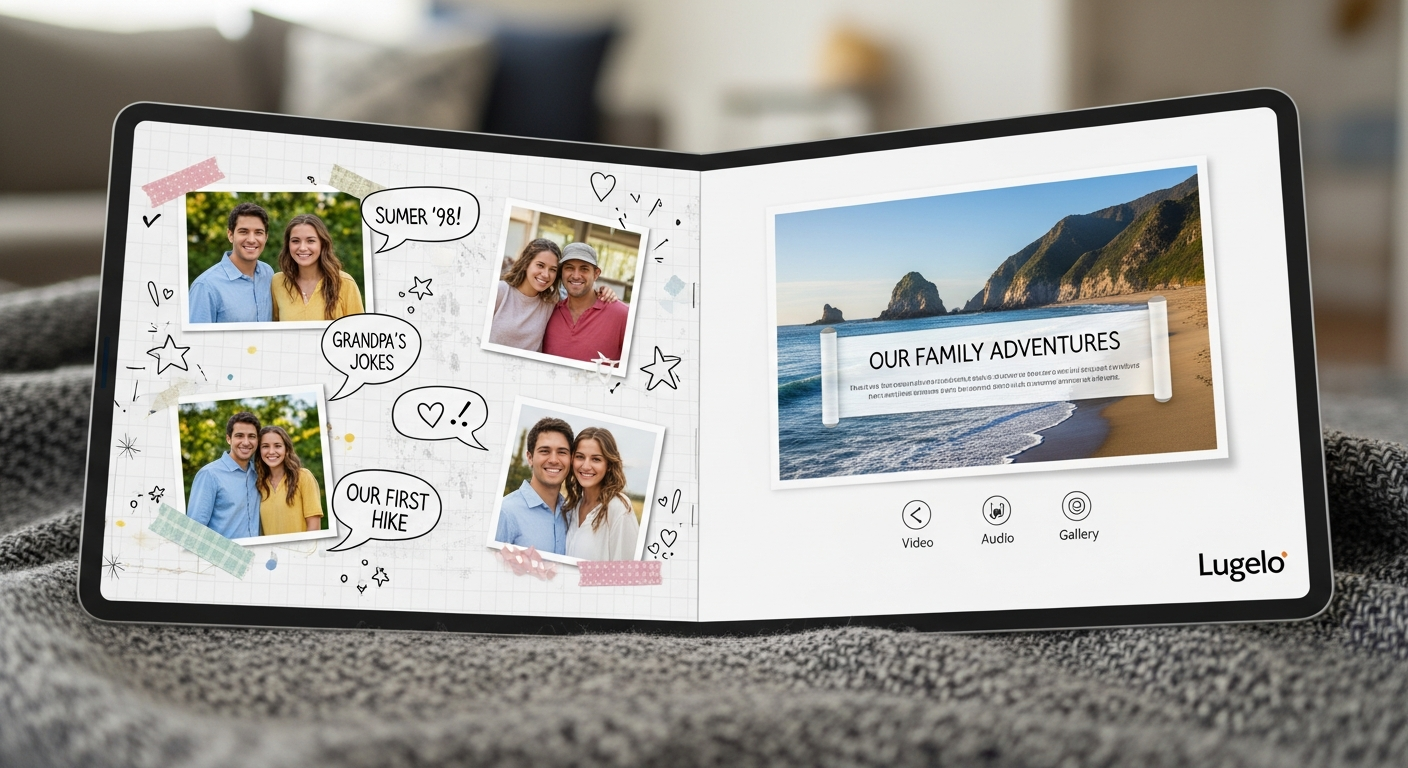
An open journal filled with photographs and handwritten notes, resting beside a smartphone showing a digital memory app, bathed in warm afternoon sunlight — representing the timeless human practice of capturing and preserving stories.

The Chord That Never Stopped Ringing

On June 25, 1967, four musicians in a flower-decorated studio sent a four-word message to 400 million people. It was the world’s first viral moment. And it worked — not because of the satellites, not because of the BBC, not because of the technical wizardry of 43 control rooms and nine ground stations — but because it was true.

Fifty-nine years later, on Global Beatles Day 2026, Apple Corps Ltd. officially recognised what fans have always known: that moment is still alive. The colorized video is on YouTube right now. The feeling is still real. A fan named Faith Cohen spent fifteen years making sure it was never forgotten, and this year, the world finally said thank you.

And the truth behind the moment is still real too. The memories that matter most are the ones we share. The ones we capture. The ones we give a form that can outlast the day they happened — that can be colorized, if you like, by the warmth of everyone who was there.

Your All You Need Is Love moment is closer than you think. It might be tonight’s dinner. Your child’s laugh on an unremarkable Wednesday. A road trip you haven’t taken yet but will always be grateful you did. A gathering of people who will one day be your most treasured memory — if you let them be.

Don’t let it be the moment that 400 million people watched and nobody wrote down.

Journals are souvenirs of your past. Rejoice in yours.


Start Saving What Actually Matters — Get Lugelo Free

Download Lugelo — iOS, Android & Web

Create your first shared journal on Lugelo →

Explore Lugelo’s collaborative journaling features →

See how Lugelo turns memories into VR galleries →

Preserve Your Legacy: Using Lugelo to Capture Family History

Preserve Your Legacy: Using Lugelo to Capture Family History

In an age where moments can slip by as quickly as a swipe of a screen, preserving family history has never been more important—or more accessible. We live in times where storytelling isn’t just an art; it’s a necessity. Families are more spread out than ever, and history can be lost between generations. Enter Lugelo—a revolutionary app dedicated to capturing and celebrating your family’s journey through its easy-to-use, feature-rich platform.

The Importance of Preserving Family History

Imagine a future where your great-grandchildren can relive a family vacation through VR, or read your grandmother’s journal in her own words. Preserving family history isn’t just about remembering the past—it’s about connecting with the future. A well-documented family history keeps memories alive, ensures stories are told, and traditions are passed down.

“Preserving family memories is like building bridges from past to future; it connects generations in the most profound way.”

Why Documenting Family History Matters

  • Creating Connections: Memories and stories cultivate a sense of belonging and identity.
  • Cultural Preservation: Documenting traditions helps retain cultural practices.
  • Legacy Building: Stories of triumph and perseverance serve as inspiring legacies.

Lugelo understands this need and offers an innovative platform to make preserving history easier than ever. To see how Lugelo is changing the landscape of family storytelling, .
check out their app on Google Play

How Lugelo Works

Lugelo is more than just a journaling app—it’s a platform that turns memories into lasting legacies. Through mobile and web interfaces, Lugelo provides a secure, user-friendly experience for users of all ages.

Illustration of Lugelo app features such as journaling, collaboration, and multimedia storage.

Key Features of Lugelo:

  1. Journaling and Storybooks: Document everyday moments, from the small victories to life’s significant milestones.
  2. Collaboration Tools: Invite family members to contribute their stories and perspectives, making your family journal rich and diverse.
  3. VR Capabilities: Experience your family history in new dimensions with virtual reality—bring your stories to life.
  4. Multimedia Storage: Save photos, videos, and documents to complement written memories, creating a full sensory experience.

For an in-depth understanding of how these features work, visit .
Lugelo’s guide on their website

Starting Your Family’s Story with Lugelo

Starting out on this journey might feel daunting, but it’s akin to writing the first page of a blank book. You decide the chapter titles—your family’s beloved traditions, unforgettable vacations, and stories of bygone eras are yours to capture.

Steps to Begin Documenting with Lugelo:

  1. Reflect on Your Experiences: Gather family members to share stories. Begin by reflecting on key events that define your family’s journey. Learn how to organize these memories from these helpful tips on preserving family memories.
  2. Choose Your Format: Whether it’s journaling day-to-day experiences or mural storytelling, select a format that best represents your family’s narratives.
  3. Create a Timeline: Establish a chronological order for entries to ensure a coherent story. This helps in visualizing the family’s journey through different generations.
  4. Capture Details and Emotions: Provide context and emotion to your entries, for it is the emotions that add color to the tapestry of family history.

“Family stories are treasures—pass them on and keep the memories alive.”

Building a Legacy with Lugelo

Once you’ve begun capturing stories, Lugelo makes it easy to transform them into formats that can be shared across generations. Through tools that allow you to compile entries into ebooks and PDFs, you can ensure your family history isn’t just preserved, but accessible and cherished.

Turning Memories into Legacy

After piecing together timelines and collecting anecdotes, consider transforming your family’s historical data into an enduring legacy. For guidance on the process, .
explore how to create a lasting legacy from your research

Here’s how Lugelo aids in transforming family stories:

  • Publishing Options: Convert journals into beautifully crafted ebooks or tangible prints.
  • Personalized Storybooks: Tailor storybooks for family gatherings or special occasions.
  • Interactive History: Use VR to create immersive experiences that engage younger generations.

Visualization of a digital storybook crafted using Lugelo, featuring family photos and stories in an interactive format.

Real-World Applications and Inspirations

Many have discovered the cathartic journey of documenting family history. For example, the Johnson family used Lugelo to celebrate their grandmother’s centennial birthday by compiling decades of stories, photos, and videos. It wasn’t merely a birthday gift but a passing of a torch—one that illuminated their love and perseverance. Their story serves as an inspiration, showcasing how family history preservation can unify and fortify family bonds.

Tips and Tricks for Successful Documentation

While the idea of preserving history sounds romantic, execution requires a blend of creativity and diligence.

Practical Tips to Enhance Your Family History Project:

  • Regular Updates: Encourage family members to update entries regularly.
  • Mini-interviews: Conduct informal interviews with elders to capture stories that are not written down.
  • Thematic Storytelling: Focus on themes such as migration stories, holiday traditions, or career achievements to keep the narrative engaging.

FAQ:

Q: How can I involve my extended family in documenting our history with Lugelo?A: Use Lugelo’s collaboration features to invite family members to contribute stories and photos, fostering a collective storytelling effort.

Q: Can Lugelo accommodate extensive family histories with multimedia components?A: Absolutely. Lugelo supports multimedia integration, so you can include photos, videos, and documents alongside written entries.

Conclusion

Every family has a story worth telling—a journey filled with triumphs, challenges, laughter, and love. Lugelo provides the tools to encapsulate these stories into a legacy that can be appreciated by generations to come. As you begin your family’s storytelling journey with Lugelo, remember that the memories you preserve today will become the treasures of tomorrow.

To start nurturing your family’s living legacy, explore Lugelo on , and let your family’s history be heard and cherished through the ages. Let’s preserve, celebrate, and pass down the essence of who you are with Lugelo.
Google Play

Journaling 2.0: Exploring the Future of Personal Storytelling

Journaling 2.0: Exploring the Future of Personal Storytelling

Imagine opening your journal to find not just blank pages, but an intelligent companion guiding your thoughts, offering immersive experiences, and allowing your stories to be shared and relived in vivid detail. Welcome to Journaling 2.0, where technology meets personal storytelling, creating a new era of memory preservation and narrative expression. In this blog, we will explore how platforms like Lugelo, AI prompts, and virtual reality are transforming the journaling landscape into an interactive, collaborative canvas for personal narratives.

The Time-Tested Art of Journaling

A Legacy Built on Words

Journaling has been a cornerstone for self-reflection and personal growth for centuries. From Leonardo da Vinci’s creative scribbles to Anne Frank’s poignant wartime diary, the act of journaling is a profound way to process thoughts, capture memories, and craft narratives. As noted in the Every article on AI Journaling, journaling is an effective practice for personal development, helping individuals reduce anxiety by transferring fears from the mind to the page.

“Journaling is already an effective personal development practice. It can help you get your thoughts out of your head, rendering them less scary.” — Every

However, the digital age beckons, elevating the humble journal into a dynamic, tech-driven experience that keeps the essence of storytelling alive while offering new dimensions for its expression.

Innovations Redefining Personal Narratives

AI-Assisted Writing Prompts

Incorporating artificial intelligence into journaling offers a personalized assistant to guide and inspire writing. AI tools can deliver tailored prompts to spark creativity or nudge users to explore deeper emotional terrains. These prompts serve as digital moonlit pathways, guiding thoughts into rich, vast territories yet explored.

The Every article illuminates how AI has the potential to change the way we interact with our journals, turning a static activity into a dynamic conversation. AI doesn’t just fill in blanks—it asks the poignant questions that unlock narrative treasures nestled within the subconscious.

Immersive Storytelling with VR

Virtual reality presents another revolutionary layer to journaling by creating immersive storytelling environments. Imagine revisiting a cherished memory not just through words, but by stepping into it as though you’re there again. The medium article on Fable and immersive journaling explores how VR journaling can transform the diarist into both author and protagonist, crafting narratives that are as engaging to relive as they are to write.

“Fable 2.0 introduces a new category of personal growth: immersive journaling. Through interactive storytelling, it transforms journaling…” — Medium

Collaborative and Gamified Features

Platforms like Lugelo are setting the stage for collaborative, gamified journaling. Here, journals transform into shared storytelling mediums where narratives become collective histories, enriched by multiple perspectives and memories. Lugelo allows users to compile moments into stories, creating a tapestry of shared experiences, from birthdays to holiday adventures.

Visualization of collaborative journaling, showing multiple users contributing to a single story through a virtual platform.

Self-Care and Emotional Wellbeing Through Writing

Journaling is increasingly recognized as a tool for emotional well-being and self-care. According to research published on PMC, storytelling and journaling aid professional caregivers in maintaining mental wellness. Similarly, personalized digital journals empower everyday individuals to navigate emotional landscapes and achieve greater self-awareness through narrative exploration.

The Future Holds More Than Words

Journaling in Tomorrow’s World

As storytelling technologies evolve, so does the potential of personal narratives. The intersection of technology and journaling not only enriches the writer’s experience but also preserves each slippered detail with crystal clarity for future generations. Imagine a journal that serves as an interactive family heirloom, transcending paper to become a digital diadem imbued with the very essence of past lives, dreams, and visions.

The future of journaling invites us all to take courage, to be protagonists in our own stories, with tools that turn the introspective into the interactive, and the reflective into the immersive.

Practical Tips for Journaling in the Digital Age

Considering the ever-expanding universe of journaling options, here’s how you can integrate these innovations into your journal practice:

  1. Start with AI Prompts: Use AI to overcome writer’s block and delve into meaningful self-reflection.
  2. Explore VR Journaling: For visually rich storytelling, experiment with immersive technologies that enable you to relive memories.
  3. Make It a Collaborative Journey: Platforms like Lugelo make it easy to involve family and friends, enriching your stories with diverse perspectives.
  4. Leverage Gamification: Turn journaling into an engaging activity with gamified challenges that motivate daily entries.
  • Q: What if I’m new to digital journaling?
  • A: Ease in with AI prompts and simple digital platforms before exploring more advanced features like VR.
  • Q: How can I use journaling for self-care?
  • A: Utilize AI prompts to navigate your emotions and engage with immersive storytelling to unpack personal narratives in a therapeutic context.

Conclusion

“The power of journaling lies not merely in the act of writing, but in the journey of discovery, introspection, and connection it enables.”

As we lean into the future of personal storytelling, journaling is poised to become richer and more inclusive than ever before. Whether you’re seeking personal growth, emotional catharsis, or the preservation of memories, Journaling 2.0 holds the keys to unexplored realms of creativity and self-expression.

Join us as we explore these new horizons, and transform your journaling practice into something more vivid, more connected, and more alive. Explore tools like Lugelo to begin your journey into the next realm of personal storytelling.

The Story of Us: My Family in 5 Memories

The Story of Us: My Family in 5 Memories

Every family is like a mosaic, a vivid collection of moments that come together to form a beautiful picture of shared history and connection. As I reflect on my family, five memories stand out, each a vibrant tile that adds depth and color to our collective story. By weaving these tales into a coherent tapestry, we not only preserve them for ourselves but also turn them into an inheritance for future generations.

In this blog, I’ll share with you the essence of my family through these cherished anecdotes. You’ll also discover how to craft your own family narrative using tools like , which combine traditional storytelling with modern technology to capture and enhance our most treasured memories.
Lugelo

Memory 1: The Great Camping Adventure

It was the summer of 1998 when our family decided to embark on a camping trip. For some, it might seem like a simple retreat into the wild, but for us, it became an unforgettable adventure marked by laughter, challenges, and a deeper connection.

We set up our tents beside a serene lake, the air crisp with the promise of exploration. Little did we know, a family of curious raccoons had decided to explore our food supplies the first night. Instead of a disaster, their nightly visits became a source of endless amusement, marking a pivotal moment of spontaneity and laughter that we would recall fondly for years to come.

Family gathered around a campfire under a starlit sky, sharing stories and laughter.

Tools to Capture the Adventure

To recreate such cherished outings, consider using a designed to house memories both big and small. Whether it’s a pesky raccoon or a perfect sunset, each detail contributes to your family story.
Family Journal

Memory 2: The Surprise 70th Birthday

INSERT IMAGE HERE: A large family gathered around a festively decorated table, celebrating a milestone birthday.

As the lights flickered on, Grandpa’s face lit up brighter than any candle. In those shared embraces and joyful tears, we learned that our family is a circle of strength and love, formed by shared memories and bound together by the smiles of those we hold dear.

A milestone celebration, Grandpa’s 70th birthday was a testament to our family’s unity and love. The secret planning meetings, countless giggles over WhatsApp chats, and hushed conversations to keep it under wraps culminated in a surprise party that brought every generation together.

Creating Lasting Records

Capture such heartfelt celebrations using , where you can document each cherished smile and surprise moment, transforming them into timeless heirlooms.
Our Family: A Keepsake Album

Memory 3: A Day at the Amusement Park

INSERT IMAGE HERE: A vibrant amusement park with families joyously exploring various rides and attractions.

But it wasn’t the rides that made the day extraordinary—it was the shared joy and the glances of pure delight that illuminated our path as we moved from one attraction to another. Sometimes, it is in simplicity that we find the most invaluable treasures.

A seemingly ordinary outing to the amusement park turned into a tapestry of joy and togetherness. With children tugging at our hands, eager to conquer the towering roller coasters, it was a day filled with screams, laughter, and cotton-candy-induced giggles.

Enhancing Your Narrative

Immortalize such simple yet profound moments using platforms like , which offer a creative space for turning everyday experiences into captivating stories enriched with multimedia elements.
Lugelo

Memory 4: The Unplanned Family Reunion

While it wasn’t the same as sharing physical space, seeing everyone on-screen, laughing at shared jokes, and watching toddlers toddle into their parents’ laps, brought about a sense of warmth and unity that transcended physical barriers.

Life has a way of bringing unexpected blessings our way. A year ago, the world paused, compelling us to embrace new ways of connecting. With travel restricted, we turned to digital platforms to bring family from different corners of the world into one virtual room.

“A family’s story is its heritage. It’s something to be passed down.” –

Family Life

Memory 5: Christmas Eve Traditions

INSERT IMAGE HERE: Family joyfully exchanges gifts around a warmly lit Christmas tree.

In the glow of twinkling lights and under the watchful eye of our evergreen tree, we bask in the comfort of togetherness. These moments remind us that no matter the directions life takes us, our family is a constant lighthouse guiding us home.

Every Christmas Eve, our family gathers around to share stories and open one special gift each. This tradition, rich with nostalgia and warmth, anchors us to our roots and each other.

Tools to Chronicle Traditions

To preserve such traditions in a dynamic format, turn to , which allow you to include VR elements and rich media, creating an immersive experience for future generations.
family storytelling platforms like Lugelo

Conclusion: Weaving the Tapestry of Us

Our family stories are more than just memories; they are threads in the tapestry of our lives—vibrant strands that capture the essence of who we are. By documenting and sharing these tales, we not only celebrate ourselves but also build a legacy that will resonate through generations.

For those looking to initiate their own family chronicle, explore resources like , , or . Each offers a unique canvas to capture the story of us, ensuring that love, laughter, and togetherness are always at the heart of our narrative.
Lugelo’s digital storytelling possibilitiesKeepsake AlbumsMemories – Our Family Journal

“In the end, it’s not the years in your life that count. It’s the life in your years.” – Abraham Lincoln

Blending Analog with Digital: Enhancing Creativity through Journaling

Blending Analog with Digital: Enhancing Creativity through Journaling

Introduction

In a world driven by digital convenience, the tactile pleasure of putting pen to paper holds its ground as a timeless practice. Journaling, a medium beloved by writers, thinkers, and dreamers alike, offers an intimate space for reflection and creativity. But what happens when you merge the analog charm of traditional journaling with the cutting-edge tools of the digital realm? Welcome to the enriched universe of hybrid journaling—a confluence where your creativity not only flows, but also thrives.

This exploration into blending analog with digital journaling will reveal how integrating both mediums can elevate your storytelling and imagination. From using apps like Lugelo to embracing the simple joy of a blank page, let’s embark on a journey to enhance our personal narratives through a comprehensive and dynamic journaling experience.

The Power of Analog Journaling

A Handwritten Journey

The essence of analog journaling lies in the physical act of writing. The sensation of pen gliding over paper engages multiple senses, forging a deeper connection between mind and medium. This tactile interaction can unlock a wellspring of creativity, fostering an environment where ideas are free to roam and grow unrestrained by pixels and screens.

The Bullet Journal method highlights the power of the analog approach, emphasizing raw, unfiltered expression devoid of auto-corrections and digital distractions. By cultivating a routine that encourages manual writing, journaling becomes a mindful practice, grounding you in the present moment.

“When you write by hand, you create a unique connection with your thoughts and emotions—one that digital platforms can sometimes dilute.” — Journal Enthusiast

Close-up of a handwritten journal entry featuring elaborate sketches and notes.

Introducing Digital Platforms to the Mix

From Paper to Pixels: Embracing the Digital Realm

While analog journaling captures the beauty of spontaneity and personal touch, digital journaling apps introduce an array of tools designed to enhance creativity. One such platform, Lugelo, offers a secure and interactive space to weave multimedia elements into your entries, revolutionizing how stories are documented.

  • Multimedia Integration: Enrich your entries with photos, audio recordings, and videos, bringing memories to life in vivid detail.
  • Organizational Tools: Leverage tags, timelines, and search functions to easily organize and retrieve your thoughts.
  • Accessibility & Security: Document your journey anywhere, anytime, with cloud-backed security.

Crafting a Personalized Hybrid Practice

Researchers have focused on creating hybrid tools that seamlessly bind the tangible with the digital. These tools, as discussed in the ACM study, allows users to preserve the authenticity of analog documentation while exploiting digital affordances for a more flexible journaling experience.

  1. Begin on Paper: Start with an analog session to brainstorm ideas and capture raw thoughts.
  2. Extend Digitally: Transition to a digital platform to expand on ideas, incorporate multimedia, and organize your entries.
  3. Revisit and Reflect: Regularly review both mediums to see how they complement each other and your evolving narrative.

Enhancing Storytelling and Imagination

Finding Inspiration in Every Medium

Combining analog and digital mediums empowers you to explore diverse storytelling avenues. Analog allows spontaneity—sketch out drafts, scribble thoughts, and let your imagination roam free. Transitioning to digital platforms, you can refine your narratives, experiment with formats, and create a comprehensive archive of vivid stories.

The blog by Pausa.co illustrates how Artificial Intelligence can enhance your journaling by turning handwritten notes into editable digital texts, promoting creativity without boundaries. AI-driven insights even suggest prompts and patterns to ignite your creative process anew.

Real-World Application: A Writer’s Experience

Consider Alex, an indie author who struggles with writer’s block. By blending analog and digital journaling, Alex embraced a free-flowing analog session each morning, followed by structured digital entries where multimedia elements added depth and context. This practice not only alleviated creative blocks but also resulted in a rich tapestry of ideas ready for further development into publishable work.

“The marriage of analog and digital methods reinvigorated my writing process, transforming journaling into both a creative playground and a strategic tool.” — Alex, Indie Author

Organizing Ideas and Maintaining Consistency

Practical Tips for Organization

The challenge of maintaining a cohesive journaling practice lies in organization. Here are practical tips to keep your hybrid journaling efforts structured and invigorating:

  • Dedicated Journals: Allocate separate notebooks for specific themes or ideas to maintain focus.
  • Digital Cataloging: Use digital tags and folders to categorize your entries for easy navigation and retrieval.
  • Regular Review: Schedule a monthly review to connect the dots, revisit forgotten ideas, and find new inspiration.

The Role of Technology in Sustaining Structure

Technological advancements support organizational efficiency. Digital platforms offer integration capabilities that synchronize handwritten notes to their digital counterparts. As detailed in the Lugelo article, this synthesis allows automatic sorting, tagging, and archiving, streamlining the maintenance of a structured journaling practice.

Image representing organized journaling using both analog notebooks and a digital device showing categorized entries.

Conclusion

By creatively blending analog and digital methods, you can transcend the limitations of a single medium, unlocking new avenues for self-expression and storytelling. Whether capturing spontaneous ideas on paper or expanding them digitally with multimedia richness, this hybrid approach enriches your journaling journey.

As you engage in this dynamic process, you’ll not only enhance your creativity but also create a valuable archive of experiences and insights. Remember, the ultimate goal of journaling—be it analog, digital, or blended—is to enable a deeper connection with yourself and the stories you wish to tell.

“In the fusion of tradition and innovation, we’re rediscovering the limitless potential of the human imagination.” — Creative Enthusiast

Explore more about enhancing your journaling practice by visiting the Lugelo Blog Page. Let this be your guide to discovering a world where analog charm meets digital innovation, making each page an evolving masterpiece.

The Future of Journaling: AI Meets VR in Lugelo

The Future of Journaling: AI Meets VR in Lugelo

Introduction

Imagine stepping into a world where your personal diary isn’t just a collection of written entries but a vivid, immersive experience. Imagine reliving your memories as if you are walking through them again, witnessing moments frozen in time. This is precisely what Lugelo, an innovative journaling app, is bringing to life by merging artificial intelligence (AI) with virtual reality (VR). In this blog, we’ll explore how these cutting-edge technologies are revolutionizing the way we document and relive our personal stories.

The Evolution of Journaling

From Pen and Paper to Digital Platforms

Journaling has been a way for people to document their lives for centuries, evolving from simple diary entries written with quill and ink to digital notes on smartphones. But technology is taking journaling a quantum leap forward. With Lugelo, the act of journaling becomes an immersive journey, integrating the experiential power of AI and VR.

The Role of AI in Modern Journaling

Artificial intelligence introduces a new dimension to journaling by automating and enhancing traditional diary tasks. Whether it’s through AI-driven suggestions for entries or organizing your life stories in a cohesive narrative, AI serves as a personal assistant in the journaling process. More insights on the seamless integration of AI and VR can be found in a .
Medium article on crafting realities that feel alive

“AI is the invisible engine making virtual worlds smarter, more responsive, and eerily lifelike.” — Medium

Enter: Virtual Reality

Making Memories Tangible

Virtual reality has the potential to transform how we experience our memories. By turning journal entries into vivid VR experiences, Lugelo enables users to walk through memories as if they are living them again. Instead of merely reading about a family vacation, you can put on a VR headset and find yourself back at that beach, feeling the sand beneath your feet and hearing the waves crash.

Creating a Personal VR Gallery

Lugelo offers a unique feature called the Personal VR Gallery, which allows users to curate their virtual spaces filled with moments, achievements, and stories. This customization not only makes the journaling experience more personal but also deeply immersive. Interested users can explore how to create their Personal VR Gallery in Lugelo through their .
website

The Synergy of AI and VR

Enhancing User Experience

The convergence of AI and VR holds immense potential for enriching user experiences. AI can enhance interactions within VR environments by providing AI-driven chatbots and virtual companions. These elements offer guidance and companionship, making the VR experience not just interactive but engaging and personalized. Learn how AI enhances VR devices on .
Unite AI

Narratives Brought to Life

The ability to interact with AI-driven elements within a VR setting enables storytelling to be more dynamic and interactive. Instead of reading about a significant life event, imagine conversing with a virtual representation of your past self or watching a critical moment unfold with digital aids guiding you through the narrative. This immersive storytelling is explored further in .
emerging frontiers in immersive technologies

“AI-driven chatbots provide assistance and companionship, enriching the user’s interaction with VR devices.” — Unite AI

Real-World Applications and Benefits

Personalized Experiences

One of the most significant benefits of combining AI with VR in journaling is the ability to offer personalized experiences. AI tailors the content, presenting you the most meaningful narratives based on your past entries and preferences.

A New Dimension of Therapy

This technological advancement also has implications for the therapeutic realm. The immersive recounting of positive memories through VR can serve as an innovative tool for reflection, relaxation, and therapy. Users can revisit happier times, reinforcing positive emotions and providing mental health benefits. The emotional and psychological advantages of AI-enhanced VR are a burgeoning field that promises transformative outcomes.

Challenges and Future Prospects

Overcoming Technical Hurdles

As exciting as these advancements are, integrating AI and VR into something as personal as journaling isn’t without its challenges. Ensuring privacy, managing data security, and delivering high-quality immersive experiences are crucial concerns that Lugelo and similar platforms will need to address.

Charting the Path Forward

Despite these challenges, the future looks promising. As AI and VR technologies continue to evolve, the potential applications within the field of personal journaling are vast. We are on the cusp of making personal storytelling not only a digital interaction but an immersive adventure.

Conclusion

The convergence of AI and VR in the realm of journaling marks a pivotal transformation in how we document and relive our life stories. With Lugelo at the forefront, users are offered a glimpse into a future where the boundaries between memory and experience blur, creating a rich tapestry of personal narratives. As you consider adopting these innovative tools, envision the power of not just reading your memories but stepping back into them, enveloped by the richness of your past transported to life through technology.

As we embrace these technological innovations, the question is no longer merely how we will remember but how vividly we will choose to relive. Explore this new journaling frontier with Lugelo today.

A mesmerizing VR landscape symbolizing the expansive potential of immersive journaling.

5 Journaling Habits That Will Transform Your Life in 30 Days

5 Journaling Habits That Will Transform Your Life in 30 Days

Introduction

Get ready to embark on a transformative journey of self-discovery and personal growth, one page at a time.

Imagine waking up each morning with a sense of clarity and purpose, feeling in control of your thoughts and emotions. Now, picture the transformation your life could undergo with just 30 days of a simple yet powerful habit: journaling. Whether you’re a seasoned journaler or a complete beginner, incorporating these five journaling habits can lead to profound changes in your daily life—bringing clarity, focus, and emotional balance.

1. Set Daily Intentions

Every morning, embrace the power of intention-setting. By writing down your intentions for the day, you create a roadmap for your thoughts and actions. This practice enhances focus and motivation, aligning your daily activities with your broader life goals.

How to Set Intentions:

  • Start with a Focus: Choose one or two areas in your life you want to focus on. For example, “Improve my productivity” or “Practice kindness.”
  • Specificity is Key: Make your intentions specific. Instead of “Be more productive,” write, “Completed 3 key tasks at work today.”
  • Reflect and Adapt: At the end of the day, revisit your intentions. Reflect on what worked and what needs adjusting.

Quote:

“Setting intentions is a vigorous act of creation. This is the power of the conscious mind.” — Jane Houston

Consider joining a , which offers daily prompts to inspire and solidify your intentions.
One Month Journaling Challenge

2. Gratitude Journaling

Gratitude journaling has the power to shift your mindset to one of abundance and positivity. By regularly noting what you’re grateful for, you train your brain to focus on the good, reducing stress and enhancing happiness.

Gratitude Journaling Tips:

  • Keep it Simple: Each day, list 3 things you’re grateful for. They can be as simple as a great cup of coffee or the smile of a stranger.
  • Be Consistent: Establish a specific time each day to write, like right before bed. Consistency helps make gratitude journaling a habit.
  • Expand Your Gratitude: Occasionally, dive deeper into why you’re grateful for something. This enriches the practice.

Explore how gratitude can transform your mindset in this and start your journey toward positivity.
Inkspire Daily article

An open journal with a list of gratitude entries.

3. Mindful Reflection

In a world of constant distractions, taking the time to reflect mindfully is a grounding practice. It allows you to digest your day, understand your emotions, and grow from your experiences.

Reflective Journaling Practice:

  • Daily Reflection: Spend a few minutes each evening reflecting on your day. Ask yourself, “What went well today?” and “What could I improve tomorrow?”
  • Emotional Check-in: Note any strong emotions you experienced and what triggered them. This helps in understanding emotional patterns.
  • Weekly Summary: At the end of each week, summarize your insights. Look for recurring themes or lessons.

Mindful reflections help solidify learning and foster self-awareness, aiding personal growth. For more on effective journaling habits, check out .
5 Habits That Will Change Your Life in 30 Days

4. Goal Setting and Tracking

A crucial aspect of personal development is setting and tracking meaningful goals. Journaling provides a structured way to outline your aspirations and monitor your progress.

Goal-Setting Steps:

  • Define Clear Goals: Write down both short-term and long-term goals with realistic deadlines.
  • Break It Down: Divide large goals into smaller, manageable tasks.
  • Review Regularly: Track your progress frequently and adjust your strategies as needed.

Using a journal to track goals not only helps in achieving them but also in understanding the journey and obstacles encountered along the way. For more in-depth guidance, explore the .
Lugelo Blog’s journaling techniques

Women checking journal with goal entries, celebrating milestones.

5. Creative Expression

Unleash your creativity and reduce stress through free writing, sketching, or any form of artistic expression that suits you. Journaling provides a private space to explore your creative side and process emotions constructively.

Creative Journaling Techniques:

  • Free Writing: Spend 10 minutes writing without any constraints. Let your thoughts flow without judgment.
  • Drawing and Doodling: Use illustrations or doodles to express ideas or emotions.
  • Storytelling: Write short stories or anecdotes about your day or imagined scenarios. This can boost creativity and offer new perspectives.

Creative expression through journaling not only enhances creativity but also acts as a therapeutic outlet, improving mental well-being.

Quote:

“Creativity is intelligence having fun.” — Albert Einstein

Conclusion

In just 30 days, these five journaling habits can truly transform your life. They offer pathways to clarity, intentionality, gratitude, introspection, and creativity. The beauty of journaling is its ability to adapt to each individual’s journey, allowing for a deeply personal transformation.

Start today and experience the positive changes these journaling practices can bring to your life. For further inspiration and resources, explore the vast benefits of journaling and personal growth with and other influential sources.
Inkspire Daily

A peaceful scene of journaling, signaling a new beginning.

Set aside time for yourself, turn the page, and begin a new chapter today. Your journaling journey awaits!

The Future of Digital Journaling: Embracing VR, AI, and Enhanced Privacy

The Future of Digital Journaling: Embracing VR, AI, and Enhanced Privacy

Imagine journaling in a realm where your stories come alive, where your inner thoughts are transformed into immersive realities. The era of introspective pen-to-paper routines is being redefined by the cutting-edge advancements in Virtual Reality (VR) and Artificial Intelligence (AI). Welcome to the future of digital journaling, an exciting frontier where Lugelo stands at the forefront, seamlessly integrating technological innovation with personal reflection.

Introduction: Venturing into an Immersive Storytelling Experience

In a world increasingly driven by technological marvels, the act of journaling—once a solitary and introspective task—is evolving. Technologies like VR and AI are not only enhancing the storytelling experience but are doing so while addressing paramount concerns of digital privacy. In this blog, we delve into how Lugelo’s innovative approach is setting a new benchmark in the realm of digital journaling, ensuring stories are more engaging than ever while keeping your personal data secure.

The Role of VR and AI: Bringing Stories to Life

VR: The Next Leap in Storytelling

Imagine putting on a VR headset and finding yourself immersed in the vibrant streets of Paris, the tranquil gardens of Kyoto, or the bustling bazaars of Marrakech—all while documenting your travel memories. With advancements in VR, these once-static journal entries evolve into dynamic, multisensory experiences.

According to , the marriage of VR and AI is unlocking unprecedented levels of realism and interactivity, allowing for hyper-personalized, dynamic stories. VR is the canvas, and your memories paint the narrative—creating a vivid tapestry of your life’s story.
AxisXR

AI: From Narration to Curation

AI, on the other hand, transforms journaling by acting as a digital muse. Not only can AI curate your journal entries, but it can also provide prompts, generate insights, and even detect emotional tones through sophisticated algorithms. This interactivity makes journaling an evolving conversation rather than a static monologue. As discussed in , AI is significantly enhancing user interaction, making digital journaling smarter and more engaging than ever before.
Whimsy Games’ blog

AI and VR merging to create a vibrant digital journaling experience, showcasing a blend of neural networks and virtual environments.

Importance of Digital Privacy: The Lugelo Promise

Ensuring Privacy in a Digital Age

While the technological horizon looks promising, it also comes with the specter of privacy concerns. As journaling moves from paper to pixels, the security of personal narratives becomes a critical concern. In an era where digital identities are constantly under threat, Lugelo takes a proactive stance in ensuring user data remains both private and secure.

A recent highlights the importance of protecting user privacy and identity in social virtual reality. This is where Lugelo excels, offering robust encryption and adhering to strict data protection protocols—ensuring your stories remain your own.
systematic review in Frontiers in Virtual Reality

Encryption and Secure Storage

Lugelo prioritizes privacy through advanced encryption techniques, creating a digital vault for your stories. This commitment ensures that your personal experiences are safeguarded against unauthorized access, allowing you to journal freely without worrying about data breaches. Visit to learn more about how they protect your cherished memories in secure, interactive journals.
Lugelo

“In a digital era, privacy is not just an option—it is a fundamental right. Lugelo embodies this ethos by ensuring that your digital reflections remain yours alone.” — Data Privacy Advocate

Real-World Applications and Future Prospects

Beyond Journaling: Expanding Horizons

The implications of VR and AI in journaling go beyond simply enhancing the traditional experience. These technologies pave the way for new forms of storytelling, educational tools, therapeutic applications, and even virtual legacy creation—where narratives are preserved as living histories for future generations.

A glimpse of a digital legacy creation setup where AI organizes family stories into an interactive VR experience.

Lugelo’s Vision for the Future

Looking ahead, Lugelo envisions further integration of biometric data to create even more personalized and dynamic storytelling experiences. This advancement will enable the journaling process to adapt to your mood and mental state, offering insights and reflections that are deeply attuned to your current emotions.

  • Q: How does Lugelo ensure my data is secure?
  • A: Lugelo uses advanced encryption to secure data. All journals are stored in a protected digital vault accessible only by you.
  • Q: Can I experience VR journaling without any specialized equipment?
  • A: While a VR headset enhances the experience, Lugelo is accessible on various devices, allowing for a flexible and adjustable journaling experience.

Conclusion: Embrace the Future

As we stand on the cusp of a new era in personal storytelling, the fusion of VR, AI, and enhanced privacy represents an exciting frontier. Lugelo is leading this revolution, offering a platform where your personal reflections are not only vividly alive but also securely protected.

By embracing these advancements, you can embark on a journaling journey that is as dynamic and unique as your own story. Join the movement, safeguard your digital identity, and create the vibrant stories of tomorrow with Lugelo today.

“The future of journaling is not just digital—it’s immersive, intelligent, and secure.” – Innovator in Digital Storytelling

An artist's impression of future journaling technology where digital interactions and data security converge.

Prepare to leave behind the constraints of traditional journaling and step into a world where your narratives are enriched with life-like experiences, all while protected by industry-leading privacy measures. Welcome to the future of digital journaling—a realm that awaits your stories.