
How to Write a Memoir: A Beginner’s Guide to Telling Your Own Story
It usually happens on a quiet morning. The house is empty, the coffee is hot, and the laptop is open to a blank document for the first time in years. You have been meaning to do this for a decade — since your mother died, or since you retired, or since the night your daughter asked a question about your childhood and you realised you were the only person left who knew the answer.
You type three words. I was born—If you have been wondering how to write a memoir, the first useful thing to know is that the problem is almost never your writing. It is your scope. People do not abandon memoirs because they lack the talent to describe a kitchen or render a conversation. They abandon them because they sat down to write eighty years and got nine pages in before the weight of everything they had left out became unbearable.
Then you stop. Because the sentence after that one could go anywhere, and so could the four hundred sentences after that. Was it the town that mattered, or the year? Do you explain your grandparents first? How much of the war? You sit with the cursor blinking at the end of a half-finished clause, and after eleven minutes you close the laptop and tell yourself you will start properly next week.
Here is the reframe that makes the whole thing possible: a memoir is not your life. It is one thread of it.
The novelist Martin Amis, in his own memoir Experience, observed that what everyone seems to have in them “is not a novel but a memoir.” He is right, and the instinct is worth trusting. You do have a book in you. You simply do not have that book in you — the complete one, the cradle-to-grave one, the one that begins with your birth and ends with the present tense. Nobody does.
This guide will give you a process rather than encouragement. We will cover what a memoir actually is and how it differs from an autobiography, how to find the through-line that organises everything, a ninety-second compression exercise you will do inside this article, three outline structures with a clear recommendation, a writing rhythm that survives an ordinary week, how to write about real people fairly, and what to do when the draft is finished.
Two honest caveats before we start. This will not tell you how to get published, and it makes no promises about how the writing will make you feel. What it will do is get you to a working draft.
That begins with a definition — because most people attempting a memoir are, without knowing it, attempting something considerably harder.
What a Memoir Actually Is, and How It Differs From an Autobiography
Almost every scope problem in beginner memoir writing starts with a single confusion, and clearing it up takes about a minute. The two forms sound like synonyms. They are not remotely the same job.
An autobiography is a record of a life. It runs chronologically, it aims at completeness, and — this is the part nobody says out loud — it generally assumes the reader already cares who you are. Autobiographies are written by former prime ministers and footballers and people whose names appear on the cover as the reason to buy the book. The structure is the life itself. The organising principle is and then.
A memoir is a slice of a life, organised around a theme, and it earns the reader’s interest through the story itself. It does not assume you are famous. It does not attempt completeness. Its organising principle is not and then but because — or better, what did that mean?Hold onto that distinction, because it will do more work than any other idea in this article:
- An autobiography asks: what happened in my life?
- A memoir asks: what did one part of my life mean?
- An autobiography is measured in years covered.
- A memoir is measured in depth reached.
frames the form in almost exactly these terms — as writing that focuses on striking or life-changing events rather than the full biographical span, sitting far closer in spirit to the personal essay than to biography. That is not a decorative citation. It is how memoir is taught in university creative nonfiction courses, and it should quietly change what you think you have signed up for. You are not writing a biography of yourself. You are writing an extended personal essay with scenes in it.
Purdue OWL’s guide to the personal memoir
The critic and poet Blake Morrison, writing in The Guardian about the craft of life writing, puts the permission slip more plainly than any writing manual: “it doesn’t have to be cradle-to-grave: a slice of life, or collage of fragments, can be enough.”
Can be enough. Read that twice if you are the sort of person who has been putting this off because the task felt enormous. The task is not enormous. You made it enormous by choosing the wrong container.
“But my life isn’t interesting enough”
This is the objection that arrives next, always, and it deserves a real answer rather than reassurance. Reassurance would be to say of course your life is interesting! — which is both patronising and unhelpful, because you would not believe it.
The real answer is a craft answer. Memoirs are not interesting because of what happened. They are interesting because of what the narrator makes of what happened.Drama is not the raw material of memoir. Attention is. A woman writing about the four months she spent driving her father to dialysis appointments has more usable material than a man writing a survey of a distinguished forty-year career, because she has a confined space, a repeating action, and a relationship under pressure. He has a CV.
Consider the evidence of the form itself. There are memoirs about extraordinary events — wars, escapes, catastrophic illnesses — that are dull, because the writer assumed the events would do the work and simply reported them. And there are memoirs about a single unremarkable summer, a job in a shop, a friendship that faded, that are unforgettable, because the writer noticed something true and had the patience to follow it.
Which brings us to what a memoir is not, stated bluntly, because these are the four things beginners accidentally write instead:
- It is not a family tree. Genealogy is a valuable and separate pursuit. A list of who begat whom is data, not narrative.
- It is not a chronology of jobs and addresses. “In 1974 we moved to Leeds, where I joined the council” is a fact. It is not a scene, and a reader cannot live inside it.
- It is not a defence of your decisions. The moment a memoir becomes an argument for why you were right, the reader stops trusting the narrator. Self-justification is the fastest way to lose an audience.
- It is not a complete accounting. You are permitted — required, actually — to leave enormous amounts out.
There is a phrase people search for constantly: how to write a memoir about yourself.But do not overcorrect. Virginia Woolf identified the opposite failure, and Morrison quotes her sharp diagnosis: the reason so many memoirs are failures is that “they leave out the person to whom things happened.”
It is a perfectly natural way to ask the question, and it is very slightly misleading. The best memoirs are not about their authors in the way a portrait is about its sitter. They are about a subject — a place, a relationship, an obsession, a loss, a craft — that happens to involve the author intimately. The self is the lens, not the landscape.
So it is
Once you accept that a memoir needs a theme rather than a chronology, exactly one question remains, and it is the hardest and most valuable in the whole enterprise: what is yours?
about you. Just not as a list of you. You must be present on every page as a consciousness making sense of things — noticing, misreading, revising your own understanding — rather than as a subject being catalogued. The memoirist’s job is to be the person to whom things happened, visibly, while writing about something larger than themselves.
Finding Your Through-Line: The Question Your Memoir Is Actually Asking
“My childhood” is a topic. “My years in the army” is a topic. “My mother” is a topic. Topics are infinitely large, which is precisely why they cannot hold a book together — there is no criterion for what belongs inside them and what doesn’t.
A through-line is not a topic. This is the single most common misunderstanding, and getting past it is worth more than any amount of writing practice.
A through-line is a question the book is trying to answer, or a tension it keeps returning to without ever fully resolving. It has a shape. It can be stated in one sentence. And crucially, it can be used to make decisions.
Watch what happens when you convert:
Topic: My childhood.
- Through-line: Why did I spend twenty years trying to earn the approval of a man who had already left?
Topic: Emigrating in 1979.
- Through-line: What do you owe a country you chose, when you can no longer speak to your own mother without an interpreter?
Topic: My career change at forty-eight.
- Through-line: I was good at a job I did not believe in. What does it cost to admit that late?
Topic: Looking after Dad.
- Through-line: He became a stranger by degrees, and I kept behaving as though the old man would come back. When did I stop?
Topic: My friendship with Marian.
- Through-line: We were inseparable for eleven years and then we simply weren’t. Nothing happened. What does that say about how I hold onto people?
Notice what each conversion does. It introduces pressure. It implies a change over time. It puts the narrator visibly inside the material, wondering about something rather than reporting it. And — this is the practical magic — it gives you a criterion.“The reason so many memoirs are failures is that they leave out the person to whom things happened.”
— Virginia Woolf
The ten-moment diagnostic
Here is a genuine exercise rather than a vague prompt. It takes about twenty minutes and it works.
List ten moments from your life you would tell a stranger about. Not the ten most important. Not the ten you think you shouldWrite them fast — a line each, no more. Do not edit. Do not arrange them. Do not judge whether they are significant enough; the ones that feel too small are frequently the ones that matter. Ten, written quickly, in one sitting.
pick. The ten you would actually reach for if you were sat next to someone interesting on a long train journey and they asked you a real question.
Then read them back and look for what they have in common — and here is the part people get wrong: look for the recurring pressure, not the recurring people.
Your mother may appear in six of the ten. That does not mean your memoir is about your mother. Look underneath. Is she present in all six as someone you are trying to impress? Someone you are protecting? Someone whose approval you are still auditing yourself against? ThatGive this some time. It is the section of this article where you should slow down.
Sometimes the pattern is not emotional but situational. You may notice that eight of your ten moments happen in the six months after a move. Or that every one involves being the only person in the room who did not know the rules. Or that you keep returning to thresholds — arrivals, departures, doorways. Patterns like that are gifts. They are the book telling you what it is.
— the trying-to-impress, the protecting, the auditing — is the through-line. The people are the cast. The pressure is the story.
Why a through-line is the answer to the scope problem
Let us be explicit about the mechanism, because this is the argument the entire article rests on.
A through-line lets you say no.Without one, every memory in your possession is equally relevant, because there is no test to apply. The holiday in 1986 might belong. Your first boss might belong. The thing your brother said at the funeral might belong. Everything might belong, so everything gets in, and the draft swells until it collapses under its own undifferentiated weight. This is why so many first memoirs stall somewhere around chapter three — not from a failure of nerve or ability, but because the writer has run out of a way to choose.
With a through-line, the test is a single question you ask of every scene: does this touch the thread? If yes, it stays and probably needs expanding. If no, it goes — into a separate file, not the bin, but out of the draft. That is not a limitation. That is the thing that makes finishing possible.
This is also the honest answer to how to start a memoir. You do not start at the beginning. The beginning of your life is almost never the beginning of your story. You start at the through-line — identify it first, and the question of which scene opens the book becomes a solvable craft problem rather than an existential one.
A note on the raw material you don’t have yet
There is a difficulty here that most people only discover once they are already committed, so it is worth naming now.
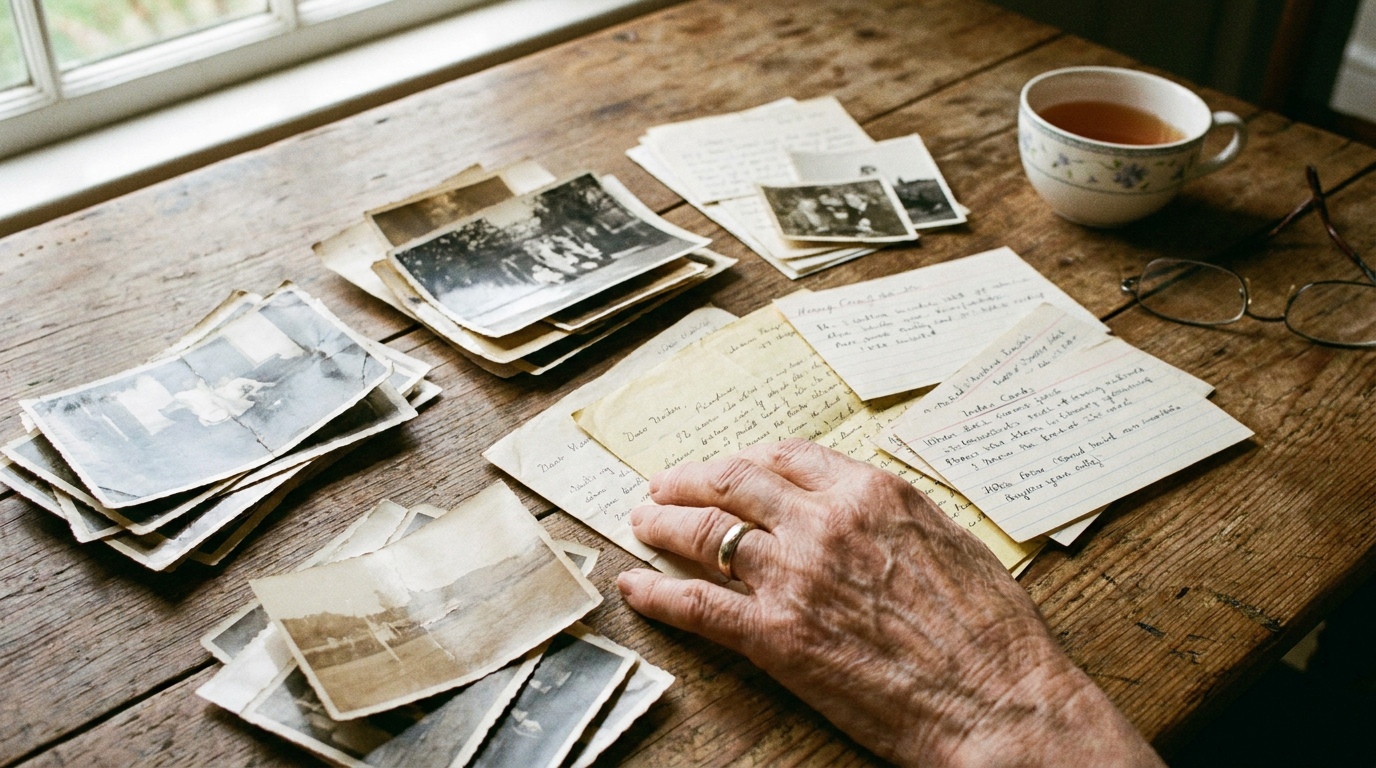
Most people trying to find a through-line are working from memory alone, and memory is a poor archive. It is excellent at preserving the shape of a moment — the fact that a conversation was tense, that a room felt cold, that you left early. It is unreliable about texture. The name of the street. What was actually said. Which year the shop closed. Who else was in the car.
Photographs help, but only partially, and it is worth being precise about how. A photograph tells you that an event occurred and roughly what it looked like. It does not tell you what it meant, what preceded it, or why the person on the left is standing slightly apart from everyone else. An image is evidence, not narrative — which is a large part of why a camera roll full of holiday photographs so rarely translates into a story anyone can tell.
Two practical moves at this stage. First, talk to the people who were there, with actual questions rather than open invitations to reminisce — a structured set of questions put to an older relative will surface detail that no amount of solitary remembering will produce. Second, start writing down the ordinary details of now, because the texture you are currently missing from 1985 is exactly the texture you are failing to record about this week.
You now have a thread. Before we discuss what shape to build around it, let us get you physically writing — with the smallest commitment available anywhere in the craft.
Warm-Up: Write Your Story in Six Words First
Put the outline down. We are going to write something complete in the next ninety seconds.
This is not a party trick, and it is not a social-media exercise dressed up as craft. Six-word writing teaches the single most transferable skill in memoir: selectionWhich is, precisely and exactly, the skill this entire article is trying to teach you at scale.
. In six words, you cannot explain. You cannot provide context. You cannot cover eighty years. You can only choose — and let what you leave out do the work.
How to Write a Six-Word Memoir
The form has a famous origin story: the six-word story about baby shoes, never worn, traditionally attributed to Hemingway. It is worth knowing that this attribution is disputed and has never been reliably verified. introduces it with the careful phrase “as the old story goes” — which is the right register. Treat it as literary legend rather than literary history. The legend is instructive regardless of who wrote it.
The Poets & Writers prompt built around the exercise
The mechanics are simple and unforgiving:
- Exactly six words. Not five, not seven. The constraint is the teacher.
- Imply; do not state. “I was very sad for years” states. It gives the reader nothing to do.
- Distrust adjectives doing emotional work. Heartbreaking, beautiful, devastating — these are instructions to the reader to feel something, which is not the same as making them feel it.
- Aim for a turn or a withheld fact. The best six-word memoirs contain a pivot in the back half, or a gap the reader has to step across.
Here are five originals, across different lives:
Left at nineteen. Still packing lightly.
Learned her language. Too late, obviously.
Forty years teaching. Remember eleven names.
Sold the shop. Kept the keys.
Everyone assumed I’d been the difficult one.
Now the editing move, which is where the real learning happens. Take a weak version:
I was always sad about my father leaving when I was young.
That is thirteen words, it states its emotion outright, and it has no gap in it. Compress and withhold:
Dad left Tuesday. I still check.
Six words. The emotion is never named, and it is far more present for that. “Still check” does everything — it establishes decades of time, a persistent habit, and a hope the narrator probably knows is unreasonable. The reader assembles the sadness themselves, which is why they feel it.
Now write three.
Not one. Three. The first one you write will be the obvious one — the headline version of your life that you have half-composed a hundred times. The second will be a correction of the first. The third is where you stop performing and something true gets in.
Keep the third. Write it somewhere you will see it, because it is usually the closest thing you have to your through-line in miniature.
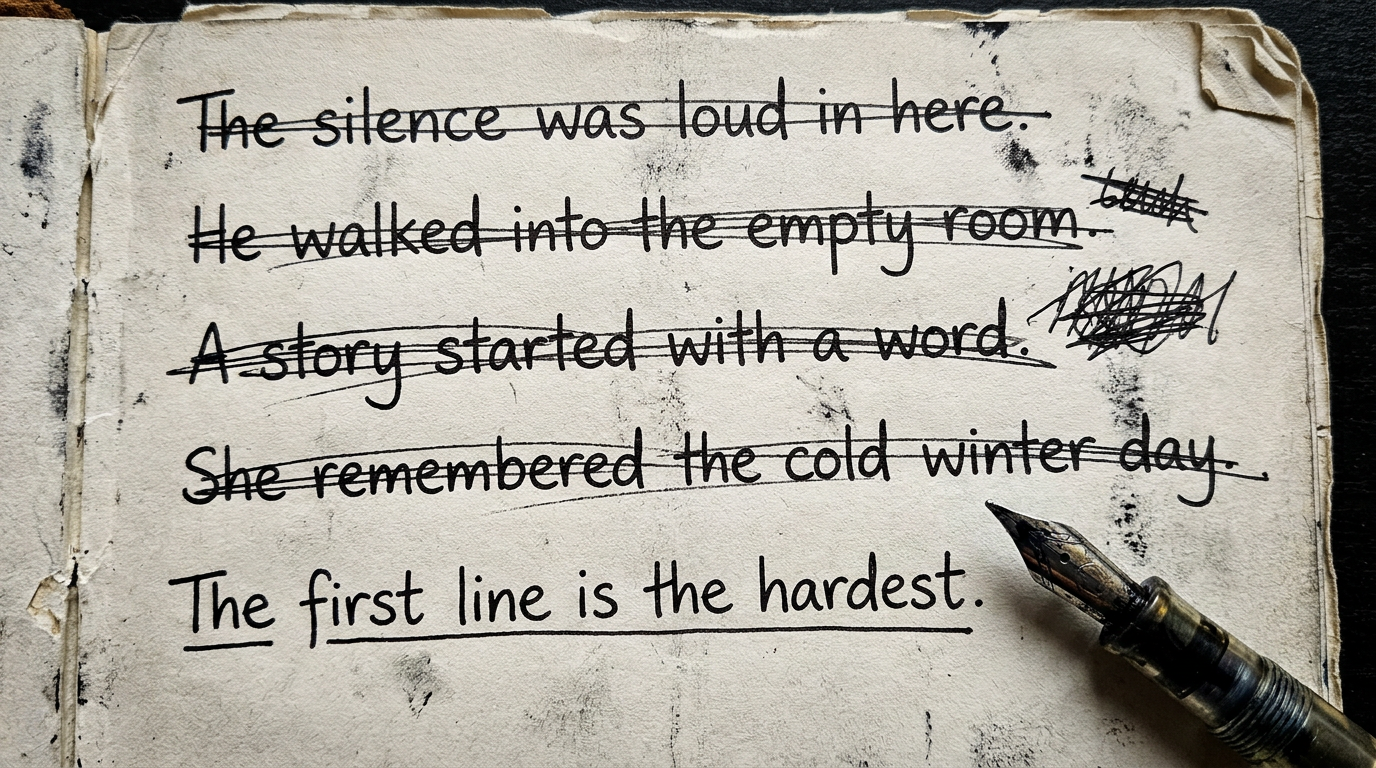
Here is why that exercise mattered. If you managed six words that imply more than they say, you have proved you can select. You have demonstrated the core competency of the form in under two minutes. Everything that remains between you and a finished memoir is a question of order and scale
Structural problems have solutions. They are called outlines.
— which is a structural problem, not a talent problem.
How to Build a Memoir Outline: Three Structures That Work
Forget everything the word “outline” suggests. You are not making a table of contents, and you are not numbering chapters.
A memoir outline is a decision about shapeWhich is how we end up with the default trap.
— what the reader learns, and in what order they learn it. That is all. It is a sequence of revelations, not a filing system. Two writers with identical material and identical through-lines can produce entirely different books depending on this one choice, and it is the choice that most first-time memoirists never realise they are making.
Why chronology is a fallback, not a plan
Almost every abandoned memoir is chronological, and there is a reason. Chronology is the only structure most people know. It requires no decisions, which feels like a mercy at the start and becomes the problem later.
Three things go wrong. First, chronology removes all your choices — the order is dictated by the calendar, so you never have to ask what the reader needs next, which means you never discover what your book is arguing. Second, it flattens emphasis: the summer that changed everything gets the same structural weight as the four years in which nothing happened, because both are simply next. Third, and most fatally, it makes even an eventful life read as a list.
Morrison’s advice in that same GuardianHere are three that plan properly.
essay is to be bold with chronology — to treat the timeline as material you are free to rearrange rather than an order you are obliged to obey. Take him seriously. Chronology is what you fall back on when a structure fails, not what you plan with.
Structure One: The Single Thread
How it works. You follow one question, relationship, or project across time. It is chronological within the thread, which keeps it easy to write — but it ruthlessly excludes anything that does not touch the thread. Whole years vanish in a sentence. Major life events appear only if the thread runs through them.
What it suits. A defined relationship. A single sustained project. An illness. A move. A long estrangement. Any through-line with a clear subject and a natural sense of progression.
Worked example. A memoir about learning your mother’s first language, having grown up without it. Every chapter is a stage of the learning — the first lesson, the first time you understood a joke, the first phone call, the first argument, the conversation you had too late. Your marriage, your career, your children exist in the book only where they touch the language. Everything else in those decades is scenery.
Failure mode. Creeping inclusion. The thread widens by degrees — one chapter about your brother because he was learning too, then one about your job because it paid for the classes — until you have quietly rebuilt an autobiography and lost the reason anyone was reading.
Single Thread — best for a clear subject with natural progression; watch for the thread quietly widening into everything.
Structure Two: The Braid
How it works. Two strands — occasionally three, rarely more — alternate throughout the book. They appear unrelated at first and converge by the end. The most common and most effective version is a “then” strand and a “now” strand, cut against each other so that each illuminates the other.
What it suits. Through-lines where the meaning of the past only becomes visible from the present. If your honest answer to “what is this about?” involves the phrase I only understood later, the Braid is probably your form, because it lets the reader do the understanding alongside you.
Worked example. Alternating chapters between a grandparent’s migration in the 1950s and your own relocation six decades later. You never once write the sentence “I finally understood what she gave up.” You do not have to. The structure makes the argument — the reader arrives at the parallel themselves, which is considerably more powerful than being told.
Failure mode. Strand imbalance. One thread is far more compelling than the other, and readers start skimming the weak strand to get back to the strong one. The diagnostic is simple and brutal: read each strand alone, start to finish, as its own document. If one is boring in isolation, it is boring in the book — you are just hiding it behind the good one.
The Braid — best when the past only makes sense from the present; watch for one strand carrying the other.
Structure Three: The Mosaic
How it works. Many short, self-contained pieces — scenes, lists, letters, descriptions of objects, single remembered conversations — arranged around a theme rather than a timeline. This is the “collage of fragments” that Morrison explicitly endorses as a legitimate and complete form.
What it suits. Memory that genuinely arrives in fragments, which is how most memory arrives. Writers who work in short bursts and cannot sustain long sessions. Material with no natural narrative arc — which describes a great many real lives, and is not a deficiency.
Worked example. A memoir built from twenty-five objects in a family house, each two to four pages: the clock nobody could fix, the coat left in the hall for eleven years, the recipe card in two different handwritings. Each fragment stands alone. Together, they describe a marriage, a decline, a house being emptied.
Failure mode. Fragments without an argument. This is the big one. A mosaic still requires a through-line — arguably a stronger one than the other forms, because there is no narrative momentum carrying the reader forward. Without it, you have not written a mosaic. You have written a scrapbook with paragraphs.
The Mosaic — best for fragmentary memory and short working sessions; watch for a lack of underlying argument.
Which one to start with, and why
For a first memoir, start with the Single Thread.
Not because it is the most artful. It isn’t — the Braid usually is, and the Mosaic is often the most beautiful on a sentence level. Start with the Single Thread because of one specific property: it makes the question does this belong?That matters more than elegance, because the most common reason first memoirs die is not bad prose. It is an unanswerable version of that question, asked forty times a session, until the writer is exhausted by adjudication before they have written anything.
answerable on a single criterion, every single time, without deliberation. Does it touch the thread? Yes or no. Next.
There is also a practical argument. A Single Thread draft converts easily; a shapeless draft does not.Choose the artful structure for your second memoir. Choose the finishable one for your first.
If you finish a Single Thread and realise it wants to be a Braid, you already have one complete strand and a clear sense of what the second must do. That is a manageable second draft. If you finish something formless and realise it needs a shape, you are not revising — you are starting again with a very long file of notes.
Practical mechanics: chapters, scenes and working titles
Three concrete parameters to build with, which also answer the question of how to write a memoir chapter that earns its place.
Aim for 15 to 25 units. Chapters in a Single Thread or Braid; fragments in a Mosaic. Fewer than fifteen and each unit is carrying too much. More than twenty-five and you are usually including things out of completeness rather than design. At a typical memoir length, that puts most chapters somewhere between 2,000 and 4,000 words, and most fragments between 500 and 1,500.
One scene per unit. A scene means a specific time and place with things happening in it — not a summary of a period. “The Tuesday she didn’t recognise me” is a scene. “The gradual decline” is a summary. Summaries belong in the connective tissue between chapters, not as their spine.
Give every unit a working title that names what changes in it. Not “Chapter Six.” Not “Christmas 1994.” Something like “I stop correcting him” or “The first time she pays for dinner.” This is the most useful diagnostic tool in the whole outline, because if you cannot name what changes, the unit is not earning its place.
You now have a shape and a chapter list. Which leaves the question that quietly kills more drafts than structure ever does: how much to write, and how often.
Either find the change, merge it into an adjacent chapter, or cut it.
How Much to Write, How Often, and Where the Raw Material Comes From
Most writing advice at this stage becomes inspirational, which is to say useless. Let us do arithmetic instead.
Recommended session: 300 to 500 words, or 45 minutes, four days a week.Name the arithmetic and the thing stops being a vague lifelong ambition and becomes a finite piece of work with an end date. That single shift does more for completion rates than any amount of motivation.
Now the reasoning, which matters more than the numbers. A memoir of 60,000 words, written at 400 words a session, four days a week, takes roughly nine months. That is it. That is the entire project, expressed as a duration you can actually picture — shorter than a house renovation, roughly the length of a pregnancy, comfortably inside a year.
Against inspiration, and against writing every day
The first is waiting for inspiration. Inspiration is a consequence of working, not a prerequisite for it — most productive writing sessions begin badly and improve around the fifteen-minute mark, which you will never discover if you only sit down on the days you feel moved to.
Two orthodoxies to reject.
The second is more contentious: do not write every day. The seven-day rule sounds disciplined and functions as a trap. In a seven-day system, a missed day is a failure — you broke the streak, the chain is snapped, and the whole framework now indicts you. In a four-day system, a missed day is Tuesday. You write Wednesday instead.
This matters because people rarely quit after a bad writing session. They quit after a sense of failure. Build a system with slack in it, and the ordinary chaos of an ordinary life — illness, grandchildren, a boiler breaking — costs you a session rather than the project.
A short practical routine that holds up:
- Same time, not same mood. Attach the session to a fixed point in the day rather than to how you feel when you arrive at it.
- Never end at the end of a scene. Stop mid-paragraph, ideally mid-sentence, at a point where you already know exactly what comes next. Tomorrow you will not face a blank page — you will face a half-finished sentence, which takes no courage at all to complete. This is the single best anti-blank-page move in existence.
- Keep the draft and the research in separate files. Chasing a date mid-session is how forty-five minutes becomes an afternoon of looking at old photographs and no words written.
- Draft badly on purpose. First drafts of memoir are for retrieving material, not for prose.
That last point deserves expansion. Joyce Carol Oates has argued that a memoir is not journalism or history supplying “a verifiable, corroborative truth” — it is a literary text, words “artfully arranged.” She is right about the destination. But arrangement is a second-draft activity, and here is the thing nobody tells beginners: you cannot arrange what you have not yet retrieved. Trying to write beautifully in a first draft is not ambition, it is avoidance. Get the material out badly. Make it artful later.
The raw-material problem
Roughly three chapters in, most people hit an obstacle they did not anticipate, and it is worth naming clearly so it does not read as personal failure when it arrives.
You will discover that you do not have the details.
Not the big ones — those you remember. The small ones. The name of the street the shop was on. What your uncle actually said at the table, as opposed to the gist of it. The year the factory closed. Whether the car was brown or green. Who drove.
Memory supplies the shape of a moment and almost never its texture. And texture is what makes memoir readable — the specific, checkable, physical detail that persuades a reader they are in a real room rather than a summary of one.
Four remedies, in order of usefulness:
Interview the people who were there. Not “tell me about the old days,” which produces anecdotes they have told a hundred times. Ask narrow, specific, sensory questions — what the house smelled like, what was on the table, what time people got up. A structured list of questions is genuinely more productive than an open conversation, because specificity is what unlocks memory in other people just as it does in you.
Collect objects and documents. Letters, payslips, school reports, recipe cards, ticket stubs. Objects carry dates and details that memory has quietly edited.
Keep a running “detail” file. Separate from the draft. Every time you remember something small and out of sequence — the sound the gate made — it goes there. Do not interrupt the draft to place it.
Write down what is happening now. This is the one people skip and later regret. Today’s utterly ordinary detail is next decade’s irretrievable one. The memoir you write in 2036 will be built from what you bothered to record in 2026. Building a small daily habit around this is easier with structure — a set of prompts removes the decision of what to write about, which is usually the thing that stops people, and the keeps a running collection of them.
Lugelo blog
Where the material lives while you work
This is the practical problem underneath all four remedies: a memoir’s raw material arrives from everywhere, over years, in fragments — a voice note from an aunt, a photograph nobody has labelled, a paragraph you wrote at midnight — and it needs to be somewhere you can actually find it again.
That is the honest reason exists, and where it fits into this process. A journal of Moments becomes the source material you will be glad you gathered — text, photographs, voice notes, all attached to the memory rather than scattered across four devices. Memory Lane arranges those Moments into a timeline, which is quietly invaluable to a memoirist: you need to know the real chronology in order to write against it. with role-based permissions let your family add their own recollections of the same event, which is very often where the detail you are missing actually lives — the family journal becomes a collective archive rather than your solitary one. And the is there for the blank-page mornings: it prompts and expands, and it does not replace your voice. That distinction matters to anyone writing a memoir, so it is worth stating plainly rather than implying.
Lugelo
Your journals are private by default, with owner-controlled access — you decide who can view or contribute, and access can be revoked at any time. The sets out the detail in plain English.
FAQ page
One honest boundary: Lugelo is not a publishing house, and it will not write your memoir. It is where the material and the drafting live.

Once the material starts genuinely arriving, you run into the problem every memoirist meets sooner or later — the story is not only yours.
Writing About Real People: Honesty, Fairness, and Your Own Version
More memoirs are stopped by this than by any craft problem: what will my sister think?It is a legitimate concern, and it deserves better than either of the two standard answers — “write your truth and damn the consequences” or “be careful not to upset anyone.” The first produces cruelty, the second produces mush. There is a third position, and it happens to be both the more ethical one and the better writing.
Write your version, and mark it as yours
Here is the principle that resolves most of it. You can describe what someone did, and what you understood it to mean. You cannot report their interior life as fact.
Compare two sentences.
My father was ashamed of me.
That is a claim about the contents of another person’s mind. You cannot support it, your father would very likely dispute it, and — set the ethics aside for a moment — it is weak writing, because it asks the reader to accept an assertion rather than witness anything.
My father wouldn’t look at me across the table, and I decided it was shame.
That is honest. It is also considerably better. It gives the reader the observable evidence and the narrator’s interpretation as two separate things, and it leaves visible the act of interpretation — the I decidedThis is the rare case where the ethical move and the craft move are the same move. Attributing motives makes you a less trustworthy narrator. Showing your reasoning makes you a more compelling one.
. The reader can now see you making meaning, possibly getting it wrong. Which is Woolf’s point again: it keeps the person to whom things happened present on the page.
Separate drafting from sharing
Morrison is unambiguous about the sequence, and it is the most practical advice in this section:
“In mid-flow, you need the illusion of privacy, not to be anticipating people’s reactions.”
This is also the mundane reason a private working draft matters: journals are private by default with owner-controlled access, so what you write stays yours until you decide otherwise, and access can be revoked at any time.
So do them in order. Write the honest version first, for nobody. Then, separately, deliberately, as a distinct decision at a distinct time, work out what you are comfortable sharing and with whom. Two tasks. Two occasions. The first requires nerve; the second requires judgement; they interfere with each other badly.
You cannot write freely and edit for other people’s feelings simultaneously. Attempting both produces a draft that is cautious, vague and lifeless — full of sentences hedged into meaninglessness by a reader who is not even in the room yet.
Three practical options once the draft exists
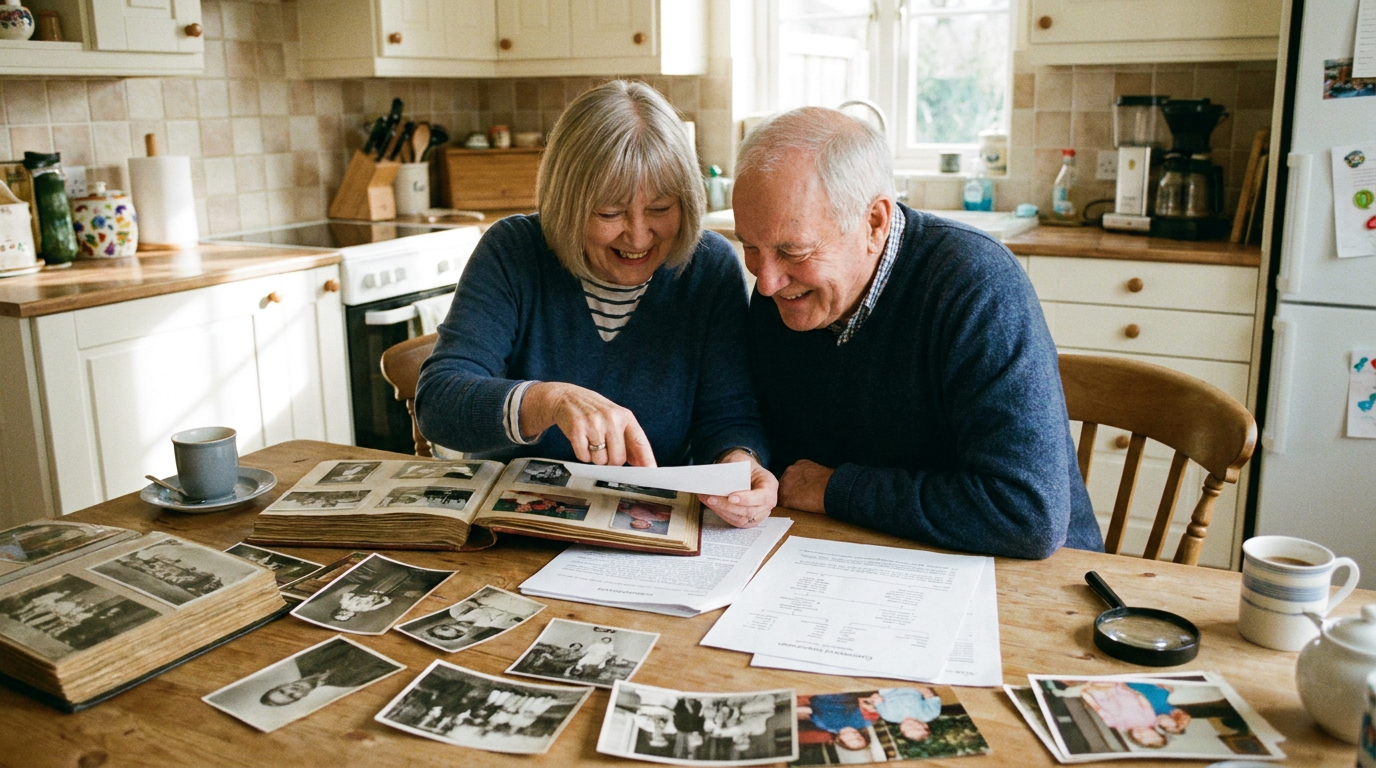
Show people the pages that concern them. Not the whole manuscript — that invites line-editing from people who are not your editors. The specific pages. And frame it precisely: this is how I remember it; tell me what you remember. That framing is not a negotiation over whether you may write it. It is a request for testimony.
Be honest with yourself about the outcomes. Sometimes this produces better material than you had — a correction, a detail, a completely different account that is more interesting than your version and belongs in the book. Sometimes it produces conflict. You know your family; no article does. But it is generally better to have that conversation over four pages during a draft than over a finished book at Christmas.
Change identifying details. Names, jobs, locations, the number of siblings, the town. This is entirely standard practice in the form. The one condition: if you do it, say so somewhere in the book — a line in a preface or an author’s note is enough. Readers accept alteration readily. They do not accept concealment, and the difference between the two is disclosure. , and it is worth reading if you want a sense of where writers and readers currently draw that line, because the boundary is genuinely contested rather than settled.
The Guardian has covered the broader debate about invention and omission in memoir
Keep private drafts private while you work. Covered above, and it is the least dramatic and most effective of the three.
What accuracy actually requires
Return to Oates: a memoir is not obliged to supply “a verifiable, corroborative truth.” It is a literary text.
That is not permission to invent. It describes a real and workable standard: a memoir does not claim to be independently corroborated, but it does claim that nothing in it is knowingly untrue.
Within that standard, a great deal is allowed. You may compress three arguments into one representative scene. You may approximate dialogue you could not possibly recall verbatim — nobody remembers exact speech from 1988, and readers understand this. You may reorder events for clarity, provided you are not misrepresenting cause and effect. You may admit uncertainty on the page, and admitting it is usually stronger than papering over it: I think it was raining, though I may be importing that from a different day.What falls outside the standard is deliberate falsification — inventing events that did not occur, fabricating people, manufacturing a dramatic incident because the true one was flatter. That is a different activity with a different name.
“Is writing a memoir therapeutic?”
This question arrives constantly, and memoir is marketed relentlessly on the promise. It deserves a careful answer rather than a marketing one.
The writer Katherine Angel, asked exactly this about her book Daddy Issues, gave the best response available:
“It’s the wrong question… writing is how I experience my experience. Until writing, in mere living, everything is out of focus.”
That is a description of what writing is like
With the hardest questions answered, there is one left — the good one. What happens when the draft is actually finished?
Finally, and stated once: if you intend to publish commercially and you have concerns about writing about a specific living person, get professional advice before you do. That is outside what any article can responsibly cover.
That is a real and worthwhile experience, and it is worth wanting for its own sake. It is not a treatment, and this article makes no claims of that kind. What can honestly be said is smaller and truer: difficult material is difficult to write, people write it at their own pace, and there is no schedule you are behind on.
, not a claim about what it does to you. Things that felt shapeless acquire shape. Events you had only ever lived through become things you have also looked at. A period you had filed as chaos turns out, on the page, to have had a structure you could not see from inside it.
What to Do With a Finished Memoir
Let us remove a false binary that does real damage.
The options are not “get a book deal” or “leave it in a drawer.” Most finished memoirs are read by somewhere between five and fifty people. That is not a consolation prize. That is a complete outcome, and for the overwhelming majority of memoirs it is the correctA memoir read closely by eleven people who are in it, or descended from the people in it, has done more than most published books manage.
outcome — because the book was written for those particular people, and they are the ones for whom it will matter most.
Revising without disappearing into it
You do not need a full revision course, and you should be suspicious of anyone offering you one before your first draft exists. Three concrete moves will get you most of the way:
- Read the whole draft once without changing a single word. Print it if you can. Take notes only on where you got bored — a mark in the margin, nothing else. Boredom is the most reliable diagnostic instrument you own, and it stops working the moment you start fiddling with sentences.
- Cut the scenes that repeat a beat you have already landed. Most overlong memoirs are not overlong because of digressions. They are overlong because the same emotional point is made four times in four different settings. Keep the strongest instance. Cut the rest.
- Check that the through-line is visible in the first ten pages. Not stated outright — visible. A reader should be able to sense what question the book is circling well before the halfway point. If they cannot, the opening is doing the wrong job.
Sharing it with the people it is for
Treat these as genuine ambitions rather than fallbacks, because that is what they are. The moment a memoir stops being a private document and becomes an object someone else holds is the moment the project completes itself.
Print copies for family. Read a chapter aloud at a birthday or an anniversary — memoir is unexpectedly good read aloud, because the form is close to speech. Send a single chapter to the person it is about, on its own, with a note.
Looking after the originals
Once you have gathered letters, photographs and documents, the practical question of how to look after them arrives — and it is worth taking seriously, because personal papers are more fragile than people assume.
is the best free resource available, and it treats personal papers with the same seriousness as institutional ones. Their advice on storage conditions and handling is straightforward and immediately actionable.
The National Archives’ guidance on preserving family archives
One caution from their is worth repeating loudly, because it runs against most people’s instincts: keep your originals after you digitise them. Scanning is not a substitute for the physical item. Digital files carry preservation risks of their own — formats change, drives fail, accounts lapse, and files are easily misplaced. Digitising creates an additional copy. It does not retire the original.
guidance on digitizing family papers and photographs
The supplies the sensible companion move: make copies and distribute them among relatives. Several people holding copies in several places is a more robust arrangement than one person holding everything in one place — and it has the side benefit of putting the material in front of the people most likely to add to it.
Library of Congress guidance on preserving family documents
The aim throughout is modest and achievable: keep the memoir and its source material in one place, easy to revisit, somewhere it can be found again. No stronger claim than that is worth making, by anyone.
Making the finished thing
There is a specific moment worth writing toward: the one where you hand it to someone, and watch them turn to the first page.
A finished memoir, or a single chapter of one, can become a storybook or an eBook you can put directly into someone’s hands. A scrapbook or a can hold the photographs, voice notes and material that never fit the prose but should not be separated from it. Templates give a first-time maker a starting layout, which removes the design problem from a project that already has enough problems. covers what each of those outputs actually looks like.
Lugelo’s features page
This is about sharing with people you choose — not publishing to the world. Commercial publication exists, and pursuing it is a separate undertaking with its own process and its own advisers. Nothing here is a route to it, and nothing here needs to be.

The Real Obstacle Was Never Your Talent
Picture the kitchen table from the beginning of this article. Same coffee, same light, same laptop. The only difference is what gets typed.
So: a memoir is a slice rather than a record, and it differs from an autobiography in kind rather than in length. It is held together by a through-line — a question it keeps asking rather than a topic it covers — which you can find by listing ten moments quickly and looking for the recurring pressure underneath them. You can prove you are capable of the essential skill in six words. You can give the material a shape, and for a first attempt that shape should almost certainly be the Single Thread. You can write it at four hundred words a session, four days a week, and be finished within a year. You can write about real people by describing what they did and owning what you made of it. And you can end with something a person you love holds in their hands.
Return, finally, to the argument this whole article has been making. The reason memoirs get abandoned is scope, not ability. You were never short of skill. You were short of a boundary — a defensible reason to leave things out.
Not I was born—
You just did.
This will not make you a published author, and it makes no promises about how the writing will feel while you do it. What it does is convert a vague intention you have carried for years into a process with a next step in it. Everyone has a story worth telling. Most go untold — not because they did not matter, but because nobody ever decided where to begin.
. A question instead. The one your life keeps asking and has not yet finished answering.
Start Saving What Actually Matters
The memoir you write in five years will be built from the moments you write down now. Start a journal, capture today’s ordinary details before they become next decade’s missing ones, and let your family add their side of the story too. Journals are private by default, with owner-controlled access.
— available on .
web, iOS, Android and HarmonyOSGet started with Lugelo