Why Every Parent Should Start a School Year Blog for Their Child (And How to Do It in Minutes)
You know the exact moment. You’ve lived it every September for as many years as you’ve been a parent. The new backpack, slightly too big for their frame. The outfit they picked out themselves — with varying degrees of success. The sign, handwritten or printed, announcing the grade, the year, the name. You raise your phone. They smile — for approximately thirty seconds before the excitement of the door pulls them in, and just like that, another school year has begun.
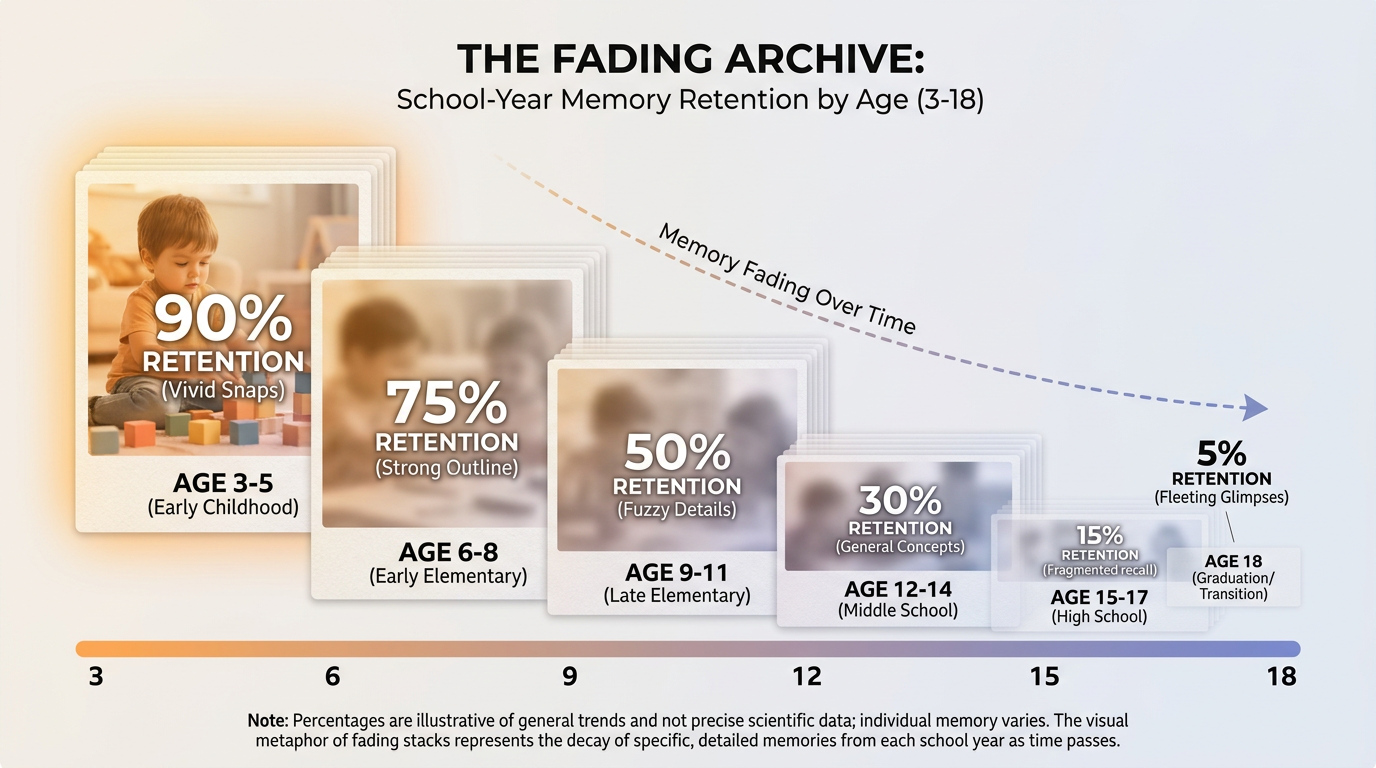
The photo is beautiful. It lands in your camera roll somewhere between a grocery list screenshot and a video of the dog. And life accelerates. By Halloween, you’ve mostly forgotten what they said at breakfast that morning. By Christmas, you’re mixing up which teacher belongs to which year. By the time your child sits down for their own child’s kindergarten orientation, that first-day photo will be one of 40,000 images on a phone that’s already been replaced twice — and the story behind it will be almost entirely gone.
This isn’t a failure. It’s neuroscience. It’s the nature of memory, of time, of the relentless forward motion of family life. But it is a loss — a quiet, cumulative loss of something irreplaceable: the specific texture of your child’s childhood, grade by grade, year by year.
A school year journal changes that. Not a scrapbooking project. Not a photography archive that demands a dedicated Sunday afternoon every month. A living, growing, low-effort record — a school year blog for your child — that captures the ordinary Tuesday moments alongside the milestone firsts. Something that takes five minutes to update and lasts a lifetime. That’s exactly what was built for.
Lugelo
In this post, we’ll walk through why school year memories fade faster than most parents expect (the science is both fascinating and sobering), what you’re actually preserving when you document a school year, a practical blueprint for what to capture, and exactly how to start your child’s school year journal today — in minutes, not hours.
The Science Behind Why School Year Memories Slip Away Faster Than You Think
Here is something most parents don’t realize until it’s too late: the school years — the years that feel the most vivid, the most eventful, the most formative — are among the most neurologically vulnerable when it comes to long-term memory retention.
We tend to assume that the big moments stick. The first day of kindergarten. The lead in the school play. The championship soccer game. And some of them do — in impressionistic form. But the specific detail? The name of the best friend in second grade. The teacher who read aloud every Friday afternoon. The phrase your child used to say that made everyone at the dinner table laugh. The project they stayed up too late finishing. Those specifics — the ones that actually tell the story of a school year — dissolve faster than we expect, and the research explains exactly why.
Childhood amnesia is not just for toddlers. Most people are familiar with the concept of early childhood amnesia — the inability to recall events from the first three years of life. But a landmark revealed something far more striking: children aged 8 to 9 could recall fewer than 40% of early-life events that they had been able to clearly describe just a year or two earlier. The forgetting doesn’t stop at age five. It continues, aggressively, through the school years themselves. Your child is living through their childhood and simultaneously losing large portions of it in real time.
peer-reviewed study published in PMC
frames this poignantly: the brain is still developing rapidly during the school years, and the hippocampus — the region responsible for converting short-term experiences into long-term memories — is actively reshaping itself. New neural pathways are being formed so quickly that older memories are often overwritten before they have a chance to consolidate. The very growth that makes childhood so remarkable is also what makes it so forgettable.
NPR’s landmark explainer on childhood memory
And then there is the blending problem. Each school year is densely packed — a full nine months of social dynamics, academic milestones, emotional breakthroughs, and unremarkable Tuesdays that somehow feel meaningful in retrospect. But without documentation, those nine months compress. School year 3 starts to borrow details from school year 4. The teacher from grade 2 gets confused with the one from grade 3. The friend group shifts, and you can no longer remember which year the falling-out happened, or when the new best friend appeared.
Parents forget too. This is the part of the conversation that rarely gets said out loud: the school year journal is not just for the child. Research consistently shows that parents themselves lose granular detail about each school year within 18 to 24 months. By the time a child is in middle school, the elementary years have already softened into a collective warmth — happy, vague, almost entirely detail-free. The parents who wish they’d documented more aren’t negligent. They’re normal. They just didn’t have a system.
The fix is not comprehensive documentation. It is not a daily journal or a photography project that demands hours you don’t have. It is intentional, specific, consistent documentation — one entry a week, one photo, one observation. That’s enough. That’s more than enough.
Digital journaling, in its modern form
The science creates urgency. But urgency alone isn’t enough to motivate action. What moves parents to start is understanding what, exactly, they are preserving — and why it matters far more than a better-organized photo library.
, makes this kind of lightweight, meaningful practice genuinely sustainable — not a resolution, but a rhythm.
What You’re Really Preserving — And Why It Matters More Than You Think
Set aside the idea of documentation as a memory-preservation project for a moment. Because what a school year journal actually preserves is something far more significant than a chronological record of events. It preserves identity. It preserves self-esteem. It preserves the raw material of a family’s story — and according to the research, that raw material is one of the most powerful developmental gifts a parent can give.
The University of Nevada Extension’s peer-reviewed research on is striking in its clarity: children who grow up hearing and revisiting family stories — their own stories, told back to them by the people who love them — show measurably higher self-esteem, lower anxiety, fewer behavioral problems, and greater resilience in the face of adversity. The mechanism is intuitive once you understand it: a child who knows their own story, who has evidence that their experiences were witnessed and valued, develops a more secure sense of self. They know where they came from. They know who noticed.
family storytelling and its benefits for children
A school year journal is a structured source of exactly those stories.
There is a practice in developmental psychology called elaborative reminiscing — the act of revisiting past experiences with children using rich detail, emotional language, and open-ended questions. Studies consistently show that parents who engage in elaborative reminiscing raise children with stronger narrative skills, better emotional vocabulary, and greater capacity for empathy. A school year journal doesn’t just preserve events — it creates the structured opportunity for this kind of conversation. “Remember when you were in second grade and you were convinced Mrs. Peterson didn’t like you, and then she gave you the class award at the end of the year?” That conversation, prompted by a journal entry, is worth more than the entry itself.
“The ordinary Tuesdays are the ones your child will wish they could remember.”
Consider also the gift this becomes for the child themselves — not as a seven-year-old flipping through pages, but as a twenty-five-year-old who stumbles across what their parent wrote about their third-grade self. The phrases they used. The fears they had. The things they were obsessed with for exactly six weeks before moving on to the next thing. Reading that — knowing that someone saw them, specifically, at that specific moment in time — is not just nostalgic. It is profoundly identity-forming. It says: you were always you, and you were always worth noticing.
The school year journal in its truest form: not just milestones, but the texture between them. The first day photo is expected. Every parent has one. What gets lost is the Wednesday in November when they came home from school with a completely new obsession — marine biology, or origami, or the history of ancient Rome — and talked about nothing else for the entire dinner. Those moments, the ones that feel too small to formally document, are often the most revealing. They are the thread that connects who a child is at seven to who they become at thirty-five.
captures what parents do when they document their child’s growth
. It is for anyone who has something worth remembering — and every parent, of every background and writing ability, has a school year full of things worth remembering. The journal doesn’t require eloquence. It requires only presence and intention.
Digital journaling isn’t just for writers or introspective adults
Now that the why is clear, the question every parent naturally arrives at is: what, exactly, should I be capturing?
The next section answers that with a practical, grade-by-grade blueprint that turns a vague intention into a concrete, doable plan.
What to Capture — A School Year Journal Blueprint for Every Grade
The biggest reason parents don’t document their child’s school year isn’t a lack of desire — it’s a lack of structure. The blank page is intimidating. “What do I even write?” is the question that stops most people before they start. So here is a concrete, practical framework: a school year journal blueprint organized by category and timing, designed to transform a vague aspiration into a weekly, ten-minute practice.
Think of it less as a checklist and more as a set of lenses — different ways of looking at the same school year that, together, produce a complete and textured record.
The First Week of School
This is the most emotionally charged week of the year, and the most commonly underdocumented beyond the first-day photo. Go further than the photo. Write down what they said at breakfast that morning — nervous, excited, or conspicuously quiet. Note the new teacher’s name and your child’s first impression of them. Capture who they spotted immediately when they walked in the door. What were they most worried about? What were they most excited about? These details take five minutes to write and will be completely unrecoverable within eight months without a record.
Monthly Check-InsThis is the spine of the school year journal — a consistent, monthly entry that asks the same set of questions across the entire year:
- What are they obsessed with right now?
- What phrase or word do they keep using?
- What are they worried about?
- What made them laugh this month?
- What are they most proud of?
A single monthly check-in, answered honestly and briefly, takes ten minutes. Across a ten-month school year, those ten entries become an extraordinarily detailed portrait of a child at a specific moment in time. The answers in September and the answers in May will be startlingly different — and that difference is the story of the school year.
Academic Milestones
Not the grades — the reactions. The face your child made when they got the report card. The subject they suddenly discovered they love, or the one they’re quietly struggling with and don’t want to admit. The project they stayed up too late finishing and were genuinely proud of. The teacher who gave them a piece of feedback that landed differently from the others. For , resources like Meredith Amand’s parent-and-child journal framework offer a practical starting point for parents who want more structure.
prompts and questions to deepen these entries
Social Life Snapshots
These are the entries parents treasure most, and the ones most at risk of being forgotten. The best friend this year — and the complicated nature of that friendship. The birthday party that was everything, or the one that went sideways. The lunch table politics narrated in the car on the way home from school. The falling-out that felt catastrophic on Tuesday and was completely resolved by Thursday. These social snapshots reveal more about who a child is becoming than any academic record ever will.
The Ordinary Moments Worth Capturing
This category has no structure — it’s simply a permission slip to write down the small things. The thing they said on the walk to school that made you stop walking for a second. The song they had on repeat for six consecutive weeks. The book they read under the covers with a flashlight. The after-school ritual they developed entirely on their own — snack first, shoes off, fifteen minutes of absolutely nothing before they’re ready to talk about their day. These are the entries that will feel most precious in twenty years.
End-of-Year ReflectionThe final entry of the school year is its own ritual — a structured conversation, captured in the child’s own words wherever possible:
- What was the best part of this year?
- What was the hardest?
- What are you most proud of?
- Who was your favorite teacher, and why?
- What do you want to do differently next year?
Ask these questions on the last day of school — in the car, at the kitchen table, on the walk home. Record a voice note if they’re willing. makes the mechanics of capturing voice, photos, and text in a single entry straightforward and fast. And for parents who aren’t sure how to frame or expand their own entries, can help shape bullet points into something worth rereading.
AI-assisted journaling promptsUnderstanding how digital journaling works in practice
Quick Capture: 5 Questions to Ask Your Child Every Month
- What was the best thing that happened at school this month?
- What was something that was hard?
- Who made you laugh recently?
- What are you learning that you actually like?
- What do you wish I knew about your day?
A final note on media: every entry should include at least one piece of media — a photo, a short video, a voice note recorded on the way home from school. Text alone captures events. Multimedia captures texture
With a clear blueprint in hand, the remaining question is the most practical one of all: how do you actually start? The next section walks through setting up your child’s first school year journal on Lugelo — step by step, in minutes.
. The sound of a seven-year-old explaining why their teacher is the best teacher they’ve ever had is not something words alone can replicate.
How to Start Your Child’s School Year Journal on Lugelo — Step by Step
Intention without a starting point is just a wish. So here is the starting point — a simple, step-by-step guide to creating your child’s first school year journal on Lugelo today. No prior experience with journaling required. No writing talent necessary. No hours of setup. Just a few minutes and a decision to begin.
Step 1: Create the Journal
Open on whichever device you’re holding right now — it’s available on . Create a new journal. Name it something personal and specific: “Mia — Grade 3, 2026–27” or “Our School Years” or simply your child’s name and the school year. This takes sixty seconds and immediately makes the project feel real.
iOS, Android, HarmonyOS, and the webLugelo
Step 2: Choose a Template or Start Fresh
Lugelo’s templates remove the single biggest barrier to journaling: the blank page. A school year template gives parents an instant structure — First Day Snapshot, Monthly Check-In, End of Year Reflection — so you’re never staring at a cursor wondering where to begin. For parents who prefer total flexibility, starting fresh works just as well. The point is that neither option requires any setup beyond tapping a screen.
Step 3: Add Your First Entry — The First Day
Take the first-day photo. Add it directly inside your Lugelo journal — not just the camera roll, where it will disappear into 40,000 other images. Write one or two sentences about the morning. If your child is willing, record a fifteen-second voice note in their own voice. Done. Five minutes. The journal is alive, and the school year has its first witness.
“Five minutes. One entry. One photo. That’s the entire barrier to entry.”
Step 4: Use the AI Journal Assistant When the Words Don’t Come
Some parents are natural writers who will fill pages without prompting. Most aren’t — and that is perfectly fine, because Lugelo’s AI Journal Assistant bridges that gap. Type a few bullet points about what happened this week: field trip, lost her hat, made a new friend named Sofia, talked about it the whole car ride home. The AI Journal Assistant helps shape those fragments into a readable entry worth rereading. It suggests follow-up questions, expands context, and gently prompts without ever replacing the parent’s voice. It’s a co-writer, not a ghostwriter.
Step 5: Set a Simple, Sustainable Rhythm
Not daily. Not even weekly if weekly feels like too much pressure. Monthly is enough to transform a blur into a story. Many parents find a Sunday evening ritual works perfectly: ten minutes, one photo, a few sentences about what happened this week that felt worth remembering. Some weeks it’ll be a milestone. Some weeks it’ll be something small and funny. Both are worth keeping. , not because every moment is extraordinary, but because the accumulation of ordinary moments is what a childhood actually is.
Your story — and your child’s story — deserves to be kept
Step 6: Keep It Private
Lugelo is private by default. The journal is entirely owner-controlled — you decide who sees it, in what form, at what time. Military-grade encryption in transit. No third-party data sharing. Your child’s story belongs to your family, full stop. The privacy model means you can write honestly — about the hard weeks as much as the great ones — without any concern about where that information goes.
Step 7 (Optional but Powerful): Invite Your Child to Contribute
Children aged eight and older are often more capable contributors to a school year journal than parents expect. Their own entries — written or recorded in their own voice — add a dimension to the journal that no parent’s perspective alone can provide. Imagine reading, at thirty, a journal entry your ten-year-old self wrote about your best friend, sitting beside your parent’s entry about the same friendship, written on the same day. Two versions of the same year. Both true. Both irreplaceable.
The journal is started. The structure is in place. But some of the richest entries in a school year journal don’t come from one parent’s perspective — they come from the whole family. The next section explores how to make this a collaborative family project that multiplies its value.
if you’d like to see the full picture before diving in — but for most parents, the best next step is simply step one: open the app, create the journal, name it after your child.
Make It a Family Story — Collaborative School Year Journaling with Lugelo
A school year is not a solo experience — not for the child, and not for the family watching them grow through it. A mother notices different things than a father. A grandparent who does pickup twice a week sees a version of the child that neither parent witnesses. A younger sibling watches their older sibling’s world with a particular mix of admiration and insider knowledge. The school year journal, when it becomes a collaborative family document, captures all of those angles — and the result is something far richer than any single perspective could produce.
Every family member sees the school year differently. A parent focused on logistics — the school schedule, the homework, the routines — might miss the way a child has started holding themselves differently when they walk into a room. A grandparent who sees the child less frequently, but notices more acutely because of that distance, might be the one who records the observation that becomes the most treasured entry in the journal. These different perspectives don’t compete — they complete each other.
In Lugelo, collaboration is straightforward and privacy-preserving. Invite specific family members to contribute to a shared journal. Each contributor adds their own photos, notes, voice recordings, and memories without disrupting anyone else’s entries. Grandparents, co-parents, aunts and uncles — everyone can add their piece of the child’s story. The journal owner retains full control at all times: access is granted specifically and revoked just as easily. This isn’t public sharing. It’s a private family conversation, structured and preserved.
The grandparent dimension deserves particular attention. Grandparents often carry an unhurried, emotionally attentive perspective on a grandchild’s school year that is profoundly different from a parent’s view. They are not managing the logistics. They are simply watching — and often what they notice is the most quietly meaningful. A phrase the child repeated every week for a month. The way they described their teacher. The drawing they made on the kitchen table while waiting for pickup. Those observations, entered into a shared journal, add a texture that elevates the entire document. And for grandparents who are geographically distant, contributing to a school year journal is one of the most meaningful ways to remain genuinely present in a grandchild’s daily life — not through scheduled video calls, but through the slow, accumulated intimacy of shared observation.
Consider this scenario: your daughter is in fourth grade. On the morning she aces her first big spelling test, you write a quick entry — the relief on her face, the way she said “I told you I could do it” with absolutely zero irony. That afternoon, she tells your mother about it at pickup, and your mother adds her own entry: the exact words your daughter used, the pride in her voice, the way she immediately asked if they could celebrate with ice cream. Two versions of the same day. Both true. Both irreplaceable. Together, they make a moment that neither entry alone could fully capture.
Collaborative storytelling
is one of the oldest and most powerful human practices — and it translates remarkably well to the modern school year journal format.
When the school year is over, the
UNR research on family storytelling
The family has contributed. The journal is full. Now comes the part that transforms all of that effort into something lasting — something you can hold, display, gift, and return to for decades.
suggests that families benefit most when they return to shared stories together — actively, deliberately. The school year journal creates a structured opportunity for exactly this: a family gathered at the end of June, scrolling through nine months of entries, laughing at the October observation and marveling at how much has changed. That ritual is worth building, year after year.
From Journal to Keepsake — Turning the School Year Into a Storybook, eBook, or VR Gallery
You keep scrolling. October’s entry. The November check-in. The December one you almost forgot but did, because it took ten minutes and felt worth it. The February entry about the book they couldn’t put down. The April one about the friendship that had gotten complicated and then, somehow, sorted itself out. And then June — the end-of-year reflection, in their own words.
Imagine it’s a Tuesday evening in June. School just ended last week. You open your Lugelo journal — the one you’ve been adding to since September — and you scroll back to the first entry. The first-day photo. The two sentences you wrote about what your child said at breakfast. The voice note they recorded in the car on the way home.
You have just scrolled through an entire school year. A complete, specific, emotionally textured record of who your child was, grade by grade, month by month. And then you press create storybook.
The school year journal becomes a storybook. Lugelo’s allow parents to transform a year of journal entries into a beautifully formatted eBook or PDF — the child’s school year, told in their own words and their parent’s words, illustrated with photos from throughout the year, designed like a real keepsake. This is not a slideshow. It is a book. The kind of thing you print and hand to your child at high school graduation, and watch them read with an expression you won’t forget.
keepsake and export features
The timeline view reveals the whole year at once. Lugelo’s timeline feature organizes every entry chronologically, so scrolling from September to June presents a complete, unbroken narrative arc. Parents who use this feature after their first school year journal almost universally report the same feeling: I had no idea how much happened. And then, immediately: I had no idea how much I would have forgotten. The journal doesn’t just preserve memories — it makes visible the sheer density and richness of a school year that, without documentation, collapses into a single warm impression.
VR galleries bring the school year to life in three dimensions. For families who have captured photos, artwork, and video throughout the year, transforms those assets into an immersive, three-dimensional space where the memories of the school year become something you can inhabit. A child’s favorite drawing on one wall. A photo from the school play on another. The class project mounted in the center of a virtual room. It is, in the most literal sense possible, a world built from a year’s worth of moments — and it is unlike anything a photo album has ever been able to offer.
Lugelo’s VR Gallery feature
The most compelling framing for all of this is the long view. The storybook can be gifted. To grandparents who contributed entries. To the child themselves. To a beloved teacher who made a particular year extraordinary. Lugelo’s outputs make this possible for any parent, regardless of design skill or technical knowledge. The effort is in the journaling. The output takes care of itself.
Journaling, in its most evolved modern form
, has moved far beyond a diary on a nightstand — it is now a living document that can be transformed, shared, and experienced in ways that previous generations of parents couldn’t have imagined. One school year journal is a meaningful object. Thirteen school year journals — one for every grade from kindergarten to senior year — are a complete archive of a childhood. A child who receives that archive on the day they leave for college receives something no other gift can match: the evidence that their entire growing-up life was witnessed, valued, and preserved by the people who loved them most.
Building the habit that makes all of this sustainable is easier than most parents expect — can help establish the rhythm that turns a good intention into an annual tradition.
a practice like the 100-Day Memory Challenge
“Journals are souvenirs of your past. The school year journal is the souvenir your child will be most grateful you kept.”

Start This September — Because Some Years Are Too Important to Lose
The school years are the most densely lived, most rapidly forgotten chapters of a child’s life. This is not a pessimistic observation — it is simply the truth about how memory works, and understanding it is the first step toward doing something about it. Every year that passes undocumented is a year of specific, irretrievable detail that both parent and child will eventually wish they had access to. The name of the teacher. The friendship that shaped everything. The ordinary Tuesday that turned out to matter.
But here is the equally important truth: preserving those years is not the enormous project most parents imagine it to be. It is one entry a week, or even one entry a month. One photo. One sentence, or five. A voice note recorded in the car. A brief end-of-year reflection in a child’s own words. The commitment, compounded across a school year, produces something extraordinary — not because of the individual entries, but because of what they collectively become: a record of a year, a portrait of a child, a story worth telling.
A school year journal on Lugelo is one of the most meaningful gifts a parent can give — not just to a child’s future self, but to themselves, to the grandparents who contributed, to the family’s story as a whole. It is the kind of object that becomes more valuable with every year that passes, and more irreplaceable with every year that doesn’t get one.
Everyone has a story to tell. Your child’s story starts this September — and it is worth keeping.
Start Your Child’s School Year Journal Free →
Don’t let this school year become a blur. Lugelo is free to start, and the first entry takes five minutes. Create your child’s journal today — before September, if you can, or right now if the school year is already underway. Every entry you add from here matters.
Download the Lugelo App →
Available on iOS, Android, HarmonyOS, and web — wherever the school year takes you.
See How Lugelo Works →
For parents who want to see the full picture before starting. Five minutes of exploring is all it takes.
Because some days are too important to lose.