A World Cup of Cities: Journaling Your Way Through the 2026 Host Cities of USA, Mexico & Canada
Imagine stepping out of AT&T Stadium in Arlington, Texas, on a sun-scorched July evening. The roar of 80,000 people is still ringing in your ears. The smell of Tex-Mex from a food truck drifts across the parking lot. The last goal — the one that sent your team through — plays on a loop behind your eyes. You’re shaking. You’re grinning. You’re reaching into your bag for your phone and you don’t even know why, but you know one thing with absolute certainty: this moment deserves to be remembered.
Now picture a different scene entirely. A living room somewhere in the world. A couch, a coffee table, a television blazing in blue and green. A journal sits open, pen resting in the spine, the score of tonight’s match scrawled at the top of the page. A plate of snacks — maybe something inspired by the host city — sits beside it. This fan is nowhere near North America, but they’re completely, wholly there.
Both of these people are living the 2026 FIFA World Cup™. Both of their stories matter. And this summer, both of them need a place to put those stories down.
The 2026 FIFA World Cup™ is not just a football tournament. It is a 39-day journey across the soul of a continent — 48 nations, 104 matches, three countries, and 16 host cities, each one a world unto itself. We are deep in the knockout stages now, and the tournament has never felt more electric. Whether you have a ticket in your hand or a remote on your lap, every single city is telling a story right now. The question is whether you’ll capture yours.
This is your invitation to start. Open a Lugelo journal, pick up your pen — or tap open your phone — and let the greatest sporting event in North American history become the most meaningful travel journal you’ve ever kept. Whether you’re in the stands or on your sofa, your World Cup story is worth saving.
The 2026 World Cup: A Once-in-a-Generation Storytelling Stage
There has never been a World Cup quite like this one. Not in scale. Not in ambition. Not in the sheer, sprawling geography of it all. According to Britannica’s complete guide to the 2026 FIFA World Cup, this edition marks the first time in the tournament’s history that three nations — the United States, Mexico, and Canada — have co-hosted, and the result is something that no previous World Cup has managed to be: a genuinely continental event that forces fans to think geographically, culturally, and emotionally about the host cities as much as the teams.
Forty-eight teams. That’s sixteen more than any previous edition. One hundred and four matches spread across venues from the Pacific rainforests of Vancouver to the ancient volcanic basin of Mexico City, from the turquoise waterfront of Miami to the fog-kissed hills of San Francisco. The tournament runs from June 11 all the way to July 19, and right now, in the thick of the knockout stages, the drama is at its absolute peak.
The Round of 16 has been sending shockwaves through the bracket. Dallas hosted a Round of 16 clash at AT&T Stadium on July 6. Seattle lit up Lumen Field the same evening. Atlanta’s Mercedes-Benz Stadium roared on July 7, as did Vancouver’s BC Place. Philadelphia’s Lincoln Financial Field crackled with historic Independence Day energy on July 4. The Quarterfinals followed fast: Boston’s Gillette Stadium on July 9, Los Angeles’s SoFi Stadium on July 10, and both Miami and Kansas City on July 11. The bracket is nearly set. The Semifinals loom. And on July 19, the world will watch as MetLife Stadium in New Jersey hosts the Final — the most-watched sporting event on Earth that day.
Here is what makes this World Cup different from every single one that came before it: for the first time, this is a World Cup of Cities. Fans aren’t following a tournament through one country’s lens. They’re following it across three nations, sixteen cities, and countless cultural identities. Every match venue brings its own flavour to the tournament — its own food, its own music, its own architecture, its own story. Dallas doesn’t feel like Seattle. Montreal doesn’t feel like Mexico City. Boston doesn’t feel like Guadalajara. And each of these differences is an invitation.
“48 teams, 16 cities, 3 countries, and one unforgettable summer — every moment is worth saving.”
This is exactly why the 2026 World Cup is the ultimate journaling adventure. It doesn’t just give you one story. It gives you sixteen. For the fan in the stands, there is the sensory immediacy of the city itself — the food, the crowd, the transit rides between venues, the neighbourhoods discovered by accident. For the armchair traveller watching from home, there is something equally powerful: the chance to use each match as a passport to a city you’ve never visited, to build a wishlist, to learn something, to feel transported.
Lugelo’s AI Journal Assistant was built for exactly these kinds of moments — the ones where you know something mattered but you don’t quite know where to start. When the match ends and the feeling is too big to put into words, a well-placed journal prompt can unlock the whole thing. Think of your Lugelo journal as the travel companion you carry through all 16 cities, whether you physically visit them or not. Think of this summer as the most extraordinary raw material any journalist has ever been handed.
The cities are waiting. Let’s visit them.
The Atlantic Seaboard and the American South: Where History Meets Heart
There is a reason why the East Coast and the American South feel like the dramatic backbone of this World Cup. These are cities with stories so dense that you could journal for weeks without touching the surface. They are cities of revolution, of transformation, of arrival — places where America’s contradictions and beauties sit side by side in the kind of proximity that makes writers reach for their notebooks.
New York / New Jersey — The City That Holds the Final
MetLife Stadium in East Rutherford, New Jersey, sits in the shadow of the New York City skyline, and on July 19, it will host what will arguably be the most-watched event in human history that day: the 2026 FIFA World Cup Final. There is simply no city on Earth with a gravitational pull quite like New York’s. It is the world’s most storied urban landscape — a place of yellow cabs and steel canyons, of immigrant neighbourhoods stacked with history, of the High Line and the Brooklyn Bridge and the smell of hot pretzels on a cold morning.
If you’re journaling this city, the prompts write themselves. What does New York smell like at rush hour? If you could watch the Final from anywhere in the five boroughs — a rooftop in Brooklyn, a bar in Jackson Heights, a picnic blanket in Central Park — where would it be and who would you call? New York is a city that rewards the curious and the observant, a city where every block is a story waiting to be written. Your journal entry for this city doesn’t need to be polished. It needs to be alive.
Armchair traveller prompt: “If I could bring one person to watch the World Cup Final in New York City — someone I love, someone I owe something to, someone who has never seen the city — who would it be and why?”
Boston — Where History and High Stakes Collide
Gillette Stadium in Foxborough hosted a Quarterfinal on July 9 — one of the most tension-filled matches of the entire tournament. The city of Boston, just 30 miles away, is a place that wears its history on its sleeve with no apology. The Freedom Trail winds past revolutionary landmarks. Fenway Park sits like a beloved artefact in the middle of the city. The waterfront serves legendary clam chowder. Harvard Yard and MIT exist a subway ride apart.
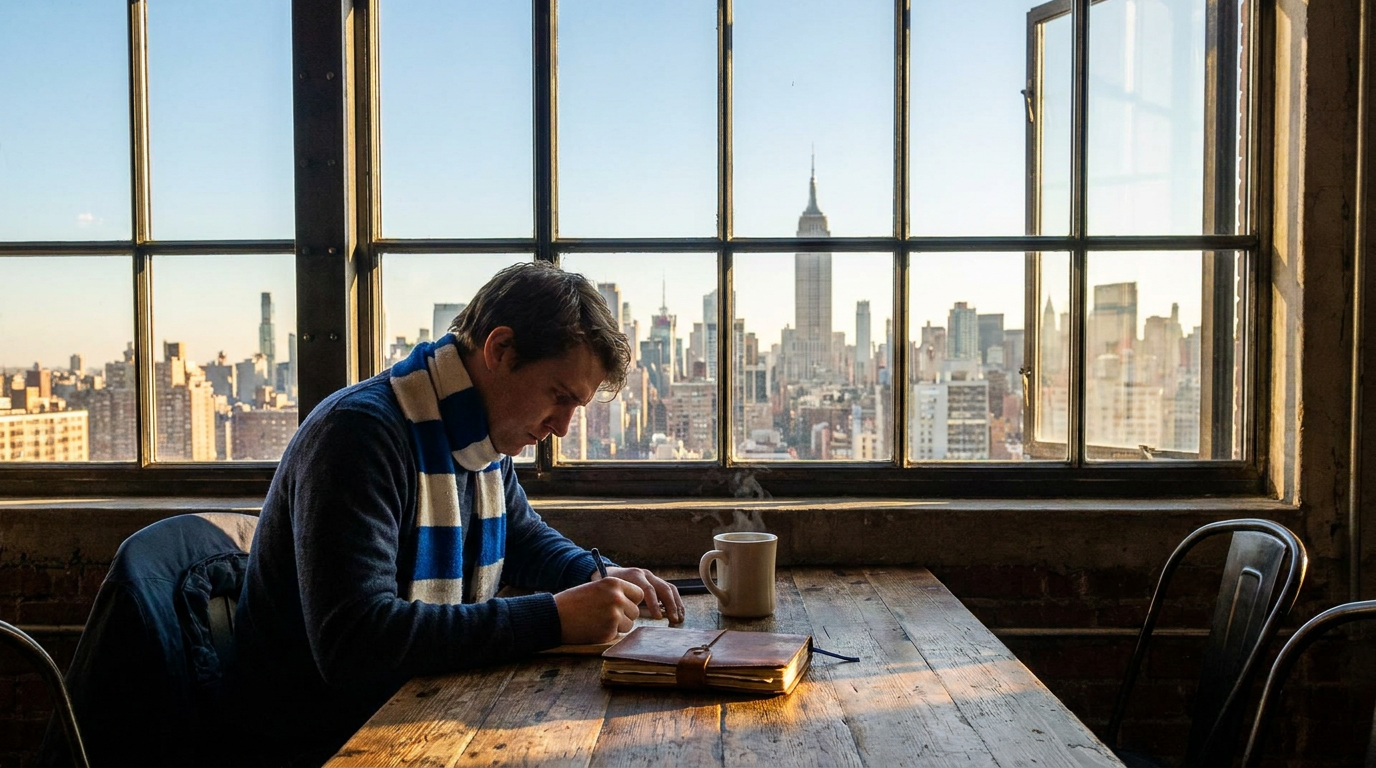
What makes Boston extraordinary as a journaling destination is the collision of time. This is a city built on the idea that ordinary people can change history — that a group of colonists in a harbour can shake the world. And here it is, hosting a World Cup Quarterfinal, welcoming fans from 48 nations to walk its cobblestoned streets. Journal entry idea: “Walk the Freedom Trail with a football scarf around your neck. What does this city feel like when two kinds of history collide — the American Revolution and the beautiful game?”
Armchair traveller prompt: “Five things I would do in Boston if I had 48 hours between matches — from the waterfront to the North End to Fenway Park.”
Philadelphia — Independence Day on a Football Pitch
Lincoln Financial Field hosted a Round of 16 match on July 4 — Independence Day. The symmetry is almost too good to be real. Philadelphia, the city where American independence was declared, hosted a knockout round match on the 250th anniversary of that declaration. The Liberty Bell. The Rocky Steps at the Philadelphia Museum of Art. The vibrant Italian Market. A mural arts scene unlike anything else in the country. And cheesesteaks — always cheesesteaks.
Philly is gritty, proud, deeply layered, and utterly itself. It doesn’t perform for visitors; it simply exists in its particular magnificent way and dares you to keep up. Journal entry idea: “What does freedom feel like in a city that was built on it? Write about something you’ve fought for — or something you want to.”
Miami — Heat, Latin Soul, and Quarterfinal Drama
Hard Rock Stadium in Miami Gardens hosted a Quarterfinal on July 11 and will host the Third Place playoff on July 18, making Miami one of the busiest and most electric host cities of the knockout rounds. Condé Nast Traveler’s 2026 FIFA World Cup Travel Guide calls Miami one of the tournament’s most atmospherically unique venues, and it’s hard to argue. This is a city of Art Deco architecture and turquoise water, of Wynwood Walls and Calle Ocho in Little Havana, of Cuban coffee at a ventanita at 7am and world-class nightlife that doesn’t start until midnight.
Miami is sensory overload in the best possible way. It deserves a journal entry that doesn’t try to organise anything — just pure sensation. Journal entry idea: “Describe Miami in five sensory details. One smell. One sound. One taste. One texture. One image you’ll never forget.”
Atlanta — A City of Transformation
Mercedes-Benz Stadium in Atlanta hosted a Round of 16 match on July 7. Atlanta is one of the most historically significant cities in the United States — the birthplace of the Civil Rights Movement, the city of Dr. Martin Luther King Jr.’s National Historic Site, the Fox Theatre, the BeltLine, and one of the most vibrant hip-hop cultures in the world. Its food scene is extraordinary, blending soul food traditions with international influences that reflect the city’s growing global reach.
Atlanta is a city that has always been in the process of becoming something — always moving, always changing, always insisting on its own transformation. Journal entry idea: “What does it mean to be on the right side of history? Write about something you witnessed — in a match, in your life, in your city — that you never want to forget.”
Houston — The World in One City
NRG Stadium in Houston hosted a Round of 16 match on July 4, sharing Independence Day honours with Philadelphia. Houston is the most ethnically diverse major city in the United States — over 145 languages are spoken within its city limits — which makes it perhaps the most fitting host city for a tournament that celebrates 48 nations. Space Center Houston. The Museum District. A Vietnamese-Texan food fusion scene that is unlike anything else you’ve ever tasted.
Journal entry idea: “What’s the most unexpected thing about Houston that you’d never have guessed before the World Cup? What does it mean that the world’s most diverse city is hosting the world’s most global tournament?”
Universal journal prompts for East/South US cities:
- “What’s one neighbourhood in this city I’d explore if I had 24 hours here?”
- “What local food am I capturing in my journal — and what does it taste like?”
- “What moment from the match would I want to describe to my grandchildren in 30 years?”
From the Atlantic seaboard and the Deep South, we now head west — to the wide skies of Texas, the jazz-soaked plains of Kansas City, the Pacific mist of San Francisco, the cinematic sprawl of Los Angeles, and the emerald rain of Seattle.
From the Heartland to the Pacific Shore: The West Writes Its Own Story
If the East Coast cities of this World Cup feel layered in history and human drama, the Central and Western cities feel expansive — wider, more open, more cinematic. These are cities of big skies and bigger dreams, of rivers and mountains and coastlines that remind you just how vast this continent truly is.
Dallas / Arlington — Where Everything Is Bigger
AT&T Stadium in Arlington hosted a Round of 16 match on July 6, kicking off the most dramatic week of the tournament. AT&T Stadium is one of the largest stadiums in the world, and walking into it for the first time is a genuine physical experience — the sheer scale of the thing forces you to recalibrate your sense of space. This is very much a Texas feeling.
Dallas proper rewards exploration: Deep Ellum’s music scene pulses on weekend nights. The Sixth Street District hums with energy. The Perot Museum of Nature and Science is a genuine architectural marvel. Tex-Mex cuisine here isn’t a restaurant category — it’s a way of life. And the Texas sky at dusk, seen from a stadium concourse, is something that belongs in a journal.
Journal entry idea: “Write about a moment when the sheer size of something — a crowd, a stadium, a Texas sky — made you feel small in the best possible way. What did that feeling teach you?”
Armchair traveller prompt: “Five things I associate with Dallas and Texas — and which ones actually surprised me when I looked closer.”
Kansas City — The Great American Surprise
Arrowhead Stadium hosted a Quarterfinal on July 11, and Kansas City stepped onto the world stage with quiet, soulful confidence. This city is one of America’s most underrated, a place that feeds you extraordinarily well — world-famous slow-smoked BBQ that has sparked genuine regional pride and passionate ongoing debate — and then plays you jazz. Charlie Parker was born here. The Nelson-Atkins Museum of Art is one of the finest in the country. The art deco Union Station is jaw-dropping. The Crossroads Arts District is alive.
Kansas City is the kind of city that sneaks up on you. You arrive with modest expectations and leave writing long journal entries about why you need to come back. Journal entry idea: “What does a city that feeds you well and plays you jazz feel like on a warm July evening? Write about a meal, a song, a sky — anything that surprised you.”
Armchair traveller prompt: “Write your personal ranking of great BBQ cities in America. Where does Kansas City land — and why does it matter so much that they care so deeply about the craft?”
San Francisco Bay Area — At the Edge of Everything
Levi’s Stadium in Santa Clara brought the Bay Area into the World Cup story, and the surrounding region is one of the most visually spectacular in the world. The Golden Gate Bridge emerging from morning fog. The Mission District’s murals blazing in afternoon sun. Haight-Ashbury’s layered counterculture history. Chinatown’s sensory density. Sourdough bread so good it requires its own journal entry. And just an hour’s drive south, the engines of global technology innovation running quietly behind glass-and-steel campuses.
San Francisco sits at the literal edge of a continent and the cultural edge of possibility. Journal entry idea: “Write about standing somewhere high — a bridge, a hill, a stadium upper deck — and looking out at something vast. What are you hoping for? What are you afraid of? What do you see?”
Armchair traveller prompt: “The one photograph from San Francisco that no camera could ever fully capture — describe it in words instead.”
Los Angeles — The City of Stories
SoFi Stadium in Inglewood hosted a Quarterfinal on July 10, and Los Angeles is, simply, one of the most storied cities on Earth. Hollywood. Venice Beach. The Getty Center perched on its hill above the city. The extraordinary diversity of East LA. Koreatown. The smell of jasmine and ocean on a warm evening. In-N-Out Burger at midnight after a late match.
Los Angeles is the city where everyone is making something — a film, a record, a start-up, a new version of themselves. It has an energy unlike anywhere else, both exhausting and intoxicating in equal measure. Journal entry idea: “What’s the story you’re telling yourself right now — about who you are, where you’re going, what this summer means to you? Write the opening line of the movie of your life.”
Armchair traveller prompt: “If LA were a journal entry, what genre would it be? Drama? Comedy? Road movie? Epic? Write the opening paragraph.”
Seattle — Moody, Beautiful, Made for Journaling
Lumen Field hosted a Round of 16 match on July 6, concurrent with Dallas, and Seattle brought its own particular magic to the tournament. This is a city of perpetual drizzle and extraordinary coffee, of Pike Place Market where fishmongers throw salmon over the heads of tourists, of the Space Needle standing watch over Puget Sound. The Olympic National Park sits within reach. The grunge music heritage lingers in the venues of Capitol Hill. A thriving tech and creative scene gives the city a restless, searching energy.
Seattle is, perhaps more than any other World Cup host city, perfectly calibrated for journaling. The moody weather. The café culture. The mountains visible on clear days across the water. The quiet introspection the city seems to encourage in everyone who lives here. Journal entry idea: “Write a journal entry from a café window while rain runs down the glass. What are you watching? What are you thinking? What question are you sitting with?”
Armchair traveller prompt: “What would I order at Pike Place Market — describe the sights, the smells, the people — and who would I share it with?”
Universal prompts for Central and West US cities:
- “What would my perfect day in this city look like — from morning coffee to midnight?”
- “What’s the one image I’d want in an immersive VR gallery of this city and this tournament?”
- “If I could live in one of these five cities for one month, which one would I choose — and what would change about me by the end of it?”
From the Pacific shores of the United States, we now cross borders — because this World Cup belongs, equally and beautifully, to three nations. Our next stops are the ancient, passionate, breathtaking cities of Mexico and the magnificently diverse urban landscapes of Canada.
Crossing Borders: The Mexican and Canadian Cities That Complete the Story
One of the most quietly remarkable things about the 2026 FIFA World Cup is what happens when you look at it as a whole: this tournament is genuinely, structurally, architecturally international in a way that no previous edition has been. The Mexican and Canadian host cities don’t feel like an appendix to an American tournament. They feel like essential chapters — and for many fans around the world, they may be the most compelling chapters of all.
Mexico City — Where Three World Cups Have Lived
Estadio Azteca is the only stadium in history to have hosted three World Cup finals. That alone makes Mexico City a place of almost mythological football significance. But the city itself is so much more than its sporting history. According to National Geographic’s FIFA World Cup travel guide, Mexico City is one of the most complex, layered, and magnificent cities in the world — a place built on a drained lake, layered with thousands of years of history, where Aztec ruins sit beneath Spanish colonial architecture beneath ultra-modern neighbourhoods where world-class restaurants serve mezcal cocktails until 3am.
Frida Kahlo’s Casa Azul in Coyoacán. The Zócalo, the great central plaza, always alive with something. The ancient pyramids of Teotihuacán just outside the city, where you can climb to the top and look out at a landscape that has barely changed in a thousand years. Diego Rivera’s murals in the National Palace. The stunning neighbourhood of Roma Norte with its Art Nouveau buildings and its café culture that puts Paris to shame.
Journal entry idea: “Write about a place where you could feel history underneath your feet — literally and figuratively. What does it mean to stand somewhere that has seen so much more of time than you have?”
Armchair traveller prompt: “If the walls of Estadio Azteca could talk — if they could describe three matches they’ve witnessed — which three would they choose? What do you know about the history of this stadium?”
Guadalajara — The Soul of Mexico
Estadio Akron in Guadalajara hosted group stage matches that drew fans to the birthplace of tequila, mariachi, and the Mexican hat dance — three things that between them constitute a significant portion of what the world pictures when it imagines Mexico. The cultural richness of Guadalajara, known as the city of the Tapatíos, runs far deeper than these famous exports. The historic Centro Histórico is lined with stunning colonial architecture. The Tlaquepaque artisan markets overflow with handmade crafts, pottery, and blown glass. As Condé Nast Traveler’s guide to Guadalajara describes, the street food scene is extraordinary — birria tacos, tortas ahogadas drowning in spicy sauce, fresh aguas frescas in flavours you’ve never encountered before.
Guadalajara rewards slow exploration. It does not reveal itself to those who rush. Journal entry idea: “Describe a market stall in Guadalajara — the colours on display, the smells drifting from the food nearby, the vendor’s face, the sound of Spanish and music from a nearby doorway — in as much specific, sensory detail as you can manage.”
Armchair traveller prompt: “What do I actually know about tequila’s birthplace? What’s on my Guadalajara food bucket list — and what would I order first?”
Monterrey — Industrial Heart, Mountain Soul
Estadio BBVA in Guadalupe, Nuevo León, stands against the dramatic backdrop of the Sierra Madre mountains, which loom over Monterrey in a way that makes the city feel constantly aware of its own smallness in the face of something ancient and enormous. This is Mexico’s business capital — fast-moving, entrepreneurial, ambitious — but it carries its industrial history with pride. Parque Fundidora, a former steel mill transformed into one of the most innovative public parks in Latin America, is a testament to what a city can become when it refuses to be defined by its past.
Norteño music roots run deep here. The food culture, particularly the cabrito (slow-roasted baby goat) and carnitas, is something that serious eaters make pilgrimages for. Condé Nast Traveler on Monterrey notes that the city has one of the most exciting dining and nightlife scenes in all of Mexico.
Journal entry idea: “Write about a mountain you’d like to climb — literally or metaphorically. What would you think about on the way up? What would you see from the top that you couldn’t see from the valley?”
Toronto — A Love Letter to Pluralism
BMO Field brought Toronto into the World Cup story, and Canada’s largest city arrived as one of the tournament’s most culturally complex and generous host cities. Over 200 languages are spoken within Toronto’s city limits — a statistic that sounds like a tourism tagline until you actually walk through Kensington Market and hear four languages in the space of a single block, or eat your way through Little Italy, Chinatown, Little India, Little Portugal, and Greektown in a single afternoon.
The Distillery District’s Victorian cobblestones offer a different Toronto entirely — artisan coffee shops, galleries, and restaurants housed in beautifully preserved 19th-century industrial buildings. The CN Tower. The waterfront along Lake Ontario. The Art Gallery of Ontario. Toronto is a city that has figured out something that most cities are still struggling with: how to be genuinely, successfully, authentically plural.
Journal entry idea: “Describe a meal where the food told you more about a culture than any book or documentary could have. What did you eat, where were you, and what did you understand afterwards that you hadn’t understood before?”
Armchair traveller prompt: “What does it feel like to be in a city where every language in the world is spoken? What would you say, and in which language, to the person sitting next to you at the match?”
Vancouver — Where the Mountains Meet the Ocean
BC Place in Vancouver hosted a Round of 16 match on July 7, and the setting is one of the most naturally spectacular of any World Cup venue in history. Vancouver is a city where you can ski in the morning and kayak in the afternoon, where Stanley Park’s ancient rainforest sits at the edge of a thriving downtown, where Granville Island’s public market serves fresh Pacific salmon alongside handmade cheese and artisan bread. The Japanese-Canadian heritage of the Japantown neighbourhood. The North Shore mountains as a constant backdrop, snow-capped even in July.
Vancouver is the rare city that makes you feel simultaneously adventurous and deeply, inexplicably calm — as though the mountains and the ocean between them have worked out some kind of agreement to keep the chaos of the world at bay. Journal entry idea: “Write about a place where nature and city existed in perfect balance — where the built and the wild were genuinely equal partners. What did that place teach you about how humans could live?”
Armchair traveller prompt: “My wishlist for 48 hours in Vancouver: mountains, market, and match. What would be on it, and what would I be hoping to feel by the end?”
Universal journal prompts for Mexico and Canada:
- “What’s one thing I knew about this country before the World Cup — and one thing I learned during it that genuinely surprised me?”
- “If I could bring home one memory from each of the three host nations, what would it be?”
- “Describe the moment a goal was scored in a city far away from where you were watching. What did it feel like to witness something that was happening simultaneously in places you’ve never been?”
We’ve now travelled through all 16 host cities across three nations and countless cultures. Now comes the practical question: how do you actually build a World Cup journal that captures all of this? Here’s how Lugelo makes it possible.
Your World Cup Journal Playbook: How to Capture This Summer with Lugelo
This section is for everyone — the fan who flew to Dallas for the Round of 16, the family watching from their living room in London, the solo traveller who’s been following the bracket from a series of Airbnbs, and the armchair explorer who uses each match as a window into a city they’ve never visited. The World Cup is giving all of you extraordinary raw material. Lugelo’s features are how you turn that raw material into something lasting.
For Fans in the Stands
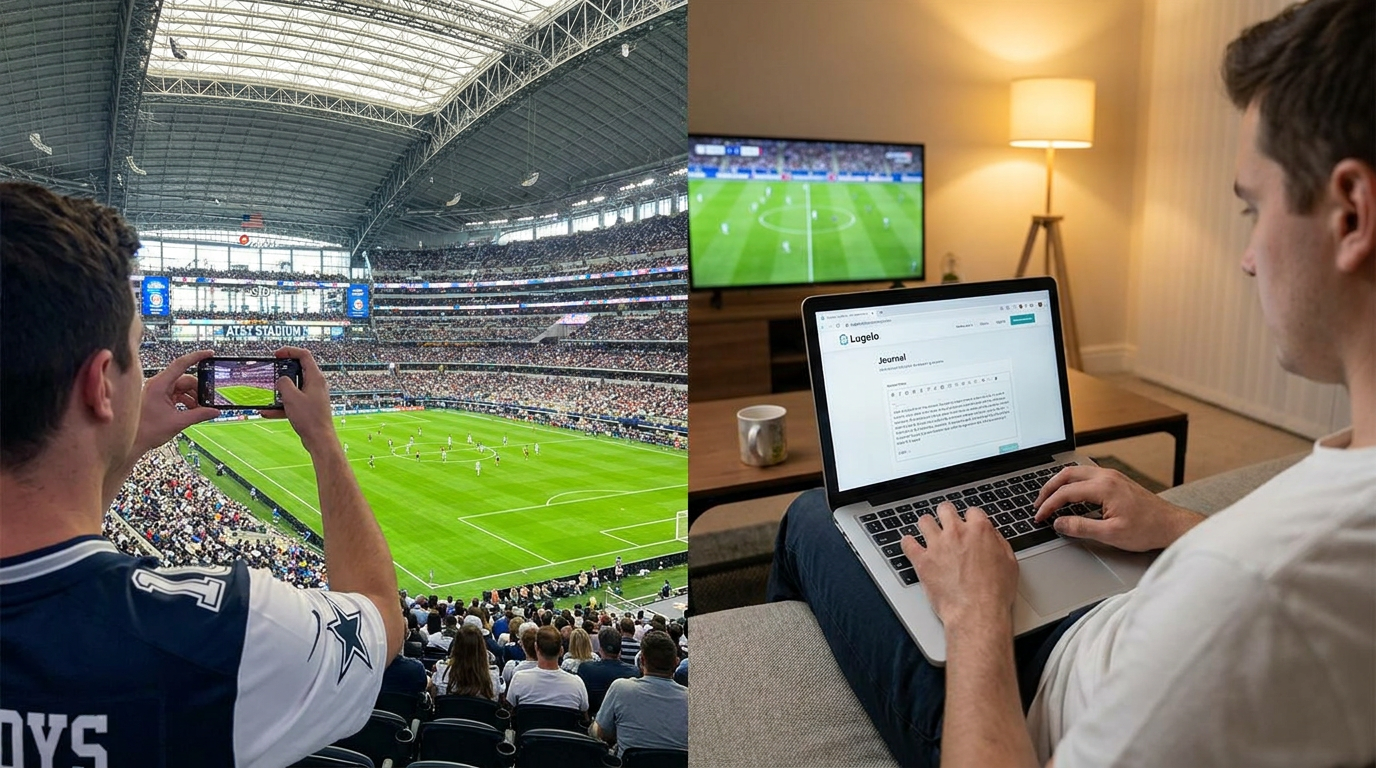
If you’re one of the fortunate ones who made it to a host city for a match, your journaling opportunities are almost overwhelming in the best possible way. Here’s how to structure your Lugelo World Cup journal:
Before the match: Open Lugelo and create a “City Profile” entry. What do you know about this city? What have you already seen, eaten, experienced? What surprised you? Take a photo of the stadium exterior. Record a voice memo of the crowd noise building outside the gates. Drop a location pin.
Match day: Use the photo and video features to capture what you see from your seat — not just the pitch, but the people around you, the flags, the confetti, the faces when a goal goes in. Lugelo holds photos, videos, and audio clips all in one private, organised place, so nothing gets lost in the chaos of your camera roll.
After the match: This is your most important journal entry. Write while the emotion is still physical, still present. Describe the goal that changed everything. Who were you sitting with? What did the city feel like when you walked out into the night? Use Lugelo’s AI Journal Assistant if you’re too overwhelmed to know where to start — a well-crafted prompt can unlock the whole experience.
In transit: Some of the best journal entries happen on trains, buses, and planes between cities. The distance gives you perspective. Use Lugelo’s speech-to-text feature to dictate thoughts on the go.
For the Armchair Traveller
The armchair World Cup journal is one of the most underrated ideas in travel writing, and it works like this: each match night becomes a new chapter. You research the host city before kickoff. Maybe you cook something inspired by its cuisine — birria for a Mexico City match, clam chowder for Boston, BBQ for Kansas City. You write a “City Profile” entry based on what you’ve learned. You watch the match and write a “Match Day Memory” — the score, the standout moments, who you watched it with. Afterwards, you write a “Wishlist Entry” — what you’d do if you visited this city for real.
By July 19, you won’t just have a record of a football tournament. You’ll have a 16-chapter travel journal of a continent you’ve explored through curiosity, creativity, and the beautiful game. You might even have a shortlist of cities you actually want to visit next year.
The World Cup City Journal: A Suggested Structure
Here is a simple five-entry framework for each host city, usable in Lugelo’s journal templates:
- City Profile — What you know (or are learning) about this city before the match kicks off
- Match Day Memory — Score, standout moments, who you watched with, how you felt
- Cultural Discovery — One new thing you learned about the host city during the tournament
- Wishlist Entry — What you’d do if you visited for real: neighbourhoods, restaurants, landmarks
- Reflection — What this tournament, this city, this moment means to you personally
Watch Together, Journal Together
Lugelo’s collaborative journaling features make the World Cup a genuinely shared experience. Imagine a group of friends — some watching in person, some from home — each contributing their perspective on the same tournament. One friend is at the match in Vancouver. Another is watching from a pub in Dublin. A third is making homemade tacos and watching from their apartment in São Paulo. At the end of the tournament, all three contribute their entries to a single shared Lugelo storybook. The result is something no single perspective could have created: a collective memory, built from three vantage points, archived permanently, beautiful.
Your memories deserve better than scattered apps.
5 Quick-Start Journal Prompts for Your Next Match Night
- What city is hosting tonight’s match — and what’s one thing you know about it that you didn’t know last month?
- Who are you watching with tonight, and why does it matter that they’re there with you?
- Describe the goal that changed the match. What did you feel in the exact second it went in?
- What food or drink is on your table right now? What city’s cuisine would you attempt to cook for the next match?
- If you could visit one of tonight’s host cities next year — flights booked, no excuses — which one would it be, and what would your first hour look like?
From Match Day to Memory Lane: VR Galleries, Storybooks, and the Art of Remembering
There is journaling, and then there is what Lugelo makes possible after journaling — something that feels more like architecture than writing. This is the section where your World Cup entries stop being words in a private notebook and become something immersive, beautiful, and designed to last.
Step Into Your World Cup
Imagine this: it’s August 2026. The tournament is over. The bracket is complete, the champions are crowned, the confetti has settled. You open Lugelo and tap into your VR Gallery. The world around you shifts.
You’re standing in a digital space where each “room” is a different host city. Walk into the Dallas room and your photos from AT&T Stadium float on the walls around you, a video of the crowd erupting after a goal plays in the corner, the audio from your voice memo — that 80,000-person roar — fills the space. Step through into Vancouver, and there’s the photo you took of the mountains through the stadium roof, your handwritten reflection about nature and cities in perfect balance, the voice note you dictated on the ferry back to downtown. Step through again — Mexico City, with its colours and its history, and your entry about standing somewhere ancient.
Lugelo’s VR gallery feature lets users build this immersive 360-degree memory space in under 10 minutes. It’s not a slideshow. It’s not an album. It’s a room you walk through, filled with your life.
Your World Cup Storybook
At the end of the tournament — or even mid-tournament, after the Quarterfinals — Lugelo users can compile their city entries into a beautifully formatted storybook or ebook. Choose a theme from Lugelo’s growing library, and the app generates a polished, shareable document from your entries, photos, and reflections. Print it. Share it with family. Keep it private as a keepsake for future you.
Twenty years from now, you’ll open that document and remember exactly how it felt. The score. The city. The food on the table. The person sitting next to you. The feeling of being alive in the summer of 2026, when the world came to North America and played football.
The Timeline That Holds Everything
Lugelo’s timeline feature creates a chronological arc of your entire World Cup journal — from the opening match in Mexico City on June 11 all the way to the Final at MetLife Stadium on July 19. Each entry is anchored to its date, its location, its moment. Scroll through it in January 2027 and the whole summer unfolds again in sequence. The early group stage excitement. The first knockout nerves. The Quarterfinal drama. The Final.
The timeline doesn’t just organize your memories. It tells you the story of who you were in the summer when North America hosted the world.
Building a Collective Memory
For groups of friends who watched different matches in different cities — or who were split between in-person attendance and at-home viewing — Lugelo’s collaborative storybook is the most powerful tool in the arsenal. Invite your people to contribute. One friend adds their Dallas Round of 16 experience. Another adds their armchair journal from the Boston Quarterfinal. A third adds their living room account of the Final, complete with a photo of the homemade jersey they wore and the score written on the back of a napkin.
The result isn’t any one person’s story. It’s the story of a group of people who loved something together across an entire summer. It’s the kind of thing that gets passed down.
“Turn this summer into a story you’ll relive forever.”
July 19 — The Last Entry
On July 19, 2026, the World Cup Final kicks off at MetLife Stadium. The most-watched event on Earth that day. What will you write in your journal when it’s over? What do you want to remember about this summer — not just the result, but the feeling of being present for something this large, this rare, this collectively human?
Journals are souvenirs of your past. This summer — with 16 cities, 48 teams, 104 matches — is giving you the most extraordinary collection of souvenirs imaginable.
Don’t Let a Single Moment of This Summer Disappear
The 2026 FIFA World Cup is the greatest storytelling stage North America has ever hosted. Sixteen cities. Three countries. Forty-eight nations. One hundred and four matches. And at the centre of all of it, sitting quietly in the middle of the noise and the colour and the goals and the heartbreak and the joy, is you — with your specific perspective, your particular memories, your unique experience of this summer.
Whether you’re watching from a stadium in Dallas or a living room in another country entirely, whether you’re cooking city-inspired food for match night or actually walking the streets of Guadalajara — your story matters. And it will fade, the way all experiences fade, if you don’t write it down.
Every journal entry you write this summer is a keepsake. Every photo you caption, every voice note you record at the moment of a goal, every wishlist entry you build for a city you hope to visit someday — it all adds up to something that will outlast the tournament by decades. The cities are there. The matches are happening. Your journal is waiting for its first entry.
This World Cup will end on July 19. Your memories of it will last as long as you give them somewhere to live.
Sixteen cities. Three countries. One unforgettable summer. Don’t let a single moment of it disappear.
Start Your World Cup City Journal on Lugelo — Free
Capture match memories, explore host city culture, and turn this historic summer into a beautiful storybook or immersive VR gallery — all in one private, collaborative app.
Already a Lugelo user? Open your app and create a new journal called “World Cup 2026.” Your first entry is waiting.
Download Lugelo: