It’s the 94th minute. The score is level. A player steps up to the spot, twelve yards from goal, and the whole world seems to hold its breath at once. You can feel it — not just in the stadium, not just in the room you’re watching from, but somewhere deep in your chest. Your hands are gripping whatever is nearest. Someone next to you has stopped breathing. The referee blows the whistle. The run-up begins. And then — in a single frozen second — everything either erupts or collapses.
You know that feeling. Anyone who has ever watched knockout football knows it viscerally. It is one of the most purely human experiences that sport offers: total investment, absolute stakes, and no second chances.
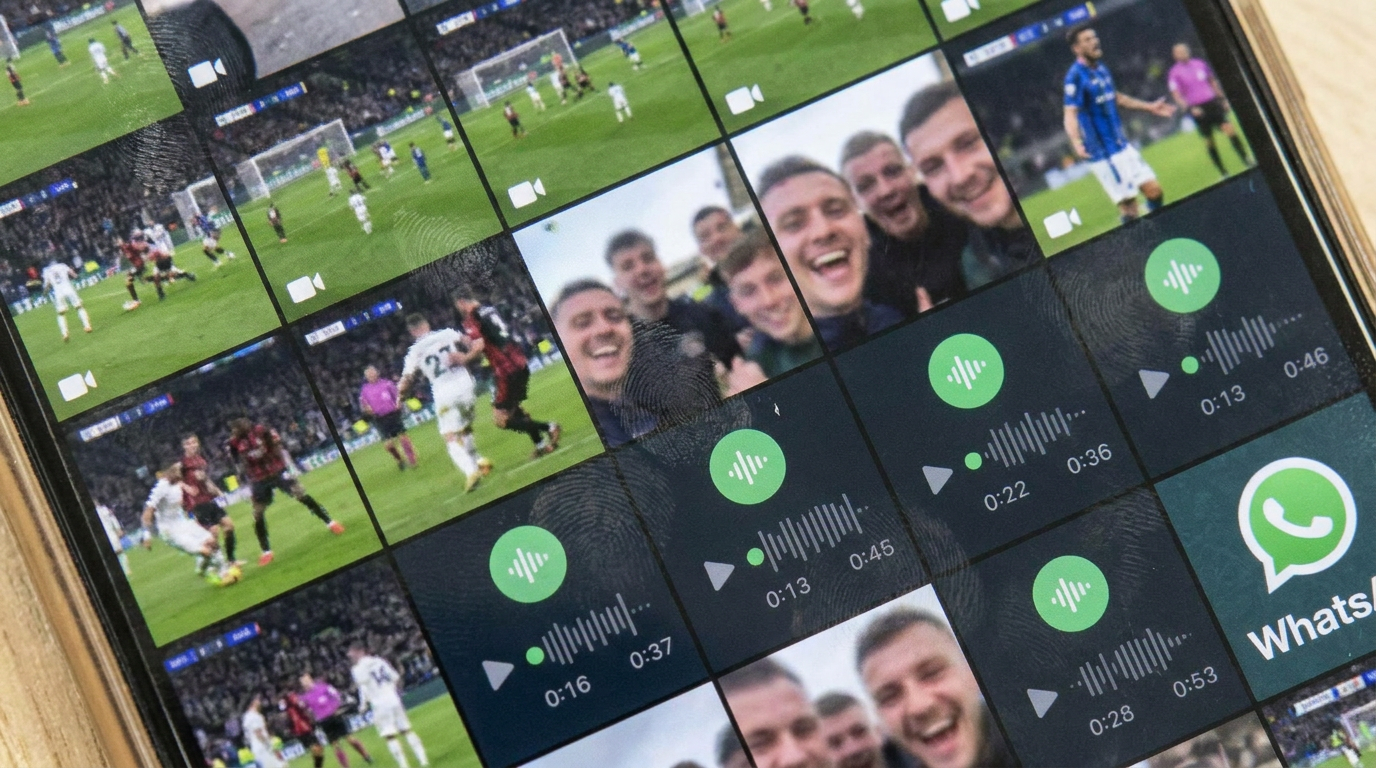
Now ask yourself: what did you do with the last moment like that? Chances are, you grabbed your phone. You posted a reaction. You sent a voice note. Maybe you filmed the room in the chaos of the final whistle. And then, within 24 hours, your Instagram Story was gone. Your tweet was buried under a thousand others. The camera roll photo sits in a folder you’ll scroll past in six months without stopping. And that feeling — the one that made your hands shake — has already started to blur.
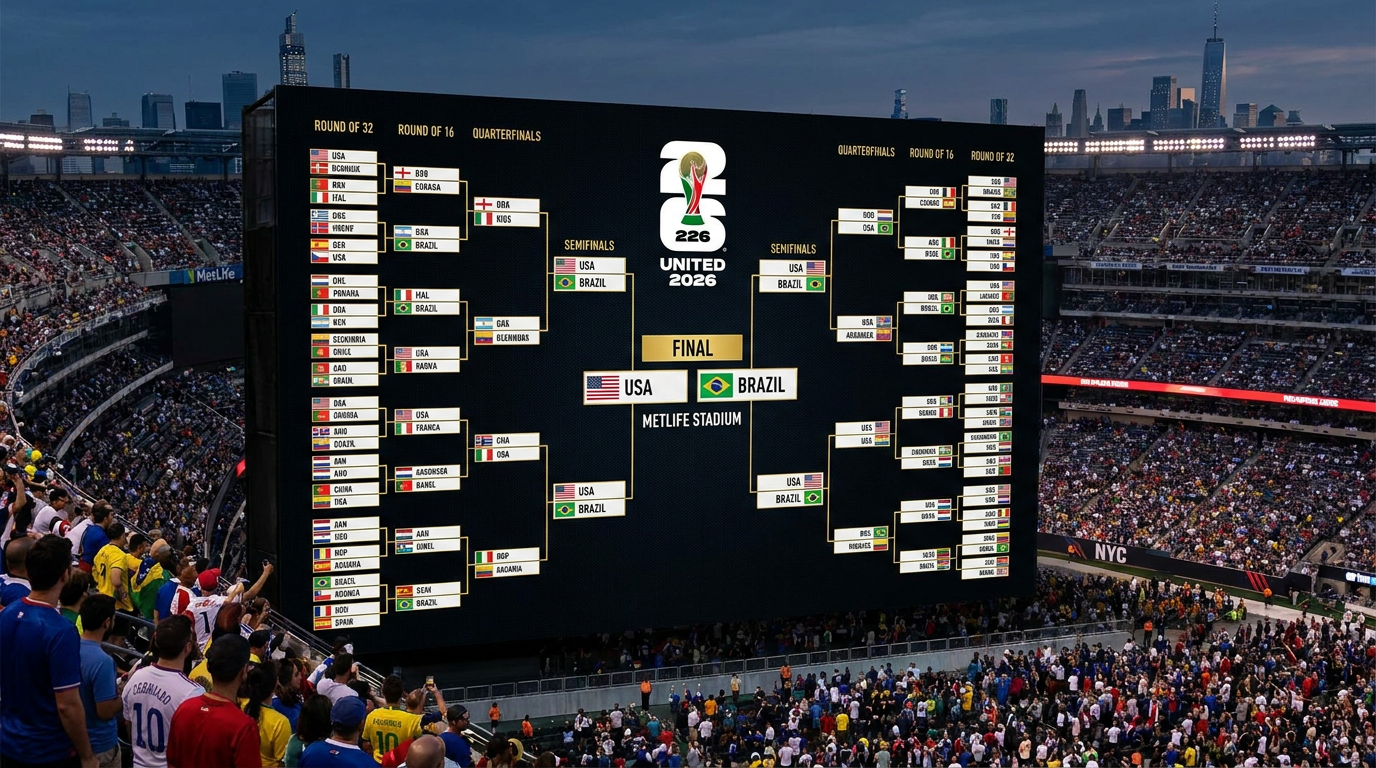
This is the quiet paradox of being a football fan in the social media era. The moments are getting bigger, and the tools we’re using to hold onto them are getting shallower. Nowhere is that tension more vivid than right now, in the middle of history’s largest-ever FIFA World Cup. Week 4 of the 2026 FIFA World Cup — running from June 29 through July 5 — marks the tournament’s most dramatic phase: the Round of 32 completing across stadiums in Houston, Arlington, East Rutherford, and Mexico City, and the Round of 16 igniting from July 4 onward. This is the first-ever 48-team World Cup in history, which means the Round of 32 itself is an entirely new format — a milestone being lived in real time.
The moments that unfold in these weeks will be talked about for decades. The question is whether you’ll have anything real to show for them — or just a buried post and a fading feeling.
This is an invitation, not a lecture. An invitation to preserve what actually matters, in a way that actually lasts.
Why Knockout Football Hits Differently: The Emotional Weight of Win-or-Go-Home
There is a specific quality to knockout football that no other phase of any sport quite replicates. It is not merely the importance of the result — it is the finality of it. When the final whistle blows in a group-stage match, both teams go home knowing there are more chances ahead. There are points still to play for, results still to manipulate, margins still to recover. In a knockout match, none of that is true. One team’s tournament is over. Completely, irreversibly, without appeal. And that finality — that absolute, edge-of-a-cliff quality — is what transforms a football match into something approaching a life event.
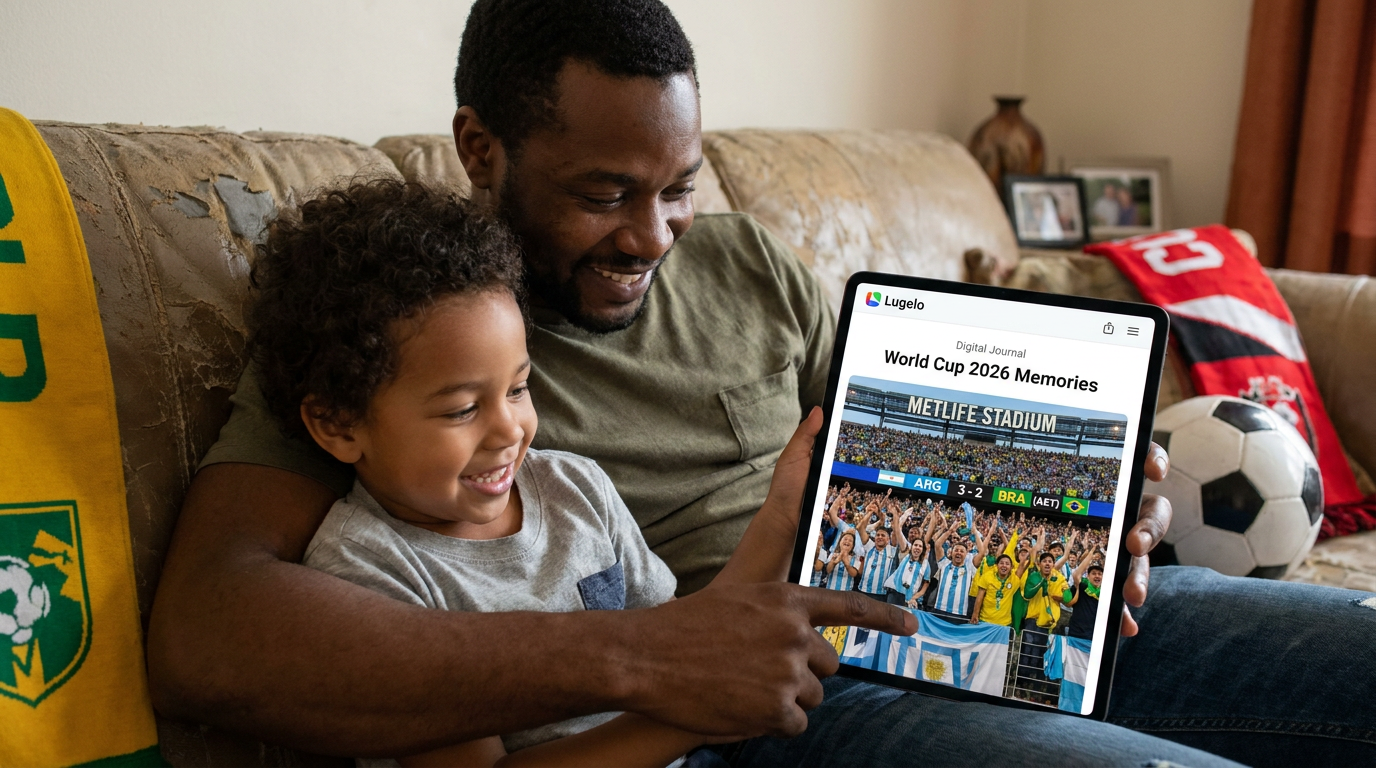
Think about what the 2026 FIFA World Cup knockout stage looks like in its raw geography: Gillette Stadium in Foxborough, Estadio Azteca in Mexico City, MetLife Stadium in East Rutherford, AT&T Stadium in Arlington. These are not just venues — they are theatres, and the drama being staged inside them over these weeks is the kind that lodges permanently in the people who witness it.
History tells us as much. Consider Roberto Baggio walking back from the penalty spot at the 1994 World Cup final, his head bowed, his ponytail hanging, the entirety of Italy’s hope dissolving with that one high kick. Or Belgium versus Japan in 2018 — two goals down, seemingly out, and then three goals in the final 28 minutes, Nacer Chadli burying a 94th-minute counter-attack to send Japan home in one of the great sporting reversals. Or Fabio Grosso, in the 119th minute of the 2006 semi-final, curling a shot past Jens Lehmann to send Italy to the final in Berlin. Or — perhaps the greatest knockout match ever played — Argentina versus France in the 2022 final: 3-3 after extra time, a Kylian Mbappé hat-trick somehow not enough, Emiliano Martínez enormous in the shootout, Lionel Messi lifting the one trophy that had always eluded him.
These are not sports results. They are memories that people carry in their bodies. Ask someone who watched the 2022 final where they were, and they will tell you instantly — the room, the people, the exact sensation of the penalties. Ask them what they posted about it, and most will struggle to remember.
“There are a handful of moments in a football fan’s life that become part of who they are. Most of them happen in knockout rounds.”
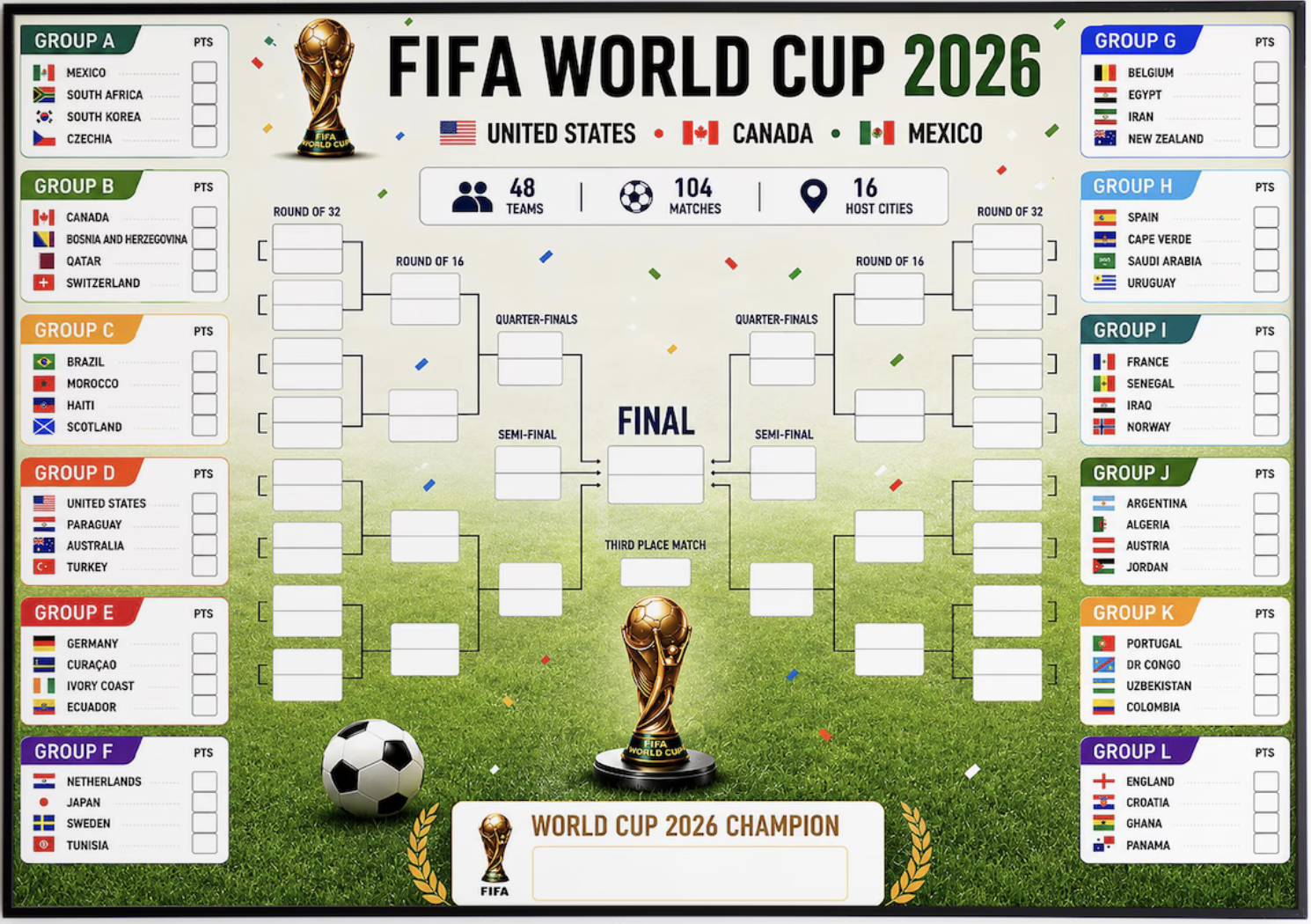
The 2026 World Cup is, by every statistical measure, the biggest in the history of the tournament. Forty-eight nations. One hundred and four matches. A new Round of 32 format that no generation of fans has ever experienced before. Moments of the magnitude of Baggio, of Grosso, of Messi — they are coming. They may already be happening as you read this. And the question of how you preserve them is more urgent than it has ever been.
The Round of 32 — which runs from June 28 through July 3 according to the official FIFA match schedule — compresses world-class football into a relentless window of single-elimination drama. Sixteen matches. Sixteen eliminations. Sixteen national stories ending. The Round of 16 then begins July 4, sharpening the field further. Every day brings a new moment of finality, a new set of images that could belong to the ages.
These are the moments that deserve more than a 24-hour Story. They deserve a record. And to understand why so many of them are currently going undocumented in any meaningful sense, we have to reckon honestly with the tools we’ve been relying on.
The Illusion of Sharing: Why Social Media Was Never Built to Remember
Here is something worth sitting with: Instagram Stories were explicitly designed to disappear. That 24-hour limit is not a technical limitation or an oversight — it is a deliberate product decision. Ephemerality is a feature, not a flaw. The format was built for immediacy, for urgency, for the dopamine loop of posting and consuming in the moment. It was not built for the long Tuesday in January five years from now when you want to revisit the night your team made the quarter-finals.
We have all been there. The match ends — in triumph, in heartbreak, in the delirious chaos of a penalty shootout — and the instinct is immediate: share it. Post the photo. Film the room. Caption the emotion in whatever shorthand feels adequate. There is nothing wrong with that impulse. It is human to want to mark a moment, to reach out and say I’m here, this is happening, can you believe this? But the architecture of the platforms we share on is working against us in ways we rarely stop to examine.
Algorithms on every major social platform are designed to prioritise the newest content. What you posted four hours ago is already deprioritised. What you posted last week is effectively invisible. The design optimises for continuous engagement — the next post, the next scroll, the next dopamine hit — not for retrieval, not for reflection, not for meaning.
Academic research has begun to map this problem with precision. A study published in the ACM Digital Library, examining how users navigate Instagram Stories and the tension between ephemeral and archival cultures, found that users strategically gravitate toward ephemerality for convenience — choosing formats that disappear rather than persist — often without fully reckoning with the trade-off. The convenience of posting a Story feels like memory-keeping. It isn’t.
Consider the contrast. Imagine you watch a knockout match tonight — a 120-minute thriller that ends on penalties. In the version most of us are living, here is what the memory record looks like in a week: one blurry Story that no longer exists, three tweets buried under thousands of others, a camera roll photo with no context attached, and a feeling that is already softening at the edges. Now imagine a different version. You write it down that same night — where you were, who you watched with, what it felt like when the goalkeeper dived the right way. You add the photo as an anchor for the memory, not as a broadcast. You note the things you want to remember: the exact words someone said when the goal went in. The way the room felt in the silence before the penalty.
Same night. Same moment. Radically different depth of record.
Social media was built for reach — to connect you to an audience in real time. It is genuinely extraordinary at that. But reach and remembrance are not the same thing. They have never been the same thing. And as the most emotionally charged week of the 2026 World Cup unfolds, it is worth asking which one actually matters to you more.
The 20% You Lose Every Time You Reach for Your Phone
The argument for deeper memory-keeping isn’t just philosophical. There is a growing body of research that describes, with uncomfortable specificity, what we actually lose when we document for social media rather than for ourselves.
Research by UC Santa Cruz doctoral student Julia Soares, whose work on the photo-taking-impairment effect has been widely cited in cognitive psychology, found compelling evidence that the act of taking photographs actively impairs people’s memory of the events they are photographing. The mechanism behind this is a process called cognitive offloading — when we externalise a memory to a device, our brains reduce the effort invested in encoding it internally. We essentially tell ourselves: the phone has it, so I don’t need to. The result is that the photographed memory becomes paradoxically less vivid, less detailed, and less emotionally resonant than the unrecorded one.
There is a second mechanism at work alongside cognitive offloading, and it is perhaps even more relevant to the experience of watching football: attentional disengagement. When you step out of a moment to document it — to frame the shot, open the app, write the caption — you are, for that duration, no longer fully in the moment. You are observing it, not experiencing it. And because the depth of a memory is largely determined by the depth of the experience that formed it, the partially-experienced moment becomes the partially-remembered one.
This has a real application to the specific drama of knockout football. The penalty shootout you filmed on your phone, posting it story-clip by story-clip to your followers, was not the same shootout experienced by the person next to you who put their phone away and lived every kick with their whole body. They will remember it differently — more viscerally, more completely. The Euronews overview of iconic World Cup moments that shaped history is full of memories that have grown more vivid with time precisely because the people who lived them were present for them. Baggio’s missed penalty. The Maracanazo. These are not archived tweets. They are lived experiences that burned themselves into memory.
Research from Stockholm’s KTH Royal Institute of Technology on working memory further suggests that constant social media engagement — the cycle of posting, checking for responses, and consuming others’ posts in return — creates a form of cognitive overload that deteriorates the brain’s capacity to process and consolidate experiences. We are not just offloading our memories to our phones. We are actively fragmenting the mental bandwidth that forms them in the first place.
None of this is meant as a verdict on social media, or on the people who use it — which is all of us. It is meant as an honest account of what the research shows about what is happening when we reach for our phones in the moments that matter most. We are, with the best of intentions, trading depth of experience for speed of distribution. We are choosing to be slightly less present in the most present moments of our lives.
The antidote is not to stop capturing. It is to change when and how you capture. To be fully present for the moment itself, and then — while it is still fresh, while the emotion is still in the room — to write about it. Reflect on it. Give it a home that won’t be buried by an algorithm in the morning. That shift — from real-time broadcast to deliberate reflection — is the difference between a fleeting reaction and a real memory.
A Deeper Way to Keep the Moment: Write It, Save It, Relive It
So what does a richer, more intentional form of memory-keeping actually look like in practice? Not in theory, not abstractly — but on the night of a knockout match, when the final whistle has blown and the feeling is still very much alive in you?
This is exactly the gap that Lugelo was built to fill. Not as a replacement for the shared joy of social media — but as the place where the real record lives. The difference between a social media post and a Lugelo journal entry is the difference between a broadcast and a keepsake. One is designed to reach an audience; the other is designed to last.
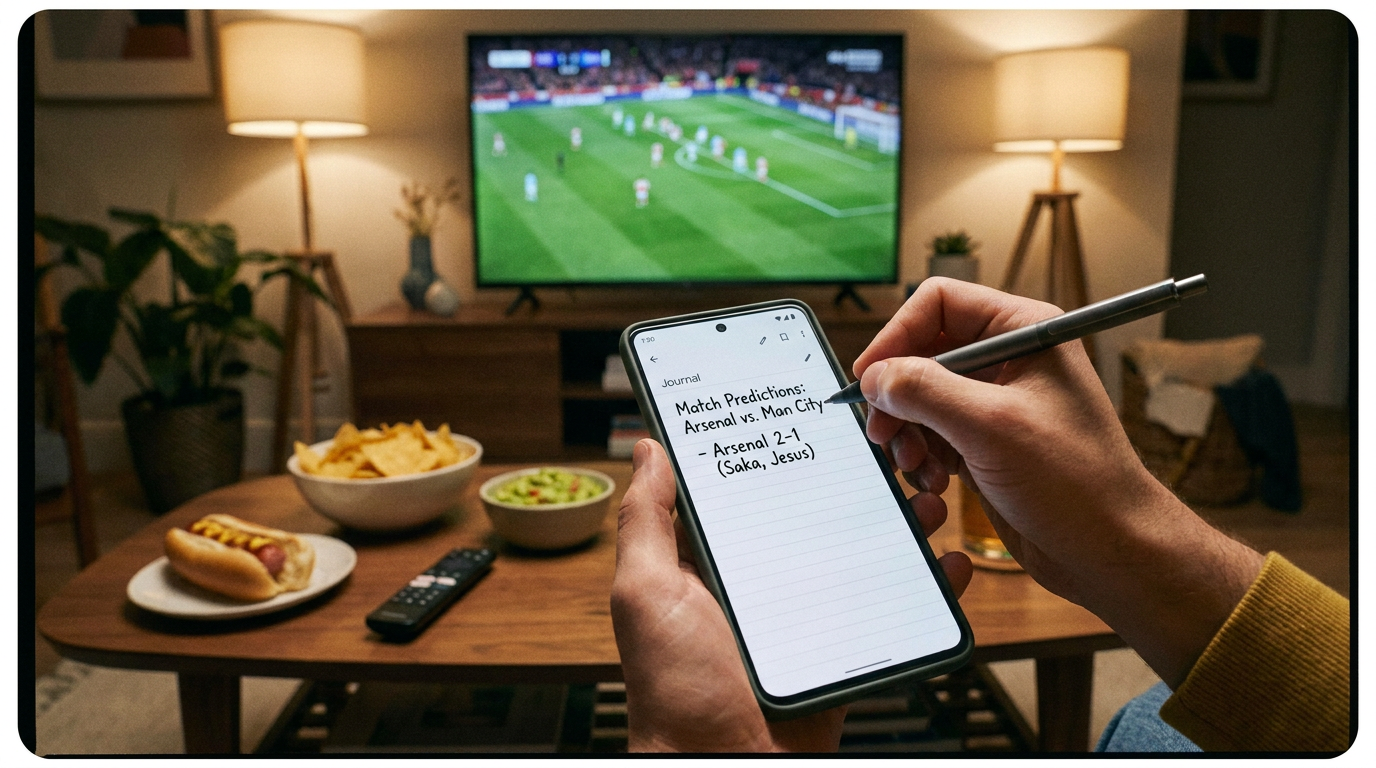
Imagine it concretely. Your team has just gone through on penalties. You watched the whole shootout from behind a cushion. Three of the kicks were so tense you forgot to breathe. You open Lugelo. You write:
“3-3. Extra time. I was sitting on the floor by the end. Couldn’t watch. Then the goalkeeper dived the right way and the room just — exploded. I don’t think I’ve ever made a sound like that in my life. Watched with [name], who started crying immediately. Both of us just standing there, screaming, not knowing what to do with ourselves.”
That is a memory. That is something you can return to in five years, in ten years, and find exactly as you left it — the feeling intact, the detail preserved, the people named. No algorithm will bury it. No 24-hour timer will erase it.
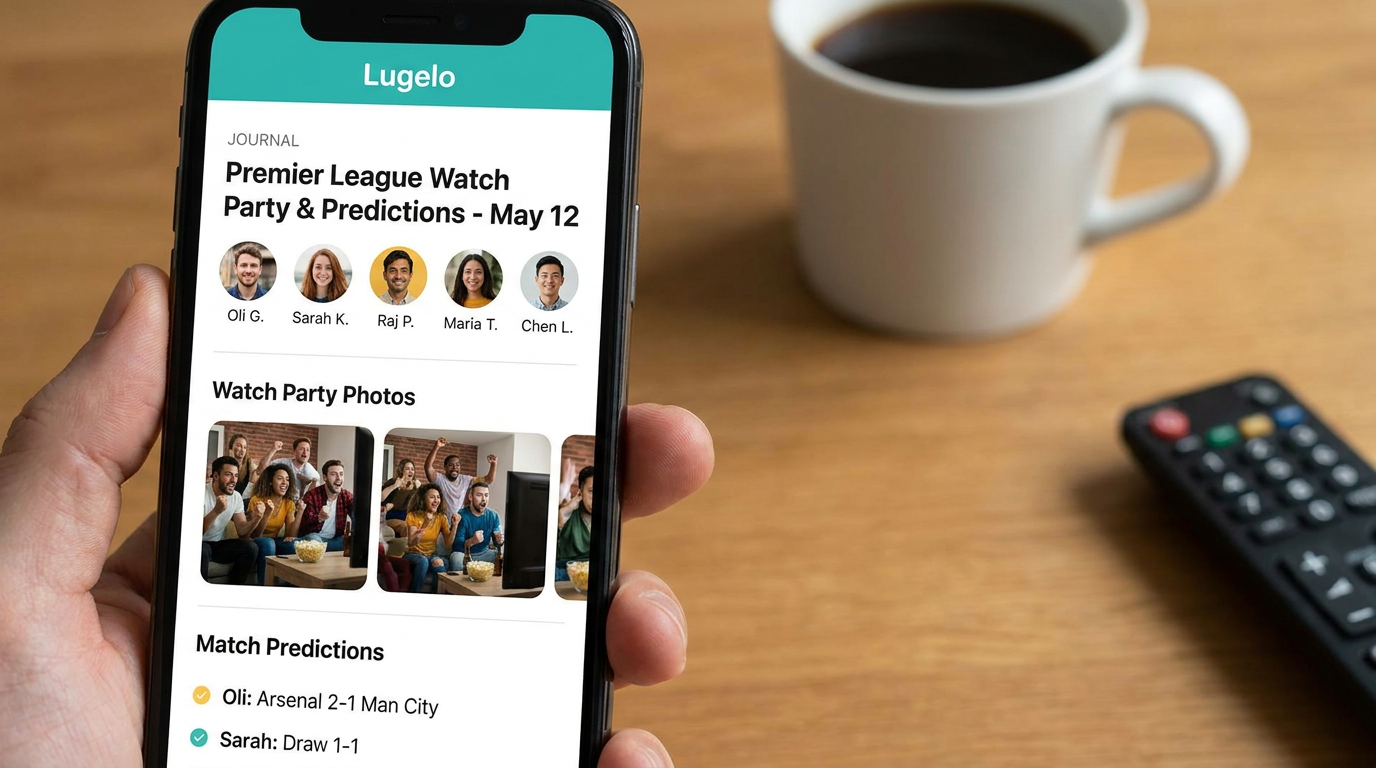
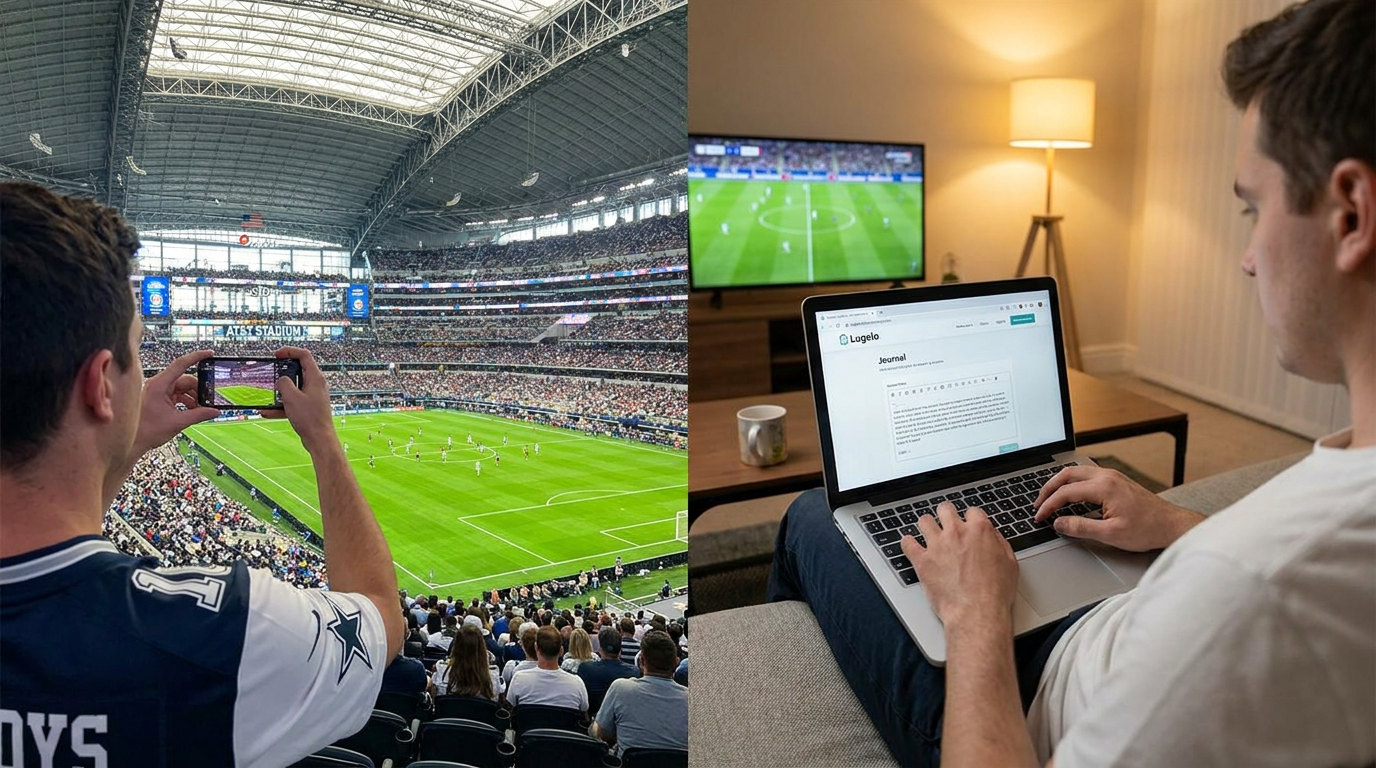
Lugelo’s full feature set makes this kind of rich, multi-layered memory-keeping genuinely easy. You can write your text reflection — the raw, honest account of what it felt like. You can add photos from the watch party, a clip of your reaction, the audio of the room in the moments after. You can include a link to the match highlights as context for anyone reading the entry later. You can attach the specific details that no highlight reel will ever capture: who made the snacks, what you said at half-time when it was still goalless, which friend you called the moment it was over.
Lugelo’s AI Journal Assistant is particularly valuable for the moments when the feeling is enormous but the words aren’t coming. It offers prompts to help you find the language for what you experienced — guiding you from I don’t know how to describe this to a journal entry that actually captures it. For those newer to journaling, pre-built match-night templates give you a structure to work from, so the blank page never becomes a barrier to starting.
And critically — none of it disappears. You can return to a journal entry written tonight in 2036 and find it exactly as you left it. The photo of your living room, the words you wrote in the hour after the final whistle, the chaos of the moment — all preserved, owner-controlled, and entirely yours.
Start your World Cup journal on Lugelo — free to get started, yours to keep forever. Download the app here and open your first entry tonight.
The practical shift is simple: be fully present for the match itself. Put the phone down for the actual football. Then, in the hour after — while it’s still fresh, while the emotion is still real — open Lugelo and write. Add your photos as memory anchors, not broadcasts. Give the moment a home that lasts.
Your Memories, Your Audience: The Case for Private-First Storytelling
There is another dimension to this conversation that often goes unspoken, but that most of us have felt at some point: the slight unease of making a private moment public by default.
When you post to Instagram, your World Cup night goes — simultaneously, immediately — to your followers, to the platform’s algorithm, to the advertising infrastructure that monetises your engagement, and to the data systems that categorise and store your behaviour. That is the implicit bargain of social media: your moments, in exchange for the audience. Most of the time, we accept that bargain without thinking about it. But not every moment is meant for that exchange.
The tears after an elimination. The specific intimacy of watching a match with one person who matters to you. The private superstitions and rituals of the die-hard fan. The words you said in the heat of the moment that were real and unpolished and not curated for anyone’s consumption. These are yours. They feel different when they’re genuinely yours — not because there’s anything wrong with sharing, but because the texture of a truly private memory is different from a performed one.
Lugelo is private by default. Your journals are owner-controlled. You decide — for every entry, every photo, every piece of writing — who sees it. The options range from completely private (only you) to selectively shared with specific people, to fully public if that’s what you want. Encrypted in transit and designed around your ownership of your own data, Lugelo operates on a fundamentally different model from social platforms: your memories are not the product. You can even download all your data at any time, in full compliance with GDPR and other privacy regulations, as noted in the Lugelo privacy policy.
The collaborative dimension of Lugelo is opt-in and genuinely meaningful. You can invite the friends you watched a match with — the ones who were actually in the room — to contribute their own perspective, their own photos, their own memories, to a shared journal. Imagine having a record of the same night from three or four different viewpoints: what it felt like in different parts of the room, the different angles on the same penalty, the different reactions to the final whistle. That is something richer and more honest than any single public post. It is a multi-dimensional record of a shared experience, owned by the people who lived it.
This kind of intentional, collaborative memory-keeping is exactly what Lugelo enables for families and close groups through its family journal and stories feature. The same principle applies to a group of friends who’ve been watching the 2026 World Cup together — every match, every round, every moment of drama building into a shared storybook that belongs to all of you.
Privacy, in this framing, is not a withdrawal from connection. It is a more deliberate, more meaningful form of it. You are not curating for an audience. You are collaborating with the people who were actually there.
From Match Night to Memory Lane: Turning the Tournament Into a Keepsake
Here is the wider picture, and it is one worth pausing on: the 2026 FIFA World Cup is not a single moment. It is a journey. A six-week arc of group-stage drama, knockout tension, and — for those whose teams go deep — something approaching an obsession. And while every individual match night has its own emotional signature, the real richness is in the whole story: the progression, the accumulation, the tournament experienced as a living narrative rather than a series of isolated events.
Lugelo makes it possible to capture that whole story in a way that nothing else does. Not just tonight’s match, but all of them — match by match, round by round, building across the tournament into something you can scroll through, share, print, and revisit for the rest of your life.
The timeline view lets you build a match-by-match record of your tournament experience — each entry dated, sequenced, and scrollable in the order it happened. You can watch your own emotional arc across the tournament: the cautious optimism of the group stage, the electric tension of the Round of 32, the intensity of the knockout rounds. In ten years, you’ll be able to scroll through it like a diary of a summer that mattered.
The eBook and storybook features go further still. Select an eBook theme, and Lugelo transforms your journal entries — text, photos, videos, links and all — into a beautifully formatted PDF-style storybook. Something you can actually print. Something you’d want to share with someone who loves football the way you do. Not a social media grid. A real, designed artifact of an extraordinary summer.
And then there is the VR gallery — perhaps Lugelo’s most remarkable feature. Add enough multimedia to your journal, and you can transform it into an immersive 3D experience. Imagine, in five years, stepping into a virtual gallery of your 2026 World Cup summer — walking through the moments, seeing the photos in three dimensions, experiencing the memory in something closer to the way it felt to live it. That is not a metaphor. It is a feature you can use today, starting with the entries you write tonight.
The value of all of this compounds over time. The 2022 World Cup final — Argentina versus France, widely considered one of the greatest matches in the history of the sport — is now four years in the past. People who wrote about that night have something to return to. They can read exactly what they wrote in the hour after Messi lifted the trophy, exactly what they felt, exactly who they were with. Everyone else has a buried tweet and a dimming recollection.
In a decade, this World Cup — the first 48-team edition, spanning three nations, generating moments that don’t yet exist but surely will — will feel like a different era of football. The stadiums will still be standing. The records will still show who won. But the personal record — the felt account of what it was like to be a fan during this tournament — will only exist if someone thought to keep it.
To get started, here are a few prompts worth writing about tonight, courtesy of Lugelo’s journal approach:
- Who did you watch the match with, and why does that matter?
- What was the exact moment everything changed?
- How did the room feel in the seconds after the final whistle?
- What do you want to remember about this summer, ten years from now?
These are not complicated questions. But written down, honestly, in the hours after a knockout match — they become the building blocks of a memory that actually lasts.
Keep the Feeling: A Summer Worth Preserving
Go back to that 94th-minute penalty. The held breath. The hands gripping the cushion. The moment of absolute clarity about what you want to happen and the absolute uncertainty of whether it will.
That feeling is real. It is not trivial or performative. It is one of the things that makes being a football fan — being human — genuinely extraordinary. The capacity to care that deeply about something, to be transported so completely by a game played on grass by twenty-two people you’ve never met, is a kind of magic. It deserves to be honoured.
Social media is not the villain of this story. It connects us, it amplifies shared joy, it lets us find each other in the noise of a global event. It has its place. But it was built for reach, not for remembrance. For the next post, not for the last memory. And the moments that are unfolding right now — in the Round of 32, in the Round of 16, in the extraordinary drama of the first-ever 48-team World Cup knockout stage — deserve something more permanent than a 24-hour window.
The best World Cup memories are the ones you can return to: the full story, the specific emotion, the exact context, the people you were with, the words that were actually said. Not just a photo with a caption, but a real account of a real night that mattered to you. The kind of thing that, in ten years, you’ll be grateful you kept.
Lugelo was built for exactly this — to help people capture life’s moments, give them shape in journals and storybooks, and share them as timelines, eBooks, and immersive VR experiences with the people who matter. It is a place where your memories are private by default, yours to control, and built to last — not to disappear at dawn.
Everyone has a story to tell. This World Cup, yours deserves to be kept.
The tournament is live. The knockout rounds are here. And the next unforgettable moment is probably ninety minutes away.
Your knockout memories deserve better than a 24-hour Story.
Start your World Cup journal on Lugelo today →
Free to get started. Yours to keep forever.