Category Archive : AR/VR

Knockout Rounds, Unforgettable Moments: Why Your World Cup Memories Deserve More Than a Social Media Post

Knockout Rounds, Unforgettable Moments: Why Your World Cup Memories Deserve More Than a Social Media Post

It’s the 94th minute. The score is level. A player steps up to the spot, twelve yards from goal, and the whole world seems to hold its breath at once. You can feel it — not just in the stadium, not just in the room you’re watching from, but somewhere deep in your chest. Your hands are gripping whatever is nearest. Someone next to you has stopped breathing. The referee blows the whistle. The run-up begins. And then — in a single frozen second — everything either erupts or collapses.

You know that feeling. Anyone who has ever watched knockout football knows it viscerally. It is one of the most purely human experiences that sport offers: total investment, absolute stakes, and no second chances.

Now ask yourself: what did you do with the last moment like that? Chances are, you grabbed your phone. You posted a reaction. You sent a voice note. Maybe you filmed the room in the chaos of the final whistle. And then, within 24 hours, your Instagram Story was gone. Your tweet was buried under a thousand others. The camera roll photo sits in a folder you’ll scroll past in six months without stopping. And that feeling — the one that made your hands shake — has already started to blur.

This is the quiet paradox of being a football fan in the social media era. The moments are getting bigger, and the tools we’re using to hold onto them are getting shallower. Nowhere is that tension more vivid than right now, in the middle of history’s largest-ever FIFA World Cup. Week 4 of the 2026 FIFA World Cup — running from June 29 through July 5 — marks the tournament’s most dramatic phase: the Round of 32 completing across stadiums in Houston, Arlington, East Rutherford, and Mexico City, and the Round of 16 igniting from July 4 onward. This is the first-ever 48-team World Cup in history, which means the Round of 32 itself is an entirely new format — a milestone being lived in real time.

The moments that unfold in these weeks will be talked about for decades. The question is whether you’ll have anything real to show for them — or just a buried post and a fading feeling.

This is an invitation, not a lecture. An invitation to preserve what actually matters, in a way that actually lasts.

A packed football stadium at night with floodlights blazing, fans in full colour holding scarves and flags, the tension of a knockout match palpable in the crowd.

Why Knockout Football Hits Differently: The Emotional Weight of Win-or-Go-Home

There is a specific quality to knockout football that no other phase of any sport quite replicates. It is not merely the importance of the result — it is the finality of it. When the final whistle blows in a group-stage match, both teams go home knowing there are more chances ahead. There are points still to play for, results still to manipulate, margins still to recover. In a knockout match, none of that is true. One team’s tournament is over. Completely, irreversibly, without appeal. And that finality — that absolute, edge-of-a-cliff quality — is what transforms a football match into something approaching a life event.

Think about what the 2026 FIFA World Cup knockout stage looks like in its raw geography: Gillette Stadium in Foxborough, Estadio Azteca in Mexico City, MetLife Stadium in East Rutherford, AT&T Stadium in Arlington. These are not just venues — they are theatres, and the drama being staged inside them over these weeks is the kind that lodges permanently in the people who witness it.

History tells us as much. Consider Roberto Baggio walking back from the penalty spot at the 1994 World Cup final, his head bowed, his ponytail hanging, the entirety of Italy’s hope dissolving with that one high kick. Or Belgium versus Japan in 2018 — two goals down, seemingly out, and then three goals in the final 28 minutes, Nacer Chadli burying a 94th-minute counter-attack to send Japan home in one of the great sporting reversals. Or Fabio Grosso, in the 119th minute of the 2006 semi-final, curling a shot past Jens Lehmann to send Italy to the final in Berlin. Or — perhaps the greatest knockout match ever played — Argentina versus France in the 2022 final: 3-3 after extra time, a Kylian Mbappé hat-trick somehow not enough, Emiliano Martínez enormous in the shootout, Lionel Messi lifting the one trophy that had always eluded him.

These are not sports results. They are memories that people carry in their bodies. Ask someone who watched the 2022 final where they were, and they will tell you instantly — the room, the people, the exact sensation of the penalties. Ask them what they posted about it, and most will struggle to remember.

“There are a handful of moments in a football fan’s life that become part of who they are. Most of them happen in knockout rounds.”

The 2026 World Cup is, by every statistical measure, the biggest in the history of the tournament. Forty-eight nations. One hundred and four matches. A new Round of 32 format that no generation of fans has ever experienced before. Moments of the magnitude of Baggio, of Grosso, of Messi — they are coming. They may already be happening as you read this. And the question of how you preserve them is more urgent than it has ever been.

A black-and-white close-up of a footballer's face showing raw emotion immediately after a goal or penalty miss, eyes wide, hands covering mouth.

The Round of 32 — which runs from June 28 through July 3 according to the official FIFA match schedule — compresses world-class football into a relentless window of single-elimination drama. Sixteen matches. Sixteen eliminations. Sixteen national stories ending. The Round of 16 then begins July 4, sharpening the field further. Every day brings a new moment of finality, a new set of images that could belong to the ages.

These are the moments that deserve more than a 24-hour Story. They deserve a record. And to understand why so many of them are currently going undocumented in any meaningful sense, we have to reckon honestly with the tools we’ve been relying on.

The Illusion of Sharing: Why Social Media Was Never Built to Remember

Here is something worth sitting with: Instagram Stories were explicitly designed to disappear. That 24-hour limit is not a technical limitation or an oversight — it is a deliberate product decision. Ephemerality is a feature, not a flaw. The format was built for immediacy, for urgency, for the dopamine loop of posting and consuming in the moment. It was not built for the long Tuesday in January five years from now when you want to revisit the night your team made the quarter-finals.

We have all been there. The match ends — in triumph, in heartbreak, in the delirious chaos of a penalty shootout — and the instinct is immediate: share it. Post the photo. Film the room. Caption the emotion in whatever shorthand feels adequate. There is nothing wrong with that impulse. It is human to want to mark a moment, to reach out and say I’m here, this is happening, can you believe this? But the architecture of the platforms we share on is working against us in ways we rarely stop to examine.

Algorithms on every major social platform are designed to prioritise the newest content. What you posted four hours ago is already deprioritised. What you posted last week is effectively invisible. The design optimises for continuous engagement — the next post, the next scroll, the next dopamine hit — not for retrieval, not for reflection, not for meaning.

A smartphone screen showing an Instagram Story with a countdown timer in the corner, representing content about to disappear.

Academic research has begun to map this problem with precision. A study published in the ACM Digital Library, examining how users navigate Instagram Stories and the tension between ephemeral and archival cultures, found that users strategically gravitate toward ephemerality for convenience — choosing formats that disappear rather than persist — often without fully reckoning with the trade-off. The convenience of posting a Story feels like memory-keeping. It isn’t.

Consider the contrast. Imagine you watch a knockout match tonight — a 120-minute thriller that ends on penalties. In the version most of us are living, here is what the memory record looks like in a week: one blurry Story that no longer exists, three tweets buried under thousands of others, a camera roll photo with no context attached, and a feeling that is already softening at the edges. Now imagine a different version. You write it down that same night — where you were, who you watched with, what it felt like when the goalkeeper dived the right way. You add the photo as an anchor for the memory, not as a broadcast. You note the things you want to remember: the exact words someone said when the goal went in. The way the room felt in the silence before the penalty.

Same night. Same moment. Radically different depth of record.

Social media was built for reach — to connect you to an audience in real time. It is genuinely extraordinary at that. But reach and remembrance are not the same thing. They have never been the same thing. And as the most emotionally charged week of the 2026 World Cup unfolds, it is worth asking which one actually matters to you more.

The 20% You Lose Every Time You Reach for Your Phone

The argument for deeper memory-keeping isn’t just philosophical. There is a growing body of research that describes, with uncomfortable specificity, what we actually lose when we document for social media rather than for ourselves.

Research by UC Santa Cruz doctoral student Julia Soares, whose work on the photo-taking-impairment effect has been widely cited in cognitive psychology, found compelling evidence that the act of taking photographs actively impairs people’s memory of the events they are photographing. The mechanism behind this is a process called cognitive offloading — when we externalise a memory to a device, our brains reduce the effort invested in encoding it internally. We essentially tell ourselves: the phone has it, so I don’t need to. The result is that the photographed memory becomes paradoxically less vivid, less detailed, and less emotionally resonant than the unrecorded one.

Two side-by-side images: on the left, a person holding up a smartphone filming a match; on the right, a person fully engaged, head in hands in emotion, living the moment.

There is a second mechanism at work alongside cognitive offloading, and it is perhaps even more relevant to the experience of watching football: attentional disengagement. When you step out of a moment to document it — to frame the shot, open the app, write the caption — you are, for that duration, no longer fully in the moment. You are observing it, not experiencing it. And because the depth of a memory is largely determined by the depth of the experience that formed it, the partially-experienced moment becomes the partially-remembered one.

This has a real application to the specific drama of knockout football. The penalty shootout you filmed on your phone, posting it story-clip by story-clip to your followers, was not the same shootout experienced by the person next to you who put their phone away and lived every kick with their whole body. They will remember it differently — more viscerally, more completely. The Euronews overview of iconic World Cup moments that shaped history is full of memories that have grown more vivid with time precisely because the people who lived them were present for them. Baggio’s missed penalty. The Maracanazo. These are not archived tweets. They are lived experiences that burned themselves into memory.

Research from Stockholm’s KTH Royal Institute of Technology on working memory further suggests that constant social media engagement — the cycle of posting, checking for responses, and consuming others’ posts in return — creates a form of cognitive overload that deteriorates the brain’s capacity to process and consolidate experiences. We are not just offloading our memories to our phones. We are actively fragmenting the mental bandwidth that forms them in the first place.

None of this is meant as a verdict on social media, or on the people who use it — which is all of us. It is meant as an honest account of what the research shows about what is happening when we reach for our phones in the moments that matter most. We are, with the best of intentions, trading depth of experience for speed of distribution. We are choosing to be slightly less present in the most present moments of our lives.

The antidote is not to stop capturing. It is to change when and how you capture. To be fully present for the moment itself, and then — while it is still fresh, while the emotion is still in the room — to write about it. Reflect on it. Give it a home that won’t be buried by an algorithm in the morning. That shift — from real-time broadcast to deliberate reflection — is the difference between a fleeting reaction and a real memory.

A Deeper Way to Keep the Moment: Write It, Save It, Relive It

So what does a richer, more intentional form of memory-keeping actually look like in practice? Not in theory, not abstractly — but on the night of a knockout match, when the final whistle has blown and the feeling is still very much alive in you?

This is exactly the gap that Lugelo was built to fill. Not as a replacement for the shared joy of social media — but as the place where the real record lives. The difference between a social media post and a Lugelo journal entry is the difference between a broadcast and a keepsake. One is designed to reach an audience; the other is designed to last.

Imagine it concretely. Your team has just gone through on penalties. You watched the whole shootout from behind a cushion. Three of the kicks were so tense you forgot to breathe. You open Lugelo. You write:

“3-3. Extra time. I was sitting on the floor by the end. Couldn’t watch. Then the goalkeeper dived the right way and the room just — exploded. I don’t think I’ve ever made a sound like that in my life. Watched with [name], who started crying immediately. Both of us just standing there, screaming, not knowing what to do with ourselves.”

That is a memory. That is something you can return to in five years, in ten years, and find exactly as you left it — the feeling intact, the detail preserved, the people named. No algorithm will bury it. No 24-hour timer will erase it.

A warm, close-up shot of a journal entry on a tablet screen showing photos from a football watch party alongside handwritten-style text capturing the emotional memory of a match.

Lugelo’s full feature set makes this kind of rich, multi-layered memory-keeping genuinely easy. You can write your text reflection — the raw, honest account of what it felt like. You can add photos from the watch party, a clip of your reaction, the audio of the room in the moments after. You can include a link to the match highlights as context for anyone reading the entry later. You can attach the specific details that no highlight reel will ever capture: who made the snacks, what you said at half-time when it was still goalless, which friend you called the moment it was over.

Lugelo’s AI Journal Assistant is particularly valuable for the moments when the feeling is enormous but the words aren’t coming. It offers prompts to help you find the language for what you experienced — guiding you from I don’t know how to describe this to a journal entry that actually captures it. For those newer to journaling, pre-built match-night templates give you a structure to work from, so the blank page never becomes a barrier to starting.

And critically — none of it disappears. You can return to a journal entry written tonight in 2036 and find it exactly as you left it. The photo of your living room, the words you wrote in the hour after the final whistle, the chaos of the moment — all preserved, owner-controlled, and entirely yours.

Start your World Cup journal on Lugelo — free to get started, yours to keep forever. Download the app here and open your first entry tonight.

The practical shift is simple: be fully present for the match itself. Put the phone down for the actual football. Then, in the hour after — while it’s still fresh, while the emotion is still real — open Lugelo and write. Add your photos as memory anchors, not broadcasts. Give the moment a home that lasts.

Your Memories, Your Audience: The Case for Private-First Storytelling

There is another dimension to this conversation that often goes unspoken, but that most of us have felt at some point: the slight unease of making a private moment public by default.

When you post to Instagram, your World Cup night goes — simultaneously, immediately — to your followers, to the platform’s algorithm, to the advertising infrastructure that monetises your engagement, and to the data systems that categorise and store your behaviour. That is the implicit bargain of social media: your moments, in exchange for the audience. Most of the time, we accept that bargain without thinking about it. But not every moment is meant for that exchange.

The tears after an elimination. The specific intimacy of watching a match with one person who matters to you. The private superstitions and rituals of the die-hard fan. The words you said in the heat of the moment that were real and unpolished and not curated for anyone’s consumption. These are yours. They feel different when they’re genuinely yours — not because there’s anything wrong with sharing, but because the texture of a truly private memory is different from a performed one.

A small group of friends around a TV watching football together, laughing and reacting, in a warm living room setting — an intimate, private moment of shared experience.

Lugelo is private by default. Your journals are owner-controlled. You decide — for every entry, every photo, every piece of writing — who sees it. The options range from completely private (only you) to selectively shared with specific people, to fully public if that’s what you want. Encrypted in transit and designed around your ownership of your own data, Lugelo operates on a fundamentally different model from social platforms: your memories are not the product. You can even download all your data at any time, in full compliance with GDPR and other privacy regulations, as noted in the Lugelo privacy policy.

The collaborative dimension of Lugelo is opt-in and genuinely meaningful. You can invite the friends you watched a match with — the ones who were actually in the room — to contribute their own perspective, their own photos, their own memories, to a shared journal. Imagine having a record of the same night from three or four different viewpoints: what it felt like in different parts of the room, the different angles on the same penalty, the different reactions to the final whistle. That is something richer and more honest than any single public post. It is a multi-dimensional record of a shared experience, owned by the people who lived it.

This kind of intentional, collaborative memory-keeping is exactly what Lugelo enables for families and close groups through its family journal and stories feature. The same principle applies to a group of friends who’ve been watching the 2026 World Cup together — every match, every round, every moment of drama building into a shared storybook that belongs to all of you.

Privacy, in this framing, is not a withdrawal from connection. It is a more deliberate, more meaningful form of it. You are not curating for an audience. You are collaborating with the people who were actually there.

From Match Night to Memory Lane: Turning the Tournament Into a Keepsake

Here is the wider picture, and it is one worth pausing on: the 2026 FIFA World Cup is not a single moment. It is a journey. A six-week arc of group-stage drama, knockout tension, and — for those whose teams go deep — something approaching an obsession. And while every individual match night has its own emotional signature, the real richness is in the whole story: the progression, the accumulation, the tournament experienced as a living narrative rather than a series of isolated events.

Lugelo makes it possible to capture that whole story in a way that nothing else does. Not just tonight’s match, but all of them — match by match, round by round, building across the tournament into something you can scroll through, share, print, and revisit for the rest of your life.

A tablet displaying a vibrant Lugelo journal timeline with football match photos, text entries, and emoji reactions laid out beautifully across a colourful interface.

The timeline view lets you build a match-by-match record of your tournament experience — each entry dated, sequenced, and scrollable in the order it happened. You can watch your own emotional arc across the tournament: the cautious optimism of the group stage, the electric tension of the Round of 32, the intensity of the knockout rounds. In ten years, you’ll be able to scroll through it like a diary of a summer that mattered.

The eBook and storybook features go further still. Select an eBook theme, and Lugelo transforms your journal entries — text, photos, videos, links and all — into a beautifully formatted PDF-style storybook. Something you can actually print. Something you’d want to share with someone who loves football the way you do. Not a social media grid. A real, designed artifact of an extraordinary summer.

And then there is the VR gallery — perhaps Lugelo’s most remarkable feature. Add enough multimedia to your journal, and you can transform it into an immersive 3D experience. Imagine, in five years, stepping into a virtual gallery of your 2026 World Cup summer — walking through the moments, seeing the photos in three dimensions, experiencing the memory in something closer to the way it felt to live it. That is not a metaphor. It is a feature you can use today, starting with the entries you write tonight.

The value of all of this compounds over time. The 2022 World Cup final — Argentina versus France, widely considered one of the greatest matches in the history of the sport — is now four years in the past. People who wrote about that night have something to return to. They can read exactly what they wrote in the hour after Messi lifted the trophy, exactly what they felt, exactly who they were with. Everyone else has a buried tweet and a dimming recollection.

In a decade, this World Cup — the first 48-team edition, spanning three nations, generating moments that don’t yet exist but surely will — will feel like a different era of football. The stadiums will still be standing. The records will still show who won. But the personal record — the felt account of what it was like to be a fan during this tournament — will only exist if someone thought to keep it.

To get started, here are a few prompts worth writing about tonight, courtesy of Lugelo’s journal approach:

  • Who did you watch the match with, and why does that matter?
  • What was the exact moment everything changed?
  • How did the room feel in the seconds after the final whistle?
  • What do you want to remember about this summer, ten years from now?

These are not complicated questions. But written down, honestly, in the hours after a knockout match — they become the building blocks of a memory that actually lasts.

A warm evening scene of a stadium exterior with crowds flowing out, city lights reflected in puddles, capturing the end of a match that will live long in memory.

Keep the Feeling: A Summer Worth Preserving

Go back to that 94th-minute penalty. The held breath. The hands gripping the cushion. The moment of absolute clarity about what you want to happen and the absolute uncertainty of whether it will.

That feeling is real. It is not trivial or performative. It is one of the things that makes being a football fan — being human — genuinely extraordinary. The capacity to care that deeply about something, to be transported so completely by a game played on grass by twenty-two people you’ve never met, is a kind of magic. It deserves to be honoured.

Social media is not the villain of this story. It connects us, it amplifies shared joy, it lets us find each other in the noise of a global event. It has its place. But it was built for reach, not for remembrance. For the next post, not for the last memory. And the moments that are unfolding right now — in the Round of 32, in the Round of 16, in the extraordinary drama of the first-ever 48-team World Cup knockout stage — deserve something more permanent than a 24-hour window.

The best World Cup memories are the ones you can return to: the full story, the specific emotion, the exact context, the people you were with, the words that were actually said. Not just a photo with a caption, but a real account of a real night that mattered to you. The kind of thing that, in ten years, you’ll be grateful you kept.

Lugelo was built for exactly this — to help people capture life’s moments, give them shape in journals and storybooks, and share them as timelines, eBooks, and immersive VR experiences with the people who matter. It is a place where your memories are private by default, yours to control, and built to last — not to disappear at dawn.

Everyone has a story to tell. This World Cup, yours deserves to be kept.

The tournament is live. The knockout rounds are here. And the next unforgettable moment is probably ninety minutes away.

Your knockout memories deserve better than a 24-hour Story.

Start your World Cup journal on Lugelo today →

Free to get started. Yours to keep forever.

A Beatles Song for Every Life Chapter: How Music Inspires Journaling

A Beatles Song for Every Life Chapter: How Music Inspires Journaling

There’s a moment most of us know well. A song comes on — maybe from a half-remembered radio station, a film, a playlist someone made you years ago — and suddenly, you’re somewhere else entirely. Not in the room you’re sitting in, but in a memory so vivid you can almost smell it. The particular quality of afternoon light through a car window. The way a kitchen smelled on a Sunday morning. The feeling of being young and certain that the moment you were living would last forever.

Music does this to us. Not occasionally. Reliably. And perhaps no catalogue of music has triggered more of these moments, across more generations, across more cultures and languages and continents, than the songs of The Beatles.

Today — June 25, 2026 — is Global Beatles Day, an annual worldwide celebration of the most influential band in history. It’s a day that invites us to come together around music, memory, and the message that has outlasted every era it passed through: that love, creativity, and human connection are the things worth holding onto. And it is the perfect occasion to do something that the Beatles themselves were masters of — to look back at the chapters of a life, honestly and tenderly, and to put them into words.

This is what we’re doing today. We’re pairing iconic Beatles songs with the chapters of a human life — from childhood wonder to lasting legacy — and giving you the journaling prompts to unlock each one. Whether you’re new to journaling or you’ve been keeping one for years, this is an invitation to let the music lead you somewhere true. To let the songs do what they’ve always done: carry you back to the moments that made you.

By the end of this blog, you’ll have a song-by-song guide through life’s most significant milestones, a set of journaling prompts to help you capture each one, and a clear path to preserving all of it beautifully — using Lugelo, the digital journaling app built for exactly this kind of storytelling.

Press play. Let’s begin.

Vintage vinyl record spinning on a turntable with warm afternoon light streaming across it, evoking nostalgia and memory.

Why Music Unlocks Memory — The Science Behind the Song

Before we can talk about which Beatles song belongs to which chapter of your life, it’s worth understanding why this works at all — because the answer is more extraordinary than you might expect. The reason a song can drop you instantly into a thirty-year-old memory isn’t sentimentality. It’s neuroscience. And the science, it turns out, makes the emotional experience even richer.

Music and memory are neurologically intertwined in a way that is almost unique among human experiences. When you hear a song tied to a meaningful moment in your past, your brain doesn’t just retrieve a memory passively, the way it might recall a fact from a textbook. Instead, it lights up across multiple systems simultaneously. A 2025 study led by Assal Habibi of the Brain and Creativity Institute at USC Dornsife used functional MRI to monitor participants’ brain activity as they listened to songs connected to significant life events. What the researchers found was striking: nostalgic music activates both the brain’s default mode network — the system linked to memory, self-reflection, and autobiographical thought — and its reward circuitry, simultaneously. This dual activation is rare. Very few stimuli can produce it. Music, it seems, has a special key.

As Habibi put it directly: “Music is deeply intertwined with our sense of identity and personal history. What we’re seeing is that nostalgic songs don’t just bring back memories — they activate the brain in ways that could support emotional well-being and cognitive function.” The research, published in Human Brain Mapping, goes further to identify a distinct neural signature for music-evoked nostalgia — what the researchers call a pattern that explains music’s unique ability to unlock vivid, personal, autobiographical memory. This isn’t just a warm feeling. It’s a measurable, reproducible brain event.

A brain scan illustration overlaid with musical waveforms and soft glowing nodes, representing memory activation through music.

There’s another concept worth understanding here: the reminiscence bump. Psychologists use this term to describe the clusters of memory formed between the ages of roughly 15 and 25 — the formative years when identity is being built, when first loves and first losses are happening, when the world seems largest and most vivid. Songs that were the soundtrack to those years become anchored to those memories in an especially durable way. Research in the psychological benefits of music-evoked nostalgia shows that these musically-linked memories tend to promote feelings of social connectedness, self-continuity, and meaning — exactly the emotional resources that make life feel coherent and worthwhile.

For journaling, this is profound. It means that music isn’t just a mood-setter before you write. It’s a memory key. Playing a song associated with a life chapter unlocks not just the event, but the textures surrounding it — the emotions, the sensory details, the faces and conversations that belong to that time. It hands you the raw material that makes a journal entry come alive, not as a dry record of events, but as something true and felt and worth preserving.

Here’s a practical note: before you sit down to write about a particular memory or period of your life, try putting on the song that was playing in the background of that time. Let it run for its full duration. Don’t try to write yet — just listen. Notice what surfaces. The images that arrive uninvited. The feelings that come before you’ve had a chance to name them. That is where your journal entry begins.

The Beatles’ catalogue spans from 1963 to 1970 — seven years of recording that somehow managed to cover the full emotional spectrum of human experience. Joy, heartbreak, wonder, loss, love, change, legacy, defiance, tenderness. Their songs have been reaching people across generations for over six decades precisely because they touch something essential about what it means to be alive. Which makes them, as it turns out, the perfect companions for a life-chapter journaling practice.

Understanding why music unlocks memory so powerfully sets the stage for everything that follows. But first, let’s take a moment to honour the occasion that brought us here — and the remarkable story of why June 25th belongs to The Beatles.

The Story Behind Global Beatles Day — and Why June 25th Matters

Not everyone knows the specific history behind Global Beatles Day, and that history is worth knowing — because it makes the occasion feel less like a marketing calendar entry and more like what it actually is: a celebration of one of the most extraordinary moments in the history of human communication.

The date, June 25, was chosen for a specific reason. On June 25, 1967, The Beatles performed “All You Need Is Love” live as part of the BBC’s Our World programme — the first-ever live international satellite television broadcast in history. For the first time, the entire planet was watching the same thing, at the same moment. An estimated 400 million people across 25 countries tuned in simultaneously. And what they saw was four young men from Liverpool, surrounded by friends, flowers, and hand-painted signs, playing a song that had been deliberately written to be understood by anyone, in any language, anywhere on Earth.

“All You Need Is Love” was composed by John Lennon with the specific brief that it needed to be universally comprehensible — no complicated wordplay, no cultural references that would lose people in translation. Just a message so simple and so true that a child in Tokyo and a grandmother in São Paulo could receive it equally. The song was performed live in Abbey Road’s Studio One, with guests including members of the Rolling Stones, Eric Clapton, and Marianne Faithfull joining in the final chorus. The world was watching. And what The Beatles chose to say to the world, when given this unprecedented stage, was: love is all you need.

A retro television screen displaying a colourful globe surrounded by music notes, representing the first-ever global satellite TV broadcast in 1967.

Global Beatles Day was established in 2009 as an annual occasion to celebrate the band’s music, legacy, and enduring message. Today, June 25, 2026, it is marked by fans, musicians, and cultural institutions across the world. You can explore the official Beatles celebration of the day to see just how global this community remains — proof that songs written over sixty years ago haven’t just survived, they’ve continued to find new listeners in every generation.

What makes The Beatles so powerful as a vehicle for a “life chapters” exercise is precisely what made them powerful as a band: they wrote from inside human experience. Many of their most beloved songs were directly autobiographical. “In My Life” was Lennon’s meditation on the places and people of his past. “Yesterday” grew from a melody McCartney dreamed. “Let It Be” was his tribute to his late mother, Mary. “Hey Jude” was written to comfort a child in pain. These weren’t constructed pop songs designed to sell records — they were people trying to make sense of their lives through music. Which is, of course, exactly what journaling is.

On this Global Beatles Day, we’re honouring that tradition. Because if John Lennon could write “In My Life” and lay his memories out with such clarity and grace, you can write a journal entry. The scale is different. The impulse is the same.

With the cultural and historical stage set, it’s time to open the album and begin — at life’s most golden chapter: childhood, youth, and the first wide-eyed adventures of growing up.

Your Early Chapters — Childhood, Youth & First Adventures

Imagine it. A summer afternoon that never seemed to end. A backyard, a field, a street corner that felt like the whole world. The smell of cut grass or library books or your grandmother’s kitchen. The absolute certainty, available only in childhood, that whatever you were doing in that moment was the most important thing that had ever happened.

These early chapters — the wonder years, the school days, the summers of infinite possibility — are often the hardest to articulate precisely because they were felt rather than understood. We didn’t have words for them at the time. We just lived them. Journaling about them now, from the distance of years, is one of the most generous things you can do for your younger self: it says, I see you. That mattered.

A child running through a sunlit field with arms outstretched, capturing the joy and freedom of early childhood.The Beatles, who spent their own youth navigating the bombed-out streets and council estates of post-war Liverpool, understood the texture of early life intimately. Several of their most enduring songs speak directly to these first chapters — and each one carries a journaling prompt that can help you bring yours back to life on the page.

🎵 “Here Comes the Sun” (1969)Childhood wonder and new beginnings

George Harrison wrote this song in a friend’s garden one spring morning, after what he described as a particularly difficult winter. But the feeling it captures — that sudden, almost physical sense of relief and brightness when hard times lift — is one of the most universally recognisable experiences of childhood. Think of the last day of school before summer. Think of the morning after a frightening night. Think of the first warm day that tells you everything is going to be okay. That is “Here Comes the Sun.”

Journaling Prompt: Describe the moment in your childhood when you felt the world open up in front of you. What did it look, smell, and feel like? Who was there? Don’t summarise it — step back inside it, and describe it as if it’s happening right now.

🎵 “Yellow Submarine” (1966)Imagination, play, and the magic of being young

This is the song that proved The Beatles could do anything — a full children’s lullaby sitting comfortably on the same album as “Eleanor Rigby.” “Yellow Submarine” is about the world children build inside their heads: the imaginary kingdoms, the invented games, the private languages between best friends. Every child had their yellow submarine — the hiding place, the make-believe, the world that was entirely their own.

Journaling Prompt: What was your childhood “yellow submarine” — the place, game, or world you retreated to that felt entirely your own? Who was allowed in? What were the rules? What happened there that you’ve never fully described to anyone?

🎵 “Help!” (1965)The turbulence of growing up and finding your footing

It’s worth knowing that John Lennon later said this was one of the most honest songs he ever wrote — and that at the time, people thought it was just a catchy title. “Help!” was written during a period of genuine personal crisis, when Lennon felt overwhelmed by fame, identity, and the sense that he was losing himself. Which makes it, paradoxically, the most adolescent Beatles song of all. Because what is adolescence if not that exact feeling — the sense of needing something you can’t name, from someone you haven’t met yet, for reasons you don’t fully understand?

Journaling Prompt: Write about a time in your youth when you felt lost or overwhelmed. Not the resolved version — the middle of it. Who or what became your anchor? What did that period teach you that you couldn’t have learned any other way?

🎵 “A Hard Day’s Night” (1964)The energy, chaos, and thrill of youthful ambition

The title came from Ringo Starr, who said it accidentally after a particularly exhausting day of filming, and Lennon knew immediately it was a song. “A Hard Day’s Night” is relentless energy — it’s the feeling of working yourself to the bone toward something that matters desperately, then collapsing into the arms of whoever is waiting for you. It’s the spirit of a young person who is chasing something with everything they have.

Journaling Prompt: Describe your hardest-working younger self. What were you chasing, and why did it matter so much? What were you willing to sacrifice for it? And when you finally got to collapse — who or what were you coming home to?

Developing strong journaling habits around these early memories is one of the most powerful things you can do — both for your own sense of self and for the people who will one day want to know who you were before they knew you. These aren’t just diary entries. They’re the opening chapters of a story worth telling.

As we grow older, the chapters deepen — and the heart opens in ways that surprise us. Love arrives. Commitments are made. Families are built. The Beatles had songs for all of that, too.

Love, Commitment & Family — Songs for Your Heart’s Chapters

If the early chapters were about discovery — of the world, of yourself, of your own edges and appetite — then these are the chapters of connection. The love that arrived and rearranged everything. The person you chose, and chose again. The children who made you understand what you were capable of feeling. The friendships and families that became the true architecture of your life.

These are the chapters that most Lugelo users describe as the ones they most want to preserve — not because they’re the most dramatic, but because they’re the most precious. A first date doesn’t announce itself as a turning point when you’re living it. You only know it was, looking back. Which is exactly why you need to write it down.

🎵 “I Want to Hold Your Hand” (1963)First love and the electricity of new connection

This is the song that launched Beatlemania across the Atlantic — the track that made America stop, turn around, and pay attention. And it’s the most physically direct love song ever written: not “I love you” or “you’re beautiful,” but I want to hold your hand. That specific urgency. That particular want. It captures the electricity of new connection in a way that is almost embarrassingly accurate — the desire just to be near someone, to close the distance between you.

Journaling Prompt: Write about the first time you truly wanted to be close to someone — romantically or otherwise. What was it about them? What made that feeling so different from anything you’d experienced before? Describe the specific moment you knew.

🎵 “Something” (1969)Deep, enduring love that grows quietly over time

George Harrison’s masterpiece — and perhaps the greatest love song in the entire Beatles catalogue. Frank Sinatra reportedly called it “the greatest love song of the last fifty years,” and he wasn’t wrong. What makes “Something” extraordinary is what it doesn’t say: it never defines the feeling, it never explains why. It just observes — something in the way she moves — and trusts that the listener will recognise it. This is the song for long love. Quiet love. The kind that has stopped needing to announce itself because it’s simply become part of the structure of your days.

Journaling Prompt: Describe the person in your life who makes you feel the way Harrison describes — inexplicable, certain, and full. Don’t describe your relationship. Describe the small, specific moments that show you what it is. The morning routine. The look across a room. The thing they do that no one else notices.

A couple sitting together outdoors at golden hour, looking at old photographs together, sharing a quiet moment of memory.

🎵 “All You Need Is Love” (1967)Commitment, community, and the radical simplicity of love

Broadcast to 400 million people on this very date in 1967, this song was written as a universal statement — and it works as a personal one, too. “All You Need Is Love” is the song for the moment you chose: the relationship you committed to, the community you built, the cause you gave yourself over to. It’s the song for yes. For the moment you understood, with full clarity, what truly matters.

Journaling Prompt: Write about a time you chose love over logic. A decision that didn’t make rational sense but felt completely right. What did you commit to? How did it change the shape of your life? And what would you tell the version of you who was afraid to make that choice?

🎵 “Hey Jude” (1968)Parenthood, protection, and the courage to encourage

The backstory of this song is one of the most quietly beautiful in all of popular music. Paul McCartney wrote it in 1968 to comfort five-year-old Julian Lennon, who was going through the turmoil of his parents’ divorce. McCartney was driving to visit Julian and Cynthia Lennon when he began composing a melody in the car, singing “Hey Jules” to himself — a private note of encouragement to a child he loved. By the time it was released, it had become an anthem. But at its heart, it was always just one person saying to another: take a sad song, and make it better. Don’t be afraid. Don’t carry this alone.

Journaling Prompt: Write a letter — in your journal — to someone younger than you who is going through something difficult. It could be a child, a younger sibling, a student, a mentee. What do you want them to know? What would the younger version of you have needed to hear? Write it with all of the tenderness you actually feel.

🎵 “Let It Be” (1970)The grace of acceptance in family and love

Paul McCartney wrote this song about his late mother, Mary, who died of cancer when he was fourteen. “Let It Be” is about surrender — not defeat, but the deeper kind of peace that comes from accepting what cannot be changed. It is the song for every hard chapter in a family’s life: the loss, the estrangement, the year everything fell apart and you had to find a way through anyway. It is the song of a person who has learned that sometimes, the wisest thing you can do is let go.

Journaling Prompt: Write about a time you had to let something — or someone — go. Not the anger around it. Not the story of how it happened. The moment of acceptance itself. What did it feel like to stop fighting? What did that surrender leave behind?

Lugelo’s collaborative journaling features make these love and family chapters particularly powerful to preserve — because the people who share these memories with you can contribute their own perspectives, photos, and voices to the same journal. Two people will always remember the same moment differently. Both versions are worth keeping. As explored in Storytelling Together: The Power of Collaboration with Lugelo, shared journals don’t just document a memory — they deepen it, layering it with the fullness of multiple lives lived alongside each other.

Love shapes us. But so does loss. So does change. And some of the most profound journaling happens when we turn toward the chapters that don’t have easy names — the ones that required more of us than we knew we had.

Change, Loss & Legacy — Songs for Life’s Deeper Chapters

Every life has chapters that resist neat description. The year everything shifted. The loss that rewired you. The quiet morning you looked in the mirror and realised how much time had passed since you last truly took stock of where you were and how you got there. These are the chapters that most people leave unjournaled — not because they don’t matter, but because they matter too much, and the page can feel inadequate to the weight of them.

It isn’t. The page can hold all of it. And some of the Beatles’ most profound, most enduring songs were written from exactly this place — from grief, from reflection, from the long view that only time can give. They make the deepest journaling prompts of all.

An older pair of hands holding a worn, open journal filled with handwritten notes, pressed flowers, and old photographs.

🎵 “Yesterday” (1965)Loss, grief, and the weight of what has passed

One of the most covered songs in the history of recorded music. McCartney dreamed the melody and woke up convinced he’d heard it somewhere before — it took him weeks to accept that it was his own. The song is about the sudden, wrenching realisation that something is gone and cannot come back. It doesn’t rage. It doesn’t explain. It simply holds the loss, with all of its bewildering weight. Why she had to go, I don’t know — she wouldn’t say.

Journaling Prompt: Write about something from your past that you miss. Not to grieve it — to honour it. Give it the full, careful attention it deserves: describe what made it matter, what it felt like to be inside it, what it gave you that you carry forward still. Let it live again on the page.

🎵 “Across the Universe” (1970)Change, surrender, and the vast uncertainty of transition

Lennon wrote this during a period of personal upheaval, and its lyrics — “words are flowing out like endless rain into a paper cup” — feel like the experience of trying to journal during a time when nothing has resolved yet. “Across the Universe” is the song for the middle of a change: a move, a career shift, a relationship ending before the next one has begun. It is about sitting inside uncertainty with something approaching peace.

Journaling Prompt: You are in the middle of something shifting right now — or recall a time when you were. Write about it without needing to know how it ends. Don’t write the conclusion. Write the middle: what are you noticing? What are you afraid of? What, despite everything, are you curious about?

🎵 “The Long and Winding Road” (1970)The journey itself, with all its beautiful detours

McCartney’s final recorded appeal to the band he loved — a meditation on persistence, on the sheer length of a life, on all the people and places left behind in the process of becoming who you are. It is the song for anyone who has walked a long road — a career, a creative project, a relationship, a recovery — and has moments of wondering whether any of it was worth it. The answer, the song suggests, is in the walking. It was always in the walking.

Journaling Prompt: Look back at the longest road you’ve walked — the commitment that has asked the most of you over the most time. Map it out in your journal: the decision that set you on it, the moment it became genuinely hard, what kept you going when you could have turned back, and what you can see now that you couldn’t see then.

🎵 “In My Life” (1965)Gratitude, legacy, and the people who made you

Often cited as the greatest Beatles song ever written — and it is easy to understand why. Lennon’s “In My Life” is a perfect piece of writing: unsentimental but tender, specific but universal, clear-eyed about loss but fundamentally grateful. It is a song about taking stock. About looking back across a life and naming — with precision and love — the places and people who mattered most. It is, in essence, the ideal journaling prompt set to music.

Journaling Prompt: Write about the five people, places, or moments that shaped you most. Don’t summarise them or explain their significance. Describe them. Let each one live again on the page with as much sensory detail as you can give it. Smell, sound, light, feeling. Let them be real.

There is a concept worth naming here: journaling as a legacy practice. These reflections are not just for you. They are for the people who will come after you — the children, grandchildren, nieces and nephews, students and friends who will one day want to know who you were, what you loved, what you survived, and what you thought about it all. Lugelo’s storybook and eBook outputs — explored in Journaling 2.0: The Future of Personal Storytelling — mean that these journals can become something tangible and lasting: not just files on a phone, but keepsakes that can be held, shared, and revisited across generations. For the most immersive experience, Lugelo’s VR Galleries allow you to step back inside your memories in three dimensions — a truly extraordinary way to honour the chapters that made you.

If you’re new to digital journaling and wondering where to begin, What Is Digital Journaling? A Complete Beginner’s Guide for 2026 is the perfect starting point.

Now that the life chapters are mapped and the prompts are in hand, the question becomes a practical one: how do you actually build this? How do you turn a Beatles-inspired journaling session into something you can treasure, share, and relive for years?

How to Build Your Beatles-Inspired Memory Journal with Lugelo

The song pairings and prompts above are the beginning — the spark. What you do with that spark is what determines whether a single journal entry becomes a treasured piece of your story, or simply a note you’ll forget about by next week. The good news is that building a beautiful, lasting, Beatles-inspired memory journal is far simpler than it sounds. Here’s exactly how to do it.

A person sitting at a café table with a phone open to a journaling app, headphones in, with a coffee and soft warm light — mid-journaling session.


Step 1: Choose Your Chapter

Start by reading back through the song pairings in this blog and noticing which one pulls at you most — which melody already started playing in your head before you’d finished reading the prompt. That instinctive response is important. It’s your memory telling you where it wants to go. Pick one song. One chapter. That’s your starting point, and it’s enough.

Don’t try to document everything at once. Journals built one entry at a time, each one rich and specific, are far more alive than ambitious projects that lose momentum after the first week. The chapter that calls to you today is the right one. Start there.

Step 2: Press Play, Then Write

Before opening Lugelo, put the song on. Not as background music — as a deliberate act of memory. Find it on whatever platform you use, put on headphones if you have them, and let it run for its full duration. As you listen, don’t try to organise your thoughts. Just notice: what images arrive? What faces? What smells or sensations? What emotion comes before you’ve had time to name it?

When the song ends, open a new journal in Lugelo and begin with the corresponding prompt. Don’t write to impress anyone — write to remember. The first sentence doesn’t need to be beautiful. It just needs to be true. Everything else will follow.

Step 3: Add the Full Picture

One of the things that makes Lugelo so powerful for this kind of journaling is that it supports far more than text. A memory isn’t just words — it’s a photograph tucked into a wallet for twenty years, a voice note recorded on a crackly phone, a link to a song that takes you straight back to where you were. Lugelo lets you add all of it.

Find a photograph from the chapter you’re writing about. Record a voice note describing the moment in your own voice — the way you actually talk, with all the pauses and warmth that written words can flatten out. Add the Beatles song itself as a link. Let the entry be as multimedia and layered as the memory actually is. The richest journals aren’t just the best-written ones — they’re the ones that feel most fully inhabited.

Step 4: Invite Your People

If the memory involves family or friends — and most of the best ones do — consider inviting them in. Lugelo’s collaboration features allow co-authors to contribute their own perspectives, photos, and stories to a shared journal. This is where something genuinely extraordinary can happen: you write your version of the family road trip, your sibling writes theirs, and your parent adds a photograph you’ve never seen before. Three versions of the same moment, each one true, each one different.

Memory is not a single channel. It’s a chorus. And a journal that holds multiple voices is a richer document of a life than any one person could create alone. Digital journaling is for far more people than you might think — families, communities, couples, and collaborators all have a place in this practice.

Step 5: Turn It Into Something Lasting

When your Beatles-chapter journal is complete — when the text is written, the photos are in, the voices are recorded and the memories are alive on the page — Lugelo can transform it into something you can hold. A storybook. An eBook. A timeline. A keepsake that can be printed, shared, gifted, or simply kept somewhere safe for the people who come after you.

For the most immersive experience available, explore Lugelo’s VR Gallery feature — which allows you to step back inside your memories in three dimensions, experiencing them not just as words on a screen but as spaces you can inhabit again. It is, genuinely, unlike anything else available in journaling today.

Lugelo is available on iOS, Android, HarmonyOS, and web — so you can capture wherever the memory finds you. And when the words don’t flow easily, Lugelo’s AI Journal Assistant offers follow-up questions and gentle prompts to help you go deeper rather than stopping at the surface.

You can explore everything Lugelo offers at lugelo.com/features. But the most important step is the one you take first: choosing a song, pressing play, and beginning.

A warm, beautifully lit journal spread open on a wooden table, surrounded by vinyl records, old photographs, and a cup of tea — a rich tapestry of remembered life.

The Song That Never Really Ends

We began with a moment most of us know: a song coming on unexpectedly and dropping you, whole and immediate, into a memory you thought you’d half-forgotten. By now, you understand why that happens — not as magic, but as something even more wonderful: your brain doing exactly what it was built to do, keeping what matters alive, lighting up the reward and memory systems simultaneously in a way that few other experiences can produce.

The Beatles gave us a soundtrack for every chapter because they were doing what all great artists do — they were trying to make sense of their own lives, and in doing so, they made sense of ours. Every “Yesterday” is someone’s loss. Every “Here Comes the Sun” is someone’s first breath of relief after a long winter. Every “In My Life” is someone taking stock and finding, to their own surprise, that they are grateful.

Beatles journaling prompts like the ones in this blog are not exercises in nostalgia for its own sake. They are invitations to do something quietly radical: to insist that your life — the specific, particular, unrepeatable life that you have lived — is worth the attention of careful words. That the people who loved you deserve to be described. That the moments that shaped you deserve to be honoured. That the chapters, even the hard ones, deserve to be named.

Journaling is the act of saying: this happened, and it mattered. Your journals are the storybooks your future self — and the people who come after you — will one day be grateful for. You don’t need to write perfectly. You don’t need to write every day. You just need to start. Pick a song. Write one true sentence. The chapter begins there.

Lugelo was built for exactly this — to help you turn the music of your life into something you can hold, share, and relive. The memories are already in you. The songs are already playing. All that’s left is to open the page.

Don’t Just Live It — Keep It

Start your first Beatles-inspired memory journal on Lugelo today — free, private, and entirely yours.

Start Your Story Now →

Already on Lugelo? Open a new journal and start with your favourite Beatles song prompt today. Explore Lugelo’s features →

Get Lugelo on iOS | Android | Web

All You Need Is Love: The Story Behind the World’s First Viral Moment — and Why Shared Memories Still Matter

All You Need Is Love: The Story Behind the World’s First Viral Moment — and Why Shared Memories Still Matter

Picture this. It’s June 25, 2026. You’re somewhere — a kitchen, a commute, a quiet room before the rest of the house wakes up — and you click on a video. A colorized clip, recently surfaced on YouTube. Four young men in a flower-strewn studio, bathed in the warm, surreal light of a summer that believed, genuinely and recklessly, that love could change everything. A simple melody begins. Eight notes. And then a voice: All you need is love.

You’ve heard this song a thousand times. You know every word. But something about watching it today — right now, on this particular June morning — feels different. Feels alive.

Here’s why: fifty-nine years ago today, on June 25, 1967, approximately 400 million people watched this exact performance together. Simultaneously. Live. Across 24 countries, in the same moment, breathing the same four words. It was the largest shared television audience in human history up to that point. It was the world’s first truly viral moment — before the internet, before social media, before any of the infrastructure we now take for granted as the connective tissue of modern life. Four satellites, 10,000 people, and one song were all it took.

And today, on Global Beatles Day 2026, that story is more alive than ever. Apple Corps Ltd. has officially recognised the fan-founded celebration for the first time. The colorized version of that legendary performance has been released publicly online for the very first time. Millions of fans around the world are watching together again — this time in their living rooms, on their phones, in their own private corners of a world that desperately needs reminding of something it has always known: that sharing what we love with the people we love is the most human thing we do.

This is the story of that moment. Why it happened. Why it still matters. And what it tells us about memory, love, and the stories we owe it to ourselves to keep.A warm, golden-toned horizontal photograph evoking the Summer of Love — flower petals, vintage recording equipment, a globe lit from within, and a faint satellite arc across the sky above it.

June 25, 1967 — The Night the World Watched Together

To understand what happened on the evening of June 25, 1967, you have to understand what kind of world it happened in.

It was a year of extremes. The Vietnam War was at its most brutal and contested. The Six-Day War had just reshaped the Middle East. Civil rights movements were convulsing cities across America. And yet, simultaneously, something extraordinary was blooming in the cultural soil of the decade: a genuine, wide-eyed, flower-wearing belief that the world could be made better. That music could carry the weight of that hope. That if you said something true enough, simply enough, to enough people at once — it might actually land.

It was into this world that the BBC’s Our World broadcast was born. Conceived by BBC producer Aubrey Singer and coordinated by the European Broadcasting Union (EBU), the programme was, in every sense of the phrase, a logistical miracle. It took ten months of planning and the coordinated effort of 10,000 technicians, producers, and performers across 14 national broadcasters on five continents. The technical infrastructure required to pull it off had never been assembled before and would not be replicated for years afterward.

Four communications satellites were pressed into service to make the broadcast physically possible: Intelsat I — nicknamed “Early Bird” — and Intelsat II F-3, known as “Canary Bird,” held geosynchronous orbits over different parts of the Atlantic Ocean. Intelsat II F-2, or “Lani Bird,” and NASA’s ATS-1 covered the Pacific. Nine ground stations across North America, Europe, Australia, and Japan received and transmitted signals in real time. Forty-three control rooms monitored and manipulated those feeds simultaneously, routed through master control at BBC Television Centre in London. It was, by any measure, the most technically complex television production that had ever been attempted.

The full historical record of the Our World program tells the story in remarkable detail. Fourteen national broadcasters participated. The programme was transmitted live to 24 countries, with an estimated audience of between 400 and 700 million people — the largest television audience up to that date in history. The rules were strict and deliberately idealistic: no politicians or heads of state could appear; everything had to be transmitted live (no pre-recorded content); and inclusion was based solely on programme balance, not on geography or politics. It was, in its structure, an act of radical optimism.

A vintage black-and-white image of a broadcast control room in 1967 showing multiple screens relaying live satellite feeds from around the world during the Our World television broadcast.

The programme’s opening was its own small act of planetary poetry. The Vienna Boys’ Choir sang the Our World theme in seventeen different languages — a number that had originally been twenty-two, but was reduced after a shadow fell across the broadcast just four days before air. Five Eastern Bloc countries — Czechoslovakia, East Germany, Hungary, Poland, and the Soviet Union — withdrew in protest of the Western nations’ response to the Six-Day War. The world that had hoped to unite itself was reminded, at the last possible moment, that unity is never as simple as it appears on paper. The broadcast went ahead without them.

What viewers saw over the following two hours was a portrait of the world in its fullness: factories in Austria, fishing fleets in the Gulf of Cádiz, construction workers building Tokyo’s subway system, a summit conference in Glassboro, New Jersey — as close as the programme’s no-politicians rule would allow to the Lyndon Johnson–Alexei Kosygin meeting happening just outside frame — and the Kennedy Space Center, reaching toward the stars. Births were broadcast live from hospitals in Japan, Denmark, Mexico, and Canada. The world was shown to itself, in all its working, striving, aspiring complexity, in real time.

And then came Abbey Road.

In Studio One, the Beatles were surrounded by balloons, flowers, and their closest friends — members of the Rolling Stones, Eric Clapton, Marianne Faithfull, Keith Moon, Graham Nash — seated on the floor and draped across chairs in the festival atmosphere that John, Paul, George, and Ringo had deliberately created. They had been asked, simply and impossibly, to write a song that the whole world could understand, with a message that could travel across every language barrier, every cultural divide, every political fracture — at the exact height of the Vietnam War.

They wrote four words.

“All you need is love,” introduced to the world by broadcaster Steve Race, rippled out from a London studio through four satellites to 400 million screens. Within a month, the song was released as a single. It reached number one in country after country. It has never really stopped playing since.

According to the official Beatles account of the day, Our World was “the first live multinational satellite TV production” — a description that barely captures what it actually was: the moment humanity first watched itself together, in a single shared breath. The Summer of Love had its anthem. And the world had its first viral moment.

What is extraordinary is not just the scale of it, but the intention behind it. The Our World broadcast didn’t go viral by accident. It was designed, at every level, to create a feeling of shared humanity — to make every person watching feel that they were part of something larger than themselves. That instinct — the desire to make people feel together — is what made it last.

Fifty-nine years later, that instinct is still the most powerful force in human communication. And it’s that same force that, in 2026, has brought the story of the broadcast back to life in a way nobody anticipated.

Global Beatles Day 2026 — When a Fan’s Dream Becomes Official History

There is something deeply moving about the way Global Beatles Day began. Not in a boardroom or in a marketing campaign or with the machinery of a major label or the resources of a global corporation. It began, in 2009, with a fan.

Her name is Faith Cohen. A lifelong Beatles devotee, she looked at the calendar, saw June 25 — the anniversary of the Our World broadcast — and decided, with the quiet conviction of someone who simply believes in something, that this day deserved to be remembered. That the spirit of that broadcast — the idea that love is the message, and that the message belongs to everyone — was worth celebrating, every single year, without permission or precedent.

And so Global Beatles Day was born. Grassroots, fan-run, built entirely on love. Over more than fifteen years, it grew organically, the way things grow when they’re rooted in something real: tribute concerts in Tokyo, Beatles-themed exhibitions in New York City, singalongs in Buenos Aires, fan gatherings on the streets of Liverpool. No official backing. No corporate endorsement. Just people, wherever they were, stopping to listen and share a little joy.

For fifteen years, Apple Corps Ltd. — the company founded by the Beatles themselves to manage their creative and business legacy — watched this movement grow from the outside. And in 2026, on the fifty-ninth anniversary of the broadcast that started it all, they finally stepped in. Not to take it over. Not to commercialise it. But to do something far more meaningful: to say we see you, and we agree.

Apple Corps Ltd.’s official announcement confirmed, for the first time, that the company formally acknowledges Global Beatles Day — celebrated annually on June 25, marking the anniversary of the Our World BBC performance of “All You Need Is Love.” In a letter written personally to Faith Cohen, Apple Corps CEO Tom Greene articulated exactly why the day matters:

“More than ever, the message of The Beatles, and of ‘All You Need Is Love’ speaks to something vital for community, connection, and the power of bringing people together. That is what makes Global Beatles Day so special. It asks nothing more than for people, wherever they are, to stop, listen, and share a little joy.”

Those words — stop, listen, and share a little joy — could serve as the mission statement of an entire philosophy of living. They certainly serve as the soul of what Global Beatles Day has always been.A colorized image from the Beatles' 1967 Our World BBC broadcast performance of All You Need Is Love, showing the band in flower-decorated Abbey Road Studios surrounded by friends.

To mark the occasion, on June 25, 2026, a newly colorized version of the Beatles’ BBC Our World performance of “All You Need Is Love” was released for free on YouTube — the first time the iconic performance has been made publicly available online. The colorized version itself is not new: it was created in 1995 for The Beatles Anthology TV special, using color photographs taken at the original event as a reference, beginning in its original monochromatic format before rapidly morphing into the vivid, psychedelic flower-power palette of the Summer of Love. But it had never been released publicly online before today. That deliberate choice — to release it now, on this anniversary, to give fans around the world the chance to watch together in a live YouTube chat — is its own act of poetic symmetry. In 1967, 400 million people watched together. Today, the invitation is open again.

The Beatles’ legacy, of course, needs no introduction. More than five decades after their split, their music continues to reach new listeners through streaming platforms, through films, through the kind of cross-generational discovery that no algorithm fully explains — only love does. Their influence stretches from the fashion of the 1960s to the production techniques of contemporary pop, from the “British Invasion” that rewired American music to the groundbreaking studio experimentation of Sgt. Pepper’s Lonely Hearts Club Band. And the future is bright: a four-film Beatles cinematic event — directed by Sam Mendes, starring Harris Dickinson, Barry Keoghan, Paul Mescal, and Joseph Quinn — is set for April 2028 through Sony Pictures Entertainment. The first official Beatles fan experience, at 3 Savile Row, opens in 2027. The story is still being told. The legacy is still being built.

But today, on Global Beatles Day 2026, the story that matters most is the oldest one: a group of friends in a flower-decorated studio, sending a message to everyone, everywhere. And one fan who decided, seventeen years ago, that the world should never forget it.

The historical and the contemporary now converge on a single question that has always been at the heart of this story: why do moments like this one resonate so deeply? Why does a song from 1967 still make people feel something in 2026? The answer reaches deeper than music, deeper than nostalgia — all the way down to the way human memory actually works.

Why Shared Moments Become the Memories We Keep Longest

Think back to your most vivid memory. Not a photograph. Not a story you’ve been told about yourself. An actual memory — the kind where you can feel the texture of the moment, smell it almost, hear the quality of the light. The chances are very high that you were not alone in it.

There’s a reason for that. Neuroscience and memory research have long established that emotionally charged experiences are encoded more deeply in the brain than neutral ones — the amygdala essentially flags the moment as important, instructing the hippocampus to store it with greater fidelity. But the presence of other people amplifies this effect in ways that researchers are still working to fully understand. Shared experiences are rated as more intense, more meaningful, and more memorable than the same experiences had alone. When we feel something together, we feel it more.

The Our World broadcast worked not just as a technological triumph but as a human one. For a few minutes on the evening of June 25, 1967, 400 million people had the same feeling at the same time. They didn’t know each other. They didn’t share a language or a government or a set of beliefs. But they shared a moment. And that simultaneity — the knowledge, even if only subconscious, that millions of others were experiencing the same thing right now — gave the moment a weight it could not have had in isolation.

This is what sociologists call collective memory: the phenomenon by which groups of people share a common recollection of a significant event, and in doing so, weave that event into the fabric of a shared identity. The Our World broadcast is collective memory made literal — a single moment that belonged to everyone who watched it, across every divide, and continues to belong to the generations who have inherited it since.

A group of friends and family sitting together in a warmly lit living room, watching something emotional on a screen, faces showing shared joy and connection.

Music adds another dimension to this. Decades of research into autobiographical memory — the kind of memory that tells us the story of our own lives — have consistently shown that music-triggered memories are among the most vivid and emotionally complete that human beings can access. A melody can unlock a moment in time with a precision that no other sense can match. “All You Need Is Love” has served as this kind of memory key for generations: for the people who watched the broadcast live in 1967, for their children who grew up hearing it, for every person who has ever heard it at a wedding, or in a hospital waiting room, or through a car radio on a road they’ll never forget.

The impulse to share an experience — to turn to someone beside you and say are you feeling this too? — is one of the most fundamentally human impulses there is. The Beatles understood this instinctively; they built their career on it. The BBC’s Our World broadcast understood it on a civilisational scale, and weaponised it in the best possible sense: to remind a fractured world of its own wholeness, even briefly.

But here is where the story becomes personal. Here is where it stops being about 1967 and starts being about right now.

Because in 2026, we have more tools to share than at any point in the history of the species. More cameras, more platforms, more channels, more ways to say look at this, feel this, be here with me. And yet there is a growing, quiet, private grief at the heart of modern life: the sense that the truly meaningful moments — the ones we want to hold onto — are getting harder to preserve. They slip into camera rolls nobody opens then disappear from social media stories after twenty-four hours. They blur into the general noise of a life lived at speed.

We have captured more moments than any generation in history. We have preserved fewer of them in any meaningful form.

Journals are souvenirs of your past.

That line — Lugelo’s own — lands differently when you hold it against the scale of what was lost and found in the story of the Our World broadcast. Because the broadcast itself was preserved: in archives, in memories, in the cultural inheritance of every generation since. And because of that preservation, it is still alive today. It is still being watched. Still being felt. Still being shared.

The question for every one of us, right now, is whether our own moments will be as lucky.

From “All You Need Is Love” to the Stories You Share with the People You Love

The Beatles didn’t write “All You Need Is Love” for a stadium tour or a record label’s quarterly target. They wrote it for the world, and they shared it in the most deliberately collaborative way possible: surrounded by their closest friends, in a room full of balloons and flowers, the doors open to anyone who was supposed to be there. The song’s chorus was designed to be sung along with. The performance was designed to feel like a gathering. The whole broadcast was engineered to make 400 million strangers feel like they were in the same room.

That spirit — the come join us, this moment is for everyone spirit — is ancient.

  • It predates the Beatles by millennia.
  • It is the spirit of the campfire, the feast, the communal song.
  • It is what every family photograph is reaching toward, what every group chat full of shared memories is trying to replicate.
  • It is the impulse that says: I want you to have been part of this.

The difference between experiencing something and preserving it is the difference between a feeling and a story. Feelings are real, but they fade. They erode at the edges, soften in the middle, lose their colour over time like an old photograph left in sunlight.

  • Stories survive.
  • Stories can be returned to.
  • Stories carry the weight of a moment across years, across generations, across the distance between who you were then and who you are now.

A parent and child sitting together on a sofa, looking at a shared digital journal on a tablet, smiling warmly at photos and written entries capturing shared family memories.

What Lugelo does, at its core, is what the Our World broadcast did in 1967: it creates a shared space where multiple people can contribute their perspective on the same moment and build something together that no single person could build alone. Because the truth about every significant moment in your life is that your account of it is only ever partial. You saw it through your own eyes, felt it through your own nervous system, understood it through the lens of your own particular history. Someone else who was there — your mother, your best friend, your child — saw something different. Felt something different. Noticed the detail you missed and missed the detail you noticed.

The journal that holds all of those perspectives is something richer, truer, and more lasting than any single account. It is the emotional equivalent of 400 million viewers each holding their own memory of the same broadcast — and someone having the wisdom to collect them all into one place.

Lugelo’s collaborative journaling features allow multiple people to contribute to the same journal: their own photos, voice notes, videos, and written reflections, woven together into a multi-voice, multi-perspective memory that honours the complexity of shared experience. The journal becomes not just a record of what happened, but a record of how different people experienced it — and that difference, that beautiful variation in human perception, is where the real richness lives.

The best moments in your life were almost certainly shared with someone else. That’s not a coincidence. That’s the nature of love. And the question of whether those moments belong only to you — or to all of you — is one worth sitting with.

In 1967, you needed four satellites, 10,000 people, and the BBC to share a moment with the world. Today, all you need is Lugelo.

Capture Your Own “All You Need Is Love” Moment — Preserving Shared Stories with Lugelo

Every person reading this has their own version of the Our World moment. The gathering that felt historic. The ordinary Tuesday that was secretly perfect. The meal that lasted four hours because nobody wanted it to end. The concert where you looked around and realised you were exactly where you were supposed to be. These moments exist in your life. The question is only whether you capture them.

Here’s how to start.

1. Create the shared journal

Open Lugelo and create a new journal for the moment you want to preserve. Give it a name that actually means something. Not “Photos 2026” — something with weight. “Summer Before Everything Changed.” “Mum’s 70th.” “The Year We All Came Home.” This is the equivalent of choosing your broadcast studio: the name sets the intention, and the intention shapes what you collect.

2. Invite your people

Use Lugelo’s collaboration features to invite everyone who was part of the moment — family members, friends, whoever was there. The ground rule of the Our World broadcast was that inclusion should be based on what makes the programme richer, not on hierarchy or politics. Apply the same rule to your journal: every perspective matters, every contribution adds something nobody else could have added.

  • Let your grandmother add her memory.
  • Let your teenage nephew add his.
  • Let the person who almost didn’t come add theirs — because their almost-wasn’t-there perspective might be the most interesting of all.

3. Capture everything

Text, photographs, audio recordings, short video clips, links to the song that was playing, the article you all argued about, the menu from the restaurant — Lugelo holds all of it in one private, organised place. Capture the moment as it’s happening, or sit down in the immediate aftermath, before the edges start to blur, and write down the raw feeling. The feeling you’re afraid you’ll lose. Because you will lose it, if you don’t.

Family collecting memories together.


4. Let the AI help when the words won’t come

Sometimes the moment is too big for a neat sentence. Sometimes you know what you felt but you can’t find the shape of it in language. Lugelo’s AI Journal Assistant is designed for exactly this: speak or type the raw reaction, however fragmented, and let the assistant help you shape it into something worth rereading. The Our World broadcast had Antony Jay writing the script and a team of interpreters providing real-time translation. You have something better: an assistant that works in your own voice, at your own pace, with your own memories.

5. Turn it into a keepsake

When the moment is fully documented, transform the journal into something lasting. An eBook. A timeline. Or a VR gallery that lets you step back inside the memory, walking through it the way you might walk through a room you haven’t visited in years. The Our World performance was originally broadcast in black and white — it took until 1995 for it to be colorized, until 2026 for it to be shared with the world. Your memories deserve that same transformation. Give them color, form and somewhere to live.

Think about what this looks like in practice. A family reunion captured not just through your eyes but through your uncle’s, your grandmother’s, your children’s — four generations, four sets of memories, one journal that holds them all. A group of friends watching a historic sporting event together and each adding their own moment of disbelief, joy, heartbreak. A wedding documented from ten different angles, ten different emotional vantage points, each one a love letter to the couple from a different direction. An ordinary Tuesday that felt, unexpectedly, like the kind of day you’ll still be thinking about in thirty years — and which you actually captured, because you had somewhere to put it.

Lugelo works across iOS, Android, and web, syncing seamlessly across all your devices. Journals are private by default; sharing is always user-controlled; your data is encrypted in transit and never sold to third parties. The infrastructure, in other words, is the opposite of four satellites and a control room in London: it fits in your pocket, and it belongs entirely to you.

The practical tools are in your hands. But the more important question — the one this blog has been building toward since the very first paragraph — is not how to capture your moments. It’s why it matters that you do.

The Story Behind the Moment — Why Keeping Your Memories Is an Act of Love

The Beatles wrote “All You Need Is Love” as a message to the world. That is its public meaning, its historical purpose, the reason it was chosen to represent Britain to 400 million viewers on a summer evening in 1967. But the truest version of that message has always been quieter and more intimate than its global broadcast suggests. It’s not about the world. It’s about the people whose lives are tangled up with yours.

  • The ones who were in the room.
  • The ones who remember the same night from a different angle.
  • The ones who you want to still know what that felt like, years from now, when memory has done its slow and inevitable work.
  • Every photograph left uncaptioned.
  • Every voice note not recorded.
  • Every moment allowed to blur into the general noise of a life lived forward — these are not just missed memories.

They are missed stories. And stories are how we make sense of who we are, who we loved, how we lived, and what it was all for.

The act of writing down a memory — of reaching for it before it recedes, organising it into something that can be returned to, giving it a form that outlasts the day it happened — is an act of love.

  • Love toward your future self, who will one day be grateful beyond measure that you bothered.
  • Love toward your family, who deserve to inherit more than photographs they can’t place.
  • Love toward the people who shared the moment with you, whose experience of it deserves to be held alongside yours, not left to fade in separate, private minds.

A multi-generational family sitting together outdoors in warm golden-hour light, laughing and looking at a phone or tablet together, representing the joy of shared and preserved family memories.

In 1967, the BBC needed four satellites and 10,000 people to share a moment with 400 million viewers and ensure it would be remembered. In 2026, you need a phone and a Lugelo account. The technology has changed almost beyond recognition. The impulse behind it — this matters, let’s make sure it lasts — has not changed at all.

Global Beatles Day began because one person decided that a moment worth feeling was worth preserving. Faith Cohen didn’t have satellites or a BBC studio. She had conviction and love for a band whose message she believed in. And from that, something global grew — organically, beautifully, unstoppably — because it was rooted in something true.

Your moments are happening right now. In your kitchen, your garden, your childhood home on a holiday visit, your friendship group in the years before everyone scatters. The question is not whether those moments matter. You already know they do. The question is whether they will still be there to revisit — fully, vividly, the way the colorized Our World performance is there to revisit today — in ten, twenty, fifty years.

Lugelo exists to make sure the answer is yes. Not because it sells journals, but because it believes what the Beatles believed, and what Faith Cohen believed, and what the producers of Our World believed in 1967: that the moments that matter most are the ones we share. And that sharing them — really sharing them, in a form that lasts — is itself an act of love.

The moments that mattered most to you in your life were almost certainly shared with someone else. That’s not a coincidence. That’s the nature of love. And love, as it turns out, is all you need.

An open journal filled with photographs and handwritten notes, resting beside a smartphone showing a digital memory app, bathed in warm afternoon sunlight — representing the timeless human practice of capturing and preserving stories.

The Chord That Never Stopped Ringing

On June 25, 1967, four musicians in a flower-decorated studio sent a four-word message to 400 million people. It was the world’s first viral moment. And it worked — not because of the satellites, not because of the BBC, not because of the technical wizardry of 43 control rooms and nine ground stations — but because it was true.

Fifty-nine years later, on Global Beatles Day 2026, Apple Corps Ltd. officially recognised what fans have always known: that moment is still alive. The colorized video is on YouTube right now. The feeling is still real. A fan named Faith Cohen spent fifteen years making sure it was never forgotten, and this year, the world finally said thank you.

And the truth behind the moment is still real too. The memories that matter most are the ones we share. The ones we capture. The ones we give a form that can outlast the day they happened — that can be colorized, if you like, by the warmth of everyone who was there.

Your All You Need Is Love moment is closer than you think. It might be tonight’s dinner. Your child’s laugh on an unremarkable Wednesday. A road trip you haven’t taken yet but will always be grateful you did. A gathering of people who will one day be your most treasured memory — if you let them be.

Don’t let it be the moment that 400 million people watched and nobody wrote down.

Journals are souvenirs of your past. Rejoice in yours.


Start Saving What Actually Matters — Get Lugelo Free

Download Lugelo — iOS, Android & Web

Create your first shared journal on Lugelo →

Explore Lugelo’s collaborative journaling features →

See how Lugelo turns memories into VR galleries →

Your World Cup Story Starts Now: How to Create the Ultimate World Cup 2026 Journal with Lugelo

Your World Cup Story Starts Now: How to Create the Ultimate World Cup 2026 Journal with Lugelo

Close your eyes for a second. Picture it: the roar starts low, somewhere deep in the belly of the Estadio Azteca — eighty-seven thousand voices finding each other at once. The tunnel opens. Mexico walks out. Fifty-five years of World Cup folklore embedded in every blade of that pitch. A wall of noise crashes over the stands like a wave, flags of green, white, and red rippling in the June heat. And somewhere across North America, in 16 cities spread across three countries, 48 nations begin their stories simultaneously. June 11, 2026. The greatest football tournament in history. The whistle hasn’t blown yet, but the feeling is already everything.

Now fast forward five years. You’re sitting with your family, someone asks, “Where were you when that happened?” — and you struggle to remember. Not because the moment didn’t matter, but because memory is fragile. The blur of 104 matches, 39 days, and a hundred incredible moments collapses into a vague, golden feeling with no edges. You watched every minute of it. You remember almost none of it.

That’s the paradox of once-in-a-generation experiences: they feel so big in the moment that we assume we’ll remember them forever. We rarely do. This blog is your guide to making sure that doesn’t happen. It’s a practical, inspiring walkthrough to building the ultimate World Cup 2026 journal in Lugelo — from the opening whistle on June 11 to the final whistle on July 19 — so that five, ten, fifty years from now, you don’t just remember that you watched it. You remember exactly how it felt.

Here’s what we’ll cover: setting up your journal before kick-off, capturing the electricity of opening day, tracking every prediction across 104 matches, collaborating with your squad, using AI prompts to keep the writing going across 39 days, and — the payoff — turning it all into an eBook and VR gallery that lasts forever.

The tournament is on! Your story starts now.

Why the FIFA World Cup 2026 Is a Once-in-a-Generation Moment Worth Documenting

There are sporting events, and then there are civilisational moments — occasions so vast in scope and so deep in human significance that they transcend sport entirely. The FIFA World Cup 2026™ is the latter. And the numbers alone tell only part of the story.

For the first time in history, 48 nations will compete at a single World Cup. That’s 16 more than the 32 teams who contested Qatar 2022 — 16 more nations, 16 more sets of fans, 16 more stories of qualification, sacrifice, and national pride converging on a single tournament. According to FIFA, the tournament will span 16 cities across three countries — the United States, Mexico, and Canada — making it the first tri-hosted World Cup in the history of the game. 104 matches will be played over 39 days, from June 11 to July 19, 2026, culminating in a final at MetLife Stadium in New Jersey that will be watched by an estimated billion people around the world.

But the statistics don’t capture what makes this tournament genuinely historic. Mexico becomes the first nation ever to host the World Cup three times, opening the tournament at the legendary Estadio Azteca — a venue that has witnessed Diego Maradona’s Hand of God, the Goal of the Century, and countless other moments that define what football means to humanity. When Mexico walks out on June 11, they’ll be walking into a building soaked in more World Cup history than any other stadium on earth.

And then there are the nations making their debuts on football’s grandest stage. Haiti qualifies for the first time ever, carrying the hopes of a nation and an entire diaspora with them. Bosnia and Herzegovina — who dramatically beat Italy in the playoffs — arrive at their first-ever World Cup, a football story so good it barely seems real. These are the underdog narratives that the sport lives for, and they’re just two of the many new storylines that the expanded format unlocks.

“The FIFA World Cup is the biggest peacetime gathering of nations on earth. The 2026 edition is the biggest it has ever been.”
Britannica’s complete guide to the 2026 FIFA World Cup

Then there’s the cultural dimension. This isn’t just a sporting event — it’s a festival. Three opening ceremonies across three cities on June 11 and 12 will set the tone: Shakira and Burna Boy headline the Mexico City ceremony at Estadio Azteca on June 11, while Los Angeles hosts Katy Perry, Future, Anitta, LISA, Rema, and Tyla at SoFi Stadium on June 12 — and Toronto welcomes the world with Michael Bublé and Alanis Morissette. Three cities, three ceremonies, one extraordinary opening weekend that signals this World Cup is as much a cultural celebration as a sporting competition.

A collage-style graphic showing the flags of all 48 participating nations arranged in a grid, with the World Cup trophy in the centre.

And here’s the argument for your World Cup 2026 journal: research in cognitive psychology consistently shows that our memories of even the most vivid, emotionally intense experiences fade dramatically without active documentation. We don’t remember events — we remember the last time we thought about them. Journaling breaks that cycle. It locks the details, the emotions, the context, and the texture of an experience into a permanent record before the neural pathways fade. The World Cup 2026 is not an event you want to experience only once. It deserves to be lived twice — once in real time, and once, years from now, through the pages of your journal.

This tournament is a once-in-a-generation moment, and very likely the last of its kind for decades. The time to start capturing it is before the first kick-off — not after the final whistle.

Now that we understand why this tournament demands to be documented, let’s talk about how — starting with setting up your World Cup journal in Lugelo before June 11 arrives.

Setting Up Your World Cup 2026 Journal in Lugelo — Before Kick-Off

The best journaling habit is the one you build before you need it. If you wait until after the opening match to set up your journal, you’ll already be playing catch-up — and the memories from those first electric hours are the ones that set the emotional tone for the entire tournament. So let’s get your journal ready now, while you still have time.

The first thing to know is that Lugelo is built for exactly this kind of milestone experience. It’s not a notes app. It’s not a social media platform. It’s a dedicated journaling tool designed to help you capture, preserve, and revisit the moments that actually matter — with multimedia, AI assistance, collaboration, and beautiful output formats built in from the ground up. Setting it up takes minutes. The payoff lasts a lifetime.

Here’s how to get started:

Step 1: Create a dedicated journal for the World Cup. Don’t mix these memories in with everyday journaling — this tournament deserves its own space. Lugelo lets you create unlimited journals, so give the 2026 World Cup a home of its own. Name it something that will make you smile when you open it in 2036: “My World Cup 2026 Story”, “Road to New Jersey: World Cup 2026”, or even something personal to your team allegiance, like “Three Lions — Summer 2026.” The name is the first signal to your future self that this journal matters.

Step 2: Set a custom cover. Lugelo allows fully personalised journal covers, and this is not a step to skip. Use an opening ceremony photo, a photo of your favourite team’s home kit, a scan of a match ticket, or a hero image of the Estadio Azteca at sunset. The cover sets the emotional tone of the entire journal from the moment you open it — and it’s the first thing you’ll see every time you return.

Step 3: Enable collaboration from day one. Right in the setup stage, invite the family members, friends, or fellow fans who’ll be watching the tournament with you. Lugelo’s privacy controls are granular — you decide exactly who has access, and each contributor’s entries remain distinctly theirs. More on this in Section 5, but setting collaboration up at the start means nobody misses the opening day.

Step 4: Choose a template. Lugelo’s pre-built templates and writing prompts are specifically designed to remove the blank page problem. Select a travel, event, or milestone template as your base structure, then customise it to fit the football format. Structure matters in long-form journaling — a consistent template makes each entry easy to write and even easier to read back later.

Step 5: Write your “before it all begins” entry. The evening of June 10 — the night before the opening match — write a short first entry. Your predictions for the tournament. The team you’re backing. Your excitement level on a scale of one to ten. Who you’re planning to watch with. This entry becomes the emotional baseline for your entire World Cup journal: the “before” against which everything else is measured.

A smartphone screen showing the Lugelo app's journal creation screen, with a World Cup themed cover image being selected and a journal named "World Cup 2026 — My Story".

The beauty of Lugelo is its flexibility. It works seamlessly across web, iOS, Android, and HarmonyOS — which means you can start your setup on your laptop tonight and switch to your phone tomorrow during the match, without losing a single word. If you’re a visual learner, Lugelo’s how-to videos walk you through every feature in detail, so there’s genuinely no barrier to getting started.

Five steps, fifteen minutes, and you’ll have a journal that’s ready to hold the greatest football story of your life. All that’s left is for June 11 to arrive — and when it does, you’ll want to be ready to capture every second of it.

Capturing Opening Match Day — June 11 at the Estadio Azteca

There are days that divide time into “before” and “after.” June 11, 2026 is one of them. At the Estadio Azteca in Mexico City — a stadium that has hosted more World Cup history than any other building on the planet — Mexico vs South Africa will kick off the biggest World Cup in history. And whether you’re watching from the stands, from a living room in Manchester, from a bar in Lagos, or from a garden in São Paulo, the emotional charge of this day is unlike anything else in sport.

The opening ceremony comes first. Shakira and Burna Boy take the stage at Azteca before the match — a fusion of Latin passion and African energy that perfectly encapsulates the global character of this tournament. It’s a cultural statement as much as a performance, and it deserves its own journal entry. Before a ball is even kicked, write down what you’re feeling: the anticipation, the spectacle, the sense that something enormous is beginning.

Here’s the key insight about matchday journaling: the best entries begin before kick-off. The pre-match rituals are the details that make memories personal and irreplaceable. What are you eating? Who’s in the room with you? What is the group chat saying? Is your jersey on? Is your superstition in place — the lucky seat, the lucky snack, the muted commentary during penalties? These small, specific, human details are what transform a journal entry from a match report into a genuine memory. Anyone can find the result of Mexico vs South Africa in five years. Nobody else can find the entry that describes exactly what your living room felt like at kick-off.

During the match itself, Lugelo’s multimedia capabilities become your secret weapon. You don’t need to pause the match to type lengthy entries — that’s not what great matchday journaling looks like. Instead:

  • Snap a photo of the TV screen at kick-off — the lineup, the first formation, the roar of the Azteca translated into pixels.
  • Record a 10-second voice note at a key moment. A goal. A VAR decision. A near-miss that nearly gives you a heart attack. You don’t need words — just your raw, unfiltered reaction.
  • Drop a text entry at half-time — two or three sentences on how the match is feeling, which team is dominating, and whether your pre-tournament predictions are already starting to unravel.

Lugelo’s Speech-to-Text feature is particularly invaluable during live matches. Nobody wants to type mid-game. Just speak — Lugelo’s voice recognition captures your words in real time and converts them to text, hands-free. You can narrate a moment, record a reaction, or dictate your half-time analysis without ever looking away from the screen.

A group of friends in football jerseys watching an opening match on a large TV screen, one person laughing and another holding up their phone to capture the moment.

After the final whistle, sit down for a proper post-match entry. Give yourself ten minutes and follow this simple structure:

  1. The score — the factual anchor.
  2. The standout moment — the single image or incident that defined the match for you.
  3. The surprise — something you didn’t expect.
  4. Your reaction — the emotion. Don’t censor it.
  5. The prediction update — how has this result changed what you think will happen in the tournament?

That’s it. Five points, ten minutes, and you’ve preserved the opening match of the greatest World Cup in history from your unique perspective as a fan. No broadcaster, no journalist, no FIFA highlights package can ever replicate what you just wrote — because it’s yours.

The FIFA official match schedule gives you a full view of every match across the tournament, so you can plan your journaling sessions across the entire opening week. Because here’s the thing: the opening match is just the beginning. As the group stage unfolds, a new challenge emerges — keeping track of the predictions you’re making and the calls you’re getting right (and spectacularly wrong).

The Prediction Tracker — Logging Scores, Picks, and Upsets Match by Match

Ask any true football fan what makes a World Cup addictive, and the answer is almost always the same: the predictions. The bold calls, the shocking upsets, the moments when a 200-to-1 outsider puts a footballing giant to the sword, and somewhere in a living room across the world, someone yells “I told you so!” The prediction game is as much a part of the World Cup experience as the matches themselves — and your World Cup 2026 journal is the perfect place to play it.

The genius of turning your Lugelo journal into a prediction tracker is simple: it gives you a reason to return to the journal after every single match. Not just the ones involving your team. Not just the finals. Every match. Because every match now has something personal riding on it — your prediction, your instinct, your football knowledge on the line. It transforms the journal from a passive record into an active, living document that grows richer with every result.

Setting up a prediction format in Lugelo is straightforward. Create a recurring entry structure — either one entry per match (for the hardcore fan) or one entry per matchday (for the casual fan who wants to cover all the action without burning out by the quarter-finals). The structure looks like this:

  • Match: Teams + Date + Stadium
  • My Predicted Score: What do you think the scoreline will be?
  • Key Player to Watch: Who are you keeping your eye on?
  • Actual Result: Fill this in after the final whistle.
  • Did My Pick Advance? ✓ or ✗ — simple accountability.

A flat-lay of a notebook, football stickers, and a phone displaying a Lugelo journal entry with a match prediction template — score, teams, and key player noted.

With 48 teams across 12 groups in the expanded format, the group stage alone provides 48 matches of prediction opportunities before the round of 32 even begins. ESPN’s comprehensive guide to all 48 World Cup 2026 teams is an excellent resource for building your prediction knowledge base — checking key players, recent form, and the bookmakers’ expectations before you commit your picks to paper.

The expanded 48-team format also guarantees something that makes journaling particularly electric: upsets. More nations means more mismatches, more Davids meeting Goliaths, more jaw-dropping moments when a first-time qualifier takes down a football superpower. Haiti’s tournament debut. Bosnia and Herzegovina’s first-ever World Cup appearance after beating Italy in the playoffs. These are the stories that define tournaments — and the shock of witnessing them, captured in a journal entry written in the immediate aftermath, is something no highlights reel can replicate.

There’s also the bracket tracking angle that makes the journal feel like a genuine companion to the tournament. Dedicate a section to tracking which teams advance from each of the 12 groups — updating it after every matchday as the bracket takes shape. By the end of the group stage, your journal will contain a complete, handwritten (or hand-typed) record of every group table, every surprise elimination, and every team that beat the odds to advance.

The timeline view in Lugelo’s features adds another dimension to this: after Week 1, you can look back at your entries in chronological order and see the tournament’s shape beginning to emerge — the early form teams, the shock results, the predictions you nailed and the ones that aged poorly by Day 3. It gives your World Cup journal 2026 a narrative structure that feels genuinely cinematic.

Prediction tracking is even more compelling when it becomes a group sport — which brings us to one of Lugelo’s most powerful features for the World Cup: collaborative journaling with the people who matter most to you.

Invite Your Squad — Collaborative World Cup Journaling with Friends & Family

The World Cup has never been a solo sport. It’s watched in groups, debated across kitchen tables, celebrated in living rooms, and suffered through on sofas surrounded by people who feel every moment as deeply as you do. The greatest World Cup memories are almost never about what happened on the pitch alone — they’re about who was in the room with you when it happened.

Lugelo’s collaborative journaling feature is built for exactly this reality. Rather than one person shouldering the entire journaling experience, your World Cup 2026 journal becomes a shared, co-authored document — every person in your group contributing their own perspective, their own photos, their own voice notes, and their own emotional reactions to the same matches. The result is something richer and more textured than any single voice could produce: a true multi-perspective account of the tournament.

Inviting collaborators to your journal in Lugelo is straightforward. Send a privacy-controlled invitation to the people you want to include — family members, friends, your WhatsApp group, your work colleagues who are all ignoring their inboxes for 39 days. Each person can add their own entries, photos, and voice notes without disrupting anyone else’s contributions. The family journal stories on Lugelo show exactly how this looks in practice — real journals, real families, real stories built together.

The use cases for collaborative World Cup journaling are as varied as football fandom itself:

  1. The geographically scattered family — siblings and parents spread across different cities, each watching the matches in their own home, each adding their local watch party entries to a single shared journal. The morning after each match, everyone wakes up and reads each other’s entries — a daily ritual that keeps the family connected across distance.
  2. The multi-allegiance friend group — four friends, four different national teams all in the tournament. Each person logs their emotional reactions to the same matches, but from completely different perspectives. One person’s moment of heartbreak is another’s moment of triumph. One journal. Four stories. Infinitely richer than any single account.
  3. The international fan collective — friends from different countries whose national teams are all competing. A Brazilian fan, a French fan, a Nigerian fan, and a Japanese fan, all contributing to the same journal across 39 days. When the tournament ends, they have a document that captures the World Cup from four different cultural perspectives simultaneously.

“Everyone has a story to tell. The World Cup gives everyone a story worth keeping.”
— Lugelo

The watch party documentation angle is particularly worth pursuing for each match gathering. Create a dedicated entry for every watch party: who was there, what you ate, what the atmosphere was like before kick-off, who made the best reaction to a goal, and who had to leave the room during penalties. These are the social memories that sit alongside the footballing memories — the context that makes the sporting moments human.

Four friends of different backgrounds laughing together at a World Cup watch party, one holding up a phone showing a collaborative Lugelo journal with multiple entries from different contributors.

For users who are conscious about privacy — and many people are — Lugelo’s approach is worth emphasising. The journal remains entirely private to the invited group. There’s no public social media sharing required, no algorithm surfacing your private moments to strangers, and no advertising built around your memories. You share with exactly the people you choose, and nobody else. In an era where everything seems to end up online, a genuinely private shared space feels like a rare and valuable thing.

The collaboration features on Lugelo’s platform go deep — every contributor’s additions are visible to the group in real time, so the journal grows and evolves throughout each matchday. By the time the semi-finals arrive, you’ll have a document that dozens of people have shaped together, carrying dozens of unique voices — all united by the same tournament.

Bringing people together is just one layer of the challenge. The other is sustaining the momentum across 39 days and 104 matches — which is where Lugelo’s AI assistant becomes the most underrated tool in your World Cup journaling kit.

Never Run Out of Things to Write — AI Prompts & Templates for Every Matchday

Thirty-nine days. One hundred and four matches. Five weeks of football that starts with a ceremony at the Azteca and ends with a nation lifting the trophy under the lights at MetLife Stadium. It’s an extraordinary, relentless, beautiful marathon of a tournament — and even the most passionate football fan can hit a journaling wall somewhere around Week 3.

You know the feeling. It’s midnight. Portugal just played a 90-minute goalless draw. You know something happened — there were talking points, a tactical battle, a moment that nearly broke the deadlock — but you’re exhausted, and the blank page is doing nothing to help. This is the moment where most journals quietly die.

Lugelo’s AI Journal Assistant exists specifically to solve this problem. And for a 39-day tournament, it’s not a luxury — it’s a necessity. Here’s how it works: instead of staring at a blank page, you jot a quick voice note or a handful of bullet points — “0-0 Portugal. Boring first half. Bruno had a chance in the 70th. Tactical masterclass from the Portuguese manager. My pick still alive.” — and then you ask the AI to expand it. What comes back is a beautifully written, emotionally resonant journal entry that captures the match from your perspective as a fan, in your voice, in minutes. Not hours. Minutes.

The AI doesn’t write for you — it writes with you. Your bullet points, your reaction, your perspective remain the raw material. The AI simply transforms them into something worth reading years from now, when you can’t quite remember why that Portugal draw felt so tense.

Here are some AI prompts worth trying across your World Cup 2026 journal:

  • “Describe how I felt watching the opening match, as if I’m writing to my future self ten years from now.”
  • “Turn these match notes into a vivid match report from my perspective as a fan in my living room.”
  • “Write a short reflection on why [team] matters to me and what their World Cup journey means.”
  • “Help me capture the atmosphere of our watch party — who was there, what we ate, and the moment everything changed.”
  • “It’s the quarter-finals. Write an entry about what it feels like to have watched this tournament unfold and still have so much left.”

A close-up of someone typing a short note into their phone during a match, with the Lugelo AI assistant generating a full journal entry on screen below their rough bullet points.

Beyond the AI assistant, Lugelo’s pre-designed templates give every matchday entry a consistent structure that makes writing feel effortless and reading back feel rewarding. A simple template rhythm — pre-match expectations, key moments, result reaction, prediction update, tomorrow’s matches to watch — means you never have to figure out where to start. You just open the template and fill it in.

For the truly lazy journaler (and there’s no shame in that — it’s 1am and Brazil just equalised in extra time), Speech-to-Text is the answer. Open Lugelo. Press the voice recognition button. Talk for sixty seconds about what just happened. Lugelo converts it to text, and you can format it later. The key insight here: done is better than perfect. A rough voice note captured at midnight is worth infinitely more than a beautifully written entry you intended to do tomorrow and never got around to.

For readers who are following World Cup coverage online — checking post-match analysis, reading injury reports, catching up on press conferences — Lugelo’s browser extension for Chrome and Firefox lets you clip articles, stats, and analysis directly into your journal entries. Find an incredible post-match breakdown of a tactical masterclass? Clip it. Read a quote from a manager that perfectly captures what you’re feeling? Clip it. Your journal becomes a living archive of the tournament as it’s being documented in real time.

The complete breakdown of Lugelo’s AI journaling features — including the AI assistant, templates, speech-to-text, and browser extension — is worth exploring before June 11 so you’re ready to use every tool from day one.

With consistent entries building across five weeks — the group stage thrill, the round of 32 drama, the quarter-final heartbreak or euphoria, the semi-final tension — by the time July 19 arrives, you’ll have something extraordinary in your hands. Something you built across 39 days. Something that no one else in the world has. And Lugelo gives you the tools to turn it into a keepsake that will outlast the tournament itself.

From Opening Whistle to Final Whistle — Turning Your World Cup Journal into a Lasting Keepsake

July 19, 2026. MetLife Stadium, New Jersey. The final whistle blows. A nation erupts. Confetti falls. The trophy is lifted. And somewhere, in the noise and the emotion and the beautiful exhaustion of it all, you have 39 days of journal entries, hundreds of photos, voice notes, video clips, and memories from across the most extraordinary football tournament ever staged. The question is: what do you do with all of it?

The answer is where Lugelo becomes something genuinely irreplaceable — not just a journal app, but a memory architecture for the most significant sporting event of your lifetime.

The eBook: Your World Cup Story in Print-Quality Format

At any point during or after the tournament, you can compile your journal into a beautifully designed eBook or PDF. Choose a theme, arrange your entries, add your favourite photos from across the group stage through to the final, and generate something that looks and feels like a proper, published keepsake. This is the souvenir that no official FIFA merchandise can replicate — because it’s your story of the tournament, told in your voice, with your photos and your memories embedded in every page. It’s the kind of thing you’ll want to share with your family, keep on your hard drive, and maybe, someday, show your children or grandchildren.

The eBook creation and timeline features on Lugelo make this process intuitive and beautiful — you don’t need design skills or technical knowledge. The platform does the heavy lifting; you provide the memories.

The VR Gallery: Your Personal World Cup Museum

This is Lugelo’s most distinctive and emotionally powerful feature — and if you’ve been taking photos and videos consistently across the 39 days of the tournament, the VR Gallery is the payoff that makes all of it worthwhile. Every image and video you’ve captured can be assembled into a Lugelo VR Photo Gallery — an immersive, 360-degree virtual space where you can literally walk through your World Cup memories. Not scroll through them. Walk through them. Your own personal World Cup museum, built from your own personal archive.

Imagine standing in a virtual gallery where one wall holds photos from the opening ceremony at Azteca, another captures the round of 32 watch party, and another shows the moment your team’s star player scored in the quarter-final. Your memories aren’t just preserved — they’re inhabitable. That’s a concept that no photo album, scrapbook, or social media account can come close to matching.

A person sitting in a cosy room, holding a tablet showing a beautifully designed Lugelo eBook cover titled "World Cup 2026 — Our Story", with match photos and journal entries visible on the screen.

The Timeline: The Visual Story of a Tournament

Looking back at your journal’s timeline view — from the first entry on June 10 through to the final on July 19 — tells the story of an entire tournament in a single, scrollable narrative. The opening excitement. The group stage drama. The upsets that nobody saw coming. The agonising semi-finals. The final. Every entry sits in its correct place in the chronological arc, and the effect is genuinely cinematic — the shape of a tournament made visible, entry by entry, day by day.

Sharing, Privacy, and Legacy

The finished eBook can be exported and shared privately with every collaborator who contributed to the journal — a beautiful, co-authored record of a shared experience. Or it can stay entirely private, visible only to you. Lugelo’s default is privacy; sharing is always a choice you make consciously. The family journal stories on Lugelo are filled with examples of real journals transformed into real keepsakes — proof that the output is as beautiful as the process.

And here is the deepest argument for building your World Cup 2026 journal, the one that sits beneath all the features and templates and AI prompts: legacy. In ten years, this journal will be one of the most vivid personal records in your possession — not a general memory of “watching the World Cup in 2026,” but a granular, emotionally textured account of exactly where you were, who you were with, and how you felt during 39 days of the most extraordinary football tournament in history. In thirty years, your children might explore it. In fifty years, your grandchildren might walk through the VR gallery and see the world the way you saw it, on a Tuesday afternoon in July 2026 when someone lifted a golden trophy in New Jersey.

That is what documentation does. It defeats time.

“Journals are souvenirs of your past.” — Lugelo

The most powerful souvenir you’ll ever own from the FIFA World Cup 2026 won’t be a shirt, a scarf, or a match programme. It’ll be the journal you wrote, the photos you took, the voice notes you recorded, and the eBook you built across 39 days — assembled in Lugelo, preserved forever, and ready to take you back to June 11 every time you open it.

Your World Cup Story Deserves to Be Kept

The FIFA World Cup 2026 will be over before it feels like it’s really begun. That’s the cruel physics of extraordinary experiences — they pass fastest when you want them to last longest. Thirty-nine days. One hundred and four matches. Three countries. Forty-eight nations. One chance to document it the way it deserves to be documented.

The path is laid out in front of you: set up your journal tonight, capture the opening ceremony tomorrow, log your predictions from day one, invite your squad to contribute their voices, let Lugelo’s AI help you write when the words won’t come, and walk away on July 19 with an eBook and a VR gallery that makes the whole thing live forever.

The best World Cup journals are the ones that start on Day 1. June 11 is three days away. The time is now.

“Everyone has a story to tell — Share yours on Lugelo.” Your World Cup 2026 story is waiting to be written. Make sure you write it.

A wide-angle shot of fans celebrating together in a living room after a memorable World Cup match, arms raised, jerseys on, faces lit with joy — a moment worth preserving forever.

Your World Cup 2026 story starts on June 11. Don’t let it slip away.

Save Today Before It Becomes a Blur. Don’t Just Live It — Keep It.

Create your free World Cup journal on Lugelo today — add your friends and family, set up your prediction tracker, and be ready to capture every goal, shock, and moment of magic from kick-off to the final whistle.

Start Your World Cup Journal — It’s Free

Download Lugelo on iOS, Android, or use it on the web — wherever you watch the match, Lugelo is ready.

From Watch Parties to Memory Lanes: Capturing Every Group Stage Moment with Friends & Family on Lugelo

From Watch Parties to Memory Lanes: Capturing Every Group Stage Moment with Friends & Family on Lugelo

There’s a specific kind of magic that only exists inside a living room during a World Cup match. The lights dimmed just enough. Someone’s made way too much food. The pre-match predictions are flying — confident, chaotic, completely wrong — and the group is buzzing with that particular cocktail of nerves and joy that only football can brew. You’re not just watching a game. You’re in it together.

Right now, in Week 2 of the FIFA World Cup 2026, that magic is happening night after night. France vs. Senegal on June 16. England vs. Croatia on June 17. USA vs. Australia on June 19. Spain vs. Saudi Arabia on June 21. The group stage is in full swing — and for millions of households across the country, these matches are more than sporting events. They’re occasions. Gatherings. Rituals.

This is already the biggest World Cup in history. Forty-eight teams. One hundred and four matches. Sixteen host cities spread across the United States, Canada, and Mexico. And according to a study highlighted by Sports Business Journal and Goal.com, 75% of Americans plan to follow the 2026 World Cup in some capacity. The scale of shared fandom is genuinely staggering — a once-in-a-generation cultural moment unfolding in real time across living rooms, bars, backyards, and fan zones from Los Angeles to Boston.

But here’s the question nobody asks in the middle of the celebration: What happens to all of this after the final whistle blows?

The laughter when someone’s ridiculous score prediction somehow landed. The half-time argument about tactics that lasted well into the second half. The photo of everyone’s faces in the exact moment the goal went in. The voice note someone sent at midnight that perfectly captured how the night felt. These are the textures of real shared experience — and almost all of them disappear. Into group chats. Into camera rolls. Into memory, which is the most unreliable archive of all.

That’s where collaborative journaling for group events changes everything. And that’s where Lugelo comes in — not as a tool, but as the place where scattered watch party moments become a story the whole group can keep forever.

The Group Stage Problem: Big Moments, Scattered Memories

The group stage of the 2026 World Cup is the most gloriously chaotic stretch of football on the planet. From June 15 through June 21 alone, the schedule is relentless in the best possible way. England vs. Croatia on June 17. Argentina vs. Algeria on June 16. USA vs. Australia on June 19. Brazil vs. Haiti on June 19. Spain vs. Saudi Arabia on June 21. Every night brings a new reason to gather, a new set of predictions to make, a new batch of moments to react to together.

The watch party culture that builds around this kind of schedule is real and it is vivid. But the aftermath? That’s where things get messy.

Think about what actually happens in the hours and days after a big group stage match. Someone’s got 200 photos across three different phones, most of them blurry mid-reaction shots. There are at least four separate WhatsApp threads, each carrying fragments of the pre-match banter and the post-match fallout, now buried under dozens of football memes and an argument about whether the referee was right. The prediction sheet — the physical one, the one with everyone’s handwriting on it and the running tally of who was right — is somewhere on the coffee table. Or maybe it got recycled. The voice note someone sent during the penalty has been unlistened to by half the group. The photo of the goal celebration in the living room is in three different camera rolls and nobody’s shared it to anyone.

This is the default experience of group memory. Not because people don’t care — they care deeply — but because there’s no system. No shared home for all of it.

A cluttered phone camera roll filled with blurry football match screenshots, group selfies, and scattered WhatsApp voice notes.

The psychology here is important. Researchers have long understood that shared memories are the connective tissue of group identity — but only when those memories are actively preserved and revisited together. A moment that lives only in someone’s individual camera roll isn’t really a shared memory. It’s a personal memory that happened to occur in the presence of others. The distinction matters more than most people realize. When memories are documented collectively and returned to as a group, they become part of the story the group tells about itself. That’s how watch parties become lore. That’s how “remember the night of the Argentina match” becomes a sentence that means something to everyone in the room.

Social media offers an imperfect workaround. People post their highlight moments — the best photo, the most quotable reaction, the neatest summary of the night — and it captures a fragment. But social media posts are fragments by design. They don’t capture the pre-match prediction. They don’t carry the half-time debate. They don’t preserve the moment someone’s absurd 4-1 scoreline call turned out to be exactly right. They show the world that the evening happened; they don’t tell the group what the evening actually felt like.

The natural antidote to all of this is a shared journal for a World Cup watch party — one place, every contributor, every perspective, every moment. A single living record of the whole group stage experience, built collaboratively by everyone who was there. That concept isn’t new — people have been keeping scrapbooks and memory boxes for generations. What’s new is having a tool that makes it effortless, beautiful, and genuinely collaborative, regardless of how many people are involved or what devices they’re using.

That’s exactly what the next section is about — because setting one up is far simpler than it sounds.

Creating Your World Cup Collaborative Journal on Lugelo

Here’s what most people don’t realize about starting a collaborative group journal: it doesn’t require planning, technical skills, or even much time. On Lugelo, it takes about as long as it does to set up a new WhatsApp group — except the result is infinitely more beautiful and actually permanent.

The idea is simple: you create a dedicated journal for your World Cup 2026 watch parties — call it something like “World Cup 2026: Our Group Stage Journey” or “Watch Party Diaries: The Lads vs. the World” — and that journal becomes the shared home for everything your group captures over the course of the tournament. Every match entry. Every photo. Every voice note. Every prediction. Every post-match verdict. All of it, in one place, organized and accessible to everyone you invite.

Inviting contributors is as straightforward as sharing a link. Once your friends and family are in, each person can add their own photos, notes, voice reactions, and match predictions directly from their phone — whether they’re on iOS, Android, HarmonyOS, or web. That’s the critical practical detail: everyone at the watch party, regardless of their device or their tech comfort level, can contribute. There’s no friction, no “I don’t have that app,” no one left out.

A smartphone screen showing a Lugelo collaborative journal with multiple contributor avatars, watch party photos, and match prediction notes.

One of the things that makes Lugelo genuinely different for a use case like this is that it’s private by default. Unlike social media, where anything you post enters a public or semi-public ecosystem controlled by algorithms you didn’t choose, your Lugelo journal stays exactly where you put it — within your group, accessible only to the people you’ve explicitly invited, controlled entirely by you as the journal owner. Your group’s inside jokes, embarrassing predictions, and unfiltered reactions don’t end up feeding a data model or appearing in someone’s suggested content. They live in your journal, private and protected.

Think about what a group’s World Cup journal might actually look like across Week 2, built entry by entry as the matches roll in. Before England vs. Croatia on June 17, someone creates a “Pre-Match Predictions” entry and everyone drops in their scoreline pick. During Argentina vs. Algeria on June 16, one contributor snaps a photo of the group’s stunned faces at a controversial moment in the second half. After the USA vs. Australia match on June 19, the person who called the result correctly gets to write the post-match entry — by group agreement, naturally. By the end of the week, there’s a running “Best Reaction of the Week” thread, a photo album from three different watch parties, and at least one voice note from the Spain vs. Saudi Arabia match that has already become something of a group legend.

That’s not a hypothetical. That’s what documenting with intention looks like — and Lugelo’s collaboration features are built precisely for this. As the platform puts it: “Save moments from a holiday, concert, hiking, birthday, outing and more into a single journal with everyone’s updates.” A World Cup group stage, spanning a full week of high-emotion, high-stakes matches, is exactly the kind of multi-day, multi-person experience that this feature was designed for.

The 2026 World Cup has its own communal spirit baked into its infrastructure — fan hubs, public screenings, and shared spaces designed to bring people together around the matches. Your collaborative journal is the private version of that: the fan hub that belongs exclusively to your group, where the energy of the tournament lives alongside your own story.

If you’re reading this before the next match kicks off, you could start your journal right now. Download Lugelo, create the journal, share it with the group — and by the time the first whistle blows tonight, you’re already capturing.

The journal is ready. The contributors are in. Now the real question is: what should you actually capture? The answer is richer than you might expect.

What to Capture — A Multimedia Guide for Every Match

Think of your World Cup journal not as a diary but as a living documentary of your group’s experience — one that weaves together text, photos, voice, and video into a layered story that no single format could tell alone. Research on social bonding and sport confirms that the emotional and social experience of watching sport together is genuinely powerful — and the journal is how you honour that experience by preserving it properly.

The question of what to capture breaks naturally across the rhythm of every match. And once you think about it this way, you’ll find there are moments worth documenting at every stage — before, during, at half-time, and after.

Before the match is actually one of the richest moments to capture, and the one most people skip entirely. Take five minutes before kick-off and open the journal for a pre-match entry. Write down everyone’s scoreline predictions — the more specific and overconfident, the better. Ask each person: which player are you watching most closely tonight? One word to describe how we’re feeling right now. These pre-match snapshots are pure gold in retrospect. When France vs. Senegal is over and the person who predicted a 3-0 France win is crowing, you want the receipts. Lugelo’s AI Journal Assistant can turn a quick voice note of everyone shouting out their predictions into a polished written entry in seconds — no one has to type a word if they don’t want to.

During the match is about instinct. Don’t try to document everything — just capture the moments that feel charged. The group’s reaction when a goal goes in. The collective horror at a VAR decision. The person who has been ominously quiet all match suddenly becoming the loudest person in the room. Photographs here should focus on people, not screens. The TV will have better footage of the match than your phone ever will — but no camera in the world will capture the exact expression on your friend’s face when their team concedes in injury time. That’s yours to keep.

“The goal is not to document everything. It’s to capture the moments that, five years from now, will make everyone burst out laughing or well up with pride.”

Half-time is the moment for longer-form capture. The group is talking, the energy is high, opinions are flying. This is where Lugelo’s Speech-to-Text feature earns its place — hit record, let the half-time debate happen naturally, and Lugelo transcribes the chaos into a readable entry. Voice notes work beautifully here too. The raw, unfiltered half-time analysis — even when it’s spectacularly wrong — is exactly the kind of thing that makes a journal come alive when you read it back later.

A family gathered around a coffee table during a football match, one person holding up their phone to capture the group's reaction after a goal.

After the match, take ten minutes for the post-match entry. Document the final scoreline, the best moment of the game as experienced in your living room (not on the pitch — in the room), who had the winning prediction, and a short group verdict: did the result surprise anyone? Was this a great watch party or a tense, difficult one? These post-match entries become the chapters of your group stage story.

Running threads across Week 2 add another layer of richness. Consider a “Player of the Day” pick after each match — one entry per game, updated by whoever calls it first. A “Watch Party MVP” running tally for whoever’s calling the most correct predictions. A growing photo album of the food spread at each gathering, because let’s be honest, the snack evolution across a football tournament is its own kind of storytelling.

Web clippings are an underused feature that can add extraordinary context to your group’s entries. Lugelo’s Browser Extension lets you clip match recaps, player stats, and post-match headlines directly into a journal entry — so your record of Spain vs. Saudi Arabia on June 21 includes not just the group’s own reactions but the actual match report, the post-match analysis, the key statistics. Years from now, that entry will read like a complete capsule of the evening, not just a personal diary entry.

Lugelo supports text, photos, videos, audio clips, URLs, and social media shares — all flowing into a single, beautifully organized journal. Want to learn exactly how each feature works? Lugelo’s help videos walk you through everything in action. And if you want the full feature overview, the features page covers photos, videos, audio, and more.

Capturing is the first act. But all of this raw material is building toward something — a proper keepsake that the group can return to long after the tournament is over.

Why Scattered Social Media Posts Don’t Do Justice to Shared Experiences

There’s nothing wrong with posting about the match. Sharing a photo on Instagram, tweeting a reaction, dropping a clip into a TikTok — these are natural, joyful parts of modern fandom. But they are not the same thing as preserving the shared experience of your group. Not even close.

Social media captures the highlight reel. A collaborative journal captures the full story — the build-up, the anticipation, the arguments, the in-jokes, the aftermath, the quiet moment after the final whistle when everyone is processing what just happened. One is a broadcast. The other is a record.

“A photo on your feed tells the world you were there. A journal tells your group what it actually felt like.”

Think about the structural differences. A social media post is public, or at least semi-public — it goes out to followers, acquaintances, and algorithm feeds that you don’t control. It’s ephemeral in its own way: stories disappear after 24 hours, posts get buried under an endless new feed within days, and the platform’s own changes can make old content inaccessible or invisible. There’s no unified narrative. When every person at the watch party posts their own version of the evening separately, what you get is five competing fragments, not one shared story. Each post reflects one person’s perspective, one moment, one edit — chosen for external presentation, not internal honesty.

Scientific research confirms that being in a crowd during shared experiences creates physiological synchrony and group bonding — the kind of deep social connection that watch parties naturally generate. But those bonds are meaningfully strengthened when the memory is preserved and revisited together, as a group. Scrolling past an old Instagram post alone doesn’t do that. Opening a collaborative journal together — seeing everyone’s contributions, reading each other’s predictions, hearing the voice notes — does.

A private collaborative journal vs. social media comparison comes down to a few fundamental dimensions:

  • Privacy: Your journal on Lugelo is private by default. No algorithm sees it. No platform monetizes it. No stranger stumbles upon your group’s candid photos. Your watch party banter stays in the watch party. Social media, by contrast, is built on the logic of audience — what you post is, by design, a performance for people beyond your group.
  • Permanence: Lugelo journals are yours, stored securely, accessible whenever you want them. Social media content is ephemeral, platform-dependent, and subject to changes in terms, ownership, and algorithmic visibility that are entirely outside your control.
  • Multiple Perspectives: In a Lugelo journal, every contributor’s perspective lives in the same space — layered, woven together, forming a richer picture than any single viewpoint could. Social media posts are inherently singular.
  • Story Depth: Lugelo supports long-form text, audio, video, links, images, and clippings all in one organized entry. A social media post is a single format, length-limited, optimized for scrolling.
  • Revisitability: A collaborative journal is designed to be returned to — to be read, listened to, and experienced again. A social media feed is designed for forward momentum, not backward reflection.
  • Authenticity: In a private journal, you capture what actually happened — not what looks good for a feed. The messy half-time analysis, the embarrassing prediction, the voice note that perfectly captured the chaos. That’s the real story.

Lugelo’s privacy-first design reflects this philosophy. No data sold to third parties. Owner-controlled access. Encrypted in transit. The group’s story belongs to the group — and that should mean something. You can also see how real families and friend groups use Lugelo to capture the kinds of shared stories that social media simply can’t hold.

The why is now clear. The how is waiting. And the payoff — what all of these entries become once the group stage is over — is where things get genuinely extraordinary.

From Journal to Keepsake: Timelines, eBooks, and VR Galleries

Here’s the part most people don’t anticipate when they start journaling: the transformation. You begin by capturing moments — a photo here, a voice note there, a quick post-match entry before bed — and what you think you’re building is a record. What you’re actually building is a keepsake. And Lugelo is the platform that makes that transformation happen with a kind of magic that has to be experienced to be believed.

Once your group has documented the full journey through Week 2 of the group stage — and ideally beyond, through the knockout rounds — Lugelo turns that collection of raw entries into something that lasts.

A person holding a beautifully designed digital journal eBook on a tablet, with World Cup match photos, handwritten-style captions, and a colorful timeline layout visible on screen.

The Timeline view is the first gift. Open your journal after the group stage ends and see every match, every entry, every contributor’s moment laid out in chronological order — a visual memory lane of the entire experience. June 16: France vs. Senegal, the prediction entry, the half-time voice note, the post-match photo. June 17: England vs. Croatia, the watch party MVP tally, the photo of the group at the exact moment the final whistle blew. June 21: Spain vs. Saudi Arabia, the last group stage night, the weekly wrap-up entry. It’s all there, connected, ordered, whole. The timeline doesn’t just store the memories — it gives them shape and sequence.

The eBook is where the journal becomes a proper keepsake. Select a theme from Lugelo’s library and generate a beautifully formatted PDF from the journal — clean layouts, your photos, your words, organized into something you could print, frame, share, or simply keep. Imagine a chapter titled “Argentina vs. Algeria, June 16 — The Night Everyone Was Wrong” followed by “England vs. Croatia, June 17 — The Nation Holds Its Breath” and closing with “Spain vs. Saudi Arabia, June 21 — End of an Era, Beginning of Something Else.” That’s not a hypothetical future product. That’s something you can create right now, from your group’s actual journal entries, using Lugelo’s eBook and Timeline features.

The VR Gallery is genuinely unlike anything else available for personal memory-keeping. Once your group’s watch party photos and videos are in the journal, Lugelo can transform them into an immersive, 360-degree gallery that you step into and explore — as if you’re walking back through the living room on the night of the match. The photo of everyone’s faces when the goal went in becomes something you can stand inside. The video of the half-time debate plays around you. Lugelo VR Galleries represent the frontier of what collaborative memory-keeping can become — and for a group that has spent a week living intensely together through a World Cup, the ability to re-enter that experience is genuinely moving.

Friends gathered around a VR headset, laughing as they explore an immersive gallery of their shared World Cup watch party memories.

There is real science behind why this matters. Research published in the Journal of Business Research has found that memories of extraordinary group experiences lead to greater cohesion and well-being — and that having a tangible keepsake to revisit amplifies that effect significantly. The journal doesn’t just preserve the memory. It actively strengthens the bond. Every time the group returns to it — on the anniversary of a great watch party, before the next World Cup, on a rainy afternoon years from now — it does that work again.

Think about physical scrapbooks and photo albums. For generations, families have kept them precisely because they understood, intuitively, that memory needs a home. Lugelo is the digital-first, collaborative evolution of that tradition — built for the way people actually live today, across multiple devices, multiple contributors, and multiple formats. It doesn’t replace the instinct that made people keep scrapbooks. It fulfils it, at scale, with tools that make the result more beautiful and more accessible than a shoebox of photos ever could be.

Lugelo’s ready-to-use templates make starting even faster — structured starting points so the group isn’t staring at a blank page before the first match. By the time the group stage ends, what began as a simple journal has become a record that the group will return to, laugh at, and treasure — for years.

All that remains now is the practical question: how do you actually start? That’s where the next section hands you everything you need.

Your World Cup Journal Starter Kit: Prompts and Tips for Every Match

Think of this as your cheat sheet. The journal is ready. The group is in. The match is tonight. Here is exactly what to capture — and how — across every stage of the watch party experience.

A hand writing match predictions in a journal app on a mobile phone, with football snacks and a TV remote visible on the table nearby.

Before the match — the pre-kick-off entry:

Open the journal ten minutes before kick-off and run through these group prompts. They take two minutes and they’re worth gold in retrospect:

  • “Who do we think wins and what’s the scoreline?” — get everyone’s prediction on record, no hedging allowed.
  • “Which player are you watching most closely tonight?” — this one always produces strong opinions and great post-match callbacks.
  • “One word to describe how we’re feeling right now.” — simple, fast, and captures the atmosphere instantly.

You don’t need to type any of this. Use Lugelo’s AI Journal Assistant to turn a quick voice note into a polished written entry. Talk into your phone for sixty seconds, let the AI shape it, and the entry is done before the first whistle blows.

During the match — in-the-moment captures:

  • Goal reaction photo. Capture the group, not the screen. The screen will have better footage. Your group’s faces will not.
  • Voice note after a controversial VAR decision. The raw, immediate reaction — the disbelief, the outrage, the relieved exhale — is impossible to recreate later. Record it the moment it happens.
  • Short video of the half-time formation analysis. Even if it’s completely, spectacularly wrong. Especially if it’s completely, spectacularly wrong.

After the match — the post-match entry:

  • “Best moment of the match — in our living room, not on the pitch.” The moment on the sofa, not the highlight reel.
  • “Who’s buying the next round of snacks for getting their prediction wrong?” Essential accountability.
  • “Rate this watch party out of 10.” Short, decisive, non-negotiable.

The Weekly Wrap-Up — for June 21, the end of Week 2:

The final group stage night of Week 2 deserves a proper wrap-up entry. Gather the group, physically or virtually, and tackle these together:

  • “Best group stage match we watched together.” One pick, one reason, no arguments — or unlimited arguments, as preferred.
  • “Most outrageous prediction of the week.” Name the person. Celebrate the audacity.
  • “Who in our group would make it to the knockout stage — and why?” Turn the tournament’s survival narrative onto the group itself. This one generates genuinely memorable answers.

Two practical rules that will make the journal exceptional:

First: let the person with the correct prediction write the post-match entry and name the chapter. It creates investment, competition, and genuinely varied writing styles that make the journal richer to read back.

Second: set a group expectation that short entries are fine. Not every match produces a masterpiece. Sometimes the entry is three words and a photo. That’s enough. The journal grows organically — don’t let the pursuit of perfection become a reason not to document.

Lugelo’s AI Journal Assistant and templates remove the last remaining barrier: effort. The AI takes the rough material — a voice note, a few scattered thoughts, a list of predictions — and shapes it into something worth keeping. The templates give the journal structure from the start, so even the most reluctant journaler in the group has a clear starting point.

For readers who have questions about getting started, Lugelo’s FAQs cover everything clearly. And for those who prefer to learn visually, the how-to videos walk through every feature in real time.

The best prompts, in the end, are the ones you’ll create yourselves — live, in the moment, when something happens in that living room that no one could have scripted. This starter kit just makes sure you’re ready when it does.

A split scene: on the left, a group of friends watching a World Cup match together in a warm living room; on the right, a glowing phone screen showing a beautifully organized Lugelo collaborative journal with their shared photos and match memories.

Every group stage match is a story. Make sure yours gets told.

The Moments You Document Today Are the Stories You’ll Tell for Years

Come back for a moment to the image that started this. A group of people gathered around a screen. Argentina vs. Algeria on a Tuesday night in June. USA vs. Australia unfolding on a Friday evening. The room full of that particular energy — something between anticipation and belonging — that only exists when the people you love are watching something that matters together.

The World Cup will end. July 19 will come, a winner will be crowned, the tournament will become history, and the group chats will slowly quiet down. The prediction sheets will be lost. The voice notes will get buried. The photos will scatter across camera rolls and hard drives, unseen, unorganized, waiting for a moment of nostalgia that never quite comes.

But the journal — your collaborative journal — will still be there. Complete. Organized. Alive with every prediction, every reaction, every voice note, every photo, every half-time debate, and every post-match verdict the group produced together. Years from now, someone will open it — maybe before a different World Cup, maybe on a random Tuesday afternoon when someone asks “remember that night during the group stage?” — and the whole summer will come back. Not fragments. The whole thing. Everyone’s perspective, woven together, exactly as it was.

Journals are souvenirs of your past. This one can be a souvenir of a summer that an entire group lived together — and that makes it something rarer than any tournament trophy.

Everyone has a story to tell — yours is worth keeping.

The moments you document today are the stories you’ll tell for years. Start now, before the next match kicks off.

Start Your Group Journal — It’s Free

Don’t let this World Cup slip through your fingers.

Start your collaborative group journal on Lugelo today — before the next match kicks off. Invite your friends, add your first prediction, and let the memories begin. Start your group journal on Lugelo — it’s free.

Curious how it works first? Explore Lugelo’s collaboration features or watch how to get started — it takes less time than the pre-match warm-up.

Available free on iOS, Android, and web. Your group’s story is waiting.

The Beautiful Game Deserves Beautiful Memories: Turning World Cup 2026 Drama into a Digital Storybook

The Beautiful Game Deserves Beautiful Memories: Turning World Cup 2026 Drama into a Digital Storybook

Picture it. It’s late June 2026. Somewhere across the three-nation sprawl of the most ambitious World Cup in football history, twelve groups are being decided — simultaneously, mercilessly, beautifully. In one stadium, a nation that has never reached the knockout stages is ninety seconds away from the impossible. In another, a former champion is clinging to goal difference, watching a scoreboard update from a match hundreds of miles away. In living rooms, pubs, fan parks, and backyard gatherings from Vancouver to Mexico City to Miami, millions of people are pressed against their seats, their phones abandoned mid-sentence, their voices caught somewhere between a scream and a prayer.

This is Matchday 3 of the FIFA World Cup 2026™. And there is nothing else quite like it on earth.

The 2026 edition of the FIFA World Cup is the largest, most expansive tournament in the competition’s history — 48 teams drawn from every corner of the globe, competing across 16 host cities in the United States, Canada, and Mexico. Twelve groups of four. The top two from each group advance, as do the eight best third-place finishers — meaning that even the final group matches carry gut-wrenching, split-second drama down to the very last minute of added time. From June 24 to June 27, all 24 Matchday 3 fixtures will be played out. Then, on June 28, the Round of 32 begins — and the stakes rise to something almost unbearable.

These are the moments that football fans talk about for decades. The shock eliminations. The last-gasp equalisers that flip a group on its head. The quiet devastation of going home on goal difference. The euphoric, disbelieving roar of an underdog nation making history. These are the moments you feel in your chest before you can process them in your mind.

And here’s the uncomfortable truth: most fans will let them blur.

Within weeks — sometimes days — the specific texture of these experiences begins to fade. The score you’ll remember. The city, maybe. But the look on your best friend’s face when that goal went in? The exact words you screamed? The way the room went silent before it erupted? Those details, the ones that make a memory yours, have a habit of quietly disappearing into the noise of everything that comes next.

This blog is about not letting that happen. By the time you finish reading, you’ll know exactly how to turn your World Cup 2026 experience — every match, every watch party, every jaw-dropping moment — into a beautifully organized, emotionally rich digital storybook using Lugelo. Something you’ll want to revisit in ten years and feel everything all over again.

Let’s start with why these moments matter so much in the first place.


When the World Holds Its Breath — The Unique Drama of Final Group Stage Matchdays

There are sporting events, and then there is the FIFA World Cup final group stage matchday. Nothing else in global sport creates quite the same conditions: simultaneous kickoffs, dozens of nations’ fates decided in parallel, millions of people collectively holding their breath across different time zones, different languages, different cultures — all watching, waiting, hoping.

This tradition of simultaneous final group stage matches has been a FIFA rule since 1982, introduced specifically to prevent collusion and ensure fair competition. What it created, almost by accident, was something far more powerful: a shared global moment of mass uncertainty. When the whistles blow across multiple stadiums at the same time, nobody — not the players, not the coaches, not the fans — knows how it ends until it ends. The chaos is the point.

The FIFA World Cup 2026™ takes that tradition and scales it to something unprecedented. With 48 teams across 12 groups — the largest format in World Cup history — there are more teams, more stories, more permutations, and more heartbreak compressed into the final group matchday than ever before. Consider: in a standard 32-team World Cup, 16 nations are eliminated in the group stage. In 2026, that number rises to 16 teams going home — but the drama is amplified by the third-place qualification route. Even a team that finishes third in their group isn’t necessarily eliminated. The eight best third-place teams advance. That means a team could lose their final group match and still make the Round of 32, depending on results elsewhere.

The mathematical complexity of this is staggering. And for fans, it produces an almost hallucinogenic level of tension in the closing minutes of Matchday 3.

“Ninety minutes can change everything. The question is whether you’ll remember how it felt.”

The 16 host cities spanning three countries — from Los Angeles to Toronto, from Mexico City to Miami, from Vancouver to Dallas — each bring their own atmosphere, their own fan culture, their own electric energy to this tournament. A match in Guadalajara carries different weight than one in Seattle. A watch party in a London pub has its own distinct flavour compared to a family gathering in Lagos or a midnight crowd in Buenos Aires huddled around a screen. The World Cup doesn’t happen in one place. It happens everywhere, all at once, in thousands of simultaneous stories that never quite intersect — and that’s precisely what makes it extraordinary.

Think about what Matchday 3 actually delivers. Groups resolved in the space of two hours. Nations that haven’t qualified for a knockout round in decades suddenly discovering they’re through. Established powers bundled out by upstarts. A single goal, scored in the 89th minute in a city thousands of miles away, changing your team’s fate without them touching the ball. The collective mental gymnastics of tracking four groups at once, phone in one hand, snacks long forgotten, someone in the room narrating the score updates like a relay race commentary.

These experiences don’t just feel vivid in the moment — they feel like the most vivid thing happening anywhere on the planet. And yet memory is a strange, fallible thing. The science of episodic memory tells us that even the most emotionally intense experiences begin losing their specific details within days. The feeling persists; the texture fades. Week 3 of the World Cup is particularly vulnerable: fans may watch six, eight, even ten matches across four days. By the time the Round of 32 kicks off, the drama of Matchday 3’s opening hours can already feel like it happened in a different era.

That’s the gap between experiencing something and preserving it. And it’s a gap worth closing with intention.

Now that we’ve felt the full weight of what these moments carry, let’s talk honestly about why they’re so difficult to hold onto — and what most fans do wrong when they try.


Why World Cup Memories Fade Faster Than You Think

Here’s a paradox that every football fan knows but rarely names: the more overwhelming an experience feels, the harder it can be to remember the specific details later. Intense emotion floods the system. You’re not carefully encoding every detail — you’re living it. And when the final whistle blows and the euphoria (or devastation) subsides, you’re already being swept forward by the next moment, the next match, the next conversation.

The way most fans try to capture their World Cup experience is, with the best intentions, deeply flawed.

The camera roll problem is real and widely shared. You take a photo of the TV when a goal goes in. You snap a picture of your watch party crew mid-celebration. You grab a blurry shot of the stadium atmosphere or the kit you’re wearing. Within a week, your camera roll has accumulated hundreds of images with no context, no captions, no narrative thread connecting them. Scrolling back through them weeks later, you’ll remember that something happened, but not how it felt or why it mattered. A photo of a TV screen showing a scoreline tells you almost nothing about the room, the people, the sound, the twenty minutes of unbearable tension that preceded it.

Group chats feel like living memory — in the moment, the rapid-fire messages, voice notes, and reactions are exactly what the experience sounds like. But group chats are not archives. They’re rivers, not lakes. Within days, new conversations have buried the good ones. Within weeks, they’ve disappeared into a scroll so long nobody ever returns to them. And they’re entirely platform-dependent: when a messaging app updates, migrates, or becomes obsolete, those messages go with it.

Social media stories are, almost by design, built to disappear. They’re ephemeral by architecture — gone in 24 hours, or buried in an endless algorithmic feed that surfaces content on its schedule, not yours. Posting a celebration story the moment your team qualifies feels satisfying. Finding it again five years later, in a meaningful way, in the right context? Nearly impossible.

And even when fans do manage to save some content — some photos, some screenshots, some saved posts — the critical element is almost always missing: the emotional context. Not just who scored, but how you felt when they did. Not just which city you were in, but who was sitting next to you and what they said. Not just the final score, but the agonising eight minutes of added time that preceded it, and the meal you barely ate because you were too nervous to put food in your mouth.

Lugelo’s guiding truth is this: “Journals are souvenirs of your past.” And like any souvenir, the value isn’t in the object itself — it’s in what it carries. A photo without a story is just a file. A match result without context is just a number. A full, richly annotated, multimedia journal entry is a time capsule — something that drops you back into that moment with a completeness that no single photo or tweet ever could.

Week 3 of a World Cup is arguably the densest, most emotionally layered stretch of football any fan will experience. Matchday 3 runs from June 24 to June 27. The Round of 32 opens on June 28. In the space of four days, the entire landscape of the tournament shifts. For a fan watching multiple matches across multiple groups, the sensory overload is real — and by the time the knockout stage begins, the early moments of the group stage already feel distant.

The good news? There’s a better way. And it starts before the next match kicks off.


Setting Up Your World Cup 2026 Storybook on Lugelo — A Step-by-Step Guide

The blank page is the enemy of in-the-moment capture. When a match ends and emotions are running hot — win, lose, or draw — the last thing most people want to do is stare at an empty document wondering where to begin. This is exactly why structure matters. And this is exactly where Lugelo changes the game.

Lugelo app interface showing a World Cup themed journal with multiple entries organized by match day, including a team flag as the journal cover image.

Setting up your World Cup 2026 digital storybook takes less than five minutes. What it creates is a framework that makes every subsequent capture effortless — because the scaffolding is already there, waiting for you to fill it.

Here’s how to build yours:

Step 1 — Create Your Master World Cup Journal

Open Lugelo and create a new journal dedicated entirely to the FIFA World Cup 2026™. Give it a name that means something to you: “My World Cup 2026”, “Summer of Football”, “The Greatest Show on Earth — Our Story”. Lugelo supports unlimited journals, so you can create one overarching storybook for the full tournament, or separate journals for different phases — one for the group stage, one for the knockouts, one per national team you’re following. There are no rules here, only your story.

Step 2 — Choose a Structure That Fits Your Viewing Style

How you watch the World Cup shapes how you should organize your journal. A few approaches that work beautifully:

  1. By match — a new journal entry for every match you watch, capturing the date, teams, result, and your raw emotional reaction. This creates a complete match-by-match log of your entire tournament experience.
  2. By team — follow one national team’s journey from group stage through to their final match. Every entry documents another chapter in their World Cup story — and yours.
  3. By day — a single comprehensive daily entry covering everything you watched, felt, discussed, and experienced that day. Perfect for fans watching multiple matches in a sitting.
  4. By experience — capture the surrounding story, not just the matches. Fan festival entries. Watch party summaries. Stadium atmosphere pieces. Travel journals if you’re attending games in person.

Step 3 — Use Templates to Eliminate the Blank Page

Lugelo’s ready-to-use templates and AI writing prompts give you an instant starting point for each entry. Rather than staring at an empty field after a match, you’re working with a structure that asks the right questions: How did the match begin? What was the turning point? Who was with you? What do you want to remember? Templates are particularly valuable during the tournament’s busiest days — when you’ve watched three matches and want to capture all of them without losing specificity.

Step 4 — Personalize Your Journal Cover

Choose a cover image that immediately signals what this journal is about. A flag of the national team you’re supporting. An iconic stadium photograph. A shot from a watch party. Lugelo allows each journal to have its own distinct cover, turning your digital storybook into something that feels visually intentional — not just a folder of notes, but an artefact.

Step 5 — Activate the AI Writing Assistant

After a match — particularly an emotionally charged one — your thoughts may be scattered, fragmented, too big for neat sentences. Lugelo’s AI Journal Assistant is built for exactly this moment. Speak or type your raw reactions, and use the assistant to help shape them into vivid, readable narrative prose. The difference between “we were 1-0 up and then they equalized in injury time and it was awful” and a journal entry you’ll actually want to re-read in five years is precisely what the AI assistant helps bridge.

You can access Lugelo across iOS, Android, and web — meaning your storybook is always with you, whether you’re at a fan festival, watching from a pub, or settled at home for the 2am kick-off. Download Lugelo before Matchday 1 on June 11 and your journal is ready before the tournament even begins. If you want to get familiar with the platform quickly, Lugelo’s help videos walk you through every feature in minutes.

The setup is the foundation. What you build on it — the photos, the audio, the narrative, the shared perspectives — is where the real magic begins.


Beyond the Score — Capturing the Full Sensory Story of Every Match

A journal entry that only records the final score is like a souvenir keyring — technically a memento, but one that carries almost no emotional weight. The World Cup 2026 deserves more than that. The richest memories are the multidimensional ones: not just what happened, but how it looked, how it sounded, how it felt, and who was there to feel it with you.

Lugelo is built to capture all of it.

A Lugelo journal entry for a World Cup match showing a photo of fans watching, a voice memo indicator, a written narrative reflection, and a FIFA match recap link — a rich, multimedia moment.

“The score tells you what happened. Your journal tells you how it felt.”

Photos are the most natural starting point, but the key is context. A photo of the television screen with the goal celebration frozen mid-air means more when it’s paired with a caption: “Minute 88. We hadn’t spoken in ten minutes. Then this.” A fan selfie in your team’s colours captures who was there. A shot of the food spread on the table — the snacks you prepared, the drinks you made — places the entry firmly in a specific, sensory moment that a score alone never could. Photos embedded directly into Lugelo journal entries become part of the narrative, not just an attached file.

Short video clips are even more powerful. A ten-second clip of the room erupting after a goal, shaky and loud and chaotic, will transport you back to that moment more completely than any written description. Record the post-match celebration. Capture the silence after an elimination. Film the group’s collective reaction to a penalty miss. These are the clips you’ll watch at the tournament’s end and feel the whole week again in under a minute.

Audio moments deserve their own spotlight. Voice memos recorded in the moment — your voice cracking as you narrate a last-minute goal, your friends arguing the refereeing decision, the crowd noise bleeding through from the television behind you — capture something photographs simply cannot: sound. The timbre of a room at full celebration or full despair is a uniquely powerful memory trigger. Lugelo’s audio support means these moments can live directly inside your journal entry, alongside everything else.

Speech-to-Text is Lugelo’s most underrated feature for live match capture. In the immediate aftermath of a final whistle, you may be too emotional — too elated, too gutted, too wired — to sit down and type coherent sentences. You don’t need to. Open Lugelo, hit the speech-to-text function, and just talk. Stream of consciousness. Unfiltered reaction. Raw feeling. Lugelo captures your voice and converts it to text, preserving the immediacy of the moment even when your fingers can’t quite cooperate.

Web references and URLs add professional depth to your personal entries. Link a FIFA official match recap. Add the highlight reel from a broadcaster. Drop in a news article about an upset that shocked the world. When you paste a URL into Lugelo, it automatically pulls summary information from the page — enriching your entry with external context that gives your personal reaction a broader frame. Your emotional response to a match, set alongside the official match summary and a journalist’s analysis, creates a document that reads like a complete record, not just a diary entry.

Social media imports round out the picture. If you posted a reaction, shared a clip, or were tagged in something during the match, you can bring that content directly into your Lugelo journal. Everything lives in one place — not scattered across three platforms and a group chat, but organized, contextual, and retrievable.

The goal of all this is not completeness for its own sake. It’s specificity. It’s the difference between “I remember that match was incredible” and “I remember exactly how it felt, who said what, what the room looked like, and why it mattered so much.” Capture the surrounding story: the pre-match anticipation ritual, the half-time conversation that turned into a debate, the post-match walk where nobody said anything for five minutes. These are the textures that make a World Cup memory yours, and Lugelo is the platform built to hold them.

The individual experience is powerful. But the World Cup is almost never a solo sport. What happens when you capture those moments together?


Watch Parties Are Stories Too — Building a Collaborative World Cup Journal

Football is a communal act. It is almost never watched alone — and when it is, there’s an emptiness to it that even the most passionate fan will recognize. The World Cup, especially, is an experience that multiplies in intensity with every additional person in the room. The friend who called the upset two days before it happened. The one who hid behind a pillow during penalties. The one who knows every squad member’s club stats and is ready to deliver them at any moment. The newcomer who has never watched a full match before but is somehow, inexplicably, the loudest person in the room by minute 70.

These people are part of your World Cup story. Their perspectives are part of the record. And a solo journal, however rich, can never capture them.

Lugelo’s collaboration features are designed precisely for this. A shared journal isn’t just a technical feature — it’s a fundamentally different kind of memory. When multiple people contribute to the same storybook, what emerges is a multi-voice, multi-perspective document that captures not just what happened, but how different people experienced the same moment differently. The same goal. The same penalty. The same elimination — seen through four different sets of eyes, processed with four different emotional histories, articulated in four different voices.

Here’s how collaborative journaling works on Lugelo: As the journal creator, you invite friends or family members to your shared World Cup journal. Each contributor can add their own moments: their own photos, their own audio clips, their own written reflections. Nobody overwrites anyone else’s entry — the journal becomes a layered, parallel record. Scroll through it and you’re not reading one story; you’re reading the group’s story, told from the inside.

For those who want to contribute without full edit access, Lugelo’s Contribute feature is the answer. Set a journal to “contribute” mode and even non-collaborators can add their voice and perspective without touching the structure of the journal itself. It’s the digital equivalent of passing a notebook around the room and asking everyone to write one sentence about how they felt.

The use cases here are rich and varied:

  • The friend group following their national team together — a shared journal that tracks every match, every result, every watch party from the group stage all the way (hopefully) to the final. A decade from now, this becomes an archive of a friendship as much as a tournament.
  • Families spread across different cities or countries — watching the same matches simultaneously but from different locations. One entry from a sister in Toronto, another from a parent in Lagos, another from a cousin in Manchester. Different rooms, different climates, same shared hope. Lugelo stitches them together into a single storybook.
  • A pub group or supporters’ club — creating a formal record of a communal tournament experience. The table they always sat at. The superstitions they developed. The run that ended in heartbreak or glory.

Crucially, privacy is built into Lugelo’s DNA. Your shared journal is visible only to the people you choose to invite — there’s no requirement to make it public, no social media exposure, no algorithmic feed surfacing it somewhere you didn’t intend. It’s a private collaboration, which means people write with honesty and warmth rather than performance. The best memories are often the ones never meant for a wide audience.

The result of a well-built collaborative World Cup journal isn’t just a collection of entries. It’s a record of who you were — and who you were with — during one of the most extraordinary football tournaments in history. When the last match is played on July 19, you’ll have something to show for all of it.

But here’s where it gets truly extraordinary: those raw captures, those rich entries, those collaborative contributions — they’re not just a journal. They’re raw material for something far more beautiful.


From Match Notes to Masterpiece — Turning Your Journal into an eBook, Timeline, or VR Gallery

Every great story deserves a worthy format. And Lugelo gives you three.

A person viewing a Lugelo VR gallery of their World Cup 2026 memories — glowing match photos and video clips displayed in a three-dimensional virtual space.

“The FIFA World Cup 2026 is a once-in-a-generation tournament. Your story of watching it deserves to last just as long.”

The eBook: A Tangible Artefact of a Historic Tournament

When the group stage drama has subsided and the dust of the knockout rounds has settled, Lugelo allows you to transform your journal into a professionally generated eBook — a stunning, themed PDF document complete with photos, narrative entries, multimedia references, and the full arc of your World Cup experience, laid out beautifully from first match to last. Choose from Lugelo’s growing library of eBook themes — each designed to turn raw journal content into something that looks and feels like it was made to be kept. Print it. Share it privately with your watch party group. Keep it as a personal archive.

Imagine: “World Cup 2026: My Story” — a physical or digital book that captures every entry from the opening fixture through the final, complete with the photos from your watch parties, the voice memo transcripts from the most emotional moments, and the narrative you built across six weeks. This isn’t a screenshot. This isn’t a saved chat. This is a document of a life, lived during a historic tournament, that holds its value indefinitely.

The Timeline: The Full Arc of the Tournament in One View

Lugelo’s timeline feature organizes your entries chronologically, creating a beautiful visual narrative of your entire World Cup journey. Scroll through it and watch the story unfold: the nervous anticipation of Group Stage Matchday 1, the growing confidence of Matchday 2, the breathless chaos of Matchday 3, the knockout drama that followed. Each entry sits in its proper place on a flowing timeline — not buried in a folder, not lost in a scroll, but presented as exactly what it is: a journey. The timeline view transforms a collection of moments into a narrative with a beginning, a middle, and an end.

The VR Gallery: Step Back Into the Memory

This is Lugelo’s most extraordinary output — and the one that truly distinguishes a storybook from a diary. The VR Gallery takes your journal entries, photos, video clips, and audio recordings and places them inside a three-dimensional virtual gallery space. Step in, and you’re not reading about your World Cup memories — you’re inside them. Walk through a 360-degree space filled with images from Matchday 3’s chaos, hear the voice memos from the watch party, see the clips from the most electric moments of the tournament, all displayed around you in an immersive, interactive environment.

This is what it means to relive something, rather than just remember it. A year from now, five years from now, a decade from now — you can step back into your World Cup 2026 VR Gallery and experience the summer all over again from the inside.

The emotional power of this cannot be overstated. The FIFA World Cup 2026 is not just another tournament. It is the first 48-team World Cup in history, hosted across three nations simultaneously, featuring more teams, more stories, and more drama than any edition that came before it. The matches being played this summer will be talked about for generations. The upsets, the comebacks, the shock eliminations, the underdog stories — these are the moments that become football mythology.

And you were there for them. Your experience of this tournament — however you watched it, whoever you watched it with, whatever it meant to you — is as real and as valid as any official record. The FIFA match schedules and fixtures will document what happened on the pitch. Lugelo documents what happened in your life while the pitch was burning.

That’s not a small thing. That’s a legacy.


A person sitting by a window in the golden hour, reviewing their completed World Cup 2026 digital storybook on Lugelo — journal entries, photos, and match memories glowing on screen.


Your World Cup Story Deserves to Last as Long as the Game Itself

Years from now, someone will ask you: “Where were you for the 2026 World Cup? What was that like?”

You’ll have two possible answers. The first: “It was incredible — I think we watched most of the matches at Jamie’s place, it was brilliant, I can’t remember all the details but it was one of those summers, you know?” A feeling, vague and warm, but featureless. The memory of a memory.

The second: “Let me show you.”

A digital storybook that opens to the exact evening of Matchday 3, group stage, when everything was on the line. A photo of the room. A voice note of the moment the goal went in. A paragraph — written in the heat of the moment, refined by an AI assistant into something almost literary — about what it meant. A collaborative entry from three different friends, each writing their own version of the same ninety minutes. An eBook, beautifully formatted. A VR gallery you can step into, look around, and feel the whole summer come flooding back.

That’s the difference between experiencing something and preserving it.

The World Cup happens every four years. But a tournament like 2026 — the first of this scale, this ambition, this geographic breadth — happens once. Forty-eight nations. Three countries. Sixteen host cities. A hundred and four matches. And somewhere inside all of that magnificent noise, your specific story: the matches you watched, the people you watched them with, the feelings that rose and fell with every scoreline update.

As Lugelo’s founding truth holds: “Journals are souvenirs of your past.” And this summer, the souvenir worth keeping isn’t a branded scarf or a tournament programme. It’s the full, rich, multimedia account of what this World Cup meant to you — captured with intention, organized with care, and preserved in a format that grows more valuable with every passing year.

Lugelo isn’t a note-taking app. It isn’t a camera roll. It’s a private, collaborative, multimedia storytelling platform built for exactly these moments — the ones too big to fit in a text message and too precious to leave to a fading memory.

The beautiful game deserves beautiful memories. And you deserve a storybook that does this summer justice.


Don’t Let This Tournament Become a Blur — Start Your Storybook Today

The group stage drama is happening right now. Matchday 1 kicks off on June 11, and Matchday 3’s simultaneous drama runs June 24 to June 27. The Round of 32 won’t wait — and neither should your memories.

Start your World Cup 2026 digital storybook on Lugelo today. Set up your journal before the opening whistle. Capture the first match. Build the habit before the stakes rise in the knockout rounds. Because the moments that matter most in this tournament are the ones you capture as they happen — not the ones you try to reconstruct two weeks later from a blurry camera roll and a half-remembered group chat.

It’s free. It’s private. It’s built for exactly this moment.

The beautiful game is already underway. Make sure your story of it lasts.

The Final Whistle: How to Turn Your World Cup 2026 Journey into a Lasting Legacy with Lugelo

The Final Whistle: How to Turn Your World Cup 2026 Journey into a Lasting Legacy with Lugelo

The roar began to fade. Confetti — gold and silver and white — fell like slow snow across MetLife Stadium. Somewhere in the stands, a fan pressed their hands to their face, not quite believing. Somewhere else, arms wrapped around a stranger, because in that moment every stranger felt like family. The final whistle of the FIFA World Cup 2026 had just blown, and 82,500 people inside that stadium in East Rutherford, New Jersey, shared a single, irreversible, magnificent truth: it was over.

Six weeks. One hundred and four matches. Sixteen cities across three nations. And now, silence — or something close to it, the kind of silence that only arrives after something enormous.

You were here. Maybe not in the stadium — but you were here. You watched, you screamed, you stayed up too late, you texted people at 2 AM over goals you couldn’t stop replaying. And now that it’s over, the most important question isn’t who won. It’s this: What happens to all those memories now?

This blog is your answer. A guide to gathering everything you felt, captured, and experienced over six extraordinary weeks of World Cup 2026 football — and turning it into something that will last far longer than the tournament did. Because a story this good deserves to be properly told. And Lugelo is the place to tell it.

Six Weeks, 104 Matches, One Unforgettable Arc

It started on June 11, 2026, at Estadio Azteca in Mexico City — a venue soaked in footballing mythology — and it ended thirty-nine days later beneath the skies of New Jersey. In between, the FIFA World Cup 2026 unfolded as the largest, most sprawling, most ambitious tournament in the history of the sport. Forty-eight nations. Sixteen host cities stretching from Vancouver to Guadalajara, from Seattle to Miami. One hundred and four matches played across the United States, Canada, and Mexico in a shared act of footballing ambition that no one alive had ever seen before.

Think about the sheer scale of what you witnessed. The group stage alone featured 12 groups — 48 nations — each fighting for their tournament lives across weeks of drama that produced upsets no one predicted, penalty shootouts that ended friendships (temporarily), and moments of individual brilliance that people will be quoting for decades. The Round of 32 arrived like a sudden narrowing of the world. Then the Round of 16. The quarterfinals. And then — Week 6.

Week 6 was the emotional crescendo. It was the week where everything that had been building since the opening ceremony finally broke open. On July 14, AT&T Stadium in Arlington, Texas — one of the most striking venues in world sport — hosted the first semifinal, 92,000 seats packed with noise and nerves in equal measure. One day later, on July 15, Mercedes-Benz Stadium in Atlanta, Georgia, hosted the second, a match that many neutral observers called one of the most electric nights of the entire tournament. July 18 brought the Third-Place Playoff to Hard Rock Stadium in Miami — not the grand finale, but a genuine farewell salute, two great teams giving everything for the honor of that bronze medal.

And then July 19. MetLife Stadium. 3:00 PM ET. The Final.

As if the football weren’t enough, the halftime show — the first-ever Super Bowl-style halftime show in World Cup history, featuring performances by Madonna, Shakira, and BTS, curated by Coldplay’s Chris Martin and directed by Hamish Hamilton — transformed the occasion into something beyond sport. It was a cultural event. A once-in-a-generation spectacle. The kind of thing your grandchildren will ask you about.

A tournament bracket graphic illustrating the FIFA World Cup 2026 knockout rounds from the Round of 32 through to the Final at MetLife Stadium, East Rutherford, New Jersey.

Every match was a chapter. Every week was a movement. The whole six-week arc, from Azteca to MetLife, was a story — your story, because you lived through it alongside billions of others. The question now is whether you’ll let it blur into a fading feeling or shape it into something you can hold onto.

The answer to that starts with understanding why these memories matter so much more than a final scoreline.


Why These Moments Are Worth More Than a Final Score

There’s a reason you remember exactly where you were when that goal went in. It’s not sentimentality. It’s neuroscience.

Research published by the National Institutes of Health confirms that emotional arousal during significant events dramatically enhances memory consolidation — the process by which the brain encodes experiences for long-term retention. When you watch a penalty shootout that determines whether your team advances, your brain isn’t just watching football. It’s filing that moment away with exceptional care, tagging it with urgency, emotion, and meaning. The World Cup Final wasn’t just entertainment. It was a neurological event.

But here’s the uncomfortable truth: even the most vivid memories erode. Details blur. The exact scoreline gets fuzzy. The name of the player who scored first becomes something you have to Google five years later. The feeling lingers, but the specifics — the ones that make the story real — quietly slip away without our noticing. Photos help, but they’re snapshots without context. A photo of a stadium tells you where you were. It doesn’t tell you what you thought in that moment, who you called, what you said, why it mattered. That context is the actual story, and it lives only in your head until you put it somewhere else.

This is where intentional memory-keeping becomes something far more than a hobby. Writing about your personal experiences, according to Harvard Health, reduces stress and helps the mind process intense emotional episodes — exactly the kind of emotional turbulence that six weeks of high-stakes football delivers. Journaling after a major event isn’t just nostalgia. It’s a way of making sense of something that moved you.

“Journals are souvenirs of your past.” — Lugelo

And the World Cup, by its very nature, is a communal experience. You didn’t watch this alone — not really. Even if you sat in your living room by yourself, you were texting your group chat, arguing on social media, calling your dad at halftime. Shared memories and reminiscing strengthen social bonds in ways that psychologists have documented extensively. The World Cup brought people together across oceans and time zones. Preserving the memory of that togetherness deepens its meaning.

A person sitting in a stadium seat writing in a journal with the football pitch visible in the background, capturing their World Cup experience in real time.

There’s also the concept of autobiographical memory — the idea that our lived experiences form the narrative of who we are. Your World Cup 2026 experience is now part of your personal history. It’s a chapter in the story of your life. In 20 years, will you remember how you felt when that goal went in? Will your children know what this tournament meant to you? A well-kept journal doesn’t just preserve the memory. It preserves you — the version of you who was alive and electric and fully present in the middle of something remarkable.

The emotional case for memory-keeping is clear. Now let’s talk about how to actually do it — starting with pulling everything you’ve already captured back into one place.


Looking Back: How to Gather Six Weeks of World Cup Memories

Before you can build something lasting, you need to find everything that already exists. And if you’re anything like most football fans, your World Cup memories are scattered across at least five different places right now.

Start with what journalers call a memory audit. Open your camera roll and scroll back to June 11. What’s there? Stadium shots and selfies, probably. Scoreline screenshots taken in the heat of the moment. Group photos from watch parties. That blurry video you took when the crowd erupted and your hands were shaking. Food and atmosphere shots from the fan zones. The ticket stub you photographed before tucking it in your bag. All of it. Every one of those images is a data point in your World Cup story.

Then go wider. Check your WhatsApp groups — what did you send and receive in the minutes after the biggest moments? Look at your social media archives, your saved posts, your liked videos. Check your voice memos app; you might have captured audio in the crowd without even remembering. Look for match programs, newspaper front pages you photographed, highlight articles you bookmarked. The raw material is almost certainly richer than you think.

The problem — and this is the universal problem of modern digital life — is that all of this is scattered. Different devices, different apps, different platforms. Your camera roll doesn’t talk to your WhatsApp. Your bookmarked articles don’t talk to either. What you have is the contents of a great story with no way to read it in order.

Here’s what to gather for your World Cup journal:

  • Match-day photos and stadium shots
  • Group selfies and watch party images
  • Scoreline and moment screenshots
  • Reaction videos (even the shaky, chaotic ones — especially those)
  • Photographs of physical mementos: tickets, programs, scarves
  • Links to match reports and highlight articles you saved
  • Audio clips or voice notes from match days
  • Social media posts and group chat messages worth preserving
  • Food, fan zone, and atmosphere captures

Lugelo was built for exactly this consolidation challenge. On the platform, you can gather photos, videos, audio clips, URLs, and written notes into a single, organized private journal — a unified archive of everything the tournament meant to you. The approach that works best: organize by match or week. Each game becomes its own journal entry. Each phase of the tournament — Group Stage, Knockouts, Semifinals, Final — becomes its own chapter. Suddenly, what was chaos becomes a timeline. What was scattered becomes a story.

Lugelo’s browser extension makes this even more seamless — you can clip match reports, Wikipedia pages, or highlight articles directly from the web and drop them straight into your journal entry, context and all. And if your notes from the heat of the moment are brief (“GOAL!!!!! 🔥” doesn’t exactly capture the nuance), Lugelo’s AI Journal Assistant can help you expand those fragments into full, rich memory entries — drawing out the detail, the feeling, and the story that lives behind the exclamation marks.

What was the moment that made you hold your breath? The goal that made you jump out of your seat? Find that photo. Find that screenshot. And get ready to write around it — because in the next step, everything you’ve gathered transforms into something truly worth keeping.


From Scattered Entries to a Lasting Keepsake: Your World Cup Timeline and eBook

This is the moment where raw material becomes art.

Imagine it: a complete, chronological record of your World Cup 2026 journey, beginning on June 11 at Estadio Azteca and ending with confetti falling at MetLife Stadium on July 19. Every match that mattered to you. Every goal, every heartbreak, every moment where football felt like the only thing in the world. All of it organized, visually rich, and beautifully presented — not just a camera roll, but a narrative.

Lugelo’s Timeline View makes this possible. Every journal entry you create is automatically placed in chronological order, building a scrollable, visual narrative of your entire tournament experience from first kick to final whistle. Think of it as your personal World Cup documentary — but instead of a production team assembling it, you assembled it from the inside, with your own eyes and your own words. The timeline doesn’t just show you what happened. It shows you your World Cup — which is the only one that truly matters.

The structure practically writes itself. Group Stage weeks become your opening chapters — the nervous excitement, the early upsets, the first real belief that something special might be happening. The Round of 32 and Round of 16 entries carry the weight of rising stakes. The quarterfinals get their own dramatic chapter. And then Week 6 — the semifinals, the third-place match, the Final — becomes the climax that the whole journal has been building toward.

But Lugelo goes further than a digital timeline. Its eBook feature allows you to select your journal entries, choose a theme, and generate a beautifully formatted, PDF-style eBook from everything you’ve created. And that’s where the magic really lands.

Imagine flipping through a 50-page eBook — your eBook — of everything you felt, watched, and celebrated over six weeks of the greatest sporting event on Earth.

A beautifully designed Lugelo eBook displayed on a tablet, with the cover title 'My World Cup 2026 Story' surrounded by football imagery and a visual timeline of tournament moments from June 11 to July 19.

This isn’t a generic photo album. It’s a personalized, curated, designed keepsake — yours from cover to cover. You can customize the journal cover, choose your entry themes, and give it a title that means something to you. “My World Cup 2026 Story.” “The Road to MetLife.” “Six Weeks of Football.” The name is yours to choose, and the finished product is something worth printing, sharing, or archiving for decades.

For readers who prefer a head start, Lugelo’s templates offer pre-designed structures that make the eBook creation process even more intuitive — a scaffold you can fill with your own story, your own voice, your own memories. The finished eBook can be kept privately as a personal archive, shared as a PDF with the people who were part of the journey, or printed as a physical keepsake. All user-controlled. All yours.

Think of it this way: before Lugelo, you had a scattered camera roll. After Lugelo, you have a book. The distance between those two things is the distance between a memory and a legacy.

And the legacy-building doesn’t stop with an eBook. Because Lugelo also offers something that no photo album or PDF can — the ability to step back inside your most powerful memories, in full immersive 3D.


Relive It in 3D: Creating Your World Cup VR Gallery

One day — maybe ten years from now, maybe twenty — you’ll want to go back. You’ll want to walk through the night the semifinal was decided, or stand again in the atmosphere of that watch party when the Final entered extra time. You’ll want to feel what it felt like to be inside those six weeks, not just remember that they happened.

With Lugelo’s VR Gallery feature, you actually can.

A Lugelo VR Gallery is a 360-degree immersive virtual space built entirely from your own content — your photos, your videos, your journal entries, your memories. Rather than scrolling through a flat timeline, you move through your World Cup story spatially, the way you move through a room or a museum. It is, genuinely, one of the most remarkable things journaling technology has ever made possible.

Building your World Cup VR gallery begins with selecting the best content from your journal — the photos with the most visual impact, the videos with the most emotional weight. From there, you organize by theme. Match Nights. Fan Zones. The Road to the Final. MetLife, July 19. Each theme becomes a “room” in your gallery — a space filled with the memories, sights, sounds, and stories from that dimension of your World Cup experience.

Lugelo offers pre-built gallery themes like Moments in Time, Places I’ve Been, and People I Love — but the real power for a tournament of this magnitude is building something custom. The Road to MetLife isn’t just a catchy title — it’s a thematic through-line. From the first group stage match through every knockout round, you trace the journey that led to the most spectacular final in the sport’s history, complete with a halftime show featuring Madonna, Shakira, and BTS that no one who saw it will ever forget.

“Step into your memories like never before and experience your life story in immersive VR.” — Lugelo

Inside the gallery, you can embed interactive memory hotspots — points in the virtual space where audio clips play, text entries appear, photos expand, or video moments begin. Walking through the gallery isn’t passive. It’s an experience. It’s the closest thing that currently exists to actually going back.

A person using a smartphone to explore a Lugelo VR gallery immersed in World Cup match photos and memories, experiencing their personal highlights in a 360-degree virtual environment.

The emotional proposition of this feature is almost impossibly generous: “One day, you’ll want to walk through that night again. With Lugelo’s VR gallery, you actually can.” And importantly, no VR headset is required. Lugelo’s VR galleries are fully viewable on iOS and Android — accessible to anyone, anywhere, on the device already in your pocket.

But perhaps the most moving use of a World Cup VR gallery isn’t for yourself at all. It’s for the people who come after you. Let your kids walk through your World Cup story. Let them feel what you felt at MetLife on July 19. Let them understand — viscerally, immersively — what it meant to be alive for this. That’s not just memory-keeping. That’s storytelling across generations.

You’ve built the journal, the eBook, and the VR gallery. Now comes the most human part — sharing all of it with the people who were there alongside you.


Share the Story: Turning Your Journal into a Shared Keepsake

The World Cup is never truly a solo experience. Even for fans who watched alone, the tournament unfolded inside a web of relationships — friends on group chats, family on video calls, colleagues rehashing match highlights in the break room, strangers bonding instantly over a shared nation’s fortunes. Football fandom, at its core, is communal. And the story of your World Cup 2026 experience belongs not just to you, but to everyone who lived it alongside you.

This is where Lugelo’s collaboration features open up something genuinely beautiful.

Invite friends and family to contribute their own photos, memories, and perspectives directly into your shared journal. Not just to view it — to add to it. The friend who caught the semifinal in person at AT&T Stadium can drop in their stadium photos and their first-person account. The family member who watched the Final from the pub, surrounded by strangers who became instant friends, can add their own entry. The sibling who was in a completely different country but was texting you throughout can contribute their side of the story. The journal becomes multi-authored, multi-angled, and exponentially richer for it.

A group of friends gathered around a laptop laughing together as they review a shared Lugelo journal filled with World Cup 2026 watch party photos and memories.

Consider a few scenarios that bring this to life:

A group of six friends watched every knockout match together at the same house. They each took photos and videos throughout. With Lugelo, they built a shared journal — one entry per match, co-authored with photos, memories, and personal commentary from each person. The finished eBook became something all six of them treasure.

A family attended the Final at MetLife Stadium together. Using Lugelo, each family member contributed their own perspective — the parent’s emotional entry about what it meant to share this with their children, the teenager’s excited capture of the halftime show, the grandparent’s reflection on how football has changed over their lifetime. One event. Six perspectives. One keepsake that will outlast all of them.

An online community of fans who never met in person but followed the tournament together built a collaborative journal across three countries. The shared experience of watching remotely — the same matches, the same moments — became a document of their friendship.

Privacy is always user-controlled on Lugelo. Your World Cup story, your rules. Share it privately with the people who deserve to be part of it. Keep it entirely to yourself. Or make it public and share it with the world — the choice is entirely yours, and Lugelo’s collaboration features are designed to honor that. Research into the mental health benefits of life story writing consistently shows that shared storytelling deepens meaning and strengthens the social bonds that make significant experiences feel real and lasting.

One final suggestion for your shared journal: create a collaborative “Final Memory” entry. Ask everyone in your group to add their reaction to the World Cup Final — what they felt, where they were, what moment broke them open. It’s a digital version of signing a match program. And unlike a signed program, it never fades.

The act of sharing the story brings us to the blog’s final and most resonant beat — the bigger question that all of this memory-keeping is really answering.


You Were Here: The Legacy of Keeping Your World Cup Story

Step back, for a moment, from the journals and the eBooks and the VR galleries. Step back from the features and the tools and the practical advice. And sit with the bigger truth.

The FIFA World Cup 2026 was the first 48-team World Cup in the history of the sport. Not a minor administrative change — a fundamental reinvention of football’s greatest competition, one that brought new nations to the global stage and expanded the boundaries of who gets to participate in the game’s defining moment. Future historians of football will mark 2026 as a turning point. And you were alive for it. You watched it happen. That is not a small thing.

There’s a concept called witness memory — the significance of having been present, even at a distance, for something historic. You don’t have to have been in MetLife Stadium on July 19 to be a witness to this tournament. Billions of people watched. Billions of people felt the same suspension of ordinary life that only the World Cup creates — that six-week period where football becomes the organizing principle of human attention across the entire planet. Being part of that, even from your living room, is meaningful. It is worth preserving.

Research published in the PMC journal on the power of positive episodic memories demonstrates that these kinds of experiences — charged with positive emotion, shared with others, embedded in a significant cultural moment — retain their emotional intensity and contribute measurably to long-term wellbeing. The memories you made during this World Cup aren’t just nice to have. They are, in the most literal scientific sense, good for you.

But science aside — here is the human truth. In ten years, the details will have blurred. In twenty, more so. In thirty, you might struggle to recall which semifinal happened in which stadium, or exactly how the Final unfolded in its final minutes. The feeling will persist, because the brain is good at preserving emotional impressions. But the story — the specific, detailed, personal account of what you experienced — will exist only if you wrote it down.

A father and young child sitting together on a couch, smiling as they scroll through a Lugelo digital journal of their World Cup 2026 memories on a tablet, pausing on a photo from the Final at MetLife Stadium.

Your World Cup journal isn’t just for you. It’s for the version of you who will want to remember this in twenty years — the one who will sit quietly with a tablet and scroll through a Lugelo timeline and feel, with startling vividness, what it was like to be here. It’s for your children and grandchildren, who will want to understand what this tournament meant to the people who lived through it. It’s for the record — personal, private, human — that you were present for something that mattered.

Lugelo exists for exactly this purpose. Not as a social media platform, not as a content tool, but as a private, personal space for the stories that deserve more than a fading camera roll. Everyone has a story to tell — share yours on Lugelo. The greatest sporting event on Earth just gave you one of the best chapters you’ll ever have.

The final whistle has blown. The story isn’t over. It’s just beginning to be told.

“Journals are souvenirs of your past. Rejoice in yours.” — Lugelo


A Lugelo journal displayed on a tablet screen showing a visual timeline of FIFA World Cup 2026 memories — match photos, handwritten entries, and personal highlights spanning six weeks of the tournament from June 11 to July 19, 2026.


The Story Is Yours — Now Make It Last

The FIFA World Cup 2026 is over. The confetti has been swept from the MetLife Stadium turf. The trophies have been lifted. The planes have carried millions of fans back to their ordinary lives. And somewhere in your camera roll, scattered across your apps and your memory, six extraordinary weeks of football are waiting to be shaped into something more than a fading feeling.

You gathered memories across 104 matches and 39 days. You have photos you love, moments you’ll never forget, and a story that deserves to be told properly. Don’t let it fade into a forgotten camera roll. Gather it, shape it, and turn it into the story it deserves to be.

Journals are souvenirs of your past — and this was one of the greatest chapters you’ll ever live.


Start Your World Cup Legacy Journal on Lugelo

Your six weeks of memories deserve more than scattered screenshots. Gather them, shape them, and turn them into something you’ll treasure forever — a timeline, an eBook, a VR gallery, or all three. Private, collaborative, and beautifully yours.

Create Your First Journal — It’s Free

Explore how Lugelo turns memories into keepsakes →

See Lugelo’s VR Galleries in action →

Download Lugelo on iOS or Android →

A World Cup of Cities: Journaling Your Way Through the 2026 Host Cities of USA, Mexico & Canada

A World Cup of Cities: Journaling Your Way Through the 2026 Host Cities of USA, Mexico & Canada

Imagine stepping out of AT&T Stadium in Arlington, Texas, on a sun-scorched July evening. The roar of 80,000 people is still ringing in your ears. The smell of Tex-Mex from a food truck drifts across the parking lot. The last goal — the one that sent your team through — plays on a loop behind your eyes. You’re shaking. You’re grinning. You’re reaching into your bag for your phone and you don’t even know why, but you know one thing with absolute certainty: this moment deserves to be remembered.

Now picture a different scene entirely. A living room somewhere in the world. A couch, a coffee table, a television blazing in blue and green. A journal sits open, pen resting in the spine, the score of tonight’s match scrawled at the top of the page. A plate of snacks — maybe something inspired by the host city — sits beside it. This fan is nowhere near North America, but they’re completely, wholly there.

Both of these people are living the 2026 FIFA World Cup™. Both of their stories matter. And this summer, both of them need a place to put those stories down.

The 2026 FIFA World Cup™ is not just a football tournament. It is a 39-day journey across the soul of a continent — 48 nations, 104 matches, three countries, and 16 host cities, each one a world unto itself. We are deep in the knockout stages now, and the tournament has never felt more electric. Whether you have a ticket in your hand or a remote on your lap, every single city is telling a story right now. The question is whether you’ll capture yours.

This is your invitation to start. Open a Lugelo journal, pick up your pen — or tap open your phone — and let the greatest sporting event in North American history become the most meaningful travel journal you’ve ever kept. Whether you’re in the stands or on your sofa, your World Cup story is worth saving.

The 2026 World Cup: A Once-in-a-Generation Storytelling Stage

There has never been a World Cup quite like this one. Not in scale. Not in ambition. Not in the sheer, sprawling geography of it all. According to Britannica’s complete guide to the 2026 FIFA World Cup, this edition marks the first time in the tournament’s history that three nations — the United States, Mexico, and Canada — have co-hosted, and the result is something that no previous World Cup has managed to be: a genuinely continental event that forces fans to think geographically, culturally, and emotionally about the host cities as much as the teams.

Forty-eight teams. That’s sixteen more than any previous edition. One hundred and four matches spread across venues from the Pacific rainforests of Vancouver to the ancient volcanic basin of Mexico City, from the turquoise waterfront of Miami to the fog-kissed hills of San Francisco. The tournament runs from June 11 all the way to July 19, and right now, in the thick of the knockout stages, the drama is at its absolute peak.

The Round of 16 has been sending shockwaves through the bracket. Dallas hosted a Round of 16 clash at AT&T Stadium on July 6. Seattle lit up Lumen Field the same evening. Atlanta’s Mercedes-Benz Stadium roared on July 7, as did Vancouver’s BC Place. Philadelphia’s Lincoln Financial Field crackled with historic Independence Day energy on July 4. The Quarterfinals followed fast: Boston’s Gillette Stadium on July 9, Los Angeles’s SoFi Stadium on July 10, and both Miami and Kansas City on July 11. The bracket is nearly set. The Semifinals loom. And on July 19, the world will watch as MetLife Stadium in New Jersey hosts the Final — the most-watched sporting event on Earth that day.

A colorful illustrated map of North America with all 16 host city pins lit up in sky-blue, showing the arc of the tournament sweeping from Mexico City in the south to Vancouver in the north.

Here is what makes this World Cup different from every single one that came before it: for the first time, this is a World Cup of Cities. Fans aren’t following a tournament through one country’s lens. They’re following it across three nations, sixteen cities, and countless cultural identities. Every match venue brings its own flavour to the tournament — its own food, its own music, its own architecture, its own story. Dallas doesn’t feel like Seattle. Montreal doesn’t feel like Mexico City. Boston doesn’t feel like Guadalajara. And each of these differences is an invitation.

“48 teams, 16 cities, 3 countries, and one unforgettable summer — every moment is worth saving.”

This is exactly why the 2026 World Cup is the ultimate journaling adventure. It doesn’t just give you one story. It gives you sixteen. For the fan in the stands, there is the sensory immediacy of the city itself — the food, the crowd, the transit rides between venues, the neighbourhoods discovered by accident. For the armchair traveller watching from home, there is something equally powerful: the chance to use each match as a passport to a city you’ve never visited, to build a wishlist, to learn something, to feel transported.

Lugelo’s AI Journal Assistant was built for exactly these kinds of moments — the ones where you know something mattered but you don’t quite know where to start. When the match ends and the feeling is too big to put into words, a well-placed journal prompt can unlock the whole thing. Think of your Lugelo journal as the travel companion you carry through all 16 cities, whether you physically visit them or not. Think of this summer as the most extraordinary raw material any journalist has ever been handed.

The cities are waiting. Let’s visit them.

The Atlantic Seaboard and the American South: Where History Meets Heart

There is a reason why the East Coast and the American South feel like the dramatic backbone of this World Cup. These are cities with stories so dense that you could journal for weeks without touching the surface. They are cities of revolution, of transformation, of arrival — places where America’s contradictions and beauties sit side by side in the kind of proximity that makes writers reach for their notebooks.

New York / New Jersey — The City That Holds the Final

MetLife Stadium in East Rutherford, New Jersey, sits in the shadow of the New York City skyline, and on July 19, it will host what will arguably be the most-watched event in human history that day: the 2026 FIFA World Cup Final. There is simply no city on Earth with a gravitational pull quite like New York’s. It is the world’s most storied urban landscape — a place of yellow cabs and steel canyons, of immigrant neighbourhoods stacked with history, of the High Line and the Brooklyn Bridge and the smell of hot pretzels on a cold morning.

If you’re journaling this city, the prompts write themselves. What does New York smell like at rush hour? If you could watch the Final from anywhere in the five boroughs — a rooftop in Brooklyn, a bar in Jackson Heights, a picnic blanket in Central Park — where would it be and who would you call? New York is a city that rewards the curious and the observant, a city where every block is a story waiting to be written. Your journal entry for this city doesn’t need to be polished. It needs to be alive.

Armchair traveller prompt: “If I could bring one person to watch the World Cup Final in New York City — someone I love, someone I owe something to, someone who has never seen the city — who would it be and why?”

Boston — Where History and High Stakes Collide

Gillette Stadium in Foxborough hosted a Quarterfinal on July 9 — one of the most tension-filled matches of the entire tournament. The city of Boston, just 30 miles away, is a place that wears its history on its sleeve with no apology. The Freedom Trail winds past revolutionary landmarks. Fenway Park sits like a beloved artefact in the middle of the city. The waterfront serves legendary clam chowder. Harvard Yard and MIT exist a subway ride apart.

A fan wearing a football scarf, writing in a journal at a café table with the New York City skyline visible through a large window behind them, warm afternoon light streaming in.

What makes Boston extraordinary as a journaling destination is the collision of time. This is a city built on the idea that ordinary people can change history — that a group of colonists in a harbour can shake the world. And here it is, hosting a World Cup Quarterfinal, welcoming fans from 48 nations to walk its cobblestoned streets. Journal entry idea: “Walk the Freedom Trail with a football scarf around your neck. What does this city feel like when two kinds of history collide — the American Revolution and the beautiful game?”

Armchair traveller prompt: “Five things I would do in Boston if I had 48 hours between matches — from the waterfront to the North End to Fenway Park.”

Philadelphia — Independence Day on a Football Pitch

Lincoln Financial Field hosted a Round of 16 match on July 4 — Independence Day. The symmetry is almost too good to be real. Philadelphia, the city where American independence was declared, hosted a knockout round match on the 250th anniversary of that declaration. The Liberty Bell. The Rocky Steps at the Philadelphia Museum of Art. The vibrant Italian Market. A mural arts scene unlike anything else in the country. And cheesesteaks — always cheesesteaks.

Philly is gritty, proud, deeply layered, and utterly itself. It doesn’t perform for visitors; it simply exists in its particular magnificent way and dares you to keep up. Journal entry idea: “What does freedom feel like in a city that was built on it? Write about something you’ve fought for — or something you want to.”

Miami — Heat, Latin Soul, and Quarterfinal Drama

Hard Rock Stadium in Miami Gardens hosted a Quarterfinal on July 11 and will host the Third Place playoff on July 18, making Miami one of the busiest and most electric host cities of the knockout rounds. Condé Nast Traveler’s 2026 FIFA World Cup Travel Guide calls Miami one of the tournament’s most atmospherically unique venues, and it’s hard to argue. This is a city of Art Deco architecture and turquoise water, of Wynwood Walls and Calle Ocho in Little Havana, of Cuban coffee at a ventanita at 7am and world-class nightlife that doesn’t start until midnight.

Miami is sensory overload in the best possible way. It deserves a journal entry that doesn’t try to organise anything — just pure sensation. Journal entry idea: “Describe Miami in five sensory details. One smell. One sound. One taste. One texture. One image you’ll never forget.”

Atlanta — A City of Transformation

Mercedes-Benz Stadium in Atlanta hosted a Round of 16 match on July 7. Atlanta is one of the most historically significant cities in the United States — the birthplace of the Civil Rights Movement, the city of Dr. Martin Luther King Jr.’s National Historic Site, the Fox Theatre, the BeltLine, and one of the most vibrant hip-hop cultures in the world. Its food scene is extraordinary, blending soul food traditions with international influences that reflect the city’s growing global reach.

Atlanta is a city that has always been in the process of becoming something — always moving, always changing, always insisting on its own transformation. Journal entry idea: “What does it mean to be on the right side of history? Write about something you witnessed — in a match, in your life, in your city — that you never want to forget.”

Houston — The World in One City

NRG Stadium in Houston hosted a Round of 16 match on July 4, sharing Independence Day honours with Philadelphia. Houston is the most ethnically diverse major city in the United States — over 145 languages are spoken within its city limits — which makes it perhaps the most fitting host city for a tournament that celebrates 48 nations. Space Center Houston. The Museum District. A Vietnamese-Texan food fusion scene that is unlike anything else you’ve ever tasted.

Journal entry idea: “What’s the most unexpected thing about Houston that you’d never have guessed before the World Cup? What does it mean that the world’s most diverse city is hosting the world’s most global tournament?”

Universal journal prompts for East/South US cities:

  1. “What’s one neighbourhood in this city I’d explore if I had 24 hours here?”
  2. “What local food am I capturing in my journal — and what does it taste like?”
  3. “What moment from the match would I want to describe to my grandchildren in 30 years?”

From the Atlantic seaboard and the Deep South, we now head west — to the wide skies of Texas, the jazz-soaked plains of Kansas City, the Pacific mist of San Francisco, the cinematic sprawl of Los Angeles, and the emerald rain of Seattle.

From the Heartland to the Pacific Shore: The West Writes Its Own Story

If the East Coast cities of this World Cup feel layered in history and human drama, the Central and Western cities feel expansive — wider, more open, more cinematic. These are cities of big skies and bigger dreams, of rivers and mountains and coastlines that remind you just how vast this continent truly is.

Dallas / Arlington — Where Everything Is Bigger

AT&T Stadium in Arlington hosted a Round of 16 match on July 6, kicking off the most dramatic week of the tournament. AT&T Stadium is one of the largest stadiums in the world, and walking into it for the first time is a genuine physical experience — the sheer scale of the thing forces you to recalibrate your sense of space. This is very much a Texas feeling.

A couple sitting in the stands of Lumen Field in Seattle, the city's skyline visible through the open end of the stadium, one person writing in a journal while the other photographs the pitch.

Dallas proper rewards exploration: Deep Ellum’s music scene pulses on weekend nights. The Sixth Street District hums with energy. The Perot Museum of Nature and Science is a genuine architectural marvel. Tex-Mex cuisine here isn’t a restaurant category — it’s a way of life. And the Texas sky at dusk, seen from a stadium concourse, is something that belongs in a journal.

Journal entry idea: “Write about a moment when the sheer size of something — a crowd, a stadium, a Texas sky — made you feel small in the best possible way. What did that feeling teach you?”

Armchair traveller prompt: “Five things I associate with Dallas and Texas — and which ones actually surprised me when I looked closer.”

Kansas City — The Great American Surprise

Arrowhead Stadium hosted a Quarterfinal on July 11, and Kansas City stepped onto the world stage with quiet, soulful confidence. This city is one of America’s most underrated, a place that feeds you extraordinarily well — world-famous slow-smoked BBQ that has sparked genuine regional pride and passionate ongoing debate — and then plays you jazz. Charlie Parker was born here. The Nelson-Atkins Museum of Art is one of the finest in the country. The art deco Union Station is jaw-dropping. The Crossroads Arts District is alive.

Kansas City is the kind of city that sneaks up on you. You arrive with modest expectations and leave writing long journal entries about why you need to come back. Journal entry idea: “What does a city that feeds you well and plays you jazz feel like on a warm July evening? Write about a meal, a song, a sky — anything that surprised you.”

Armchair traveller prompt: “Write your personal ranking of great BBQ cities in America. Where does Kansas City land — and why does it matter so much that they care so deeply about the craft?”

San Francisco Bay Area — At the Edge of Everything

Levi’s Stadium in Santa Clara brought the Bay Area into the World Cup story, and the surrounding region is one of the most visually spectacular in the world. The Golden Gate Bridge emerging from morning fog. The Mission District’s murals blazing in afternoon sun. Haight-Ashbury’s layered counterculture history. Chinatown’s sensory density. Sourdough bread so good it requires its own journal entry. And just an hour’s drive south, the engines of global technology innovation running quietly behind glass-and-steel campuses.

San Francisco sits at the literal edge of a continent and the cultural edge of possibility. Journal entry idea: “Write about standing somewhere high — a bridge, a hill, a stadium upper deck — and looking out at something vast. What are you hoping for? What are you afraid of? What do you see?”

Armchair traveller prompt: “The one photograph from San Francisco that no camera could ever fully capture — describe it in words instead.”

Los Angeles — The City of Stories

SoFi Stadium in Inglewood hosted a Quarterfinal on July 10, and Los Angeles is, simply, one of the most storied cities on Earth. Hollywood. Venice Beach. The Getty Center perched on its hill above the city. The extraordinary diversity of East LA. Koreatown. The smell of jasmine and ocean on a warm evening. In-N-Out Burger at midnight after a late match.

Los Angeles is the city where everyone is making something — a film, a record, a start-up, a new version of themselves. It has an energy unlike anywhere else, both exhausting and intoxicating in equal measure. Journal entry idea: “What’s the story you’re telling yourself right now — about who you are, where you’re going, what this summer means to you? Write the opening line of the movie of your life.”

Armchair traveller prompt: “If LA were a journal entry, what genre would it be? Drama? Comedy? Road movie? Epic? Write the opening paragraph.”

Seattle — Moody, Beautiful, Made for Journaling

Lumen Field hosted a Round of 16 match on July 6, concurrent with Dallas, and Seattle brought its own particular magic to the tournament. This is a city of perpetual drizzle and extraordinary coffee, of Pike Place Market where fishmongers throw salmon over the heads of tourists, of the Space Needle standing watch over Puget Sound. The Olympic National Park sits within reach. The grunge music heritage lingers in the venues of Capitol Hill. A thriving tech and creative scene gives the city a restless, searching energy.

Seattle is, perhaps more than any other World Cup host city, perfectly calibrated for journaling. The moody weather. The café culture. The mountains visible on clear days across the water. The quiet introspection the city seems to encourage in everyone who lives here. Journal entry idea: “Write a journal entry from a café window while rain runs down the glass. What are you watching? What are you thinking? What question are you sitting with?”

Armchair traveller prompt: “What would I order at Pike Place Market — describe the sights, the smells, the people — and who would I share it with?”

Universal prompts for Central and West US cities:

  1. “What would my perfect day in this city look like — from morning coffee to midnight?”
  2. “What’s the one image I’d want in an immersive VR gallery of this city and this tournament?”
  3. “If I could live in one of these five cities for one month, which one would I choose — and what would change about me by the end of it?”

From the Pacific shores of the United States, we now cross borders — because this World Cup belongs, equally and beautifully, to three nations. Our next stops are the ancient, passionate, breathtaking cities of Mexico and the magnificently diverse urban landscapes of Canada.

Crossing Borders: The Mexican and Canadian Cities That Complete the Story

One of the most quietly remarkable things about the 2026 FIFA World Cup is what happens when you look at it as a whole: this tournament is genuinely, structurally, architecturally international in a way that no previous edition has been. The Mexican and Canadian host cities don’t feel like an appendix to an American tournament. They feel like essential chapters — and for many fans around the world, they may be the most compelling chapters of all.

A journal open on a café table in Mexico City's Roma Norte neighbourhood, with a half-drunk café de olla, a handwritten entry about the Zócalo, and a blurred street scene of colourful buildings visible through floor-to-ceiling windows.

Mexico City — Where Three World Cups Have Lived

Estadio Azteca is the only stadium in history to have hosted three World Cup finals. That alone makes Mexico City a place of almost mythological football significance. But the city itself is so much more than its sporting history. According to National Geographic’s FIFA World Cup travel guide, Mexico City is one of the most complex, layered, and magnificent cities in the world — a place built on a drained lake, layered with thousands of years of history, where Aztec ruins sit beneath Spanish colonial architecture beneath ultra-modern neighbourhoods where world-class restaurants serve mezcal cocktails until 3am.

Frida Kahlo’s Casa Azul in Coyoacán. The Zócalo, the great central plaza, always alive with something. The ancient pyramids of Teotihuacán just outside the city, where you can climb to the top and look out at a landscape that has barely changed in a thousand years. Diego Rivera’s murals in the National Palace. The stunning neighbourhood of Roma Norte with its Art Nouveau buildings and its café culture that puts Paris to shame.

Journal entry idea: “Write about a place where you could feel history underneath your feet — literally and figuratively. What does it mean to stand somewhere that has seen so much more of time than you have?”

Armchair traveller prompt: “If the walls of Estadio Azteca could talk — if they could describe three matches they’ve witnessed — which three would they choose? What do you know about the history of this stadium?”

Guadalajara — The Soul of Mexico

Estadio Akron in Guadalajara hosted group stage matches that drew fans to the birthplace of tequila, mariachi, and the Mexican hat dance — three things that between them constitute a significant portion of what the world pictures when it imagines Mexico. The cultural richness of Guadalajara, known as the city of the Tapatíos, runs far deeper than these famous exports. The historic Centro Histórico is lined with stunning colonial architecture. The Tlaquepaque artisan markets overflow with handmade crafts, pottery, and blown glass. As Condé Nast Traveler’s guide to Guadalajara describes, the street food scene is extraordinary — birria tacos, tortas ahogadas drowning in spicy sauce, fresh aguas frescas in flavours you’ve never encountered before.

Guadalajara rewards slow exploration. It does not reveal itself to those who rush. Journal entry idea: “Describe a market stall in Guadalajara — the colours on display, the smells drifting from the food nearby, the vendor’s face, the sound of Spanish and music from a nearby doorway — in as much specific, sensory detail as you can manage.”

Armchair traveller prompt: “What do I actually know about tequila’s birthplace? What’s on my Guadalajara food bucket list — and what would I order first?”

Monterrey — Industrial Heart, Mountain Soul

Estadio BBVA in Guadalupe, Nuevo León, stands against the dramatic backdrop of the Sierra Madre mountains, which loom over Monterrey in a way that makes the city feel constantly aware of its own smallness in the face of something ancient and enormous. This is Mexico’s business capital — fast-moving, entrepreneurial, ambitious — but it carries its industrial history with pride. Parque Fundidora, a former steel mill transformed into one of the most innovative public parks in Latin America, is a testament to what a city can become when it refuses to be defined by its past.

Norteño music roots run deep here. The food culture, particularly the cabrito (slow-roasted baby goat) and carnitas, is something that serious eaters make pilgrimages for. Condé Nast Traveler on Monterrey notes that the city has one of the most exciting dining and nightlife scenes in all of Mexico.

Journal entry idea: “Write about a mountain you’d like to climb — literally or metaphorically. What would you think about on the way up? What would you see from the top that you couldn’t see from the valley?”

Toronto — A Love Letter to Pluralism

BMO Field brought Toronto into the World Cup story, and Canada’s largest city arrived as one of the tournament’s most culturally complex and generous host cities. Over 200 languages are spoken within Toronto’s city limits — a statistic that sounds like a tourism tagline until you actually walk through Kensington Market and hear four languages in the space of a single block, or eat your way through Little Italy, Chinatown, Little India, Little Portugal, and Greektown in a single afternoon.

The Distillery District’s Victorian cobblestones offer a different Toronto entirely — artisan coffee shops, galleries, and restaurants housed in beautifully preserved 19th-century industrial buildings. The CN Tower. The waterfront along Lake Ontario. The Art Gallery of Ontario. Toronto is a city that has figured out something that most cities are still struggling with: how to be genuinely, successfully, authentically plural.

Journal entry idea: “Describe a meal where the food told you more about a culture than any book or documentary could have. What did you eat, where were you, and what did you understand afterwards that you hadn’t understood before?”

Armchair traveller prompt: “What does it feel like to be in a city where every language in the world is spoken? What would you say, and in which language, to the person sitting next to you at the match?”

Vancouver — Where the Mountains Meet the Ocean

BC Place in Vancouver hosted a Round of 16 match on July 7, and the setting is one of the most naturally spectacular of any World Cup venue in history. Vancouver is a city where you can ski in the morning and kayak in the afternoon, where Stanley Park’s ancient rainforest sits at the edge of a thriving downtown, where Granville Island’s public market serves fresh Pacific salmon alongside handmade cheese and artisan bread. The Japanese-Canadian heritage of the Japantown neighbourhood. The North Shore mountains as a constant backdrop, snow-capped even in July.

Vancouver is the rare city that makes you feel simultaneously adventurous and deeply, inexplicably calm — as though the mountains and the ocean between them have worked out some kind of agreement to keep the chaos of the world at bay. Journal entry idea: “Write about a place where nature and city existed in perfect balance — where the built and the wild were genuinely equal partners. What did that place teach you about how humans could live?”

Armchair traveller prompt: “My wishlist for 48 hours in Vancouver: mountains, market, and match. What would be on it, and what would I be hoping to feel by the end?”

Universal journal prompts for Mexico and Canada:

  1. “What’s one thing I knew about this country before the World Cup — and one thing I learned during it that genuinely surprised me?”
  2. “If I could bring home one memory from each of the three host nations, what would it be?”
  3. “Describe the moment a goal was scored in a city far away from where you were watching. What did it feel like to witness something that was happening simultaneously in places you’ve never been?”

We’ve now travelled through all 16 host cities across three nations and countless cultures. Now comes the practical question: how do you actually build a World Cup journal that captures all of this? Here’s how Lugelo makes it possible.

Your World Cup Journal Playbook: How to Capture This Summer with Lugelo

This section is for everyone — the fan who flew to Dallas for the Round of 16, the family watching from their living room in London, the solo traveller who’s been following the bracket from a series of Airbnbs, and the armchair explorer who uses each match as a window into a city they’ve never visited. The World Cup is giving all of you extraordinary raw material. Lugelo’s features are how you turn that raw material into something lasting.

A split-screen image: on the left, a fan at AT&T Stadium in Dallas, phone raised to photograph the pitch; on the right, the same fan at home on a couch with Lugelo open on a laptop, typing a journal entry with a match playing on the TV in the background.

For Fans in the Stands

If you’re one of the fortunate ones who made it to a host city for a match, your journaling opportunities are almost overwhelming in the best possible way. Here’s how to structure your Lugelo World Cup journal:

Before the match: Open Lugelo and create a “City Profile” entry. What do you know about this city? What have you already seen, eaten, experienced? What surprised you? Take a photo of the stadium exterior. Record a voice memo of the crowd noise building outside the gates. Drop a location pin.

Match day: Use the photo and video features to capture what you see from your seat — not just the pitch, but the people around you, the flags, the confetti, the faces when a goal goes in. Lugelo holds photos, videos, and audio clips all in one private, organised place, so nothing gets lost in the chaos of your camera roll.

After the match: This is your most important journal entry. Write while the emotion is still physical, still present. Describe the goal that changed everything. Who were you sitting with? What did the city feel like when you walked out into the night? Use Lugelo’s AI Journal Assistant if you’re too overwhelmed to know where to start — a well-crafted prompt can unlock the whole experience.

In transit: Some of the best journal entries happen on trains, buses, and planes between cities. The distance gives you perspective. Use Lugelo’s speech-to-text feature to dictate thoughts on the go.

For the Armchair Traveller

The armchair World Cup journal is one of the most underrated ideas in travel writing, and it works like this: each match night becomes a new chapter. You research the host city before kickoff. Maybe you cook something inspired by its cuisine — birria for a Mexico City match, clam chowder for Boston, BBQ for Kansas City. You write a “City Profile” entry based on what you’ve learned. You watch the match and write a “Match Day Memory” — the score, the standout moments, who you watched it with. Afterwards, you write a “Wishlist Entry” — what you’d do if you visited this city for real.

By July 19, you won’t just have a record of a football tournament. You’ll have a 16-chapter travel journal of a continent you’ve explored through curiosity, creativity, and the beautiful game. You might even have a shortlist of cities you actually want to visit next year.

The World Cup City Journal: A Suggested Structure

Here is a simple five-entry framework for each host city, usable in Lugelo’s journal templates:

  1. City Profile — What you know (or are learning) about this city before the match kicks off
  2. Match Day Memory — Score, standout moments, who you watched with, how you felt
  3. Cultural Discovery — One new thing you learned about the host city during the tournament
  4. Wishlist Entry — What you’d do if you visited for real: neighbourhoods, restaurants, landmarks
  5. Reflection — What this tournament, this city, this moment means to you personally

Watch Together, Journal Together

Lugelo’s collaborative journaling features make the World Cup a genuinely shared experience. Imagine a group of friends — some watching in person, some from home — each contributing their perspective on the same tournament. One friend is at the match in Vancouver. Another is watching from a pub in Dublin. A third is making homemade tacos and watching from their apartment in São Paulo. At the end of the tournament, all three contribute their entries to a single shared Lugelo storybook. The result is something no single perspective could have created: a collective memory, built from three vantage points, archived permanently, beautiful.

Your memories deserve better than scattered apps.

5 Quick-Start Journal Prompts for Your Next Match Night

  1. What city is hosting tonight’s match — and what’s one thing you know about it that you didn’t know last month?
  2. Who are you watching with tonight, and why does it matter that they’re there with you?
  3. Describe the goal that changed the match. What did you feel in the exact second it went in?
  4. What food or drink is on your table right now? What city’s cuisine would you attempt to cook for the next match?
  5. If you could visit one of tonight’s host cities next year — flights booked, no excuses — which one would it be, and what would your first hour look like?

From Match Day to Memory Lane: VR Galleries, Storybooks, and the Art of Remembering

There is journaling, and then there is what Lugelo makes possible after journaling — something that feels more like architecture than writing. This is the section where your World Cup entries stop being words in a private notebook and become something immersive, beautiful, and designed to last.

Step Into Your World Cup

Imagine this: it’s August 2026. The tournament is over. The bracket is complete, the champions are crowned, the confetti has settled. You open Lugelo and tap into your VR Gallery. The world around you shifts.

You’re standing in a digital space where each “room” is a different host city. Walk into the Dallas room and your photos from AT&T Stadium float on the walls around you, a video of the crowd erupting after a goal plays in the corner, the audio from your voice memo — that 80,000-person roar — fills the space. Step through into Vancouver, and there’s the photo you took of the mountains through the stadium roof, your handwritten reflection about nature and cities in perfect balance, the voice note you dictated on the ferry back to downtown. Step through again — Mexico City, with its colours and its history, and your entry about standing somewhere ancient.

Lugelo’s VR gallery feature lets users build this immersive 360-degree memory space in under 10 minutes. It’s not a slideshow. It’s not an album. It’s a room you walk through, filled with your life.

A futuristic VR gallery view showing a digital room with World Cup match photos displayed on floating panels, a timeline of host cities along the left wall, and a panoramic view of MetLife Stadium at the center — representing Lugelo's immersive VR memory experience.

Your World Cup Storybook

At the end of the tournament — or even mid-tournament, after the Quarterfinals — Lugelo users can compile their city entries into a beautifully formatted storybook or ebook. Choose a theme from Lugelo’s growing library, and the app generates a polished, shareable document from your entries, photos, and reflections. Print it. Share it with family. Keep it private as a keepsake for future you.

Twenty years from now, you’ll open that document and remember exactly how it felt. The score. The city. The food on the table. The person sitting next to you. The feeling of being alive in the summer of 2026, when the world came to North America and played football.

The Timeline That Holds Everything

Lugelo’s timeline feature creates a chronological arc of your entire World Cup journal — from the opening match in Mexico City on June 11 all the way to the Final at MetLife Stadium on July 19. Each entry is anchored to its date, its location, its moment. Scroll through it in January 2027 and the whole summer unfolds again in sequence. The early group stage excitement. The first knockout nerves. The Quarterfinal drama. The Final.

The timeline doesn’t just organize your memories. It tells you the story of who you were in the summer when North America hosted the world.

Building a Collective Memory

For groups of friends who watched different matches in different cities — or who were split between in-person attendance and at-home viewing — Lugelo’s collaborative storybook is the most powerful tool in the arsenal. Invite your people to contribute. One friend adds their Dallas Round of 16 experience. Another adds their armchair journal from the Boston Quarterfinal. A third adds their living room account of the Final, complete with a photo of the homemade jersey they wore and the score written on the back of a napkin.

The result isn’t any one person’s story. It’s the story of a group of people who loved something together across an entire summer. It’s the kind of thing that gets passed down.

“Turn this summer into a story you’ll relive forever.”

July 19 — The Last Entry

On July 19, 2026, the World Cup Final kicks off at MetLife Stadium. The most-watched event on Earth that day. What will you write in your journal when it’s over? What do you want to remember about this summer — not just the result, but the feeling of being present for something this large, this rare, this collectively human?

Journals are souvenirs of your past. This summer — with 16 cities, 48 teams, 104 matches — is giving you the most extraordinary collection of souvenirs imaginable.

A warm, golden-hour image of a person sitting alone on a stadium concourse step, journal open in their lap, looking out at the empty pitch of a beautiful World Cup stadium — afternoon light casting long shadows across the seats, the host city skyline visible in the distance.

Don’t Let a Single Moment of This Summer Disappear

The 2026 FIFA World Cup is the greatest storytelling stage North America has ever hosted. Sixteen cities. Three countries. Forty-eight nations. One hundred and four matches. And at the centre of all of it, sitting quietly in the middle of the noise and the colour and the goals and the heartbreak and the joy, is you — with your specific perspective, your particular memories, your unique experience of this summer.

Whether you’re watching from a stadium in Dallas or a living room in another country entirely, whether you’re cooking city-inspired food for match night or actually walking the streets of Guadalajara — your story matters. And it will fade, the way all experiences fade, if you don’t write it down.

Every journal entry you write this summer is a keepsake. Every photo you caption, every voice note you record at the moment of a goal, every wishlist entry you build for a city you hope to visit someday — it all adds up to something that will outlast the tournament by decades. The cities are there. The matches are happening. Your journal is waiting for its first entry.

This World Cup will end on July 19. Your memories of it will last as long as you give them somewhere to live.

Sixteen cities. Three countries. One unforgettable summer. Don’t let a single moment of it disappear.

Start Your World Cup City Journal on Lugelo — Free

Capture match memories, explore host city culture, and turn this historic summer into a beautiful storybook or immersive VR gallery — all in one private, collaborative app.

Already a Lugelo user? Open your app and create a new journal called “World Cup 2026.” Your first entry is waiting.

Download Lugelo:

Who Is Digital Journaling For? More People Than You Think

Who Is Digital Journaling For? More People Than You Think

When most people picture a journalers, they imagine a teenager writing about their feelings in a diary, or a writer keeping a literary notebook. That image is both limited and outdated. Digital journaling in 2026 is for virtually everyone — and the variety of ways it shows up in real lives is worth mapping out clearly.

Parents and Families
The parents who feel most haunted by the passage of time are often the ones who built no archive of it. Childhood moves fast — shockingly fast. The milestones, the funny things your toddler said, the first day of school expressions, the family vacations — they blur together within months. A digital family journal captures these moments with the full richness they deserve: photos, videos, written reflections, and the emotional context that transforms a memory into a story.

Friend Groups
Some of life’s best memories are shared ones. Concerts, road trips, adventures, ridiculous moments that become legendary with retelling — these deserve more than a group chat thread that disappears into the scroll. A collaborative digital journal lets everyone contribute their photos and perspective, creating a shared archive that belongs to all of you.

Wedding Parties and Event Groups
Weddings, anniversaries, milestone celebrations — these are moments people spend enormous energy planning but often struggle to truly preserve. Collaborative event journals let guests contribute their own memories, creating a multi-perspective keepsake that no single photographer could produce.

Travelers and Adventurers
Travel is one of the richest sources of experience in a human life — and one of the most rapidly forgotten. A travel log that captures not just where you went but how it felt, what surprised you, what you ate, what you overheard — that’s a document worth keeping for a lifetime. And digital format means your photos live inside the story, not in a separate camera roll.

Personal Reflectors and Mental Wellness Seekers
This is perhaps the largest and fastest-growing segment of the journaling world. Daily gratitude journals, mood tracking, stress processing, therapy adjuncts — the research behind expressive writing for mental health is robust enough that therapists now routinely recommend journaling as a clinical tool.

Creative Writers and Memoir Builders
Many of the world’s most celebrated writers have kept journals — not as finished work, but as a generative space where raw material becomes refined story. Digital journaling is a natural home for anyone building toward a memoir, a personal essay, or simply a richer understanding of their own narrative.

Memory Keepers and Family Historians
There is a generation of people alive today who carry stories that will be lost when they are gone. Family histories, immigration stories, wartime memories, cultural traditions — digital journaling offers a structured, accessible way to capture these stories before they disappear.

Privacy-Conscious Individuals
Not everything belongs on social media. Not every memory is meant for an audience of hundreds. Digital journaling offers controlled sharing — you decide what’s private, what’s shared with family, and what remains entirely yours.

Whoever you are, whatever your reason — start your first journal on Lugelo and discover what version of digital journaling fits your life. Once you recognize that it’s for you, the next question is simply: how do you actually begin?

Best Journaling Apps in 2026: Honest Comparison for Every Type of Journaler

Best Journaling Apps in 2026: Honest Comparison for Every Type of Journaler

What is the best journaling app in 2026? The best journaling app in 2026 depends on what you need. For solo reflection and clean design, Day One leads. For AI-guided emotional check-ins, Rosebud excels. For privacy-first simplicity, Penzu delivers. For one-time purchase flexibility, Diarium stands out. And for families, friend groups, and memory keepers who want to collaborate and turn moments into storybooks, ebooks, timelines, and VR galleries — Lugelo is the clear standout.

You know that feeling when a moment slips by before you’ve had a chance to hold onto it? A birthday dinner where everyone was laughing just right. A road trip morning where the light came through the windows at a perfect angle. A quiet conversation with someone you love that you knew — even as it was happening — you’d want to remember forever. And then life moves on, and the moment fades faster than you expected.

That’s exactly why journaling exists. Not as a productivity ritual or a self-optimization hack, but as an act of preservation. Research consistently shows that journaling supports mental health, sharpens self-awareness, and helps people process emotions with greater clarity and depth. But beyond the clinical benefits lies something more personal and more urgent: the human need to make meaning out of the moments that matter.

In 2026, the journaling app landscape has expanded in ways that would have felt like science fiction not long ago. There are apps built for quiet solo reflection, apps powered by AI wellness companions, apps that lock your thoughts behind military-grade encryption, and apps that transform your memories into immersive VR galleries and beautifully designed storybooks. The challenge isn’t finding a journaling app anymore. It’s finding the right one — the one that fits your habits, your relationships, and the kind of story you want to tell.

This post is an honest, structured comparison of six of the best journaling apps available today: Day One, Journey, Penzu, Rosebud, Diarium, and Lugelo. We’ll walk through what each does well, where each falls short, and which one wins for every type of journaler. No spec-sheet recitations. No affiliate hedging. Just a straight answer.

Before diving in, though, it helps to know how to evaluate these apps — because the criteria matter as much as the conclusions.

What Makes a Great Journaling App in 2026? The Criteria That Actually Matter

Choosing a journaling app is a surprisingly personal decision — more personal, arguably, than choosing a note-taking tool or a task manager. A journaling app is where you put the unfinished thoughts, the raw feelings, the memories you don’t want to lose. That intimacy makes the evaluation stakes high. A great app doesn’t just hold your words; it earns your trust, fits your life, and ideally makes you want to come back.

Before this comparison can be fair, the criteria need to be transparent. Consistency matters more than frequency when it comes to journaling’s long-term benefits — which means the right app isn’t the one with the most features, it’s the one that makes showing up feel natural and easy. Here’s exactly what was evaluated across all six apps:

Privacy & Security: Does the app encrypt your entries? Who controls access? Can you password-lock individual journals? Is data stored locally, in the cloud, or both — and can you choose? For many journalers, this is non-negotiable. A diary that isn’t truly private isn’t truly a diary.

Multimedia Support: Life doesn’t happen in plain text. A great journaling app should support photos, video, audio recordings, and links — capturing not just what you thought but what you saw, heard, and experienced. The richer the media support, the more complete the memory.

Platform Availability: Can you journal on your phone during a commute, on your laptop at night, and on a web browser at work? Availability across iOS, Android, web, Windows, macOS, and even HarmonyOS determines whether the app fits your actual life or just your ideal one.

Collaboration: Can you share journals with family, friends, or a partner? Can you co-create entries in real time? For most apps, the answer is limited at best. But collaboration is increasingly the defining differentiator for a new generation of memory-keepers who want to document life together.

Output & Export: Can your journal become something more? A PDF, an ebook, a printed storybook, an immersive gallery? Or does everything you write stay locked inside the app forever? The export question is actually a legacy question: what can you do with this someday?

AI & Smart Features: From automatic location and weather tagging to conversational AI companions and reflective summaries, smart features are transforming what journaling feels like. Some people want none of it. Others want a guided experience that meets them where they are emotionally.

Pricing Model: Subscription, one-time purchase, or freemium? The pricing model affects not just your wallet but your relationship with the app. A subscription creates pressure to use something you’re paying for monthly. A one-time purchase removes that friction entirely.

Offline Access: Can you journal without an internet connection — on a plane, in a remote cabin, in a dead zone? Offline sync is a quiet but critical feature for real-world journaling habits.

These criteria map directly to the app-by-app comparison that follows. Keep them in mind — they’re the lens, not just the list.

An Honest App-by-App Breakdown: The Top Journaling Apps of 2026

Writing enhances memory formation — and the medium you choose shapes the experience profoundly. With that in mind, here’s a fair, rigorous breakdown of each app. What it does well. Where it stumbles. And who it’s truly built for.

Day One: The Gold Standard for Solo Journaling

There’s a reason Day One is the first app that comes up in virtually every best-journaling-apps conversation. It’s simply one of the most thoughtfully designed journaling experiences ever built. The interface is clean, warm, and inviting in a way that makes opening the app feel like sitting down with a good book. Every design decision, from the typography to the entry animations, signals that someone cared deeply about the experience.

In 2026, Day One has expanded its offering to three tiers. The Basic (free) plan includes unlimited text entries, one photo per entry, end-to-end encryption, daily prompts, and templates. The Silver plan at $49.99/year unlocks unlimited photos and videos, audio recordings with transcription, cross-device sync, and integrations with Strava, Zapier, and IFTTT. The Gold plan at $74.99/year adds AI features: Daily Chat for guided reflection, AI-generated summaries, entry title suggestions, reflective prompts, and image generation. Day One is available on iOS, macOS, Android, and the web.

The app automatically captures contextual metadata — weather, location, step count — creating a rich environmental layer around each entry without requiring any extra effort. It supports end-to-end encryption and biometric lock options, making it one of the more trustworthy privacy options in this space.

Where Day One falls short is equally clear: it’s fundamentally a solo experience. There are no real-time collaboration tools, no co-journaling features, and no meaningful way to share a living journal with someone else. Export options, while decent (PDF, printed journals), don’t extend to ebooks or immersive formats. And at the Gold tier, the price point climbs high for features that some journalers will use rarely.

Best for: Solo journalers who want a beautiful, private, richly designed multimedia diary — and are willing to pay a premium for the experience.

Journey: The Cross-Platform Journaler’s Best Friend

If your life spans multiple devices, operating systems, and contexts, Journey is the app that refuses to leave anyone behind. Available on iOS, Android, macOS, Windows, Linux, and the web, Journey is the most genuinely cross-platform option in this comparison — and it earns that distinction without sacrificing depth.

Journey’s feature set is impressively broad. Entries support text, photos, videos, and audio. The app automatically adds weather and location context. Mood tracking gives users a longitudinal view of their emotional landscape over time. Guided programs provide structured journaling experiences focused on self-care, gratitude, and personal growth. The premium plan runs $4.99/month with a free tier available, making it one of the more accessible options on price.

One of Journey’s most underrated features is its ePub export capability — users can turn their journal into an actual ebook. For writers, memoirists, and memory-keepers, this is a meaningful output option that most apps don’t offer. End-to-end encryption covers the privacy bases.

The critique most often leveled at Journey is that its interface can feel cluttered. The wealth of features is a strength and a weakness simultaneously — new users sometimes struggle to find their footing, and the experience lacks the calm, focused elegance of Day One. Collaborative features exist but feel like an afterthought rather than a design priority.

Best for: Journalers who need true cross-platform access across all devices and want light guided reflection without committing to a single ecosystem.

Penzu: The Privacy Purist’s Safe Haven

Penzu doesn’t try to be everything. It tries to be one thing exceptionally well: a genuinely private, genuinely secure digital diary. And it succeeds.

The app’s interface is deliberately minimal — clean white pages, a text cursor, and nothing to distract you from writing. There are no social features, no AI companions, no multimedia galleries. There’s just the page and your words. For a particular type of journaler — someone who wants a private outlet with zero noise — this is exactly the point. As one user put it, “Penzu offers something increasingly rare: a journaling app where your entries are genuinely private.”

On the security front, Penzu delivers meaningfully. The Pro plan ($19.99/year) includes encryption locking, custom journal covers, entry tagging, PDF export, and writing prompts. The Pro+ plan ($49.99/year) adds military-grade encryption, fullscreen zen mode, version history, and premium support. Critically, even Penzu’s support team cannot retrieve your entries if you forget your password — the encryption is genuinely user-controlled. The app runs on iOS, Android, and web, with email reminders and writing prompts to keep users consistent.

The limitations are real and by design: no AI features, no multimedia-rich entries beyond basic images, and no collaborative tools whatsoever. If you want your journal to become something — a keepsake, a shared memory, an ebook — Penzu isn’t the vehicle for that journey.

Best for: Privacy-focused individuals who want a simple, distraction-free, genuinely secure digital diary and nothing more.

Rosebud: The AI Wellness Companion for Self-Reflection

Rosebud exists in a category of its own. It’s less a traditional journaling app and more a guided emotional wellness experience powered by a sophisticated AI companion. Where most apps give you a blank page and step aside, Rosebud leans in — asking follow-up questions, identifying emotional patterns, and offering personalized feedback that evolves with your entries over time.

The core journaling experience is conversational. You write (or speak — Rosebud supports voice journaling in over 20 languages with automatic transcription), and the AI responds with adaptive follow-up questions that deepen the reflection. Weekly AI-generated summaries highlight key themes and emotional trends, making it easier to see patterns you might otherwise miss. Intention-setting tools and habit tracking round out the self-improvement toolkit.

The results have been notable. In a study of Rosebud users, 69% of those struggling with anxiety reported improvement within a single week of use. The app is available on web, iOS, and Android. The Bloom premium plan runs $12.99/month or $8.99/month when billed annually, with a free version offering basic features.

Where Rosebud falls short is outside its lane: there are no collaborative features, limited multimedia support, and minimal export options. It’s an introspective wellness tool, not a memory-preservation platform. If your goal is emotional growth and self-awareness, it’s exceptional. If your goal is capturing and sharing the texture of your life, it’s not the right fit.

Best for: Individuals focused on emotional wellness, self-improvement, and AI-guided reflection who want a thoughtful companion for inner work.

Diarium: The Power User’s Subscription-Free Diary

Diarium occupies a unique space in the journaling app market by refusing the subscription model entirely. You pay once per platform — approximately $19.99 on Windows, with the Android version offering a free download and a one-time Pro unlock after a 7-day trial — and the app is yours. No monthly fees. No renewal anxiety. Just a fully-featured diary that you own.

The feature set is genuinely impressive for a one-time purchase. Diarium supports text, photos, audio, video, location, and tags. It integrates automatically with services like Facebook, Instagram, Google Fit, Fitbit, and Strava — meaning your workouts, your social posts, and your life data can all flow into your journal without manual effort. Cloud sync works through your own storage (OneDrive, Google Drive, Dropbox, iCloud, WebDAV), which is another privacy-friendly choice. Strong offline functionality means you can journal anywhere, internet or not. Available on Windows, macOS, Android, and iOS.

The gaps are meaningful: there are no collaborative features, no VR or immersive export formats, and the design aesthetic won’t win design awards alongside Day One. For users who want a deeply customizable, privacy-respecting, subscription-free diary that integrates with the rest of their digital life, though, Diarium is a genuinely excellent choice.

Best for: Power users who want a feature-rich, subscription-free personal diary with deep customization and cross-platform support.

Lugelo: The Platform Built for Shared Memory-Making

Lugelo is a different kind of journaling app — different in ambition, different in design philosophy, and different in what it believes a journal can ultimately become. Where most journaling apps are built around the private individual experience, Lugelo was built around the fundamental truth that the memories worth keeping are rarely made alone.

At its core, Lugelo is a collaborative, multimedia storytelling platform. You can create journals with text, photos, video, audio, and links. You can invite family members, friends, or entire groups to co-create and contribute to shared journals — making it the natural home for family travel diaries, couples’ memory books, friend group adventures, wedding keepsakes, and graduation archives. An AI Journal Assistant helps users build and structure their stories faster, removing the blank-page paralysis that stops many people from ever starting.

What sets Lugelo apart most dramatically, though, is what you can do with your journal once it exists. Entries can be organized into interactive timelines, transformed into beautifully designed ebooks, printed as storybooks, or viewed as immersive VR gallery experiences — three-dimensional spaces where your memories become something you can walk through, not just scroll past. No other app in this comparison offers this breadth of output.

Privacy is built into the foundation. Lugelo uses military-grade encryption and gives owners full control over sharing — every journal is private by default. The app is available on iOS, Android, HarmonyOS, and web, with Chrome and Firefox browser extensions and offline sync for journaling without a connection. It’s free to start on iOS, and 92% of users report satisfaction with the keepsake output quality.

Best for: Families, friend groups, couples, event participants, and anyone who wants to turn shared moments into lasting, beautifully crafted keepsakes.

With a clear picture of what each app offers and where each falls short, the natural next question is: which one is right for you specifically?

Best Journaling App for Every Type of Journaler: The Use-Case Winners

This is the section that matters most for most readers. You don’t need to evaluate six apps in their entirety — you need to find your app. Here are the clear winners for every type of journaler, based on the honest assessments above.

Best for Solo Daily Journaling → Lugelo

For the journaler who wants a beautiful, private, richly designed space to document their inner world, Day One remains the benchmark. The interface is second to none. The multimedia support is deep. The AI features in the Gold plan add genuine value for guided reflection. If your journaling is fundamentally a solo practice, Day One is the app that will make that practice feel worthy of the moments you’re capturing.

Best for Privacy & Simplicity → Penzu

If your primary concern is keeping your thoughts genuinely, verifiably private — and you want nothing more than a clean page and a reliable lock — Penzu is the right answer. Its Pro+ plan’s military-grade encryption and user-controlled password protection offer a level of security that most apps gesture toward but Penzu actually delivers. Simple. Private. Exactly what it says it is.

Best for AI-Guided Emotional Wellness → Rosebud

No other app in this comparison invests in the emotional intelligence of the journaling experience the way Rosebud does. If you’re using journaling as a tool for self-awareness, mental health, or personal growth, Rosebud’s conversational AI, mood tracking, and weekly insights create a feedback loop that a blank page simply cannot match. The data on anxiety improvement alone — 69% of users seeing results within a week — is compelling.

Best for Cross-Platform Flexibility → Journey

If you move between a Windows laptop, an Android phone, a Mac, and a web browser throughout your week, Journey is the only app that follows you everywhere without compromise. Its guided programs and ePub export add meaningful depth. And at $4.99/month with a free tier, the entry point is accessible. Cross-platform champion, no contest.

Best for Subscription-Free Customization → Diarium

For journalers who resent the subscription economy and want a fully-featured diary they can own outright, Diarium is in a category of one. The one-time purchase model, deep customization options, and automatic integrations with fitness trackers and social platforms make it the power user’s choice — without the recurring bill.

Best for Families & Collaborative Memory-Keeping → Lugelo

“For families and groups who want to preserve shared memories, Lugelo is the journaling app that enables collaborative storytelling with privacy controls.”

Lugelo was purpose-built for this. No other app lets multiple people contribute to a living, shared journal in real time, with the result exportable as a storybook, ebook, or immersive VR gallery. Family vacations, milestones, reunions, celebrations — Lugelo captures them the way they actually happened: together.

Best for Turning Memories into Keepsakes (Ebooks, Storybooks, VR) → Lugelo

If you’ve ever wished your camera roll could become something more meaningful — a book someone could hold, a gallery someone could step into — Lugelo is the only app that makes that possible at this level of quality. The 92% user satisfaction with keepsake output quality isn’t a marketing number; it reflects how different the emotional experience of a beautifully produced memory book feels compared to a feed of photos.

Start creating your first collaborative journal on Lugelo →

Best for Friend Groups Documenting Shared Experiences → Lugelo

Group chats scatter memories across threads. Shared photo albums lack context and story. Lugelo gives friend groups a dedicated, structured, collaborative space to build a living record of their shared experiences — with everyone contributing, and everyone receiving something beautiful at the end.

Best Overall for Memory Preservation → Lugelo

Expressive writing helps people process and preserve meaningful memories in ways that passive photo capture simply cannot replicate. When the goal is not just recording but preserving — creating something that will matter to the people you love for decades — Lugelo is the only app in this comparison that was designed with that ambition at its center.

Ready to see how Lugelo works? Start your free journal today →

How Every App Stacks Up: A Full Feature-by-Feature Comparison

The individual app reviews tell the story in depth. But sometimes you need a fast, clean side-by-side reference. Here’s how all six apps compare across the criteria that matter most, as of April 2026.

Platforms Available

  • Day One: iOS, Android, macOS, Web
  • Journey: iOS, Android, macOS, Windows, Linux, Web
  • Penzu: iOS, Android, Web
  • Rosebud: iOS, Android, Web
  • Diarium: iOS, Android, macOS, Windows
  • Lugelo: iOS, Android, HarmonyOS, Web + Chrome & Firefox Extensions

Offline Access

  • Day One: ✅ Yes
  • Journey: ✅ Yes
  • Penzu: ⚠️ Limited
  • Rosebud: ⚠️ Limited
  • Diarium: ✅ Yes (strong offline mode)
  • Lugelo: ✅ Yes (offline sync)

Multimedia Support (Photos, Video, Audio)

  • Day One: ✅ Full (photos, video, audio, drawings)
  • Journey: ✅ Full (photos, video, audio)
  • Penzu: ⚠️ Basic (images only)
  • Rosebud: ⚠️ Voice input only
  • Diarium: ✅ Full (photos, video, audio, files)
  • Lugelo: ✅ Full (photos, video, audio, links)

Privacy & Encryption

  • Day One: ✅ End-to-end encryption
  • Journey: ✅ End-to-end encryption
  • Penzu: ✅ Military-grade encryption (Pro+)
  • Rosebud: ✅ Standard encryption
  • Diarium: ✅ Password/biometric protection
  • Lugelo: ✅ Military-grade encryption, owner-controlled sharing

AI Features

  • Day One: ✅ Gold plan (AI chat, summaries, prompts, image generation)
  • Journey: ⚠️ Basic prompts and mood tracking
  • Penzu: ❌ None
  • Rosebud: ✅ Full AI companion (voice, insights, weekly reports)
  • Diarium: ❌ None
  • Lugelo: ✅ AI Journal Assistant for faster story creation

Collaboration

  • Day One: ❌ Solo only
  • Journey: ⚠️ Limited
  • Penzu: ❌ Solo only
  • Rosebud: ❌ Solo only
  • Diarium: ❌ Solo only
  • Lugelo: ✅ Full real-time co-journaling with groups

Export Formats

  • Day One: ✅ PDF, printed journals
  • Journey: ✅ ePub ebook, PDF
  • Penzu: ✅ PDF
  • Rosebud: ❌ Minimal
  • Diarium: ⚠️ Basic export
  • Lugelo: ✅ Ebook, storybook, timeline, VR gallery

VR Gallery

  • Day One:
  • Journey:
  • Penzu:
  • Rosebud:
  • Diarium:
  • Lugelo:

Pricing Model

  • Day One: Freemium + subscription ($49.99–$74.99/yr)
  • Journey: Freemium + subscription ($4.99/mo)
  • Penzu: Freemium + subscription ($19.99–$49.99/yr)
  • Rosebud: Freemium + subscription ($8.99–$12.99/mo)
  • Diarium: One-time purchase per platform (~$19.99)
  • Lugelo: Free on iOS; platform-based access

Free Tier Available

  • Day One:
  • Journey:
  • Penzu:
  • Rosebud:
  • Diarium: ⚠️ Trial only
  • Lugelo: ✅ Free on iOS

Feature data accurate as of April 2026. Always verify current pricing and availability directly with each app — Lugelo is available on iOS, Android, HarmonyOS, and web.

The comparison makes the differentiation clear. The next question is: why does this differentiation matter — and where is journaling as a category actually heading?

Why the Future of Journaling Is Collaborative, Multimodal, and Immersive

For most of human history, a journal was a private thing. A leather book. A locked drawer. A record of the self, for the self. That model still has profound value — and apps like Day One and Penzu honor it faithfully. But something significant is shifting in how people think about memory, storytelling, and what a journal is actually for.

“Journals are souvenirs of your past.”

That line gets at something true. A souvenir isn’t meant to stay hidden. It’s meant to be held, shared, returned to — to serve as a bridge between the moment something happened and the people who lived it. And that idea is quietly transforming what the best journaling platforms look like.

The mental health and self-awareness benefits of journaling have always centered on the individual. Writing about your experiences creates distance, perspective, and emotional clarity that’s hard to access any other way. But there’s a parallel truth that the most meaningful experiences tend to involve other people. Weddings. Vacations. Graduations. The late-night conversations that define a friendship. The family dinners that become family lore. These moments don’t belong to one person’s journal — they belong to everyone who was there.

Collaborative journaling is no longer a niche feature. It’s becoming the defining direction for a new generation of memory-keepers. Families who want to build shared archives of their life together. Friend groups who want something more lasting than a group chat thread. Event participants — at conferences, retreats, celebrations — who want to document a shared experience as it unfolds. Lugelo’s growth in this space reflects a broader shift: the journal is moving from private document to shared artifact.

AI is accelerating this shift in unexpected ways. Not by replacing the human voice in journaling — that would defeat the purpose — but by removing the friction that stops people from showing up. An AI Journal Assistant that helps you structure a story, suggest a caption, or organize a timeline of entries makes it dramatically easier to maintain a rich, collaborative journal over time. The blank page has always been the enemy of consistent journaling. AI is finally a credible answer to it.

Perhaps the most forward-looking development in the category is immersive output. Lugelo’s VR gallery feature represents something genuinely new: the idea that revisiting a memory shouldn’t mean scrolling through a feed. It should mean stepping into a space — a three-dimensional gallery where photos, journal entries, and moments from a family vacation or a milestone birthday float around you like a living archive. This is what journaling looks like when the technology finally catches up to the emotional ambition.

The shift from “journaling as productivity” to “journaling as legacy” is real and accelerating. The apps built only for today’s private entry will serve today’s need. But the platforms built to help people create something that lasts — something their children might explore someday, something their friends might share at a reunion — are building for a different and more enduring kind of value. Lugelo users report 3x faster family story collaboration compared to standard note-taking apps, which reflects not just a feature advantage but a fundamentally different product philosophy.

For anyone who has ever thought, I wish I had kept better track of this period of our lives — the tools to do that now exist in ways they simply didn’t five years ago. The question is whether you’ll choose a tool built for that ambition, or one that was designed for something simpler. Lugelo’s blog is a rich resource for exploring how people are using collaborative journaling to document every

Want the most beautifully designed solo journaling experience?
Day One. Nothing comes close on pure design quality and individual journaling depth.

Want genuine, verifiable privacy and nothing else?
Penzu. Simple, encrypted, yours. Exactly as promised.

Want AI to help you understand yourself better?
Rosebud. The emotional intelligence here is unmatched in the category.

Want to journal on every device, everywhere?
Journey. The true cross-platform champion for multi-device lives.

Want to own your app outright with no subscription?
Diarium. A one-time purchase that delivers a genuinely full-featured diary.

Want to capture life together — and turn those moments into something that lasts?
Lugelo. And it’s not even close.
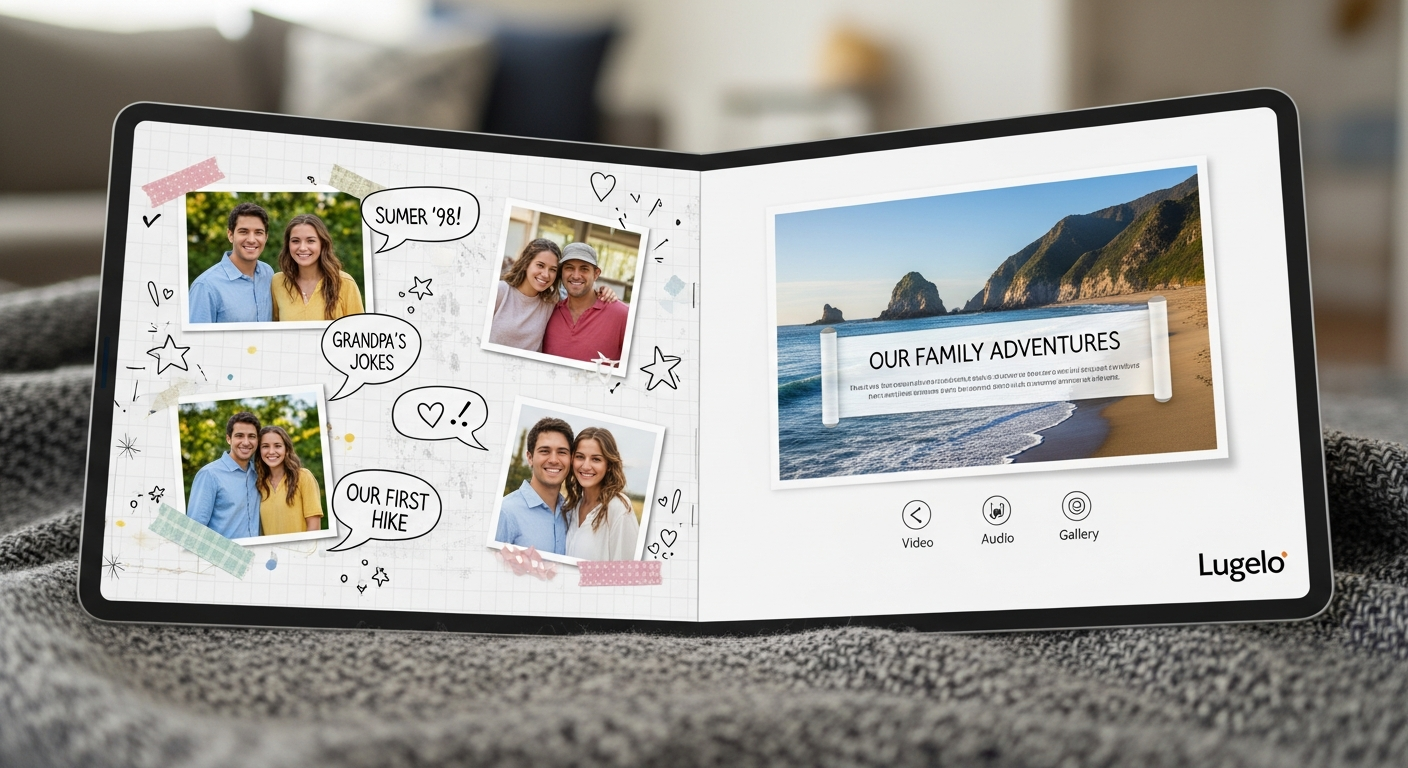
Here’s the truth that the feature comparisons point toward but don’t quite say outright: most of the moments in your life that you’ll most want to remember are moments you shared with other people. Your children’s milestones. Your family’s trips. The celebrations that took years to plan and flew by in a single afternoon. None of those memories belong in a solo diary. They belong in a shared space — one where everyone who was there can contribute, and everyone can receive something beautiful from what was built together.

The moments that matter most are rarely lived alone.

Lugelo was built with that understanding at its foundation. It’s free to start on iOS, available on iOS, Android, HarmonyOS, and web — and the keepsakes it produces speak for themselves. Storybooks. Ebooks. Timelines. VR galleries. Not just entries in an app, but artifacts that will still matter in twenty years.

Your story deserves more than a camera roll. It deserves a home.

The Only Question Left to Answer

Every journaling app in this comparison serves someone well. Day One is a masterpiece for the solo journaler. Penzu is a fortress for the privacy-conscious writer. Rosebud is a revelation for the person doing the inner work. Journey is a workhorse for the perpetual multi-device switcher. Diarium is freedom for the subscription-averse power user.

But none of them were built for what Lugelo was built for: the belief that a journal shouldn’t just hold your memories — it should help you share them, shape them into something meaningful, and preserve them in forms worthy of the moments they capture. That’s not a feature difference. It’s a philosophical one. And it’s the difference between an app that holds your words and a platform that honors your story.

The best journaling app isn’t the one with the most features. It’s the one you’ll actually use — the one that fits the kind of storyteller you want to be. If your story involves other people (and the best stories always do), you need a platform that was designed for that from the ground up.

Everyone has a story to tell. The only question is: where are you keeping yours?

Your memories deserve better than scattered apps.
Start capturing, collaborating, and creating with Lugelo — free to get started.
Create Your First Journal →


Already journaling? Explore how Lugelo turns your entries into storybooks, ebooks, and VR galleries.
Learn More →

Can AI Be Your Co-Writer? Exploring AI Prompts in Personal Journaling

Can AI Be Your Co-Writer? Exploring AI Prompts in Personal Journaling

Introduction

This blog endeavors to understand how AI can revolutionize the age-old practice of journaling. By delivering unique prompts and insights, AI can inspire creativity, offer new perspectives, and help document personal growth. We’ll dive into how tools like Lugelo are integrating AI into the art of storytelling and weigh the pros and cons of such an approach.

Imagine this: It’s a quiet Sunday morning, the sun softly filters through your window, and it’s the ideal time for some reflective journaling. Yet, as you sit with pen in hand, the page remains blank. Your thoughts resist organization, and creativity feels elusive. Enter artificial intelligence—a formidable companion that can transform your journaling experience. In an era where AI is revolutionizing numerous facets of daily life, from automating tasks to enhancing creativity, its potential as a “co-writer” in personal journaling is an exciting paradigm to explore.

Eureka Moments Enhanced by AI

The Creativity Catalyst

Have you ever faced the infamous writer’s block—staring at a blank page, overwhelmed by the vast universe of untapped ideas? AI can be the creative catalyst you never knew you needed. By generating innovative prompts, AI encourages self-reflection and fosters creativity, acting as a digital muse ready to stimulate your thoughts.

For instance, demonstrates how different prompts can personalize the journaling experience. By using AI like ChatGPT, users can receive prompts specifically tailored to evoke introspection and validate their emotional expression.
Mandy Nicole’s experience on Medium

“AI doesn’t limit creativity; it enhances it by showing you facets of yourself and your journey you might not readily see.” — Mandy Nicole

Providing Unique Perspectives

Imagine daring guidance that leads you down less-traveled cognitive paths. AI isn’t just about the here and now; it can illuminate your thought patterns and help you gain clarity. Insights derived from AI prompts can reveal subconscious biases or unexplored narratives in your life story, nudging you to view challenges or memories through a fresh lens.

A fascinating shares how integrating AI questions helped an individual analyze their writing deeply. By asking tailored questions, the AI managed to poke into the essence of the person’s thoughts, leading to revelations about their emotional state and mindset.
Reddit post on ZenHabits

Documenting Personal Growth

In the endurance track of life, sometimes the incremental progress we make can blend into the background. AI technology can meticulously record this growth through consistent pattern recognition. Using a fusion of historical journaling data and predictive algorithms, AI can highlight the subtle shifts you might otherwise miss.

Key Features of AI-Enhanced Journaling Tools:

  • Prompt Generation: Creativity-sparking questions that inspire new entries.
  • Sentiment Analysis: Analyzing tone and mood in your previous entries to reflect growth.
  • Tailored Insights: Personalized suggestions based on past writing patterns.

An image of a digital journal showing AI-generated prompts and expressive writing entries.

Navigating the Journal with Lugelo

A Storytelling Companion

Lugelo, a groundbreaking journaling app, exemplifies how AI can enhance personal storytelling. This secure, user-friendly platform offers both web and mobile capabilities to seamlessly integrate into your life. Aside from the interactive journaling experience, Lugelo lets you share compositions across a broad audience—a community of fellow writers who can provide feedback and encouragement.

In learning , you’ll discover that it not only enriches your writing process but also curates your entries to spotlight growth trajectories and thematic life arcs—a fascinating self-exploration tool.
how Lugelo works

Integrating AI to Boost Mental Wellbeing

Balancing mental health and personal journaling often entails excavating deeper emotions. Enter , an AI-powered journal dedicated to improving mental wellbeing, cognitive skills, and overall mindset. Trusted by thousands, this tool similarly leverages AI to provide scientifically-backed prompts that fuel mental resilience and introspection.
Mindsera

“The mind is a labyrinth of thoughts, and AI holds a map to navigate its corridors, ensuring occupants find peace at its core.” — Mindsera

The Benefits and Limitations of AI Journaling

Benefits of an AI Co-Writer

  • Consistency: AI can instill discipline by reminding you of your journaling schedule and suggesting time slots.
  • Objectivity: Provides external perspectives free from subjective bias, encouraging broader thinking.
  • Customization: Offers personalized prompts that resonate with your individual experiences and aspirations.

Limitations to Consider

While AI can be a remarkable ally, it’s important to recognize the limitations inherent in its use:

  • Lack of Emotional Intelligence: Despite impressive linguistic capabilities, AI lacks true empathy and emotional depth.
  • Privacy Concerns: Users must remain vigilant about data privacy, ensuring their personal information is protected.
  • Over-Reliance: Depending too heavily on AI can dampen natural creativity and lessen the personal touch found in human-authored content.

An image depicting balance between AI technology and human creativity in journaling.

Conclusion

In a world where personal growth stories unfold on pages every day, imagine inviting AI into that narrative—an emerging reality at the intersection of human expression and technological evolution. Now, as you sit to pen your next journal entry, ask yourself: “Could AI help me uncover the stories I might not yet know?”

Yet, it is critical to traverse this venture with mindfulness, embracing both the power and potential pitfalls of AI involvement. By balancing AI’s analytical strengths with the emotive nuances of human creativity, you can create an enriching journaling experience that truly reflects the self’s multiplicity.

As we chart the untraveled terrains of artificial intelligence in personal journaling, the promise of a collaborative co-writer emerges—a partner in creativity offering fresh perspectives and systematic documentation of personal growth. AI, when utilized judiciously, can add layers of richness to the journaling process, enhancing the delivery of meaningful insights.

“Can AI be your co-writer? Absolutely. After all, every great writer has occasionally sought an external muse for inspiration.” – Unnamed Journalist

What Is Digital Journaling? A Complete Beginner’s Guide for 2026

What Is Digital Journaling? A Complete Beginner’s Guide for 2026

You took a hundred photos on that trip. You felt everything — the warmth of the afternoon light, the sound of laughter echoing down a cobblestone street, the way that one perfect meal tasted after a long day of walking. But six months later, you can barely piece together what actually happened. The photos are buried in a camera roll somewhere. The feelings? Gone. The story? Lost.

This is the quiet tragedy of modern memory. We capture more than any generation before us, yet we preserve less. And that gap — between living a moment and actually keeping it — is exactly what digital journaling was built to close.

What is digital journaling? Digital journaling is the practice of recording your thoughts, memories, experiences, and reflections using a digital device — such as a smartphone, tablet, or computer — instead of pen and paper. Unlike traditional journaling, digital journals can include photos, videos, audio clips, and links, and are accessible across multiple devices at any time.

Spring 2026 is a natural reset moment. A new season, new energy, a quiet pull toward building habits that actually stick. And if there’s one habit that your future self will thank you for, it’s this one.

In this guide, you’ll learn:

  • What digital journaling actually is — and what it isn’t
  • How it differs from paper journaling and generic notes apps
  • The proven mental health, memory, and creativity benefits backed by research
  • Who digital journaling is for (the answer may surprise you)
  • How to start your very first digital journal today, step by step
  • Where the technology is headed in 2026 and beyond

The digital journaling market is valued at $5.69 billion in 2025 and growing rapidly — this isn’t a niche wellness trend anymore. It’s a mainstream shift in how people preserve their lives. And platforms like Lugelo’s private journaling platform are at the forefront of turning scattered memories into meaningful, lasting stories.

Let’s begin.

Digital Journaling Defined: More Than Just a Notes App

Before we go anywhere else, let’s establish a clear, complete understanding of what digital journaling actually is — because it’s frequently misunderstood, undersold, and confused with tools that don’t come close to capturing what it can do.

At its most fundamental level, digital journaling is the intentional practice of recording your inner life using digital tools. That means your thoughts, your memories, your experiences, your reflections — all captured not in a leather-bound notebook with a pen, but on the devices you already carry everywhere. A smartphone in your pocket. A tablet on your nightstand. A laptop open on a rainy Sunday afternoon.

But the definition doesn’t stop at “digital text.” That’s like describing a photograph as “light on paper.” The real power of digital journaling lies in what it can hold that paper never could.

A digital journal entry can include a paragraph of reflection and three photos from that afternoon and a voice note of your daughter laughing and a link to the song that was playing. It can be tagged by mood, date, location, or theme. It can be searched instantly — find every entry from last November in seconds. It can be private, shared with select people, or built collaboratively with a group.

This is why Harvard Health’s research on writing your life story consistently emphasizes that documenting lived experience has profound cognitive and emotional benefits — and digital journaling doesn’t just enable that practice, it deepens it by giving your story texture, multimedia richness, and longevity.

Here’s what digital journaling is not:

  • It is not a notes app. A generic notes application has no structure, no memory-first purpose, no prompts, and no privacy architecture designed around your story. It’s a scratchpad, not a journal.
  • It is not social media. Social media is audience-first — you perform for others. Journaling is self-first — you record for yourself and the people you choose.

  • It is not a word processor. Opening a blank document and hoping for the best is very different from a journaling experience that provides templates, AI prompts, emotional context, and organizational tools designed to make reflection natural.

Digital journals come in many formats, each serving a different kind of story:

  • Daily reflections — capturing the rhythm of ordinary life before it slips away
  • Gratitude journals — a research-backed practice for building positive emotional patterns
  • Travel logs — rich, multimedia accounts of adventures while the details are still vivid
  • Family memory books — collaborative archives built across generations
  • Life story timelines — chronological narratives of a person’s whole journey
  • Group or event journals — shared spaces where friends, couples, or families co-author a memory

And then there are platforms like Lugelo that take this further still — transforming journal entries not just into a list of memories, but into storybooks, ebooks, interactive timelines, and even VR galleries. Digital journaling, at its best, isn’t just record-keeping. It’s legacy-building.

The question of what is digital journaling is really a question about how you want to experience your own story. Once you understand what it’s truly capable of, the more interesting question becomes: how does it actually work?

How Digital Journaling Works — The Mechanics Made Simple

Understanding the idea of digital journaling is one thing. Feeling confident that you can actually do it — without a learning curve, without a technology degree, without spending an hour figuring out an app — is another. So let’s walk through the real mechanics: what devices you’ll use, what an entry actually looks like, and what happens to your journal once you’ve made it.

The devices are the ones you already own. Digital journaling works across smartphones (iOS, Android, HarmonyOS), tablets, computers, and web browsers. The best platforms sync across all of them automatically — so you might start an entry on your phone during your morning coffee, add a photo from your tablet in the evening, and review old entries on your laptop on a Sunday. Your journal is wherever you are. Always.


Here’s what creating a digital journal entry actually feels like in practice:

  1. Open the app. One tap, no friction. You’re immediately in your journal space.
  2. Write your entry. A few sentences, a paragraph, a full page — whatever the moment calls for. No minimum, no maximum.
  3. Attach richness. Add a photo from your camera roll, record a quick voice note, embed a video clip, or drop in a link. Even one multimedia element transforms text into a memory.
  4. Organize it. Apply a tag (family, travel, work, personal), note your mood, or let the platform auto-date and categorize your entry.
  5. Save and sync. Your entry is backed up to the cloud, encrypted, and accessible across every device you own.

That entire process can take five minutes. Or fifty. The technology flexes to match your energy, not the other way around.

One of the most transformative elements of modern digital journaling is the role of AI-powered prompts and journal assistants. Blank-page paralysis — that familiar, frustrating moment of staring at an empty entry and not knowing what to write — is one of the biggest barriers to consistent journaling. AI assistants solve this elegantly, offering personalized prompts, suggesting entry ideas based on recent events, and even helping you reflect more deeply on what you’ve written. A 2024 study published on arXiv demonstrated that AI-powered journaling apps produced measurable improvements in emotional wellbeing among college students — and the technology has only grown more sophisticated since.

Privacy is another mechanic worth understanding clearly. The best digital journaling platforms are private by default — meaning no one sees your entries unless you explicitly choose to share them. Look for apps that offer end-to-end encryption in transit, password or biometric protection, and granular sharing controls. Your journal should feel as safe as your thoughts.

And then there’s the organizational power that paper simply cannot match. Digital journals are searchable across years of entries in seconds. You can filter by date, mood, tag, journal type, or keyword. Want to find every entry you wrote about your daughter’s first year? Two seconds. Looking for all your travel reflections from the past five years? Done. The ability to instantly surface any memory you’ve ever recorded transforms a journal from an archive into a living, breathing record of your life.

Download Lugelo on iOS, Android, or web to experience what a purpose-built digital journaling platform feels like — designed not as a utility, but as a home for your story.

Now that you understand the mechanics, a fair and important question emerges: if paper journaling has worked for centuries, why make the switch? Let’s explore that honestly.

Digital Journaling vs. Paper Journaling — An Honest Side-by-Side

This is the debate that every journaling beginner eventually encounters, and it deserves a fair, nuanced answer — not a sales pitch. Because paper journaling is genuinely beautiful. It has real advantages. And dismissing it would be both dishonest and unhelpful.

So let’s look at both clearly.

Where paper journaling genuinely wins:

Paper offers something digital can’t fully replicate: the sensory experience of writing by hand. The scratch of a pen on a page, the physical act of forming letters, the smell of a worn notebook — these tactile elements engage the brain differently. Research consistently suggests that handwriting can produce a slower, more deliberate mode of thinking. There are no notifications on a paper journal. No battery warnings. No temptation to check your messages mid-sentence.

Paper also offers absolute creative freedom. You can sketch in the margins, press a flower between the pages, write in three different colors, or let your handwriting itself carry your mood. A paper journal has personality in ways a digital font cannot always match.

Where digital journaling pulls decisively ahead:

The moment you need to find something, paper breaks down completely. There’s no search function in a handwritten journal from 2019. There’s no way to attach the photo you took that day, the song you were listening to, or the voice message your mother sent. Paper journals can’t be backed up. They can be lost in a move, damaged by water, or simply sit in a box for decades, unread and unfound.

Here’s what digital journaling offers that paper fundamentally cannot:

  • Searchability — find any entry, any memory, from any year, in seconds
  • Multimedia richness — photos, video, audio, and links woven directly into your story
  • Cross-device access — your journal is always with you, on any screen
  • Cloud backup and encryption — your memories are protected from loss, damage, or theft
  • Collaboration — invite family members, friends, or partners to contribute their own perspective to a shared journal
  • Templates and AI prompts — no more blank-page paralysis
  • Output formats — transform entries into ebooks, storybooks, timelines, and VR galleries

The real-world problem with paper isn’t just convenience — it’s completeness. A handwritten journal entry about a birthday party exists separately from the photos on your phone, the video on your partner’s camera, and the note your child drew. Digital journaling brings all of these threads together into one coherent, searchable, shareable memory.

Harvard Health’s research on expressive writing confirms that the act of writing about emotions produces real mental health benefits — and those benefits apply whether you’re writing by hand or typing. The format matters far less than the habit.

The wisest approach for many journalers is a hybrid model: paper for daily quiet reflection, digital for milestone events, collaborative memories, and anything you want to preserve for decades. These two practices don’t compete — they complement each other.

But if you’re choosing where to build your primary memory archive — the one you want to search, share, and transform into something lasting — digital journaling isn’t just better. It’s in a different category entirely. As Lugelo puts it: “Your memories deserve better than scattered apps.”

Beyond the format debate, the science behind journaling itself is remarkably powerful — and that’s where digital journaling truly earns its place in a modern life.

The Future of Digital Journaling in 2026 — AI, VR, and Collaborative Storytelling

The Future of Digital Journaling in 2026 — AI, VR, and Collaborative Storytelling

We are living through an inflection point in how human beings preserve their stories. The tools available to journalers in spring 2026 would have seemed extraordinary five years ago — and what’s emerging over the next few years is more extraordinary still.

The Market Signal: This Is Mainstream Now

The digital journaling market is projected to grow from $5.69 billion in 2025 to $6.34 billion in 2026 at an 11.4% CAGR. Journaling app downloads increased 400% between 2020 and 2024. These numbers don’t describe a niche habit — they describe a mainstream cultural shift in how people think about memory, reflection, and self-documentation. The question is no longer whether digital journaling will become a standard practice. It already has.

AI Journal Assistants: The End of Blank-Page Paralysis

The integration of artificial intelligence into journaling isn’t a gimmick — it’s genuinely changing the experience of sitting down to write. AI-powered prompts adapt to your patterns, suggesting entry ideas based on what you’ve written before, the time of year, or events you’ve noted. AI assistants can help you reflect more deeply on an entry you’ve just finished, identifying emotional themes you might not have noticed yourself.

The MindScape study on arXiv documented how an AI-powered journaling app produced meaningful improvements in positive affect, reductions in loneliness, and gains in mindfulness — all from an 8-week journaling habit enhanced by intelligent prompting. As these systems become more sophisticated, the gap between “wanting to journal” and “actually journaling consistently” will continue to shrink.

VR Memory Galleries: Walking Through Your Story

This is the frontier that feels most extraordinary — and it’s closer than most people realize. Imagine not just reading a journal entry from a family vacation, but stepping into it: a three-dimensional, explorable space where the photos become windows, the videos play in the air around you, and the full richness of a memory surrounds you immersively.

Lugelo’s VR gallery feature is already moving in this direction — allowing users to transform their journal entries and photos into three-dimensional memory galleries. The goal is not novelty. The goal is presence — the feeling of actually being back in a moment, not just reading about it.

Collaborative Storytelling: From Solo Practice to Shared Legacy

Perhaps the most meaningful evolution in digital journaling isn’t technological — it’s social. Journaling is transforming from a solitary, private act into a collaborative, multi-perspective memory-building experience. Families co-author memory books. Friend groups build shared archives. Partners document their relationship from both sides. Groups create event journals that capture a celebration from every angle at once.

This shift matters because the most complete version of any memory is never a single perspective. Your daughter’s first birthday looks different through her eyes than through yours. A road trip remembered by five friends contains five stories. Collaborative digital journaling is the infrastructure for capturing that full richness.

From Journal to Keepsake: The Evolution of Output

The final major trend reshaping digital journaling is the evolution of what a journal can become. Entries in a list are just the beginning. Modern platforms are transforming those entries into printed memory books, illustrated ebooks, interactive timelines, and immersive VR galleries. Journaling is becoming legacy creation — the act of building something that outlasts the moment and can be passed down through generations.

“Your memories deserve more than a folder of photos. They deserve a story — and in 2026, the tools to tell it have never been better.”

Privacy as a Standard, Not a Feature

As people grow more conscious of data ownership — who sees their information, who controls their story — private-by-default journaling is becoming the expected norm rather than a premium offering. The best platforms don’t ask you to opt into privacy. They build it in from the ground up, with user-controlled sharing and encryption as baseline features.

Spring 2026 is the right moment to start. The technology is ready. The research is clear. And the tools — like Lugelo — are more accessible and more powerful than they’ve ever been.

Frequently Asked Questions About Digital Journaling

Frequently Asked Questions About Digital Journaling

What is digital journaling?
Digital journaling is the practice of recording thoughts, memories, and experiences on a digital device — such as a smartphone, tablet, or computer — using an app or platform designed for personal reflection and storytelling. Unlike a notes app, a digital journal provides structure, multimedia support, privacy controls, and memory-first features.

Is digital journaling better than paper journaling?
Both have unique strengths. Digital journaling offers searchability, multimedia support, cloud backup, and collaboration — making it better for preserving rich, complex memories over time. Paper journaling offers a tactile, screen-free experience. Many people use both — paper for quiet daily reflection, digital for milestone events and shared memories.

What should I write in a digital journal?
You can write daily reflections, gratitude entries, travel logs, family milestone records, goal-tracking notes, or collaborative memories with loved ones. Templates and AI prompts can help you start if you feel stuck. A simple starting question: “What happened today that I don’t want to forget?”

How do I keep my digital journal private?
Choose an app that offers encryption, password or biometric protection, and owner-controlled sharing. Lugelo, for example, is private by default — only you decide who sees your entries, and your data is encrypted in transit.

Can I include photos and videos in a digital journal?
Yes — and this is one of digital journaling’s greatest advantages over paper. You can embed photos, video clips, audio recordings, and links directly into your entries to create richer, more vivid memories that capture not just what happened, but how it felt.

How do I start a digital journal as a beginner?
Choose a journaling app, pick a purpose (daily reflection, family memories, travel log), create your first entry today, and add one photo. Start with five minutes. You don’t need to be a writer — you just need to begin. Lugelo makes this process simple for first-time journalers.

What is collaborative digital journaling?
Collaborative digital journaling allows multiple people to contribute to the same journal — adding entries, photos, and memories from their own perspective. It’s ideal for families documenting milestones, friend groups capturing shared adventures, and events like weddings or group trips where every participant has a unique story to tell.

Can digital journals be turned into books or keepsakes?
Yes. Modern platforms like Lugelo allow you to transform journal entries into ebooks, storybooks, printed memory books, timelines, and even immersive VR gallery experiences — turning your ongoing journaling practice into a lasting, shareable legacy.

How to Start Your First Digital Journal — A Beginner’s Step-by-Step Guide

How to Start Your First Digital Journal — A Beginner’s Step-by-Step Guide


The most common reason people never start a journal isn’t laziness. It’s the quiet, persistent belief that they need to be ready — that they need a significant moment, the right mood, the perfect first line. They don’t. And you don’t either.

Here is the clearest, most friction-free path from thinking about journaling to actually doing it.

Step 1: Choose Your Journaling Purpose

Before you open any app, take sixty seconds to answer this question: what do I most want to capture?

Daily thoughts and feelings? Family milestones? A big trip coming up? A season of personal growth you want to document? Your purpose shapes everything — how often you write, what format you use, whether you invite others. You can always expand later. For now, just pick one thing.

Step 2: Pick the Right Platform

Not all journaling apps are created equal. Look for a platform that supports multimedia (photos, video, audio), offers genuine privacy controls, works across your devices, and provides templates or AI prompts to help you when you’re stuck. Generic notes apps don’t meet this bar.

Lugelo is purpose-built for exactly this: a private, multimedia-rich journaling platform that works across iOS, Android, and web, with collaborative features and AI journal assistance built in.

Step 3: Create Your First Journal and Write Your First Entry Today

Don’t wait for a significant moment. Don’t wait until something “worth writing about” happens. Write about right now — this season, this week, this afternoon. Your future self will be grateful for the ordinary moments far more than the extraordinary ones.

Name your journal. Pick a template if one is available. Write three sentences. That’s a real entry.

Step 4: Add Richness to Your Entry

Go to your camera roll and add one photo to your entry. That’s it. One photo. Watch how instantly that transforms a paragraph of text into something that feels like a memory rather than a note. Audio, video, and links can come later. One photo is enough to start.

Step 5: Build the Habit

Consistency beats quality every time when it comes to journaling. Five minutes every evening is worth infinitely more than one two-hour session once a month. Set a regular time — morning reflection while coffee brews, an evening recap before sleep, a post-event documentation ritual after anything meaningful happens.

Use prompts when the blank page intimidates you:

  • “What happened today that I don’t want to forget?”
  • “What was the best moment of the last week?”
  • “What do I want to remember about this season of life?”

These three questions alone can sustain a journaling practice indefinitely.

Step 6: Invite Others (Optional, But Powerful)

If you’re documenting a shared experience — a family vacation, a group trip, a wedding — invite the people who were there to contribute. Collaborative journaling multiplies the richness of any memory exponentially. Someone else noticed things you missed. Their photos are different from yours. Their emotional experience of the same moment may surprise you.

Download the Lugelo app for iOS or Android and you can be writing your first entry within minutes. No experience required. No special writing skills needed. You just need to begin.

And if you’re wondering where this technology is heading — because it is heading somewhere remarkable — the next section will show you what’s already here and what’s coming fast.

Writing Through Change: Journaling During Life Transitions

In this blog, we’ll delve into effective journaling techniques for times of change and explore how tools like Lugelo are revolutionizing the journaling landscape, offering new dimensions through collaboration and virtual reality (VR) features.

Transitions in life are inevitable, whether it’s starting a new job, moving to a new city, or navigating personal growth. These moments, though often exciting, can also bring a sense of uncertainty and emotional upheaval. Enter journaling—a powerful tool that offers not just an escape, but a lens to view, process, and understand these turbulent periods.

The Power of Journaling Through Transitions

Why Journaling Matters

Journaling isn’t just about jotting down thoughts; it’s about weaving a narrative through the chaos. When life is in flux, journaling serves as a grounding practice, helping you reflect, gain clarity, and process emotions. It’s a safe space where you can explore fears, dreams, and challenges without judgment.

According to , regular journaling can keep your practice engaging and meaningful, allowing you to uncover insights about your personal journey through weekly prompts.
iDare’s article

“Great stories happen to those who can tell them.” — Ira Glass

How Journaling Helps:

  • Emotional Outlet: Writing provides a therapeutic release of pent-up emotions.
  • Clarity and Perspective: Organizing your thoughts on paper can offer new perspectives.
  • Track Growth: Journaling serves as a record of progress over time.
  • Creative Freedom: It’s a space to experiment and explore unfiltered creativity.

Real-World Examples

Consider Emma, who moved from her hometown to a bustling metropolis for a new career opportunity. Initially overwhelmed, she decided to chronicle her experience through journaling. Month by month, she saw her transition from fear of the unknown to confidently navigating and embracing her new lifestyle.

An open journal with handwritten notes and sketches depicting a personal journey.

Techniques for Effective Journaling During Transitions

Finding Your Style

No two journals are the same. Your journaling style should be unique to your preferences and might include a mix of written entries, sketches, and even digital elements. Here are some techniques to consider:

Use prompts to guide your writing and ensure you explore areas you might overlook. Prompts from resources like Pose questions to yourself in your journal and answer them. It’s a way of engaging with your inner dialogue and uncovering deeper insights.
iDare

Use diagrams or mind maps to visualize connections between thoughts and ideas. This can help in organizing complex feelings and decisions during a transitional period.

Create themed entries that focus on specific areas, such as career aspirations, personal networks, or emotional check-ins. This technique helps in structuring thoughts and recognizing patterns.

can fuel introspection and spark creativity, keeping your journaling practice rich and varied.

Leveraging Lugelo for Enhanced Journaling

Digital Journaling with Lugelo

Lugelo stands out as a modern, secure platform designed for the digital age of journaling. It offers more than just a digital notebook; it’s an ecosystem where you can create private journals, interactive timelines, and even collaborative stories.

Explore for insights on how to maximize these features and leverage the platform for enriched journaling experiences.
Lugelo’s Blog

Key Features:

  • Interactive Timelines: Track events and emotions through dynamic timelines.
  • Secure Private Journals: Safety is paramount; Lugelo ensures your entries remain confidential.
  • Collaborative Stories: Engage with friends or communities in group journaling projects.
  • VR Experiences: Immerse yourself in capturing moments with a new depth of feeling through VR.

Capturing Pivotal Moments

With , you can preserve life’s milestones with precision and creativity. Whether it’s starting a new chapter or reflecting on a completed one, Lugelo’s features empower you to document your journey in innovative ways.
Lugelo’s digital storytelling tools

Person using Lugelo app on a tablet to journal their life transitions.

Journaling as a Transformative Practice

Creating a Ritual

Make journaling a ritual rather than a chore. Set aside dedicated time for it, create a comfortable environment, and perhaps pair it with activities like meditative music or a soothing cup of tea to establish consistency and ritualistic pleasure.

Incorporating Feedback Loops

Review past entries periodically to gain insight and measure growth. Reflect on earlier concerns or ideas and consider how your perspective has evolved. This feedback loop encourages self-reflection and growth.

  • Q: How often should I journal during a transition?
  • A: There is no fixed rule. Some prefer daily entries, while others benefit from weekly reflections. The key is consistency and finding a rhythm that suits you.
  • Q: What if I experience writer’s block?
  • A: Use prompts or switch to drawing and doodling. Sometimes visual expression can unblock verbal expression.

Conclusion

Journaling is a journey in itself—a voyage through the landscapes of change, doubt, and discovery. It provides a roadmap of where you’ve been and points to the direction in which you’re heading. As you write through life’s transitions, remember to embrace each entry as a step closer to understanding and transformation.

Start your journaling practice with tools like , and turn life’s transitional periods into rich, meaningful stories worth revisiting. Happy journaling!
Lugelo

“Each day has a new story to tell. Just open the book and let the writing begin.”

Preserve Your Legacy: Using Lugelo to Capture Family History

Preserve Your Legacy: Using Lugelo to Capture Family History

In an age where moments can slip by as quickly as a swipe of a screen, preserving family history has never been more important—or more accessible. We live in times where storytelling isn’t just an art; it’s a necessity. Families are more spread out than ever, and history can be lost between generations. Enter Lugelo—a revolutionary app dedicated to capturing and celebrating your family’s journey through its easy-to-use, feature-rich platform.

The Importance of Preserving Family History

Imagine a future where your great-grandchildren can relive a family vacation through VR, or read your grandmother’s journal in her own words. Preserving family history isn’t just about remembering the past—it’s about connecting with the future. A well-documented family history keeps memories alive, ensures stories are told, and traditions are passed down.

“Preserving family memories is like building bridges from past to future; it connects generations in the most profound way.”

Why Documenting Family History Matters

  • Creating Connections: Memories and stories cultivate a sense of belonging and identity.
  • Cultural Preservation: Documenting traditions helps retain cultural practices.
  • Legacy Building: Stories of triumph and perseverance serve as inspiring legacies.

Lugelo understands this need and offers an innovative platform to make preserving history easier than ever. To see how Lugelo is changing the landscape of family storytelling, .
check out their app on Google Play

How Lugelo Works

Lugelo is more than just a journaling app—it’s a platform that turns memories into lasting legacies. Through mobile and web interfaces, Lugelo provides a secure, user-friendly experience for users of all ages.

Illustration of Lugelo app features such as journaling, collaboration, and multimedia storage.

Key Features of Lugelo:

  1. Journaling and Storybooks: Document everyday moments, from the small victories to life’s significant milestones.
  2. Collaboration Tools: Invite family members to contribute their stories and perspectives, making your family journal rich and diverse.
  3. VR Capabilities: Experience your family history in new dimensions with virtual reality—bring your stories to life.
  4. Multimedia Storage: Save photos, videos, and documents to complement written memories, creating a full sensory experience.

For an in-depth understanding of how these features work, visit .
Lugelo’s guide on their website

Starting Your Family’s Story with Lugelo

Starting out on this journey might feel daunting, but it’s akin to writing the first page of a blank book. You decide the chapter titles—your family’s beloved traditions, unforgettable vacations, and stories of bygone eras are yours to capture.

Steps to Begin Documenting with Lugelo:

  1. Reflect on Your Experiences: Gather family members to share stories. Begin by reflecting on key events that define your family’s journey. Learn how to organize these memories from these helpful tips on preserving family memories.
  2. Choose Your Format: Whether it’s journaling day-to-day experiences or mural storytelling, select a format that best represents your family’s narratives.
  3. Create a Timeline: Establish a chronological order for entries to ensure a coherent story. This helps in visualizing the family’s journey through different generations.
  4. Capture Details and Emotions: Provide context and emotion to your entries, for it is the emotions that add color to the tapestry of family history.

“Family stories are treasures—pass them on and keep the memories alive.”

Building a Legacy with Lugelo

Once you’ve begun capturing stories, Lugelo makes it easy to transform them into formats that can be shared across generations. Through tools that allow you to compile entries into ebooks and PDFs, you can ensure your family history isn’t just preserved, but accessible and cherished.

Turning Memories into Legacy

After piecing together timelines and collecting anecdotes, consider transforming your family’s historical data into an enduring legacy. For guidance on the process, .
explore how to create a lasting legacy from your research

Here’s how Lugelo aids in transforming family stories:

  • Publishing Options: Convert journals into beautifully crafted ebooks or tangible prints.
  • Personalized Storybooks: Tailor storybooks for family gatherings or special occasions.
  • Interactive History: Use VR to create immersive experiences that engage younger generations.

Visualization of a digital storybook crafted using Lugelo, featuring family photos and stories in an interactive format.

Real-World Applications and Inspirations

Many have discovered the cathartic journey of documenting family history. For example, the Johnson family used Lugelo to celebrate their grandmother’s centennial birthday by compiling decades of stories, photos, and videos. It wasn’t merely a birthday gift but a passing of a torch—one that illuminated their love and perseverance. Their story serves as an inspiration, showcasing how family history preservation can unify and fortify family bonds.

Tips and Tricks for Successful Documentation

While the idea of preserving history sounds romantic, execution requires a blend of creativity and diligence.

Practical Tips to Enhance Your Family History Project:

  • Regular Updates: Encourage family members to update entries regularly.
  • Mini-interviews: Conduct informal interviews with elders to capture stories that are not written down.
  • Thematic Storytelling: Focus on themes such as migration stories, holiday traditions, or career achievements to keep the narrative engaging.

FAQ:

Q: How can I involve my extended family in documenting our history with Lugelo?A: Use Lugelo’s collaboration features to invite family members to contribute stories and photos, fostering a collective storytelling effort.

Q: Can Lugelo accommodate extensive family histories with multimedia components?A: Absolutely. Lugelo supports multimedia integration, so you can include photos, videos, and documents alongside written entries.

Conclusion

Every family has a story worth telling—a journey filled with triumphs, challenges, laughter, and love. Lugelo provides the tools to encapsulate these stories into a legacy that can be appreciated by generations to come. As you begin your family’s storytelling journey with Lugelo, remember that the memories you preserve today will become the treasures of tomorrow.

To start nurturing your family’s living legacy, explore Lugelo on , and let your family’s history be heard and cherished through the ages. Let’s preserve, celebrate, and pass down the essence of who you are with Lugelo.
Google Play

Journaling 2.0: Exploring the Future of Personal Storytelling

Journaling 2.0: Exploring the Future of Personal Storytelling

Imagine opening your journal to find not just blank pages, but an intelligent companion guiding your thoughts, offering immersive experiences, and allowing your stories to be shared and relived in vivid detail. Welcome to Journaling 2.0, where technology meets personal storytelling, creating a new era of memory preservation and narrative expression. In this blog, we will explore how platforms like Lugelo, AI prompts, and virtual reality are transforming the journaling landscape into an interactive, collaborative canvas for personal narratives.

The Time-Tested Art of Journaling

A Legacy Built on Words

Journaling has been a cornerstone for self-reflection and personal growth for centuries. From Leonardo da Vinci’s creative scribbles to Anne Frank’s poignant wartime diary, the act of journaling is a profound way to process thoughts, capture memories, and craft narratives. As noted in the Every article on AI Journaling, journaling is an effective practice for personal development, helping individuals reduce anxiety by transferring fears from the mind to the page.

“Journaling is already an effective personal development practice. It can help you get your thoughts out of your head, rendering them less scary.” — Every

However, the digital age beckons, elevating the humble journal into a dynamic, tech-driven experience that keeps the essence of storytelling alive while offering new dimensions for its expression.

Innovations Redefining Personal Narratives

AI-Assisted Writing Prompts

Incorporating artificial intelligence into journaling offers a personalized assistant to guide and inspire writing. AI tools can deliver tailored prompts to spark creativity or nudge users to explore deeper emotional terrains. These prompts serve as digital moonlit pathways, guiding thoughts into rich, vast territories yet explored.

The Every article illuminates how AI has the potential to change the way we interact with our journals, turning a static activity into a dynamic conversation. AI doesn’t just fill in blanks—it asks the poignant questions that unlock narrative treasures nestled within the subconscious.

Immersive Storytelling with VR

Virtual reality presents another revolutionary layer to journaling by creating immersive storytelling environments. Imagine revisiting a cherished memory not just through words, but by stepping into it as though you’re there again. The medium article on Fable and immersive journaling explores how VR journaling can transform the diarist into both author and protagonist, crafting narratives that are as engaging to relive as they are to write.

“Fable 2.0 introduces a new category of personal growth: immersive journaling. Through interactive storytelling, it transforms journaling…” — Medium

Collaborative and Gamified Features

Platforms like Lugelo are setting the stage for collaborative, gamified journaling. Here, journals transform into shared storytelling mediums where narratives become collective histories, enriched by multiple perspectives and memories. Lugelo allows users to compile moments into stories, creating a tapestry of shared experiences, from birthdays to holiday adventures.

Visualization of collaborative journaling, showing multiple users contributing to a single story through a virtual platform.

Self-Care and Emotional Wellbeing Through Writing

Journaling is increasingly recognized as a tool for emotional well-being and self-care. According to research published on PMC, storytelling and journaling aid professional caregivers in maintaining mental wellness. Similarly, personalized digital journals empower everyday individuals to navigate emotional landscapes and achieve greater self-awareness through narrative exploration.

The Future Holds More Than Words

Journaling in Tomorrow’s World

As storytelling technologies evolve, so does the potential of personal narratives. The intersection of technology and journaling not only enriches the writer’s experience but also preserves each slippered detail with crystal clarity for future generations. Imagine a journal that serves as an interactive family heirloom, transcending paper to become a digital diadem imbued with the very essence of past lives, dreams, and visions.

The future of journaling invites us all to take courage, to be protagonists in our own stories, with tools that turn the introspective into the interactive, and the reflective into the immersive.

Practical Tips for Journaling in the Digital Age

Considering the ever-expanding universe of journaling options, here’s how you can integrate these innovations into your journal practice:

  1. Start with AI Prompts: Use AI to overcome writer’s block and delve into meaningful self-reflection.
  2. Explore VR Journaling: For visually rich storytelling, experiment with immersive technologies that enable you to relive memories.
  3. Make It a Collaborative Journey: Platforms like Lugelo make it easy to involve family and friends, enriching your stories with diverse perspectives.
  4. Leverage Gamification: Turn journaling into an engaging activity with gamified challenges that motivate daily entries.
  • Q: What if I’m new to digital journaling?
  • A: Ease in with AI prompts and simple digital platforms before exploring more advanced features like VR.
  • Q: How can I use journaling for self-care?
  • A: Utilize AI prompts to navigate your emotions and engage with immersive storytelling to unpack personal narratives in a therapeutic context.

Conclusion

“The power of journaling lies not merely in the act of writing, but in the journey of discovery, introspection, and connection it enables.”

As we lean into the future of personal storytelling, journaling is poised to become richer and more inclusive than ever before. Whether you’re seeking personal growth, emotional catharsis, or the preservation of memories, Journaling 2.0 holds the keys to unexplored realms of creativity and self-expression.

Join us as we explore these new horizons, and transform your journaling practice into something more vivid, more connected, and more alive. Explore tools like Lugelo to begin your journey into the next realm of personal storytelling.

The Story of Us: My Family in 5 Memories

The Story of Us: My Family in 5 Memories

Every family is like a mosaic, a vivid collection of moments that come together to form a beautiful picture of shared history and connection. As I reflect on my family, five memories stand out, each a vibrant tile that adds depth and color to our collective story. By weaving these tales into a coherent tapestry, we not only preserve them for ourselves but also turn them into an inheritance for future generations.

In this blog, I’ll share with you the essence of my family through these cherished anecdotes. You’ll also discover how to craft your own family narrative using tools like , which combine traditional storytelling with modern technology to capture and enhance our most treasured memories.
Lugelo

Memory 1: The Great Camping Adventure

It was the summer of 1998 when our family decided to embark on a camping trip. For some, it might seem like a simple retreat into the wild, but for us, it became an unforgettable adventure marked by laughter, challenges, and a deeper connection.

We set up our tents beside a serene lake, the air crisp with the promise of exploration. Little did we know, a family of curious raccoons had decided to explore our food supplies the first night. Instead of a disaster, their nightly visits became a source of endless amusement, marking a pivotal moment of spontaneity and laughter that we would recall fondly for years to come.

Family gathered around a campfire under a starlit sky, sharing stories and laughter.

Tools to Capture the Adventure

To recreate such cherished outings, consider using a designed to house memories both big and small. Whether it’s a pesky raccoon or a perfect sunset, each detail contributes to your family story.
Family Journal

Memory 2: The Surprise 70th Birthday

INSERT IMAGE HERE: A large family gathered around a festively decorated table, celebrating a milestone birthday.

As the lights flickered on, Grandpa’s face lit up brighter than any candle. In those shared embraces and joyful tears, we learned that our family is a circle of strength and love, formed by shared memories and bound together by the smiles of those we hold dear.

A milestone celebration, Grandpa’s 70th birthday was a testament to our family’s unity and love. The secret planning meetings, countless giggles over WhatsApp chats, and hushed conversations to keep it under wraps culminated in a surprise party that brought every generation together.

Creating Lasting Records

Capture such heartfelt celebrations using , where you can document each cherished smile and surprise moment, transforming them into timeless heirlooms.
Our Family: A Keepsake Album

Memory 3: A Day at the Amusement Park

INSERT IMAGE HERE: A vibrant amusement park with families joyously exploring various rides and attractions.

But it wasn’t the rides that made the day extraordinary—it was the shared joy and the glances of pure delight that illuminated our path as we moved from one attraction to another. Sometimes, it is in simplicity that we find the most invaluable treasures.

A seemingly ordinary outing to the amusement park turned into a tapestry of joy and togetherness. With children tugging at our hands, eager to conquer the towering roller coasters, it was a day filled with screams, laughter, and cotton-candy-induced giggles.

Enhancing Your Narrative

Immortalize such simple yet profound moments using platforms like , which offer a creative space for turning everyday experiences into captivating stories enriched with multimedia elements.
Lugelo

Memory 4: The Unplanned Family Reunion

While it wasn’t the same as sharing physical space, seeing everyone on-screen, laughing at shared jokes, and watching toddlers toddle into their parents’ laps, brought about a sense of warmth and unity that transcended physical barriers.

Life has a way of bringing unexpected blessings our way. A year ago, the world paused, compelling us to embrace new ways of connecting. With travel restricted, we turned to digital platforms to bring family from different corners of the world into one virtual room.

“A family’s story is its heritage. It’s something to be passed down.” –

Family Life

Memory 5: Christmas Eve Traditions

INSERT IMAGE HERE: Family joyfully exchanges gifts around a warmly lit Christmas tree.

In the glow of twinkling lights and under the watchful eye of our evergreen tree, we bask in the comfort of togetherness. These moments remind us that no matter the directions life takes us, our family is a constant lighthouse guiding us home.

Every Christmas Eve, our family gathers around to share stories and open one special gift each. This tradition, rich with nostalgia and warmth, anchors us to our roots and each other.

Tools to Chronicle Traditions

To preserve such traditions in a dynamic format, turn to , which allow you to include VR elements and rich media, creating an immersive experience for future generations.
family storytelling platforms like Lugelo

Conclusion: Weaving the Tapestry of Us

Our family stories are more than just memories; they are threads in the tapestry of our lives—vibrant strands that capture the essence of who we are. By documenting and sharing these tales, we not only celebrate ourselves but also build a legacy that will resonate through generations.

For those looking to initiate their own family chronicle, explore resources like , , or . Each offers a unique canvas to capture the story of us, ensuring that love, laughter, and togetherness are always at the heart of our narrative.
Lugelo’s digital storytelling possibilitiesKeepsake AlbumsMemories – Our Family Journal

“In the end, it’s not the years in your life that count. It’s the life in your years.” – Abraham Lincoln

Blending Analog with Digital: Enhancing Creativity through Journaling

Blending Analog with Digital: Enhancing Creativity through Journaling

Introduction

In a world driven by digital convenience, the tactile pleasure of putting pen to paper holds its ground as a timeless practice. Journaling, a medium beloved by writers, thinkers, and dreamers alike, offers an intimate space for reflection and creativity. But what happens when you merge the analog charm of traditional journaling with the cutting-edge tools of the digital realm? Welcome to the enriched universe of hybrid journaling—a confluence where your creativity not only flows, but also thrives.

This exploration into blending analog with digital journaling will reveal how integrating both mediums can elevate your storytelling and imagination. From using apps like Lugelo to embracing the simple joy of a blank page, let’s embark on a journey to enhance our personal narratives through a comprehensive and dynamic journaling experience.

The Power of Analog Journaling

A Handwritten Journey

The essence of analog journaling lies in the physical act of writing. The sensation of pen gliding over paper engages multiple senses, forging a deeper connection between mind and medium. This tactile interaction can unlock a wellspring of creativity, fostering an environment where ideas are free to roam and grow unrestrained by pixels and screens.

The Bullet Journal method highlights the power of the analog approach, emphasizing raw, unfiltered expression devoid of auto-corrections and digital distractions. By cultivating a routine that encourages manual writing, journaling becomes a mindful practice, grounding you in the present moment.

When you write by hand, you create a unique connection with your thoughts and emotions—one that digital platforms can sometimes dilute.” — Journal Enthusiast

Close-up of a handwritten journal entry featuring elaborate sketches and notes.

Introducing Digital Platforms to the Mix

From Paper to Pixels: Embracing the Digital Realm

While analog journaling captures the beauty of spontaneity and personal touch, digital journaling apps introduce an array of tools designed to enhance creativity. One such platform, Lugelo, offers a secure and interactive space to weave multimedia elements into your entries, revolutionizing how stories are documented.

  • Multimedia Integration: Enrich your entries with photos, audio recordings, and videos, bringing memories to life in vivid detail.
  • Organizational Tools: Leverage tags, timelines, and search functions to easily organize and retrieve your thoughts.
  • Accessibility & Security: Document your journey anywhere, anytime, with cloud-backed security.

Crafting a Personalized Hybrid Practice

Researchers have focused on creating hybrid tools that seamlessly bind the tangible with the digital. These tools, as discussed in the ACM study, allows users to preserve the authenticity of analog documentation while exploiting digital affordances for a more flexible journaling experience.

  1. Begin on Paper: Start with an analog session to brainstorm ideas and capture raw thoughts.
  2. Extend Digitally: Transition to a digital platform to expand on ideas, incorporate multimedia, and organize your entries.
  3. Revisit and Reflect: Regularly review both mediums to see how they complement each other and your evolving narrative.

Enhancing Storytelling and Imagination

Finding Inspiration in Every Medium

Combining analog and digital mediums empowers you to explore diverse storytelling avenues. Analog allows spontaneity—sketch out drafts, scribble thoughts, and let your imagination roam free. Transitioning to digital platforms, you can refine your narratives, experiment with formats, and create a comprehensive archive of vivid stories.

The blog by Pausa.co illustrates how Artificial Intelligence can enhance your journaling by turning handwritten notes into editable digital texts, promoting creativity without boundaries. AI-driven insights even suggest prompts and patterns to ignite your creative process anew.

Real-World Application: A Writer’s Experience

Consider Alex, an indie author who struggles with writer’s block. By blending analog and digital journaling, Alex embraced a free-flowing analog session each morning, followed by structured digital entries where multimedia elements added depth and context. This practice not only alleviated creative blocks but also resulted in a rich tapestry of ideas ready for further development into publishable work.

The marriage of analog and digital methods reinvigorated my writing process, transforming journaling into both a creative playground and a strategic tool.” — Alex, Indie Author

Organizing Ideas and Maintaining Consistency

Practical Tips for Organization

The challenge of maintaining a cohesive journaling practice lies in organization. Here are practical tips to keep your hybrid journaling efforts structured and invigorating:

  • Dedicated Journals: Allocate separate notebooks for specific themes or ideas to maintain focus.
  • Digital Cataloging: Use digital tags and folders to categorize your entries for easy navigation and retrieval.
  • Regular Review: Schedule a monthly review to connect the dots, revisit forgotten ideas, and find new inspiration.

The Role of Technology in Sustaining Structure

Technological advancements support organizational efficiency. Digital platforms offer integration capabilities that synchronize handwritten notes to their digital counterparts. As detailed in the Lugelo article, this synthesis allows automatic sorting, tagging, and archiving, streamlining the maintenance of a structured journaling practice.

Image representing organized journaling using both analog notebooks and a digital device showing categorized entries.

Conclusion

By creatively blending analog and digital methods, you can transcend the limitations of a single medium, unlocking new avenues for self-expression and storytelling. Whether capturing spontaneous ideas on paper or expanding them digitally with multimedia richness, this hybrid approach enriches your journaling journey.

As you engage in this dynamic process, you’ll not only enhance your creativity but also create a valuable archive of experiences and insights. Remember, the ultimate goal of journaling—be it analog, digital, or blended—is to enable a deeper connection with yourself and the stories you wish to tell.

In the fusion of tradition and innovation, we’re rediscovering the limitless potential of the human imagination.” — Creative Enthusiast

Explore more about enhancing your journaling practice by visiting the Lugelo Blog Page. Let this be your guide to discovering a world where analog charm meets digital innovation, making each page an evolving masterpiece.

The Future of Journaling: AI Meets VR in Lugelo

The Future of Journaling: AI Meets VR in Lugelo

Introduction

Imagine stepping into a world where your personal diary isn’t just a collection of written entries but a vivid, immersive experience. Imagine reliving your memories as if you are walking through them again, witnessing moments frozen in time. This is precisely what Lugelo, an innovative journaling app, is bringing to life by merging artificial intelligence (AI) with virtual reality (VR). In this blog, we’ll explore how these cutting-edge technologies are revolutionizing the way we document and relive our personal stories.

The Evolution of Journaling

From Pen and Paper to Digital Platforms

Journaling has been a way for people to document their lives for centuries, evolving from simple diary entries written with quill and ink to digital notes on smartphones. But technology is taking journaling a quantum leap forward. With Lugelo, the act of journaling becomes an immersive journey, integrating the experiential power of AI and VR.

The Role of AI in Modern Journaling

Artificial intelligence introduces a new dimension to journaling by automating and enhancing traditional diary tasks. Whether it’s through AI-driven suggestions for entries or organizing your life stories in a cohesive narrative, AI serves as a personal assistant in the journaling process. More insights on the seamless integration of AI and VR can be found in a .
Medium article on crafting realities that feel alive

“AI is the invisible engine making virtual worlds smarter, more responsive, and eerily lifelike.” — Medium

Enter: Virtual Reality

Making Memories Tangible

Virtual reality has the potential to transform how we experience our memories. By turning journal entries into vivid VR experiences, Lugelo enables users to walk through memories as if they are living them again. Instead of merely reading about a family vacation, you can put on a VR headset and find yourself back at that beach, feeling the sand beneath your feet and hearing the waves crash.

Creating a Personal VR Gallery

Lugelo offers a unique feature called the Personal VR Gallery, which allows users to curate their virtual spaces filled with moments, achievements, and stories. This customization not only makes the journaling experience more personal but also deeply immersive. Interested users can explore how to create their Personal VR Gallery in Lugelo through their .
website

The Synergy of AI and VR

Enhancing User Experience

The convergence of AI and VR holds immense potential for enriching user experiences. AI can enhance interactions within VR environments by providing AI-driven chatbots and virtual companions. These elements offer guidance and companionship, making the VR experience not just interactive but engaging and personalized. Learn how AI enhances VR devices on .
Unite AI

Narratives Brought to Life

The ability to interact with AI-driven elements within a VR setting enables storytelling to be more dynamic and interactive. Instead of reading about a significant life event, imagine conversing with a virtual representation of your past self or watching a critical moment unfold with digital aids guiding you through the narrative. This immersive storytelling is explored further in .
emerging frontiers in immersive technologies

“AI-driven chatbots provide assistance and companionship, enriching the user’s interaction with VR devices.” — Unite AI

Real-World Applications and Benefits

Personalized Experiences

One of the most significant benefits of combining AI with VR in journaling is the ability to offer personalized experiences. AI tailors the content, presenting you the most meaningful narratives based on your past entries and preferences.

A New Dimension of Therapy

This technological advancement also has implications for the therapeutic realm. The immersive recounting of positive memories through VR can serve as an innovative tool for reflection, relaxation, and therapy. Users can revisit happier times, reinforcing positive emotions and providing mental health benefits. The emotional and psychological advantages of AI-enhanced VR are a burgeoning field that promises transformative outcomes.

Challenges and Future Prospects

Overcoming Technical Hurdles

As exciting as these advancements are, integrating AI and VR into something as personal as journaling isn’t without its challenges. Ensuring privacy, managing data security, and delivering high-quality immersive experiences are crucial concerns that Lugelo and similar platforms will need to address.

Charting the Path Forward

Despite these challenges, the future looks promising. As AI and VR technologies continue to evolve, the potential applications within the field of personal journaling are vast. We are on the cusp of making personal storytelling not only a digital interaction but an immersive adventure.

Conclusion

The convergence of AI and VR in the realm of journaling marks a pivotal transformation in how we document and relive our life stories. With Lugelo at the forefront, users are offered a glimpse into a future where the boundaries between memory and experience blur, creating a rich tapestry of personal narratives. As you consider adopting these innovative tools, envision the power of not just reading your memories but stepping back into them, enveloped by the richness of your past transported to life through technology.

As we embrace these technological innovations, the question is no longer merely how we will remember but how vividly we will choose to relive. Explore this new journaling frontier with Lugelo today.

A mesmerizing VR landscape symbolizing the expansive potential of immersive journaling.

5 Journaling Habits That Will Transform Your Life in 30 Days

5 Journaling Habits That Will Transform Your Life in 30 Days

Introduction

Get ready to embark on a transformative journey of self-discovery and personal growth, one page at a time.

Imagine waking up each morning with a sense of clarity and purpose, feeling in control of your thoughts and emotions. Now, picture the transformation your life could undergo with just 30 days of a simple yet powerful habit: journaling. Whether you’re a seasoned journaler or a complete beginner, incorporating these five journaling habits can lead to profound changes in your daily life—bringing clarity, focus, and emotional balance.

1. Set Daily Intentions

Every morning, embrace the power of intention-setting. By writing down your intentions for the day, you create a roadmap for your thoughts and actions. This practice enhances focus and motivation, aligning your daily activities with your broader life goals.

How to Set Intentions:

  • Start with a Focus: Choose one or two areas in your life you want to focus on. For example, “Improve my productivity” or “Practice kindness.”
  • Specificity is Key: Make your intentions specific. Instead of “Be more productive,” write, “Completed 3 key tasks at work today.”
  • Reflect and Adapt: At the end of the day, revisit your intentions. Reflect on what worked and what needs adjusting.

Quote:

“Setting intentions is a vigorous act of creation. This is the power of the conscious mind.” — Jane Houston

Consider joining a , which offers daily prompts to inspire and solidify your intentions.
One Month Journaling Challenge

2. Gratitude Journaling

Gratitude journaling has the power to shift your mindset to one of abundance and positivity. By regularly noting what you’re grateful for, you train your brain to focus on the good, reducing stress and enhancing happiness.

Gratitude Journaling Tips:

  • Keep it Simple: Each day, list 3 things you’re grateful for. They can be as simple as a great cup of coffee or the smile of a stranger.
  • Be Consistent: Establish a specific time each day to write, like right before bed. Consistency helps make gratitude journaling a habit.
  • Expand Your Gratitude: Occasionally, dive deeper into why you’re grateful for something. This enriches the practice.

Explore how gratitude can transform your mindset in this and start your journey toward positivity.
Inkspire Daily article

An open journal with a list of gratitude entries.

3. Mindful Reflection

In a world of constant distractions, taking the time to reflect mindfully is a grounding practice. It allows you to digest your day, understand your emotions, and grow from your experiences.

Reflective Journaling Practice:

  • Daily Reflection: Spend a few minutes each evening reflecting on your day. Ask yourself, “What went well today?” and “What could I improve tomorrow?”
  • Emotional Check-in: Note any strong emotions you experienced and what triggered them. This helps in understanding emotional patterns.
  • Weekly Summary: At the end of each week, summarize your insights. Look for recurring themes or lessons.

Mindful reflections help solidify learning and foster self-awareness, aiding personal growth. For more on effective journaling habits, check out .
5 Habits That Will Change Your Life in 30 Days

4. Goal Setting and Tracking

A crucial aspect of personal development is setting and tracking meaningful goals. Journaling provides a structured way to outline your aspirations and monitor your progress.

Goal-Setting Steps:

  • Define Clear Goals: Write down both short-term and long-term goals with realistic deadlines.
  • Break It Down: Divide large goals into smaller, manageable tasks.
  • Review Regularly: Track your progress frequently and adjust your strategies as needed.

Using a journal to track goals not only helps in achieving them but also in understanding the journey and obstacles encountered along the way. For more in-depth guidance, explore the .
Lugelo Blog’s journaling techniques

Women checking journal with goal entries, celebrating milestones.

5. Creative Expression

Unleash your creativity and reduce stress through free writing, sketching, or any form of artistic expression that suits you. Journaling provides a private space to explore your creative side and process emotions constructively.

Creative Journaling Techniques:

  • Free Writing: Spend 10 minutes writing without any constraints. Let your thoughts flow without judgment.
  • Drawing and Doodling: Use illustrations or doodles to express ideas or emotions.
  • Storytelling: Write short stories or anecdotes about your day or imagined scenarios. This can boost creativity and offer new perspectives.

Creative expression through journaling not only enhances creativity but also acts as a therapeutic outlet, improving mental well-being.

Quote:

“Creativity is intelligence having fun.” — Albert Einstein

Conclusion

In just 30 days, these five journaling habits can truly transform your life. They offer pathways to clarity, intentionality, gratitude, introspection, and creativity. The beauty of journaling is its ability to adapt to each individual’s journey, allowing for a deeply personal transformation.

Start today and experience the positive changes these journaling practices can bring to your life. For further inspiration and resources, explore the vast benefits of journaling and personal growth with and other influential sources.
Inkspire Daily

A peaceful scene of journaling, signaling a new beginning.

Set aside time for yourself, turn the page, and begin a new chapter today. Your journaling journey awaits!

The Future of Digital Journaling: Embracing VR, AI, and Enhanced Privacy

The Future of Digital Journaling: Embracing VR, AI, and Enhanced Privacy

Imagine journaling in a realm where your stories come alive, where your inner thoughts are transformed into immersive realities. The era of introspective pen-to-paper routines is being redefined by the cutting-edge advancements in Virtual Reality (VR) and Artificial Intelligence (AI). Welcome to the future of digital journaling, an exciting frontier where Lugelo stands at the forefront, seamlessly integrating technological innovation with personal reflection.

Introduction: Venturing into an Immersive Storytelling Experience

In a world increasingly driven by technological marvels, the act of journaling—once a solitary and introspective task—is evolving. Technologies like VR and AI are not only enhancing the storytelling experience but are doing so while addressing paramount concerns of digital privacy. In this blog, we delve into how Lugelo’s innovative approach is setting a new benchmark in the realm of digital journaling, ensuring stories are more engaging than ever while keeping your personal data secure.

The Role of VR and AI: Bringing Stories to Life

VR: The Next Leap in Storytelling

Imagine putting on a VR headset and finding yourself immersed in the vibrant streets of Paris, the tranquil gardens of Kyoto, or the bustling bazaars of Marrakech—all while documenting your travel memories. With advancements in VR, these once-static journal entries evolve into dynamic, multisensory experiences.

According to , the marriage of VR and AI is unlocking unprecedented levels of realism and interactivity, allowing for hyper-personalized, dynamic stories. VR is the canvas, and your memories paint the narrative—creating a vivid tapestry of your life’s story.
AxisXR

AI: From Narration to Curation

AI, on the other hand, transforms journaling by acting as a digital muse. Not only can AI curate your journal entries, but it can also provide prompts, generate insights, and even detect emotional tones through sophisticated algorithms. This interactivity makes journaling an evolving conversation rather than a static monologue. As discussed in , AI is significantly enhancing user interaction, making digital journaling smarter and more engaging than ever before.
Whimsy Games’ blog

AI and VR merging to create a vibrant digital journaling experience, showcasing a blend of neural networks and virtual environments.

Importance of Digital Privacy: The Lugelo Promise

Ensuring Privacy in a Digital Age

While the technological horizon looks promising, it also comes with the specter of privacy concerns. As journaling moves from paper to pixels, the security of personal narratives becomes a critical concern. In an era where digital identities are constantly under threat, Lugelo takes a proactive stance in ensuring user data remains both private and secure.

A recent highlights the importance of protecting user privacy and identity in social virtual reality. This is where Lugelo excels, offering robust encryption and adhering to strict data protection protocols—ensuring your stories remain your own.
systematic review in Frontiers in Virtual Reality

Encryption and Secure Storage

Lugelo prioritizes privacy through advanced encryption techniques, creating a digital vault for your stories. This commitment ensures that your personal experiences are safeguarded against unauthorized access, allowing you to journal freely without worrying about data breaches. Visit to learn more about how they protect your cherished memories in secure, interactive journals.
Lugelo

“In a digital era, privacy is not just an option—it is a fundamental right. Lugelo embodies this ethos by ensuring that your digital reflections remain yours alone.” — Data Privacy Advocate

Real-World Applications and Future Prospects

Beyond Journaling: Expanding Horizons

The implications of VR and AI in journaling go beyond simply enhancing the traditional experience. These technologies pave the way for new forms of storytelling, educational tools, therapeutic applications, and even virtual legacy creation—where narratives are preserved as living histories for future generations.

A glimpse of a digital legacy creation setup where AI organizes family stories into an interactive VR experience.

Lugelo’s Vision for the Future

Looking ahead, Lugelo envisions further integration of biometric data to create even more personalized and dynamic storytelling experiences. This advancement will enable the journaling process to adapt to your mood and mental state, offering insights and reflections that are deeply attuned to your current emotions.

  • Q: How does Lugelo ensure my data is secure?
  • A: Lugelo uses advanced encryption to secure data. All journals are stored in a protected digital vault accessible only by you.
  • Q: Can I experience VR journaling without any specialized equipment?
  • A: While a VR headset enhances the experience, Lugelo is accessible on various devices, allowing for a flexible and adjustable journaling experience.

Conclusion: Embrace the Future

As we stand on the cusp of a new era in personal storytelling, the fusion of VR, AI, and enhanced privacy represents an exciting frontier. Lugelo is leading this revolution, offering a platform where your personal reflections are not only vividly alive but also securely protected.

By embracing these advancements, you can embark on a journaling journey that is as dynamic and unique as your own story. Join the movement, safeguard your digital identity, and create the vibrant stories of tomorrow with Lugelo today.

“The future of journaling is not just digital—it’s immersive, intelligent, and secure.” – Innovator in Digital Storytelling

An artist's impression of future journaling technology where digital interactions and data security converge.

Prepare to leave behind the constraints of traditional journaling and step into a world where your narratives are enriched with life-like experiences, all while protected by industry-leading privacy measures. Welcome to the future of digital journaling—a realm that awaits your stories.

Unlock Your Mind: Top 10 Mental Health Benefits of Daily Journaling

Unlock Your Mind: Top 10 Mental Health Benefits of Daily Journaling

Imagine having a tool that fits snugly in your hand, yet holds the power to illuminate the darkest corners of your mind. This tool isn’t an advanced gadget or a cutting-edge app; it’s something as simple as a journal. More than just a repository of thoughts, journaling is a powerful practice that nurtures mental well-being and encourages personal growth. This blog delves into the top 10 mental health benefits of daily journaling, offering insights on how you can harness its potential to unlock your mind.

The Magic of Journaling

A Portal to the Inner Self

Journaling is like opening a dialogue with yourself. Each entry uncovers layers of thought and emotion that you might not even be aware of. By putting pen to paper (or fingers to keyboard), you’re not just recording events—you’re engaging in an active process of self-exploration and healing.

According to , quick writing exercises can uplift your mood and offer a fresh perspective, making journaling a versatile tool for enhancing emotional wellness.
HelpGuide

“Journaling is like whispering to one’s self and listening at the same time.” — Mina Murray

Top 10 Benefits of Daily Journaling

1. Reduces Stress and Anxiety

Anxiety often stems from rumination—obsessive dwelling on worries. Journaling provides an outlet for these thoughts, allowing you to release tension and gain clarity. A reveals how journaling helps decrease symptoms of anxiety and depression by offering a safe space to explore negative emotions without judgment.
study on Suno Chat

2. Improves Mood

Writing about positive experiences or expressing gratitude can lead to a happier mindset. Creating a gratitude journal, where you consistently record what you’re thankful for, can dramatically boost your mood.

A colorful journal entry filled with words of gratitude and positivity.

3. Boosts Creativity

Facing a creative block? Journaling can spark new ideas and ignite your creative spark. As you write without constraints, your imagination begins to flow, offering novel insights and perspectives.

4. Enhances Memory and Comprehension

Regular journaling acts like a workout for your brain, honing your ability to articulate thoughts clearly and improve memory retention. As you recount events and emotions, you cement these memories in your mind.

5. Strengthens Emotional Intelligence

By reflecting on your thoughts and feelings, journaling enhances self-awareness. This deeper understanding not only improves your emotional intelligence but also boosts your ability to empathize with others.

6. Encourages Mindfulness

Journaling is a mindful practice that encourages you to pause and reflect on your life. It draws your focus to the present moment, enabling you to acknowledge and process your experiences more fully.

7. Facilitates Problem Solving

When faced with challenges, writing about them can help you brainstorm solutions. Journaling fosters a problem-solving mindset by framing issues in a new light and revealing potential pathways you might have previously overlooked.

8. Promotes Self-Discipline

Sticking to a daily journaling routine requires dedication. Over time, this cultivates self-discipline and strengthens your commitment to personal goals.

9. Improves Communication Skills

Journaling helps you articulate thoughts more clearly, enhancing your verbal and written communication skills. This can translate into better interpersonal interactions, both personally and professionally.

10. Builds an Archive of Personal Growth

A journal is a living archive that documents your journey. Looking back on past entries allows you to see how you’ve grown, what you’ve overcome, and where you want to go next.

Tips to Start Your Journaling Journey

Crafting Your Habit

Starting a journaling practice is easier than you think. Here are some tips to help you begin:

  1. Find Your Medium: Whether it’s a traditional notebook or a digital journal, choose the format that feels most comfortable for you.
  2. Set a Time: Designate a specific time each day to journal. Consistency is key to reaping the benefits.
  3. Start Small: Aim for short, manageable entries when you’re starting out. As you become more comfortable, your entries can grow naturally.

Integrating Technology

Apps like offer a unique way to enhance your journaling experience. Lugelo provides a secure, user-friendly platform for digital journaling, allowing you to share your insights and collaborate with others if you choose. This blend of traditional journaling with tech can make your practice more engaging and interactive.
Lugelo

Conclusion

Journaling is more than a mere pastime—it’s a transformative practice that offers profound mental health benefits. By unlocking your mind through daily writing, you can cultivate greater self-awareness, emotional resilience, and overall well-being. So why wait? Start your journaling journey today and witness the unfolding of a more mindful and fulfilled you.

A serene illustration of a person journaling while enjoying a cup of tea, symbolizing tranquility and self-reflection.

“Journal writing, when it becomes a ritual for transformation, is not only life-changing but life-expanding.” — Jen Williamson

Embark on this journey of self-discovery with the aid of technology and enjoy the process of unlocking your mind. Let your pen—or app—guide you to new realms of understanding and personal growth.

Journaling is the New Self-Care: Transforming Well-Being with Words

Journaling is the New Self-Care: Transforming Well-Being with Words

Introduction

Join us as we delve into the transformative power of journaling, a practice that extends beyond mere diary entries into a potent form of self-care capable of nurturing the mind and spirit.

In an era where our lives often move at breakneck speed, carving out moments for self-care has become not just beneficial, but essential. While many individuals turn to meditation or mindful breathing, another, perhaps less trodden path to emotional and mental well-being lies in the simple yet profound act of journaling. As contemporary self-care evolves, journaling has emerged as a versatile tool to help individuals harness their thoughts, emotions, and creativity. But what is it about putting pen to paper—or fingers to keyboard—that offers such profound benefits?

The Science Behind Journaling

The Psychological Benefits

Journaling’s efficacy as a self-care tool is firmly rooted in psychological science. As outlined in the , journaling offers a way to declutter the mind and process complex emotions by externalizing inner turmoil onto the page. This act of transcription not only aids in organizing thoughts but also offers an opportunity for reflection and self-discovery. By documenting personal experiences and related feelings, individuals can gain clarity and practice mindfulness, leading to an enhanced sense of well-being.
HelpGuide article

“Journaling transforms swirling thoughts into clear, tangible expressions, serving as a bridge connecting your mind and heart.” — Luke Coutinho (source)

Stress Reduction and Emotional Processing

Beyond just organizing thoughts, journaling has the power to significantly reduce stress. Writing about events and emotions can help individuals process life experiences in a healthy manner, reducing the cognitive load associated with unexpressed emotions. By reflecting in a journal, individuals often uncover patterns in their behaviors and thoughts, gaining new insights and fostering emotional release and relief. As explored in the article on the , journaling encourages a deeper exploration of one’s “self,” enhancing emotional intelligence and resilience.
Peachey Counselling website

Exploring Different Journaling Techniques

From Traditional to Technological

Journaling isn’t a one-size-fits-all practice; it can be tailored to meet individual needs and preferences. Traditional pen-and-paper journaling offers tactile satisfaction and a personal touch, while digital journaling allows for endless customization and accessibility. Modern apps, like Lugelo, take journaling to an innovative level by incorporating storytelling and collaboration features, making it easier for families to document shared memories .
source

  1. Stream of Consciousness: Write continuously for a set period without worrying about grammar or structure. This technique encourages free expression and unearths subconscious feelings.
  2. Gratitude Journaling: Focus on documenting things you are grateful for each day. This positive reflection improves mood and outlook.
  3. Prompted Journaling: Use prompts or questions to guide your writing, facilitating exploration of specific topics.
  4. Collaborative Journaling: Use apps like Lugelo to share and document memories with others, enhancing family connections.

Customizing Your Journaling Experience

Whether traditional or digital, journaling should be as unique as you are. Consider personalizing your journaling practice by experimenting with different techniques to see which resonates most. You might begin with prompt-based journaling to guide your thoughts, or perhaps a blend of gratitude entries and storytelling to build narratives around positive experiences. Whatever form it takes, your journal should be a safe space for self-expression and growth.

Journaling as a Form of Self-Exploration

Insights and Reflections

By regularly engaging in journaling, individuals are often surprised by the self-insights they uncover. Writing not only clears the mind but also fosters self-awareness by highlighting recurring themes and patterns. As suggests, this practice can be transformative, turning ephemeral thoughts into enduring insights that guide personal growth.
Luke Coutinho

Setting and Achieving Goals

Journaling can also be a powerful tool for setting and pursuing goals. Documenting your aspirations and mapping out steps to achieve them focuses your energy, offering a tangible reminder of your progress. Whether it’s building a new habit, developing a skill, or simply enhancing your life satisfaction, journaling helps sustain motivation by reminding you of your journey.

  • Q: How often should I journal?
  • A: There’s no fixed rule. Some find daily journaling beneficial, while others prefer weekly entries. Find a rhythm that fits your lifestyle.
  • Q: Is digital journaling as effective as traditional methods?
  • A: Both methods have their merits. Digital journaling offers flexibility and convenience, while traditional writing provides a tactile experience. Your personal comfort should guide your choice.

Innovative Tools to Enhance Your Journaling

Technology Meets Tradition

As the art of journaling evolves, so do the tools that facilitate it. Digital applications like Lugelo provide platforms not only to pen down your musings but to also engage with storytelling elements and collaborative features . These innovations expand the realm of journaling, transforming it from a solitary activity into a shared, dynamic experience.
source

  1. Lugelo: Offers features for collaborative journaling, perfect for families documenting shared experiences.
  2. Day One: An app that combines beautiful interface design with powerful features like photos and tags.
  3. Journey: A user-friendly app that integrates text, photos, and social sharing.

The Role of Apps in Modern Journaling

Apps can enhance journaling in myriad ways, from automating entries to integrating multimedia components. They provide versatility and accessibility, enabling users to journal anytime, anywhere. Moreover, the integration of AI offers unique insights and prompts, personalizing your journaling journey and encouraging deeper emotional exploration.

Conclusion

Let your journal be a refuge and a guide—a transformative space where your mind and heart connect. Ready your pen or open your app, and embark on this profound journey to well-being through words.

In a world where self-care is paramount, journaling emerges as a timeless yet adaptable practice that nurtures mental and emotional well-being. Whether through traditional writing or innovative digital platforms such as Lugelo, journaling invites introspection, cultivates self-awareness, and fosters mental clarity. By turning to this tool, we can navigate life’s challenges with grace and intentionality, bridging our inner worlds with the outside chaos in a meaningful dance of words.

“In the tapestry of our lives, journaling stitches together moments of insight and clarity, crafting a narrative that’s uniquely ours.” — Unattributed Proverb

Open journal with a quotes page and warm lighting, symbolizing inspiration and reflection.

Explore the transformative power of journaling for mental wellness and discover personalized journaling techniques that suit your lifestyle today!

Storytelling in the Age of AI: How Your Personal Journal Can Stand Out

Storytelling in the Age of AI: How Your Personal Journal Can Stand Out

In the digital age, where artificial intelligence and virtual reality are no longer elements of science fiction but integral parts of our everyday lives, storytelling is undergoing a remarkable transformation. With tools that can generate text, create immersive experiences, and analyze personal data with astounding precision, one might wonder how traditional forms of storytelling, like personal journaling, manage to retain their relevance and charm. This blog explores the unique position of personal journals in the age of AI and how platforms like Lugelo are empowering individuals to capture and share their stories in a way that is both innovative and deeply personal.

The Evolution of Storytelling

A New Age of Narrative

Storytelling has always been a fundamental human practice, a way to share experiences, connect with others, and make sense of the world around us. However, the advent of AI is reshaping the narrative landscape. As explored in a recent , AI has opened up new horizons for writers, offering powerful tools to enhance storytelling. Yet, even amidst these technological advancements, the essence of storytelling remains rooted in the human experience.
Tufts Now article

The potential of AI in storytelling is vast—AI can suggest themes, revise drafts, and even generate narratives from scratch. But the heart of a story, its emotional depth and personal nuances, is something that AI can’t replicate. As highlighted by Nate Lewis in the , AI serves as an enhancer, not a replacement, for the storyteller.
LinkedIn article on the power of storytelling

The Human Touch

As technology advances, it’s important to remember the value of the human touch in storytelling. AI may be able to analyze data and provide insights, but it is the subtleties of human emotion that bring a narrative to life. Stories are more than just data points; they are reflections of our experiences, our hopes, our fears, and our dreams. In an era where AI can create content, maintaining this personal touch is what allows personal journals to stand out.

Personal Journals: Where Tradition Meets Innovation

Journaling’s Timeless Appeal

The act of journaling is timeless. It serves as a refuge where individuals can capture their thoughts, document their journeys, and reflect on their personal growth. But in the age of AI, journaling is undergoing its own evolution. Platforms like Lugelo provide innovative ways to document life’s narratives while preserving the authenticity of the writer’s voice.

Hand holding a pen poised over an open journal, with digital symbols representing AI and technology hovering above the page.

The Lugelo Experience

Lugelo empowers users to create rich, multimedia journals that bring stories to life in unprecedented ways. Whether you’re chronicling family adventures or recording personal milestones, Lugelo allows you to add photos, videos, and even voice notes, creating a living archive of your experiences. As explained in For example, a family vacation documented in a Lugelo journal is more than just words on a page—it’s a vivid, multi-sensory experience. With the ability to integrate different media types, Lugelo journals capture the nuances of an experience, enriching the story with visual and auditory elements that text alone cannot convey.
Lugelo’s Family Journal Stories

, these features translate into more meaningful and engaging storytelling.

AI: Friend, Not Foe

Enhancing the Personal Narrative

AI can assist in the journaling process by offering prompts, providing insights, and organizing entries in ways that reveal deeper patterns and themes. According to an article in When combined with human creativity, AI becomes a powerful ally. It allows storytellers to explore new dimensions of their narratives, offering tools that enhance rather than replace the human perspective. By utilizing AI to manage the technical components, writers are free to focus on the emotional resonance of their stories.
Psyche

, AI journaling tools can provide a mirror for self-reflection, helping individuals to see their lives from new perspectives and find meaning in their experiences.

Balancing Technology and Emotion

The challenge lies in striking a balance between technological assistance and the emotional core of storytelling. While AI can organize data and suggest narrative arcs, it is the writer’s unique voice and emotional insight that breathe life into the narrative. This synergy between technology and human emotion has the potential to create stories that are more compelling and meaningful than ever before.

An eye symbolizing individual perspective amidst a digital web of data and AI elements, representing the balance of human emotions and technology in storytelling.

Making Your Journal Stand Out

Practical Tips for Unique Storytelling

  1. Embrace Multimedia Elements: Enrich your journal with photos, videos, and audio recordings to create a multi-sensory narrative.
  2. Utilize AI Insights: Leverage AI tools for prompts and reflections, but ensure your authentic voice remains central.
  3. Integrate Personal Reflection: Dive deep into your emotions and insights to add depth and authenticity to your stories.
  4. Regularly Review and Reflect: Revisit past entries to identify recurring themes and personal growth over time.
  5. Be Authentic: Let your unique perspective and voice shine through each entry—a human touch that AI can never replicate.

Examples of Successful Storytelling

To better understand how personal storytelling can thrive amidst AI advancements, consider the stories of individuals who have used platforms like Lugelo to craft their narratives. One storyteller chronicled their journey through a career change, using multimedia elements to capture the highs and lows of the experience. Through reflection and vulnerability, their journal became a source of inspiration and insight for others.

The Future of Storytelling

The future of storytelling will be a dance between the storyteller and technology, where both play essential roles. AI will enhance and expand storytelling possibilities, but it will be the human experience, that ineffable quality unique to each individual, that continues to captivate audiences.

Emphasizing Creativity

As we look to the future, it’s crucial to encourage creativity and exploration in storytelling. Supporting platforms like Lugelo that prioritize personal expression will play a key role in ensuring that stories remain diverse, vibrant, and personal, even as technology continues to evolve.

Two hands, one human and one virtual, holding a pen, symbolizing the collaboration between humans and AI in storytelling.

Conclusion

In the age of AI, personal journals offer a retreat from the digital noise—a space where stories are not just reflections of data but expressions of the soul. Platforms like Lugelo empower individuals to preserve their unique voices while embracing technology in a way that enhances their storytelling. So, here’s to the stories yet to be told, the narratives waiting to be discovered, and the journals that will stand out as both a testament to human creativity and a celebration of the age of AI.

“Storytelling is about engaging the human heart and mind, something that, even in the age of AI, remains inherently human.” – Nate Lewis

Explore, reflect, and write your own story today, blending the timeless art of journaling with the tools of the future.

From Moments to Memories: How Gen Z and Millennials Are Redefining Journaling

From Moments to Memories: How Gen Z and Millennials Are Redefining Journaling

Imagine capturing the essence of your day within an interactive digital canvas, complete with multimedia memories. Welcome to the reimagined world of journaling—a dynamic blend of nostalgia and innovation, where Gen Z and Millennials are leading the charge. As technology strides forward, so too does the art of journaling, transforming from a private whisper into a vibrant community choir. This blog delves into how journaling is being redefined by today’s younger generations and how platforms like Lugelo are spearheading this revolution.

The Cultural Shift: Why Journaling Matters

The Therapeutic Power of Writing

In an era characterized by rapid change and constant connectivity, journaling offers a crucial, cathartic outlet for self-reflection and expression. It is no wonder that Gen Z and Millennials have embraced this practice not just as a hobby but as a vital tool for mental health. As explored in a , writing therapy is particularly potent for these generations, providing a structured way to process emotions and celebrate growth.
Brainz Magazine article

“Journaling is not just a record of life events—it is a powerful form of therapy that helps individuals process their experiences, reduce stress, and enhance well-being.” — Mental Health Advocate

The Appeal to Younger Generations

But why does journaling hold such appeal to younger generations? According to a piece in

The Post – Athens

, it offers an escapism from digital overload and serves as a grounding hobby amidst life’s chaos. The article highlights how journaling allows for introspection and creativity, making it a beneficial habit in times of stress and uncertainty.

Key Benefits of Journaling for Young People:

  • Mental Health Support: Provides an outlet for emotions and thoughts, functioning as self-guided therapy.
  • Creativity and Self-Expression: Offers a canvas for artistic expression, from doodles to detailed drawings.
  • Reflection and Growth: Encourages reflection on personal experiences, promoting self-awareness.

From Paper to Pixels: The Evolution of Journaling

A visual of digital storytelling through platforms like Lugelo, highlighting its features.

Digital Storytelling with Lugelo

As we transition from paper to pixels, journaling has embraced the digital era. Enter Lugelo, a platform that reinvigorates the classic diary by integrating technology to create dynamic storytelling experiences. highlights how users can craft storybooks, scrapbooks, and journals, sharing them as timelines or e-books, transforming personal reflections into shareable narratives.
Lugelo’s blog

The embrace of digital journaling is aptly captured by Lugelo’s

Instagram post

, stating, “From paper to pixels — the diary has evolved! Welcome to the digital era of storytelling.”

Journal 2.0: Integration of AI and VR

The digital transformation of journaling doesn’t stop at simple electronification. Platforms are now integrating cutting-edge technologies like AI and VR to enhance personal storytelling further. AI aids in curating experiences, suggesting prompts, and organizing memories, while VR offers immersive re-experiences of recorded events, almost as if reliving them.

“Through the integration of technology, journaling becomes an immersive, collaborative, and even therapeutic experience, drastically different from the solitary task it once was.” — Tech Enthusiast

A Community-Driven Approach

Fostering Connections and Collaboration

One of the most significant shifts in the world of journaling is the move from solitary reflection to communal sharing. Lugelo not only allows users to document their memories but also encourages collaboration through shared narratives and collective timelines. This approach fosters a sense of community and connection, showcasing how our stories intersect and influence each other.

In , it is noted that younger generations gravitate toward journals that offer practical and social elements, such as bullet journals. These formats allow users to organize their lives while engaging with a community of like-minded individuals.
an article on WZOZ

The Rise of Visual Storytelling

Gen Z and Millennials are naturally inclined towards visual platforms, as seen with the popularity of Instagram and Snapchat. Therefore, it’s no surprise that journaling for these generations often includes visually dynamic elements, such as photos, sketches, and digital artwork. With tools like Lugelo, creating visually appealing journals that capture life’s vibrancy is seamless and intuitive.

A dynamic image displaying a young individual engaging with a VR headset, embodying the future of journaling with immersive experiences.

Start Your Journey: Practical Tips for Digital Journaling

Embracing the future of journaling can start today. Here are some practical tips for diving into digital journaling:

Getting Started with Digital Journaling

  1. Choose Your Platform Wisely: Platforms like Lugelo offer intuitive tools tailored for various storytelling preferences.
  2. Set Regular Time for Reflection: Incorporate journaling into your routine; even a few minutes a day can be incredibly beneficial.
  3. Be Open to Different Formats: Experiment with text, audio, and visual elements to find your unique storytelling style.
  4. Embrace Community: Share your stories with others and learn from their experiences, fostering a connected journaling community.

Emphasizing Creativity and Growth

Let journaling be a space where creativity flourishes. Utilize AI-driven prompts when you’re feeling stuck or explore VR experiences to garner a new perspective on past events. The flexibility and diversity within digital journaling encourage growth, self-discovery, and connection.

“With digital journaling, the possibilities are limitless. It isn’t just about recording what happens; it’s about exploring who you are and connecting with the world.” — Lugelo User

Conclusion

From pen and paper to pixels and screens, journaling has evolved considerably, embracing the digital age while maintaining its core therapeutic essence. Gen Z and Millennials redefine what it means to document life’s journey, transforming simple entries into vibrant, interactive, and community-focused experiences. As platforms like Lugelo lead this transformation, journaling becomes more than a personal log—it becomes a bridge connecting individuals and their collective stories.

So why not start your journey today? Explore these new dimensions of journaling, and transform your moments into lasting memories. Happy journaling!

Why Lugelo is the Best Digital Journaling App for Organizing Your Life

Why Lugelo is the Best Digital Journaling App for Organizing Your Life

In today’s fast-paced world, it’s more important than ever to stay organized and manage your time effectively. One of the best ways to achieve this is by journaling. Journaling can help you process your thoughts, stay on track with your goals, and make progress towards the life you want to lead. With digital journaling apps becoming increasingly popular, it can be challenging to decide which one is the best fit for you. In this article, we will discuss why Lugelo is the best digital journaling app for organizing your life.

Ease of Use

Lugelo is incredibly user-friendly and easy to navigate, making it accessible to anyone. The app is designed to be intuitive, and it’s easy to get started with just a few clicks. You can access Lugelo from any device with internet connectivity, whether it’s a desktop, laptop, tablet, or smartphone. The interface is simple and straightforward, making it easy to find what you’re looking for quickly.

Customizable Organization

Lugelo offers a high degree of customization when it comes to organizing your entries. You can create multiple journals, each with its own set of tags and categories. This feature is useful for people who like to separate their personal and professional lives or who have multiple projects to keep track of. Additionally, you can customize your journal entries with multimedia, such as photos, videos, and voice recordings.

Secure and Private

Privacy and security are essential when it comes to digital journaling. Lugelo takes security seriously and provides a range of measures to protect your data. All your entries are backed up on secure servers, and Lugelo uses encryption to protect your data. Additionally, you can password-protect your journals to ensure that only you can access them.

Goal Setting and Tracking

Lugelo provides a goal-setting feature that allows you to create and track goals over time. You can set deadlines, reminders, and track your progress towards your goals. This feature is particularly useful for people who want to make positive changes in their lives, such as breaking a bad habit, starting a new project, or developing a new skill.

Integration with Productivity Tools

Lugelo integrates seamlessly with a range of productivity tools, such as Trello, Asana, and Google Calendar. This feature allows you to keep all your productivity tools in one place, making it easier to manage your tasks and time. You can also set reminders and deadlines for your tasks, and track your progress towards completing them.

Mood Tracking and Gratitude Journaling

Lugelo provides a range of tools to help you track your moods and cultivate a sense of gratitude. You can track your moods over time and identify patterns in your emotional states. Additionally, you can create a gratitude journal, which is a powerful tool for improving your mental health and overall well-being.

Customer Support

Lugelo provides excellent customer support, with a team of dedicated professionals who are available to help you with any issues you may have. You can contact customer support via email, phone, or live chat, and they will respond promptly to your queries.

In conclusion, Lugelo is the best digital journaling app for organizing your life. It provides a high degree of customization, security, and privacy, making it an ideal tool for managing your time, tracking your progress, and improving your well-being. With a range of productivity tools and excellent customer support, Lugelo is the perfect app for anyone looking to stay organized and on top of their game.

So why not give Lugelo a try and see how it can help you organize your life?

Welcome to Our Blog

Welcome to Our Blog

What is Lugelo?

Lugelo is the leading journal and storytelling patented technology platform that helps people write and collaborate on personal and group stories for either private collection or public release. Trusted by avid journal, scrapbook and amateur writers from all walks of life, Lugelo helps individuals transform their stories into written works with endless possibilities of easily publishing or transforming into other forms. Lugelo’s patented platform helps groups collaborate on journals, scrapbooks and live social stories at scale with easy content addition to enhance stories. Welcome to the launch of our new and improved Lugelo website.

Question:

How do you effectively collect, organize and use all your dispersed personal digital content?

Answer:

Lugelo Journal Stories, Storybooks, Scrapbooks and eJournals – Private platform for correlated storage of all personal digital data.

“Great stories happen to those who can tell them.” — Ira Glas

— Team Lugelo