A Gentle 10-Minute Reflection Ritual (No Pressure, No Rules)
That’s the whole problem this post is about. Not a large problem. Just a quietly annoying one.
It’s nine o’clock on a Saturday evening in October. The washing up is done, or it isn’t. There’s a lamp on in the corner. The day is essentially over, and if someone asked you what happened on Tuesday, you’d hesitate. Not because Tuesday was bad. Because Tuesday was Tuesday, and it went the way most Tuesdays go — which is to say it went, and took its details with it.
Most advice about writing things down arrives with a lot of scaffolding attached. Streaks. Daily targets. An app that turns amber when you’ve missed two days and sends you a notification shaped like disappointment. The implication is always that you’re starting something, and starting something means keeping it up, and keeping it up is the part you already know you’re bad at. If you’ve tried before and it fizzled out by mid-February, you’re in good company — and if you want the wider view on that, we’ve written a fuller guide to Here’s the offer, plainly. Ten minutes. A few times a week. At the end of the day. That’s it. That’s the entire proposition. It sits in your evening the way making a cup of tea sits in your evening, or reading a chapter before you turn the light off. It is not a project. There is nothing to complete.
starting a journal again after it didn’t stick before
. This post is the narrow version. It takes one section of that guide — the short reflection ritual — and gives it the room it deserves.
And here’s what you get, stated honestly and without inflation: you’ll remember the day, and the week will stop blurring together. That’s the payoff. It’s real, it’s modest, and I’m not going to dress it up as anything larger, because the moment a small pleasant thing gets sold as a life overhaul, it stops being small and pleasant and starts being one more thing you’re behind on.
Along the way you’ll get a bank of more than thirty gentle prompts to write to — gratitude prompts among them, alongside noticing prompts, small-detail prompts and a set for the end of the week. Pick one. Ignore the rest. That’s allowed.
So why does a bounded ten minutes work when a sincere intention to “journal more” doesn’t? That’s worth understanding before we get to the structure itself.
Why a Container Beats an Open-Ended Habit
“Journal more” is a strange instruction when you look at it directly. More than what? Finished when? There’s no line you cross where you can put your pen down and think, right, that’s done.That difference sounds small. It isn’t. Most of what makes an intention wear you down is the low background hum of incompleteness it generates. Remove the open end and the hum goes with it.
Ten minutes at the end of the day is a different kind of object entirely. It has edges. It starts when you sit down and it ends when it ends, and at that point you have unambiguously done the thing. There’s no partial credit and no residue. Ten minutes is ten minutes.
You can always have written more, gone deeper, been more consistent. An unbounded task never releases you. It just sits there, permanently slightly unmet.
A habit asks you to keep something going. A ritual just asks you to show up tonight.
Habits accumulate failure. That’s almost their defining feature. Miss nine days and the nine days are now part of the story — you’re not returning to a neutral thing, you’re returning to a thing you’ve already let down. There’s an implicit apology built into picking it back up. Rituals don’t work like that. A ritual has no memory of your absence. You didn’t feel like it on Tuesday; you feel like it tonight. Those two facts have nothing to do with each other.
There’s a second advantage, and it’s the one that matters most if you’ve abandoned this sort of thing before. A container is much easier to restart than a habit is.
This is where it helps to separate a reflection journal from the older idea of a diary. A diary, in the way most of us absorbed it as children, is something you keepLet me be as clear as I can about what this post is not going to do. It is not going to ask you to be consistent. There are no streaks here, no counters, no completion percentages, no little rings to close. I’m not going to suggest you build a chain and then not break it. Those mechanisms work for some people and they’re genuinely motivating right up until the moment they aren’t, at which point they convert straight into a reason to quit. A missed day shouldn’t be able to cost you anything. In this ritual, it can’t.
The end of the day makes a particularly good container, for a reason that’s easy to miss. The day is already finished. There’s nothing left to add to it, nothing you could still get done, no way to improve your performance in it. It’s closed. You’re not sitting down to plan or fix or optimise anything — you’re sitting down to note down what happened in a stretch of time that has already concluded. That’s a genuinely low-stakes position to write from, and it’s why evening suits this ritual better than morning does. Morning is full of the day’s potential. Evening has none, and that’s the appeal.
. The verb is telling. It implies custody, maintenance, an unbroken line of entries with dates on them, and a faint sense of shame about the gaps. A reflection journal with a container attached is a much lighter proposition: it’s somewhere you write for ten minutes when you fancy it, and the record it produces is a record of the evenings you felt like writing. Which is a perfectly honest thing for a record to be.
If you want the broader framing — how a container fits into the wider question of making a journal stick after a few false starts — covers it at length. Otherwise, we’ve established the shape of the box. Let’s look at what goes inside it.
the wider guide to restarting a journal
The Ten Minutes: Three Short Movements
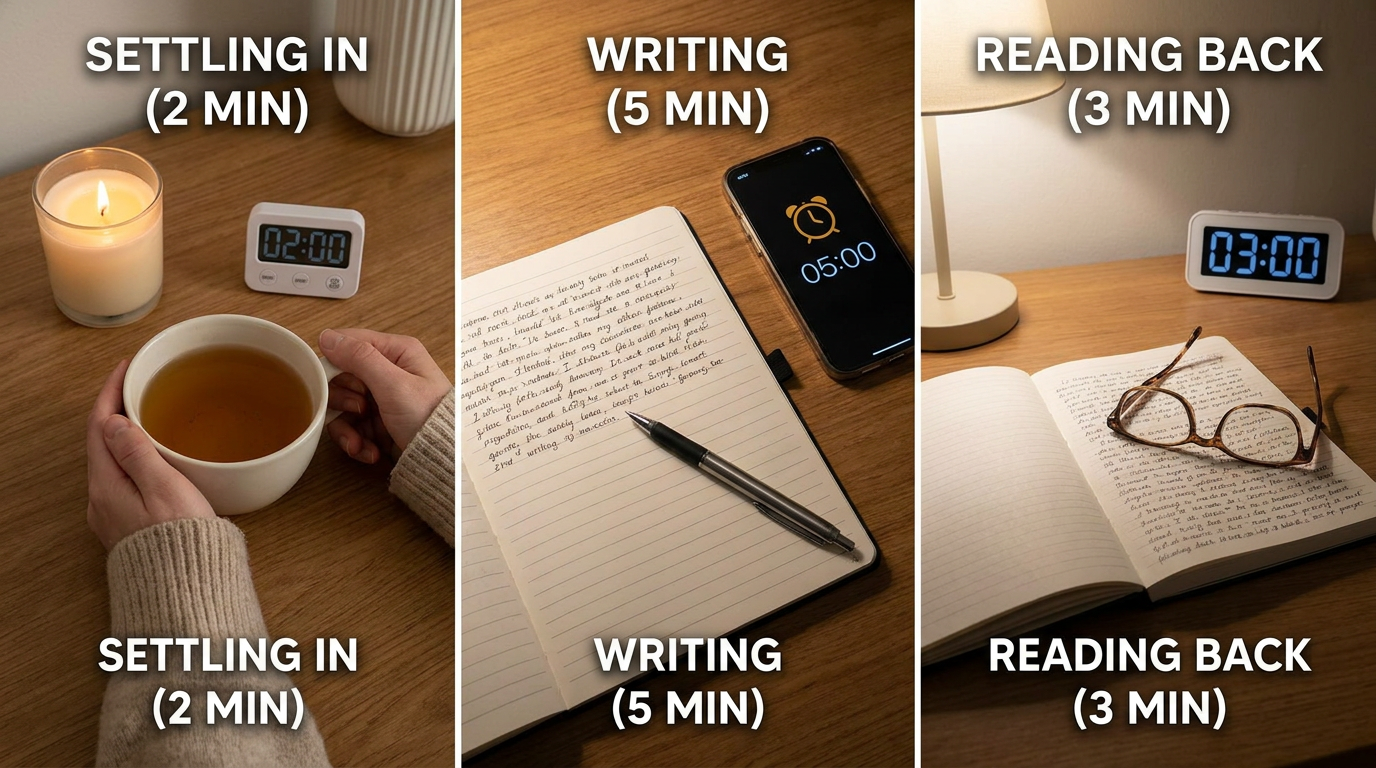
The ritual has three parts, and they’re deliberately uneven:
- Two minutes — settling, and running the day back
- Five minutes — writing to one prompt
- Three minutes — reading back the last few entries
That’s the whole architecture. You can follow it tonight without reading another word of this post, though the prompt bank in the next section will make the middle five minutes considerably easier.
Two minutes: settling
Don’t skip ahead to writing. The retrieval is what gives you something to write about, and it’s also the part that lets you arrive properly in the ten minutes rather than opening an app and staring at it.
You’ll find this is harder than it sounds for the first few evenings and then rapidly becomes easy. You’ll also find that about a third of what surfaces is stuff you’d genuinely have lost by Thursday. That’s the point of the two minutes.
For two minutes, just run the day back roughly from the morning. Where you were. Who you spoke to. What you ate. What the weather did. What you were doing at eleven, and at three, and at six. It’s a mechanical exercise, and it’s meant to be — you’re not hunting for significance or deciding what any of it meant. You’re just retrieving. Most of the day is sitting there perfectly accessible; it simply hasn’t been asked for.
Sit down. Put the tea somewhere it won’t get knocked over. Don’t write anything yet.
Five minutes: writing to one prompt
If you already know what you want to write when you sit down, skip the prompt entirely. Prompts exist to solve the blank-page problem. No blank page, no problem.
Set a timer if it helps. Plenty of people find the timer is the thing that makes it work, because it converts “write about your day” into “survive five minutes,” which is a much simpler assignment. When it goes, stop — even mid-sentence, if you like. You can always come back tomorrow, and the unfinished sentence will make you smile in a year.
Five minutes is short on purpose. It’s enough for a few sentences — three, four, six if you’re moving quickly — and it is emphatically not enough for an essay. That ceiling is doing useful work. It means you never sit down to a blank page with the vague expectation of producing something substantial, which is the expectation that kills more evening writing than tiredness ever has. A few sentences is a complete, legitimate entry. You’re not producing literature. You’re noting down what happened.
Write to it for five minutes and then stop.
Pick one prompt. One. Not three, not a sequence, not “I’ll do the gratitude one and then the noticing one.”
Three minutes: reading back
Scroll back through the last three or four entries and read them.
This is the movement everyone skips. It’s also the one that makes the entire ritual worth doing, and if you only take one thing from this post, take this: the reading back is not an optional extra bolted onto the writing. It is where the value actually lives. Writing an entry produces a record. Reading back is the moment you useThree minutes is enough for four short entries. You’ll notice things: that you mentioned the same small irritation twice, that Wednesday had something good in it you’d already mislaid, that you ate the same dinner three times. None of that needs interpreting. It’s just nice to know.
it — and the moment the previous week stops being an undifferentiated smear and turns back into a series of specific days with things in them.
In Lugelo, this is your Memory Lane — the chronological view your Moments land on automatically, in order, without you filing anything. You can see what that looks like alongside if you want a sense of it before you start.
Memory Lane and the rest of Lugelo’s journaling features
The proportions matter more than the numbers
What holds is the relationship: a short settle, a bounded write, and a genuine read-back. Lose the read-back and you’ve got a slightly dutiful writing exercise. Keep it and you’ve got something you look forward to.
Two, five and three are a suggestion, not a specification. One minute settling, six writing, three reading works fine. So does three, five, two. Some evenings you’ll do ninety seconds of writing and four minutes of reading back and that’ll be the right shape for that evening.
One practical note, particularly if you’ve arrived here looking for an evening journal routineThe five minutes in the middle needs something to point at, though. So here’s the bank.
that survives contact with real life: this works on a phone on the sofa. It works on a laptop at a cleared kitchen table. It works in a paper notebook with a pen that lives next to it. Lugelo captures Moments offline as well, so a patchy signal on the train home isn’t a reason to skip — the entry syncs across your devices when it can.
A Bank of 30+ Gentle Prompts (Including Gratitude Prompts)
Before the list, three rules for using it — and they’re the only rules in this post.
Pick one. Don’t work through them in order. This isn’t a curriculum and there’s no completion state.
Don’t feel obliged to use one at all. If you sat down already knowing what you wanted to write, write that.
Small is correct. Every prompt below is answerable in a few sentences. None of them require excavation, none of them ask you to reach a conclusion, and none of them are trying to get somewhere with you. If a prompt feels like homework, pick a different one.
They’re grouped into five registers. Skim to whichever suits the evening.
Noticing prompts
The smallest register in the bank. Sensory, low-stakes, no significance required. These are perfect for tired evenings because they don’t ask you to have had an interesting day — only to have been present during an ordinary one.
- What’s one thing you noticed today that you’d usually walk past? (This one is a real Lugelo prompt.)
- What was the light doing at some point today?
- What was the first thing you heard this morning?
- Was there a smell today that reminded you of something else?
- What could you hear from outside, if you’d stopped to listen?
- What was the temperature like — not the number, the feeling of it?
- What’s one small change you noticed in a place you go often?
- What did your hands do today that you didn’t have to think about?
Gratitude prompts
The fullest set in the bank, and the one people ask for most. The trick with gratitude prompts is to keep them specific and unsentimental. “What are you grateful for?” is an enormous question that tends to produce the same three answers forever. Small and concrete beats grand and abstract every time — and a specific answer is far more interesting to read back in a year.
- Who held the door for you this week — physically or otherwise? (Another real Lugelo prompt.)
- What did someone do today that saved you five minutes?
- What’s a thing you own that worked exactly as it was supposed to?
- What small thing would you miss if it vanished tomorrow?
- Who made something easier today without being asked?
- What went right today that you’d only have noticed if it had gone wrong?
- Which part of today would you happily do again tomorrow?
- What’s something you were given once that you still use?
Gratitude prompts of this kind sit alongside the — short, repeatable exercises in noting what you’re glad of.
gratitude practices described by the Greater Good Science Center at UC Berkeley
Small-detail prompts
These are the prompts that age best. They feel almost pointless to write and they are, without competition, the most rewarding to read back. In five years the detail is the whole value — you will not remember what you ate on an ordinary Thursday in October 2026 unless you wrote it down, and you’ll be oddly delighted to find out.
- What did you eat today?
- What were you wearing?
- What was on — music, a programme, a podcast, the radio?
- What was the walk like? (Any walk. Even the short one.)
- What did you nearly buy and then didn’t?
- What’s currently on the table or the desk in front of you?
- What did you do today that you also did yesterday?
- What’s the last thing you looked up?
People prompts
Observational, not diagnostic. These are about who was in your day, not about what your relationships mean. Keep them light — you’re recording the cast, not analysing the plot.
- Who did you see today, even briefly?
- Who did you text, and roughly what about?
- What’s something someone said that stuck?
- What made you laugh?
- Who did you think about but not contact?
- Who did you overhear?
- Who was somewhere they usually aren’t?
- Who’s someone you’ll probably see tomorrow?
End-of-week prompts
A slightly wider frame, for Fridays, Saturdays or Sundays — the evenings where the natural unit isn’t the day but the week. These pair particularly well with a longer read-back.
- What happened this week that you’d otherwise forget by next month?
- What’s different from last Saturday?
- What was the best hour of the week?
- What did this week have that last week didn’t?
- Where did most of the week actually go?
- What’s one thing from this week you’d tell someone about?
- What are you carrying into next week?
That’s thirty-nine prompts. On any given evening, thirty-eight of them are irrelevant and one of them is the right one.
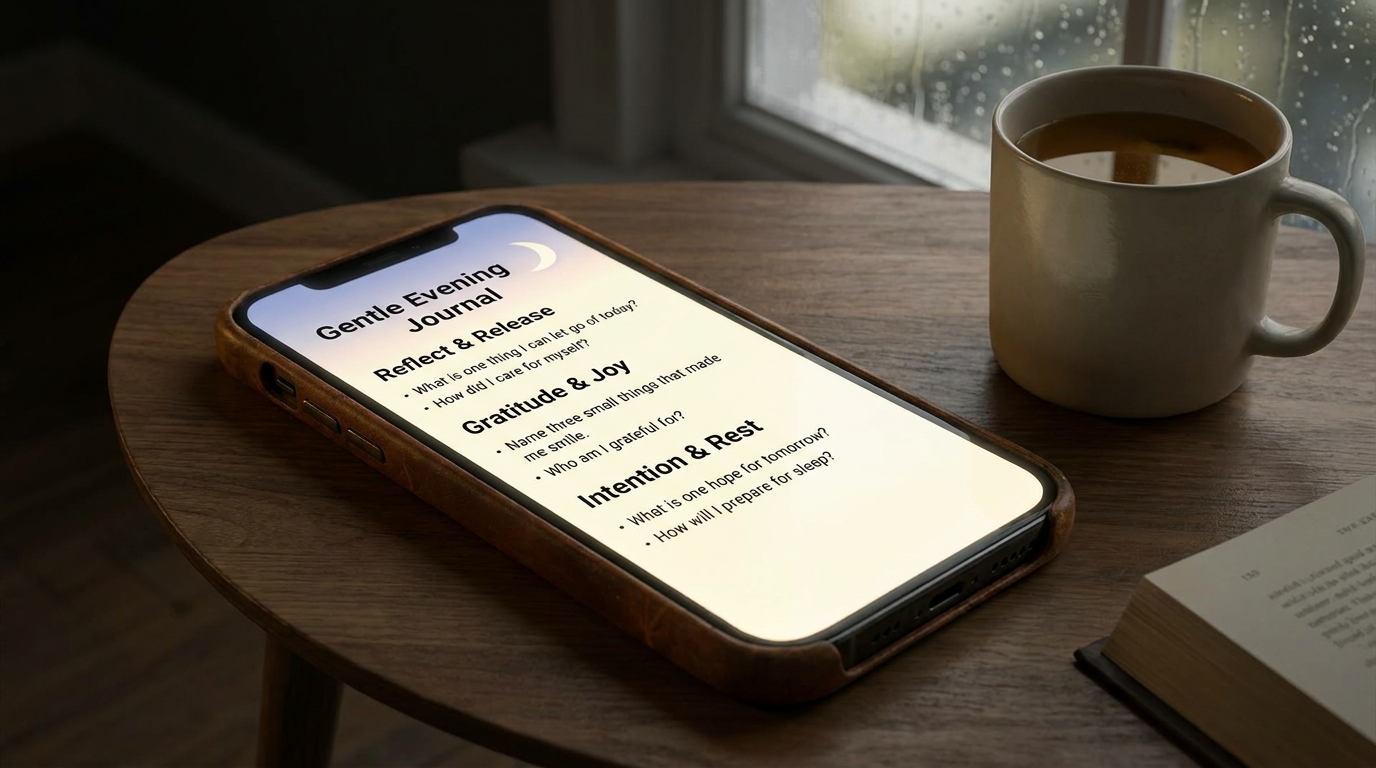
And some nights, none of them will fit — which is precisely what the AI Journal Assistant is for. There’s a bigger objection than “none of these fit,” though, and it deserves its own section: some days genuinely have nothing in them.
Lugelo’s AI Journal Assistant can generate prompts that fit your journal
: prompts that reflect the kind of journal you’re actually building rather than a generic list, across registers like reflection, gratitude and memory. Refresh one you don’t like. Ignore all of them. It’s a suggestion, not an instruction.
What to Write on Days When Nothing Happened
You sit down. You do the two minutes. You run the day back and it’s work, dinner, a screen, bed. There’s a real temptation at that point to close the app and think, not tonight, there’s nothing to say.This is the single most common reason an evening ritual quietly stops. Not tiredness. Not lack of time. The conviction that an uneventful day isn’t worth recording.
Here’s the reframe, and it’s a practical one rather than an inspiring one: ordinary days are the ones you actually lose. Big days look after themselves. You’ll remember the wedding without writing it down. You’ll remember the move, the trip, the day the offer came through. Those are already anchored — other people remember them too, there are photographs, they come up in conversation. Tuesday the fourteenth has none of that support. It disappears entirely within about three weeks unless something catches it.
So the days that feel least worth writing about are, in strict record-keeping terms, the days where writing produces the most. That’s not a motivational flourish. It’s just how memory distributes itself.
On a flat evening, here’s what to do:
- Write one sentence and stop. Genuinely. One sentence is a complete entry.
- Record what you ate. The most reliably interesting detail in any old journal.
- Note the weather and what you wore. Two lines, both of which will place the day precisely when you read it back.
- Write down what you’re reading or watching, and where you’re up to. This turns your journal into an accidental log of your own tastes over time.
- Log one thing you did that you won’t otherwise remember doing. Rang the dentist. Fixed the wobbly shelf. Walked the long way.
The one-line entry is fully legitimate. I want to be unambiguous about that, because a lot of people carry an unexamined belief that a short entry is a failed entry. It isn’t. A Moment that reads:
Rain all day. Finished the blue book. Beans on toast.
is a real entry, and in three years it will read beautifully. Better, in fact, than four laboured paragraphs about how you were feeling, because it’s specific, and specificity is what survives.
It’s also worth remembering that a Moment doesn’t have to be text at all. A photograph of what was on the table. A twenty-second voice note recorded while the kettle boils. A short clip of the rain on the window. You can , and on a genuinely flat evening the lowest-effort capture is usually the right one. A photo of Tuesday’s dinner is a better record of Tuesday than nothing is, and it takes four seconds.
capture a Moment as text, a photo, or a voice note
The practical payoff has never been that the day was interesting. It’s that you’ll know what October actually looked likeThat covers the evening where nothing happened. Now the harder one: the evening where you simply don’t want to.
— not the highlights of October, the texture of it. The rain, the book, the beans on toast.
Permission to Skip: This Is a Ritual, Not a Commitment
The distinction that matters is between a ritual and a commitment. A commitment is something you are failing at during every moment you’re not doing it — that’s structurally what a commitment is. A ritual is simply available. The tea is there whether you make it or not, and the kettle doesn’t take it personally.
Let’s kill the make-up instinct while we’re here, because it’s the second thing that goes wrong. If you’ve missed a week, do not sit down on Sunday and try to backfill it. Don’t reconstruct Tuesday from your camera roll and your messages out of some obligation to completeness. You don’t owe the journal the days you missed. The journal isn’t waiting. Start with tonight.
I want that sentence to sit on its own, because everything else in this section is a footnote to it. There is no streak to break. There is no counter to reset. There is nothing to catch up on.
Missing a Saturday means nothing.
And a gap in a reflection journalSo what’s a realistic target? A few times a week is a good outcome. Not every night. Every night was never the goal, and anyone telling you otherwise is selling you a streak. Three evenings a week, for a season, produces a genuinely useful record. Two is fine. One good Sunday a week is fine.
None of this is undermined by the product, either, and it’s worth saying plainly. Lugelo’s prompts can be refreshed or ignored entirely, and plenty of people use the app without ever touching the AI features at all. There’s no nagging. Nothing turns amber.
is not damage to the record. It’s part of it. A three-week hole in late November almost always means something busy was going on — a deadline, a house move, a new baby, a bad flu, a good holiday. When you read back, the gap tells you that as clearly as an entry would. Nothing has been lost. The shape of the year includes the parts where you weren’t writing.
One more thing belongs here, because evening writing is personal by nature. Journals in Lugelo are private by default, with owner-controlled sharing — nothing is shared unless you choose to share it — and your data is encrypted in transit. That’s the arrangement, and it’s the reason people feel able to write the unflattering bits.
With the pressure off, the interesting question becomes a different one. Not how do I make myself do this, but how do I make this something I want to come back to.
Making It Pleasant Rather Than Dutiful
The single most useful principle for an evening ritual is this: attach the ten minutes to something you already like.
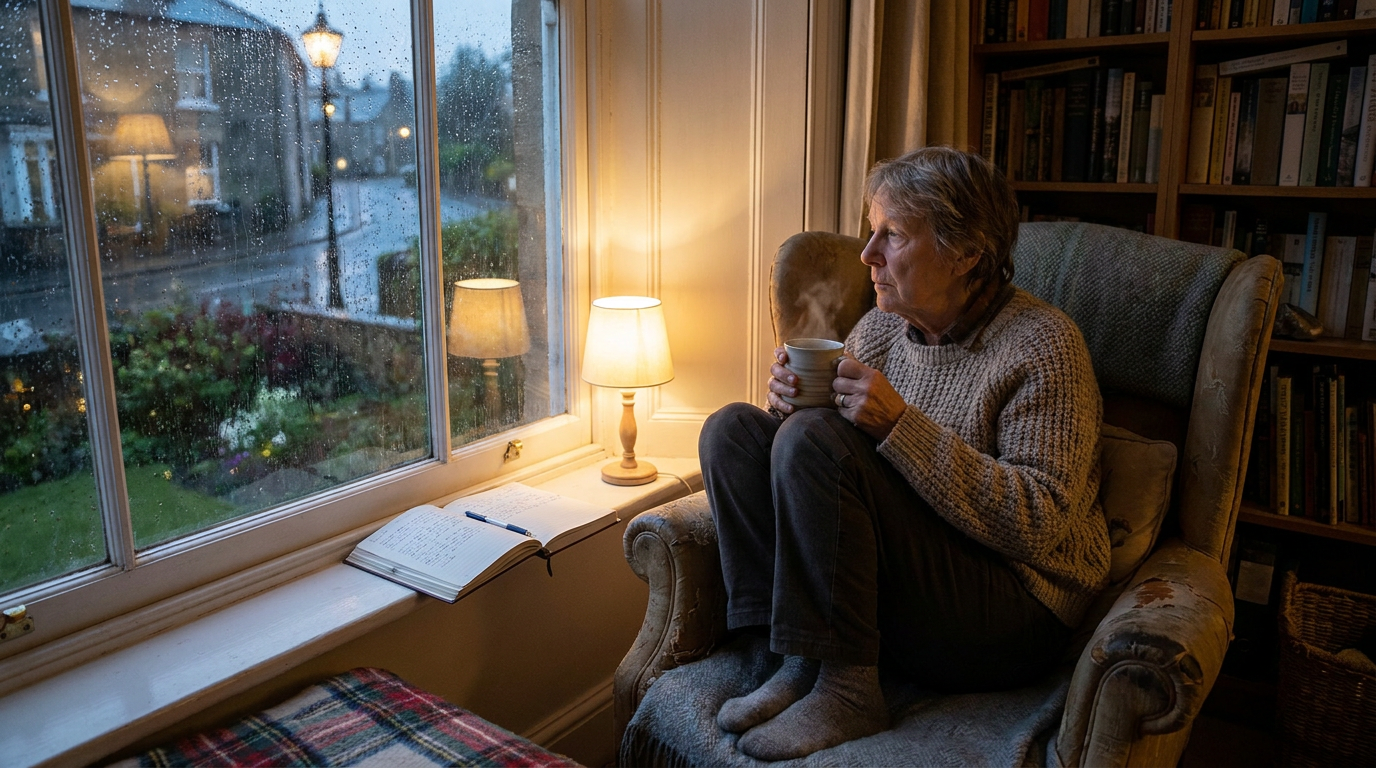
Not as a reward afterwards. As part of it. The ritual should be the good bit of the evening — the bit you’re heading towards — rather than a small obstacle standing between you and bed. Get that right and consistency stops being a question of discipline, because you’ll be going back for the tea and the lamp and the chair, and the writing will come along as a passenger.
The tea, or whatever yours is. A drink you actually like, made deliberately. Not a mug of something reheated twice. The making of it is genuinely part of the ritual — the kettle, the two minutes of waiting, carrying it through — and it conveniently doubles as your settling time. By the time you sit down you’ve already been running the day back while the water boiled. Wine works. Cocoa works. A specific mug helps more than it has any right to.
The chair. One place. Not “wherever I end up.” The corner of the sofa nearest the lamp, the chair by the window, the kitchen table once it’s been cleared. Location does far more work than willpower does, because a specific spot builds an association you don’t have to maintain consciously — after a fortnight, sitting there is itself the cue. This is also why the bed is a poor choice. Too many other associations already booked in.
The lamp. Low, warm, not the overhead light. This sounds like an affectation and isn’t. Switching the big light off marks the evening as a different part of the day from the one that came before it, and that boundary is doing real work. In October, when it’s properly dark by six, the lamp is the whole difference between “still in the day” and “in the evening.”
The same time, loosely. Roughly after dinner. Roughly before bed. Not a scheduled slot with an alarm attached — an alarm turns it into an appointment, and appointments can be missed, and missing appointments feels like something. A rough position in the evening can’t be missed. It just arrives or it doesn’t.
The device or the notebook — whichever you’ll actually reach for. There’s a certain romance to the leather-bound notebook, and if that’s genuinely what you’ll pick up, use it. But be honest. If the notebook lives in a drawer upstairs and your phone is already in your hand, the phone is the better tool, and a phone on the sofa is a perfectly respectable end of day reflection setup. A few optional flourishes, worth a line each because small specifics are what turn a routine into a ritual:
Lugelo is free on iOS, Android, HarmonyOS and the web
, with Chrome and Firefox extensions, no ads, and an optional Plus tier if you ever want it. The best journal is the one within arm’s reach at nine o’clock.
- A record on, quietly. Something without lyrics if you’re writing.
- A window open for the first two minutes, even in October. Especially in October.
- The same candle, but only in one season — so that in three years the smell places the entries.
- Writing before you properly look at your phone, rather than after twenty minutes of scrolling that you’ll then have nothing to say about.
- A blanket. Genuinely.
And here’s the honest test, the one to apply after a fortnight: if you’re dreading it, something in the setup is wrong.Get it right and it stops being something you do and starts being something the evening does. Which raises the last question worth answering: what does all this quietly amount to?
Shorten it. Move it. Change the drink. Drop to twice a week. The ritual is supposed to bend.
Not something in you. The ritual is ten minutes of writing a few sentences with a warm drink — there is nothing inherently dreadful in it, so if dread has appeared, it’s been imported from somewhere. Usually it’s length: five minutes has quietly become twenty. Sometimes it’s placement: you’ve put it after the point in the evening where you’ve run out of energy. Sometimes it’s the drink, or the chair, or the fact that you’ve started treating the prompt bank as a to-do list.
What Ten Minutes a Few Times a Week Adds Up To
The entries you don’t remember writing are the good ones. That’s the consistent experience. The ones you laboured over are fine; the throwaway line about the man at the bus stop, or the fact that the heating made a new noise, or that you finished a book on a Tuesday and started another one the same night — those are the ones that reach out and hand you the evening back. And the week you’d have sworn was completely empty turns out, on inspection, to have had four things in it.
But it’s thirty evenings you can account for. And the strange thing — the thing nobody quite believes until it happens to them — is what it’s like to read back a season of it in January.
That is not a book. Nobody’s publishing it. Total time invested: around five hours, spread across a season, most of it spent with a warm drink in a comfortable chair.
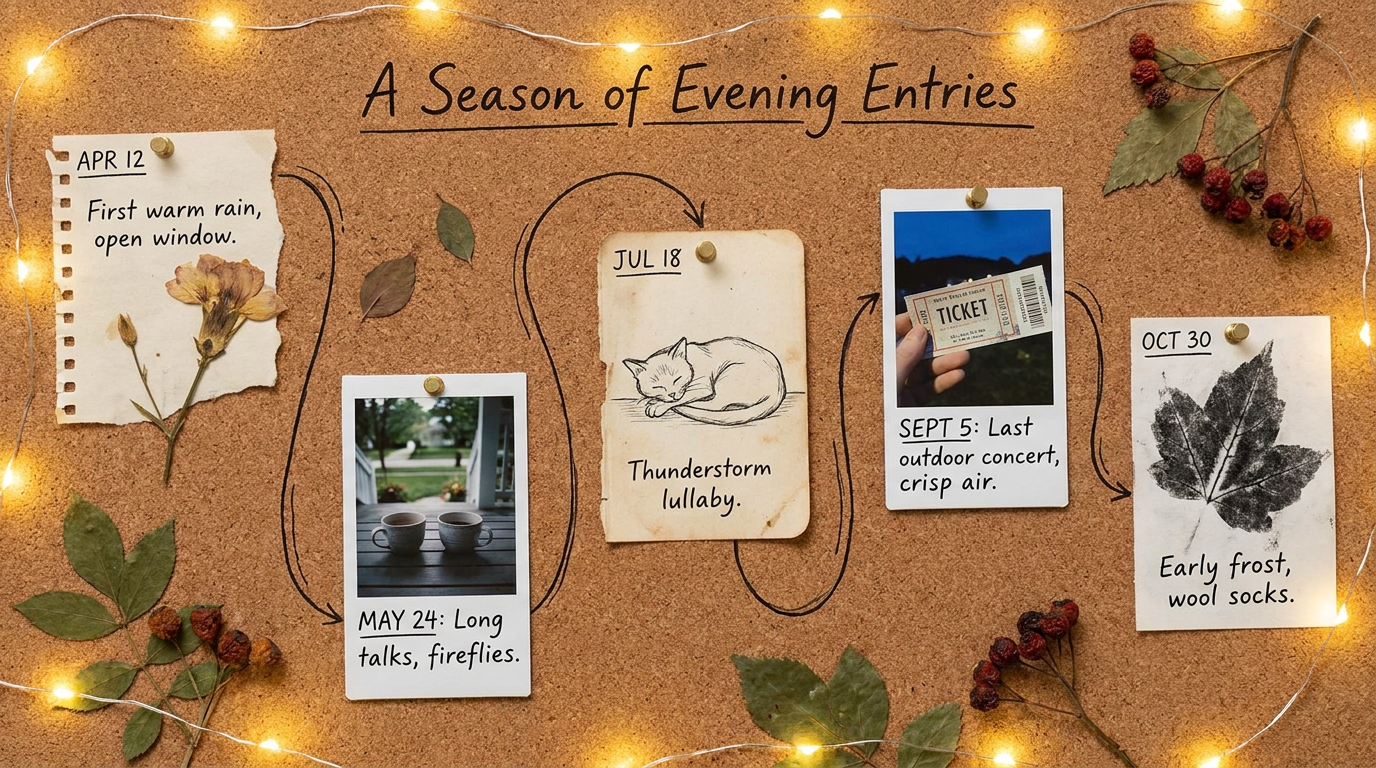
Three evenings a week, from the start of October to Christmas, is about twelve weeks. Call it thirty-something entries, allowing for the weeks where you skip entirely and the weeks where you write four times because you’re enjoying it. Thirty entries, each of them a few sentences long, some of them a single line about the weather and what you had for dinner.
Let’s do the arithmetic out loud, because the honest number is more persuasive than a vague promise.
The read-back payoff compounds. Three entries back is mildly interesting. Thirty entries back is a season. In Lugelo, your Moments land on Memory Lane in order automatically, so the season assembles itself while you’re not paying attention — there’s no filing, no tagging, no organising step you’ll fall behind on. You just scroll.
The blank page never beat you. It just outlasted you.
If you ever want to do something with a run of entries, you can. A season of Moments can Similarly, and only because it comes up: some people keep a shared evening journal with a partner or a family member, which is owner-controlled like everything else. Nice if it appeals. Ignore it if it doesn’t.
turn a season of Moments into a storybook
or an eBook export, which some people do at the end of a year and most people never do at all. Treat it as strictly downstream and entirely optional — the ten minutes is worth doing if you never export a single thing.
Which brings us back to where we started. None of this was about becoming a person who journals. There’s no identity on offer here, no new version of yourself to construct, no membership. It was ten minutes and a cup of tea, a few times a week, in October — and the week not blurring together. If you want the fuller picture of how a small ritual like this fits into a journaling habit that actually survives, is the place to go next.
the fuller guide to making a journal stick
Frequently Asked Questions
How long should an end-of-day reflection take?
Ten minutes is plenty. The three movements run roughly two minutes settling and running the day back, five minutes writing to one prompt, and three minutes reading the last few entries. Shorter is completely fine — some evenings you’ll do four minutes and call it done. The proportions matter more than the exact numbers, and the read-back is the part worth protecting.
What are good gratitude prompts to start with?
Start with the small, specific ones rather than the big abstract ones. “What did someone do today that saved you five minutes?” produces a much better entry than “What are you grateful for?” Pick a single prompt for the evening rather than working through the list — the bank is there so you never face a blank page, not so you can complete it.
Do I have to write every night?
No. A few times a week is a good outcome, and it was never meant to be nightly. There’s no streak, no counter and nothing to catch up on. Missing days doesn’t undo anything you’ve already written, and you don’t need to backfill the week you skipped. Just start again with tonight.
What should I write when nothing happened that day?
One line. What you ate, what the weather did, what you’re reading and where you’re up to. Ordinary days are the ones you’d otherwise lose entirely — big days survive on their own, but an unremarkable Tuesday disappears within weeks unless something catches it. A single sentence is a complete, legitimate entry.
Is it better to journal in the morning or the evening?
Evening suits this particular ritual, because the day is finished and there’s nothing left to add to it. You’re noting down what happened rather than planning what might. Morning writing is a different thing and works well for other purposes — intentions, ideas, longer pieces. For a short end-of-day record, evening is the natural fit.
Is a reflection journal the same as a diary?
Broadly, yes — both are records of your days. The difference here is the container. A diary implies an open page and an obligation to keep it up. This is a bounded ten minutes and one prompt, a few times a week, with no expectation of an unbroken run. Same idea, much lighter frame.
Do I need an app, or is paper fine?
Either works. Paper is genuinely good, and if a notebook is what you’ll actually reach for, use it. An app makes the reading-back movement easier, since entries land in date order automatically with no filing, and photos or voice notes can sit in the same entry as the text. Use whichever is within arm’s reach.
Are my journal entries private?
Journals in Lugelo are private by default with owner-controlled sharing, and data is encrypted in transit. Nothing is shared unless you choose to share it.
What if none of the prompts fit?
That happens most weeks. Lugelo’s can generate prompts based on the journal you’re actually building, across registers like reflection, gratitude and memory. Any prompt can be refreshed if it doesn’t suit the evening, or ignored completely — and if you already know what you want to write, skip the prompt entirely.
AI Journal Assistant
Is Lugelo free?Yes. It’s free on iOS, Android, HarmonyOS and the web, with Chrome and Firefox extensions, and there are no ads. There’s an optional Plus tier if you want it, and offline capture is built in, so entries you write without a signal sync across your devices later.
Ten Minutes, a Cup of Tea, and October
You’ll remember the day. And the season won’t blur.
And the permission, restated plainly, because it’s the part most worth keeping: no streaks, no rules, nothing to keep up with perfectly. Skip whenever you like. Miss a fortnight. Come back on a Thursday in November with a single line about the weather and it’ll count exactly as much as anything else in there.
The whole ritual, one more time, so it’s easy to remember. Two minutes running the day back without writing anything. Five minutes on one prompt — just one — and then stop, even mid-sentence. Three minutes scrolling back through the last few entries, which is the part that makes the rest of it worth doing.
So: it’s nine o’clock on a Saturday evening in October. The lamp’s on. There’s a drink going cold at your elbow because you got interested in something you were writing.
If you want somewhere to put tonight’s ten minutes, Lugelo is free on iOS, Android, HarmonyOS and the web, with Chrome and Firefox extensions. Journals are private by default, with owner-controlled sharing. Start with one Moment tonight — .
Get Started