Category Archive : Mental Health

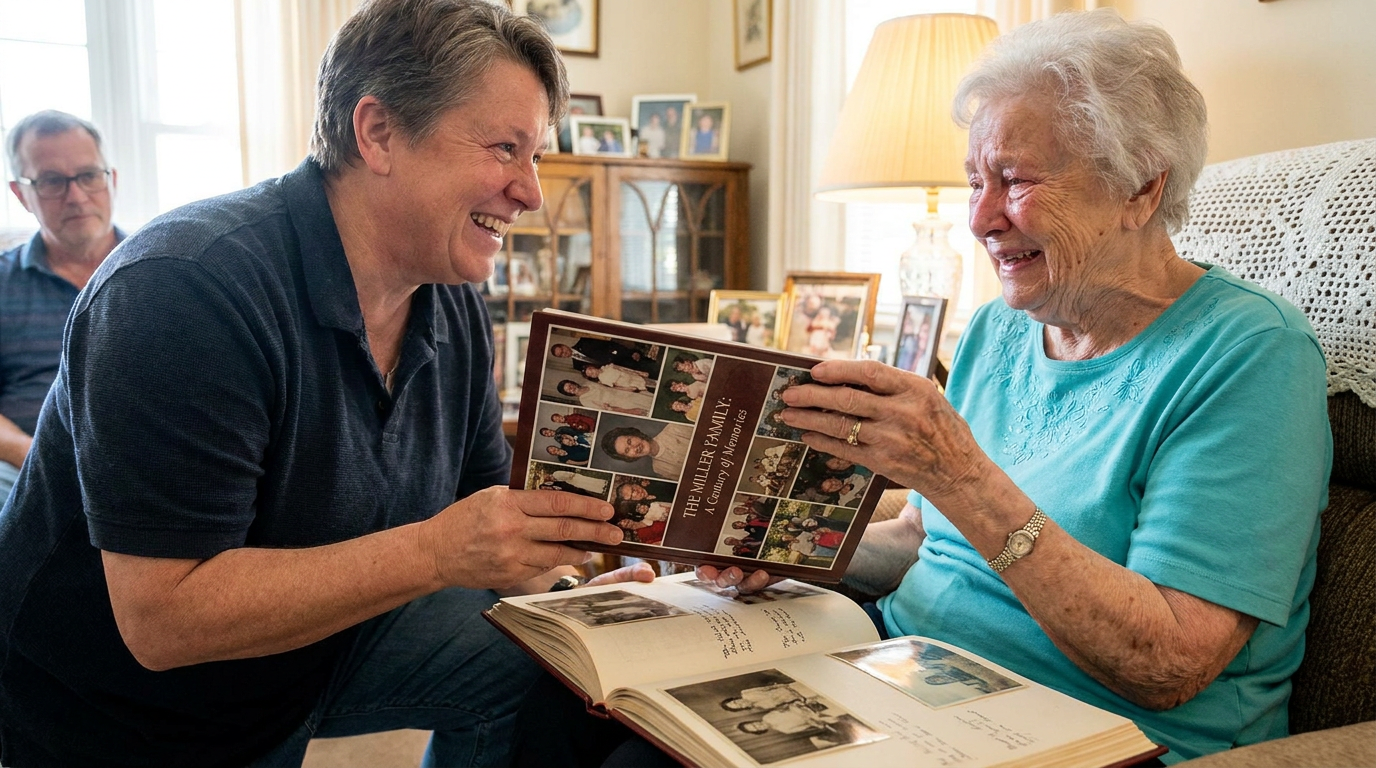
The Family Memory Book: Preserving a Life, Not Just a Camera Roll

And it’s just a picture. There’s a date stamp that means nothing to anyone but you. No names. No story. No indication of why your hands were shaking when you took it, or that it happened three weeks after she’d told you she was never going to learn, or that the bike had been your brother’s.

Nine minutes later, you find it.

So you scroll. Past four hundred screenshots. Past three nearly identical photographs of a parking space you were worried you’d forget. Past a receipt, a meme someone sent you in 2023, twelve pictures of a restaurant menu. Past a blurred thumb.

Picture this: it’s a Sunday evening and you’re looking for one photograph. Just one. The afternoon your daughter finally rode her bike without you holding the saddle — the wobble, the shriek, the look back over her shoulder. You know it exists. You took it.

Here’s the gap nobody names: saving is not the same as preserving.

We have never captured more and remembered less. Roughly — about 5.3 billion every single day. The typical phone carries somewhere in the low thousands of images, with most credible estimates landing between about 2,000 and 2,800. Plenty of family phones carry many multiples of that. Volume has never been our problem. Meaning is.
1.95 trillion photographs will be taken worldwide this year

A memory book does something structurally different. It isn’t a bigger pile. It’s a record — curated, contextual, and deliberately built to be understood by someone who wasn’t there.

Let’s be honest with each other from the first paragraph, because this whole guide depends on it: making one takes real effort. Most people who start a memory book never finish it. This guide exists to make sure you’re not one of them.

So we’ll cover all of it. What a memory book actually is. What belongs inside it beyond photographs. Who to involve, and how to get them to actually respond. How to begin whether you’re facing fifty years of shoeboxes or a completely blank page. Which format to choose, honestly assessed. How to organise it without inventing a second job for yourself. And the part nobody warns you about — how to finish.

Journals are souvenirs of your past.

What a Family Memory Book Actually Is

A memory book is a curated, narrated record of a person, a family, or a period of time — one that combines images with the words, voices, objects and context that explain why any of it mattered. Where a camera roll accumulates, a memory book selects and explains. That single difference is the whole discipline.

The confusion is understandable, because three different objects get used interchangeably in everyday conversation. They are not the same thing, and choosing between them deliberately will save you months.

The photo album. Images arranged in sequence, usually chronological, usually behind plastic sleeves. It’s strong on visuals and almost entirely silent on meaning. It answers exactly one question: what did this look like? Effort is low, shareability is poor (it exists in one copy), and it’s best suited to people who already know the story and simply want to see it again.

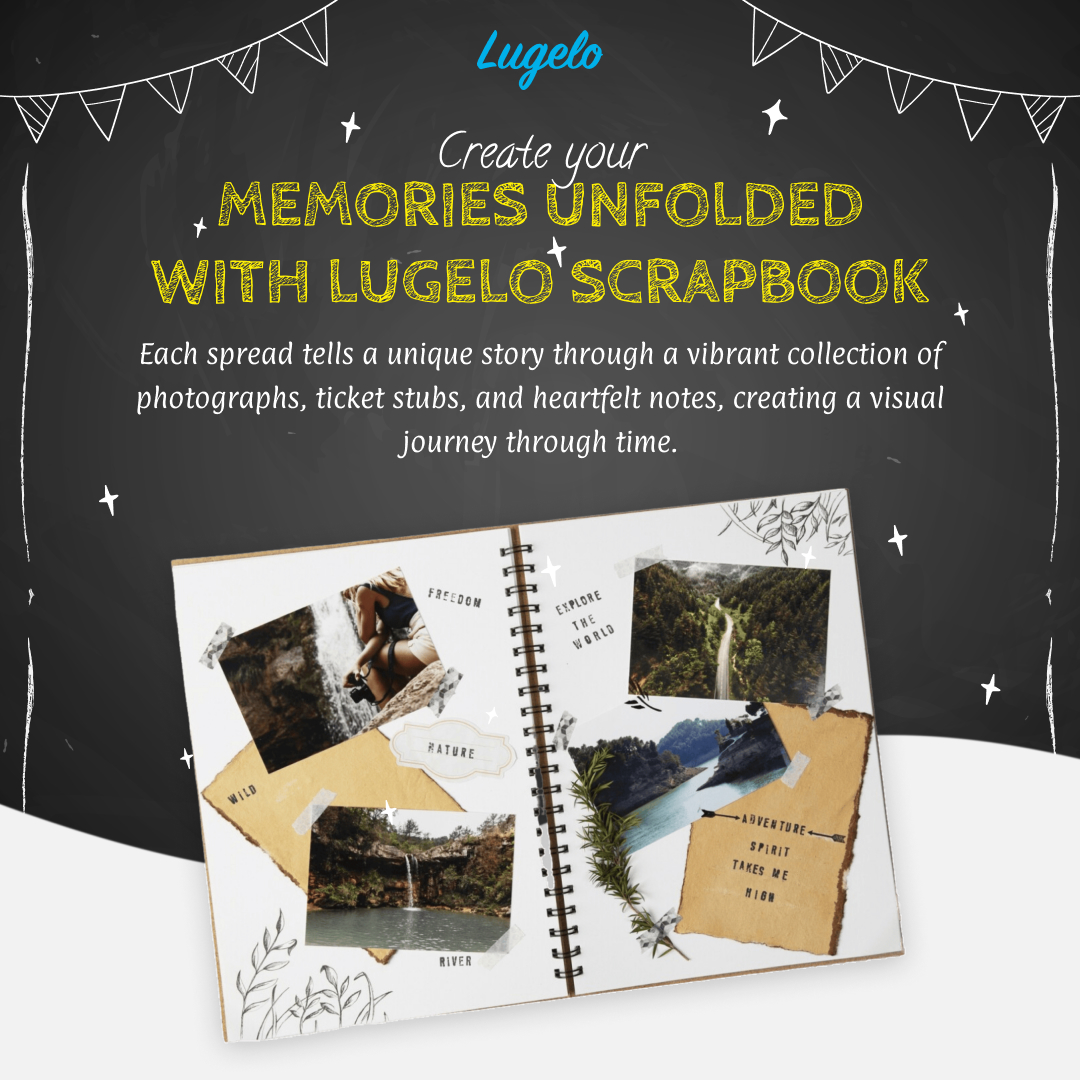
The scrapbook. Images plus decorative craft — patterned paper, ticket stubs, ribbon, hand-lettering, pressed flowers. Scrapbooks are wonderful. They carry texture and personality that nothing digital replicates, and the making of them is genuinely pleasurable. But they’re typically thin on narrative, extremely difficult to duplicate, and effectively impossible to share with a cousin in another country. They answer what did this feel like aesthetically? rather than what happened?

The memory book. Images plus narrative, voice, documents and context. It answers the questions that actually survive: Who were these people? What happened? Why did it matter? It carries more effort than an album but produces something categorically more useful — a record legible to a reader who has no prior knowledge, no shared memories, and no one left to ask.

That last point is the test this entire article runs on, so let’s state it plainly and come back to it repeatedly:

Would a stranger — or your own great-grandchild — understand this without you standing next to them explaining it?

If the answer is no, you have a pile. A beautiful, beloved, carefully stored pile. But a pile.

The Variations People Are Actually Looking For

“Memory book” is an umbrella term covering several genuinely distinct projects, and knowing which one you’re making changes every decision downstream.

A family memory book is multi-generational — several people, often several decades, usually assembled by one person with contributions from many. A baby memory book covers the first years: milestones, firsts, the name story, the things nobody thinks to write down because they assume they’ll remember. A memory journal runs forward rather than backward — ongoing, written, closer to a diary with intent. A memorial or tribute book gathers a life after it’s ended, often assembled collaboratively by people processing the same loss from different angles. And single-event books cover one bounded thing: a wedding, an emigration, a year abroad, a house.

There’s also the school-years version, which deserves its own treatment — if that’s your project specifically, we’ve written that goes considerably deeper on that narrower scope than this page can.
a complete guide to creating a school memory book

Retrospective, Prospective, or Both

Every memory book runs in one of two directions, and most good ones run in both.

Retrospective means assembling what already exists — the loft boxes, the inherited albums, the folder of scans your aunt emailed you in 2019. ProspectiveThe retrospective approach is archaeology. The prospective approach is journalism. Archaeology is harder, slower, and often incomplete. Journalism is easier and produces better material — but only if you start.

means capturing as life happens, so that in five years you have material with full context attached rather than mysteries to solve.

In , the vocabulary for this is simple and worth learning now because it recurs throughout this guide. An individual entry — a photo with a caption, a voice recording, a scanned document, a paragraph of writing — is called a Moment. The chronological view where those Moments arrange themselves into a readable timeline is called Memory LaneOnce you know what a memory book is meant to do, the practical question arrives immediately — what actually goes inside one?
Lugelo

One reassurance before we go further, because it stops more people than any technical obstacle. You do not need to be a writer. You do not need to be a designer. You do not need to be an organised person, and the evidence suggests most people who successfully make these are not. What you need is a decision about scope and a single place to put things.

. That’s the whole structural grammar: you add Moments, and Memory Lane puts them in order.

What to Put in a Memory Book Beyond Photographs

Here’s the insight that changes how people approach this entire project: photographs record surfaces. Almost everything that makes a person recognisable lives somewhere else.

A photograph shows you a face. It doesn’t carry a voice. It doesn’t hold a phrase, a temper, a laugh, the particular way someone came down the stairs, or what the kitchen smelled like on a Sunday. Twenty years on, the face is the thing you’re least likely to have forgotten — and the voice is the thing you’d give almost anything to hear again.

So build outward from the photographs.

Voices. This is the category families consistently name as the most treasured thing they own, and the one they most regret not gathering. A recording of a grandparent telling a story in their own accent, at their own pace, with their own hesitations and their own laugh, is not a supplement to a photograph. It’s a different order of thing entirely. Record it before you feel ready. A two-minute voice note made badly on a kitchen table beats a perfectly planned interview that never happens, and the perfect interview is the enemy here. Lugelo Moments accept audio directly, so a voice note can be the entry — no transcription required.

“A photograph shows you a face. A voice recording gives you back a person.”

Handwriting. A shopping list. A birthday card. A note in the margin of a cookbook. Handwriting is startlingly personal — more identifiably someone than most portraits — and it is disappearing faster than any other category on this list. Photograph it or scan it. Before you handle fragile originals, it’s worth reading the : clean dry hands, support the whole item, and never reach for adhesive tape.
National Archives guidance on handling family papers

Recipes. Especially annotated ones. The splashes, the crossings-out, the “add more than it says,” the oven temperature amended twice in different pens. An unmarked recipe is instructions. A marked one is a record of someone cooking.

Documents. Immigration papers, military records, deeds, school reports, letters, telegrams, naturalisation certificates, employment cards. These anchor a family in verifiable history and give future readers something to pull on when they want to go further.

The mundane details. This is the category nobody thinks to record, because at the time it all feels too ordinary to be worth the trouble. The car they drove. The exact route of the school run. What was always in the fridge. The phrase your father used when he was annoyed. What the house sounded like at seven in the morning. These become the most precious material in the book, and they vanish completely and without warning.

Objects, photographed. A watch, a christening gown, a ticket stub, a chipped mug that nobody was allowed to throw away. Photograph the object and write down who it belonged to and why it survived. An unexplained object in a photograph is a puzzle; an explained one is a story.

Maps and places. Where people lived, in what order, and why they moved. Migration is the spine of most family histories, and the “why” is almost never recorded.

Prompts to Capture the Ordinary

If you want something you can act on tonight, answer these in writing or out loud:

  1. What did a completely normal Tuesday look like in 1994?
  2. What was always in the fridge?
  3. Who called the house, and at what time of day?
  4. What did the house sound like in the morning?
  5. What did people wear indoors?
  6. What was the argument that came back every year?

One honest counterweight: more is not automatically better. A memory book bloated with everything is just a camera roll with extra steps. Every addition should survive the stranger test — would someone who wasn’t there understand why this is here?

The Ten Things Families Wish They’d Recorded: voices · handwriting · recipes · the name story · an ordinary weekday · the house · the car · the repeated phrases · the objects and who owned them · the reasons behind the big decisions.
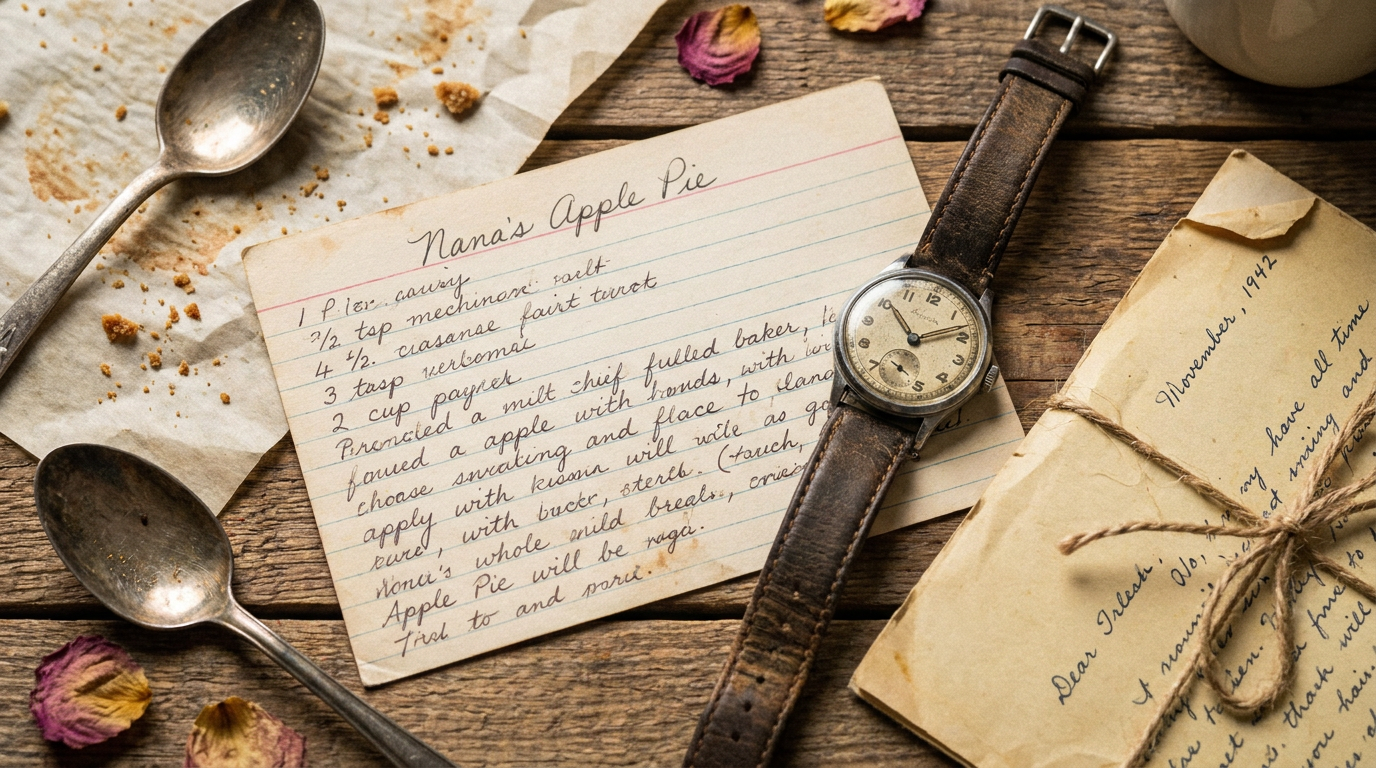
Close-up of a handwritten recipe card, a wristwatch and an old letter arranged on a table

Building a Baby Memory Book: The First-Years Version

The baby memory bookKnowing what to gather raises an awkward question, though: most of this material isn’t actually in your possession.

One structural advantage worth using from day one: both parents can add their own Moments to the same baby journal, and so can grandparents, rather than one person silently inheriting the entire job. Two perspectives on the same first year is a better record than one — and it halves the load.

The practical approach is to capture loosely and organise later. A single running journal you actually add to beats a beautiful structured template you fall behind on by February. Add a Moment when something happens; let the timeline sort itself out.

What genuinely matters is a much shorter list than the templates suggest. The first photograph. The name story — who chose it, why, and what the alternatives were, because that gets forgotten within a decade. A handwriting sample: a note from each parent to the child, written now, in the present tense. Birth details. A recording of the parents’ voices in the first weeks, when everyone sounds exhausted and slightly amazed. First words. And the sayings — the mangled, invented words a child produces that the family repeats for the next thirty years and never writes down.

is the most common entry point into this entire subject — and the easiest to over-plan and abandon. Something about a new baby makes people buy a 200-page hardback with prompts for every week, which is precisely the design most likely to stall at week six, at which point the guilt of being behind becomes a reason not to open it at all.

Who to Involve and How to Get Family to Contribute

So the collaboration problem isn’t optional. It’s structural.

That person inherits two things simultaneously: all of the labour, and an incomplete record. Because siblings remember different years. Cousins hold photographs from the branch of the family that emigrated. An aunt has the letters. Your mother knows who the people in the 1968 photographs are, and nobody else does. The archivist has the motivation and roughly a third of the material.

In almost every family, one person becomes the default archivist. You probably know who it is in yours. There’s a reasonable chance it’s you, given you’re reading this.

Why People Don’t Contribute

It is almost never indifference, which is worth internalising before you get resentful. There are four real reasons:

They don’t know what you want. “Send me your old photos” is not a request, it’s a project. It requires the recipient to make decisions, and so they defer it.

They think their contribution isn’t good enough. The photograph is blurry. They can’t remember the exact year. They’re “not a writer.” So they send nothing, on the theory that nothing is better than something imperfect.

They don’t know how to use the tool. Particularly for older relatives, the fear of pressing the wrong button and breaking something you’ve spent months building is genuinely paralysing.

The ask is too big. An open-ended request to “help with the family history” reads as a commitment of unknown size, and people don’t accept commitments of unknown size.

The Fixes That Actually Work

Ask for one specific thing. “Do you have a photo from the 1987 holiday in Cornwall?” gets a reply within a day. “Send me your old photos” gets nothing, ever, from anyone.

Set a comically low bar and say so out loud. Tell people explicitly: one photograph with one sentence is a complete contribution. Say it in those words. It removes the fear of being judged on effort.

Accept voice notes. The relative who insists they aren’t a writer will happily talk for four minutes without pausing. Meet people in the format they’re comfortable with, and you’ll get ten times the material.

Assign by era, not by task. Whoever was there for the 1970s owns the 1970s. This converts a vague collective obligation into a defined personal one, and it flatters people by treating their memory as authoritative.

Attach a deadline to a real event. A birthday, an anniversary, a reunion, Christmas. Open-ended projects do not finish. Projects with a delivery date do.

Here’s a message you can copy and adapt right now:

“Hi — I’m putting together a memory book for Mum’s 70th in March. Could you send me one photo of her from before 1985, and one thing you remember about her from back then? Doesn’t need to be long — two lines is perfect, or just record yourself talking for a minute and send me the voice note. That’s genuinely all I need.”

How It Works in Practice

In , you create a shared journal and invite people by email or link, assigning each person a role: Viewer, Contributor, or EditorThat role distinction solves the anxiety problem directly. Contributors can add their own Moments — photos, video, audio, text — but cannot alter anyone else’s entries. Nobody can accidentally delete your work. Once an older relative understands that, the “what if I mess it up” objection disappears, and it is a far bigger barrier than most people realise.
Lugelo’s collaborative journal

.

Journals are private by default. The owner keeps owner-controlled access throughout and can revoke it at any point. And every Moment shows who added it and when, which means the finished book naturally carries multiple voices rather than flattening into a single narrator’s summary of everyone else’s lives.

If you’re dividing the work between two people specifically — two parents, two siblings — our guide on covers that workflow in more depth.
how to co-create a journal with a partner
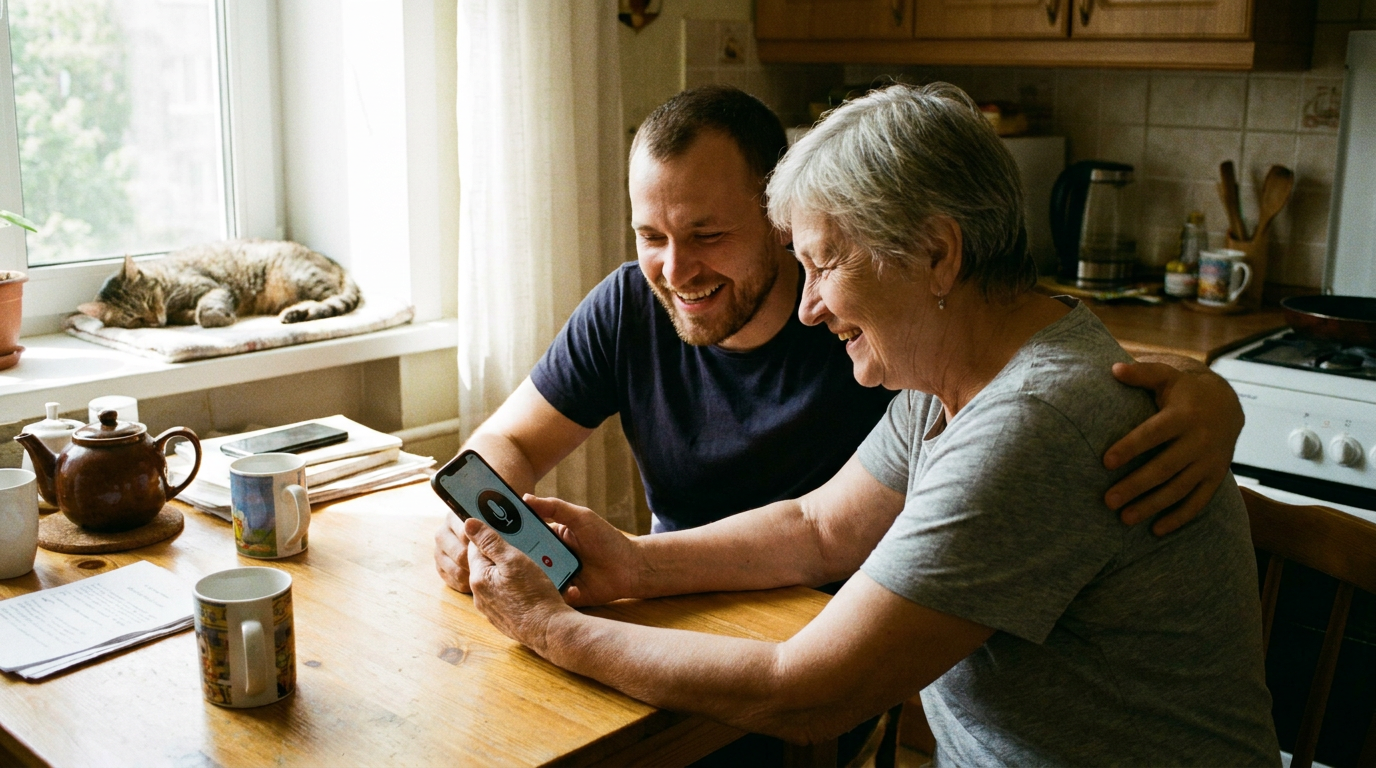
An older woman and her adult grandson recording a voice note together on a phone at a kitchen table

Making a Grandparents’ Memory Book

This is the most time-sensitive version of the project and, predictably, the one people most often postpone.

The approach that works is questions, not a blank page. Nobody can respond usefully to “tell me about your life.” Almost everybody can answer: Where were you living when you were my age? What was your first job, and what did it pay? What was your mother like? What did you do on a Saturday when you were nineteen? What’s a story your parents told you about their parents?With people and material lined up, the hardest practical question arrives: where do you actually begin?

Grandparents can be added as Contributors and add Moments from their own device — or a family member can add on their behalf after a visit, which is often the more realistic arrangement.

And it’s worth saying plainly, without drama: this particular project has a deadline set by circumstance rather than by you. The people who can identify the faces in the photographs and explain why the family left in 1962 are a finite resource. That isn’t a reason for anxiety. It’s a reason to book the first session this month.

Work in short sessions. Forty minutes is plenty. Repeat visits produce dramatically better material than one marathon interview, partly because memory works associatively — the question you asked on Tuesday surfaces an answer on Friday.

Record audio rather than transcribing as you go. It’s faster, it keeps the conversation natural instead of turning it into dictation, and it preserves the voice itself, which is the point.

That last question is quietly the most valuable one on the list — it reaches back a generation further than living memory usually goes.

How to Start a Memory Book From Anything or Nothing

Two opposite paralysis states stop most memory books before the first page. Either there’s far too much material, or there’s almost none. Both feel like disqualifications. Neither is.

Start Here If You Have Too Much

Do not start by sorting. This is the single most important instruction in the section. Sorting is where these projects die — it’s effortful, it produces no visible output, and it can be extended indefinitely, which makes it the perfect procrastination activity disguised as progress.

Start instead by choosing a scope. One person. One decade. One household. One theme. A finished book about your mother’s childhood is worth more than an unfinished book about everything since 1890, and the second one is what you’ll accidentally attempt if you don’t decide now.

Then work in passes rather than perfection:

  1. Pass one — gather. Get everything into one physical place. No decisions, no sorting, no reading. Just consolidation.
  2. Pass two — react. Go through and pull out only the items that make you feel something. Trust that instinct; it’s a better editor than any system.
  3. Pass three — caption. Identify and caption what you pulled. Names, approximate year, what’s happening, why it’s here.
  4. Ignore everything else for now. It isn’t going anywhere.

Before you handle anything fragile, get the basics right. The is plain-English, non-commercial and genuinely practical: clean dry hands, support the whole item, no adhesive tape, no rubber bands, no paper clips. Their guidance on is worth reading before you put anything back in the loft, because storage conditions do more damage than handling ever will.
storing family papers and photographsNational Archives’ guide to preserving family archives

Digitise the fragile things first. Anything brittle, fading, water-marked or stored somewhere damp goes to the front of the queue. Photographs and negatives are considerably more vulnerable than paper. The Archives also publish specific advice on and on — worth having open the first time you lift the lid on a box that’s been in a garage since 1998.
what to do about mould or insect damagescanning and digitising

And then the highest-value hour of the entire project: caption while the person who knows is still in the room. Sit with the oldest relative you have and go through photographs asking who, where, roughly when. An unidentified photograph is close to worthless three generations on. An identified one is evidence.
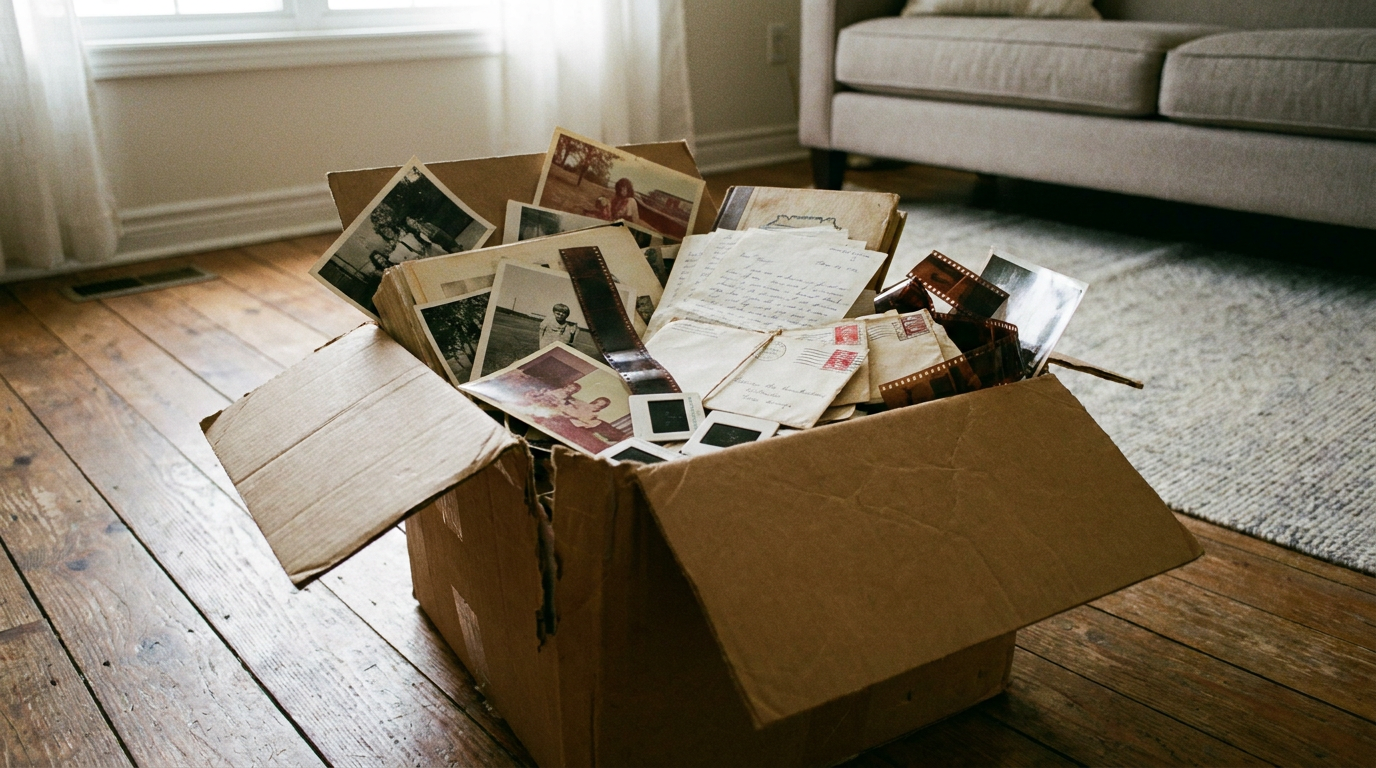
An open cardboard box of unsorted family photographs, letters and negatives on a living room floor

Start Here If You Have Almost Nothing

An empty start is a genuine advantage, and it’s worth reframing it as one immediately. You aren’t reconstructing a record from fragments with the context missing. You’re building forward, with full context available, from people who are still here to explain themselves.

Start with living memory. Interview the oldest willing relative this month. One conversation typically produces more usable material than a weekend in the loft.

Start with the present. A memory book does not have to begin in the past. Begin today — this week, this ordinary September — and let it accumulate. In five years you’ll hold something no amount of retrospective effort could ever manufacture, because it’ll have the details that only get recorded contemporaneously.

Anchor with documents. Certificates, records and public archives fix names, dates and places, and give later readers something verifiable to build on.

Beat the blank page with prompts. If the obstacle is simply not knowing what to write, Lugelo’s offers prompts and can expand rough bullet points into a readable entry — without replacing your own voice, which remains the thing that matters. Used well, it’s a way past the first sentence, not a ghostwriter.
AI Journal Assistant

The First Weekend Plan

Four hours, and you’ll be ahead of most people who ever attempt this:

  • Hour one. Decide the scope and give the book a name. Write both down.
  • Hour two. Gather twenty items. No sorting, no judging.
  • Hour three. Caption ten of them — names, rough year, what’s happening.
  • Hour four. Record one voice memory. Yours or someone else’s.

Before committing serious hours to gathering, though, it’s worth deciding what form the finished thing will actually take.

That’s it. You now have a scoped project, twenty pieces of material, ten identified items and one voice recording. That is further than the overwhelming majority of memory books ever get.

Memory Book Formats Compared: Physical, Printed and Digital

This is the section where the article either earns your trust or loses it, so let’s be genuinely even-handed. There are four realistic formats, and the right answer depends entirely on what you’re optimising for.

Physical scrapbook or album. Best for tactility, craft and the pleasure of making something with your hands. Holds audio or video? No. Shareable? Barely — it exists in exactly one copy. Main risk: that single copy. Fire, flood, damp, a house move, a well-meaning clearout. Real strengths, though, and they’re often undersold: no device required, no file formats to worry about, no account to maintain, and it’s genuinely lovely to hold. People pick up physical books. They rarely open folders.

Printed photo book. Best for producing a finished, giftable object with a definite ending. Holds audio or video? No. Shareable? Yes, at a cost per copy. Main risk: it’s fixed at the moment of printing — an error in a name is permanent-ish in the only sense that matters, and there’s limited room for text. But it sits on a shelf where people actually reach for it, which is more than can be said for most digital archives.

Digital, private and single-owner. Best for searchability, multimedia and ongoing capture. Holds audio or video? Yes. Shareable? Yes, at your discretion. Main risk: it requires active care, and people assume it doesn’t. Strengths are substantial — it holds voice, video and documents, it’s searchable, it can be copied to multiple locations, and it has no page limit.

Shared digital. Best for multi-contributor family projects across distance. Holds audio or video? Yes. Shareable? By design. Main risk: it still needs one person to own it and set expectations, or it drifts. The upside is that no single person carries the entire load, and you get multiple perspectives instead of one narrator’s summary.

Digital Is Not the Same as Durable

Here’s the honest part, and it matters more than anything else in this section.

Digital files are not self-preserving. Putting something into an app does not make it safe. The makes the point that digital materials can in some respects be harder to look after than physical ones, precisely because they depend on technology — file formats, software, hardware, accounts — to remain readable at all. A shoebox in a dry cupboard needs nothing from you for thirty years. A digital archive needs attention.
Library of Congress’s personal digital archiving programme

So three rules, and they apply regardless of which service or software you use:

  1. More than one copy. Always.
  2. In more than one place. Not two folders on the same laptop.
  3. Checked more than once. Periodically open old files and confirm they still open. Migrate ageing formats before they become unreadable, and favour common, well-supported ones.

The Library of Congress publishes format-specific guidance worth following for and , which is particularly relevant if voice recordings are going to be the emotional centre of your book.
digital audiodigital photographs

The Hybrid Is the Honest Recommendation

Keep a working digital record as the living archive — searchable, multimedia, shareable, easy to add to on a Tuesday evening. Then print a physical copy at milestones: a significant birthday, the end of a decade, the completion of a chapter.

Two formats. Two entirely different failure modes. One story. That’s the most defensible answer anyone can give you, and it’s what we’d actually recommend.

A printed family photo book sitting beside a tablet showing a digital memory timeline

Choosing Tools for a Family Memoir Project

Rather than a shopping list, use criteria. Ask any tool you’re considering these six questions:

Does it hold audio and video, or only photos and text? If voices matter to you — and they should — this is disqualifying for a lot of options.

Can more than one person contribute, with controlled permissions? Not just shared access. Roles, so a nervous relative can add without being able to overwrite.

Can you export your material out in a standard format? This is the most overlooked criterion in the entire decision, and the one people regret ignoring. If your family’s record can’t leave, it isn’t really yours to move.

Is it private by default? The default matters more than the settings, because defaults are what most people actually live with.

Can it produce something printable at the end? A record with no exit into physical form is a record with only one failure mode.

Does it work on the devices your least tech-confident relative actually owns? The most capable tool is useless if your grandmother can’t open it.

For transparency, here’s where Lugelo sits factually against those criteria: multimedia Moments including audio and video, role-based collaboration with Viewer, Contributor and Editor permissions, eBook and PDF export, private by default with owner-controlled sharing, and availability on iOS, Android, HarmonyOS and the web. Cost is a legitimate factor in this decision too, and the With the format settled, the work becomes organisational — and this is where projects quietly collapse under admin.
pricing page

lays that out plainly.

Organising a Memory Book Without Drowning in Admin

Chronological order is the default that worksIt requires no invented logic, so you never have to explain the structure. It shows change over time, which is the thing photographs do better than any other medium. And crucially, a stranger can follow it without instruction. The visual force of seeing the same person at five, at fifteen and at fifty in sequence cannot be replicated by any thematic arrangement, however clever.

, and it’s worth understanding why before you consider alternatives.

Now the release valve, because this is where perfectionism does its damage: you do not need exact dates.

“Sometime in the mid-eighties” is a perfectly good date. So is “before they moved.” So is “she looks about seven here, so probably 1974.” Approximate placement beats indefinite postponement every single time, and perfectionism about metadata is the number one cause of abandonment in this entire category.

“An approximate date beats an indefinite delay. ‘Sometime in the eighties’ is a date.”

Four Structures That Work

Strict chronology. Everything in time order, one continuous run. Best for single-subject books and family histories.

Life stages. Childhood, school, working life, parenthood, later years. Gentler than strict chronology when dates are patchy, and it gives the book natural chapters.

One book per person. Cleaner than it sounds, and much easier to finish. Also the most giftable structure — each person’s book can go to the people who loved them.

Thematic threads across the timeline. Holidays, houses, the same photograph taken every year. These work best layered on top of a chronological spine rather than replacing it.

Let the Structure Emerge From Adding

The mechanism matters here. In Lugelo, Moments arrange themselves chronologically into , which means the structure emerges from the act of adding rather than from a separate sorting phase. You add; the timeline organises. That single design choice removes most of the administrative overhead that kills these projects, because the organising work never accumulates into a task you have to schedule.
Memory Lane

If you’d rather watch the workflow than read about it, the show the process directly.
how-to walkthroughs

Five Anti-Admin Rules

  1. Caption at the moment of adding. Never “I’ll do it later.” Later is where uncaptioned photographs go to become anonymous.
  2. Use consistent naming for people. Pick one form of each name — “Nana Ruth,” not sometimes “Ruth,” sometimes “Nan,” sometimes “Mum’s mum” — so the record stays searchable.
  3. Add the year even when you can’t add the day. Partial data is data.
  4. Batch similar work. Twenty captions in one sitting is faster than twenty captions across twenty sittings.
  5. Set a recurring twenty-minute slot. Sunday evening, Wednesday lunchtime, whenever. Waiting for a free weekend is waiting for something that does not arrive.

Recurring Traditions Make the Best Timelines

The single most powerful structure available in any memory book is the same thing, photographed every year. Repetition is what converts ordinary snapshots into a visible record of change — no individual photo does much, but forty of them in a row are extraordinary.

Annual family traditions are the load-bearing structure of family identity: the same table, the same dish, the same argument about the same board game, the same person falling asleep at the same point in the afternoon. They photograph consistently by their nature, which makes them ideal timeline material.

The costume timeline is the clearest example. Halloween costumes lined up year on year — the same child, October after October, at four, at nine, at fourteen — is one of the most striking sequences a family can build. Nothing demonstrates the speed of childhood more plainly, and it takes one photograph a year to produce.

Remembrance traditions translate unusually well into this format. Día de los Muertos ofrendas — photographs, favourite foods, marigolds, objects belonging to those being remembered — map naturally onto a digital memory book, where each person remembered can hold their own set of Moments, stories and recorded voices. Approached with cultural respect rather than as novelty, it’s one of the most meaningful structures in this guide, because the tradition and the medium are doing the same work.

The same-capture-every-year method is exactly what makes so effective in practice, and it scales to any repeating occasion.
an annual school year record

These annual sequences can also be gathered as a themed journal and later viewed as a VR gallery, with a 2D preview available on any device for family without a headset.

A digital Memory Lane timeline showing family moments arranged chronologically across several decades

Structure solves the middle of the project. The ending is where nearly every memory book actually fails.

Finishing a Memory Book: The Completion Problem

Let’s say the quiet part directly: the hard part is not starting. It’s finishing.Starting is emotionally rewarding and requires no discipline. Finishing requires both.

Half-built memory books are among the most common objects in family homes. The album with twelve filled pages and forty empty ones. The box labelled “to sort” in handwriting from two house moves ago. The app opened twice. The scanner bought in January.

The Four Reasons They Stall

Scope creep. The project quietly expands from “Mum’s childhood” to “everything about our family since 1890.” Nobody decides this; it just happens, one reasonable addition at a time, until the project is too large to complete and too meaningful to abandon.

The perfection trap. Waiting until you have every date, every name and every photograph before you’ll let yourself call it finished. There is always one more relative to ask.

No deadline. Nothing external forces completion, so completion never happens. This is the most fixable of the four.

Solo overload. One person carrying material that belongs to eight people, doing the work of an archivist without the mandate or the hours.

How to Actually Finish

Define “done” before you start — in writing. One person. One era. Forty pages. Thirty Moments. Whatever it is, name it and write it down, because an undefined project cannot be completed by definition.

Attach it to a date. A birthday, an anniversary, a reunion, a Christmas. A memory book with a delivery date gets finished. One without a delivery date becomes a hobby, and then a guilt.

Ship version one. Finish something small and imperfect. You can always make a second, and a second is much easier than a first. This is the most important sentence in the article, so it gets its own line:

“A finished, imperfect memory book beats a perfect one you never made.”

Leave the gaps visible. “We don’t know who this is” is a legitimate entry. So is “Nobody could remember whether this was 1961 or 1962.” Honest gaps are part of the record, not a failure of it — and a future relative might close one.

The Define Done worksheet. Five lines, filled in before you start:

  1. Who is this about?
  2. Which years does it cover?
  3. How many entries will it contain?
  4. Who is it for?
  5. When is it due?

A finished printed family memory book being handed to an older relative as a gift

Turning a Memory Book Into a Printed Book, eBook or VR Gallery

A completed journal doesn’t have to stay on a screen. There are three outputs, and they serve different purposes.

Export as an eBook or PDF-style storybook. This is what most families print, bind or gift. It’s the version that ends up on a shelf, and it’s the one that survives independently of any account or device.

View it as a Memory Lane timeline. The living version — still readable, still searchable, still open to additions when a cousin surfaces a photograph nobody had seen.

Galleries work best on Meta Quest, Apple Vision Pro, or WebXR-capable browsers, with a 2D preview available on any device so nobody is excluded for lack of hardware. Shared rooms support up to eight peopleBefore you export, do four things. Check the captions. Confirm names are spelled correctly — this is the error people regret most in print. Decide what stays private. Choose a cover image.

Without overstating it: for relatives who missed the years in question entirely, moving through a gallery of a life is a fundamentally different experience from scrolling a feed. It has scale and sequence. You can see how much there was.

, which is what makes it workable for a family spread across several countries — a grandparent in one place, grandchildren in another, walking through the same gallery at the same time.

And on control: exporting and sharing are always deliberate, owner-controlled actions. Journals remain private by default until you decide otherwise. If you’d like to see what completion actually looks like in practice, the collection is a more persuasive argument than anything we could write here.
family journal stories

Frequently Asked Questions About Memory Books

What is a memory book?

A memory book is a curated, narrated record of a person, family or period — photographs combined with stories, voices, documents and context that explain why the moments mattered. Unlike a camera roll, it’s selective and explained, built so that someone who wasn’t there can still understand what they’re looking at.

What’s the difference between a memory book and a scrapbook?

A scrapbook is primarily decorative — craft, ephemera and layout, focused on how the page looks and feels. A memory book is primarily narrative — it prioritises context, voices and documents that explain events. Scrapbooks capture texture and personality; memory books capture meaning. Many people combine both, using craft for presentation and narrative for substance.

What should I include in a family memory book?

Photographs, plus everything photographs can’t carry: voice recordings, handwriting samples, annotated recipes, official documents, and the ordinary details nobody thinks to record — the car, the weekday routine, the phrases people repeated, what was always in the fridge. Include objects too, photographed alongside a note about who owned them and why they survived.

How do I start a baby memory book?

Start with the first photograph, the name story, a handwritten note from each parent, birth details and a voice recording from the first weeks. Then keep it loose. Add moments as they happen rather than following a rigid weekly template — a running journal you actually maintain beats a structured book you fall behind on.

How long does it take to make a memory book?

A focused single-subject book — one person, one decade — is realistically a few weekends of concentrated work. A broader family archive isn’t a project with an end date; it’s a habit, best served by twenty minutes a week rather than a mythical free weekend. Scope determines timeline more than anything else.

Is it better to make a memory book digitally or on paper?

The hybrid is the honest answer. Keep a digital record as the living archive — searchable, multimedia, easy to add to and share — and print a physical copy at milestones. Digital needs active care to stay readable. Paper exists in a single vulnerable copy. Together they cover each other’s weaknesses.

How do I get relatives to contribute?

Ask for one specific thing rather than “anything you’ve got.” Set an openly low bar: one photo and one sentence is a complete contribution. Accept voice notes from people who say they aren’t writers. Assign by era so each person owns the years they lived through. And attach a deadline to a real event.

Are my memories private if I use an app?

In Lugelo, journals are private by default and sharing is owner-controlled — you decide who gets access and can revoke it at any time. Data is encrypted in transit, and there is no third-party data sharing. You can delete your account at any point, with a 30-day recovery window. Full details are on the .
Lugelo FAQs page

Can I turn a memory book into a printed book?

Yes. A completed journal can be exported as an eBook or PDF-style storybook suitable for printing or gifting. You can also view it as a Memory Lane timeline, or build it into a VR gallery that works on Meta Quest, Apple Vision Pro or WebXR-capable browsers, with a 2D preview on any device.

How do I make sure a digital memory book lasts?

Keep more than one copy, in more than one location, and check periodically that older files still open. Migrate ageing formats before they become unreadable, and prefer common, well-supported ones. The is independent, practical and free — digital records need active care, not just storage.
Library of Congress personal digital archiving guidance

A family adding photographs and handwritten notes to a shared memory book together

Preserving a Life, Not Just a Camera Roll

The goal was never to have more photographs. We solved that problem so thoroughly that it became a different problem. The goal is to be able to hand someone a life and have them understand it.

Go back to that Sunday evening. The phone with forty thousand images on it. The nine minutes of scrolling. The photograph you finally found, which turned out to explain nothing at all.

That’s the whole shift. A memory bookOne last piece of honesty, because this guide has tried to be honest throughout. This takes effort. Digital records need looking after — copies, checks, migration. Physical materials degrade. Nothing you do makes a memory immune to time, and anyone who tells you otherwise is selling something.

is not a bigger camera roll — it’s a record: what it is, what belongs in it beyond photographs, who should help build it, how to begin whether you’re facing fifty years of shoeboxes or an empty page, which format genuinely suits you, how to organise it without inventing a second job, and how to finish the thing rather than joining the enormous silent population of people with twelve filled pages and good intentions.

But here’s what you can do, and it’s not a small thing. You can make a life findable, understandable and shareable by the people who come after you. You can make sure the faces have names, the stories have context, and the voice still exists somewhere. That is the entire job, and it’s worth doing properly.

The urgency isn’t dramatic, but it is real. The people who can identify the faces and explain why the family left in 1962 are the resource with a deadline attached. Everything else can wait; that can’t.

So do one thing this week. Not the whole project — one thing. Record one voice. Two minutes, badly, on a kitchen table.

Journals are souvenirs of your past.

And everyone has a story worth telling.

Stop Losing the Moments That Matter

Start your family memory book on Lugelo — free, private by default, and ready for everyone you want to invite.

Get Started →

Build it together —

explore collaborative journals →

See what you can create —

Lugelo features →

Step inside your memories —

VR galleries →

Available on iOS, Android, HarmonyOS and the web.

Because some days are too important to lose.
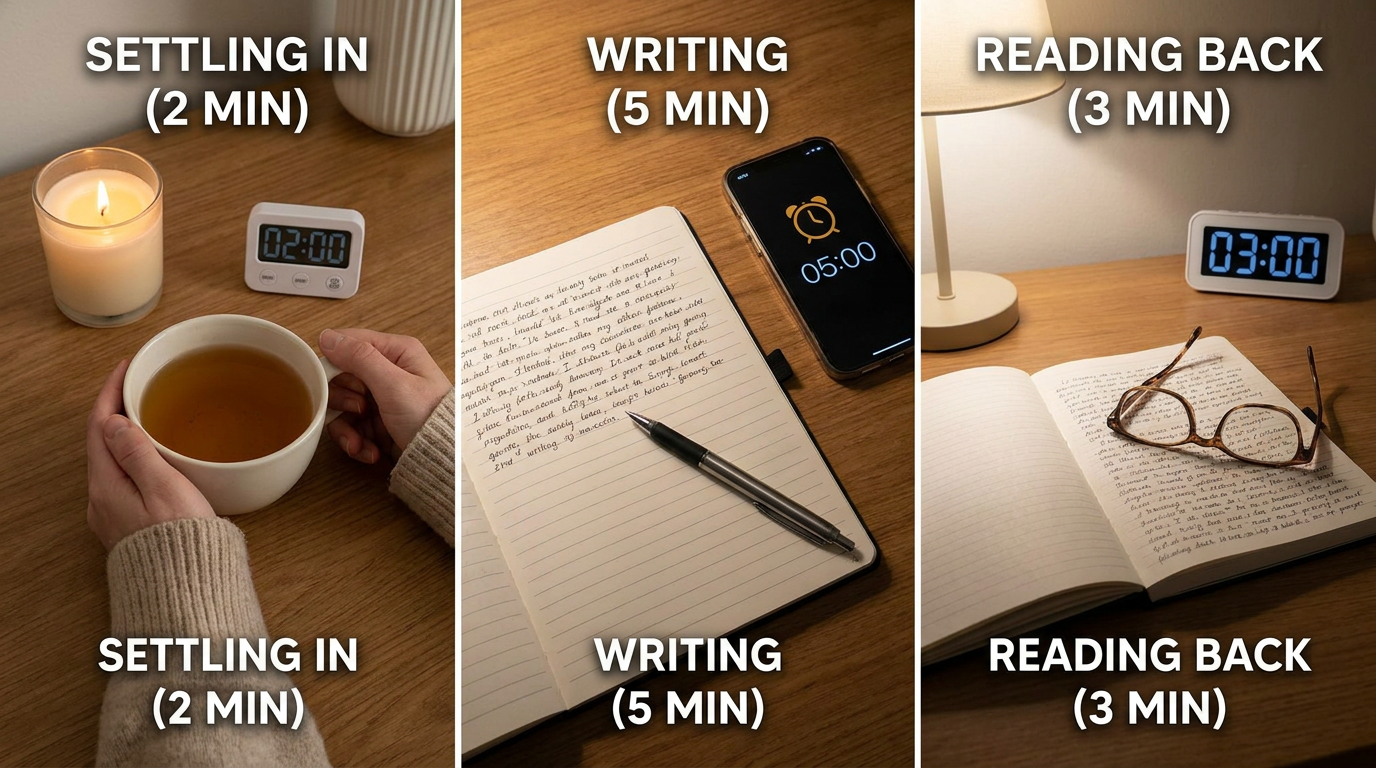
10-minute evening journaling routine with 2 minutes settling, 5 minutes writing, and 3 minutes reading back

A Gentle 10-Minute Reflection Ritual (No Pressure, No Rules)

That’s the whole problem this post is about. Not a large problem. Just a quietly annoying one.

It’s nine o’clock on a Saturday evening in October. The washing up is done, or it isn’t. There’s a lamp on in the corner. The day is essentially over, and if someone asked you what happened on Tuesday, you’d hesitate. Not because Tuesday was bad. Because Tuesday was Tuesday, and it went the way most Tuesdays go — which is to say it went, and took its details with it.

Most advice about writing things down arrives with a lot of scaffolding attached. Streaks. Daily targets. An app that turns amber when you’ve missed two days and sends you a notification shaped like disappointment. The implication is always that you’re starting something, and starting something means keeping it up, and keeping it up is the part you already know you’re bad at. If you’ve tried before and it fizzled out by mid-February, you’re in good company — and if you want the wider view on that, we’ve written a fuller guide to Here’s the offer, plainly. Ten minutes. A few times a week. At the end of the day. That’s it. That’s the entire proposition. It sits in your evening the way making a cup of tea sits in your evening, or reading a chapter before you turn the light off. It is not a project. There is nothing to complete.
starting a journal again after it didn’t stick before

. This post is the narrow version. It takes one section of that guide — the short reflection ritual — and gives it the room it deserves.

And here’s what you get, stated honestly and without inflation: you’ll remember the day, and the week will stop blurring together. That’s the payoff. It’s real, it’s modest, and I’m not going to dress it up as anything larger, because the moment a small pleasant thing gets sold as a life overhaul, it stops being small and pleasant and starts being one more thing you’re behind on.

Along the way you’ll get a bank of more than thirty gentle prompts to write to — gratitude prompts among them, alongside noticing prompts, small-detail prompts and a set for the end of the week. Pick one. Ignore the rest. That’s allowed.

So why does a bounded ten minutes work when a sincere intention to “journal more” doesn’t? That’s worth understanding before we get to the structure itself.

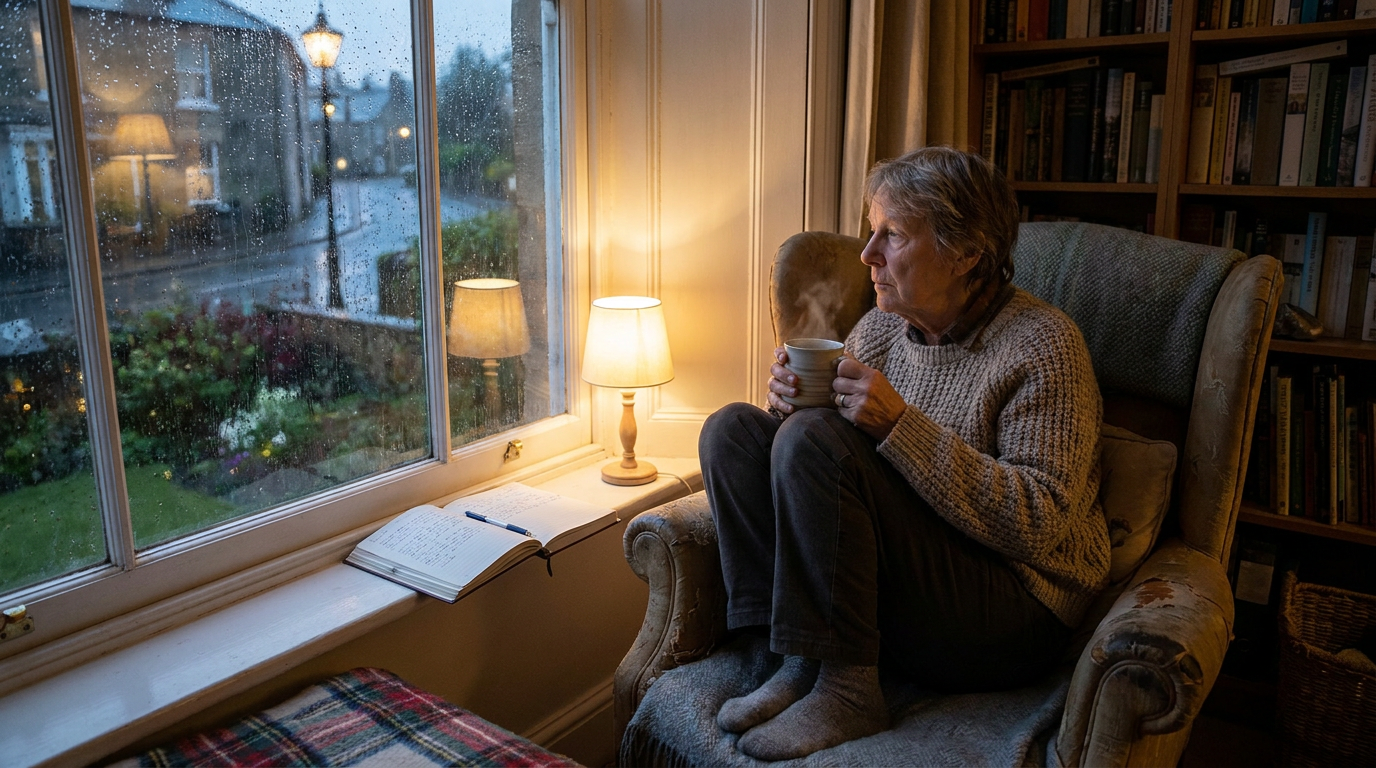
Person sitting quietly by a window with tea during an evening reflection routine

Why a Container Beats an Open-Ended Habit

“Journal more” is a strange instruction when you look at it directly. More than what? Finished when? There’s no line you cross where you can put your pen down and think, right, that’s done.That difference sounds small. It isn’t. Most of what makes an intention wear you down is the low background hum of incompleteness it generates. Remove the open end and the hum goes with it.

Ten minutes at the end of the day is a different kind of object entirely. It has edges. It starts when you sit down and it ends when it ends, and at that point you have unambiguously done the thing. There’s no partial credit and no residue. Ten minutes is ten minutes.

You can always have written more, gone deeper, been more consistent. An unbounded task never releases you. It just sits there, permanently slightly unmet.

A habit asks you to keep something going. A ritual just asks you to show up tonight.

Habits accumulate failure. That’s almost their defining feature. Miss nine days and the nine days are now part of the story — you’re not returning to a neutral thing, you’re returning to a thing you’ve already let down. There’s an implicit apology built into picking it back up. Rituals don’t work like that. A ritual has no memory of your absence. You didn’t feel like it on Tuesday; you feel like it tonight. Those two facts have nothing to do with each other.

There’s a second advantage, and it’s the one that matters most if you’ve abandoned this sort of thing before. A container is much easier to restart than a habit is.

This is where it helps to separate a reflection journal from the older idea of a diary. A diary, in the way most of us absorbed it as children, is something you keepLet me be as clear as I can about what this post is not going to do. It is not going to ask you to be consistent. There are no streaks here, no counters, no completion percentages, no little rings to close. I’m not going to suggest you build a chain and then not break it. Those mechanisms work for some people and they’re genuinely motivating right up until the moment they aren’t, at which point they convert straight into a reason to quit. A missed day shouldn’t be able to cost you anything. In this ritual, it can’t.

The end of the day makes a particularly good container, for a reason that’s easy to miss. The day is already finished. There’s nothing left to add to it, nothing you could still get done, no way to improve your performance in it. It’s closed. You’re not sitting down to plan or fix or optimise anything — you’re sitting down to note down what happened in a stretch of time that has already concluded. That’s a genuinely low-stakes position to write from, and it’s why evening suits this ritual better than morning does. Morning is full of the day’s potential. Evening has none, and that’s the appeal.

. The verb is telling. It implies custody, maintenance, an unbroken line of entries with dates on them, and a faint sense of shame about the gaps. A reflection journal with a container attached is a much lighter proposition: it’s somewhere you write for ten minutes when you fancy it, and the record it produces is a record of the evenings you felt like writing. Which is a perfectly honest thing for a record to be.

If you want the broader framing — how a container fits into the wider question of making a journal stick after a few false starts — covers it at length. Otherwise, we’ve established the shape of the box. Let’s look at what goes inside it.
the wider guide to restarting a journal

The Ten Minutes: Three Short Movements

The ritual has three parts, and they’re deliberately uneven:

  • Two minutes — settling, and running the day back
  • Five minutes — writing to one prompt
  • Three minutes — reading back the last few entries

That’s the whole architecture. You can follow it tonight without reading another word of this post, though the prompt bank in the next section will make the middle five minutes considerably easier.

Two minutes: settling

Don’t skip ahead to writing. The retrieval is what gives you something to write about, and it’s also the part that lets you arrive properly in the ten minutes rather than opening an app and staring at it.

You’ll find this is harder than it sounds for the first few evenings and then rapidly becomes easy. You’ll also find that about a third of what surfaces is stuff you’d genuinely have lost by Thursday. That’s the point of the two minutes.

For two minutes, just run the day back roughly from the morning. Where you were. Who you spoke to. What you ate. What the weather did. What you were doing at eleven, and at three, and at six. It’s a mechanical exercise, and it’s meant to be — you’re not hunting for significance or deciding what any of it meant. You’re just retrieving. Most of the day is sitting there perfectly accessible; it simply hasn’t been asked for.

Sit down. Put the tea somewhere it won’t get knocked over. Don’t write anything yet.

Five minutes: writing to one prompt

If you already know what you want to write when you sit down, skip the prompt entirely. Prompts exist to solve the blank-page problem. No blank page, no problem.

Set a timer if it helps. Plenty of people find the timer is the thing that makes it work, because it converts “write about your day” into “survive five minutes,” which is a much simpler assignment. When it goes, stop — even mid-sentence, if you like. You can always come back tomorrow, and the unfinished sentence will make you smile in a year.

Five minutes is short on purpose. It’s enough for a few sentences — three, four, six if you’re moving quickly — and it is emphatically not enough for an essay. That ceiling is doing useful work. It means you never sit down to a blank page with the vague expectation of producing something substantial, which is the expectation that kills more evening writing than tiredness ever has. A few sentences is a complete, legitimate entry. You’re not producing literature. You’re noting down what happened.

Write to it for five minutes and then stop.

Pick one prompt. One. Not three, not a sequence, not “I’ll do the gratitude one and then the noticing one.”

Three minutes: reading back

Scroll back through the last three or four entries and read them.

This is the movement everyone skips. It’s also the one that makes the entire ritual worth doing, and if you only take one thing from this post, take this: the reading back is not an optional extra bolted onto the writing. It is where the value actually lives. Writing an entry produces a record. Reading back is the moment you useThree minutes is enough for four short entries. You’ll notice things: that you mentioned the same small irritation twice, that Wednesday had something good in it you’d already mislaid, that you ate the same dinner three times. None of that needs interpreting. It’s just nice to know.

it — and the moment the previous week stops being an undifferentiated smear and turns back into a series of specific days with things in them.

In Lugelo, this is your Memory Lane — the chronological view your Moments land on automatically, in order, without you filing anything. You can see what that looks like alongside if you want a sense of it before you start.
Memory Lane and the rest of Lugelo’s journaling features

The proportions matter more than the numbers

What holds is the relationship: a short settle, a bounded write, and a genuine read-back. Lose the read-back and you’ve got a slightly dutiful writing exercise. Keep it and you’ve got something you look forward to.

Two, five and three are a suggestion, not a specification. One minute settling, six writing, three reading works fine. So does three, five, two. Some evenings you’ll do ninety seconds of writing and four minutes of reading back and that’ll be the right shape for that evening.

One practical note, particularly if you’ve arrived here looking for an evening journal routineThe five minutes in the middle needs something to point at, though. So here’s the bank.

that survives contact with real life: this works on a phone on the sofa. It works on a laptop at a cleared kitchen table. It works in a paper notebook with a pen that lives next to it. Lugelo captures Moments offline as well, so a patchy signal on the train home isn’t a reason to skip — the entry syncs across your devices when it can.

A Bank of 30+ Gentle Prompts (Including Gratitude Prompts)

Before the list, three rules for using it — and they’re the only rules in this post.

Pick one. Don’t work through them in order. This isn’t a curriculum and there’s no completion state.

Don’t feel obliged to use one at all. If you sat down already knowing what you wanted to write, write that.

Small is correct. Every prompt below is answerable in a few sentences. None of them require excavation, none of them ask you to reach a conclusion, and none of them are trying to get somewhere with you. If a prompt feels like homework, pick a different one.

They’re grouped into five registers. Skim to whichever suits the evening.

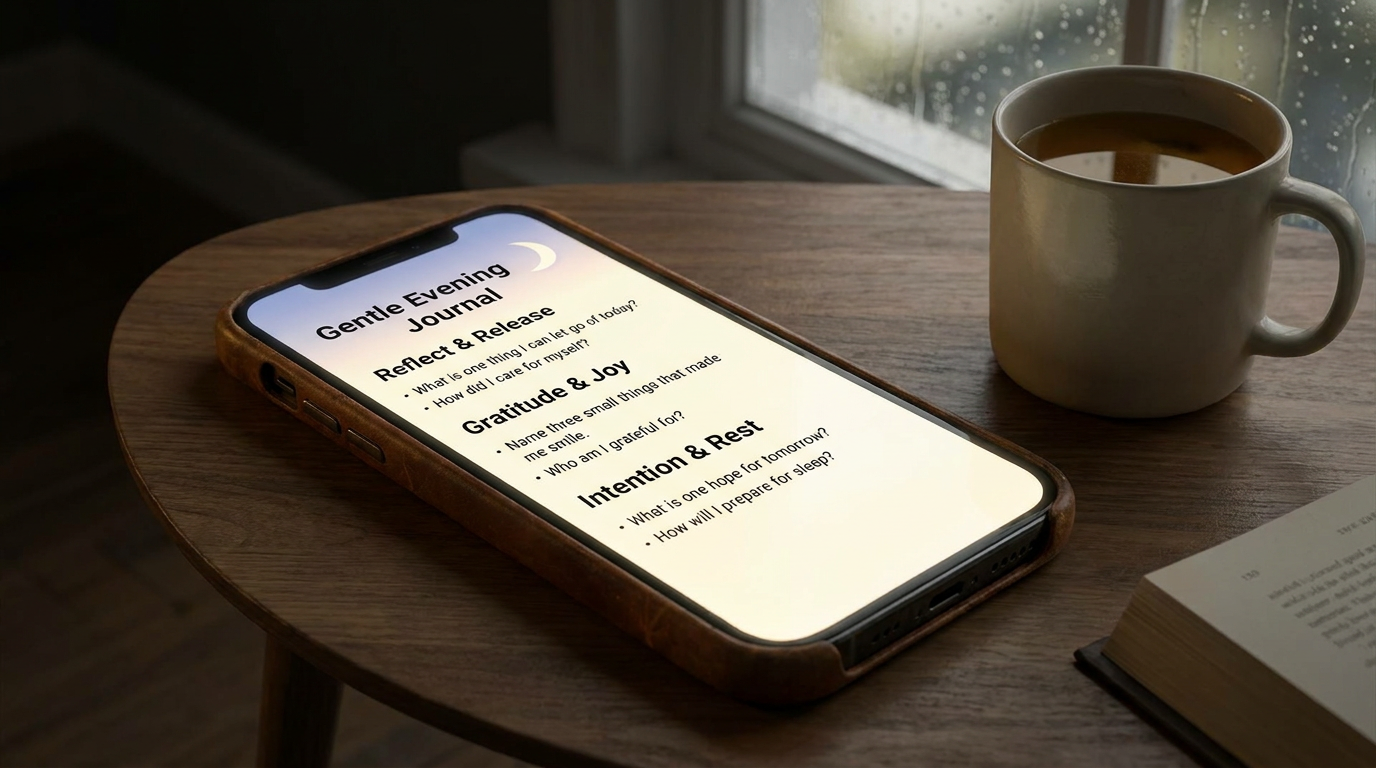
A set of gentle evening journal prompts grouped by type, shown on a phone screen

Noticing prompts

The smallest register in the bank. Sensory, low-stakes, no significance required. These are perfect for tired evenings because they don’t ask you to have had an interesting day — only to have been present during an ordinary one.

  • What’s one thing you noticed today that you’d usually walk past? (This one is a real Lugelo prompt.)
  • What was the light doing at some point today?
  • What was the first thing you heard this morning?
  • Was there a smell today that reminded you of something else?
  • What could you hear from outside, if you’d stopped to listen?
  • What was the temperature like — not the number, the feeling of it?
  • What’s one small change you noticed in a place you go often?
  • What did your hands do today that you didn’t have to think about?

Gratitude prompts

The fullest set in the bank, and the one people ask for most. The trick with gratitude prompts is to keep them specific and unsentimental. “What are you grateful for?” is an enormous question that tends to produce the same three answers forever. Small and concrete beats grand and abstract every time — and a specific answer is far more interesting to read back in a year.

  • Who held the door for you this week — physically or otherwise? (Another real Lugelo prompt.)
  • What did someone do today that saved you five minutes?
  • What’s a thing you own that worked exactly as it was supposed to?
  • What small thing would you miss if it vanished tomorrow?
  • Who made something easier today without being asked?
  • What went right today that you’d only have noticed if it had gone wrong?
  • Which part of today would you happily do again tomorrow?
  • What’s something you were given once that you still use?

Gratitude prompts of this kind sit alongside the — short, repeatable exercises in noting what you’re glad of.
gratitude practices described by the Greater Good Science Center at UC Berkeley

Small-detail prompts

These are the prompts that age best. They feel almost pointless to write and they are, without competition, the most rewarding to read back. In five years the detail is the whole value — you will not remember what you ate on an ordinary Thursday in October 2026 unless you wrote it down, and you’ll be oddly delighted to find out.

  • What did you eat today?
  • What were you wearing?
  • What was on — music, a programme, a podcast, the radio?
  • What was the walk like? (Any walk. Even the short one.)
  • What did you nearly buy and then didn’t?
  • What’s currently on the table or the desk in front of you?
  • What did you do today that you also did yesterday?
  • What’s the last thing you looked up?

People prompts

Observational, not diagnostic. These are about who was in your day, not about what your relationships mean. Keep them light — you’re recording the cast, not analysing the plot.

  • Who did you see today, even briefly?
  • Who did you text, and roughly what about?
  • What’s something someone said that stuck?
  • What made you laugh?
  • Who did you think about but not contact?
  • Who did you overhear?
  • Who was somewhere they usually aren’t?
  • Who’s someone you’ll probably see tomorrow?

End-of-week prompts

A slightly wider frame, for Fridays, Saturdays or Sundays — the evenings where the natural unit isn’t the day but the week. These pair particularly well with a longer read-back.

  • What happened this week that you’d otherwise forget by next month?
  • What’s different from last Saturday?
  • What was the best hour of the week?
  • What did this week have that last week didn’t?
  • Where did most of the week actually go?
  • What’s one thing from this week you’d tell someone about?
  • What are you carrying into next week?

That’s thirty-nine prompts. On any given evening, thirty-eight of them are irrelevant and one of them is the right one.

And some nights, none of them will fit — which is precisely what the AI Journal Assistant is for. There’s a bigger objection than “none of these fit,” though, and it deserves its own section: some days genuinely have nothing in them.
Lugelo’s AI Journal Assistant can generate prompts that fit your journal

: prompts that reflect the kind of journal you’re actually building rather than a generic list, across registers like reflection, gratitude and memory. Refresh one you don’t like. Ignore all of them. It’s a suggestion, not an instruction.

What to Write on Days When Nothing Happened

You sit down. You do the two minutes. You run the day back and it’s work, dinner, a screen, bed. There’s a real temptation at that point to close the app and think, not tonight, there’s nothing to say.This is the single most common reason an evening ritual quietly stops. Not tiredness. Not lack of time. The conviction that an uneventful day isn’t worth recording.

Here’s the reframe, and it’s a practical one rather than an inspiring one: ordinary days are the ones you actually lose. Big days look after themselves. You’ll remember the wedding without writing it down. You’ll remember the move, the trip, the day the offer came through. Those are already anchored — other people remember them too, there are photographs, they come up in conversation. Tuesday the fourteenth has none of that support. It disappears entirely within about three weeks unless something catches it.

So the days that feel least worth writing about are, in strict record-keeping terms, the days where writing produces the most. That’s not a motivational flourish. It’s just how memory distributes itself.

On a flat evening, here’s what to do:

  1. Write one sentence and stop. Genuinely. One sentence is a complete entry.
  2. Record what you ate. The most reliably interesting detail in any old journal.
  3. Note the weather and what you wore. Two lines, both of which will place the day precisely when you read it back.
  4. Write down what you’re reading or watching, and where you’re up to. This turns your journal into an accidental log of your own tastes over time.
  5. Log one thing you did that you won’t otherwise remember doing. Rang the dentist. Fixed the wobbly shelf. Walked the long way.

The one-line entry is fully legitimate. I want to be unambiguous about that, because a lot of people carry an unexamined belief that a short entry is a failed entry. It isn’t. A Moment that reads:

Rain all day. Finished the blue book. Beans on toast.

is a real entry, and in three years it will read beautifully. Better, in fact, than four laboured paragraphs about how you were feeling, because it’s specific, and specificity is what survives.

It’s also worth remembering that a Moment doesn’t have to be text at all. A photograph of what was on the table. A twenty-second voice note recorded while the kettle boils. A short clip of the rain on the window. You can , and on a genuinely flat evening the lowest-effort capture is usually the right one. A photo of Tuesday’s dinner is a better record of Tuesday than nothing is, and it takes four seconds.
capture a Moment as text, a photo, or a voice note

The practical payoff has never been that the day was interesting. It’s that you’ll know what October actually looked likeThat covers the evening where nothing happened. Now the harder one: the evening where you simply don’t want to.

— not the highlights of October, the texture of it. The rain, the book, the beans on toast.

Permission to Skip: This Is a Ritual, Not a Commitment

The distinction that matters is between a ritual and a commitment. A commitment is something you are failing at during every moment you’re not doing it — that’s structurally what a commitment is. A ritual is simply available. The tea is there whether you make it or not, and the kettle doesn’t take it personally.

Let’s kill the make-up instinct while we’re here, because it’s the second thing that goes wrong. If you’ve missed a week, do not sit down on Sunday and try to backfill it. Don’t reconstruct Tuesday from your camera roll and your messages out of some obligation to completeness. You don’t owe the journal the days you missed. The journal isn’t waiting. Start with tonight.

I want that sentence to sit on its own, because everything else in this section is a footnote to it. There is no streak to break. There is no counter to reset. There is nothing to catch up on.

Missing a Saturday means nothing.

And a gap in a reflection journalSo what’s a realistic target? A few times a week is a good outcome. Not every night. Every night was never the goal, and anyone telling you otherwise is selling you a streak. Three evenings a week, for a season, produces a genuinely useful record. Two is fine. One good Sunday a week is fine.

None of this is undermined by the product, either, and it’s worth saying plainly. Lugelo’s prompts can be refreshed or ignored entirely, and plenty of people use the app without ever touching the AI features at all. There’s no nagging. Nothing turns amber.

is not damage to the record. It’s part of it. A three-week hole in late November almost always means something busy was going on — a deadline, a house move, a new baby, a bad flu, a good holiday. When you read back, the gap tells you that as clearly as an entry would. Nothing has been lost. The shape of the year includes the parts where you weren’t writing.

One more thing belongs here, because evening writing is personal by nature. Journals in Lugelo are private by default, with owner-controlled sharing — nothing is shared unless you choose to share it — and your data is encrypted in transit. That’s the arrangement, and it’s the reason people feel able to write the unflattering bits.

With the pressure off, the interesting question becomes a different one. Not how do I make myself do this, but how do I make this something I want to come back to.

Making It Pleasant Rather Than Dutiful

The single most useful principle for an evening ritual is this: attach the ten minutes to something you already like.

Not as a reward afterwards. As part of it. The ritual should be the good bit of the evening — the bit you’re heading towards — rather than a small obstacle standing between you and bed. Get that right and consistency stops being a question of discipline, because you’ll be going back for the tea and the lamp and the chair, and the writing will come along as a passenger.

The tea, or whatever yours is. A drink you actually like, made deliberately. Not a mug of something reheated twice. The making of it is genuinely part of the ritual — the kettle, the two minutes of waiting, carrying it through — and it conveniently doubles as your settling time. By the time you sit down you’ve already been running the day back while the water boiled. Wine works. Cocoa works. A specific mug helps more than it has any right to.

The chair. One place. Not “wherever I end up.” The corner of the sofa nearest the lamp, the chair by the window, the kitchen table once it’s been cleared. Location does far more work than willpower does, because a specific spot builds an association you don’t have to maintain consciously — after a fortnight, sitting there is itself the cue. This is also why the bed is a poor choice. Too many other associations already booked in.

The lamp. Low, warm, not the overhead light. This sounds like an affectation and isn’t. Switching the big light off marks the evening as a different part of the day from the one that came before it, and that boundary is doing real work. In October, when it’s properly dark by six, the lamp is the whole difference between “still in the day” and “in the evening.”

The same time, loosely. Roughly after dinner. Roughly before bed. Not a scheduled slot with an alarm attached — an alarm turns it into an appointment, and appointments can be missed, and missing appointments feels like something. A rough position in the evening can’t be missed. It just arrives or it doesn’t.

The device or the notebook — whichever you’ll actually reach for. There’s a certain romance to the leather-bound notebook, and if that’s genuinely what you’ll pick up, use it. But be honest. If the notebook lives in a drawer upstairs and your phone is already in your hand, the phone is the better tool, and a phone on the sofa is a perfectly respectable end of day reflection setup. A few optional flourishes, worth a line each because small specifics are what turn a routine into a ritual:
Lugelo is free on iOS, Android, HarmonyOS and the web

, with Chrome and Firefox extensions, no ads, and an optional Plus tier if you ever want it. The best journal is the one within arm’s reach at nine o’clock.

  • A record on, quietly. Something without lyrics if you’re writing.
  • A window open for the first two minutes, even in October. Especially in October.
  • The same candle, but only in one season — so that in three years the smell places the entries.
  • Writing before you properly look at your phone, rather than after twenty minutes of scrolling that you’ll then have nothing to say about.
  • A blanket. Genuinely.

And here’s the honest test, the one to apply after a fortnight: if you’re dreading it, something in the setup is wrong.Get it right and it stops being something you do and starts being something the evening does. Which raises the last question worth answering: what does all this quietly amount to?

Shorten it. Move it. Change the drink. Drop to twice a week. The ritual is supposed to bend.

Not something in you. The ritual is ten minutes of writing a few sentences with a warm drink — there is nothing inherently dreadful in it, so if dread has appeared, it’s been imported from somewhere. Usually it’s length: five minutes has quietly become twenty. Sometimes it’s placement: you’ve put it after the point in the evening where you’ve run out of energy. Sometimes it’s the drink, or the chair, or the fact that you’ve started treating the prompt bank as a to-do list.

What Ten Minutes a Few Times a Week Adds Up To

The entries you don’t remember writing are the good ones. That’s the consistent experience. The ones you laboured over are fine; the throwaway line about the man at the bus stop, or the fact that the heating made a new noise, or that you finished a book on a Tuesday and started another one the same night — those are the ones that reach out and hand you the evening back. And the week you’d have sworn was completely empty turns out, on inspection, to have had four things in it.

But it’s thirty evenings you can account for. And the strange thing — the thing nobody quite believes until it happens to them — is what it’s like to read back a season of it in January.

That is not a book. Nobody’s publishing it. Total time invested: around five hours, spread across a season, most of it spent with a warm drink in a comfortable chair.

Three evenings a week, from the start of October to Christmas, is about twelve weeks. Call it thirty-something entries, allowing for the weeks where you skip entirely and the weeks where you write four times because you’re enjoying it. Thirty entries, each of them a few sentences long, some of them a single line about the weather and what you had for dinner.

Let’s do the arithmetic out loud, because the honest number is more persuasive than a vague promise.

The read-back payoff compounds. Three entries back is mildly interesting. Thirty entries back is a season. In Lugelo, your Moments land on Memory Lane in order automatically, so the season assembles itself while you’re not paying attention — there’s no filing, no tagging, no organising step you’ll fall behind on. You just scroll.

The blank page never beat you. It just outlasted you.

If you ever want to do something with a run of entries, you can. A season of Moments can Similarly, and only because it comes up: some people keep a shared evening journal with a partner or a family member, which is owner-controlled like everything else. Nice if it appeals. Ignore it if it doesn’t.
turn a season of Moments into a storybook

or an eBook export, which some people do at the end of a year and most people never do at all. Treat it as strictly downstream and entirely optional — the ten minutes is worth doing if you never export a single thing.

Which brings us back to where we started. None of this was about becoming a person who journals. There’s no identity on offer here, no new version of yourself to construct, no membership. It was ten minutes and a cup of tea, a few times a week, in October — and the week not blurring together. If you want the fuller picture of how a small ritual like this fits into a journaling habit that actually survives, is the place to go next.
the fuller guide to making a journal stick

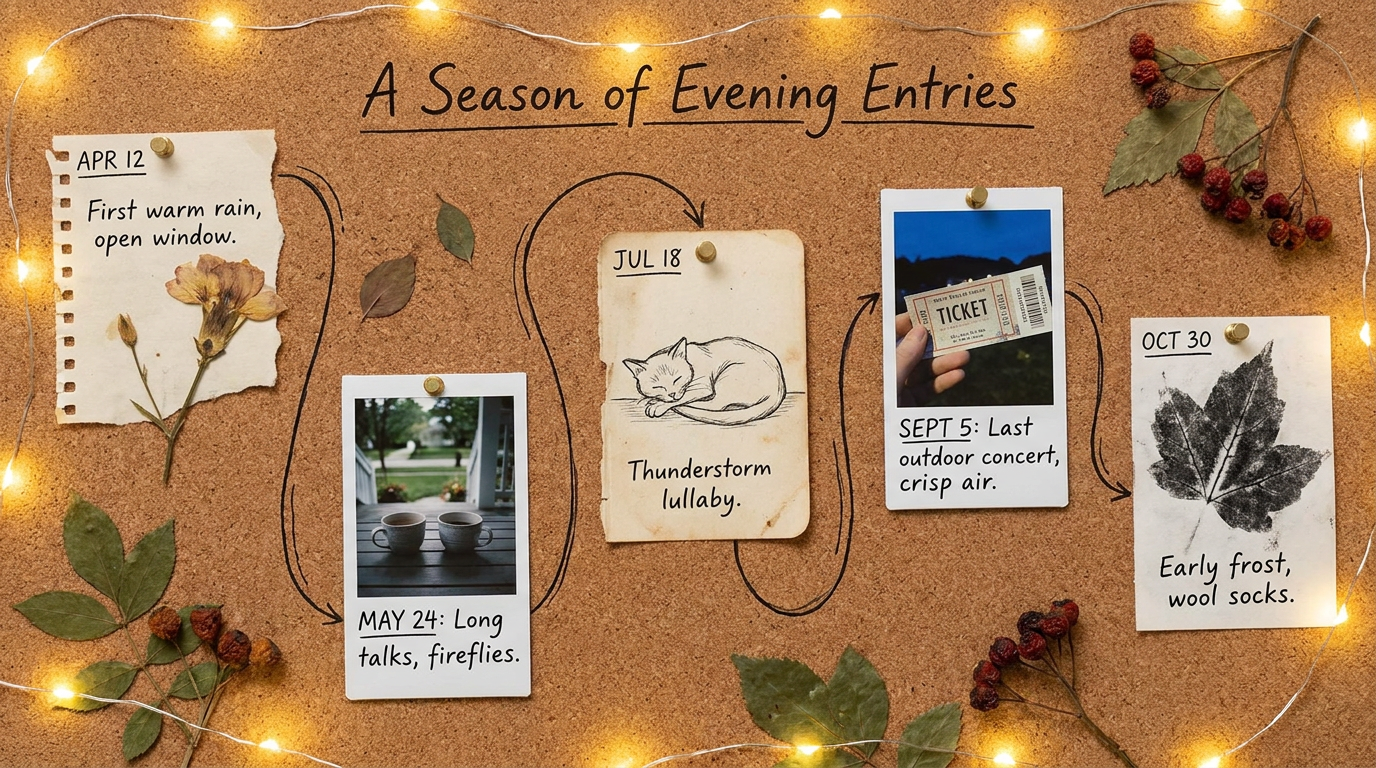
A season of evening journal entries shown as a chronological timeline of small moments

Frequently Asked Questions

How long should an end-of-day reflection take?

Ten minutes is plenty. The three movements run roughly two minutes settling and running the day back, five minutes writing to one prompt, and three minutes reading the last few entries. Shorter is completely fine — some evenings you’ll do four minutes and call it done. The proportions matter more than the exact numbers, and the read-back is the part worth protecting.

What are good gratitude prompts to start with?

Start with the small, specific ones rather than the big abstract ones. “What did someone do today that saved you five minutes?” produces a much better entry than “What are you grateful for?” Pick a single prompt for the evening rather than working through the list — the bank is there so you never face a blank page, not so you can complete it.

Do I have to write every night?

No. A few times a week is a good outcome, and it was never meant to be nightly. There’s no streak, no counter and nothing to catch up on. Missing days doesn’t undo anything you’ve already written, and you don’t need to backfill the week you skipped. Just start again with tonight.

What should I write when nothing happened that day?

One line. What you ate, what the weather did, what you’re reading and where you’re up to. Ordinary days are the ones you’d otherwise lose entirely — big days survive on their own, but an unremarkable Tuesday disappears within weeks unless something catches it. A single sentence is a complete, legitimate entry.

Is it better to journal in the morning or the evening?

Evening suits this particular ritual, because the day is finished and there’s nothing left to add to it. You’re noting down what happened rather than planning what might. Morning writing is a different thing and works well for other purposes — intentions, ideas, longer pieces. For a short end-of-day record, evening is the natural fit.

Is a reflection journal the same as a diary?

Broadly, yes — both are records of your days. The difference here is the container. A diary implies an open page and an obligation to keep it up. This is a bounded ten minutes and one prompt, a few times a week, with no expectation of an unbroken run. Same idea, much lighter frame.

Do I need an app, or is paper fine?

Either works. Paper is genuinely good, and if a notebook is what you’ll actually reach for, use it. An app makes the reading-back movement easier, since entries land in date order automatically with no filing, and photos or voice notes can sit in the same entry as the text. Use whichever is within arm’s reach.

Are my journal entries private?

Journals in Lugelo are private by default with owner-controlled sharing, and data is encrypted in transit. Nothing is shared unless you choose to share it.

What if none of the prompts fit?

That happens most weeks. Lugelo’s can generate prompts based on the journal you’re actually building, across registers like reflection, gratitude and memory. Any prompt can be refreshed if it doesn’t suit the evening, or ignored completely — and if you already know what you want to write, skip the prompt entirely.
AI Journal Assistant

Is Lugelo free?Yes. It’s free on iOS, Android, HarmonyOS and the web, with Chrome and Firefox extensions, and there are no ads. There’s an optional Plus tier if you want it, and offline capture is built in, so entries you write without a signal sync across your devices later.

Ten Minutes, a Cup of Tea, and October

You’ll remember the day. And the season won’t blur.

And the permission, restated plainly, because it’s the part most worth keeping: no streaks, no rules, nothing to keep up with perfectly. Skip whenever you like. Miss a fortnight. Come back on a Thursday in November with a single line about the weather and it’ll count exactly as much as anything else in there.

The whole ritual, one more time, so it’s easy to remember. Two minutes running the day back without writing anything. Five minutes on one prompt — just one — and then stop, even mid-sentence. Three minutes scrolling back through the last few entries, which is the part that makes the rest of it worth doing.

So: it’s nine o’clock on a Saturday evening in October. The lamp’s on. There’s a drink going cold at your elbow because you got interested in something you were writing.

If you want somewhere to put tonight’s ten minutes, Lugelo is free on iOS, Android, HarmonyOS and the web, with Chrome and Firefox extensions. Journals are private by default, with owner-controlled sharing. Start with one Moment tonight — .
Get Started

The Beautiful Game Deserves Beautiful Memories: Turning World Cup 2026 Drama into a Digital Storybook

The Proven Benefits of Digital Journaling — Mental Health, Memory, and More

In a world that’s evolving at the speed of a swipe, capturing your child’s precious moments has become more than just a treasure trove of nostalgia—it’s an art. Parents today are not just observers; they are the architects of tomorrow’s memories, and with innovative tools like Lugelo, they have the power to create rich, interactive tapestries of their child’s journey. Imagine a digital diary that not only captures milestones but also weaves together stories, art, and emotions in a way that can be cherished for generations to come. Welcome to Lugelo, where every giggle, first step, and victory lap becomes an integral part of a narrative that celebrates life’s most cherished chapters.

The Importance of Preserving Family Memories

Before delving into the how-tos of Lugelo, let’s take a moment to understand why documenting these fleeting moments is so vital. According to Pittsburgh Parent, preserving family memories is crucial for creating lasting bonds and building a solid foundation for our children. As time passes, memories that are not recorded can fade, but capturing them digitally ensures they remain fresh and vibrant, well into the future.

“Mindfully working in precious time spent with family can increase bonds, building a stronger, more memorable foundation for your kids.” — Pittsburgh Parent

Introducing Lugelo: Your Digital Diary Solution

Lugelo offers a unique, user-friendly platform for parents to document every stage of their child’s development. It’s not just a digital diary; it’s a living, breathing archive of moments that can be enhanced, shared, and celebrated with loved ones. From virtual reality features to collaborative storytelling, Lugelo stands out by offering a myriad of features that transform ordinary memories into extraordinary narratives.

Key Features of Lugelo:

  • Interactive Journaling: Create entries that combine text, images, and videos, allowing for a multi-dimensional storytelling experience.
  • VR-Enhanced Storytelling: Immerse yourself in memories with virtual reality, giving a new perspective to the recorded moments.
  • Collaborative Family Journals: Invite family members to contribute to the diary, making it a collective memory repository.
  • Privacy Controls: Keep certain entries private or choose to share them with a select audience.

Transforming Everyday Moments into Cherished Memories

The Art of Routine Documentation

Often, it’s the everyday moments that hold the most significant meaning—those candid snapshots of life that stitch together the fabric of our memories. Lugelo allows you to document these occurrences with ease. Whether it’s a child’s first artwork or a family bike ride, each entry becomes a story worth telling.

In a Medium article, it is emphasized how parents can effectively digitize their children’s artwork for future references. Similarly, Lugelo provides a platform to record and preserve these artworks alongside other daily activities, making it an extensive repository of childhood memories.

Creating a Narrative with VR Storytelling

One of Lugelo’s standout features is its ability to enhance storytelling through virtual reality. Imagine donning a VR headset and reliving your child’s birthday party as if you were there again. This immersive experience not only enriches the memory but also makes sharing it with family members more impactful. As more parents and children are engaged in such storytelling, the experience becomes a part of a shared legacy, one that technology like VR makes possible.

Involving Family: Collaborative Journaling

Family involvement in documenting memories enhances the depth and richness of the stories told. Lugelo allows team members to join in on the journaling process, creating a collaborative tapestry of shared experiences. Grandparents can add anecdotes, siblings can contribute artwork, and distant relatives can leave messages of love and support. This collective approach to memory-keeping ensures that everyone’s perspective is part of your child’s story.

An exploration of Lugelo’s family journal capabilities reveals how these features can be harnessed to create detailed references of family histories. From school activities to funny moments at home, Lugelo captures the essence of daily life.

A family actively engaging in creating a shared digital journal on Lugelo.

Practical Steps to Start Your Lugelo Journey

Getting Started with Lugelo

Embarking on your Lugelo journey is simple and rewarding. Here’s a step-by-step guide to help you get started:

  1. Create Your Lugelo Account: Visit the Lugelo website and sign up for a free account. The process is quick and hassle-free.
  2. Set Up Your Child’s Journal: Begin by creating a dedicated journal for your child. Customize it with a theme that resonates with their personality.
  3. Start Documenting: Capture everyday moments by adding text, photos, videos, and even voice recordings. The flexibility of the platform allows for a personalized experience.
  4. Invite Contributors: Add family members as contributors to the journal, allowing them to enrich it with their own stories and perspectives.
  5. Explore VR Features: If you have access to a VR headset, experiment with the virtual reality features to see your memories come to life in a whole new way.

Tips for Successful Memory Documentation

  • Be Consistent: Regularly update your child’s journal to ensure no moment is missed.
  • Include Diverse Media: Use a mix of photos, videos, and text to create a richer narrative.
  • Celebrate Milestones: Highlight important events like birthdays, first steps, and school achievements with dedicated entries.
  • Q: Can I share specific entries with limited audiences?
  • A: Yes, Lugelo offers privacy controls that allow you to share entries selectively.
  • Q: Is there a way to back up our Lugelo entries?
  • A: Lugelo provides options for backing up entries to ensure they are securely preserved.

The Enduring Value of Preserved Memories

As parents, we hold the key to preserving the essence of our children’s formative years. Lugelo empowers us to weave a digital tapestry that our children can cherish and build upon as they grow. These preserved memories become more than just stories; they are legacies of love and family. By embracing Lugelo and harnessing its potential, we ensure that those cherished moments live on, becoming a source of joy and reflection for future generations.

“The greatest legacy we can leave our children is the memory of who they were and where they came from.”

Embrace the power of Lugelo today and begin crafting the narrative of your child’s lifetime—one filled with moments that matter, stories that touch the heart, and memories that stand the test of time.

For more inspiration on creating a rich, digital narrative of family stories, visit Lugelo’s official website.

in

Who Is Digital Journaling For? More People Than You Think

Who Is Digital Journaling For? More People Than You Think

When most people picture a journalers, they imagine a teenager writing about their feelings in a diary, or a writer keeping a literary notebook. That image is both limited and outdated. Digital journaling in 2026 is for virtually everyone — and the variety of ways it shows up in real lives is worth mapping out clearly.

Parents and Families
The parents who feel most haunted by the passage of time are often the ones who built no archive of it. Childhood moves fast — shockingly fast. The milestones, the funny things your toddler said, the first day of school expressions, the family vacations — they blur together within months. A digital family journal captures these moments with the full richness they deserve: photos, videos, written reflections, and the emotional context that transforms a memory into a story.

Friend Groups
Some of life’s best memories are shared ones. Concerts, road trips, adventures, ridiculous moments that become legendary with retelling — these deserve more than a group chat thread that disappears into the scroll. A collaborative digital journal lets everyone contribute their photos and perspective, creating a shared archive that belongs to all of you.

Wedding Parties and Event Groups
Weddings, anniversaries, milestone celebrations — these are moments people spend enormous energy planning but often struggle to truly preserve. Collaborative event journals let guests contribute their own memories, creating a multi-perspective keepsake that no single photographer could produce.

Travelers and Adventurers
Travel is one of the richest sources of experience in a human life — and one of the most rapidly forgotten. A travel log that captures not just where you went but how it felt, what surprised you, what you ate, what you overheard — that’s a document worth keeping for a lifetime. And digital format means your photos live inside the story, not in a separate camera roll.

Personal Reflectors and Mental Wellness Seekers
This is perhaps the largest and fastest-growing segment of the journaling world. Daily gratitude journals, mood tracking, stress processing, therapy adjuncts — the research behind expressive writing for mental health is robust enough that therapists now routinely recommend journaling as a clinical tool.

Creative Writers and Memoir Builders
Many of the world’s most celebrated writers have kept journals — not as finished work, but as a generative space where raw material becomes refined story. Digital journaling is a natural home for anyone building toward a memoir, a personal essay, or simply a richer understanding of their own narrative.

Memory Keepers and Family Historians
There is a generation of people alive today who carry stories that will be lost when they are gone. Family histories, immigration stories, wartime memories, cultural traditions — digital journaling offers a structured, accessible way to capture these stories before they disappear.

Privacy-Conscious Individuals
Not everything belongs on social media. Not every memory is meant for an audience of hundreds. Digital journaling offers controlled sharing — you decide what’s private, what’s shared with family, and what remains entirely yours.

Whoever you are, whatever your reason — start your first journal on Lugelo and discover what version of digital journaling fits your life. Once you recognize that it’s for you, the next question is simply: how do you actually begin?

5 Journaling Habits That Will Transform Your Life in 30 Days

5 Journaling Habits That Will Transform Your Life in 30 Days

Introduction

Get ready to embark on a transformative journey of self-discovery and personal growth, one page at a time.

Imagine waking up each morning with a sense of clarity and purpose, feeling in control of your thoughts and emotions. Now, picture the transformation your life could undergo with just 30 days of a simple yet powerful habit: journaling. Whether you’re a seasoned journaler or a complete beginner, incorporating these five journaling habits can lead to profound changes in your daily life—bringing clarity, focus, and emotional balance.

1. Set Daily Intentions

Every morning, embrace the power of intention-setting. By writing down your intentions for the day, you create a roadmap for your thoughts and actions. This practice enhances focus and motivation, aligning your daily activities with your broader life goals.

How to Set Intentions:

  • Start with a Focus: Choose one or two areas in your life you want to focus on. For example, “Improve my productivity” or “Practice kindness.”
  • Specificity is Key: Make your intentions specific. Instead of “Be more productive,” write, “Completed 3 key tasks at work today.”
  • Reflect and Adapt: At the end of the day, revisit your intentions. Reflect on what worked and what needs adjusting.

Quote:

“Setting intentions is a vigorous act of creation. This is the power of the conscious mind.” — Jane Houston

Consider joining a , which offers daily prompts to inspire and solidify your intentions.
One Month Journaling Challenge

2. Gratitude Journaling

Gratitude journaling has the power to shift your mindset to one of abundance and positivity. By regularly noting what you’re grateful for, you train your brain to focus on the good, reducing stress and enhancing happiness.

Gratitude Journaling Tips:

  • Keep it Simple: Each day, list 3 things you’re grateful for. They can be as simple as a great cup of coffee or the smile of a stranger.
  • Be Consistent: Establish a specific time each day to write, like right before bed. Consistency helps make gratitude journaling a habit.
  • Expand Your Gratitude: Occasionally, dive deeper into why you’re grateful for something. This enriches the practice.

Explore how gratitude can transform your mindset in this and start your journey toward positivity.
Inkspire Daily article

An open journal with a list of gratitude entries.

3. Mindful Reflection

In a world of constant distractions, taking the time to reflect mindfully is a grounding practice. It allows you to digest your day, understand your emotions, and grow from your experiences.

Reflective Journaling Practice:

  • Daily Reflection: Spend a few minutes each evening reflecting on your day. Ask yourself, “What went well today?” and “What could I improve tomorrow?”
  • Emotional Check-in: Note any strong emotions you experienced and what triggered them. This helps in understanding emotional patterns.
  • Weekly Summary: At the end of each week, summarize your insights. Look for recurring themes or lessons.

Mindful reflections help solidify learning and foster self-awareness, aiding personal growth. For more on effective journaling habits, check out .
5 Habits That Will Change Your Life in 30 Days

4. Goal Setting and Tracking

A crucial aspect of personal development is setting and tracking meaningful goals. Journaling provides a structured way to outline your aspirations and monitor your progress.

Goal-Setting Steps:

  • Define Clear Goals: Write down both short-term and long-term goals with realistic deadlines.
  • Break It Down: Divide large goals into smaller, manageable tasks.
  • Review Regularly: Track your progress frequently and adjust your strategies as needed.

Using a journal to track goals not only helps in achieving them but also in understanding the journey and obstacles encountered along the way. For more in-depth guidance, explore the .
Lugelo Blog’s journaling techniques

Women checking journal with goal entries, celebrating milestones.

5. Creative Expression

Unleash your creativity and reduce stress through free writing, sketching, or any form of artistic expression that suits you. Journaling provides a private space to explore your creative side and process emotions constructively.

Creative Journaling Techniques:

  • Free Writing: Spend 10 minutes writing without any constraints. Let your thoughts flow without judgment.
  • Drawing and Doodling: Use illustrations or doodles to express ideas or emotions.
  • Storytelling: Write short stories or anecdotes about your day or imagined scenarios. This can boost creativity and offer new perspectives.

Creative expression through journaling not only enhances creativity but also acts as a therapeutic outlet, improving mental well-being.

Quote:

“Creativity is intelligence having fun.” — Albert Einstein

Conclusion

In just 30 days, these five journaling habits can truly transform your life. They offer pathways to clarity, intentionality, gratitude, introspection, and creativity. The beauty of journaling is its ability to adapt to each individual’s journey, allowing for a deeply personal transformation.

Start today and experience the positive changes these journaling practices can bring to your life. For further inspiration and resources, explore the vast benefits of journaling and personal growth with and other influential sources.
Inkspire Daily

A peaceful scene of journaling, signaling a new beginning.

Set aside time for yourself, turn the page, and begin a new chapter today. Your journaling journey awaits!

Unlock Your Mind: Top 10 Mental Health Benefits of Daily Journaling

Unlock Your Mind: Top 10 Mental Health Benefits of Daily Journaling

Imagine having a tool that fits snugly in your hand, yet holds the power to illuminate the darkest corners of your mind. This tool isn’t an advanced gadget or a cutting-edge app; it’s something as simple as a journal. More than just a repository of thoughts, journaling is a powerful practice that nurtures mental well-being and encourages personal growth. This blog delves into the top 10 mental health benefits of daily journaling, offering insights on how you can harness its potential to unlock your mind.

The Magic of Journaling

A Portal to the Inner Self

Journaling is like opening a dialogue with yourself. Each entry uncovers layers of thought and emotion that you might not even be aware of. By putting pen to paper (or fingers to keyboard), you’re not just recording events—you’re engaging in an active process of self-exploration and healing.

According to , quick writing exercises can uplift your mood and offer a fresh perspective, making journaling a versatile tool for enhancing emotional wellness.
HelpGuide

“Journaling is like whispering to one’s self and listening at the same time.” — Mina Murray

Top 10 Benefits of Daily Journaling

1. Reduces Stress and Anxiety

Anxiety often stems from rumination—obsessive dwelling on worries. Journaling provides an outlet for these thoughts, allowing you to release tension and gain clarity. A reveals how journaling helps decrease symptoms of anxiety and depression by offering a safe space to explore negative emotions without judgment.
study on Suno Chat

2. Improves Mood

Writing about positive experiences or expressing gratitude can lead to a happier mindset. Creating a gratitude journal, where you consistently record what you’re thankful for, can dramatically boost your mood.

A colorful journal entry filled with words of gratitude and positivity.

3. Boosts Creativity

Facing a creative block? Journaling can spark new ideas and ignite your creative spark. As you write without constraints, your imagination begins to flow, offering novel insights and perspectives.

4. Enhances Memory and Comprehension

Regular journaling acts like a workout for your brain, honing your ability to articulate thoughts clearly and improve memory retention. As you recount events and emotions, you cement these memories in your mind.

5. Strengthens Emotional Intelligence

By reflecting on your thoughts and feelings, journaling enhances self-awareness. This deeper understanding not only improves your emotional intelligence but also boosts your ability to empathize with others.

6. Encourages Mindfulness

Journaling is a mindful practice that encourages you to pause and reflect on your life. It draws your focus to the present moment, enabling you to acknowledge and process your experiences more fully.

7. Facilitates Problem Solving

When faced with challenges, writing about them can help you brainstorm solutions. Journaling fosters a problem-solving mindset by framing issues in a new light and revealing potential pathways you might have previously overlooked.

8. Promotes Self-Discipline

Sticking to a daily journaling routine requires dedication. Over time, this cultivates self-discipline and strengthens your commitment to personal goals.

9. Improves Communication Skills

Journaling helps you articulate thoughts more clearly, enhancing your verbal and written communication skills. This can translate into better interpersonal interactions, both personally and professionally.

10. Builds an Archive of Personal Growth

A journal is a living archive that documents your journey. Looking back on past entries allows you to see how you’ve grown, what you’ve overcome, and where you want to go next.

Tips to Start Your Journaling Journey

Crafting Your Habit

Starting a journaling practice is easier than you think. Here are some tips to help you begin:

  1. Find Your Medium: Whether it’s a traditional notebook or a digital journal, choose the format that feels most comfortable for you.
  2. Set a Time: Designate a specific time each day to journal. Consistency is key to reaping the benefits.
  3. Start Small: Aim for short, manageable entries when you’re starting out. As you become more comfortable, your entries can grow naturally.

Integrating Technology

Apps like offer a unique way to enhance your journaling experience. Lugelo provides a secure, user-friendly platform for digital journaling, allowing you to share your insights and collaborate with others if you choose. This blend of traditional journaling with tech can make your practice more engaging and interactive.
Lugelo

Conclusion

Journaling is more than a mere pastime—it’s a transformative practice that offers profound mental health benefits. By unlocking your mind through daily writing, you can cultivate greater self-awareness, emotional resilience, and overall well-being. So why wait? Start your journaling journey today and witness the unfolding of a more mindful and fulfilled you.

A serene illustration of a person journaling while enjoying a cup of tea, symbolizing tranquility and self-reflection.

“Journal writing, when it becomes a ritual for transformation, is not only life-changing but life-expanding.” — Jen Williamson

Embark on this journey of self-discovery with the aid of technology and enjoy the process of unlocking your mind. Let your pen—or app—guide you to new realms of understanding and personal growth.

Journaling is the New Self-Care: Transforming Well-Being with Words

Journaling is the New Self-Care: Transforming Well-Being with Words

Introduction

Join us as we delve into the transformative power of journaling, a practice that extends beyond mere diary entries into a potent form of self-care capable of nurturing the mind and spirit.

In an era where our lives often move at breakneck speed, carving out moments for self-care has become not just beneficial, but essential. While many individuals turn to meditation or mindful breathing, another, perhaps less trodden path to emotional and mental well-being lies in the simple yet profound act of journaling. As contemporary self-care evolves, journaling has emerged as a versatile tool to help individuals harness their thoughts, emotions, and creativity. But what is it about putting pen to paper—or fingers to keyboard—that offers such profound benefits?

The Science Behind Journaling

The Psychological Benefits

Journaling’s efficacy as a self-care tool is firmly rooted in psychological science. As outlined in the , journaling offers a way to declutter the mind and process complex emotions by externalizing inner turmoil onto the page. This act of transcription not only aids in organizing thoughts but also offers an opportunity for reflection and self-discovery. By documenting personal experiences and related feelings, individuals can gain clarity and practice mindfulness, leading to an enhanced sense of well-being.
HelpGuide article

“Journaling transforms swirling thoughts into clear, tangible expressions, serving as a bridge connecting your mind and heart.” — Luke Coutinho (source)

Stress Reduction and Emotional Processing

Beyond just organizing thoughts, journaling has the power to significantly reduce stress. Writing about events and emotions can help individuals process life experiences in a healthy manner, reducing the cognitive load associated with unexpressed emotions. By reflecting in a journal, individuals often uncover patterns in their behaviors and thoughts, gaining new insights and fostering emotional release and relief. As explored in the article on the , journaling encourages a deeper exploration of one’s “self,” enhancing emotional intelligence and resilience.
Peachey Counselling website

Exploring Different Journaling Techniques

From Traditional to Technological

Journaling isn’t a one-size-fits-all practice; it can be tailored to meet individual needs and preferences. Traditional pen-and-paper journaling offers tactile satisfaction and a personal touch, while digital journaling allows for endless customization and accessibility. Modern apps, like Lugelo, take journaling to an innovative level by incorporating storytelling and collaboration features, making it easier for families to document shared memories .
source

  1. Stream of Consciousness: Write continuously for a set period without worrying about grammar or structure. This technique encourages free expression and unearths subconscious feelings.
  2. Gratitude Journaling: Focus on documenting things you are grateful for each day. This positive reflection improves mood and outlook.
  3. Prompted Journaling: Use prompts or questions to guide your writing, facilitating exploration of specific topics.
  4. Collaborative Journaling: Use apps like Lugelo to share and document memories with others, enhancing family connections.

Customizing Your Journaling Experience

Whether traditional or digital, journaling should be as unique as you are. Consider personalizing your journaling practice by experimenting with different techniques to see which resonates most. You might begin with prompt-based journaling to guide your thoughts, or perhaps a blend of gratitude entries and storytelling to build narratives around positive experiences. Whatever form it takes, your journal should be a safe space for self-expression and growth.

Journaling as a Form of Self-Exploration

Insights and Reflections

By regularly engaging in journaling, individuals are often surprised by the self-insights they uncover. Writing not only clears the mind but also fosters self-awareness by highlighting recurring themes and patterns. As suggests, this practice can be transformative, turning ephemeral thoughts into enduring insights that guide personal growth.
Luke Coutinho

Setting and Achieving Goals

Journaling can also be a powerful tool for setting and pursuing goals. Documenting your aspirations and mapping out steps to achieve them focuses your energy, offering a tangible reminder of your progress. Whether it’s building a new habit, developing a skill, or simply enhancing your life satisfaction, journaling helps sustain motivation by reminding you of your journey.

  • Q: How often should I journal?
  • A: There’s no fixed rule. Some find daily journaling beneficial, while others prefer weekly entries. Find a rhythm that fits your lifestyle.
  • Q: Is digital journaling as effective as traditional methods?
  • A: Both methods have their merits. Digital journaling offers flexibility and convenience, while traditional writing provides a tactile experience. Your personal comfort should guide your choice.

Innovative Tools to Enhance Your Journaling

Technology Meets Tradition

As the art of journaling evolves, so do the tools that facilitate it. Digital applications like Lugelo provide platforms not only to pen down your musings but to also engage with storytelling elements and collaborative features . These innovations expand the realm of journaling, transforming it from a solitary activity into a shared, dynamic experience.
source

  1. Lugelo: Offers features for collaborative journaling, perfect for families documenting shared experiences.
  2. Day One: An app that combines beautiful interface design with powerful features like photos and tags.
  3. Journey: A user-friendly app that integrates text, photos, and social sharing.

The Role of Apps in Modern Journaling

Apps can enhance journaling in myriad ways, from automating entries to integrating multimedia components. They provide versatility and accessibility, enabling users to journal anytime, anywhere. Moreover, the integration of AI offers unique insights and prompts, personalizing your journaling journey and encouraging deeper emotional exploration.

Conclusion

Let your journal be a refuge and a guide—a transformative space where your mind and heart connect. Ready your pen or open your app, and embark on this profound journey to well-being through words.

In a world where self-care is paramount, journaling emerges as a timeless yet adaptable practice that nurtures mental and emotional well-being. Whether through traditional writing or innovative digital platforms such as Lugelo, journaling invites introspection, cultivates self-awareness, and fosters mental clarity. By turning to this tool, we can navigate life’s challenges with grace and intentionality, bridging our inner worlds with the outside chaos in a meaningful dance of words.

“In the tapestry of our lives, journaling stitches together moments of insight and clarity, crafting a narrative that’s uniquely ours.” — Unattributed Proverb

Open journal with a quotes page and warm lighting, symbolizing inspiration and reflection.

Explore the transformative power of journaling for mental wellness and discover personalized journaling techniques that suit your lifestyle today!

Why Lugelo is the Best Digital Journaling App for Organizing Your Life

Why Lugelo is the Best Digital Journaling App for Organizing Your Life

In today’s fast-paced world, it’s more important than ever to stay organized and manage your time effectively. One of the best ways to achieve this is by journaling. Journaling can help you process your thoughts, stay on track with your goals, and make progress towards the life you want to lead. With digital journaling apps becoming increasingly popular, it can be challenging to decide which one is the best fit for you. In this article, we will discuss why Lugelo is the best digital journaling app for organizing your life.

Ease of Use

Lugelo is incredibly user-friendly and easy to navigate, making it accessible to anyone. The app is designed to be intuitive, and it’s easy to get started with just a few clicks. You can access Lugelo from any device with internet connectivity, whether it’s a desktop, laptop, tablet, or smartphone. The interface is simple and straightforward, making it easy to find what you’re looking for quickly.

Customizable Organization

Lugelo offers a high degree of customization when it comes to organizing your entries. You can create multiple journals, each with its own set of tags and categories. This feature is useful for people who like to separate their personal and professional lives or who have multiple projects to keep track of. Additionally, you can customize your journal entries with multimedia, such as photos, videos, and voice recordings.

Secure and Private

Privacy and security are essential when it comes to digital journaling. Lugelo takes security seriously and provides a range of measures to protect your data. All your entries are backed up on secure servers, and Lugelo uses encryption to protect your data. Additionally, you can password-protect your journals to ensure that only you can access them.

Goal Setting and Tracking

Lugelo provides a goal-setting feature that allows you to create and track goals over time. You can set deadlines, reminders, and track your progress towards your goals. This feature is particularly useful for people who want to make positive changes in their lives, such as breaking a bad habit, starting a new project, or developing a new skill.

Integration with Productivity Tools

Lugelo integrates seamlessly with a range of productivity tools, such as Trello, Asana, and Google Calendar. This feature allows you to keep all your productivity tools in one place, making it easier to manage your tasks and time. You can also set reminders and deadlines for your tasks, and track your progress towards completing them.

Mood Tracking and Gratitude Journaling

Lugelo provides a range of tools to help you track your moods and cultivate a sense of gratitude. You can track your moods over time and identify patterns in your emotional states. Additionally, you can create a gratitude journal, which is a powerful tool for improving your mental health and overall well-being.

Customer Support

Lugelo provides excellent customer support, with a team of dedicated professionals who are available to help you with any issues you may have. You can contact customer support via email, phone, or live chat, and they will respond promptly to your queries.

In conclusion, Lugelo is the best digital journaling app for organizing your life. It provides a high degree of customization, security, and privacy, making it an ideal tool for managing your time, tracking your progress, and improving your well-being. With a range of productivity tools and excellent customer support, Lugelo is the perfect app for anyone looking to stay organized and on top of their game.
​
So why not give Lugelo a try and see how it can help you organize your life?