
How to Make a Travel Journal: 30 Prompts and Ideas for the Trip You Just Took
The suitcase is still in the hallway. It’s half unpacked, which is somehow worse than not unpacked at all — one shoe out, the toiletry bag leaking something onto a folded shirt, a boarding pass wedged in the side pocket you’ll find in eleven months. There’s a laundry pile with a smell that is unmistakably hotelAnd here’s the part nobody warns you about: it’s been four days, and you already can’t remember which night the good dinner was. You know it happened. You know there was a table outside, and someone laughed so hard they had to put their glass down. You just can’t place it. Was that the second night or the third? Was it the town with the bridge or the one after?
. Your phone says you took six hundred and forty photos. You have opened approximately nine of them.
This is a guide to how to make a travel journal after you’ve come home. Not before you leave. Not while you’re away, balancing a notebook on your knees in an airport that smells like floor cleaner. After. For the trip you just took, the one currently dissolving at the edges while you answer emails.
There’s no scolding here. You didn’t fail at anything by not journalling on the road — you were busy being somewhere, which is rather the point of going. What follows is 30 travel journal prompts, a structure that actually holds together, and a set of ideas to make the whole thing worth opening again in five years.
Starting now isn’t second-best. In some ways, it’s better.
What a Travel Journal Actually Is — and Why “Too Late” Is a Myth
The belief worth dismantling right now is that a travel journal only counts if it was written daily, in the moment, in a leather notebook, ideally at a café table with good light. That’s a lovely image. It’s also the single biggest reason people never make one at all.
A travel journal is a personal record of a trip: where you went, what happened, and what it was actually like to be there. That’s it. It isn’t an itinerary — an itinerary tells you the train left at 7:40, not that the woman opposite you ate an entire rotisserie chicken with her hands and offered you some. It isn’t a photo dump either, because two hundred near-identical shots of the same cathedral aren’t a record of anything except indecision.
Reconstructing a trip from memory afterwards is entirely normal, and it frequently produces better writing. Distance does some of the editing for you. Four days, four weeks or four months later, you’re not writing down everything — you’re writing down what survived. And what survived is, by definition, what mattered. The morning you spent queuing for a museum has quietly deleted itself. The conversation with the taxi driver has not. Your memory has already done the hard editorial work of deciding what the trip was actually about, and it did it for free.
There’s a related argument made well by National Geographic, which : social posts capture the polished, external version of a trip — the version arranged for other people. A journal captures the version that was actually happening to you. Nobody is liking it. Nobody is grading it. That freedom is the whole value.
makes the case for keeping a travel journal rather than relying on social media
Paper, digital, or both — an honest comparison
Paper deserves a fair hearing, not a token nod before the sales pitch.
A paper journal is tactile in a way that matters. It doesn’t ping. Nothing in it wants your attention for reasons of its own. You can glue a ticket stub straight onto the page, and twenty years later that stub will still be exactly where you put it, slightly buckled from the glue. You can draw badly in the margin. You can write on a train without a signal. If you want to go all the way, the US National Park Service publishes — folding your own pages, cutting a cover from a paper grocery bag, poking holes along the spine and stitching the whole thing together with embroidery thread. It is not a metaphor. They mean actual thread.
a genuinely charming step-by-step guide to making a travel journal by hand
Digital has different strengths, and they’re not the same strengths pretending to be better ones. Photos and video sit inside the entry rather than in a separate app. Voice notes let you capture a story in forty seconds while you’re still doing the laundry. You can search it — and this is the one that quietly wins arguments, because there is no search function in a handwritten journal from 2019, and if you want to find the name of that restaurant you are going to be turning pages for a while. More than one person can add to a digital journal, which matters enormously if you didn’t travel alone. We’ve written a fuller Which brings us to the actual difficulty. Permission isn’t the hard part. Getting the first words down is.
honest comparison of journaling formats
Plenty of people sensibly want both, and that’s not a fudge — it’s the correct answer for a lot of travellers. Handwrite the messy, private, thinking-out-loud pages. Keep the photos, clips and voice notes somewhere searchable. Travel diaries have existed in every format humans have ever invented, from ship’s logs to postcards to a Notes app entry typed at 2am in an airport. Travel journaling isn’t a medium. It’s a habit of paying attention, and you can pick it up at any point — including now, from an armchair, with the suitcase still in the hallway.
if you want to weigh it up properly.
30 Travel Journal Prompts to Bring the Trip Back
These 30 travel journal prompts are grouped into six clusters. Work through them in order, skip to whichever cluster looks interesting, or answer one a night for a month. There’s no correct dosage.
That’s the trick that makes after-the-fact journalling work. Faced with “write about Portugal,” most people write four sentences and give up. Faced with “what did the place smell like first thing in the morning?” — suddenly there’s something to say, and the saying of it pulls three other memories along behind it.
You don’t need to write about the whole trip. You need one good question at a time.
The Senses — the details a photo can’t hold
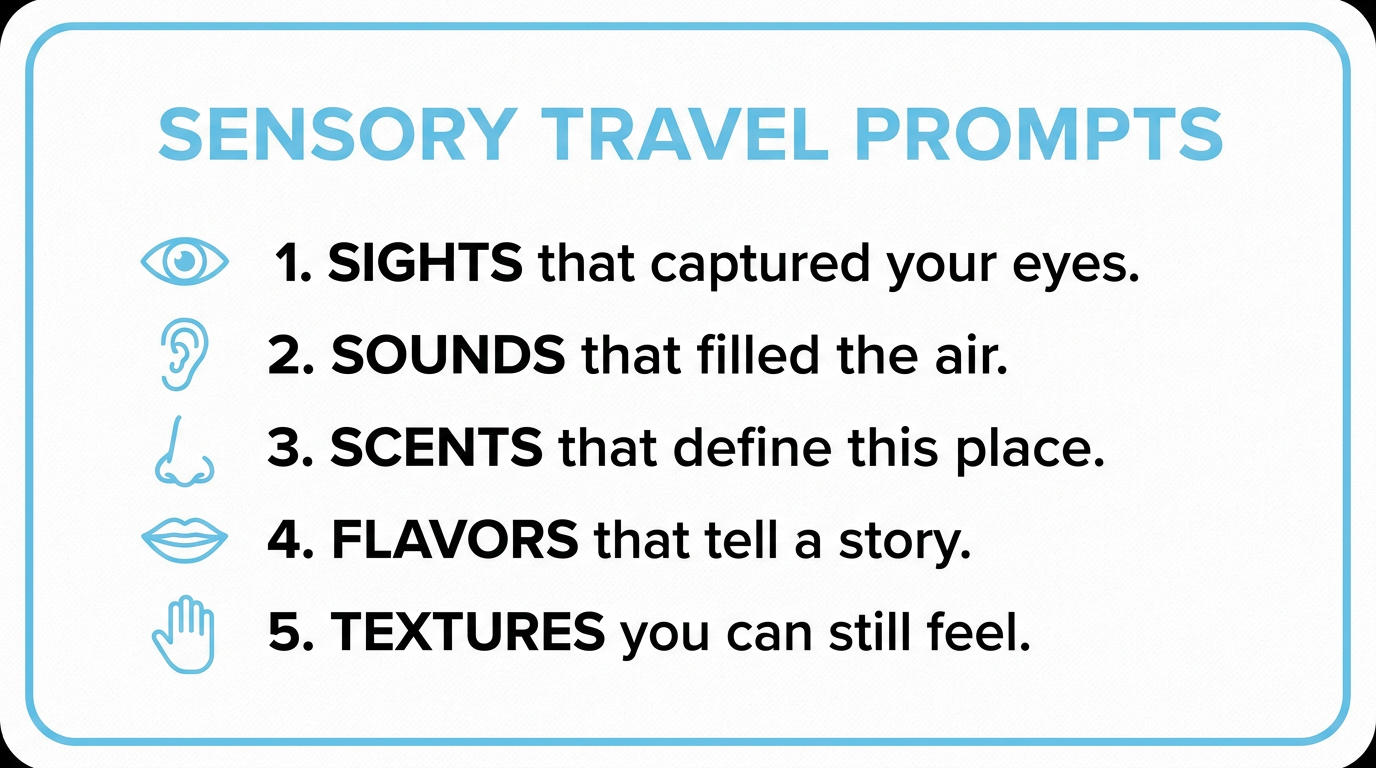
Photographs are a visual record of a place, which sounds comprehensive until you realise it covers roughly one fifth of what being there was like. National Geographic’s piece on makes the point sharply: compulsive documentation can crowd out the small, ordinary, sensory details that are precisely what your future self will want back. These five go after those.
the secret to remembering travel
- What did the place smell like first thing in the morning, before anyone else was up?
- What sound would instantly put you back there — traffic, birds, a particular language, a church bell, a specific kind of silence?
- What was the temperature like on your skin at the hottest point of the day, and what did you do about it?
- Describe one thing you ate in enough detail that someone who wasn’t there could taste it — texture, temperature, what it came on, whether you liked it.
- What did the place you slept sound like at night, and how long did it take you to stop noticing?
The People — travel is mostly other people
You can visit a country and remember a building. You will almost always remember a person longer.
- Who did you talk to that you’ll never see again, and what did they say?
- What did you learn about the person you travelled with that you didn’t know before?
- Who was kind to you when they didn’t have to be, and what did they actually do?
- Was there someone you found irritating — a fellow traveller, a guide, someone at the next table — and what specifically did they do?
- Who did you watch from a distance and invent an entire life for?
The Unplanned — the parts that weren’t on the itinerary
Nobody’s favourite travel story is “and then we arrived on time and everything went as booked.”
- What went wrong, and what did it turn into?
- What did you find purely by accident that you’d never have found on purpose?
- What did you plan carefully that turned out to be completely unnecessary?
- Was there a moment you were genuinely lost, and how did it resolve?
- What did you say yes to that you’d normally have said no to?
The Ordinary — the texture of being somewhere
This cluster is the sleeper hit. The unremarkable stuff ages the best, because it’s the first thing memory throws overboard and the last thing you expect to miss.
- What did you eat for breakfast most mornings, and where?
- Describe the walk between where you slept and the nearest station, shop, or beach.
- What did you buy that you didn’t plan to buy — the charger, the plasters, the umbrella, the weirdly good supermarket snack?
- How did you actually spend the dead hours — the waiting, the transit, the afternoon it rained?
- What did the light look like at the end of the day, and where were you when you noticed it?
The Shift — what the trip did to your ordinary
Not self-improvement. Just the observable difference between how you live at home and how you lived for those ten days.
- What did you do on this trip that you wouldn’t normally do at home?
- What was easier than you expected? What was harder?
- What did you stop caring about by day three that you’d been fussing over on day one?
- What surprised you about the place that no one had mentioned beforehand?
- What did you get wrong about the place before you went?
The Return — what came home with you
The trip doesn’t end at the airport. These are the prompts most people never think to answer, and often the ones that read best later.
- What’s the first thing you told someone about when you got back?
- What would you do differently if you went again tomorrow?
- What do you miss most, one week on — and is it what you expected to miss?
- What did you bring home, physically? Where is it now?
- Finish this sentence honestly: “I’ll probably never tell anyone this, but the best part of the trip was…”
Answer five of these and you have a travel journal. Answer all thirty and you have something closer to a book.
These work exactly as well in a paper notebook as they do in a digital one — the questions don’t care where you write them down. If you’d like prompts shaped around your specific trip rather than a general list, can generate them from what you’ve already written. And if you find that prompt-led writing suits you, we use the same approach for other life events, including With plenty to write about, the next question is where all of it goes.
a set of journal prompts for kids starting the school yearLugelo’s AI Journal Assistant
.
How to Make a Travel Journal That Holds Together: Structure and Organisation
A pile of good answers isn’t a journal. It’s a pile. The difference is structure — and structure is the bit most guides wave at vaguely before moving on.
There are three sensible ways to organise a travel journal, and one of them is better than the others more often than people admit.
By day. Chronological, one entry per day. This works genuinely well for short trips — a long weekend, four nights, a week at most — and it’s the natural fit for road trips, where the whole shape of the thing is the sequence. Day one you left, day six you arrived, and the movement between is the story.
By place. One section per town, city, island, or base. For any trip longer than about a week, this beats by-day organisation and it isn’t close. Days blur. You will not remember whether the market was Tuesday or Wednesday, and more to the point you won’t care. But you will always remember which town the market was in. Place is how human memory files travel — we say “that thing that happened in Split,” never “that thing that happened on the ninth.” Organise by place and you’re working with your memory instead of against it.
By theme.If you’re unsure: pick place for anything over a week, day for anything under. You can always regroup later.
Food, people, walks, disasters, things I bought, arguments. This is the right answer when the trip was one long stretch in a single location — three weeks in one apartment, a residency, a stay with family — where days and places both stop being useful dividers.
What to include beyond the writing
The text is the spine. These are the ribs:
- Photos — but curated, not dumped. Five that mean something beat fifty that nearly do.
- Short video clips — ten seconds of a street is worth more than a paragraph describing it.
- Voice notes — including the ones you recorded at the time, half-shouting over wind.
- Tickets, receipts, boarding passes — photograph them if you’re going digital.
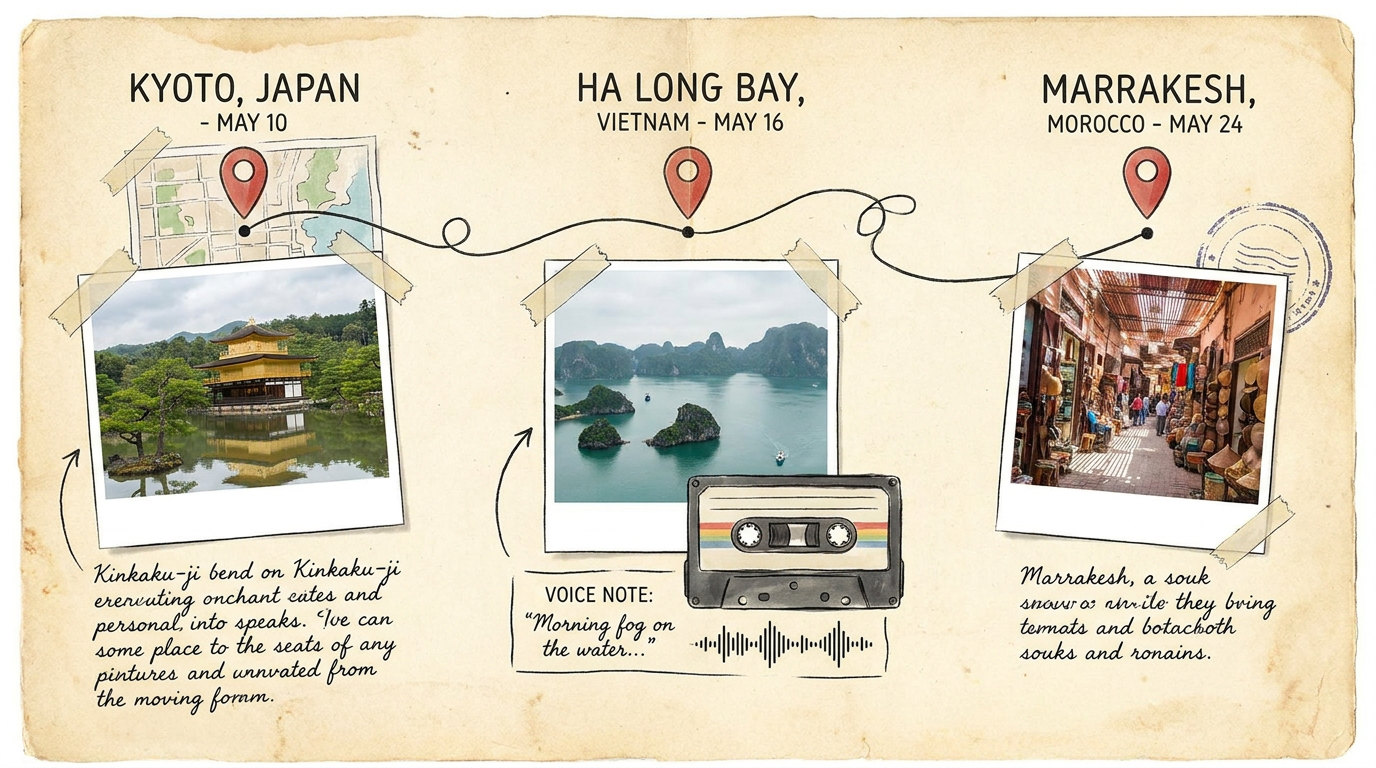
- Maps — with the route you actually took, not the one you planned.
- Links — to the restaurant, the guesthouse, the walking route, so that future-you can recommend it properly.
The no-notes rescue: reconstruct the trip from evidence you already have
Here’s the section for the reader who wrote down absolutely nothing. You are in a far better position than you think, because you left a detailed forensic trail without meaning to.
Your photo timestamps and location data give you a day-by-day skeleton. Open your camera roll, switch to the map or date view, and the itinerary rebuilds itself. That gap between 11am and 4pm on the Thursday? That was the long drive. You now have a spine without having written a word. The Washington Post has covered , and this is the practical starting point.
how to turn travel photos into a journal rather than an archive nobody opens
Your bank and card transactions tell you where you ate and when. This is the single most underused memory tool available. Scroll your statement for the trip dates and the restaurant names come back with the food attached — you’ll see a charge and immediately remember the room, the waiter, what you ordered. Card statements are a receipt for your own life.
Messages you sent during the trip are a real-time diary you already wrote. This is the good one. Scroll back through what you sent your sister, your group chat, your partner, your friend who was following along. You were writing dispatches the entire time: complaints, photos, the good news, the bad news, the joke about the hotel breakfast. Copy the best lines straight into your journal. They’re better than anything you’d write now, because they were written while it was happening.
Booking confirmation emails pin down the facts.Between those four sources, most people can reconstruct eighty percent of a trip in an evening. This is how to keep a travel journal when you didn’t keep one at the time — and it’s also, incidentally, how to write in a travel journal without the terror of the blank page, because you’re never starting from nothing. You’re starting from evidence.
Search your inbox for the dates and you’ll recover hotel names, addresses, flight times and the exact spelling of that town you’ve been calling “the one with the castle.”
This is where a digital journal quietly earns its place: a timeline — Lugelo calls it a Memory Lane — arranges entries chronologically as you add them, so the trip orders itself while you’re busy remembering it. If you want the plain-English mechanics of building one online, we’ve broken down .
how digital journaling works
Structure gets it built. The next section is what makes it worth opening again.
Travel Journal Ideas That Make It Worth Re-Reading
Most travel journals fail not because they’re unfinished but because they’re boring. They read like a receipt. “We went to the market and it was nice. Then we had lunch. The weather was good.” Ten years later that tells you nothing you didn’t already vaguely know.
Compare: “The man selling peaches shouted the same four words for three hours straight. By the end I could say them back to him. I still don’t know what they meant.”
One of those is a sentence. The other is a memory with a door in it.
Specificity beats summary, every time. This isn’t a stylistic preference, it’s how recall works — a concrete detail is a handle, and a generalisation isn’t. Veteran travel editor Don George makes a version of this argument in his , warning against the flat diary recitation of I woke up, I ate, I walked, and passing on John McPhee’s rule that every word should earn its place. George is writing for people who want to be published, which you don’t have to be. Take the specificity; leave the rest.
advice on self-editing for travel writers
Because the second principle contradicts him, deliberately:
“You are not writing for an audience. You are writing for the person who, in ten years, will have forgotten all of this.”
Write for your future self, not a reader. Nobody is grading this. There’s no word count, no editor, no comments section. That means you should write down the private, unimpressive, weirdly specific things — the ones you’d never put in a caption. That you cried a bit in a train station for no clear reason. That you thought about work on the second day and felt guilty. That the highlight of Tuesday was a supermarket. These are the entries that will surprise you later, because they’re the ones you’d otherwise have edited out of your own history.
Include the bad bits. The delayed train. The argument on day four that neither of you has mentioned since. The meal that was genuinely terrible and cost a fortune. The afternoon you were bored. A journal containing only highlights reads like a brochure, and brochures age horribly — they’re not just incomplete, they’re faintly embarrassing. Travel diaries that include the friction are the ones you actually believe when you read them back.
Five formats worth stealing
- A one-line-per-day spine. One sentence per day, no more, even for a three-week trip. It takes twenty minutes total and reads astonishingly well end to end, like a poem written by someone who was very tired.
- A running “best thing I ate” list. One entry per day, ranked or unranked. This is the section you will reread most, guaranteed.
- A map with pins for everywhere you actually went — including the pharmacy, the wrong turning, the beach you couldn’t find parking at.
- A “would go back / wouldn’t go back” verdict. Two columns, brutally honest, written within a week of getting home while the opinions are still hot.
- Three words per place, written before you overthink it. First instinct only. Reading those back years later is uncanny, because the first instinct is usually right.
Everything so far has assumed you’re writing this alone. You almost certainly didn’t travel alone.
Journalling the Trip Together: Everyone Remembers a Different Version
Right now, that trip is scattered. It lives across three camera rolls, a group chat that’s already moved on to other things, and a shared album nobody has opened since the flight home. Nobody’s fault — that’s just what happens. But it’s a poor arrangement for something you’d like to look at again, and it gets worse with every month that passes. One place is better.
Which means a journal written by one person is a first-hand account with a single point of view. A journal built by everyone who was there is something closer to the actual trip.
Someone else has the photo of you that you didn’t know existed — mid-sentence, squinting, holding a map upside down. Someone else remembers the name of the restaurant that’s been on the tip of your tongue for a week. Someone else found the whole disastrous ferry situation hilarious rather than stressful, and their version is frankly better than yours. Memory isn’t a recording; it’s a reconstruction, and every person on the trip built a different one.
Here’s something that becomes obvious the moment you compare notes: you and the people you travelled with went on different trips.
In Lugelo, a shared journal lets everyone add their own Moments — photos, video, voice notes, text — into the same journal, so the trip assembles itself from several angles instead of one. You invite the people you travelled with; they add what they’ve got. The journal owner controls who’s invited and can revoke access at any time, journals are private by default, and entries are encrypted in transit. That’s the whole of it, in plain English. You can .
set up a collaborative journal here
If you want the practical mechanics of inviting contributors and splitting the work between several people, we’ve written — a different occasion, but the process transfers directly. And for why multiple perspectives on the same event matter so much, there’s .
our piece on shared memoriesa step-by-step guide to co-creating a shared journal
[TO BE ADDED AT PUBLISH — link forward to the shared-albums-for-friend-groups post, post 3 of the post-trip cluster]

Once the trip is written down and everyone’s added their part, it can become something more than a file.
Turning Your Travel Journal Into Something You Keep
A finished travel journal doesn’t have to stay a journal. Once the writing exists and the photos are attached, it can become an object — something with a cover, or a scroll, or a room you can walk into.
A storybook. The trip laid out as a designed book, entries and photographs arranged in order. This is the version you hand to someone.
An eBook or PDF. The same thing, sent. Useful for the people you travelled with, and for the family who didn’t come but have been asking about it for a fortnight.
A timeline. The whole trip in chronological order, start to finish, in one scroll — Memory Lane, in Lugelo’s terms. Good for the trips where the sequence is the story.
A VR gallery. Step back into somewhere you visited, viewable in a browser or on your phone. It’s a strange and rather affecting way to revisit a place you’ve physically left, and you can .
see how VR journaling works here
The obvious use: send the storybook to the people you travelled with. It’s a considerably better souvenir than a fridge magnet, and it arrives at the point — three or four weeks after landing — when everyone’s started to miss it. For an example of a shared experience taking this route from journal to keepsake, see .
how a big shared event became a storybook
[TO BE ADDED AT PUBLISH — link forward to the photo-overwhelm post, post 2 of the post-trip cluster: "you've written the trip; now what about the 2,000 photos?"]Before you start, a few practical questions worth clearing up.
Travel Journal FAQs
What is a travel journal?
A travel journal is a personal record of a trip — where you went, what happened, and what it was like to be there. It’s not an itinerary or a photo album. It can be handwritten, digital, or both, and it can be written during the trip or reconstructed afterwards from memory, photos and messages.
How do you keep a travel journal?
Pick a format you’ll actually use, then lower the bar. A few sentences per day, or per place, is enough. Add photos, voice notes and tickets as you go. Most travel journals die from ambition, not laziness — the people who keep them going are the ones writing three lines, not three pages.
What should you write in a travel journal?
Write the specifics: what things smelled like, who you spoke to, what went wrong, what you ate for breakfast. Skip the summary (“it was lovely”) and record the detail (“the coffee came in a glass and burned my hand”). Include the bad days — they age better than the highlights.
How do you journal while travelling?
Realistically, briefly. Record a forty-second voice note while you walk. Write one line a day in your phone before you sleep. Caption three photos while you’re waiting for a train. Anything sustainable beats a system you abandon on day two, and anything captured now is material for writing it up properly later.
Can you start a travel journal after the trip?
Yes — and it often works better. Rebuild the timeline from your photo timestamps, check card transactions for restaurants, and read back the messages you sent friends during the trip. Then answer one prompt at a time. Distance filters out the forgettable parts for you.
How do you make a travel journal online?
Choose a digital journal, create one journal for the trip, and add entries with photos, video and voice notes attached. Organise by place for long trips, by day for short ones. Most tools arrange entries on a timeline automatically. Here’s in plain English.
how digital journaling works
Do you need to write every day?
No. The pressure to write daily is what kills most travel journals — miss two days, feel behind, stop entirely. Write when you have something worth recording. A journal with nine good entries beats an abandoned one with three dutiful ones and a fortnight of blank pages.

The Trip Isn’t Gone — It’s Just Not Written Down Yet
The suitcase is still in the hallway. The six hundred photos are still unopened. But the trip itself hasn’t disappeared, and it isn’t disappearing as fast as it feels like it is — it’s simply sitting in a form you can’t get at yet.
Starting now, from memory, from photo timestamps, from the messages you sent your sister on day three, is a completely legitimate way to make a travel journal. It’s not a downgrade from the notebook you meant to keep. It’s just the version that’s actually available to you, and the only one that gets written.
One prompt. One paragraph. One photo. That’s a start, and it’s a real one — the second entry is always easier than the first, and the fifth barely feels like effort at all.
Go and find out which night the good dinner was.
Don’t Just Live It — Keep It
Free to start. Private by default. Invite the people you travelled with whenever you’re ready.
Start a journal on LugeloSee how Lugelo worksDownload Lugelo for iOS, Android and web