Category Archive : Travel

Holiday Travel Planning: Set Up the Trip Journal Before You Pack

The suitcase is open on the bed, about a third full. There’s a stack of folded jumpers that will not survive the zip, a wash bag you’ve already packed and unpacked twice, and one shoe. The mental list is running on a loop — passports, the charger, the otherAnd there is exactly one thing that isn’t on it, that takes five minutes, and that determines whether you’ll be able to remember this trip in five years.

Every item on that list matters enormously for the next seven days.

charger, the adapter, the present for your aunt that is definitely still in the boot of the car. Someone is shouting up the stairs asking what time you’re actually leaving, and the honest answer is later than you said.

That’s the whole argument, so here it is plainly: five minutes before you leave is worth an hour after you’re back.This isn’t a guide to journalling on the road, and it isn’t a guide to writing the thing up when you get home. We’ve covered both of those elsewhere — including, as it happens, a whole piece that opens on this same suitcase, dumped in the hallway, half-unpacked, three days after landing. This one catches the suitcase at the other end of the journey.

Not a philosophy. A scheduling observation. The five minutes you spend with the suitcase still open buys back an hour of squinting at photo timestamps in February, trying to work out whether the good night was the Tuesday or the Wednesday.

This is the part of travel journaling almost nobody writes about, because it happens before the trip does. It’s the setup. Six small decisions, made at home, with both hands free.

Then you close the case.

The One Item That Isn’t on Your Packing List

Late November through early January is the densest travel stretch of the year, and the numbers are genuinely difficult to picture. AAA’s forecast for Thanksgiving 2025 put the figure at , with 73.3 million of them going by car. The year-end stretch is bigger still: AAA projected .
122.4 million travellers across the 13 days from late December 2025 into January 202681.8 million Americans travelling 50 miles or more

That’s a lot of people in cars on the same motorways, eating the same service-station sandwich, arriving at the same slightly overheated houses.

And here’s the thing that’s always struck me as slightly absurd about it.

The trips we most want to keep are the ones we’re least likely to record.

Think about which trips those actually are. Christmas at your parents’ house. The first year everybody’s partners came and nobody quite knew where to sit. The year the new baby was passed around the table like a parcel. The last year your grandparents made the journey, which nobody knew was the last year at the time, because nobody ever does.

These are the highest-stakes trips of anyone’s life. They are also, reliably, the most chaotic — and chaos is what kills documentation.

Holiday trips resist journalling in a way that ordinary holidays don’t. On a normal trip you’re a tourist. Tourists have idle afternoons. You sit outside a café with a coffee going cold, waiting for a museum to open, and there is genuinely nothing else demanding your attention for forty minutes. That’s when people write things down.

A holiday visit gives you none of that. You’re not a tourist, you’re a participant. There’s a turkey with an internal temperature that someone needs to be monitoring. There are relatives who want to talk to you specifically. There’s a schedule you have absolutely no control over, set by whoever owns the kitchen. There are children in a state of sugar-driven ascent. Nobody gets a quiet hour with a notebook, and the one person who tries is going to be interrupted within four minutes to help find the good scissors.

So the trips with the most worth remembering come with the least opportunity to remember them in.

Now compare that to how carefully we plan the rest of it.The fix takes five minutes and happens before you leave the house. I’ll come to exactly what it involves shortly.

That’s not a criticism, and there’s no scolding here — the logistics are urgent and the memory isn’t, and urgent always wins. But it does mean the single highest-return item you could add to the packing list is the one nobody thinks to add, because it doesn’t feel like packing.

Not one item on that list is aimed at the next fifty years.

Every bit of that planning is aimed at the next seven days.

Holiday travel planning is a genuinely impressive feat of domestic logistics. People colour-code departure times. They plan around traffic on the M6. They pack the car in a particular order so the pushchair comes out first. They remember, unprompted, that one nephew is dairy-free and another has developed strong opinions about mash.

One caveat before we go on: if you’ve landed here after a trip rather than before one, this is the wrong post for you and you should start with For everyone still packing — the reason journals fail isn’t the reason you think.
our full guide to making a travel journal

instead. That one is written for the suitcase in the hallway, and it covers reconstructing a trip you’ve already taken. Come back to this one in the spring, when you’re packing again.

Why Travel Journals Die on Day Three (It Isn’t Discipline)

You already know how this goes, because a version of it has happened to almost everyone who has ever meant to keep a journal.

Day one is excellent. You write a proper entry. It’s long, it’s got a bit of scene-setting in it, you describe the drive and the weather and the strange man at the petrol station. You feel briefly like a person who keeps a journal. You reread it and it’s genuinely quite good.

Day two is shorter. Still fine. A paragraph. You mean to come back and add the photos.

Day three is a hotel room at 11:40pm. Or the spare room at your sister’s, or a childhood bedroom that is now an office with a bed in it. Everyone else is asleep. You’re sitting on the edge of the mattress holding your phone, and the day was actually a good one — there was a thing your dad said at lunch that you want to keep — and you open your phone and there is nothing there.

No journal. No title. No structure. No decision, ever made, about what this thing is supposed to look like.

So you don’t.

Here’s the diagnosis: the journal didn’t exist yet. That’s the whole failure, and it’s worth being precise about it, because the standard explanation — that you lack discipline, or aren’t a journalling sort of person — is not just unkind, it’s wrong.

On day three you weren’t being asked to write. You were being asked to invent a system. At 11:40pm. In an unfamiliar room. While tired. With a decision to make about organisation and format that you had never previously considered and had no reason to have an opinion about. And then, only once that was resolved, to write something good.

That is an enormous ask disguised as a small one. It fails for the same reason people don’t start tax returns at midnight.

Four decisions were never made, and every one of them was needed at 11:40pm. The journal wasn’t created. Nobody was invited into it. There was no structure. And there was no agreed rule about what anyone was actually supposed to contribute.

Each of those is a five-second decision at your kitchen table. Each of them is a genuine, momentum-killing obstacle in a dark room in another country.

Now run the counter-case.

The journal already exists. It has a name — a real one, with a place in it. It has a cover photo, so it doesn’t look like an empty form. There are three other people already in it, two of whom have added something. There are two prompts sitting there waiting, so there’s no blank page.

Day three now asks you for one sentence.

That is a completely different request, made of the same person, in the same tired state, at the same time of night. Nothing about you changed. The friction did.

A dimly lit hotel room at night, a phone glowing face-up on the bedside table beside a half-unpacked bag

Nobody abandons a travel journal because they don’t care about the trip. That’s worth saying directly. The people who abandon them are, overwhelmingly, the people who cared enough to start one — the indifferent never open the app at all. What defeats them is friction they had no reason to anticipate, arriving at the exact moment of the day when they have the least capacity to deal with it.

You didn’t fail. You were handed a design problem at midnight and asked to solve it while yawning.

There are three separate jobs here, and they’re often confused with one another. Capturing things while you’re moving — in the car, on the road, between places — is one job, and it has its own techniques. [TO BE ADDED AT PUBLISH — link to post #11, keeping a road trip diary] Reconstructing a trip after you’re home, from photos and card statements and the messages you sent your sister, is a second job, and that’s what This post is about the third job. It’s the cheapest of the three by a distance, it takes five minutes, and it makes the other two dramatically easier — which is a strange thing about setup work generally. It’s the least interesting part and it does the most.
the pillar guide

is for.

If you’ve never used a journalling app and you’re quietly wondering what “setup” even means in practice, Right. Four decisions missing. Let’s make all of them before the suitcase closes.
here’s how digital journaling works in plain English

— no jargon, no assumed knowledge.

The Five-Minute Pre-Departure Setup, Step by Step

Six steps. Five minutes. All of them done at home, with both hands free, on a wifi connection that works, while you are fully awake and not in a room belonging to somebody else.

That last part is the whole point. None of these steps is difficult. Every one of them is nearly impossible at 11:40pm on day three, which is precisely why they belong on the packing list.

Create the journal and name it something specific

Name it “Christmas in Edinburgh 2026.” Not “Holiday.” Not “Trip.” Not “December.”

This sounds like a triviality and it is quietly the most important step of the six.

A vague name signals a vague commitment, and — more practically — it creates a container you can’t add anything to without first deciding what it means. You cannot put a Moment into “Holiday,” because “Holiday” isn’t anywhere. You’d have to work out what belongs in it first. But you can put anything at all into “Christmas in Edinburgh 2026,” instantly, without a single thought, because you know exactly what that is and whether the thing in your hand goes in it.

Naming is the cheapest commitment device available to anyone. It costs one line of typing and it converts a vague intention into an actual object with edges.

There’s a second benefit that arrives much later. In nine years, when you’re trying to find this, “Christmas in Edinburgh 2026” is a thing you would plausibly type into a search box. “Holiday” is not, and neither is “Untitled Journal 4.”

A phone screen showing a newly created travel journal titled Christmas in Edinburgh 2026, with a cover photo and two prompts waiting

Add a cover photo before you go

You’re removing the blank-page feeling before the blank page ever gets a chance to appear. Thirty seconds.

An empty journal with a grey placeholder where the image should be looks like an unfinished chore. A journal with a cover photo looks like something that has already started — and adding to something that has started is a fundamentally easier psychological act than beginning something that hasn’t.

The point isn’t aesthetics, and it certainly isn’t curation.

Anything will do. Last year’s photo from the same trip. A picture of the city off the internet. A photo of the tickets sitting on the kitchen table next to the car keys and a mug.

Decide the structure now, in five seconds

By day, by place, or by route.

Rule of thumb: by day for short trips, by place for anything over a week, by route if the trip is essentially a drive and the sequence is the story.

That’s deliberately brisk, because this genuinely isn’t the post for the full argument — in the pillar guide, including why place beats day more often than people expect. Go and read that if you want the reasoning.
we’ve laid out the complete case for organising by day, by place, or by theme

What matters herePick one. Five seconds. You can always regroup the entries later, and nobody is going to inspect it.

is not which structure you pick. It’s that the decision gets made before departure, so that no entry, ever, begins with a format question. A format question at midnight is how you end up writing nothing.

Pre-load two or three prompts

Thirty prompts is a library, and a library is something you browse rather than answer. Two or three prompts sitting in the journal are a starting point — day one already has somewhere to go, and the first entry doesn’t require you to invent a subject.

Two or three. Not thirty.

If you want prompts shaped to the specific kind of trip you’re taking, there’s a fuller set coming: [TO BE ADDED AT PUBLISH — link to post #2, travel journal prompts by trip type] And if choosing feels like one more decision you don’t want, the AI Journal Assistant will generate prompts from a few words about the trip, and there are templates if you’d rather start from a shape that already exists.

But here’s the one I’d genuinely insist on.

Write one Moment before you leave.Ninety seconds. And it is, reliably, the entry people most enjoy reading back afterwards, because it’s the only one in the entire journal written before you knew how any of it went. Everything else is written with hindsight. This one isn’t, and that makes it strange and rather moving to reread — a small letter from someone who didn’t know yet.

What are you expecting? Who are you slightly nervous about seeing? What do you want this trip to be — and what do you suspect it’ll actually be? Is there a conversation you’re hoping happens, or one you’re hoping doesn’t?

Not on the plane. Now, with the suitcase open.

Download the app at home, and sort out the signal problem

Install it now, on your own wifi, with a working connection and nobody behind you. Not at the gate. Not in the airport queue with a boarding pass in your teeth.

Get it set up before you leave, not at the airport.

Then the genuinely relevant technical point, which matters more on holiday trips than on any other kind:

Offline capture is built in by default. There is no setting to enable.

The mobile app captures Moments — text, photos, videos, voice recordings — with no internet connection at all, and everything syncs automatically the moment you reconnect. You don’t switch anything on, you don’t tick a box, and you don’t need to have remembered any of this in advance.

Consider where you actually are during a holiday trip. On a plane. In a car on the A9 with one bar. In a farmhouse where the wifi password is written on a card that stopped being correct in 2019. At your grandmother’s, where the signal works in exactly one corner of the kitchen and everybody knows which corner.

Those are the parts of the trip where you’re least likely to have a connection and most likely to have something worth recording. A journal that requires signal is a journal that quietly fails during the best bits.

cover the rest of what’s useful on the road — location-tagged entries that build a personal map of where you actually went, speech-to-text for when typing is impractical, and one-tap eBook or PDF export for afterwards.
Lugelo’s travel journaling features

While you’re in checklist mode: . This is the one for everything that happens in it.
the TSA has a checklist for everything going in the case

Set one reminder, for the first evening only

And the first Moment is the only genuinely hard one. Once there’s something in the journal, the thing has visibly begun, and additions are additions rather than beginnings. Momentum handles the rest, and on a shared journal other people’s Moments do the reminding for you far more effectively than a notification ever will.

One notification on the first night does something completely different. It gets the first Moment in.

This is counterintuitive enough to be worth defending. A daily reminder feels like the responsible option, and it’s actively harmful. By day three, a recurring notification has become noise, and you dismiss it without reading it. By day four you’re dismissing it reflexively. What you have built, with the best intentions, is a small daily machine that trains you to ignore your own journal.

One. Not a daily recurring reminder.

The total cost

Six decisions:

  1. Create the journal and give it a specific name.
  2. Add any cover photo at all.
  3. Choose day, place, or route — in five seconds.
  4. Drop in two or three prompts, and write one Moment before you leave.
  5. Install the app at home; offline capture is already on.
  6. Set a single reminder for the first evening.

Five of those six you can do entirely on your own. The sixth — the one that changes the trip most — involves everybody else, and its timing is everything.

None of them is difficult. Not one requires taste, effort, or a decision you’d need to think about twice. Every single one of them is close to impossible once you’re tired and elsewhere.

Invite Your Travel Companions Before You Leave — Not on Day Four

Here’s the insight that took me embarrassingly long to notice, and it’s the most useful thing in this post.

Invite people before departure and contributing is the default. Ask on day four and you’re requesting a favour from people in holiday mode.

Identical request. Identical journal. Identical group of people. Completely different social weight — and the only variable that changed is when the invitation arrived.

, and then let me explain why the timing does so much work.
Set up a collaborative journal before you go

Before the trip, everybody is in logistics mode. The family thread is already full of admin. What time are you setting off. Has anyone got the postcode. Don’t forget the folding chairs. Is Ellie’s train getting in before six. Everyone’s phone is in their hand, and everyone is in a frame of mind where incoming trip-related items get processed immediately, because that’s what the last three days have consisted of.

An invitation to a trip journal, dropped into that thread, is simply one more piece of trip admin. It gets accepted in four seconds, between two other messages, without any deliberation whatsoever. Nobody asks what it’s for. It’s obviously for the trip. Everything in the thread is for the trip.

On day four, that context is gone. Everyone has decompressed. Phones are face-down. Your brother-in-law is asleep in a chair. Someone is halfway through a jigsaw and there’s a film on that nobody is watching properly.

Into that, you send an invitation, and you have just become the person asking their family to do homework on their holiday.

You will get a “yeah, sure.” You will get several. You will get precisely nothing else, and the reason isn’t that they don’t care — it’s that you’ve asked people to adopt a new habit at the exact point in the week when adopting new habits is least appealing.
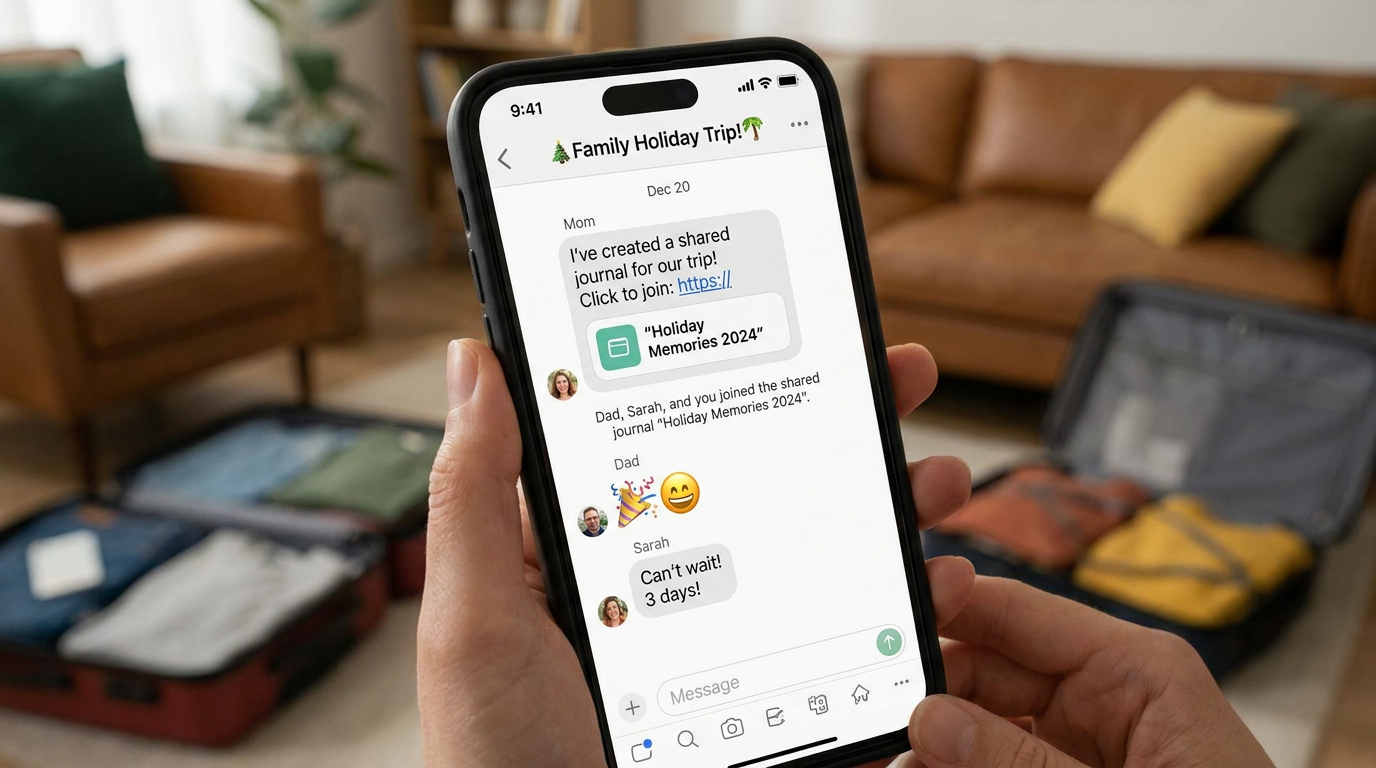
A family group chat on a phone screen showing an accepted invitation to a shared holiday trip journal, days before departure

“Invite people in advance and contributing is the default. Ask on day four and you’re asking for a favour.”

There’s a compounding effect that makes the early invite worth even more than it first appears.Content recruits contributors. An empty journal recruits nobody, no matter how many times you mention it at dinner.

And a journal with three people’s Moments already in it recruits the fourth person entirely on its own. Nobody has to nag. Your cousin opens it, sees photos she wasn’t there for and a voice note from her dad, and adds something within the hour — not because she was asked, but because everyone else obviously is, and the thing is visibly alive.

People who accept before departure start contributing from day one. Which means the journal has content in it before anybody needs reminding of anything.

The mechanics, which take about a minute

There’s no hard limit on contributors. In practice, family and couples journals tend to run two to eight people. Weddings and reunions can run to dozens.

The person you’ve invited creates a free account in under a minute and lands directly inside the journal. Not on a homepage. Not in a tutorial. In the journal, with your cover photo at the top, which is the entire reason step two mattered.

Open the journal. Tap Share or Invite. Send the link however your family already communicates — email, message, or whichever chat app the group thread lives in. There’s no benefit to introducing a new channel for this; use the one people already check.

Permissions, in plain English

Not everybody should have the same access, and holiday trips are exactly where that starts to matter — because the group of people who’d like to see the trip is nearly always larger than the group who were on it.

Viewer is for the relatives who’d love to look but will never add anything. Your great-aunt. The cousins in Vancouver. People who want to see the photos and have no intention of writing a word, which is a perfectly reasonable way to be.

Contributor is for everyone actually on the trip. This is most people, and it’s the setting you’ll use by default.

EditorThose are the entries you’ll actually want in ten years. You only get them if nobody feels watched.

That last point is more central to a family trip than it might sound. A shared Christmas journal is not a social media post. Nobody is performing. There’s no audience, no reach, no algorithm deciding which of your photos deserved better. Which means people write the true version — including the bit about the argument over the parking, and the fact that the second day was a bit flat, and that someone cried in the car on the way home for reasons nobody has raised since.

The journal owner controls who’s invited and can revoke access at any time. Journals are private by default, sharing is owner-controlled, and entries are encrypted in transit.

is for the one person — and there is always exactly one — who will tidy the whole thing up afterwards, reorder the muddled bits, and turn it into an eBook to send round in January. Give them Editor before you leave and they’ll thank you for it later.

Everyone’s on a different device, and that’s fine

It works across all of them — iOS, Android, HarmonyOS via the Huawei AppGallery, and the web, with Chrome and Firefox extensions. Contributions appear in the shared journal in real time, so when your mother adds a photo from the market, it’s simply there for everybody else, and nobody has to send anything to anybody.

The realistic composition of a family trip: your mother is on an Android phone she’s had for six years. Your brother has the newest iPhone and mentions it. Your father will not install anything and will only ever use the laptop in the study. One cousin has a Huawei.

If you want more depth on splitting the work between several contributors, covers the same process for a different occasion — the mechanics transfer directly. And if you’ve watched a group holiday scatter across five camera rolls and a shared album nobody opened again, Everyone’s in the journal before departure. Now there’s one last thing to settle, and it has to be said out loud.
here’s what friend groups are doing insteadour step-by-step guide to co-creating a shared journal

.

Agree One Capture Rule Out Loud Before the Trip Starts

Here it is.

One photo and one line before bed.

That’s the rule. Say it out loud, once, in the car or at the departure gate or over the first dinner. Then never mention it again.

“Out loud” is doing most of the work here. An invitation is a piece of software. A rule spoken to a group of people is a social agreement — and on holidays, social agreements are what actually get followed. Everyone knowing that everyone else agreed is the entire mechanism. It’s the same force that gets people into cold water.

The rule has to be embarrassingly small. This is the part people get wrong.

An ambitious rule — “let’s all write a proper entry every night” — gets agreed to with real enthusiasm and is dead by Tuesday. Not because anyone stopped caring, but because the first time someone misses it, they’ve failed, and people who feel they’ve failed at something optional quietly stop doing it rather than catch up.

A rule that takes forty seconds cannot be failed. There is no version of your evening that doesn’t have forty seconds in it.

And the small rule reliably overdelivers. People who commit to one line frequently write four, because starting was the hard part and they were already typing. Nobody who commits to a full entry writes a full entry on day five.

Do not run an app tour.Voice notes, photos, video clips and text all count as Moments, so “one line” can be spoken rather than typed on the nights when typing feels like too much.

Adapt it to who’s there. Teenagers do a photo and a caption, which is a format they already have strong native fluency in. Grandparents do a voice note — often the best material in the journal. Small children pick the photo of the day and tell you what to write underneath it, word for word, including the bits that don’t make sense.

One rule and one already-created journal beats a demonstration every single time.

This is the commonest mistake. Someone gathers the family in the kitchen and starts explaining features. Everybody is slightly bored, nobody retains any of it, and the whole thing acquires the atmosphere of a work meeting on Boxing Day.

Forty seconds a day, from everybody. That’s it. What you do with the material afterwards is a separate and much more enjoyable problem, covered in The rule holds for almost any trip. Holiday travel, though, has some particular complications worth planning for directly.
the travel journal method

.

Holiday-Specific Realities: Multi-Generational Trips, Small Children, and the Return Leg

General advice tends to fall apart on contact with an actual family Christmas. So here are the four situations that come up every year.

Multi-generational trips. These produce the most valuable journals you will ever make, and they are the hardest ones to run, because the technology comfort gap across three generations is enormous and no single approach suits everybody in the room.

The fix is set before departure, not during. Grandparents get Contributor access, and their format is the voice note. Not because typing is beyond anyone, but because a seventy-eight-year-old telling a story out loud for ninety seconds will give you something a typed paragraph structurally cannot — the actual voice. The pauses. The particular way they say a name. The laugh at the end when they realise they’ve gone off on a tangent.

Worth saying plainly: the oldest people at the table are usually holding the stories nobody else has heard. Not the famous family anecdotes that get retold every year, but the ones nobody has ever thought to ask about — what the street looked like, who lived next door, what they were doing the winter they were twenty-three. A holiday gathering is very often the only occasion in the calendar when three generations are in a room with time on their hands, and it’s the only realistic opportunity anyone gets to ask.

Set that up in advance and the trip captures something that isn’t really about the trip at all.

Three generations of a family at a holiday table, a grandmother recording a short voice note on a phone while others talk

Travelling with young children.Children can also be given a job, and they take it more seriously than you’d expect. Choosing the photo of the day is a genuine, meaningful role to a six-year-old. They will deliberate. They will reject your favourite. And the journal becomes partly theirs, which changes how they relate to it later — a child who chose the photos is a fourteen-year-old who scrolls back through them.

Set the expectation accordingly, because the failure here is almost always ambition rather than capacity. The realistic version is photos captured during the day — which you’re taking anyway — and thirty seconds after bedtime, when the house goes suddenly, gloriously quiet and you’re sitting on the stairs.

Let’s be realistic: you will not be journalling in the moment. You will be managing a small person who has strong feelings about their coat.

For the logistics side of flying with children, covers screening, what you can bring, and how the process actually works with a pushchair.
the TSA’s guidance for families flying together

Splitting up during the day and reconvening. Extremely common on holiday trips and rarely planned for. Some of the group goes to the market. Some stay at the house with the oven. Someone takes the children to burn off energy somewhere with a slide. Everyone reconvenes at five with three different afternoons behind them.

This is precisely where a shared journal outperforms one person’s account, and it’s not a small margin. Everybody adds their half of the day, and the day reassembles itself on the Memory Lane in the right order without anyone coordinating anything.

Crucially, nobody has to be the designated documenter. That role — one person quietly appointing themselves the family archivist, taking all the photos, in none of them — is thankless and produces a one-sided record. Distributing it produces a better journal and a better holiday for the person who’d otherwise be doing it.

The return leg is the natural review window, and almost nobody uses it.Offline capture matters here specifically. A plane is the single best journalling environment of the entire trip — no signal, no interruptions, nowhere else to be, everyone sitting still — and it has no connection at all. Write the whole thing at 35,000 feet. It syncs when you land.

Twenty minutes on the way home is worth hours in February. Fill the gaps. Add the photos nobody got round to uploading. Argue productively about what actually happened on the Sunday. Name the day everyone keeps calling “the good dinner,” so that in nine years it’s a Thursday with a restaurant attached rather than an unplaceable warm feeling.

Look at what’s true in that moment: everyone who was on the trip is together, in one place, with nothing whatsoever to do, and the trip is still completely vivid. That combination does not occur again. Within a week everyone’s back at work and the details have started their slow slide into approximation.

The flight home. The four-hour drive. The train with the table seats.

Afterwards, the trip can become an eBook, a Memory Lane you scroll end to end, or a VR Gallery you can step back into. That’s a separate subject and handles it properly. And if the real problem is that you came home with two thousand photos and no idea what to do with them, A few practical questions tend to come up before people close the tab.
we’ve written about exactly thatthe pillar guide

.

Holiday Trip Journal FAQs

When should I set up a travel journal — before or during the trip?

Before. The setup takes about five minutes and it removes every decision that would otherwise have to be made in a hotel room at midnight. Setting up during the trip means inventing a system while tired, which is the single most common reason travel journals get abandoned around day three.

What should I name my trip journal?

Something specific, with a place and a year in it. “Christmas in Edinburgh 2026” beats “Holiday” comfortably. A specific name creates a container you can add to without thinking, and it’s the sort of thing you’d actually be able to find by searching for it in nine years’ time.

How do I get my family to actually contribute to a shared trip journal?

Invite them before departure rather than during, and agree one small rule out loud — one photo and one line before bed. Invited in advance, contributing becomes the default. Asked on day four, it becomes a favour, and you’ll get agreement without follow-through.

Can I journal while travelling without an internet connection?

Yes. Offline capture is built in by default and there’s nothing to enable. Text, photos, videos and voice recordings are all captured without a connection and sync automatically once you reconnect. Useful on planes, in cars, and in houses where the signal only works in one corner of the kitchen.

How many people can contribute to a shared travel journal?

There’s no hard limit. Family and couples journals typically run two to eight contributors. Larger gatherings — reunions, wedding trips, big multi-household Christmases — can run to dozens without any difficulty.

Can I control who sees the journal?

Yes. Journals are private by default, and the owner controls access on a per-person basis: Viewer for people who’ll only look, Contributor for everyone on the trip, Editor for whoever tidies it up afterwards. Access can be revoked at any time.

What if I’ve already taken the trip and didn’t set anything up?

That’s a different job and an entirely doable one. You can reconstruct a trip from photo timestamps, card transactions and the messages you sent people at the time. walks through the whole process.
Our guide to making a travel journal after the trip

Is it free?

Lugelo is free on iOS, Android, HarmonyOS and the web, with Chrome and Firefox extensions, and Safari coming soon. There’s an optional Plus tier. No ads, and no credit card needed to sign up.

How long does setting up a trip journal actually take?

About five minutes. Create and name it, add a cover photo, pick a structure, pre-load a couple of prompts, invite your travel companions, and set one reminder for the first evening. Every step is a small decision, and all of them are far easier at home than abroad.

A closed suitcase by the front door with coats and a phone on top, ready to leave, the trip journal already created

Conclusion: The Five Minutes Goes In Beside the Chargers

The suitcase is closed now. It’s by the front door with the coats piled on top of it and someone’s scarf hanging off the handle. The passports are in the bag, in the pocket you’ll check four more times. The chargers are in the side compartment. The thing you always forget is, once again, upstairs, and you will remember it somewhere near the second roundabout.

Five minutes before you leave is worth an hour after you’re back.It takes ninety seconds, and it will surprise you more than anything else in there when you read it back — because it’s the only entry written by someone who didn’t yet know how it went.

One last thing, and it’s the bit I’d genuinely not skip: write that first Moment before you go. What you’re expecting. Who you’re looking forward to seeing. What you quietly hope this one turns out to be.

This is also, as it happens, where we came in. Sixty days ago we started with a suitcase in a hallway, half-unpacked, and a trip that had already begun to blur at the edges. This time the suitcase is by the door and the journal already exists. Same object. Opposite end of the story.

Nothing here is guaranteed. Nothing is permanent, and anyone who tells you otherwise is selling something. But a trip that has a journal already open — named, covered, populated, with four people in it and a rule everyone said out loud in the car — is a trip you’re far more likely to still have hold of when you want it. That’s the honest offer, and I think it’s enough.

That’s it. The setup belongs on the packing list, right next to the chargers, because it costs about the same amount of attention as the chargers and it’s the only item on that list still doing anything in five years’ time.

Don’t Just Live It — Keep It

Free on iOS, Android, HarmonyOS and the web. Private by default, with owner-controlled sharing.

Create the journal, invite the people you’re travelling with, and close the suitcase.


You Took 2,000 Holiday Photos. Here's How to Turn Them Into Something You'll Actually Look At

You Took 2,000 Holiday Photos. Here’s How to Turn Them Into Something You’ll Actually Look At

You’re home. The suitcase is finally empty, the laundry is done, and the tan is already fading. It was a genuinely wonderful trip — one of the good ones. And somewhere on your phone are roughly two thousand photographs of it, which you have looked at approximately nine times, all of them in the first four days back.

You are not disorganized. Let’s establish that in the first paragraph and never revisit it. Your camera is built to capture infinitely and your photo library is built to store infinitely, but almost nothing in that system is built to surfaceSo here’s the order of operations. First we clear the mess — practical, specific advice you can start acting on in the next sixty seconds. Then we get to the part almost everyone skips, which is the actual reason those photos will or won’t mean anything to you in ten years.

anything. That’s not a character flaw. That’s a design gap.

This works for the trip you just got back from and for the shoebox in the closet, the inherited albums, the folder of exports from a phone you no longer own. And if you haven’t written the trip down at all yet — not a word — and come back here after.
start with a travel journal first

Let’s begin with the uncomfortable bit: why two thousand photos is a worse outcome than twenty.

Why 2,000 Photos Is Worse Than 20

Scarcity used to do the editing for us. Twenty-four exposures per roll, a cost per shot, a wait to see what you got — the constraint forced selection before the shutter even opened. Abundance removed the constraint and, with it, the selection. Nobody replaced that job. It simply stopped being done.

There is a shoebox somewhere in your family containing perhaps twenty prints from a holiday in 1994. Someone has looked at those prints more recently than you have looked at last month’s camera roll. That is not nostalgia talking. It’s arithmetic.

Then there’s the deeper problem, which has nothing to do with quantity. A photo with no context is a file, not a memory. You can see the beach. You cannot see why everybody in the frame is laughing, who was standing behind the camera making them laugh, or what happened twenty seconds before the shutter went. The photograph captured the surface of the moment and none of its substance. Five years from now, the surface is all that’s left.

Which brings us to retrieval. People rarely lose digital photos — the files sit there faithfully, backed up, duplicated across devices. What people lose is access. Anything you cannot find, and would never think to go looking for, is functionally gone whether it exists or not. Your library isn’t a collection; it’s a haystack with excellent uptime.

So there are two distinct jobs here, and the whole architecture of this article rests on separating them:

  1. Reduction — getting from two thousand files to a number a human being can actually care about.
  2. Attachment — adding the context that makes those survivors both findable and worth finding.

Nearly every guide you’ll read does the first job and stops. It’s telling that professional archivists don’t. The treats deciding which photos are most important and describing them with names and subjects as core preservation work — not optional polish afterwards. Selection and description sit at the center of the discipline.
Library of Congress’s personal archiving guidance

You can see people arriving at this conclusion on their own. Search behavior gives it away: alongside the tidy queries about folders and drives, people type things like how to organize and preserve digitized family photos with stories

Let’s do the first job properly, then.

. They already know that storage is only half the job. Almost nobody has been answering the other half. Ask for the best way to organize your photos and you’ll be handed a list of software, when what you needed was a method.

How to Organize Digital Photos: The Ruthless First Pass

The single most valuable thing about this week is that you still remember everything. You know which of the four near-identical shots of the harbour is the good one, because you remember standing there. Give it three months and all four will look the same to you. Momentum beats method — start now, imperfectly, rather than later, systematically.

Start with duplicates, because they require no thinking

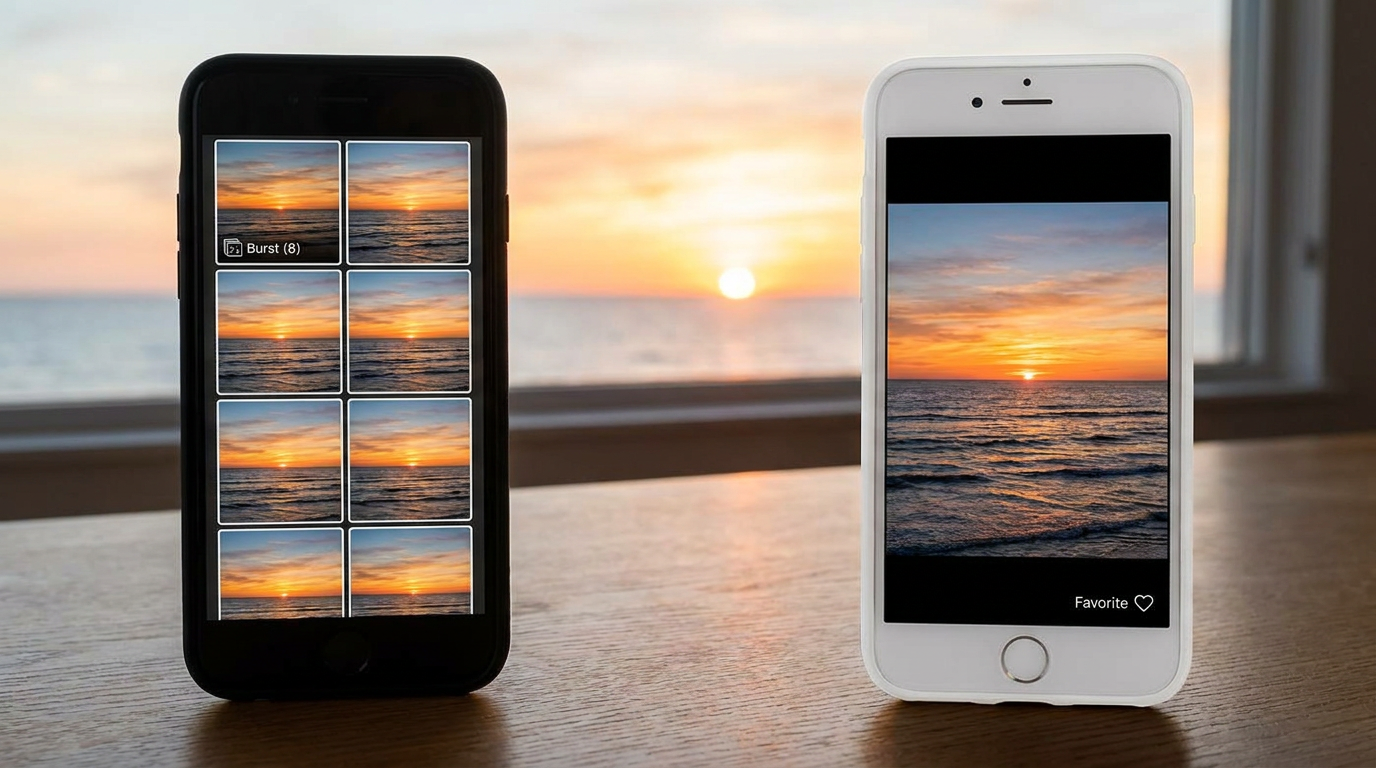
Deleting duplicates and near-identical bursts is the fastest volume win available to you, and it demands zero decisions about meaning. Nobody ever agonized over which of eight consecutive frames of a sunset to sacrifice.

If you’re on an iPhone, the Photos app will do a chunk of this for you. Open Photos, tap Collections, scroll to Utilities, and tap Duplicates. explains that merging keeps the highest-quality version along with the most relevant metadata and moves the rest out of your way. One useful thing that trips people up: the Duplicates album only appears once your phone has actually detected duplicates, and that detection runs quietly in the background while the device is locked and charging. If it isn’t there tonight, plug in and check tomorrow.
Apple’s guide to merging duplicate photos and videos

Name the fear, then dissolve it

The real reason people never delete anything is not laziness. It’s the fear of an irreversible mistake — the conviction that the one photo you bin will turn out to have been the good one.

So let’s remove it. On an iPhone, deleted photos don’t vanish; they move to Recently Deleted, where Read that again if you need to, because it’s the psychological unlock that makes everything below executable.
Apple confirms they stay for 30 days

before being removed. You have a month-long undo button. Anything you regret at any point in the next four weeks is one tap from coming back.

The 10% rule

Here’s a working target rather than a law: from any given trip, roughly one photo in ten is worth keeping, and maybe one in a hundred is worth actively showing to another human being. Aim to keep two hundred from two thousand — not two thousand from two thousand.

If deleting still feels transgressive, take it from the archivists. The states plainly that snapshot collections should be weeded of poor prints — blurred images, bad exposures — and of less desirable photos such as multiples and badly cropped shots, before the best ones are properly housed. A national archive is telling you to throw away your bad photos. Consider it permission, formally granted.
National Archives’ family archives guidance

Two side-by-side phone screens: the left showing eight nearly identical burst photos of the same sunset, the right showing one selected favorite with the rest cleared away.

Favorite, don’t file

Sorting is a completely separate job from selecting, and combining them is the number one reason people abandon this project halfway through. Choosing what matters uses one part of your brain; deciding where it belongs uses another. Ask for both at once and you’ll stall around photo four hundred, somewhere over the Adriatic.

On the first pass, do not build a single folder. Do not create a single album. Just go through and tap the heart on anything that makes you feel something.

How to organize thousands of digital photos in one sitting

You won’t, and you shouldn’t try. Work in twenty-minute blocks, trip by trip or oldest-first, never the whole library at once.

The rule that makes this survivable: finish one bounded chunk completely rather than half-doing everything. One trip fully sorted beats five trips partially sorted, because the finished one gives you a small, real hit of completion — and that’s the fuel for the next block.

How to organize years of digital photos without giving up

If you’re staring down a decade-deep backlog, here’s the counterintuitive advice: do not start at the beginning.

Now that there’s dramatically less to organize, you need somewhere for it to live that won’t fall apart the moment real life resumes.

Start with the three events you genuinely care about. Finish those completely. Then let everything else stay messy for as long as it likes. A backlog is not a moral failing and it carries no obligation to be resolved in sequence. The years in between will still be there, and honestly, most of them can wait indefinitely without anyone suffering.

Chronological order is how the files were created, not how you care about them.

A Folder Structure That Survives Contact With Real Life

Most advice on this topic hands you a menu — organize by date, or by event, or by person, or by project — and then declines to recommend anything. That’s not helpful, so here is a recommendation you can act on.

Organize by event, not by date. Human memory retrieves by occasion. Nobody has ever thought “I’d like to see March 2024.” They think “Lisbon,” or “Mum’s 60th,” or “the weekend it rained the entire time.” Your filing structure should mirror the way you’ll actually go looking, and you go looking by occasion every single time.

The hybrid that actually works

The date prefix keeps everything sorting chronologically without any effort from you. The event name makes it findable by memory. You get both properties from one convention, and you never have to think about it again.

Which in practice looks like:

Pure event names sort alphabetically, which scatters your chronology to the wind. So combine the two:

Naming conventions, in plain English

Be consistent — a slightly imperfect system applied everywhere beats a perfect one applied twice. Write dates year-month-day so they sort correctly. Skip special characters, which some systems and drives handle badly. And resist the urge to cram the whole story into the filename; that isn’t what filenames are for. The offers genuinely practical, non-commercial guidance on hierarchy and consistent naming if you want to go deeper.
University of Cincinnati Libraries’ guide to digitizing home collections

How to organize digital photos on your computer

Mirror the exact same structure you use everywhere else. One structure, replicated identically across every device and location, beats three clever bespoke ones every time. Cleverness is the enemy here — you want a system so boring that future-you can navigate it half-asleep.

How to organize digital photos on an external hard drive

Your external drive is a copyThen, once a year, plug it in and confirm it still reads. Drives fail silently and they fail most often at exactly the moment you finally need them.

, not a filing system. Keep the identical structure so the two are genuinely interchangeable and you never have to work out which version is authoritative.

The uncomfortable truth about backups

A single cloud account is not a backup. It is one copy, in one place, behind one password. That’s a convenience, and a good one, but it isn’t redundancy.

Archival practice is unambiguous. The keeping at least two copies and storing them “in different locations that are as physically far apart as practical” — the reasoning being that if disaster reaches one location, the copies elsewhere survive it. That’s the whole principle: separation, not accumulation.
Library of Congress advises

And here’s the part that rarely gets said out loud in articles like this one. No storage is permanent. Even national archives don’t pretend otherwise — the

National Archives’ guidance on digital photographic records

With the new photos handled, it’s time for the harder pile — the one that was never digital to begin with.

Which is a genuinely useful thing to know, because it changes what you should be optimizing for. If nothing sits safely untouched, then the value isn’t in the pile. It’s in whether you ever go back to it.

is built around active management precisely because hardware and file formats age out from underneath you. Institutions whose entire purpose is preservation plan for migration, not for a resting place.

What to Do With Old Photos: Shoeboxes, Inherited Albums and Decade-Old Exports

Old photos aren’t one problem. They’re three, and each wants different handling.

There are printed photos — the shoebox, the sticky-page albums from the seventies, the envelopes from the developer with the negatives still tucked in the flap. There are inherited photos, arriving in bulk after a house move or a bereavement, often featuring people nobody present can reliably name. And there are orphaned digital exports: the folder from the laptop that died, the download from a photo service that shut down, the dump from a phone three phones ago, named something like IMG_20140812_00417.jpg.

Digitizing without turning it into a second career

Phone scanning apps are fast and perfectly good for volume — for the hundred holiday snapshots that matter as a set rather than individually. A flatbed scanner is worth the extra minutes for the ones you’d genuinely be upset to lose. Professional services earn their fee on fragile, oversized, or irreplaceable originals — glass plates, large-format prints, anything crumbling at the edges. You do not need archival-grade scans of every photo of a caravan.

Match your effort to the importance of the original. That’s the whole strategy.

Keep the originals — scanning is not replacing

This one is worth stating firmly, because a lot of people scan a box and then feel entitled to recycle it.

The guidance from both the and the is explicit: don’t throw away original film and prints after digitizing them. A digital copy is not considered a replacement for an original — data can be lost, and the hardware and software needed to read it go obsolete. That’s the same honest logic from the last section, stated by the people who do this professionally.
Library of CongressNational Archives

So store prints somewhere cool, dry and dark. Not the loft, which cooks in summer. Not the basement, which floods. Handle them by the edges. If you have anything genuinely fragile or valuable, the are an excellent, entirely non-commercial place to learn what you’re dealing with.
Northeast Document Conservation Center’s free preservation leaflets

How to organize old photos digitally

Digitize straight into the same event-based structure you built in the previous section. 1994-08 — Cornwall sits perfectly happily beside 2026-07 — Lisbon with the Hendersons.

Do this from the start and your old library and your new one gradually merge into a single thing. Do it separately and you’ve simply created a second problem with its own filing logic, which you will eventually have to reconcile.

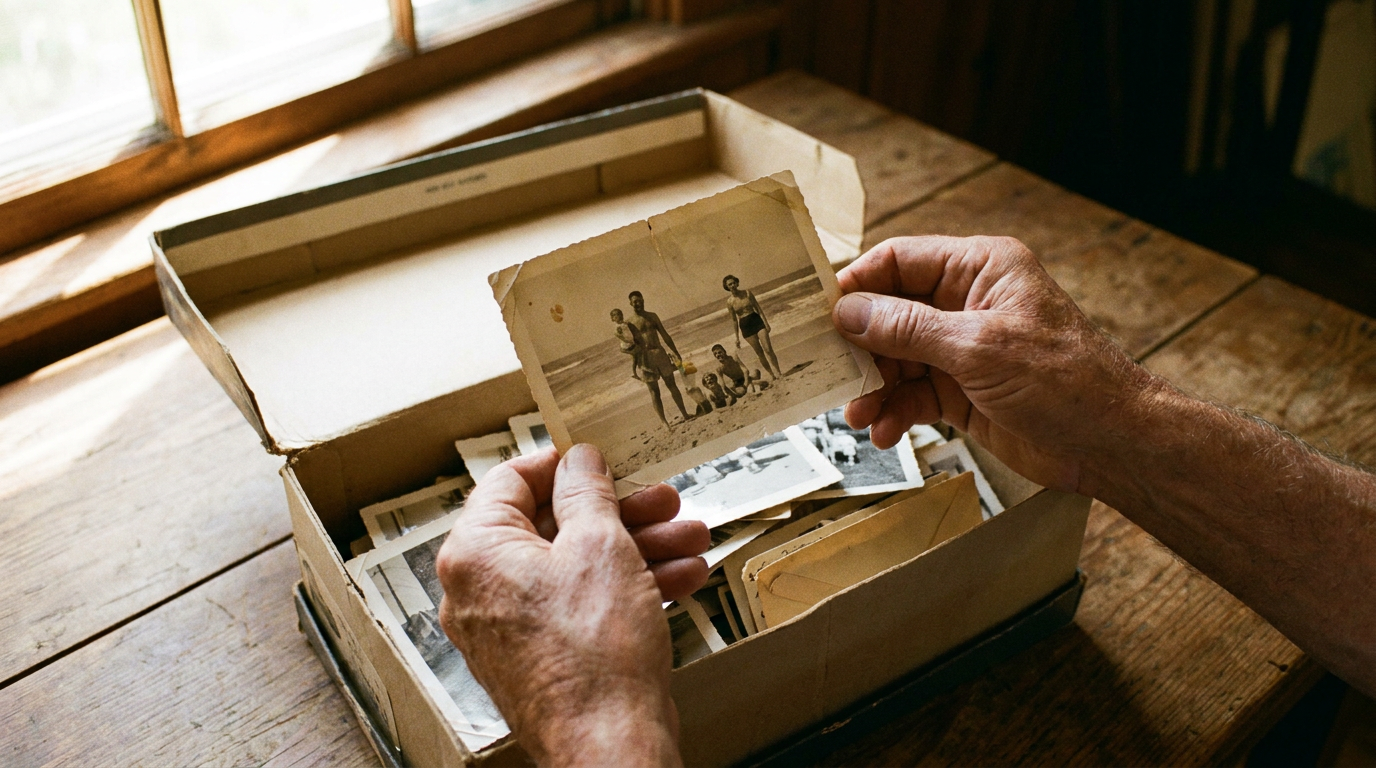
Two hands holding a faded printed photograph over an open shoebox of old prints, lit by warm natural window light.

The part that matters more than the scanner

Here is the strongest argument in this entire section, and it’s the one that gets left out of every digitizing guide on the internet.

Scanning a photo without capturing the story attached to it is a half-finished job.And the person who knows who’s in the photograph is a finite resource.

A 600-dpi scan of a photograph where nobody knows who’s in it is not a preserved memory. It’s a high-resolution mystery. You’ve upgraded the file format of something you’ve already lost.

That’s not meant morbidly. It’s meant as an invitation, and a rather lovely one: call your mum and ask her about this one. Take the album to your grandfather’s and go through it with

Which leads directly to the step almost everyone skips.

People in decluttering and family-history communities describe this same regret over and over — the box got digitized beautifully, and nobody thought to write down the names while there was still someone to ask.

That afternoon is worth more than the scanner. It’s worth more than the entire rest of this article, frankly. Scanners will keep getting better and cheaper; that conversation has a window.

him, phone on the table recording audio, one unhurried afternoon and a pot of tea. Ask who that is at the back. Ask where it was taken. Ask why everyone’s dressed like that.

The Part Everyone Skips: Attaching the Story to the Photo

You’ll want to know why everyone was laughing.

In ten years’ time, you will not want to know that this photograph was taken on 14 July at 6:42pm at latitude 38.7223. Your phone has recorded that with tremendous precision and it will be of no use to you whatsoever.

You’ll want to know why everyone was laughing. Nothing in your camera roll is recording that.

The four things worth capturing

For any photo you actually care about — and after the first pass, that’s a manageable number — capture four things:

  1. Who is in it. Full names, including the people at the edges you’ll stop recognizing.
  2. Where it was. The actual place, in words a human would use, not coordinates.
  3. What had just happened. The twenty seconds before the shutter. This is almost always the story.
  4. Why you took it. What made you reach for your phone at that particular moment.

Here’s what’s striking about that list: it’s essentially the standard professional archivists have used for decades. The describes captioning in a consistent format covering dates, locations, names, subjects and events — who, what, when, where, why. The likewise recommends tagging photos with the names of people and descriptive subjects.
Library of CongressNational Archives’ guidance on photographic records

Adding the story isn’t a soft, sentimental extra layered on top of real preservation. It is real preservation. Everybody just quietly dropped it from the consumer version.

Side-by-side comparison: a bare holiday photo with no information, and the same photo inside a journal entry with a written caption, names, a date and a voice note attached.

Voice notes are the cheat code

If you take one thing from this entire article, take this.

Forty seconds of you talking over a photo captures more than an hour of typing. You’ll mention the smell of the place. You’ll mention that the restaurant got your order wrong twice and it became the running joke of the week. You’ll go off on a tangent about the man with the accordion. None of that survives the transition to a typed caption, because typing makes people formal and formal people leave out the good bits.

And it captures your actual voice. Which, decades from now, is not a small thing to have recorded.

You don’t need to be articulate. You don’t need to prepare. Press record, look at the photo, and describe it to someone who wasn’t there. Ramble. Ramble is good. Ramble is texture.

A person sitting on a sofa recording a short voice note over a photo on their phone in warm evening light, with a clean sky-blue app interface visible.

Do it in batches, while it’s warm

Twenty photos with real context beat two thousand with none. Not slightly — categorically. Twenty is a story. Two thousand is a directory listing.

The flight home is the single best journaling opportunity of any trip. You’re sitting still, you have no signal, and everything is still vivid. The same evening works nearly as well.

Where the story actually goes

Because there’s nowhere natural to put it. Your photo library has a caption field that nobody fills in, buried behind a swipe, designed for a sentence. It treats the story as metadata attached to the file — a small note pinned to the important thing.

So why does everybody skip this step, given it’s clearly the valuable one?

The alternative is to invert it: put the photo inside the story instead of the story beside the photo.

That’s the idea is built around. A Moment holds the photos, the writing, the voice notes and the video together as a single entry — not a picture with a label, but a record of something that happened, which happens to contain pictures. Those Moments accumulate into a Memory LaneYour camera roll keeps the files. Your backup drive keeps the copies. This is where the story goes.
Lugelo

: a timeline you can walk back through, where each stop has something to say for itself.

The version of the trip none of you had alone

Everyone on the trip photographed a different half of it. You have the mornings; someone else has the night everybody remembers. You have the landscapes; someone else has the candid shot of you looking genuinely happy, which you’ve never seen.

Invite them into the same journal and you assemble the version of the trip that no single person actually experienced. let several people contribute to one record — their photos, their voice notes, their memory of what happened, sitting alongside yours.
Lugelo’s collaborative journals

On staring at a blank box with nothing to say

It happens. You open the entry, look at a photograph of a perfectly nice square in a perfectly nice town, and find you have absolutely nothing to write.

The exists for that specific moment. It prompts and expands — asks the question that unsticks you, helps shape three bullet points into something you’d actually want to reread. It doesn’t replace your voice; it gets you talking.
AI Journal Assistant

Privacy, in plain English

Since we’re asking you to put the meaningful version of your life somewhere, you’re owed a straight answer about it. Per

Lugelo’s own FAQs

Once the story is attached, there’s finally something worth making out of it.

: journals are private by default. You choose exactly who can view or contribute, and you can revoke that access whenever you want. Data is encrypted in transit. Personal data isn’t sold to third parties. And if you want out, you can delete your account and your data, with a 30-day window to recover it if you change your mind.

Turning a Trip Into a Digital Memory Book

A digital memory book is an edit, not an archive — and that distinction is the entire reason it works.

Choose 20 to 40 photos

Not two hundred. Certainly not two thousand.

The restraint is the product. A book of thirty photographs gets opened, passed around, and finished. A gallery of eight hundred gets scrolled for forty seconds and closed. If you did the ruthless first pass, you’ve already got your two hundred keepers; now pick the best fifth of those and let the rest stay where they are.

Sequence for narrative, not chronology

A folder has an order. A memory book has a shape, and they’re not the same thing.

Open on your strongest image — not the first one taken, the best one. Group by day or by theme, whichever tells better. Put the funny one where the pace needs lifting. Close on something quiet: the empty street on the last morning, the view from the plane, somebody asleep in the car on the way home from the airport.

A finished digital memory book open on a tablet, showing a curated two-page spread of trip photos with short written captions.

Write short connective text

Two or three sentences between clusters. That’s it. You’re writing connective tissue, not a travelogue, and the temptation to over-explain is what kills most of these projects before they’re finished.

How to make a photo album on iPhone

If you want to group your selection natively first, lays out the steps: open Photos, tap Collections, tap Albums, tap the Add (+) button, choose New Album, name it, then select your photos and tap CreateWorth being honest about what that gives you. As a selection tool it’s excellent — fast, native, and free. As a story tool it does nothing at all, because there’s still nowhere for the story to live. You’ve made a smaller pile. A better pile, but a pile.
Apple’s guide to creating photo albums

.

The step beyond the album

Once your Moments exist, they can become something you’d actually hand to another person. In Lugelo, a journal can be shaped into a storybook, exported as an eBook, laid out as a timeline, or opened as a you can step into from a browser or your phone. covers the range if you want to see it.
The features page

“There are some awesome and cool features on Lugelo that I like. Creating journals, adding moments and converting them into an eBook!” — Krishna Pankhania, App Store review

If everyone on the trip has been contributing, the finished thing is genuinely collective — and if you want to think harder about how

shared memories work across a group

Before we close, a few questions that tend to come up.

, that’s worth its own read.

Frequently Asked Questions About Organizing Photos

What’s the best way to organize thousands of digital photos?

Reduce before you sort. Delete duplicates and burst sequences first, then keep roughly one in ten of what’s left, then file the survivors into event-based folders. Sorting before reducing is why most attempts stall — you end up carefully filing hundreds of photos you were always going to delete.

Should I organize photos by date or by event?

By event, with the date as a prefix — 2026-07 — Lisbon. You remember occasions, not timestamps, so your structure should match how you’ll actually search. The date prefix keeps folders in chronological order automatically, so you lose nothing by leading with the name.

What should I do with old printed photos?

Digitize the ones that matter, keep the physical originals stored somewhere cool, dry and dark, and record who’s in them while someone still knows. Archival guidance is clear that scans don’t replace originals. The identification is the urgent part; the scanning can wait.

How do I organize digital photos on an external hard drive?

Mirror the exact folder structure you use elsewhere, so the drive and your main library are interchangeable. Treat it as one copy among several rather than as your filing system, and check it still reads at least once a year — drives fail quietly.

How many photos should I keep from a trip?

Around 10% is a realistic target: roughly two hundred from two thousand. For something you’d actually show people — a memory book, a shared album — twenty to forty is plenty. Keeping more doesn’t preserve more; it just raises the cost of finding anything.

What’s the best way to back up family photos?

At least two copies, on different media, in different physical locations, refreshed every few years as hardware and formats age. The recommends keeping copies as physically far apart as practical. One cloud account is a single copy, not a backup.
Library of Congress

How do I make a photo album on iPhone?

In , tap Collections → Albums → the Add (+) button → New Album, then name it and add your photos. It’s a strong grouping tool, but note that an album holds images without holding any of the story behind them.
Photos

How do I organize digital photos and videos together?

Keep them in the same event folder rather than splitting them by file type. The thirty-second video from a moment belongs beside the photos from that same moment — separating them by format breaks the story into two halves that no longer make sense on their own.

A family sitting together on a sofa, laughing while scrolling back through a timeline of their trip on a tablet, in warm light with a clean sky-blue interface.

Conclusion

Same trip. Same two thousand photos. But now there are forty you can actually find, a handful with names attached to the faces, and two or three where you can hear yourself talking about what happened just before the picture.

That’s the distinction worth holding onto: organizing your photos makes them findable; attaching the story makes them worth finding. The first job is housekeeping. The second is the one that decides whether any of this matters in a decade.

And no, nothing lasts indefinitely — not drives, not file formats, not services, not shoeboxes. Every serious archive plans around that rather than pretending otherwise. What you can

build is something you actually return to, because the records that survive tend to be the ones people keep visiting. Attention is the only preservation strategy that has ever really worked.

Ditch Camera Roll Chaos

Start small — one trip, one journal, one Moment. Your camera roll keeps the files; keeps the story that makes them worth keeping. Available on web, iOS, Android and HarmonyOS — and start saving what actually matters.
download it hereLugelo

How to Make a Travel Journal: 30 Prompts and Ideas for the Trip You Just Took

How to Make a Travel Journal: 30 Prompts and Ideas for the Trip You Just Took

The suitcase is still in the hallway. It’s half unpacked, which is somehow worse than not unpacked at all — one shoe out, the toiletry bag leaking something onto a folded shirt, a boarding pass wedged in the side pocket you’ll find in eleven months. There’s a laundry pile with a smell that is unmistakably hotelAnd here’s the part nobody warns you about: it’s been four days, and you already can’t remember which night the good dinner was. You know it happened. You know there was a table outside, and someone laughed so hard they had to put their glass down. You just can’t place it. Was that the second night or the third? Was it the town with the bridge or the one after?

. Your phone says you took six hundred and forty photos. You have opened approximately nine of them.

This is a guide to how to make a travel journal after you’ve come home. Not before you leave. Not while you’re away, balancing a notebook on your knees in an airport that smells like floor cleaner. After. For the trip you just took, the one currently dissolving at the edges while you answer emails.

There’s no scolding here. You didn’t fail at anything by not journalling on the road — you were busy being somewhere, which is rather the point of going. What follows is 30 travel journal prompts, a structure that actually holds together, and a set of ideas to make the whole thing worth opening again in five years.

Starting now isn’t second-best. In some ways, it’s better.

What a Travel Journal Actually Is — and Why “Too Late” Is a Myth

The belief worth dismantling right now is that a travel journal only counts if it was written daily, in the moment, in a leather notebook, ideally at a café table with good light. That’s a lovely image. It’s also the single biggest reason people never make one at all.

A travel journal is a personal record of a trip: where you went, what happened, and what it was actually like to be there. That’s it. It isn’t an itinerary — an itinerary tells you the train left at 7:40, not that the woman opposite you ate an entire rotisserie chicken with her hands and offered you some. It isn’t a photo dump either, because two hundred near-identical shots of the same cathedral aren’t a record of anything except indecision.

Reconstructing a trip from memory afterwards is entirely normal, and it frequently produces better writing. Distance does some of the editing for you. Four days, four weeks or four months later, you’re not writing down everything — you’re writing down what survived. And what survived is, by definition, what mattered. The morning you spent queuing for a museum has quietly deleted itself. The conversation with the taxi driver has not. Your memory has already done the hard editorial work of deciding what the trip was actually about, and it did it for free.

There’s a related argument made well by National Geographic, which : social posts capture the polished, external version of a trip — the version arranged for other people. A journal captures the version that was actually happening to you. Nobody is liking it. Nobody is grading it. That freedom is the whole value.
makes the case for keeping a travel journal rather than relying on social media

Paper, digital, or both — an honest comparison

Paper deserves a fair hearing, not a token nod before the sales pitch.

A paper journal is tactile in a way that matters. It doesn’t ping. Nothing in it wants your attention for reasons of its own. You can glue a ticket stub straight onto the page, and twenty years later that stub will still be exactly where you put it, slightly buckled from the glue. You can draw badly in the margin. You can write on a train without a signal. If you want to go all the way, the US National Park Service publishes — folding your own pages, cutting a cover from a paper grocery bag, poking holes along the spine and stitching the whole thing together with embroidery thread. It is not a metaphor. They mean actual thread.
a genuinely charming step-by-step guide to making a travel journal by hand

Digital has different strengths, and they’re not the same strengths pretending to be better ones. Photos and video sit inside the entry rather than in a separate app. Voice notes let you capture a story in forty seconds while you’re still doing the laundry. You can search it — and this is the one that quietly wins arguments, because there is no search function in a handwritten journal from 2019, and if you want to find the name of that restaurant you are going to be turning pages for a while. More than one person can add to a digital journal, which matters enormously if you didn’t travel alone. We’ve written a fuller Which brings us to the actual difficulty. Permission isn’t the hard part. Getting the first words down is.
honest comparison of journaling formats

Plenty of people sensibly want both, and that’s not a fudge — it’s the correct answer for a lot of travellers. Handwrite the messy, private, thinking-out-loud pages. Keep the photos, clips and voice notes somewhere searchable. Travel diaries have existed in every format humans have ever invented, from ship’s logs to postcards to a Notes app entry typed at 2am in an airport. Travel journaling isn’t a medium. It’s a habit of paying attention, and you can pick it up at any point — including now, from an armchair, with the suitcase still in the hallway.

if you want to weigh it up properly.

30 Travel Journal Prompts to Bring the Trip Back

These 30 travel journal prompts are grouped into six clusters. Work through them in order, skip to whichever cluster looks interesting, or answer one a night for a month. There’s no correct dosage.

That’s the trick that makes after-the-fact journalling work. Faced with “write about Portugal,” most people write four sentences and give up. Faced with “what did the place smell like first thing in the morning?” — suddenly there’s something to say, and the saying of it pulls three other memories along behind it.

You don’t need to write about the whole trip. You need one good question at a time.

The Senses — the details a photo can’t hold

Photographs are a visual record of a place, which sounds comprehensive until you realise it covers roughly one fifth of what being there was like. National Geographic’s piece on makes the point sharply: compulsive documentation can crowd out the small, ordinary, sensory details that are precisely what your future self will want back. These five go after those.
the secret to remembering travel

  1. What did the place smell like first thing in the morning, before anyone else was up?
  2. What sound would instantly put you back there — traffic, birds, a particular language, a church bell, a specific kind of silence?
  3. What was the temperature like on your skin at the hottest point of the day, and what did you do about it?
  4. Describe one thing you ate in enough detail that someone who wasn’t there could taste it — texture, temperature, what it came on, whether you liked it.
  5. What did the place you slept sound like at night, and how long did it take you to stop noticing?

The People — travel is mostly other people

You can visit a country and remember a building. You will almost always remember a person longer.

  1. Who did you talk to that you’ll never see again, and what did they say?
  2. What did you learn about the person you travelled with that you didn’t know before?
  3. Who was kind to you when they didn’t have to be, and what did they actually do?
  4. Was there someone you found irritating — a fellow traveller, a guide, someone at the next table — and what specifically did they do?
  5. Who did you watch from a distance and invent an entire life for?

The Unplanned — the parts that weren’t on the itinerary

Nobody’s favourite travel story is “and then we arrived on time and everything went as booked.”

  1. What went wrong, and what did it turn into?
  2. What did you find purely by accident that you’d never have found on purpose?
  3. What did you plan carefully that turned out to be completely unnecessary?
  4. Was there a moment you were genuinely lost, and how did it resolve?
  5. What did you say yes to that you’d normally have said no to?

The Ordinary — the texture of being somewhere

This cluster is the sleeper hit. The unremarkable stuff ages the best, because it’s the first thing memory throws overboard and the last thing you expect to miss.

  1. What did you eat for breakfast most mornings, and where?
  2. Describe the walk between where you slept and the nearest station, shop, or beach.
  3. What did you buy that you didn’t plan to buy — the charger, the plasters, the umbrella, the weirdly good supermarket snack?
  4. How did you actually spend the dead hours — the waiting, the transit, the afternoon it rained?
  5. What did the light look like at the end of the day, and where were you when you noticed it?

The Shift — what the trip did to your ordinary

Not self-improvement. Just the observable difference between how you live at home and how you lived for those ten days.

  1. What did you do on this trip that you wouldn’t normally do at home?
  2. What was easier than you expected? What was harder?
  3. What did you stop caring about by day three that you’d been fussing over on day one?
  4. What surprised you about the place that no one had mentioned beforehand?
  5. What did you get wrong about the place before you went?

A clean designed card listing five sensory travel journal prompts, sky-blue accents on white, rounded corners.

The Return — what came home with you

The trip doesn’t end at the airport. These are the prompts most people never think to answer, and often the ones that read best later.

  1. What’s the first thing you told someone about when you got back?
  2. What would you do differently if you went again tomorrow?
  3. What do you miss most, one week on — and is it what you expected to miss?
  4. What did you bring home, physically? Where is it now?
  5. Finish this sentence honestly: “I’ll probably never tell anyone this, but the best part of the trip was…”

Answer five of these and you have a travel journal. Answer all thirty and you have something closer to a book.

These work exactly as well in a paper notebook as they do in a digital one — the questions don’t care where you write them down. If you’d like prompts shaped around your specific trip rather than a general list, can generate them from what you’ve already written. And if you find that prompt-led writing suits you, we use the same approach for other life events, including With plenty to write about, the next question is where all of it goes.
a set of journal prompts for kids starting the school yearLugelo’s AI Journal Assistant

.

How to Make a Travel Journal That Holds Together: Structure and Organisation

A pile of good answers isn’t a journal. It’s a pile. The difference is structure — and structure is the bit most guides wave at vaguely before moving on.

There are three sensible ways to organise a travel journal, and one of them is better than the others more often than people admit.

By day. Chronological, one entry per day. This works genuinely well for short trips — a long weekend, four nights, a week at most — and it’s the natural fit for road trips, where the whole shape of the thing is the sequence. Day one you left, day six you arrived, and the movement between is the story.

By place. One section per town, city, island, or base. For any trip longer than about a week, this beats by-day organisation and it isn’t close. Days blur. You will not remember whether the market was Tuesday or Wednesday, and more to the point you won’t care. But you will always remember which town the market was in. Place is how human memory files travel — we say “that thing that happened in Split,” never “that thing that happened on the ninth.” Organise by place and you’re working with your memory instead of against it.

By theme.If you’re unsure: pick place for anything over a week, day for anything under. You can always regroup later.

Food, people, walks, disasters, things I bought, arguments. This is the right answer when the trip was one long stretch in a single location — three weeks in one apartment, a residency, a stay with family — where days and places both stop being useful dividers.

What to include beyond the writing

The text is the spine. These are the ribs:

  • Photos — but curated, not dumped. Five that mean something beat fifty that nearly do.
  • Short video clips — ten seconds of a street is worth more than a paragraph describing it.
  • Voice notes — including the ones you recorded at the time, half-shouting over wind.
  • Tickets, receipts, boarding passes — photograph them if you’re going digital.
  • Maps — with the route you actually took, not the one you planned.
  • Links — to the restaurant, the guesthouse, the walking route, so that future-you can recommend it properly.

The no-notes rescue: reconstruct the trip from evidence you already have

Here’s the section for the reader who wrote down absolutely nothing. You are in a far better position than you think, because you left a detailed forensic trail without meaning to.

Your photo timestamps and location data give you a day-by-day skeleton. Open your camera roll, switch to the map or date view, and the itinerary rebuilds itself. That gap between 11am and 4pm on the Thursday? That was the long drive. You now have a spine without having written a word. The Washington Post has covered , and this is the practical starting point.
how to turn travel photos into a journal rather than an archive nobody opens

Your bank and card transactions tell you where you ate and when. This is the single most underused memory tool available. Scroll your statement for the trip dates and the restaurant names come back with the food attached — you’ll see a charge and immediately remember the room, the waiter, what you ordered. Card statements are a receipt for your own life.

Messages you sent during the trip are a real-time diary you already wrote. This is the good one. Scroll back through what you sent your sister, your group chat, your partner, your friend who was following along. You were writing dispatches the entire time: complaints, photos, the good news, the bad news, the joke about the hotel breakfast. Copy the best lines straight into your journal. They’re better than anything you’d write now, because they were written while it was happening.

Booking confirmation emails pin down the facts.Between those four sources, most people can reconstruct eighty percent of a trip in an evening. This is how to keep a travel journal when you didn’t keep one at the time — and it’s also, incidentally, how to write in a travel journal without the terror of the blank page, because you’re never starting from nothing. You’re starting from evidence.

Search your inbox for the dates and you’ll recover hotel names, addresses, flight times and the exact spelling of that town you’ve been calling “the one with the castle.”

This is where a digital journal quietly earns its place: a timeline — Lugelo calls it a Memory Lane — arranges entries chronologically as you add them, so the trip orders itself while you’re busy remembering it. If you want the plain-English mechanics of building one online, we’ve broken down .
how digital journaling works

A timeline-style journal layout showing a trip organised by place, with photo cards, a voice note and a map pin.

Structure gets it built. The next section is what makes it worth opening again.

Travel Journal Ideas That Make It Worth Re-Reading

Most travel journals fail not because they’re unfinished but because they’re boring. They read like a receipt. “We went to the market and it was nice. Then we had lunch. The weather was good.” Ten years later that tells you nothing you didn’t already vaguely know.

Compare: “The man selling peaches shouted the same four words for three hours straight. By the end I could say them back to him. I still don’t know what they meant.”

One of those is a sentence. The other is a memory with a door in it.

Specificity beats summary, every time. This isn’t a stylistic preference, it’s how recall works — a concrete detail is a handle, and a generalisation isn’t. Veteran travel editor Don George makes a version of this argument in his , warning against the flat diary recitation of I woke up, I ate, I walked, and passing on John McPhee’s rule that every word should earn its place. George is writing for people who want to be published, which you don’t have to be. Take the specificity; leave the rest.
advice on self-editing for travel writers

Because the second principle contradicts him, deliberately:

“You are not writing for an audience. You are writing for the person who, in ten years, will have forgotten all of this.”

Write for your future self, not a reader. Nobody is grading this. There’s no word count, no editor, no comments section. That means you should write down the private, unimpressive, weirdly specific things — the ones you’d never put in a caption. That you cried a bit in a train station for no clear reason. That you thought about work on the second day and felt guilty. That the highlight of Tuesday was a supermarket. These are the entries that will surprise you later, because they’re the ones you’d otherwise have edited out of your own history.

Include the bad bits. The delayed train. The argument on day four that neither of you has mentioned since. The meal that was genuinely terrible and cost a fortune. The afternoon you were bored. A journal containing only highlights reads like a brochure, and brochures age horribly — they’re not just incomplete, they’re faintly embarrassing. Travel diaries that include the friction are the ones you actually believe when you read them back.

Five formats worth stealing

  1. A one-line-per-day spine. One sentence per day, no more, even for a three-week trip. It takes twenty minutes total and reads astonishingly well end to end, like a poem written by someone who was very tired.
  2. A running “best thing I ate” list. One entry per day, ranked or unranked. This is the section you will reread most, guaranteed.
  3. A map with pins for everywhere you actually went — including the pharmacy, the wrong turning, the beach you couldn’t find parking at.
  4. A “would go back / wouldn’t go back” verdict. Two columns, brutally honest, written within a week of getting home while the opinions are still hot.
  5. Three words per place, written before you overthink it. First instinct only. Reading those back years later is uncanny, because the first instinct is usually right.

Everything so far has assumed you’re writing this alone. You almost certainly didn’t travel alone.

Journalling the Trip Together: Everyone Remembers a Different Version

Right now, that trip is scattered. It lives across three camera rolls, a group chat that’s already moved on to other things, and a shared album nobody has opened since the flight home. Nobody’s fault — that’s just what happens. But it’s a poor arrangement for something you’d like to look at again, and it gets worse with every month that passes. One place is better.

Which means a journal written by one person is a first-hand account with a single point of view. A journal built by everyone who was there is something closer to the actual trip.

Someone else has the photo of you that you didn’t know existed — mid-sentence, squinting, holding a map upside down. Someone else remembers the name of the restaurant that’s been on the tip of your tongue for a week. Someone else found the whole disastrous ferry situation hilarious rather than stressful, and their version is frankly better than yours. Memory isn’t a recording; it’s a reconstruction, and every person on the trip built a different one.

Here’s something that becomes obvious the moment you compare notes: you and the people you travelled with went on different trips.

In Lugelo, a shared journal lets everyone add their own Moments — photos, video, voice notes, text — into the same journal, so the trip assembles itself from several angles instead of one. You invite the people you travelled with; they add what they’ve got. The journal owner controls who’s invited and can revoke access at any time, journals are private by default, and entries are encrypted in transit. That’s the whole of it, in plain English. You can .
set up a collaborative journal here

If you want the practical mechanics of inviting contributors and splitting the work between several people, we’ve written — a different occasion, but the process transfers directly. And for why multiple perspectives on the same event matter so much, there’s .
our piece on shared memoriesa step-by-step guide to co-creating a shared journal

[TO BE ADDED AT PUBLISH — link forward to the shared-albums-for-friend-groups post, post 3 of the post-trip cluster]

Three friends around a table adding photos and notes from a recent trip to a shared journal on their phones.

Once the trip is written down and everyone’s added their part, it can become something more than a file.

Turning Your Travel Journal Into Something You Keep

A finished travel journal doesn’t have to stay a journal. Once the writing exists and the photos are attached, it can become an object — something with a cover, or a scroll, or a room you can walk into.

A storybook. The trip laid out as a designed book, entries and photographs arranged in order. This is the version you hand to someone.

An eBook or PDF. The same thing, sent. Useful for the people you travelled with, and for the family who didn’t come but have been asking about it for a fortnight.

A timeline. The whole trip in chronological order, start to finish, in one scroll — Memory Lane, in Lugelo’s terms. Good for the trips where the sequence is the story.

A VR gallery. Step back into somewhere you visited, viewable in a browser or on your phone. It’s a strange and rather affecting way to revisit a place you’ve physically left, and you can .
see how VR journaling works here

The obvious use: send the storybook to the people you travelled with. It’s a considerably better souvenir than a fridge magnet, and it arrives at the point — three or four weeks after landing — when everyone’s started to miss it. For an example of a shared experience taking this route from journal to keepsake, see .
how a big shared event became a storybook

[TO BE ADDED AT PUBLISH — link forward to the photo-overwhelm post, post 2 of the post-trip cluster: "you've written the trip; now what about the 2,000 photos?"]Before you start, a few practical questions worth clearing up.

Travel Journal FAQs

What is a travel journal?

A travel journal is a personal record of a trip — where you went, what happened, and what it was like to be there. It’s not an itinerary or a photo album. It can be handwritten, digital, or both, and it can be written during the trip or reconstructed afterwards from memory, photos and messages.

How do you keep a travel journal?

Pick a format you’ll actually use, then lower the bar. A few sentences per day, or per place, is enough. Add photos, voice notes and tickets as you go. Most travel journals die from ambition, not laziness — the people who keep them going are the ones writing three lines, not three pages.

What should you write in a travel journal?

Write the specifics: what things smelled like, who you spoke to, what went wrong, what you ate for breakfast. Skip the summary (“it was lovely”) and record the detail (“the coffee came in a glass and burned my hand”). Include the bad days — they age better than the highlights.

How do you journal while travelling?

Realistically, briefly. Record a forty-second voice note while you walk. Write one line a day in your phone before you sleep. Caption three photos while you’re waiting for a train. Anything sustainable beats a system you abandon on day two, and anything captured now is material for writing it up properly later.

Can you start a travel journal after the trip?

Yes — and it often works better. Rebuild the timeline from your photo timestamps, check card transactions for restaurants, and read back the messages you sent friends during the trip. Then answer one prompt at a time. Distance filters out the forgettable parts for you.

How do you make a travel journal online?

Choose a digital journal, create one journal for the trip, and add entries with photos, video and voice notes attached. Organise by place for long trips, by day for short ones. Most tools arrange entries on a timeline automatically. Here’s in plain English.
how digital journaling works

Do you need to write every day?

No. The pressure to write daily is what kills most travel journals — miss two days, feel behind, stop entirely. Write when you have something worth recording. A journal with nine good entries beats an abandoned one with three dutiful ones and a fortnight of blank pages.

A person at a kitchen table writing up a recent trip, phone propped against a coffee cup, ticket stubs and a map beside an open journal.

The Trip Isn’t Gone — It’s Just Not Written Down Yet

The suitcase is still in the hallway. The six hundred photos are still unopened. But the trip itself hasn’t disappeared, and it isn’t disappearing as fast as it feels like it is — it’s simply sitting in a form you can’t get at yet.

Starting now, from memory, from photo timestamps, from the messages you sent your sister on day three, is a completely legitimate way to make a travel journal. It’s not a downgrade from the notebook you meant to keep. It’s just the version that’s actually available to you, and the only one that gets written.

One prompt. One paragraph. One photo. That’s a start, and it’s a real one — the second entry is always easier than the first, and the fifth barely feels like effort at all.

Go and find out which night the good dinner was.

Don’t Just Live It — Keep It

Free to start. Private by default. Invite the people you travelled with whenever you’re ready.

Start a journal on LugeloSee how Lugelo worksDownload Lugelo for iOS, Android and web