All You Need Is Love: The Story Behind the World’s First Viral Moment — and Why Shared Memories Still Matter
Picture this. It’s June 25, 2026. You’re somewhere — a kitchen, a commute, a quiet room before the rest of the house wakes up — and you click on a video. A colorized clip, recently surfaced on YouTube. Four young men in a flower-strewn studio, bathed in the warm, surreal light of a summer that believed, genuinely and recklessly, that love could change everything. A simple melody begins. Eight notes. And then a voice: All you need is love.
You’ve heard this song a thousand times. You know every word. But something about watching it today — right now, on this particular June morning — feels different. Feels alive.
Here’s why: fifty-nine years ago today, on June 25, 1967, approximately 400 million people watched this exact performance together. Simultaneously. Live. Across 24 countries, in the same moment, breathing the same four words. It was the largest shared television audience in human history up to that point. It was the world’s first truly viral moment — before the internet, before social media, before any of the infrastructure we now take for granted as the connective tissue of modern life. Four satellites, 10,000 people, and one song were all it took.
And today, on Global Beatles Day 2026, that story is more alive than ever. Apple Corps Ltd. has officially recognised the fan-founded celebration for the first time. The colorized version of that legendary performance has been released publicly online for the very first time. Millions of fans around the world are watching together again — this time in their living rooms, on their phones, in their own private corners of a world that desperately needs reminding of something it has always known: that sharing what we love with the people we love is the most human thing we do.
This is the story of that moment. Why it happened. Why it still matters. And what it tells us about memory, love, and the stories we owe it to ourselves to keep.
June 25, 1967 — The Night the World Watched Together
To understand what happened on the evening of June 25, 1967, you have to understand what kind of world it happened in.
It was a year of extremes. The Vietnam War was at its most brutal and contested. The Six-Day War had just reshaped the Middle East. Civil rights movements were convulsing cities across America. And yet, simultaneously, something extraordinary was blooming in the cultural soil of the decade: a genuine, wide-eyed, flower-wearing belief that the world could be made better. That music could carry the weight of that hope. That if you said something true enough, simply enough, to enough people at once — it might actually land.
It was into this world that the BBC’s Our World broadcast was born. Conceived by BBC producer Aubrey Singer and coordinated by the European Broadcasting Union (EBU), the programme was, in every sense of the phrase, a logistical miracle. It took ten months of planning and the coordinated effort of 10,000 technicians, producers, and performers across 14 national broadcasters on five continents. The technical infrastructure required to pull it off had never been assembled before and would not be replicated for years afterward.
Four communications satellites were pressed into service to make the broadcast physically possible: Intelsat I — nicknamed “Early Bird” — and Intelsat II F-3, known as “Canary Bird,” held geosynchronous orbits over different parts of the Atlantic Ocean. Intelsat II F-2, or “Lani Bird,” and NASA’s ATS-1 covered the Pacific. Nine ground stations across North America, Europe, Australia, and Japan received and transmitted signals in real time. Forty-three control rooms monitored and manipulated those feeds simultaneously, routed through master control at BBC Television Centre in London. It was, by any measure, the most technically complex television production that had ever been attempted.
The full historical record of the Our World program tells the story in remarkable detail. Fourteen national broadcasters participated. The programme was transmitted live to 24 countries, with an estimated audience of between 400 and 700 million people — the largest television audience up to that date in history. The rules were strict and deliberately idealistic: no politicians or heads of state could appear; everything had to be transmitted live (no pre-recorded content); and inclusion was based solely on programme balance, not on geography or politics. It was, in its structure, an act of radical optimism.
The programme’s opening was its own small act of planetary poetry. The Vienna Boys’ Choir sang the Our World theme in seventeen different languages — a number that had originally been twenty-two, but was reduced after a shadow fell across the broadcast just four days before air. Five Eastern Bloc countries — Czechoslovakia, East Germany, Hungary, Poland, and the Soviet Union — withdrew in protest of the Western nations’ response to the Six-Day War. The world that had hoped to unite itself was reminded, at the last possible moment, that unity is never as simple as it appears on paper. The broadcast went ahead without them.
What viewers saw over the following two hours was a portrait of the world in its fullness: factories in Austria, fishing fleets in the Gulf of Cádiz, construction workers building Tokyo’s subway system, a summit conference in Glassboro, New Jersey — as close as the programme’s no-politicians rule would allow to the Lyndon Johnson–Alexei Kosygin meeting happening just outside frame — and the Kennedy Space Center, reaching toward the stars. Births were broadcast live from hospitals in Japan, Denmark, Mexico, and Canada. The world was shown to itself, in all its working, striving, aspiring complexity, in real time.
And then came Abbey Road.
In Studio One, the Beatles were surrounded by balloons, flowers, and their closest friends — members of the Rolling Stones, Eric Clapton, Marianne Faithfull, Keith Moon, Graham Nash — seated on the floor and draped across chairs in the festival atmosphere that John, Paul, George, and Ringo had deliberately created. They had been asked, simply and impossibly, to write a song that the whole world could understand, with a message that could travel across every language barrier, every cultural divide, every political fracture — at the exact height of the Vietnam War.
They wrote four words.
“All you need is love,” introduced to the world by broadcaster Steve Race, rippled out from a London studio through four satellites to 400 million screens. Within a month, the song was released as a single. It reached number one in country after country. It has never really stopped playing since.
According to the official Beatles account of the day, Our World was “the first live multinational satellite TV production” — a description that barely captures what it actually was: the moment humanity first watched itself together, in a single shared breath. The Summer of Love had its anthem. And the world had its first viral moment.
What is extraordinary is not just the scale of it, but the intention behind it. The Our World broadcast didn’t go viral by accident. It was designed, at every level, to create a feeling of shared humanity — to make every person watching feel that they were part of something larger than themselves. That instinct — the desire to make people feel together — is what made it last.
Fifty-nine years later, that instinct is still the most powerful force in human communication. And it’s that same force that, in 2026, has brought the story of the broadcast back to life in a way nobody anticipated.
Global Beatles Day 2026 — When a Fan’s Dream Becomes Official History
There is something deeply moving about the way Global Beatles Day began. Not in a boardroom or in a marketing campaign or with the machinery of a major label or the resources of a global corporation. It began, in 2009, with a fan.
Her name is Faith Cohen. A lifelong Beatles devotee, she looked at the calendar, saw June 25 — the anniversary of the Our World broadcast — and decided, with the quiet conviction of someone who simply believes in something, that this day deserved to be remembered. That the spirit of that broadcast — the idea that love is the message, and that the message belongs to everyone — was worth celebrating, every single year, without permission or precedent.
And so Global Beatles Day was born. Grassroots, fan-run, built entirely on love. Over more than fifteen years, it grew organically, the way things grow when they’re rooted in something real: tribute concerts in Tokyo, Beatles-themed exhibitions in New York City, singalongs in Buenos Aires, fan gatherings on the streets of Liverpool. No official backing. No corporate endorsement. Just people, wherever they were, stopping to listen and share a little joy.
For fifteen years, Apple Corps Ltd. — the company founded by the Beatles themselves to manage their creative and business legacy — watched this movement grow from the outside. And in 2026, on the fifty-ninth anniversary of the broadcast that started it all, they finally stepped in. Not to take it over. Not to commercialise it. But to do something far more meaningful: to say we see you, and we agree.
Apple Corps Ltd.’s official announcement confirmed, for the first time, that the company formally acknowledges Global Beatles Day — celebrated annually on June 25, marking the anniversary of the Our World BBC performance of “All You Need Is Love.” In a letter written personally to Faith Cohen, Apple Corps CEO Tom Greene articulated exactly why the day matters:
“More than ever, the message of The Beatles, and of ‘All You Need Is Love’ speaks to something vital for community, connection, and the power of bringing people together. That is what makes Global Beatles Day so special. It asks nothing more than for people, wherever they are, to stop, listen, and share a little joy.”
Those words — stop, listen, and share a little joy — could serve as the mission statement of an entire philosophy of living. They certainly serve as the soul of what Global Beatles Day has always been.
To mark the occasion, on June 25, 2026, a newly colorized version of the Beatles’ BBC Our World performance of “All You Need Is Love” was released for free on YouTube — the first time the iconic performance has been made publicly available online. The colorized version itself is not new: it was created in 1995 for The Beatles Anthology TV special, using color photographs taken at the original event as a reference, beginning in its original monochromatic format before rapidly morphing into the vivid, psychedelic flower-power palette of the Summer of Love. But it had never been released publicly online before today. That deliberate choice — to release it now, on this anniversary, to give fans around the world the chance to watch together in a live YouTube chat — is its own act of poetic symmetry. In 1967, 400 million people watched together. Today, the invitation is open again.
The Beatles’ legacy, of course, needs no introduction. More than five decades after their split, their music continues to reach new listeners through streaming platforms, through films, through the kind of cross-generational discovery that no algorithm fully explains — only love does. Their influence stretches from the fashion of the 1960s to the production techniques of contemporary pop, from the “British Invasion” that rewired American music to the groundbreaking studio experimentation of Sgt. Pepper’s Lonely Hearts Club Band. And the future is bright: a four-film Beatles cinematic event — directed by Sam Mendes, starring Harris Dickinson, Barry Keoghan, Paul Mescal, and Joseph Quinn — is set for April 2028 through Sony Pictures Entertainment. The first official Beatles fan experience, at 3 Savile Row, opens in 2027. The story is still being told. The legacy is still being built.
But today, on Global Beatles Day 2026, the story that matters most is the oldest one: a group of friends in a flower-decorated studio, sending a message to everyone, everywhere. And one fan who decided, seventeen years ago, that the world should never forget it.
The historical and the contemporary now converge on a single question that has always been at the heart of this story: why do moments like this one resonate so deeply? Why does a song from 1967 still make people feel something in 2026? The answer reaches deeper than music, deeper than nostalgia — all the way down to the way human memory actually works.
Why Shared Moments Become the Memories We Keep Longest
Think back to your most vivid memory. Not a photograph. Not a story you’ve been told about yourself. An actual memory — the kind where you can feel the texture of the moment, smell it almost, hear the quality of the light. The chances are very high that you were not alone in it.
There’s a reason for that. Neuroscience and memory research have long established that emotionally charged experiences are encoded more deeply in the brain than neutral ones — the amygdala essentially flags the moment as important, instructing the hippocampus to store it with greater fidelity. But the presence of other people amplifies this effect in ways that researchers are still working to fully understand. Shared experiences are rated as more intense, more meaningful, and more memorable than the same experiences had alone. When we feel something together, we feel it more.
The Our World broadcast worked not just as a technological triumph but as a human one. For a few minutes on the evening of June 25, 1967, 400 million people had the same feeling at the same time. They didn’t know each other. They didn’t share a language or a government or a set of beliefs. But they shared a moment. And that simultaneity — the knowledge, even if only subconscious, that millions of others were experiencing the same thing right now — gave the moment a weight it could not have had in isolation.
This is what sociologists call collective memory: the phenomenon by which groups of people share a common recollection of a significant event, and in doing so, weave that event into the fabric of a shared identity. The Our World broadcast is collective memory made literal — a single moment that belonged to everyone who watched it, across every divide, and continues to belong to the generations who have inherited it since.
Music adds another dimension to this. Decades of research into autobiographical memory — the kind of memory that tells us the story of our own lives — have consistently shown that music-triggered memories are among the most vivid and emotionally complete that human beings can access. A melody can unlock a moment in time with a precision that no other sense can match. “All You Need Is Love” has served as this kind of memory key for generations: for the people who watched the broadcast live in 1967, for their children who grew up hearing it, for every person who has ever heard it at a wedding, or in a hospital waiting room, or through a car radio on a road they’ll never forget.
The impulse to share an experience — to turn to someone beside you and say are you feeling this too? — is one of the most fundamentally human impulses there is. The Beatles understood this instinctively; they built their career on it. The BBC’s Our World broadcast understood it on a civilisational scale, and weaponised it in the best possible sense: to remind a fractured world of its own wholeness, even briefly.
But here is where the story becomes personal. Here is where it stops being about 1967 and starts being about right now.
Because in 2026, we have more tools to share than at any point in the history of the species. More cameras, more platforms, more channels, more ways to say look at this, feel this, be here with me. And yet there is a growing, quiet, private grief at the heart of modern life: the sense that the truly meaningful moments — the ones we want to hold onto — are getting harder to preserve. They slip into camera rolls nobody opens then disappear from social media stories after twenty-four hours. They blur into the general noise of a life lived at speed.
We have captured more moments than any generation in history. We have preserved fewer of them in any meaningful form.
Journals are souvenirs of your past.
That line — Lugelo’s own — lands differently when you hold it against the scale of what was lost and found in the story of the Our World broadcast. Because the broadcast itself was preserved: in archives, in memories, in the cultural inheritance of every generation since. And because of that preservation, it is still alive today. It is still being watched. Still being felt. Still being shared.
The question for every one of us, right now, is whether our own moments will be as lucky.
From “All You Need Is Love” to the Stories You Share with the People You Love
The Beatles didn’t write “All You Need Is Love” for a stadium tour or a record label’s quarterly target. They wrote it for the world, and they shared it in the most deliberately collaborative way possible: surrounded by their closest friends, in a room full of balloons and flowers, the doors open to anyone who was supposed to be there. The song’s chorus was designed to be sung along with. The performance was designed to feel like a gathering. The whole broadcast was engineered to make 400 million strangers feel like they were in the same room.
That spirit — the come join us, this moment is for everyone spirit — is ancient.
- It predates the Beatles by millennia.
- It is the spirit of the campfire, the feast, the communal song.
- It is what every family photograph is reaching toward, what every group chat full of shared memories is trying to replicate.
- It is the impulse that says: I want you to have been part of this.
The difference between experiencing something and preserving it is the difference between a feeling and a story. Feelings are real, but they fade. They erode at the edges, soften in the middle, lose their colour over time like an old photograph left in sunlight.
- Stories survive.
- Stories can be returned to.
- Stories carry the weight of a moment across years, across generations, across the distance between who you were then and who you are now.
What Lugelo does, at its core, is what the Our World broadcast did in 1967: it creates a shared space where multiple people can contribute their perspective on the same moment and build something together that no single person could build alone. Because the truth about every significant moment in your life is that your account of it is only ever partial. You saw it through your own eyes, felt it through your own nervous system, understood it through the lens of your own particular history. Someone else who was there — your mother, your best friend, your child — saw something different. Felt something different. Noticed the detail you missed and missed the detail you noticed.
The journal that holds all of those perspectives is something richer, truer, and more lasting than any single account. It is the emotional equivalent of 400 million viewers each holding their own memory of the same broadcast — and someone having the wisdom to collect them all into one place.
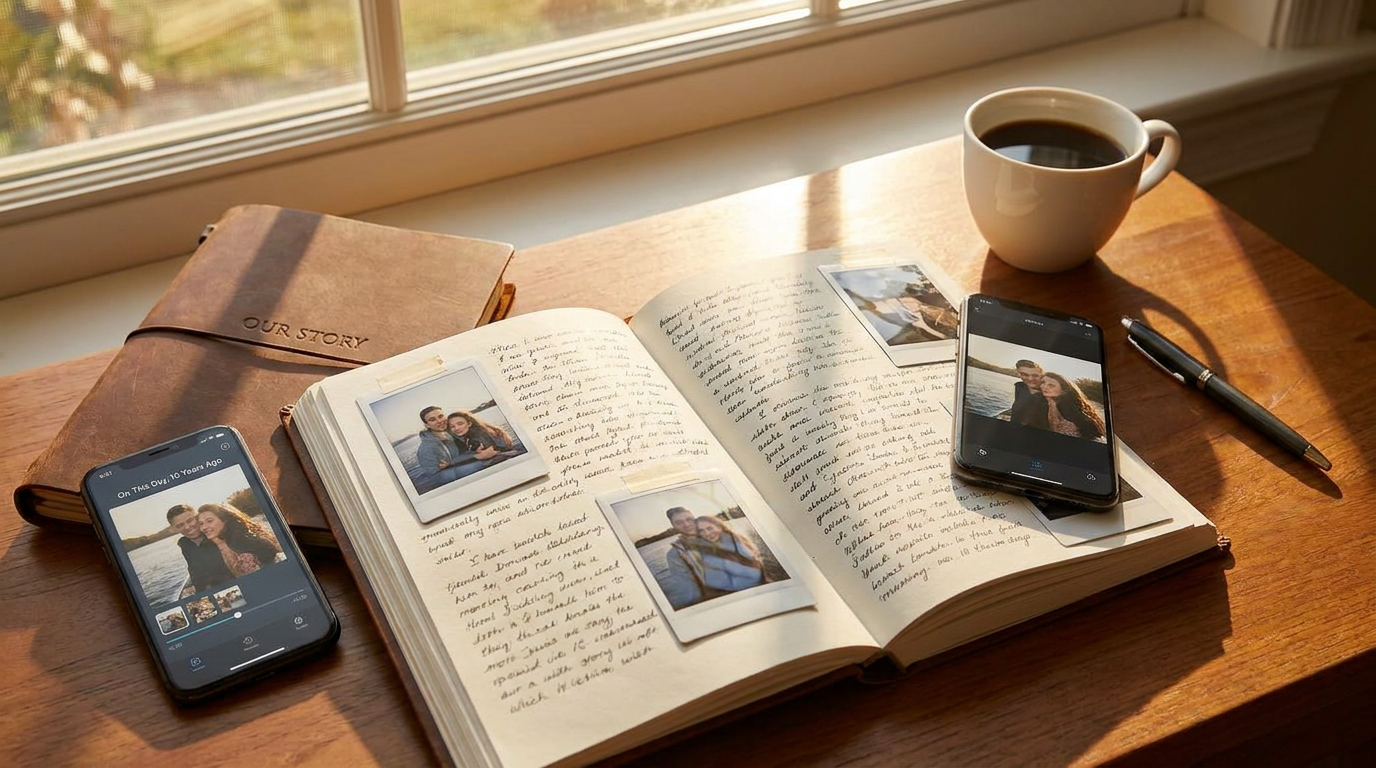
Lugelo’s collaborative journaling features allow multiple people to contribute to the same journal: their own photos, voice notes, videos, and written reflections, woven together into a multi-voice, multi-perspective memory that honours the complexity of shared experience. The journal becomes not just a record of what happened, but a record of how different people experienced it — and that difference, that beautiful variation in human perception, is where the real richness lives.
The best moments in your life were almost certainly shared with someone else. That’s not a coincidence. That’s the nature of love. And the question of whether those moments belong only to you — or to all of you — is one worth sitting with.
In 1967, you needed four satellites, 10,000 people, and the BBC to share a moment with the world. Today, all you need is Lugelo.
Capture Your Own “All You Need Is Love” Moment — Preserving Shared Stories with Lugelo
Every person reading this has their own version of the Our World moment. The gathering that felt historic. The ordinary Tuesday that was secretly perfect. The meal that lasted four hours because nobody wanted it to end. The concert where you looked around and realised you were exactly where you were supposed to be. These moments exist in your life. The question is only whether you capture them.
Here’s how to start.
1. Create the shared journal
Open Lugelo and create a new journal for the moment you want to preserve. Give it a name that actually means something. Not “Photos 2026” — something with weight. “Summer Before Everything Changed.” “Mum’s 70th.” “The Year We All Came Home.” This is the equivalent of choosing your broadcast studio: the name sets the intention, and the intention shapes what you collect.
2. Invite your people
Use Lugelo’s collaboration features to invite everyone who was part of the moment — family members, friends, whoever was there. The ground rule of the Our World broadcast was that inclusion should be based on what makes the programme richer, not on hierarchy or politics. Apply the same rule to your journal: every perspective matters, every contribution adds something nobody else could have added.
- Let your grandmother add her memory.
- Let your teenage nephew add his.
- Let the person who almost didn’t come add theirs — because their almost-wasn’t-there perspective might be the most interesting of all.
3. Capture everything
Text, photographs, audio recordings, short video clips, links to the song that was playing, the article you all argued about, the menu from the restaurant — Lugelo holds all of it in one private, organised place. Capture the moment as it’s happening, or sit down in the immediate aftermath, before the edges start to blur, and write down the raw feeling. The feeling you’re afraid you’ll lose. Because you will lose it, if you don’t.

4. Let the AI help when the words won’t come
Sometimes the moment is too big for a neat sentence. Sometimes you know what you felt but you can’t find the shape of it in language. Lugelo’s AI Journal Assistant is designed for exactly this: speak or type the raw reaction, however fragmented, and let the assistant help you shape it into something worth rereading. The Our World broadcast had Antony Jay writing the script and a team of interpreters providing real-time translation. You have something better: an assistant that works in your own voice, at your own pace, with your own memories.
5. Turn it into a keepsake
When the moment is fully documented, transform the journal into something lasting. An eBook. A timeline. Or a VR gallery that lets you step back inside the memory, walking through it the way you might walk through a room you haven’t visited in years. The Our World performance was originally broadcast in black and white — it took until 1995 for it to be colorized, until 2026 for it to be shared with the world. Your memories deserve that same transformation. Give them color, form and somewhere to live.
Think about what this looks like in practice. A family reunion captured not just through your eyes but through your uncle’s, your grandmother’s, your children’s — four generations, four sets of memories, one journal that holds them all. A group of friends watching a historic sporting event together and each adding their own moment of disbelief, joy, heartbreak. A wedding documented from ten different angles, ten different emotional vantage points, each one a love letter to the couple from a different direction. An ordinary Tuesday that felt, unexpectedly, like the kind of day you’ll still be thinking about in thirty years — and which you actually captured, because you had somewhere to put it.
Lugelo works across iOS, Android, and web, syncing seamlessly across all your devices. Journals are private by default; sharing is always user-controlled; your data is encrypted in transit and never sold to third parties. The infrastructure, in other words, is the opposite of four satellites and a control room in London: it fits in your pocket, and it belongs entirely to you.
The practical tools are in your hands. But the more important question — the one this blog has been building toward since the very first paragraph — is not how to capture your moments. It’s why it matters that you do.
The Story Behind the Moment — Why Keeping Your Memories Is an Act of Love
The Beatles wrote “All You Need Is Love” as a message to the world. That is its public meaning, its historical purpose, the reason it was chosen to represent Britain to 400 million viewers on a summer evening in 1967. But the truest version of that message has always been quieter and more intimate than its global broadcast suggests. It’s not about the world. It’s about the people whose lives are tangled up with yours.
- The ones who were in the room.
- The ones who remember the same night from a different angle.
- The ones who you want to still know what that felt like, years from now, when memory has done its slow and inevitable work.
- Every photograph left uncaptioned.
- Every voice note not recorded.
- Every moment allowed to blur into the general noise of a life lived forward — these are not just missed memories.
They are missed stories. And stories are how we make sense of who we are, who we loved, how we lived, and what it was all for.
The act of writing down a memory — of reaching for it before it recedes, organising it into something that can be returned to, giving it a form that outlasts the day it happened — is an act of love.
- Love toward your future self, who will one day be grateful beyond measure that you bothered.
- Love toward your family, who deserve to inherit more than photographs they can’t place.
- Love toward the people who shared the moment with you, whose experience of it deserves to be held alongside yours, not left to fade in separate, private minds.
In 1967, the BBC needed four satellites and 10,000 people to share a moment with 400 million viewers and ensure it would be remembered. In 2026, you need a phone and a Lugelo account. The technology has changed almost beyond recognition. The impulse behind it — this matters, let’s make sure it lasts — has not changed at all.
Global Beatles Day began because one person decided that a moment worth feeling was worth preserving. Faith Cohen didn’t have satellites or a BBC studio. She had conviction and love for a band whose message she believed in. And from that, something global grew — organically, beautifully, unstoppably — because it was rooted in something true.
Your moments are happening right now. In your kitchen, your garden, your childhood home on a holiday visit, your friendship group in the years before everyone scatters. The question is not whether those moments matter. You already know they do. The question is whether they will still be there to revisit — fully, vividly, the way the colorized Our World performance is there to revisit today — in ten, twenty, fifty years.
Lugelo exists to make sure the answer is yes. Not because it sells journals, but because it believes what the Beatles believed, and what Faith Cohen believed, and what the producers of Our World believed in 1967: that the moments that matter most are the ones we share. And that sharing them — really sharing them, in a form that lasts — is itself an act of love.
The moments that mattered most to you in your life were almost certainly shared with someone else. That’s not a coincidence. That’s the nature of love. And love, as it turns out, is all you need.
The Chord That Never Stopped Ringing
On June 25, 1967, four musicians in a flower-decorated studio sent a four-word message to 400 million people. It was the world’s first viral moment. And it worked — not because of the satellites, not because of the BBC, not because of the technical wizardry of 43 control rooms and nine ground stations — but because it was true.
Fifty-nine years later, on Global Beatles Day 2026, Apple Corps Ltd. officially recognised what fans have always known: that moment is still alive. The colorized video is on YouTube right now. The feeling is still real. A fan named Faith Cohen spent fifteen years making sure it was never forgotten, and this year, the world finally said thank you.
And the truth behind the moment is still real too. The memories that matter most are the ones we share. The ones we capture. The ones we give a form that can outlast the day they happened — that can be colorized, if you like, by the warmth of everyone who was there.
Your All You Need Is Love moment is closer than you think. It might be tonight’s dinner. Your child’s laugh on an unremarkable Wednesday. A road trip you haven’t taken yet but will always be grateful you did. A gathering of people who will one day be your most treasured memory — if you let them be.
Don’t let it be the moment that 400 million people watched and nobody wrote down.
Journals are souvenirs of your past. Rejoice in yours.
Start Saving What Actually Matters — Get Lugelo Free
Download Lugelo — iOS, Android & Web
Create your first shared journal on Lugelo →