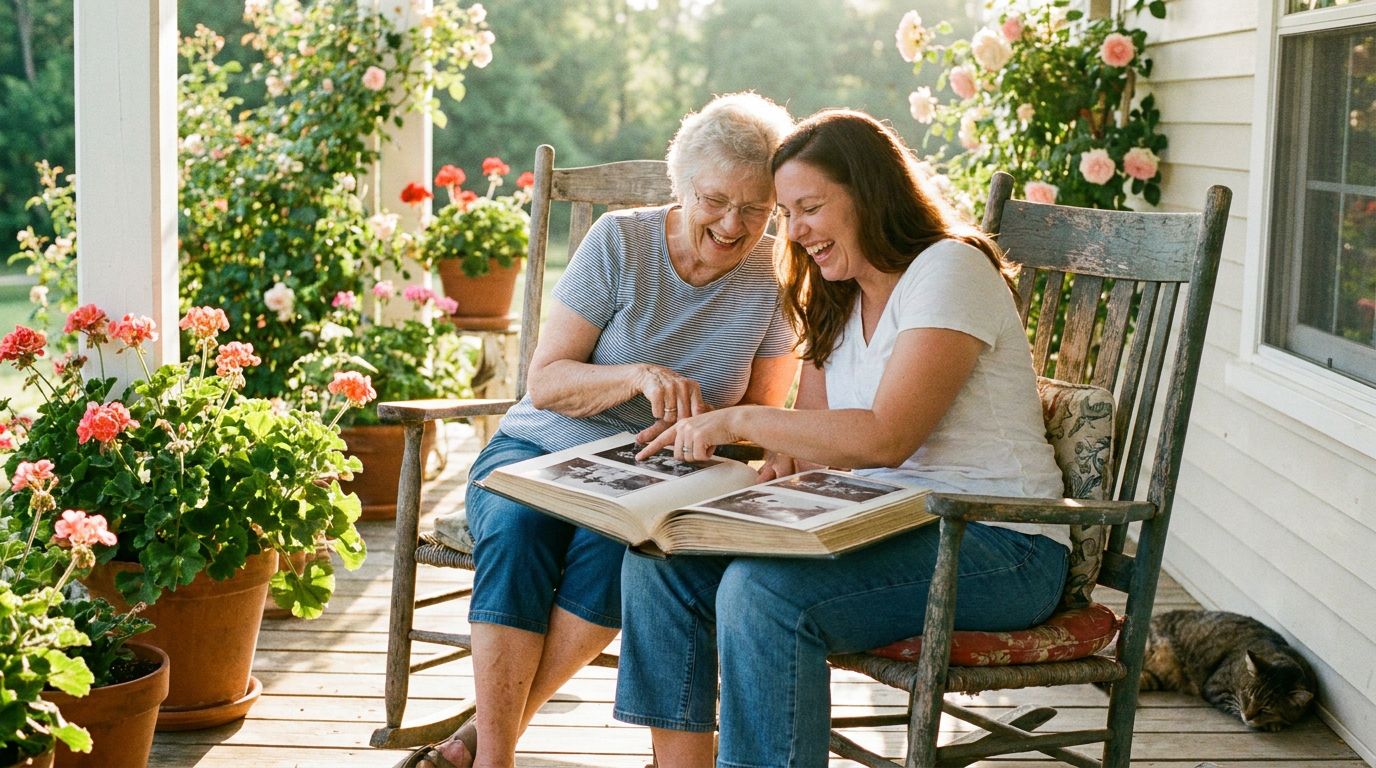
50 Questions to Ask Your Grandparents Before It’s Too Late
A grandmother mentions, in passing, that she used to drive a delivery van. And the person sitting opposite her — thirty-four years old, someone who has known her their entire life — has never once heard about a van.
It usually happens somewhere between the second cup of tea and the biscuit tin.
They ask one follow-up question. What did you deliver?Here is the honest thing, said once and then set down: most of us quietly assume there will be another Sunday. There usually is. But that assumption is why the van never came up for thirty-four years — not because time was short, but because nobody thought to ask. And that is a much more hopeful problem, because it has a very easy solution.
She says “bread, mostly.” Then somebody’s phone rings, and the moment closes, and that story is still unfinished years later.
So this is a list of 50 real questions to ask grandparents — questions you can actually say out loud, in a kitchen, without anybody feeling like they’re being interviewed. No clipboard. No solemn voice.
We’re going to start with the silly ones. There’s a reason for that.
After the list, we’ll get into the part most articles skip: how to actually have the conversation, how to ask permission properly before you record anything, and how to keep what they tell you somewhere it can be found again instead of buried in a phone.
National Grandparents Day falls on Sunday 13 September 2026, which makes a convenient excuse to pick up the phone. Treat it as a reason, not a deadline.
But first — why should a handful of ordinary questions change how you see someone you’ve known your whole life?
Why the Questions You Never Thought to Ask Matter Most
We know them as grandparents — which is to say we know them in the last act, in the good chair, in the version of themselves that has already been softened and edited and made safe for children. We rarely know them as the twenty-two-year-old who moved cities with one suitcase and no plan. We don’t know which of their siblings they found unbearable. We don’t know that they were, by their own account, genuinely terrible at their first job.
Because we don’t know our grandparents. We know them in one role.
Most family knowledge turns out to be exactly one generation deep. Ask yourself what you actually know about your great-grandmother — not her name, but what she was likeOrdinary detail outlasts official detail. This is the single most useful thing to understand before you start asking, because it changes what you ask for. The dates are recoverable — a certificate, a census record, a headstone will give you those. What isn’t recoverable is the texture: the smell of the hallway, the nickname, the argument about the dress.
What survives, when anything survives, is almost never the headline facts. Nobody remembers the year of the wedding. Everybody remembers that he proposed at a bus stop in the rain because he’d rehearsed it for the restaurant and lost his nerve. Nobody remembers what street the first flat was on. Everybody remembers that she hated the dress in the wedding photograph and said so, loudly, for six decades.
, what she found funny, what she was afraid of — and for most of us the answer arrives embarrassingly fast. Nothing. We know nothing. And the gap didn’t open because of some dramatic loss. It opened because one generation didn’t ask the next, and then it was simply gone from the record, the way a conversation is gone when the room empties.
What the Research Gently Suggests About Family Stories
There’s a well-known piece of work here worth one careful mention. Researchers at Emory University developed something called the “Do You Know?” scale — a short set of questions measuring how much children know about their family’s history, things like where their parents grew up or how their grandparents met. In Hold that loosely. The samples studied skewed heavily towards middle-class, two-parent households, and an observed association is not proof that learning family stories causes any particular outcome. It’s a correlation, noticed by careful people, and it’s suggestive rather than conclusive.
Emory University’s reporting on family narrative research
, children who scored higher on that scale tended to also report a stronger sense of where they came from and of belonging to something larger than themselves.
That’s the whole research section. One nod, hedged, and back to the human part — which is where the interesting material lives anyway. Emory has also written more warmly about , which is closer to the spirit of this exercise: not a study, just people around a table, telling each other where they came from.
sharing family stories around holidays and get-togethers
This Is a Real Discipline, Not a Sentimental Hobby
If asking your grandmother about her first job feels a little self-indulgent, it’s worth knowing that entire national institutions exist to do precisely this, at scale, with archivists and release forms and climate-controlled storage.
The has spent decades collecting first-hand accounts from American war veterans, on the explicit reasoning that these accounts cannot be reconstructed from any other source. You can look up what happened in 1962 in about nine seconds. You cannot look up what your grandfather thought about it while it was happening, or who he was sitting next to, or whether he was frightened. That information exists in exactly one location, and it is not the internet.
Library of Congress Veterans History Project
Oral history is a recognised discipline with its own methodology because first-hand testimony is genuinely irreplaceable — not sentimentally irreplaceable, practicallySo let’s reframe the title, because it did its job and now it can relax.
irreplaceable. Historians know this. Archivists know this. It just doesn’t tend to occur to us that the same logic applies to the woman making us a sandwich.
The best time to ask is while the asking is easy and the tea is hot.
“Before it’s too late” isn’t a countdown, and this article is not going to spend another word on that. It’s just an honest reminder that this conversation is available right now, for free, from someone who already likes you. That’s it. That’s the entire argument.
And these are, in the end, the stories that hold a family together — the ones cousins repeat at weddings, the ones that explain why your family does that odd thing at Christmas that no other family does. If you’d like somewhere for several relatives to add their own versions of the same story, Before you ask anything at all, though, there’s one conversation to have first. It’s short.
a shared family journal
is built for exactly that.
Before You Ask: Consent, Comfort and the Right to Say No
You don’t need elegant phrasing. You need something like this:
Never start a recording — audio, video, or even tapping notes into a phone under the table — without saying plainly what you’re doing and why. Not because of any rule, but because being recorded without knowing it is a small betrayal, and this whole exercise is built on trust.
Ask first. Always.
“I’d love to record this so I can listen back later, and so the cousins can hear it too. Is that okay with you? I’ll turn it off the second you want me to.”
That’s the entire ask. Say it, then wait for a real answer rather than a polite one.
They can decline any question, without giving a reason. Say this out loud before you begin — not after they’ve already hesitated and had to invent a reason. A skipped question is a completely normal outcome, not a failure of the interview. Professional interviewers treat consent as step one for exactly this reason, and if you look at , the entire structure is built around a participant who knows what’s happening and has agreed to it. The Library of Congress sends people actual release forms. Institutions do the paperwork; you can manage a sentence.
StoryCorps’ guidance on what to expect from an interview
Some topics carry real weight. A sibling who died young. A war. A marriage that ended badly and was never discussed again. A country they left and cannot go back to. If you sense resistance — a shortened answer, a change of subject, a hand moving to a teacup — let it go. Move to something lighter, and do not circle back to it later in the same sitting hoping they’ve warmed up. They haven’t. They noticed you noticing.
Stopping is always available. “We can stop whenever you like” should be said at the beginning and meant throughout, and if they ask you afterwards to delete the recording, you delete the recording. No negotiation, no “let me just keep it for the family.” Delete it.
Ask who else gets to hear it. This one gets forgotten constantly. Someone may be perfectly happy talking to you and horrified at the idea of the recording being played at a family gathering, or sent to a relative they’ve fallen out with. Agree on that in advance, in plain terms: who is this for? It takes ten seconds and it prevents the one outcome that would genuinely make them regret talking to you.
Comfort is practical, too. Pick their chair, not yours. Pick their best time of day — for a lot of older people that’s mid-morning, not after dinner. Somewhere quiet. And if energy is limited, keep it short and leave while everyone’s still enjoying it. This is a visit, not a session.
The four non-negotiables, in one place:
- Ask before you record — every time, in plain words
- Any question can be skipped — no reason required, no follow-up
- Stopping is always allowed — including deleting it afterwards
- Agree who gets to hear it — before you start, not after
With that settled, the fun part. And the list begins exactly where it should.
Here’s the reframe that matters: permission isn’t a formality that slows the conversation down. Being asked properly is very often the thing that makes someone willing to talk in the first place. People open up when they can feel the exits. Take the exits away and they’ll give you the polished version — the same six anecdotes you’ve heard at every birthday for twenty years.
The 50 Questions to Ask Your Grandparents
A note on the running order before you dive in: this list starts light on purpose. The warm-up questions aren’t filler — they’re what make the later ones possible. Nobody in the history of conversation has successfully opened with “tell me about the hardest year of your life.” But ask about a bad haircut, get a laugh, and twenty minutes later you’ll find yourself somewhere you couldn’t have reached directly.
Also, plainly: you will not get through all 50 in one sitting, and you shouldn’t try. Pick five or six. The rest keep. Professional interviewers keep a list of great questions on hand for exactly this reason — exists so that interviewers have somewhere to go when the conversation stalls, not so they can march through every item. Use this the same way.
StoryCorps’ Great Questions
Fun Questions to Ask Your Grandparents (Questions 1–10)
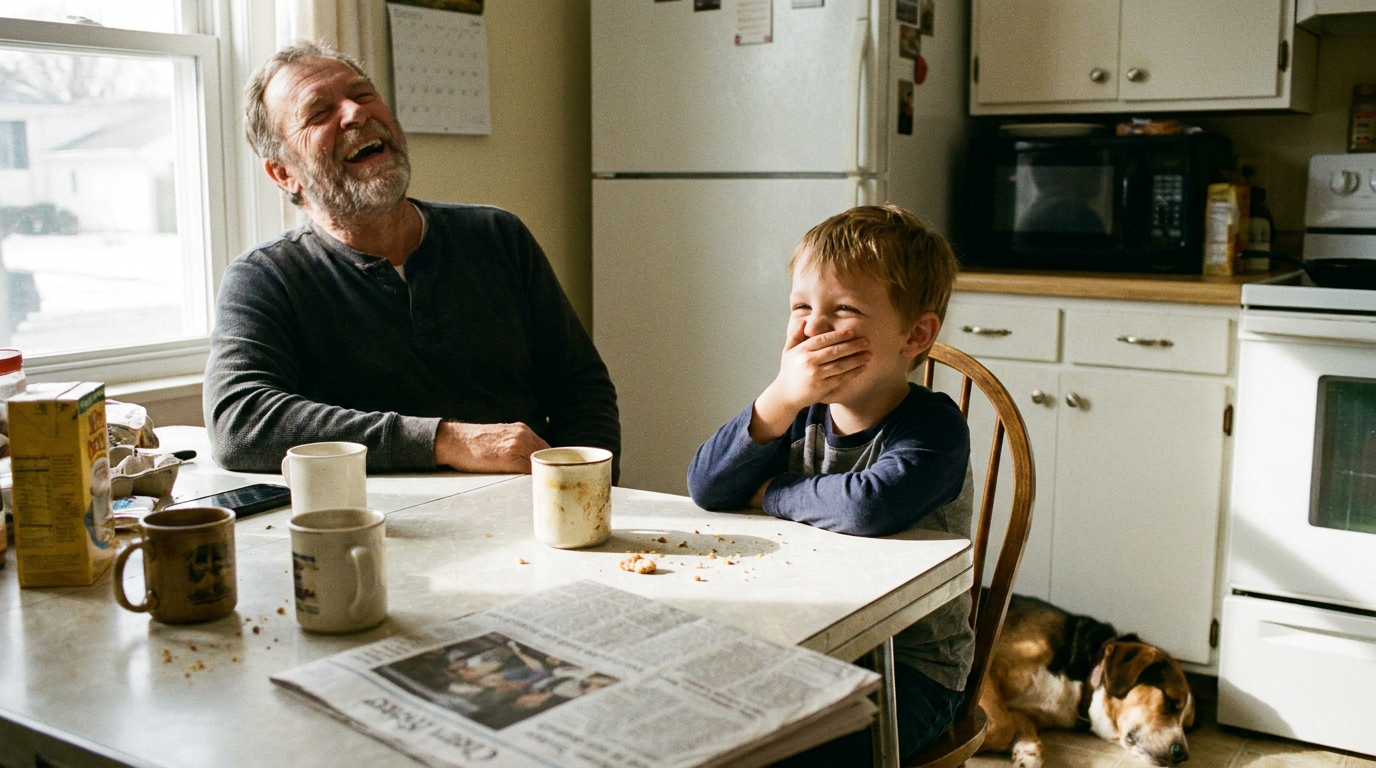
Start here. Always start here. These are the fun questions to ask grandparents that get a laugh in the first two minutes and change the temperature of everything that follows.
- What’s the worst haircut you ever had, and whose fault was it?
- What did you get in trouble for most often as a kid?
- What’s a food you loved back then that nobody seems to eat anymore?
- Did you have a nickname? Who gave it to you, and did you hate it?
- What’s the most ridiculous thing you ever spent money on?
- What song did you play so many times that everyone in the house begged you to stop?
- What’s something you did as a teenager that your parents never found out about?
- Who was the best dancer in your family, and who thought they were?
- What’s the worst outfit you ever wore in public and genuinely believed looked good?
- What was the biggest fad when you were young that you can’t believe you fell for?
Question seven does more work than the other nine combined. There is always an answer, it is always better than you expect, and the moment they realise they’re allowed to tell you is usually the moment the real conversation starts.
Childhood and Growing Up (Questions 11–18)
Now go concrete. Sensory detail unlocks memory far more reliably than big abstract questions do — ask someone about the smell of a hallway and you’ll often get twenty minutes you didn’t ask for.
- What did your childhood home smell like when you walked in the door?
- Who was your best friend, and what did the two of you actually do all day?
- What was your bedroom like — did you have it to yourself?
- What chore did you hate most, and did you ever get out of it?
- What was the walk to school like, and who did you walk with?
- Which teacher do you still remember, and what did they do to earn that?
- What did your mother or father say so often that you can still hear their voice saying it?
- What were you frightened of as a child that seems funny to you now?
Love, and How You Two Met (Questions 19–25)
A gentle note before this cluster: if a partner has died, these questions are very often welcomed rather than avoided. Many people are grateful for the chance to talk about someone whose name has quietly dropped out of family conversation. But follow their lead entirely — if the answer is short, let it be short, and move on without commentary.
- Where were you standing the first time you saw each other?
- What did you wear on your first date, and how long did it take to decide?
- What did your parents think of them at the beginning?
- What’s something they did that always made you laugh, even when you didn’t want to?
- When did you know, and did you tell anyone before you told them?
- What did the two of you argue about most, and who usually won?
- What’s the best thing about them that most people never noticed?
Work, Money and Everyday Life (Questions 26–32)
This cluster is underrated and it is where the surprises live. Oral historians ask about ordinary days, not just big events — you can see the same instinct in , which spend as much time on daily routine and living conditions as on major events. The texture of an ordinary decade is what actually vanishes.
the Library of Congress’s sample interview questions
- What was your very first job, and what did it pay?
- What did a completely normal Saturday look like for you at twenty-five?
- What was the first thing you bought that you were genuinely proud of?
- What did you want to be, before you became what you became?
- How did you get to work, and how long did it take?
- What did you and your friends do that cost nothing?
- Was there ever a stretch when money was tight, and how did you manage it?
Hard Times and How You Got Through Them (Questions 33–38)
Only ask these if the conversation has already gone somewhere real — and accept a “no” instantly, without a follow-up question. Notice that every one of these is pointed at what got them through, not at the difficulty itself. That’s deliberate. Keep it that way.
- Who helped you when things were hardest?
- What got you through that particular year?
- Was there a decision you made that changed everything afterwards?
- What do you know now that you wish somebody had told you then?
- Who did you turn to when you needed to talk to someone?
- What’s something you’re glad you didn’t do?
Family History and Where We Come From (Questions 39–45)
This is the cluster to write down carefully, because these are the family history questions that turn into actual research trails later. Names, places, dates, and the stories nobody can verify.
- Where did our family come from, as far back as you know?
- Who am I named after, and what were they like?
- What’s the oldest photograph you have, and who’s in it?
- Is there a family story you’ve never been sure is actually true?
- What happened to the people who stayed behind?
- What did your grandparents do, and did you ever meet them?
- Is there anything in this family that gets passed down — an object, a name, a habit?
Once you have names and places, becomes genuinely straightforward — the National Archives publishes a free guide to starting genealogy research, and a single accurate town name from a grandparent will save you months of guessing.
tracing the names and places they mention
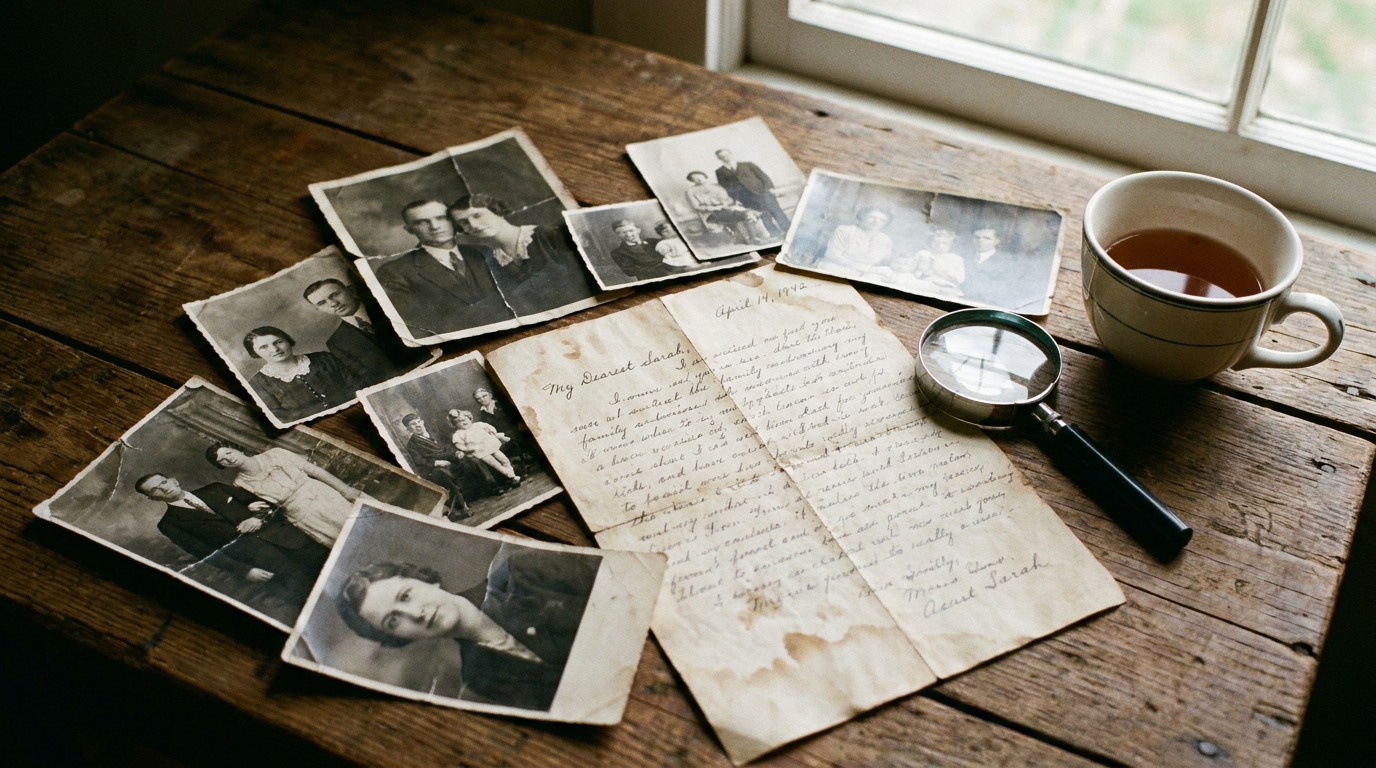
A note on what question 41 tends to do. People ask about the oldest photograph expecting a name and a date. What comes back is frequently fifteen minutes about someone nobody in the family has ever mentioned — a woman who ran the household with an iron grip and once threw a saucepan at a landlord, say, sitting in a drawer for sixty years, one question away.And if their answers start turning into something longer — if one afternoon becomes four, if they start bringing things out of cupboards — there’s a natural next step in shaping all of it into something readable.
Advice, Belief and What You’d Pass On (Questions 46–50)
End warm. These aren’t farewell questions and shouldn’t be delivered like they are — they’re just the questions you can finally ask once someone has spent an hour remembering who they were.
- What are you proudest of?
- What advice would you give me, at exactly the age I am now?
- What do you hope I remember about you?
- What’s something you changed your mind about as you got older?
- Is there anything you’ve always wanted to tell me and never have?
Fifty questions. But a good list is only half of it — what you do with their answer matters considerably more than which question you asked.
How to Actually Have the Conversation
The list is a starting point. The material is in the follow-ups.
This is the thing nobody tells you: the prepared question opens the door, and then everything worth having comes from the four or five unscripted seconds after they finish answering. What happened next? How did that feel? Who else was there? Wait — go back, who was Ronnie?
The single easiest technique, and it feels absurd until you try it, is to repeat their last few words back as a question. They say “and after that we didn’t speak for two years.” You say “you didn’t speak for two years?” And they tell you why. You’ve contributed four words and received the entire story. Interviewers are trained to listen more than they speak, which is very clearly the operating principle behind — the interviewer’s job is to be interested, not interesting.
StoryCorps’ guidance for interview participants
Learn to Sit in the Silence
A pause of five seconds usually means they’re retrieving something. It almost never means they’ve finished. Do not fill it.
This is the most actionable advice in this entire article and it is the hardest to follow, because silence in conversation feels like a failure you’re personally responsible for. Resist it. Count to five in your head if you have to. The thing they say after the pause is consistently better than the thing they said before it — memory takes a moment to load, especially for something that hasn’t been accessed in forty years.
Many Short Chats Beat One Long Afternoon
So stop early. You have explicit permission. Leaving while it’s still enjoyable is how you get invited back.
There’s a second benefit that people rarely anticipate: between visits, they think about it. You’ll arrive the following week and be told “I remembered something after you left,” which is frequently the best thing you’ll get all month. A single long session doesn’t give memory time to do that work.
Twenty minutes over a cup of tea, repeated across several weeks, will produce better material than one heroic two-hour sitting. Every time. Energy fades, attention drifts, and hour two is almost always worse than hour one — for both of you.
Put an Object in Their Hands
Props unlock memory better than questions do. It’s not close.
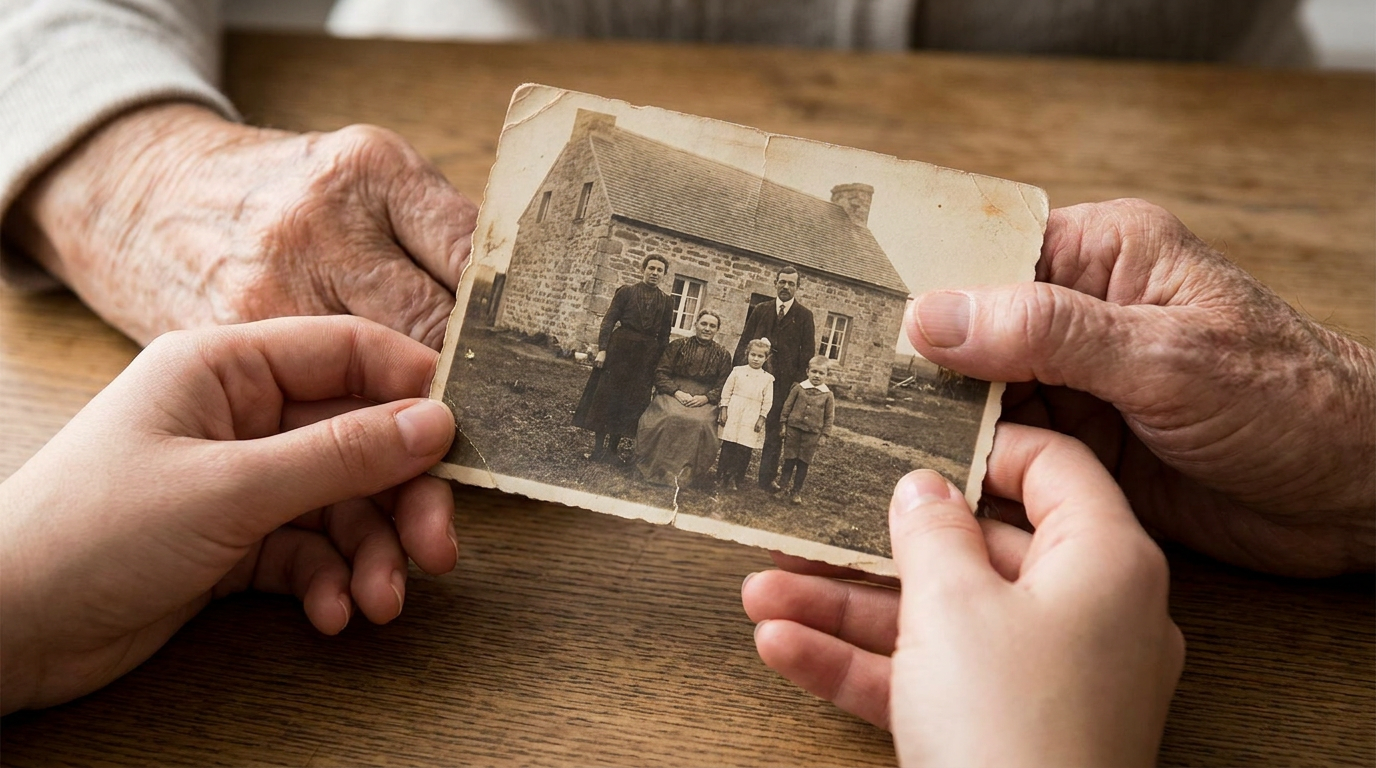
An old photograph, a recipe card in handwriting they recognise, a piece of jewellery, a map of the street they grew up on, a tin, a tool, a school report. Physical objects bypass the part of the brain that’s trying to produce a sensible answer for you and go straight to recall. Hand someone a photograph and they don’t tell you about the photograph — they tell you who took it, and what happened immediately afterwards, and why the man on the left isn’t smiling.
If you’re visiting and can only bring one thing, bring a photograph with more than three people in it. Group photos are the most efficient memory device ever invented.
Don’t Correct Them
You are collecting their account, not fact-checking a record, and the moment you correct someone they become careful — and careful people give you nothing. The version of events they carry around is itself a piece of information, and often a more interesting one than what actually happened. Public records can fill in the names and dates later, quietly, without anybody being contradicted in their own kitchen.
If a date is wrong, let it be wrong. If two separate stories have quietly merged into one over the decades, let them stay merged.
Ask About the People, Not Just the Events
Events tend to come out pre-packaged, because they’ve been told before and worn smooth. People don’t. Ask “who else lived on that street?” and you’ll get material that has genuinely never been said out loud in your family, because nobody’s ever asked a question shaped like that.
Ask about the neighbours. The colleague who was always late. The sibling nobody mentions. The woman two doors down who everybody was slightly afraid of.
And if they’d rather not be recorded at all — some people simply won’t, and that’s entirely their right — then write down three things afterwards while it’s fresh. Not a transcript. Three things. Notes are a completely valid outcome and infinitely better than the nothing you’d otherwise have. If you want prompts for your own journal while you’re at it, our Now, from how to ask to how to capture it — starting, as always, from the permission you already agreed.
25 journal prompts for kids
work in both directions — the same habit, pointed at your own week.
How to Record It Without Making It Awkward
Reconfirm consent before you press record. Every single time — not just the first time, not just the first visit.
It’s one sentence: “Still okay to record today?” Permission given in March is not permission given in June, and asking again takes two seconds and signals that you meant it the first time.
Right. The technical part, which is mercifully small.
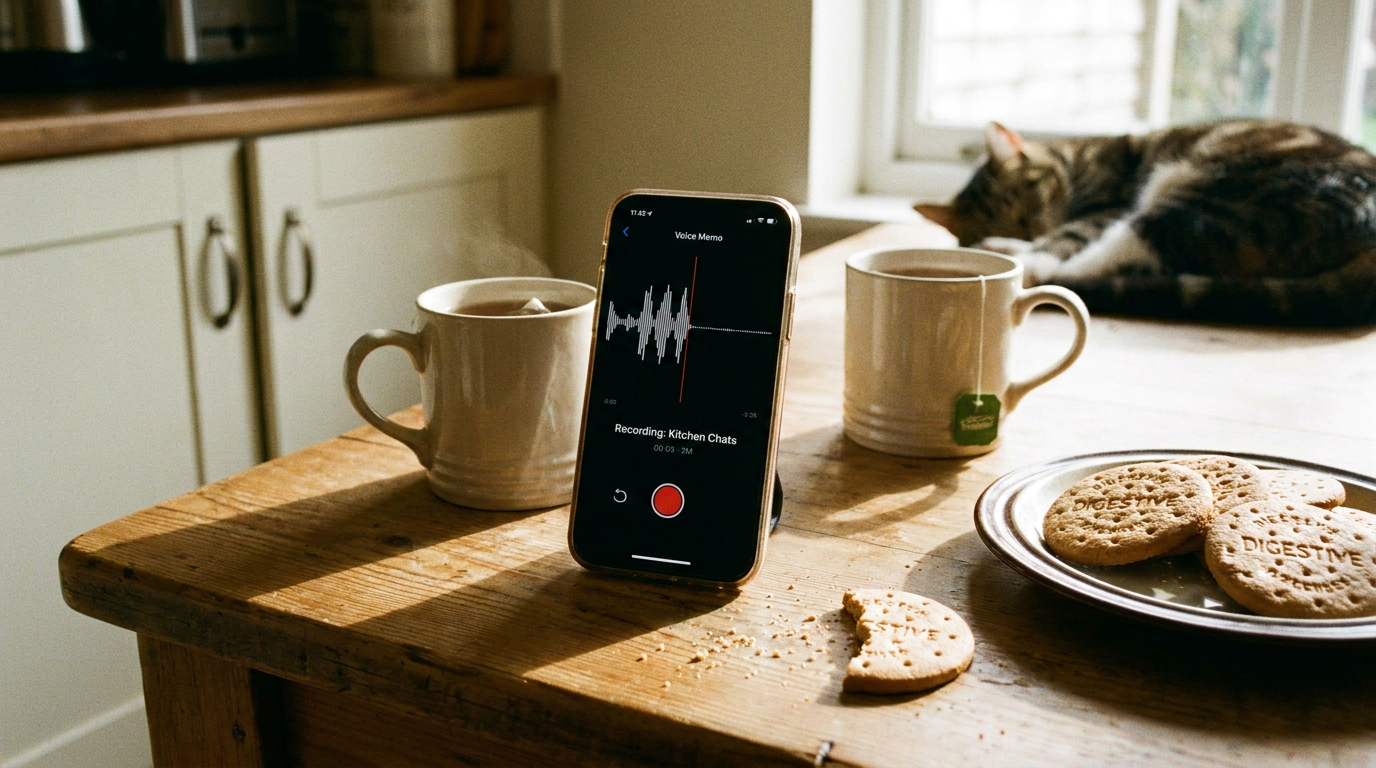
The phone in your pocket is enough. Open the voice memo app, press record, put it face-down on the table, and then forget about it entirely. That’s the whole setup. Elaborate equipment — microphones on stands, tripods, anything with a windsock — makes everybody self-conscious and produces worse conversation in better audio quality, which is the wrong trade.
Audio usually beats video.Quick setup checklist:
People relax dramatically more without a lens pointed at them, and a voice carries far more of a person than most people expect. The hesitations, the laugh, the way they say your name — all of that is in the audio. Video mostly adds the sight of someone being visibly aware they’re on camera.
- Quiet room — no TV, no radio, and check the dishwasher isn’t about to start
- Take the phone off the table surface if it’s a hard table that rattles, or put it on a cloth
- Sit at an angle to each other rather than directly face-on — it’s less like an interview
- Say the date and who’s speaking at the start, out loud, on the recording
- Keep it to 20–30 minutes; battery, energy and attention all run out at roughly the same point
Label it immediately. An untitled audio file is a lost audio file. Rename it the moment you finish — who, when, and roughly what — because Voice 047 is functionally invisible and you will never find it again. The two minutes you spend renaming a file is the entire difference between something you’ll actually return to and something that dissolves into a camera roll of two thousand untouched photos.
If you want to go deeper, there’s free field guidance from established oral-history programmes: is a genuinely practical, government-issued guide to recording an interview properly, and it costs nothing. And when you’re ready to check the names and dates you didn’t correct in the moment, through the National Archives’ resources for family historians.
public records can fill in the names and dates laterthe Library of Congress Veterans History Project Field Kit
Which raises the question you’re probably already holding: you’ve now got an hour of audio, a shoebox of photographs and three pages of notes. Where does all of that actually go?
Where Their Answers Live Afterwards
Play a recording back three years later and something happens that you cannot prepare for.
It isn’t the information. You already know the story by then — you’ve told it at two family dinners. It’s the soundThen the practical problem arrives, and it’s always the same problem. The recording is on your phone. The photographs are on your sister’s. Your cousin has the only surviving picture of the house on the corner, on a hard drive, in a box. The story your grandmother told you exists in four places and belongs to nobody, and every one of those places is a device that will eventually be replaced.
. The specific shape of their laugh. The two-second pause before they answer the question about their mother. The particular way they say your name, which you had never once thought of as distinctive until it was coming out of a speaker. A transcript cannot do that. A photograph cannot do that. Only their voice can, and it turns out that voices are the thing we forget first and miss most.
This is the gap was built for. A single Moment can hold the text of what they said, the photographs they were holding while they said it, video, and the audio of their actual voice — all in one entry. The recording sits beside the picture it belongs to, rather than drifting off alone into a folder with a number for a name.
Lugelo
Shared journals are the part that matters for a family. Siblings, cousins and grandchildren can all contribute to one family record, each adding the piece they happened to be there for — your brother’s version of the same afternoon, your aunt’s photographs, the detail your cousin remembers that you completely missed. Role-based permissions mean you decide who can view and who can add. You can see how invitations and access work on the .
collaborative journal page
Memory Lane arranges it all into a timeline, so a life reads in order — the childhood house, the wedding, the move, the grandchildren — instead of as a pile of undated files. That ordering is quietly the whole trick. Twelve recordings in a folder is homework; twelve moments along a timeline is a story.
From there it can become something you hand around. Templates to start faster when the blank page is intimidating, the to help shape rough notes into readable entries, and outputs like a storybook, a scrapbook, an eBook or a VR gallery — so at the next family gathering there’s an actual object on the table rather than five people passing a phone. covers the range.
Lugelo’s features pageAI Journal Assistant
On privacy, plainly, because this is somebody else’s personal history and you made them a promise about who would hear it: journals are private by default, with owner-controlled access. You decide who can view or contribute, and access can be revoked at any time. Data is encrypted in transit, personal data is not sold to third parties, and account and data deletion is available with a 30-day recovery window. That’s the whole picture — the agreement you made in their kitchen about who gets to listen is one you can actually keep. The plain-English detail lives on the .
FAQ page
The point of all of it is unglamorous: everything in one place, easy to revisit, somewhere it can be found again. If you’re setting one up from scratch, start small — one Moment, one recording, one photograph. Other families have written about how theirs came together over on Which brings us down from the whole system to the smallest possible first step.
family journal stories
.
Start With Three Questions This Sunday
Fifty questions is a library, not a to-do list. Choose three.
If you’d like the shortcut, here’s the opening trio worth recommending, all lifted from the fun cluster:
- What’s the worst haircut you ever had?
- Did you have a nickname, and who gave it to you?
- What did you get in trouble for most as a kid?
Bring one object if you can — a photograph, a recipe card, a map of the old street — and let it do half the work for you.
If they’re far away, the phone is completely fine. Ask permission to record the call in exactly the same way you would in person.
National Grandparents Day is Sunday 13 September 2026, which is a ready-made excuse to call or visit — an occasion, not a deadline. If Sunday doesn’t work, any Tuesday will do just as well.
A laugh in the first two minutes genuinely changes everything that follows. Once somebody has laughed, they’ve stopped performing, and once they’ve stopped performing you can ask them almost anything.
Afterwards, while the kettle’s still warm, write down the three things you don’t want to lose. Not a transcript. Three things. That’s the entire practice, and you can in about ninety seconds.
pick your three from the list above
The Real Reason to Ask
Ask about the haircut. See where it goes.
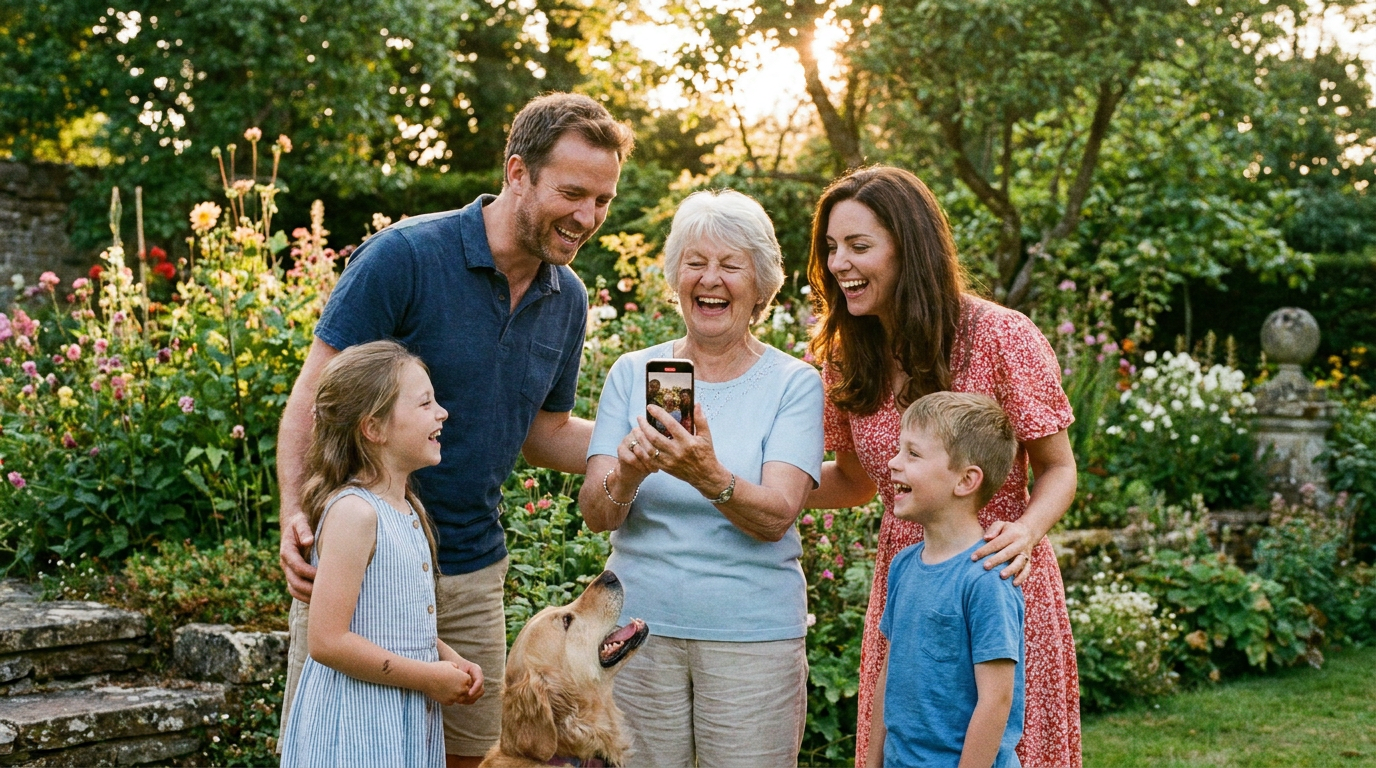
So the reason to do this isn’t that time is running out. It’s that there’s someone remarkable sitting in the good chair whom you’ve only ever met in one role, and they have almost certainly been waiting for someone to ask. Two things make it work, and they’re both simple: ask permission, and keep what they tell you somewhere it can be found again.
That’s what one question opens. Not a revelation, not a family secret — just a whole person who has been standing in the kitchen the entire time, filed under “grandmother,” waiting for somebody to ask a question that didn’t have an obvious answer.
Forty minutes, from a woman somebody had known for thirty-four years and never seen like that before.
Because here is how that story tends to end, when somebody finally asks. It was a bakery. It was 1961. She was nineteen, and she was the only woman driving for them. She got the job because her brother taught her to drive in a field and then told the depot she’d been driving for years. She loved it — the early starts, the empty roads, the man on the corner who bought the same loaf every morning for eleven years and never once said good morning.
Go back about the van.
Don’t Just Live It — Keep It
Start a shared family journal, invite the people who were there, and keep their answers, their photographs and their voice in one place — where the whole family can add the pieces only they remember.
Start Saving What Actually Matters →
Available on . Journals are private by default, and you decide who can view or contribute.
web, iOS, Android and HarmonyOS