Baby Memory Books: What To Actually Record In The First Year
This is not a product roundup. It is not a reason to abandon the book you already own.
So this is a concrete list of what is genuinely worth recording in a baby’s first year memory book — most of which no printed book has a page for.
The problem is structural. Most baby memory books are built around a fixed list of milestones, and those milestones either happen when nobody is holding a pen, or do not happen on the printed schedule at all.
This is normal. It is extremely common. It is not a failure of effort, and it is certainly not a failure of love.
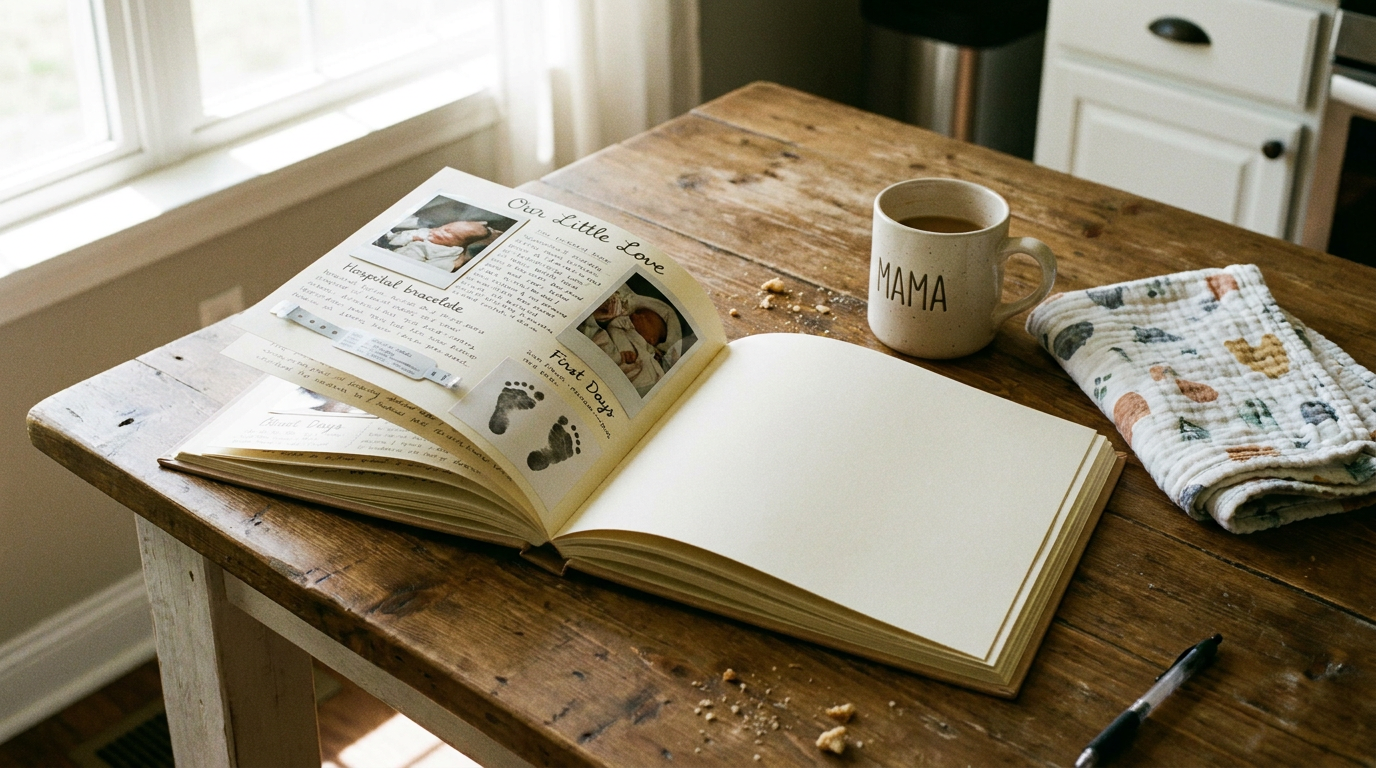
It is in a drawer now. The “first tooth” page is blank, because the tooth arrived during a week when nobody in the house was sleeping.
Someone gave you a beautiful baby memory book at the shower. The cover is lovely. The paper is thick. You filled it in properly for about six weeks.
And before anything else, here is the standard worth adopting: one line and one photo is a complete entry.
If you are still deciding whether to buy one of these books at all, start here.
What Is a Baby Memory Book, and What Is Inside One?
A baby memory book is a keepsake book for recording a child’s early life. It holds photos, dates, handwritten notes and small mementoes. Most cover the first year, though some carry on for longer.
That is the whole definition. There is nothing more technical to it.
Contents vary by publisher, but the standard set is fairly consistent. Most books include some combination of the following:
- Milestone pages. Printed slots for first smile, first tooth, first word, first steps.
- Growth and measurement charts. Space to log length and weight at intervals.
- First-year photo slots. Usually one per month, sometimes a few extra.
- A family tree page. Space for the people around the child, however that family is arranged.
- Letters to the child. One or two pages for writing directly to them, to be read much later.
- Hand and footprint space. A page designed to take ink or paint.
- Pockets or envelopes. For hospital bracelets, cards, tags and other flat keepsakes.
That last item is worth pausing on. A memory book is, functionally, a small family archive, and the same These books are, for the most part, well made and genuinely lovely objects. Most of them still end up unfinished. That is worth understanding before you buy one.
guidance on preserving family archives
That single difference will determine whether you finish the book. It matters far more than the cover design. There is a section further down on how to weigh it.
One more distinction matters more than any of this, and it is the one most people overlook. Some books are guided and prompt-heavy. Others are mostly blank space.
Shoppers will meet two main formats. The first covers the first year only. The second is a baby memory book first 5 years format, which carries on through toddlerhood and into the early school years.
There is a naming problem worth clearing up now. “Baby book,” “baby’s first year memory book” and “baby journal” are mostly the same product under different names. No industry standard exists. Judge what is inside, not what is printed on the spine.
that applies to letters and documents applies to what you tuck into those pockets.
Why Do So Many Baby Memory Books End Up Half-Finished?
The books are not badly made. They are badly matched to the year they are meant to document.
Three design decisions cause most of the trouble:
- Fixed prompts. The book asks for things that may not apply to your child, in an order that may not match your year.
- Fixed timing. Milestones are printed on a schedule. Real babies have not read the schedule.
- An assumed standard of neatness. Many books quietly imply careful handwriting, good light and a free afternoon. The first year supplies none of those reliably.
Then there is the practical trap. The milestone almost always happens when nobody is holding a pen.
By the time there is a pen, the date is a guess. The guess feels inadequate. The page stays blank, the blank page starts to feel like a small failure, and eventually the book gets avoided entirely.
So change the standard instead of the book.
One line and one photo is a complete entry. A date and five words beats a beautiful page you never wrote.
Approximate dates are fine. “Sometime in the spring” is a real record. Precision was never the point of a keepsake.
It is also worth saying plainly that babies do these things on wildly different schedules. A memory book is a keepsake, not a chart to be measured against. A late entry is not a data point about your child.
If anything about your child’s development is on your mind, that is a conversation for your paediatrician or health visitor, not a page in a book.
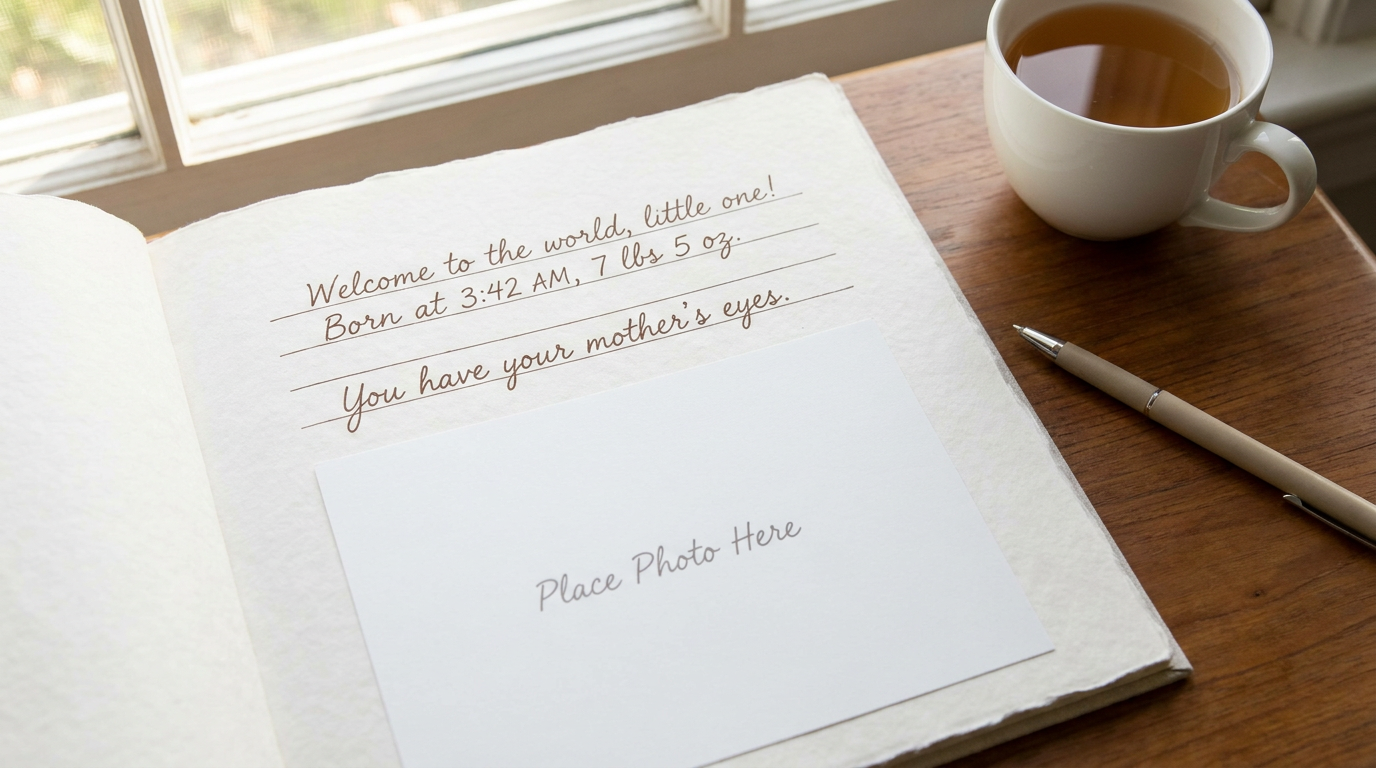
If the printed prompts are the weak point, then the useful question is not which book to buy. It is what is actually worth writing down.
A record kept during a time like that is still worth keeping. There is no requirement that a memory book only hold good days.
Not every first year is straightforward. Some babies spend time in NICU. Some first years include serious illness, and some include loss.
What To Actually Record In Your Baby’s First Year
Most of what you will want back later is not on any printed page.
The standard milestones worth keeping
Start with the obvious ones, because they are genuinely worth having:
- First smile. The real one, not the one everyone argued about.
- First tooth. Approximate date is fine.
- First word. And what they actually meant by it.
- First steps. Including where, and who saw it.
- First foods. And the face they made.
- First haircut. Keep a bit of the hair if you can.
- First night in their own room. For you as much as for them.
- First time they recognised someone across a room. This one is underrated and disappears from memory fast.
Record these if and when they happen, in whatever order they happen. Leave blanks without apology.
One practical tip transforms these entries. Write the approximate date and the circumstance“First proper laugh — at the dog drinking” is worth far more in twenty years than a date sitting alone on a line.
, not just the date.
Sound recordings and photographs both need deliberate care if they are going to survive, which is the core message of the Library of Congress — and it applies just as much to the noises your baby is making right now.
personal digital archiving guidance
The ordinary things no printed book has a page for
This is the part people wish they had. None of it appears in a printed book, and all of it is gone within a couple of years.
- What the house sounded like at three in the morning. The specific noises — a radiator, a road, a particular creak. It is the fastest route back into a memory.
- What you ate, one-handed, standing up. Unglamorous, and instantly recognisable to your future self.
- The song that worked when nothing else did. Every household has one. Nobody remembers it five years later.
- The nickname that stuck, and where it came from. The origin story always vanishes before the nickname does.
- Who visited, and what they brought. A record of who showed up is a record of your family at that moment.
- What you were worried about that month. Note it — and later, whether it turned out to matter. This is the most reassuring thing you can leave for yourself.
- The walk you did every day, and the exact route. Street names included. That loop was most of your year.
- What made them laugh first. Usually something absurd and specific.
- What the light looked like in the room where you fed them most. You spent hundreds of hours in that light.
- The thing you got wrong and figured out. Useful later, for you or for them.
- What you were reading, watching or listening to in the small hours. It timestamps the year better than any milestone.
- Who else was holding them most that month. This changes constantly and is never written down.
The things that disappear fastest
These are the ones people most often say they wish they had kept:
- Pre-speech babble. The specific noises, which vanish completely and very quickly.
- The particular weight of them asleep on you. Describable, just about, if you try.
- The exact shade of newborn hair before it changed. Photographs rarely get this right.
- The way they smelled after a bath. No format holds this one. Words are the only option.
- Their handhold, and how small it actually was. Trace it on paper if you can.
Some of these can be written down. Some genuinely cannot be captured in words at all. Hold that thought — it comes back later.
Twelve monthly questions, one for each month
Each of these is answerable in two sentences by an exhausted person. That is the design brief. This kind of question-led record keeping scales well past infancy, too, as the same approach behind shows.
creating a school memory book
- What surprised you most this month?
- What did a normal day look like, start to finish?
- What sound are they making constantly right now?
- What has changed in the house since they arrived?
- What are they doing with their hands?
- What makes them laugh this month?
- What is the hardest part of this month, honestly?
- Who have they started to recognise?
- What do they do that nobody else would find interesting?
- What have you stopped worrying about since month one?
- What do they love that you did not expect?
- What do you want them to know about this year?
If you miss a month, answer the question late. A late answer is still the answer.
What the people around the baby would say
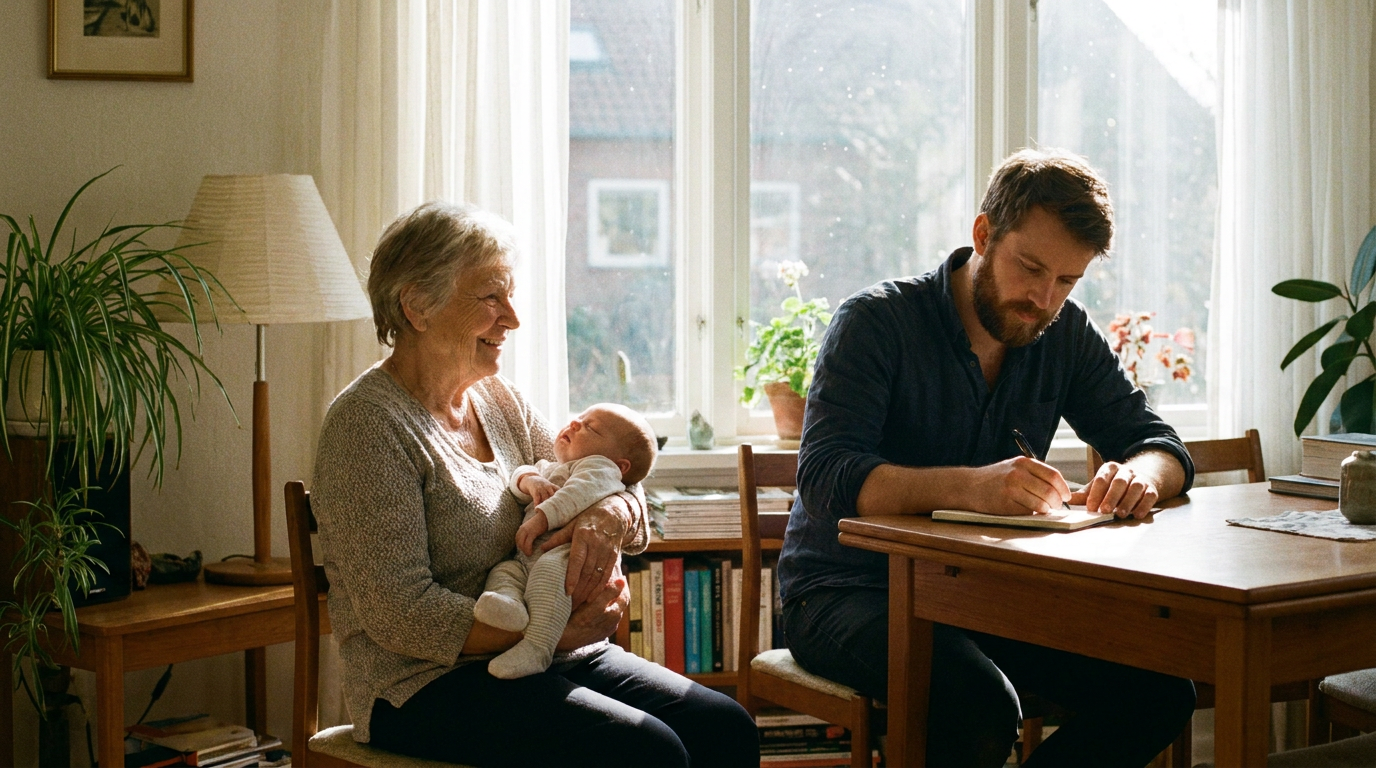
The same month looks completely different to a grandparent, a sibling, a partner, a co-parent or a close friend. Your version is one of several, and it is the only one that usually gets written down.
Ask one person for two or three sentences in their own words. Then keep their wording exactly as given. Do not tidy it.
Three asks that work well:
- “What do you notice about them that I might not?”
- “What were you thinking the first time you held them?”
- “What do you want them to know about this year?”
That covers what to record. The remaining question is what to put it in.
A sibling’s version, recorded exactly as a small child says it, tends to age better than anything an adult writes. Resist the urge to correct the grammar.
How To Choose the Best Baby Memory Book
There are no recommendations here. The best baby memory book depends entirely on how you will actually use it, so what follows is decision criteria instead.
- Writing space versus photo space. Some books are mostly photo slots with a caption line. Others are mostly blank writing space. Choose based on which you will realistically fill — be honest rather than aspirational.
- Fixed prompts versus open pages. Prompts help when you are too tired to think. Open pages help when your year does not match the printed assumptions. Many people want both, so look for a book that mixes them.
- One year or five. A baby memory book first 5 years format keeps everything in one object and stays useful long past the first birthday. A one-year book is fuller, faster to finish, and less likely to be abandoned in year three.
- Lay-flat binding. A book that will not stay open is a book you will not write in. This sounds minor. It is not.
- Page thickness. Thin pages buckle under glue, tape and thick pens. Check it can take the mementoes you actually plan to add.
- Assumed family shape. Read the prompts before buying. Some assume two parents, a particular naming of those parents, a pregnancy, a hospital birth, or a biological connection. If those do not describe your family, choose a book with more open pages — or cross a prompt out and write your own. Crossing things out is allowed.
- Prompts that assume things that may not be true. Some books assume every milestone happened, and happened on time. Open-format books age better here.
- Storage and durability. A keepsake gets stored for decades. Cool, dry and stable — not the attic, not the basement.
That last point deserves expanding, because it is where most keepsakes are actually lost. The Library of Congress guidance on the is the clearest reference available, and readers outside the US will find an equivalent in the UK National Archives’ , which is blunt about damp and heat.
leaflet on caring for your photographscare, handling and storage of photographs
One specific warning from both: avoid self-adhesive “magnetic” album pages. They damage photographs over time.
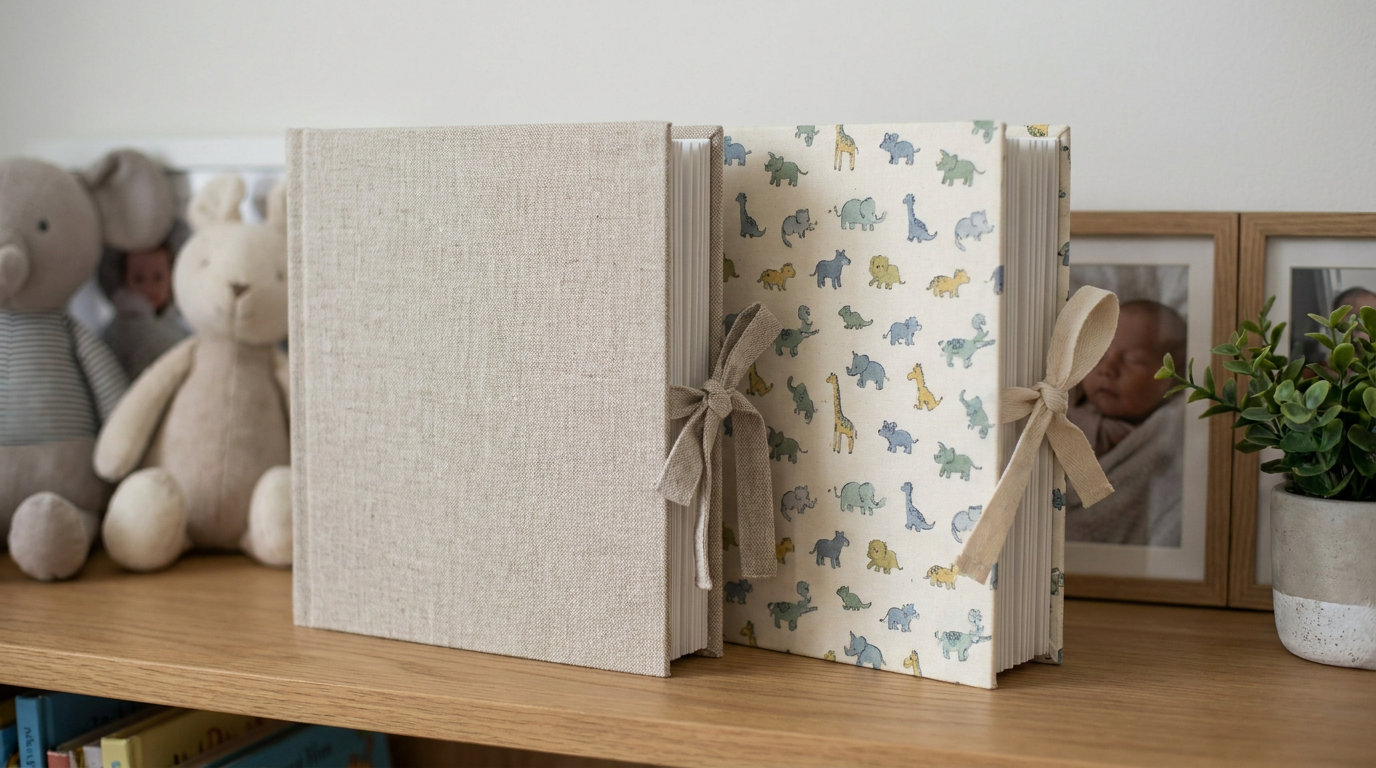
Gendered covers, and whether they matter
Treat it as a design choice with no bearing on the contents. Plenty of people prefer a neutral cover — particularly if the book might be shared between siblings later, or handed on.
A baby memory book for girl and a baby memory book for boy almost always differ in exactly one respect: cover art and colour palette. The interior prompts are usually identical.
Is a personalised book worth it?
Ordering takes time, too. That matters if you are buying close to a due date or an arrival.
It is worth it as a gift, or when you want the object to feel specifically theirs. It is less worth it if there is any chance the book gets handed on or reused, because personalisation cannot be changed later and a printed name makes that awkward.
A personalized baby memory book usually means a printed name, a birth date, and sometimes a cover photo or a chosen colourway. That is generally the whole offer.
One-year books versus five-year books, side by side
A one-year book gives you:
- Space per month: generous — often several pages.
- Likelihood of finishing: high. The end is visible from the start.
- Usefulness after the first birthday: none. It is complete and closed.
- With a second child: buy a second book. Each child gets their own object.
A five-year book gives you:
- Space per month: limited — often a few lines after year one.
- Likelihood of finishing: lower. Year three is where most are abandoned.
- Usefulness after the first birthday: high. It keeps going.
- With a second child: workable in one object, though comparison between children becomes visible on the page.
Once the book is chosen, there is one limit worth understanding. It is not a flaw — just a fact about paper.
Neither is better. They are built for different habits.
What Paper Holds Better, and What It Cannot Hold
Paper does several things that nothing else does, and they are not small things.
- It is a physical object a child can hold. Nothing digital replaces the experience of a child turning pages about themselves.
- It survives without accounts, passwords, batteries, subscriptions, or a company continuing to exist. A book on a shelf has no dependencies.
- It can be handed over intact. One object, in one piece, to a grown child or a grandchild.
- Handwriting carries something typing does not. The shape of the letters is itself part of the record. A shaky line written at 4am says something the words do not.
- It has an edge. A book ends. That makes it finishable in a way a phone library never is.
That is a genuinely strong list. Now the limit, stated as fact rather than complaint.
A printed page cannot hold a sound, a moving image, or several thousand photographs. That is not a shortcoming. It is simply what paper is.
In practice, that means the following sit outside the book entirely:
- The sound of a first word, and the babble that came before it.
- Video of a first step, a first crawl, a first attempt at a stair.
- A voice note of a grandparent talking to a newborn — which becomes irreplaceable and is almost never deliberately recorded.
- Sheer volume. A first year generates thousands of photos and dozens of videos. A book has perhaps forty slots.
Most of that material currently sits scattered across two or more phones, unlabelled. Within a couple of years it is effectively unfindable, even though none of it has technically been lost.
Keeping photos, audio and video together as one record is a habit rather than a technology, and it works the same way in other contexts — the approach behind is the same idea applied to a different kind of year.
making a travel journal
Digital files need deliberate care to survive. The That points toward a practical conclusion — though probably not the one you are bracing for.
personal digital records
guidance is short and worth following: keep more than one copy, keep the copies in different places, and check once a year that they still open.
The Honest Answer: Keep the Book, and Keep a Digital Half
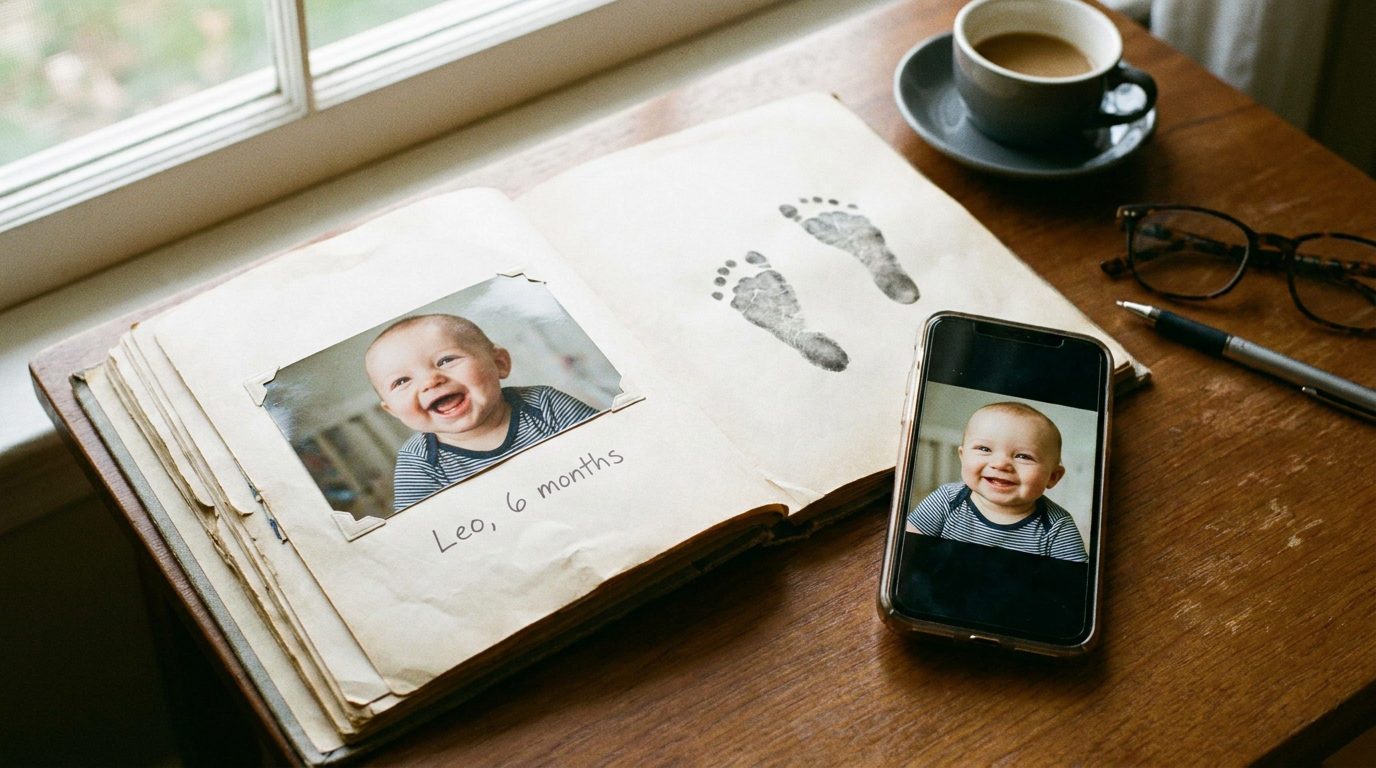
Keep the paper book for the milestones, the handwriting and the mementoes. Keep a digital record for the audio, the video and the volume of photos a book physically cannot hold.
If you only ever do the paper book, that is a complete and good outcome. Nobody needs two systems. This post is not a to-do list.
The division of labour is simple:
- Paper: milestones, handwriting, letters to your child, flat mementoes, and the object itself.
- Digital: voice notes, video, the monthly photo overflow, and the things other people contribute.
That last item is where the digital half genuinely earns its place. A first year is witnessed by more than one person.
A grandparent’s two sentences. A partner’s version of the same month. A sibling’s description. These are easy to collect digitally and very hard to collect on a page that lives in one house — and the Baby content deserves a plain answer on privacy rather than security theatre. Entries are private by default. Sharing is owner-controlled, so nothing is visible to anyone else unless you choose it. Data is encrypted in transit.
collaborative approach to journaling across a family
If you want the audio, video and photo overflow held in one place, organised by month, with more than one person able to add their own version, that is the job Lugelo is built for.
works the same way here.
One last point defuses any suggestion that this is an argument against paper. A digital record can be exported and printed later — The two halves are not in competition. One can become the other.
turning a journal into a book or PDF
is a straightforward process.
Baby Memory Book Questions Parents Actually Ask
When should I start a baby memory book?
Starting late costs you nothing that a few backdated lines cannot recover. The book does not know when you bought it.
Whenever you start is the right time. Many people begin in the first weeks. Plenty begin months in, and some begin after the first birthday.
What if I missed the first few months?
A recollection written at six months is a real record. The alternative is no record at all, which is the only genuinely bad outcome here.
Write what you remember now, approximately, and mark it as approximate. That is all it takes.
Do I need a separate baby memory book for a second child?
There is no wrong answer. Second children famously get thinner books — this is close to universal and not worth any guilt.
A separate book is the common choice, and it neatly avoids the comparison problem. A five-year or multi-child format works well if you would rather keep one object.
What is the difference between a baby book and a baby memory book?
No standard governs the naming. Judge the contents, not the name on the cover.
In practice, very little. The terms are used interchangeably, along with “baby journal” and “first year book.”
How much should I actually write?
Specific beats long, every time. “Slept through — first time — after the long walk” is a better record than three tidy sentences that say nothing.
One line per entry is enough. A date and one specific detail beats a paragraph you never write.
What do I do about milestones we missed, or that happened differently?
If anything about your child’s development is on your mind, speak to your paediatrician or health visitor.
Leave the page blank, cross the prompt out, or write your own over the top of it. The book is a keepsake, not a form to be completed.
Are five-year books better than one-year books?
One-year books get finished far more often. Match the format to how much you realistically expect to write.
They are different, not better. Five-year books keep everything in one object but give you less space per month.
What should I do with all the photos?
Choose a small number for the book — most have room for a few dozen at most. For the rest, keep two copies in two different places and check once a year that they still open, which is the core of the .
family archives preservation guidance
If you would rather keep the overflow and the voice notes together and organised by month, Lugelo handles that. And when the first year ends, becomes the natural next habit.
keeping an ongoing record for a child
The Blank Pages Are Allowed To Stay Blank
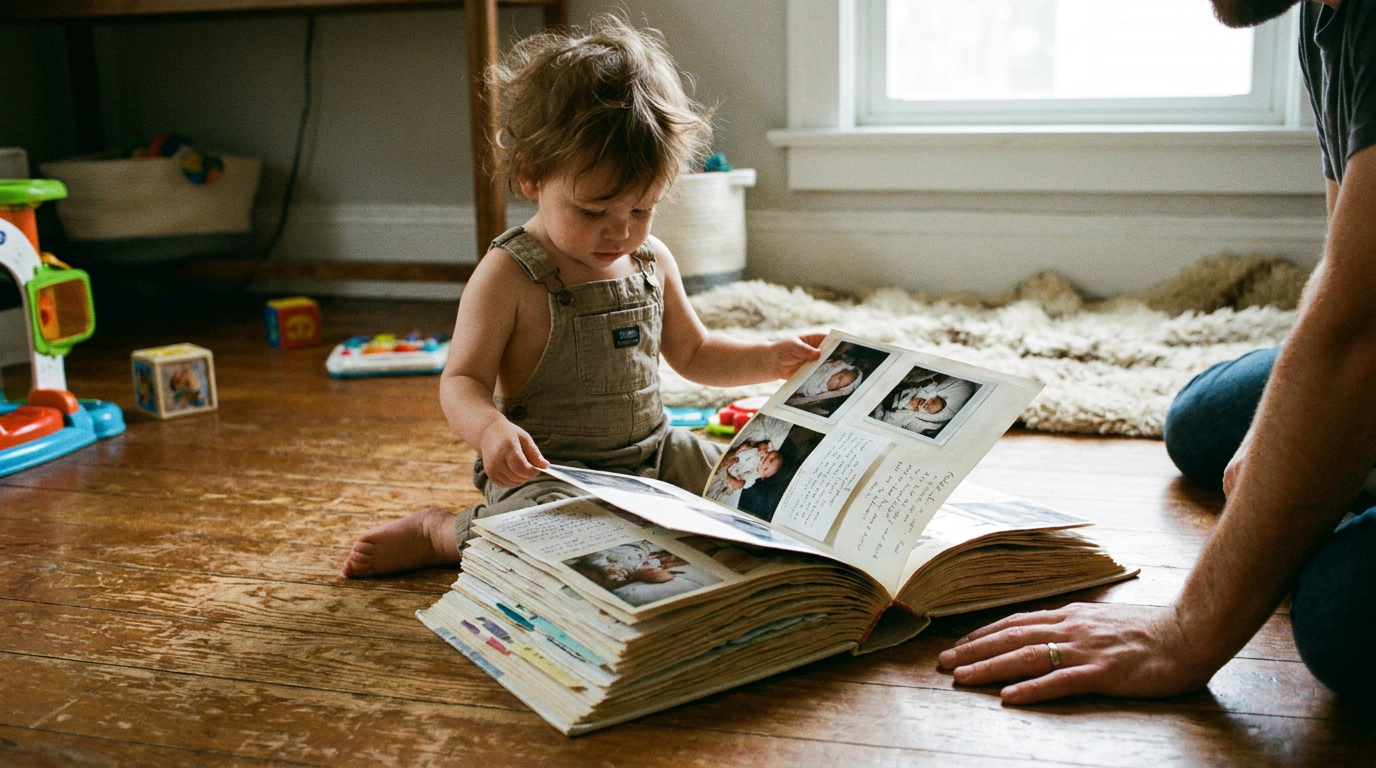
Go back to the drawer. The book with the empty “first tooth” page is not a failed book.
A half-finished baby memory book still holds enormously more than no book at all. Nobody opening it in thirty years will audit the gaps.
Here is the thing worth keeping. The milestones are the part everyone remembers to record. The ordinary texture of the year — the 3am sounds, the song that worked, the route you walked every single day — is the part people actually want back.
One line and one photo is a complete entry. That standard has not changed and does not need to.
Remember too that this year is being witnessed by more than one person. Other people’s versions are worth collecting while they are still easy to get, because those memories fade on a schedule of their own.
Whatever you record is more than nothing. The blank pages can stay blank.
Preserve what you never want to forget. Lugelo holds the half a paper book cannot — the voice notes, the video, the photo overflow — organised by month, private by default, with sharing controlled entirely by you.