Thanksgiving Journal Prompts: 40 Questions For The Table This Year
Nobody thought to ask for it.
That information existed in exactly one place. It was sitting at the end of the table, with a plate in front of it, for four hours, once a year, for thirty years.
Years later — and this is the part that stings — somebody in that family will realise nobody ever asked Grandma the obvious question. Not a dramatic one. Not the question you’d build a documentary around. Just an ordinary one. What her first job was. What the house she grew up in smelled like. Who she was at nineteen, before she was anybody’s mother. What her own mother’s handwriting looked like.
And the conversation is about parking.
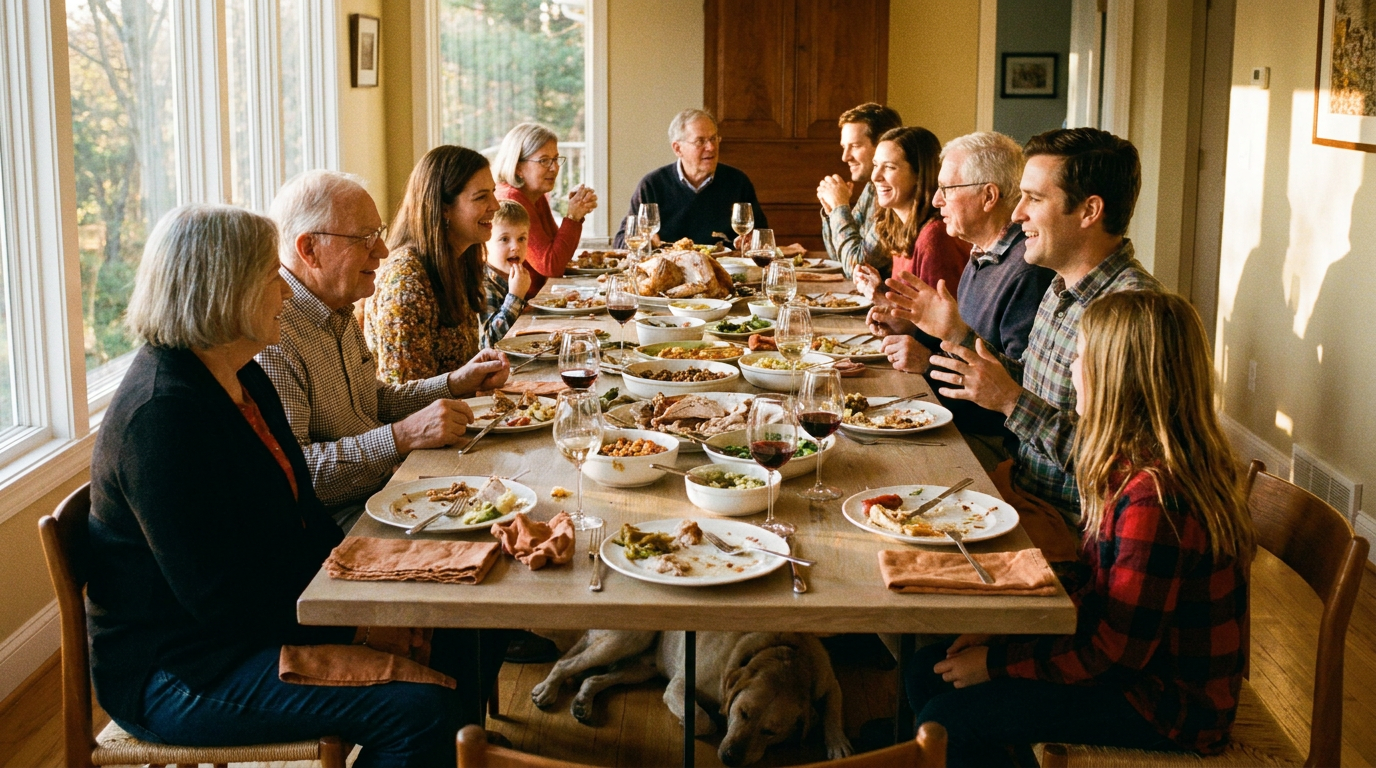
Here’s the thing about that room. Three generations are in it. They have nothing to do. They are not going anywhere for four hours. This happens once a year, maybe twice, and for a lot of families it doesn’t reliably happen at all.
What time people are leaving. Whether the bridge will be backed up. Who’s got the aux cable. Someone asks if anyone wants coffee and three people say yes and nobody gets up. Then somebody puts the football on, and that’s the afternoon.
Then the conversation starts up again and it’s about parking.
The plates are full. Someone has finally sat down. There’s a moment — maybe ninety seconds — where everyone is eating at the same time and nobody is talking, and it’s good.
So here’s what this post is. Forty Thanksgiving journal prompts written to be asked out loud at the table — not written alone in a notebook at eleven at night. That distinction is the whole point. Almost every Thanksgiving prompt list you’ll find is built for solo journaling, which is lovely if you’re a person who journals, and completely useless for the uncle who isn’t. These questions are a shared, spoken activity. Which means the uncle can take part. So can the seven-year-old. So can the great-aunt who thinks all of this is a bit much and will nevertheless answer, at length, once she gets going.
The set runs like this: icebreakers for the first twenty minutes, a block for kids and classrooms, the questions that get the older generation telling stories they’ve never told you, harder ones for after the plates are cleared, a careful section for an empty chair or a hard year, and a handful of written prompts for the quiet afterwards.
One expectation to set before you scroll. You are not going to ask forty questions.
You are going to ask five.
Why Thanksgiving Journal Prompts Work Better Out Loud
That’s it. That’s the entire difference, and it’s enormous. A question at a table is the most ordinary thing in the world. Nobody has to identify as anything to answer one. You don’t opt in to being the kind of person who answers questions at dinner — you just answer, because someone asked, and answering is what people do.
A spoken prompt asks a question.
A written prompt asks one person to perform reflection. They have to sit down, on purpose, with a pen, and decide that today is a day for looking inward. That’s a real barrier, and it filters out roughly everyone who doesn’t already think of themselves as the journaling type.
This is why the same forty questions that would die in a notebook come alive at a table. The format removes the self-consciousness. Nobody is reflecting. Everybody is just talking, and the reflection happens sideways, as a by-product, which is the only way most people will ever do it.
What makes a Thanksgiving writing prompt work when it’s said out loud
Four rules. Apply them to your own questions and you’ll be able to write these yourself.
- Short enough to say from memory. If you have to read it off your phone, the table watches you read it off your phone, and the moment collapses into an activity. A question you can say in one breath sounds like curiosity. A question you recite sounds like a form.
- One clear answer, not a topic. “Tell us about your childhood” is a topic. Topics are paralysing. “Who lived in the house with you when you were ten?” is a question, and it has an answer, and the answer arrives in about two seconds.
- Answerable in a sentence or two. If it needs a paragraph, people will feel the length of it coming and hedge, or defer, or say “oh, I don’t know.” Let the sentence be the floor, not the ceiling — most people will keep going once they’ve started.
- Safe for every age in the room. The seven-year-old should be able to answer it. So should the eighty-seven-year-old. If a question only works for one demographic at the table, it excludes everyone else from the moment, and exclusion is what kills a conversation faster than awkwardness.
The specificity principle, which is the only craft note that really matters
It’s not that people aren’t thankful. It’s that the question is too large to answer. When the brain is handed a question that broad, it does what brains do with impossibly wide prompts — it returns the most generic acceptable answer available and stops working. “Family.” “Health.” “Being here.” All true, all sincere, all completely empty of information, and the conversation has nowhere to go afterwards.
“What are you thankful for?” produces “family.” Then silence.
Here is the single most useful thing in this entire post, and it’s the reason most Thanksgiving question lists fail.
Now try: “Who made something easier for you this year without being asked?”That produces an actual person. With a name. And because there’s a name, there’s a story attached to the name, and because there’s a story, somebody else at the table remembers a similar one. You’ve gone from a dead end to a thread.
The mechanism is simple. Ask about one thing. One moment. One object. One person. One decision. Specificity gives the brain somewhere to search, and once it’s searching it will hand you far more than you asked for.
“What are you thankful for?” is a topic. “Who made something easier for you this year?” is a question.
This is the same principle underneath Lugelo’s , which builds its whole set around narrow, concrete questions rather than broad reflective themes — because a small question reliably opens a large door, and a large question reliably closes one.
September journal prompts
The same questions work written down — later
None of this means Thanksgiving writing prompts are worse. It means they belong at a different point in the day. Spoken at the table, written afterwards. The speaking generates the material; the writing keeps it. There’s a whole set of written prompts near the end of this post for exactly that purpose, once the house is quiet.
There’s also a quieter argument for asking a group rather than an individual. When four people answer the same question about the same Thanksgiving, you don’t get four versions of one account — you get something with depth to it, because everybody noticed a different thing and remembers a different detail. Your brother watched the kitchen. Your aunt watched the kids. You watched the door. Lugelo’s
Which brings us to the thing that stops most people from ever trying.
One honest note before we go further. Not everyone at the table will want to do this. Someone will roll their eyes. Someone will answer in four words and go back to their plate. That is a normal outcome, not a failed activity. You are not running a workshop and there is no completion rate to hit.
goes deep on this multi-perspective idea for a different occasion, and the logic transfers directly to a holiday table.
How to Actually Ask These at the Table Without It Feeling Forced
People bookmark lists like this one and never open them again. Not because the questions are bad. Because they can picture the awkwardness with total clarity — standing up, tapping a glass, announcing that we’re all going to share something — and the mental image is so excruciating that the tab just quietly dies.
So let’s fix that first, before you even see the questions. Here is how this actually works in a real room with real relatives.
Pick five, not forty.
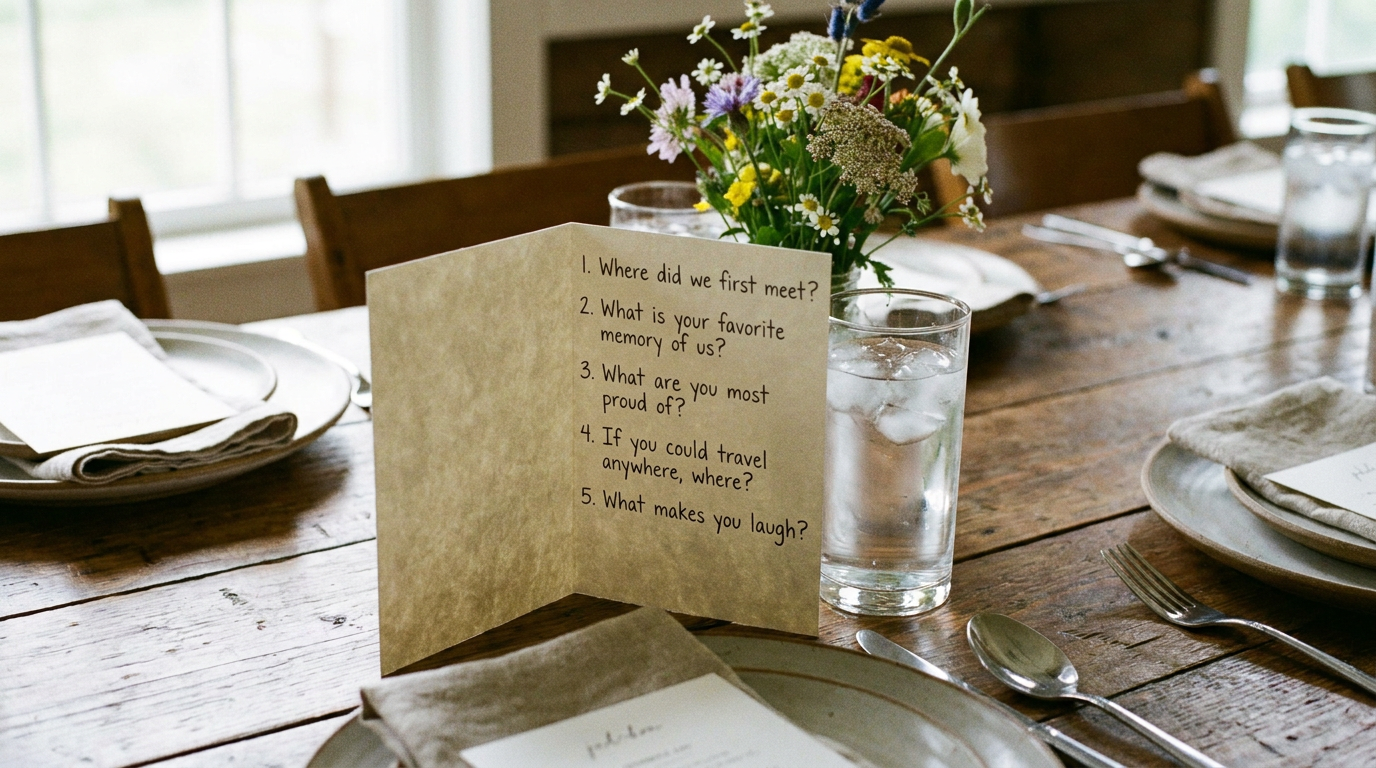
Forty questions is a library. It is not a plan. Before people sit down, choose five — the ones that suit this particular table, this particular year, these particular people. Write them on the back of an envelope. The other thirty-five keep perfectly well until next year, and reusing the same five every November turns into its own quiet tradition faster than you’d think. This is, incidentally, how professional interviewers work. list exists as a resource to keep on hand for when a conversation stalls, not as a running order to march through item by item. The list is a safety net, not a script.
StoryCorps’ Great Questions
Ask, don’t interrogate.
No clipboard. No going round the table in strict order. No “right, everyone, we’re doing an activity before dessert.” Drop one question into a lull the way you’d drop in any other question — the same tone you’d use to ask whether anyone’s seen the neighbour’s new car. The second it feels like a scheduled segment, people start performing, and a performed answer is worth nothing to anybody.
Say that anyone can pass — and say it first.
Before you ask anything. Not after somebody has already hesitated and had to manufacture a reason for hesitating. “You can skip any of these, obviously” costs you four seconds and changes the whole temperature of the thing.
This matters more than it sounds. People answer far more freely when they can feel where the exits are. The pass isn’t a failure condition — it’s the mechanism that makes honest answers possible in the first place.
One question per course.
One while people are still serving and passing dishes. One mid-meal. One when the plates are cleared and nobody’s moved yet. Spacing them out is what keeps this feeling like conversation rather than a quiz round. Three good questions across two hours will get you more than ten in ten minutes, every single time.
The follow-up is where the real material is.
This is the part nobody tells you. The prepared question is just the door. Everything worth keeping comes from the unscripted seconds afterwards.
What happened next?
Who else was there?
Wait — who’s Ronnie?
The easiest technique in the world, and it feels absurd until you watch it work, is to repeat their last few words back as a question. “We had to sell the piano.” — “You had to sell the piano?” And off they go. You are not conducting an interview. You are being visibly interested, which is a thing most people encounter far less often than they’d like.
If your table conversation cracks something open and you want to go properly deep afterwards, Lugelo’s covers interview technique in far more depth than a section like this can — it’s built for a quiet kitchen and an hour, which is a different instrument to the one we’re using here.
50 questions to ask your grandparents
Let the silence sit.
A pause almost never means someone has finished. It means they’re retrieving something, and retrieval takes a few seconds, and those few seconds feel like a year to everyone else at the table.
Don’t fill it. Don’t rescue them. Don’t move to the next question.
The thing said after the pause is consistently better than the thing said before it. That’s not a rule of thumb, it’s nearly a law.
Decide who’s hosting — and make it two people.
Not necessarily the cook. The cook is up and down all meal, checking things, carrying things, being asked where the serving spoons are. This works best with whoever is already comfortable talking across a table. And it works considerably better if two people know the plan in advance, so one can pick up the thread when the other is carving or refilling glasses. A question that gets abandoned halfway because the host had to deal with the oven is worse than no question at all.
Give a kid the job.
This is the single best trick in the section. Hand a child the printed list and let them choose the next question. The dynamic inverts completely — it stops being an adult activity being performed at
That’s the method. Now the questions, starting deliberately light.
the table and becomes something the kids are running. People answer children more honestly than they answer their own siblings, they’re gentler about it, and no one accuses a nine-year-old of being weird for asking. A child holding a numbered list has more social licence than any adult in the room.
Thanksgiving Writing Prompts, Part One: Icebreakers and Questions for Kids
Nobody in the history of family dinners has successfully opened with “tell me about the hardest year of your life.” The room has to warm up first, and the fastest way to warm a room is to get a laugh inside the first two minutes. Once people have laughed once, the entire afternoon becomes available. Skip that step and you’ll spend the rest of the meal trying to recover from a question that landed like a dropped plate.
Start light. Always. Every time.
Icebreakers for the Start of the Meal (Questions 1–8)
These are for the first twenty minutes, and especially for a table with guests, in-laws, new partners, or people who genuinely don’t know each other. Low stakes. No vulnerability required. Anyone can answer any of them without thinking hard or revealing anything they’d rather not.
- Is there a dish on this table with a story behind it?
- What’s something on the Thanksgiving menu you’ve never actually liked?
- What’s the best thing you’ve eaten all year?
- What’s one good thing that happened this year that you haven’t told anyone about?
- What’s something you learned this year, however small?
- What’s a tradition in this family that nobody remembers starting?
- Who taught you to cook the thing you cook best?
- What’s the most useless skill you’ve picked up this year?
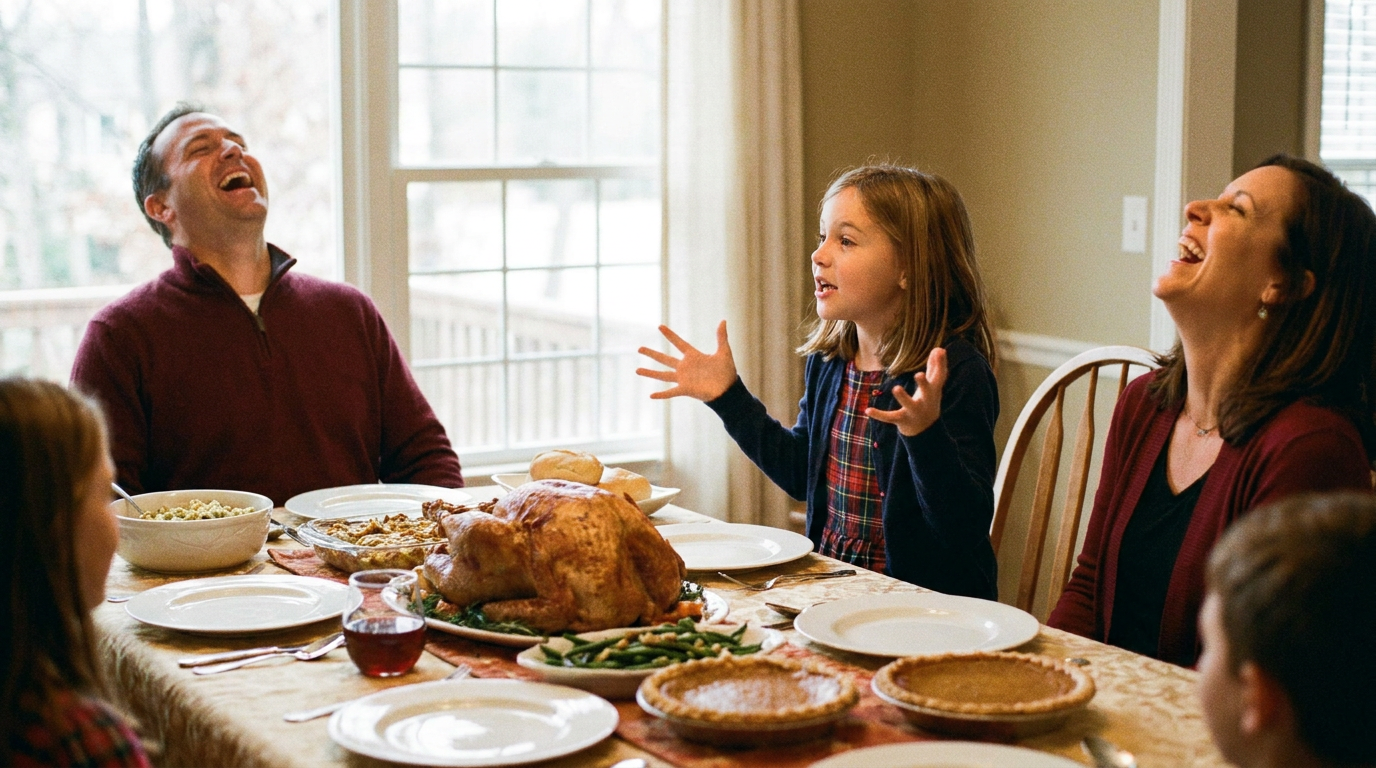
Notice that every one of those is under fifteen words, and that not one of them asks anybody to be profound. Question 2 in particular is worth more than it looks — a table full of people confessing which traditional dish they’ve been politely eating for two decades will generate more genuine laughter than anything else on this list, and laughter is the currency you need before anything harder becomes possible.
Thanksgiving Writing Prompts for Kids at the Table (Questions 9–16)
Children answer abstractions badly and objects brilliantly.
Ask a seven-year-old what they’re grateful for and you’ll get a shrug, or a copy of whatever the last adult said, or “my dog,” which is at least honest. Ask them what the best thing on their plate is right now and you’ll get a considered, specific, weirdly passionate answer with reasons attached. The problem was never the child’s capacity for reflection. It was the shape of the question. Lugelo’s A note on what counts as an answer here: drawing counts. Dictating it with a mouth full of potatoes counts. A one-word answer followed by a better answer four minutes later counts. These are pitched at roughly ages five to twelve.
25 journal prompts for kids
is built on exactly this principle, age-tiered, and it’s worth a look for any parent who wants to keep this going past November.
- What’s the best thing on your plate right now?
- If you could choose anyone in the world to sit next to today, who would it be?
- What’s something you can do now that you couldn’t do last year?
- What’s the funniest thing anyone has said today?
- If you were in charge of the whole meal, what would you cook?
- Which grown-up here is really good at something? What are they good at?
- What’s the best thing that’s happened since summer?
- What’s one thing you want to do before the year ends?
Question 14 is the sleeper. Children notice competence in adults with startling accuracy and almost never get asked about it, and the adult in question will remember being told for a very long time.
One note for parents, and it’s the reason this Thanksgiving writing prompt block is worth more than it appears. A child’s version of the day is genuinely, structurally different from yours. They were at knee height. They were in the hallway when the argument happened. They thought the best part was the dog getting under the table. Their account is not a lesser version of the adult account — it’s a different one, and it’s the one that disappears fastest, because nobody writes it down and the child won’t remember it by spring.
These same Thanksgiving writing prompts
do double duty in a classroom, which is the next section — though a room of twenty-eight children needs a slightly different shape than a room of nine relatives.
Thanksgiving Writing Activities for the Classroom
If you’re a teacher planning Thanksgiving writing activities for the week before the break, the questions above will work in a classroom with one adjustment.
In a classroom, they get written down as well as spoken. And the speaking is what makes the writing possible.
The read-aloud-then-write method
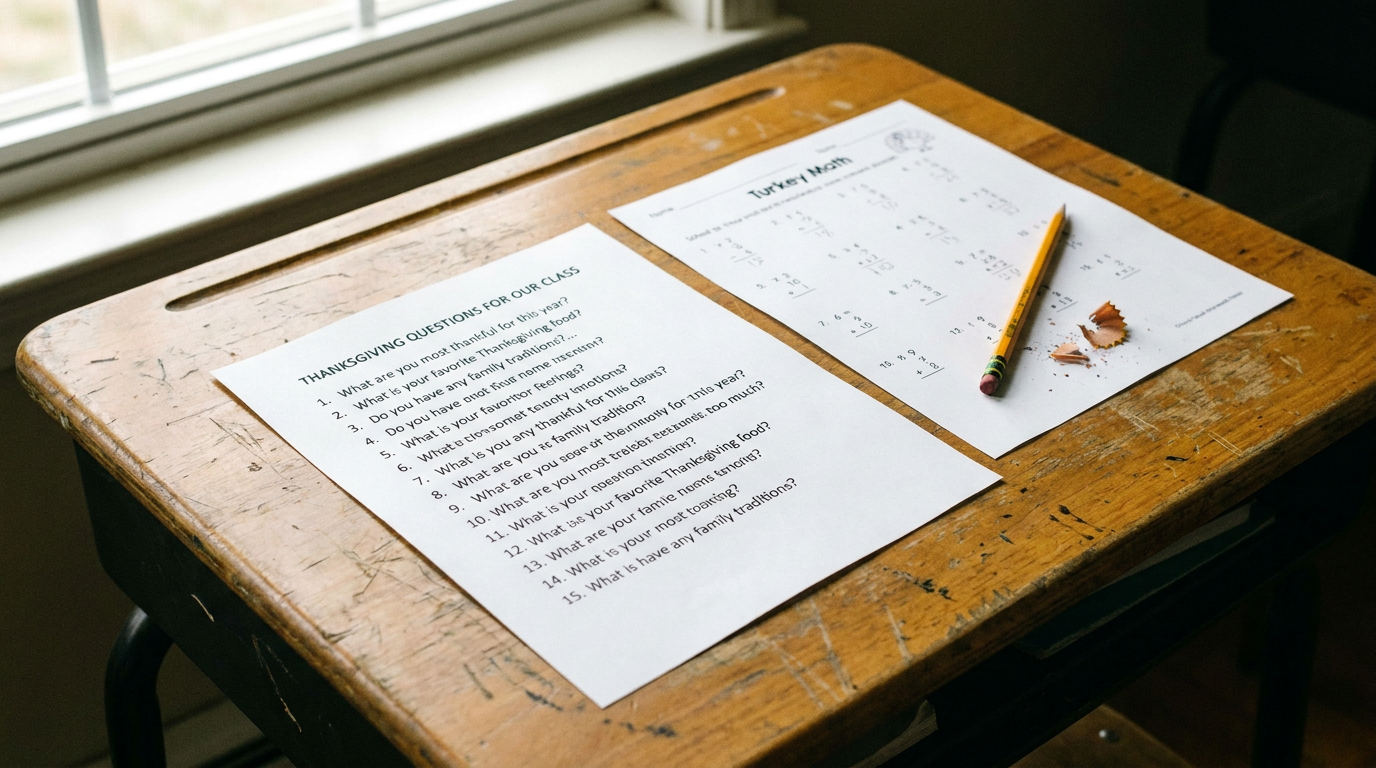
Ask the question to the whole room. Take two or three spoken answers — not from volunteers only, but don’t force it either. Then everyone writes.
That’s the entire method, and the sequence is the point. Students who freeze at a blank page very rarely freeze after they’ve heard three classmates answer. They’re not copying. They’re calibrating — working out what register the answer lives in, how long it’s meant to be, whether it’s allowed to be funny. The spoken round is scaffolding, not a warm-up, and removing it removes the thing that was holding the exercise up. Lugelo’s guide to unpacks this in more detail for anyone who wants the longer version.
how classroom blogging builds self-reflection skills in students
Tiering it by age
Early elementary. One question. One drawing. One dictated sentence underneath it. A drawing is a complete answer and should be marked as one — the sentence is a bonus, not a requirement.
Elementary. One question, three sentences, with a single requirement: include one detail nobody else in the room would know. That constraint does an enormous amount of work. It’s the difference between “we had turkey” and “we had turkey and my grandad always cuts his into exact squares.”
Middle school and up. One question plus a follow-up. Either what changed — before and after — or what you’d say about this to someone who wasn’t there. The second framing reliably produces better writing, because it gives the student an audience, and writing without an audience is just homework.
Which of the forty to use in class
Be deliberate about the rest. The elder-focused questions further down assume access to a grandparent, which not every student has. The grief and empty-chair block is not classroom material — it belongs at a kitchen table with someone who loves you, not in a room of twenty-eight peers. If you want those in play at all, send them home as an optional family activity with a note to the caregiver, and let families decide.
The icebreaker block and the kids’ block are your classroom set. Questions 1 through 16 are safe, age-appropriate, and require no disclosure about anybody’s home life. Questions 3, 5, 6, 9, 11, 12, 13, 14, 15 and 16 in particular will work in almost any room.
The take-home version, which is the best use of this list
Here’s the highest-value Thanksgiving day writing activities assignment on this page, and it’s almost embarrassingly simple.
Ask one older relative one question over the break. Write down what they say. Bring it back.
That’s it. One question, one answer, one page. What it does is convert a writing exercise into an oral history exercise, and it produces material that families keep — which almost nothing else assigned in a school week manages. StoryCorps has run a version of this nationally for years; their are free, classroom-ready, and built around precisely this premise of students recording an elder over the holiday. If you want the structured version with permission forms and lesson framing already done, start there.
Great Thanksgiving Listen materials for educators
The other reason to run it as a take-home: the writing has somewhere to go afterwards. A stack of “what I’m thankful for” worksheets gets recycled in December. A stack of transcribed grandparent interviews does not, because every family in the room wants their copy. Lugelo’s
ultimate guide to creating a school memory book
And the take-home assignment — one older relative, one question — is the doorway into the most valuable cluster in this entire post.
One practical note: the full set of forty is numbered continuously and uninterrupted specifically so you can select it, copy it, and drop it into a worksheet without editing anything. No decorative breaks, no boxes, no commentary wedged between items. It was built to be printed.
covers turning collected student writing into something that’s kept rather than binned at the end of term, which is the difference between an assignment and an artefact.
The Questions That Get the Older Generation Telling Stories
These questions are aimed at that other person. She’s still in there and she remembers all of it.
We almost never know her as the twenty-two-year-old who moved cities with one suitcase and no plan. As the person who was furious about something for eleven years. As someone’s daughter, standing in a kitchen that no longer exists, being told off.
And there’s a reframe that makes these questions work far better than they should. We know our grandparents in exactly one role. We meet them in the last act, already cast, in the version of themselves that has been edited and smoothed and made appropriate for children. Grandma is a person who makes a particular pie and has opinions about the weather.
For most families, this is the only realistic chance anyone gets to ask.
A holiday table is one of the very few occasions in the year when three generations occupy one room with time on their hands and no agenda. Not a wedding, where everyone’s busy. Not a funeral, where the timing is wrong. Not a hospital visit, where the shape of the conversation is already determined. A long meal, in a warm room, with nowhere to be.
Let’s name the opportunity plainly, because it’s easy to miss when you’re carrying a dish.
Ask for texture, not for dates
This is the discipline that separates a useful question from a wasted one.
Dates are recoverable. Somebody’s birth year, the name of a town, the year of a marriage — a certificate will give you those. A census record will give you those. A cousin with a subscription to a genealogy site will give you those in about forty minutes, long after everyone who could have told you is gone.
What is not recoverable, by any method, ever, is the texture. The smell of the hallway. The nickname only three people used. The argument about the dress. What the radio was playing. Which neighbour you weren’t allowed to talk to and the never-explained reason why.
That material exists in precisely one location, and it is sitting at the other end of the table asking whether anyone wants more gravy.
The dates are recoverable. The texture isn’t.
Questions for the Older Generation at the Table (Questions 17–26)
Ten questions, all shaped for a busy table rather than a quiet one-to-one interview. Each one is answerable in under a minute if that’s all someone wants to give it — and each one expands indefinitely if they don’t.
- What did Thanksgiving look like when you were a kid?
- Who did the cooking, and who was actually in charge?
- Is there a dish we used to have that nobody makes anymore?
- What’s the longest journey you ever made to get to a family meal?
- Who’s in the oldest photograph you own?
- Who used to sit at this table that none of us ever met?
- What were you doing at the age I am now?
- What’s the best year you can remember, and why that one?
- What’s something you were completely sure about at twenty-five and turned out to be wrong about?
- What’s one thing you hope this family keeps doing?
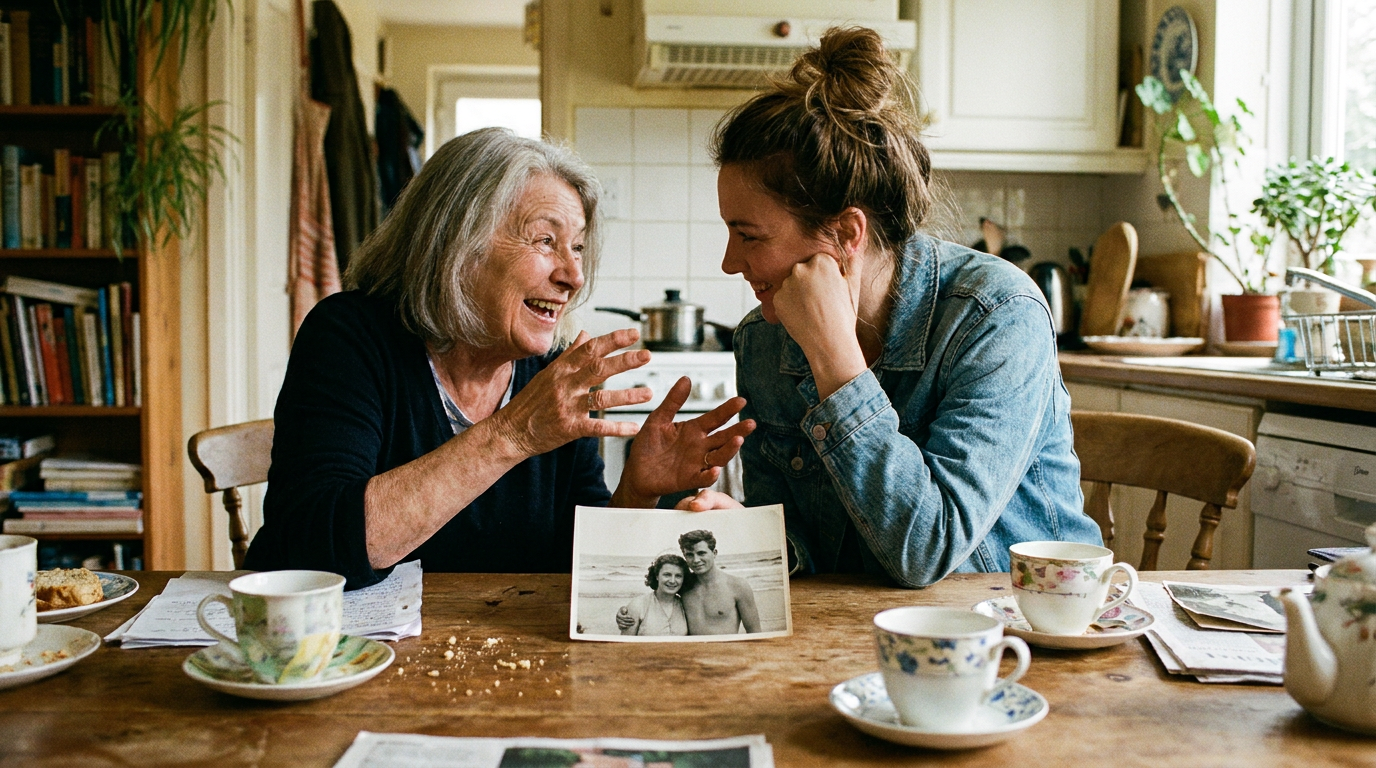
Question 23 is the other one to watch. Asking an eighty-year-old what they were doing at thirty-one, while a thirty-one-year-old sits across from them, collapses the distance between two people who have never once thought of themselves as peers. It reliably changes how both of them talk for the rest of the meal.
A specific note about question 21, because it behaves unlike the others. People expect to answer it with a name and an approximate date. What actually happens, with remarkable consistency, is fifteen unbroken minutes about somebody nobody in the family has ever heard mentioned — a sister who died young, a business partner, a neighbour who effectively raised them for two years. The photograph question is a trapdoor, and what’s underneath it is usually the best thing you’ll get all day.
One piece of research, held loosely
Researchers at Emory University developed something called the “Do You Know” scale — Marshall Duke and Robyn Fivush’s work on measuring how much children know about their family’s history, the small stories about where their grandparents grew up and what went wrong and what happened next. They observed an association between knowing more of that material and a stronger sense of belonging and resilience in children. You can read about the ongoing work at The samples studied skewed towards middle-class, two-parent households, which is a real limitation on how widely it generalises. An association is not proof of cause — it’s entirely plausible that families who talk like this are already doing several other things that help, and the talking is a symptom rather than the medicine. It’s suggestive. It isn’t conclusive, and anyone who quotes it at you as settled science is overselling it.
Emory’s Family Narratives Lab
Hold that loosely.
.
What it does do is confirm something less controversial: this isn’t a sentimental hobby. Collecting first-hand accounts is a recognised discipline with institutions built around it, and the reason those institutions exist is that first-hand accounts cannot be reconstructed from any other source once they’re gone. has been running on exactly this premise for years — a national initiative organised around the observation that the holiday table is the best available room for this, which is a reasonable independent vote of confidence in the whole idea.
StoryCorps’ Great Thanksgiving Listen
And if the table conversation opens something up and you want to sit down with someone properly afterwards, Lugelo’s is the deeper instrument. Every question in the block above is deliberately different from that list, so the two work together rather than overlapping — this set for a noisy table, that set for a quiet afternoon with a pot of tea and two hours.
50 questions to ask your grandparents
Consent, briefly and clearly
Once a table has gone somewhere real, the questions can get a little harder. That usually happens on its own, around the time the plates come away.
And agree who gets to hear it afterwards. This is the one that gets forgotten constantly, and it’s the single thing most likely to make someone regret having talked to you. “Is it alright if I play this for the kids?” is a thirty-second conversation that prevents a genuinely bad outcome. Ask it at the time, not six months later when the recording has already been in the family group chat for a fortnight.
Any question can be declined, without a reason, and the decline should land without any follow-up at all.
If you’re going to record any of this — audio, video, notes — say so plainly and ask first. Not as a legal formality. As basic courtesy to someone who is about to tell you something.
After the Plates Are Cleared: Harder Questions, an Empty Chair, and a Hard Year
That’s when these work.
There’s a specific window in the afternoon. The table has been cleared but nobody’s actually left it. Someone’s making coffee. Two people are still picking at the pie. The light has gone amber and nobody has turned a lamp on yet.
The Questions for When People Linger (Questions 27–33)
Accept a pass instantly, and without a follow-up.
Only ask these if the room has genuinely warmed up. You’ll know. If it hasn’t, stay with the icebreakers and lose nothing — a good light conversation beats a forced deep one every time.
- Who helped you this year? Have you told them?
- What’s a decision you made this year that you’re glad about?
- What’s something you changed your mind about?
- Who would you want at this table next year who isn’t here?
- What’s one thing you’d want someone to know about this particular year?
- Is there something you’re carrying that you’d like to put down before the year ends?
- What do you want the next twelve months to look like? Not impressive — just well spent.
Question 27 has a habit of turning into action. People answer it, hear themselves answer it, and then text the person that evening. That’s a better outcome than anything you’d get from a journaling exercise.
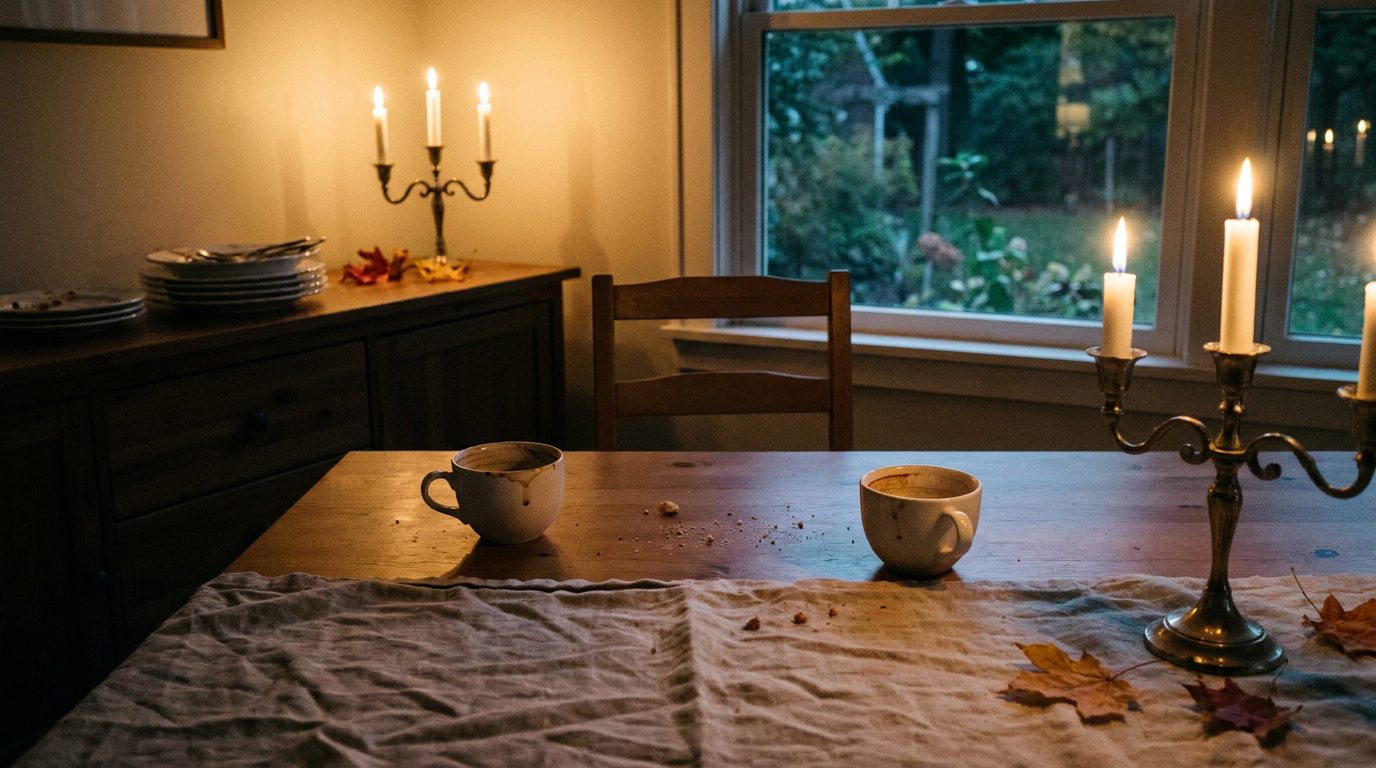
For an Empty Chair or a Hard Year (Questions 34–37)
These four are aimed at remembrance, not resolution.
Nobody has to be grateful for a hard year. You are allowed to say that it was hard, full stop, with no redemptive clause attached. If anyone at your table tries to append one on your behalf, they’re wrong.
So, plainly: these questions are not an instruction to find the silver lining.
Some tables have a chair that isn’t being used, and everyone has noticed, and nobody has said anything. Some people arrive from an estrangement, or a diagnosis, or a separation, or a year that simply took something and didn’t give anything back. Pretending otherwise is a large part of why some people dread the day — not the grief itself, but the obligation to perform being fine about it while passing the potatoes.
Thanksgiving is not warm for everyone.
- What would they have said about today?
- What did they always do at this meal that someone else has quietly taken over?
- What would you tell them about this year if you could?
- What’s a small thing they taught you that you still do?
And if someone is missing by choice rather than by death, these are probably not the right questions. Estrangement is a different thing and this post is not going to offer you advice about it. Skipping this block entirely is a perfectly good decision and requires no justification to anyone.
But follow the lead of whoever is closest to the loss. Entirely. If the answer is short, let it be short and move on without commentary — no “that’s beautiful,” no squeezing of the hand, no meaningful pause. Just continue. Whoever has the strongest claim to the grief gets to set the terms, including the term that we’re not doing this today.
Naming someone out loud is very often welcomed rather than avoided. This surprises people. The common fear is that saying the name will ruin the afternoon — but for a lot of grieving people, the harder thing is watching a name drop out of family conversation entirely, as though the person has been quietly filed away. Being asked about them can be a relief.
A few practical notes, and then we’ll move on.
If You’re Alone This Thanksgiving (Questions 38–40)
These three are written to be answered on paper rather than spoken. They are not consolation prizes.
Some Thanksgivings are solo. By distance, by circumstance, by a shift pattern, or by deliberate choice because last year was exhausting and you’ve decided not to do it again.
- Who would you most want to sit down with today, and what would you ask them?
- What would make a quiet day feel like it was worth something?
- What’s something good from this year that nobody else knows about?
No instruction here to reframe solitude as an opportunity, or to treat a quiet day as secretly the better option. A quiet day is allowed to be a quiet day. Writing something down is not a treatment for anything and shouldn’t be sold as one — though if you find that a page helps, Lugelo’s
That’s all forty. Which leaves one problem, and it’s the one that makes or breaks everything above: by next week, most of it will be gone.
A fuller set of gratitude prompts also works well for a quiet day, and they’re worth keeping past November rather than retiring with the leftovers — the useful ones tend to be the ones you can answer in any month.
offer a longer set in the same register, without overclaiming what a notebook can do.
Capturing the Answers Before They Evaporate — and Where They Live Afterwards
Here’s what happens.
Within a week, you will remember that the conversation was good. You’ll remember the feeling of it. You’ll remember laughing, and the bit where she surprised everyone, and the fact that it went on much longer than expected.
You will not remember what she said about the bakery. Or the name of the street. Or the year. Or the exact phrase she used that made your mother put her fork down.
The detail has a very short half-life, and nothing about caring more will change that. This isn’t a character flaw and it isn’t fixable by intention. It’s just how memory works with spoken language — the gist survives, the wording evaporates, and the wording was the good part.

Three ways to catch it, all free, all doable by anyone
A voice memo. Phone face-down on the table. Ask first — plainly, in normal words — then start it and genuinely forget about it. Audio carries everything text loses: the hesitation before the honest bit, the laugh, the particular way they say your name. Those are the first things you forget and the things you miss most. One rule, and it’s not optional: label it immediately. An untitled audio file is a lost audio file, and you will not recognise it in three years. The National Archives’ makes the same point about labelling and dating for exactly this reason — the identification is the preservation.
guidance on preserving family archives
One photo of the table. Not of people posing. Of the table as it actually was, mid-meal, half-eaten, crowded, someone’s elbow in frame. That photograph will date the day and trigger more recall than any arranged group shot, because it contains the unedited evidence of what the afternoon was actually like.
One person taking notes.And restating this once more because it matters: ask before you record, every time, in plain words. Then agree who gets to hear it. Both of those take under a minute and they’re the difference between a recording someone’s glad you made and one they wish you hadn’t.
Not a transcript — nobody is doing that, and trying will ruin the meal. Three things, jotted down while the kettle’s boiling. Three things beats the nothing you’d otherwise have by an enormous margin, and it remains a completely valid approach for a table where someone would genuinely rather not be recorded at all.
The problem that starts after you’ve captured it
Every one of those places is a device that will eventually be replaced, wiped, lost, or upgraded by someone who assumed everything was backed up.
The recording is on your phone. The photos are on your sister’s. Someone posted a clip in the group chat where it’s already sinking. Your cousin wrote down the bit about the bakery in a notes app she’ll eventually clear out. The best story from the best conversation of the year now exists in four separate places and belongs to nobody in particular.
Now you have material. And within about two weeks it’s scattered.
This is the problem A single Moment holds the text of what she said, the photo of the table, and the audio of her actual voice — in one entry, rather than three apps that don’t know the others exist. When you open it in ten years, the whole thing arrives together.
Lugelo
was built for.
Shared journals let everyone who was there add their own version of the same afternoon. Your brother’s account of the kitchen. Your aunt’s photographs. The detail your cousin caught while you were carving and completely missed. Role-based permissions mean the owner decides who can view and who can add — you can see what that looks like in practice in Lugelo’s Memory Lane arranges everything in order, which is the thing that turns a pile of undated files into something that reads as a sequence. And that’s not a small distinction. One Thanksgiving is a nice entry. Ten Thanksgivings laid end to end is a completely different object — you can watch the children arrive, the table get longer, the recipes move between hands.
family journal stories
, which is other families doing this rather than a description of doing it.
And when you’ve got a few years of it, storybooks, scrapbooks and eBook export turn a set of answers into something you can physically put on the table next November — rather than five people crowded around one phone, taking turns to scroll. Lugelo’s walks through that process if you’re collecting with that endpoint in mind.
guide to turning a journal into a book
One more practical note for anyone travelling to the table rather than hosting it: decide who’s capturing what before you leave. Two people both assuming the other one is recording is how a decade of families have ended up with nothing. Lugelo’s covers setting that up in advance, which takes about five minutes and removes the entire problem.
holiday travel journal setup guide
On privacy, in plain English. Journals are private by default, with owner-controlled access. You decide who can view or contribute, and access can be revoked at any time. Data is encrypted in transit, there’s no third-party data sharing, and deletion is available with a 30-day recovery window. If you want the full detail, it’s all on .
Lugelo’s FAQ page
November Journal Prompts: Writing It Down Once Everyone’s Gone Home
These are for the evening after, or the following morning — when the dishwasher’s on its second run, the house has gone quiet, and you’re the only one still thinking about what your uncle said. They sit outside the numbered forty, deliberately, so the printable set stays intact.
The forty above were spoken. This handful is not.
- Who surprised you today?
- What do you want to remember about this specific group of people, as they are right now?
- What was different about this year’s table?
- What do you want to ask next year?
- What are the three things from today you don’t want to lose?
Answer the same few every November and something happens that’s hard to appreciate until you’re several years in. You end up with a record no photo album could produce — not of how everyone looked, but of who they were, what they were worried about, what they’d just decided, and who was newly at the table. These November journal prompts work precisely because they repeat. The same question asked annually becomes a measuring stick, and the answers only get more interesting as the stack grows. That’s the quiet case for November writing prompts
Before you close the tab, a few things people usually want to know.
over one-off reflection: the value compounds.
Thanksgiving Journal Prompt FAQs
What are good Thanksgiving journal prompts?
Good Thanksgiving journal prompts are short, specific questions that can be answered out loud in a sentence or two — things like “What’s a tradition in this family that nobody remembers starting?” or “What’s something you can do now that you couldn’t do last year?” The best ones ask about one moment, one person or one object rather than a whole year, and they work across ages, so children and grandparents can both answer the same question.
What should I ask at Thanksgiving dinner?
Pick five questions before people sit down and space them across the meal rather than asking them all at once. Start light — something about the food, or the best thing someone’s eaten all year — and only go deeper once the room has warmed up. The icebreaker block above is built for the first twenty minutes and requires nothing from anyone beyond an opinion about dinner.
How do I start a conversation at Thanksgiving without it feeling awkward?
Don’t announce an activity. Drop a single question into a natural lull, in the same tone you’d use for any other question, and let it be a conversation rather than a segment. Say up front that anyone can pass — before you ask, not after somebody hesitates. The awkwardness comes almost entirely from the announcement, not from the questions themselves.
What are good Thanksgiving writing prompts for kids?
Concrete ones. Children answer questions about objects, people and specific moments brilliantly, and questions about abstractions badly. Ask what the best thing on their plate is, or what they can do now that they couldn’t last year, rather than what they’re thankful for. Drawing counts as a complete answer, and so does dictating it to an adult mid-meal.
What are some Thanksgiving writing activities for the classroom?
The most reliable method is read-aloud-then-write: ask the question to the room, take two or three spoken answers, then everyone writes. Hearing classmates answer removes the blank-page freeze. The highest-value version is a take-home assignment — ask one older relative one question over the break, write down the answer, bring it back. That converts a writing exercise into oral history.
What questions should I ask my grandparents at Thanksgiving?
Ask for texture rather than dates. Certificates and records will eventually give you birth years and place names; nothing will give you the smell of the hallway or the nickname nobody uses anymore. Try “Who’s in the oldest photograph you own?” or “What were you doing at the age I am now?” For a longer sit-down afterwards, the list goes considerably deeper.
50 questions to ask your grandparents
What do you write in a November journal entry?
Write the things from the day you don’t want to lose. Who surprised you, what was different this year, what somebody said that you want to keep. Short is completely fine — one photo and one sentence is a finished entry, not a draft of one. The entries you’ll value most in a decade are rarely the long ones; they’re the ones that captured a detail nobody else recorded.
How do I handle Thanksgiving when someone is missing?
Saying their name out loud is very often welcomed rather than avoided — many people find it harder when a name quietly drops out of family conversation altogether. But follow the lead of whoever is closest to the loss, completely. If the answer is short, let it be short and move on without commentary. Deciding to skip it entirely is a perfectly good decision.
Is Lugelo free?
Yes — Lugelo is free on iOS, Android, HarmonyOS and the web, with Chrome and Firefox extensions available. Journals are private by default, with owner-controlled access, so you decide who can view or contribute to anything you create.

Conclusion: Ask One. See Where It Goes.
So let’s be clear about what the argument here actually is, because it isn’t the one these posts usually make. The point is not that time is running out and you should act before it does. That framing turns a good afternoon into an obligation, and obligations are exhausting.
Nobody asked. That’s the whole of it.
There’s no revelation waiting at the end of that story. Nothing was hidden and nobody was withholding anything. She simply had the answer the entire time — to what her first job was, and what the house smelled like, and who she was at nineteen — and she would have told anyone who asked, probably at length, probably with a laugh in the middle of it.
Back to the grandmother at the end of the table.
The point is much more cheerful than that. Everyone you’d want to ask is already going to be sitting at a table, for a few hours, once a year, with nothing else to do. The opportunity isn’t scarce or urgent. It’s availablePick one question. Ask it somewhere between the main course and the pie.
And the commitment is smaller than you think. Don’t plan the activity. Don’t print anything, don’t tap a glass, don’t tell anyone this is happening.
, right now, for free, from people who already like you.
If you want a specific first move rather than general encouragement: use number 6. What’s a tradition in this family that nobody remembers starting?
The table gets cleared either way. The only difference is whether anyone wrote anything down.
Then afterwards, while the kitchen’s still warm and someone’s still drying plates, write down three things. Not a transcript. Three things.
If it goes nowhere, you’ve lost thirty seconds. If it goes somewhere, you’ve got the afternoon.
It’s safe, it’s funny, everyone has an opinion, and it very reliably turns into an argument about who started it — which is exactly the kind of argument you want a recording of.
Don’t Just Live It — Keep It
Start a shared journal for this year’s table and invite the people who were there. Keep their answers, the photo of the table and their actual voice in one place — so next November, you’re adding to something instead of starting over.
Start Saving What Actually Matters
Available on web, iOS, Android and HarmonyOS — .
Download Lugelo
Journals are private by default, with owner-controlled sharing. Data is encrypted in transit.