Your Kid’s Costume, Every Year: Building a Halloween Photo Timeline
Here is the thing nobody tells you on that first Halloween: the photograph is not the point.
You take the photo. You take about forty photos that night, honestly. This one goes in among the rest.
The light goes amber around half past five at the end of October. You know the exact quality of it — low, slanting, the kind that turns a perfectly ordinary front step into something out of a film. Your child is standing on that step in a costume they chose themselves, with a level of conviction that only a four-year-old can bring to the question of whether they are, in fact, a dinosaur.
The sequenceAn honest expectation before we start: this costs about ninety seconds a year, plus a little care. Not nothing. But close.
We’ll cover the rule you need to write down before you need it, the four details worth capturing alongside the image, how to build the timeline backwards out of the Halloweens you’ve already photographed, what to do about the years you genuinely missed, how to handle several children and one unimpressed teenager, and what the whole run actually becomes when you finally scroll it end to end.
So this post is about one artifact and one artifact only: the annual costume photograph, taken year after year, and what it turns into when the years line up. Not Halloween in general. Not what to do on the night. Just the photo, and the sequence.
It works for a reason worth understanding. What changes only becomes legible because everything else stays the same. The door doesn’t move. The framing doesn’t move. The date doesn’t move. Against all that constancy, growth becomes visible in a way it simply isn’t in a camera roll of thirty thousand images shot from thirty thousand angles. Consistency is what makes change readable.
Put that same child on that same step at four, at nine, at fourteen — the same doorway, the same light, the same slightly crooked house number over their shoulder — and you have made something that no single photograph is capable of doing. You have made the plainest, most undeniable record of how quickly childhood actually moves.
is the point.
It’s also one thread inside a much bigger idea — the notion that a family’s real record isn’t the camera roll but the handful of things you deliberately keep. We wrote about that at length in , and the costume timeline is one of its most rewarding chapters. It’s also, for most families, the easiest place to start collecting kids halloween memories that hold up over time.
The Family Memory Book: Preserving a Life, Not Just a Camera Roll
But none of the practical advice lands unless you first understand why repetition does the heavy lifting. So let’s begin there.
The Power of One Photo a Year
Forty photos of one evening is a blur. One photo across ten evenings is a story.
Think about last Halloween. You probably came home with somewhere between thirty and a hundred images — the costume half-on, the costume fully on, the costume being adjusted in the hallway, three near-identical frames on the path, a blurry one of them running, a group shot where one child blinked, a group shot where a different child blinked. All of it evidence of a good evening. Almost none of it something you’d ever sit down and look at again.
There’s a paradox sitting underneath modern family photography, and once you notice it you can’t stop noticing it: the more photos you take of an occasion, the less any individual one of them means.
Forty photos of one evening is a blur. One photo across ten evenings is a story.
That’s not a sentimental claim, it’s a structural one. A timeline is a comparison deviceThis is why the effort curve and the value curve run in completely different directions, which is the best deal in family record-keeping.
. It functions the way a scientific control functions — by holding every variable steady except the one you actually want to observe. Same location. Same framing. Same week of the year. Same distance from the camera. When all of that is locked down, the only thing left for the eye to read is the child, and the child is the thing you wanted to see all along.
Year one, you have a photo of a small person in a costume. Nice. Unremarkable. Year two, you have two photos that look pleasingly similar. Year three, it’s mildly interesting — you can see something happening. Year five is usually where other people start reacting; someone glances over your shoulder and says oh, look at herThe work stays exactly the same the whole way through. Ninety seconds, once a year. The value compounds on its own.
. And by year ten, it has quietly stopped being a photo album at all. It has become a document. It is the sort of thing that gets shown at a twenty-first birthday.
Why Halloween is the ideal anchor
You could theoretically do this on any recurring date, and plenty of families do it with birthdays or the first day of school. But Halloween has a specific set of properties that make it unusually well-suited to becoming an annual photographic anchor, and they’re worth spelling out.
It lands on the same date every year. No moving feast, no shifting term dates, no “was it the second weekend or the third?” October 31st, permanently. That reliability matters enormously over a decade.
The photograph already exists in the evening’s natural shape. You are, on this specific night, already dressing the child up and already photographing them. You are not adding a task to the calendar — you are shaping a task that was going to happen anyway. That’s the difference between a habit that survives and a habit that gets quietly dropped in year three.
There’s a natural moment built into the evening. Just before leaving the house, everyone is dressed, everyone is together, nobody has eaten their body weight in fun-size chocolate yet, and the costume is at peak structural integrity. You have a window of roughly two minutes where the conditions are ideal and everybody is in one place. Very few family occasions offer that.
And the costume itself is a genuine annual snapshot of the person wearing it.What a child chooses to dress as tells you more about that specific year of their life than almost any other single data point you could collect. It’s an inadvertent autobiography, recorded one frame at a time, entirely by accident.
This is the part I find most quietly remarkable.
The four-year-old dinosaur — that’s the year of the dinosaur books, the dinosaur pyjamas, the correcting of adults who mispronounce ParasaurolophusWhich raises the immediate practical problem. Sameness is the entire mechanism — but how do you guarantee sameness across ten years, when you will not have the faintest memory next October of what you did this one?
This is also why the costume timeline makes such a good spine for a wider halloween scrapbook. If you want to keep more — the pumpkin designs, the haul, the neighbourhood, the friends — you can hang all of it off the annual photo, because the photo is the thing that gives every year its fixed point. Build the spine first. Everything else can attach to it later.
Scroll those in order and you’re not just watching a child get taller. You’re watching an imagination develop — the obsessions arriving and departing, the influences shifting, the exact year self-consciousness turned up. Height is the obvious story in a costume sequence. Personality is the better one.
. The seven-year-old astronaut belongs to the year they became briefly, intensely obsessed with the solar system and insisted on the correct number of moons around Jupiter. The nine-year-old who wanted to be a very specific character from a very specific film that nobody outside the household had heard of. The twelve-year-old who chose something deliberately, elaborately ironic, because irony had just arrived in their life and they were trying it on for size along with the costume.
Set the Rule Before You Need It
Here is the single most useful thing in this entire post, so I’ll put it plainly: the enemy of a multi-year photo sequence is not laziness. It’s forgetting your own system.
Nobody abandons a costume timeline because they can’t be bothered to take a photograph. They abandon it because it’s 4:50pm on October 31st, there’s a child in a cape vibrating with impatience by the door, and you cannot for the life of you remember whether last year you stood to the left of the door or the right, whether you shot portrait or landscape, or whether you got the whole costume in or cut it off at the knees. So you take a photo that’s near enough, and the year after that you take another one that’s near enough to thatThe fix takes four minutes and you only do it once. Write the rule down.
one, and by year five the sequence has drifted so far that it no longer reads as a sequence at all.
The five decisions to make once
A fixed spot. Front door, porch step, the gate, the same tree at the end of the drive, a particular stretch of living room wall. What you’re looking for is something structural — something unlikely to be repainted, removed, replaced or grown over within a decade. A front door is close to perfect. A specific shrub is a gamble. And if you move house, don’t quietly pretend nothing happened: note the move, and let the sequence show a visible new chapter. A timeline that changes address mid-run isn’t broken. It’s accurate.
A fixed framing. Full body, head to shoes. This is non-negotiable and it’s the mistake I see most often — costumes live in their details, and the details are almost always at the bottom. The boots. The tail. The hem of the cape. The wellies underneath the princess dress because it was raining. Crop those out and you’ve lost half the record. Decide portrait or landscape now and never switch, because a sequence that alternates orientation is genuinely unpleasant to scroll. Decide roughly how much headroom you’re leaving. And mark the physical spot the child stands on — a chalk cross, a specific paving slab, the join in the decking, the third floorboard. Standing on the same mark matters far more than people expect, because it’s what keeps the child the same size in frame relative to the background, which is precisely what makes the growth legible.
A fixed time of day. Late afternoon or early evening, before trick-or-treating — not at nine o’clock at night under a porch light, when the costume has been through a hedge, the face paint has migrated, and everyone involved has stopped enjoying themselves. Natural light at the same hour is remarkably consistent from one year to the next. Flash photography is not; it changes with every phone upgrade and every slightly different angle, and it flattens everything it touches.
A fixed photographer, where you can manage it. The same person, at the same height, holding the phone the same habitual way, produces a far more consistent run than a rotating cast. If the photographer has to change — and over ten years it will — just note the height difference in the rule so the new person knows to crouch or stand.
A fixed “one and done” discipline. Three frames, pick one, done. The instant the annual photo turns into a photoshoot, children stop cooperating, and a tradition that generates friction is a tradition with a short life expectancy. Protect the ritual by keeping it almost insultingly quick.
The Costume Photo Rule Card
Now — where do you keep it?
Copy this, fill it in, and keep it somewhere you’ll actually find it again. This is the whole system.
Not in a notes app you’ll never open. Not on a scrap of paper in a kitchen drawer, which is where it will be found in 2034 during a house move. The most reliable place to store the rule is attached to last year’s photograph itself, because last year’s photograph is the one thing you’re guaranteed to go looking for.
This is where keeping the sequence in a journal rather than a camera roll starts to pay for itself. In Lugelo, each entry is called a Moment, and is the chronological timeline that places every Moment in order as you add it — so the sequence assembles itself rather than needing to be sorted, hunted for or manually arranged. Put the rule in the same Moment as the photo, and opening last October shows you both the image you’re matching and the instructions for matching it, side by side, at the exact second you need them.
Memory Lane
Which brings me to the single best trick in this whole article, and it costs nothing.
Before you shoot, pull up last year’s photo on your phone and hold it up beside the scene. Look at where the child’s head sat against the door. Look at how much step was showing at the bottom. Then move your feet until the live view matches. It takes about ninety seconds and it is the difference between a decade of photographs that align beautifully and a decade of photographs that are all sort ofThe photo, though, is only half of what you’re keeping. The other half is a handful of details that will be entirely gone from your memory inside eighteen months.
the same. Do this one thing and you can be fairly relaxed about everything else.
Capture the Story Around the Photo
Let me describe a very specific kind of loss, because I suspect you’ve already experienced it.
You’re looking at a photo from five or six years ago. Your child is dressed as something extremely elaborate — a hand-built cardboard robot, say, or a character you can no longer identify. And you remember the costume perfectly. What you cannot remember, at all, is why.
You can’t remember that they were obsessed with a particular film for exactly four months that spring. You can’t remember that they’d originally wanted to be something else entirely and changed their mind twice in the last week of October. You can’t remember that the robot was built out of a nappy box and about eleven metres of duct tape because the shop-bought one was £40. You can’t remember what they said when they saw themselves in the hall mirror.
All of that was completely obvious to you at the time. That’s precisely why you didn’t write it down.
So: four details, captured every year, taking about sixty seconds. Not an assignment. Just a caption with a bit more in it than usual.
Who chose it, and why. Was it their idea or yours? What were they into that year? What had they just watched, just read, just decided they were going to be when they grew up? This is the line that will mean the most in a decade, and it’s the one you’re most likely to skip because it feels too obvious to bother recording.
What it was made of. Shop-bought, hand-sewn, hired, inherited from an older sibling, or assembled at eleven o’clock the night before out of cardboard and desperation. The construction story is very often the actual family story — the year the grandmother sewed it, the year you gave up and ordered it, the year they made the whole thing themselves and wouldn’t let you help. Note who made it. That detail ages beautifully.
The rejected options. Genuinely my favourite thing on this list, and the one that vanishes fastest. The two or three things they nearly were — the ones campaigned for hard in mid-October and then abandoned — are a portrait of a child’s year all by themselves. Wanted to be a shark, then a vampire, settled on a shark-vampire. You will never remember this. You will be delighted to have it.
What they said when they put it on. One line, verbatim, in their words. Do not clean it up, do not fix the grammar, do not translate it into adult English. The mistakes are the entire point.
“I’m a dinosaur but a nice one so people can still be friends with me.”
— age four, dinosaur, 2019
That’s the whole thing. Eighteen words that will outlast the costume, the photograph and quite possibly the house.
Capture it in the sixty seconds before you leave
Timing is everything here, and the timing is: nowYou don’t have to type it. Honestly, you shouldn’t — typing on a phone in a hallway while wearing a coat is nobody’s idea of a good time. Just talk. Lugelo supports audio, so you can record a thirty-second voice note saying “right, this is 2026, she’s a shark-vampire, it was entirely her idea, we made the fin out of a yoga mat, she rejected being a postbox and a wolf, and when she put it on she said—” and you’re done. Speech-to-text is there if you’d rather end up with something written.
, not later. Later never happens. The window is the minute before you leave the house, or the first two minutes in the car, while it’s all still fresh and nobody has yet been handed a bucket of sweets.
The advantage of keeping it together is that — so this year’s frame, the thirty-second voice note, a ten-second clip of them belting down the path, and the four typed details all live as one object. That matters more than it sounds. The usual failure mode isn’t losing things; it’s scattering them. The photo ends up in the camera roll, the funny quote in a message to your sister, the video in a group chat, and the costume’s origin story nowhere at all. Reassembling that in eight years is essentially impossible. Keeping it assembled in the first place takes a minute.
a single Moment can hold photos, video, audio and text in one place
Optional extras, if you’re enjoying yourself
None of these are required. Some families add one or two and find they become the best part.
- A photo of the costume laid flat on the floor before it’s worn — surprisingly striking as its own annual sequence.
- What it cost, or how many hours it took to make. Both are funny later.
- The weather. October weather shapes the entire evening and is completely unmemorable afterwards.
- Who they went out with, and how that changes as friendship groups shift.
- How far you walked, and what time they gave up. The year they lasted eleven minutes is a story.
Now, most people reading this are not standing at year zero with a newborn. You’ve probably got five or six Halloweens already sitting in a camera roll somewhere, which raises the obvious question.
Keep the whole thing light. If it starts feeling like homework, cut it back to the photo and the one quote — those two alone are worth more than a complete set you resent doing.
Backfill the Years Behind You
This is completely wrong, and dismantling it is probably the most valuable thing this article can do.
The most common reason people don’t start a costume timeline is the belief that they’ve missed the boat. Their eldest is nine. The moment has gone. Starting now feels like admitting defeat on the eight years already behind them.
You are almost certainly not starting at year one. You have been photographing your children on Halloween for as long as you’ve had them, because everybody does. Those photographs exist. The work in front of you isn’t taking new pictures — it’s finding and sequencing the ones you already have. That’s an afternoon’s work, not a decade’s, and it can take a timeline from “started this year” to “goes back to 2018” in a single sitting.
Where to look
Work through these in order. Most people find eighty percent of what they need in the first twenty minutes.
- Search your camera roll by date range — October 28th to November 1st, one year at a time. This single trick surfaces almost everything. Every phone photo library supports date search, and Halloween’s fixed date makes it unusually easy to target. Go back as far as your library goes.
- Check messaging threads and group chats. This is where the best photo often hides. The really good frame was frequently the one you sent straight to a grandparent or the family group and never saved back to your own device.
- Check the other parent’s phone. Then check the grandparents’ phones. The best shot of a child is very often on somebody else’s device entirely — the person who wasn’t holding the bucket, wrangling the little one or driving, and therefore had a free hand.
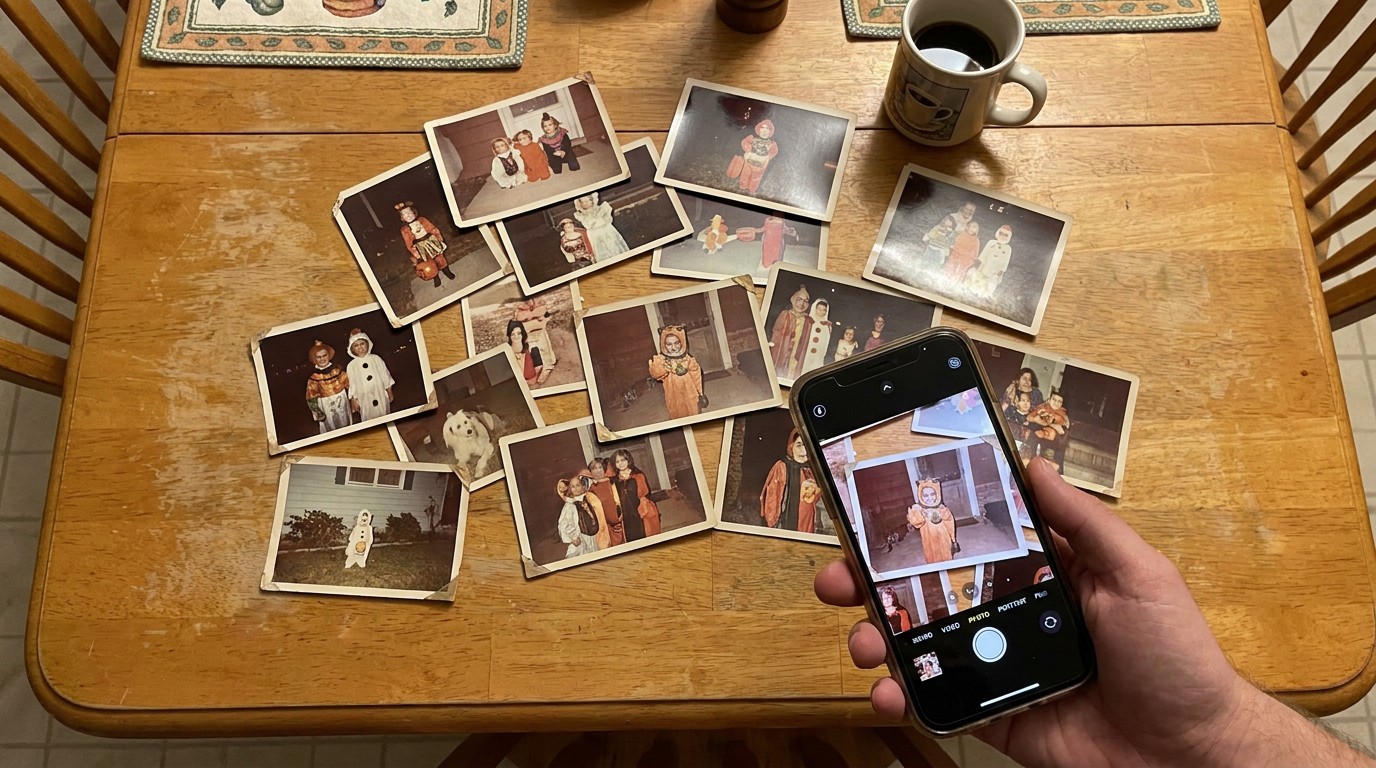
- Photograph or scan any printed photos. For older years, lay the print flat in good indirect daylight, avoid your own shadow, and shoot straight down. It won’t be archival quality but it will absolutely be good enough for a timeline, and it takes seconds per photo.
- Pull from old social posts if that’s the only surviving copy. Lugelo offers social media import, and its Chrome and Firefox extensions let you clip photos straight into a journal from the browser — genuinely useful when the only remaining copy of year one is a post from six years ago on a platform you’ve barely opened since.
- Use scan-to-text on the backs of prints. Older photographs often have a date, a name or a note pencilled on the reverse, and that handwriting is worth keeping alongside the image itself.
Backfilling also tends to be a collective activity, because the photos are distributed across a family rather than sitting on one device. This is where it helps that — the missing year-two photograph can be added directly by the grandparent who actually took it, rather than being described over the phone, emailed at the wrong resolution, and lost again.
grandparents and both parents can add their own shots to the same journal
Choosing one photo per year is the hard part
And it is genuinely hard, so brace for it.
You will find forty photos from Halloween 2021 and you will want to keep nine of them. Don’t. Pick one frame per year.The other photos aren’t deleted. They stay wherever they are. You’re not curating your camera roll — you’re pulling one thread out of it.
Your selection criteria, in priority order: full body if it exists, clearest view of the costume, child recognisably themselves and facing roughly forwards. Sharpness matters less than you think. A slightly soft photo showing the whole costume beats a pin-sharp one cropped at the waist every single time.
The sequence only reads as a sequence if each year is represented by a single image — the moment 2021 gets six photos and 2022 gets one, the rhythm collapses and you’re back to a folder of pictures.
Dating the ones you can’t place
You’ll hit photos you can’t confidently assign to a year. Detective work, in rough order of reliability: the child’s height against a doorframe, their teeth (missing front teeth date a photo with startling precision), which other children are in the shot and how old theyAnd when all that fails — approximate. “Roughly 2021” is infinitely more useful than leaving the photo out entirely. Note the uncertainty and move on.
look, the state of the garden, the car on the drive, the sofa, the phone it was taken on.
The years you genuinely missed
Mark the gap. Add one line saying why. Carry on.
The year the new baby arrived and the entire month is a blur. The year you moved house in October and Halloween happened somewhere between two postcodes. The year everyone had the same virus and nobody left the sofa. The year you were simply too tired, which is a completely legitimate reason and requires no further explanation.
Some years there is no photo. There just isn’t.
A gap is not a failure in a family record — it is the record. “2020: no photo, we didn’t go out” says something true and specific about that year, and in fifteen years it will read as history rather than omission. A sequence with a hole in it is still deeply moving. A sequence abandoned in year three because it wasn’t going to be complete is nothing at all.
I want to be blunt about this, because I think it’s the thing that stops most people: perfectionism destroys more family archives than forgetfulness ever has. The instinct that says if I can’t do this properly I won’t do itEven a well-set-up timeline, though, eventually collides with real family life. Usually in the form of a second child, and eventually in the form of a teenager who would rather not.
is the single most destructive force in personal record-keeping. Incomplete and existing beats complete and imaginary, permanently.
When the Streak Gets Complicated
Every costume timeline that fails, fails in one of about four places. Knowing where the failures happen means you can see them coming, which is most of the battle.
More Than One Child
Three approaches genuinely work. Each involves a trade, so pick with your eyes open.
Separate sequences. Each child gets their own timeline, in their own journal. This is by far the cleanest to read back, and it’s the best option if you intend to hand each child their own record when they’re grown — nobody wants their childhood interleaved with their brother’s. The cost is time on the night: two children means two setups, two rounds of cooperation, twice the negotiation.
One group shot per year. The simplest and by some distance the most sustainable. It captures something the solo shots can’t — the sibling dynamic, who’s holding whose hand, the exact year the younger one stopped being carried, the year they started standing deliberately far apart. The weakness is that individual costumes get lost in a wide frame, and the sequence takes a hit in any year one child is away, unwell or has flatly refused to participate.
Both, which is what I’d actually recommend. One group frame, then one solo frame each, all in the same spot with the same framing. If the spot and the rule are already fixed, this is still comfortably under three minutes for two or three children, because you’re not making any decisions — you’re just executing a plan you already wrote down.
One more thing worth saying: children arrive at different times, so their sequences start at different years. A second child’s timeline simply begins later, and the eldest will always have more frames. This isn’t an imbalance to correct. It’s just true, and it’s part of what the record shows.
Teenagers
This is where most sequences quietly die, so let’s handle it with some care.
Expect resistance somewhere between eleven and fourteen. It arrives suddenly, it is not personal, and it is very nearly always temporary. The child who spent October planning a costume for six weeks straight has become a person for whom standing on the front step being photographed is a genuinely excruciating prospect, and that shift is a normal, healthy part of growing up rather than a rejection of the tradition.
Four things help.
Drop the costume requirement. This is the big one. Nothing in the sequence’s value depends on there being a costume — the value comes from continuity. If they’ve aged out of dressing up, the annual photo can just be them, on the step, on October 31st, in a hoodie. The run continues uninterrupted. Fifteen years later, the hoodie years will be every bit as affecting as the dinosaur years, and possibly more so, because that’s the exact stretch of their life you have the fewest photographs of.
Hand them control. Let them see the shot. Let them veto a frame. Let them choose the pose and the expression. A teenager who gets to reject the first two frames is a teenager participating in the tradition rather than submitting to it.
Accept irony as participation. The deliberately unimpressed teenage photo — dead-eyed, arms folded, radiating suffering — is reliably one of the funniest and most beloved frames in any sequence. It is not a failed photo. It is an extremely accurate one. Let them be sardonic about it; sardonic is a form of taking part.
Show them the run.And if none of it works? Let it go for the year. One skipped year is entirely survivable. An argument about it is what actually ends the streak, because it converts a warm family ritual into a thing that gets fought about — and no tradition survives that for long.
This is the move that works most often. Most resistance evaporates the instant a fourteen-year-old scrolls back and sees themselves at five, in a costume made of a cereal box, grinning with two teeth missing. Nobody is immune to that. Very often they’ll take the photo without further comment — and quite often they’ll start caring about the sequence more than you do.
When Life Interrupts
Split households where Halloween alternates. A house move. A year abroad. Illness. A year where the 31st fell somewhere inconvenient and it simply didn’t happen.
The principle in every case is identical: keep the rule even when the spot has to change.Note what changed. One sentence. Continue.
If the child is at their other parent’s house, the photo can be taken there — same framing, same time of day, different doorstep — and someone else can add it to the shared journal directly, which is exactly the sort of situation collaborative access is useful for. If you’ve moved, use the new front door and note the move in a line. If you were abroad, photograph them against whatever door you had.
The underlying truth here, and I’d like it to be the thing you take away from this section: the sequence is resilient, not fragile. It tolerates gaps, changed locations, wildly varying photo quality, missing years and reluctant participants far better than anyone expects. A timeline with three different front doors, two missing years and one furious teenager in it is not a compromised record — it’s a truthfulSo — assume you keep it going. What does it actually become?
The only thing it doesn’t tolerate is being abandoned.
one.
What the Sequence Becomes and How to Keep It Readable
It’s one object. It behaves like one thing. And you notice this the first time you show it to anyone, because of a consistent and slightly strange reaction: nobody looks at any individual frame. Not one. They scroll the entire run, top to bottom, in about four seconds — and then they immediately scroll it again, slower.
Ten costume photographs in a row is not ten photographs.
The second pass is where it lands. That’s when people start pointing. Look how small. When did that happen? That’s the year of the shark. Watch a child’s head climb the door frame year on year — the same door, the same paint, the same house number — and there’s simply no arguing with it. You cannot feel your children growing in real time; the change is too gradual and you’re too close to it. A costume timeline is one of the very few instruments that makes it visible.
Nobody looks at any single frame. Everybody scrolls the whole run, twice.
Three ways to see the whole run
Memory Lane. The chronological timeline, where each October’s Moment sits in sequence automatically because it was filed by date the moment you added it. No folders, no sorting, no annual admin. Scrolling ten years of costumes takes a few seconds, and the fact that it takes a few seconds is the entire reason people actually do it.
A walkable gallery. The sequence can also be viewed as a 3D space rather than a scroll — one costume per wall, so you walk through the years instead of swiping them. It’s a different experience, and a surprisingly emotional one, because the years become distances you move through. You can on Meta Quest, Apple Vision Pro or a WebXR browser, and there’s a 2D preview available on any device if you don’t own a headset. Shared rooms hold up to eight people, which makes it a genuinely good thing to open with extended family at the end of October — grandparents in one house, cousins in another, everybody walking the same decade of costumes together.
view the sequence as a walkable gallery
An eBook or storybook export. The sequence as a printable keepsake, one year per page. This is the format that turns the timeline into a gift: for a child at eighteen, for grandparents at Christmas, for the wall. Printed and bound, the run has a weight that scrolling doesn’t quite replicate.
On privacy, briefly
Since this is a decade of photographs of children, one plain statement and then I’ll move on. A family journal in Lugelo is private by default and shared only with the people the owner invites — you control who has access, and you can change that at any time. Data is encrypted in transit. For a lot of parents, that’s the appeal of keeping the sequence somewhere other than a public feed: the photos still get shared with the grandparents, just not with everybody else.
The honest part: a photo sequence is a thing you tend
A multi-year photo sequence needs active care. Files corrupt. Drives fail. Formats fall out of use. Accounts get abandoned. This is true of every digital photograph you own, and it becomes more true the longer the collection lives — which is exactly the problem with something designed to span a childhood.
I’m not going to end this post pretending the timeline looks after itself, because it doesn’t, and a preservation article that overpromises isn’t worth reading.
The good news is that the people who think hardest about this have published plain, actionable advice. The Library of Congress maintains that translates neatly into family language:
guidance on keeping personal digital photographs
- Keep more than one copy, in more than one place. The LoC recommends at least two copies of anything you’ve chosen to keep, and more is better — across different types of storage, held as physically far apart as is practical. One copy on the device you use every day is not a backup. Two copies in the same house survive most things but not a fire.
- Check once a year that the files still open. The LoC’s advice is to verify at least annually that you can still read your photos, and this is the single most useful habit in this entire article. Pair it with the ritual you’re already doing: you’re standing in the hallway every October anyway, so scroll back to the oldest photo in the run and confirm it opens. Thirty seconds. Once a year. That one check catches almost every slow-motion disaster before it becomes permanent.
- Name things descriptively, and note who’s in them.
2021-halloween-shark-vampire-age-7.jpgis legible to a stranger;IMG_4471.jpgis legible to nobody, including you, in 2039. The LoC also suggests keeping a short inventory describing what’s in your collection and storing a copy of it with your important papers — for a costume timeline that’s a one-page list of which year is which, kept with the passports. - Refresh copies onto current media every few years. The LoC suggests making new copies roughly every five years, or sooner if a drive is getting old. Storage formats age out; the photographs only survive if they keep moving onto things that can still be read.
And the thing that needs saying directly: no app, Lugelo very much included, removes your need for your own backups.Think of the sequence as a thing you tend rather than a thing you set and forget — closer to a garden than a safe. Ninety seconds in October to take the photo, thirty seconds to check the old ones still open, and a copy somewhere else. That’s the whole maintenance burden, and it’s small enough to actually keep up.
A journal keeps the sequence organised, dated, captioned and in one piece, which solves the problem most families actually have. It does not replace the discipline of keeping copies elsewhere. Anyone who tells you otherwise is selling something.
Halloween Costume Timeline FAQ
When should I take the annual Halloween costume photo?
Late afternoon or early evening, before trick-or-treating begins. The costume is still intact, the child is still cooperative, and natural light at that hour is far more consistent from year to year than flash. Aim for the same time each year — around 5pm works for most families — and take it just before you leave the house, when everyone’s dressed and together.
What if I’ve already missed several years?
You’ve almost certainly got the photos already. Search your camera roll by date range, October 28th to November 1st, one year at a time — that alone usually surfaces most of them. Then check messaging threads, the other parent’s phone, and grandparents’ devices. Approximate dating is completely fine, and missing years are acceptable. Backfilling a decade typically takes one afternoon.
How do I keep the photos consistent from year to year?
Fix five things and write them down: the spot, the framing, the time of day, the photographer, and a three-frames-then-stop rule. Store that note with last year’s photo so you find it when you need it. Then, before shooting, pull up last year’s image on your phone and physically match the scene to it. That ninety seconds of alignment is what produces a decade of consistency.
How should I handle more than one child?
The most sustainable approach is one group frame plus one solo frame for each child, all taken in the same spot with the same framing — under three minutes once the rule is fixed. If you’d rather give each child their own keepsake when they’re grown, run separate sequences in separate journals. Younger siblings’ timelines simply start later, which is fine.
What do I do when my teenager refuses to dress up?
Drop the costume requirement and keep the photograph. Continuity is what gives the sequence its power, not novelty — them on the step in a hoodie on October 31st continues the run perfectly. Give them control over the frame, let them veto shots, and accept ironic participation. Showing them the earlier years usually resolves the resistance faster than anything you can say.
How do I make sure the photo sequence stays readable over the years?
Keep at least two copies in different places and on different types of storage, check once a year that the files still open, give files descriptive names, and copy everything onto current media every few years. The sets out the detail. Pair the annual check with the annual photo so it actually gets done.
Library of Congress personal archiving guidance
Is a family journal private?
A journal in Lugelo is private by default and shared only with the people the owner chooses to invite, with owner-controlled sharing you can adjust at any time. Data is encrypted in transit.

The Photo You Take This Year Won’t Look Like Much
Back to the doorstep, then, and the amber light, and the child who is absolutely certain about the dinosaur.
The photo you take this October will be unremarkable. It will look like every other photo you took that night, and when you look at it on November 1st you will feel nothing in particular about it. That is exactly as it should be — the value of an annual photograph isn’t created on the night. It accrues. Quietly, in the background, at a rate you won’t notice until year five, when someone glances at the run and says ohNinety seconds a year. One frame. One rule, written down once. Keep a couple of copies somewhere sensible and check them each October when you take the new one, and the sequence will still be there when you want it — which, sooner than feels possible, will be at an eighteenth birthday, or a wedding, or an ordinary Tuesday when someone asks what they were like as a child and for once you can just show them.
.
So here’s the only thing to do this week, before the 31st arrives and the moment slides past for another year: decide the spot, and write down the rule. That’s it. Four minutes at the kitchen table. Everything else in this article is optional; that one step is what makes the rest possible.
And if the idea of a recurring thread that quietly compounds appeals to you, the costume timeline is one of several — the same thinking applies to first days of school, to birthdays, to the same walk taken every New Year’s Day. We laid out the wider version of the idea in , which is the natural next read.
The Family Memory Book: Preserving a Life, Not Just a Camera Roll
Set up this year’s Moment before October 31st, and let Memory Lane keep the rest in order. Lugelo is free on iOS, Android, Web and HarmonyOS, with Chrome and Firefox extensions, no ads, and an optional Plus tier if you want more.
Start Journaling