
Holiday Travel Planning: Set Up the Trip Journal Before You Pack
The suitcase is open on the bed, about a third full. There’s a stack of folded jumpers that will not survive the zip, a wash bag you’ve already packed and unpacked twice, and one shoe. The mental list is running on a loop — passports, the charger, the otherAnd there is exactly one thing that isn’t on it, that takes five minutes, and that determines whether you’ll be able to remember this trip in five years.
Every item on that list matters enormously for the next seven days.
charger, the adapter, the present for your aunt that is definitely still in the boot of the car. Someone is shouting up the stairs asking what time you’re actually leaving, and the honest answer is later than you said.
That’s the whole argument, so here it is plainly: five minutes before you leave is worth an hour after you’re back.This isn’t a guide to journalling on the road, and it isn’t a guide to writing the thing up when you get home. We’ve covered both of those elsewhere — including, as it happens, a whole piece that opens on this same suitcase, dumped in the hallway, half-unpacked, three days after landing. This one catches the suitcase at the other end of the journey.
Not a philosophy. A scheduling observation. The five minutes you spend with the suitcase still open buys back an hour of squinting at photo timestamps in February, trying to work out whether the good night was the Tuesday or the Wednesday.
This is the part of travel journaling almost nobody writes about, because it happens before the trip does. It’s the setup. Six small decisions, made at home, with both hands free.
Then you close the case.
The One Item That Isn’t on Your Packing List
Late November through early January is the densest travel stretch of the year, and the numbers are genuinely difficult to picture. AAA’s forecast for Thanksgiving 2025 put the figure at , with 73.3 million of them going by car. The year-end stretch is bigger still: AAA projected .
122.4 million travellers across the 13 days from late December 2025 into January 202681.8 million Americans travelling 50 miles or more
That’s a lot of people in cars on the same motorways, eating the same service-station sandwich, arriving at the same slightly overheated houses.
And here’s the thing that’s always struck me as slightly absurd about it.
The trips we most want to keep are the ones we’re least likely to record.
Think about which trips those actually are. Christmas at your parents’ house. The first year everybody’s partners came and nobody quite knew where to sit. The year the new baby was passed around the table like a parcel. The last year your grandparents made the journey, which nobody knew was the last year at the time, because nobody ever does.
These are the highest-stakes trips of anyone’s life. They are also, reliably, the most chaotic — and chaos is what kills documentation.
Holiday trips resist journalling in a way that ordinary holidays don’t. On a normal trip you’re a tourist. Tourists have idle afternoons. You sit outside a café with a coffee going cold, waiting for a museum to open, and there is genuinely nothing else demanding your attention for forty minutes. That’s when people write things down.
A holiday visit gives you none of that. You’re not a tourist, you’re a participant. There’s a turkey with an internal temperature that someone needs to be monitoring. There are relatives who want to talk to you specifically. There’s a schedule you have absolutely no control over, set by whoever owns the kitchen. There are children in a state of sugar-driven ascent. Nobody gets a quiet hour with a notebook, and the one person who tries is going to be interrupted within four minutes to help find the good scissors.
So the trips with the most worth remembering come with the least opportunity to remember them in.
Now compare that to how carefully we plan the rest of it.The fix takes five minutes and happens before you leave the house. I’ll come to exactly what it involves shortly.
That’s not a criticism, and there’s no scolding here — the logistics are urgent and the memory isn’t, and urgent always wins. But it does mean the single highest-return item you could add to the packing list is the one nobody thinks to add, because it doesn’t feel like packing.
Not one item on that list is aimed at the next fifty years.
Every bit of that planning is aimed at the next seven days.
Holiday travel planning is a genuinely impressive feat of domestic logistics. People colour-code departure times. They plan around traffic on the M6. They pack the car in a particular order so the pushchair comes out first. They remember, unprompted, that one nephew is dairy-free and another has developed strong opinions about mash.
One caveat before we go on: if you’ve landed here after a trip rather than before one, this is the wrong post for you and you should start with For everyone still packing — the reason journals fail isn’t the reason you think.
our full guide to making a travel journal
instead. That one is written for the suitcase in the hallway, and it covers reconstructing a trip you’ve already taken. Come back to this one in the spring, when you’re packing again.
Why Travel Journals Die on Day Three (It Isn’t Discipline)
You already know how this goes, because a version of it has happened to almost everyone who has ever meant to keep a journal.
Day one is excellent. You write a proper entry. It’s long, it’s got a bit of scene-setting in it, you describe the drive and the weather and the strange man at the petrol station. You feel briefly like a person who keeps a journal. You reread it and it’s genuinely quite good.
Day two is shorter. Still fine. A paragraph. You mean to come back and add the photos.
Day three is a hotel room at 11:40pm. Or the spare room at your sister’s, or a childhood bedroom that is now an office with a bed in it. Everyone else is asleep. You’re sitting on the edge of the mattress holding your phone, and the day was actually a good one — there was a thing your dad said at lunch that you want to keep — and you open your phone and there is nothing there.
No journal. No title. No structure. No decision, ever made, about what this thing is supposed to look like.
So you don’t.
Here’s the diagnosis: the journal didn’t exist yet. That’s the whole failure, and it’s worth being precise about it, because the standard explanation — that you lack discipline, or aren’t a journalling sort of person — is not just unkind, it’s wrong.
On day three you weren’t being asked to write. You were being asked to invent a system. At 11:40pm. In an unfamiliar room. While tired. With a decision to make about organisation and format that you had never previously considered and had no reason to have an opinion about. And then, only once that was resolved, to write something good.
That is an enormous ask disguised as a small one. It fails for the same reason people don’t start tax returns at midnight.
Four decisions were never made, and every one of them was needed at 11:40pm. The journal wasn’t created. Nobody was invited into it. There was no structure. And there was no agreed rule about what anyone was actually supposed to contribute.
Each of those is a five-second decision at your kitchen table. Each of them is a genuine, momentum-killing obstacle in a dark room in another country.
Now run the counter-case.
The journal already exists. It has a name — a real one, with a place in it. It has a cover photo, so it doesn’t look like an empty form. There are three other people already in it, two of whom have added something. There are two prompts sitting there waiting, so there’s no blank page.
Day three now asks you for one sentence.
That is a completely different request, made of the same person, in the same tired state, at the same time of night. Nothing about you changed. The friction did.

Nobody abandons a travel journal because they don’t care about the trip. That’s worth saying directly. The people who abandon them are, overwhelmingly, the people who cared enough to start one — the indifferent never open the app at all. What defeats them is friction they had no reason to anticipate, arriving at the exact moment of the day when they have the least capacity to deal with it.
You didn’t fail. You were handed a design problem at midnight and asked to solve it while yawning.
There are three separate jobs here, and they’re often confused with one another. Capturing things while you’re moving — in the car, on the road, between places — is one job, and it has its own techniques. [TO BE ADDED AT PUBLISH — link to post #11, keeping a road trip diary] Reconstructing a trip after you’re home, from photos and card statements and the messages you sent your sister, is a second job, and that’s what This post is about the third job. It’s the cheapest of the three by a distance, it takes five minutes, and it makes the other two dramatically easier — which is a strange thing about setup work generally. It’s the least interesting part and it does the most.
the pillar guide
is for.
If you’ve never used a journalling app and you’re quietly wondering what “setup” even means in practice, Right. Four decisions missing. Let’s make all of them before the suitcase closes.
here’s how digital journaling works in plain English
— no jargon, no assumed knowledge.
The Five-Minute Pre-Departure Setup, Step by Step
Six steps. Five minutes. All of them done at home, with both hands free, on a wifi connection that works, while you are fully awake and not in a room belonging to somebody else.
That last part is the whole point. None of these steps is difficult. Every one of them is nearly impossible at 11:40pm on day three, which is precisely why they belong on the packing list.
Create the journal and name it something specific
Name it “Christmas in Edinburgh 2026.” Not “Holiday.” Not “Trip.” Not “December.”
This sounds like a triviality and it is quietly the most important step of the six.
A vague name signals a vague commitment, and — more practically — it creates a container you can’t add anything to without first deciding what it means. You cannot put a Moment into “Holiday,” because “Holiday” isn’t anywhere. You’d have to work out what belongs in it first. But you can put anything at all into “Christmas in Edinburgh 2026,” instantly, without a single thought, because you know exactly what that is and whether the thing in your hand goes in it.
Naming is the cheapest commitment device available to anyone. It costs one line of typing and it converts a vague intention into an actual object with edges.
There’s a second benefit that arrives much later. In nine years, when you’re trying to find this, “Christmas in Edinburgh 2026” is a thing you would plausibly type into a search box. “Holiday” is not, and neither is “Untitled Journal 4.”

Add a cover photo before you go
You’re removing the blank-page feeling before the blank page ever gets a chance to appear. Thirty seconds.
An empty journal with a grey placeholder where the image should be looks like an unfinished chore. A journal with a cover photo looks like something that has already started — and adding to something that has started is a fundamentally easier psychological act than beginning something that hasn’t.
The point isn’t aesthetics, and it certainly isn’t curation.
Anything will do. Last year’s photo from the same trip. A picture of the city off the internet. A photo of the tickets sitting on the kitchen table next to the car keys and a mug.
Decide the structure now, in five seconds
By day, by place, or by route.
Rule of thumb: by day for short trips, by place for anything over a week, by route if the trip is essentially a drive and the sequence is the story.
That’s deliberately brisk, because this genuinely isn’t the post for the full argument — in the pillar guide, including why place beats day more often than people expect. Go and read that if you want the reasoning.
we’ve laid out the complete case for organising by day, by place, or by theme
What matters herePick one. Five seconds. You can always regroup the entries later, and nobody is going to inspect it.
is not which structure you pick. It’s that the decision gets made before departure, so that no entry, ever, begins with a format question. A format question at midnight is how you end up writing nothing.
Pre-load two or three prompts
Thirty prompts is a library, and a library is something you browse rather than answer. Two or three prompts sitting in the journal are a starting point — day one already has somewhere to go, and the first entry doesn’t require you to invent a subject.
Two or three. Not thirty.
If you want prompts shaped to the specific kind of trip you’re taking, there’s a fuller set coming: [TO BE ADDED AT PUBLISH — link to post #2, travel journal prompts by trip type] And if choosing feels like one more decision you don’t want, the AI Journal Assistant will generate prompts from a few words about the trip, and there are templates if you’d rather start from a shape that already exists.
But here’s the one I’d genuinely insist on.
Write one Moment before you leave.Ninety seconds. And it is, reliably, the entry people most enjoy reading back afterwards, because it’s the only one in the entire journal written before you knew how any of it went. Everything else is written with hindsight. This one isn’t, and that makes it strange and rather moving to reread — a small letter from someone who didn’t know yet.
What are you expecting? Who are you slightly nervous about seeing? What do you want this trip to be — and what do you suspect it’ll actually be? Is there a conversation you’re hoping happens, or one you’re hoping doesn’t?
Not on the plane. Now, with the suitcase open.
Download the app at home, and sort out the signal problem
Install it now, on your own wifi, with a working connection and nobody behind you. Not at the gate. Not in the airport queue with a boarding pass in your teeth.
Get it set up before you leave, not at the airport.
Then the genuinely relevant technical point, which matters more on holiday trips than on any other kind:
Offline capture is built in by default. There is no setting to enable.
The mobile app captures Moments — text, photos, videos, voice recordings — with no internet connection at all, and everything syncs automatically the moment you reconnect. You don’t switch anything on, you don’t tick a box, and you don’t need to have remembered any of this in advance.
Consider where you actually are during a holiday trip. On a plane. In a car on the A9 with one bar. In a farmhouse where the wifi password is written on a card that stopped being correct in 2019. At your grandmother’s, where the signal works in exactly one corner of the kitchen and everybody knows which corner.
Those are the parts of the trip where you’re least likely to have a connection and most likely to have something worth recording. A journal that requires signal is a journal that quietly fails during the best bits.
cover the rest of what’s useful on the road — location-tagged entries that build a personal map of where you actually went, speech-to-text for when typing is impractical, and one-tap eBook or PDF export for afterwards.
Lugelo’s travel journaling features
While you’re in checklist mode: . This is the one for everything that happens in it.
the TSA has a checklist for everything going in the case
Set one reminder, for the first evening only
And the first Moment is the only genuinely hard one. Once there’s something in the journal, the thing has visibly begun, and additions are additions rather than beginnings. Momentum handles the rest, and on a shared journal other people’s Moments do the reminding for you far more effectively than a notification ever will.
One notification on the first night does something completely different. It gets the first Moment in.
This is counterintuitive enough to be worth defending. A daily reminder feels like the responsible option, and it’s actively harmful. By day three, a recurring notification has become noise, and you dismiss it without reading it. By day four you’re dismissing it reflexively. What you have built, with the best intentions, is a small daily machine that trains you to ignore your own journal.
One. Not a daily recurring reminder.
The total cost
Six decisions:
- Create the journal and give it a specific name.
- Add any cover photo at all.
- Choose day, place, or route — in five seconds.
- Drop in two or three prompts, and write one Moment before you leave.
- Install the app at home; offline capture is already on.
- Set a single reminder for the first evening.
Five of those six you can do entirely on your own. The sixth — the one that changes the trip most — involves everybody else, and its timing is everything.
None of them is difficult. Not one requires taste, effort, or a decision you’d need to think about twice. Every single one of them is close to impossible once you’re tired and elsewhere.
Invite Your Travel Companions Before You Leave — Not on Day Four
Here’s the insight that took me embarrassingly long to notice, and it’s the most useful thing in this post.
Invite people before departure and contributing is the default. Ask on day four and you’re requesting a favour from people in holiday mode.
Identical request. Identical journal. Identical group of people. Completely different social weight — and the only variable that changed is when the invitation arrived.
, and then let me explain why the timing does so much work.
Set up a collaborative journal before you go
Before the trip, everybody is in logistics mode. The family thread is already full of admin. What time are you setting off. Has anyone got the postcode. Don’t forget the folding chairs. Is Ellie’s train getting in before six. Everyone’s phone is in their hand, and everyone is in a frame of mind where incoming trip-related items get processed immediately, because that’s what the last three days have consisted of.
An invitation to a trip journal, dropped into that thread, is simply one more piece of trip admin. It gets accepted in four seconds, between two other messages, without any deliberation whatsoever. Nobody asks what it’s for. It’s obviously for the trip. Everything in the thread is for the trip.
On day four, that context is gone. Everyone has decompressed. Phones are face-down. Your brother-in-law is asleep in a chair. Someone is halfway through a jigsaw and there’s a film on that nobody is watching properly.
Into that, you send an invitation, and you have just become the person asking their family to do homework on their holiday.
You will get a “yeah, sure.” You will get several. You will get precisely nothing else, and the reason isn’t that they don’t care — it’s that you’ve asked people to adopt a new habit at the exact point in the week when adopting new habits is least appealing.
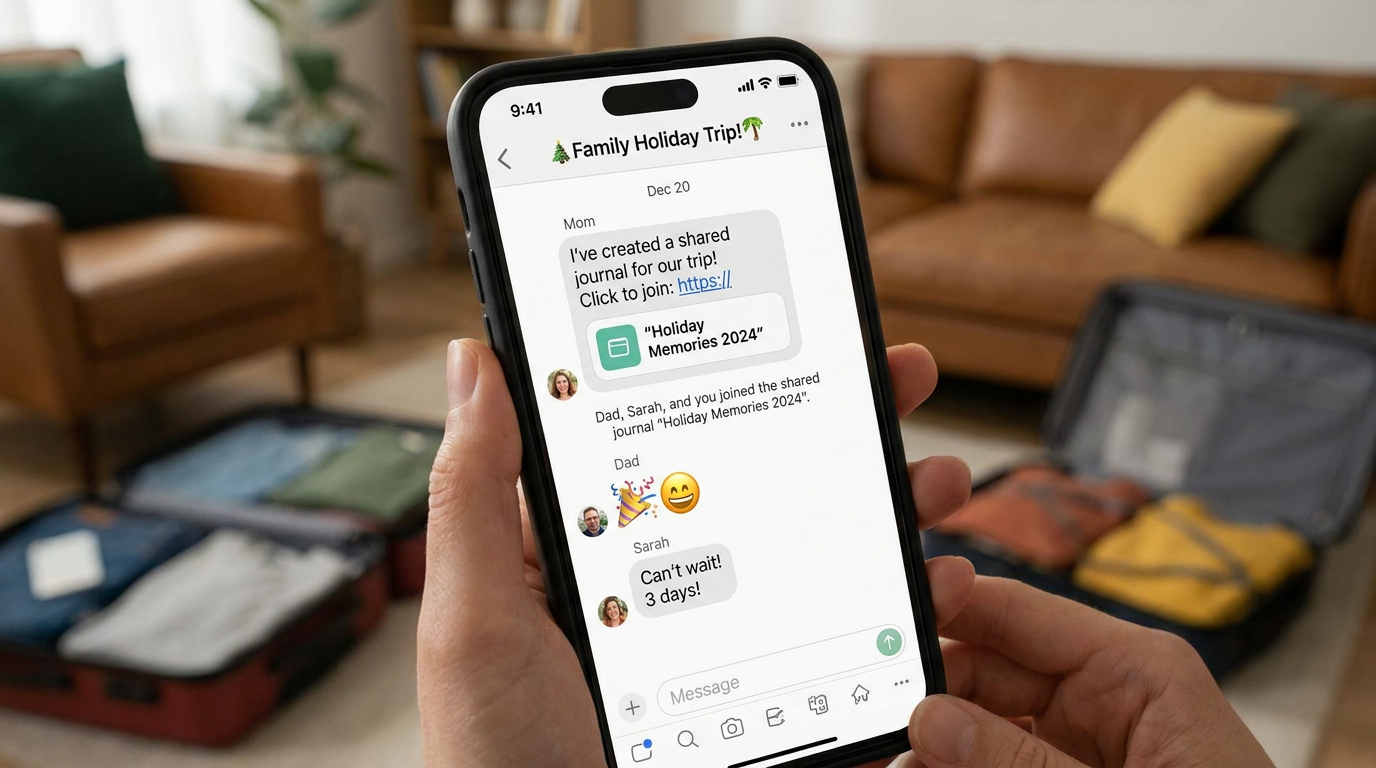
“Invite people in advance and contributing is the default. Ask on day four and you’re asking for a favour.”
There’s a compounding effect that makes the early invite worth even more than it first appears.Content recruits contributors. An empty journal recruits nobody, no matter how many times you mention it at dinner.
And a journal with three people’s Moments already in it recruits the fourth person entirely on its own. Nobody has to nag. Your cousin opens it, sees photos she wasn’t there for and a voice note from her dad, and adds something within the hour — not because she was asked, but because everyone else obviously is, and the thing is visibly alive.
People who accept before departure start contributing from day one. Which means the journal has content in it before anybody needs reminding of anything.
The mechanics, which take about a minute
There’s no hard limit on contributors. In practice, family and couples journals tend to run two to eight people. Weddings and reunions can run to dozens.
The person you’ve invited creates a free account in under a minute and lands directly inside the journal. Not on a homepage. Not in a tutorial. In the journal, with your cover photo at the top, which is the entire reason step two mattered.
Open the journal. Tap Share or Invite. Send the link however your family already communicates — email, message, or whichever chat app the group thread lives in. There’s no benefit to introducing a new channel for this; use the one people already check.
Permissions, in plain English
Not everybody should have the same access, and holiday trips are exactly where that starts to matter — because the group of people who’d like to see the trip is nearly always larger than the group who were on it.
Viewer is for the relatives who’d love to look but will never add anything. Your great-aunt. The cousins in Vancouver. People who want to see the photos and have no intention of writing a word, which is a perfectly reasonable way to be.
Contributor is for everyone actually on the trip. This is most people, and it’s the setting you’ll use by default.
EditorThose are the entries you’ll actually want in ten years. You only get them if nobody feels watched.
That last point is more central to a family trip than it might sound. A shared Christmas journal is not a social media post. Nobody is performing. There’s no audience, no reach, no algorithm deciding which of your photos deserved better. Which means people write the true version — including the bit about the argument over the parking, and the fact that the second day was a bit flat, and that someone cried in the car on the way home for reasons nobody has raised since.
The journal owner controls who’s invited and can revoke access at any time. Journals are private by default, sharing is owner-controlled, and entries are encrypted in transit.
is for the one person — and there is always exactly one — who will tidy the whole thing up afterwards, reorder the muddled bits, and turn it into an eBook to send round in January. Give them Editor before you leave and they’ll thank you for it later.
Everyone’s on a different device, and that’s fine
It works across all of them — iOS, Android, HarmonyOS via the Huawei AppGallery, and the web, with Chrome and Firefox extensions. Contributions appear in the shared journal in real time, so when your mother adds a photo from the market, it’s simply there for everybody else, and nobody has to send anything to anybody.
The realistic composition of a family trip: your mother is on an Android phone she’s had for six years. Your brother has the newest iPhone and mentions it. Your father will not install anything and will only ever use the laptop in the study. One cousin has a Huawei.
If you want more depth on splitting the work between several contributors, covers the same process for a different occasion — the mechanics transfer directly. And if you’ve watched a group holiday scatter across five camera rolls and a shared album nobody opened again, Everyone’s in the journal before departure. Now there’s one last thing to settle, and it has to be said out loud.
here’s what friend groups are doing insteadour step-by-step guide to co-creating a shared journal
.
Agree One Capture Rule Out Loud Before the Trip Starts
Here it is.
One photo and one line before bed.
That’s the rule. Say it out loud, once, in the car or at the departure gate or over the first dinner. Then never mention it again.
“Out loud” is doing most of the work here. An invitation is a piece of software. A rule spoken to a group of people is a social agreement — and on holidays, social agreements are what actually get followed. Everyone knowing that everyone else agreed is the entire mechanism. It’s the same force that gets people into cold water.
The rule has to be embarrassingly small. This is the part people get wrong.
An ambitious rule — “let’s all write a proper entry every night” — gets agreed to with real enthusiasm and is dead by Tuesday. Not because anyone stopped caring, but because the first time someone misses it, they’ve failed, and people who feel they’ve failed at something optional quietly stop doing it rather than catch up.
A rule that takes forty seconds cannot be failed. There is no version of your evening that doesn’t have forty seconds in it.
And the small rule reliably overdelivers. People who commit to one line frequently write four, because starting was the hard part and they were already typing. Nobody who commits to a full entry writes a full entry on day five.
Do not run an app tour.Voice notes, photos, video clips and text all count as Moments, so “one line” can be spoken rather than typed on the nights when typing feels like too much.
Adapt it to who’s there. Teenagers do a photo and a caption, which is a format they already have strong native fluency in. Grandparents do a voice note — often the best material in the journal. Small children pick the photo of the day and tell you what to write underneath it, word for word, including the bits that don’t make sense.
One rule and one already-created journal beats a demonstration every single time.
This is the commonest mistake. Someone gathers the family in the kitchen and starts explaining features. Everybody is slightly bored, nobody retains any of it, and the whole thing acquires the atmosphere of a work meeting on Boxing Day.
Forty seconds a day, from everybody. That’s it. What you do with the material afterwards is a separate and much more enjoyable problem, covered in The rule holds for almost any trip. Holiday travel, though, has some particular complications worth planning for directly.
the travel journal method
.
Holiday-Specific Realities: Multi-Generational Trips, Small Children, and the Return Leg
General advice tends to fall apart on contact with an actual family Christmas. So here are the four situations that come up every year.
Multi-generational trips. These produce the most valuable journals you will ever make, and they are the hardest ones to run, because the technology comfort gap across three generations is enormous and no single approach suits everybody in the room.
The fix is set before departure, not during. Grandparents get Contributor access, and their format is the voice note. Not because typing is beyond anyone, but because a seventy-eight-year-old telling a story out loud for ninety seconds will give you something a typed paragraph structurally cannot — the actual voice. The pauses. The particular way they say a name. The laugh at the end when they realise they’ve gone off on a tangent.
Worth saying plainly: the oldest people at the table are usually holding the stories nobody else has heard. Not the famous family anecdotes that get retold every year, but the ones nobody has ever thought to ask about — what the street looked like, who lived next door, what they were doing the winter they were twenty-three. A holiday gathering is very often the only occasion in the calendar when three generations are in a room with time on their hands, and it’s the only realistic opportunity anyone gets to ask.
Set that up in advance and the trip captures something that isn’t really about the trip at all.

Travelling with young children.Children can also be given a job, and they take it more seriously than you’d expect. Choosing the photo of the day is a genuine, meaningful role to a six-year-old. They will deliberate. They will reject your favourite. And the journal becomes partly theirs, which changes how they relate to it later — a child who chose the photos is a fourteen-year-old who scrolls back through them.
Set the expectation accordingly, because the failure here is almost always ambition rather than capacity. The realistic version is photos captured during the day — which you’re taking anyway — and thirty seconds after bedtime, when the house goes suddenly, gloriously quiet and you’re sitting on the stairs.
Let’s be realistic: you will not be journalling in the moment. You will be managing a small person who has strong feelings about their coat.
For the logistics side of flying with children, covers screening, what you can bring, and how the process actually works with a pushchair.
the TSA’s guidance for families flying together
Splitting up during the day and reconvening. Extremely common on holiday trips and rarely planned for. Some of the group goes to the market. Some stay at the house with the oven. Someone takes the children to burn off energy somewhere with a slide. Everyone reconvenes at five with three different afternoons behind them.
This is precisely where a shared journal outperforms one person’s account, and it’s not a small margin. Everybody adds their half of the day, and the day reassembles itself on the Memory Lane in the right order without anyone coordinating anything.
Crucially, nobody has to be the designated documenter. That role — one person quietly appointing themselves the family archivist, taking all the photos, in none of them — is thankless and produces a one-sided record. Distributing it produces a better journal and a better holiday for the person who’d otherwise be doing it.
The return leg is the natural review window, and almost nobody uses it.Offline capture matters here specifically. A plane is the single best journalling environment of the entire trip — no signal, no interruptions, nowhere else to be, everyone sitting still — and it has no connection at all. Write the whole thing at 35,000 feet. It syncs when you land.
Twenty minutes on the way home is worth hours in February. Fill the gaps. Add the photos nobody got round to uploading. Argue productively about what actually happened on the Sunday. Name the day everyone keeps calling “the good dinner,” so that in nine years it’s a Thursday with a restaurant attached rather than an unplaceable warm feeling.
Look at what’s true in that moment: everyone who was on the trip is together, in one place, with nothing whatsoever to do, and the trip is still completely vivid. That combination does not occur again. Within a week everyone’s back at work and the details have started their slow slide into approximation.
The flight home. The four-hour drive. The train with the table seats.
Afterwards, the trip can become an eBook, a Memory Lane you scroll end to end, or a VR Gallery you can step back into. That’s a separate subject and handles it properly. And if the real problem is that you came home with two thousand photos and no idea what to do with them, A few practical questions tend to come up before people close the tab.
we’ve written about exactly thatthe pillar guide
.
Holiday Trip Journal FAQs
When should I set up a travel journal — before or during the trip?
Before. The setup takes about five minutes and it removes every decision that would otherwise have to be made in a hotel room at midnight. Setting up during the trip means inventing a system while tired, which is the single most common reason travel journals get abandoned around day three.
What should I name my trip journal?
Something specific, with a place and a year in it. “Christmas in Edinburgh 2026” beats “Holiday” comfortably. A specific name creates a container you can add to without thinking, and it’s the sort of thing you’d actually be able to find by searching for it in nine years’ time.
How do I get my family to actually contribute to a shared trip journal?
Invite them before departure rather than during, and agree one small rule out loud — one photo and one line before bed. Invited in advance, contributing becomes the default. Asked on day four, it becomes a favour, and you’ll get agreement without follow-through.
Can I journal while travelling without an internet connection?
Yes. Offline capture is built in by default and there’s nothing to enable. Text, photos, videos and voice recordings are all captured without a connection and sync automatically once you reconnect. Useful on planes, in cars, and in houses where the signal only works in one corner of the kitchen.
How many people can contribute to a shared travel journal?
There’s no hard limit. Family and couples journals typically run two to eight contributors. Larger gatherings — reunions, wedding trips, big multi-household Christmases — can run to dozens without any difficulty.
Can I control who sees the journal?
Yes. Journals are private by default, and the owner controls access on a per-person basis: Viewer for people who’ll only look, Contributor for everyone on the trip, Editor for whoever tidies it up afterwards. Access can be revoked at any time.
What if I’ve already taken the trip and didn’t set anything up?
That’s a different job and an entirely doable one. You can reconstruct a trip from photo timestamps, card transactions and the messages you sent people at the time. walks through the whole process.
Our guide to making a travel journal after the trip
Is it free?
Lugelo is free on iOS, Android, HarmonyOS and the web, with Chrome and Firefox extensions, and Safari coming soon. There’s an optional Plus tier. No ads, and no credit card needed to sign up.
How long does setting up a trip journal actually take?
About five minutes. Create and name it, add a cover photo, pick a structure, pre-load a couple of prompts, invite your travel companions, and set one reminder for the first evening. Every step is a small decision, and all of them are far easier at home than abroad.

Conclusion: The Five Minutes Goes In Beside the Chargers
The suitcase is closed now. It’s by the front door with the coats piled on top of it and someone’s scarf hanging off the handle. The passports are in the bag, in the pocket you’ll check four more times. The chargers are in the side compartment. The thing you always forget is, once again, upstairs, and you will remember it somewhere near the second roundabout.
Five minutes before you leave is worth an hour after you’re back.It takes ninety seconds, and it will surprise you more than anything else in there when you read it back — because it’s the only entry written by someone who didn’t yet know how it went.
One last thing, and it’s the bit I’d genuinely not skip: write that first Moment before you go. What you’re expecting. Who you’re looking forward to seeing. What you quietly hope this one turns out to be.
This is also, as it happens, where we came in. Sixty days ago we started with a suitcase in a hallway, half-unpacked, and a trip that had already begun to blur at the edges. This time the suitcase is by the door and the journal already exists. Same object. Opposite end of the story.
Nothing here is guaranteed. Nothing is permanent, and anyone who tells you otherwise is selling something. But a trip that has a journal already open — named, covered, populated, with four people in it and a rule everyone said out loud in the car — is a trip you’re far more likely to still have hold of when you want it. That’s the honest offer, and I think it’s enough.
That’s it. The setup belongs on the packing list, right next to the chargers, because it costs about the same amount of attention as the chargers and it’s the only item on that list still doing anything in five years’ time.
Don’t Just Live It — Keep It
Free on iOS, Android, HarmonyOS and the web. Private by default, with owner-controlled sharing.
Create the journal, invite the people you’re travelling with, and close the suitcase.