From Watch Parties to Memory Lanes: Capturing Every Group Stage Moment with Friends & Family on Lugelo
There’s a specific kind of magic that only exists inside a living room during a World Cup match. The lights dimmed just enough. Someone’s made way too much food. The pre-match predictions are flying — confident, chaotic, completely wrong — and the group is buzzing with that particular cocktail of nerves and joy that only football can brew. You’re not just watching a game. You’re in it together.
Right now, in Week 2 of the FIFA World Cup 2026, that magic is happening night after night. France vs. Senegal on June 16. England vs. Croatia on June 17. USA vs. Australia on June 19. Spain vs. Saudi Arabia on June 21. The group stage is in full swing — and for millions of households across the country, these matches are more than sporting events. They’re occasions. Gatherings. Rituals.
This is already the biggest World Cup in history. Forty-eight teams. One hundred and four matches. Sixteen host cities spread across the United States, Canada, and Mexico. And according to a study highlighted by Sports Business Journal and Goal.com, 75% of Americans plan to follow the 2026 World Cup in some capacity. The scale of shared fandom is genuinely staggering — a once-in-a-generation cultural moment unfolding in real time across living rooms, bars, backyards, and fan zones from Los Angeles to Boston.
But here’s the question nobody asks in the middle of the celebration: What happens to all of this after the final whistle blows?
The laughter when someone’s ridiculous score prediction somehow landed. The half-time argument about tactics that lasted well into the second half. The photo of everyone’s faces in the exact moment the goal went in. The voice note someone sent at midnight that perfectly captured how the night felt. These are the textures of real shared experience — and almost all of them disappear. Into group chats. Into camera rolls. Into memory, which is the most unreliable archive of all.
That’s where collaborative journaling for group events changes everything. And that’s where Lugelo comes in — not as a tool, but as the place where scattered watch party moments become a story the whole group can keep forever.
The Group Stage Problem: Big Moments, Scattered Memories
The group stage of the 2026 World Cup is the most gloriously chaotic stretch of football on the planet. From June 15 through June 21 alone, the schedule is relentless in the best possible way. England vs. Croatia on June 17. Argentina vs. Algeria on June 16. USA vs. Australia on June 19. Brazil vs. Haiti on June 19. Spain vs. Saudi Arabia on June 21. Every night brings a new reason to gather, a new set of predictions to make, a new batch of moments to react to together.
The watch party culture that builds around this kind of schedule is real and it is vivid. But the aftermath? That’s where things get messy.
Think about what actually happens in the hours and days after a big group stage match. Someone’s got 200 photos across three different phones, most of them blurry mid-reaction shots. There are at least four separate WhatsApp threads, each carrying fragments of the pre-match banter and the post-match fallout, now buried under dozens of football memes and an argument about whether the referee was right. The prediction sheet — the physical one, the one with everyone’s handwriting on it and the running tally of who was right — is somewhere on the coffee table. Or maybe it got recycled. The voice note someone sent during the penalty has been unlistened to by half the group. The photo of the goal celebration in the living room is in three different camera rolls and nobody’s shared it to anyone.
This is the default experience of group memory. Not because people don’t care — they care deeply — but because there’s no system. No shared home for all of it.
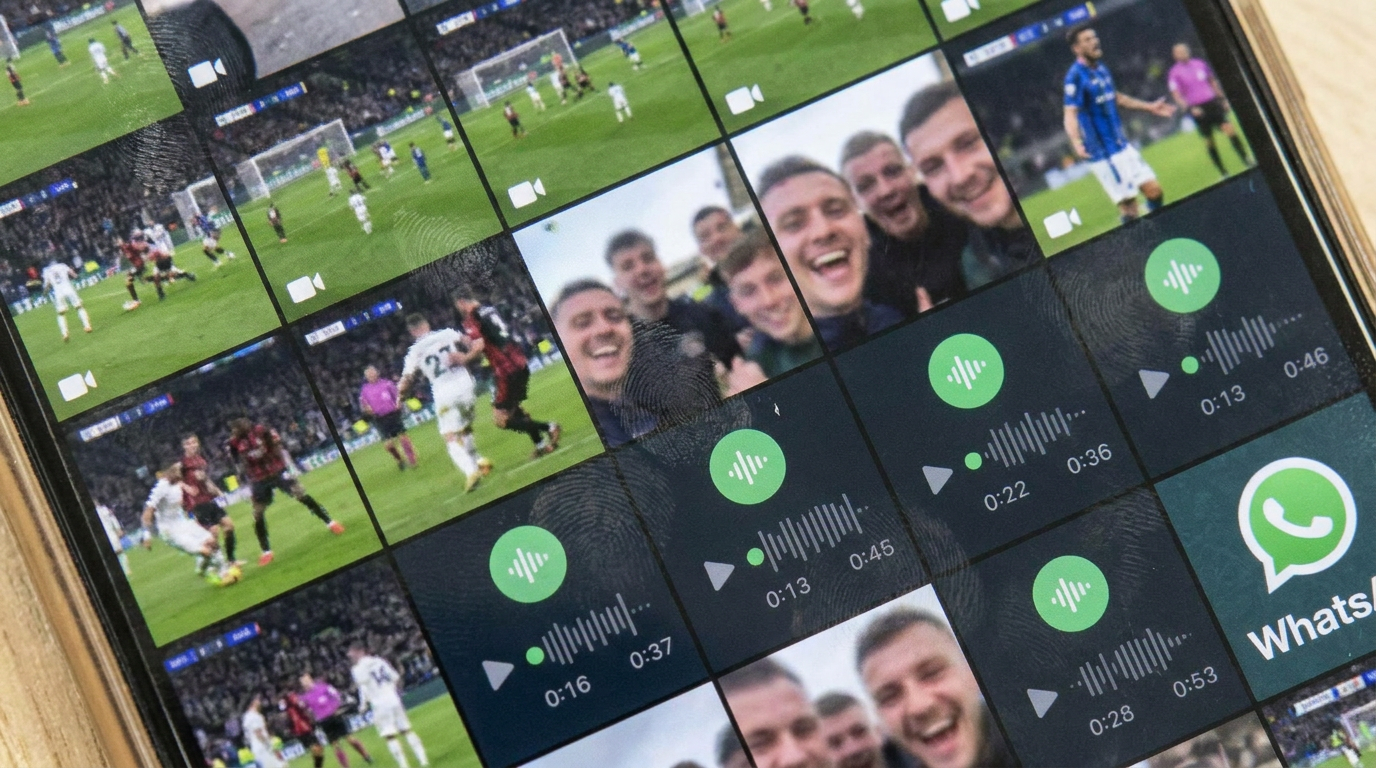
The psychology here is important. Researchers have long understood that shared memories are the connective tissue of group identity — but only when those memories are actively preserved and revisited together. A moment that lives only in someone’s individual camera roll isn’t really a shared memory. It’s a personal memory that happened to occur in the presence of others. The distinction matters more than most people realize. When memories are documented collectively and returned to as a group, they become part of the story the group tells about itself. That’s how watch parties become lore. That’s how “remember the night of the Argentina match” becomes a sentence that means something to everyone in the room.
Social media offers an imperfect workaround. People post their highlight moments — the best photo, the most quotable reaction, the neatest summary of the night — and it captures a fragment. But social media posts are fragments by design. They don’t capture the pre-match prediction. They don’t carry the half-time debate. They don’t preserve the moment someone’s absurd 4-1 scoreline call turned out to be exactly right. They show the world that the evening happened; they don’t tell the group what the evening actually felt like.
The natural antidote to all of this is a shared journal for a World Cup watch party — one place, every contributor, every perspective, every moment. A single living record of the whole group stage experience, built collaboratively by everyone who was there. That concept isn’t new — people have been keeping scrapbooks and memory boxes for generations. What’s new is having a tool that makes it effortless, beautiful, and genuinely collaborative, regardless of how many people are involved or what devices they’re using.
That’s exactly what the next section is about — because setting one up is far simpler than it sounds.
Creating Your World Cup Collaborative Journal on Lugelo
Here’s what most people don’t realize about starting a collaborative group journal: it doesn’t require planning, technical skills, or even much time. On Lugelo, it takes about as long as it does to set up a new WhatsApp group — except the result is infinitely more beautiful and actually permanent.
The idea is simple: you create a dedicated journal for your World Cup 2026 watch parties — call it something like “World Cup 2026: Our Group Stage Journey” or “Watch Party Diaries: The Lads vs. the World” — and that journal becomes the shared home for everything your group captures over the course of the tournament. Every match entry. Every photo. Every voice note. Every prediction. Every post-match verdict. All of it, in one place, organized and accessible to everyone you invite.
Inviting contributors is as straightforward as sharing a link. Once your friends and family are in, each person can add their own photos, notes, voice reactions, and match predictions directly from their phone — whether they’re on iOS, Android, HarmonyOS, or web. That’s the critical practical detail: everyone at the watch party, regardless of their device or their tech comfort level, can contribute. There’s no friction, no “I don’t have that app,” no one left out.
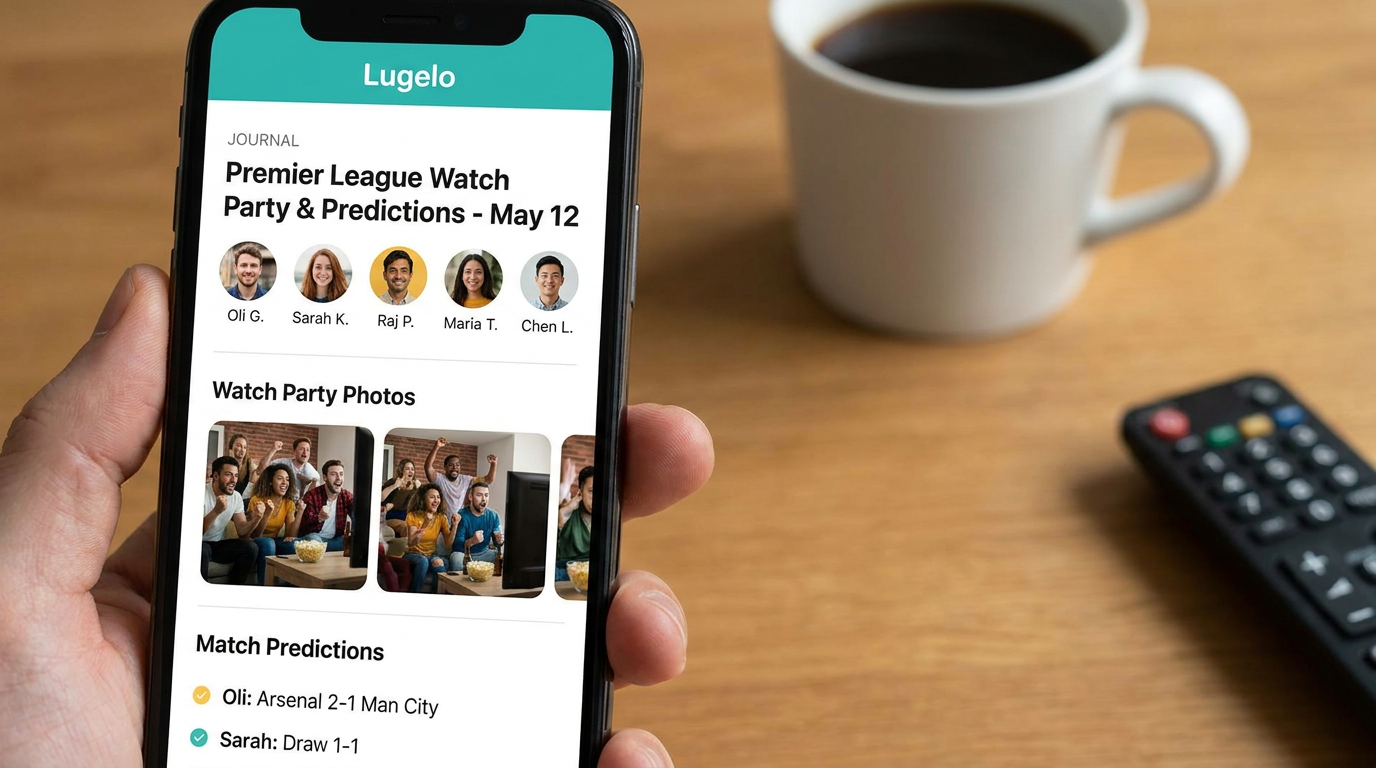
One of the things that makes Lugelo genuinely different for a use case like this is that it’s private by default. Unlike social media, where anything you post enters a public or semi-public ecosystem controlled by algorithms you didn’t choose, your Lugelo journal stays exactly where you put it — within your group, accessible only to the people you’ve explicitly invited, controlled entirely by you as the journal owner. Your group’s inside jokes, embarrassing predictions, and unfiltered reactions don’t end up feeding a data model or appearing in someone’s suggested content. They live in your journal, private and protected.
Think about what a group’s World Cup journal might actually look like across Week 2, built entry by entry as the matches roll in. Before England vs. Croatia on June 17, someone creates a “Pre-Match Predictions” entry and everyone drops in their scoreline pick. During Argentina vs. Algeria on June 16, one contributor snaps a photo of the group’s stunned faces at a controversial moment in the second half. After the USA vs. Australia match on June 19, the person who called the result correctly gets to write the post-match entry — by group agreement, naturally. By the end of the week, there’s a running “Best Reaction of the Week” thread, a photo album from three different watch parties, and at least one voice note from the Spain vs. Saudi Arabia match that has already become something of a group legend.
That’s not a hypothetical. That’s what documenting with intention looks like — and Lugelo’s collaboration features are built precisely for this. As the platform puts it: “Save moments from a holiday, concert, hiking, birthday, outing and more into a single journal with everyone’s updates.” A World Cup group stage, spanning a full week of high-emotion, high-stakes matches, is exactly the kind of multi-day, multi-person experience that this feature was designed for.
The 2026 World Cup has its own communal spirit baked into its infrastructure — fan hubs, public screenings, and shared spaces designed to bring people together around the matches. Your collaborative journal is the private version of that: the fan hub that belongs exclusively to your group, where the energy of the tournament lives alongside your own story.
If you’re reading this before the next match kicks off, you could start your journal right now. Download Lugelo, create the journal, share it with the group — and by the time the first whistle blows tonight, you’re already capturing.
The journal is ready. The contributors are in. Now the real question is: what should you actually capture? The answer is richer than you might expect.
What to Capture — A Multimedia Guide for Every Match
Think of your World Cup journal not as a diary but as a living documentary of your group’s experience — one that weaves together text, photos, voice, and video into a layered story that no single format could tell alone. Research on social bonding and sport confirms that the emotional and social experience of watching sport together is genuinely powerful — and the journal is how you honour that experience by preserving it properly.
The question of what to capture breaks naturally across the rhythm of every match. And once you think about it this way, you’ll find there are moments worth documenting at every stage — before, during, at half-time, and after.
Before the match is actually one of the richest moments to capture, and the one most people skip entirely. Take five minutes before kick-off and open the journal for a pre-match entry. Write down everyone’s scoreline predictions — the more specific and overconfident, the better. Ask each person: which player are you watching most closely tonight? One word to describe how we’re feeling right now. These pre-match snapshots are pure gold in retrospect. When France vs. Senegal is over and the person who predicted a 3-0 France win is crowing, you want the receipts. Lugelo’s AI Journal Assistant can turn a quick voice note of everyone shouting out their predictions into a polished written entry in seconds — no one has to type a word if they don’t want to.
During the match is about instinct. Don’t try to document everything — just capture the moments that feel charged. The group’s reaction when a goal goes in. The collective horror at a VAR decision. The person who has been ominously quiet all match suddenly becoming the loudest person in the room. Photographs here should focus on people, not screens. The TV will have better footage of the match than your phone ever will — but no camera in the world will capture the exact expression on your friend’s face when their team concedes in injury time. That’s yours to keep.
“The goal is not to document everything. It’s to capture the moments that, five years from now, will make everyone burst out laughing or well up with pride.”
Half-time is the moment for longer-form capture. The group is talking, the energy is high, opinions are flying. This is where Lugelo’s Speech-to-Text feature earns its place — hit record, let the half-time debate happen naturally, and Lugelo transcribes the chaos into a readable entry. Voice notes work beautifully here too. The raw, unfiltered half-time analysis — even when it’s spectacularly wrong — is exactly the kind of thing that makes a journal come alive when you read it back later.
After the match, take ten minutes for the post-match entry. Document the final scoreline, the best moment of the game as experienced in your living room (not on the pitch — in the room), who had the winning prediction, and a short group verdict: did the result surprise anyone? Was this a great watch party or a tense, difficult one? These post-match entries become the chapters of your group stage story.
Running threads across Week 2 add another layer of richness. Consider a “Player of the Day” pick after each match — one entry per game, updated by whoever calls it first. A “Watch Party MVP” running tally for whoever’s calling the most correct predictions. A growing photo album of the food spread at each gathering, because let’s be honest, the snack evolution across a football tournament is its own kind of storytelling.
Web clippings are an underused feature that can add extraordinary context to your group’s entries. Lugelo’s Browser Extension lets you clip match recaps, player stats, and post-match headlines directly into a journal entry — so your record of Spain vs. Saudi Arabia on June 21 includes not just the group’s own reactions but the actual match report, the post-match analysis, the key statistics. Years from now, that entry will read like a complete capsule of the evening, not just a personal diary entry.
Lugelo supports text, photos, videos, audio clips, URLs, and social media shares — all flowing into a single, beautifully organized journal. Want to learn exactly how each feature works? Lugelo’s help videos walk you through everything in action. And if you want the full feature overview, the features page covers photos, videos, audio, and more.
Capturing is the first act. But all of this raw material is building toward something — a proper keepsake that the group can return to long after the tournament is over.
Why Scattered Social Media Posts Don’t Do Justice to Shared Experiences
There’s nothing wrong with posting about the match. Sharing a photo on Instagram, tweeting a reaction, dropping a clip into a TikTok — these are natural, joyful parts of modern fandom. But they are not the same thing as preserving the shared experience of your group. Not even close.
Social media captures the highlight reel. A collaborative journal captures the full story — the build-up, the anticipation, the arguments, the in-jokes, the aftermath, the quiet moment after the final whistle when everyone is processing what just happened. One is a broadcast. The other is a record.
“A photo on your feed tells the world you were there. A journal tells your group what it actually felt like.”
Think about the structural differences. A social media post is public, or at least semi-public — it goes out to followers, acquaintances, and algorithm feeds that you don’t control. It’s ephemeral in its own way: stories disappear after 24 hours, posts get buried under an endless new feed within days, and the platform’s own changes can make old content inaccessible or invisible. There’s no unified narrative. When every person at the watch party posts their own version of the evening separately, what you get is five competing fragments, not one shared story. Each post reflects one person’s perspective, one moment, one edit — chosen for external presentation, not internal honesty.
Scientific research confirms that being in a crowd during shared experiences creates physiological synchrony and group bonding — the kind of deep social connection that watch parties naturally generate. But those bonds are meaningfully strengthened when the memory is preserved and revisited together, as a group. Scrolling past an old Instagram post alone doesn’t do that. Opening a collaborative journal together — seeing everyone’s contributions, reading each other’s predictions, hearing the voice notes — does.
A private collaborative journal vs. social media comparison comes down to a few fundamental dimensions:
- Privacy: Your journal on Lugelo is private by default. No algorithm sees it. No platform monetizes it. No stranger stumbles upon your group’s candid photos. Your watch party banter stays in the watch party. Social media, by contrast, is built on the logic of audience — what you post is, by design, a performance for people beyond your group.
- Permanence: Lugelo journals are yours, stored securely, accessible whenever you want them. Social media content is ephemeral, platform-dependent, and subject to changes in terms, ownership, and algorithmic visibility that are entirely outside your control.
- Multiple Perspectives: In a Lugelo journal, every contributor’s perspective lives in the same space — layered, woven together, forming a richer picture than any single viewpoint could. Social media posts are inherently singular.
- Story Depth: Lugelo supports long-form text, audio, video, links, images, and clippings all in one organized entry. A social media post is a single format, length-limited, optimized for scrolling.
- Revisitability: A collaborative journal is designed to be returned to — to be read, listened to, and experienced again. A social media feed is designed for forward momentum, not backward reflection.
- Authenticity: In a private journal, you capture what actually happened — not what looks good for a feed. The messy half-time analysis, the embarrassing prediction, the voice note that perfectly captured the chaos. That’s the real story.
Lugelo’s privacy-first design reflects this philosophy. No data sold to third parties. Owner-controlled access. Encrypted in transit. The group’s story belongs to the group — and that should mean something. You can also see how real families and friend groups use Lugelo to capture the kinds of shared stories that social media simply can’t hold.
The why is now clear. The how is waiting. And the payoff — what all of these entries become once the group stage is over — is where things get genuinely extraordinary.
From Journal to Keepsake: Timelines, eBooks, and VR Galleries
Here’s the part most people don’t anticipate when they start journaling: the transformation. You begin by capturing moments — a photo here, a voice note there, a quick post-match entry before bed — and what you think you’re building is a record. What you’re actually building is a keepsake. And Lugelo is the platform that makes that transformation happen with a kind of magic that has to be experienced to be believed.
Once your group has documented the full journey through Week 2 of the group stage — and ideally beyond, through the knockout rounds — Lugelo turns that collection of raw entries into something that lasts.
The Timeline view is the first gift. Open your journal after the group stage ends and see every match, every entry, every contributor’s moment laid out in chronological order — a visual memory lane of the entire experience. June 16: France vs. Senegal, the prediction entry, the half-time voice note, the post-match photo. June 17: England vs. Croatia, the watch party MVP tally, the photo of the group at the exact moment the final whistle blew. June 21: Spain vs. Saudi Arabia, the last group stage night, the weekly wrap-up entry. It’s all there, connected, ordered, whole. The timeline doesn’t just store the memories — it gives them shape and sequence.
The eBook is where the journal becomes a proper keepsake. Select a theme from Lugelo’s library and generate a beautifully formatted PDF from the journal — clean layouts, your photos, your words, organized into something you could print, frame, share, or simply keep. Imagine a chapter titled “Argentina vs. Algeria, June 16 — The Night Everyone Was Wrong” followed by “England vs. Croatia, June 17 — The Nation Holds Its Breath” and closing with “Spain vs. Saudi Arabia, June 21 — End of an Era, Beginning of Something Else.” That’s not a hypothetical future product. That’s something you can create right now, from your group’s actual journal entries, using Lugelo’s eBook and Timeline features.
The VR Gallery is genuinely unlike anything else available for personal memory-keeping. Once your group’s watch party photos and videos are in the journal, Lugelo can transform them into an immersive, 360-degree gallery that you step into and explore — as if you’re walking back through the living room on the night of the match. The photo of everyone’s faces when the goal went in becomes something you can stand inside. The video of the half-time debate plays around you. Lugelo VR Galleries represent the frontier of what collaborative memory-keeping can become — and for a group that has spent a week living intensely together through a World Cup, the ability to re-enter that experience is genuinely moving.
There is real science behind why this matters. Research published in the Journal of Business Research has found that memories of extraordinary group experiences lead to greater cohesion and well-being — and that having a tangible keepsake to revisit amplifies that effect significantly. The journal doesn’t just preserve the memory. It actively strengthens the bond. Every time the group returns to it — on the anniversary of a great watch party, before the next World Cup, on a rainy afternoon years from now — it does that work again.
Think about physical scrapbooks and photo albums. For generations, families have kept them precisely because they understood, intuitively, that memory needs a home. Lugelo is the digital-first, collaborative evolution of that tradition — built for the way people actually live today, across multiple devices, multiple contributors, and multiple formats. It doesn’t replace the instinct that made people keep scrapbooks. It fulfils it, at scale, with tools that make the result more beautiful and more accessible than a shoebox of photos ever could be.
Lugelo’s ready-to-use templates make starting even faster — structured starting points so the group isn’t staring at a blank page before the first match. By the time the group stage ends, what began as a simple journal has become a record that the group will return to, laugh at, and treasure — for years.
All that remains now is the practical question: how do you actually start? That’s where the next section hands you everything you need.
Your World Cup Journal Starter Kit: Prompts and Tips for Every Match
Think of this as your cheat sheet. The journal is ready. The group is in. The match is tonight. Here is exactly what to capture — and how — across every stage of the watch party experience.
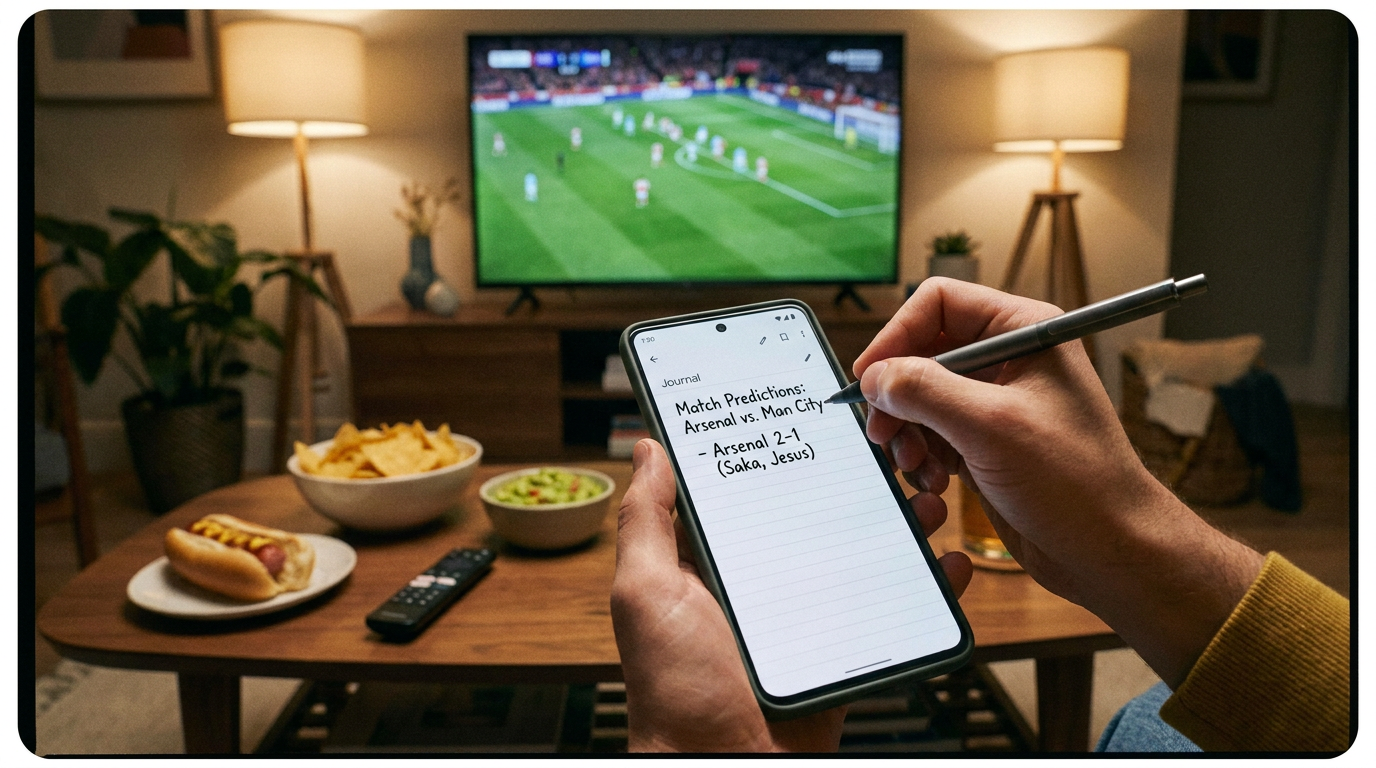
Before the match — the pre-kick-off entry:
Open the journal ten minutes before kick-off and run through these group prompts. They take two minutes and they’re worth gold in retrospect:
- “Who do we think wins and what’s the scoreline?” — get everyone’s prediction on record, no hedging allowed.
- “Which player are you watching most closely tonight?” — this one always produces strong opinions and great post-match callbacks.
- “One word to describe how we’re feeling right now.” — simple, fast, and captures the atmosphere instantly.
You don’t need to type any of this. Use Lugelo’s AI Journal Assistant to turn a quick voice note into a polished written entry. Talk into your phone for sixty seconds, let the AI shape it, and the entry is done before the first whistle blows.
During the match — in-the-moment captures:
- Goal reaction photo. Capture the group, not the screen. The screen will have better footage. Your group’s faces will not.
- Voice note after a controversial VAR decision. The raw, immediate reaction — the disbelief, the outrage, the relieved exhale — is impossible to recreate later. Record it the moment it happens.
- Short video of the half-time formation analysis. Even if it’s completely, spectacularly wrong. Especially if it’s completely, spectacularly wrong.
After the match — the post-match entry:
- “Best moment of the match — in our living room, not on the pitch.” The moment on the sofa, not the highlight reel.
- “Who’s buying the next round of snacks for getting their prediction wrong?” Essential accountability.
- “Rate this watch party out of 10.” Short, decisive, non-negotiable.
The Weekly Wrap-Up — for June 21, the end of Week 2:
The final group stage night of Week 2 deserves a proper wrap-up entry. Gather the group, physically or virtually, and tackle these together:
- “Best group stage match we watched together.” One pick, one reason, no arguments — or unlimited arguments, as preferred.
- “Most outrageous prediction of the week.” Name the person. Celebrate the audacity.
- “Who in our group would make it to the knockout stage — and why?” Turn the tournament’s survival narrative onto the group itself. This one generates genuinely memorable answers.
Two practical rules that will make the journal exceptional:
First: let the person with the correct prediction write the post-match entry and name the chapter. It creates investment, competition, and genuinely varied writing styles that make the journal richer to read back.
Second: set a group expectation that short entries are fine. Not every match produces a masterpiece. Sometimes the entry is three words and a photo. That’s enough. The journal grows organically — don’t let the pursuit of perfection become a reason not to document.
Lugelo’s AI Journal Assistant and templates remove the last remaining barrier: effort. The AI takes the rough material — a voice note, a few scattered thoughts, a list of predictions — and shapes it into something worth keeping. The templates give the journal structure from the start, so even the most reluctant journaler in the group has a clear starting point.
For readers who have questions about getting started, Lugelo’s FAQs cover everything clearly. And for those who prefer to learn visually, the how-to videos walk through every feature in real time.
The best prompts, in the end, are the ones you’ll create yourselves — live, in the moment, when something happens in that living room that no one could have scripted. This starter kit just makes sure you’re ready when it does.
Every group stage match is a story. Make sure yours gets told.
The Moments You Document Today Are the Stories You’ll Tell for Years
Come back for a moment to the image that started this. A group of people gathered around a screen. Argentina vs. Algeria on a Tuesday night in June. USA vs. Australia unfolding on a Friday evening. The room full of that particular energy — something between anticipation and belonging — that only exists when the people you love are watching something that matters together.
The World Cup will end. July 19 will come, a winner will be crowned, the tournament will become history, and the group chats will slowly quiet down. The prediction sheets will be lost. The voice notes will get buried. The photos will scatter across camera rolls and hard drives, unseen, unorganized, waiting for a moment of nostalgia that never quite comes.
But the journal — your collaborative journal — will still be there. Complete. Organized. Alive with every prediction, every reaction, every voice note, every photo, every half-time debate, and every post-match verdict the group produced together. Years from now, someone will open it — maybe before a different World Cup, maybe on a random Tuesday afternoon when someone asks “remember that night during the group stage?” — and the whole summer will come back. Not fragments. The whole thing. Everyone’s perspective, woven together, exactly as it was.
Journals are souvenirs of your past. This one can be a souvenir of a summer that an entire group lived together — and that makes it something rarer than any tournament trophy.
Everyone has a story to tell — yours is worth keeping.
The moments you document today are the stories you’ll tell for years. Start now, before the next match kicks off.
Start Your Group Journal — It’s Free
Don’t let this World Cup slip through your fingers.
Start your collaborative group journal on Lugelo today — before the next match kicks off. Invite your friends, add your first prediction, and let the memories begin. Start your group journal on Lugelo — it’s free.
Curious how it works first? Explore Lugelo’s collaboration features or watch how to get started — it takes less time than the pre-match warm-up.
Available free on iOS, Android, and web. Your group’s story is waiting.