Category Archive : Digital

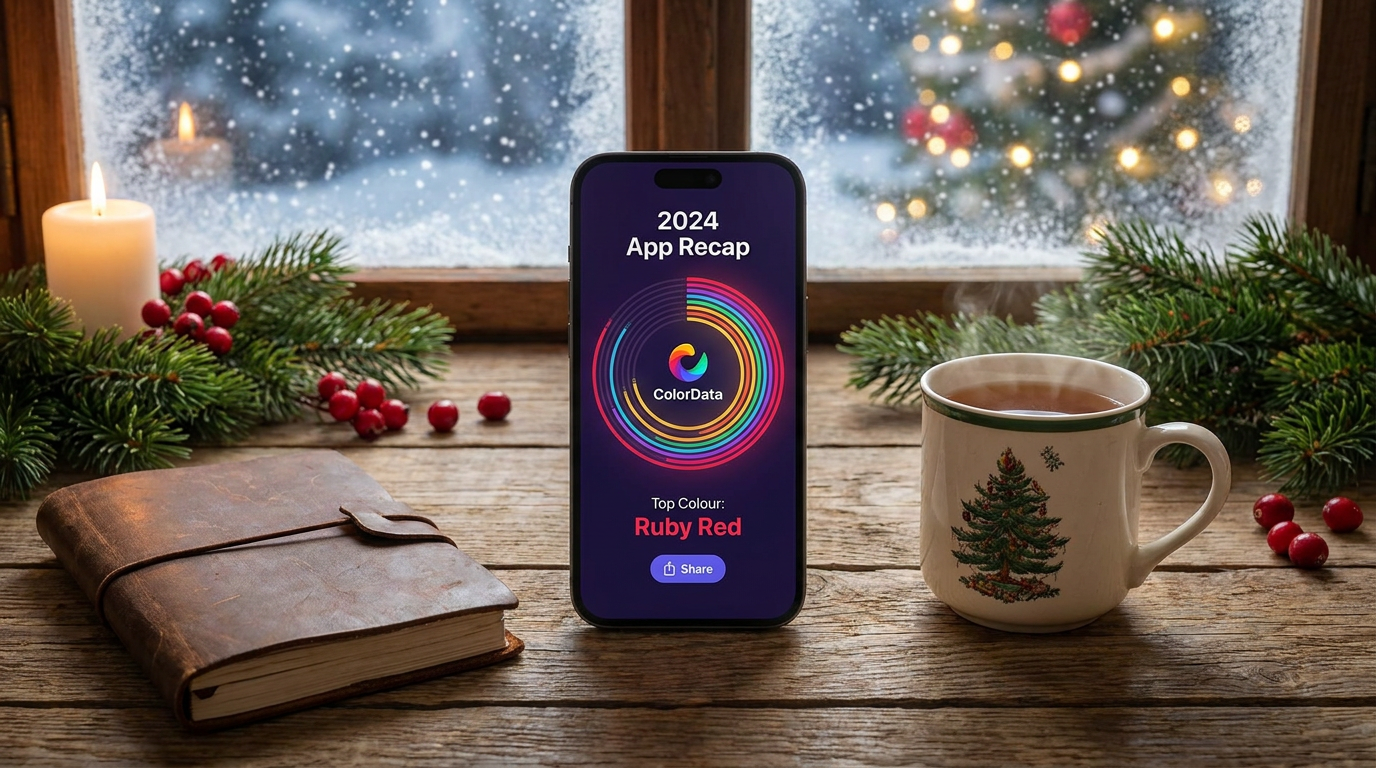
Smartphone displaying a colourful annual app recap on a wooden table with a Christmas-themed winter background.

The Year in Review Template That Isn’t a Wrapped Recap

Four recaps arrived in a single week. You learned your most-played song, which you’d have guessed. You learned your step count, which was lower than you’d hoped. You learned how many hours you spent on something you would honestly rather not have totalled up. They were fun. You sent one to a friend, who sent one back, and you both agreed that the algorithm had read you for filth.

Then, a few days later, somebody asked what you did in April.

And April was a blank. Not a hazy blank. A complete one.

These are recaps of your consumption, not your life.The most reviewed year in history is also one of the least recorded.

An algorithm can only review the parts of your year that happened through a screen. It cannot know that you moved house. It cannot know that you changed your mind about something that actually mattered to you. It doesn’t know you made a new friend in March, or that you sat with someone through the worst week they’d had in years.

So this is a year in review template for the other kind of review — the one no app can generate for you, because it doesn’t have the data. What’s below is about forty questions, three realistic ways to actually get it done, and a full guide to writing the year in review card if you’re someone who sends one.

None of this says the recaps are bad. They’re great. This is an addition, not a correction.

“Year in review” is one of those phrases everybody uses and almost nobody defines. Let’s start there.

What Is a Year in Review, Exactly?

Nobody is grading this. There is no score at the end.

It’s worth saying what it isn’t, because the phrase has picked up some unhelpful baggage. It is not a performance review. It is not a productivity audit. It is not a list of goals hit and missed, colour-coded by whether you disappointed yourself.

That’s it. That’s the whole definition.

A year in review is a deliberate look back over twelve months — what happened, what changed, what you learned, and what you want to carry forward.

How the recap differs from the review

The difference is easiest to see side by side.

What the recap your apps make knows: what you watched, played and streamed. It’s measured in hours and counts. It generates itself automatically. It can tell you what you were listening to on a Tuesday afternoon in March. And it ends when the year ends.

What the review you make knows:One of those is a mirror. The other is a record.

what you did, and who you did it with. It’s measured in what changed rather than what accumulated. It takes about an hour. It knows you moved house. And — this is the part that matters most — it gets better every single year you repeat it.

Why April disappears

Here’s the thing about April. You haven’t forgotten the year. You’ve forgotten the textureYou remember that a summer happened. You probably remember roughly where you went and roughly who was there. What’s gone is the meal you’d order again, the walk you kept taking without deciding to, the joke that ran for three months — and those are exactly the parts you’d want back.

of it.

There’s some research that lines up with this. A small study of healthy young adults found that — the peripheral, sensory specifics fell away noticeably faster than the central thread of what happened. It’s one modest study from a single university subject pool, so hold it loosely. But it matches what everyone already knows from experience: the headline survives, the detail evaporates.
different kinds of detail are forgotten at different rates

Which is why a good annual review template asks small questions rather than big ones. “How was your year?” produces nothing. “What did you eat this year that you’d happily eat again tomorrow?” produces an actual memory, with a room and a person attached to it.

That principle isn’t guesswork either. Cornell’s John S. Knight Institute, in its Here’s the template. Copy it, print it, or just read down it and answer the ones that catch you.
guidance on reflective writing

People do this for all sorts of reasons. Some want to remember. Some want to notice change they can’t see from inside it. Some want something to hand their children in thirty years. Any of those is reason enough, and you don’t need to pick one.

, makes the case that closely observed specifics carry far more than broad summary does. Specific beats general. Every question in the template below is built on that one idea.

The Year in Review Template: 40 Questions to Look Back On
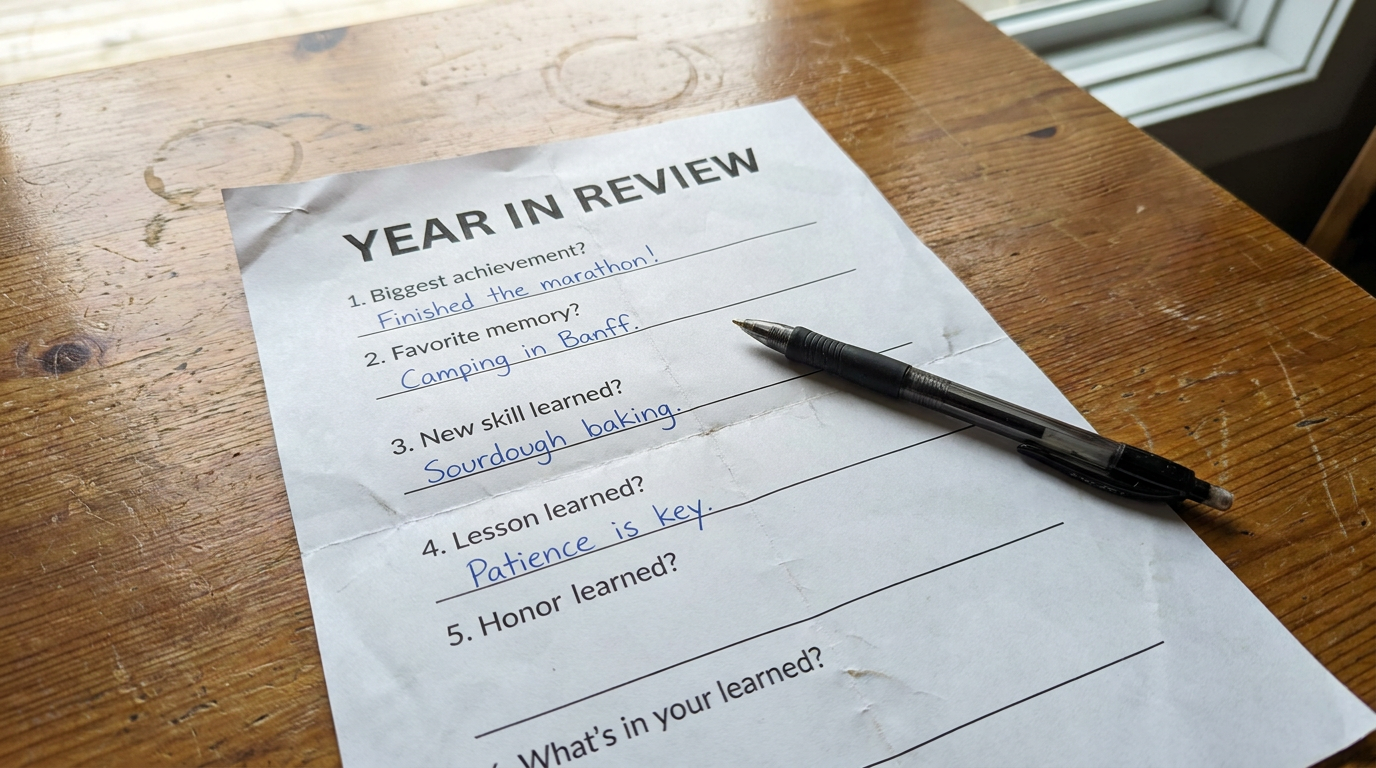
A printed page of year in review questions on a table, with a pen resting on it and a few answers written in by hand.

You are not answering all of these. Pick ten.Read down the list, notice which ones snag on something, and answer those. Ten good answers beat forty rushed ones, and the ones you skip will still be here next year.

The facts — what actually happened

Anything with a date attached. Start here because it’s the easiest, and it warms you up.

  1. Where did you live this year, and did that change?
  2. What did you do for work, and did that change?
  3. Where did you go that you’d never been before?
  4. What happened with your health?
  5. What was the biggest thing you spent money on?
  6. What changed in your home?
  7. What’s one date from this year you’d mark on a calendar?

The people

Who was around, who wasn’t, and who mattered.

  1. Who came into your life this year?
  2. Who did you see most?
  3. Who did you lose touch with?
  4. Did you mean to?
  5. Who helped you when you needed it?
  6. Who did you help?

The changes

The stuff that shifted quietly, usually without an announcement.

  1. What did you change your mind about?
  2. What did you stop doing?
  3. What did you start doing?
  4. What would have surprised you a year ago?
  5. What got easier?
  6. What got harder?

The hard parts

Four questions, plainly put.

  1. What was the worst week?
  2. What did you lose?
  3. What worried you most often?
  4. What are you still carrying?

Skipping this section entirely is a completely fine choice. A year that was mostly hard is still worth recording honestly, and it doesn’t need to be made into anything else.

The small things

The ordinary texture nobody thinks to write down. This block is the one people end up treasuring.

  1. What did you eat that you’d eat again?
  2. What walk or route did you keep taking?
  3. What was the running joke?
  4. What made you laugh until you couldn’t speak?
  5. What song got overplayed in your own house?
  6. What did you wear constantly?
  7. What did a normal Tuesday actually look like?

What you made or finished

Not achievements. Things that now exist because you did them.

  1. What did you fix or repair?
  2. What did you grow, build or make?
  3. What did you finally finish?
  4. What recipe did you get right?
  5. What difficult conversation did you actually have?

What you want more and less of

Forward-facing and low-pressure. These are not resolutions, and none of them should have a number in the answer.

  1. What do you want more of?
  2. What do you want less of?
  3. Who do you want to see more often?
  4. What would you like next year to feel like?
  5. What’s one small thing you could do in January?

Reminder: you were only ever picking ten. If you answered more, good. If you answered six, that’s a finished review.

One more thing worth knowing — this same set of questions works just as well pointed at somebody else. Asking an older relative what their ordinary Tuesday looked like tends to produce far better material than asking them about their life. If that’s a direction you want to go, our Now, the obvious problem. A template on its own gets bookmarked and forgotten. So here are three ways to actually do the thing.
50 questions to ask your grandparents

runs on exactly the same principle: pick a few, don’t march through all of them.

Three Ways to Actually Do Your Year in Review

People don’t skip their year in review because they don’t care. They skip it because December is the single busiest month of the year, and “sit down and reflect on twelve months” sounds a lot like homework.

So pick a method that fits the month you’re actually in.

  1. The one-hour version — about an hour, best for people who like a clean sweep, medium difficulty.
  2. The twelve-photo version — twenty to thirty minutes, best for almost everyone, easy. Start here.
  3. The conversation version — an evening, best for couples, friends and families, easy but needs two people.

The one-hour version

It works best with a drink, a pen, and your phone in another room. The hour limit isn’t arbitrary discipline; it’s what stops the whole thing turning into an essay you abandon at question four.

Stop at the hour whether or not you’re finished.

Sit down once. Pick ten questions from the template. Answer each one in two sentences — genuinely two, not two paragraphs wearing a disguise.

The twelve-photo version

A camera roll open on a phone, scrolled to a month of photos, with one image selected.

This is the one to start with, and it’s the one to recommend to anyone who’s never done this before.

Open your camera roll. Scroll month by month. Pick one photo per month — not the best photo, just one that’s fromYour camera roll is already a rough index of your year. You’re just annotating it.

It works because it removes the hardest part of the job, which is remembering unprompted. Nobody can summon April from a standing start. But almost everybody can look at a blurry photo of a kitchen table in April and immediately recall who was sitting at it.

Twelve photos. Twelve lines. Done in half an hour.

that month. Under each, write one line about what was actually going on around it.

And this is where the real problem shows up. The raw material for a proper year in review is already scattered — some in your camera roll, some in your messages, some in three different notes apps you’ve stopped opening. April is a blank not because nothing happened, but because nothing about April was ever written down in one place. Keeping the photo and the line about it together, in a single dated entry, is the entire point of a tool like Either way — app, notebook, back of an envelope — the method is the same. Twelve photos, twelve lines.
Lugelo

.

The conversation version

Someone does need to write down the good bits afterwards, or you’ll lose them by morning.

Answers get longer and more honest when they’re spoken. You’ll also get corrected, which is the best part: you’ll say something happened in the autumn and be told, flatly, that it happened in February.

Two people take turns asking each other questions out loud.

This works on a long drive, on a walk, or in that strange quiet stretch between the holidays when nobody’s quite sure what day it is. Answering alongside another person is also one of the more reliable consistency mechanisms there is — a point we’ve made before in our For plenty of households, though, the review isn’t only for themselves. Some of it ends up in an envelope.
September journal prompts

A review with six answers is a real review. There is no minimum, and nobody is checking.

, and it holds just as true once a year as it does once a month.

How to Write a Year in Review Christmas Card

A year in review christmas cardSometimes it’s a full printed letter. Sometimes it’s a few lines written inside the card itself. Sometimes it’s a photo with a caption on the back. All three count, and the short ones are not a lesser version of the long ones.

is the annual letter or card that sums up a household’s year and goes out with the holiday greetings.

How long should it be?

That’s the honest answer, and it’s usually what people came here to find out. People genuinely do read the short ones. People genuinely do skim the long ones. If you’re standing there wondering whether to cut something — cut it.

Short. One side.

A simple structure that works

  1. One line per person in the household.
  2. One photo.
  3. One thing you’re looking forward to.

That’s it. That’s the whole format.
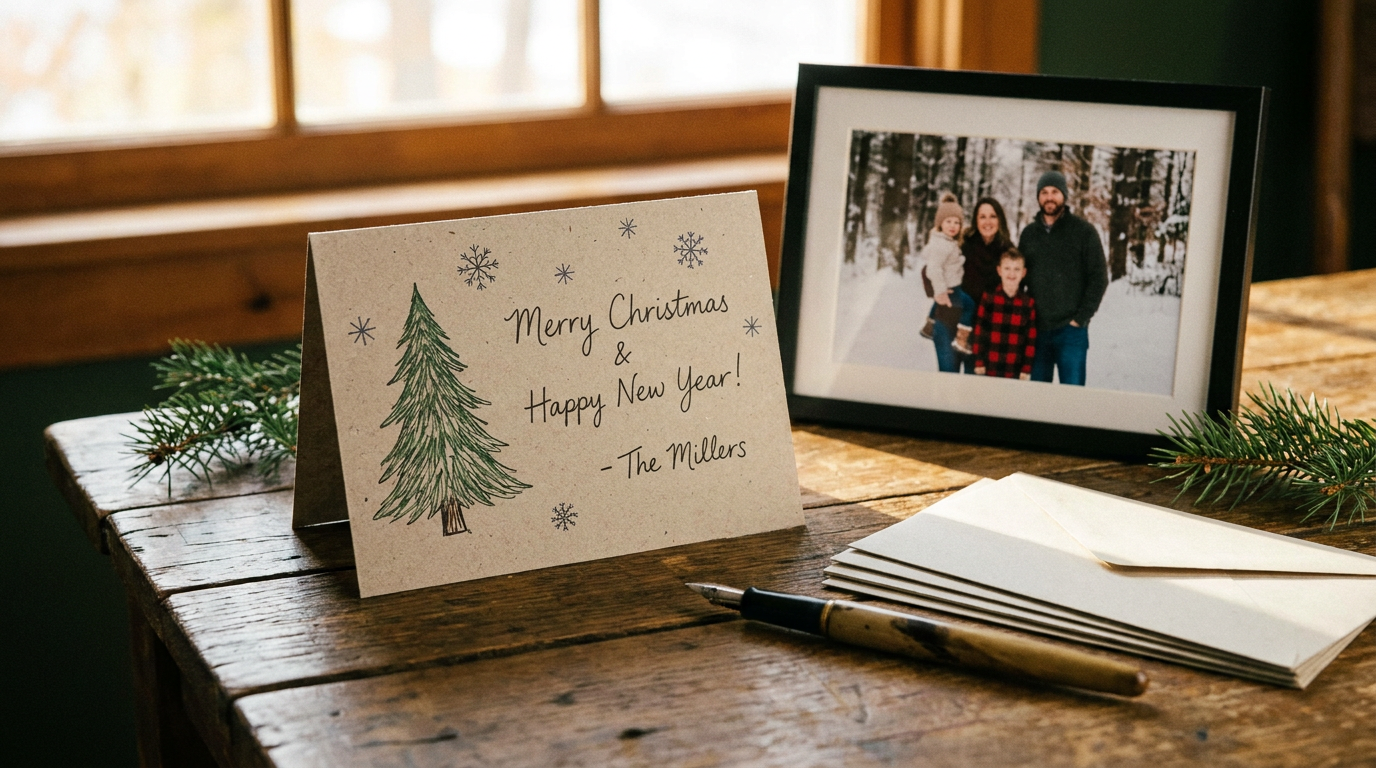
A handwritten holiday card on a table beside a printed family photo, envelopes and a pen.

What makes a card a pleasure to receive

“He learned to whistle this year and will not stop” lands. “He continues to excel academically” does not. The first one is a person. The second one is a press release.

Specificity and brevity. Every time, without exception.

It’s worth being fair about the so-called brag letter, because the complaint is much older than any of us. Smithsonian Magazine’s history of traces the form’s spread through the post-war decades — and traces the grumbling about it almost as far back. Critics were mocking these letters in print within a few years of them becoming common.
our love-hate relationship with the Christmas letter

But here’s the thing. The people writing those letters are proud of their families. That is a genuinely good thing to be, and the world would be worse with less of it.

The fix was never modesty. The fix is detail.

Nobody resents hearing that your daughter had a good year. They resent hearing it in the register of a LinkedIn update. Swap the achievement for the small true thing that sits underneath it and the same news becomes a delight to read.

What works well: one specific, small, true detail per person. Naming the ordinary stuff. One good photo. Half a page. Saying a year was hard, briefly.

What wears the reader out: a list of accomplishments. Grade averages and job titles. Six photos and a collage. Three pages, both sides. Explaining at length why a hard year wasn’t really that hard.

And it’s not a throwaway object, either. The Schlesinger Library at Harvard actively collects as historical documents — a research library decided these letters are worth preserving, which is a reasonable argument that the one you’re about to write has a life well past January. The card itself has a longer history than most people assume; the dates to the Victorian era.
first commercial Christmas cardfamily holiday newsletters

When the year was hard

None of those choices need explaining to anyone.

You are allowed to send a short card with no recap at all. You are allowed to write one line saying it was a difficult year without detailing a single part of it. You are allowed to skip the letter this time and just send the card.

Plainly, and briefly:

Practical notes

  1. Pick the photo where everyone looks like themselves, not the best-composed one.
  2. Start about three to four weeks before you want them to arrive.
  3. Check your address list before you print, not after.
  4. If you’re printing, order a few spares — you will remember someone.

You’ve already written it

Here’s the connective tissue. If you’ve answered even ten questions from the template above, the card is already done.

Your answers to “the small things” and “what you made or finished” areHere’s roughly the shape of a good one:

the card. You’re not writing something new. You’re picking three lines and shortening them.

We finally fixed the back door, which means we no longer have to warn guests about the back door. Nina spent the year learning the recorder; the rest of us spent the year developing character. Theo has become a person who has opinions about soup. Spring was a hard stretch for us and we’re glad to see the back of it. Next year we’re getting the garden into some kind of order — ask us how that’s going.

The card goes out once and it’s gone by January. The answers behind it don’t have to be — and that’s where this gets genuinely interesting.

Four sentences. No achievements. You know exactly what that household was like this year.

Why You Should Answer the Same Questions Every Year

Any single year’s answers are mildly interesting. Ten years of the same ten questions is something else entirely.

That’s the strongest argument in this whole post, so it’s worth slowing down on.

One year gives you a snapshot. Several years give you a direction. You can only see change by comparing like with like — which is precisely why asking the same questions matters far more than asking clever ones. The moment you swap the questions out, you lose the ability to compare, and comparison is the entire payoff.
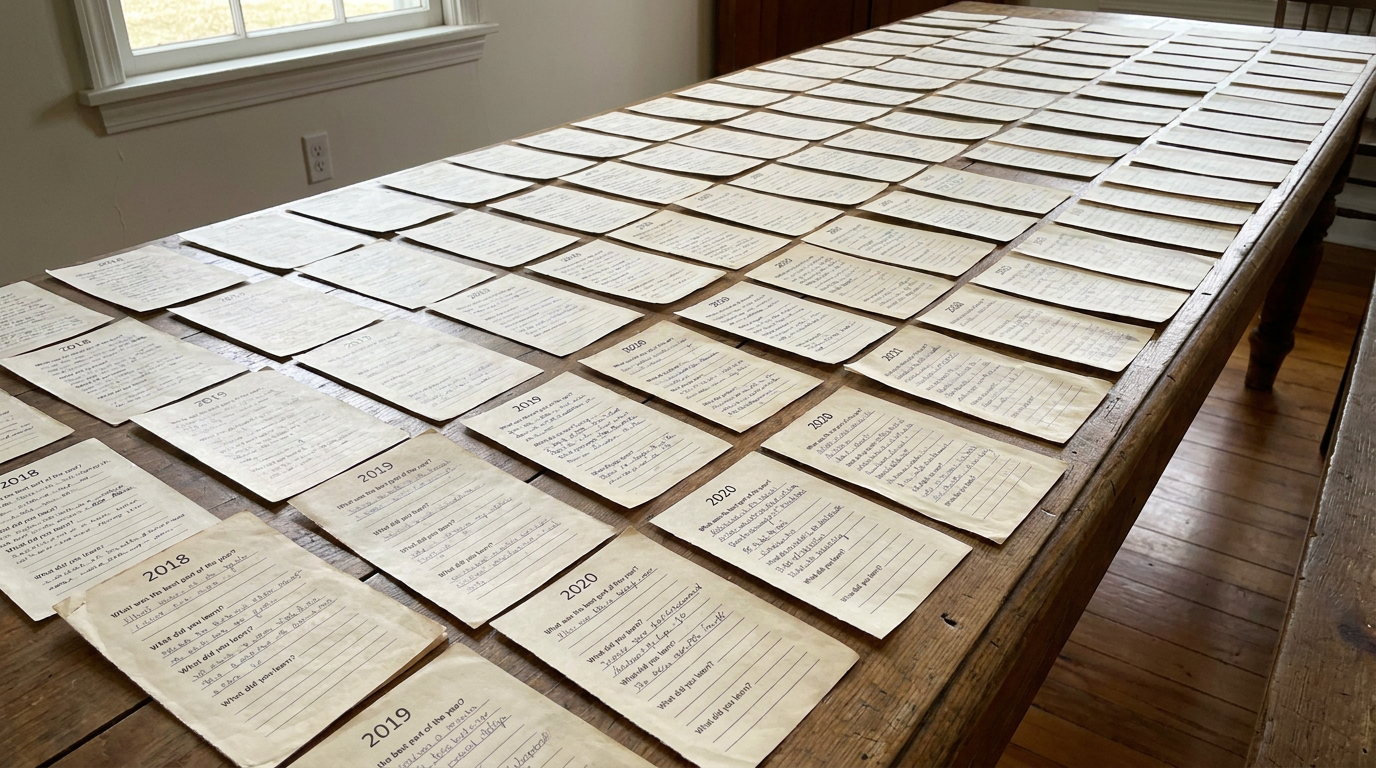
Several years of short handwritten review pages laid side by side on a table, showing the same questions answered differently each year.

What only shows up across years

Some things are invisible in a single entry and unmissable across five:

  • The answer to “who did you see most” changing three times in five years. Nobody notices that while it’s happening. Everybody notices it on the page.
  • A “what do you want more of” answer that shows up four years running and never once happens. That’s not a failure. That’s information, and it’s the kind you can act on.
  • A single person appearing first as someone new, then as a constant, then as someone you lost touch with — and being able to see the year it turned.
  • The same running joke surviving six years, which is funnier written down than it ever was out loud.

None of that is available to you in year one.

The first year feels thin

The value is in accumulation, not in any single entry. The writing is the deposit. The rereading is the interest. You’re not really writing this for December — you’re writing it for a version of yourself who goes looking, some years from now, for a detail nobody else recorded.

It will. That’s normal, and it isn’t a failure of the method or of you.

We’ve made the same case at a smaller scale in our — same idea, one month instead of twelve, and it shows what the year-over-year comparison actually looks like in practice.
October memory journal

And today’s ordinary detail is next decade’s missing detail. Anyone who has ever tried to write something substantial about their own life discovers this immediately: the material is built entirely from what you bothered to record at the time. Our goes into that properly, and the short version is that memory is a worse archivist than you think it is.
guide to writing a memoir

It’s an hour

Which raises an awkward practical question. If you’re going to answer these again next December — where, exactly, are this year’s answers going to be?

That’s the whole commitment. An hour a year, and in a decade you’ll have something that genuinely cannot be bought, reconstructed or generated.

It isn’t a practice. It isn’t a system. It isn’t a lifestyle change or a habit you have to protect. It’s an hour, once, in the same week each December — near enough the same week that you’ll find it again next time.

This is roughly one hour a year.

Let’s be accurate about the cost, because the cost is what stops people.

Where Your Answers Live, and Who Can See Them

There’s a second half to the problem. The review is text, but the best bits of it aren’t. There’s a photo, a voice note of someone laughing, a screenshot of a message you saved. Those live in three different places and drift further apart every year.

For most people the answer is no. And that — not laziness, not lack of interest — is the actual reason the annual habit never compounds. The writing happens. The finding doesn’t.

Here’s the honest test: could you find last year’s answers right now, in under a minute?

Neither is a notes app you’ll eventually migrate off. Neither is an email to yourself. Neither is a photo of a notebook page, sitting at position four thousand in a camera roll.

A document on a laptop you’ll replace within two years is not somewhere you’ll find anything next December.

A single entry can hold the text, the photos and the audio together, dated, so that next December the whole thing opens in one place instead of four. A timeline view is what makes several years readable in sequence rather than as scattered files. And for households doing this together — which is most households, since the card is usually a joint project — a means two people can add to the same entry instead of maintaining two half-versions. If you want a printed keepsake out of it eventually, that’s what the are for.
storybook and eBook outputscollaborative journal

On privacy, plainly: journals are private by default. You decide who can view or contribute, and access can be revoked at any time. Data is encrypted in transit. Personal data isn’t sold to third parties, and account deletion is available. The Now — the questions people tend to ask before they start.
FAQ page

A memory journal isn’t the place for marketing language about security, so that’s all we’ll say about it.

sets out the details in plain English.

Year in Review Questions: FAQs

What should a year in review include?

Six things: the facts, the people, the changes, the small ordinary details, what you made or finished, and what you want more and less of. You don’t need all six. Ten answers spread across two or three of those areas is plenty for a complete review, and far more useful than a thin pass at everything.

How do you write a year in review for yourself?

Pick ten questions, answer each in two sentences, and stop. If it’s your first attempt, use the twelve-photo method instead — scroll your camera roll, choose one photo per month, write a line under each. It takes about half an hour and removes the hardest part, which is remembering with no prompt.

What questions should I ask in a year in review?

Use the forty above, or write your own on the same principle: ask small, specific, answerable questions. “How was your year?” gets you nothing. “What did you eat that you’d eat again?” gets you a real memory with a place and a person attached. Small questions unlock big answers; big questions unlock silence.

How long should a year in review be?

As long as it takes to answer ten questions honestly — for most people, under a page. Longer isn’t better and usually isn’t more truthful, just more thorough. Two sentences per question is a good ceiling. If you’re writing paragraphs, the question was too broad.

What is a year in review letter?

It’s the annual letter sent out with holiday cards summarising a household’s year — sometimes a printed page, sometimes a few lines inside the card. The card section above covers structure, length and what to do when the year was difficult. One side of paper is the right length.

When should I write my year in review?

Any time from late November to the end of January. The quiet stretch between the holidays is the easiest window most people get all year, and it’s the one to aim for. Writing it in January is not late — nobody is checking the postmark, and a review written in the first week of January covers exactly the same twelve months.

What do I write if the year was bad?

Record it honestly and skip the sections you don’t want. Don’t go looking for a lesson in it. A short entry is a complete entry.

How do I do a year in review with my family?

Use the conversation version: ask each other the questions out loud, and have one person write down the good bits afterwards. Different people remember the same year differently, and the gaps between accounts are usually the most interesting part of the exercise — one person’s quiet month is another person’s worst week.

A person sitting by a window in winter light with a notebook open, writing, a mug beside them.

The Blank Month, Filled In

April doesn’t have to be a blank next year. That’s the whole offer.

A review with six answers still counts. So does a card with three sentences in it.

The whole of this post reduces to something quite small: ten questions, twelve photos, one line under each. Under half an hour, once. Then do it again next December, and the pair together is worth considerably more than either one on its own.

They’ll tell you what you consumed. They won’t tell you what happened.

The recaps will arrive again next December. They’ll be fun again. Send them to your friends again — nothing here says don’t.

Don’t Just Live It — Keep It

Answer ten questions, add the twelve photos, and keep them somewhere you’ll actually find them next December. That’s the entire job.

Start Saving What Actually Matters

Available on web, iOS, Android and HarmonyOS. Journals are private by default, and you decide who can view or contribute.
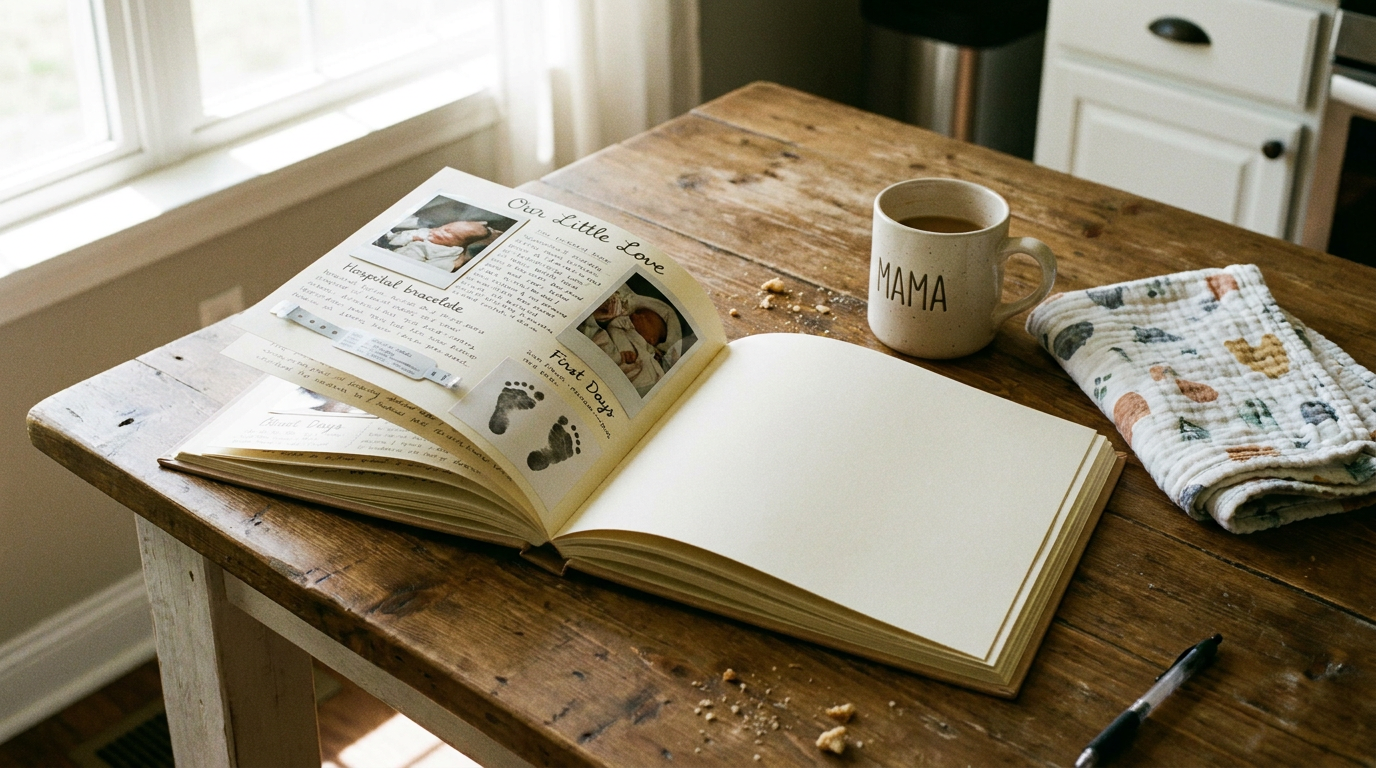
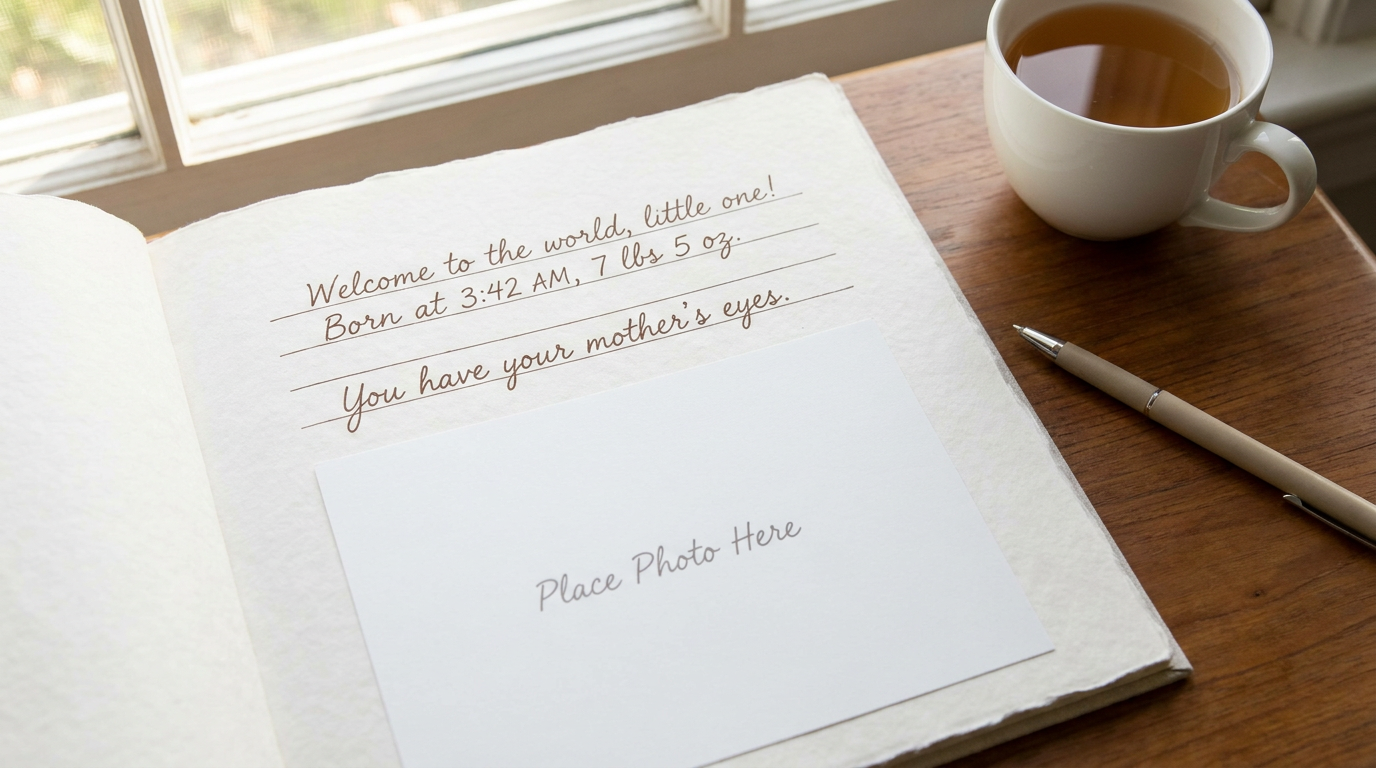
Open baby memory book with newborn photos and footprints beside a blank journal, a mug labelled “Mama,” and a folded baby blanket on a wooden table

Baby Memory Books: What To Actually Record In The First Year

This is not a product roundup. It is not a reason to abandon the book you already own.

So this is a concrete list of what is genuinely worth recording in a baby’s first year memory book — most of which no printed book has a page for.

The problem is structural. Most baby memory books are built around a fixed list of milestones, and those milestones either happen when nobody is holding a pen, or do not happen on the printed schedule at all.

This is normal. It is extremely common. It is not a failure of effort, and it is certainly not a failure of love.

It is in a drawer now. The “first tooth” page is blank, because the tooth arrived during a week when nobody in the house was sleeping.

Someone gave you a beautiful baby memory book at the shower. The cover is lovely. The paper is thick. You filled it in properly for about six weeks.

And before anything else, here is the standard worth adopting: one line and one photo is a complete entry.

If you are still deciding whether to buy one of these books at all, start here.

What Is a Baby Memory Book, and What Is Inside One?

A baby memory book is a keepsake book for recording a child’s early life. It holds photos, dates, handwritten notes and small mementoes. Most cover the first year, though some carry on for longer.

That is the whole definition. There is nothing more technical to it.

Contents vary by publisher, but the standard set is fairly consistent. Most books include some combination of the following:

  1. Milestone pages. Printed slots for first smile, first tooth, first word, first steps.
  2. Growth and measurement charts. Space to log length and weight at intervals.
  3. First-year photo slots. Usually one per month, sometimes a few extra.
  4. A family tree page. Space for the people around the child, however that family is arranged.
  5. Letters to the child. One or two pages for writing directly to them, to be read much later.
  6. Hand and footprint space. A page designed to take ink or paint.
  7. Pockets or envelopes. For hospital bracelets, cards, tags and other flat keepsakes.

That last item is worth pausing on. A memory book is, functionally, a small family archive, and the same These books are, for the most part, well made and genuinely lovely objects. Most of them still end up unfinished. That is worth understanding before you buy one.
guidance on preserving family archives

That single difference will determine whether you finish the book. It matters far more than the cover design. There is a section further down on how to weigh it.

One more distinction matters more than any of this, and it is the one most people overlook. Some books are guided and prompt-heavy. Others are mostly blank space.

Shoppers will meet two main formats. The first covers the first year only. The second is a baby memory book first 5 years format, which carries on through toddlerhood and into the early school years.

There is a naming problem worth clearing up now. “Baby book,” “baby’s first year memory book” and “baby journal” are mostly the same product under different names. No industry standard exists. Judge what is inside, not what is printed on the spine.

that applies to letters and documents applies to what you tuck into those pockets.

Why Do So Many Baby Memory Books End Up Half-Finished?

The books are not badly made. They are badly matched to the year they are meant to document.

Three design decisions cause most of the trouble:

  1. Fixed prompts. The book asks for things that may not apply to your child, in an order that may not match your year.
  2. Fixed timing. Milestones are printed on a schedule. Real babies have not read the schedule.
  3. An assumed standard of neatness. Many books quietly imply careful handwriting, good light and a free afternoon. The first year supplies none of those reliably.

Then there is the practical trap. The milestone almost always happens when nobody is holding a pen.

By the time there is a pen, the date is a guess. The guess feels inadequate. The page stays blank, the blank page starts to feel like a small failure, and eventually the book gets avoided entirely.

So change the standard instead of the book.

One line and one photo is a complete entry. A date and five words beats a beautiful page you never wrote.

Approximate dates are fine. “Sometime in the spring” is a real record. Precision was never the point of a keepsake.

It is also worth saying plainly that babies do these things on wildly different schedules. A memory book is a keepsake, not a chart to be measured against. A late entry is not a data point about your child.

If anything about your child’s development is on your mind, that is a conversation for your paediatrician or health visitor, not a page in a book.

A half-completed baby memory book page with a few handwritten lines and an empty space beneath, photographed in soft daylight.

If the printed prompts are the weak point, then the useful question is not which book to buy. It is what is actually worth writing down.

A record kept during a time like that is still worth keeping. There is no requirement that a memory book only hold good days.

Not every first year is straightforward. Some babies spend time in NICU. Some first years include serious illness, and some include loss.

What To Actually Record In Your Baby’s First Year

Most of what you will want back later is not on any printed page.

The standard milestones worth keeping

Start with the obvious ones, because they are genuinely worth having:

  1. First smile. The real one, not the one everyone argued about.
  2. First tooth. Approximate date is fine.
  3. First word. And what they actually meant by it.
  4. First steps. Including where, and who saw it.
  5. First foods. And the face they made.
  6. First haircut. Keep a bit of the hair if you can.
  7. First night in their own room. For you as much as for them.
  8. First time they recognised someone across a room. This one is underrated and disappears from memory fast.

Record these if and when they happen, in whatever order they happen. Leave blanks without apology.

One practical tip transforms these entries. Write the approximate date and the circumstance“First proper laugh — at the dog drinking” is worth far more in twenty years than a date sitting alone on a line.

, not just the date.

Sound recordings and photographs both need deliberate care if they are going to survive, which is the core message of the Library of Congress — and it applies just as much to the noises your baby is making right now.
personal digital archiving guidance

The ordinary things no printed book has a page for

This is the part people wish they had. None of it appears in a printed book, and all of it is gone within a couple of years.

  1. What the house sounded like at three in the morning. The specific noises — a radiator, a road, a particular creak. It is the fastest route back into a memory.
  2. What you ate, one-handed, standing up. Unglamorous, and instantly recognisable to your future self.
  3. The song that worked when nothing else did. Every household has one. Nobody remembers it five years later.
  4. The nickname that stuck, and where it came from. The origin story always vanishes before the nickname does.
  5. Who visited, and what they brought. A record of who showed up is a record of your family at that moment.
  6. What you were worried about that month. Note it — and later, whether it turned out to matter. This is the most reassuring thing you can leave for yourself.
  7. The walk you did every day, and the exact route. Street names included. That loop was most of your year.
  8. What made them laugh first. Usually something absurd and specific.
  9. What the light looked like in the room where you fed them most. You spent hundreds of hours in that light.
  10. The thing you got wrong and figured out. Useful later, for you or for them.
  11. What you were reading, watching or listening to in the small hours. It timestamps the year better than any milestone.
  12. Who else was holding them most that month. This changes constantly and is never written down.

A parent's handwritten note in a notebook listing small everyday details, with a phone and a half-drunk cup of tea beside it.

The things that disappear fastest

These are the ones people most often say they wish they had kept:

  • Pre-speech babble. The specific noises, which vanish completely and very quickly.
  • The particular weight of them asleep on you. Describable, just about, if you try.
  • The exact shade of newborn hair before it changed. Photographs rarely get this right.
  • The way they smelled after a bath. No format holds this one. Words are the only option.
  • Their handhold, and how small it actually was. Trace it on paper if you can.

Some of these can be written down. Some genuinely cannot be captured in words at all. Hold that thought — it comes back later.

Twelve monthly questions, one for each month

Each of these is answerable in two sentences by an exhausted person. That is the design brief. This kind of question-led record keeping scales well past infancy, too, as the same approach behind shows.
creating a school memory book

  1. What surprised you most this month?
  2. What did a normal day look like, start to finish?
  3. What sound are they making constantly right now?
  4. What has changed in the house since they arrived?
  5. What are they doing with their hands?
  6. What makes them laugh this month?
  7. What is the hardest part of this month, honestly?
  8. Who have they started to recognise?
  9. What do they do that nobody else would find interesting?
  10. What have you stopped worrying about since month one?
  11. What do they love that you did not expect?
  12. What do you want them to know about this year?

If you miss a month, answer the question late. A late answer is still the answer.

A grandparent holding a baby by a window while another adult writes something down nearby.

What the people around the baby would say

The same month looks completely different to a grandparent, a sibling, a partner, a co-parent or a close friend. Your version is one of several, and it is the only one that usually gets written down.

Ask one person for two or three sentences in their own words. Then keep their wording exactly as given. Do not tidy it.

Three asks that work well:

  1. “What do you notice about them that I might not?”
  2. “What were you thinking the first time you held them?”
  3. “What do you want them to know about this year?”

That covers what to record. The remaining question is what to put it in.

A sibling’s version, recorded exactly as a small child says it, tends to age better than anything an adult writes. Resist the urge to correct the grammar.

How To Choose the Best Baby Memory Book

There are no recommendations here. The best baby memory book depends entirely on how you will actually use it, so what follows is decision criteria instead.

  1. Writing space versus photo space. Some books are mostly photo slots with a caption line. Others are mostly blank writing space. Choose based on which you will realistically fill — be honest rather than aspirational.
  2. Fixed prompts versus open pages. Prompts help when you are too tired to think. Open pages help when your year does not match the printed assumptions. Many people want both, so look for a book that mixes them.
  3. One year or five. A baby memory book first 5 years format keeps everything in one object and stays useful long past the first birthday. A one-year book is fuller, faster to finish, and less likely to be abandoned in year three.
  4. Lay-flat binding. A book that will not stay open is a book you will not write in. This sounds minor. It is not.
  5. Page thickness. Thin pages buckle under glue, tape and thick pens. Check it can take the mementoes you actually plan to add.
  6. Assumed family shape. Read the prompts before buying. Some assume two parents, a particular naming of those parents, a pregnancy, a hospital birth, or a biological connection. If those do not describe your family, choose a book with more open pages — or cross a prompt out and write your own. Crossing things out is allowed.
  7. Prompts that assume things that may not be true. Some books assume every milestone happened, and happened on time. Open-format books age better here.
  8. Storage and durability. A keepsake gets stored for decades. Cool, dry and stable — not the attic, not the basement.

That last point deserves expanding, because it is where most keepsakes are actually lost. The Library of Congress guidance on the is the clearest reference available, and readers outside the US will find an equivalent in the UK National Archives’ , which is blunt about damp and heat.
leaflet on caring for your photographscare, handling and storage of photographs

One specific warning from both: avoid self-adhesive “magnetic” album pages. They damage photographs over time.

Two closed baby memory books side by side on a shelf, one with a plain neutral linen cover and one patterned, with no visible branding.

Gendered covers, and whether they matter

Treat it as a design choice with no bearing on the contents. Plenty of people prefer a neutral cover — particularly if the book might be shared between siblings later, or handed on.

A baby memory book for girl and a baby memory book for boy almost always differ in exactly one respect: cover art and colour palette. The interior prompts are usually identical.

Is a personalised book worth it?

Ordering takes time, too. That matters if you are buying close to a due date or an arrival.

It is worth it as a gift, or when you want the object to feel specifically theirs. It is less worth it if there is any chance the book gets handed on or reused, because personalisation cannot be changed later and a printed name makes that awkward.

A personalized baby memory book usually means a printed name, a birth date, and sometimes a cover photo or a chosen colourway. That is generally the whole offer.

One-year books versus five-year books, side by side

A one-year book gives you:

  1. Space per month: generous — often several pages.
  2. Likelihood of finishing: high. The end is visible from the start.
  3. Usefulness after the first birthday: none. It is complete and closed.
  4. With a second child: buy a second book. Each child gets their own object.

A five-year book gives you:

  1. Space per month: limited — often a few lines after year one.
  2. Likelihood of finishing: lower. Year three is where most are abandoned.
  3. Usefulness after the first birthday: high. It keeps going.
  4. With a second child: workable in one object, though comparison between children becomes visible on the page.

Once the book is chosen, there is one limit worth understanding. It is not a flaw — just a fact about paper.

Neither is better. They are built for different habits.

What Paper Holds Better, and What It Cannot Hold

Paper does several things that nothing else does, and they are not small things.

  1. It is a physical object a child can hold. Nothing digital replaces the experience of a child turning pages about themselves.
  2. It survives without accounts, passwords, batteries, subscriptions, or a company continuing to exist. A book on a shelf has no dependencies.
  3. It can be handed over intact. One object, in one piece, to a grown child or a grandchild.
  4. Handwriting carries something typing does not. The shape of the letters is itself part of the record. A shaky line written at 4am says something the words do not.
  5. It has an edge. A book ends. That makes it finishable in a way a phone library never is.

That is a genuinely strong list. Now the limit, stated as fact rather than complaint.

A printed page cannot hold a sound, a moving image, or several thousand photographs. That is not a shortcoming. It is simply what paper is.

In practice, that means the following sit outside the book entirely:

  • The sound of a first word, and the babble that came before it.
  • Video of a first step, a first crawl, a first attempt at a stair.
  • A voice note of a grandparent talking to a newborn — which becomes irreplaceable and is almost never deliberately recorded.
  • Sheer volume. A first year generates thousands of photos and dozens of videos. A book has perhaps forty slots.

Most of that material currently sits scattered across two or more phones, unlabelled. Within a couple of years it is effectively unfindable, even though none of it has technically been lost.

Keeping photos, audio and video together as one record is a habit rather than a technology, and it works the same way in other contexts — the approach behind is the same idea applied to a different kind of year.
making a travel journal

Digital files need deliberate care to survive. The That points toward a practical conclusion — though probably not the one you are bracing for.
personal digital records

guidance is short and worth following: keep more than one copy, keep the copies in different places, and check once a year that they still open.

The Honest Answer: Keep the Book, and Keep a Digital Half

Keep the paper book for the milestones, the handwriting and the mementoes. Keep a digital record for the audio, the video and the volume of photos a book physically cannot hold.

If you only ever do the paper book, that is a complete and good outcome. Nobody needs two systems. This post is not a to-do list.

The division of labour is simple:

  1. Paper: milestones, handwriting, letters to your child, flat mementoes, and the object itself.
  2. Digital: voice notes, video, the monthly photo overflow, and the things other people contribute.

A paper baby book open on a table next to a phone showing a photo of the same child, both in frame together.

That last item is where the digital half genuinely earns its place. A first year is witnessed by more than one person.

A grandparent’s two sentences. A partner’s version of the same month. A sibling’s description. These are easy to collect digitally and very hard to collect on a page that lives in one house — and the Baby content deserves a plain answer on privacy rather than security theatre. Entries are private by default. Sharing is owner-controlled, so nothing is visible to anyone else unless you choose it. Data is encrypted in transit.
collaborative approach to journaling across a family

If you want the audio, video and photo overflow held in one place, organised by month, with more than one person able to add their own version, that is the job Lugelo is built for.

works the same way here.

One last point defuses any suggestion that this is an argument against paper. A digital record can be exported and printed later — The two halves are not in competition. One can become the other.
turning a journal into a book or PDF

is a straightforward process.

Baby Memory Book Questions Parents Actually Ask

When should I start a baby memory book?

Starting late costs you nothing that a few backdated lines cannot recover. The book does not know when you bought it.

Whenever you start is the right time. Many people begin in the first weeks. Plenty begin months in, and some begin after the first birthday.

What if I missed the first few months?

A recollection written at six months is a real record. The alternative is no record at all, which is the only genuinely bad outcome here.

Write what you remember now, approximately, and mark it as approximate. That is all it takes.

Do I need a separate baby memory book for a second child?

There is no wrong answer. Second children famously get thinner books — this is close to universal and not worth any guilt.

A separate book is the common choice, and it neatly avoids the comparison problem. A five-year or multi-child format works well if you would rather keep one object.

What is the difference between a baby book and a baby memory book?

No standard governs the naming. Judge the contents, not the name on the cover.

In practice, very little. The terms are used interchangeably, along with “baby journal” and “first year book.”

How much should I actually write?

Specific beats long, every time. “Slept through — first time — after the long walk” is a better record than three tidy sentences that say nothing.

One line per entry is enough. A date and one specific detail beats a paragraph you never write.

What do I do about milestones we missed, or that happened differently?

If anything about your child’s development is on your mind, speak to your paediatrician or health visitor.

Leave the page blank, cross the prompt out, or write your own over the top of it. The book is a keepsake, not a form to be completed.

Are five-year books better than one-year books?

One-year books get finished far more often. Match the format to how much you realistically expect to write.

They are different, not better. Five-year books keep everything in one object but give you less space per month.

What should I do with all the photos?

Choose a small number for the book — most have room for a few dozen at most. For the rest, keep two copies in two different places and check once a year that they still open, which is the core of the .
family archives preservation guidance

If you would rather keep the overflow and the voice notes together and organised by month, Lugelo handles that. And when the first year ends, becomes the natural next habit.
keeping an ongoing record for a child

A toddler sitting on the floor turning the pages of a filled baby memory book, an adult's hand resting nearby.

The Blank Pages Are Allowed To Stay Blank

Go back to the drawer. The book with the empty “first tooth” page is not a failed book.

A half-finished baby memory book still holds enormously more than no book at all. Nobody opening it in thirty years will audit the gaps.

Here is the thing worth keeping. The milestones are the part everyone remembers to record. The ordinary texture of the year — the 3am sounds, the song that worked, the route you walked every single day — is the part people actually want back.

One line and one photo is a complete entry. That standard has not changed and does not need to.

Remember too that this year is being witnessed by more than one person. Other people’s versions are worth collecting while they are still easy to get, because those memories fade on a schedule of their own.

Whatever you record is more than nothing. The blank pages can stay blank.

Preserve what you never want to forget. Lugelo holds the half a paper book cannot — the voice notes, the video, the photo overflow — organised by month, private by default, with sharing controlled entirely by you.

Extended family gathered around a dining table sharing a festive meal, talking and laughing together in a warmly lit home.

Thanksgiving Journal Prompts: 40 Questions For The Table This Year

Nobody thought to ask for it.

That information existed in exactly one place. It was sitting at the end of the table, with a plate in front of it, for four hours, once a year, for thirty years.

Years later — and this is the part that stings — somebody in that family will realise nobody ever asked Grandma the obvious question. Not a dramatic one. Not the question you’d build a documentary around. Just an ordinary one. What her first job was. What the house she grew up in smelled like. Who she was at nineteen, before she was anybody’s mother. What her own mother’s handwriting looked like.

And the conversation is about parking.

Here’s the thing about that room. Three generations are in it. They have nothing to do. They are not going anywhere for four hours. This happens once a year, maybe twice, and for a lot of families it doesn’t reliably happen at all.

What time people are leaving. Whether the bridge will be backed up. Who’s got the aux cable. Someone asks if anyone wants coffee and three people say yes and nobody gets up. Then somebody puts the football on, and that’s the afternoon.

Then the conversation starts up again and it’s about parking.

The plates are full. Someone has finally sat down. There’s a moment — maybe ninety seconds — where everyone is eating at the same time and nobody is talking, and it’s good.

So here’s what this post is. Forty Thanksgiving journal prompts written to be asked out loud at the table — not written alone in a notebook at eleven at night. That distinction is the whole point. Almost every Thanksgiving prompt list you’ll find is built for solo journaling, which is lovely if you’re a person who journals, and completely useless for the uncle who isn’t. These questions are a shared, spoken activity. Which means the uncle can take part. So can the seven-year-old. So can the great-aunt who thinks all of this is a bit much and will nevertheless answer, at length, once she gets going.

The set runs like this: icebreakers for the first twenty minutes, a block for kids and classrooms, the questions that get the older generation telling stories they’ve never told you, harder ones for after the plates are cleared, a careful section for an empty chair or a hard year, and a handful of written prompts for the quiet afterwards.

One expectation to set before you scroll. You are not going to ask forty questions.

You are going to ask five.

Why Thanksgiving Journal Prompts Work Better Out Loud

That’s it. That’s the entire difference, and it’s enormous. A question at a table is the most ordinary thing in the world. Nobody has to identify as anything to answer one. You don’t opt in to being the kind of person who answers questions at dinner — you just answer, because someone asked, and answering is what people do.

A spoken prompt asks a question.

A written prompt asks one person to perform reflection. They have to sit down, on purpose, with a pen, and decide that today is a day for looking inward. That’s a real barrier, and it filters out roughly everyone who doesn’t already think of themselves as the journaling type.

This is why the same forty questions that would die in a notebook come alive at a table. The format removes the self-consciousness. Nobody is reflecting. Everybody is just talking, and the reflection happens sideways, as a by-product, which is the only way most people will ever do it.

What makes a Thanksgiving writing prompt work when it’s said out loud

Four rules. Apply them to your own questions and you’ll be able to write these yourself.

  1. Short enough to say from memory. If you have to read it off your phone, the table watches you read it off your phone, and the moment collapses into an activity. A question you can say in one breath sounds like curiosity. A question you recite sounds like a form.
  2. One clear answer, not a topic. “Tell us about your childhood” is a topic. Topics are paralysing. “Who lived in the house with you when you were ten?” is a question, and it has an answer, and the answer arrives in about two seconds.
  3. Answerable in a sentence or two. If it needs a paragraph, people will feel the length of it coming and hedge, or defer, or say “oh, I don’t know.” Let the sentence be the floor, not the ceiling — most people will keep going once they’ve started.
  4. Safe for every age in the room. The seven-year-old should be able to answer it. So should the eighty-seven-year-old. If a question only works for one demographic at the table, it excludes everyone else from the moment, and exclusion is what kills a conversation faster than awkwardness.

The specificity principle, which is the only craft note that really matters

It’s not that people aren’t thankful. It’s that the question is too large to answer. When the brain is handed a question that broad, it does what brains do with impossibly wide prompts — it returns the most generic acceptable answer available and stops working. “Family.” “Health.” “Being here.” All true, all sincere, all completely empty of information, and the conversation has nowhere to go afterwards.

“What are you thankful for?” produces “family.” Then silence.

Here is the single most useful thing in this entire post, and it’s the reason most Thanksgiving question lists fail.

Now try: “Who made something easier for you this year without being asked?”That produces an actual person. With a name. And because there’s a name, there’s a story attached to the name, and because there’s a story, somebody else at the table remembers a similar one. You’ve gone from a dead end to a thread.

The mechanism is simple. Ask about one thing. One moment. One object. One person. One decision. Specificity gives the brain somewhere to search, and once it’s searching it will hand you far more than you asked for.

“What are you thankful for?” is a topic. “Who made something easier for you this year?” is a question.

This is the same principle underneath Lugelo’s , which builds its whole set around narrow, concrete questions rather than broad reflective themes — because a small question reliably opens a large door, and a large question reliably closes one.
September journal prompts

The same questions work written down — later

None of this means Thanksgiving writing prompts are worse. It means they belong at a different point in the day. Spoken at the table, written afterwards. The speaking generates the material; the writing keeps it. There’s a whole set of written prompts near the end of this post for exactly that purpose, once the house is quiet.

There’s also a quieter argument for asking a group rather than an individual. When four people answer the same question about the same Thanksgiving, you don’t get four versions of one account — you get something with depth to it, because everybody noticed a different thing and remembers a different detail. Your brother watched the kitchen. Your aunt watched the kids. You watched the door. Lugelo’s

October memory journal

Which brings us to the thing that stops most people from ever trying.

One honest note before we go further. Not everyone at the table will want to do this. Someone will roll their eyes. Someone will answer in four words and go back to their plate. That is a normal outcome, not a failed activity. You are not running a workshop and there is no completion rate to hit.

goes deep on this multi-perspective idea for a different occasion, and the logic transfers directly to a holiday table.

How to Actually Ask These at the Table Without It Feeling Forced

People bookmark lists like this one and never open them again. Not because the questions are bad. Because they can picture the awkwardness with total clarity — standing up, tapping a glass, announcing that we’re all going to share something — and the mental image is so excruciating that the tab just quietly dies.

So let’s fix that first, before you even see the questions. Here is how this actually works in a real room with real relatives.

Pick five, not forty.

Forty questions is a library. It is not a plan. Before people sit down, choose five — the ones that suit this particular table, this particular year, these particular people. Write them on the back of an envelope. The other thirty-five keep perfectly well until next year, and reusing the same five every November turns into its own quiet tradition faster than you’d think. This is, incidentally, how professional interviewers work. list exists as a resource to keep on hand for when a conversation stalls, not as a running order to march through item by item. The list is a safety net, not a script.
StoryCorps’ Great Questions

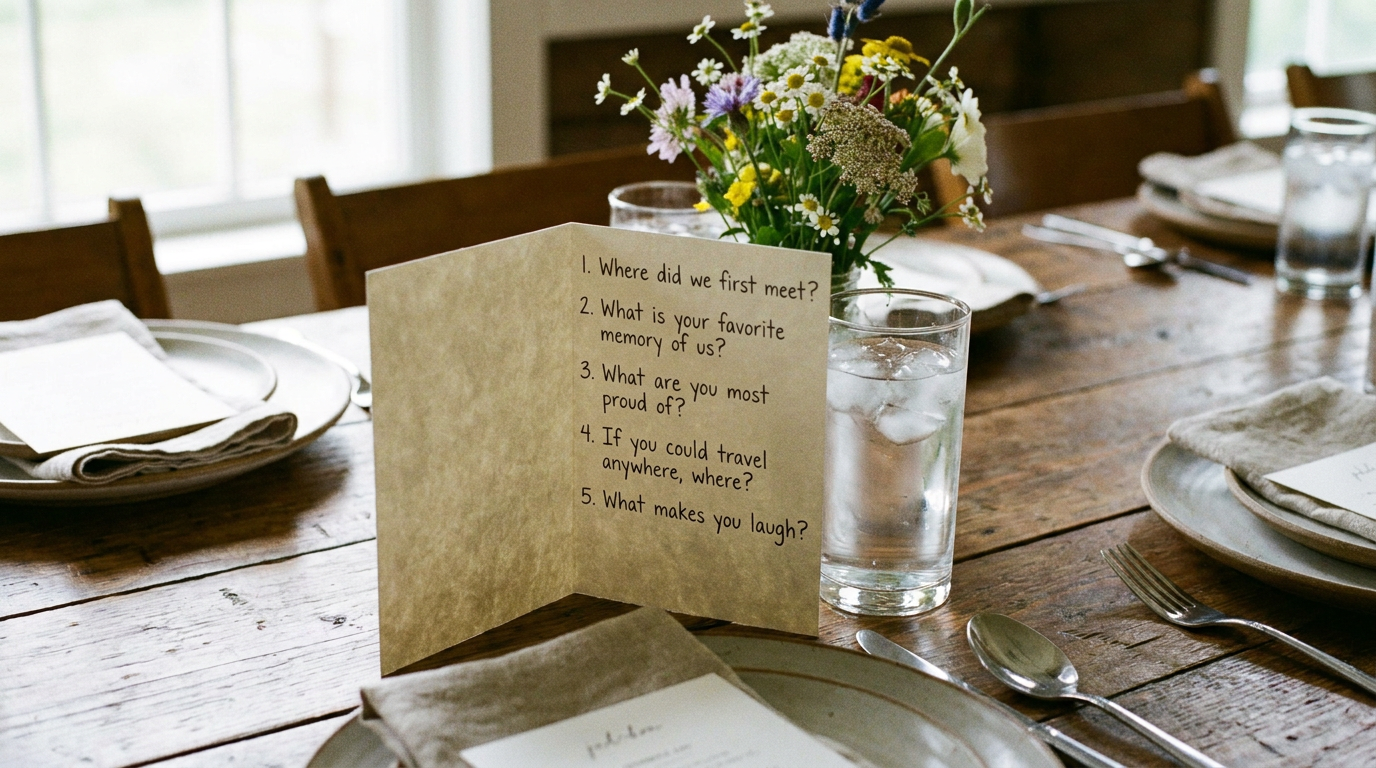
A hand-written list of five questions on a folded card, propped against a water glass on a set dinner table.

Ask, don’t interrogate.

No clipboard. No going round the table in strict order. No “right, everyone, we’re doing an activity before dessert.” Drop one question into a lull the way you’d drop in any other question — the same tone you’d use to ask whether anyone’s seen the neighbour’s new car. The second it feels like a scheduled segment, people start performing, and a performed answer is worth nothing to anybody.

Say that anyone can pass — and say it first.

Before you ask anything. Not after somebody has already hesitated and had to manufacture a reason for hesitating. “You can skip any of these, obviously” costs you four seconds and changes the whole temperature of the thing.

This matters more than it sounds. People answer far more freely when they can feel where the exits are. The pass isn’t a failure condition — it’s the mechanism that makes honest answers possible in the first place.

One question per course.

One while people are still serving and passing dishes. One mid-meal. One when the plates are cleared and nobody’s moved yet. Spacing them out is what keeps this feeling like conversation rather than a quiz round. Three good questions across two hours will get you more than ten in ten minutes, every single time.

The follow-up is where the real material is.

This is the part nobody tells you. The prepared question is just the door. Everything worth keeping comes from the unscripted seconds afterwards.

What happened next?

Who else was there?

Wait — who’s Ronnie?

The easiest technique in the world, and it feels absurd until you watch it work, is to repeat their last few words back as a question. “We had to sell the piano.” — “You had to sell the piano?” And off they go. You are not conducting an interview. You are being visibly interested, which is a thing most people encounter far less often than they’d like.

If your table conversation cracks something open and you want to go properly deep afterwards, Lugelo’s covers interview technique in far more depth than a section like this can — it’s built for a quiet kitchen and an hour, which is a different instrument to the one we’re using here.
50 questions to ask your grandparents

Let the silence sit.

A pause almost never means someone has finished. It means they’re retrieving something, and retrieval takes a few seconds, and those few seconds feel like a year to everyone else at the table.

Don’t fill it. Don’t rescue them. Don’t move to the next question.

The thing said after the pause is consistently better than the thing said before it. That’s not a rule of thumb, it’s nearly a law.

Decide who’s hosting — and make it two people.

Not necessarily the cook. The cook is up and down all meal, checking things, carrying things, being asked where the serving spoons are. This works best with whoever is already comfortable talking across a table. And it works considerably better if two people know the plan in advance, so one can pick up the thread when the other is carving or refilling glasses. A question that gets abandoned halfway because the host had to deal with the oven is worse than no question at all.

Give a kid the job.

This is the single best trick in the section. Hand a child the printed list and let them choose the next question. The dynamic inverts completely — it stops being an adult activity being performed at

That’s the method. Now the questions, starting deliberately light.

the table and becomes something the kids are running. People answer children more honestly than they answer their own siblings, they’re gentler about it, and no one accuses a nine-year-old of being weird for asking. A child holding a numbered list has more social licence than any adult in the room.

Thanksgiving Writing Prompts, Part One: Icebreakers and Questions for Kids

Nobody in the history of family dinners has successfully opened with “tell me about the hardest year of your life.” The room has to warm up first, and the fastest way to warm a room is to get a laugh inside the first two minutes. Once people have laughed once, the entire afternoon becomes available. Skip that step and you’ll spend the rest of the meal trying to recover from a question that landed like a dropped plate.

Start light. Always. Every time.

Icebreakers for the Start of the Meal (Questions 1–8)

These are for the first twenty minutes, and especially for a table with guests, in-laws, new partners, or people who genuinely don’t know each other. Low stakes. No vulnerability required. Anyone can answer any of them without thinking hard or revealing anything they’d rather not.

  1. Is there a dish on this table with a story behind it?
  2. What’s something on the Thanksgiving menu you’ve never actually liked?
  3. What’s the best thing you’ve eaten all year?
  4. What’s one good thing that happened this year that you haven’t told anyone about?
  5. What’s something you learned this year, however small?
  6. What’s a tradition in this family that nobody remembers starting?
  7. Who taught you to cook the thing you cook best?
  8. What’s the most useless skill you’ve picked up this year?

Notice that every one of those is under fifteen words, and that not one of them asks anybody to be profound. Question 2 in particular is worth more than it looks — a table full of people confessing which traditional dish they’ve been politely eating for two decades will generate more genuine laughter than anything else on this list, and laughter is the currency you need before anything harder becomes possible.

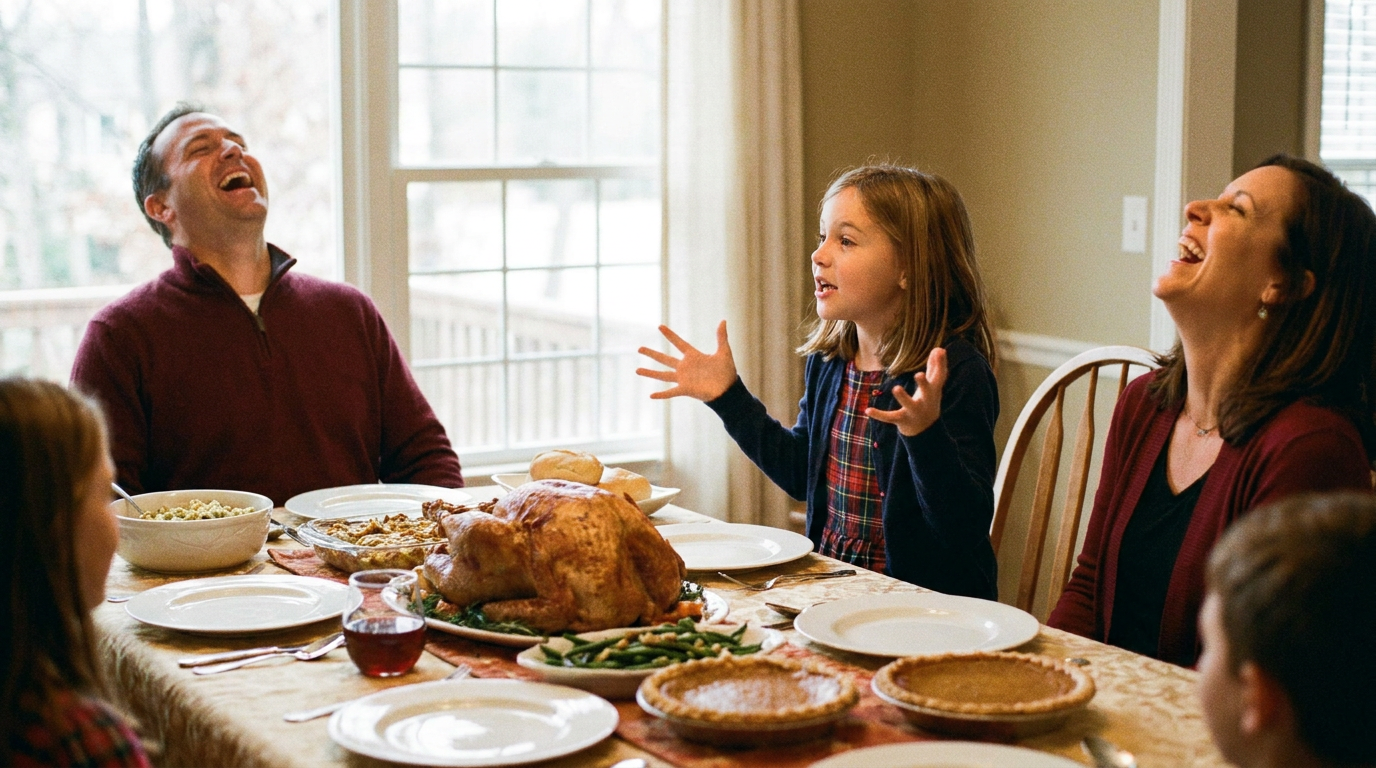
A child at a Thanksgiving table, mid-sentence, hands up, telling a story to two laughing adults.

Thanksgiving Writing Prompts for Kids at the Table (Questions 9–16)

Children answer abstractions badly and objects brilliantly.

Ask a seven-year-old what they’re grateful for and you’ll get a shrug, or a copy of whatever the last adult said, or “my dog,” which is at least honest. Ask them what the best thing on their plate is right now and you’ll get a considered, specific, weirdly passionate answer with reasons attached. The problem was never the child’s capacity for reflection. It was the shape of the question. Lugelo’s A note on what counts as an answer here: drawing counts. Dictating it with a mouth full of potatoes counts. A one-word answer followed by a better answer four minutes later counts. These are pitched at roughly ages five to twelve.
25 journal prompts for kids

is built on exactly this principle, age-tiered, and it’s worth a look for any parent who wants to keep this going past November.

  1. What’s the best thing on your plate right now?
  2. If you could choose anyone in the world to sit next to today, who would it be?
  3. What’s something you can do now that you couldn’t do last year?
  4. What’s the funniest thing anyone has said today?
  5. If you were in charge of the whole meal, what would you cook?
  6. Which grown-up here is really good at something? What are they good at?
  7. What’s the best thing that’s happened since summer?
  8. What’s one thing you want to do before the year ends?

Question 14 is the sleeper. Children notice competence in adults with startling accuracy and almost never get asked about it, and the adult in question will remember being told for a very long time.

One note for parents, and it’s the reason this Thanksgiving writing prompt block is worth more than it appears. A child’s version of the day is genuinely, structurally different from yours. They were at knee height. They were in the hallway when the argument happened. They thought the best part was the dog getting under the table. Their account is not a lesser version of the adult account — it’s a different one, and it’s the one that disappears fastest, because nobody writes it down and the child won’t remember it by spring.

These same Thanksgiving writing prompts

do double duty in a classroom, which is the next section — though a room of twenty-eight children needs a slightly different shape than a room of nine relatives.

Thanksgiving Writing Activities for the Classroom

If you’re a teacher planning Thanksgiving writing activities for the week before the break, the questions above will work in a classroom with one adjustment.

In a classroom, they get written down as well as spoken. And the speaking is what makes the writing possible.

The read-aloud-then-write method

Ask the question to the whole room. Take two or three spoken answers — not from volunteers only, but don’t force it either. Then everyone writes.

That’s the entire method, and the sequence is the point. Students who freeze at a blank page very rarely freeze after they’ve heard three classmates answer. They’re not copying. They’re calibrating — working out what register the answer lives in, how long it’s meant to be, whether it’s allowed to be funny. The spoken round is scaffolding, not a warm-up, and removing it removes the thing that was holding the exercise up. Lugelo’s guide to unpacks this in more detail for anyone who wants the longer version.
how classroom blogging builds self-reflection skills in students

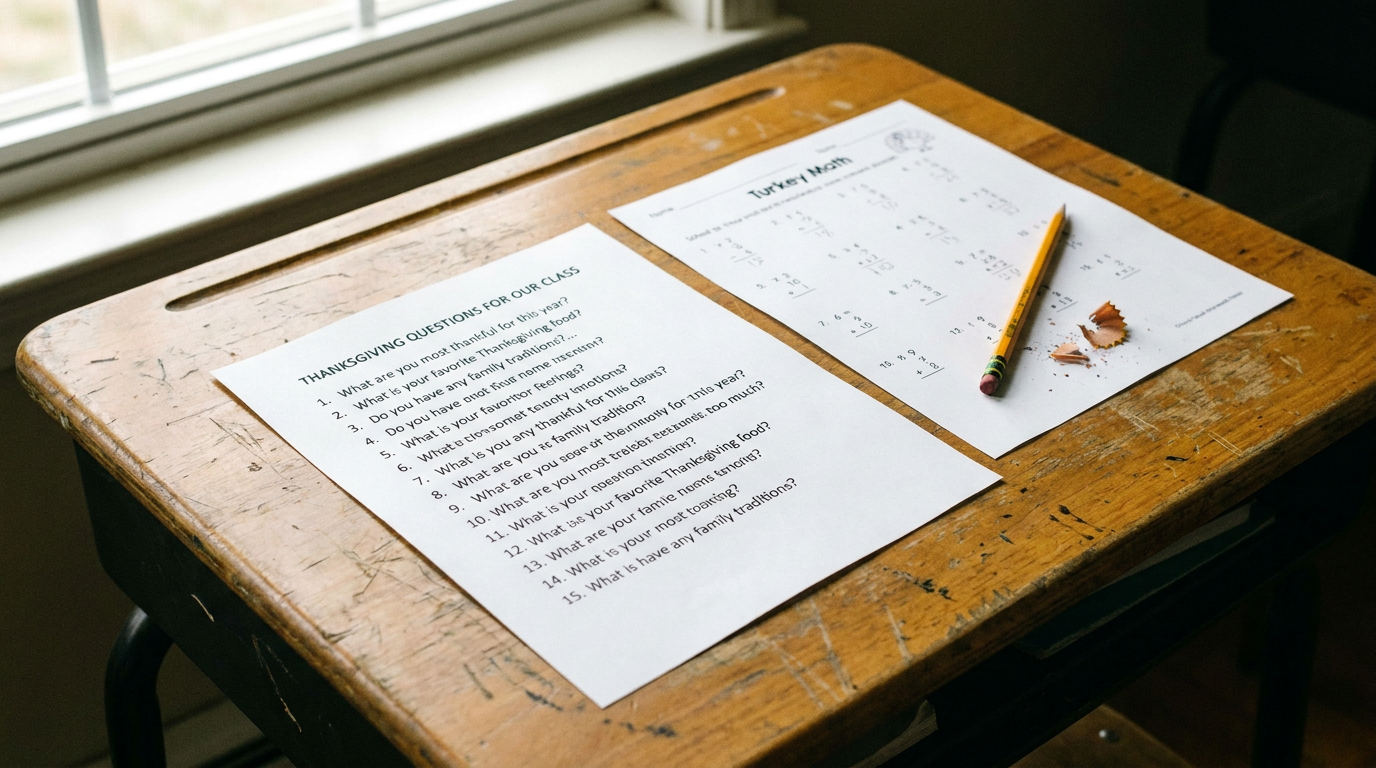
A printed, numbered list of Thanksgiving questions on a classroom desk beside a pencil and a half-finished worksheet.

Tiering it by age

Early elementary. One question. One drawing. One dictated sentence underneath it. A drawing is a complete answer and should be marked as one — the sentence is a bonus, not a requirement.

Elementary. One question, three sentences, with a single requirement: include one detail nobody else in the room would know. That constraint does an enormous amount of work. It’s the difference between “we had turkey” and “we had turkey and my grandad always cuts his into exact squares.”

Middle school and up. One question plus a follow-up. Either what changed — before and after — or what you’d say about this to someone who wasn’t there. The second framing reliably produces better writing, because it gives the student an audience, and writing without an audience is just homework.

Which of the forty to use in class

Be deliberate about the rest. The elder-focused questions further down assume access to a grandparent, which not every student has. The grief and empty-chair block is not classroom material — it belongs at a kitchen table with someone who loves you, not in a room of twenty-eight peers. If you want those in play at all, send them home as an optional family activity with a note to the caregiver, and let families decide.

The icebreaker block and the kids’ block are your classroom set. Questions 1 through 16 are safe, age-appropriate, and require no disclosure about anybody’s home life. Questions 3, 5, 6, 9, 11, 12, 13, 14, 15 and 16 in particular will work in almost any room.

The take-home version, which is the best use of this list

Here’s the highest-value Thanksgiving day writing activities assignment on this page, and it’s almost embarrassingly simple.

Ask one older relative one question over the break. Write down what they say. Bring it back.

That’s it. One question, one answer, one page. What it does is convert a writing exercise into an oral history exercise, and it produces material that families keep — which almost nothing else assigned in a school week manages. StoryCorps has run a version of this nationally for years; their are free, classroom-ready, and built around precisely this premise of students recording an elder over the holiday. If you want the structured version with permission forms and lesson framing already done, start there.
Great Thanksgiving Listen materials for educators

The other reason to run it as a take-home: the writing has somewhere to go afterwards. A stack of “what I’m thankful for” worksheets gets recycled in December. A stack of transcribed grandparent interviews does not, because every family in the room wants their copy. Lugelo’s

ultimate guide to creating a school memory book

And the take-home assignment — one older relative, one question — is the doorway into the most valuable cluster in this entire post.

One practical note: the full set of forty is numbered continuously and uninterrupted specifically so you can select it, copy it, and drop it into a worksheet without editing anything. No decorative breaks, no boxes, no commentary wedged between items. It was built to be printed.

covers turning collected student writing into something that’s kept rather than binned at the end of term, which is the difference between an assignment and an artefact.

The Questions That Get the Older Generation Telling Stories

These questions are aimed at that other person. She’s still in there and she remembers all of it.

We almost never know her as the twenty-two-year-old who moved cities with one suitcase and no plan. As the person who was furious about something for eleven years. As someone’s daughter, standing in a kitchen that no longer exists, being told off.

And there’s a reframe that makes these questions work far better than they should. We know our grandparents in exactly one role. We meet them in the last act, already cast, in the version of themselves that has been edited and smoothed and made appropriate for children. Grandma is a person who makes a particular pie and has opinions about the weather.

For most families, this is the only realistic chance anyone gets to ask.

A holiday table is one of the very few occasions in the year when three generations occupy one room with time on their hands and no agenda. Not a wedding, where everyone’s busy. Not a funeral, where the timing is wrong. Not a hospital visit, where the shape of the conversation is already determined. A long meal, in a warm room, with nowhere to be.

Let’s name the opportunity plainly, because it’s easy to miss when you’re carrying a dish.

Ask for texture, not for dates

This is the discipline that separates a useful question from a wasted one.

Dates are recoverable. Somebody’s birth year, the name of a town, the year of a marriage — a certificate will give you those. A census record will give you those. A cousin with a subscription to a genealogy site will give you those in about forty minutes, long after everyone who could have told you is gone.

What is not recoverable, by any method, ever, is the texture. The smell of the hallway. The nickname only three people used. The argument about the dress. What the radio was playing. Which neighbour you weren’t allowed to talk to and the never-explained reason why.

That material exists in precisely one location, and it is sitting at the other end of the table asking whether anyone wants more gravy.

The dates are recoverable. The texture isn’t.

Questions for the Older Generation at the Table (Questions 17–26)

Ten questions, all shaped for a busy table rather than a quiet one-to-one interview. Each one is answerable in under a minute if that’s all someone wants to give it — and each one expands indefinitely if they don’t.

  1. What did Thanksgiving look like when you were a kid?
  2. Who did the cooking, and who was actually in charge?
  3. Is there a dish we used to have that nobody makes anymore?
  4. What’s the longest journey you ever made to get to a family meal?
  5. Who’s in the oldest photograph you own?
  6. Who used to sit at this table that none of us ever met?
  7. What were you doing at the age I am now?
  8. What’s the best year you can remember, and why that one?
  9. What’s something you were completely sure about at twenty-five and turned out to be wrong about?
  10. What’s one thing you hope this family keeps doing?

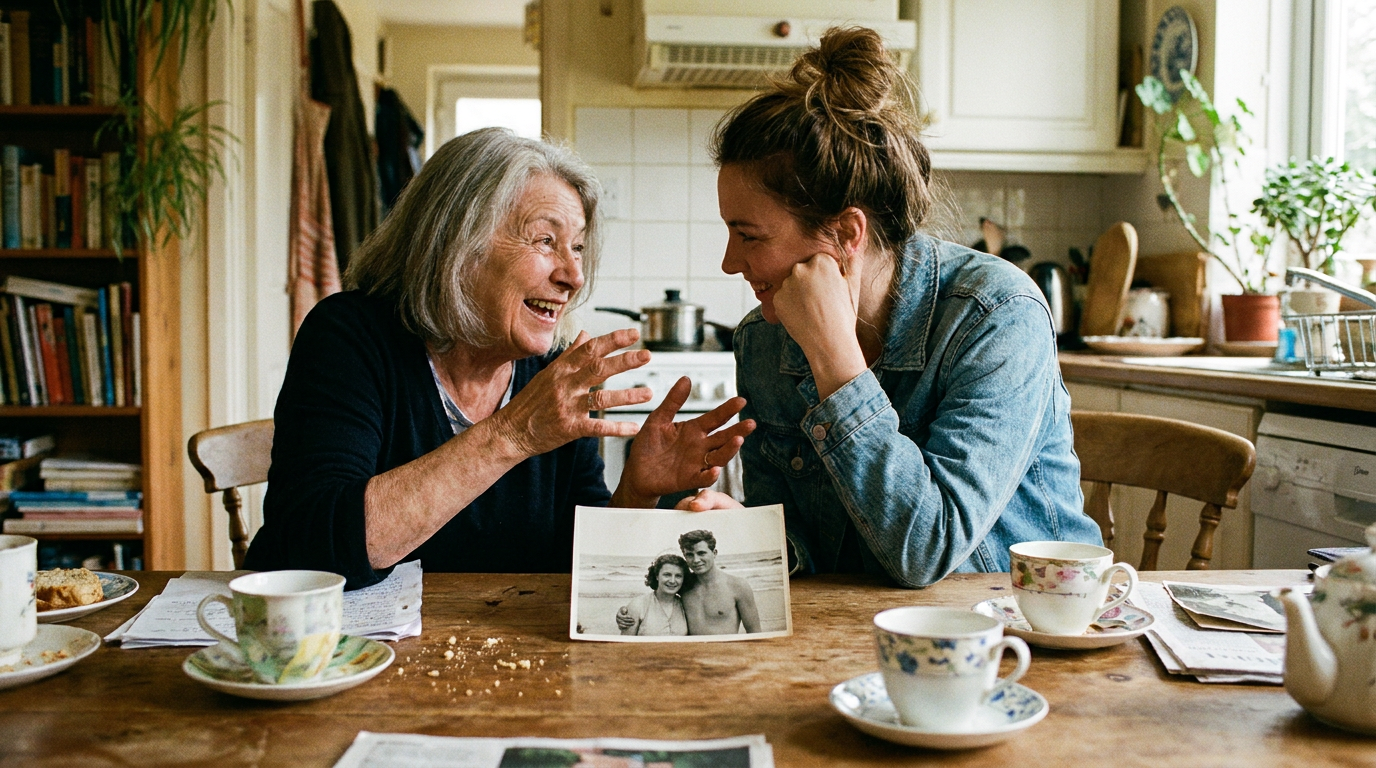
An older woman at a table mid-story, a younger relative leaning in to listen, an old photograph face-up between them.

Question 23 is the other one to watch. Asking an eighty-year-old what they were doing at thirty-one, while a thirty-one-year-old sits across from them, collapses the distance between two people who have never once thought of themselves as peers. It reliably changes how both of them talk for the rest of the meal.

A specific note about question 21, because it behaves unlike the others. People expect to answer it with a name and an approximate date. What actually happens, with remarkable consistency, is fifteen unbroken minutes about somebody nobody in the family has ever heard mentioned — a sister who died young, a business partner, a neighbour who effectively raised them for two years. The photograph question is a trapdoor, and what’s underneath it is usually the best thing you’ll get all day.

One piece of research, held loosely

Researchers at Emory University developed something called the “Do You Know” scale — Marshall Duke and Robyn Fivush’s work on measuring how much children know about their family’s history, the small stories about where their grandparents grew up and what went wrong and what happened next. They observed an association between knowing more of that material and a stronger sense of belonging and resilience in children. You can read about the ongoing work at The samples studied skewed towards middle-class, two-parent households, which is a real limitation on how widely it generalises. An association is not proof of cause — it’s entirely plausible that families who talk like this are already doing several other things that help, and the talking is a symptom rather than the medicine. It’s suggestive. It isn’t conclusive, and anyone who quotes it at you as settled science is overselling it.
Emory’s Family Narratives Lab

Hold that loosely.

.

What it does do is confirm something less controversial: this isn’t a sentimental hobby. Collecting first-hand accounts is a recognised discipline with institutions built around it, and the reason those institutions exist is that first-hand accounts cannot be reconstructed from any other source once they’re gone. has been running on exactly this premise for years — a national initiative organised around the observation that the holiday table is the best available room for this, which is a reasonable independent vote of confidence in the whole idea.
StoryCorps’ Great Thanksgiving Listen

And if the table conversation opens something up and you want to sit down with someone properly afterwards, Lugelo’s is the deeper instrument. Every question in the block above is deliberately different from that list, so the two work together rather than overlapping — this set for a noisy table, that set for a quiet afternoon with a pot of tea and two hours.
50 questions to ask your grandparents

Consent, briefly and clearly

Once a table has gone somewhere real, the questions can get a little harder. That usually happens on its own, around the time the plates come away.

And agree who gets to hear it afterwards. This is the one that gets forgotten constantly, and it’s the single thing most likely to make someone regret having talked to you. “Is it alright if I play this for the kids?” is a thirty-second conversation that prevents a genuinely bad outcome. Ask it at the time, not six months later when the recording has already been in the family group chat for a fortnight.

Any question can be declined, without a reason, and the decline should land without any follow-up at all.

If you’re going to record any of this — audio, video, notes — say so plainly and ask first. Not as a legal formality. As basic courtesy to someone who is about to tell you something.

After the Plates Are Cleared: Harder Questions, an Empty Chair, and a Hard Year

That’s when these work.

There’s a specific window in the afternoon. The table has been cleared but nobody’s actually left it. Someone’s making coffee. Two people are still picking at the pie. The light has gone amber and nobody has turned a lamp on yet.

The Questions for When People Linger (Questions 27–33)

Accept a pass instantly, and without a follow-up.

Only ask these if the room has genuinely warmed up. You’ll know. If it hasn’t, stay with the icebreakers and lose nothing — a good light conversation beats a forced deep one every time.

  1. Who helped you this year? Have you told them?
  2. What’s a decision you made this year that you’re glad about?
  3. What’s something you changed your mind about?
  4. Who would you want at this table next year who isn’t here?
  5. What’s one thing you’d want someone to know about this particular year?
  6. Is there something you’re carrying that you’d like to put down before the year ends?
  7. What do you want the next twelve months to look like? Not impressive — just well spent.

Question 27 has a habit of turning into action. People answer it, hear themselves answer it, and then text the person that evening. That’s a better outcome than anything you’d get from a journaling exercise.

A cleared Thanksgiving table at dusk, two coffee cups and one empty chair, low warm light.

For an Empty Chair or a Hard Year (Questions 34–37)

These four are aimed at remembrance, not resolution.

Nobody has to be grateful for a hard year. You are allowed to say that it was hard, full stop, with no redemptive clause attached. If anyone at your table tries to append one on your behalf, they’re wrong.

So, plainly: these questions are not an instruction to find the silver lining.

Some tables have a chair that isn’t being used, and everyone has noticed, and nobody has said anything. Some people arrive from an estrangement, or a diagnosis, or a separation, or a year that simply took something and didn’t give anything back. Pretending otherwise is a large part of why some people dread the day — not the grief itself, but the obligation to perform being fine about it while passing the potatoes.

Thanksgiving is not warm for everyone.

  1. What would they have said about today?
  2. What did they always do at this meal that someone else has quietly taken over?
  3. What would you tell them about this year if you could?
  4. What’s a small thing they taught you that you still do?

And if someone is missing by choice rather than by death, these are probably not the right questions. Estrangement is a different thing and this post is not going to offer you advice about it. Skipping this block entirely is a perfectly good decision and requires no justification to anyone.

But follow the lead of whoever is closest to the loss. Entirely. If the answer is short, let it be short and move on without commentary — no “that’s beautiful,” no squeezing of the hand, no meaningful pause. Just continue. Whoever has the strongest claim to the grief gets to set the terms, including the term that we’re not doing this today.

Naming someone out loud is very often welcomed rather than avoided. This surprises people. The common fear is that saying the name will ruin the afternoon — but for a lot of grieving people, the harder thing is watching a name drop out of family conversation entirely, as though the person has been quietly filed away. Being asked about them can be a relief.

A few practical notes, and then we’ll move on.

If You’re Alone This Thanksgiving (Questions 38–40)

These three are written to be answered on paper rather than spoken. They are not consolation prizes.

Some Thanksgivings are solo. By distance, by circumstance, by a shift pattern, or by deliberate choice because last year was exhausting and you’ve decided not to do it again.

  1. Who would you most want to sit down with today, and what would you ask them?
  2. What would make a quiet day feel like it was worth something?
  3. What’s something good from this year that nobody else knows about?

No instruction here to reframe solitude as an opportunity, or to treat a quiet day as secretly the better option. A quiet day is allowed to be a quiet day. Writing something down is not a treatment for anything and shouldn’t be sold as one — though if you find that a page helps, Lugelo’s

September journal prompts

That’s all forty. Which leaves one problem, and it’s the one that makes or breaks everything above: by next week, most of it will be gone.

A fuller set of gratitude prompts also works well for a quiet day, and they’re worth keeping past November rather than retiring with the leftovers — the useful ones tend to be the ones you can answer in any month.

offer a longer set in the same register, without overclaiming what a notebook can do.

Capturing the Answers Before They Evaporate — and Where They Live Afterwards

Here’s what happens.

Within a week, you will remember that the conversation was good. You’ll remember the feeling of it. You’ll remember laughing, and the bit where she surprised everyone, and the fact that it went on much longer than expected.

You will not remember what she said about the bakery. Or the name of the street. Or the year. Or the exact phrase she used that made your mother put her fork down.

The detail has a very short half-life, and nothing about caring more will change that. This isn’t a character flaw and it isn’t fixable by intention. It’s just how memory works with spoken language — the gist survives, the wording evaporates, and the wording was the good part.

A phone lying face-down on a cleared table next to a coffee cup, recording, with people talking in soft focus behind it.

Three ways to catch it, all free, all doable by anyone

A voice memo. Phone face-down on the table. Ask first — plainly, in normal words — then start it and genuinely forget about it. Audio carries everything text loses: the hesitation before the honest bit, the laugh, the particular way they say your name. Those are the first things you forget and the things you miss most. One rule, and it’s not optional: label it immediately. An untitled audio file is a lost audio file, and you will not recognise it in three years. The National Archives’ makes the same point about labelling and dating for exactly this reason — the identification is the preservation.
guidance on preserving family archives

One photo of the table. Not of people posing. Of the table as it actually was, mid-meal, half-eaten, crowded, someone’s elbow in frame. That photograph will date the day and trigger more recall than any arranged group shot, because it contains the unedited evidence of what the afternoon was actually like.

One person taking notes.And restating this once more because it matters: ask before you record, every time, in plain words. Then agree who gets to hear it. Both of those take under a minute and they’re the difference between a recording someone’s glad you made and one they wish you hadn’t.

Not a transcript — nobody is doing that, and trying will ruin the meal. Three things, jotted down while the kettle’s boiling. Three things beats the nothing you’d otherwise have by an enormous margin, and it remains a completely valid approach for a table where someone would genuinely rather not be recorded at all.

The problem that starts after you’ve captured it

Every one of those places is a device that will eventually be replaced, wiped, lost, or upgraded by someone who assumed everything was backed up.

The recording is on your phone. The photos are on your sister’s. Someone posted a clip in the group chat where it’s already sinking. Your cousin wrote down the bit about the bakery in a notes app she’ll eventually clear out. The best story from the best conversation of the year now exists in four separate places and belongs to nobody in particular.

Now you have material. And within about two weeks it’s scattered.

This is the problem A single Moment holds the text of what she said, the photo of the table, and the audio of her actual voice — in one entry, rather than three apps that don’t know the others exist. When you open it in ten years, the whole thing arrives together.
Lugelo

was built for.

Shared journals let everyone who was there add their own version of the same afternoon. Your brother’s account of the kitchen. Your aunt’s photographs. The detail your cousin caught while you were carving and completely missed. Role-based permissions mean the owner decides who can view and who can add — you can see what that looks like in practice in Lugelo’s Memory Lane arranges everything in order, which is the thing that turns a pile of undated files into something that reads as a sequence. And that’s not a small distinction. One Thanksgiving is a nice entry. Ten Thanksgivings laid end to end is a completely different object — you can watch the children arrive, the table get longer, the recipes move between hands.
family journal stories

, which is other families doing this rather than a description of doing it.

And when you’ve got a few years of it, storybooks, scrapbooks and eBook export turn a set of answers into something you can physically put on the table next November — rather than five people crowded around one phone, taking turns to scroll. Lugelo’s walks through that process if you’re collecting with that endpoint in mind.
guide to turning a journal into a book

One more practical note for anyone travelling to the table rather than hosting it: decide who’s capturing what before you leave. Two people both assuming the other one is recording is how a decade of families have ended up with nothing. Lugelo’s covers setting that up in advance, which takes about five minutes and removes the entire problem.
holiday travel journal setup guide

On privacy, in plain English. Journals are private by default, with owner-controlled access. You decide who can view or contribute, and access can be revoked at any time. Data is encrypted in transit, there’s no third-party data sharing, and deletion is available with a 30-day recovery window. If you want the full detail, it’s all on .
Lugelo’s FAQ page

November Journal Prompts: Writing It Down Once Everyone’s Gone Home

These are for the evening after, or the following morning — when the dishwasher’s on its second run, the house has gone quiet, and you’re the only one still thinking about what your uncle said. They sit outside the numbered forty, deliberately, so the printable set stays intact.

The forty above were spoken. This handful is not.

  • Who surprised you today?
  • What do you want to remember about this specific group of people, as they are right now?
  • What was different about this year’s table?
  • What do you want to ask next year?
  • What are the three things from today you don’t want to lose?

Answer the same few every November and something happens that’s hard to appreciate until you’re several years in. You end up with a record no photo album could produce — not of how everyone looked, but of who they were, what they were worried about, what they’d just decided, and who was newly at the table. These November journal prompts work precisely because they repeat. The same question asked annually becomes a measuring stick, and the answers only get more interesting as the stack grows. That’s the quiet case for November writing prompts

Before you close the tab, a few things people usually want to know.

over one-off reflection: the value compounds.

Thanksgiving Journal Prompt FAQs

What are good Thanksgiving journal prompts?

Good Thanksgiving journal prompts are short, specific questions that can be answered out loud in a sentence or two — things like “What’s a tradition in this family that nobody remembers starting?” or “What’s something you can do now that you couldn’t do last year?” The best ones ask about one moment, one person or one object rather than a whole year, and they work across ages, so children and grandparents can both answer the same question.

What should I ask at Thanksgiving dinner?

Pick five questions before people sit down and space them across the meal rather than asking them all at once. Start light — something about the food, or the best thing someone’s eaten all year — and only go deeper once the room has warmed up. The icebreaker block above is built for the first twenty minutes and requires nothing from anyone beyond an opinion about dinner.

How do I start a conversation at Thanksgiving without it feeling awkward?

Don’t announce an activity. Drop a single question into a natural lull, in the same tone you’d use for any other question, and let it be a conversation rather than a segment. Say up front that anyone can pass — before you ask, not after somebody hesitates. The awkwardness comes almost entirely from the announcement, not from the questions themselves.

What are good Thanksgiving writing prompts for kids?

Concrete ones. Children answer questions about objects, people and specific moments brilliantly, and questions about abstractions badly. Ask what the best thing on their plate is, or what they can do now that they couldn’t last year, rather than what they’re thankful for. Drawing counts as a complete answer, and so does dictating it to an adult mid-meal.

What are some Thanksgiving writing activities for the classroom?

The most reliable method is read-aloud-then-write: ask the question to the room, take two or three spoken answers, then everyone writes. Hearing classmates answer removes the blank-page freeze. The highest-value version is a take-home assignment — ask one older relative one question over the break, write down the answer, bring it back. That converts a writing exercise into oral history.

What questions should I ask my grandparents at Thanksgiving?

Ask for texture rather than dates. Certificates and records will eventually give you birth years and place names; nothing will give you the smell of the hallway or the nickname nobody uses anymore. Try “Who’s in the oldest photograph you own?” or “What were you doing at the age I am now?” For a longer sit-down afterwards, the list goes considerably deeper.
50 questions to ask your grandparents

What do you write in a November journal entry?

Write the things from the day you don’t want to lose. Who surprised you, what was different this year, what somebody said that you want to keep. Short is completely fine — one photo and one sentence is a finished entry, not a draft of one. The entries you’ll value most in a decade are rarely the long ones; they’re the ones that captured a detail nobody else recorded.

How do I handle Thanksgiving when someone is missing?

Saying their name out loud is very often welcomed rather than avoided — many people find it harder when a name quietly drops out of family conversation altogether. But follow the lead of whoever is closest to the loss, completely. If the answer is short, let it be short and move on without commentary. Deciding to skip it entirely is a perfectly good decision.

Is Lugelo free?

Yes — Lugelo is free on iOS, Android, HarmonyOS and the web, with Chrome and Firefox extensions available. Journals are private by default, with owner-controlled access, so you decide who can view or contribute to anything you create.

A Thanksgiving table photographed from above at the end of the meal — empty plates, crumpled napkins, two glasses, warm lamplight.

Conclusion: Ask One. See Where It Goes.

So let’s be clear about what the argument here actually is, because it isn’t the one these posts usually make. The point is not that time is running out and you should act before it does. That framing turns a good afternoon into an obligation, and obligations are exhausting.

Nobody asked. That’s the whole of it.

There’s no revelation waiting at the end of that story. Nothing was hidden and nobody was withholding anything. She simply had the answer the entire time — to what her first job was, and what the house smelled like, and who she was at nineteen — and she would have told anyone who asked, probably at length, probably with a laugh in the middle of it.

Back to the grandmother at the end of the table.

The point is much more cheerful than that. Everyone you’d want to ask is already going to be sitting at a table, for a few hours, once a year, with nothing else to do. The opportunity isn’t scarce or urgent. It’s availablePick one question. Ask it somewhere between the main course and the pie.

And the commitment is smaller than you think. Don’t plan the activity. Don’t print anything, don’t tap a glass, don’t tell anyone this is happening.

, right now, for free, from people who already like you.

If you want a specific first move rather than general encouragement: use number 6. What’s a tradition in this family that nobody remembers starting?

The table gets cleared either way. The only difference is whether anyone wrote anything down.

Then afterwards, while the kitchen’s still warm and someone’s still drying plates, write down three things. Not a transcript. Three things.

If it goes nowhere, you’ve lost thirty seconds. If it goes somewhere, you’ve got the afternoon.

It’s safe, it’s funny, everyone has an opinion, and it very reliably turns into an argument about who started it — which is exactly the kind of argument you want a recording of.

Don’t Just Live It — Keep It

Start a shared journal for this year’s table and invite the people who were there. Keep their answers, the photo of the table and their actual voice in one place — so next November, you’re adding to something instead of starting over.

Start Saving What Actually Matters

Available on web, iOS, Android and HarmonyOS — .
Download Lugelo

Journals are private by default, with owner-controlled sharing. Data is encrypted in transit.

An open journal, a closed linen notebook, a smartphone, a pen and a cup of tea arranged on a bed beside a sunlit window.

What to Write in a Pregnancy Journal (Week by Week, Without the Pressure)

You bought the journal at week six. It has a ribbon marker and gold lettering on the front. It sat on the bedside table for a while. Now it is in a drawer, still blank, and you are twenty-two weeks in.

The blank journal is not evidence that you don’t care. It is evidence that the journal asked for more than you had.

So if you’re wondering what to write in a pregnancy journal, here is the short version:

  1. The date, and how many weeks you are.
  2. How you feel today. One word is enough.
  3. One thing that happened.
  4. One thing you’re wondering about.

That’s it. Four lines is a complete entry. Not a rough draft of one. A complete one.

The rest of this post is the long version. Sixty prompts sorted by stage. Low-effort formats that aren’t a book. What to do on the days you’re too tired to type. And where the entries live afterwards, which matters more than most people expect.

One more thing before we start. You are allowed to write badly. You are allowed to skip weeks. You are allowed to write down the hard parts.

Why do week-by-week pregnancy journal templates stop working around week 12?

Then you miss two weeks. And the template stops being a journal and turns into a scoreboard you are losing.

A template asks the same amount from you every single week. It asks whether or not anything happened. It asks whether or not you have anything left in the tank. Week nine and week nineteen get identical space and identical questions.

The week-by-week template is usually where it breaks. Not because you lost interest. Because of how the thing is built.

Almost everyone stops. That is worth saying at the start, plainly, because most people assume they are the only one with a drawer like that.

What the format assumes about you

So the format fails on contact with an ordinary life. That is a design problem, not a character problem.

Early pregnancy frequently supplies none of the three. Neither does late pregnancy, for different reasons. The middle stretch might, if you’re lucky, for a while.

That page is designed around three assumptions: that you had a steady week, that you have a settled mood, and that you have time.

Look at what a standard week-by-week page actually requires. A full page of writing. A styled photo. A mood. A reflection. Sometimes a letter.

What actually counts as a finished entry

Here is the bar, and it is deliberately low enough that it cannot be failed.

One line and one photo is a finished entry.A single line with a date attached is worth more, a year from now, than the beautiful page you kept meaning to write and never did. The beautiful page does not exist. The line does.

Read that again if you’ve been carrying around a mental image of what a “proper” entry looks like. There is no proper. There is dated and undated, and dated wins.

The backfill instinct is what kills it

This is the single most common reason people never restart, so it gets its own section.

You open the journal after a gap. Your instinct is to catch up. Summarise the three weeks you missed. Maybe write a small apology at the top — sorry, it’s been a while.Backfilling converts re-entry into homework. Homework is something you postpone. Postponing is how a two-week gap becomes a two-month gap becomes a drawer.

Pick up at today’s date. Write today’s four lines. The gap stays a gap.

Do not catch up. Do not apologise to your own notebook. Do not summarise the weeks you missed.

Don’t. Any of it.

What the template asks for, versus what actually works

This is the whole argument in one block. If you only read one part of this section, read this one.

  1. A full page every week — versus four lines, on the weeks you can manage four lines.
  2. A styled bump photo with good light — versus the photo you already took in the bathroom mirror.
  3. Every week, in order, none missing — versus whichever weeks you actually felt like it.
  4. Considered, reflective prose — versus a fragment. A list. One word.
  5. A fresh start each week — versus adding to the same note from the top.
  6. Neat handwriting, no crossings-out — versus typos stay. Nobody is marking this.

The right-hand column is not a compromised version of the left-hand column. It is the version that gets finished.

Gaps are information too

You do not have to fill them in later to make them count. An uneven record is an honest record.

The weeks where nothing gets written are also part of the record. A three-week silence in a journal tells you something real about that stretch of time. You were flat out. Or you were flattened. Or nothing happened worth reporting, which is itself a fact about those weeks.

One last reframe, and it’s the one people find most freeing.

If you want the longer case for a lower bar you can actually keep, Lugelo’s

post on building a journaling habit without the streak pressure

Everything that follows is built to that lower bar. Starting with sixty questions you can answer in a sentence each.

makes the same argument in more depth — weekly beats daily, one photo and one sentence is complete, and you always pick up at today’s date rather than backfilling.

What to write in a pregnancy journal: 60 prompts by stage

Pick two or three. Not all sixty. Answer them out of order, skip anything that irritates you, and treat one sentence as a complete answer. These are here to remove the blank page, not to give you a new list of things you are behind on.

A short note on how to use these before you scroll.

First trimester prompts (1–10)

For the early weeks, including the stretch where you haven’t told anyone yet.

  1. The moment you found out — where were you, and who else was in the room?
  2. What did you do in the first hour afterwards?
  3. Who do you most want to tell, and why haven’t you yet?
  4. What is it like holding news this big inside a completely ordinary week?
  5. What excuse have you been using to explain how you’ve been feeling?
  6. What are you most looking forward to about telling people?
  7. What are you worried about that you haven’t said out loud to anyone?
  8. What has changed in your day-to-day this week, in practical terms?
  9. How do you feel about your body right now?
  10. What would you want to remember specifically about this week?

Second trimester prompts (11–20)

  1. How did telling people go, and who surprised you?
  2. What was the first thing you bought, or the first thing you were given?
  3. Have you had a name conversation yet, and did you agree?
  4. What have strangers started saying to you?
  5. What have you stopped doing, and do you miss it?
  6. What is one moment from this month you would keep?
  7. What are you reading, watching or listening to on a loop right now?
  8. Who has been most useful, and what exactly did they do?
  9. What did you think you would feel by now that you don’t?
  10. What is one question you want to ask at your next appointment?

Third trimester prompts (21–30)

  1. What does a normal day look like now, hour by hour?
  2. What are you doing to fill the waiting?
  3. What has been prepared, and what definitely hasn’t?
  4. What was the last completely ordinary thing you did?
  5. What are you nervous about? Write it plainly, not politely.
  6. What are you quietly looking forward to?
  7. What is the conversation you keep having with everyone?
  8. What would you tell yourself at week eight, if you could?
  9. Who do you want nearby?
  10. What is the smallest thing that has made this week easier?

A person sitting on a sofa typing a short note into their phone, one hand resting on their bump, evening light.

Pregnancy journal prompts that aren’t tied to any week (31–40)

Starting at week 30 costs you nothing. These work at any point, including retroactively.

  1. What do you remember about finding out? Write it now rather than then.
  2. What are the three things about this stretch you would forget first?
  3. What have you changed your mind about?
  4. What are you grateful for today that is small and specific?
  5. What food, smell or song is attached to this particular time?
  6. What would you tell someone at the very start of theirs?
  7. What has surprised you most so far?
  8. How have the people around you changed?
  9. What are you carrying at the moment that you would rather put down?
  10. What do you want this record to be for?

Prompts for a partner to answer separately (41–50)

The value here is in the word separately. Two accounts of the same weeks are far more interesting than one negotiated version. Don’t compare notes first.

  1. Where were you when you found out?
  2. What did you do for the rest of that day?
  3. What are you most looking forward to?
  4. What are you worried about that you haven’t mentioned?
  5. What have you noticed changing in them?
  6. What have you been doing that nobody has noticed?
  7. What do you think you’ll be like?
  8. What do you want to remember about this specific week?
  9. What would you want them to know about how you feel?
  10. What is a question you have and haven’t asked?

Questions you’ll wish you’d asked your own parent (51–60)

Answer these about them if you already know, or put them to your parent directly. Most people find they know almost nothing about this particular stretch of their own parent’s life. If you want a fuller list of questions worth asking an older relative — including how to ask, how to get consent before recording anything, and how to keep the answers — there’s .
Lugelo’s guide to interviewing family before it’s too late

  1. What do they remember about being pregnant with you?
  2. How did they find out, and who did they tell first?
  3. What were they afraid of?
  4. What did nobody warn them about?
  5. What did the weeks beforehand actually look like, day to day?
  6. What did they hope for?
  7. What would they do differently?
  8. What advice were they given that turned out to be nonsense?
  9. What did their own parent say to them at the time?
  10. What do they wish someone had asked them back then?

That’s sixty. Notice that not one of them requires a notebook.

DIY pregnancy journal ideas that don’t involve a notebook

Here is the reframe that makes the rest of this section work.

A pregnancy journal is a habit, not an object.

This is why the prettiest notebook has the worst completion rate. A beautiful blank page raises the stakes of every entry. You start editing before you’ve written anything, because the object looks like it deserves better than a fragment.

Cheap and ugly gets used. That is not a slogan, it’s just what happens.

So here are eight formats that are genuinely low-effort. None of them require you to sit down at a desk.

  1. The voice memo in the car. Ninety seconds after an appointment, before you’ve started driving. Takes two minutes. Best for the weeks when appointments are the main thing happening.
  2. One photo a week. Same spot, same angle, no styling. Takes ten seconds. Best for people who don’t want to write at all.
  3. A note on your phone. One single note, added to from the top. No app, no setup. Takes thirty seconds. Best for people who want zero friction.
  4. A running list. Not sentences. Just lines: tired, craving oranges, that thing my sister said. Takes fifteen seconds. Best for the depleted days.
  5. Texts to yourself. Send them to a saved chat and screenshot the lot later. Takes ten seconds. Best for people who already live in their messages.
  6. The appointment card, photographed. A dated object, no writing required at all. Takes five seconds. Best for building a spine of dates you can hang things on later.
  7. A weekly voice note to someone you haven’t told yet. Takes two minutes. Best for the secret-keeping stretch, when you need somewhere to put it.
  8. The five-minute Sunday. One slot a week, attached to something that already happens. Takes five minutes. Best for people who need a rhythm rather than a reminder.

Pick one. Not four. The whole point of this list is that you choose the lowest-effort option available to you and then stop thinking about it.

Mixing formats is normal

You don’t have to be consistent. A voice memo one week, a photo the next, three lines typed on a Tuesday. That is a journal.

The thing people get wrong is believing the format has to match across entries. It doesn’t. Nobody is going to grade the presentation.

If you’ve never kept a journal on a phone before, explains the mechanics in plain English — no jargon, and no assumption that you’ve done this before.
the beginner’s guide to digital journaling

And a word in defence of paper

A few things worth keeping from these weeks, though, can’t be written down at all.

If you want to keep the notebook, keep it — just shrink what you require of it. Four lines. Same bar.

The problem was never paper. It was the size of the ask.

Handwriting genuinely carries something typing doesn’t. Your own handwriting on a tired evening looks different from your handwriting on a good morning, and that is information no font preserves. A physical object on a shelf survives neglect better than most people expect.

There is nothing wrong with a notebook.

What’s worth capturing that paper can’t hold?

Some of the most specific things about these particular weeks are sounds and movement. A page cannot hold either one.

That isn’t an argument against writing. It’s just an observation about what writing is for, and where it runs out.

Here is what people consistently say they’re glad they have.

Audio from an appointment. If you’re allowed to record, and you’ve asked first. Ask the clinic before recording anything — some will say no, and that is entirely their call to make.

A voice note at 3am. When you’re awake anyway and there’s nothing else to do with the time. These are reliably the most honest entries anyone keeps, for the simple reason that nobody composes anything at 3am.

A short video of a kick. The blanket moving, filmed on a phone, ten seconds long, badly lit.

The sound of the room. Not just the event — the background. A conversation, a laugh, the television going in the next room. Ambient sound dates a period of your life more precisely than almost anything else.

Your own voice at each stage. Tone changes across these months in a way that writing does not capture. You will not notice it while it’s happening. You will notice it immediately on playback.

The problem is not capturing it — it’s finding it again

Six months later, none of them are findable. Functionally, that means they are lost. You have not lost the file. You have lost the ability to ever come across it again, which amounts to the same thing.

The video ends up in the camera roll among several thousand other images. The voice memo is titled with a number. The written note is in a different app entirely, and the photo of the appointment card is somewhere between the two.

This is the bit that catches people out.

This is the practical job that is meant to solve. When an entry can hold all four, the ten-second video sits beside the line you wrote that day instead of drifting off into a folder on its own. That’s the whole point of it here — everything about a given week in one place, rather than scattered across four apps that don’t know the others exist.
keeping text, photos, video and audio in one entry

Label things, even badly

One small habit that pays off out of all proportion to the effort.

Date it, and give it three words. Week 24, clinic, raining. That’s enough.

An untitled file is an invisible file. Three words is the difference between something you’ll find again and something that dissolves into a list of numbered recordings you will never scroll through.

Which raises the question you’re probably already holding. If all of this is being written down and recorded — who can see it?

A phone screen showing a short voice recording being made, resting on a kitchen counter at night.

Where do these entries live, and who can see them?

That creates a specific requirement, and most of the obvious options fail it.

A great many people journal a pregnancy for weeks or months before telling anybody. The record starts long before the announcement does.

Here is the situation almost no pregnancy content acknowledges.

Why the usual options don’t fit this stretch

A shared photo album is visible to everyone already in it. That’s the entire purpose of a shared album, and it’s exactly wrong here.

A social platform is the wrong shape entirely. There is no audience for this yet. There may never be one, and that has to be an acceptable outcome.

A notes app is genuinely private, which is a real advantage — but it’s unstructured, and nothing in it is findable later. Everything sits in one undifferentiated list.

A paper notebook on the bedside table is findable by anyone who lives in your house, including the people you haven’t told.

The requirement changes over time, and that’s the crux

Access needs to be able to move in one direction, on your schedule, decided by you. Not set once at the beginning and then forgotten about.

What you need at week seven is not what you need at week twenty-five. Private to begin with. Shared with one person later, maybe. Possibly opened up to family after that.

This is the part that matters most.

That’s the reason this post treats privacy as a practical feature rather than a legal footnote. In Lugelo, journals are private by default, with owner-controlled sharing — you decide who can view or contribute, and access can be revoked at any time. Data is encrypted in transit, personal data is not sold to third parties, and deletion is available. You can read yourself rather than taking a blog post’s word for it.
the plain-English detail

The partner version

You let them in when you’re ready, and not before. One person’s account of week nineteen sitting next to another person’s account of week nineteen is considerably more interesting than a single version that two people agreed on.

Prompts 41 to 50 are built to be answered separately. That works best when both sets of answers end up in the same place without either person editing the other’s.

What happens to it afterwards

A quiet note, and then we’ll move on.

Entries from a stretch like this can later become something readable — a timeline, or something you can hold. If that appeals, there’s a

step-by-step guide to exporting a journal as an eBook or PDF

Which brings us to the harder question — not where the entries live, but how you keep making them at all.

They don’t have to become anything. A record that stays exactly as it is, unread and unformatted, is also a complete outcome.

that walks through it.

How do you keep a pregnancy journal going when you’re exhausted?

Let’s restate the bar, because the skimmer may have missed it the first time and it is the whole thesis of this post.

One line plus one photo is a finished entry.Everything below assumes that. None of these tactics are about writing more. They’re about lowering the cost of writing at all.

Five things that actually help

  1. Attach it to something that already happens. After an appointment. Sunday evening. The moment you sit down at the end of the day. A habit bolted onto an existing habit survives; a habit floating free of your routine does not.
  2. Never end on a blank. If you open it, put something in it. One word counts. Opening and closing without writing teaches you that opening it is pointless.
  3. Let the format drop. On the worst days, a voice note instead of typing. Speaking is significantly easier than writing when you’re depleted, and the entry is no less real for being spoken.
  4. Skip on purpose rather than by default. A deliberate skip doesn’t build guilt — you decided, and the decision was fine. A drift does build guilt, because nothing was ever decided.
  5. Expect the gap and plan the re-entry. You will stop for a stretch. When you come back, pick up at today’s date. No apology. No catch-up.

That last one is worth more than the other four combined.

The hard parts belong in it

Write the flat weeks. Write the irritating ones. “Nothing today” with a date on it is a real entry.

A record of only the good days is a less useful record, and a less honest one. It is also, practically speaking, harder to keep — because it means you can only write on the days you’re doing well, which are not reliably the days you have time.

All of it is legitimate journal material. None of it needs to be balanced out with a positive line afterwards.

Exhaustion. Nausea. Fear. Resentment. Boredom. Ambivalence. Feeling nothing at all, on a day when you assumed you’d feel something.

One thing this article will not do

If something about how you’re feeling is worrying you, that is a conversation for your own midwife, OB or care provider — not for a journal, and not for an article. The Nothing in this post is medical advice, and no journal prompt is a substitute for asking someone qualified.
NHS guidance on antenatal care and appointments

sets out how that care is structured.

On pregnancies that don’t go as hoped

A few questions come up repeatedly.

The rest of this post is practical, and it resumes below.

Not every pregnancy ends the way the person hoped it would. A journal kept during that time is still worth keeping. There is no wrong way to handle those pages — you can keep them, close them, come back to them in years, or never open them again. Whatever you decide about them is the right decision, and it does not have to be made now. It does not have to be made at all.

Pregnancy journal FAQs

When should I start a pregnancy journal?

Whenever you’re reading this. Starting late costs you nothing at all. A record that begins at week 31 is a record of weeks 31 onwards, which is considerably more than a record that never begins because the timing felt wrong.

What if I missed the whole first trimester?

Use the prompts that aren’t tied to a week — numbers 31 to 40 — and write those weeks from memory now. Write it as memory, though. “I remember it being” rather than pretending you wrote it live. The hedges and the gaps are part of the record.

Do I need a special pregnancy journal?

No. A notes app, a voice memo and a weekly photo are a pregnancy journal. The dedicated product with the guided pages is a format, not a requirement, and for a lot of people it’s the format that caused the problem in the first place.

What do I write if I don’t feel anything?

Write that. “Nothing today” with a date attached is a real entry, and it is more honest than a manufactured one. Flatness is a genuine feature of some weeks. A journal that only records the weeks you had feelings about is a partial journal.

Is it weird to write to the baby?

No, and plenty of people do it. Plenty of others don’t, and write to themselves, or to nobody in particular. Both are completely normal. Pick whichever framing doesn’t make you self-conscious, and change your mind whenever you like.

Should my partner write in it too?

Only if they want to. It works considerably better if you both answer separately rather than composing entries together — two independent accounts beat one negotiated one. Prompts 41 to 50 are written for exactly that.

What about a second pregnancy — is it worth journaling again?

Yes, and the content comes out different. There’s less novelty and a lot more comparison to last time. There’s also usually far less time, which is precisely why the four-line entry matters more the second time round, not less.

What if I stop halfway through?

Then you have half a record, which is more than none. Pick up at today’s date if you want to, or don’t. An unfinished journal is not a failed one — it’s just a record with an end date you didn’t choose in advance.

A phone and an open notebook side by side on a kitchen table, a short handwritten line visible on the page, afternoon light.

The notebook in the drawer was never your failure

It’s still in there. With the ribbon and the gold lettering and the twenty-two blank weeks.

You don’t have to do anything about it. It asked for a full page every week from someone who had a fraction of that, and it was never going to work. That is a fact about the notebook.

Here is the whole post, compressed, for anyone who scrolled straight down:

  • The date and how many weeks you are. How you feel. One thing that happened. One thing you’re wondering about.
  • Four lines is a complete entry.
  • Skip weeks. Write badly. Write the hard parts too.

So: write four lines tonight. That’s the whole thing.

That’s the part that disappears, and it’s the part you’d want if you read this back later.

Why bother at all? Only this, and it’s modest: the detail goes first, and it goes much faster than anyone expects. Not the big moments — those tend to stay. The ordinary texture of these particular weeks. What the waiting room smelled like. What you kept eating. The thing someone said that annoyed you out of all proportion.

Don’t Just Live It — Keep It

Start a journal for these weeks, write four lines tonight, and add to it whenever you can.

Journals are private by default, with owner-controlled sharing — you decide if and when anyone else sees it. Available on web, iOS, Android and HarmonyOS.

Start Saving What Actually Matters

Two people sitting on a sofa in a living room, both looking at their smartphones instead of interacting with each other.

60 Couples Journal Prompts For People Who Aren’t “Journal People”

The problem is not that nothing happened. Plenty happened. Nobody wrote any of it down.

You can narrow it down by a haircut. Somebody’s coat helps. But the actual year — the one where the car broke down, the one where you were both exhausted, the one that was quietly one of the best — those have merged into a single smear of good intentions and similar jumpers.

And now you cannot tell which year is which.

There is a photo of the two of you standing in front of the same tree, or the same front door, or the same stretch of coastline. You take it every year. It has become a thing you do.

So here are sixty couples journal promptsBecause two accounts of the same weekend are more interesting than one negotiated summary — and in ten years, they are worth considerably more.

Two answers. One question.

built around one rule that makes them work differently to every other list of this kind: you both answer the same question, separately, and then you read what the other one put. Not together. Not out loud. Not one agreed version you both nod at.

Now, the bit you are already thinking. Neither of you is a “journal person.” One of you may in fact physically recoil from the word. That is fine, and it does not stop this working, because nobody here is being asked to write a paragraph. A sentence is a complete answer. “Tacos. Yes.” is a complete answer.

What follows is sixty prompts in six blocks, a short method that takes about a minute to read, and the part most lists skip entirely — what you actually do with the answers once you have them.

Before the prompts, though, there is one rule. It is the only thing on this page that really matters.

Why you should both answer the same question separately

Most journal prompts for couplesTwo separate accounts of the same week keep both versions intact. Nothing gets negotiated away.

One person writing means you get one set of eyes on the whole relationship. Discussing it and agreeing flattens it — you talk until you land on the version you both accept, and the differences get sanded off in the conversation. What survives is a summary. Summaries are fine. They are also forgettable.

Both of those lose the good part.

quietly assume one of two things. Either one person is doing the writing and the other is a character in it, or the two of you discuss the question over dinner and arrive at a shared version of events.

The gap between your two answers is the actual point

Neither of you is wrong. Neither of you has a bad memory.

Here is what happens the first time you try it. You will write about the drive — the wrong turn, the terrible service station coffee, the argument about the sat nav that was not really an argument. Your partner will write about the meal at the end of it, and will not mention the drive at all.

Two people standing in the same room genuinely encode different versions of it, because they noticed different things and felt different things while it was happening. As , you may recall something differently partly because you understood it differently at the time. There is also a well-documented tendency for people to remember their own actions more clearly than anyone else’s, which is exactly as ordinary as it sounds and says nothing at all about a relationship.
the University of Waterloo’s psychology department explains

So the gap is not a fault in the record. The gap isOnce you know that, the whole exercise changes shape. You stop trying to produce an accurate account and start collecting two honest ones.

the record. Two people, same Tuesday, two completely different Tuesdays.

The five ground rules, in full

These take ten seconds to read and they are the entire method.

  1. Answer separately. Do not write it together, do not read over a shoulder, do not narrate as you go.
  2. Do not negotiate a version. There is no final draft. Two answers stand as two answers.
  3. Do not correct the other person’s account. What they wrote is a record of what they noticed. Correcting it turns two records back into one.
  4. Nobody has to share every answer. Some answers can stay yours.
  5. Anyone can pass on any prompt. No reason required, no follow-up question, no sulking.

Rules four and five are not politeness. They are structural. The moment answering becomes compulsory, the answers start getting managed, and managed answers are worth nothing in ten years.

What if the two answers really don’t match?

Sometimes you will read their version of a day and think: that is not what happened.One plain line, and then we move on: if things are genuinely hard between the two of you right now, a journal is not the tool for that, and real support exists for it. Please use that instead.

Usually that is interesting rather than a problem. You remembered the part that mattered to you and they remembered the part that mattered to them, and now you have both. If it turns out to be an actual problem — a genuine disagreement about something that matters — that is a conversation to have out loud, face to face. It is not a journal entry, and a journal is a poor place to conduct it.

The bar is much lower than you think

Nobody is being graded. There is no minimum length, no requirement to be insightful, and no prize for good handwriting.

A sentence is a finished answer. Three words is a finished answer. “Rained. Went anyway.”The method is genuinely this simple. Which is why it is slightly infuriating that almost nobody ever gets round to doing it — so here is how to make it actually happen.

is, honestly, a better entry than four paragraphs of reflection, because you will actually write it, and because in ten years it will bring the whole day back faster than the four paragraphs would.

How to actually make this happen (without it becoming a chore)

Every good intention in this category dies the same way. You both agree it is a lovely idea, you do it twice, and then the notebook goes in a drawer and becomes a small, quiet monument to a nice evening you once had.

Here is how to avoid that.

Once a month beats every night. Twelve entries a year that actually exist are worth more than a nightly habit abandoned in week two. Twelve is a real record. Nine consecutive days in February is an anecdote.

Ten minutes, and use a timer if it helps. When the timer goes, you are done — even mid-sentence, especially mid-sentence. The unfinished sentence is oddly one of the nicer things to find later.

Bolt it onto something that already happens. The last night of a trip. The Sunday evening before the week starts. A birthday. The drive home from somewhere you go regularly. A habit attached to an existing routine survives; a free-floating one does not, no matter how much you both meant it.

One of you will be more into this than the other. This is normal, it is not a verdict on the relationship, and it is not a problem unless the keen one starts managing the reluctant one. Do not chase. Do not remind twice. Do not leave a notebook open on someone’s side of the bed with a pen balanced on it. The fastest way to kill this is to turn it into homework with a deadline set by your partner.

You do not need anything new to start

These journal ideas for couplesThat is worth saying plainly, because the rest of this section is about one specific weakness that paper has.

A shared note on your phones works. A paper notebook works. An email thread to yourselves works, and has the accidental benefit of being timestamped and searchable. A folder of voice notes works if neither of you wants to type. The method is what matters — separate answers to the same question — and the method does not care what it is written in.

work perfectly well in whatever you already own.

A notebook can only be in one place. Whoever’s bag it is in becomes the person who writes in it, and within a couple of months one of you has quietly become the designated archivist while the other has stopped contributing entirely. Then the record has one author again, and the entire point has evaporated. A shared journal both of you can add to from your own phones sidesteps that — is built for exactly this kind of thing, where in their own words rather than one person transcribing for two.
more than one person contributes to a single recordLugelo

But if you do this in a notebook and it works, you have done it properly. Nothing about the sixty prompts below requires an app.

A phone on a kitchen counter showing a shared journal entry being typed, with a second phone face-down beside a set of keys.

Right. The list.

60 couples journal prompts, in six blocks

Here are the sixty couples journal prompts, grouped into six blocks of ten so you can find the right one in about four seconds. Use whichever block suits the week you are having. Screenshot the block you want. Skip anything that does not appeal. If you like this format and want prompts outside the couples context, there are Same rule throughout: you both answer the same number, separately, then swap.
more prompt lists on the Lugelo blog

to raid.

Easy starters for people who have never done this (1–10)

Use these for your first go, when neither of you is sure about any of this.

These are the couple journal prompts to open with — genuinely low stakes, answerable in one line, and a couple of them are quite funny once you read what the other one put.

  1. What did you eat today, and was it any good?
  2. What’s something small that annoyed you this week that you’ve already forgotten the reason for?
  3. If someone filmed the last hour of your day, what would it look like?
  4. What song have you had on repeat lately, and are you embarrassed about it?
  5. What’s currently on your side of the room that shouldn’t be?
  6. What did you nearly say out loud today and didn’t?
  7. What’s the last thing that made you laugh when you were on your own?
  8. How did you actually sleep, and what’s your excuse?
  9. What’s the most boring thing you did today?
  10. If today had a title, what would it be?

The week you just had (11–20)

Use these on a Sunday night, or whenever the week has blurred into one long Wednesday.These are the ones that build the actual record. Small, specific, recent. Nothing abstract, nothing that needs thinking about for more than a few seconds.

  1. What’s one thing that happened this week you’d have forgotten by next month?
  2. Where did you go this week that you don’t usually go?
  3. What was the best ten minutes of your week?
  4. Who did you talk to this week that you were glad to hear from?
  5. What did you eat this week that was worth eating?
  6. What took longer than it should have?
  7. What was the weather doing on the day you remember most clearly?
  8. What did you spend money on that you’re pleased about?
  9. What’s still on the list that was on the list last week?
  10. What would you tell someone about this week if they asked how it was and actually meant it?

How you got here (21–30)

Use these when you want the origin story on the record, in both versions.This is the block where two separate answers pay off hardest. You both write your own account of the same beginning, and the two accounts will not match. Keep it curious rather than evaluative — you are collecting what each of you noticed, not scoring the performance.

  1. What do you actually remember about the first time you met? Not the version you tell people — what you remember.
  2. What did you think was going to happen next?
  3. What’s the first meal you remember eating together?
  4. When did you first tell someone else about them, and what did you say?
  5. What were you wearing, as far as you can recall, and how confident are you about that?
  6. What’s the first thing you noticed about them that wasn’t how they looked?
  7. Where did you go on an early outing that you’ve never been back to?
  8. What did you get completely wrong about them at the start?
  9. What’s a small thing from the early days that you’d forgotten until right now?
  10. When did it stop feeling new?

What you notice about each other (31–40)

Use these when you want to say something nice and can’t think how to start.Appreciative and specific. Nothing in this block invites criticism, scoring or comparison — it is the good version of noticing, and it is the block people are most surprised by when they read the other answer.

  1. What did they do this week that they’d assume you didn’t notice?
  2. What are they better at than they think they are?
  3. What’s a small thing they always do that you’d miss if it stopped?
  4. When did they last make you laugh without trying to?
  5. What do they do that other people don’t see?
  6. What would you trust them with that you wouldn’t trust anyone else with?
  7. What’s a phrase they say constantly that is now permanently theirs?
  8. What did they handle recently that you were quietly glad you didn’t have to?
  9. What do they look like when they’re properly concentrating?
  10. What’s something they’ve got better at since you met?

Couples travel journal prompts (41–50)

Use these during a trip, or in the day or two after, while it’s all still fresh.

An open notebook and a phone on a café table abroad, with a tram window and unfamiliar street signs behind them.

  1. What surprised you about this place?
  2. Which meal would you go back for?
  3. What went wrong that’s already funny?
  4. If you came back, what would you skip?
  5. What’s the one moment from this trip you want to still have in ten years?
  6. What did the mornings smell like?
  7. Who did you meet, even briefly, that you’ll remember?
  8. What did you spend far too long deciding about?
  9. What’s the thing you saw that the photos completely failed to capture?
  10. What did you get used to here that you’ll miss by Thursday?

Looking forward (51–60)

Use these at the start of a year, a season, or anything new.Modest and concrete. No five-year plans, no vision boards, nothing that requires a whiteboard.

  1. What’s one small thing you’d like to do more of next month?
  2. Where would you like to go that’s less than two hours away?
  3. What’s something you keep meaning to sort out?
  4. What would make next weekend a good one?
  5. What’s one thing you’d like to be slightly better at by the end of the season?
  6. Who would you like to see more of?
  7. What’s a small thing you’d happily spend money on this year?
  8. What do you want to have stopped doing by this time next year?
  9. What’s one evening in the next month you’d like to properly plan?
  10. What would you like next year’s version of this answer to say?

That is the sixty. They are the easy part — what you do with the answers is what makes any of this worth doing.

What to do once you’ve both answered

You have two answers to the same question. Now read them.

Read their version and leave it alone

What they wrote is a record of what they noticed and how it landed for them, which is a different and more interesting thing than a verified timeline. The second you start editing their entry, you are back to one negotiated version, and you have undone the only thing that made this worth doing.

Let it be wrong.

Resist the urge to correct it. This is harder than it sounds, because their account will contain something you are certain is wrong — the wrong restaurant, the wrong month, a conversation you are sure went differently.

The most common reaction, by a distance, is mild surprise. You remembered that bit? That is the method landing. Two people were there, two people came away with different halves, and now both halves exist.

Archivists have known this for a long time — precisely because the differences between them carry information that no single tidy version could. What is true for a public archive is true for a kitchen table. Two records are richer than one.
oral history collections routinely hold several narrators’ accounts of the same event

The once-a-year reread is where the payoff lives

You will also find that the entries you thought were pointless at the time are the best ones. Nobody rereads the profound entry. Everybody rereads the one about the disastrous barbecue.

Most of it will be things neither of you could have recalled unprompted. That is not a sign you have bad memories. It is just what happens to ordinary weeks, which is the entire reason for writing them down in the first place.

Pick a fixed occasion — an anniversary of something, the last weekend of summer, the flat bit between Christmas and New Year — and read the whole thing back in one sitting.

The single highest-value habit on this page

That is it. That is the trick.

Pick two or three prompts and answer the same ones every year.

One entry is a snapshot. The same question answered five years running is something else entirely — you can watch your own answers change, and watch theirs change, and see things neither of you announced or even noticed at the time. What would make next weekend a good one?Nothing else in this post comes close to it for value per minute spent.

answered five times in a row tells you more about a relationship than any amount of reflective writing.

Over time the pile stops being entries and starts being an object. You can Which raises the obvious practical question — where does a thing like this actually live, and who gets to see it?
turn a journal into a printed book or a PDF

And again, because it bears repeating: some answers stay private, and that is completely fine. A record with a few things held back is still a record.

if you want something you can actually hold, which is a nice thing to have on a shelf and a genuinely strange thing to read.

Where a shared couples journal lives, and who can see it

Take the format question honestly first, because every option has a trade-off and pretending otherwise would be silly.

Paper is lovely and lives in exactly one place, which is the archivist problem from earlier. A shared note on your phones is frictionless and gets buried under shopping lists within about a fortnight. A document works and is searchable, but nobody in the history of the world has opened a word processor and felt they were making a keepsake. An email threadNone of these is disqualifying. Pick one and start.

is surprisingly durable and aesthetically grim.

What you actually need from whatever you choose

That is the honest specification. Anything that meets it is fine.

Strip it back and the requirements are short. Both of you need to be able to add to it from your own phone, in your own words, without one person turning into the designated typist. It needs to survive a phone upgrade. And a year later, the whole thing needs to be in one place you can find without a search party.

Privacy is what makes the permission real

Sharing should be a choice you make per journal, not a default you inherit.

If everything either of you writes is automatically visible to the other, then “you can pass on any prompt” is a polite fiction. You need somewhere that separates the two. The usual arrangement is straightforward: one shared journal for the answers you both read, and a separate private one for the answers you don’t.

This part matters more than it looks, because the permission this post gave you in the ground rules — you can keep some answers to yourself — is only real if the place you are writing actually supports it.

This is where relationship journals for couples differ from a general note-taking app, and it is the practical reason people end up wanting something purpose-built. On , journals are private by default with owner-controlled sharing — you decide what gets shared and who can contribute, and you can keep separate journals for the shared answers and the private ones. Data is encrypted in transit. The travel case is the one that sells itself: both of you adding photos and short notes to the same trip record while you are still on the trip, rather than one person reconstructing the whole thing a fortnight later from two thousand camera roll photos and a receipt.
Lugelo

But the honest position stands, and it is the one worth ending this section on. The method matters more than the tool. A couples journal kept in a cheap notebook, with both of you writing your own answers and neither of you editing the other’s, beats the most elegant app used badly. If you do this in a notebook, you have done it.

A phone screen showing a shared trip journal with two people's entries side by side and a sharing setting visible.

Couples journaling: common questions

What is a couples journal?

A couples journal is a shared record that both people write in, rather than one person keeping a diary about a relationship. In this post’s version, you both answer the same prompt separately and then read each other’s answers, so the journal ends up holding two accounts of every entry instead of one. That is the only meaningful difference from a normal journal, and it is the thing that makes it worth the ten minutes.

Do we both write in the same journal?

Yes — same journal, separate answers. The distinction matters, because “writing together” usually means one person talking while the other types, which produces a single version filtered through one set of hands. Instead, you each answer the prompt on your own, without conferring, and both answers go in. Same question, two entries, sitting next to each other. That side-by-side is the whole method.

How often should we do this?

Once a month, reliably, beats every night for a fortnight. Ten minutes is plenty — set a timer and stop when it goes. The failure mode here is almost never doing too little; it is starting with an ambitious nightly plan, missing four days, feeling vaguely guilty, and quietly never returning. Twelve honest entries a year is a real record. Attach it to something that already happens and it will survive.

What if my partner isn’t interested?

Start on your own, keep it light, and do not manage them. Your answers are worth keeping regardless, and a one-sided record is still better than none. Plenty of people come round after reading a single entry, usually because it is funnier or odder than they expected. Some never do, and that is genuinely fine — it is a preference, not a statement about the relationship. Nagging converts nobody and turns a nice idea into an obligation.

What do you write in a relationship journal?

Whatever the prompt asks, in as few words as you like. Use the six blocks above — starters, the week you just had, how you got here, what you notice about each other, travel, and looking forward — and pick the block that fits the week. A sentence counts as a complete entry. If you like this question-led format, the same approach works for , which is the same trick pointed at a different person.
asking your grandparents about their lives

Is couples journaling actually worth it?

Honest answer: not for the writing, for the reading. On the day itself, couples journaling feels mildly pleasant and slightly pointless — you have written three lines about a Tuesday. The value arrives later, on the reread, when you find a week you had completely lost and an account of it from someone who was there and noticed different things. Judge it after a year, not after an evening.

Should we read each other’s entries?

Yes — that is the entire point, but only the ones you have both chosen to share. The pass rule stands permanently: anyone can skip any prompt without explaining why, and anyone can keep an answer private. Reading is what turns two separate entries into something better than either one alone. Just read without correcting. Their version is theirs.

What if we disagree about what happened?

Usually it is interesting rather than a problem — two people notice and remember different things, which is ordinary and well understood. Most gaps are about what each of you paid attention to, not about who is right. If a disagreement turns out to be a real one, that is a conversation to have out loud rather than in writing. A journal is a good place to keep a record and a poor place to argue with one.

A couple flipping back through a year of entries on a tablet at a kitchen table, both laughing at something on the screen.

The photo, with something attached to it

So lower the bar as far as it will go. Pick one block. Answer three prompts. That already beats the alternative, which is another year of similar jumpers and no idea which was which. Skip anything you do not fancy, and keep some answers to yourself.

That is all this is. Two accounts of the same week are better than one, and dramatically better than none.

Now imagine that one of them has two short written answers attached — yours and theirs, written the same evening, neither of them edited. One mentions the drive. One mentions the meal. Between them they hand you back a day you had otherwise lost entirely.

Go back to the photo in front of the same tree. It is still a nice photo, and you still cannot tell which year is which.

Pick a block. Both of you answer three prompts tonight, separately. Then read what the other one wrote — that part takes about ninety seconds and is the good bit. If you want somewhere for it to live that both of you can reach, you can start a shared journal on from either of your phones, private by default with owner-controlled sharing.
Lugelo

Don’t Just Live It — Keep It